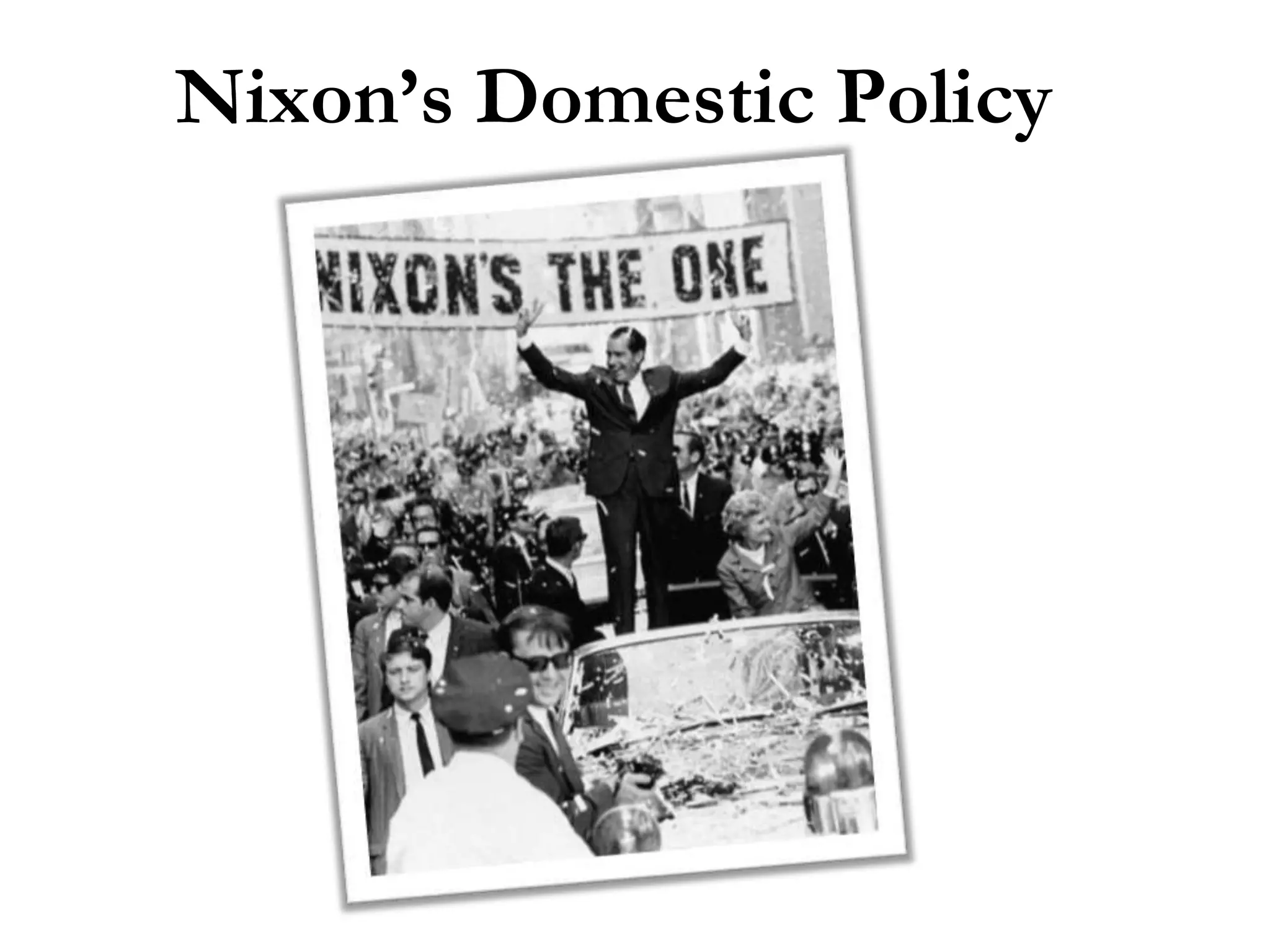
Nixon’s Domestic Policy
New Federalism
• Thought federal
government was too
large.
• Solution was called
the New Federalism.
• Key feature was
the concept of
revenue sharing.
• Believed that
local
governments
could spend
taxpayers money
more effectively.
Southern Strategy
• Nixon wanted to
expand his support in
the Democratic
south.
• Tried to weaken the
1965 Voting Rights
Act.
• Urged a slowdown in
forced integration.
• Opposed busing.
• Wanted local
governments to take
action themselves.
Nixon the Conservative
Drugs and Crime
• Opposed federal
court rulings that
put limits on the
power of the police.
• Sought to name
conservative judges
to federal courts.
• Filled four openings
on the Supreme
Court (2 of his
nominees were
rejected).
Nixon the Liberal
Environmentalism
• Environmental concerns had been
growing.
• Rachel Carson’s Silent Spring.
• Massive Earth Day demonstrations
in 1970.
• Signed the Clean Air Act
– Act sought to regulate levels of air
pollution created by factories and
other sources.
• Worked to establish the
Environmental Protection Agency.
Other Policies
• Signed the Occupational Safety
and Health Act.
– Act created the Occupational Health
and Safety Administration (OSHA) to
prevent work-related death and
injuries.
• Advanced affirmative action by
setting specific hiring goals and
timetables for overcoming
discrimination.
– Extended affirmative action programs
to the hiring of women.
Domestic Policies
• Great Society programs
expanded the welfare system
and provided services to
poor Americans
• proposed and supported civil
rights legislation
• increased government
spending on social programs
• believed that
some form of
government
assistance was
necessary to
combat poverty
• wanted to reform welfare
system by replacing the
government provision of
services with the Family
Assistance Plan
• no new civil rights
legislation
• pledged to cut back
Democratic programs
Kennedy’s and
Johnson’s Policies
Nixon’s Policies
Major Social and Cultural Events
during the Nixon Years
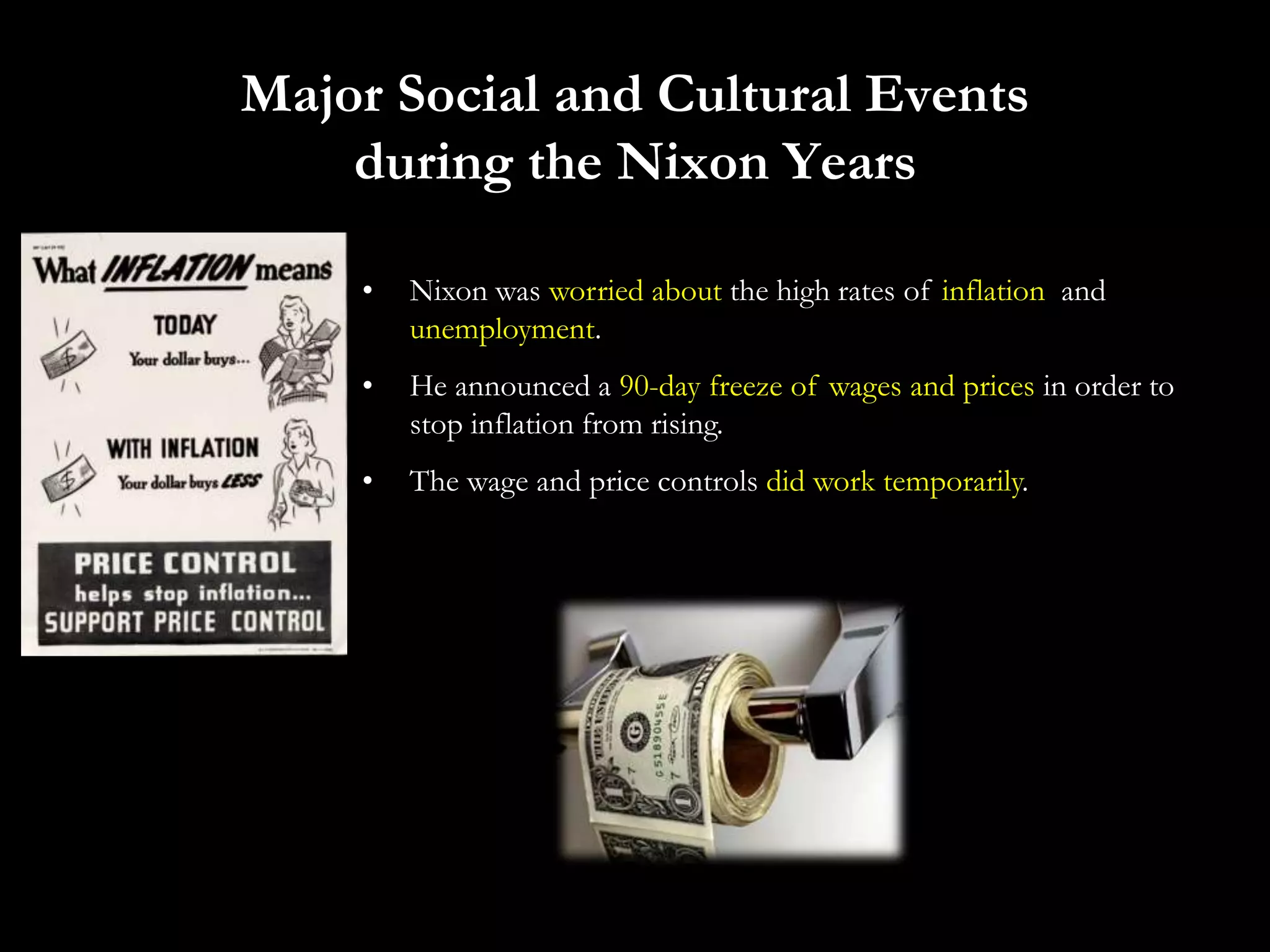
• Nixon was worried about the high rates of inflation and
unemployment.
• He announced a 90-day freeze of wages and prices in order to
stop inflation from rising.
• The wage and price controls did work temporarily.
Major Social and Cultural Events
during the Nixon Years
• On July 16, 1969 the Apollo 11 successfully lifted off from the
Kennedy Space Center.
• Three astronauts were on board—Neil Armstrong, Edwin
“Buzz” Aldrin, and Michael Collins.
• On July 20 Neil Armstrong was the first man to walk on the
moon.
Nixon’s Foreign Policy
• Nixon had great success with his foreign policy
issues.
• Henry Kissinger was Nixon’s national security
advisor and later secretary of state.
• Kissinger shaped much of Nixon’s foreign
policy.
Henry Kissinger
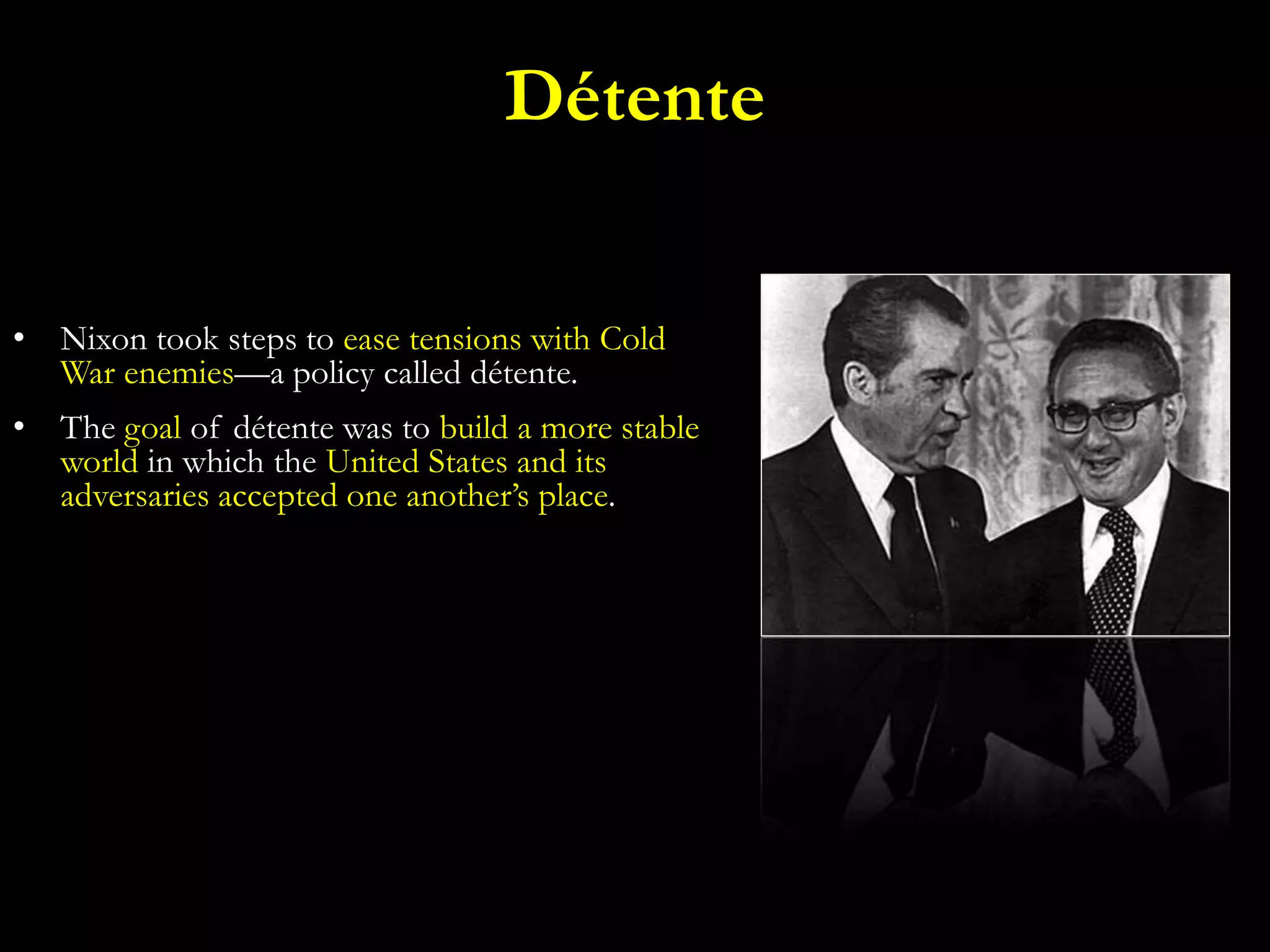
• Nixon took steps to ease tensions with Cold
War enemies—a policy called détente.
• The goal of détente was to build a more stable
world in which the United States and its
adversaries accepted one another’s place.
Détente
Realpolitik
Kissinger believed the United States
should consider each foreign-policy
conflict or question from the standpoint
of what is best for America.
The government should not be bound by promises to fight communism
or promote freedom wherever it is threatened.
Kissinger’s realpolitik marked a significant change from earlier policies such
as containment.
Kissinger believed in the notion of
realpolitik—or basing foreign policies on
realistic views of national interest rather
than on broad rules or principles.
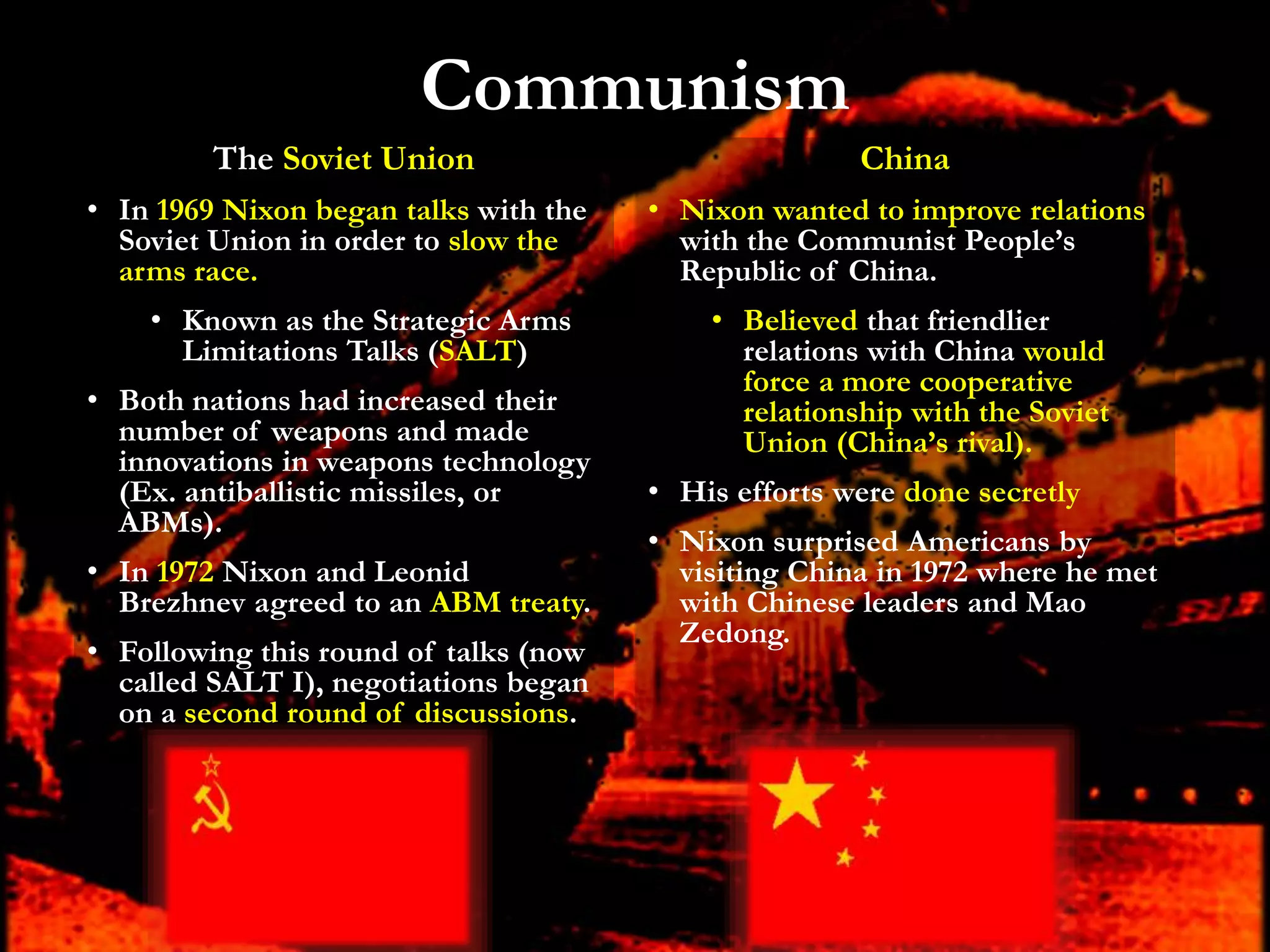
The Soviet Union
• In 1969 Nixon began talks with the
Soviet Union in order to slow the
arms race.
• Known as the Strategic Arms
Limitations Talks (SALT)
• Both nations had increased their
number of weapons and made
innovations in weapons technology
(Ex. antiballistic missiles, or
ABMs).
• In 1972 Nixon and Leonid
Brezhnev agreed to an ABM treaty.
• Following this round of talks (now
called SALT I), negotiations began
on a second round of discussions.
China
• Nixon wanted to improve relations
with the Communist People’s
Republic of China.
• Believed that friendlier
relations with China would
force a more cooperative
relationship with the Soviet
Union (China’s rival).
• His efforts were done secretly
• Nixon surprised Americans by
visiting China in 1972 where he met
with Chinese leaders and Mao
Zedong.
Communism
• 1967 Six-Day War
– resulted in Israel occupying territory that had belonged to the nations of Egypt,
Syria, and Jordan
– The United Nations passed a resolution that called for Israel to withdraw from
these lands and for the Arab states to recognize Israel’s right to exist
• 1973 Yom Kippur War
– Egypt and Syria attacked Israel, and the fighting affected the United States.
• Threat of Soviet involvement could turn conflict into a superpower
confrontation
• Imposition of an oil embargo
Trouble in the Middle East
Oil Embargo
• Several Arab nations imposed an oil
embargo in reaction to the Yom
Kippur War.
• They agreed not to ship oil to the
United States and certain other
countries who supported Israel.
• The Arab countries were a part of
OPEC (the Organization of
Petroleum Exporting Countries).
• The United States was dependent on
foreign sources for 33% of its oil
needs. We now import 58% of our oil.
• The embargo caused serious problems
throughout the U.S. economy.
Shuttle Diplomacy
• Henry Kissinger tried to solve the
crisis in the Middle East.
• He was unable to get all the parties to
meet together to talk about solutions.
• Started what came to be called shuttle
diplomacy
• Kissinger traveled—shuttled—from
group to group trying to work out
separate agreements.
• Eventually the fighting ended and the
oil embargo was lifted.
Trouble in the Middle East

President Richard Nixon

  • 1.
  • 2.
    New Federalism • Thoughtfederal government was too large. • Solution was called the New Federalism. • Key feature was the concept of revenue sharing. • Believed that local governments could spend taxpayers money more effectively. Southern Strategy • Nixon wanted to expand his support in the Democratic south. • Tried to weaken the 1965 Voting Rights Act. • Urged a slowdown in forced integration. • Opposed busing. • Wanted local governments to take action themselves. Nixon the Conservative Drugs and Crime • Opposed federal court rulings that put limits on the power of the police. • Sought to name conservative judges to federal courts. • Filled four openings on the Supreme Court (2 of his nominees were rejected).
  • 3.
    Nixon the Liberal Environmentalism •Environmental concerns had been growing. • Rachel Carson’s Silent Spring. • Massive Earth Day demonstrations in 1970. • Signed the Clean Air Act – Act sought to regulate levels of air pollution created by factories and other sources. • Worked to establish the Environmental Protection Agency. Other Policies • Signed the Occupational Safety and Health Act. – Act created the Occupational Health and Safety Administration (OSHA) to prevent work-related death and injuries. • Advanced affirmative action by setting specific hiring goals and timetables for overcoming discrimination. – Extended affirmative action programs to the hiring of women.
  • 4.
    Domestic Policies • GreatSociety programs expanded the welfare system and provided services to poor Americans • proposed and supported civil rights legislation • increased government spending on social programs • believed that some form of government assistance was necessary to combat poverty • wanted to reform welfare system by replacing the government provision of services with the Family Assistance Plan • no new civil rights legislation • pledged to cut back Democratic programs Kennedy’s and Johnson’s Policies Nixon’s Policies
  • 5.
    Major Social andCultural Events during the Nixon Years • Nixon was worried about the high rates of inflation and unemployment. • He announced a 90-day freeze of wages and prices in order to stop inflation from rising. • The wage and price controls did work temporarily.
  • 6.
    Major Social andCultural Events during the Nixon Years • On July 16, 1969 the Apollo 11 successfully lifted off from the Kennedy Space Center. • Three astronauts were on board—Neil Armstrong, Edwin “Buzz” Aldrin, and Michael Collins. • On July 20 Neil Armstrong was the first man to walk on the moon.
  • 7.
  • 8.
    • Nixon hadgreat success with his foreign policy issues. • Henry Kissinger was Nixon’s national security advisor and later secretary of state. • Kissinger shaped much of Nixon’s foreign policy. Henry Kissinger
  • 9.
    • Nixon tooksteps to ease tensions with Cold War enemies—a policy called détente. • The goal of détente was to build a more stable world in which the United States and its adversaries accepted one another’s place. Détente
  • 10.
    Realpolitik Kissinger believed theUnited States should consider each foreign-policy conflict or question from the standpoint of what is best for America. The government should not be bound by promises to fight communism or promote freedom wherever it is threatened. Kissinger’s realpolitik marked a significant change from earlier policies such as containment. Kissinger believed in the notion of realpolitik—or basing foreign policies on realistic views of national interest rather than on broad rules or principles.
  • 11.
    The Soviet Union •In 1969 Nixon began talks with the Soviet Union in order to slow the arms race. • Known as the Strategic Arms Limitations Talks (SALT) • Both nations had increased their number of weapons and made innovations in weapons technology (Ex. antiballistic missiles, or ABMs). • In 1972 Nixon and Leonid Brezhnev agreed to an ABM treaty. • Following this round of talks (now called SALT I), negotiations began on a second round of discussions. China • Nixon wanted to improve relations with the Communist People’s Republic of China. • Believed that friendlier relations with China would force a more cooperative relationship with the Soviet Union (China’s rival). • His efforts were done secretly • Nixon surprised Americans by visiting China in 1972 where he met with Chinese leaders and Mao Zedong. Communism
  • 12.
    • 1967 Six-DayWar – resulted in Israel occupying territory that had belonged to the nations of Egypt, Syria, and Jordan – The United Nations passed a resolution that called for Israel to withdraw from these lands and for the Arab states to recognize Israel’s right to exist • 1973 Yom Kippur War – Egypt and Syria attacked Israel, and the fighting affected the United States. • Threat of Soviet involvement could turn conflict into a superpower confrontation • Imposition of an oil embargo Trouble in the Middle East
  • 13.
    Oil Embargo • SeveralArab nations imposed an oil embargo in reaction to the Yom Kippur War. • They agreed not to ship oil to the United States and certain other countries who supported Israel. • The Arab countries were a part of OPEC (the Organization of Petroleum Exporting Countries). • The United States was dependent on foreign sources for 33% of its oil needs. We now import 58% of our oil. • The embargo caused serious problems throughout the U.S. economy. Shuttle Diplomacy • Henry Kissinger tried to solve the crisis in the Middle East. • He was unable to get all the parties to meet together to talk about solutions. • Started what came to be called shuttle diplomacy • Kissinger traveled—shuttled—from group to group trying to work out separate agreements. • Eventually the fighting ended and the oil embargo was lifted. Trouble in the Middle East