Pleural Physiology
Tim S. Trinidad, MD
St. Luke’s Medical Center
Disclosure
o Current Advisory Board member & Lecturer
o Boehringer Ingelheim
o Pascual Pharmaceuticals
o Lecturer
o OEP
o Novartis
o Astra-zeneca
o UAP
Road Map
• Role of pleura in
breathing
• Normal Pleural fluid
turnover
• Pathophysiology of
Pleural Effusion
Road Map
• Role of pleura in
breathing
• Normal Pleural fluid
turnover
• Pathophysiology of
Pleural Effusion
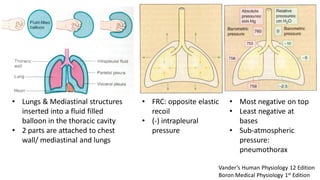
• Lungs & Mediastinal structures
inserted into a fluid filled
balloon in the thoracic cavity
• 2 parts are attached to chest
wall/ mediastinal and lungs
• FRC: opposite elastic
recoil
• (-) intrapleural
pressure
• Most negative on top
• Least negative at
bases
• Sub-atmospheric
pressure:
pneumothorax
Vander’s Human Physiology 12 Edition
Boron Medical Physiology 1st Edition
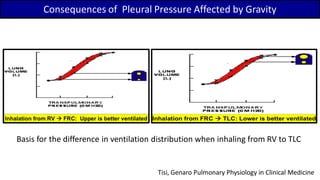
Consequences of Pleural Pressure Affected by Gravity
Upper (more distended) > Lower
Affected by Gravity
Consequences of Pleural Pressure Affected by Gravity
Basis for the difference in ventilation distribution when inhaling from RV to TLC
Tisi, Genaro Pulmonary Physiology in Clinical Medicine
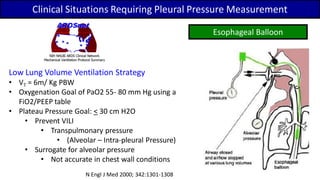
Low Lung Volume Ventilation Strategy
• VT = 6m/ Kg PBW
• Oxygenation Goal of PaO2 55- 80 mm Hg using a
FiO2/PEEP table
• Plateau Pressure Goal: < 30 cm H2O
• Prevent VILI
• Transpulmonary pressure
• (Alveolar – Intra-pleural Pressure)
• Surrogate for alveolar pressure
• Not accurate in chest wall conditions
Esophageal Balloon
Clinical Situations Requiring Pleural Pressure Measurement
N Engl J Med 2000; 342:1301-1308
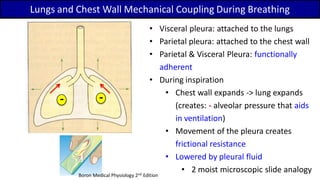
• Visceral pleura: attached to the lungs
• Parietal pleura: attached to the chest wall
• Parietal & Visceral Pleura: functionally
adherent
• During inspiration
• Chest wall expands -> lung expands
(creates: - alveolar pressure that aids
in ventilation)
• Movement of the pleura creates
frictional resistance
• Lowered by pleural fluid
• 2 moist microscopic slide analogy
- -
Lungs and Chest Wall Mechanical Coupling During Breathing
Boron Medical Physiology 2nd Edition
Road Map
• Role of pleura in
breathing
• Normal Pleural fluid
turnover
• Pathophysiology of
Pleural Effusion
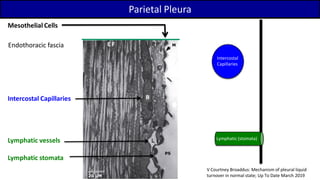
Endothoracic fascia
Intercostal Capillaries
Lymphatic vessels
Lymphatic stomata
Mesothelial Cells
Intercostal
Capillaries
Lymphatic (stomata)
Parietal Pleura
V Courtney Broaddus: Mechanism of pleural liquid
turnover in normal state; Up To Date March 2019
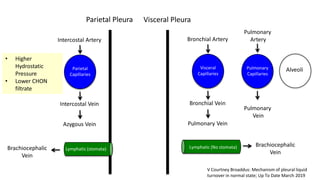
Parietal
Capillaries
Lymphatic (stomata)Brachiocephalic
Vein
Intercostal Artery
Intercostal Vein
Azygous Vein
Parietal Pleura
Visceral
Capillaries
Brachiocephalic
Vein
Bronchial Artery
Bronchial Vein
Pulmonary Vein
Visceral Pleura
Lymphatic (No stomata)
Pulmonary
Capillaries
Pulmonary
Artery
Pulmonary
Vein
Alveoli
• Higher
Hydrostatic
Pressure
• Lower CHON
filtrate
V Courtney Broaddus: Mechanism of pleural liquid
turnover in normal state; Up To Date March 2019
Parietal
Capillaries
Lymphatic (stomata)
Parietal
Visceral
Capillaries
Visceral
Lymphatic (No stomata)
Pulmonary
Capillaries
Alveoli
Interstitial
Compartment
Interstitial
Compartment
Net filtration pressure = k x [ (PCAP – PIC) – s (PCAP – PIC) ]
• K: Liquid conductance
• PCAP: capillary hydrostatic pressure
• PIC: Interstitial Compartment hydrostatic pressure
• S: reflection coefficient
• 0: Completely permeable to protein
• 1: Non- permeable to protein
• PCAP: capillary oncotic pressure
• PIC: Interstitial Compartment oncotic pressure(+) : favors fluid moving out of the capillaries
V Courtney Broaddus: Mechanism of pleural liquid
turnover in normal state; Up To Date March 2019
Parietal Visceral
K (Liquid conductance) Same
PCAP Higher Lower
PIC Same
S (Reflection Coefficient) Same
PCAP Same
PIC Same
Net filtration pressure
(cm H2O)
14 9
Net filtration pressure = k x [ (PCAP – PIC) – s (PCAP – PIC) ]
Parietal
Capillaries
Lymphatic (stomata)
Parietal
Visceral
Capillaries
Visceral
Lymphatic (No stomata)
V Courtney Broaddus: Mechanism of pleural liquid
turnover in normal state; Up To Date March 2019
Parietal
Capillaries
Lymphatic (stomata)
Parietal
Visceral
Capillaries
Visceral
Lymphatic (No stomata)
Parietal: more important
• Vessels are nearer
• Has stomata
• V Courtney Broaddus: Mechanism of pleural liquid
turnover in normal state; Up To Date March 2019
• Misserochi, G. Topics In Thoracic Surgery: Feb 2012.
Parietal
Capillaries
Lymphatic (stomata)
Parietal
Visceral
Capillaries
Visceral
Lymphatic (No stomata)
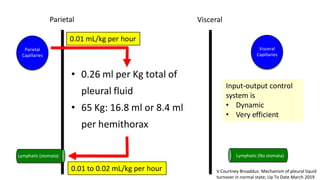
0.01 mL/kg per hour
0.01 to 0.02 mL/kg per hour
• 0.26 ml per Kg total of
pleural fluid
• 65 Kg: 16.8 ml or 8.4 ml
per hemithorax
Input-output control
system is
• Dynamic
• Very efficient
V Courtney Broaddus: Mechanism of pleural liquid
turnover in normal state; Up To Date March 2019
Road Map
• Role of pleura in
breathing
• Normal Pleural fluid
turnover
• Pathophysiology of
Pleural Effusion
Pathophysiology of Pleural Effusion
• Increased fluid formation alone
– Uncommon: large lymphatic
reserve (28X)
• Decreased lymphatic drainage alone
– Uncommon: slow fluid formation
(500 in 30 days)
• Combination of conditions
– Usually
Parietal
Capillaries
Lymphatic (stomata)
Visceral
Capillaries
Lymphatic (No stomata)
Pulmonary
Capillaries Alveoli
V Courtney Broaddus: Mechanism of pleural liquid
accumulation in disease; Up To Date March 2019
Parietal
Capillaries
Lymphatic (stomata)
Visceral
Capillaries
Lymphatic (No stomata)
Pulmonary
Capillaries Alveoli
Net filtration pressure = k x [ (PCAP – PIC) – s (PCAP – PIC) ]
Pathophysiology of Pleural Effusion: Increased Fluid Formation
Parietal
Capillaries
Lymphatic (stomata)
Visceral
Capillaries
Lymphatic (No stomata)
Pulmonary
Capillaries Alveoli
Net filtration pressure = k x [ (PCAP – PIC) – s (PCAP – PIC) ] Increased Liquid Conductance
• Induced substances released during
• Malignancy
• Infection
• Inflammation
• Fluid: Exudative Type (usually
concomitant with decreased in
reflection coefficient)
V Courtney Broaddus: Mechanism of pleural liquid
accumulation in disease; Up To Date March 2019
Net filtration pressure = k x [ (PCAP - PIC) – s (πCAP – πIC) ]
Pathophysiology of Pleural Effusion: Increased Fluid Formation
Parietal
Capillaries
Lymphatic (stomata)
Visceral
Capillaries
Lymphatic (No stomata)
Pulmonary
Capillaries Alveoli
Net filtration pressure = k x [ (PCAP – PIC) – s (PCAP – PIC) ]
Increased Capillary Hydrostatic Pressure
• High systemic venous pressure
• High pulmonary venous pressure
• Fluid: Transudative Type
V Courtney Broaddus: Mechanism of pleural liquid
accumulation in disease; Up To Date March 2019
Net filtration pressure = k x [ (PCAP - PIC) – s (πCAP – πIC) ]
Pathophysiology of Pleural Effusion: Increased Fluid Formation
Decreased Interstitial Compartment
Hydrostatic Pressure (more negative)
• Atelectasis
• Fluid: Transudative Type
V Courtney Broaddus: Mechanism of pleural liquid
accumulation in disease; Up To Date March 2019
Pathophysiology of Pleural Effusion: Increased Fluid Formation
Decreased Reflection Coefficient
• Secondary to substances released
during
• Malignancy
• Infection
• Inflammation
• Fluid: Exudative Type
V Courtney Broaddus: Mechanism of pleural liquid
turnover in normal state; Up To Date March 2019
Pathophysiology of Pleural Effusion: Increased Fluid Formation
Decreased Capillary Oncotic Pressure
• Low albumin
• Cirrhosis
• CHON losing nephropathy
• Malnutrition
• Fluid: Transudative Type
V Courtney Broaddus: Mechanism of pleural liquid
accumulation in disease; Up To Date March 2019
Pathophysiology of Pleural Effusion: Increased Fluid Formation
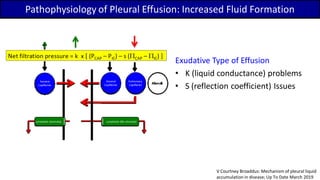
Exudative Type of Effusion
• K (liquid conductance) problems
• S (reflection coefficient) Issues
V Courtney Broaddus: Mechanism of pleural liquid
accumulation in disease; Up To Date March 2019
Intrinsic Factors: Inhibition of lymphatic smooth
muscle contraction
• Products of inflammation
• Endocrine abnormalities (hypothyroidism)
• Radiation or drugs (chemotherapeutic agents)
• Cancer cell infiltration
Extrinsic Factors: Lymphatics are normal
• Limitation of respiratory movements
(diaphragm paralysis)
• Mechanical compression (pleural fibrosis)
• Blockade of stomata (pleural malignancy)
• Decrease intrapleural pressure (atelectasis)
• Increased systemic venous pressure
Parietal
Capillaries
Lymphatic (stomata)
Visceral
Capillaries
Lymphatic (No stomata)
Pulmonary
Capillaries Alveoli
Net filtration pressure = k x [ (PCAP – PIC) – s (PCAP – PIC) ]
Pathophysiology of Pleural Effusion: Decreased Drainage
V Courtney Broaddus: Mechanism of pleural liquid
accumulation in disease; Up To Date March 2019
Net filtration pressure = k x [ (PCAP - PIC) – s (πCAP – πIC) ]
Intrinsic Factors: Inhibition of lymphatic smooth
muscle contraction
• Products of inflammation
• Endocrine abnormalities (hypothyroidism)
• Radiation or drugs (chemotherapeutic agents)
• Cancer cell infiltration
Extrinsic Factors: Lymphatics are normal
• Limitation of respiratory movements
(diaphragm paralysis)
• Mechanical compression (pleural fibrosis)
• Blockade of stomata (pleural malignancy)
• Decrease intrapleural pressure (atelectasis)
• Increased systemic venous pressure
Parietal
Capillaries
Lymphatic (stomata)
Visceral
Capillaries
Lymphatic (No stomata)
Pulmonary
Capillaries Alveoli
Net filtration pressure = k x [ (PCAP – PIC) – s (PCAP – PIC) ]
Pathophysiology of Pleural Effusion: Malignancy
V Courtney Broaddus: Mechanism of pleural liquid
accumulation in disease; Up To Date March 2019
Net filtration pressure = k x [ (PCAP - PIC) – s (πCAP – πIC) ]
Intrinsic Factors: Inhibition of lymphatic smooth
muscle contraction
• Products of inflammation
• Endocrine abnormalities (hypothyroidism)
• Radiation or drugs (chemotherapeutic agents)
• Cancer cell infiltration
Extrinsic Factors: Lymphatics are normal
• Limitation of respiratory movements
(diaphragm paralysis)
• Mechanical compression (pleural fibrosis)
• Blockade of stomata (pleural malignancy)
• Decrease intrapleural pressure (atelectasis)
• Increased systemic venous pressure
Parietal
Capillaries
Lymphatic (stomata)
Visceral
Capillaries
Lymphatic (No stomata)
Pulmonary
Capillaries Alveoli
Net filtration pressure = k x [ (PCAP – PIC) – s (PCAP – PIC) ]
Pathophysiology of Pleural Effusion: Pulmonary Embolism
Majority of pleural effusion 2nd to
PE are exudative.
V Courtney Broaddus: Mechanism of pleural liquid
accumulation in disease; Up To Date March 2019
Net filtration pressure = k x [ (PCAP - PIC) – s (πCAP – πIC) ]
Intrinsic Factors: Inhibition of lymphatic smooth
muscle contraction
• Products of inflammation
• Endocrine abnormalities (hypothyroidism)
• Radiation or drugs (chemotherapeutic agents)
• Cancer cell infiltration
Extrinsic Factors: Lymphatics are normal
• Limitation of respiratory movements
(diaphragm paralysis)
• Mechanical compression (pleural fibrosis)
• Blockade of stomata (pleural malignancy)
• Decrease intrapleural pressure (atelectasis)
• Increased systemic venous pressure
Parietal
Capillaries
Lymphatic (stomata)
Visceral
Capillaries
Lymphatic (No stomata)
Pulmonary
Capillaries Alveoli
Net filtration pressure = k x [ (PCAP – PIC) – s (PCAP – PIC) ]
Pathophysiology of Pleural Effusion: Left Heart Failure
V Courtney Broaddus: Mechanism of pleural liquid
accumulation in disease; Up To Date March 2019
Net filtration pressure = k x [ (PCAP - PIC) – s (πCAP – πIC) ]
Parietal
Capillaries
Lymphatic (stomata)
Visceral
Capillaries
Lymphatic (No stomata)
Pulmonary
Capillaries Alveoli
Net filtration pressure = k x [ (PCAP – PIC) – s (PCAP – PIC) ]
Pathophysiology of Pleural Effusion: Left Heart Failure
Interlobular  peri-bronchovascular  sub-pleural interstitium Pleural cavity
V Courtney Broaddus: Mechanism of pleural liquid
accumulation in disease; Up To Date March 2019
Net filtration pressure = k x [ (PCAP - PIC) – s (πCAP – πIC) ]
Take Home Messages
• The pleura provides the mechanical coupling of the
respiratory system during breathing.
• The parietal is the more important structure in fluid
turnover.
• Normally there is a balance between fluid formation
and drainage.
• Pleural effusion results from an imbalance which is
usually to combination of altered Starling’s forces and
lymphatic function.
01 pleural physiology referenced

01 pleural physiology referenced

  • 1.
    Pleural Physiology Tim S.Trinidad, MD St. Luke’s Medical Center
  • 2.
    Disclosure o Current AdvisoryBoard member & Lecturer o Boehringer Ingelheim o Pascual Pharmaceuticals o Lecturer o OEP o Novartis o Astra-zeneca o UAP
  • 3.
    Road Map • Roleof pleura in breathing • Normal Pleural fluid turnover • Pathophysiology of Pleural Effusion
  • 4.
    Road Map • Roleof pleura in breathing • Normal Pleural fluid turnover • Pathophysiology of Pleural Effusion
  • 5.
    • Lungs &Mediastinal structures inserted into a fluid filled balloon in the thoracic cavity • 2 parts are attached to chest wall/ mediastinal and lungs • FRC: opposite elastic recoil • (-) intrapleural pressure • Most negative on top • Least negative at bases • Sub-atmospheric pressure: pneumothorax Vander’s Human Physiology 12 Edition Boron Medical Physiology 1st Edition
  • 6.
    Consequences of PleuralPressure Affected by Gravity Upper (more distended) > Lower Affected by Gravity
  • 7.
    Consequences of PleuralPressure Affected by Gravity Basis for the difference in ventilation distribution when inhaling from RV to TLC Tisi, Genaro Pulmonary Physiology in Clinical Medicine
  • 8.
    Low Lung VolumeVentilation Strategy • VT = 6m/ Kg PBW • Oxygenation Goal of PaO2 55- 80 mm Hg using a FiO2/PEEP table • Plateau Pressure Goal: < 30 cm H2O • Prevent VILI • Transpulmonary pressure • (Alveolar – Intra-pleural Pressure) • Surrogate for alveolar pressure • Not accurate in chest wall conditions Esophageal Balloon Clinical Situations Requiring Pleural Pressure Measurement N Engl J Med 2000; 342:1301-1308
  • 9.
    • Visceral pleura:attached to the lungs • Parietal pleura: attached to the chest wall • Parietal & Visceral Pleura: functionally adherent • During inspiration • Chest wall expands -> lung expands (creates: - alveolar pressure that aids in ventilation) • Movement of the pleura creates frictional resistance • Lowered by pleural fluid • 2 moist microscopic slide analogy - - Lungs and Chest Wall Mechanical Coupling During Breathing Boron Medical Physiology 2nd Edition
  • 10.
    Road Map • Roleof pleura in breathing • Normal Pleural fluid turnover • Pathophysiology of Pleural Effusion
  • 11.
    Endothoracic fascia Intercostal Capillaries Lymphaticvessels Lymphatic stomata Mesothelial Cells Intercostal Capillaries Lymphatic (stomata) Parietal Pleura V Courtney Broaddus: Mechanism of pleural liquid turnover in normal state; Up To Date March 2019
  • 12.
    Parietal Capillaries Lymphatic (stomata)Brachiocephalic Vein Intercostal Artery IntercostalVein Azygous Vein Parietal Pleura Visceral Capillaries Brachiocephalic Vein Bronchial Artery Bronchial Vein Pulmonary Vein Visceral Pleura Lymphatic (No stomata) Pulmonary Capillaries Pulmonary Artery Pulmonary Vein Alveoli • Higher Hydrostatic Pressure • Lower CHON filtrate V Courtney Broaddus: Mechanism of pleural liquid turnover in normal state; Up To Date March 2019
  • 13.
    Parietal Capillaries Lymphatic (stomata) Parietal Visceral Capillaries Visceral Lymphatic (Nostomata) Pulmonary Capillaries Alveoli Interstitial Compartment Interstitial Compartment Net filtration pressure = k x [ (PCAP – PIC) – s (PCAP – PIC) ] • K: Liquid conductance • PCAP: capillary hydrostatic pressure • PIC: Interstitial Compartment hydrostatic pressure • S: reflection coefficient • 0: Completely permeable to protein • 1: Non- permeable to protein • PCAP: capillary oncotic pressure • PIC: Interstitial Compartment oncotic pressure(+) : favors fluid moving out of the capillaries V Courtney Broaddus: Mechanism of pleural liquid turnover in normal state; Up To Date March 2019
  • 14.
    Parietal Visceral K (Liquidconductance) Same PCAP Higher Lower PIC Same S (Reflection Coefficient) Same PCAP Same PIC Same Net filtration pressure (cm H2O) 14 9 Net filtration pressure = k x [ (PCAP – PIC) – s (PCAP – PIC) ] Parietal Capillaries Lymphatic (stomata) Parietal Visceral Capillaries Visceral Lymphatic (No stomata) V Courtney Broaddus: Mechanism of pleural liquid turnover in normal state; Up To Date March 2019
  • 15.
    Parietal Capillaries Lymphatic (stomata) Parietal Visceral Capillaries Visceral Lymphatic (Nostomata) Parietal: more important • Vessels are nearer • Has stomata • V Courtney Broaddus: Mechanism of pleural liquid turnover in normal state; Up To Date March 2019 • Misserochi, G. Topics In Thoracic Surgery: Feb 2012.
  • 16.
    Parietal Capillaries Lymphatic (stomata) Parietal Visceral Capillaries Visceral Lymphatic (Nostomata) 0.01 mL/kg per hour 0.01 to 0.02 mL/kg per hour • 0.26 ml per Kg total of pleural fluid • 65 Kg: 16.8 ml or 8.4 ml per hemithorax Input-output control system is • Dynamic • Very efficient V Courtney Broaddus: Mechanism of pleural liquid turnover in normal state; Up To Date March 2019
  • 17.
    Road Map • Roleof pleura in breathing • Normal Pleural fluid turnover • Pathophysiology of Pleural Effusion
  • 18.
    Pathophysiology of PleuralEffusion • Increased fluid formation alone – Uncommon: large lymphatic reserve (28X) • Decreased lymphatic drainage alone – Uncommon: slow fluid formation (500 in 30 days) • Combination of conditions – Usually Parietal Capillaries Lymphatic (stomata) Visceral Capillaries Lymphatic (No stomata) Pulmonary Capillaries Alveoli V Courtney Broaddus: Mechanism of pleural liquid accumulation in disease; Up To Date March 2019
  • 19.
    Parietal Capillaries Lymphatic (stomata) Visceral Capillaries Lymphatic (Nostomata) Pulmonary Capillaries Alveoli Net filtration pressure = k x [ (PCAP – PIC) – s (PCAP – PIC) ] Pathophysiology of Pleural Effusion: Increased Fluid Formation
  • 20.
    Pathophysiology of PleuralEffusion: Increased Fluid Formation Parietal Capillaries Lymphatic (stomata) Visceral Capillaries Lymphatic (No stomata) Pulmonary Capillaries Alveoli Net filtration pressure = k x [ (PCAP – PIC) – s (PCAP – PIC) ] Increased Liquid Conductance • Induced substances released during • Malignancy • Infection • Inflammation • Fluid: Exudative Type (usually concomitant with decreased in reflection coefficient) V Courtney Broaddus: Mechanism of pleural liquid accumulation in disease; Up To Date March 2019 Net filtration pressure = k x [ (PCAP - PIC) – s (πCAP – πIC) ]
  • 21.
    Pathophysiology of PleuralEffusion: Increased Fluid Formation Parietal Capillaries Lymphatic (stomata) Visceral Capillaries Lymphatic (No stomata) Pulmonary Capillaries Alveoli Net filtration pressure = k x [ (PCAP – PIC) – s (PCAP – PIC) ] Increased Capillary Hydrostatic Pressure • High systemic venous pressure • High pulmonary venous pressure • Fluid: Transudative Type V Courtney Broaddus: Mechanism of pleural liquid accumulation in disease; Up To Date March 2019 Net filtration pressure = k x [ (PCAP - PIC) – s (πCAP – πIC) ]
  • 22.
    Pathophysiology of PleuralEffusion: Increased Fluid Formation Decreased Interstitial Compartment Hydrostatic Pressure (more negative) • Atelectasis • Fluid: Transudative Type V Courtney Broaddus: Mechanism of pleural liquid accumulation in disease; Up To Date March 2019
  • 23.
    Pathophysiology of PleuralEffusion: Increased Fluid Formation Decreased Reflection Coefficient • Secondary to substances released during • Malignancy • Infection • Inflammation • Fluid: Exudative Type V Courtney Broaddus: Mechanism of pleural liquid turnover in normal state; Up To Date March 2019
  • 24.
    Pathophysiology of PleuralEffusion: Increased Fluid Formation Decreased Capillary Oncotic Pressure • Low albumin • Cirrhosis • CHON losing nephropathy • Malnutrition • Fluid: Transudative Type V Courtney Broaddus: Mechanism of pleural liquid accumulation in disease; Up To Date March 2019
  • 25.
    Pathophysiology of PleuralEffusion: Increased Fluid Formation Exudative Type of Effusion • K (liquid conductance) problems • S (reflection coefficient) Issues V Courtney Broaddus: Mechanism of pleural liquid accumulation in disease; Up To Date March 2019
  • 26.
    Intrinsic Factors: Inhibitionof lymphatic smooth muscle contraction • Products of inflammation • Endocrine abnormalities (hypothyroidism) • Radiation or drugs (chemotherapeutic agents) • Cancer cell infiltration Extrinsic Factors: Lymphatics are normal • Limitation of respiratory movements (diaphragm paralysis) • Mechanical compression (pleural fibrosis) • Blockade of stomata (pleural malignancy) • Decrease intrapleural pressure (atelectasis) • Increased systemic venous pressure Parietal Capillaries Lymphatic (stomata) Visceral Capillaries Lymphatic (No stomata) Pulmonary Capillaries Alveoli Net filtration pressure = k x [ (PCAP – PIC) – s (PCAP – PIC) ] Pathophysiology of Pleural Effusion: Decreased Drainage V Courtney Broaddus: Mechanism of pleural liquid accumulation in disease; Up To Date March 2019 Net filtration pressure = k x [ (PCAP - PIC) – s (πCAP – πIC) ]
  • 27.
    Intrinsic Factors: Inhibitionof lymphatic smooth muscle contraction • Products of inflammation • Endocrine abnormalities (hypothyroidism) • Radiation or drugs (chemotherapeutic agents) • Cancer cell infiltration Extrinsic Factors: Lymphatics are normal • Limitation of respiratory movements (diaphragm paralysis) • Mechanical compression (pleural fibrosis) • Blockade of stomata (pleural malignancy) • Decrease intrapleural pressure (atelectasis) • Increased systemic venous pressure Parietal Capillaries Lymphatic (stomata) Visceral Capillaries Lymphatic (No stomata) Pulmonary Capillaries Alveoli Net filtration pressure = k x [ (PCAP – PIC) – s (PCAP – PIC) ] Pathophysiology of Pleural Effusion: Malignancy V Courtney Broaddus: Mechanism of pleural liquid accumulation in disease; Up To Date March 2019 Net filtration pressure = k x [ (PCAP - PIC) – s (πCAP – πIC) ]
  • 28.
    Intrinsic Factors: Inhibitionof lymphatic smooth muscle contraction • Products of inflammation • Endocrine abnormalities (hypothyroidism) • Radiation or drugs (chemotherapeutic agents) • Cancer cell infiltration Extrinsic Factors: Lymphatics are normal • Limitation of respiratory movements (diaphragm paralysis) • Mechanical compression (pleural fibrosis) • Blockade of stomata (pleural malignancy) • Decrease intrapleural pressure (atelectasis) • Increased systemic venous pressure Parietal Capillaries Lymphatic (stomata) Visceral Capillaries Lymphatic (No stomata) Pulmonary Capillaries Alveoli Net filtration pressure = k x [ (PCAP – PIC) – s (PCAP – PIC) ] Pathophysiology of Pleural Effusion: Pulmonary Embolism Majority of pleural effusion 2nd to PE are exudative. V Courtney Broaddus: Mechanism of pleural liquid accumulation in disease; Up To Date March 2019 Net filtration pressure = k x [ (PCAP - PIC) – s (πCAP – πIC) ]
  • 29.
    Intrinsic Factors: Inhibitionof lymphatic smooth muscle contraction • Products of inflammation • Endocrine abnormalities (hypothyroidism) • Radiation or drugs (chemotherapeutic agents) • Cancer cell infiltration Extrinsic Factors: Lymphatics are normal • Limitation of respiratory movements (diaphragm paralysis) • Mechanical compression (pleural fibrosis) • Blockade of stomata (pleural malignancy) • Decrease intrapleural pressure (atelectasis) • Increased systemic venous pressure Parietal Capillaries Lymphatic (stomata) Visceral Capillaries Lymphatic (No stomata) Pulmonary Capillaries Alveoli Net filtration pressure = k x [ (PCAP – PIC) – s (PCAP – PIC) ] Pathophysiology of Pleural Effusion: Left Heart Failure V Courtney Broaddus: Mechanism of pleural liquid accumulation in disease; Up To Date March 2019 Net filtration pressure = k x [ (PCAP - PIC) – s (πCAP – πIC) ]
  • 30.
    Parietal Capillaries Lymphatic (stomata) Visceral Capillaries Lymphatic (Nostomata) Pulmonary Capillaries Alveoli Net filtration pressure = k x [ (PCAP – PIC) – s (PCAP – PIC) ] Pathophysiology of Pleural Effusion: Left Heart Failure Interlobular  peri-bronchovascular  sub-pleural interstitium Pleural cavity V Courtney Broaddus: Mechanism of pleural liquid accumulation in disease; Up To Date March 2019 Net filtration pressure = k x [ (PCAP - PIC) – s (πCAP – πIC) ]
  • 31.
    Take Home Messages •The pleura provides the mechanical coupling of the respiratory system during breathing. • The parietal is the more important structure in fluid turnover. • Normally there is a balance between fluid formation and drainage. • Pleural effusion results from an imbalance which is usually to combination of altered Starling’s forces and lymphatic function.