Introduction to Course & Course Outline
WIRELESS COMMUNICATIONS
First Semester, Final Year
14TL Batch
Course layout
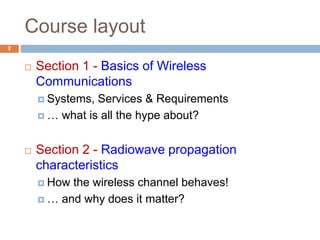
 Section 1 - Basics of Wireless
Communications
 Systems, Services & Requirements
 … what is all the hype about?
 Section 2 - Radiowave propagation
characteristics
 How the wireless channel behaves!
 … and why does it matter?
2
Course layout
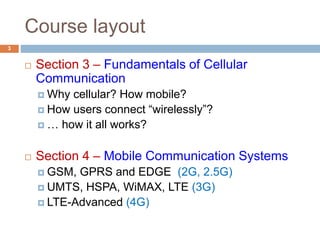
 Section 3 – Fundamentals of Cellular
Communication
 Why cellular? How mobile?
 How users connect “wirelessly”?
 … how it all works?
 Section 4 – Mobile Communication Systems
 GSM, GPRS and EDGE (2G, 2.5G)
 UMTS, HSPA, WiMAX, LTE (3G)
 LTE-Advanced (4G)
3
Course layout
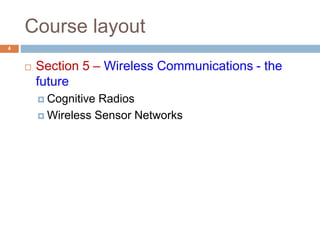
 Section 5 – Wireless Communications - the
future
 Cognitive Radios
 Wireless Sensor Networks
4
Reading material
 Text book
 “Wireless Communication: Principles and Practice” by
T. S. Rappaport, Prentice Hall, 2nd Ed. 2003.
 Research papers
 Lectures notes and tutorials
5
Why, this subject…?
6
 Wireless Communications is a fundamental
course of Telecommunications
 Defines modern telecommunications!
 A good number of jobs in Pakistan and
worldwide are related to WComs
 Your FYP will most probably be related to
WComs, directly or in directly…
 MARKs – final year contributes 40% to your
BE. academic grade…
Introduction to Wireless
Systems
7
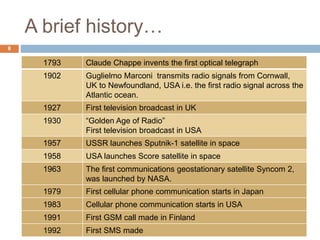
A brief history…
8
1793 Claude Chappe invents the first optical telegraph
1902 Guglielmo Marconi transmits radio signals from Cornwall,
UK to Newfoundland, USA i.e. the first radio signal across the
Atlantic ocean.
1927 First television broadcast in UK
1930 “Golden Age of Radio”
First television broadcast in USA
1957 USSR launches Sputnik-1 satellite in space
1958 USA launches Score satellite in space
1963 The first communications geostationary satellite Syncom 2,
was launched by NASA.
1979 First cellular phone communication starts in Japan
1983 Cellular phone communication starts in USA
1991 First GSM call made in Finland
1992 First SMS made
Why wireless?
9
 We want “mobile” communication system!
 Wireline communication can be a hassle
 Wireline communication isn’t always the best
option!
 Doesn’t make sense to provide each and every
person with a wireline connection
 Would you lay down a core network for just 5 users?
… and why not?
10
 Wireless channel is unpredictable!
 Can have obstructions, severe attenuation for the
signal…
 Designing Wireless Communication system is
not an easy task
 Limited frequency spectrum!
But we still want to use it!
Wireless Communications
11
 Advantages
 Mobility
 A wireless communication network is a solution in
areas where cables are impossible to install (e.g.
hazardous areas, long distances etc.)
 Easier to maintain
 Disadvantages
 Has security vulnerabilities
 High costs for setting the infrastructure
 Unlike wired comm., wireless comm. is influenced by
physical obstructions, climatic conditions, interference
from other wireless devices
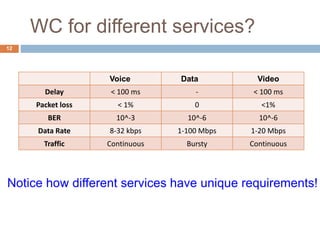
WC for different services?
12
Voice Data Video
Delay < 100 ms - < 100 ms
Packet loss < 1% 0 <1%
BER 10^-3 10^-6 10^-6
Data Rate 8-32 kbps 1-100 Mbps 1-20 Mbps
Traffic Continuous Bursty Continuous
Notice how different services have unique requirements!
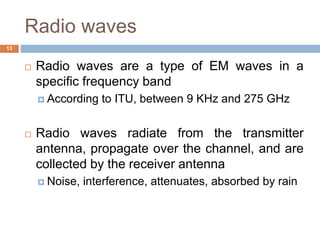
Radio waves
13
 Radio waves are a type of EM waves in a
specific frequency band
 According to ITU, between 9 KHz and 275 GHz
 Radio waves radiate from the transmitter
antenna, propagate over the channel, and are
collected by the receiver antenna
 Noise, interference, attenuates, absorbed by rain
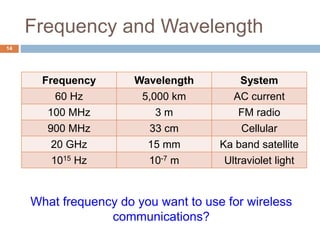
Frequency and Wavelength
14
Frequency Wavelength System
60 Hz 5,000 km AC current
100 MHz 3 m FM radio
900 MHz 33 cm Cellular
20 GHz 15 mm Ka band satellite
1015 Hz 10-7 m Ultraviolet light
What frequency do you want to use for wireless
communications?
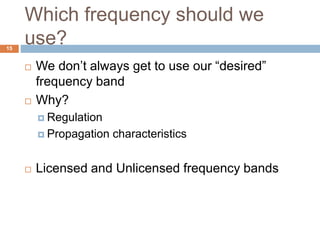
Which frequency should we
use?
15
 We don’t always get to use our “desired”
frequency band
 Why?
 Regulation
 Propagation characteristics
 Licensed and Unlicensed frequency bands
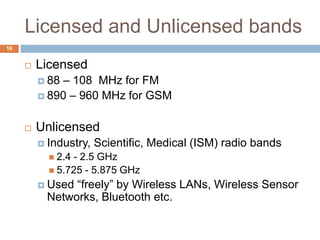
Licensed and Unlicensed bands
16
 Licensed
 88 – 108 MHz for FM
 890 – 960 MHz for GSM
 Unlicensed
 Industry, Scientific, Medical (ISM) radio bands
 2.4 - 2.5 GHz
 5.725 - 5.875 GHz
 Used “freely” by Wireless LANs, Wireless Sensor
Networks, Bluetooth etc.
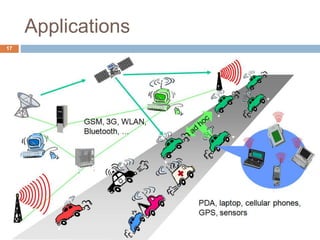
Applications
17
Outlook for Wireless Comms
18
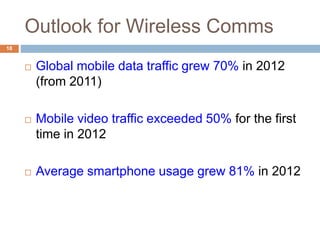
 Global mobile data traffic grew 70% in 2012
(from 2011)
 Mobile video traffic exceeded 50% for the first
time in 2012
 Average smartphone usage grew 81% in 2012
Outlook for Wireless Comms
19
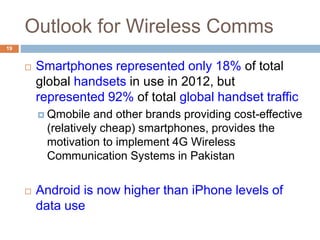
 Smartphones represented only 18% of total
global handsets in use in 2012, but
represented 92% of total global handset traffic
 Qmobile and other brands providing cost-effective
(relatively cheap) smartphones, provides the
motivation to implement 4G Wireless
Communication Systems in Pakistan
 Android is now higher than iPhone levels of
data use
Outlook for Wireless Comms
20
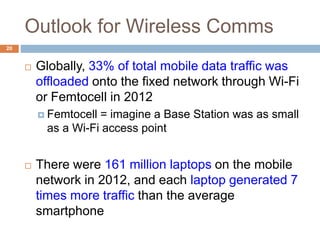
 Globally, 33% of total mobile data traffic was
offloaded onto the fixed network through Wi-Fi
or Femtocell in 2012
 Femtocell = imagine a Base Station was as small
as a Wi-Fi access point
 There were 161 million laptops on the mobile
network in 2012, and each laptop generated 7
times more traffic than the average
smartphone
Outlook for Wireless Comms
21
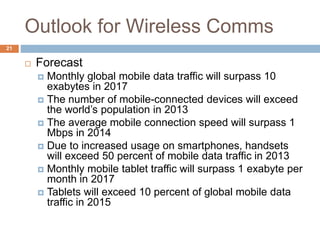
 Forecast
 Monthly global mobile data traffic will surpass 10
exabytes in 2017
 The number of mobile-connected devices will exceed
the world’s population in 2013
 The average mobile connection speed will surpass 1
Mbps in 2014
 Due to increased usage on smartphones, handsets
will exceed 50 percent of mobile data traffic in 2013
 Monthly mobile tablet traffic will surpass 1 exabyte per
month in 2017
 Tablets will exceed 10 percent of global mobile data
traffic in 2015
Independent Study
22
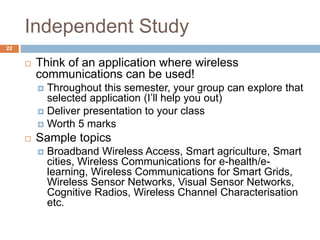
 Think of an application where wireless
communications can be used!
 Throughout this semester, your group can explore that
selected application (I’ll help you out)
 Deliver presentation to your class
 Worth 5 marks
 Sample topics
 Broadband Wireless Access, Smart agriculture, Smart
cities, Wireless Communications for e-health/e-
learning, Wireless Communications for Smart Grids,
Wireless Sensor Networks, Visual Sensor Networks,
Cognitive Radios, Wireless Channel Characterisation
etc.

Lecture 1 - Introduction to Course & Course outline.pptx

  • 1.
    Introduction to Course& Course Outline WIRELESS COMMUNICATIONS First Semester, Final Year 14TL Batch
  • 2.
    Course layout  Section1 - Basics of Wireless Communications  Systems, Services & Requirements  … what is all the hype about?  Section 2 - Radiowave propagation characteristics  How the wireless channel behaves!  … and why does it matter? 2
  • 3.
    Course layout  Section3 – Fundamentals of Cellular Communication  Why cellular? How mobile?  How users connect “wirelessly”?  … how it all works?  Section 4 – Mobile Communication Systems  GSM, GPRS and EDGE (2G, 2.5G)  UMTS, HSPA, WiMAX, LTE (3G)  LTE-Advanced (4G) 3
  • 4.
    Course layout  Section5 – Wireless Communications - the future  Cognitive Radios  Wireless Sensor Networks 4
  • 5.
    Reading material  Textbook  “Wireless Communication: Principles and Practice” by T. S. Rappaport, Prentice Hall, 2nd Ed. 2003.  Research papers  Lectures notes and tutorials 5
  • 6.
    Why, this subject…? 6 Wireless Communications is a fundamental course of Telecommunications  Defines modern telecommunications!  A good number of jobs in Pakistan and worldwide are related to WComs  Your FYP will most probably be related to WComs, directly or in directly…  MARKs – final year contributes 40% to your BE. academic grade…
  • 7.
  • 8.
    A brief history… 8 1793Claude Chappe invents the first optical telegraph 1902 Guglielmo Marconi transmits radio signals from Cornwall, UK to Newfoundland, USA i.e. the first radio signal across the Atlantic ocean. 1927 First television broadcast in UK 1930 “Golden Age of Radio” First television broadcast in USA 1957 USSR launches Sputnik-1 satellite in space 1958 USA launches Score satellite in space 1963 The first communications geostationary satellite Syncom 2, was launched by NASA. 1979 First cellular phone communication starts in Japan 1983 Cellular phone communication starts in USA 1991 First GSM call made in Finland 1992 First SMS made
  • 9.
    Why wireless? 9  Wewant “mobile” communication system!  Wireline communication can be a hassle  Wireline communication isn’t always the best option!  Doesn’t make sense to provide each and every person with a wireline connection  Would you lay down a core network for just 5 users?
  • 10.
    … and whynot? 10  Wireless channel is unpredictable!  Can have obstructions, severe attenuation for the signal…  Designing Wireless Communication system is not an easy task  Limited frequency spectrum! But we still want to use it!
  • 11.
    Wireless Communications 11  Advantages Mobility  A wireless communication network is a solution in areas where cables are impossible to install (e.g. hazardous areas, long distances etc.)  Easier to maintain  Disadvantages  Has security vulnerabilities  High costs for setting the infrastructure  Unlike wired comm., wireless comm. is influenced by physical obstructions, climatic conditions, interference from other wireless devices
  • 12.
    WC for differentservices? 12 Voice Data Video Delay < 100 ms - < 100 ms Packet loss < 1% 0 <1% BER 10^-3 10^-6 10^-6 Data Rate 8-32 kbps 1-100 Mbps 1-20 Mbps Traffic Continuous Bursty Continuous Notice how different services have unique requirements!
  • 13.
    Radio waves 13  Radiowaves are a type of EM waves in a specific frequency band  According to ITU, between 9 KHz and 275 GHz  Radio waves radiate from the transmitter antenna, propagate over the channel, and are collected by the receiver antenna  Noise, interference, attenuates, absorbed by rain
  • 14.
    Frequency and Wavelength 14 FrequencyWavelength System 60 Hz 5,000 km AC current 100 MHz 3 m FM radio 900 MHz 33 cm Cellular 20 GHz 15 mm Ka band satellite 1015 Hz 10-7 m Ultraviolet light What frequency do you want to use for wireless communications?
  • 15.
    Which frequency shouldwe use? 15  We don’t always get to use our “desired” frequency band  Why?  Regulation  Propagation characteristics  Licensed and Unlicensed frequency bands
  • 16.
    Licensed and Unlicensedbands 16  Licensed  88 – 108 MHz for FM  890 – 960 MHz for GSM  Unlicensed  Industry, Scientific, Medical (ISM) radio bands  2.4 - 2.5 GHz  5.725 - 5.875 GHz  Used “freely” by Wireless LANs, Wireless Sensor Networks, Bluetooth etc.
  • 17.
  • 18.
    Outlook for WirelessComms 18  Global mobile data traffic grew 70% in 2012 (from 2011)  Mobile video traffic exceeded 50% for the first time in 2012  Average smartphone usage grew 81% in 2012
  • 19.
    Outlook for WirelessComms 19  Smartphones represented only 18% of total global handsets in use in 2012, but represented 92% of total global handset traffic  Qmobile and other brands providing cost-effective (relatively cheap) smartphones, provides the motivation to implement 4G Wireless Communication Systems in Pakistan  Android is now higher than iPhone levels of data use
  • 20.
    Outlook for WirelessComms 20  Globally, 33% of total mobile data traffic was offloaded onto the fixed network through Wi-Fi or Femtocell in 2012  Femtocell = imagine a Base Station was as small as a Wi-Fi access point  There were 161 million laptops on the mobile network in 2012, and each laptop generated 7 times more traffic than the average smartphone
  • 21.
    Outlook for WirelessComms 21  Forecast  Monthly global mobile data traffic will surpass 10 exabytes in 2017  The number of mobile-connected devices will exceed the world’s population in 2013  The average mobile connection speed will surpass 1 Mbps in 2014  Due to increased usage on smartphones, handsets will exceed 50 percent of mobile data traffic in 2013  Monthly mobile tablet traffic will surpass 1 exabyte per month in 2017  Tablets will exceed 10 percent of global mobile data traffic in 2015
  • 22.
    Independent Study 22  Thinkof an application where wireless communications can be used!  Throughout this semester, your group can explore that selected application (I’ll help you out)  Deliver presentation to your class  Worth 5 marks  Sample topics  Broadband Wireless Access, Smart agriculture, Smart cities, Wireless Communications for e-health/e- learning, Wireless Communications for Smart Grids, Wireless Sensor Networks, Visual Sensor Networks, Cognitive Radios, Wireless Channel Characterisation etc.