
MODULE 5: LESSON 1
CURRICULUM EVALUATION
and the TEACHER
CHAPTER 4
EVALUATING A CURRICULUM
Presented by:
Mari Toni Gultiano-Destua
Module Overview
 Context and Definition
 Role of the teacher as an Evaluator
 Present ways of evaluating the curriculum
as: written, planned or implemented
 Reference to popular curriculum models
Take Note:
 It’s a component of curriculum development
 Look into educational reforms or innovations
 Establish the merit or worth of the curriculum
Module Overview
1. Do planned courses, programs, activities as written
and implemented produce desired outcomes?
2. How can these school curricula be improved?
Attempt to Answer the Questions:
Lesson 1: What, Why and How to Evaluate
a Curriculum?
Desired Learning Outcomes:
 Acquire clear understanding of what is curriculum
evaluation
 Explain the need to evaluate the curriculum
 How it is being done
 Expand knowledge about the different
curriculum evaluation models
Curriculum Evaluation:
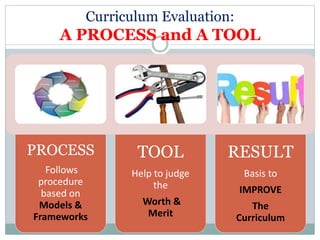
A PROCESS and A TOOL
PROCESS
Follows
procedure
based on
Models &
Frameworks
TOOL
Help to judge
the
Worth &
Merit
RESULT
Basis to
IMPROVE
The
Curriculum
Curriculum Evaluation:
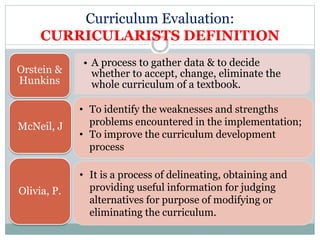
CURRICULARISTS DEFINITION
• A process to gather data & to decide
whether to accept, change, eliminate the
whole curriculum of a textbook.
Orstein &
Hunkins
McNeil, J
Olivia, P.
• To identify the weaknesses and strengths
problems encountered in the implementation;
• To improve the curriculum development
process
• It is a process of delineating, obtaining and
providing useful information for judging
alternatives for purpose of modifying or
eliminating the curriculum.
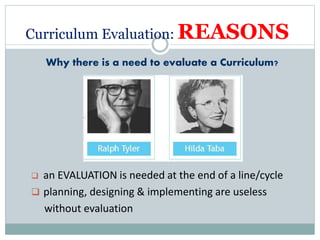
Curriculum Evaluation: REASONS
Why there is a need to evaluate a Curriculum?
 an EVALUATION is needed at the end of a line/cycle
 planning, designing & implementing are useless
without evaluation
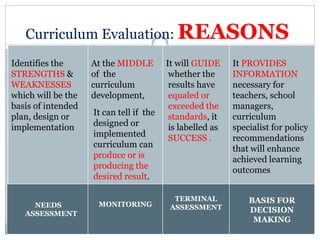
Curriculum Evaluation: REASONS
Identifies the
STRENGTHS &
WEAKNESSES
which will be the
basis of intended
plan, design or
implementation
At the MIDDLE
of the
curriculum
development,
It can tell if the
designed or
implemented
curriculum can
produce or is
producing the
desired result.
It will GUIDE
whether the
results have
equaled or
exceeded the
standards, it
is labelled as
SUCCESS .
It PROVIDES
INFORMATION
necessary for
teachers, school
managers,
curriculum
specialist for policy
recommendations
that will enhance
achieved learning
outcomes
NEEDS
ASSESSMENT
MONITORING
TERMINAL
ASSESSMENT
BASIS FOR
DECISION
MAKING
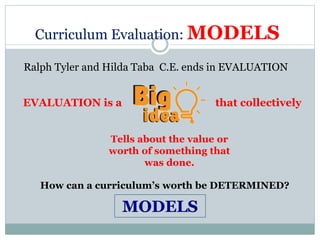
Curriculum Evaluation: MODELS
Ralph Tyler and Hilda Taba C.E. ends in EVALUATION
EVALUATION is a
Tells about the value or
worth of something that
was done.
that collectively
How can a curriculum’s worth be DETERMINED?
MODELS
EVALUATING A CURRICULUM

EVALUATING A CURRICULUM

  • 1.
    MODULE 5: LESSON1 CURRICULUM EVALUATION and the TEACHER CHAPTER 4 EVALUATING A CURRICULUM Presented by: Mari Toni Gultiano-Destua
  • 2.
    Module Overview  Contextand Definition  Role of the teacher as an Evaluator  Present ways of evaluating the curriculum as: written, planned or implemented  Reference to popular curriculum models Take Note:  It’s a component of curriculum development  Look into educational reforms or innovations  Establish the merit or worth of the curriculum
  • 3.
    Module Overview 1. Doplanned courses, programs, activities as written and implemented produce desired outcomes? 2. How can these school curricula be improved? Attempt to Answer the Questions:
  • 4.
    Lesson 1: What,Why and How to Evaluate a Curriculum? Desired Learning Outcomes:  Acquire clear understanding of what is curriculum evaluation  Explain the need to evaluate the curriculum  How it is being done  Expand knowledge about the different curriculum evaluation models
  • 5.
    Curriculum Evaluation: A PROCESSand A TOOL PROCESS Follows procedure based on Models & Frameworks TOOL Help to judge the Worth & Merit RESULT Basis to IMPROVE The Curriculum
  • 6.
    Curriculum Evaluation: CURRICULARISTS DEFINITION •A process to gather data & to decide whether to accept, change, eliminate the whole curriculum of a textbook. Orstein & Hunkins McNeil, J Olivia, P. • To identify the weaknesses and strengths problems encountered in the implementation; • To improve the curriculum development process • It is a process of delineating, obtaining and providing useful information for judging alternatives for purpose of modifying or eliminating the curriculum.
  • 7.
    Curriculum Evaluation: REASONS Whythere is a need to evaluate a Curriculum?  an EVALUATION is needed at the end of a line/cycle  planning, designing & implementing are useless without evaluation
  • 8.
    Curriculum Evaluation: REASONS Identifiesthe STRENGTHS & WEAKNESSES which will be the basis of intended plan, design or implementation At the MIDDLE of the curriculum development, It can tell if the designed or implemented curriculum can produce or is producing the desired result. It will GUIDE whether the results have equaled or exceeded the standards, it is labelled as SUCCESS . It PROVIDES INFORMATION necessary for teachers, school managers, curriculum specialist for policy recommendations that will enhance achieved learning outcomes NEEDS ASSESSMENT MONITORING TERMINAL ASSESSMENT BASIS FOR DECISION MAKING
  • 9.
    Curriculum Evaluation: MODELS RalphTyler and Hilda Taba C.E. ends in EVALUATION EVALUATION is a Tells about the value or worth of something that was done. that collectively How can a curriculum’s worth be DETERMINED? MODELS