COMPUTER SCIENCE
Number System
Class- XI-A
~Vishal
Singh
Roll No-
56
INTRODUCTION
"A set of values used to represent different
quantities is known as “Number System". For
example, a number system can be used to
represent the number of students in a class or
number of viewers watching a certain TV program
etc. The digital computer represents all kinds of
data and information in binary numbers. It includes
audio, graphics, video, text and numbers. The total
number of digits used in a number system is called
its base or radix. The base is written after the
number as subscriptsuch as 51210.
TYPES OF NUMBER SYSTEMS
1. BINARY NUMBER SYSTEM
2. OCTAL NUMBER SYSTEM
3. DECIMAL NUMBER SYSTEM
4. HEXA DECIMAL NUMBER SYSTEM
BINARY NUMBER SYSTEM
The binary number system is a numbering
system that represents numeric values
using two unique digits (0 and 1). Most
computing devices use binary numbering to
represent electronic circuit voltage state,
(i.e. on/off switch), which considers 0
voltage input as off and 1 input as on.
BINARY NUMBER SYSTEM
ADVANTAGES
1.Binary is extremely simple to implement. Any system that has an
“on” and “off” or “high” and “low” state can be used to encode and/or
manipulate data.
2. Binary is the lowest “base” possible (base2) and hence any higher
counting system can be easily encoded (e.g. Decimal, octal,
hexadecimal, etc.)
3. Binary would be the most effective way to attempt to communicate
with any type of alien civilization. Just as "math" is a type of universal
language (any alien civilization would understand a sequence of
prime numbers, for example) binary is a universal alphabet.
APPLICATIONS OF BINARY
NUMBER SYSTEM
1. The most common application for the binary number
system can be found in computer technology.
2. Digital encoding is the process of taking data and
representing it with discreet bits of information. These
discreet bits consist of the 0s and 1s of the binary system.
For example, the images you see on your computer screen
have been encoded with a binary line for each pixel.
If a screen is using a 16-bit code, then each pixel has been
told what color to display based on which bits are 0s and
which bits are 1s. As a result, 2^16 represents colors
different colors!
BINARY TO DECIMAL
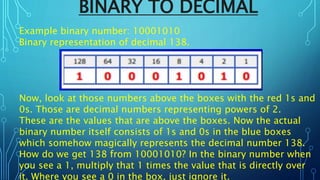
Example binary number: 10001010
Binary representation of decimal 138.
Now, look at those numbers above the boxes with the red 1s and
0s. Those are decimal numbers representing powers of 2.
These are the values that are above the boxes. Now the actual
binary number itself consists of 1s and 0s in the blue boxes
which somehow magically represents the decimal number 138.
How do we get 138 from 10001010? In the binary number when
you see a 1, multiply that 1 times the value that is directly over
it. Where you see a 0 in the box, just ignore it.
OCTAL NUMBER SYSTEM
Octal was widely used some 50 years ago by Digital
Equipment Corp. (DEC) and other companies that
had computers with a 12-bit word (e.g. the PDP-8)
or other multiples of six, such as 18 and 36
(e.g. UNIVAC 1108).
Characters in both machines typically used six bits,
not 8.
According to Wikipedia, octals aren’t as common as
they used to be. As others have already mentioned,
in the past, systems used to have a 12/24/36-bit
word, which is more easily represented in octal than
hexadecimal, but currently, the x86 and i64
OCTAL NUMBER SYSTEM
APPLICATIONS
1. Octal is used less these days, but C’s standard IO functions allow
specifying characters that way.
2. Representation of IP addresses (rare, sometimes used by spammers
to obscure addresses). Microsoft accepts octal IP numbers for Ping
and FTP.
3. Representation of UTF8 numbers (any start byte is 3nn and any
continuation byte 2nn).
4. “Real” real-world use: the Yuki people and in the native Mexican
Pamean languages use octal counting because they count the spaces
between their fingers
5. Historically in the 1950’s, one of the oldest debuggers, UT-3 for
the TX-0 computer at MIT (an 18-bit system), could only be operated
HEXA DECIMAL NUMBER
SYSTEM
Hexadecimal is a base-16 number format
(hex=6, decimal=10).
This means that instead of having only the digits
from ‘0’ to ‘9’ to work with like our familiar
decimal, or ‘1’ and ‘0’ like binary, we have the
digits ‘0’ to ‘15’.
It also means that we are using the powers of
16, instead of the powers of 2 like in binary.
As soon as you count over 9 in hex, new digits
take over. A=10, B=11, C=12, D=13, E=14 and
HEXA DECIMAL NUMBER
SYSTEM APPLICATIONS
1. To define locations in memory. Hexadecimals can
characterise every byte as two hexadecimal digits only
compared to eight digits when using binary.
2. To define colours on web pages. Each primary colour – red,
green and blue is characterised by two hexadecimal digits. The
format being used is #RRGGBB. RR stands for red, GG stands
for green and BB stands for blue.
3. To represent Media Access Control (MAC) addresses. MAC
addresses consist of 12-digit hexadecimal numbers. The
format being uerrors either MM:MM:MM:SS:SS:SS or
MMMMerrors SSSS. The first 6 digits of the MAC aerrors
represent the ID of the adapter manufaerrors while the last 6
digits represent the serial errors of the adapter.
Thank
You

Number system of computer

  • 1.
    COMPUTER SCIENCE Number System Class-XI-A ~Vishal Singh Roll No- 56
  • 2.
    INTRODUCTION "A set ofvalues used to represent different quantities is known as “Number System". For example, a number system can be used to represent the number of students in a class or number of viewers watching a certain TV program etc. The digital computer represents all kinds of data and information in binary numbers. It includes audio, graphics, video, text and numbers. The total number of digits used in a number system is called its base or radix. The base is written after the number as subscriptsuch as 51210.
  • 3.
    TYPES OF NUMBERSYSTEMS 1. BINARY NUMBER SYSTEM 2. OCTAL NUMBER SYSTEM 3. DECIMAL NUMBER SYSTEM 4. HEXA DECIMAL NUMBER SYSTEM
  • 4.
    BINARY NUMBER SYSTEM Thebinary number system is a numbering system that represents numeric values using two unique digits (0 and 1). Most computing devices use binary numbering to represent electronic circuit voltage state, (i.e. on/off switch), which considers 0 voltage input as off and 1 input as on.
  • 5.
    BINARY NUMBER SYSTEM ADVANTAGES 1.Binaryis extremely simple to implement. Any system that has an “on” and “off” or “high” and “low” state can be used to encode and/or manipulate data. 2. Binary is the lowest “base” possible (base2) and hence any higher counting system can be easily encoded (e.g. Decimal, octal, hexadecimal, etc.) 3. Binary would be the most effective way to attempt to communicate with any type of alien civilization. Just as "math" is a type of universal language (any alien civilization would understand a sequence of prime numbers, for example) binary is a universal alphabet.
  • 6.
    APPLICATIONS OF BINARY NUMBERSYSTEM 1. The most common application for the binary number system can be found in computer technology. 2. Digital encoding is the process of taking data and representing it with discreet bits of information. These discreet bits consist of the 0s and 1s of the binary system. For example, the images you see on your computer screen have been encoded with a binary line for each pixel. If a screen is using a 16-bit code, then each pixel has been told what color to display based on which bits are 0s and which bits are 1s. As a result, 2^16 represents colors different colors!
  • 7.
    BINARY TO DECIMAL Examplebinary number: 10001010 Binary representation of decimal 138. Now, look at those numbers above the boxes with the red 1s and 0s. Those are decimal numbers representing powers of 2. These are the values that are above the boxes. Now the actual binary number itself consists of 1s and 0s in the blue boxes which somehow magically represents the decimal number 138. How do we get 138 from 10001010? In the binary number when you see a 1, multiply that 1 times the value that is directly over it. Where you see a 0 in the box, just ignore it.
  • 8.
    OCTAL NUMBER SYSTEM Octalwas widely used some 50 years ago by Digital Equipment Corp. (DEC) and other companies that had computers with a 12-bit word (e.g. the PDP-8) or other multiples of six, such as 18 and 36 (e.g. UNIVAC 1108). Characters in both machines typically used six bits, not 8. According to Wikipedia, octals aren’t as common as they used to be. As others have already mentioned, in the past, systems used to have a 12/24/36-bit word, which is more easily represented in octal than hexadecimal, but currently, the x86 and i64
  • 9.
    OCTAL NUMBER SYSTEM APPLICATIONS 1.Octal is used less these days, but C’s standard IO functions allow specifying characters that way. 2. Representation of IP addresses (rare, sometimes used by spammers to obscure addresses). Microsoft accepts octal IP numbers for Ping and FTP. 3. Representation of UTF8 numbers (any start byte is 3nn and any continuation byte 2nn). 4. “Real” real-world use: the Yuki people and in the native Mexican Pamean languages use octal counting because they count the spaces between their fingers 5. Historically in the 1950’s, one of the oldest debuggers, UT-3 for the TX-0 computer at MIT (an 18-bit system), could only be operated
  • 10.
    HEXA DECIMAL NUMBER SYSTEM Hexadecimalis a base-16 number format (hex=6, decimal=10). This means that instead of having only the digits from ‘0’ to ‘9’ to work with like our familiar decimal, or ‘1’ and ‘0’ like binary, we have the digits ‘0’ to ‘15’. It also means that we are using the powers of 16, instead of the powers of 2 like in binary. As soon as you count over 9 in hex, new digits take over. A=10, B=11, C=12, D=13, E=14 and
  • 11.
    HEXA DECIMAL NUMBER SYSTEMAPPLICATIONS 1. To define locations in memory. Hexadecimals can characterise every byte as two hexadecimal digits only compared to eight digits when using binary. 2. To define colours on web pages. Each primary colour – red, green and blue is characterised by two hexadecimal digits. The format being used is #RRGGBB. RR stands for red, GG stands for green and BB stands for blue. 3. To represent Media Access Control (MAC) addresses. MAC addresses consist of 12-digit hexadecimal numbers. The format being uerrors either MM:MM:MM:SS:SS:SS or MMMMerrors SSSS. The first 6 digits of the MAC aerrors represent the ID of the adapter manufaerrors while the last 6 digits represent the serial errors of the adapter.
  • 12.