Languages in the Catalan Educational System


Subdirecció General de Llengua i Plurilingüisme
Ministry of Education of Catalonia
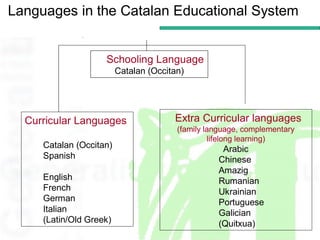
Languages in the Catalan Educational System


                    Schooling Language
                         Catalan (Occitan)


  Curricular Languages                 Extra Curricular languages
                                        (family language, complementary
                                                 lifelong learning)
     Catalan (Occitan)                             Arabic
     Spanish                                      Chinese
                                                  Amazig
     English                                      Rumanian
     French                                       Ukrainian
     German                                       Portuguese
     Italian                                      Galician
     (Latin/Old Greek)                            (Quitxua)
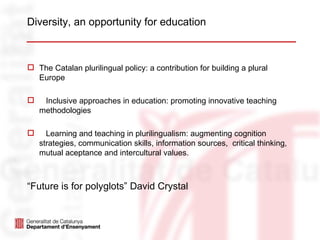
Diversity, an opportunity for education


 The Catalan plurilingual policy: a contribution for building a plural
  Europe

    Inclusive approaches in education: promoting innovative teaching
    methodologies

     Learning and teaching in plurilingualism: augmenting cognition
    strategies, communication skills, information sources, critical thinking,
    mutual aceptance and intercultural values.


“Future is for polyglots” David Crystal
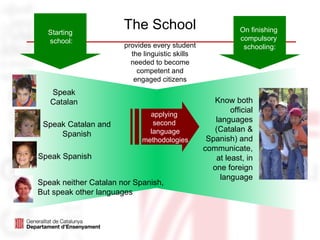
Starting
                       The School                           On finishing
  school:                                                   compulsory
                       provides every student                schooling:
                         the linguistic skills
                         needed to become
                           competent and
                          engaged citizens
   Speak
   Catalan                                          Know both
                                                         official
                              applying
                               second               languages
 Speak Catalan and
                              language              (Catalan &
     Spanish
                            methodologies         Spanish) and
                                                 communicate,
Speak Spanish                                       at least, in
                                                   one foreign
                                                      language
Speak neither Catalan nor Spanish,
But speak other languages
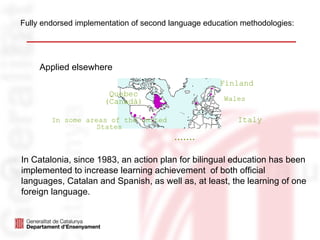
Fully endorsed implementation of second language education methodologies:


     Applied elsewhere
                                                     Finland
                       Quebec
                      (Canadà)                        Wales


        In some areas of the United                       Italy
                   States
                                         .......

In Catalonia, since 1983, an action plan for bilingual education has been
implemented to increase learning achievement of both official
languages, Catalan and Spanish, as well as, at least, the learning of one
foreign language.
Language education in schools...

 Catalan is taught following a holistic approach.


 Life at school is conducted in Catalan, is only learnt when used.


 Students are taught Catalan, Spanish and, at least, one foreign language.


 Value is given to all languages and cultures of the families, because roots
  are important and play a major role in enriching society and enhancing
  social cohesion.
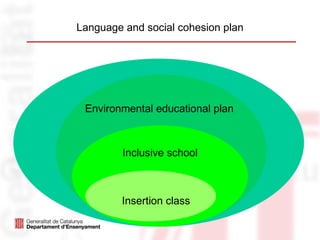
Language and social cohesion plan


 Environmental educational plan


         Inclusive school


        Insertion class
Context and justification

Government Plan 2011-2014
  reduction school drop outs by systematically
  promoting reading throughout the schooling years

National Reading Plan
 coordinates the efforts of different sectors and areas
 of Catalan society to improve reading habits:
 libraries, editors, etc.


                                                          9
Reading competence

An essential ability to be developed in the academic
and social learning fields and to encourage lifelong learning.
It is part of the linguistic competence and, therefore, linked to
other components of the communicative competence: mastery
of oral and written skills.
Giving priority to the reading ability as a strategy to improve
the linguistic and communicative competence for the
acquisition and understanding of other subjects of the school
system.


        Reading is the foundation of all learning


                                                                    10
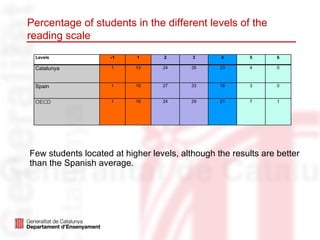
Percentage of students in the different levels of the
reading scale
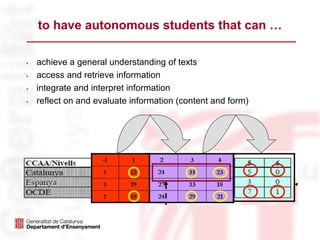
 Levels             <1     1      2       3      4       5      6

 Catalunya           1     13     24     35      23      4      0


 Spain               1     19     27     33      18      3      0


 OECD                1     18     24     29      21      7      1


Few students located at higher levels, although the results are better
than the Spanish average.
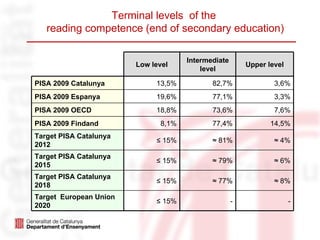
Terminal levels of the
   reading competence (end of secondary education)

                                     Intermediate
                        Low level                       Upper level
                                         level

PISA 2009 Catalunya          13,5%          82,7%               3,6%
PISA 2009 Espanya            19,6%          77,1%               3,3%
PISA 2009 OECD               18,8%          73,6%               7,6%
PISA 2009 Findand             8,1%          77,4%              14,5%
Target PISA Catalunya
                             ≤ 15%          ≈ 81%               ≈ 4%
2012
Target PISA Catalunya
                             ≤ 15%          ≈ 79%               ≈ 6%
2015
Target PISA Catalunya
                             ≤ 15%          ≈ 77%               ≈ 8%
2018
Target European Union
                             ≤ 15%                  -                 -
2020
Strategic Aim of the Education Departament


To     promote reading in all the  curriculum areas and
subjects as a learning tool and as systematic and cross
curricular strategy to improve school performance
and to promote the habit of reading and the reading for
pleasure.


                                                          13
PISA 2009: aspects that guide the evaluation of the RC


 . information retrieval
 . forming a general understanding
 . development of an interpretation
 . reflection and evaluation of the contents of
   a text
 . reflection and evaluation of the shape of a
   text
The three areas of the reading competence

 Learn to read
The learning of reading as the developing of the ability of reading,
  understanding and interpreting texts.

 Read to learn
The use of reading for learning by developing the ability to read as
  a tool to access information, to discover and expand knowledge.

 Enjoy reading
The reading habit fosters personal growth and lifelong learning


                                                                       15
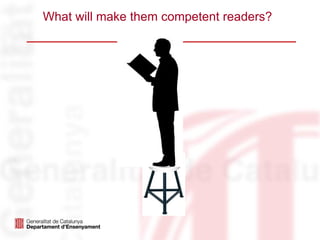
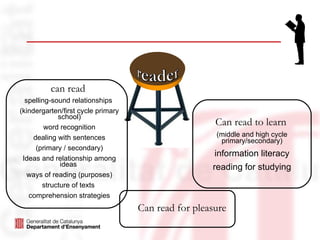
What will make them competent readers?
can read
  spelling-sound relationships
(kindergarten/first cycle primary
             school)
         word recognition
                                                      Can read to learn
     dealing with sentences                           (middle and high cycle
                                                       primary/secondary)
      (primary / secondary)
 Ideas and relationship among
                                                      information literacy
              ideas                                  reading for studying
   ways of reading (purposes)
        structure of texts
   comprehension strategies
                                    Can read for pleasure
Specifics Aims


Students
 Incorporate different types of evaluation, especially
  self-assessment as a learning strategy that allows
  students to regulate their learning process.
 Increase of the amount of time devoted to reading
  and the number of books read throughout the year.
 Incorporate reflection on what they have learned and
  how they have learned it, explaining the reading
  strategies used.
Working with a reading portfolio.
Specifics Aims


Teachers
 Plan didactic units, developing methodological
  strategies according to the evolution of the learning
  process of the students.
 Incorporate evaluation as a tool of the teaching /
  learning process.
 Formulate the objectives of the activities based on
  what students must prove they have learned.
Reading workshops. Mini lessons. Modeling.
Specific objectives

Schools
 Incorporate reading and reading comprehension
  strategies in all subjects / areas.
 Establish an adequate strategy in the schools
  according to the diagnosed needs after an internal
  and external evaluation.
 Incorporate elements to measure the academic
  progress of student performance in relation to the
  previous year.
Educational project. School reading plan. Data
Specifics Aims


Families
 Find a while every day (10 to 20 minutes) to read with
  their children or to read by their side to reinforce good
  reading habits and empower autonomous reading.
 Understand the methodology used at school to learn
  to read.
 Apply the guidelines of how they can contribute to
  enhance their children’s good reading habits.
Guidelines. Reading Portfolio
Intervention lines


 Promote an evaluative culture in the schools,
  defining follow up and evaluation indicators
  related to the results of the different curricular
  contents.

 Improve the professional skills of teachers
  and directors, through advising and training.


                                                       22
Main ideas


1. We learn to read by learning the strategies that need
   to be applied.
2. The student must be an active participant in the
   process.


       The reading strategies should be made
         explicit to the students so that they
            become autonomous readers
       and learn to apply them spontaneously.
Work phases at schools


1. Diagnosis: reflection on the results and the line of work
   used
2. Define objectives, content and assessment criteria in
   relation to the reading line of work and make suggestions
   for improvement that are coherent with the results.
3. Working on the theoretical framework of the 3 axes (learn
   to read, read to learn and reading for pleasure) and
   design the required training in the didactics of reading.
4. Revise the didactic material and the teaching strategies for
    the reading competence and model classroom activities.


                                                                  24
Planning: a school reading plan?


From the result of the diagnosis:
•   Set goals of improvement by cycles or levels
•   Initial learning of reading
•   Agreements in methodology and evaluation
•   Expand objectives, content and assessment criteria of the three
    axes
•   Families participation
•   Participation of the environing society (public libraries and
    associations)
•   Training
•   Evaluation, revision and proposals of improvement
to have autonomous students that can …

.   achieve a general understanding of texts
.   access and retrieve information
.   integrate and interpret information
.   reflect on and evaluate information (content and form)

000_Institutional program: Reading Plan

  • 1.
    Languages in theCatalan Educational System Subdirecció General de Llengua i Plurilingüisme Ministry of Education of Catalonia
  • 2.
    Languages in theCatalan Educational System Schooling Language Catalan (Occitan) Curricular Languages Extra Curricular languages (family language, complementary lifelong learning) Catalan (Occitan) Arabic Spanish Chinese Amazig English Rumanian French Ukrainian German Portuguese Italian Galician (Latin/Old Greek) (Quitxua)
  • 3.
    Diversity, an opportunityfor education  The Catalan plurilingual policy: a contribution for building a plural Europe  Inclusive approaches in education: promoting innovative teaching methodologies  Learning and teaching in plurilingualism: augmenting cognition strategies, communication skills, information sources, critical thinking, mutual aceptance and intercultural values. “Future is for polyglots” David Crystal
  • 4.
    Starting The School On finishing school: compulsory provides every student schooling: the linguistic skills needed to become competent and engaged citizens Speak Catalan Know both official applying second languages Speak Catalan and language (Catalan & Spanish methodologies Spanish) and communicate, Speak Spanish at least, in one foreign language Speak neither Catalan nor Spanish, But speak other languages
  • 5.
    Fully endorsed implementationof second language education methodologies: Applied elsewhere Finland Quebec (Canadà) Wales In some areas of the United Italy States ....... In Catalonia, since 1983, an action plan for bilingual education has been implemented to increase learning achievement of both official languages, Catalan and Spanish, as well as, at least, the learning of one foreign language.
  • 6.
    Language education inschools...  Catalan is taught following a holistic approach.  Life at school is conducted in Catalan, is only learnt when used.  Students are taught Catalan, Spanish and, at least, one foreign language.  Value is given to all languages and cultures of the families, because roots are important and play a major role in enriching society and enhancing social cohesion.
  • 7.
    Language and socialcohesion plan Environmental educational plan Inclusive school Insertion class
  • 9.
    Context and justification GovernmentPlan 2011-2014 reduction school drop outs by systematically promoting reading throughout the schooling years National Reading Plan coordinates the efforts of different sectors and areas of Catalan society to improve reading habits: libraries, editors, etc. 9
  • 10.
    Reading competence An essentialability to be developed in the academic and social learning fields and to encourage lifelong learning. It is part of the linguistic competence and, therefore, linked to other components of the communicative competence: mastery of oral and written skills. Giving priority to the reading ability as a strategy to improve the linguistic and communicative competence for the acquisition and understanding of other subjects of the school system. Reading is the foundation of all learning 10
  • 11.
    Percentage of studentsin the different levels of the reading scale Levels <1 1 2 3 4 5 6 Catalunya 1 13 24 35 23 4 0 Spain 1 19 27 33 18 3 0 OECD 1 18 24 29 21 7 1 Few students located at higher levels, although the results are better than the Spanish average.
  • 12.
    Terminal levels ofthe reading competence (end of secondary education) Intermediate Low level Upper level level PISA 2009 Catalunya 13,5% 82,7% 3,6% PISA 2009 Espanya 19,6% 77,1% 3,3% PISA 2009 OECD 18,8% 73,6% 7,6% PISA 2009 Findand 8,1% 77,4% 14,5% Target PISA Catalunya ≤ 15% ≈ 81% ≈ 4% 2012 Target PISA Catalunya ≤ 15% ≈ 79% ≈ 6% 2015 Target PISA Catalunya ≤ 15% ≈ 77% ≈ 8% 2018 Target European Union ≤ 15% - - 2020
  • 13.
    Strategic Aim ofthe Education Departament To promote reading in all the curriculum areas and subjects as a learning tool and as systematic and cross curricular strategy to improve school performance and to promote the habit of reading and the reading for pleasure. 13
  • 14.
    PISA 2009: aspectsthat guide the evaluation of the RC . information retrieval . forming a general understanding . development of an interpretation . reflection and evaluation of the contents of a text . reflection and evaluation of the shape of a text
  • 15.
    The three areasof the reading competence  Learn to read The learning of reading as the developing of the ability of reading, understanding and interpreting texts.  Read to learn The use of reading for learning by developing the ability to read as a tool to access information, to discover and expand knowledge.  Enjoy reading The reading habit fosters personal growth and lifelong learning 15
  • 16.
    What will makethem competent readers?
  • 17.
    can read spelling-sound relationships (kindergarten/first cycle primary school) word recognition Can read to learn dealing with sentences (middle and high cycle primary/secondary) (primary / secondary) Ideas and relationship among information literacy ideas reading for studying ways of reading (purposes) structure of texts comprehension strategies Can read for pleasure
  • 18.
    Specifics Aims Students  Incorporatedifferent types of evaluation, especially self-assessment as a learning strategy that allows students to regulate their learning process.  Increase of the amount of time devoted to reading and the number of books read throughout the year.  Incorporate reflection on what they have learned and how they have learned it, explaining the reading strategies used. Working with a reading portfolio.
  • 19.
    Specifics Aims Teachers  Plandidactic units, developing methodological strategies according to the evolution of the learning process of the students.  Incorporate evaluation as a tool of the teaching / learning process.  Formulate the objectives of the activities based on what students must prove they have learned. Reading workshops. Mini lessons. Modeling.
  • 20.
    Specific objectives Schools  Incorporatereading and reading comprehension strategies in all subjects / areas.  Establish an adequate strategy in the schools according to the diagnosed needs after an internal and external evaluation.  Incorporate elements to measure the academic progress of student performance in relation to the previous year. Educational project. School reading plan. Data
  • 21.
    Specifics Aims Families  Finda while every day (10 to 20 minutes) to read with their children or to read by their side to reinforce good reading habits and empower autonomous reading.  Understand the methodology used at school to learn to read.  Apply the guidelines of how they can contribute to enhance their children’s good reading habits. Guidelines. Reading Portfolio
  • 22.
    Intervention lines  Promotean evaluative culture in the schools, defining follow up and evaluation indicators related to the results of the different curricular contents.  Improve the professional skills of teachers and directors, through advising and training. 22
  • 23.
    Main ideas 1. Welearn to read by learning the strategies that need to be applied. 2. The student must be an active participant in the process. The reading strategies should be made explicit to the students so that they become autonomous readers and learn to apply them spontaneously.
  • 24.
    Work phases atschools 1. Diagnosis: reflection on the results and the line of work used 2. Define objectives, content and assessment criteria in relation to the reading line of work and make suggestions for improvement that are coherent with the results. 3. Working on the theoretical framework of the 3 axes (learn to read, read to learn and reading for pleasure) and design the required training in the didactics of reading. 4. Revise the didactic material and the teaching strategies for the reading competence and model classroom activities. 24
  • 25.
    Planning: a schoolreading plan? From the result of the diagnosis: • Set goals of improvement by cycles or levels • Initial learning of reading • Agreements in methodology and evaluation • Expand objectives, content and assessment criteria of the three axes • Families participation • Participation of the environing society (public libraries and associations) • Training • Evaluation, revision and proposals of improvement
  • 26.
    to have autonomousstudents that can … . achieve a general understanding of texts . access and retrieve information . integrate and interpret information . reflect on and evaluate information (content and form)

Editor's Notes

  • #2 Neus Lorenzo &lt;nlorenzo@xtec.cat &gt;
  • #5 Children arrive in school knowing their family language (whatever that is). Some of them are monolingual. Other pupils are bilingual in catalan and spanish or, in some cases, in other languages. For instance, students born in Pakistan: they usually speak urdu, but they often also know panjabi, patani, even english... The Linguistic Policy Act no. 1/1998 , orders that the catalan education system must assure the right to know both official languages. So, the role of the school is: providing every student the linguistic skills to reach the competence in our two official languages, regardless of their family language, ON FINISHING COMPULSORY SCHOOLING, at 16 (Competence means be able to use correctly and fluently catalan and spanish). In addition to catalan and spanish, students at 16 also must be able to communicate, at least, in one foreign language. In fact, knowing both official languages guarantees equal rights to the citizens in our country. So, teaching in catalan, is not only a way of teaching and learning: we are also talking about equity and social cohesion.
  • #6 In Catalonia, since 1983, an action plan for bilingual education has been implemented to increase learning achievement of both official languages, Catalan and Spanish, as well as, at least, the learning of one foreign language. That methodology has been widely essayed in different countries. The map only shows a few samples: Canada (French in Quebec), USA (English in areas with strong immigration from Spanish speaking origin), Finland (Finnish in areas with Swedish speaking minorities; Vaasa is a university of reference in this field), Wales (Welsch, United Kingdom), Italy ( Fri ulian or Romansch in Friule). But also: German : South Tirol ( in Italy ), Als ace ( in France ). • Irish Gaèlic : in Ir e land. • Bret on : western Br ittany ( in France ). • Bas que : Basque Country, Navarra ( in Spain ) and North of Euskadi ( in France ). • Catal an : in Catalonia, Valencia (Valencian strand schools), Balearic Islands (b asically in State schools), Catalan speaking area in the South of France ( La Bressola, Arrels and bilingual strands in some state schools) , in the infant school La Costura in the Alg hero ( isle of Sardinia, in Italy ) • Occit an : in Occit any ( France ), Vall d’Aran ( Spain ).
  • #7 As we have said, catalan is the language of education in Catalonia. Not only because it is Catalonia’s own language, but also because in contexts in which catalan is not the family language, nor even the language usually spoken in the area, it’s the only way to guarantee that all students will be able to learn and use both official languages correctly. Our students not only learn catalan: Spanish is also taught, and we have seen that students reach the same levels as in the rest of Spain, together with at least one foreign language (usually that language is English, but it depends on each school linguistic project). The linguistic educational target is that Catalan citizens become proficient in at least 3 languages, if not four. Finally, our system doesn’t forget to give importance to family languages that immigrant pupils bring along, considered an heritage, one more richness in today’s catalan society.
  • #8 Immersion methodology fits in the language, interculturality and social cohesion plan (LIC), that considers three educational levels, that work togheter for social cohesion and language learning: The classroom, the natural space for insertion of the children The school, conceived as an inclusive and cosy space The environtment: neighbourhood, civil society, town, ... Each one of three levels contributing to the education from different angles