KEMENTERIAN PELAJARAN MALAYSIA


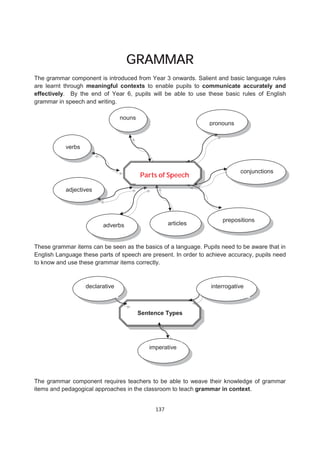
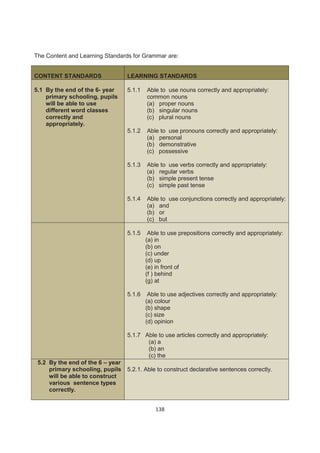
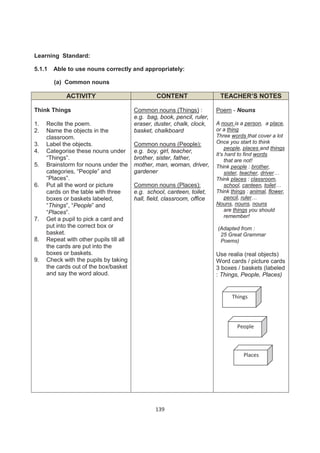
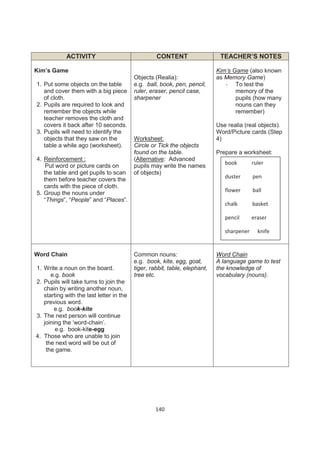
Kurikulum Standard Sekolah Rendah


   TEACHER'S GUIDE
      SK & SJK

 ENGLISH LANGUAGE
       YEAR 3


                   Terbitan


        Bahagian Pembangunan Kurikulum


                   2012
Cetakan Pertama 2012
Š Kementerian Pelajaran Malaysia

Hak Cipta Terpelihara. Tidak dibenarkan mengeluar ulang mana-mana bahagian
artikel, ilustrasi dan isi kandungan buku ini dalam apa-apa juga bentuk dan dengan
cara apa-apa jua sama ada secara elektronik, fotokopi, mekanik, rakaman atau cara
lain sebelum mendapat kebenaran bertulis daripada Pengarah, Bahagian
Pembangunan Kurikulum, Kementerian Pelajaran Malaysia, Aras 4-8, Blok E9,
Parcel E, Kompleks Pentadbiran Kerajaan Persekutuan, 62604 Putrajaya.
CONTENT


Content                           iii
Foreword                           v
Preface                           vi

Section 1
The English Language Curriculum    3

Section 2
Listening and Speaking             21
Reading                            49
Writing                            89
Language Arts                     117
Grammar                           137

Section 3
Sample Lesson                     183


Acknowledgements                  201


                         iii
FOREWORD


 The new Malaysian English Language Curriculum f or Prim ary
 Schools w as int roduced in st ages beginning 2011 st art ing
 w it h Year 1, Year 2 in 2012 and Year 3 in 2013. Theref ore t o
 provide help and support t o t he t eachers, CDD has produced
 t his Year 3 guidebook as a usef ul resource f or t eachers in
 im plem ent ing t he new curriculum .

 CDD hopes t hat t his guidebook w ill help Year Three English
 Language t eachers t o get accust om ed t o t he changes in t he
 new English Language Curriculum and act as a valuable
 t eaching resource.          Suggest ed t eaching and learning
 st rat egies and act ivit ies f or classroom t eaching and learning
 have been included. We hope t hat t eachers w ill gain ideas t o
 help t hem carry out t heir daily lessons. How ever, t eachers
 are encouraged not t o rely solely on t his guidebook only
 w hen planning lessons. Teachers are encouraged t o use
 t heir ow n creat ivit y and init iat ive t o plan st im ulat ing and
 enjoyable lessons suit able t o t heir pupils’ level and

 CDD w ould like t o t ake t his opport unit y t o acknow ledge
 w it h grat it ude t he cont ribut ions m ade by t he panel of
 English t eachers involved in m aking t his guidebook a realit y.


Dato’ Ibrahim bin Mohamad
Director
Curriculum Development Division


                                    v
PREFACE


This guidebook is a resource for teachers in showing strategies in which learning standards
could be achieved. Some aspects of language skills, language arts and grammar that are
required to be taught in Year Three are covered in this book.

Section 1 of the guidebook provides an overview of the English Language Curriculum while
Section 2 deals with the four language skills, language arts and grammar. Suggested activities
are presented in a 3-column table for each module. The first is the activity column where
suggested activities for teachers include explanations and teaching steps. The second is the
content column which includes teaching points and the suggested word list. The third is the
teachers’ notes column which includes teaching aids/materials and other instructions for
teachers.

Section 3 consists of complete sample lessons. In this section, teachers will be able to see and
understand how the different language skills, language arts and grammar modules are
presented for each week, based on one particular theme and topic, in a coherent and cohesive
manner. These complete sample lessons are provided to help teachers plan effective and
enjoyable lessons. Section 4 provides teachers with a glossary.

The guidebook provides suitable and practical suggestions of teaching methods via the
materials provided. However, teachers are in a better position to make appropriate and relevant
decisions when planning their lessons. There is no single ‘best way’ and teachers have to use
their pedagogical content knowledge, experience, skills and creativity to plan their lessons in
order to help their pupils learn better. Teachers should decide on a theme/topic and then select
suitable listening and speaking, reading, writing and language arts activities to be used for
teaching that topic. Activities from the MOE Teaching courseware, the textbook and other
suitable resources are encouraged to be used when teachers are planning their lessons.


This guide book is neither complete nor exhaustive by itself. The activities provided are merely
suggestions and teachers are free to improvise and adapt accordingly to the level and suitability
of their pupils. A lot of initiative, imagination and creativity are needed by teachers in planning
their lessons in order to extend the experiences of their pupils. Therefore, It is hoped that
teachers will find this guidebook useful and pupils will enjoy the activities and hence improve
their English language proficiency.


                                                vi
THE ENGLISH LANGUAGE
   CURRICULUM
THE ENGLISH LANGUAGE CURRICULUM


         AIM

         The English Language Curriculum for Primary Schools aims to equip pupils with
         basic language skills to enable them to communicate effectively in a variety of
         contexts that’s appropriate to the pupils’ level of development.


         OBJECTIVES


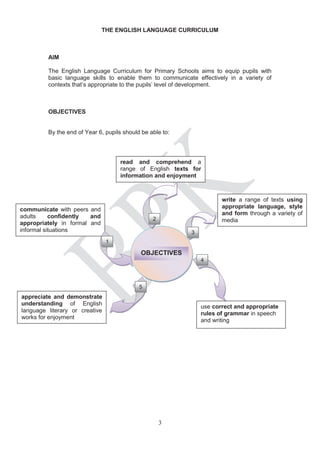
         By the end of Year 6, pupils should be able to:


                                    read and comprehend a
                                    range of English texts for
                                    information and enjoyment


                                                                      write a range of texts using
                                                                      appropriate language, style
communicate with peers and
                                                                      and form through a variety of
adults     confidently  and                      2
appropriately in formal and                                           media
informal situations                                        3
                                1

                                            OBJECTIVES
                                                               4


                                            5
appreciate and demonstrate
understanding of English
                                                               use correct and appropriate
language literary or creative                                  rules of grammar in speech
works for enjoyment
                                                               and writing


                                                     3
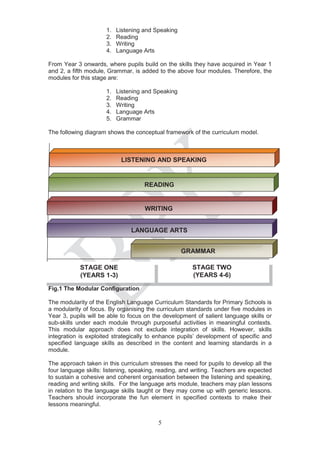
CONCEPTUAL FRAMEWORK

Primary education is divided into two stages: Stage One refers to Year 1,2 and 3,
and Stage Two, Year 4, 5 and 6. The English Language Curriculum has been
designed in two strands. Strand 1 is the language focus and strand 2 is language
arts. Language focus deals with language skills such as listening & speaking,
reading, writing and grammar. Language arts deals with music, poetry, drama and
children’s literature.

As English language learning is developmental, the focus in Year 1 and 2 is basic
literacy. This is done by building a strong foundation in basic literacy skills namely
reading through phonics, penmanship and basic listening and speaking. Activities
are contextualized and fun-filled with integration of language skills in meaningful
contexts.

From Year 3 and onwards, pupils will further develop the ability to speak, listen, read
and write in English meaningfully, purposefully and with confidence. A grammar
module is introduced from Year 3 to enable pupils develop a sound grasp of the
language structures and rules of grammar.

The Language Arts module has been added to the English language curriculum from
Year 1 to allow pupils to engage and enjoy stories, poems, songs, rhymes and plays
written in English.


                                     STRAND 1                      STRAND 2

                                LANGUAGE FOCUS                 LANGUAGE ARTS


        LEVEL 1                 Listening & Speaking                 Music
     (Years 1, 2 & 3)                  Reading                       Poetry
                                       Writing                       Drama
                               Grammar (from Year 3)             Class Readers


                                Listening & Speaking                Literature
        LEVEL 2                        Reading
     (Years 4, 5 & 6)                  Writing                   English at Play:
                                      Grammar
                                                             Music, Poetry & Drama


CURRICULUM ORGANISATION

The curriculum is modular in design and this is reflected in the organisation of the
content and learning standards.

In Year 1 and 2, the English language curriculum emphasises the development of
basic language skills so that pupils will have a strong foundation to build their
proficiency in the language. In this initial stage, there will only be four modules;
namely:


                                          4
1.   Listening and Speaking
                      2.   Reading
                      3.   Writing
                      4.   Language Arts

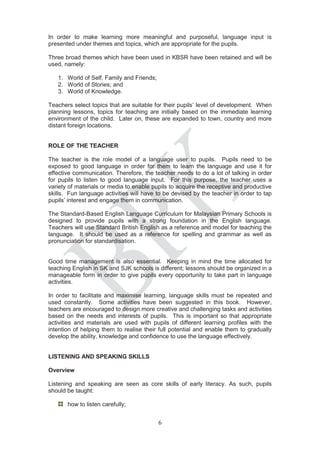
From Year 3 onwards, where pupils build on the skills they have acquired in Year 1
and 2, a fifth module, Grammar, is added to the above four modules. Therefore, the
modules for this stage are:

                      1.   Listening and Speaking
                      2.   Reading
                      3.   Writing
                      4.   Language Arts
                      5.   Grammar

The following diagram shows the conceptual framework of the curriculum model.


                            LISTENING AND SPEAKING


                                     READING


                                     WRITING


                                LANGUAGE ARTS


                                                    GRAMMAR

            STAGE ONE                                  STAGE TWO
            (YEARS 1-3)                                (YEARS 4-6)

Fig.1 The Modular Configuration

The modularity of the English Language Curriculum Standards for Primary Schools is
a modularity of focus. By organising the curriculum standards under five modules in
Year 3, pupils will be able to focus on the development of salient language skills or
sub-skills under each module through purposeful activities in meaningful contexts.
This modular approach does not exclude integration of skills. However, skills
integration is exploited strategically to enhance pupils’ development of specific and
specified language skills as described in the content and learning standards in a
module.

The approach taken in this curriculum stresses the need for pupils to develop all the
four language skills: listening, speaking, reading, and writing. Teachers are expected
to sustain a cohesive and coherent organisation between the listening and speaking,
reading and writing skills. For the language arts module, teachers may plan lessons
in relation to the language skills taught or they may come up with generic lessons.
Teachers should incorporate the fun element in specified contexts to make their
lessons meaningful.


                                          5
In order to make learning more meaningful and purposeful, language input is
presented under themes and topics, which are appropriate for the pupils.
Three broad themes which have been used in KBSR have been retained and will be
used, namely:

   1. World of Self, Family and Friends;
   2. World of Stories; and
   3. World of Knowledge.

Teachers select topics that are suitable for their pupils’ level of development. When
planning lessons, topics for teaching are initially based on the immediate learning
environment of the child. Later on, these are expanded to town, country and more
distant foreign locations.


ROLE OF THE TEACHER

The teacher is the role model of a language user to pupils. Pupils need to be
exposed to good language in order for them to learn the language and use it for
effective communication. Therefore, the teacher needs to do a lot of talking in order
for pupils to listen to good language input. For this purpose, the teacher uses a
variety of materials or media to enable pupils to acquire the receptive and productive
skills. Fun language activities will have to be devised by the teacher in order to tap
pupils’ interest and engage them in communication.

The Standard-Based English Language Curriculum for Malaysian Primary Schools is
designed to provide pupils with a strong foundation in the English language.
Teachers will use Standard British English as a reference and model for teaching the
language. It should be used as a reference for spelling and grammar as well as
pronunciation for standardisation.


Good time management is also essential. Keeping in mind the time allocated for
teaching English in SK and SJK schools is different; lessons should be organized in a
manageable form in order to give pupils every opportunity to take part in language
activities.

In order to facilitate and maximise learning, language skills must be repeated and
used constantly. Some activities have been suggested in this book. However,
teachers are encouraged to design more creative and challenging tasks and activities
based on the needs and interests of pupils. This is important so that appropriate
activities and materials are used with pupils of different learning profiles with the
intention of helping them to realise their full potential and enable them to gradually
develop the ability, knowledge and confidence to use the language effectively.


LISTENING AND SPEAKING SKILLS

Overview

Listening and speaking are seen as core skills of early literacy. As such, pupils
should be taught:

       how to listen carefully;


                                           6
to speak from the basic level of sound, word, phrase and structural sentences
          in various situational contexts;

          the stress, rhythm and intonation patterns and how to use them correctly;

          to recognise, understand and use not only verbal but also non-verbal
          communication; and

          oral communication practice by means of repeating, responding,
          understanding and applying structures of the language in order to prepare
          them for communication.

   In order to achieve the abovementioned, content and learning standards have been
   developed from basic listening and speaking, and then progressing to communicating
   in various situations effectively.


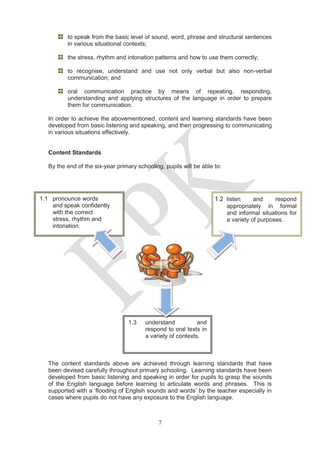
   Content Standards

   By the end of the six-year primary schooling, pupils will be able to:


1.1 pronounce words                                                  1.2 listen       and     respond
    and speak confidently                                                  appropriately in formal
    with the correct                                                       and informal situations for
    stress, rhythm and                                                     a variety of purposes.
    intonation.


                                  1.3    understand           and
                                         respond to oral texts in
                                         a variety of contexts.


   The content standards above are achieved through learning standards that have
   been devised carefully throughout primary schooling. Learning standards have been
   developed from basic listening and speaking in order for pupils to grasp the sounds
   of the English language before learning to articulate words and phrases. This is
   supported with a ‘flooding of English sounds and words’ by the teacher especially in
   cases where pupils do not have any exposure to the English language.


                                              7
The learning standards begin with basic listening and speaking skills which have
been developed incrementally in this manner :

               develop pupils’ phonemic awareness
               engage in fun learning activities such as reciting rhymes, poems and
               tongue twisters as well as singing songs
               participate in daily conversations
               follow and give instructions and directions
               able to participate in conversations
               talk on topics of interest

Relationships are established through the ability to communicate by listening first
then speaking thoughts, ideas and feelings. Pupils should aim at becoming confident
speakers who can communicate clearly, appropriately and coherently in any given
context using language to explore the possibilities and opportunities. Pupils need to
listen carefully and respond to what others say and think about the needs of their
listeners. Social conventions in listening and speaking such as turn taking, politeness
and courtesy need to be observed. These are crucial especially in group discussions
where viewpoints and opinions are exchanged.


READING SKILL

Overview

The teaching of reading skills:

       enables pupils to become independent readers who are able to comprehend
       a text effectively and efficiently.

       begins at the word and phrase levels before progressing to sentence
       recognition and reading at the paragraph level.

       focuses on basic literacy with the use of phonics in Year 1 and 2.

       teaches pupils to extract specific information from a text and respond to a text
       with their own ideas and opinions.


In order to achieve the abovementioned, content and learning standards have been
devised progressively. The teaching of reading in the early stages begins at the
word and phrase levels before progressing to sentence recognition and reading at
the paragraph level. Gradually, pupils are taught to extract specific information from
a text and to respond to a text with their own ideas and opinions.


                                          8
Content Standards

      By the end of the six-year primary schooling, pupils will be able to:


                                                                    2.2   demonstrate understanding of
2.1     apply knowledge of                                                a variety of linear and non-
        sounds of letters to                                              linear texts in the form of print
        recognize words in                                                and non-print materials using
        linear and non-linear                                             a range of strategies to
        texts.                                                            construct meaning.


                                     2.3   read independently for
                                           information       and
                                           enjoyment.


      The content standards above are achieved through learning standards that have
      been devised carefully throughout primary schooling. Learning standards have been
      developed from recognition of sounds in order for pupils to acquire the sounds of the
      English language before learning to blend and segment words. This is further
      developed through vocabulary activities to widen pupils’ vocabulary. By the end of
      Year 6, pupils are able to read and demonstrate understanding of text for information
      as well as read for enjoyment.


      The learning standards begin with basic literacy which has been developed
      incrementally in this manner :

                     distinguish the shapes of the letters;
                     recognise and articulate phonemes;
                     blend and segment words;
                     apply word recognition and word attack skills to acquire vocabulary;
                     read and understand phrases, simple sentences and texts; and
                     read independently for information and enjoyment.


                                                 9
The reading aloud strategy is also encouraged in the first two years of primary
education:

       Teacher reads aloud a text to pupils. Implementing this strategy allows
       teachers to model reading.

       Here, articulation and pronunciation of words by the teacher have to be as
       precise as possible for pupils to efficiently imitate and reproduce correctly.

       This strategy effectively engage pupils in a text that may be too difficult for
       them to read on their own, hence, pupils sit back and enjoy the story.


Teachers should also carry out shared reading strategies in the classroom:

       During shared reading, the teacher and pupils read together, thus allowing
       pupils to actively participate and support one another in the process of
       reading.

       Teachers point to the text as they read slowly for word recognition and to
       “build a sense of story”.


Ultimately, the objective of getting pupils to read a variety of texts enables pupils to
see how grammar is used correctly so that they can emulate them in their productive
skills; speaking and writing. Reading for enjoyment and pleasure in seeking
information and knowledge should be inculcated in pupils. Pupils are also trained to
give their own ideas and opinions in order to become efficient readers.


WRITING SKILL

Overview

It is expected that by the end of Year 6 :

       pupils will be able to express their ideas clearly on paper in legible
       handwriting or to communicate via the electronic media.

       the focus of writing is on developing pupils’ writing ability beginning at the
       word and phrase levels before progressing to the sentence and paragraph
       levels.

       pupils who are capable must be encouraged to write simple compositions
       comprising several paragraphs.

       attention is also paid to penmanship so that even from a young age, pupils
       are taught to write clearly and legibly including cursive writing.

       simple compositions and the various steps involved in writing, such as
       planning, drafting, revising, and editing are taught. In the process, pupils
       learn the genre approach to writing as they are taught to use appropriate
       vocabulary and correct grammar to get their meaning across clearly.


                                             10
all pupils will be encouraged to write for different purposes and for different
       audiences.

       although much of the writing at this level is guided, the amount of control is
       relaxed for pupils who are able and proficient in the language.

       spelling and dictation are also given emphasis.


To achieve the abovementioned, content and learning standards have been devised
progressively. The teaching of writing in the early stages begins with pre-writing
activities to develop pupils’ visual skills as well as develop hand-eye coordination.
This is later developed to writing letters of the alphabet and copying words, phrases
and simple sentences. Pupils begin constructing simple sentences with the teacher’s
guidance and later develop to become independent writers by the end of primary
schooling.


Content Standards

By the end of the six year primary schooling, pupils will be able to:


3.1   form letters and words                                   3.2      write using appropriate
      in neat legible print                                             language, form and style
      including       cursive                                           for a range of purposes.
      writing.


                                3.3 write and present ideas
                                     through a variety of
                                     media.

Content standards are achieved through learning standards that have been devised
carefully throughout primary schooling. Learning standards have been developed
progressively, from acquiring fine motor control of hands and fingers to copying


                                            11
writing activities, before being taught to write with guidance linear and non-linear
texts using appropriate language, form and style. The use of various media is also
encouraged and pupils can create both linear and non-linear texts with guidance or
independently.


LANGUAGE ARTS

Overview

The rationale behind Language Arts is to steer the continuous growth and
development of pupils’ thinking and language abilities. The standards for Language
Arts:

       cover a range of creative and literary works in English such as rhymes,
       songs, poems, stories and plays to activate pupils’ imagination and interest.

       allow pupils to benefit from hearing and using language from fictional as well
       as non-fictional sources.

       allow pupils to gain rich and invaluable experiences using the English
       language through fun-filled and meaningful activities.

       train pupils to be able to appreciate, demonstrate understanding and express
       personal responses to literary and creative works for enjoyment. Hence they
       will also be able to use English for both functional as well as aesthetic
       purposes, confidently and competently by the end of Year 6.


In order to achieve the abovementioned, content and learning standards have been
devised progressively. The teaching of language arts will help pupils develop their
oral and analytical skills as well as hone their creativity. Language Arts creates
ample opportunities for pupils to speak in English in a very relaxed atmosphere and
this will help increase pupils’ confidence in using the English language.


                                         12
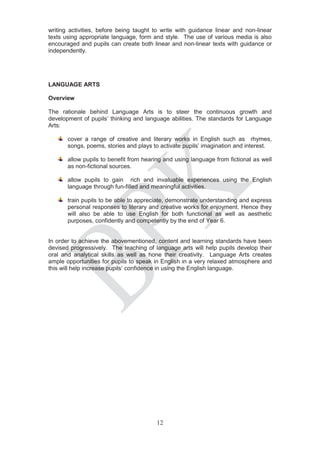
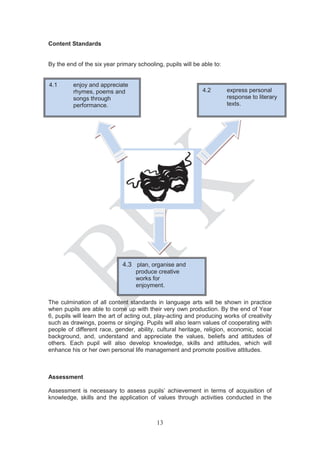
Content Standards


By the end of the six year primary schooling, pupils will be able to:


4.1      enjoy and appreciate
         rhymes, poems and                                   4.2        express personal
         songs through                                                  response to literary
         performance.                                                   texts.


                             4.3 plan, organise and
                                  produce creative
                                  works for
                                  enjoyment.

The culmination of all content standards in language arts will be shown in practice
when pupils are able to come up with their very own production. By the end of Year
6, pupils will learn the art of acting out, play-acting and producing works of creativity
such as drawings, poems or singing. Pupils will also learn values of cooperating with
people of different race, gender, ability, cultural heritage, religion, economic, social
background, and, understand and appreciate the values, beliefs and attitudes of
others. Each pupil will also develop knowledge, skills and attitudes, which will
enhance his or her own personal life management and promote positive attitudes.


Assessment

Assessment is necessary to assess pupils’ achievement in terms of acquisition of
knowledge, skills and the application of values through activities conducted in the


                                           13
classroom. Assessment also supports pupils’ learning and gives pertinent feedback
    to teachers, pupils and parents about their development and achievement.

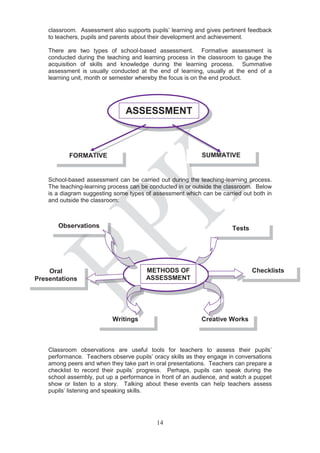
    There are two types of school-based assessment. Formative assessment is
    conducted during the teaching and learning process in the classroom to gauge the
    acquisition of skills and knowledge during the learning process. Summative
    assessment is usually conducted at the end of learning, usually at the end of a
    learning unit, month or semester whereby the focus is on the end product.


                                ASSESSMENT


           FORMATIVE
                TI                                          SUMMATIVE
                                                               MA


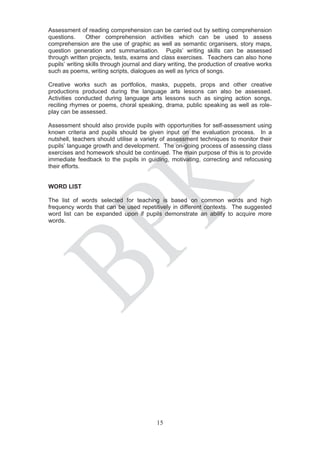
    School-based assessment can be carried out during the teaching-learning process.
    The teaching-learning process can be conducted in or outside the classroom. Below
    is a diagram suggesting some types of assessment which can be carried out both in
    and outside the classroom:


       Observations                                                    Tests


    Oral                               METHODS OF                              Checklists
Presentations                          ASSESSMENT


                           Writings                         Creative Works
                                                              ea


    Classroom observations are useful tools for teachers to assess their pupils’
    performance. Teachers observe pupils’ oracy skills as they engage in conversations
    among peers and when they take part in oral presentations. Teachers can prepare a
    checklist to record their pupils’ progress. Perhaps, pupils can speak during the
    school assembly, put up a performance in front of an audience, and watch a puppet
    show or listen to a story. Talking about these events can help teachers assess
    pupils’ listening and speaking skills.


                                           14
Assessment of reading comprehension can be carried out by setting comprehension
questions.      Other comprehension activities which can be used to assess
comprehension are the use of graphic as well as semantic organisers, story maps,
question generation and summarisation. Pupils’ writing skills can be assessed
through written projects, tests, exams and class exercises. Teachers can also hone
pupils’ writing skills through journal and diary writing, the production of creative works
such as poems, writing scripts, dialogues as well as lyrics of songs.

Creative works such as portfolios, masks, puppets, props and other creative
productions produced during the language arts lessons can also be assessed.
Activities conducted during language arts lessons such as singing action songs,
reciting rhymes or poems, choral speaking, drama, public speaking as well as role-
play can be assessed.

Assessment should also provide pupils with opportunities for self-assessment using
known criteria and pupils should be given input on the evaluation process. In a
nutshell, teachers should utilise a variety of assessment techniques to monitor their
pupils’ language growth and development. The on-going process of assessing class
exercises and homework should be continued. The main purpose of this is to provide
immediate feedback to the pupils in guiding, motivating, correcting and refocusing
their efforts.


WORD LIST

The list of words selected for teaching is based on common words and high
frequency words that can be used repetitively in different contexts. The suggested
word list can be expanded upon if pupils demonstrate an ability to acquire more
words.


                                           15
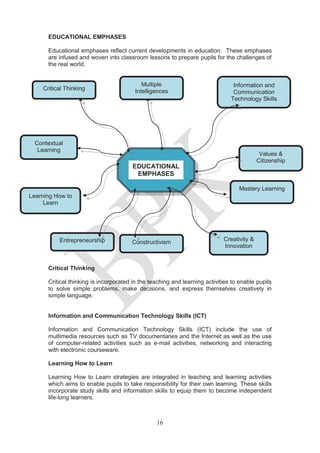
EDUCATIONAL EMPHASES

      Educational emphases reflect current developments in education. These emphases
      are infused and woven into classroom lessons to prepare pupils for the challenges of
      the real world.


                                           Multiple                             Information and
    Critical Thinking                   Intelligences                           Communication
                                                                               Technology Skills


  Contextual
   Learning
                                                                                            Values &
                                                                                           Citizenship
                                       EDUCATIONAL
                                        EMPHASES

                                                                                  Mastery Learning
Learning How to
     Learn


          Entrepreneurship
                         p                                                  Creativity &
                                       Constructivism
                                        o
                                                                            Innovation


      Critical Thinking

      Critical thinking is incorporated in the teaching and learning activities to enable pupils
      to solve simple problems, make decisions, and express themselves creatively in
      simple language.


      Information and Communication Technology Skills (ICT)

      Information and Communication Technology Skills (ICT) include the use of
      multimedia resources such as TV documentaries and the Internet as well as the use
      of computer-related activities such as e-mail activities, networking and interacting
      with electronic courseware.

      Learning How to Learn

      Learning How to Learn strategies are integrated in teaching and learning activities
      which aims to enable pupils to take responsibility for their own learning. These skills
      incorporate study skills and information skills to equip them to become independent
      life-long learners.


                                                 16
Values and Citizenship

The values contained in the Standard Based Curriculum for Moral is incorporated into
the English language lessons. Elements of patriotism and citizenship is also
emphasised in lessons in order to cultivate a love for the nation and produce patriotic
citizens.

Creativity and Innovation

Creativity and innovation is the ability to produce something new in an imaginative
and fun-filled way. Pupils display interest, confidence and self-esteem through
performance and producing simple creative works.

Entrepreneurship

Fostering an entrepreneurial mind set among pupils at their young age is essential in
this new world. Some of the elements that are linked with entrepreneurship are
creativity, innovation and initiative, which are also attributes for personal fulfilment
and success.


Mastery Learning

Mastery Learning will ensure that all pupils master the learning standards stipulated
in the Standard Based Curriculum. Mastery Learning requires quality teaching and
learning in the classroom and teachers need to ensure that pupils master a learning
standard before proceeding to the next learning standard.

Multiple Intelligences

The theory of Multiple Intelligences encompasses eight different intelligences human
beings possess. These intelligences are essential in order to maximise teaching and
learning in the classroom. .


Constructivism

Constructivism will enable pupils to build new knowledge and concepts based on
existing knowledge or schema that they have. The teacher assists pupils to acquire
new knowledge and solve problems through pupil-centred active learning.

Contextual Learning

Contextual Learning is an approach to learning which connects the contents being
learnt to the pupils’ daily lives, the community around them and the working world.
Learning takes place when pupils are able to relate the new knowledge acquired in a
meaningful manner in their lives.


                                          17
LISTENING & SPEAKING
      READING
      WRITING
   LANGUAGE ARTS
     GRAMMAR
THE LISTENING AND SPEAKING SKILL
The listening and speaking skill is crucial for communication at home,
at school, as well as in the community. However, this skill is often neglected or given minimal
emphasis during English language lessons. In order to develop this skill, teachers have to
provide their pupils with various opportunities to listen and to talk about a range of subjects
which may include topics on personal interests, school work and even current affairs. It is hoped
that the learning standards will offer teachers some ideas on how they could provide
opportunities for pupils to engage in various listening and speaking activities at Year Three.
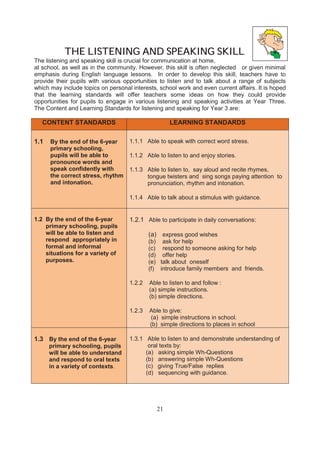
The Content and Learning Standards for listening and speaking for Year 3 are:

   CONTENT STANDARDS                                LEARNING STANDARDS

1.1   By the end of the 6-year      1.1.1 Able to speak with correct word stress.
      primary schooling,
      pupils will be able to        1.1.2 Able to listen to and enjoy stories.
      pronounce words and
      speak confidently with        1.1.3 Able to listen to, say aloud and recite rhymes,
      the correct stress, rhythm          tongue twisters and sing songs paying attention to
      and intonation.                     pronunciation, rhythm and intonation.

                                    1.1.4 Able to talk about a stimulus with guidance.


1.2 By the end of the 6-year        1.2.1 Able to participate in daily conversations:
    primary schooling, pupils
    will be able to listen and              (a) express good wishes
    respond appropriately in                (b) ask for help
    formal and informal                     (c) respond to someone asking for help
    situations for a variety of             (d) offer help
    purposes.                               (e) talk about oneself
                                            (f) introduce family members and friends.

                                    1.2.2   Able to listen to and follow :
                                            (a) simple instructions.
                                            (b) simple directions.

                                    1.2.3   Able to give:
                                            (a) simple instructions in school.
                                            (b) simple directions to places in school

1.3 By the end of the 6-year        1.3.1 Able to listen to and demonstrate understanding of
      primary schooling, pupils            oral texts by:
      will be able to understand          (a) asking simple Wh-Questions
      and respond to oral texts           (b) answering simple Wh-Questions
      in a variety of contexts.           (c) giving True/False replies
                                          (d) sequencing with guidance.


                                               21
Learning Standard:

 1.1.1    Able to speak with correct word stress.

            Activity                         Content                Teacher’s note
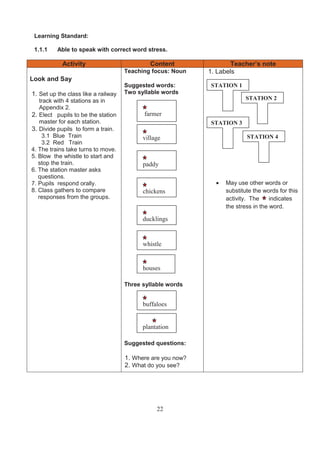
                                     Teaching focus: Noun    1. Labels
Look and Say
                                     Suggested words:        STATION 1
1. Set up the class like a railway   Two syllable words
   track with 4 stations as in                                           STATION 2
   Appendix 2.
2. Elect pupils to be the station          farmer
   master for each station.                                  STATION 3
3. Divide pupils to form a train.
    3.1 Blue Train                         village                        STATION 4
    3.2 Red Train
4. The trains take turns to move.
5. Blow the whistle to start and
   stop the train.                         paddy
6. The station master asks
   questions.
7. Pupils respond orally.                                         May use other words or
8. Class gathers to compare                chickens               substitute the words for this
   responses from the groups.                                     activity. The     indicates
                                                                  the stress in the word.

                                           ducklings


                                           whistle


                                           houses

                                     Three syllable words


                                           buffaloes


                                           plantation

                                     Suggested questions:

                                     1. Where are you now?
                                     2. What do you see?


                                                22
Learning Standard:

1.1.1     Able to speak with correct word stress.

              Activity                             Content                 Teacher’s Note

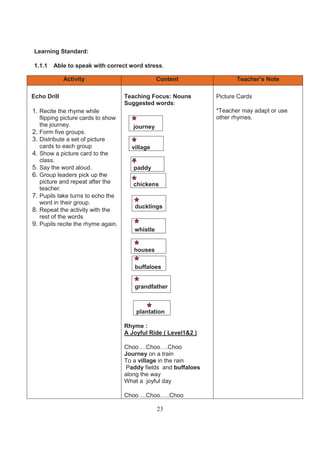
Echo Drill                            Teaching Focus: Nouns         Picture Cards
                                      Suggested words:
1. Recite the rhyme while                                           *Teacher may adapt or use
     flipping picture cards to show                                 other rhymes.
     the journey.                        journey
2.   Form five groups.
3.   Distribute a set of picture
     cards to each group                village
4.   Show a picture card to the
     class.
5.   Say the word aloud.                 paddy
6.   Group leaders pick up the
     picture and repeat after the        chickens
     teacher.
7.   Pupils take turns to echo the
     word in their group.
                                         ducklings
8.   Repeat the activity with the
     rest of the words
9.   Pupils recite the rhyme again.
                                         whistle


                                         houses

                                         buffaloes


                                         grandfather


                                          plantation

                                      Rhyme :
                                      A Joyful Ride ( Level1&2 )

                                      Choo….Choo….Choo
                                      Journey on a train
                                      To a village in the rain
                                       Paddy fields and buffaloes
                                      along the way
                                      What a joyful day

                                      Choo….Choo…..Choo

                                                   23
Plantation to see
Rows of oil palm trees
Green leaves in the breeze

Chooo…Chooo…Chooo
Attap houses everywhere
Geese and chickens here
Noisy ducklings there
Hear the whistle blowing
Look! Grandpa is waving
Ah…. the train is stopping

A Joyful Ride ( Level 3 )

Choo….Choo….Choo
A journey on a train
To a village in the rain
Oh! What a joyful day
See paddy fields far away
And buffaloes in the mud to stay
Oh ! What a lovely day

Choo….Choo…..Choo
Large plantation to see
Rows and rows of oil palm trees
Bunches of fruit and thick leaves
Swaying gently in the breeze

Chooo…Chooo…Chooo
Pretty attap houses in rows
Geese and chickens near the
burrows
See the noisy ducklings
In the pond happily quacking
Hear the whistle blowing
Look! Grandpa is waving
At last .. at last …
the train is stopping


             24
Learning Standard:


1.1.2 Able to listen to and enjoy stories


             Activity                         Content            Teacher’s Notes

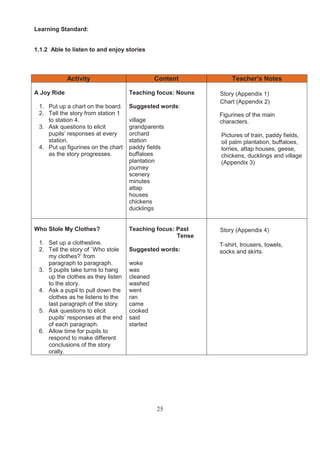
A Joy Ride                          Teaching focus: Nouns   Story (Appendix 1)
                                                            Chart (Appendix 2)
 1. Put up a chart on the board.    Suggested words:
 2. Tell the story from station 1                           Figurines of the main
    to station 4.                   village                 characters.
 3. Ask questions to elicit         grandparents
    pupils’ responses at every      orchard                 Pictures of train, paddy fields,
    station.                        station                 oil palm plantation, buffaloes,
 4. Put up figurines on the chart   paddy fields            lorries, attap houses, geese,
    as the story progresses.        buffaloes               chickens, ducklings and village
                                    plantation              (Appendix 3)
                                    journey
                                    scenery
                                    minutes
                                    attap
                                    houses
                                    chickens
                                    ducklings


Who Stole My Clothes?               Teaching focus: Past    Story (Appendix 4)
                                                    Tense
 1. Set up a clothesline.                                   T-shirt, trousers, towels,
 2. Tell the story of `Who stole    Suggested words:        socks and skirts.
    my clothes?’ from
    paragraph to paragraph.         woke
 3. 5 pupils take turns to hang     was
    up the clothes as they listen   cleaned
    to the story.                   washed
 4. Ask a pupil to pull down the    went
    clothes as he listens to the    ran
    last paragraph of the story.    came
 5. Ask questions to elicit         cooked
    pupils’ responses at the end    said
    of each paragraph.              started
 6. Allow time for pupils to
    respond to make different
    conclusions of the story
    orally.


                                              25
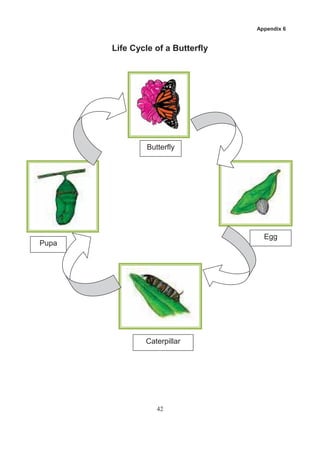
The Mouse and the                   Teaching focus:             Pictures of a caterpillar, mouse
  Caterpillar                       Adjectives                  and butterfly.
                                    Suggested words:
  1. Prepare pictures of a                                      Text (Appendix 5)
     caterpillar, mouse and a       friendly
     butterfly.                     beautiful                   Chart (Appendix 6)
  2. Tell the story part by part.   shocked
  3. Use different voices for the   green
     two characters.                small
  4. Ask questions to elicit        sad
     pupils’ responses.             fat
  5. Allow time for pupils to       new
     respond.                       close
                                    busy
                                    rich
                                    tall


Learning Standard:

1.1.3   Able to listen to, say aloud and recite rhymes, tongue twisters and sing
        songs paying attention to pronunciation, rhythm and intonation.

            Activity                            Content                  Teacher’s note

Stress Clap                         Teaching focus:             Materials
                                    Two syllable words          Word cards          journey
1. Recite the rhyme while
   flipping picture cards to        journey
   show the journey.                village
2. Repeat but this time clap        paddy                        plantation         village
   at focus word.                   chickens
                                    ducklings
                                    whistle
                                                                 grandfather        paddy
                                    Three syllable words
                                    buffaloes
                                    plantation                                      chickens
                                    grandfather                   buffalos

                                    Rhyme                                           ducklings
                                    Choo….Choo….Choo
                                    A journey on a train
                                    To a village in the rain                        whistle
                                    Oh! What a joyful day
                                    See paddy fields far away
                                    And buffaloes in the mud                         houses
                                    to stay
                                    Oh ! what a lovely day


                                                26
Choo….Choo…..Choo
                                  Large plantation to see
                                  Rows and rows of oil palm
                                  trees
                                  Bunches of fruit and thick
                                  leaves
                                  Swaying gently in the
                                  breeze

                                  Chooo…Chooo…Chooo
                                  Pretty attap houses in rows
                                  Geese and chickens near
                                  the burrows
                                  See the noisy ducklings
                                  In the pond happily
                                  quacking
                                  Hear the whistle blowing
                                  Look! Grandpa is waving
                                  At last ..at last ..
                                  the train is stopping


Learning Standard:

1.1.3   Able to listen to, say aloud and recite rhymes, tongue twisters and sing
        songs paying attention to pronunciation , rhythm and intonation.

            Activity                         Content                    Teacher’s note

I love to sing                    Teaching Focus: ‘wh’           Song Chart
                                  questions.
1.   Put up the song chart.
2.   Pupils sing the song ‘The    Suggested questions:
     Happy Wanderer’ with         1. What is the title?
     actions.                     2. Where are you going?
3.   Teacher asks Wh-questions.   3. What do you see on the
4.   Pupils answer.                  way?
5.   Pupils sing the song again
     with actions.                The Happy Wanderer

                                  I love to go a-wandering,
                                  Along the mountain track,
                                  And as I go, I love to sing,
                                  My knapsack on my back.

                                  Chorus:
                                  Val-deri,Val-dera,
                                  Val-deri,
                                  Val-dera-ha-ha-ha-ha-ha
                                  Val-deri,Val-dera
                                  My knapsack on my back.


                                             27
I love to wander by the
stream
That dances in the sun,
So joyously it calls to me,
"Come! Join my happy song!"

I wave my hat to all I meet,
And they wave back to me,
And blackbirds call so loud
and sweet
From ev'ry green wood tree.

High overhead, the skylarks
wing,
They never rest at home
But just like me, they love to
sing,
As o'er the world we roam.


           28
Learning Standard:
1.1.4 Able to talk about a stimulus with guidance.


             Activity                      Content                Teacher’s Notes
1. An Outing
                                  Teaching focus: Nouns   Suggested Items :
1. Prepare a box of items.                                   1. A Picnic Basket
2. Ask pupils to talk about the                              2. A Set of Art Tools for
   items in the box.                                            Painting


2. Advertisement from             Teaching focus:             Materials
   Newspaper or TV clips          Adjectives               1. Newspapers
1. Choose an advertisement                                 2. Video Clips
   or a video clip focusing on    Suggested words:         3. Magazines
   moral values.                                           4.
2. Ask pupils to talk about the   generous
   advertisement/video clip.      responsible
3. Ask questions to elicit        caring
   responses pertaining to the
   advertisement/video clip.


2. Advertisement from             Teaching focus:             Materials
   Newspaper or TV clips          Adjectives               5. Newspapers
1. Choose an advertisement                                 6. Video Clips
   or a video clip focusing on    Suggested words:         7. Magazines
   moral values.                                           8.
2. Ask pupils to talk about the   generous
   advertisement/video clip.      responsible
3. Ask questions to elicit        caring
   responses pertaining to the
   advertisement/video clip.


Life Cycle of a frog              Teaching focus:
                                  Sequence connectors     Pictures pertaining to the life cycle
 1. Prepare pictures for each     Suggested words:        of a frog.
    phase of the cycle.
 2. Ask pupils to talk about      first
    each phase.                   then
 3. Ask questions to encourage    next
    active participation.         finally
                                  frog
                                  eggs
                                  tadpole
                                  young frog


                                            29
Learning Standard:

1.2.1 Able to participate in daily conversations: a) express good wishes

            Activity                         Contents                        Teacher’s Notes

Listen and Respond                  Teaching focus : Social         Items for dress-up.
                                    Expressions
1. Dress pupils up as the                                           *This activity can be done in pairs,
   following characters.            Dialogues:                      groups or as a whole class.
                                    A : I am 80 years old.
   A: grandfather holding a         R : Happy Birthday!
      birthday cake
   B: an athlete holding            B : Hooray! I won the first
      a trophy                          prize.
   C: someone looking sad           R : Congratulations!
   D: someone carrying a
       luggage                      C : My grandmother is not
   E: a new pupil to the class          well.
                                    R : We hope she will get
2. Each pupil takes turn to             well soon.
   listen to the teacher and
   say aloud the statement to       D : I am leaving for
   the whole class.                     Singapore now.
                                    R : Have a safe journey.
3. Pupils respond orally.
                                    E: Hello, I’m Imran.
                                    R: Welcome to our class.


Learning Standard:

1.2.1 Able to participate in daily conversations: b) ask for help

            Activity                         Contents                        Teacher’s Notes

What’s In the Musical Box?          Teaching focus :                Pictures of situations
                                    Dialogues
1. Prepare 10 pictures of various   Pictures and questions          An attractive box
   situations.                      P1- A child asking for help
2. Play the music and pass the           when doing homework.       CD player and CD
   musical box around.              Q : Could you help me
3. When the music stops, a pupil         with my homework
   picks up a picture.                   please?                    Suggested Responses:
4. Pupil shows the picture to the                                   Could you please…?
   class.                           P2- A child trying to cross a   Would you mind…?
5. Class respond.                       busy road.                  Do you mind…?
                                    Q : Can you help me to          Please help…
                                        cross the road?

                                    P3- A girl fell and hurt her
                                               30
feet.
                                    Q : Can you please help
                                        me?

                                    P4- An old lady carrying
                                        two heavy bags.
                                    Q : Please help me to
                                        carry these bags.


Learning Standard:

1.2.1 Able to participate in daily conversations: c) respond to someone asking for help

            Activity                         Contents                     Teacher’s Notes

Please help…                        Teaching focus : Social       Old telephone
                                    Expressions
1. Prepare situations on CDs.       Dialogues and responses.      Dialogues on CD
2. When the telephone rings,        D1 : Could you please help
   a representative from each            me with my
   group takes turn to pick up           homework?                * Teacher can prepare any
   the telephone on the teacher’s   R : Yes, of course.           appropriate situations to encourage
   table.                                                         pupils’ active responses.
3. Teacher plays the CD.            D2 : Do you mind taking
4. The class listens to the              me across the road?      Suggested Responses:
   situation.                       R : Of course, I don’t        Of course…
5. The pupil with the telephone          mind. Let us cross       Most certainly…
   responds loudly and the class         the road together.       Sure…
   repeats the response verbally                                  Let me help …
   aloud.                           D3 : Help! I can’t walk.      Gladly…
                                    R : Let me help you.

                                    D4 : Would you mind
                                         helping me with these
                                         bags?
                                    R : Of course, I wouldn’t
                                         mind. Let me take
                                         the bags for you.


Learning Standard:

1.2.1 Able to participate in daily conversations: d) offer help

            Activity                         Contents                     Teacher’s Notes
                                                                  Pic card 1 : pregnant woman in the
What would you do?                  Teaching focus : Social                    bus
                                    Expressions/Actions           Pic card 2 : a blind man crossing
1. Prepare picture cards of                                                    the road
   situations.                                                    Pic card 3 : a teacher carrying
2. Give each group a picture                                                   heavy books
   card.                                                          Pic card 4 : mother cooking
3. Pupils respond accordingly.                                    Pic card 5 : an old man who falls

                                              31
4. Group members role-play the                                                  and injures himself
   situation in their picture card.
                                                                    *Teacher can substitute suggested
                                                                    situations with their own.

Learning Standard:

1.2.1 Able to participate in daily conversations: e) talk about oneself

             Activity                         Contents                      Teacher’s Notes

VIP on stage                          Teaching focus : Simple        Microphone
                                      Sentences
1. Set up a stage in front of the                                    Tape recorder
   class.
2. Pupils introduce themselves.         I am _____________.          Video camera (optional)
3. Tape it.                             I am _________ years
4. Replay and let the pupils            old.
   listen.                              I like to eat __________.
                                        My hobbies are
                                        __________.


Learning Standard:

1.2.1 Able to participate in daily conversations: f) to talk about one’s family/friend

             Activity                         Contents                      Teacher’s Notes

We love our family                    Teaching focus : Simple       Ask pupils to bring photographs of
                                      Sentences                     their families.
1. In pairs, pupils sit and face
   each other to form a big circle.   Suggested sentences:
2. Pupils pair up and exchange           1. This is Johan’s
   their family photographs.                family.
3. Pupils talk about their families      2. His father is a
4. Call out a few pupils at random          banker.
   to talk about their partner’s         3. His mother is a
   family.                                  teacher.
                                         4. His brother is ten
                                            years old
                                         5. They like to go to
                                            the beach.


                                                32
Learning Standard:

1.2.2 Able to listen to and follow: a) simple instructions

             Activity                          Contents                     Teacher’s Notes

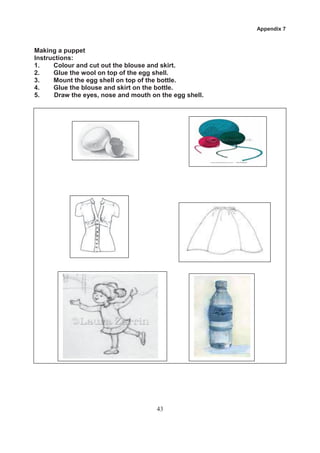
Making A Puppet                       Teaching Focus: Verbs        Instructions & Materials
                                                                   (Appendix 7)
1. Prepare materials to make          Suggested Words:
   puppets.
2. Divide pupils into groups of 5.    cut                          Materials:
3. Distribute materials to each       draw                         a. egg shells
   group.                             tie                          b. plastic bottles
4. Read instructions aloud step       paste                        c. glue
   by step.                                                        d. skirts
5. Pupils listen and follow the                                    e. blouses
   steps.                                                          f. wool
                                                                   g. magic pens


Let’s Go to the Garden                Teaching Focus:              gloves
                                      Imperatives                  boots
1. Pupils listen to the teacher’s                                  hat
   instructions and follow.           Suggested instructions:      sun glasses
2. Pupils can work individually, in
   pairs or groups.                      1.   Wear your gloves.
                                         2.   Put on your boots.
                                         3.   Wear your hat.
                                         4.   Put on your sun
                                              glasses.


Learning Standard:

1.2.2 Able to listen to and follow: b) simple directions

           Activities                          Contents                     Teacher’s Notes

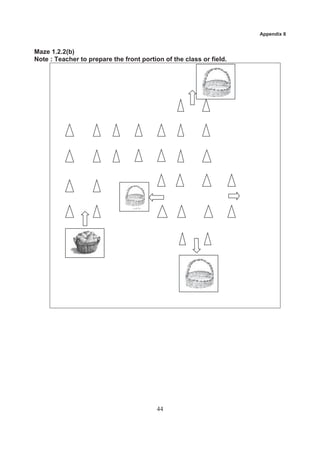
A Maze                                Teaching Focus: Verb and Materials:
 1. Prepare a maze in the                                      a. skittles
    classroom as shown in the         Preposition              b. balls
    picture.                          Suggested Words:         c. baskets
 2. Place a basket of balls at the    pick                     d. cloth to blindfold
    starting point and an empty       take
    basket at each exit.              put                      Maze (Appendix 8)
 3. Blindfold the pupil.              turn
 4. Read the directions to the        walk
    pupil.                            left
 5. Pupil listens to the teacher      right
    and follows the direction.        straight


                                                 33
Learning Standard:

     1.2.2. Able to give: a) simple instructions in school

             Activity                       Contents                           Notes

In The Library                       Teaching Focus: Simple      Suggested instructions
                                     instructions                   1. Take off your shoes.
1.   Discuss the do’s and don’t’s                                   2. Be silent.
     in a library.                                                  3. Choose a book to read.
2.   Play “Simon Says” in the
                                                                    4. Return your book to the
     classroom.
3.   Bring pupils to the library.                                      shelf.
4.   Choose a pupil to give                                         5. Arrange the books neatly.
     instructions.                                                  6. Push the chairs in.
                                                                    7. Put on your shoes.
                                                                    8. Line up.
                                                                    9. Walk quietly to your class.


Learning Standard:

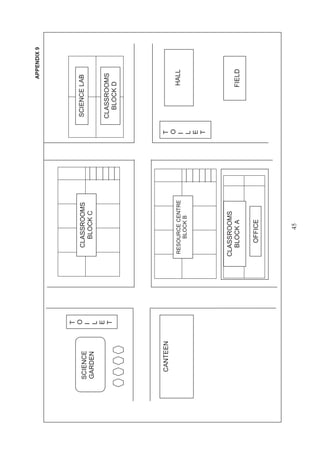
1.2.3 Able to give: b) simple directions to places in school

             Activity                       Contents                         Materials

Where Am I?                          Teaching Focus: Simple         A big chart of the school plan.
                                     directions
1. Put up the school plan.
                                                                    A long pointer.
2. Allow pupils to identify the      Suggested instructions
   places in the school.             1. Walk straight ahead.
                                     2. Turn left.                  Coloured pointers/magnetic
3. Create situations.
                                     3. Turn right.                 buttons. (to mark the starting
4. Pupils work in pairs.
                                     4. ………… is on your             and finishing line)
   A – to listen to the teacher
   and give simple instructions.        right.
                                     5. ………… is to your left.       School Plan (Appendix 9)
   B – to point the route with a
   pointer as he/she listens to A.   Situations
5. Repeat the activity with other    Examples:
   pairs.                            1.       Siti is at the
                                            office. She wants
                                            to go to the hall.

                                            Muthu is at the
                                     2.     field. He wants
                                            to go to the
                                            Science Garden.


                                              34
Learning Standard:

1.3.1 Able to listen to and demonstrate understanding of oral texts by :
      a) asking simple Wh-Questions
      b) answering simple Wh-Questions

            Activity                          Content                      Teacher’s note

Young Reporters                      Teaching Focus: ‘Wh’
                                     questions                      Story (Appendix 1)
1. Divide pupils into groups.
2. Group leaders read the            STATION 1                     *Make use of stories such as The
   story/Pupils listen to the pre-   1. What did you see ?         Princess and the Dragon,
   recorded story in their           2. Who was the driver ?       Shoemaker and Mr.King or
   groups.                                                         Anansi the Spider from the reading
3. Each group takes turns to sit     STATION 2                     module.
   in front of the class and class   1. What did you see at
   members ask questions to             Station 2?
   elicit information about the      2. How many buffaloes
                                        were in the mud?
   story.
                                     3. What colour were the
4. Group members answer the             buffaloes?
   questions.
5. Repeat this with other            STATION 3
   groups.                           1. What did you see at this
                                        station?
                                     2. What were in the
                                        plantation?
       Before the activity, the      3. What was carrying the
       teacher can drill the            oil palms?
       questions.
                                     STATION 4
                                     1. What type of houses did
                                        you see?
                                     2. What animals were
                                        there?
                                     3. Where were the
                                        ducklings?
                                     4. What were they doing?

                                     STATION 5
                                     1. What did you hear?
                                     2. What was grandfather
                                        doing?
                                     3. Was your grandfather
                                        happy to see you?


                                               35
Learning Standard:

1.3.1   Able to listen to and demonstrate understanding of oral text by:
        c) giving ‘True’ or ‘False’ replies.

             Activity                         Contents                       Materials

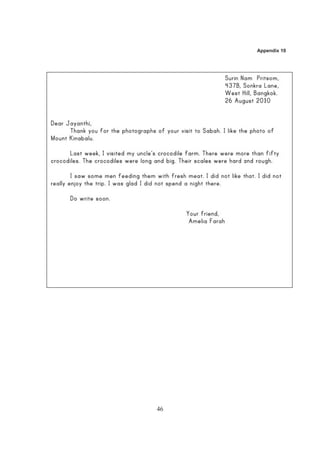
A Letter                               Teaching Focus:          Letter in an envelope.
                                       Simple Past Tense
1. Prepare a letter and put it in an                            Letter (Appendix 10)
   envelope.
2. Ask a colleague to send the
   letter to the class.
3. Open the letter in front of the
   pupils.
4. Read the letter aloud.
5. Pupils listen to the teacher.
6. Ask true/false questions based
   on the letter.
7. Pupils answer true/false.


Learning Standard:

1.3.1 Able to listen to and demonstrate understanding of oral text by:
      d) sequencing with guidance.

             Activity                         Contents                       Materials

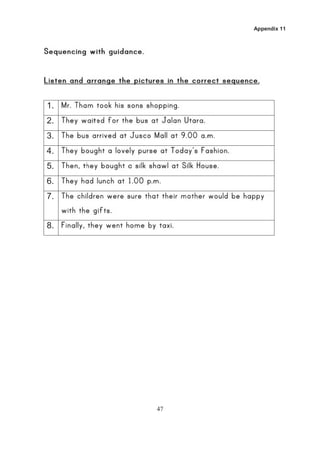
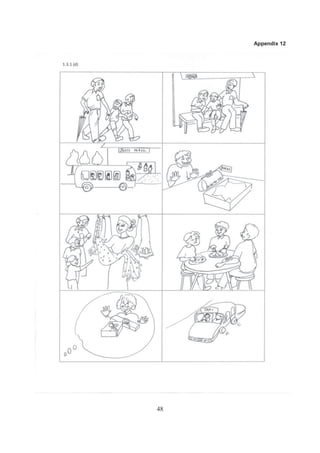
Shopping For Mom                       Teaching Focus: Simple   Sequence of cut out pictures in
                                       Past Tense               envelopes.
1. Prepare a brief story.
2. Prepare a sequence of cut                                    Story (Appendix 11)
   out pictures pertaining to the
   story.                                                       Pictures (Appendix 12)
3. Put each set of pictures into
   5 or 6 envelopes.
4. Distribute the envelopes to
   each group.
5. Read aloud the story.
6. In groups, pupils arrange the
   pictures according to the
   correct sequence.


                                                36
Appendix 1


                                    A Joy Ride
       Razak and Chong Keat are good friends. Chong Keat has never been to a

village before.

       One weekend, Razak decides to take Chong Keat to his grandparents’ village.

Razak’s grandparents own an orchard.

       Razak and Chong Keat are at the railway station. Chong Keat is very excited.

It is his first time travelling by train.

       What a journey! Chong Keat and Razak enjoy the beautiful scenery. Soon

they arrive at Station 2. They see paddy fields and buffaloes. After five minutes,

the train leaves Station 2.

       After thirty minutes, the train arrives at Station 3. They see an oil palm

plantation and big lorries carrying the oil palms.

       Along the way to Station 4, they see many attap houses, a gaggle of geese

and a brood of chickens. There is also a flock of ducklings in a pond. Chong Keat is

very excited.

       Finally, they arrive at Razak’s grandparents’ village, Kampung Pinang Sayang.

His grandparents are happy to welcome them.


                                            37
Appendix 2

     Kampung Pinang Sayang


                             4


3


                                 2


1


    Railway Station


                      38
Appendix 3


39
Appendix 4


                              Who stole my clothes?
       It was a warm morning. Leela woke up early. Her mother was sick and she was
resting in bed. Leela cleaned the house and she washed the clothes.
       “The sun is up. I must hang up the clothes!”
       Off she went outside and started to hang up the clothes.

            Up went the T-shirts
            Up went the trousers
            Up went the towels
            socks and skirts.

      Then Leela ran into the kitchen and cooked some porridge. She did not see a
goat behind the thick green bushes..

            “Me…ek! Me…ek!,” said the goat. “ What lovely clothes!”

            Down came the T-shirts
            Down came the trousers
            Down came the towels,
            socks and skirts.

      Soon, Leela came out.


**What do you think happened next?
** Who stole Leela’s clothes?


                                         40
Appendix 5


                           The Mouse and the Caterpillar


        Once upon a time, there lived a friendly mouse in a small cottage. He enjoyed
going for walks in the woods. One day, he saw a fat caterpillar on a yellow leaf.
        “Hello there! I’ve never seen you here before. Are you new here?”
        “Yes, I am new to this part of the woods.”
        “Let’s be friends!”
        Since that day, the mouse and the caterpillar became close friends. After some
time, the mouse went to the busy city to visit his rich cousins.
        Three weeks later, the mouse came back and decided to visit the caterpillar. Oh
no! The caterpillar was not there. The mouse sat on a small tree stump and waited.
        Suddenly a beautiful butterfly emerged from the tall trees.
        “Hello Mr. Mousey, why are you so sad?”
        “Have you seen my friend Cater? Cater is not here. I don’t know what happened
to Cater!”
        “Don’t you recognize me, Mr. Mousey? I am your friend!”
        The mouse was shocked and laughed. He could not believe it was Cater. The
butterfly explained how Cater became a butterfly.
        “Now, listen carefully, Mr. Mouse. I hatched from an egg. People called me
caterpillar. I ate a lot of leaves. I became fat. Then, people called me a pupa. I was
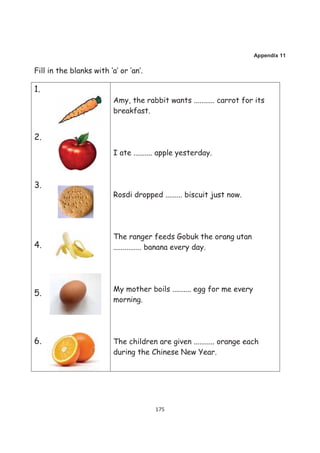
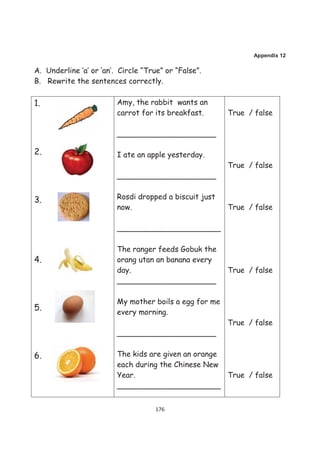
resting in the pupa for some time. Finally, from a pupa, I became a butterfly.”
        “Wow! It sounds like magic and you are more beautiful now.”
        Together they laughed happily.


                                          41
Appendix 6


       Life Cycle of a Butterfly


                Butterfly


                                     Egg
Pupa


               Caterpillar


                   42
Appendix 7


Making a puppet
Instructions:
1.    Colour and cut out the blouse and skirt.
2.    Glue the wool on top of the egg shell.
3.    Mount the egg shell on top of the bottle.
4.    Glue the blouse and skirt on the bottle.
5.     Draw the eyes, nose and mouth on the egg shell.


                                       43
Appendix 8


Maze 1.2.2(b)
Note : Teacher to prepare the front portion of the class or field.


                                          44
APPENDIX 9


           T
           O    CLASSROOMS           SCIENCE LAB
SCIENCE    I
GARDEN            BLOCK C
           L
           E
           T                         CLASSROOMS
                                       BLOCK D


 CANTEEN                         T
                                 O
               RESOURCE CENTRE   I           HALL
                   BLOCK B
                                 L
                                 E
                                 T


               CLASSROOMS
                 BLOCK A                    FIELD

                  OFFICE


                     45
Appendix 10


Instruction: Listen to the statements carefully and state ‘true’ or ‘false’.
 1. Surin Nam Pritsom lives in Bangkok.            True / False
 2. She visited her grandfather’s farm.            True / False
 3. There were less than fifty crocodiles in the   True / False
     farm.
 4. The crocodiles had hard and rough scales.      True / False
 5. The men fed them fish.                         True / False
 6. Surin did not enjoy the trip.                  True / False


                               46
Appendix 11


1.
2.
3.
4.
5.
6.
7.


8.


     47
Appendix 12


48
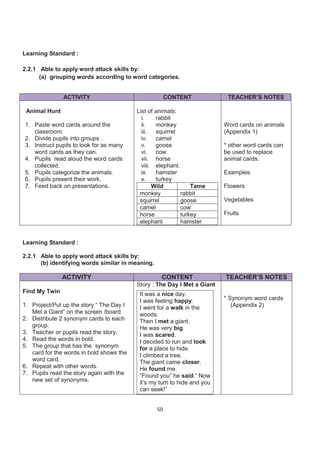
THE READING SKILL
At the end of primary education, pupils should be able to apply knowledge of sounds of letters to
recognise words in order to begin reading and then move on to the more complex skill using a range of
strategies to construct meaning from the text read. The ultimate goal of the reading component in
primary school is to produce pupils who will be able to read independently for information and enjoyment.
The Content and Learning Standards for Year 3 are:

      CONTENT STANDARDS                                    LEARNING STANDARDS


2.2    By the end of the 6-year       2.2.1    Able to apply word attack skills by:
       primary schooling, pupils              (a) grouping words according to word categories.
       will be able to demonstrate            (b) identifying words similar in meaning
       understanding of a                     (c) identifying words opposite in meaning
       variety of linear and non-
       linear texts in the form of    2.2.2. Able to read and understand phrases and sentences in
       print and non-print                   linear and non-linear texts.
       materials using
       a range of strategies to       2.2.3    Able to read and understand simple and compound
       construct meaning.                      sentences.

                                      2.2.4. Able to read and understand a paragraph with simple and
                                             compound sentences.

                                      2.2.5    Able to apply dictionary skills to locate words.
                                               (a) entry points.
                                               (b) exit points.


2.3 By the end of the 6-year          2.3.1 Able to read for information and enjoyment with guidance:
    primary schooling, pupils
    will be able to read                      (a) fiction
    independently for                         (b) non- fiction
    information and enjoyment.


In order to achieve the abovementioned, content standards and learning standards have been devised
progressively. The teaching of reading in the early stages begins at the word and phrase levels before
progressing to sentence recognition and reading at the paragraph level. Gradually, pupils are taught to
extract specific information from a text and to respond to a text with their own ideas and opinions.


                                                     49
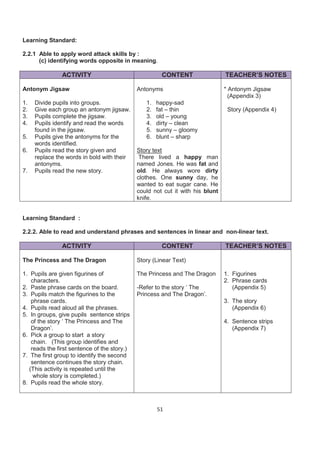
Learning Standard :

2.2.1 Able to apply word attack skills by:
      (a) grouping words according to word categories.


               ACTIVITY                                CONTENT             TEACHER’S NOTES

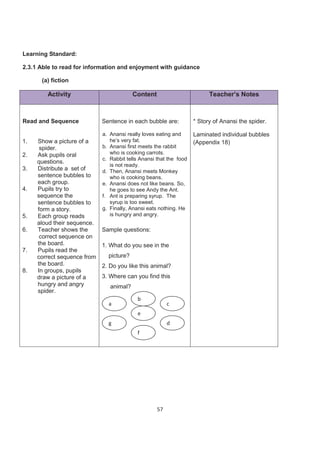
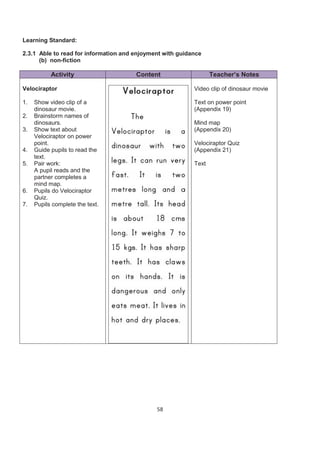
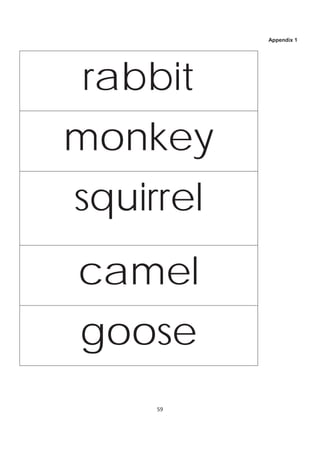
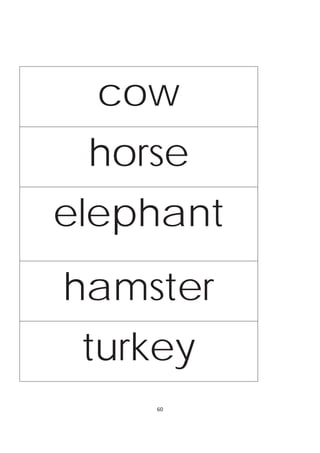
 Animal Hunt                              List of animals:
                                            i.    rabbit
1. Paste word cards around the              ii.   monkey                  Word cards on animals
   classroom.                               iii.  squirrel                (Appendix 1)
2. Divide pupils into groups .              iv. camel
3. Instruct pupils to look for as many      v.    goose                   * other word cards can
   word cards as they can.                  vi. cow                       be used to replace
4. Pupils read aloud the word cards         vii. horse                    animal cards.
   collected.                               viii. elephant.
5. Pupils categorize the animals.           ix. hamster                   Examples:
6. Pupils present their work.               x.    turkey
7. Feed back on presentations.                   Wild           Tame      Flowers
                                           monkey           rabbit
                                           squirrel         goose         Vegetables
                                           camel            cow
                                           horse            turkey        Fruits
                                           elephant         hamster


Learning Standard :

2.2.1 Able to apply word attack skills by:
      (b) identifying words similar in meaning.

               ACTIVITY                            CONTENT                TEACHER’S NOTES
                                          Story : The Day I Met a Giant
Find My Twin                               It was a nice day.
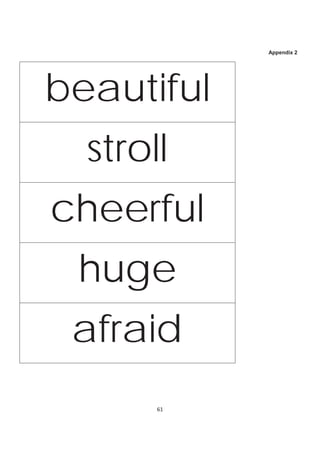
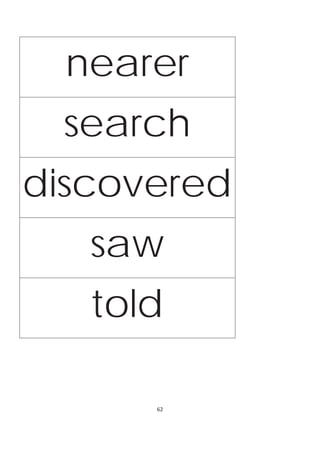
                                           I was feeling happy.           * Synonym word cards
1. Project/Put up the story “ The Day I    I went for a walk in the          (Appendix 2)
   Met a Giant” on the screen /board.      woods.
2. Distribute 2 synonym cards to each      Then I met a giant.
   group.                                  He was very big.
3. Teacher or pupils read the story.       I was scared.
4. Read the words in bold.                 I decided to run and look
5. The group that has the synonym          for a place to hide.
   card for the words in bold shows the    I climbed a tree.
   word card.                              The giant came closer.
6. Repeat with other words.                He found me.
7. Pupils read the story again with the    “Found you” he said.” Now
   new set of synonyms.                    it’s my turn to hide and you
                                           can seek!”


                                                  50
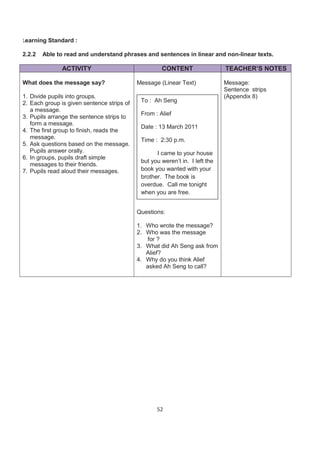
Learning Standard:

2.2.1 Able to apply word attack skills by :
      (c) identifying words opposite in meaning.

               ACTIVITY                                CONTENT                  TEACHER’S NOTES

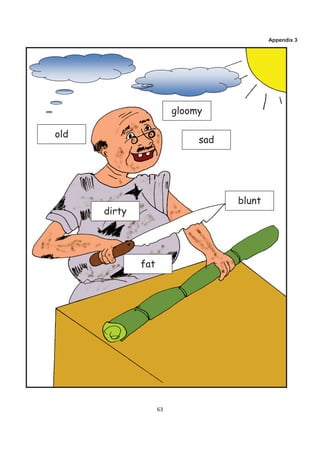
Antonym Jigsaw                                Antonyms                          * Antonym Jigsaw
                                                                                  (Appendix 3)
1.   Divide pupils into groups.                  1.   happy-sad
2.   Give each group an antonym jigsaw.          2.   fat – thin                 Story (Appendix 4)
3.   Pupils complete the jigsaw.                 3.   old – young
4.   Pupils identify and read the words          4.   dirty – clean
     found in the jigsaw.                        5.   sunny – gloomy
5.   Pupils give the antonyms for the            6.   blunt – sharp
     words identified.
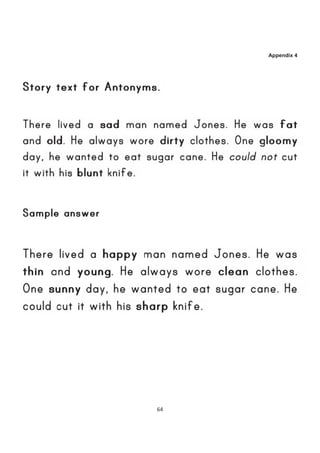
6.   Pupils read the story given and          Story text
     replace the words in bold with their      There lived a happy man
     antonyms.                                named Jones. He was fat and
7.   Pupils read the new story.               old. He always wore dirty
                                              clothes. One sunny day, he
                                              wanted to eat sugar cane. He
                                              could not cut it with his blunt
                                              knife.


Learning Standard :

2.2.2. Able to read and understand phrases and sentences in linear and non-linear text.

               ACTIVITY                                CONTENT                  TEACHER’S NOTES

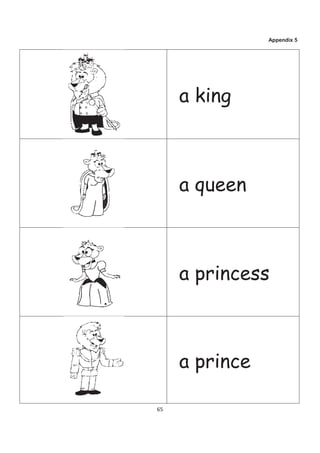
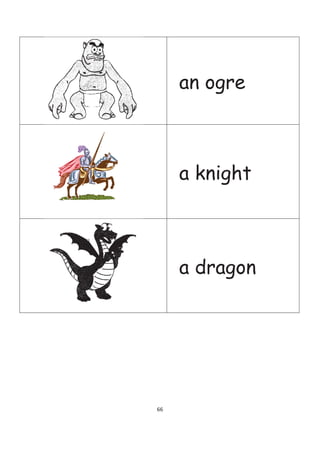
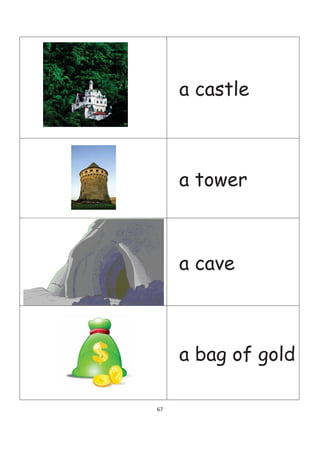
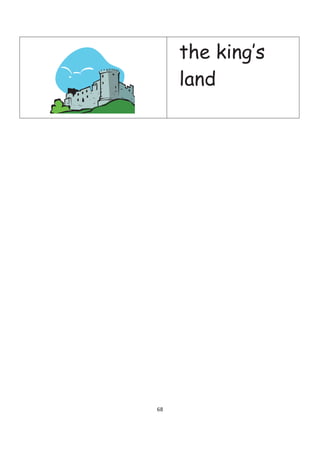
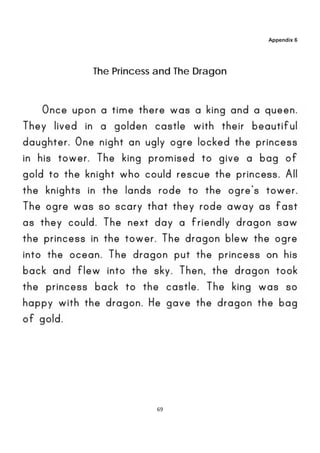
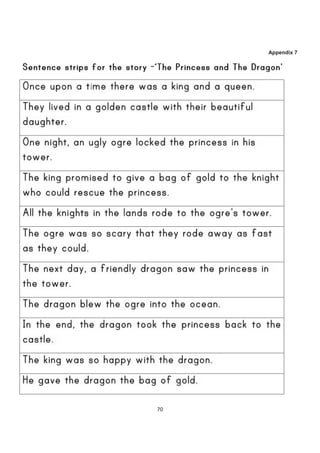
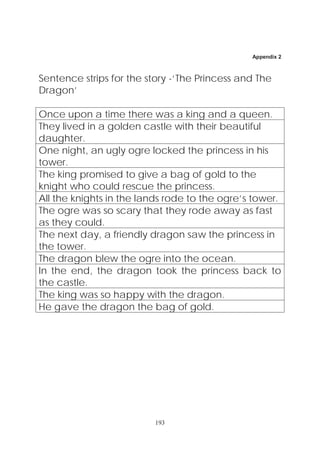
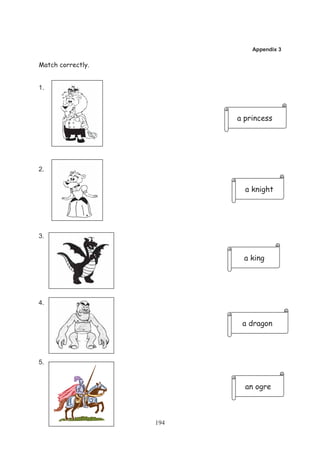
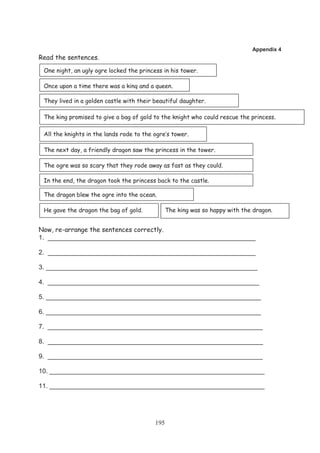
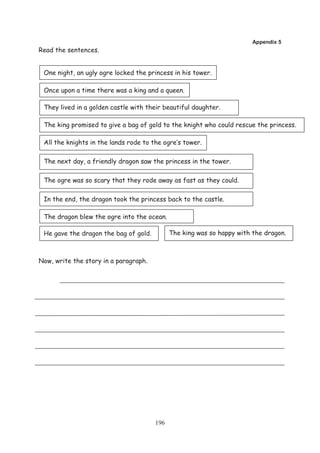
The Princess and The Dragon                   Story (Linear Text)

1. Pupils are given figurines of              The Princess and The Dragon       1. Figurines
    characters.                                                                 2. Phrase cards
2. Paste phrase cards on the board.           -Refer to the story ‘ The            (Appendix 5)
3. Pupils match the figurines to the          Princess and The Dragon’.
    phrase cards.                                                               3. The story
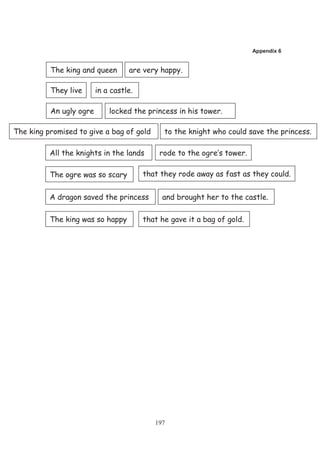
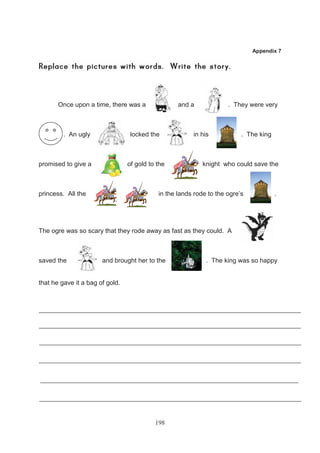
4. Pupils read aloud all the phrases.                                              (Appendix 6)
5. In groups, give pupils sentence strips
    of the story ‘ The Princess and The                                         4. Sentence strips
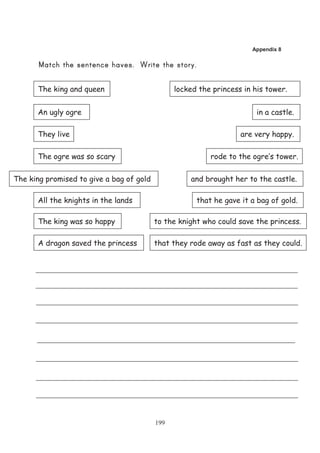
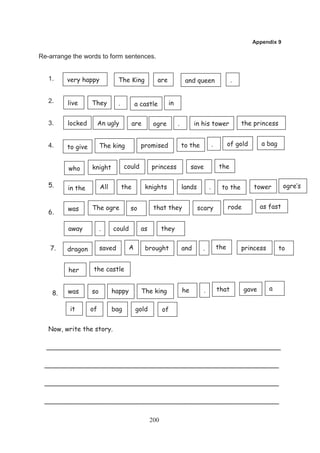
    Dragon’.                                                                       (Appendix 7)
6. Pick a group to start a story
    chain. (This group identifies and
    reads the first sentence of the story.)
7. The first group to identify the second
    sentence continues the story chain.
   (This activity is repeated until the
     whole story is completed.)
8. Pupils read the whole story.


                                                      51
Learning Standard :

2.2.2   Able to read and understand phrases and sentences in linear and non-linear texts.

               ACTIVITY                              CONTENT                  TEACHER’S NOTES

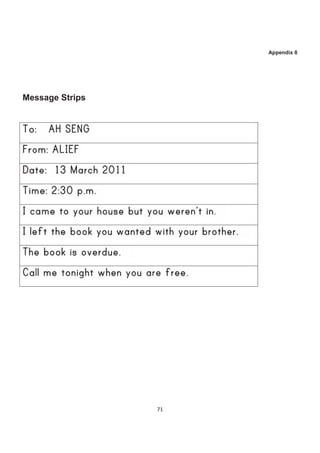
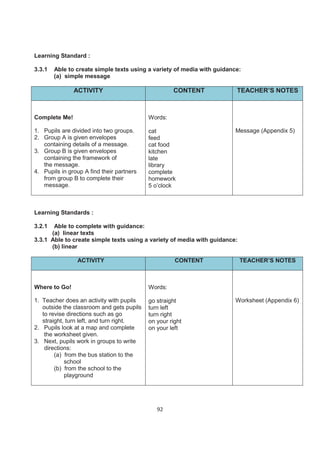
What does the message say?                  Message (Linear Text)             Message:
                                                                              Sentence strips
1. Divide pupils into groups.                                                 (Appendix 8)
2. Each group is given sentence strips of    To : Ah Seng
   a message.
                                             From : Alief
3. Pupils arrange the sentence strips to
   form a message.
                                             Date : 13 March 2011
4. The first group to finish, reads the
   message.                                  Time : 2:30 p.m.
5. Ask questions based on the message.
   Pupils answer orally.                           I came to your house
6. In groups, pupils draft simple
                                             but you weren’t in. I left the
   messages to their friends.
7. Pupils read aloud their messages.         book you wanted with your
                                             brother. The book is
                                             overdue. Call me tonight
                                             when you are free.


                                            Questions:

                                            1. Who wrote the message?
                                            2. Who was the message
                                               for ?
                                            3. What did Ah Seng ask from
                                               Alief?
                                            4. Why do you think Alief
                                               asked Ah Seng to call?


                                                   52
Learning Standard :

2.2.2   Able to read and understand phrases and sentences in linear and non-linear texts.

               ACTIVITY                             CONTENT                    TEACHER’S NOTES

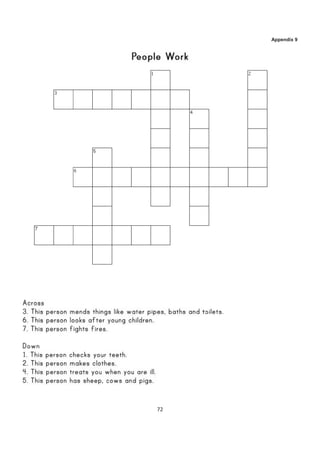
 People Work                              People work                            People Work Rhyme
                                                                                 Puzzle
 1. Pupils complete a puzzle in groups.   People work in the country             (Appendix 9)
 2. Put up the rhyme – People Work        People work in the town
 3. Pupils recite the rhyme:              People work day and night
                                          To make the world go round
    - model reading
    - shared reading                      Nigel Naylor, he’s a tailor          http://learnenglishkids.
                                          He makes trousers, suits and         britishcouncil.org/en/
                                          shirts
                                          Penny Proctor, she’s a doctor
                                          Comes to see you when it hurts

                                          Peter Palmer, he’s a farmer
                                          He’s got cows and pigs and
                                          sheep
                                          Wendy Witter, babysitter
                                          Minds the kids when they’re
                                          asleep

                                          Mabel Meacher, language
                                          teacher
                                          Teaches English, French and
                                          Greek
                                          Gary Gummer, he’s a plumber
                                          Call him when you’ve got a leak

                                          Patty Prentice, she’s a dentist
                                          Keeps your teeth both clean and
                                          white
                                          Ronnie Ryman, he’s a fireman
                                          Comes when there’s a fire to fight

                                          People work in the country
                                          People work in the town
                                          People work day and night
                                          To make the world go round


                                          People Work (simpler version)

                                          People work in the country
                                          People work in the town
                                          People work day and night
                                          To make the world go round

                                          Nigel Naylor, he’s a tailor
                                          He sews trousers, skirts and
                                          shirts
                                          Penny Proctor, she’s a doctor
                                          Come to see her when you are
                                          sick
                                                  53
Peter Palmer, he’s a farmer
                                         He’s got cows and sheep
                                         Wendy Witter, babysitter
                                         Her job is to take care of kids

                                         Mabel Meacher, she‘s a teacher
                                         Teaches English to her pupils
                                         Gary Gummer, he’s a plumber
                                         He repairs broken pipes

                                         Patty Prentice, she’s a dentist
                                         She keeps your teeth healthy
                                         Ronnie Ryman, he’s a fireman
                                         He helps to put out fire

                                         People work in the country
                                         People work in the town
                                         People work day and night
                                         To make the world go round


Learning Standard :

2.2.2 Able to read and understand phrases and sentences in linear and non-linear texts.

                ACTIVITY                            CONTENT                TEACHER’S NOTES

 Movie Poster                            Movie Poster BEN 10 (Non-         BEN 10 Poster
                                         linear text)                      (Appendix 10)
 1. Pupils are given a movie poster of
    BEN 10.                              Discussion questions.             Incomplete Poster
 2. Ask questions about the poster .     a. This is a movie poster.        (Appendix 11)
    (see discussion questions)               Can you give me the name
 3. Ask pupils to read the information       of the movie?                 Information transfer
    in the poster.                       b. How many characters do         table.
 4. Pupils are given a BEN 10 poster.        you see in the poster?        (Appendix 12)
    They fill in the name of the         c. Can you name the
    characters in groups.                    characters?
 5. Pupils are given a table to
    complete.( refer to the table on
    BEN10)
 6. Pupils read out the completed
    table.


                                                  54
Learning Standard:

2.2.3 Able to read and understand simple and compound sentences.

               ACTIVITY                               CONTENT                    TEACHER’S NOTES

Read and Draw                              Sentence strips                       * sentence strips
                                                                                   (Appendix 13)
1. Put the first sentence strip on the      I came home on a windy
   board.                                   day.                                 * frame of a house and
2. Ask pupils what they think happened.     I found all the clothes blown           a garden
3. Put the second sentence strip.           away.                                   (Appendix 14)
4. Pupils read aloud the sentence strip     Dad’s shirt and tie flew up in
   and draw on the frame given.             the sky.
5. Repeat steps 3 and 4 with other          Sister’s skirt fell into the dirt.
   sentence strips.                         My three socks were in the
6. Pupils compare their drawings with       box.
   each other.                              Brother’s jeans ended up in
7. Teacher shows the correct drawing –      the dustbin.
   discussion.                              Mum’s old hat looked good
                                            on the cat.
                                            My shirt and shorts were in
                                            a puddle of water.


Learning Standard:

2.2.4 Able to read and understand a paragraph with simple and compound sentences.

               ACTIVITY                               CONTENT                    TEACHER’S NOTES

Read and Sequence                                                                Text (Appendix 15)

1.   Ask pupils to read the text aloud.                                          Picture (Appendix 16)
2.   In groups, they are given
     worksheets.
3.   Pupils read the text again and
     complete the picture.
4.   Extension:
     Pupils choose their favourite clown
     and talk about it.


                                                   55
Learning Standard:

2.2.5 Able to apply dictionary skills to locate words.
      (a) entry points
      (b) exit points

          ACTIVITY                          CONTENT           TEACHER’S NOTES

Dictionary War                                           Sample dictionary page
                                    Words                (Appendix 17)
1.   Guide pupils to look for                            (This activity can be done with
     the meaning of the word        alien                other words.)
     ‘alien’ from the dictionary.   dangerous
2.   Explain entry/exit points      claws
     to locate words in the         weighs               Note:
     dictionary. (refer             puddle
     attachment)                                         a.   Get pupils to look up the
3.   Divide class into groups.                                first two letters of the
4.   Each pupil needs a                                       word at the top left hand
     dictionary.                                              and right hand corner of
5.   Teacher writes four words                                the page ; for e.g. for the
     on the board.                                            word ‘alien’, look for ‘al’.
6.   Each pupil in the group                             b.   After you have identified
     finds one word in the                                    the first two letters and if
     dictionary and points to it.                             there are more than one
7.   When all members of the                                  page with the same
     group have located all                                   letters, look for the next
     four words they raise their                              letter. For the word
     hands.                                                   ‘alien’; you need to look
8.   Then, pupils read out the                                for ‘ali’.
     meanings of the words                               c.   After finding, ‘ali’ then
     found.                                                   scan the page and
9.   The first group to raise                                 identify the word.
     their hands is awarded                              d.   The word on the top left
     points.                                                  hand or right hand corner
                                                              is called the ‘entry’ point.
                                                              The word that you have
                                                              been looking for is called
                                                              the ‘exit’ point.


                                                 56
Learning Standard:

2.3.1 Able to read for information and enjoyment with guidance

      (a) fiction

        Activity                         Content                          Teacher’s Notes


Read and Sequence            Sentence in each bubble are:           * Story of Anansi the spider.

                             a. Anansi really loves eating and      Laminated individual bubbles
1.   Show a picture of a        he’s very fat.                      (Appendix 18)
      spider.                b. Anansi first meets the rabbit
2.   Ask pupils oral            who is cooking carrots.
                             c. Rabbit tells Anansi that the food
     questions.
                                is not ready.
3.   Distribute a set of     d. Then, Anansi meets Monkey
     sentence bubbles to        who is cooking beans.
     each group.             e. Anansi does not like beans. So,
4.   Pupils try to              he goes to see Andy the Ant.
     sequence the            f. Ant is preparing syrup. The
     sentence bubbles to        syrup is too sweet.
     form a story.           g. Finally, Anansi eats nothing. He
5.   Each group reads           is hungry and angry.
     aloud their sequence.
6.   Teacher shows the
      correct sequence on
     the board.
7.   Pupils read the
     correct sequence from
     the board.
8.   In groups, pupils
     draw a picture of a
     hungry and angry
     spider.
                                           b
                               a                         c
                                           e
                               g                         d
                                           f


                                                    57
Learning Standard:

2.3.1 Able to read for information and enjoyment with guidance
      (b) non-fiction

           Activity                    Content                    Teacher’s Notes

Velociraptor                                               Video clip of dinosaur movie

1.   Show video clip of a                                  Text on power point
     dinosaur movie.                                       (Appendix 19)
2.   Brainstorm names of
     dinosaurs.                                            Mind map
3.   Show text about                                       (Appendix 20)
     Velociraptor on power
     point.                                                Velociraptor Quiz
4.   Guide pupils to read the                              (Appendix 21)
     text.
5.   Pair work:                                            Text
     A pupil reads and the
     partner completes a
     mind map.
6.   Pupils do Velociraptor
     Quiz.
7.   Pupils complete the text.


                                              58
Appendix 1


rabbit
monkey
squirrel
camel
goose
     59
cow
 horse
elephant
hamster
 turkey
    60
Appendix 2


beautiful
  stroll
cheerful
 huge
 afraid
       61
nearer
 search
discovered
   saw
   told

      62
Appendix 3


                         gloomy

old
                              sad


                                    blunt
      dirty


              fat


                    63
Appendix 4


64
Appendix 5


     a king


     a queen


     a princess


     a prince

65
an ogre


     a knight


     a dragon


66
a castle


     a tower


     a cave


     a bag of gold

67
the king’s
     land


68
Appendix 6


The Princess and The Dragon


            69
Appendix 7


70
Appendix 8


Message Strips


                 71
Appendix 9


72
Appendix 10


Time of show: 12.30 p.m. , 3.30 p.m. , 7.30 p.m.

Place: Cineplex Leisure Mall

Price of tickets:

     Adults           RM12.00

     Children         RM 6.00

Ben is a young boy. One day he finds a watch. He wears the watch and he
is unable to remove it. When he presses the watch, Ben changes into
different types of aliens…

                                     73
Appendix 11


74
Appendix 12


     BEN 10


75
Appendix 13


76
Appendix 14


77
Appendix 15
78
Appendix 16


76
Appendix 17


80
Appendix 18


   Anansi really
   loves eating
   and he’s very
   fat.


Anansi first meets
the rabbit who is
cooking carrots.
        78
Rabbit tells
Anansi that
the food is
not ready.


 Then, Anansi
 meets Monkey
 who is cooking
 beans.

     79
Anansi does not
 like beans. So,
 he goes to see
 Andy, the Ant.


Ant is preparing
syrup. The syrup
is too sweet.

      83
Finally, Anansi
eats nothing.
He is hungry
and angry.


     84
Appendix 19


Velociraptor


 82
Appendix 20
     Complete the mind map.
Height:
Weight:
Habitat:                           Food:
                              86
Appendix 21


87
Appendix 22


Fill in the blanks to complete the text.


                                88
THE WRITING SKILL
                   Pupils acquired penmanship and started basic writing in Year 1. Therefore,
                   by Year 3, it is hoped that they would have developed good motor skills and
                   are able to write in neat, legible print words, phrases, simple sentences as
well as punctuate correctly. Pupils are expected to write and present their ideas through a
variety of media. Therefore, the teacher’s role is crucial as she/he needs to teach pupils how to
write well. In order to do so, the scaffolding to writing has to be provided so that pupils are
guided to write a variety of texts correctly. Model and shared writing are ways in which teachers
can guide pupils in their writing experience.

The Content and Learning Standards for writing are:

  CONTENT STANDARDS                                   LEARNING STANDARDS

3.1   By the end of the 6-year       3.1.1 Able to write in neat legible print with correct spelling :
      primary schooling, pupils            (a) phrases
      will be able to form letters         (b) simple sentences
      and words in neat legible
      print including cursive
      writing.                       3.1.2 Able to write numerals in neat legible print with
                                            correct spelling:
                                           (a) numeral form
                                           (b) word form


3.2   By the end of the 6 year       3.2.1 Able to complete :
      primary schooling, pupils            (a) linear texts
      will be able to write using          (b) non-linear texts.
      appropriate language,
      form and style for a range     3.2.2 Able to write with guidance
      of purposes.                         (a) simple sentences
                                           (b) compound sentences
                                           (c) questions

                                     3.2.3 Able to punctuate correctly:
                                           (a) exclamation mark
                                           (b) comma

                                     3.2.4 Able to spell common sight words.

3.3. By the end of the 6-year        3.3.1 Able to create simple texts using a variety of media
     primary schooling, pupils             with guidance :
     will be able to write and
     present ideas through a                (a) non-linear
     variety of media using                 (b) linear
     appropriate language, form
     and style.


                                                 89
Learning Standard :

3.1.1   Able to write in neat legible print with correct spelling:
        (a) words
        (b) phrases
        (c) simple sentences


               ACTIVITY                                CONTENT              TEACHER’S NOTES


 Learning to Write                          Words:                          Figurines
                                                                            Word Cards
1. Show pictures of different parts of      ear                             Phrase Cards
   an elephant.                             tail                            Substitution table
2. Ask questions orally.                    tusk
3. Pupils spell the words.                  trunk
4. Pupils label a picture.                  legs                            Parts of an elephant
5. Talk about the elephant.                                                 (Appendix 1)
6. Ask questions about the elephant.        Phrases:
                                                                            Worksheet (Appendix 2)
     e.g. How many ears does an             two big ears
          elephant have?                    four strong legs                Substitution table
          Two ears                          a long trunk                    (Appendix 3)
                                            a short tail
          Are the ears big or small?        two white tusks
          Big
6.   Pupils read phrases written on         Sentences:
     cards.
                                            1.   An elephant has two big
    e.g. two big ears                            ears.
          four strong legs                  2.   It has four strong legs.
7. Show a substitution table.               3.   It has a long trunk.
8. Pupils make sentences from the
   table.
9. Pupils write sentences in neat legible
   print.


                                                 90
Learning Standard :

3.1.2   Able to write numerals in neat legible print with correct spelling:
        (a) numeral form
        (b) word form


                 ACTIVITY                           CONTENT                   TEACHER’S NOTES


Spell It Right                                                            Letter Cards

1. Provide pupils with triple lines and
   letter cards.
2. Say out a number and pupils choose
   the correct letter cards and place
   them on the triple line.
3. Repeat with other numbers.
4. Pupils copy them in exercise books.


Learning Standard :

3.2.1 Able to complete with guidance:
      (b) non-linear texts


                 ACTIVITY                           CONTENT                   TEACHER’S NOTES


Rebus                                     Words:

1. Pupils are given a message with        school                          Message (Appendix 4)
   pictures.                              rabbit
2. Pupils rewrite the message by          carrots                         This activity is also
   replacing the pictures with words.     cut                             known as rebus writing.
3. This activity can be conducted in      refrigerator
   groups as a competition.


                                             91
Learning Standard :

3.3.1   Able to create simple texts using a variety of media with guidance:
        (a) simple message

               ACTIVITY                             CONTENT              TEACHER’S NOTES


Complete Me!                               Words:

1. Pupils are divided into two groups.     cat                           Message (Appendix 5)
2. Group A is given envelopes              feed
   containing details of a message.        cat food
3. Group B is given envelopes              kitchen
   containing the framework of             late
   the message.                            library
4. Pupils in group A find their partners   complete
   from group B to complete their          homework
   message.                                5 o’clock


Learning Standards :

3.2.1  Able to complete with guidance:
      (a) linear texts
3.3.1 Able to create simple texts using a variety of media with guidance:
      (b) linear

                ACTIVITY                             CONTENT                TEACHER’S NOTES


Where to Go!                               Words:

1. Teacher does an activity with pupils    go straight                   Worksheet (Appendix 6)
   outside the classroom and gets pupils   turn left
   to revise directions such as go         turn right
   straight, turn left, and turn right.    on your right
2. Pupils look at a map and complete       on your left
    the worksheet given.
3. Next, pupils work in groups to write
    directions:
        (a) from the bus station to the
            school
        (b) from the school to the
            playground


                                              92
Learning Standards:

3.2.1 Able to complete with guidance:
      (a) non-linear texts
3.2.2 Able to write with guidance:
      (a) simple sentences

               ACTIVITY                              CONTENT                 TEACHER’S NOTES


My Friend                                  Words:

1. Pupils talk to a friend and complete    name                             Worksheet (Appendix 7)
    a non-linear text pertaining to        age
    personal details:                      address
    (a) complete the table given; or       hobby
    (b) draw a friend’s picture and        ambition
        complete a graphic organiser.      favourite food
2. Pupils write simple sentences
   about their friend from the completed   1. My friend is _________.
   table or graphic organiser.             2. He is ______________.
3. Pupils arrange the sentences into a     3. He lives at ____________.
   paragraph in neat legible print.        4. His hobby is ___________.
4. Pupils work can be compiled in a        5. His favourite food is _____
   folio. (individual or groups)              _________.
                                           6. He wants to be _________
                                              when he grows up.

Learning Standards:

3.2.1  Able to complete with guidance:
      (a) non-linear texts
3.2.2 Able to create simple texts using a variety of media with guidance
      (a) non-linear

               ACTIVITY                              CONTENT                 TEACHER’S NOTES


Class Party                                Sample questions:                Notice (Appendix 8)

1. Take pupils to the school notice        What is the notice about?        Notice frame & phrase
   board.                                  When is the event?               strips
2. Get pupils to read the notices.         Where will it be held?           (Appendix 9)
3. Get back to the class and ask pupils
   to give details about the notices.
4. Show a sample of a notice.
5. Read the details in the notice.
6. Put up a notice/poster of a
   canteen day.

                                                93
7. Provide pupils with details written on
   strips of paper.
8. Get pupils to paste the strips at the
   correct places.
9. Pupils complete the worksheet.

Extension:
   Pupils are given a framework of a                                     Worksheet
   notice. (Class Party)                                                 (Appendix 10)
   Pupils complete the notice.


Learning Standard :

3.2.1 Able to complete with guidance:
      (a) non-linear texts

                ACTIVITY                              CONTENT             TEACHER’S NOTES


Movie Poster
                                                                         Worksheet
1. Show sample posters from the                                          (Appendix 11)
   newspaper movie column.
2. Ask questions to get information
   about the movie(s). (title, time, place)
3. Pupils complete text based on the
   advertisement.


Learning Standard :

3.3.1   Able to create simple texts using a variety of media with guidance:
        (a) non-linear

                ACTIVITY                              CONTENT             TEACHER’S NOTES

                                              Happy Birthday!
Happy Birthday                                Selamat Hari Raya
                                              Happy Chinese New Year     Note: create any
1. Demonstrate how to make a greeting         Happy Deepavali            greeting card and
   card.                                      Merry Christmas            encourage pupils to
2. Pupils make a greeting card and            Get Well Soon              write simple messages.
   write their own greetings.                 Thank You


                                                94
Learning Standard :

3.2.2    Able to write with guidance:
        (c) questions

               ACTIVITY                               CONTENT                   TEACHER’S NOTES


Getting to Know….
                                           Wh-Questions:                       Dialogue (Appendix 12)
1. Role play the dialogue.
2. Ask questions based on the dialogue.    Who                                 Worksheet (Level 1)
   e.g. Who is Sponge Bob Square           What                                (Appendix 13)
        Pants?                             Where
        Where is Sponge Bob Square         How                                 Worksheet (Level 2)
        Pants?                                                                 (Appendix 14)
3. Teacher provides worksheet
   according to pupils’ ability.


Learning Standard :

3.2.2 Able to write with guidance:
      (a) simple sentences
      (b) compound sentences


               ACTIVITY                               CONTENT                   TEACHER’S NOTES


Ask Me
                                           What is this?                       Picture (Appendix 15)
1. Show picture of a tiger.                This is a tiger.
2. Talk about the tiger by asking pupils   (simple sentence)                   Scaffolding to writing
   questions.                                                                  (Appendix 15)
3. Write down the answers on the           Is it a wild or tame animal?
   board.                                  It is a wild animal.                Notes on simple and
4. Get pupils to combine simple            (simple sentence)                   compound sentences
   sentences to form compound                                                  (Appendix 16)
   sentences.                              This is a tiger, and it is a wild
5. This is done step by step until a       animal.
   paragraph is written about the tiger.   (compound sentence)


                                              95
Learning Standard :

3.2.3   Able to punctuate correctly:
        (a) exclamation mark
        (b) comma


                ACTIVITY                               CONTENT                  TEACHER’S NOTES


Punctuate Me!
                                             Sample sentences:                 Pupils are taught the
1. Distribute punctuation cards.                                               use of exclamation
2. Read out sentences with the correct       Help! Help!                       mark, comma and other
   intonation to stress on the               I have a teddy bear, a toy car    punctuation marks
   punctuation.                              and a ball.                       earlier.
3. Pupils with the correct punctuation
   card will hold up the card for each
   sentence read.


Correct Me!                                  Sample sentence:                  This activity can be
                                                                               done in groups or
1. Provide sentences with punctuation        Mother bought A kilo of fish! A   individually.
   errors. Pupils identify and correct the   chicken, and some
   errors.                                   vegetables?


Learning Standard :

3.2.4 Able to spell common sight words.

                ACTIVITY                               CONTENT                  TEACHER’S NOTES


Walking Spelling
                                             Words learnt in topics covered    Spelling can be done
1. Words are put around the class. A         earlier.                          orally and followed by
   pupil will ‘spy’ on a word and say it                                       written work.
   out; others will spell and write.


Fun Spelling
1. Cut out letters from newspapers or                                          Teacher prepares a list
   magazines. Use the letters to spell                                         of words or pictures.
   words from word list or pictures          Words learnt in topics covered
   given.                                    earlier.


                                               96
Learning Standard :

3.3.1 Able to create simple texts using a variety of media with guidance:
      (a) non-linear
      (b) linear


                ACTIVITY                                CONTENT         TEACHER’S NOTES


Transformers
                                              Words:                   Picture (Appendix 17)
1. Show a picture of the rafflesia.
2. Talk about the flower; its colour, size,   biggest                  Text (Appendix 17)
   characteristic, etc.                       weighs
3. Read a text on the rafflesia.              blooms                   Worksheet
4. Complete the graphic organiser.            stinks                   (Appendix 18)
5. Write a paragraph on the rafflesia.        flesh
   Pupils may construct simple or             petals
   compound sentences.


                                                97
Appendix 1


98
Appendix 2


99
Appendix 3


1.   ____________________________________________________________________________


2.   ____________________________________________________________________________


3.   ____________________________________________________________________________


4.   ____________________________________________________________________________


5.   ____________________________________________________________________________


                                         100
Appendix 4


,


          .


    101
Appendix 5


102
Appendix 6


103
Appendix 7

                     .


    Name

    Age

    Address

    Hobby

    Ambition

    Favourite food


                                        .


:


                                  :


                         104
Appendix 8


105
Appendix 9


    JUMBLE SALE           10 SEPTEMBER 2010       TIME :


 ACTIVITIES :          SK TAMAN JAYA          VENUE :


 8.00 A.M. TO 2.00 P.M.       DATE :     HAUNTED HOUSE


GAMES           SCHOOL CANTEEN DAY        FOOD GALLERY


                            106
Appendix 10


Date :

Time :

Venue :

Activities :


               107
Appendix 11


Cinema: GSC - MID VALLEY (Phone Reservation:
03-83123456)
Date: Thursday, 17 Mar 2011
Available Dates: Thu, 17 Mar | Fri, 18 Mar | Sat, 19
Mar | Sun, 20 Mar | Mon, 21 Mar | Tue, 22 Mar |
Wed, 23 Mar


Toy Story 3 – English (PG 13) Gold Class

11:00 AM 01:30 PM 04:00 PM 06:30 PM
 09:00 PM 11:30 PM

Price : RM12.00 (adults)
         RM5.00 (school children)


   108
Appendix 12


109
Appendix 13


1. __________________________________________________________________


2. __________________________________________________________________


3. ___________________________________________________________________


4. ___________________________________________________________________


5. ___________________________________________________________________


6. ________________________________________________________________________


                                     110
Appendix 14


111
Appendix 15

.


    112
Scaffolding to writing


1.     This is a tiger.

2.     It is a wild animal.

This is a tiger and it is a wild animal.

3.     It has orange and black stripes.

4.     It has two eyes.

5.     They are big.

It has two eyes and they are big.

6.     It has a long tail.

7.     It has long whiskers too.

It has a long tail and it has long whiskers too.

8.     Tigers have claws.

9.     The tigers claws are sharp.

Tigers have claws and they are sharp.

10.    It lives in the jungle.

11.    It eats meat.

The tiger lives in the jungle and it eats meat.


                                             113
Appendix 16

Note for teachers only:


Simple sentence

       The basic English language sentence is called a simple sentence. A simple
sentence contains a subject and a verb. It constitutes a complete thought which is
called an independent clause.

       Example:

                     I like English.

                     We are playing football.

Compound Sentence

      Compound sentences are made up of two or more simple sentences.               A
compound sentence contains two independent clauses. Each clause can stand alone
as a sentence. Each clause is like a sentence with a subject and a verb. It is usually
combined using a conjunction such as and, or or but. The conjunction goes in the
middle of the sentence, it is the word that joins the two clauses together.

       Example:
                     The sun was setting in the west and the moon was just rising.

                     I walked to the shops but Latif walked to the playground.

                     Can I prepare a sandwich or we buy sandwiches at the bakery?


References:

http://www.iscribe.org/english/sent.html

Loberger, Gordon & Shoup, Kate. Websters New World. English Grammar Handbook. Second
edition. Wiley. 2009


                                           114
Appendix 17


http://www.arkive.org/rafflesia/rafflesia-spp/


                                                 115
Appendix 18


                         4


                                                   6.


  _________


 3.
                                                   7.


                         8.


_________________________________________________________


                              116
LANGUAGE ARTS
         Language Arts is a new component designed to create appreciation and enjoyment
amongst pupils as they learn the English language. This experience should be fun filled and
used as a means to create confidence in pupils to use the language without inhibitions. The
rationale behind Language Arts is to steer the continuous growth and development of pupils’
thinking and language abilities. The teaching of language arts will help pupils develop their
oracy and analytical skills, as well as hone their creativity. Language Arts creates ample
opportunities for pupils to speak in English in a very relaxed atmosphere. This will help increase
pupils’ confidence in using the English language.

The Content and Learning Standards for Language Arts are:

      CONTENT STANDARDS                                 LEARNING STANDARDS
4.1    By the end of the 6-year     4.1.1    Able to enjoy action songs, jazz chants and poems
       primary schooling, pupils             through non-verbal response.
       will be able to enjoy and
       appreciate rhymes,           4.1.2     Able to sing action songs, recite jazz chants and
       poems and songs.                       poems with correct pronunciation, rhythm and
                                              intonation.

4.2    By the end of the 6-year     4.2.1 Able to respond to :
       primary schooling pupils           (a) characters
       will be able to express            (b) place
       personal esponse to
       literary texts.                       in stories with guidance.


4.3.   By the end of the 6-year     4.3.1 Able to produce simple creative works with guidance
       primary schooling, pupils          based on :
       will be able to plan,
       organise and produce                 (a)   jazz chants
       creative works for                   (b)   poems
       enjoyment.                           (c)   action songs
                                            (d)   stories

                                    4.3.2 Able to perform with guidance based on :

                                            (a)   jazz chants
                                            (b)   poems
                                            (c)   action songs
                                            (d)   stories


                                                  117
Learning Standard:

4.1.1   Able to enjoy action songs, jazz chants and poems through non-verbal response.

          ACTIVITY                             CONTENT                          NOTES

My Shadow

Pupils have learnt actions     Action song/ jazz chant/ poem that the     Prepare the required
required for the particular    teacher has taught.                        action song/ jazz
action song/ jazz chant/ poem.                                            chant/ poem to be
                                                                          heard.
1.   Position pupils in pairs,
     facing each other.
2.   As the action song/ jazz
     chant/ poem is heard,
     pupils perform the
     suitable action with the
     partner.


My Favourite Line

1.   A pupil acts out a          Action song/ jazz chant/ poem that the   Put up the poem on
     favourite line from the     teacher has taught.                      the board.
     poem learnt.
2.   Other pupils guess the
     line from the poem.


                                              118
ACTIVITY                             CONTENT                              NOTES

Comic Strip [a]

1.   Pupils rearrange given     e.g.                                          Prepare pictures and
     pictures in the correct    When Susie’s eating custard’                  paper.
     sequence according to
     the jazz chant/ poem       When Susie’s eating custard
     learnt to create a comic   It splashes everywhere –
     strip/ story poster.       Down her bib, up her nose
                                All over her high chair

                                                              Adapted from
                                When Susie’s eating custard by John Foster


                                Action song/ jazz chant/ poem that the
                                teacher has taught.


Learning Standard:

4.1.2   Able to sing action songs, recite jazz chants and poems with correct
        pronunciation, rhythm and intonation.

            ACTIVITY                             CONTENT                            NOTES

Abracadabra

1.   Prepare a secret box with       Action song/ jazz chant/ poem           Prepare secret box
     tokens in it.                   that the teacher has taught.            with tokens in it.
2.   Inform pupils that only a
     certain chant can open the
     box.
3.   Pupil has to chant with the
     correct pronunciation, rhythm
     and intonation to open the
     box.
                                               119
4.   If successful, then teacher
     opens the secret box and the
     pupil may choose a token.


Class Idol

1.    Pupils take part in a poem         Action song/ jazz chant/ poem          Prepare score sheets,
      recital competition as             that the teacher has taught.           ‘happy’ and ‘sad’ face
      contestants and judges with                                               cards.
      guidance.
2.   Pupils are divided into
     contestants and judges.
3.   Judges will indicate with
     ‘happy’ or ‘sad’ face cards for
     each category –
     pronunciation, rhythm and
     intonation [teacher may
     guide].


Learning Standard:

4.2.1    Able to respond to:
         a.     characters
         b.     place
        in stories with guidance.

           ACTIVITY                               CONTENT                           NOTES

Character Scrap-book
                                       pretty                kind
1.   Pupils look for pictures of                                         Prepare the list of characters
     the characters in the                       Picture of the          of a particular story.
     story/ stories that they                      character             Give examples of descriptive
     have learnt/ read.                                                  words.
2.   Pupils start a character           eldest                cheerful
      scrap-book by pasting
      the pictures of the
      characters.                  Any story that the pupils
3.   Pupils then label the         know.
     characters with
     descriptive words.
4.   Pupils write why they like
     or dislike the character.


                                                       120
Where Am I?

1.   Divide pupils into groups. The story that the pupils   Prepare pictures of scenes of
2.   Give each group a          know.                       one or more stories.
     picture of a specific
     scene from a story. [Do
     not show the picture to
     the other groups]
3.   Each group will take
     turns to act out their
     assigned scene.
4.   The other groups identify
     the part of the story
     where the scene is.
5.   Teacher leads discussion
     on the actions of the
     character/s in the
     scenes.


In Character

1.   Show pictures of different Any story that the pupils   Prepare pictures of different
     settings in different      know.                       settings of various stories.
     stories that the pupils
     know.
2.   Discuss with pupils the
     feelings and actions of
     the characters in the
     setting.


Learning Standard:

4.3.1   Able to produce simple creative works with guidance based on:
        a.     jazz chants
        b.     poems
        c.     action songs
        d.     stories

          ACTIVITY                        CONTENT                       NOTES

Singing Market                  e.g.
                                Seller:
1.   Select a scene at the      Good morning                Dialogues in the form of jazz
     market place.              Good morning                chants.

                                              121
2.   Pupils are divided into      Good morning, good sir.
     groups to portray the
     characters found in that     How may I help you?
     scene.                       How may I help you?
3.   Pupils practise the scene.   How may I help you today?
4.   In groups, pupils create
     other jazz chants based      Buyer:
     on the one learnt.           Good morning
5.   Pupils are encouraged to     Good morning
     make their own props.        Good morning, my good man.

                                  A kilo of potatoes
                                  Potatoes, potatoes
                                  A kilo of potatoes
                                  The finest you have.

                                  Any story that the pupils
                                  know.


I Am A Composer                                                   Prepare a selection of words
                                                                  based on poems learnt in
1.   Pupils are given a           A poem that the pupils know.    different fonts and colours,
     selection of words.                                          suitable paper. Eg:
2.   In groups, pupils arrange
     the words to form a                                                Title:
     poem.
3.   They create a poem
     poster.


Totem Pole

1.   Pupils create masks of       e.g.                            Suitable coloured papers.
     imaginary characters         Masks of 3-eyed cat, 4-legged
     based on a story/song        chicken, a tiger with a trunk
     that they have learnt.
2.   The masks will then be
     displayed on a totem
     pole.


Publish Me

1.   Pupils are given a series    Content is the story/stories    Pictures, suitable paper,
     of pictures based on a       that the pupils know.           staple, binding tape, glue and
     story learnt.                                                scissors.
2.   Pupils write sentences

                                                122
about the pictures to form
     a complete story.
3.   The pages are then
     bound into a book.


Learning Standard:

4.3.2   Able to perform with guidance based on:
        a.     jazz chants
        b.     poems
        c.     action songs
        d.     stories

          ACTIVITY                          CONTENT                      NOTES

Show Time!

1.   Divide pupils into groups.   The story that the pupils
2.   Each group then selects      know.
     the jazz chant that they
     have learnt or created.
3.   Each group performs the
     jazz chant.


Prose Time

1.   Pupils select their own      The poems that the pupils   Suitable paper.
     team members.                know.
2.   Each team selects a
     previously learnt/created
     poem.
3.   Each group recites the
     poem of their choice.

                                  e.g.
A Whole New World                 New Friend Found
                                                              Music and lyrics.
1.   Pupils use the imaginary     We walk to the right        [Teacher may use other
     masks created earlier.       We walk to the left         songs].
2.   Pupils dance/act out the     And we walk and we walk     .
     actions according to the     And we walk all night
     song played as if they
     were the characters of       With a heel and a toe
     the masks they wear.         And a half way turn
                                  With a heel and a toe
                                  And a new friend found.


                                                123
Tell Me Tale

1.   Based on their work in     Story/stories that the pupils   Prepare a place for the pupils
     the Publish Me activity,   know.                           to exhibit their books.
     pupils tell their
     story to their friends.
2.   Pupils hold a book
     exhibition.


Let’s Choral Speak!             Town Mouse and                  Choral Speaking script.
                                Country Mouse.                  (Appendix 1)
1.   Pupils choral speak a
     fairy tale.


Take 1! Scene 1!
                                The Monkey and the              Script
1.   Pupils perform a short     Crocodile.                      (Appendix 2)
     play based on a story.


Puppet Master

1.   Pupils perform a puppet    The Snake and the Frogs.        Puppets, stage and script.
     show based on a story.                                     (Appendix 3)


                                              124
Appendix 1

                        TOWN MOUSE AND COUNTRY MOUSE

Characters:          Narrator [N]                     Country Mouse [CM]
                     Town Mouse [TM]                  Chorus [C]

N             A long time ago, there were 2 mice.

C             How many?

N             2 mice.
              A long time ago, there were 2 mice.

C             2 mice.
              One [clap]
              Two [clap clap]
              2 mice.

N             Country Mouse and Town Mouse.
              Country Mouse lived in the country.
              Town Mouse lived in the town.

C             Country Mouse in the country. Town Mouse in the town.
              Country Mouse in the country. Town Mouse in the town.

N             One day, Town Mouse went to see Country Mouse.

C             What did Town Mouse do?

N             He went to see Country Mouse.
              Town Mouse went to see Country Mouse.

C             To see Country Mouse. To see Country Mouse.

TM            What a funny house!
              Funny house, funny house.
              What a funny bed!
              Funny bed, funny bed.
              What funny food!
                                           125
Funny food, funny food.

C    Funny, funny, funny!
     Funny house, funny bed, funny food!
     Funny, funny, funny!
     Funny house, funny bed, funny food!

N    Later, the two mice went for a walk.
     Suddenly, they heard a noise.
C    A noise? What noise?
     What noise did they hear?

N    Mooooo!

C    What? Moo?
     What? Moo?
     They heard moooo?

TM   Ahh! Ahh!
     What is that?
     What is that?

CM   Oh…. It’s only a cow!

C    Cow. Cow. Moo. Moo.
     Cow. Cow. Moo. Moo.

N    Town Mouse was frightened.
     Then…….

C    What? What?

N    Then, they heard another noise.

C    A noise? What noise?
     What noise did they hear?

N    Hissss!

C    What? Hiss?
     What? Hiss?
                                  126
They heard hisss!

TM   Ahh! Ahh!
     What is that?
     What is that?

CM   Oh…. It’s only a goose!

C    Goose. Goose.
     Hiss. Hiss.
     Goose. Goose.
     Hiss. Hiss.


N    Town Mouse was frightened.
     Then…….

C    What? What?

N    Then, they heard another noise.

C    A noise? What noise?
     What noise did they hear?

N    Whoooo!

C    What? Whooo?
     What? Whooo?
     They heard whooo!

TM   Ahh! Ahh!
     What is that?
     What is that?

CM   Oh…. It’s only an owl!

C    Owl. Owl. Whooo. Whooo.
     Owl. Owl. Whooo. Whooo.

CM   Oh o! Oh o!
     Run! Run! Run!
                                  127
C    Run Town Mouse!
     Run Country Mouse!
     Run! Run! Run!
     Run Town Mouse!
     Run Country Mouse!
     Run! Run! Run!

TM   I don’t like it here.
     I don’t like the country.
     No! No! No!

     Come home with me.
     Come home with me.
     Come with me to town.

CM   Ok. All right.
     Let’s go!


N    Off they went.
     Off they went to town.

CM   What a funny house!
     Funny house, funny house.
     What a funny bed!
     Funny bed, funny bed.
     What funny food!
     Funny food, funny food.

C    Funny, funny, funny!
     Funny house, funny bed, funny food!
     Funny, funny, funny!
     Funny house, funny bed, funny food!


N    Later, the two mice went for a walk.
     Suddenly, they heard a noise.

C    A noise? What noise?
     What noise did they hear?
                                  128
N    Parp! Parp!

C    What? Parp?
     What? Parp?
     They heard parp! Parp!

CM   Ahh! Ahh!
     What is that?
     What is that?

TM   Oh…. It’s only a car!

C    Car. Car.
     Parp. Parp.
     Car. Car.
     Parp. Parp.

N    Country Mouse was frightened.
     Then…….

C    What? What?

N    Then, they heard another noise.

C    A noise? What noise?
     What noise did they hear?

N    Wailllllllll!

C    What? Wailllll?
     What? Waillll?
     They heard waillll?
CM   Ahh! Ahh!
     What is that?
     What is that?

TM   Oh…. It’s only a fire engine!

C    Fire engine. Fire engine.
     Waillllllllll.
                                     129
Fire engine. Fire engine.
        Waillllllllll.

N       Then, they heard another noise.

C       A noise? What noise?
        What noise did they hear?

N       Meooooow!

C       What? Meooooow?
        What? Meooooow?
        They heard meooooow!

CM      Ahh! Ahh!
        What is that?
        What is that?

TM      Oh…. It’s only a cat!

C       Cat. Cat.
        Meooooow.
        Cat. Cat.
        Meooooow.

TM      Oh o! Oh o!
        Run! Run! Run!
C       Run Town Mouse!
        Run Country Mouse!
        Run! Run! Run!
        Run Town Mouse!
        Run Country Mouse!
        Run! Run! Run!
N       And run they did.
        Town Mouse ran.
        Country Mouse ran.
        Country Mouse ran all the way home.
C       Run! Run! Run!
        All the way home!

     (Town Mouse and Country Mouse, Ladybird Read It Yourself Series, Level 2)
                                     130
Appendix 2

                                      A SHORT PLAY

                               The Monkey And The Crocodile

Characters

The Narrator
The crocodile
The monkey
Wife of the crocodile

      Narrator      Long ago, a huge crocodile named Kara lived in the River Ganges. The
                    river ran through a jungle. A monkey named Rakta lived in that
                    jungle. His home was in a fruit tree. The tree had a lot of delicious
                    fruit to eat. One day, Kara came out of the water. He walked over to
                    the fruit tree.

      Rakta         Hello, crocodile. You have come over to my tree house. That is my
                    good luck! You are my guest. Here, I will give you some delicious
                    berries.

      Kara          Thank you, Rakta, my monkey friend. You are good to your guests. I
                    will come back tomorrow. We will talk some more. Goodbye .

      Narrator      Every day the crocodile visited the monkey. Then he swam home to
                    his wife. One day, the monkey gave the crocodile some fruit for his
                    wife. He took it to her.

      Wife          Husband, where did you get such delicious fruit? It is so sweet!

      Kara          I have a good friend. He is a monkey. The monkey’s name is Rakta.
                    Every day, Rakta gives me fruit. He said that visitors bring good luck.

      Wife          These fruits are so sweet! The monkey eats them all day. Maybe his
                    heart is sweeter than the fruit! Go get his heart for me! I want to
                    eat it.


                                           131
Kara       Don’t say those things! I am the monkey’s guest. He gives me fruit
           every day from his tree. No one is a better friend to me than the
           monkey! I can’t kill him.

Wife       Do you love me?

Kara       Of course, my dear! I love you very much. I will do anything to make
           you happy.

Wife       Then go get the monkey’s heart! I can’t eat anything else. I will die
           without the monkey’s sweet, sweet heart.

Narrator   The crocodile was sad. He liked the monkey very much. But he also
           loved his wife . What was he to do? Kara thought of a way to trick
           the monkey.

Rakta      Hello, my friend. You are late. And, you do not look happy. What is the
           matter?

Kara       Oh, my friend. My wife is angry with me. “Every day the kind monkey
           gives you fruits,” she said, “ and you have not invited him to our
           home.” So, Rakta, please come home with me today. My wife has
           prepared a wonderful feast for you.

Rakta      Your wife is so kind. But there is one problem. I am a forest animal.
           You live in the water. I can’t swim. So why don’t you invite your kind,
           beautiful wife to come to my tree?

Kara       It’s no problem, really. We live in the sand next to a big log. It is a
           beautiful home. Here , come and sit on my back. I will carry you
           through the water.

Narrator   When the crocodile went out into deep water, the monkey was scared.
           He told the crocodile to swim slowly. But the crocodile did not listen.
           He swam faster. Finally, he started to talk.

Kara       Now that you are out here, I will tell you the truth. My wife wants
           you to come to our house so she can kill you. She wants to eat your
           heart!


                                   132
Narrator   Now the monkey was very intelligent. He quickly thought of a plan to
           save himself.

Rakta      Oh, my friend. You should have told me that your wife wanted to eat
           my heart! I want to make your wife happy. I will happily give her my
           heart.

Kara       You will?

Rakta      Yes, of course! But I don’t have my heart with me.

Kara       Where is it?

Rakta      It is in a hole under my fruit tree! Let’s go back and get it! Then I can
           take it to your wife.

Narrator   The silly crocodile took the monkey back to his tree. The monkey
           jumped up the tree as fast as he could.

Kara       Why did you climb up the tree, Rakta? You told me your heart was
           under the tree.

Rakta      You silly, silly crocodile. You were my guest! When you were hungry, I
           gave you food. Then you want to kill me? Well, now I tricked you! Ha!
           Who in this world has two hearts? Silly Kara. Go back to your wife
           and explain it all to her!


                                    133
Appendix 3

                                      A SHORT PLAY

                               The Snakes And The Frogs

Characters

The Narrator
Old Brown Snake
Frog
King of the frog
Cobra

Narrator     A poisonous snake lived near a lake. His name was Boga. He was old. He
             moved very slowly. How could he catch frogs for dinner? He had an
             idea. He would play a trick on the frogs. The intelligent old snake went
             down to the lake. He rested in the grass. He looked sad and tired.

Frog         Good morning, uncle. Why are you lying there? Aren’t you going to chase
             frogs for your dinner?

Boga         Oh, dear me! Last night I was looking for food. I saw a little frog. I tried to
             catch him. Then the frog jumped into a group of people. I looked for the
             frog everywhere. But I am old and slow.

Frog         Well, what happened?

Boga         I thought I saw the little frog near a man. I jumped at the frog and bit him!

Frog         Did he die?

Boga         No, it was not the frog! I bit the finger of a little boy. His father was very
             angry!

Frog         What did he do?


                                           134
Boga       “You terrible snake!” he said. “You bit my little son! Starting now, you must
           help frogs! Frogs can ride on your back. You will carry them across the
           water. You will carry them through the forest. Now, go help the frogs, bad
           snake!” said the man.

Narrator   The little frog believed the snake’s story. He swam out into the lake. He
           called Jaka, King of the frogs.

Frog       Guess what, King Jaka? We can all ride on the deadly snake. Boga has to take
           us where we want to go! That is what he said.

Jaka       Great news! Come, all you frogs. Let’s go ride on the snake! But remember, I
           am the king! I will go first!

Narrator   Jaka jumped onto the snake’s head. The other frogs swam behind him.
           Boga started swimming across the lake. First, he swam fast. Then he
           swam slowly. He swam up and down through the water. He even swam in
           circles! The frogs were very excited!

Jaka       Yippee! This is more fun than riding an elephant! This is better than riding a
           monkey! Hurry!

Narrator   The next day, Boga returned to the lake. The frogs jumped onto his back
           again. But this time he did not do tricks or swim in circles.

Jaka       Oh, dear! This is no fun. Why are you swimming so slowly?

Boga       I’m a poor old snake. And I’m so hungry. I can’t swim fast because I have no
           food. I’m very tired. So today I can’t carry many frogs. And I will have to go
           slowly. I’m sorry, Jaka.

Jaka       Poor, poor snake. Don’t worry. I can help you find some of the smaller frogs
           to eat.

Narrator   So every day Jaka gave the dangerous snake some small frogs to eat. Soon
           the snake was healthy and strong. He ate more and more frogs every day. He
           was comfortable and happy. One day a big cobra came by. He was surprised
           to see the frogs on the snake’s back. He was amazed that the king of the
           frogs was feeding the snake.


                                           135
Cobra       Hello, Boga. Are you really a friend of the frogs? I have never seen anything
            like this before!

Boga        Shhh! You know that frogs and snakes are enemies. The frogs think I’m their
            friend. They’re wrong! I’m just playing a trick so that I can eat them. It is a
            very good trick! Look at me. I am fat and strong!

Narrator    The king of the frog heard the two snakes talking.

Jaka        Is that true? Are you playing a trick on me? We like riding on your back! It’s
            fun

Boga        No. no, no, my friend. I was not playing a trick on you. Come a little closer so
            we can talk! I will even let you ride on my head!

Narrator    The silly frog king believed the hungry snake. He hopped over to get
            onto the snake’s head. Boga ate him. Then slowly the clever snake ate
            all the silly frogs. Boga lived many more years. He had learned to trick
            his enemies. And what lesson did the frog learn?

           (Adapted from: Panchantantra, Two Short Plays by Ann Evans de Bernard)


                                           136
GRAMMAR
The grammar component is introduced from Year 3 onwards. Salient and basic language rules
are learnt through meaningful contexts to enable pupils to communicate accurately and
effectively. By the end of Year 6, pupils will be able to use these basic rules of English
grammar in speech and writing.

                                 nouns
                                                                pronouns


           verbs


                                                                            conjunctions
                                         Parts of Speech

           adjectives


                                                                     prepositions
                         adverbs                    articles


These grammar items can be seen as the basics of a language. Pupils need to be aware that in
English Language these parts of speech are present. In order to achieve accuracy, pupils need
to know and use these grammar items correctly.


                   declarative                                   interrogative


                                         Sentence Types


                                            imperative


The grammar component requires teachers to be able to weave their knowledge of grammar
items and pedagogical approaches in the classroom to teach grammar in context.


                                              137
The Content and Learning Standards for Grammar are:


CONTENT STANDARDS                 LEARNING STANDARDS

5.1 By the end of the 6- year     5.1.1   Able to use nouns correctly and appropriately:
    primary schooling, pupils             common nouns
    will be able to use                   (a) proper nouns
    different word classes                (b) singular nouns
    correctly and                         (c) plural nouns
    appropriately.
                                  5.1.2   Able to use pronouns correctly and appropriately:
                                          (a) personal
                                          (b) demonstrative
                                          (c) possessive

                                  5.1.3   Able to use verbs correctly and appropriately:
                                          (a) regular verbs
                                          (b) simple present tense
                                          (c) simple past tense

                                  5.1.4   Able to use conjunctions correctly and appropriately:
                                          (a) and
                                          (b) or
                                          (c) but

                                  5.1.5    Able to use prepositions correctly and appropriately:
                                          (a) in
                                          (b) on
                                          (c) under
                                          (d) up
                                          (e) in front of
                                          (f ) behind
                                          (g) at
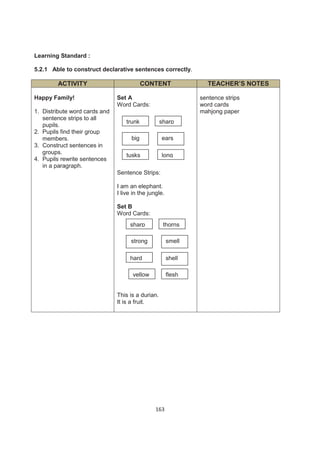
                                  5.1.6    Able to use adjectives correctly and appropriately:
                                          (a) colour
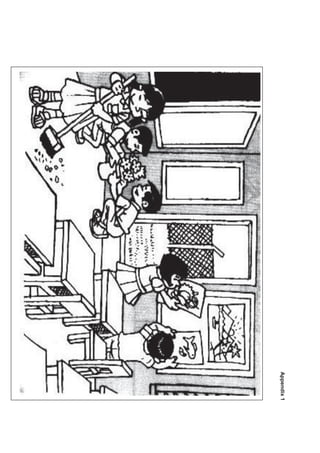
                                          (b) shape
                                          (c) size
                                          (d) opinion

                                  5.1.7 Able to use articles correctly and appropriately:
                                         (a) a
                                         (b) an
                                         (c) the
 5.2 By the end of the 6 – year
     primary schooling, pupils    5.2.1. Able to construct declarative sentences correctly.
     will be able to construct
     various sentence types
     correctly.


                                             138
Learning Standard:

5.1.1   Able to use nouns correctly and appropriately:

        (a) Common nouns

             ACTIVITY                             CONTENT                  TEACHER’S NOTES

Think Things                             Common nouns (Things) :          Poem - Nouns
                                         e.g. bag, book, pencil, ruler,
1.   Recite the poem.                    eraser, duster, chalk, clock,    A noun is a person, a place,
2.   Name the objects in the             basket, chalkboard               or a thing
     classroom.                                                           Three words that cover a lot
3.   Label the objects.                  Common nouns (People):           Once you start to think
                                                                              people, places and things
4.   Categorise these nouns under        e.g. boy, girl, teacher,
                                                                          It’s hard to find words
     “Things”.                           brother, sister, father,             that are not!
5.   Brainstorm for nouns under the      mother, man, woman, driver,      Think people : brother,
     categories, “People” and            gardener                             sister, teacher, driver…
     “Places”.                                                            Think places : classroom,
6.   Put all the word or picture         Common nouns (Places):               school, canteen, toilet…
     cards on the table with three       e.g. school, canteen, toilet,    Think things : animal, flower,
     boxes or baskets labeled,           hall, field, classroom, office       pencil, ruler…
     “Things”, “People” and                                               Nouns, nouns, nouns
     “Places”.                                                                are things you should
                                                                              remember!
7.   Get a pupil to pick a card and
     put into the correct box or                                          (Adapted from :
     basket.                                                               25 Great Grammar
8.   Repeat with other pupils till all                                     Poems)
     the cards are put into the
     boxes or baskets.                                                    Use realia (real objects)
9.   Check with the pupils by taking                                      Word cards / picture cards
     the cards out of the box/basket                                      3 boxes / baskets (labeled
     and say the word aloud.                                              : Things, People, Places)


                                                                                Things


                                                                                   People


                                                                                      Places


                                                  139
ACTIVITY                              CONTENT                   TEACHER’S NOTES

Kim’s Game                                                                  Kim’s Game (also known
                                          Objects (Realia):                 as Memory Game)
1. Put some objects on the table          e.g. ball, book, pen, pencil,        - To test the
   and cover them with a big piece        ruler, eraser, pencil case,              memory of the
   of cloth.                              sharpener                                pupils (how many
2. Pupils are required to look and                                                 nouns can they
   remember the objects while                                                      remember)
   teacher removes the cloth and
   covers it back after 10 seconds.                                         Use realia (real objects).
3. Pupils will need to identify the                                         Word/Picture cards (Step
   objects that they saw on the           Worksheet:                        4)
   table a while ago (worksheet).         Circle or Tick the objects
                                          found on the table.               Prepare a worksheet:
4. Reinforcement :                        (Alternative: Advanced
                                                                               book        ruler
    Put word or picture cards on          pupils may write the names
   the table and get pupils to scan       of objects)
   them before teacher covers the                                              duster      pen
   cards with the piece of cloth.
5. Group the nouns under                                                       flower      ball
   “Things”, “People” and “Places”.
                                                                               chalk       basket

                                                                               pencil      eraser

                                                                               sharpener     knife


Word Chain                                Common nouns:                     Word Chain
                                          e.g. book, kite, egg, goat,       A language game to test
1. Write a noun on the board.             tiger, rabbit, table, elephant,   the knowledge of
      e.g. book                           tree etc.                         vocabulary (nouns).
2. Pupils will take turns to join the
   chain by writing another noun,
   starting with the last letter in the
   previous word.
        e.g. book-kite
3. The next person will continue
   joining the ‘word-chain’.
        e.g. book-kite-egg
4. Those who are unable to join
    the next word will be out of
    the game.


                                                   140
Learning Standard:

5.1.1   Able to use nouns correctly and appropriately:

        (b) Proper nouns

            ACTIVITY                         CONTENT               TEACHER’S NOTES

Who am I?                                                         Proper nouns – special
                                     Proper nouns (People):       names for common nouns
   1. Pupils introduce               e.g. Sarah, Lokman, Daisy,   and they start with capital
      themselves.                    Chong, Joe                   letters.
      e.g. My name is Sarah.
            I live in Johor.         Proper nouns (Places):       Prepare small cards
   2. Pupils decorate their name     e.g. Johor, Melaka, Ipoh,    (name tags)
      tags.                          Sibu, Taman Bahagia
                                                                  Note: Teacher may keep
              Sarah                                               the name tags for further
              Johor                                               use (teaching of
                                                                  pronouns)
   3. Pupils wear their name
      tags.


Group Me!                            Word cards:                  Proper nouns – special
                                     e.g. Proton, National,       names for common nouns
   1. Pupils are given a word        Maggi, Mary, Daniel,         and they start with capital
      card each.                     Perlis, Penang, Cadbury,     letters.
   2. They are required to group     Sang Kancil, Mentos,
      themselves under the           Putrajaya, Abdul etc.        Prepare word cards
      respective Proper Nouns                                     (Proper Nouns)
      (Things/ People/Places).

   3. Reinforcement:
      Pupils write the proper
      nouns under each
      respective heading
      (Things/People/Places)


Common or Proper?                                                 Prepare two boxes and
                                        Common                    label them “Common
   1. Put word cards on the table.                                Nouns” and “Proper
   2. Pupils are to pick up a card       Nouns                    Nouns”.
      and drop it into the correct
      box.                                                        Prepare word cards:
   3. Pupils can also write their                  Proper         e.g. Proton, motorcycle,
      own word cards and put into                                 National, television,
      the respective boxes.                        Nouns          Cadbury, chocolates etc.


                                             141
Learning Standard:

5.1.1   Able to use nouns correctly and appropriately:

        (c) Singular nouns

        (d) Plural nouns

            ACTIVITY                         CONTENT                TEACHER’S NOTES

One or Many?                        Sentence structure:            Plural Nouns :
                                                                       - Add ‘s’ to singular
1. Get pupil A to hold a book and                                          nouns
   pupil B to hold two books.       Ali has a book.
2. Introduce the concept:
                                    Mazlan has two books.
        Ali has a book.
        Mazlan has two books.

    Stress on singular and plural
   nouns (a book / two books).
                                    e.g. Siti has a pencil.
3. Pupils repeat after teacher.
4. Practise with other examples.
                                         Rozi has two pencils.


Find Me!

1. Pupils are given a composite     Worksheet:                     Prepare a composite
   picture.                                                        picture which consists of
2. They are required to identify      Singular          Plural     many nouns (singular &
   the nouns and group them             (only         (more than   plural) – Appendix 1
   under Singular & Plural Nouns.       one)            one)
3. Fill up the grid with correct       broom                       Prepare a worksheet:
   nouns.                                              flowers     (Singular & Plural Nouns)
                                                         boys


                                            142
ACTIVITY                            CONTENT             TEACHER’S NOTES

Singular & Plural                       Two display papers:        Prepare two big display
                                                                   papers and paste them on
1.   Pupils are divided into two          Single          Double   opposite sides of the wall.
     groups, namely Single and             pen             pens    Objects / Pictures
     Double.                                                       Some marker pens
2.   Show an object/a picture and
      pupils are to write the name of
     the object/picture shown on
     the display paper which is on
     their side of the wall.
3.   Repeat with other
     objects/pictures.


                                               143
Learning Standard:

5.1.2   Able to use pronouns correctly and appropriately:

        (a) Personal pronouns (He, She, It)

             ACTIVITY                             CONTENT                TEACHER’S NOTES

He or She?                                                              Pronouns – words used to
                                         Sentence structure:            substitute nouns.
1.   Get a pupil to stand in front of    e.g. This is Ali. He is Ali.
     the class.                               He is standing.           Teacher must stress on
2.   Talk about the pupil. Stress on                                    the masculine (he) and
     the pronouns (He/She).                   That is Rozie. She is     feminine(she) pronouns.
3.   Talk about other pupils.                 Rozie. She is sitting.

4.   Reinforcement:
     Pupils put on their name tags.
              Farah
              Sibu
                                         e.g. This is Farah. She is
     Get pupils to talk about their           Farah. She is from
     friends.                                Sibu.


Who is it?
                                         Sentence structure:            Prepare a piece of cloth
1.   Pupils form a big circle (in the       - He is Suhaimi.            (for blindfolding).
     hall or field).                        - She is Rozana.
2.   Teacher blindfolds a pupil and                                     Take pupils to an open
     puts him in the centre of the                                      space, e.g. the hall / field.
     circle.
3.   The blindfolded pupil will try to
     catch a classmate and identify
     that pupil, by saying, “He is
     Zainal” or “She is Siti”.
4.   Take turns to be the
     blindfolded pupil.

5.   Alternative:
     Those pupils who are caught
     are put in one corner/hoop,
     namely the He and She group.


                                                  144
ACTIVITY                          CONTENT            TEACHER’S NOTES

Is it it?                             Pronouns (animals &       “It” – a pronoun used to
                                      objects):                 replace nouns (for
 1. Teacher shows a picture of a          - It is a rabbit.     animals / objects/ places)
    rabbit and says:                      - It is white
                                          - It is fat.
    “This is a rabbit. It is white.
     It is fat.”
 2. Practise with other nouns
    (animals or objects or places).
                                      Jazz Chant:
 3. Reinforcement:
                                         Who is he?
    Recite the jazz chant.
                                                 He is Ali.
                                                                Substitute the nouns with
                                         Who is she?
 4. Substitute with other suitable                              other suitable nouns.
                                                She is Siti.
    nouns.                               What is it?
                                                It is a book.
                                         What is this?
                                                It’s a ball.


                                              145
Learning Standard:

5.1.2   Able to use pronouns correctly and appropriately:

        (a) Demonstrative pronouns (this, that, these, those)

            ACTIVITY                           CONTENT                  TEACHER’S NOTES

This and That                          Parts of the body               This/ That – singular
                                       (nose, fingers, mouth, eyes     nouns
1.   Introduce the action song,        etc.)                           These / Those – plural
     “This and that”.                                                  nouns
2.   Pupils sing along with actions.   Action Song: This and That
3.   Substitute with other suitable    (Tune: Are You Sleeping?)       Sing while pointing to the
     nouns and practise the            This is my nose.                parts of the body.
     sentence structure.               That is your nose.
                                       This and that, this and that.   (Substitute the nouns with
4.   Alternative:                      These are my fingers.           other suitable nouns).
      Put some objects in front of     Those are your fingers.
     the class and also at the back    These and those, these and      Use realia (real objects).
     of the class.                     those.                          Point to the near object
5.   Practise the demonstrative                                        and say, “This …………..”
     pronouns (this & that) by         This is a book.                 Point to the far object and
     pointing to the object(s) and     That is a ball.                 say, “That …………”
     say:                              This and that, this and that.
         “This is a book.”             These are rulers.
         “That is a basket.”           Those are baskets.
         “These are rulers.”           These and those, these and
         “Those are balls.”            those.


                                               146
Learning Standard:

5.1.2   Able to use pronouns correctly and appropriately:

        (c) Possessive pronouns

            ACTIVITY                        CONTENT               TEACHER’S NOTES

What do you have?                   Sentence structure:          Possessive – to show
                                                                 possession of objects.
1. Show a pen and say:              e.g. I have a pencil.
                                         This is my pencil.      Possessive adjectives
        “I have a pen.                   This is mine.              - my, your, his, her
         This is my pen.
         This is mine.”                                          Possessive pronouns
2. Repeat with other objects.                                       - mine, yours, his,
3. Get a pupil to show his pencil                                      hers
   and say:
                                                                 Revision:
       “I have a pencil.                                         Singular & Plural nouns
        It is my pencil.                Ali has a pencil.        Demonstrative pronouns
        It is mine.”                    That is his pencil.
4. Get the class to say:                That is his.

      “Ali has a pencil.
       It is his pencil.
       It is his.”
5. Repeat with other objects and
   other pupils.
                                         That is her bag.
    e.g. Rina has a book.                That is hers.
          It is her book.
         It is hers.                     These are your books.
                                         They are yours.
6. Reinforcement:
   Revise the items learnt
   (singular & plural nouns,
   demonstrative pronouns)


                                         Those are his rulers.
                                         They are his.


                                            147
Learning Standard :

5.1.3    Able to use verbs correctly and appropriately :
        (a) regular verbs
        (b) simple present tense
        (c) simple past tense

        ACTIVITY                         CONTENT                    TEACHER’S NOTES
                             Example of Actions:
Walk About                   jump, skip, brush, walk
                                                                   Grammar Notes:
1. Ask pupils to do some     Example of Questions :
    actions.                 a. What can you see in the            Verbs can describe
2. Take pupils around           canteen?                           actions, feelings and
    the school.              b. What are the people in the         thoughts. Some verbs
3. Ask pupils questions.         canteen doing?                    are also being and having
4. Pupils return to class.   c. What do you see on the field?
                                                                   verbs. The verb in a
5. Ask pupils to pick        d. What are they doing?
   word cards on words                                             sentence may be one
   of what people were       Example of Words:                     word or more than one
   doing around the          wash, mop, cook, play, brush, talk,   word.
   school.                   walk, jump, pull, skip
6. Pupils pick the words                                           Example:
   and put them in a                                               The boy likes to jump.
   basket labelled                                                 The lady washes the
     “REGULAR VERB”.                                               dishes.
7. Tell pupils that words
   showing actions are                                             Materials:
   called verbs.                   REGULAR VERB                    word cards
                                                                   basket

Find My Name                 Example of Words:                     Example:

1. Pupils are given         washes, mops, cooks, plays,            Every day, my mother
   pictures each.           brushes, talks, walks, jumps, pulls,   mops the floor.
2. Pupils need to find the skips, etc
   words that match each                                           Alina and Aiza wash
   picture from the                                                dishes after dinner every
   baskets.                                                        day.
3. Pupils stick the
   pictures with the                                  mops
   matching words on the
   board.                                                          Materials:
4. Pupils are told that the
   words on the board                                              word cards
   are action words in the                                         pictures
   present tense.                                      wash        baskets
5. Tell pupils that we add
   ‘s’ or ‘es’ to actions
   that are done daily.

                                               148
ACTIVITY                         CONTENT                TEACHER’S NOTES

Past Actions                Example of Words:                 Example:

1. Divide pupils into      washed, mopped, cooked, played,    Faezah’s mum cooked
   groups of four.         brushed, talked, walked, jumped,   chicken rendang
2. Each group is given     pulled, skipped, etc.              yesterday.
   an envelope.
3. Some groups are                                            Yesterday, the boys
   given pictures and                                         played football.
   some groups are
   given words.                                      cooked   Materials:
4. Pupils have to find
   which picture matches                                      word cards
   which word.                                                picture
5. Pupils stick the
   pictures and the words                           skipped
   on the board.
6. Construct a sentence
   and write them down.
7. Tell pupils that these
   words are showing an
   action that had been
   done in the past.
8. Tell pupils that we add
   ‘ed’ to actions that
   were done in the past.


Charade                     Sample of Verbs                   Materials:

1. Prepare words in a       jump, play, wash, cook, walks,    cloth bag
   “magic” bag.             skips, etc.                       word cards
2. A pupil comes out and
   picks a word from the
   “magic” bag.
3. The pupil acts the
   word out and the rest
   of the class try to
   guess the action /                  MAGIC BAG
   verb.
4. Pupils spell the verb
   and make a sentence
   using the verb.
5. The game continues
    until all pupils have
    had a chance.


                                              149
ACTIVITY                         CONTENT                  TEACHER’S NOTES

Verb Book                    Sample of Verb Book                Materials :
                                                                A4 coloured papers
1. Divide pupils into                                           pictures of various
   groups of four or five.                                      actions
2. Pupils create their                                          glue
   own verb books.                                              scissors
3. Provide pictures of
   various actions they
   like.                           cried
4. Pupils label each             Siti cried        fishes
   picture with a verb.         yesterday      Pak Mat fishes
5. Pupils make a                               every morning
   sentence for each
   picture using the verb.
6. Compile the verb
   books and display
   them in class.

                                 cycles               laugh
                               Anne cycles.         I laugh.


                                              150
Learning Standard:

5.1.4    Able to use conjunctions correctly and appropriately:

         (a) and

          ACTIVITY                         CONTENT                    TEACHER’S NOTES


Riddle                            WHAT AM I?                       Grammar notes for teacher.

1. Put up a riddle chart.         I have a pet                     Conjunctions are used to
2. Pupils read the riddle         Big and fat                      connect words, phrases,
    aloud.                        Black and white                  clauses or sentences.
3. Show two objects.              Catches mouse and rat
    a pen, a pencil               Likes fish and rice              Use and to join two words of
5. Say:                           Can you guess                    equal importance.
       a pen                      What am I?
       a pencil                                                    e.g.
       a pen and a pencil         Examples Of Objects:
6. Repeat with other                                               Amran has a pen.
    objects and pupils say out.   pen, pencil, bag, book, table,   Amran has a pencil.
7. Explain ‘and’ is used          chair,                           Amran has a pen and a
    to join two words.                                             pencil.
8. Show picture cards             Sample Picture Cards
9. Pupils say:
      eg. boy and girl
10. Distribute the pictures to
    different pupils.
11. Blow the whistle and
    pupils must find their
    partner and shout out the
    words.                             a boy and a girl


                                                151
ACTIVITY                          CONTENT                   TEACHER’S NOTE


Write A Phrase                   Sample Phrases:
                                                                 phrase cards with strings to
1. Put the phrase cards in two   a cat      and      a rat       hang around pupil’s neck
   boxes.
2. Take out one card from        a fish and a plate of rice
    each box.                    a mouse and a rat
3. Read the phrase on the        a pen and a pencil
   card.                         a boy and a girl
4. Join the phrases using        a fork and a spoon
   ‘and’                         a table and a chair
5. Divide pupils into groups.
6. Distribute word card to
   each group.
7. Call out a group.
8. Pupils come to the front
   with the word card
   hanging on their
   necks.
9. Pupils will rearrange
   themselves to form the
   phrase.
10. Teacher writes the
     phrases on the board.
11. Pupils copy.


Puzzle                           Sample Puzzle Cards

1. Divide pupils into groups.                                    one set of picture with
2. Distribute envelopes which                                    sentence . Cut them into small
    contains picture puzzles.                                    pieces.
3. Ask pupils to arrange the        I have a pen and a pencil.
   puzzles to form the picture                                   second set of pictures without
   and sentence.                                                 the sentence.
4. Each group will come
   forward and paste the
   picture on the board
    and read out the
    sentence in the picture.
5. Repeat the activity with      There is a desk and a chair
    another set of picture       in the room.
    puzzles without the
    sentences.
6. Pupils arrange the puzzles
    and write a sentence for
    the picture.


                                               152
Learning Standard:

5.1.4 Able to use conjunctions correctly and appropriately:

       (b) or

          ACTIVITY                         CONTENT                  TEACHER’S NOTES


Which One?                         Picture Cards Of Cartoon      Grammar notes for teacher.
                                   Characters                    Conjunctions are used to
1. Show the picture card                                         connect words, phrases,
    of some familiar cartoon                                     clauses or sentences.
    characters.
2. Ask:                                                          Use or to show a choice.
    Do you like Tom or Jerry?
3. Pupils will answer                                            Eg: Do you like coffee or tea?
    Tom.
4. Repeat with other
    pictures.
5. Explain– use ‘or’
    when you have to choose.
6. Divide pupils in
    groups of four.
7. Each group is given a box
    containing picture cards.
8. The first pupil will take out
    two picture cards.
9. The pupil will ask the          Sample Picture Cards In the
    second pupil:                  Box
   “Do you like a sweet or an
     ice-cream?”
10. The second pupil will
     choose one.
     “I like the sweet.”
11. The second pupil takes
     out two pictures and asks
     the third pupil.
12. The activity goes on until
     all the pupils finish their
     turns.


                                               153
Learning Standard:

5.1.4   Able to use conjunctions correctly and appropriately :

        (c)   but

          ACTIVITY                            CONTENT                   TEACHER’S NOTE


But, But, But                     Sample pictures and               Grammar notes for teacher.
1. Show two different             sentences                         Conjunctions are used to
   picture cards to pupils.                                         connect words, phrases,
2. Say:                                                             clauses or sentences.
   ‘Bahar is tall.’
   ‘Nathan is short.’
3. Join the two sentences
   using ‘but’.                   Bahar is tall. Nathan is short.   Use but to join different ideas.
4. Read the sentence again.       Bahar is tall but Nathan is
                                  short.                            Eg: Alex is clever but lazy.
   ‘Bahar is tall but Nathan is
    short.’
5. Repeat the activity with
    other pictures.


Old But Strong                    Sample word cards
                                                                    Prepare suitable worksheet.
1. Choose a few pupils at              tall     short
   random and pair them.
2. Give each pupil a word
   card.                          Johan is tall but Dinesh is
3. Each pair will come out        short.
   and stand in front of the
   class.                              fat      thin
4. The other pupils will make
   a sentence based on the
   word cards.                         small       big
5. Give worksheets to pupils.
6. Pupils write simple
   sentences based on the              strong          weak
   pictures given.


                                                154
Learning Standard:

5.1.5 Able to use prepositions correctly and appropriately :
      (a) in
      (b) on
      (c) under

          ACTIVITY                         CONTENT                   TEACHER’S NOTE


Rat and Cat                                                      Grammar notes for Teacher

1. Put up the rhyme chart.        Rat and Cat                    Preposition is a word which
2. Read the rhyme with the        Rat in the hat                 joins a noun or pronoun to
    pupils.                       Cat on the mat                 another word and indicates
3. Then show a toy rat, cat       Rat ran under the mat          some relation between them.
    and a mat.                    Chased by the cat.
4. As the pupils to read
    the rhyme, place the          Sentence Pattern:
    animals in the correct
   location.                      The rat is in the hat.
5. Put the rat in the hat         The cat is on the mat.
   and ask: ‘Where is the rat?’   The rat is under the mat.
   Show the word with the
   preposition ‘in’
   Pupils will answer ‘The rat
   is in the hat.’
   Explain that the word ‘in’
   shows the place or location
   where the rat is .
6. Repeat with the other
   preposition as in the rhyme.

Where do you put this?            Sample sentences:

1. Divide pupils into groups
   of four.                        The pencil is under the
2. Give sentence strips and        table.
   some objects to each
   group.
                                   The eraser is in the bag.
3. The first pupil in the group
    will read the sentence
    strip and the second pupil     The book is on the chair.
    will place the object.
4. Then, the second pupil
    reads the next sentence        The bag is under the table.
    and the third pupil places
    the objects.
5. Repeat until all the pupils
   finish reading the
   sentences.

                                               155
ACTIVITY                          CONTENT                     TEACHER’S NOTE

Bingo
                                                                   Prepare a bingo card with
1. Divide the class into           Content should be familiar to   pictures and another one with
    groups.                        pupils.                         lines only.
2. Give two bingo cards to                                         Pupils will have to write three
   each group.                                                     correct sentences in one
3. Blow the whistle, the pupils                                    straight line to win.
   will write sentences on
   bingo card 2 based on the                                       Bingo Cards 1 & 2
   pictures on Card 1.                                             (Appendix 6)
4. The group that finishes first
   will shout ‘Bingo’.
5. Check the sentences
   and reward the group with
   the correct sentences.


Learning Standard:

5.1.5 Able to use prepositions correctly and appropriately :
      (a) up
      (b) in front of
      (c) behind
      (d) at

ACTIVITY                           CONTENT                         TEACHER’S NOTES


   Hide and Seek                                                   Grammar notes for Teacher
                                   Sample Word Cards
1. Choose a few pupils at                                          Preposition is a word which
    random.                                                        joins a noun or pronoun to
2. Ask other pupils to close              in front of              another word and indicates
   their eyes.                                                     some relation between them.
3. Ask selected pupils to
   stand at certain places:                 behind
   e.g.
        behind the door
        in front of the
        cupboard                                at
        at the door
   Give them a card each.
4. Ask pupils to open their
   eyes and look around the
   classroom and tell where
   their friends are.
5. Pupils will tell where their
   friends are.
6. Repeat the activity with

                                                156
other pupils chosen
   randomly.
7. Other pupils will tell if they
   are standing at the correct
   location.


Treasure Hunt                       Sample cue card:

1. Place objects at selected        Find:
   locations in the classroom
   before the lesson.               1. ball
2. Divide pupils in groups.
3. Give each group a set of         2. scissors
   cue cards.
4. Ask pupils to go around          3. glass
   and look for the objects.
                                    4. hoops
5. Pupils return to their
   groups and report where
                                    5. tambourine
   the objects are found.
6. Pupils complete a chart.

   e.g. We found a ball under
        the table.


Choose One
                                    Sample sentences:                   1. Prepare pictures showing
1. Divide pupils into groups.                                               the location of nouns
2. Give each group a                En Azmi is standing behind              according to the
    picture with different          the blackboard.                         preposition.
    sentences.                      En Azmi is standing in front of     2. Prepare cards which have
3. Pupils will look at the          the blackboard.                        three sentences describing
    picture and choose the                                                 the location of the object
    correct sentence from the       The car is in front of the lorry.      for the pupils to choose.
    sentence card.                  The car is behind the lorry.
4. Each group member will
   come forward and paste           The boys are in the field.          Prepare a worksheet
   their picture and sentence       The boys are under the field.       according to pupils level
   on the board.                                                        based on the activity.
5. Other groups will check          The cat is up the tree.             Pupils will colour the correct
    the answer.                     The stars are high up in the        sentence.
6. When all the cards have          sky.
    been pasted, the pupils         The old man climbed slowly
    will read the sentences         up the stairs.
    aloud.
7. Give pupils worksheets.
8. Pupils will read and choose
   the sentence with the
   correct preposition.


                                                   157
Learning Standard :

5.1.6    Able to use adjectives correctly and appropriately :
        (a) colour
        (b) shape
        (c) size
        (d) opinion (quality or qualifier)

          ACTIVITY                        CONTENT                  TEACHER’S NOTES

What Colour Am I?               Example:                        Grammar Notes:

1. Pupils are given various    This is a ball.                  An adjective is a describing
   objects.                    It is blue.                      word. It adds meaning to a
2. Ask pupils to talk about    It is a blue ball.               noun or a pronoun.
    the objects.
3. Explain that colours used                                    Materials:
   to describe the objects
   are called adjectives.                                       word cards
4. Pupils write the adjectives                                  objects (pictures/realia)
   on word cards and display
   on the blackboard.
5. Pupils write sentences to
   describe the object.


Shape up                        Example:
                                                                Materials:
1. Divide pupils into groups    This is a table.
   of four.                     It is square.                   word cards
2. Each group is given an       It is a square table.           lap top
   envelope.                                                    LCD
3. Groups are asked to          This is a clock.                manila Card
   complete the jigsaw          It is round.                    jigsaw puzzle (Appendix 2)
   puzzle.                      It is a round clock.
4. Pupils are asked to talk
   about their puzzle.
5. Pupils write sentences to
   describe the object.
6. Pupils describe other
   objects in the classroom.
   They construct sentences
   to describe the objects.


                                                158
ACTIVITY                          CONTENT                TEACHER’S NOTES

Let’s Have Fun                   Examples:                      Materials:

1. Divide pupils into groups    long, short, big, small, tall   word cards
    of four.                                                    pictures (Appendix 3)
2. Each group is given a        This ruler is long but that
    worksheet with pictures     ruler is short.
    and an envelope
    containing words.
3. Pupils need to pick a
    word from the envelope
    and stick it to the related
    picture.
4. Pupils construct sentences
   to describe the objects.


Story Time
                                 Story of The Shoe maker        Materials:
1. Tell a story to the pupils.   and Mr King
2. Ask pupils to talk about                                     word cards
   the story with a picture                                     lap top
   stimulus.                                                    LCD
3. Teacher draws pupils’                                        manila Card
   attention to adjectives                                      marker pens
   used in the story.
4. Distribute story text to                                     The Shoemaker and Mr King
   pupils.                                                      (Appendix 4)
5. Pupils identify and write
   the adjectives on word                                       The Shoemaker and Mr King
   cards and display them                                       – simplified version
   on the board.                                                (Appendix 5)
6. Pupils construct
   sentences using the
   adjectives identified.

Extension:

Teacher asks pupils to give
antonyms/synonyms of
adjectives identified.


                                                 159
ACTIVITY                        CONTENT                 TEACHER’S NOTES

Knowing Me Knowing You           Example:                     Pupils can use the dictionary.

1. Teacher asks pupils to        Red Rani
   find a word to describe       Long Laili
   themselves. Pupils have       Square Siti
   to come up with the word      Graceful Grace
   using the first alphabet of   Gorgeous Geraldine
   their names.
2. Pupils stand up and say
   their names with the
   words that describe them.
3. Game is played until all
   pupils have had a chance.


Adjective Treasure Hunt          Example:                     Materials:

1. Pupils are divided into       A red flower                 instruction cards
   groups of four.               A round ball
2. Each group is given an        A small leaf
   instruction card.
3. Pupils go around the
   school looking for the
   objects.
4. The first group to return
    with all the correct
    objects is the winner.


Crazy Stories                    Example of words:            Materials:

1. Ask pupils to come out        pretty, handsome , orange,   A4 papers
   with a list of adjectives     short, round
   and write on the board.
2. Pupils use these
   adjectives to write short
   stories.
3. Pupils write short stories.
4. Pupils read their stories.


                                                160
Learning Standards:

5.1.7 Able to use articles correctly and appropriately

        ACTIVITY                             CONTENT       TEACHER’S NOTES

Drilling Time                                            Grammar notes:
                                Word list:
1. Show a picture to the                                 - a and an talk about
   pupils                       carrot                     singular countable noun
2. Pupils name the things       apple                    - a is put before a noun
   (nouns) in the picture       biscuit                    that begins with
3. Ask the boys to pick         banana                     consonant sounds
   words that starts with       egg                      - an is put before a noun
   consonant sounds, then       orange                     that begins with vowel
   put the words in a box                                  sounds
   labelled ‘a’.
4. Ask the girls to put the                              Picture in MS PowerPoint
   rest of the words with                                Presentation (printable)
   vowel sounds into the                                 (Appendix 7)
   box labelled ‘an’
5. Explain briefly how                                   Picture cards (Printable
   articles are linked to the                            Version)
   nouns in the picture.                                 (Appendix 8)


Slot Me Right                   Word list:               Thinking skill:
                                                         Categorising
1. A worksheet is               rabbit
   distributed to pupils        apple
2. Pupils answer based on       biscuit                  Worksheet 1(a)
   the example given.           banana                   (Appendix 9)
                                egg
The Appropriate Me              orange                   Tasksheet 1(b)
                                book                     (Appendix 10)
1. A task sheet is              umbrella
   distributed to pupils.
2. Pupils work in pairs.
   Take turns to test each
   other orally.


Fill Me Up!                     Word list:
                                                         Worksheet 2(a)
1. A worksheet is               carrot                   (Appendix 11)
   distributed to the pupils.   apple
2. Pupils complete the          biscuit
   worksheet by filling the     banana
   blanks with the correct      egg
   articles.                    orange


                                                161
Pick Me Right
                                                                     Worksheet 2(b)
1. A worksheet is                                                    (Appendix 12)
   distributed to the pupils.
2. Pupils choose the best
   answer.


Listen and Write Right                                               Grammar note:

1. Pupils work in groups of                                          - the refers to unique and
   3.                                                                definite noun
2. A set of 2 tasks are
   distributed to each pair.                                         Task sheet 3(a)
3. Pupil A and B will read                                           (Appendix 13)
   the dialogue in the task
   sheet.                                                            Task sheet 3(b)
4. Pupil C will fill in the                                          (Appendix 14)
   blanks with correct
   articles while listening                                          Task sheet 3(b)
   to pupil A.                                                       (Appendix 15)


Let’s Go Online On Air           http://a4esl.org/q/f/y/zz94mck.ht   Activities may vary on
                                 m                                   availability of ICT facilities.
1. Pupils click on the link
   given and complete the                                            Activities in the link are
   activities on the web.                                            printable.


Notes: All activities are printable.


                                                 162
Learning Standard :

5.2.1 Able to construct declarative sentences correctly.

        ACTIVITY                           CONTENT               TEACHER’S NOTES

Happy Family!                  Set A                           sentence strips
                               Word Cards:                     word cards
1. Distribute word cards and                                   mahjong paper
   sentence strips to all
                                   trunk           sharp
   pupils.
2. Pupils find their group
   members.                          big           ears
3. Construct sentences in
   groups.                         tusks           long
4. Pupils rewrite sentences
   in a paragraph.
                               Sentence Strips:

                               I am an elephant.
                               I live in the jungle.

                               Set B
                               Word Cards:
                                    sharp           thorns

                                     strong            smell

                                    hard               shell

                                      yellow           flesh


                               This is a durian.
                               It is a fruit.


                                                163
Appendix 1
169
Appendix 2


165
Appendix 3


166
167
Appendix 4


168
Appendix 5


169
Appendix 6


.         .


    170
Appendix 7


171
Appendix 8


172
Appendix 9


                                            .


                       rabbit   apple    biscuit

                   banana       egg      orange

                         book         umbrella


             a                                             an


.........rabbit.......                          ...........apple..........

............................                    ...............................

............................                    ...............................

............................                    ...............................


                                   173
Appendix 10


Work with a partner. Take turns to test each other. Use the
words in the speech bubble.

Example:

A: dog

B: a dog

A: arm

B: an arm


             rabbit      apple         biscuit
            banana    egg        orange

            book      umbrella


                                 174
Appendix 11

Fill in the blanks with ‘a’ or ‘an’.

1.
                          Amy, the rabbit wants ........... carrot for its
                          breakfast.


2.
                          I ate .......... apple yesterday.


3.
                          Rosdi dropped ......... biscuit just now.


                          The ranger feeds Gobuk the orang utan
4.                        ............... banana every day.


                          My mother boils .......... egg for me every
5.
                          morning.


6.                        The children are given ........... orange each
                          during the Chinese New Year.


                                        175
Appendix 12

A. Underline ‘a’ or ‘an’. Circle “True” or “False”.
B. Rewrite the sentences correctly.

1.                       Amy, the rabbit wants an
                         carrot for its breakfast.      True / false

                         _____________________

2.                       I ate an apple yesterday.
                                                        True / false
                         _____________________


3.                       Rosdi dropped a biscuit just
                         now.                           True / false

                         ______________________

                         The ranger feeds Gobuk the
4.                       orang utan an banana every
                         day.                           True / false
                         _____________________

                         My mother boils a egg for me
5.                       every morning.
                                                        True / false
                         _____________________


6.                       The kids are given an orange
                         each during the Chinese New
                         Year.                        True / false
                         ______________________


                                     176
Appendix 13


177
Appendix 14


Splodge: Can Sticky have ………… carrot?

Ruff:    Yes, there are some in the kitchen.

Splodge: Can I give him (1) …………… apple and (2) ……………….. biscuit?

Ruff:    Yes. Is he very hungry?

Splodge: He’s always hungry. Can he have (3) ……………….. banana milkshake, too?

Ruff:    No! Rabbits don’t like milkshakes.

Splodge: Oh, that’s strange. Can he have (4) ………………… egg then?

Ruff:    No! Rabbits don’t eat eggs.

Splodge: He wants (5) ………………. orange. Have we got oranges?

Ruff:    No Splodge. Don’t be silly. Give Sticky (6) ……………….. carrot and go and read
         (7) ……………………. book.
Splodge: I don’t want to. Can I go out?

Ruff:    Yes, but it’s raining. Take (8) ………………….. umbrella.

Splodge: Sticky is coming with me. We want to play (9) ………………… game.

Ruff:    All right, but come back in (10) ………………. hour and don’t give Sticky any more
         food.

                                              178
Appendix 15

Fill in the blanks correctly.


Splodge: Can Sticky have ………… carrot?

Ruff:    Yes, there are some in the kitchen.

Splodge: Can I give him (1) ………………………….. and (2) …………………………….?

Ruff:    Yes. Is he very hungry?

Splodge: He’s always hungry. Can he have (3) …………………………….. milkshake, too?

Ruff:    No! Rabbits don’t like milkshakes.

Splodge: Oh, that’s strange. Can he have (4) …………………………… then?

Ruff:    No! Rabbits don’t eat eggs.

Splodge: He wants (5) …………………………….. Have we got oranges?

Ruff:    No Splodge. Don’t be silly. Give Sticky (6) ………………………… and go and read
         (7) ………………………………..
Splodge: I don’t want to. Can I go out?

Ruff:    Yes, but it’s raining. Take (8) …………………………………….

Splodge: Sticky is coming with me. We want to play (9) ……………………………...

Ruff:    All right, but come back in (10) ……………………. and don’t give Sticky any more
         food.

                                              179
SAMPLE LESSONS
Focus:               Listening and Speaking

Theme:               World of Stories

Topic:               The Princess and The Dragon

                     1.1    Pupils will be able to pronounce words and speak
                           confidently with the correct stress, rhythm and
Content                    intonation.
Standard:            1.3   Pupils will be able to understand and respond to oral
                           texts in a variety of contexts.


                     1.1.2 Able to listen to and enjoy stories. (SK)

                     1.3.1 Able to listen to and demonstrate understanding of
                           oral texts by:
                            (b) answering simple Wh-Questions (SK)
Learning
Standard:
                     1.1.2 Able to listen to and enjoy simple stories. (SJK)

                     1.3.1 Able to listen to and demonstrate understanding of
                           oral texts by:
                            (b) answering simple Wh-Questions (SJK)

                     By the end of the lesson, pupils will be able to respond to a
Objective:
                     story heard verbally.

Time :               30 / 60 minutes

Teaching Aids:       figurines, sentence strips

Extra-Curricular     MI – Verbal Linguistic
Elements:


         Activity              Teaching & Learning                     Notes
                                      Strategy
1. Teacher shows stick       Listening                     Puppets of a king, queen,
   puppets to pupils and     Making interpretations        princess, ogre, knight,
   asks them to name                                       dragon.
   the puppets.
2. Teacher tells the         Listening                     The story (Appendix 1)
   story, “The Princess
   and The Dragon”.
3. Pupils listen
   attentively.


                                             183
Activity            Teaching & Learning             Notes
                                    Strategy
4. Teacher asks simple      Answering               Questions:
   wh-questions                                     a. Where did the king and
   pertaining to the                                   queen live?
   story.                                           b. Where did the ogre
5. Pupils answer                                       bring the princess?
   questions orally.                                c. What did the king
                                                       promise?
                                                    d. Who rescued the
                                                       princess?
                                                    e. What did the king give
                                                       the dragon?
6. Tell the story again.    Reinforcement
    Pupils listen.
7. Invite pupils to tell
    the story.
8. Give sentence strips     Reinforcement
    to groups. Teacher                              Sentence Strips (Appendix
  reads a sentence,                                 2)
   pupils listen and pick
   the correct sentence.
Assessment:

Able to:                                            The assessment is carried
a. listen and pick the                              out as step 8 is carried
   correct sentence;                                out.
   and
b. arrange sentences in
   order to form a story.
Remedial:

1. Pupils match pictures    Identify and match
    and words correctly.    correctly.

Enrichment:
                                                    Encourage pupils to re-tell
Get pupils to re-tell the   Build confidence        a story.
story using their own
words.


                                            184
Focus:                Reading

Theme:                World of Stories

Topic:                The Princess and The Dragon

                      2.2   Pupils will be able to demonstrate understanding of a
Content                     variety of linear and non-linear texts in the form of
Standard:                   print and non-print materials using a range of
                            strategies to construct meaning.


                      2.2.4 Able to read and understand a paragraph with
Learning                    simple and compound sentences. (SK)
Standard:
                      2.2.4 Able to read and understand a paragraph of 5 – 8
                            simple sentences. (SJK)

                      By the end of the lesson, pupils will be able to read and
Objective:
                      sequence the story correctly.

Time :                30 / 60 minutes

                      picture cards, phrase cards, power point presentation, sentence
Teaching Aids:
                      strips

Extra-Curricular      Constructivism
Elements:


         Activity               Teaching & Learning                   Notes
                                     Strategy
1. Pupils are given
   figurines of               Read and match                Figurines and phrase
   characters.                                              cards.
2. Teacher pastes
   phrase cards on the
   board.
3. Pupils match the
   figurines to the
   phrase cards.

4. Pupils read aloud all      Reading                       a king, a queen, a
   the phrases.                                             princess, a prince, an
                                                            ogre, a knight, a dragon, a
                                                            castle, a tower, a bag of
                                                            gold, the king’s land


                                              185
Activity              Teaching & Learning            Notes
                                     Strategy
5. Teacher reads the
   story, “The Princess       Presentation            Power point presentation
   and the Dragon”.

6. In groups, give pupils
   sentence strips of the     Practice by recalling     Sentence Strips
   story, “The Princess                                 (Appendix 2)
   and the Dragon.”
7. Teacher picks a
   group to start a story
   chain. (This group
   identifies and reads
   the first sentence of
   the story).
8. The first group to
   identify the second        Practice by recalling
   sentence continues
   the story chain.
   (This activity is
     repeated until the
     whole story is
     completed.)
7. Invite pupils to read      Reinforcement
   the story with the
   correct pronunciation
   and intonation.
8. Distribute worksheets.                             Level 1 (Appendix 3)
   Pupils complete them.                              Level 2 (Appendix 4)
                                                      Level 3 (Appendix 5)
Assessment:

Able to read the story with                           The assessment is carried
the correct pronunciation                             out as step 7 is carried
and intonation.                                       out.

Remedial:

Pupils are able to re-                                Appendix 4
arrange sentences
correctly.

Enrichment:

Get pupils to talk about a    Critical Thinking
person they liked or
disliked in the story.


                                              186
Focus:                Writing

Theme:                World of Stories

Topic:                The Princess and The Dragon

Content               3.2     Pupils will be able to write using appropriate language,
Standard:                     form and style for a range of purposes.


                      3.2.2 Able to write with guidance:
                            (a) simple sentences
Learning
                            (b) compound sentences (SK)
Standard:
                      3.2.2 Able to write with guidance:
                            (a) simple sentences (SJK)

                      By the end of the lesson, pupils will be able to write a story
Objective:
                      using simple or compound sentences with guidance.

Time :                60 minutes

Teaching Aids:        figurines, phrase strips, worksheets

Extra-Curricular
Elements:


          Activity                Teaching & Learning                     Notes
                                       Strategy
1.   Tell the story, “The
     Princess and the           Listening                     Figurines
     Dragon”. Pupils listen
     attentively.
2.   Distribute picture                                       Pictures of king, queen,
     cards to groups.                                         princess, castle, ogre,
     Next, distribute pieces                                  tower, knights, bag of
     of paper. Pupils                                         gold, dragon
     name the pictures.
3.   Next, get pupils to
     pick the picture of king   Building vocabulary           Q : Are they happy or
     and queen.                                                   sad?
4.   Elicit response from                                     A: They are happy.
     pupils about the king
     and queen.                                               The king and queen are
5.   Distribute jumbled                                       very happy.
     phrases. Pupils
     arrange them.

6.   Get pupils to pick the
     picture of the king,


                                                187
queen, princess and             Q: Where do they live?
    castle.                         A: They live in a castle.
7. Elicit response about
    the pictures.
8. Distribute jumbled
    phrases. Pupils
    arrange them.
9. Get pupils to pick the
    picture of a tower, the         Q: What did an ugly
    princess and an ogre.               ogre do?
10. Elicit response about           A: An ugly ogre locked
    the pictures.                      the princess in his
11. Distribute jumbled                 tower.
    phrases. Pupils
    arrange them.
12. Get pupils to pick the
    picture of a bag of             Q: What did the King
    gold, king, knight and             promise?
    princess.                       A: The king promised to
13. Elicit response about              give a bag of gold to
    the pictures.                      the knight who could
14. Distribute jumbled                 save the princess.
    phrases. Pupils
    arrange them.
15. Get pupils to pick the
    picture of knights and          Q: What did the knights
    a tower.                            do?
16. Elicit response about           A: All the knights in the
    the picture.                       lands rode to the
17. Distribute jumbled                 ogre’s tower.
    phrases. Pupils
    arrange them.
18. Get pupils to pick the
    picture of an ogre.             Q: What happened at
19. Elicit response about              the tower?
    the picture.                    A: The ogre was so
20. Distribute jumbled                 scary that they rode
    phrases. Pupils                    away as fast as they
    arrange them.                      could.
21. Get pupils to pick the
    picture of a dragon, a          Q: What did a dragon
    princess and a tower.              do?
22. Elicit response about           A: A dragon saved
    the picture.                       the princess and
23. Distribute jumbled                 brought her to the
    phrases. Pupils                    castle.
    arrange them.
24. Get pupils to pick
    pictures of the king,           Q: What did the king
    the dragon, the                    do?
    princess and a bag of           A: The king was so
    gold.                              happy that he gave
25. Elicit response about              it a bag of gold.


                              188
the picture.
26. Distribute jumbled
    phrases. Pupils
    arrange them.
27. Arrange the strips        Reading
    together and read the                           Appendix 6
    story in groups.
28. Distribute worksheets.                          Level 1 (Appendix 7)
    Pupils complete them.                           Level 2 (Appendix 8)
                                                    Level 3 (Appendix 9)
Assessment:

Able to write the story                             Appendix 7, 8, 9
using simple or compound
sentences.

Remedial:

Pupils are able to re-
arrange sentences
correctly to form the story
learnt.
Enrichment:

Get pupils to write the       Critical Thinking
story on their own.


                                              189
Language Arts
Focus:


Theme:              World of Stories

Topic:              The Princess and The Dragon

                    4.3     Pupils will be able to plan, organize and produce creative
Content
                            works for enjoyment.
Standard:


                    4.3.2    Able to perform with guidance based on:
Learning                     (c) stories. (SJK)
Standard:
                    4.3.2    Able to perform with guidance based on:
                             (c) stories. (SJK)

                    By the end of the lesson, pupils will be able to role-play the
Objective:          story.


Time :              30 / 60 minutes

Teaching Aids:      masks, puppets

Extra-Curricular    Constructivism, Multiple Intelligences-Kinaesthetic
Elements:


         Activity               Teaching & Learning                   Notes
                                     Strategy
1. Divide pupils into
   groups.                                                  Appendix 1
2. Pupils plan for
   performance.
3. Pupils prepare props
   such as masks or
   puppets.
4. Groups take turns to       Reading
   perform.

5. Assess groups as they
   are performing.


                                             190
Focus:                 Grammar

Theme:                 World of Stories

Topic:                 The Princess and The Dragon

Content                5.1    Pupils will be able to use different word classes correctly
Standard:                     and appropriately.


                       5.1.7 Able to use articles correctly and appropriately:
Learning                     (a) a       (b) an (SK)
Standard:
                       5.1.7 Able to use articles correctly and appropriately:
                             (a) a       (b) an (SJK)

                       By the end of the lesson, pupils will be able to read and identify
Objective:
                       articles correctly.

Time :                 30 / 60 minutes

Teaching Aids:         Picture cards, board game, tokens and coins

Extra-Curricular       Constructivism, Mastery Learning
Elements:


          Activity                Teaching & Learning                    Notes
                                       Strategy
1. Get a pupil to tell the
   story learnt.                Listen attentively.

2. Drill pupils with the        Reading                       a king, a queen, a
   usage of ‘a’ or ‘an’.                                      princess, a prince, an
                                                              ogre, a knight, a dragon, a
                                                              castle, a tower, a cave, a
                                                              bag of gold

                                                              Teacher explains the
                                                              usage of ‘a’ and ‘an’.
3. Place two boxes, ‘a’
   and ‘an’ box.                                              boxes
4. Give each pupil an                                         objects
   object. Pupils place the
   objects in the correct
   box.
5. Next, introduce the                                        board game
   ‘Articles in the Attic’      Practising articles           cards
   game to pupils.                                            coin
                                                              markers


                                                191
Appendix 1


Story -‘The Princess and The Dragon’

    Once upon a time there was a king and a
queen. They lived in a golden castle with their
beautiful daughter. One night an ugly ogre locked
the princess in his tower. The king promised to give
a bag of gold to the knight who could rescue the
princess. All the knights in the lands rode to the
ogre’s tower. The ogre was so scary that they rode
away as fast as they could. The next day a friendly
dragon saw the princess in the tower. The dragon
blew the ogre into the ocean. The dragon put the
princess on his back and flew into the sky. Then, the
dragon took the princess back to the castle. The
king was so happy with the dragon. He gave the
dragon the bag of gold.


                         192
Appendix 2


Sentence strips for the story -‘The Princess and The
Dragon’

Once upon a time there was a king and a queen.
They lived in a golden castle with their beautiful
daughter.
One night, an ugly ogre locked the princess in his
tower.
The king promised to give a bag of gold to the
knight who could rescue the princess.
All the knights in the lands rode to the ogre’s tower.
The ogre was so scary that they rode away as fast
as they could.
The next day, a friendly dragon saw the princess in
the tower.
The dragon blew the ogre into the ocean.
In the end, the dragon took the princess back to
the castle.
The king was so happy with the dragon.
He gave the dragon the bag of gold.


                          193
Appendix 3

Match correctly.


1.


                         a princess


2.


                           a knight


3.


                          a king


4.


                          a dragon


5.


                           an ogre


                   194
Appendix 4
Read the sentences.

 One night, an ugly ogre locked the princess in his tower.

 Once upon a time there was a king and a queen.

 They lived in a golden castle with their beautiful daughter.

 The king promised to give a bag of gold to the knight who could rescue the princess.

 All the knights in the lands rode to the ogre’s tower .

 The next day, a friendly dragon saw the princess in the tower.

 The ogre was so scary that they rode away as fast as they could.

 In the end, the dragon took the princess back to the castle.

 The dragon blew the ogre into the ocean.

 He gave the dragon the bag of gold.             The king was so happy with the dragon.


Now, re-arrange the sentences correctly.
1. __________________________________________________________

2. __________________________________________________________

3. ___________________________________________________________

4. ___________________________________________________________

5. ____________________________________________________________

6. ____________________________________________________________

7. ____________________________________________________________

8. ____________________________________________________________

9. ____________________________________________________________

10. ____________________________________________________________

11. ____________________________________________________________


                                           195
Appendix 5
Read the sentences.


 One night, an ugly ogre locked the princess in his tower.

 Once upon a time there was a king and a queen.

 They lived in a golden castle with their beautiful daughter.

 The king promised to give a bag of gold to the knight who could rescue the princess.

 All the knights in the lands rode to the ogre’s tower.

 The next day, a friendly dragon saw the princess in the tower.

 The ogre was so scary that they rode away as fast as they could.

 In the end, the dragon took the princess back to the castle.

 The dragon blew the ogre into the ocean.

 He gave the dragon the bag of gold.         The king was so happy with the dragon.


Now, write the story in a paragraph.


                                       196
Appendix 6


          The king and queen       are very happy.

          They live      in a castle.

          An ugly ogre       locked the princess in his tower.

The king promised to give a bag of gold       to the knight who could save the princess.

          All the knights in the lands      rode to the ogre’s tower.

          The ogre was so scary         that they rode away as fast as they could.


          A dragon saved the princess        and brought her to the castle.

          The king was so happy         that he gave it a bag of gold.


                                           197
Appendix 7


       Once upon a time, there was a               and a             . They were very


         . An ugly               l locked the           in his            . The king


promised to give a               of gold to the             knight who could save the


princess. All the                           in the lands rode to the ogre’s            .


The ogre was so scary that they rode away as fast as they could. A


saved the              and brought her to the                . The king was so happy


that he gave it a bag of gold.


                                           198
Appendix 8


      The king and queen                        locked the princess in his tower.


      An ugly ogre                                                      in a castle.

      They live                                                    are very happy.

      The ogre was so scary                               rode to the ogre’s tower.

The king promised to give a bag of gold             and brought her to the castle.

      All the knights in the lands                    that he gave it a bag of gold.

      The king was so happy               to the knight who could save the princess.

      A dragon saved the princess         that they rode away as fast as they could.


                                          199
Appendix 9

Re-arrange the words to form sentences.


   1.    very happy             The King           are             and queen                     .


   2.    live      They         .         a castle       in


   3.    locked         An ugly       are         ogre        .         in his tower                 the princess


                        The king            promised              to the              .         of gold       a bag
   4.    to give


         who       knight           could        princess              save               the

   5.    in the         All         the      knights              lands           .        to the         tower         ogre’s


         was       The ogre           so          that they               scary                 rode          as fast
   6.

         away           .     could         as         they


   7.    dragon         saved         A      brought              and      .              the        princess         to


         her        the castle


         was       so         happy         The king              he          .           that         gave      a
    8.

          it       of         bag         gold         of


   Now, write the story.

  __________________________________________________________

 __________________________________________________________

 __________________________________________________________

 __________________________________________________________

                                                 200
ACKNOWLEDGEMENTS

Advisors :

Dato’ Ibrahim Bin Mohamad:    Director of Curriculum Development Division
Ho Wooi Cheng :               Principal Assistant Director, Languages and Literature Sector, CDD

Editors and Coordinators from the English Language and English Literature Unit, CDD:

Diana Fatimah Ahmad Sahani
Jagdeesh Kaur Gill
Ewe Choy Choo
Rosdy Wahid
Tunku Ireneza Marina binti Tunku Mazlan
Regina Cyril Joseph
Ng Yew Kee

Panel of Writers:

Pn Ong Soh Kheng, SK Pangkal Gong, Kelantan
Pn Thangam a/p Karuppiah, SK Relong, Kuala Lipis
Pn Kwa Jin Nee, SK Taman Putra Perdana, Puchong
Pn Umaimah bt Mohd Idris, IPG Kampus Ipoh, Hulu Kinta
Pn Easteadah Kamilah bt Mansor, SK Felda Pengeli Timur, Johor
Pn Roszana bte Abd Mutalib, SK Convent Muar, Johor
Pn Manila Apputhurai, SK Seksyen 2, Bandar Kinrara, Puchong
Pn Saratha a/p Srikandi, SK Bukit Rimau, Shah Alam
Dr Kalminderjit Kaur a/p Gurcharan Singh, ELTC, KL
Pn Ernie Aida bt Hadi Darsono, SK Bandar Tasik Kesuma, Beranang
Pn Siti Rohani Mohd Noor, SK Taman Tuanku Jaafar 2, Rembau, N. Sembilan
Pn Lailee bt Shahabudin, SK Chuah, Seremban
Pn Marcia Kathy Chamberlin, SK Combined, Kuching
Pn Tan Ah Lay, SK St Mark Perai, Seberang Perai
Pn Sim Seng Tou, SK Seberang Jaya II, Perai
Pn M. Susilah a/p Moorthy, SK Kuala Lanar, Kuala Lipis, Pahang
Pn Cheng Swee Koon, SK Cheneh Baru 12, Kemaman, Trengganu
En Joe Junior Tann, SK Lokotan, Kudat, Sabah
En Toh Eng Khoon, SKJC Chung Shan, Bayan Lepas, Pulau Pinang
Pn Jayanthi a/p Kalimuthu, SK guru Kalgidhar, Ipoh


Panel of Editors:

Cik Faizah bt Baharuddin, SK Kampung Batu, Kuala Lumpur
Cik Antoinette Gerardine Maria Raj, SK Petaling Jaya, Petaling Jaya
Cik Ida Maria bt Amiruddin, SK Jalan Empat, Bandar Baru Bangi, Selangor
Pn Christine Gnanasothy a/p A. Sivilingam, SK Bandar Sunway, Petaling Jaya
Pn Geraldine Mary Rose, SK (2) Simpang Lima, Klang
Pn Yong Lee Choo, IPG Kampus Pendidikan Teknik, Kuala Lumpur
Cik Grace Chang Siew Yeng, IPG Kampus Ilmu Khas, Kuala Lumpur
Pn Subashini a.p a.p. Menon, Sk La Salle (2), Brickfields, Kuala Lumpur
Pn Wan Kamilah bt. Hashim, SK Putrajaya Presint 8(1), Putrajaya
En Ooi Ban Aik, SK Taman SEA, Petaling Jaya


                                                201
Teacher's guide year 3 sk & sjk

Teacher's guide year 3 sk & sjk

  • 3.
    KEMENTERIAN PELAJARAN MALAYSIA KurikulumStandard Sekolah Rendah TEACHER'S GUIDE SK & SJK ENGLISH LANGUAGE YEAR 3 Terbitan Bahagian Pembangunan Kurikulum 2012
  • 4.
    Cetakan Pertama 2012 ŠKementerian Pelajaran Malaysia Hak Cipta Terpelihara. Tidak dibenarkan mengeluar ulang mana-mana bahagian artikel, ilustrasi dan isi kandungan buku ini dalam apa-apa juga bentuk dan dengan cara apa-apa jua sama ada secara elektronik, fotokopi, mekanik, rakaman atau cara lain sebelum mendapat kebenaran bertulis daripada Pengarah, Bahagian Pembangunan Kurikulum, Kementerian Pelajaran Malaysia, Aras 4-8, Blok E9, Parcel E, Kompleks Pentadbiran Kerajaan Persekutuan, 62604 Putrajaya.
  • 5.
    CONTENT Content iii Foreword v Preface vi Section 1 The English Language Curriculum 3 Section 2 Listening and Speaking 21 Reading 49 Writing 89 Language Arts 117 Grammar 137 Section 3 Sample Lesson 183 Acknowledgements 201 iii
  • 7.
    FOREWORD The newMalaysian English Language Curriculum f or Prim ary Schools w as int roduced in st ages beginning 2011 st art ing w it h Year 1, Year 2 in 2012 and Year 3 in 2013. Theref ore t o provide help and support t o t he t eachers, CDD has produced t his Year 3 guidebook as a usef ul resource f or t eachers in im plem ent ing t he new curriculum . CDD hopes t hat t his guidebook w ill help Year Three English Language t eachers t o get accust om ed t o t he changes in t he new English Language Curriculum and act as a valuable t eaching resource. Suggest ed t eaching and learning st rat egies and act ivit ies f or classroom t eaching and learning have been included. We hope t hat t eachers w ill gain ideas t o help t hem carry out t heir daily lessons. How ever, t eachers are encouraged not t o rely solely on t his guidebook only w hen planning lessons. Teachers are encouraged t o use t heir ow n creat ivit y and init iat ive t o plan st im ulat ing and enjoyable lessons suit able t o t heir pupils’ level and CDD w ould like t o t ake t his opport unit y t o acknow ledge w it h grat it ude t he cont ribut ions m ade by t he panel of English t eachers involved in m aking t his guidebook a realit y. Dato’ Ibrahim bin Mohamad Director Curriculum Development Division v
  • 8.
    PREFACE This guidebook isa resource for teachers in showing strategies in which learning standards could be achieved. Some aspects of language skills, language arts and grammar that are required to be taught in Year Three are covered in this book. Section 1 of the guidebook provides an overview of the English Language Curriculum while Section 2 deals with the four language skills, language arts and grammar. Suggested activities are presented in a 3-column table for each module. The first is the activity column where suggested activities for teachers include explanations and teaching steps. The second is the content column which includes teaching points and the suggested word list. The third is the teachers’ notes column which includes teaching aids/materials and other instructions for teachers. Section 3 consists of complete sample lessons. In this section, teachers will be able to see and understand how the different language skills, language arts and grammar modules are presented for each week, based on one particular theme and topic, in a coherent and cohesive manner. These complete sample lessons are provided to help teachers plan effective and enjoyable lessons. Section 4 provides teachers with a glossary. The guidebook provides suitable and practical suggestions of teaching methods via the materials provided. However, teachers are in a better position to make appropriate and relevant decisions when planning their lessons. There is no single ‘best way’ and teachers have to use their pedagogical content knowledge, experience, skills and creativity to plan their lessons in order to help their pupils learn better. Teachers should decide on a theme/topic and then select suitable listening and speaking, reading, writing and language arts activities to be used for teaching that topic. Activities from the MOE Teaching courseware, the textbook and other suitable resources are encouraged to be used when teachers are planning their lessons. This guide book is neither complete nor exhaustive by itself. The activities provided are merely suggestions and teachers are free to improvise and adapt accordingly to the level and suitability of their pupils. A lot of initiative, imagination and creativity are needed by teachers in planning their lessons in order to extend the experiences of their pupils. Therefore, It is hoped that teachers will find this guidebook useful and pupils will enjoy the activities and hence improve their English language proficiency. vi
  • 9.
  • 11.
    THE ENGLISH LANGUAGECURRICULUM AIM The English Language Curriculum for Primary Schools aims to equip pupils with basic language skills to enable them to communicate effectively in a variety of contexts that’s appropriate to the pupils’ level of development. OBJECTIVES By the end of Year 6, pupils should be able to: read and comprehend a range of English texts for information and enjoyment write a range of texts using appropriate language, style communicate with peers and and form through a variety of adults confidently and 2 appropriately in formal and media informal situations 3 1 OBJECTIVES 4 5 appreciate and demonstrate understanding of English use correct and appropriate language literary or creative rules of grammar in speech works for enjoyment and writing 3
  • 12.
    CONCEPTUAL FRAMEWORK Primary educationis divided into two stages: Stage One refers to Year 1,2 and 3, and Stage Two, Year 4, 5 and 6. The English Language Curriculum has been designed in two strands. Strand 1 is the language focus and strand 2 is language arts. Language focus deals with language skills such as listening & speaking, reading, writing and grammar. Language arts deals with music, poetry, drama and children’s literature. As English language learning is developmental, the focus in Year 1 and 2 is basic literacy. This is done by building a strong foundation in basic literacy skills namely reading through phonics, penmanship and basic listening and speaking. Activities are contextualized and fun-filled with integration of language skills in meaningful contexts. From Year 3 and onwards, pupils will further develop the ability to speak, listen, read and write in English meaningfully, purposefully and with confidence. A grammar module is introduced from Year 3 to enable pupils develop a sound grasp of the language structures and rules of grammar. The Language Arts module has been added to the English language curriculum from Year 1 to allow pupils to engage and enjoy stories, poems, songs, rhymes and plays written in English. STRAND 1 STRAND 2 LANGUAGE FOCUS LANGUAGE ARTS LEVEL 1 Listening & Speaking Music (Years 1, 2 & 3) Reading Poetry Writing Drama Grammar (from Year 3) Class Readers Listening & Speaking Literature LEVEL 2 Reading (Years 4, 5 & 6) Writing English at Play: Grammar Music, Poetry & Drama CURRICULUM ORGANISATION The curriculum is modular in design and this is reflected in the organisation of the content and learning standards. In Year 1 and 2, the English language curriculum emphasises the development of basic language skills so that pupils will have a strong foundation to build their proficiency in the language. In this initial stage, there will only be four modules; namely: 4
  • 13.
    1. Listening and Speaking 2. Reading 3. Writing 4. Language Arts From Year 3 onwards, where pupils build on the skills they have acquired in Year 1 and 2, a fifth module, Grammar, is added to the above four modules. Therefore, the modules for this stage are: 1. Listening and Speaking 2. Reading 3. Writing 4. Language Arts 5. Grammar The following diagram shows the conceptual framework of the curriculum model. LISTENING AND SPEAKING READING WRITING LANGUAGE ARTS GRAMMAR STAGE ONE STAGE TWO (YEARS 1-3) (YEARS 4-6) Fig.1 The Modular Configuration The modularity of the English Language Curriculum Standards for Primary Schools is a modularity of focus. By organising the curriculum standards under five modules in Year 3, pupils will be able to focus on the development of salient language skills or sub-skills under each module through purposeful activities in meaningful contexts. This modular approach does not exclude integration of skills. However, skills integration is exploited strategically to enhance pupils’ development of specific and specified language skills as described in the content and learning standards in a module. The approach taken in this curriculum stresses the need for pupils to develop all the four language skills: listening, speaking, reading, and writing. Teachers are expected to sustain a cohesive and coherent organisation between the listening and speaking, reading and writing skills. For the language arts module, teachers may plan lessons in relation to the language skills taught or they may come up with generic lessons. Teachers should incorporate the fun element in specified contexts to make their lessons meaningful. 5
  • 14.
    In order tomake learning more meaningful and purposeful, language input is presented under themes and topics, which are appropriate for the pupils. Three broad themes which have been used in KBSR have been retained and will be used, namely: 1. World of Self, Family and Friends; 2. World of Stories; and 3. World of Knowledge. Teachers select topics that are suitable for their pupils’ level of development. When planning lessons, topics for teaching are initially based on the immediate learning environment of the child. Later on, these are expanded to town, country and more distant foreign locations. ROLE OF THE TEACHER The teacher is the role model of a language user to pupils. Pupils need to be exposed to good language in order for them to learn the language and use it for effective communication. Therefore, the teacher needs to do a lot of talking in order for pupils to listen to good language input. For this purpose, the teacher uses a variety of materials or media to enable pupils to acquire the receptive and productive skills. Fun language activities will have to be devised by the teacher in order to tap pupils’ interest and engage them in communication. The Standard-Based English Language Curriculum for Malaysian Primary Schools is designed to provide pupils with a strong foundation in the English language. Teachers will use Standard British English as a reference and model for teaching the language. It should be used as a reference for spelling and grammar as well as pronunciation for standardisation. Good time management is also essential. Keeping in mind the time allocated for teaching English in SK and SJK schools is different; lessons should be organized in a manageable form in order to give pupils every opportunity to take part in language activities. In order to facilitate and maximise learning, language skills must be repeated and used constantly. Some activities have been suggested in this book. However, teachers are encouraged to design more creative and challenging tasks and activities based on the needs and interests of pupils. This is important so that appropriate activities and materials are used with pupils of different learning profiles with the intention of helping them to realise their full potential and enable them to gradually develop the ability, knowledge and confidence to use the language effectively. LISTENING AND SPEAKING SKILLS Overview Listening and speaking are seen as core skills of early literacy. As such, pupils should be taught: how to listen carefully; 6
  • 15.
    to speak fromthe basic level of sound, word, phrase and structural sentences in various situational contexts; the stress, rhythm and intonation patterns and how to use them correctly; to recognise, understand and use not only verbal but also non-verbal communication; and oral communication practice by means of repeating, responding, understanding and applying structures of the language in order to prepare them for communication. In order to achieve the abovementioned, content and learning standards have been developed from basic listening and speaking, and then progressing to communicating in various situations effectively. Content Standards By the end of the six-year primary schooling, pupils will be able to: 1.1 pronounce words 1.2 listen and respond and speak confidently appropriately in formal with the correct and informal situations for stress, rhythm and a variety of purposes. intonation. 1.3 understand and respond to oral texts in a variety of contexts. The content standards above are achieved through learning standards that have been devised carefully throughout primary schooling. Learning standards have been developed from basic listening and speaking in order for pupils to grasp the sounds of the English language before learning to articulate words and phrases. This is supported with a ‘flooding of English sounds and words’ by the teacher especially in cases where pupils do not have any exposure to the English language. 7
  • 16.
    The learning standardsbegin with basic listening and speaking skills which have been developed incrementally in this manner : develop pupils’ phonemic awareness engage in fun learning activities such as reciting rhymes, poems and tongue twisters as well as singing songs participate in daily conversations follow and give instructions and directions able to participate in conversations talk on topics of interest Relationships are established through the ability to communicate by listening first then speaking thoughts, ideas and feelings. Pupils should aim at becoming confident speakers who can communicate clearly, appropriately and coherently in any given context using language to explore the possibilities and opportunities. Pupils need to listen carefully and respond to what others say and think about the needs of their listeners. Social conventions in listening and speaking such as turn taking, politeness and courtesy need to be observed. These are crucial especially in group discussions where viewpoints and opinions are exchanged. READING SKILL Overview The teaching of reading skills: enables pupils to become independent readers who are able to comprehend a text effectively and efficiently. begins at the word and phrase levels before progressing to sentence recognition and reading at the paragraph level. focuses on basic literacy with the use of phonics in Year 1 and 2. teaches pupils to extract specific information from a text and respond to a text with their own ideas and opinions. In order to achieve the abovementioned, content and learning standards have been devised progressively. The teaching of reading in the early stages begins at the word and phrase levels before progressing to sentence recognition and reading at the paragraph level. Gradually, pupils are taught to extract specific information from a text and to respond to a text with their own ideas and opinions. 8
  • 17.
    Content Standards By the end of the six-year primary schooling, pupils will be able to: 2.2 demonstrate understanding of 2.1 apply knowledge of a variety of linear and non- sounds of letters to linear texts in the form of print recognize words in and non-print materials using linear and non-linear a range of strategies to texts. construct meaning. 2.3 read independently for information and enjoyment. The content standards above are achieved through learning standards that have been devised carefully throughout primary schooling. Learning standards have been developed from recognition of sounds in order for pupils to acquire the sounds of the English language before learning to blend and segment words. This is further developed through vocabulary activities to widen pupils’ vocabulary. By the end of Year 6, pupils are able to read and demonstrate understanding of text for information as well as read for enjoyment. The learning standards begin with basic literacy which has been developed incrementally in this manner : distinguish the shapes of the letters; recognise and articulate phonemes; blend and segment words; apply word recognition and word attack skills to acquire vocabulary; read and understand phrases, simple sentences and texts; and read independently for information and enjoyment. 9
  • 18.
    The reading aloudstrategy is also encouraged in the first two years of primary education: Teacher reads aloud a text to pupils. Implementing this strategy allows teachers to model reading. Here, articulation and pronunciation of words by the teacher have to be as precise as possible for pupils to efficiently imitate and reproduce correctly. This strategy effectively engage pupils in a text that may be too difficult for them to read on their own, hence, pupils sit back and enjoy the story. Teachers should also carry out shared reading strategies in the classroom: During shared reading, the teacher and pupils read together, thus allowing pupils to actively participate and support one another in the process of reading. Teachers point to the text as they read slowly for word recognition and to “build a sense of story”. Ultimately, the objective of getting pupils to read a variety of texts enables pupils to see how grammar is used correctly so that they can emulate them in their productive skills; speaking and writing. Reading for enjoyment and pleasure in seeking information and knowledge should be inculcated in pupils. Pupils are also trained to give their own ideas and opinions in order to become efficient readers. WRITING SKILL Overview It is expected that by the end of Year 6 : pupils will be able to express their ideas clearly on paper in legible handwriting or to communicate via the electronic media. the focus of writing is on developing pupils’ writing ability beginning at the word and phrase levels before progressing to the sentence and paragraph levels. pupils who are capable must be encouraged to write simple compositions comprising several paragraphs. attention is also paid to penmanship so that even from a young age, pupils are taught to write clearly and legibly including cursive writing. simple compositions and the various steps involved in writing, such as planning, drafting, revising, and editing are taught. In the process, pupils learn the genre approach to writing as they are taught to use appropriate vocabulary and correct grammar to get their meaning across clearly. 10
  • 19.
    all pupils willbe encouraged to write for different purposes and for different audiences. although much of the writing at this level is guided, the amount of control is relaxed for pupils who are able and proficient in the language. spelling and dictation are also given emphasis. To achieve the abovementioned, content and learning standards have been devised progressively. The teaching of writing in the early stages begins with pre-writing activities to develop pupils’ visual skills as well as develop hand-eye coordination. This is later developed to writing letters of the alphabet and copying words, phrases and simple sentences. Pupils begin constructing simple sentences with the teacher’s guidance and later develop to become independent writers by the end of primary schooling. Content Standards By the end of the six year primary schooling, pupils will be able to: 3.1 form letters and words 3.2 write using appropriate in neat legible print language, form and style including cursive for a range of purposes. writing. 3.3 write and present ideas through a variety of media. Content standards are achieved through learning standards that have been devised carefully throughout primary schooling. Learning standards have been developed progressively, from acquiring fine motor control of hands and fingers to copying 11
  • 20.
    writing activities, beforebeing taught to write with guidance linear and non-linear texts using appropriate language, form and style. The use of various media is also encouraged and pupils can create both linear and non-linear texts with guidance or independently. LANGUAGE ARTS Overview The rationale behind Language Arts is to steer the continuous growth and development of pupils’ thinking and language abilities. The standards for Language Arts: cover a range of creative and literary works in English such as rhymes, songs, poems, stories and plays to activate pupils’ imagination and interest. allow pupils to benefit from hearing and using language from fictional as well as non-fictional sources. allow pupils to gain rich and invaluable experiences using the English language through fun-filled and meaningful activities. train pupils to be able to appreciate, demonstrate understanding and express personal responses to literary and creative works for enjoyment. Hence they will also be able to use English for both functional as well as aesthetic purposes, confidently and competently by the end of Year 6. In order to achieve the abovementioned, content and learning standards have been devised progressively. The teaching of language arts will help pupils develop their oral and analytical skills as well as hone their creativity. Language Arts creates ample opportunities for pupils to speak in English in a very relaxed atmosphere and this will help increase pupils’ confidence in using the English language. 12
  • 21.
    Content Standards By theend of the six year primary schooling, pupils will be able to: 4.1 enjoy and appreciate rhymes, poems and 4.2 express personal songs through response to literary performance. texts. 4.3 plan, organise and produce creative works for enjoyment. The culmination of all content standards in language arts will be shown in practice when pupils are able to come up with their very own production. By the end of Year 6, pupils will learn the art of acting out, play-acting and producing works of creativity such as drawings, poems or singing. Pupils will also learn values of cooperating with people of different race, gender, ability, cultural heritage, religion, economic, social background, and, understand and appreciate the values, beliefs and attitudes of others. Each pupil will also develop knowledge, skills and attitudes, which will enhance his or her own personal life management and promote positive attitudes. Assessment Assessment is necessary to assess pupils’ achievement in terms of acquisition of knowledge, skills and the application of values through activities conducted in the 13
  • 22.
    classroom. Assessment alsosupports pupils’ learning and gives pertinent feedback to teachers, pupils and parents about their development and achievement. There are two types of school-based assessment. Formative assessment is conducted during the teaching and learning process in the classroom to gauge the acquisition of skills and knowledge during the learning process. Summative assessment is usually conducted at the end of learning, usually at the end of a learning unit, month or semester whereby the focus is on the end product. ASSESSMENT FORMATIVE TI SUMMATIVE MA School-based assessment can be carried out during the teaching-learning process. The teaching-learning process can be conducted in or outside the classroom. Below is a diagram suggesting some types of assessment which can be carried out both in and outside the classroom: Observations Tests Oral METHODS OF Checklists Presentations ASSESSMENT Writings Creative Works ea Classroom observations are useful tools for teachers to assess their pupils’ performance. Teachers observe pupils’ oracy skills as they engage in conversations among peers and when they take part in oral presentations. Teachers can prepare a checklist to record their pupils’ progress. Perhaps, pupils can speak during the school assembly, put up a performance in front of an audience, and watch a puppet show or listen to a story. Talking about these events can help teachers assess pupils’ listening and speaking skills. 14
  • 23.
    Assessment of readingcomprehension can be carried out by setting comprehension questions. Other comprehension activities which can be used to assess comprehension are the use of graphic as well as semantic organisers, story maps, question generation and summarisation. Pupils’ writing skills can be assessed through written projects, tests, exams and class exercises. Teachers can also hone pupils’ writing skills through journal and diary writing, the production of creative works such as poems, writing scripts, dialogues as well as lyrics of songs. Creative works such as portfolios, masks, puppets, props and other creative productions produced during the language arts lessons can also be assessed. Activities conducted during language arts lessons such as singing action songs, reciting rhymes or poems, choral speaking, drama, public speaking as well as role- play can be assessed. Assessment should also provide pupils with opportunities for self-assessment using known criteria and pupils should be given input on the evaluation process. In a nutshell, teachers should utilise a variety of assessment techniques to monitor their pupils’ language growth and development. The on-going process of assessing class exercises and homework should be continued. The main purpose of this is to provide immediate feedback to the pupils in guiding, motivating, correcting and refocusing their efforts. WORD LIST The list of words selected for teaching is based on common words and high frequency words that can be used repetitively in different contexts. The suggested word list can be expanded upon if pupils demonstrate an ability to acquire more words. 15
  • 24.
    EDUCATIONAL EMPHASES Educational emphases reflect current developments in education. These emphases are infused and woven into classroom lessons to prepare pupils for the challenges of the real world. Multiple Information and Critical Thinking Intelligences Communication Technology Skills Contextual Learning Values & Citizenship EDUCATIONAL EMPHASES Mastery Learning Learning How to Learn Entrepreneurship p Creativity & Constructivism o Innovation Critical Thinking Critical thinking is incorporated in the teaching and learning activities to enable pupils to solve simple problems, make decisions, and express themselves creatively in simple language. Information and Communication Technology Skills (ICT) Information and Communication Technology Skills (ICT) include the use of multimedia resources such as TV documentaries and the Internet as well as the use of computer-related activities such as e-mail activities, networking and interacting with electronic courseware. Learning How to Learn Learning How to Learn strategies are integrated in teaching and learning activities which aims to enable pupils to take responsibility for their own learning. These skills incorporate study skills and information skills to equip them to become independent life-long learners. 16
  • 25.
    Values and Citizenship Thevalues contained in the Standard Based Curriculum for Moral is incorporated into the English language lessons. Elements of patriotism and citizenship is also emphasised in lessons in order to cultivate a love for the nation and produce patriotic citizens. Creativity and Innovation Creativity and innovation is the ability to produce something new in an imaginative and fun-filled way. Pupils display interest, confidence and self-esteem through performance and producing simple creative works. Entrepreneurship Fostering an entrepreneurial mind set among pupils at their young age is essential in this new world. Some of the elements that are linked with entrepreneurship are creativity, innovation and initiative, which are also attributes for personal fulfilment and success. Mastery Learning Mastery Learning will ensure that all pupils master the learning standards stipulated in the Standard Based Curriculum. Mastery Learning requires quality teaching and learning in the classroom and teachers need to ensure that pupils master a learning standard before proceeding to the next learning standard. Multiple Intelligences The theory of Multiple Intelligences encompasses eight different intelligences human beings possess. These intelligences are essential in order to maximise teaching and learning in the classroom. . Constructivism Constructivism will enable pupils to build new knowledge and concepts based on existing knowledge or schema that they have. The teacher assists pupils to acquire new knowledge and solve problems through pupil-centred active learning. Contextual Learning Contextual Learning is an approach to learning which connects the contents being learnt to the pupils’ daily lives, the community around them and the working world. Learning takes place when pupils are able to relate the new knowledge acquired in a meaningful manner in their lives. 17
  • 27.
    LISTENING & SPEAKING READING WRITING LANGUAGE ARTS GRAMMAR
  • 29.
    THE LISTENING ANDSPEAKING SKILL The listening and speaking skill is crucial for communication at home, at school, as well as in the community. However, this skill is often neglected or given minimal emphasis during English language lessons. In order to develop this skill, teachers have to provide their pupils with various opportunities to listen and to talk about a range of subjects which may include topics on personal interests, school work and even current affairs. It is hoped that the learning standards will offer teachers some ideas on how they could provide opportunities for pupils to engage in various listening and speaking activities at Year Three. The Content and Learning Standards for listening and speaking for Year 3 are: CONTENT STANDARDS LEARNING STANDARDS 1.1 By the end of the 6-year 1.1.1 Able to speak with correct word stress. primary schooling, pupils will be able to 1.1.2 Able to listen to and enjoy stories. pronounce words and speak confidently with 1.1.3 Able to listen to, say aloud and recite rhymes, the correct stress, rhythm tongue twisters and sing songs paying attention to and intonation. pronunciation, rhythm and intonation. 1.1.4 Able to talk about a stimulus with guidance. 1.2 By the end of the 6-year 1.2.1 Able to participate in daily conversations: primary schooling, pupils will be able to listen and (a) express good wishes respond appropriately in (b) ask for help formal and informal (c) respond to someone asking for help situations for a variety of (d) offer help purposes. (e) talk about oneself (f) introduce family members and friends. 1.2.2 Able to listen to and follow : (a) simple instructions. (b) simple directions. 1.2.3 Able to give: (a) simple instructions in school. (b) simple directions to places in school 1.3 By the end of the 6-year 1.3.1 Able to listen to and demonstrate understanding of primary schooling, pupils oral texts by: will be able to understand (a) asking simple Wh-Questions and respond to oral texts (b) answering simple Wh-Questions in a variety of contexts. (c) giving True/False replies (d) sequencing with guidance. 21
  • 30.
    Learning Standard: 1.1.1 Able to speak with correct word stress. Activity Content Teacher’s note Teaching focus: Noun 1. Labels Look and Say Suggested words: STATION 1 1. Set up the class like a railway Two syllable words track with 4 stations as in STATION 2 Appendix 2. 2. Elect pupils to be the station farmer master for each station. STATION 3 3. Divide pupils to form a train. 3.1 Blue Train village STATION 4 3.2 Red Train 4. The trains take turns to move. 5. Blow the whistle to start and stop the train. paddy 6. The station master asks questions. 7. Pupils respond orally. May use other words or 8. Class gathers to compare chickens substitute the words for this responses from the groups. activity. The indicates the stress in the word. ducklings whistle houses Three syllable words buffaloes plantation Suggested questions: 1. Where are you now? 2. What do you see? 22
  • 31.
    Learning Standard: 1.1.1 Able to speak with correct word stress. Activity Content Teacher’s Note Echo Drill Teaching Focus: Nouns Picture Cards Suggested words: 1. Recite the rhyme while *Teacher may adapt or use flipping picture cards to show other rhymes. the journey. journey 2. Form five groups. 3. Distribute a set of picture cards to each group village 4. Show a picture card to the class. 5. Say the word aloud. paddy 6. Group leaders pick up the picture and repeat after the chickens teacher. 7. Pupils take turns to echo the word in their group. ducklings 8. Repeat the activity with the rest of the words 9. Pupils recite the rhyme again. whistle houses buffaloes grandfather plantation Rhyme : A Joyful Ride ( Level1&2 ) Choo….Choo….Choo Journey on a train To a village in the rain Paddy fields and buffaloes along the way What a joyful day Choo….Choo…..Choo 23
  • 32.
    Plantation to see Rowsof oil palm trees Green leaves in the breeze Chooo…Chooo…Chooo Attap houses everywhere Geese and chickens here Noisy ducklings there Hear the whistle blowing Look! Grandpa is waving Ah…. the train is stopping A Joyful Ride ( Level 3 ) Choo….Choo….Choo A journey on a train To a village in the rain Oh! What a joyful day See paddy fields far away And buffaloes in the mud to stay Oh ! What a lovely day Choo….Choo…..Choo Large plantation to see Rows and rows of oil palm trees Bunches of fruit and thick leaves Swaying gently in the breeze Chooo…Chooo…Chooo Pretty attap houses in rows Geese and chickens near the burrows See the noisy ducklings In the pond happily quacking Hear the whistle blowing Look! Grandpa is waving At last .. at last … the train is stopping 24
  • 33.
    Learning Standard: 1.1.2 Ableto listen to and enjoy stories Activity Content Teacher’s Notes A Joy Ride Teaching focus: Nouns Story (Appendix 1) Chart (Appendix 2) 1. Put up a chart on the board. Suggested words: 2. Tell the story from station 1 Figurines of the main to station 4. village characters. 3. Ask questions to elicit grandparents pupils’ responses at every orchard Pictures of train, paddy fields, station. station oil palm plantation, buffaloes, 4. Put up figurines on the chart paddy fields lorries, attap houses, geese, as the story progresses. buffaloes chickens, ducklings and village plantation (Appendix 3) journey scenery minutes attap houses chickens ducklings Who Stole My Clothes? Teaching focus: Past Story (Appendix 4) Tense 1. Set up a clothesline. T-shirt, trousers, towels, 2. Tell the story of `Who stole Suggested words: socks and skirts. my clothes?’ from paragraph to paragraph. woke 3. 5 pupils take turns to hang was up the clothes as they listen cleaned to the story. washed 4. Ask a pupil to pull down the went clothes as he listens to the ran last paragraph of the story. came 5. Ask questions to elicit cooked pupils’ responses at the end said of each paragraph. started 6. Allow time for pupils to respond to make different conclusions of the story orally. 25
  • 34.
    The Mouse andthe Teaching focus: Pictures of a caterpillar, mouse Caterpillar Adjectives and butterfly. Suggested words: 1. Prepare pictures of a Text (Appendix 5) caterpillar, mouse and a friendly butterfly. beautiful Chart (Appendix 6) 2. Tell the story part by part. shocked 3. Use different voices for the green two characters. small 4. Ask questions to elicit sad pupils’ responses. fat 5. Allow time for pupils to new respond. close busy rich tall Learning Standard: 1.1.3 Able to listen to, say aloud and recite rhymes, tongue twisters and sing songs paying attention to pronunciation, rhythm and intonation. Activity Content Teacher’s note Stress Clap Teaching focus: Materials Two syllable words Word cards journey 1. Recite the rhyme while flipping picture cards to journey show the journey. village 2. Repeat but this time clap paddy plantation village at focus word. chickens ducklings whistle grandfather paddy Three syllable words buffaloes plantation chickens grandfather buffalos Rhyme ducklings Choo….Choo….Choo A journey on a train To a village in the rain whistle Oh! What a joyful day See paddy fields far away And buffaloes in the mud houses to stay Oh ! what a lovely day 26
  • 35.
    Choo….Choo…..Choo Large plantation to see Rows and rows of oil palm trees Bunches of fruit and thick leaves Swaying gently in the breeze Chooo…Chooo…Chooo Pretty attap houses in rows Geese and chickens near the burrows See the noisy ducklings In the pond happily quacking Hear the whistle blowing Look! Grandpa is waving At last ..at last .. the train is stopping Learning Standard: 1.1.3 Able to listen to, say aloud and recite rhymes, tongue twisters and sing songs paying attention to pronunciation , rhythm and intonation. Activity Content Teacher’s note I love to sing Teaching Focus: ‘wh’ Song Chart questions. 1. Put up the song chart. 2. Pupils sing the song ‘The Suggested questions: Happy Wanderer’ with 1. What is the title? actions. 2. Where are you going? 3. Teacher asks Wh-questions. 3. What do you see on the 4. Pupils answer. way? 5. Pupils sing the song again with actions. The Happy Wanderer I love to go a-wandering, Along the mountain track, And as I go, I love to sing, My knapsack on my back. Chorus: Val-deri,Val-dera, Val-deri, Val-dera-ha-ha-ha-ha-ha Val-deri,Val-dera My knapsack on my back. 27
  • 36.
    I love towander by the stream That dances in the sun, So joyously it calls to me, "Come! Join my happy song!" I wave my hat to all I meet, And they wave back to me, And blackbirds call so loud and sweet From ev'ry green wood tree. High overhead, the skylarks wing, They never rest at home But just like me, they love to sing, As o'er the world we roam. 28
  • 37.
    Learning Standard: 1.1.4 Ableto talk about a stimulus with guidance. Activity Content Teacher’s Notes 1. An Outing Teaching focus: Nouns Suggested Items : 1. Prepare a box of items. 1. A Picnic Basket 2. Ask pupils to talk about the 2. A Set of Art Tools for items in the box. Painting 2. Advertisement from Teaching focus: Materials Newspaper or TV clips Adjectives 1. Newspapers 1. Choose an advertisement 2. Video Clips or a video clip focusing on Suggested words: 3. Magazines moral values. 4. 2. Ask pupils to talk about the generous advertisement/video clip. responsible 3. Ask questions to elicit caring responses pertaining to the advertisement/video clip. 2. Advertisement from Teaching focus: Materials Newspaper or TV clips Adjectives 5. Newspapers 1. Choose an advertisement 6. Video Clips or a video clip focusing on Suggested words: 7. Magazines moral values. 8. 2. Ask pupils to talk about the generous advertisement/video clip. responsible 3. Ask questions to elicit caring responses pertaining to the advertisement/video clip. Life Cycle of a frog Teaching focus: Sequence connectors Pictures pertaining to the life cycle 1. Prepare pictures for each Suggested words: of a frog. phase of the cycle. 2. Ask pupils to talk about first each phase. then 3. Ask questions to encourage next active participation. finally frog eggs tadpole young frog 29
  • 38.
    Learning Standard: 1.2.1 Ableto participate in daily conversations: a) express good wishes Activity Contents Teacher’s Notes Listen and Respond Teaching focus : Social Items for dress-up. Expressions 1. Dress pupils up as the *This activity can be done in pairs, following characters. Dialogues: groups or as a whole class. A : I am 80 years old. A: grandfather holding a R : Happy Birthday! birthday cake B: an athlete holding B : Hooray! I won the first a trophy prize. C: someone looking sad R : Congratulations! D: someone carrying a luggage C : My grandmother is not E: a new pupil to the class well. R : We hope she will get 2. Each pupil takes turn to well soon. listen to the teacher and say aloud the statement to D : I am leaving for the whole class. Singapore now. R : Have a safe journey. 3. Pupils respond orally. E: Hello, I’m Imran. R: Welcome to our class. Learning Standard: 1.2.1 Able to participate in daily conversations: b) ask for help Activity Contents Teacher’s Notes What’s In the Musical Box? Teaching focus : Pictures of situations Dialogues 1. Prepare 10 pictures of various Pictures and questions An attractive box situations. P1- A child asking for help 2. Play the music and pass the when doing homework. CD player and CD musical box around. Q : Could you help me 3. When the music stops, a pupil with my homework picks up a picture. please? Suggested Responses: 4. Pupil shows the picture to the Could you please…? class. P2- A child trying to cross a Would you mind…? 5. Class respond. busy road. Do you mind…? Q : Can you help me to Please help… cross the road? P3- A girl fell and hurt her 30
  • 39.
    feet. Q : Can you please help me? P4- An old lady carrying two heavy bags. Q : Please help me to carry these bags. Learning Standard: 1.2.1 Able to participate in daily conversations: c) respond to someone asking for help Activity Contents Teacher’s Notes Please help… Teaching focus : Social Old telephone Expressions 1. Prepare situations on CDs. Dialogues and responses. Dialogues on CD 2. When the telephone rings, D1 : Could you please help a representative from each me with my group takes turn to pick up homework? * Teacher can prepare any the telephone on the teacher’s R : Yes, of course. appropriate situations to encourage table. pupils’ active responses. 3. Teacher plays the CD. D2 : Do you mind taking 4. The class listens to the me across the road? Suggested Responses: situation. R : Of course, I don’t Of course… 5. The pupil with the telephone mind. Let us cross Most certainly… responds loudly and the class the road together. Sure… repeats the response verbally Let me help … aloud. D3 : Help! I can’t walk. Gladly… R : Let me help you. D4 : Would you mind helping me with these bags? R : Of course, I wouldn’t mind. Let me take the bags for you. Learning Standard: 1.2.1 Able to participate in daily conversations: d) offer help Activity Contents Teacher’s Notes Pic card 1 : pregnant woman in the What would you do? Teaching focus : Social bus Expressions/Actions Pic card 2 : a blind man crossing 1. Prepare picture cards of the road situations. Pic card 3 : a teacher carrying 2. Give each group a picture heavy books card. Pic card 4 : mother cooking 3. Pupils respond accordingly. Pic card 5 : an old man who falls 31
  • 40.
    4. Group membersrole-play the and injures himself situation in their picture card. *Teacher can substitute suggested situations with their own. Learning Standard: 1.2.1 Able to participate in daily conversations: e) talk about oneself Activity Contents Teacher’s Notes VIP on stage Teaching focus : Simple Microphone Sentences 1. Set up a stage in front of the Tape recorder class. 2. Pupils introduce themselves. I am _____________. Video camera (optional) 3. Tape it. I am _________ years 4. Replay and let the pupils old. listen. I like to eat __________. My hobbies are __________. Learning Standard: 1.2.1 Able to participate in daily conversations: f) to talk about one’s family/friend Activity Contents Teacher’s Notes We love our family Teaching focus : Simple Ask pupils to bring photographs of Sentences their families. 1. In pairs, pupils sit and face each other to form a big circle. Suggested sentences: 2. Pupils pair up and exchange 1. This is Johan’s their family photographs. family. 3. Pupils talk about their families 2. His father is a 4. Call out a few pupils at random banker. to talk about their partner’s 3. His mother is a family. teacher. 4. His brother is ten years old 5. They like to go to the beach. 32
  • 41.
    Learning Standard: 1.2.2 Ableto listen to and follow: a) simple instructions Activity Contents Teacher’s Notes Making A Puppet Teaching Focus: Verbs Instructions & Materials (Appendix 7) 1. Prepare materials to make Suggested Words: puppets. 2. Divide pupils into groups of 5. cut Materials: 3. Distribute materials to each draw a. egg shells group. tie b. plastic bottles 4. Read instructions aloud step paste c. glue by step. d. skirts 5. Pupils listen and follow the e. blouses steps. f. wool g. magic pens Let’s Go to the Garden Teaching Focus: gloves Imperatives boots 1. Pupils listen to the teacher’s hat instructions and follow. Suggested instructions: sun glasses 2. Pupils can work individually, in pairs or groups. 1. Wear your gloves. 2. Put on your boots. 3. Wear your hat. 4. Put on your sun glasses. Learning Standard: 1.2.2 Able to listen to and follow: b) simple directions Activities Contents Teacher’s Notes A Maze Teaching Focus: Verb and Materials: 1. Prepare a maze in the a. skittles classroom as shown in the Preposition b. balls picture. Suggested Words: c. baskets 2. Place a basket of balls at the pick d. cloth to blindfold starting point and an empty take basket at each exit. put Maze (Appendix 8) 3. Blindfold the pupil. turn 4. Read the directions to the walk pupil. left 5. Pupil listens to the teacher right and follows the direction. straight 33
  • 42.
    Learning Standard: 1.2.2. Able to give: a) simple instructions in school Activity Contents Notes In The Library Teaching Focus: Simple Suggested instructions instructions 1. Take off your shoes. 1. Discuss the do’s and don’t’s 2. Be silent. in a library. 3. Choose a book to read. 2. Play “Simon Says” in the 4. Return your book to the classroom. 3. Bring pupils to the library. shelf. 4. Choose a pupil to give 5. Arrange the books neatly. instructions. 6. Push the chairs in. 7. Put on your shoes. 8. Line up. 9. Walk quietly to your class. Learning Standard: 1.2.3 Able to give: b) simple directions to places in school Activity Contents Materials Where Am I? Teaching Focus: Simple A big chart of the school plan. directions 1. Put up the school plan. A long pointer. 2. Allow pupils to identify the Suggested instructions places in the school. 1. Walk straight ahead. 2. Turn left. Coloured pointers/magnetic 3. Create situations. 3. Turn right. buttons. (to mark the starting 4. Pupils work in pairs. 4. ………… is on your and finishing line) A – to listen to the teacher and give simple instructions. right. 5. ………… is to your left. School Plan (Appendix 9) B – to point the route with a pointer as he/she listens to A. Situations 5. Repeat the activity with other Examples: pairs. 1. Siti is at the office. She wants to go to the hall. Muthu is at the 2. field. He wants to go to the Science Garden. 34
  • 43.
    Learning Standard: 1.3.1 Ableto listen to and demonstrate understanding of oral texts by : a) asking simple Wh-Questions b) answering simple Wh-Questions Activity Content Teacher’s note Young Reporters Teaching Focus: ‘Wh’ questions Story (Appendix 1) 1. Divide pupils into groups. 2. Group leaders read the STATION 1 *Make use of stories such as The story/Pupils listen to the pre- 1. What did you see ? Princess and the Dragon, recorded story in their 2. Who was the driver ? Shoemaker and Mr.King or groups. Anansi the Spider from the reading 3. Each group takes turns to sit STATION 2 module. in front of the class and class 1. What did you see at members ask questions to Station 2? elicit information about the 2. How many buffaloes were in the mud? story. 3. What colour were the 4. Group members answer the buffaloes? questions. 5. Repeat this with other STATION 3 groups. 1. What did you see at this station? 2. What were in the plantation? Before the activity, the 3. What was carrying the teacher can drill the oil palms? questions. STATION 4 1. What type of houses did you see? 2. What animals were there? 3. Where were the ducklings? 4. What were they doing? STATION 5 1. What did you hear? 2. What was grandfather doing? 3. Was your grandfather happy to see you? 35
  • 44.
    Learning Standard: 1.3.1 Able to listen to and demonstrate understanding of oral text by: c) giving ‘True’ or ‘False’ replies. Activity Contents Materials A Letter Teaching Focus: Letter in an envelope. Simple Past Tense 1. Prepare a letter and put it in an Letter (Appendix 10) envelope. 2. Ask a colleague to send the letter to the class. 3. Open the letter in front of the pupils. 4. Read the letter aloud. 5. Pupils listen to the teacher. 6. Ask true/false questions based on the letter. 7. Pupils answer true/false. Learning Standard: 1.3.1 Able to listen to and demonstrate understanding of oral text by: d) sequencing with guidance. Activity Contents Materials Shopping For Mom Teaching Focus: Simple Sequence of cut out pictures in Past Tense envelopes. 1. Prepare a brief story. 2. Prepare a sequence of cut Story (Appendix 11) out pictures pertaining to the story. Pictures (Appendix 12) 3. Put each set of pictures into 5 or 6 envelopes. 4. Distribute the envelopes to each group. 5. Read aloud the story. 6. In groups, pupils arrange the pictures according to the correct sequence. 36
  • 45.
    Appendix 1 A Joy Ride Razak and Chong Keat are good friends. Chong Keat has never been to a village before. One weekend, Razak decides to take Chong Keat to his grandparents’ village. Razak’s grandparents own an orchard. Razak and Chong Keat are at the railway station. Chong Keat is very excited. It is his first time travelling by train. What a journey! Chong Keat and Razak enjoy the beautiful scenery. Soon they arrive at Station 2. They see paddy fields and buffaloes. After five minutes, the train leaves Station 2. After thirty minutes, the train arrives at Station 3. They see an oil palm plantation and big lorries carrying the oil palms. Along the way to Station 4, they see many attap houses, a gaggle of geese and a brood of chickens. There is also a flock of ducklings in a pond. Chong Keat is very excited. Finally, they arrive at Razak’s grandparents’ village, Kampung Pinang Sayang. His grandparents are happy to welcome them. 37
  • 46.
    Appendix 2 Kampung Pinang Sayang 4 3 2 1 Railway Station 38
  • 47.
  • 48.
    Appendix 4 Who stole my clothes? It was a warm morning. Leela woke up early. Her mother was sick and she was resting in bed. Leela cleaned the house and she washed the clothes. “The sun is up. I must hang up the clothes!” Off she went outside and started to hang up the clothes. Up went the T-shirts Up went the trousers Up went the towels socks and skirts. Then Leela ran into the kitchen and cooked some porridge. She did not see a goat behind the thick green bushes.. “Me…ek! Me…ek!,” said the goat. “ What lovely clothes!” Down came the T-shirts Down came the trousers Down came the towels, socks and skirts. Soon, Leela came out. **What do you think happened next? ** Who stole Leela’s clothes? 40
  • 49.
    Appendix 5 The Mouse and the Caterpillar Once upon a time, there lived a friendly mouse in a small cottage. He enjoyed going for walks in the woods. One day, he saw a fat caterpillar on a yellow leaf. “Hello there! I’ve never seen you here before. Are you new here?” “Yes, I am new to this part of the woods.” “Let’s be friends!” Since that day, the mouse and the caterpillar became close friends. After some time, the mouse went to the busy city to visit his rich cousins. Three weeks later, the mouse came back and decided to visit the caterpillar. Oh no! The caterpillar was not there. The mouse sat on a small tree stump and waited. Suddenly a beautiful butterfly emerged from the tall trees. “Hello Mr. Mousey, why are you so sad?” “Have you seen my friend Cater? Cater is not here. I don’t know what happened to Cater!” “Don’t you recognize me, Mr. Mousey? I am your friend!” The mouse was shocked and laughed. He could not believe it was Cater. The butterfly explained how Cater became a butterfly. “Now, listen carefully, Mr. Mouse. I hatched from an egg. People called me caterpillar. I ate a lot of leaves. I became fat. Then, people called me a pupa. I was resting in the pupa for some time. Finally, from a pupa, I became a butterfly.” “Wow! It sounds like magic and you are more beautiful now.” Together they laughed happily. 41
  • 50.
    Appendix 6 Life Cycle of a Butterfly Butterfly Egg Pupa Caterpillar 42
  • 51.
    Appendix 7 Making apuppet Instructions: 1. Colour and cut out the blouse and skirt. 2. Glue the wool on top of the egg shell. 3. Mount the egg shell on top of the bottle. 4. Glue the blouse and skirt on the bottle. 5. Draw the eyes, nose and mouth on the egg shell. 43
  • 52.
    Appendix 8 Maze 1.2.2(b) Note: Teacher to prepare the front portion of the class or field. 44
  • 53.
    APPENDIX 9 T O CLASSROOMS SCIENCE LAB SCIENCE I GARDEN BLOCK C L E T CLASSROOMS BLOCK D CANTEEN T O RESOURCE CENTRE I HALL BLOCK B L E T CLASSROOMS BLOCK A FIELD OFFICE 45
  • 54.
    Appendix 10 Instruction: Listento the statements carefully and state ‘true’ or ‘false’. 1. Surin Nam Pritsom lives in Bangkok. True / False 2. She visited her grandfather’s farm. True / False 3. There were less than fifty crocodiles in the True / False farm. 4. The crocodiles had hard and rough scales. True / False 5. The men fed them fish. True / False 6. Surin did not enjoy the trip. True / False 46
  • 55.
  • 56.
  • 57.
    THE READING SKILL Atthe end of primary education, pupils should be able to apply knowledge of sounds of letters to recognise words in order to begin reading and then move on to the more complex skill using a range of strategies to construct meaning from the text read. The ultimate goal of the reading component in primary school is to produce pupils who will be able to read independently for information and enjoyment. The Content and Learning Standards for Year 3 are: CONTENT STANDARDS LEARNING STANDARDS 2.2 By the end of the 6-year 2.2.1 Able to apply word attack skills by: primary schooling, pupils (a) grouping words according to word categories. will be able to demonstrate (b) identifying words similar in meaning understanding of a (c) identifying words opposite in meaning variety of linear and non- linear texts in the form of 2.2.2. Able to read and understand phrases and sentences in print and non-print linear and non-linear texts. materials using a range of strategies to 2.2.3 Able to read and understand simple and compound construct meaning. sentences. 2.2.4. Able to read and understand a paragraph with simple and compound sentences. 2.2.5 Able to apply dictionary skills to locate words. (a) entry points. (b) exit points. 2.3 By the end of the 6-year 2.3.1 Able to read for information and enjoyment with guidance: primary schooling, pupils will be able to read (a) fiction independently for (b) non- fiction information and enjoyment. In order to achieve the abovementioned, content standards and learning standards have been devised progressively. The teaching of reading in the early stages begins at the word and phrase levels before progressing to sentence recognition and reading at the paragraph level. Gradually, pupils are taught to extract specific information from a text and to respond to a text with their own ideas and opinions. 49
  • 58.
    Learning Standard : 2.2.1Able to apply word attack skills by: (a) grouping words according to word categories. ACTIVITY CONTENT TEACHER’S NOTES Animal Hunt List of animals: i. rabbit 1. Paste word cards around the ii. monkey Word cards on animals classroom. iii. squirrel (Appendix 1) 2. Divide pupils into groups . iv. camel 3. Instruct pupils to look for as many v. goose * other word cards can word cards as they can. vi. cow be used to replace 4. Pupils read aloud the word cards vii. horse animal cards. collected. viii. elephant. 5. Pupils categorize the animals. ix. hamster Examples: 6. Pupils present their work. x. turkey 7. Feed back on presentations. Wild Tame Flowers monkey rabbit squirrel goose Vegetables camel cow horse turkey Fruits elephant hamster Learning Standard : 2.2.1 Able to apply word attack skills by: (b) identifying words similar in meaning. ACTIVITY CONTENT TEACHER’S NOTES Story : The Day I Met a Giant Find My Twin It was a nice day. I was feeling happy. * Synonym word cards 1. Project/Put up the story “ The Day I I went for a walk in the (Appendix 2) Met a Giant” on the screen /board. woods. 2. Distribute 2 synonym cards to each Then I met a giant. group. He was very big. 3. Teacher or pupils read the story. I was scared. 4. Read the words in bold. I decided to run and look 5. The group that has the synonym for a place to hide. card for the words in bold shows the I climbed a tree. word card. The giant came closer. 6. Repeat with other words. He found me. 7. Pupils read the story again with the “Found you” he said.” Now new set of synonyms. it’s my turn to hide and you can seek!” 50
  • 59.
    Learning Standard: 2.2.1 Ableto apply word attack skills by : (c) identifying words opposite in meaning. ACTIVITY CONTENT TEACHER’S NOTES Antonym Jigsaw Antonyms * Antonym Jigsaw (Appendix 3) 1. Divide pupils into groups. 1. happy-sad 2. Give each group an antonym jigsaw. 2. fat – thin Story (Appendix 4) 3. Pupils complete the jigsaw. 3. old – young 4. Pupils identify and read the words 4. dirty – clean found in the jigsaw. 5. sunny – gloomy 5. Pupils give the antonyms for the 6. blunt – sharp words identified. 6. Pupils read the story given and Story text replace the words in bold with their There lived a happy man antonyms. named Jones. He was fat and 7. Pupils read the new story. old. He always wore dirty clothes. One sunny day, he wanted to eat sugar cane. He could not cut it with his blunt knife. Learning Standard : 2.2.2. Able to read and understand phrases and sentences in linear and non-linear text. ACTIVITY CONTENT TEACHER’S NOTES The Princess and The Dragon Story (Linear Text) 1. Pupils are given figurines of The Princess and The Dragon 1. Figurines characters. 2. Phrase cards 2. Paste phrase cards on the board. -Refer to the story ‘ The (Appendix 5) 3. Pupils match the figurines to the Princess and The Dragon’. phrase cards. 3. The story 4. Pupils read aloud all the phrases. (Appendix 6) 5. In groups, give pupils sentence strips of the story ‘ The Princess and The 4. Sentence strips Dragon’. (Appendix 7) 6. Pick a group to start a story chain. (This group identifies and reads the first sentence of the story.) 7. The first group to identify the second sentence continues the story chain. (This activity is repeated until the whole story is completed.) 8. Pupils read the whole story. 51
  • 60.
    Learning Standard : 2.2.2 Able to read and understand phrases and sentences in linear and non-linear texts. ACTIVITY CONTENT TEACHER’S NOTES What does the message say? Message (Linear Text) Message: Sentence strips 1. Divide pupils into groups. (Appendix 8) 2. Each group is given sentence strips of To : Ah Seng a message. From : Alief 3. Pupils arrange the sentence strips to form a message. Date : 13 March 2011 4. The first group to finish, reads the message. Time : 2:30 p.m. 5. Ask questions based on the message. Pupils answer orally. I came to your house 6. In groups, pupils draft simple but you weren’t in. I left the messages to their friends. 7. Pupils read aloud their messages. book you wanted with your brother. The book is overdue. Call me tonight when you are free. Questions: 1. Who wrote the message? 2. Who was the message for ? 3. What did Ah Seng ask from Alief? 4. Why do you think Alief asked Ah Seng to call? 52
  • 61.
    Learning Standard : 2.2.2 Able to read and understand phrases and sentences in linear and non-linear texts. ACTIVITY CONTENT TEACHER’S NOTES People Work People work People Work Rhyme Puzzle 1. Pupils complete a puzzle in groups. People work in the country (Appendix 9) 2. Put up the rhyme – People Work People work in the town 3. Pupils recite the rhyme: People work day and night To make the world go round - model reading - shared reading Nigel Naylor, he’s a tailor http://learnenglishkids. He makes trousers, suits and britishcouncil.org/en/ shirts Penny Proctor, she’s a doctor Comes to see you when it hurts Peter Palmer, he’s a farmer He’s got cows and pigs and sheep Wendy Witter, babysitter Minds the kids when they’re asleep Mabel Meacher, language teacher Teaches English, French and Greek Gary Gummer, he’s a plumber Call him when you’ve got a leak Patty Prentice, she’s a dentist Keeps your teeth both clean and white Ronnie Ryman, he’s a fireman Comes when there’s a fire to fight People work in the country People work in the town People work day and night To make the world go round People Work (simpler version) People work in the country People work in the town People work day and night To make the world go round Nigel Naylor, he’s a tailor He sews trousers, skirts and shirts Penny Proctor, she’s a doctor Come to see her when you are sick 53
  • 62.
    Peter Palmer, he’sa farmer He’s got cows and sheep Wendy Witter, babysitter Her job is to take care of kids Mabel Meacher, she‘s a teacher Teaches English to her pupils Gary Gummer, he’s a plumber He repairs broken pipes Patty Prentice, she’s a dentist She keeps your teeth healthy Ronnie Ryman, he’s a fireman He helps to put out fire People work in the country People work in the town People work day and night To make the world go round Learning Standard : 2.2.2 Able to read and understand phrases and sentences in linear and non-linear texts. ACTIVITY CONTENT TEACHER’S NOTES Movie Poster Movie Poster BEN 10 (Non- BEN 10 Poster linear text) (Appendix 10) 1. Pupils are given a movie poster of BEN 10. Discussion questions. Incomplete Poster 2. Ask questions about the poster . a. This is a movie poster. (Appendix 11) (see discussion questions) Can you give me the name 3. Ask pupils to read the information of the movie? Information transfer in the poster. b. How many characters do table. 4. Pupils are given a BEN 10 poster. you see in the poster? (Appendix 12) They fill in the name of the c. Can you name the characters in groups. characters? 5. Pupils are given a table to complete.( refer to the table on BEN10) 6. Pupils read out the completed table. 54
  • 63.
    Learning Standard: 2.2.3 Ableto read and understand simple and compound sentences. ACTIVITY CONTENT TEACHER’S NOTES Read and Draw Sentence strips * sentence strips (Appendix 13) 1. Put the first sentence strip on the I came home on a windy board. day. * frame of a house and 2. Ask pupils what they think happened. I found all the clothes blown a garden 3. Put the second sentence strip. away. (Appendix 14) 4. Pupils read aloud the sentence strip Dad’s shirt and tie flew up in and draw on the frame given. the sky. 5. Repeat steps 3 and 4 with other Sister’s skirt fell into the dirt. sentence strips. My three socks were in the 6. Pupils compare their drawings with box. each other. Brother’s jeans ended up in 7. Teacher shows the correct drawing – the dustbin. discussion. Mum’s old hat looked good on the cat. My shirt and shorts were in a puddle of water. Learning Standard: 2.2.4 Able to read and understand a paragraph with simple and compound sentences. ACTIVITY CONTENT TEACHER’S NOTES Read and Sequence Text (Appendix 15) 1. Ask pupils to read the text aloud. Picture (Appendix 16) 2. In groups, they are given worksheets. 3. Pupils read the text again and complete the picture. 4. Extension: Pupils choose their favourite clown and talk about it. 55
  • 64.
    Learning Standard: 2.2.5 Ableto apply dictionary skills to locate words. (a) entry points (b) exit points ACTIVITY CONTENT TEACHER’S NOTES Dictionary War Sample dictionary page Words (Appendix 17) 1. Guide pupils to look for (This activity can be done with the meaning of the word alien other words.) ‘alien’ from the dictionary. dangerous 2. Explain entry/exit points claws to locate words in the weighs Note: dictionary. (refer puddle attachment) a. Get pupils to look up the 3. Divide class into groups. first two letters of the 4. Each pupil needs a word at the top left hand dictionary. and right hand corner of 5. Teacher writes four words the page ; for e.g. for the on the board. word ‘alien’, look for ‘al’. 6. Each pupil in the group b. After you have identified finds one word in the the first two letters and if dictionary and points to it. there are more than one 7. When all members of the page with the same group have located all letters, look for the next four words they raise their letter. For the word hands. ‘alien’; you need to look 8. Then, pupils read out the for ‘ali’. meanings of the words c. After finding, ‘ali’ then found. scan the page and 9. The first group to raise identify the word. their hands is awarded d. The word on the top left points. hand or right hand corner is called the ‘entry’ point. The word that you have been looking for is called the ‘exit’ point. 56
  • 65.
    Learning Standard: 2.3.1 Ableto read for information and enjoyment with guidance (a) fiction Activity Content Teacher’s Notes Read and Sequence Sentence in each bubble are: * Story of Anansi the spider. a. Anansi really loves eating and Laminated individual bubbles 1. Show a picture of a he’s very fat. (Appendix 18) spider. b. Anansi first meets the rabbit 2. Ask pupils oral who is cooking carrots. c. Rabbit tells Anansi that the food questions. is not ready. 3. Distribute a set of d. Then, Anansi meets Monkey sentence bubbles to who is cooking beans. each group. e. Anansi does not like beans. So, 4. Pupils try to he goes to see Andy the Ant. sequence the f. Ant is preparing syrup. The sentence bubbles to syrup is too sweet. form a story. g. Finally, Anansi eats nothing. He 5. Each group reads is hungry and angry. aloud their sequence. 6. Teacher shows the correct sequence on the board. 7. Pupils read the correct sequence from the board. 8. In groups, pupils draw a picture of a hungry and angry spider. b a c e g d f 57
  • 66.
    Learning Standard: 2.3.1 Ableto read for information and enjoyment with guidance (b) non-fiction Activity Content Teacher’s Notes Velociraptor Video clip of dinosaur movie 1. Show video clip of a Text on power point dinosaur movie. (Appendix 19) 2. Brainstorm names of dinosaurs. Mind map 3. Show text about (Appendix 20) Velociraptor on power point. Velociraptor Quiz 4. Guide pupils to read the (Appendix 21) text. 5. Pair work: Text A pupil reads and the partner completes a mind map. 6. Pupils do Velociraptor Quiz. 7. Pupils complete the text. 58
  • 67.
  • 68.
  • 69.
    Appendix 2 beautiful stroll cheerful huge afraid 61
  • 70.
  • 71.
    Appendix 3 gloomy old sad blunt dirty fat 63
  • 72.
  • 73.
    Appendix 5 a king a queen a princess a prince 65
  • 74.
    an ogre a knight a dragon 66
  • 75.
    a castle a tower a cave a bag of gold 67
  • 76.
  • 77.
    Appendix 6 The Princessand The Dragon 69
  • 78.
  • 79.
  • 80.
  • 81.
    Appendix 10 Time ofshow: 12.30 p.m. , 3.30 p.m. , 7.30 p.m. Place: Cineplex Leisure Mall Price of tickets: Adults RM12.00 Children RM 6.00 Ben is a young boy. One day he finds a watch. He wears the watch and he is unable to remove it. When he presses the watch, Ben changes into different types of aliens… 73
  • 82.
  • 83.
    Appendix 12 BEN 10 75
  • 84.
  • 85.
  • 86.
  • 87.
  • 88.
  • 89.
    Appendix 18 Anansi really loves eating and he’s very fat. Anansi first meets the rabbit who is cooking carrots. 78
  • 90.
    Rabbit tells Anansi that thefood is not ready. Then, Anansi meets Monkey who is cooking beans. 79
  • 91.
    Anansi does not like beans. So, he goes to see Andy, the Ant. Ant is preparing syrup. The syrup is too sweet. 83
  • 92.
    Finally, Anansi eats nothing. Heis hungry and angry. 84
  • 93.
  • 94.
    Appendix 20 Complete the mind map. Height: Weight: Habitat: Food: 86
  • 95.
  • 96.
    Appendix 22 Fill inthe blanks to complete the text. 88
  • 97.
    THE WRITING SKILL Pupils acquired penmanship and started basic writing in Year 1. Therefore, by Year 3, it is hoped that they would have developed good motor skills and are able to write in neat, legible print words, phrases, simple sentences as well as punctuate correctly. Pupils are expected to write and present their ideas through a variety of media. Therefore, the teacher’s role is crucial as she/he needs to teach pupils how to write well. In order to do so, the scaffolding to writing has to be provided so that pupils are guided to write a variety of texts correctly. Model and shared writing are ways in which teachers can guide pupils in their writing experience. The Content and Learning Standards for writing are: CONTENT STANDARDS LEARNING STANDARDS 3.1 By the end of the 6-year 3.1.1 Able to write in neat legible print with correct spelling : primary schooling, pupils (a) phrases will be able to form letters (b) simple sentences and words in neat legible print including cursive writing. 3.1.2 Able to write numerals in neat legible print with correct spelling: (a) numeral form (b) word form 3.2 By the end of the 6 year 3.2.1 Able to complete : primary schooling, pupils (a) linear texts will be able to write using (b) non-linear texts. appropriate language, form and style for a range 3.2.2 Able to write with guidance of purposes. (a) simple sentences (b) compound sentences (c) questions 3.2.3 Able to punctuate correctly: (a) exclamation mark (b) comma 3.2.4 Able to spell common sight words. 3.3. By the end of the 6-year 3.3.1 Able to create simple texts using a variety of media primary schooling, pupils with guidance : will be able to write and present ideas through a (a) non-linear variety of media using (b) linear appropriate language, form and style. 89
  • 98.
    Learning Standard : 3.1.1 Able to write in neat legible print with correct spelling: (a) words (b) phrases (c) simple sentences ACTIVITY CONTENT TEACHER’S NOTES Learning to Write Words: Figurines Word Cards 1. Show pictures of different parts of ear Phrase Cards an elephant. tail Substitution table 2. Ask questions orally. tusk 3. Pupils spell the words. trunk 4. Pupils label a picture. legs Parts of an elephant 5. Talk about the elephant. (Appendix 1) 6. Ask questions about the elephant. Phrases: Worksheet (Appendix 2) e.g. How many ears does an two big ears elephant have? four strong legs Substitution table Two ears a long trunk (Appendix 3) a short tail Are the ears big or small? two white tusks Big 6. Pupils read phrases written on Sentences: cards. 1. An elephant has two big e.g. two big ears ears. four strong legs 2. It has four strong legs. 7. Show a substitution table. 3. It has a long trunk. 8. Pupils make sentences from the table. 9. Pupils write sentences in neat legible print. 90
  • 99.
    Learning Standard : 3.1.2 Able to write numerals in neat legible print with correct spelling: (a) numeral form (b) word form ACTIVITY CONTENT TEACHER’S NOTES Spell It Right Letter Cards 1. Provide pupils with triple lines and letter cards. 2. Say out a number and pupils choose the correct letter cards and place them on the triple line. 3. Repeat with other numbers. 4. Pupils copy them in exercise books. Learning Standard : 3.2.1 Able to complete with guidance: (b) non-linear texts ACTIVITY CONTENT TEACHER’S NOTES Rebus Words: 1. Pupils are given a message with school Message (Appendix 4) pictures. rabbit 2. Pupils rewrite the message by carrots This activity is also replacing the pictures with words. cut known as rebus writing. 3. This activity can be conducted in refrigerator groups as a competition. 91
  • 100.
    Learning Standard : 3.3.1 Able to create simple texts using a variety of media with guidance: (a) simple message ACTIVITY CONTENT TEACHER’S NOTES Complete Me! Words: 1. Pupils are divided into two groups. cat Message (Appendix 5) 2. Group A is given envelopes feed containing details of a message. cat food 3. Group B is given envelopes kitchen containing the framework of late the message. library 4. Pupils in group A find their partners complete from group B to complete their homework message. 5 o’clock Learning Standards : 3.2.1 Able to complete with guidance: (a) linear texts 3.3.1 Able to create simple texts using a variety of media with guidance: (b) linear ACTIVITY CONTENT TEACHER’S NOTES Where to Go! Words: 1. Teacher does an activity with pupils go straight Worksheet (Appendix 6) outside the classroom and gets pupils turn left to revise directions such as go turn right straight, turn left, and turn right. on your right 2. Pupils look at a map and complete on your left the worksheet given. 3. Next, pupils work in groups to write directions: (a) from the bus station to the school (b) from the school to the playground 92
  • 101.
    Learning Standards: 3.2.1 Ableto complete with guidance: (a) non-linear texts 3.2.2 Able to write with guidance: (a) simple sentences ACTIVITY CONTENT TEACHER’S NOTES My Friend Words: 1. Pupils talk to a friend and complete name Worksheet (Appendix 7) a non-linear text pertaining to age personal details: address (a) complete the table given; or hobby (b) draw a friend’s picture and ambition complete a graphic organiser. favourite food 2. Pupils write simple sentences about their friend from the completed 1. My friend is _________. table or graphic organiser. 2. He is ______________. 3. Pupils arrange the sentences into a 3. He lives at ____________. paragraph in neat legible print. 4. His hobby is ___________. 4. Pupils work can be compiled in a 5. His favourite food is _____ folio. (individual or groups) _________. 6. He wants to be _________ when he grows up. Learning Standards: 3.2.1 Able to complete with guidance: (a) non-linear texts 3.2.2 Able to create simple texts using a variety of media with guidance (a) non-linear ACTIVITY CONTENT TEACHER’S NOTES Class Party Sample questions: Notice (Appendix 8) 1. Take pupils to the school notice What is the notice about? Notice frame & phrase board. When is the event? strips 2. Get pupils to read the notices. Where will it be held? (Appendix 9) 3. Get back to the class and ask pupils to give details about the notices. 4. Show a sample of a notice. 5. Read the details in the notice. 6. Put up a notice/poster of a canteen day. 93
  • 102.
    7. Provide pupilswith details written on strips of paper. 8. Get pupils to paste the strips at the correct places. 9. Pupils complete the worksheet. Extension: Pupils are given a framework of a Worksheet notice. (Class Party) (Appendix 10) Pupils complete the notice. Learning Standard : 3.2.1 Able to complete with guidance: (a) non-linear texts ACTIVITY CONTENT TEACHER’S NOTES Movie Poster Worksheet 1. Show sample posters from the (Appendix 11) newspaper movie column. 2. Ask questions to get information about the movie(s). (title, time, place) 3. Pupils complete text based on the advertisement. Learning Standard : 3.3.1 Able to create simple texts using a variety of media with guidance: (a) non-linear ACTIVITY CONTENT TEACHER’S NOTES Happy Birthday! Happy Birthday Selamat Hari Raya Happy Chinese New Year Note: create any 1. Demonstrate how to make a greeting Happy Deepavali greeting card and card. Merry Christmas encourage pupils to 2. Pupils make a greeting card and Get Well Soon write simple messages. write their own greetings. Thank You 94
  • 103.
    Learning Standard : 3.2.2 Able to write with guidance: (c) questions ACTIVITY CONTENT TEACHER’S NOTES Getting to Know…. Wh-Questions: Dialogue (Appendix 12) 1. Role play the dialogue. 2. Ask questions based on the dialogue. Who Worksheet (Level 1) e.g. Who is Sponge Bob Square What (Appendix 13) Pants? Where Where is Sponge Bob Square How Worksheet (Level 2) Pants? (Appendix 14) 3. Teacher provides worksheet according to pupils’ ability. Learning Standard : 3.2.2 Able to write with guidance: (a) simple sentences (b) compound sentences ACTIVITY CONTENT TEACHER’S NOTES Ask Me What is this? Picture (Appendix 15) 1. Show picture of a tiger. This is a tiger. 2. Talk about the tiger by asking pupils (simple sentence) Scaffolding to writing questions. (Appendix 15) 3. Write down the answers on the Is it a wild or tame animal? board. It is a wild animal. Notes on simple and 4. Get pupils to combine simple (simple sentence) compound sentences sentences to form compound (Appendix 16) sentences. This is a tiger, and it is a wild 5. This is done step by step until a animal. paragraph is written about the tiger. (compound sentence) 95
  • 104.
    Learning Standard : 3.2.3 Able to punctuate correctly: (a) exclamation mark (b) comma ACTIVITY CONTENT TEACHER’S NOTES Punctuate Me! Sample sentences: Pupils are taught the 1. Distribute punctuation cards. use of exclamation 2. Read out sentences with the correct Help! Help! mark, comma and other intonation to stress on the I have a teddy bear, a toy car punctuation marks punctuation. and a ball. earlier. 3. Pupils with the correct punctuation card will hold up the card for each sentence read. Correct Me! Sample sentence: This activity can be done in groups or 1. Provide sentences with punctuation Mother bought A kilo of fish! A individually. errors. Pupils identify and correct the chicken, and some errors. vegetables? Learning Standard : 3.2.4 Able to spell common sight words. ACTIVITY CONTENT TEACHER’S NOTES Walking Spelling Words learnt in topics covered Spelling can be done 1. Words are put around the class. A earlier. orally and followed by pupil will ‘spy’ on a word and say it written work. out; others will spell and write. Fun Spelling 1. Cut out letters from newspapers or Teacher prepares a list magazines. Use the letters to spell of words or pictures. words from word list or pictures Words learnt in topics covered given. earlier. 96
  • 105.
    Learning Standard : 3.3.1Able to create simple texts using a variety of media with guidance: (a) non-linear (b) linear ACTIVITY CONTENT TEACHER’S NOTES Transformers Words: Picture (Appendix 17) 1. Show a picture of the rafflesia. 2. Talk about the flower; its colour, size, biggest Text (Appendix 17) characteristic, etc. weighs 3. Read a text on the rafflesia. blooms Worksheet 4. Complete the graphic organiser. stinks (Appendix 18) 5. Write a paragraph on the rafflesia. flesh Pupils may construct simple or petals compound sentences. 97
  • 106.
  • 107.
  • 108.
    Appendix 3 1. ____________________________________________________________________________ 2. ____________________________________________________________________________ 3. ____________________________________________________________________________ 4. ____________________________________________________________________________ 5. ____________________________________________________________________________ 100
  • 109.
  • 110.
  • 111.
  • 112.
    Appendix 7 . Name Age Address Hobby Ambition Favourite food . : : 104
  • 113.
  • 114.
    Appendix 9 JUMBLE SALE 10 SEPTEMBER 2010 TIME : ACTIVITIES : SK TAMAN JAYA VENUE : 8.00 A.M. TO 2.00 P.M. DATE : HAUNTED HOUSE GAMES SCHOOL CANTEEN DAY FOOD GALLERY 106
  • 115.
    Appendix 10 Date : Time: Venue : Activities : 107
  • 116.
    Appendix 11 Cinema: GSC- MID VALLEY (Phone Reservation: 03-83123456) Date: Thursday, 17 Mar 2011 Available Dates: Thu, 17 Mar | Fri, 18 Mar | Sat, 19 Mar | Sun, 20 Mar | Mon, 21 Mar | Tue, 22 Mar | Wed, 23 Mar Toy Story 3 – English (PG 13) Gold Class 11:00 AM 01:30 PM 04:00 PM 06:30 PM 09:00 PM 11:30 PM Price : RM12.00 (adults) RM5.00 (school children) 108
  • 117.
  • 118.
    Appendix 13 1. __________________________________________________________________ 2.__________________________________________________________________ 3. ___________________________________________________________________ 4. ___________________________________________________________________ 5. ___________________________________________________________________ 6. ________________________________________________________________________ 110
  • 119.
  • 120.
  • 121.
    Scaffolding to writing 1. This is a tiger. 2. It is a wild animal. This is a tiger and it is a wild animal. 3. It has orange and black stripes. 4. It has two eyes. 5. They are big. It has two eyes and they are big. 6. It has a long tail. 7. It has long whiskers too. It has a long tail and it has long whiskers too. 8. Tigers have claws. 9. The tigers claws are sharp. Tigers have claws and they are sharp. 10. It lives in the jungle. 11. It eats meat. The tiger lives in the jungle and it eats meat. 113
  • 122.
    Appendix 16 Note forteachers only: Simple sentence The basic English language sentence is called a simple sentence. A simple sentence contains a subject and a verb. It constitutes a complete thought which is called an independent clause. Example: I like English. We are playing football. Compound Sentence Compound sentences are made up of two or more simple sentences. A compound sentence contains two independent clauses. Each clause can stand alone as a sentence. Each clause is like a sentence with a subject and a verb. It is usually combined using a conjunction such as and, or or but. The conjunction goes in the middle of the sentence, it is the word that joins the two clauses together. Example: The sun was setting in the west and the moon was just rising. I walked to the shops but Latif walked to the playground. Can I prepare a sandwich or we buy sandwiches at the bakery? References: http://www.iscribe.org/english/sent.html Loberger, Gordon & Shoup, Kate. Websters New World. English Grammar Handbook. Second edition. Wiley. 2009 114
  • 123.
  • 124.
    Appendix 18 4 6. _________ 3. 7. 8. _________________________________________________________ 116
  • 125.
    LANGUAGE ARTS Language Arts is a new component designed to create appreciation and enjoyment amongst pupils as they learn the English language. This experience should be fun filled and used as a means to create confidence in pupils to use the language without inhibitions. The rationale behind Language Arts is to steer the continuous growth and development of pupils’ thinking and language abilities. The teaching of language arts will help pupils develop their oracy and analytical skills, as well as hone their creativity. Language Arts creates ample opportunities for pupils to speak in English in a very relaxed atmosphere. This will help increase pupils’ confidence in using the English language. The Content and Learning Standards for Language Arts are: CONTENT STANDARDS LEARNING STANDARDS 4.1 By the end of the 6-year 4.1.1 Able to enjoy action songs, jazz chants and poems primary schooling, pupils through non-verbal response. will be able to enjoy and appreciate rhymes, 4.1.2 Able to sing action songs, recite jazz chants and poems and songs. poems with correct pronunciation, rhythm and intonation. 4.2 By the end of the 6-year 4.2.1 Able to respond to : primary schooling pupils (a) characters will be able to express (b) place personal esponse to literary texts. in stories with guidance. 4.3. By the end of the 6-year 4.3.1 Able to produce simple creative works with guidance primary schooling, pupils based on : will be able to plan, organise and produce (a) jazz chants creative works for (b) poems enjoyment. (c) action songs (d) stories 4.3.2 Able to perform with guidance based on : (a) jazz chants (b) poems (c) action songs (d) stories 117
  • 126.
    Learning Standard: 4.1.1 Able to enjoy action songs, jazz chants and poems through non-verbal response. ACTIVITY CONTENT NOTES My Shadow Pupils have learnt actions Action song/ jazz chant/ poem that the Prepare the required required for the particular teacher has taught. action song/ jazz action song/ jazz chant/ poem. chant/ poem to be heard. 1. Position pupils in pairs, facing each other. 2. As the action song/ jazz chant/ poem is heard, pupils perform the suitable action with the partner. My Favourite Line 1. A pupil acts out a Action song/ jazz chant/ poem that the Put up the poem on favourite line from the teacher has taught. the board. poem learnt. 2. Other pupils guess the line from the poem. 118
  • 127.
    ACTIVITY CONTENT NOTES Comic Strip [a] 1. Pupils rearrange given e.g. Prepare pictures and pictures in the correct When Susie’s eating custard’ paper. sequence according to the jazz chant/ poem When Susie’s eating custard learnt to create a comic It splashes everywhere – strip/ story poster. Down her bib, up her nose All over her high chair Adapted from When Susie’s eating custard by John Foster Action song/ jazz chant/ poem that the teacher has taught. Learning Standard: 4.1.2 Able to sing action songs, recite jazz chants and poems with correct pronunciation, rhythm and intonation. ACTIVITY CONTENT NOTES Abracadabra 1. Prepare a secret box with Action song/ jazz chant/ poem Prepare secret box tokens in it. that the teacher has taught. with tokens in it. 2. Inform pupils that only a certain chant can open the box. 3. Pupil has to chant with the correct pronunciation, rhythm and intonation to open the box. 119
  • 128.
    4. If successful, then teacher opens the secret box and the pupil may choose a token. Class Idol 1. Pupils take part in a poem Action song/ jazz chant/ poem Prepare score sheets, recital competition as that the teacher has taught. ‘happy’ and ‘sad’ face contestants and judges with cards. guidance. 2. Pupils are divided into contestants and judges. 3. Judges will indicate with ‘happy’ or ‘sad’ face cards for each category – pronunciation, rhythm and intonation [teacher may guide]. Learning Standard: 4.2.1 Able to respond to: a. characters b. place in stories with guidance. ACTIVITY CONTENT NOTES Character Scrap-book pretty kind 1. Pupils look for pictures of Prepare the list of characters the characters in the Picture of the of a particular story. story/ stories that they character Give examples of descriptive have learnt/ read. words. 2. Pupils start a character eldest cheerful scrap-book by pasting the pictures of the characters. Any story that the pupils 3. Pupils then label the know. characters with descriptive words. 4. Pupils write why they like or dislike the character. 120
  • 129.
    Where Am I? 1. Divide pupils into groups. The story that the pupils Prepare pictures of scenes of 2. Give each group a know. one or more stories. picture of a specific scene from a story. [Do not show the picture to the other groups] 3. Each group will take turns to act out their assigned scene. 4. The other groups identify the part of the story where the scene is. 5. Teacher leads discussion on the actions of the character/s in the scenes. In Character 1. Show pictures of different Any story that the pupils Prepare pictures of different settings in different know. settings of various stories. stories that the pupils know. 2. Discuss with pupils the feelings and actions of the characters in the setting. Learning Standard: 4.3.1 Able to produce simple creative works with guidance based on: a. jazz chants b. poems c. action songs d. stories ACTIVITY CONTENT NOTES Singing Market e.g. Seller: 1. Select a scene at the Good morning Dialogues in the form of jazz market place. Good morning chants. 121
  • 130.
    2. Pupils are divided into Good morning, good sir. groups to portray the characters found in that How may I help you? scene. How may I help you? 3. Pupils practise the scene. How may I help you today? 4. In groups, pupils create other jazz chants based Buyer: on the one learnt. Good morning 5. Pupils are encouraged to Good morning make their own props. Good morning, my good man. A kilo of potatoes Potatoes, potatoes A kilo of potatoes The finest you have. Any story that the pupils know. I Am A Composer Prepare a selection of words based on poems learnt in 1. Pupils are given a A poem that the pupils know. different fonts and colours, selection of words. suitable paper. Eg: 2. In groups, pupils arrange the words to form a Title: poem. 3. They create a poem poster. Totem Pole 1. Pupils create masks of e.g. Suitable coloured papers. imaginary characters Masks of 3-eyed cat, 4-legged based on a story/song chicken, a tiger with a trunk that they have learnt. 2. The masks will then be displayed on a totem pole. Publish Me 1. Pupils are given a series Content is the story/stories Pictures, suitable paper, of pictures based on a that the pupils know. staple, binding tape, glue and story learnt. scissors. 2. Pupils write sentences 122
  • 131.
    about the picturesto form a complete story. 3. The pages are then bound into a book. Learning Standard: 4.3.2 Able to perform with guidance based on: a. jazz chants b. poems c. action songs d. stories ACTIVITY CONTENT NOTES Show Time! 1. Divide pupils into groups. The story that the pupils 2. Each group then selects know. the jazz chant that they have learnt or created. 3. Each group performs the jazz chant. Prose Time 1. Pupils select their own The poems that the pupils Suitable paper. team members. know. 2. Each team selects a previously learnt/created poem. 3. Each group recites the poem of their choice. e.g. A Whole New World New Friend Found Music and lyrics. 1. Pupils use the imaginary We walk to the right [Teacher may use other masks created earlier. We walk to the left songs]. 2. Pupils dance/act out the And we walk and we walk . actions according to the And we walk all night song played as if they were the characters of With a heel and a toe the masks they wear. And a half way turn With a heel and a toe And a new friend found. 123
  • 132.
    Tell Me Tale 1. Based on their work in Story/stories that the pupils Prepare a place for the pupils the Publish Me activity, know. to exhibit their books. pupils tell their story to their friends. 2. Pupils hold a book exhibition. Let’s Choral Speak! Town Mouse and Choral Speaking script. Country Mouse. (Appendix 1) 1. Pupils choral speak a fairy tale. Take 1! Scene 1! The Monkey and the Script 1. Pupils perform a short Crocodile. (Appendix 2) play based on a story. Puppet Master 1. Pupils perform a puppet The Snake and the Frogs. Puppets, stage and script. show based on a story. (Appendix 3) 124
  • 133.
    Appendix 1 TOWN MOUSE AND COUNTRY MOUSE Characters: Narrator [N] Country Mouse [CM] Town Mouse [TM] Chorus [C] N A long time ago, there were 2 mice. C How many? N 2 mice. A long time ago, there were 2 mice. C 2 mice. One [clap] Two [clap clap] 2 mice. N Country Mouse and Town Mouse. Country Mouse lived in the country. Town Mouse lived in the town. C Country Mouse in the country. Town Mouse in the town. Country Mouse in the country. Town Mouse in the town. N One day, Town Mouse went to see Country Mouse. C What did Town Mouse do? N He went to see Country Mouse. Town Mouse went to see Country Mouse. C To see Country Mouse. To see Country Mouse. TM What a funny house! Funny house, funny house. What a funny bed! Funny bed, funny bed. What funny food! 125
  • 134.
    Funny food, funnyfood. C Funny, funny, funny! Funny house, funny bed, funny food! Funny, funny, funny! Funny house, funny bed, funny food! N Later, the two mice went for a walk. Suddenly, they heard a noise. C A noise? What noise? What noise did they hear? N Mooooo! C What? Moo? What? Moo? They heard moooo? TM Ahh! Ahh! What is that? What is that? CM Oh…. It’s only a cow! C Cow. Cow. Moo. Moo. Cow. Cow. Moo. Moo. N Town Mouse was frightened. Then……. C What? What? N Then, they heard another noise. C A noise? What noise? What noise did they hear? N Hissss! C What? Hiss? What? Hiss? 126
  • 135.
    They heard hisss! TM Ahh! Ahh! What is that? What is that? CM Oh…. It’s only a goose! C Goose. Goose. Hiss. Hiss. Goose. Goose. Hiss. Hiss. N Town Mouse was frightened. Then……. C What? What? N Then, they heard another noise. C A noise? What noise? What noise did they hear? N Whoooo! C What? Whooo? What? Whooo? They heard whooo! TM Ahh! Ahh! What is that? What is that? CM Oh…. It’s only an owl! C Owl. Owl. Whooo. Whooo. Owl. Owl. Whooo. Whooo. CM Oh o! Oh o! Run! Run! Run! 127
  • 136.
    C Run Town Mouse! Run Country Mouse! Run! Run! Run! Run Town Mouse! Run Country Mouse! Run! Run! Run! TM I don’t like it here. I don’t like the country. No! No! No! Come home with me. Come home with me. Come with me to town. CM Ok. All right. Let’s go! N Off they went. Off they went to town. CM What a funny house! Funny house, funny house. What a funny bed! Funny bed, funny bed. What funny food! Funny food, funny food. C Funny, funny, funny! Funny house, funny bed, funny food! Funny, funny, funny! Funny house, funny bed, funny food! N Later, the two mice went for a walk. Suddenly, they heard a noise. C A noise? What noise? What noise did they hear? 128
  • 137.
    N Parp! Parp! C What? Parp? What? Parp? They heard parp! Parp! CM Ahh! Ahh! What is that? What is that? TM Oh…. It’s only a car! C Car. Car. Parp. Parp. Car. Car. Parp. Parp. N Country Mouse was frightened. Then……. C What? What? N Then, they heard another noise. C A noise? What noise? What noise did they hear? N Wailllllllll! C What? Wailllll? What? Waillll? They heard waillll? CM Ahh! Ahh! What is that? What is that? TM Oh…. It’s only a fire engine! C Fire engine. Fire engine. Waillllllllll. 129
  • 138.
    Fire engine. Fireengine. Waillllllllll. N Then, they heard another noise. C A noise? What noise? What noise did they hear? N Meooooow! C What? Meooooow? What? Meooooow? They heard meooooow! CM Ahh! Ahh! What is that? What is that? TM Oh…. It’s only a cat! C Cat. Cat. Meooooow. Cat. Cat. Meooooow. TM Oh o! Oh o! Run! Run! Run! C Run Town Mouse! Run Country Mouse! Run! Run! Run! Run Town Mouse! Run Country Mouse! Run! Run! Run! N And run they did. Town Mouse ran. Country Mouse ran. Country Mouse ran all the way home. C Run! Run! Run! All the way home! (Town Mouse and Country Mouse, Ladybird Read It Yourself Series, Level 2) 130
  • 139.
    Appendix 2 A SHORT PLAY The Monkey And The Crocodile Characters The Narrator The crocodile The monkey Wife of the crocodile Narrator Long ago, a huge crocodile named Kara lived in the River Ganges. The river ran through a jungle. A monkey named Rakta lived in that jungle. His home was in a fruit tree. The tree had a lot of delicious fruit to eat. One day, Kara came out of the water. He walked over to the fruit tree. Rakta Hello, crocodile. You have come over to my tree house. That is my good luck! You are my guest. Here, I will give you some delicious berries. Kara Thank you, Rakta, my monkey friend. You are good to your guests. I will come back tomorrow. We will talk some more. Goodbye . Narrator Every day the crocodile visited the monkey. Then he swam home to his wife. One day, the monkey gave the crocodile some fruit for his wife. He took it to her. Wife Husband, where did you get such delicious fruit? It is so sweet! Kara I have a good friend. He is a monkey. The monkey’s name is Rakta. Every day, Rakta gives me fruit. He said that visitors bring good luck. Wife These fruits are so sweet! The monkey eats them all day. Maybe his heart is sweeter than the fruit! Go get his heart for me! I want to eat it. 131
  • 140.
    Kara Don’t say those things! I am the monkey’s guest. He gives me fruit every day from his tree. No one is a better friend to me than the monkey! I can’t kill him. Wife Do you love me? Kara Of course, my dear! I love you very much. I will do anything to make you happy. Wife Then go get the monkey’s heart! I can’t eat anything else. I will die without the monkey’s sweet, sweet heart. Narrator The crocodile was sad. He liked the monkey very much. But he also loved his wife . What was he to do? Kara thought of a way to trick the monkey. Rakta Hello, my friend. You are late. And, you do not look happy. What is the matter? Kara Oh, my friend. My wife is angry with me. “Every day the kind monkey gives you fruits,” she said, “ and you have not invited him to our home.” So, Rakta, please come home with me today. My wife has prepared a wonderful feast for you. Rakta Your wife is so kind. But there is one problem. I am a forest animal. You live in the water. I can’t swim. So why don’t you invite your kind, beautiful wife to come to my tree? Kara It’s no problem, really. We live in the sand next to a big log. It is a beautiful home. Here , come and sit on my back. I will carry you through the water. Narrator When the crocodile went out into deep water, the monkey was scared. He told the crocodile to swim slowly. But the crocodile did not listen. He swam faster. Finally, he started to talk. Kara Now that you are out here, I will tell you the truth. My wife wants you to come to our house so she can kill you. She wants to eat your heart! 132
  • 141.
    Narrator Now the monkey was very intelligent. He quickly thought of a plan to save himself. Rakta Oh, my friend. You should have told me that your wife wanted to eat my heart! I want to make your wife happy. I will happily give her my heart. Kara You will? Rakta Yes, of course! But I don’t have my heart with me. Kara Where is it? Rakta It is in a hole under my fruit tree! Let’s go back and get it! Then I can take it to your wife. Narrator The silly crocodile took the monkey back to his tree. The monkey jumped up the tree as fast as he could. Kara Why did you climb up the tree, Rakta? You told me your heart was under the tree. Rakta You silly, silly crocodile. You were my guest! When you were hungry, I gave you food. Then you want to kill me? Well, now I tricked you! Ha! Who in this world has two hearts? Silly Kara. Go back to your wife and explain it all to her! 133
  • 142.
    Appendix 3 A SHORT PLAY The Snakes And The Frogs Characters The Narrator Old Brown Snake Frog King of the frog Cobra Narrator A poisonous snake lived near a lake. His name was Boga. He was old. He moved very slowly. How could he catch frogs for dinner? He had an idea. He would play a trick on the frogs. The intelligent old snake went down to the lake. He rested in the grass. He looked sad and tired. Frog Good morning, uncle. Why are you lying there? Aren’t you going to chase frogs for your dinner? Boga Oh, dear me! Last night I was looking for food. I saw a little frog. I tried to catch him. Then the frog jumped into a group of people. I looked for the frog everywhere. But I am old and slow. Frog Well, what happened? Boga I thought I saw the little frog near a man. I jumped at the frog and bit him! Frog Did he die? Boga No, it was not the frog! I bit the finger of a little boy. His father was very angry! Frog What did he do? 134
  • 143.
    Boga “You terrible snake!” he said. “You bit my little son! Starting now, you must help frogs! Frogs can ride on your back. You will carry them across the water. You will carry them through the forest. Now, go help the frogs, bad snake!” said the man. Narrator The little frog believed the snake’s story. He swam out into the lake. He called Jaka, King of the frogs. Frog Guess what, King Jaka? We can all ride on the deadly snake. Boga has to take us where we want to go! That is what he said. Jaka Great news! Come, all you frogs. Let’s go ride on the snake! But remember, I am the king! I will go first! Narrator Jaka jumped onto the snake’s head. The other frogs swam behind him. Boga started swimming across the lake. First, he swam fast. Then he swam slowly. He swam up and down through the water. He even swam in circles! The frogs were very excited! Jaka Yippee! This is more fun than riding an elephant! This is better than riding a monkey! Hurry! Narrator The next day, Boga returned to the lake. The frogs jumped onto his back again. But this time he did not do tricks or swim in circles. Jaka Oh, dear! This is no fun. Why are you swimming so slowly? Boga I’m a poor old snake. And I’m so hungry. I can’t swim fast because I have no food. I’m very tired. So today I can’t carry many frogs. And I will have to go slowly. I’m sorry, Jaka. Jaka Poor, poor snake. Don’t worry. I can help you find some of the smaller frogs to eat. Narrator So every day Jaka gave the dangerous snake some small frogs to eat. Soon the snake was healthy and strong. He ate more and more frogs every day. He was comfortable and happy. One day a big cobra came by. He was surprised to see the frogs on the snake’s back. He was amazed that the king of the frogs was feeding the snake. 135
  • 144.
    Cobra Hello, Boga. Are you really a friend of the frogs? I have never seen anything like this before! Boga Shhh! You know that frogs and snakes are enemies. The frogs think I’m their friend. They’re wrong! I’m just playing a trick so that I can eat them. It is a very good trick! Look at me. I am fat and strong! Narrator The king of the frog heard the two snakes talking. Jaka Is that true? Are you playing a trick on me? We like riding on your back! It’s fun Boga No. no, no, my friend. I was not playing a trick on you. Come a little closer so we can talk! I will even let you ride on my head! Narrator The silly frog king believed the hungry snake. He hopped over to get onto the snake’s head. Boga ate him. Then slowly the clever snake ate all the silly frogs. Boga lived many more years. He had learned to trick his enemies. And what lesson did the frog learn? (Adapted from: Panchantantra, Two Short Plays by Ann Evans de Bernard) 136
  • 145.
    GRAMMAR The grammar componentis introduced from Year 3 onwards. Salient and basic language rules are learnt through meaningful contexts to enable pupils to communicate accurately and effectively. By the end of Year 6, pupils will be able to use these basic rules of English grammar in speech and writing. nouns pronouns verbs conjunctions Parts of Speech adjectives prepositions adverbs articles These grammar items can be seen as the basics of a language. Pupils need to be aware that in English Language these parts of speech are present. In order to achieve accuracy, pupils need to know and use these grammar items correctly. declarative interrogative Sentence Types imperative The grammar component requires teachers to be able to weave their knowledge of grammar items and pedagogical approaches in the classroom to teach grammar in context. 137
  • 146.
    The Content andLearning Standards for Grammar are: CONTENT STANDARDS LEARNING STANDARDS 5.1 By the end of the 6- year 5.1.1 Able to use nouns correctly and appropriately: primary schooling, pupils common nouns will be able to use (a) proper nouns different word classes (b) singular nouns correctly and (c) plural nouns appropriately. 5.1.2 Able to use pronouns correctly and appropriately: (a) personal (b) demonstrative (c) possessive 5.1.3 Able to use verbs correctly and appropriately: (a) regular verbs (b) simple present tense (c) simple past tense 5.1.4 Able to use conjunctions correctly and appropriately: (a) and (b) or (c) but 5.1.5 Able to use prepositions correctly and appropriately: (a) in (b) on (c) under (d) up (e) in front of (f ) behind (g) at 5.1.6 Able to use adjectives correctly and appropriately: (a) colour (b) shape (c) size (d) opinion 5.1.7 Able to use articles correctly and appropriately: (a) a (b) an (c) the 5.2 By the end of the 6 – year primary schooling, pupils 5.2.1. Able to construct declarative sentences correctly. will be able to construct various sentence types correctly. 138
  • 147.
    Learning Standard: 5.1.1 Able to use nouns correctly and appropriately: (a) Common nouns ACTIVITY CONTENT TEACHER’S NOTES Think Things Common nouns (Things) : Poem - Nouns e.g. bag, book, pencil, ruler, 1. Recite the poem. eraser, duster, chalk, clock, A noun is a person, a place, 2. Name the objects in the basket, chalkboard or a thing classroom. Three words that cover a lot 3. Label the objects. Common nouns (People): Once you start to think people, places and things 4. Categorise these nouns under e.g. boy, girl, teacher, It’s hard to find words “Things”. brother, sister, father, that are not! 5. Brainstorm for nouns under the mother, man, woman, driver, Think people : brother, categories, “People” and gardener sister, teacher, driver… “Places”. Think places : classroom, 6. Put all the word or picture Common nouns (Places): school, canteen, toilet… cards on the table with three e.g. school, canteen, toilet, Think things : animal, flower, boxes or baskets labeled, hall, field, classroom, office pencil, ruler… “Things”, “People” and Nouns, nouns, nouns “Places”. are things you should remember! 7. Get a pupil to pick a card and put into the correct box or (Adapted from : basket. 25 Great Grammar 8. Repeat with other pupils till all Poems) the cards are put into the boxes or baskets. Use realia (real objects) 9. Check with the pupils by taking Word cards / picture cards the cards out of the box/basket 3 boxes / baskets (labeled and say the word aloud. : Things, People, Places) Things People Places 139
  • 148.
    ACTIVITY CONTENT TEACHER’S NOTES Kim’s Game Kim’s Game (also known Objects (Realia): as Memory Game) 1. Put some objects on the table e.g. ball, book, pen, pencil, - To test the and cover them with a big piece ruler, eraser, pencil case, memory of the of cloth. sharpener pupils (how many 2. Pupils are required to look and nouns can they remember the objects while remember) teacher removes the cloth and covers it back after 10 seconds. Use realia (real objects). 3. Pupils will need to identify the Word/Picture cards (Step objects that they saw on the Worksheet: 4) table a while ago (worksheet). Circle or Tick the objects found on the table. Prepare a worksheet: 4. Reinforcement : (Alternative: Advanced book ruler Put word or picture cards on pupils may write the names the table and get pupils to scan of objects) them before teacher covers the duster pen cards with the piece of cloth. 5. Group the nouns under flower ball “Things”, “People” and “Places”. chalk basket pencil eraser sharpener knife Word Chain Common nouns: Word Chain e.g. book, kite, egg, goat, A language game to test 1. Write a noun on the board. tiger, rabbit, table, elephant, the knowledge of e.g. book tree etc. vocabulary (nouns). 2. Pupils will take turns to join the chain by writing another noun, starting with the last letter in the previous word. e.g. book-kite 3. The next person will continue joining the ‘word-chain’. e.g. book-kite-egg 4. Those who are unable to join the next word will be out of the game. 140
  • 149.
    Learning Standard: 5.1.1 Able to use nouns correctly and appropriately: (b) Proper nouns ACTIVITY CONTENT TEACHER’S NOTES Who am I? Proper nouns – special Proper nouns (People): names for common nouns 1. Pupils introduce e.g. Sarah, Lokman, Daisy, and they start with capital themselves. Chong, Joe letters. e.g. My name is Sarah. I live in Johor. Proper nouns (Places): Prepare small cards 2. Pupils decorate their name e.g. Johor, Melaka, Ipoh, (name tags) tags. Sibu, Taman Bahagia Note: Teacher may keep Sarah the name tags for further Johor use (teaching of pronouns) 3. Pupils wear their name tags. Group Me! Word cards: Proper nouns – special e.g. Proton, National, names for common nouns 1. Pupils are given a word Maggi, Mary, Daniel, and they start with capital card each. Perlis, Penang, Cadbury, letters. 2. They are required to group Sang Kancil, Mentos, themselves under the Putrajaya, Abdul etc. Prepare word cards respective Proper Nouns (Proper Nouns) (Things/ People/Places). 3. Reinforcement: Pupils write the proper nouns under each respective heading (Things/People/Places) Common or Proper? Prepare two boxes and Common label them “Common 1. Put word cards on the table. Nouns” and “Proper 2. Pupils are to pick up a card Nouns Nouns”. and drop it into the correct box. Prepare word cards: 3. Pupils can also write their Proper e.g. Proton, motorcycle, own word cards and put into National, television, the respective boxes. Nouns Cadbury, chocolates etc. 141
  • 150.
    Learning Standard: 5.1.1 Able to use nouns correctly and appropriately: (c) Singular nouns (d) Plural nouns ACTIVITY CONTENT TEACHER’S NOTES One or Many? Sentence structure: Plural Nouns : - Add ‘s’ to singular 1. Get pupil A to hold a book and nouns pupil B to hold two books. Ali has a book. 2. Introduce the concept: Mazlan has two books. Ali has a book. Mazlan has two books. Stress on singular and plural nouns (a book / two books). e.g. Siti has a pencil. 3. Pupils repeat after teacher. 4. Practise with other examples. Rozi has two pencils. Find Me! 1. Pupils are given a composite Worksheet: Prepare a composite picture. picture which consists of 2. They are required to identify Singular Plural many nouns (singular & the nouns and group them (only (more than plural) – Appendix 1 under Singular & Plural Nouns. one) one) 3. Fill up the grid with correct broom Prepare a worksheet: nouns. flowers (Singular & Plural Nouns) boys 142
  • 151.
    ACTIVITY CONTENT TEACHER’S NOTES Singular & Plural Two display papers: Prepare two big display papers and paste them on 1. Pupils are divided into two Single Double opposite sides of the wall. groups, namely Single and pen pens Objects / Pictures Double. Some marker pens 2. Show an object/a picture and pupils are to write the name of the object/picture shown on the display paper which is on their side of the wall. 3. Repeat with other objects/pictures. 143
  • 152.
    Learning Standard: 5.1.2 Able to use pronouns correctly and appropriately: (a) Personal pronouns (He, She, It) ACTIVITY CONTENT TEACHER’S NOTES He or She? Pronouns – words used to Sentence structure: substitute nouns. 1. Get a pupil to stand in front of e.g. This is Ali. He is Ali. the class. He is standing. Teacher must stress on 2. Talk about the pupil. Stress on the masculine (he) and the pronouns (He/She). That is Rozie. She is feminine(she) pronouns. 3. Talk about other pupils. Rozie. She is sitting. 4. Reinforcement: Pupils put on their name tags. Farah Sibu e.g. This is Farah. She is Get pupils to talk about their Farah. She is from friends. Sibu. Who is it? Sentence structure: Prepare a piece of cloth 1. Pupils form a big circle (in the - He is Suhaimi. (for blindfolding). hall or field). - She is Rozana. 2. Teacher blindfolds a pupil and Take pupils to an open puts him in the centre of the space, e.g. the hall / field. circle. 3. The blindfolded pupil will try to catch a classmate and identify that pupil, by saying, “He is Zainal” or “She is Siti”. 4. Take turns to be the blindfolded pupil. 5. Alternative: Those pupils who are caught are put in one corner/hoop, namely the He and She group. 144
  • 153.
    ACTIVITY CONTENT TEACHER’S NOTES Is it it? Pronouns (animals & “It” – a pronoun used to objects): replace nouns (for 1. Teacher shows a picture of a - It is a rabbit. animals / objects/ places) rabbit and says: - It is white - It is fat. “This is a rabbit. It is white. It is fat.” 2. Practise with other nouns (animals or objects or places). Jazz Chant: 3. Reinforcement: Who is he? Recite the jazz chant. He is Ali. Substitute the nouns with Who is she? 4. Substitute with other suitable other suitable nouns. She is Siti. nouns. What is it? It is a book. What is this? It’s a ball. 145
  • 154.
    Learning Standard: 5.1.2 Able to use pronouns correctly and appropriately: (a) Demonstrative pronouns (this, that, these, those) ACTIVITY CONTENT TEACHER’S NOTES This and That Parts of the body This/ That – singular (nose, fingers, mouth, eyes nouns 1. Introduce the action song, etc.) These / Those – plural “This and that”. nouns 2. Pupils sing along with actions. Action Song: This and That 3. Substitute with other suitable (Tune: Are You Sleeping?) Sing while pointing to the nouns and practise the This is my nose. parts of the body. sentence structure. That is your nose. This and that, this and that. (Substitute the nouns with 4. Alternative: These are my fingers. other suitable nouns). Put some objects in front of Those are your fingers. the class and also at the back These and those, these and Use realia (real objects). of the class. those. Point to the near object 5. Practise the demonstrative and say, “This …………..” pronouns (this & that) by This is a book. Point to the far object and pointing to the object(s) and That is a ball. say, “That …………” say: This and that, this and that. “This is a book.” These are rulers. “That is a basket.” Those are baskets. “These are rulers.” These and those, these and “Those are balls.” those. 146
  • 155.
    Learning Standard: 5.1.2 Able to use pronouns correctly and appropriately: (c) Possessive pronouns ACTIVITY CONTENT TEACHER’S NOTES What do you have? Sentence structure: Possessive – to show possession of objects. 1. Show a pen and say: e.g. I have a pencil. This is my pencil. Possessive adjectives “I have a pen. This is mine. - my, your, his, her This is my pen. This is mine.” Possessive pronouns 2. Repeat with other objects. - mine, yours, his, 3. Get a pupil to show his pencil hers and say: Revision: “I have a pencil. Singular & Plural nouns It is my pencil. Ali has a pencil. Demonstrative pronouns It is mine.” That is his pencil. 4. Get the class to say: That is his. “Ali has a pencil. It is his pencil. It is his.” 5. Repeat with other objects and other pupils. That is her bag. e.g. Rina has a book. That is hers. It is her book. It is hers. These are your books. They are yours. 6. Reinforcement: Revise the items learnt (singular & plural nouns, demonstrative pronouns) Those are his rulers. They are his. 147
  • 156.
    Learning Standard : 5.1.3 Able to use verbs correctly and appropriately : (a) regular verbs (b) simple present tense (c) simple past tense ACTIVITY CONTENT TEACHER’S NOTES Example of Actions: Walk About jump, skip, brush, walk Grammar Notes: 1. Ask pupils to do some Example of Questions : actions. a. What can you see in the Verbs can describe 2. Take pupils around canteen? actions, feelings and the school. b. What are the people in the thoughts. Some verbs 3. Ask pupils questions. canteen doing? are also being and having 4. Pupils return to class. c. What do you see on the field? verbs. The verb in a 5. Ask pupils to pick d. What are they doing? word cards on words sentence may be one of what people were Example of Words: word or more than one doing around the wash, mop, cook, play, brush, talk, word. school. walk, jump, pull, skip 6. Pupils pick the words Example: and put them in a The boy likes to jump. basket labelled The lady washes the “REGULAR VERB”. dishes. 7. Tell pupils that words showing actions are Materials: called verbs. REGULAR VERB word cards basket Find My Name Example of Words: Example: 1. Pupils are given washes, mops, cooks, plays, Every day, my mother pictures each. brushes, talks, walks, jumps, pulls, mops the floor. 2. Pupils need to find the skips, etc words that match each Alina and Aiza wash picture from the dishes after dinner every baskets. day. 3. Pupils stick the pictures with the mops matching words on the board. Materials: 4. Pupils are told that the words on the board word cards are action words in the pictures present tense. wash baskets 5. Tell pupils that we add ‘s’ or ‘es’ to actions that are done daily. 148
  • 157.
    ACTIVITY CONTENT TEACHER’S NOTES Past Actions Example of Words: Example: 1. Divide pupils into washed, mopped, cooked, played, Faezah’s mum cooked groups of four. brushed, talked, walked, jumped, chicken rendang 2. Each group is given pulled, skipped, etc. yesterday. an envelope. 3. Some groups are Yesterday, the boys given pictures and played football. some groups are given words. cooked Materials: 4. Pupils have to find which picture matches word cards which word. picture 5. Pupils stick the pictures and the words skipped on the board. 6. Construct a sentence and write them down. 7. Tell pupils that these words are showing an action that had been done in the past. 8. Tell pupils that we add ‘ed’ to actions that were done in the past. Charade Sample of Verbs Materials: 1. Prepare words in a jump, play, wash, cook, walks, cloth bag “magic” bag. skips, etc. word cards 2. A pupil comes out and picks a word from the “magic” bag. 3. The pupil acts the word out and the rest of the class try to guess the action / MAGIC BAG verb. 4. Pupils spell the verb and make a sentence using the verb. 5. The game continues until all pupils have had a chance. 149
  • 158.
    ACTIVITY CONTENT TEACHER’S NOTES Verb Book Sample of Verb Book Materials : A4 coloured papers 1. Divide pupils into pictures of various groups of four or five. actions 2. Pupils create their glue own verb books. scissors 3. Provide pictures of various actions they like. cried 4. Pupils label each Siti cried fishes picture with a verb. yesterday Pak Mat fishes 5. Pupils make a every morning sentence for each picture using the verb. 6. Compile the verb books and display them in class. cycles laugh Anne cycles. I laugh. 150
  • 159.
    Learning Standard: 5.1.4 Able to use conjunctions correctly and appropriately: (a) and ACTIVITY CONTENT TEACHER’S NOTES Riddle WHAT AM I? Grammar notes for teacher. 1. Put up a riddle chart. I have a pet Conjunctions are used to 2. Pupils read the riddle Big and fat connect words, phrases, aloud. Black and white clauses or sentences. 3. Show two objects. Catches mouse and rat a pen, a pencil Likes fish and rice Use and to join two words of 5. Say: Can you guess equal importance. a pen What am I? a pencil e.g. a pen and a pencil Examples Of Objects: 6. Repeat with other Amran has a pen. objects and pupils say out. pen, pencil, bag, book, table, Amran has a pencil. 7. Explain ‘and’ is used chair, Amran has a pen and a to join two words. pencil. 8. Show picture cards Sample Picture Cards 9. Pupils say: eg. boy and girl 10. Distribute the pictures to different pupils. 11. Blow the whistle and pupils must find their partner and shout out the words. a boy and a girl 151
  • 160.
    ACTIVITY CONTENT TEACHER’S NOTE Write A Phrase Sample Phrases: phrase cards with strings to 1. Put the phrase cards in two a cat and a rat hang around pupil’s neck boxes. 2. Take out one card from a fish and a plate of rice each box. a mouse and a rat 3. Read the phrase on the a pen and a pencil card. a boy and a girl 4. Join the phrases using a fork and a spoon ‘and’ a table and a chair 5. Divide pupils into groups. 6. Distribute word card to each group. 7. Call out a group. 8. Pupils come to the front with the word card hanging on their necks. 9. Pupils will rearrange themselves to form the phrase. 10. Teacher writes the phrases on the board. 11. Pupils copy. Puzzle Sample Puzzle Cards 1. Divide pupils into groups. one set of picture with 2. Distribute envelopes which sentence . Cut them into small contains picture puzzles. pieces. 3. Ask pupils to arrange the I have a pen and a pencil. puzzles to form the picture second set of pictures without and sentence. the sentence. 4. Each group will come forward and paste the picture on the board and read out the sentence in the picture. 5. Repeat the activity with There is a desk and a chair another set of picture in the room. puzzles without the sentences. 6. Pupils arrange the puzzles and write a sentence for the picture. 152
  • 161.
    Learning Standard: 5.1.4 Ableto use conjunctions correctly and appropriately: (b) or ACTIVITY CONTENT TEACHER’S NOTES Which One? Picture Cards Of Cartoon Grammar notes for teacher. Characters Conjunctions are used to 1. Show the picture card connect words, phrases, of some familiar cartoon clauses or sentences. characters. 2. Ask: Use or to show a choice. Do you like Tom or Jerry? 3. Pupils will answer Eg: Do you like coffee or tea? Tom. 4. Repeat with other pictures. 5. Explain– use ‘or’ when you have to choose. 6. Divide pupils in groups of four. 7. Each group is given a box containing picture cards. 8. The first pupil will take out two picture cards. 9. The pupil will ask the Sample Picture Cards In the second pupil: Box “Do you like a sweet or an ice-cream?” 10. The second pupil will choose one. “I like the sweet.” 11. The second pupil takes out two pictures and asks the third pupil. 12. The activity goes on until all the pupils finish their turns. 153
  • 162.
    Learning Standard: 5.1.4 Able to use conjunctions correctly and appropriately : (c) but ACTIVITY CONTENT TEACHER’S NOTE But, But, But Sample pictures and Grammar notes for teacher. 1. Show two different sentences Conjunctions are used to picture cards to pupils. connect words, phrases, 2. Say: clauses or sentences. ‘Bahar is tall.’ ‘Nathan is short.’ 3. Join the two sentences using ‘but’. Bahar is tall. Nathan is short. Use but to join different ideas. 4. Read the sentence again. Bahar is tall but Nathan is short. Eg: Alex is clever but lazy. ‘Bahar is tall but Nathan is short.’ 5. Repeat the activity with other pictures. Old But Strong Sample word cards Prepare suitable worksheet. 1. Choose a few pupils at tall short random and pair them. 2. Give each pupil a word card. Johan is tall but Dinesh is 3. Each pair will come out short. and stand in front of the class. fat thin 4. The other pupils will make a sentence based on the word cards. small big 5. Give worksheets to pupils. 6. Pupils write simple sentences based on the strong weak pictures given. 154
  • 163.
    Learning Standard: 5.1.5 Ableto use prepositions correctly and appropriately : (a) in (b) on (c) under ACTIVITY CONTENT TEACHER’S NOTE Rat and Cat Grammar notes for Teacher 1. Put up the rhyme chart. Rat and Cat Preposition is a word which 2. Read the rhyme with the Rat in the hat joins a noun or pronoun to pupils. Cat on the mat another word and indicates 3. Then show a toy rat, cat Rat ran under the mat some relation between them. and a mat. Chased by the cat. 4. As the pupils to read the rhyme, place the Sentence Pattern: animals in the correct location. The rat is in the hat. 5. Put the rat in the hat The cat is on the mat. and ask: ‘Where is the rat?’ The rat is under the mat. Show the word with the preposition ‘in’ Pupils will answer ‘The rat is in the hat.’ Explain that the word ‘in’ shows the place or location where the rat is . 6. Repeat with the other preposition as in the rhyme. Where do you put this? Sample sentences: 1. Divide pupils into groups of four. The pencil is under the 2. Give sentence strips and table. some objects to each group. The eraser is in the bag. 3. The first pupil in the group will read the sentence strip and the second pupil The book is on the chair. will place the object. 4. Then, the second pupil reads the next sentence The bag is under the table. and the third pupil places the objects. 5. Repeat until all the pupils finish reading the sentences. 155
  • 164.
    ACTIVITY CONTENT TEACHER’S NOTE Bingo Prepare a bingo card with 1. Divide the class into Content should be familiar to pictures and another one with groups. pupils. lines only. 2. Give two bingo cards to Pupils will have to write three each group. correct sentences in one 3. Blow the whistle, the pupils straight line to win. will write sentences on bingo card 2 based on the Bingo Cards 1 & 2 pictures on Card 1. (Appendix 6) 4. The group that finishes first will shout ‘Bingo’. 5. Check the sentences and reward the group with the correct sentences. Learning Standard: 5.1.5 Able to use prepositions correctly and appropriately : (a) up (b) in front of (c) behind (d) at ACTIVITY CONTENT TEACHER’S NOTES Hide and Seek Grammar notes for Teacher Sample Word Cards 1. Choose a few pupils at Preposition is a word which random. joins a noun or pronoun to 2. Ask other pupils to close in front of another word and indicates their eyes. some relation between them. 3. Ask selected pupils to stand at certain places: behind e.g. behind the door in front of the cupboard at at the door Give them a card each. 4. Ask pupils to open their eyes and look around the classroom and tell where their friends are. 5. Pupils will tell where their friends are. 6. Repeat the activity with 156
  • 165.
    other pupils chosen randomly. 7. Other pupils will tell if they are standing at the correct location. Treasure Hunt Sample cue card: 1. Place objects at selected Find: locations in the classroom before the lesson. 1. ball 2. Divide pupils in groups. 3. Give each group a set of 2. scissors cue cards. 4. Ask pupils to go around 3. glass and look for the objects. 4. hoops 5. Pupils return to their groups and report where 5. tambourine the objects are found. 6. Pupils complete a chart. e.g. We found a ball under the table. Choose One Sample sentences: 1. Prepare pictures showing 1. Divide pupils into groups. the location of nouns 2. Give each group a En Azmi is standing behind according to the picture with different the blackboard. preposition. sentences. En Azmi is standing in front of 2. Prepare cards which have 3. Pupils will look at the the blackboard. three sentences describing picture and choose the the location of the object correct sentence from the The car is in front of the lorry. for the pupils to choose. sentence card. The car is behind the lorry. 4. Each group member will come forward and paste The boys are in the field. Prepare a worksheet their picture and sentence The boys are under the field. according to pupils level on the board. based on the activity. 5. Other groups will check The cat is up the tree. Pupils will colour the correct the answer. The stars are high up in the sentence. 6. When all the cards have sky. been pasted, the pupils The old man climbed slowly will read the sentences up the stairs. aloud. 7. Give pupils worksheets. 8. Pupils will read and choose the sentence with the correct preposition. 157
  • 166.
    Learning Standard : 5.1.6 Able to use adjectives correctly and appropriately : (a) colour (b) shape (c) size (d) opinion (quality or qualifier) ACTIVITY CONTENT TEACHER’S NOTES What Colour Am I? Example: Grammar Notes: 1. Pupils are given various This is a ball. An adjective is a describing objects. It is blue. word. It adds meaning to a 2. Ask pupils to talk about It is a blue ball. noun or a pronoun. the objects. 3. Explain that colours used Materials: to describe the objects are called adjectives. word cards 4. Pupils write the adjectives objects (pictures/realia) on word cards and display on the blackboard. 5. Pupils write sentences to describe the object. Shape up Example: Materials: 1. Divide pupils into groups This is a table. of four. It is square. word cards 2. Each group is given an It is a square table. lap top envelope. LCD 3. Groups are asked to This is a clock. manila Card complete the jigsaw It is round. jigsaw puzzle (Appendix 2) puzzle. It is a round clock. 4. Pupils are asked to talk about their puzzle. 5. Pupils write sentences to describe the object. 6. Pupils describe other objects in the classroom. They construct sentences to describe the objects. 158
  • 167.
    ACTIVITY CONTENT TEACHER’S NOTES Let’s Have Fun Examples: Materials: 1. Divide pupils into groups long, short, big, small, tall word cards of four. pictures (Appendix 3) 2. Each group is given a This ruler is long but that worksheet with pictures ruler is short. and an envelope containing words. 3. Pupils need to pick a word from the envelope and stick it to the related picture. 4. Pupils construct sentences to describe the objects. Story Time Story of The Shoe maker Materials: 1. Tell a story to the pupils. and Mr King 2. Ask pupils to talk about word cards the story with a picture lap top stimulus. LCD 3. Teacher draws pupils’ manila Card attention to adjectives marker pens used in the story. 4. Distribute story text to The Shoemaker and Mr King pupils. (Appendix 4) 5. Pupils identify and write the adjectives on word The Shoemaker and Mr King cards and display them – simplified version on the board. (Appendix 5) 6. Pupils construct sentences using the adjectives identified. Extension: Teacher asks pupils to give antonyms/synonyms of adjectives identified. 159
  • 168.
    ACTIVITY CONTENT TEACHER’S NOTES Knowing Me Knowing You Example: Pupils can use the dictionary. 1. Teacher asks pupils to Red Rani find a word to describe Long Laili themselves. Pupils have Square Siti to come up with the word Graceful Grace using the first alphabet of Gorgeous Geraldine their names. 2. Pupils stand up and say their names with the words that describe them. 3. Game is played until all pupils have had a chance. Adjective Treasure Hunt Example: Materials: 1. Pupils are divided into A red flower instruction cards groups of four. A round ball 2. Each group is given an A small leaf instruction card. 3. Pupils go around the school looking for the objects. 4. The first group to return with all the correct objects is the winner. Crazy Stories Example of words: Materials: 1. Ask pupils to come out pretty, handsome , orange, A4 papers with a list of adjectives short, round and write on the board. 2. Pupils use these adjectives to write short stories. 3. Pupils write short stories. 4. Pupils read their stories. 160
  • 169.
    Learning Standards: 5.1.7 Ableto use articles correctly and appropriately ACTIVITY CONTENT TEACHER’S NOTES Drilling Time Grammar notes: Word list: 1. Show a picture to the - a and an talk about pupils carrot singular countable noun 2. Pupils name the things apple - a is put before a noun (nouns) in the picture biscuit that begins with 3. Ask the boys to pick banana consonant sounds words that starts with egg - an is put before a noun consonant sounds, then orange that begins with vowel put the words in a box sounds labelled ‘a’. 4. Ask the girls to put the Picture in MS PowerPoint rest of the words with Presentation (printable) vowel sounds into the (Appendix 7) box labelled ‘an’ 5. Explain briefly how Picture cards (Printable articles are linked to the Version) nouns in the picture. (Appendix 8) Slot Me Right Word list: Thinking skill: Categorising 1. A worksheet is rabbit distributed to pupils apple 2. Pupils answer based on biscuit Worksheet 1(a) the example given. banana (Appendix 9) egg The Appropriate Me orange Tasksheet 1(b) book (Appendix 10) 1. A task sheet is umbrella distributed to pupils. 2. Pupils work in pairs. Take turns to test each other orally. Fill Me Up! Word list: Worksheet 2(a) 1. A worksheet is carrot (Appendix 11) distributed to the pupils. apple 2. Pupils complete the biscuit worksheet by filling the banana blanks with the correct egg articles. orange 161
  • 170.
    Pick Me Right Worksheet 2(b) 1. A worksheet is (Appendix 12) distributed to the pupils. 2. Pupils choose the best answer. Listen and Write Right Grammar note: 1. Pupils work in groups of - the refers to unique and 3. definite noun 2. A set of 2 tasks are distributed to each pair. Task sheet 3(a) 3. Pupil A and B will read (Appendix 13) the dialogue in the task sheet. Task sheet 3(b) 4. Pupil C will fill in the (Appendix 14) blanks with correct articles while listening Task sheet 3(b) to pupil A. (Appendix 15) Let’s Go Online On Air http://a4esl.org/q/f/y/zz94mck.ht Activities may vary on m availability of ICT facilities. 1. Pupils click on the link given and complete the Activities in the link are activities on the web. printable. Notes: All activities are printable. 162
  • 171.
    Learning Standard : 5.2.1Able to construct declarative sentences correctly. ACTIVITY CONTENT TEACHER’S NOTES Happy Family! Set A sentence strips Word Cards: word cards 1. Distribute word cards and mahjong paper sentence strips to all trunk sharp pupils. 2. Pupils find their group members. big ears 3. Construct sentences in groups. tusks long 4. Pupils rewrite sentences in a paragraph. Sentence Strips: I am an elephant. I live in the jungle. Set B Word Cards: sharp thorns strong smell hard shell yellow flesh This is a durian. It is a fruit. 163
  • 172.
  • 173.
  • 174.
  • 175.
  • 176.
  • 177.
  • 178.
  • 179.
  • 180.
  • 181.
    Appendix 9 . rabbit apple biscuit banana egg orange book umbrella a an .........rabbit....... ...........apple.......... ............................ ............................... ............................ ............................... ............................ ............................... 173
  • 182.
    Appendix 10 Work witha partner. Take turns to test each other. Use the words in the speech bubble. Example: A: dog B: a dog A: arm B: an arm rabbit apple biscuit banana egg orange book umbrella 174
  • 183.
    Appendix 11 Fill inthe blanks with ‘a’ or ‘an’. 1. Amy, the rabbit wants ........... carrot for its breakfast. 2. I ate .......... apple yesterday. 3. Rosdi dropped ......... biscuit just now. The ranger feeds Gobuk the orang utan 4. ............... banana every day. My mother boils .......... egg for me every 5. morning. 6. The children are given ........... orange each during the Chinese New Year. 175
  • 184.
    Appendix 12 A. Underline‘a’ or ‘an’. Circle “True” or “False”. B. Rewrite the sentences correctly. 1. Amy, the rabbit wants an carrot for its breakfast. True / false _____________________ 2. I ate an apple yesterday. True / false _____________________ 3. Rosdi dropped a biscuit just now. True / false ______________________ The ranger feeds Gobuk the 4. orang utan an banana every day. True / false _____________________ My mother boils a egg for me 5. every morning. True / false _____________________ 6. The kids are given an orange each during the Chinese New Year. True / false ______________________ 176
  • 185.
  • 186.
    Appendix 14 Splodge: CanSticky have ………… carrot? Ruff: Yes, there are some in the kitchen. Splodge: Can I give him (1) …………… apple and (2) ……………….. biscuit? Ruff: Yes. Is he very hungry? Splodge: He’s always hungry. Can he have (3) ……………….. banana milkshake, too? Ruff: No! Rabbits don’t like milkshakes. Splodge: Oh, that’s strange. Can he have (4) ………………… egg then? Ruff: No! Rabbits don’t eat eggs. Splodge: He wants (5) ………………. orange. Have we got oranges? Ruff: No Splodge. Don’t be silly. Give Sticky (6) ……………….. carrot and go and read (7) ……………………. book. Splodge: I don’t want to. Can I go out? Ruff: Yes, but it’s raining. Take (8) ………………….. umbrella. Splodge: Sticky is coming with me. We want to play (9) ………………… game. Ruff: All right, but come back in (10) ………………. hour and don’t give Sticky any more food. 178
  • 187.
    Appendix 15 Fill inthe blanks correctly. Splodge: Can Sticky have ………… carrot? Ruff: Yes, there are some in the kitchen. Splodge: Can I give him (1) ………………………….. and (2) …………………………….? Ruff: Yes. Is he very hungry? Splodge: He’s always hungry. Can he have (3) …………………………….. milkshake, too? Ruff: No! Rabbits don’t like milkshakes. Splodge: Oh, that’s strange. Can he have (4) …………………………… then? Ruff: No! Rabbits don’t eat eggs. Splodge: He wants (5) …………………………….. Have we got oranges? Ruff: No Splodge. Don’t be silly. Give Sticky (6) ………………………… and go and read (7) ……………………………….. Splodge: I don’t want to. Can I go out? Ruff: Yes, but it’s raining. Take (8) ……………………………………. Splodge: Sticky is coming with me. We want to play (9) ……………………………... Ruff: All right, but come back in (10) ……………………. and don’t give Sticky any more food. 179
  • 189.
  • 191.
    Focus: Listening and Speaking Theme: World of Stories Topic: The Princess and The Dragon 1.1 Pupils will be able to pronounce words and speak confidently with the correct stress, rhythm and Content intonation. Standard: 1.3 Pupils will be able to understand and respond to oral texts in a variety of contexts. 1.1.2 Able to listen to and enjoy stories. (SK) 1.3.1 Able to listen to and demonstrate understanding of oral texts by: (b) answering simple Wh-Questions (SK) Learning Standard: 1.1.2 Able to listen to and enjoy simple stories. (SJK) 1.3.1 Able to listen to and demonstrate understanding of oral texts by: (b) answering simple Wh-Questions (SJK) By the end of the lesson, pupils will be able to respond to a Objective: story heard verbally. Time : 30 / 60 minutes Teaching Aids: figurines, sentence strips Extra-Curricular MI – Verbal Linguistic Elements: Activity Teaching & Learning Notes Strategy 1. Teacher shows stick Listening Puppets of a king, queen, puppets to pupils and Making interpretations princess, ogre, knight, asks them to name dragon. the puppets. 2. Teacher tells the Listening The story (Appendix 1) story, “The Princess and The Dragon”. 3. Pupils listen attentively. 183
  • 192.
    Activity Teaching & Learning Notes Strategy 4. Teacher asks simple Answering Questions: wh-questions a. Where did the king and pertaining to the queen live? story. b. Where did the ogre 5. Pupils answer bring the princess? questions orally. c. What did the king promise? d. Who rescued the princess? e. What did the king give the dragon? 6. Tell the story again. Reinforcement Pupils listen. 7. Invite pupils to tell the story. 8. Give sentence strips Reinforcement to groups. Teacher Sentence Strips (Appendix reads a sentence, 2) pupils listen and pick the correct sentence. Assessment: Able to: The assessment is carried a. listen and pick the out as step 8 is carried correct sentence; out. and b. arrange sentences in order to form a story. Remedial: 1. Pupils match pictures Identify and match and words correctly. correctly. Enrichment: Encourage pupils to re-tell Get pupils to re-tell the Build confidence a story. story using their own words. 184
  • 193.
    Focus: Reading Theme: World of Stories Topic: The Princess and The Dragon 2.2 Pupils will be able to demonstrate understanding of a Content variety of linear and non-linear texts in the form of Standard: print and non-print materials using a range of strategies to construct meaning. 2.2.4 Able to read and understand a paragraph with Learning simple and compound sentences. (SK) Standard: 2.2.4 Able to read and understand a paragraph of 5 – 8 simple sentences. (SJK) By the end of the lesson, pupils will be able to read and Objective: sequence the story correctly. Time : 30 / 60 minutes picture cards, phrase cards, power point presentation, sentence Teaching Aids: strips Extra-Curricular Constructivism Elements: Activity Teaching & Learning Notes Strategy 1. Pupils are given figurines of Read and match Figurines and phrase characters. cards. 2. Teacher pastes phrase cards on the board. 3. Pupils match the figurines to the phrase cards. 4. Pupils read aloud all Reading a king, a queen, a the phrases. princess, a prince, an ogre, a knight, a dragon, a castle, a tower, a bag of gold, the king’s land 185
  • 194.
    Activity Teaching & Learning Notes Strategy 5. Teacher reads the story, “The Princess Presentation Power point presentation and the Dragon”. 6. In groups, give pupils sentence strips of the Practice by recalling Sentence Strips story, “The Princess (Appendix 2) and the Dragon.” 7. Teacher picks a group to start a story chain. (This group identifies and reads the first sentence of the story). 8. The first group to identify the second Practice by recalling sentence continues the story chain. (This activity is repeated until the whole story is completed.) 7. Invite pupils to read Reinforcement the story with the correct pronunciation and intonation. 8. Distribute worksheets. Level 1 (Appendix 3) Pupils complete them. Level 2 (Appendix 4) Level 3 (Appendix 5) Assessment: Able to read the story with The assessment is carried the correct pronunciation out as step 7 is carried and intonation. out. Remedial: Pupils are able to re- Appendix 4 arrange sentences correctly. Enrichment: Get pupils to talk about a Critical Thinking person they liked or disliked in the story. 186
  • 195.
    Focus: Writing Theme: World of Stories Topic: The Princess and The Dragon Content 3.2 Pupils will be able to write using appropriate language, Standard: form and style for a range of purposes. 3.2.2 Able to write with guidance: (a) simple sentences Learning (b) compound sentences (SK) Standard: 3.2.2 Able to write with guidance: (a) simple sentences (SJK) By the end of the lesson, pupils will be able to write a story Objective: using simple or compound sentences with guidance. Time : 60 minutes Teaching Aids: figurines, phrase strips, worksheets Extra-Curricular Elements: Activity Teaching & Learning Notes Strategy 1. Tell the story, “The Princess and the Listening Figurines Dragon”. Pupils listen attentively. 2. Distribute picture Pictures of king, queen, cards to groups. princess, castle, ogre, Next, distribute pieces tower, knights, bag of of paper. Pupils gold, dragon name the pictures. 3. Next, get pupils to pick the picture of king Building vocabulary Q : Are they happy or and queen. sad? 4. Elicit response from A: They are happy. pupils about the king and queen. The king and queen are 5. Distribute jumbled very happy. phrases. Pupils arrange them. 6. Get pupils to pick the picture of the king, 187
  • 196.
    queen, princess and Q: Where do they live? castle. A: They live in a castle. 7. Elicit response about the pictures. 8. Distribute jumbled phrases. Pupils arrange them. 9. Get pupils to pick the picture of a tower, the Q: What did an ugly princess and an ogre. ogre do? 10. Elicit response about A: An ugly ogre locked the pictures. the princess in his 11. Distribute jumbled tower. phrases. Pupils arrange them. 12. Get pupils to pick the picture of a bag of Q: What did the King gold, king, knight and promise? princess. A: The king promised to 13. Elicit response about give a bag of gold to the pictures. the knight who could 14. Distribute jumbled save the princess. phrases. Pupils arrange them. 15. Get pupils to pick the picture of knights and Q: What did the knights a tower. do? 16. Elicit response about A: All the knights in the the picture. lands rode to the 17. Distribute jumbled ogre’s tower. phrases. Pupils arrange them. 18. Get pupils to pick the picture of an ogre. Q: What happened at 19. Elicit response about the tower? the picture. A: The ogre was so 20. Distribute jumbled scary that they rode phrases. Pupils away as fast as they arrange them. could. 21. Get pupils to pick the picture of a dragon, a Q: What did a dragon princess and a tower. do? 22. Elicit response about A: A dragon saved the picture. the princess and 23. Distribute jumbled brought her to the phrases. Pupils castle. arrange them. 24. Get pupils to pick pictures of the king, Q: What did the king the dragon, the do? princess and a bag of A: The king was so gold. happy that he gave 25. Elicit response about it a bag of gold. 188
  • 197.
    the picture. 26. Distributejumbled phrases. Pupils arrange them. 27. Arrange the strips Reading together and read the Appendix 6 story in groups. 28. Distribute worksheets. Level 1 (Appendix 7) Pupils complete them. Level 2 (Appendix 8) Level 3 (Appendix 9) Assessment: Able to write the story Appendix 7, 8, 9 using simple or compound sentences. Remedial: Pupils are able to re- arrange sentences correctly to form the story learnt. Enrichment: Get pupils to write the Critical Thinking story on their own. 189
  • 198.
    Language Arts Focus: Theme: World of Stories Topic: The Princess and The Dragon 4.3 Pupils will be able to plan, organize and produce creative Content works for enjoyment. Standard: 4.3.2 Able to perform with guidance based on: Learning (c) stories. (SJK) Standard: 4.3.2 Able to perform with guidance based on: (c) stories. (SJK) By the end of the lesson, pupils will be able to role-play the Objective: story. Time : 30 / 60 minutes Teaching Aids: masks, puppets Extra-Curricular Constructivism, Multiple Intelligences-Kinaesthetic Elements: Activity Teaching & Learning Notes Strategy 1. Divide pupils into groups. Appendix 1 2. Pupils plan for performance. 3. Pupils prepare props such as masks or puppets. 4. Groups take turns to Reading perform. 5. Assess groups as they are performing. 190
  • 199.
    Focus: Grammar Theme: World of Stories Topic: The Princess and The Dragon Content 5.1 Pupils will be able to use different word classes correctly Standard: and appropriately. 5.1.7 Able to use articles correctly and appropriately: Learning (a) a (b) an (SK) Standard: 5.1.7 Able to use articles correctly and appropriately: (a) a (b) an (SJK) By the end of the lesson, pupils will be able to read and identify Objective: articles correctly. Time : 30 / 60 minutes Teaching Aids: Picture cards, board game, tokens and coins Extra-Curricular Constructivism, Mastery Learning Elements: Activity Teaching & Learning Notes Strategy 1. Get a pupil to tell the story learnt. Listen attentively. 2. Drill pupils with the Reading a king, a queen, a usage of ‘a’ or ‘an’. princess, a prince, an ogre, a knight, a dragon, a castle, a tower, a cave, a bag of gold Teacher explains the usage of ‘a’ and ‘an’. 3. Place two boxes, ‘a’ and ‘an’ box. boxes 4. Give each pupil an objects object. Pupils place the objects in the correct box. 5. Next, introduce the board game ‘Articles in the Attic’ Practising articles cards game to pupils. coin markers 191
  • 200.
    Appendix 1 Story -‘ThePrincess and The Dragon’ Once upon a time there was a king and a queen. They lived in a golden castle with their beautiful daughter. One night an ugly ogre locked the princess in his tower. The king promised to give a bag of gold to the knight who could rescue the princess. All the knights in the lands rode to the ogre’s tower. The ogre was so scary that they rode away as fast as they could. The next day a friendly dragon saw the princess in the tower. The dragon blew the ogre into the ocean. The dragon put the princess on his back and flew into the sky. Then, the dragon took the princess back to the castle. The king was so happy with the dragon. He gave the dragon the bag of gold. 192
  • 201.
    Appendix 2 Sentence stripsfor the story -‘The Princess and The Dragon’ Once upon a time there was a king and a queen. They lived in a golden castle with their beautiful daughter. One night, an ugly ogre locked the princess in his tower. The king promised to give a bag of gold to the knight who could rescue the princess. All the knights in the lands rode to the ogre’s tower. The ogre was so scary that they rode away as fast as they could. The next day, a friendly dragon saw the princess in the tower. The dragon blew the ogre into the ocean. In the end, the dragon took the princess back to the castle. The king was so happy with the dragon. He gave the dragon the bag of gold. 193
  • 202.
    Appendix 3 Match correctly. 1. a princess 2. a knight 3. a king 4. a dragon 5. an ogre 194
  • 203.
    Appendix 4 Read thesentences. One night, an ugly ogre locked the princess in his tower. Once upon a time there was a king and a queen. They lived in a golden castle with their beautiful daughter. The king promised to give a bag of gold to the knight who could rescue the princess. All the knights in the lands rode to the ogre’s tower . The next day, a friendly dragon saw the princess in the tower. The ogre was so scary that they rode away as fast as they could. In the end, the dragon took the princess back to the castle. The dragon blew the ogre into the ocean. He gave the dragon the bag of gold. The king was so happy with the dragon. Now, re-arrange the sentences correctly. 1. __________________________________________________________ 2. __________________________________________________________ 3. ___________________________________________________________ 4. ___________________________________________________________ 5. ____________________________________________________________ 6. ____________________________________________________________ 7. ____________________________________________________________ 8. ____________________________________________________________ 9. ____________________________________________________________ 10. ____________________________________________________________ 11. ____________________________________________________________ 195
  • 204.
    Appendix 5 Read thesentences. One night, an ugly ogre locked the princess in his tower. Once upon a time there was a king and a queen. They lived in a golden castle with their beautiful daughter. The king promised to give a bag of gold to the knight who could rescue the princess. All the knights in the lands rode to the ogre’s tower. The next day, a friendly dragon saw the princess in the tower. The ogre was so scary that they rode away as fast as they could. In the end, the dragon took the princess back to the castle. The dragon blew the ogre into the ocean. He gave the dragon the bag of gold. The king was so happy with the dragon. Now, write the story in a paragraph. 196
  • 205.
    Appendix 6 The king and queen are very happy. They live in a castle. An ugly ogre locked the princess in his tower. The king promised to give a bag of gold to the knight who could save the princess. All the knights in the lands rode to the ogre’s tower. The ogre was so scary that they rode away as fast as they could. A dragon saved the princess and brought her to the castle. The king was so happy that he gave it a bag of gold. 197
  • 206.
    Appendix 7 Once upon a time, there was a and a . They were very . An ugly l locked the in his . The king promised to give a of gold to the knight who could save the princess. All the in the lands rode to the ogre’s . The ogre was so scary that they rode away as fast as they could. A saved the and brought her to the . The king was so happy that he gave it a bag of gold. 198
  • 207.
    Appendix 8 The king and queen locked the princess in his tower. An ugly ogre in a castle. They live are very happy. The ogre was so scary rode to the ogre’s tower. The king promised to give a bag of gold and brought her to the castle. All the knights in the lands that he gave it a bag of gold. The king was so happy to the knight who could save the princess. A dragon saved the princess that they rode away as fast as they could. 199
  • 208.
    Appendix 9 Re-arrange thewords to form sentences. 1. very happy The King are and queen . 2. live They . a castle in 3. locked An ugly are ogre . in his tower the princess The king promised to the . of gold a bag 4. to give who knight could princess save the 5. in the All the knights lands . to the tower ogre’s was The ogre so that they scary rode as fast 6. away . could as they 7. dragon saved A brought and . the princess to her the castle was so happy The king he . that gave a 8. it of bag gold of Now, write the story. __________________________________________________________ __________________________________________________________ __________________________________________________________ __________________________________________________________ 200
  • 209.
    ACKNOWLEDGEMENTS Advisors : Dato’ IbrahimBin Mohamad: Director of Curriculum Development Division Ho Wooi Cheng : Principal Assistant Director, Languages and Literature Sector, CDD Editors and Coordinators from the English Language and English Literature Unit, CDD: Diana Fatimah Ahmad Sahani Jagdeesh Kaur Gill Ewe Choy Choo Rosdy Wahid Tunku Ireneza Marina binti Tunku Mazlan Regina Cyril Joseph Ng Yew Kee Panel of Writers: Pn Ong Soh Kheng, SK Pangkal Gong, Kelantan Pn Thangam a/p Karuppiah, SK Relong, Kuala Lipis Pn Kwa Jin Nee, SK Taman Putra Perdana, Puchong Pn Umaimah bt Mohd Idris, IPG Kampus Ipoh, Hulu Kinta Pn Easteadah Kamilah bt Mansor, SK Felda Pengeli Timur, Johor Pn Roszana bte Abd Mutalib, SK Convent Muar, Johor Pn Manila Apputhurai, SK Seksyen 2, Bandar Kinrara, Puchong Pn Saratha a/p Srikandi, SK Bukit Rimau, Shah Alam Dr Kalminderjit Kaur a/p Gurcharan Singh, ELTC, KL Pn Ernie Aida bt Hadi Darsono, SK Bandar Tasik Kesuma, Beranang Pn Siti Rohani Mohd Noor, SK Taman Tuanku Jaafar 2, Rembau, N. Sembilan Pn Lailee bt Shahabudin, SK Chuah, Seremban Pn Marcia Kathy Chamberlin, SK Combined, Kuching Pn Tan Ah Lay, SK St Mark Perai, Seberang Perai Pn Sim Seng Tou, SK Seberang Jaya II, Perai Pn M. Susilah a/p Moorthy, SK Kuala Lanar, Kuala Lipis, Pahang Pn Cheng Swee Koon, SK Cheneh Baru 12, Kemaman, Trengganu En Joe Junior Tann, SK Lokotan, Kudat, Sabah En Toh Eng Khoon, SKJC Chung Shan, Bayan Lepas, Pulau Pinang Pn Jayanthi a/p Kalimuthu, SK guru Kalgidhar, Ipoh Panel of Editors: Cik Faizah bt Baharuddin, SK Kampung Batu, Kuala Lumpur Cik Antoinette Gerardine Maria Raj, SK Petaling Jaya, Petaling Jaya Cik Ida Maria bt Amiruddin, SK Jalan Empat, Bandar Baru Bangi, Selangor Pn Christine Gnanasothy a/p A. Sivilingam, SK Bandar Sunway, Petaling Jaya Pn Geraldine Mary Rose, SK (2) Simpang Lima, Klang Pn Yong Lee Choo, IPG Kampus Pendidikan Teknik, Kuala Lumpur Cik Grace Chang Siew Yeng, IPG Kampus Ilmu Khas, Kuala Lumpur Pn Subashini a.p a.p. Menon, Sk La Salle (2), Brickfields, Kuala Lumpur Pn Wan Kamilah bt. Hashim, SK Putrajaya Presint 8(1), Putrajaya En Ooi Ban Aik, SK Taman SEA, Petaling Jaya 201