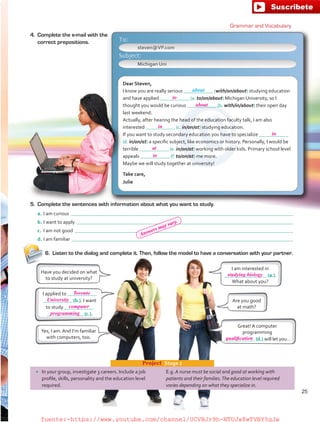
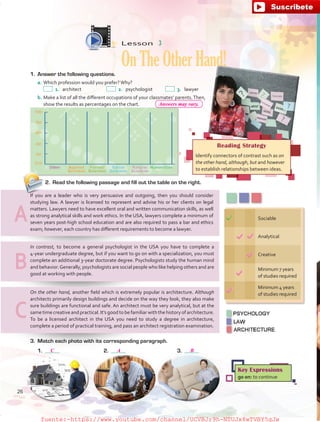
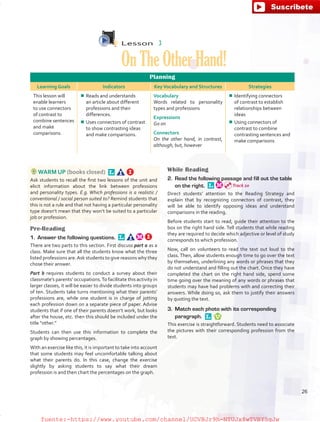
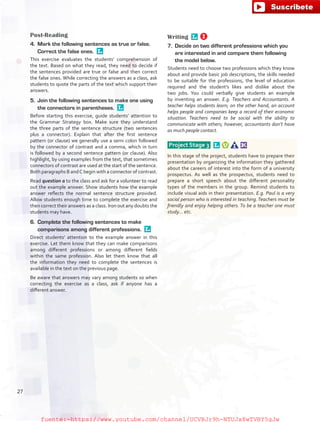
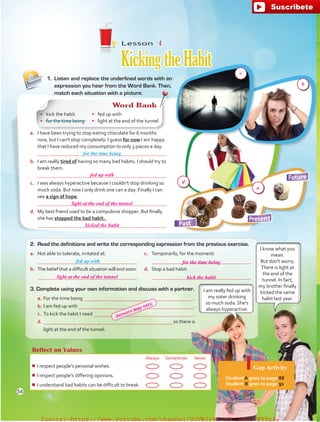
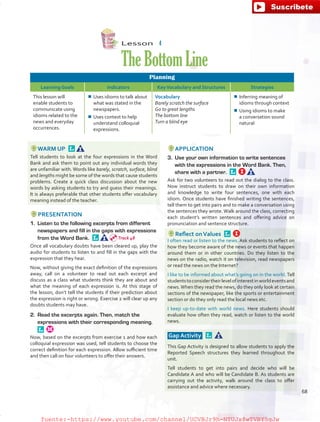
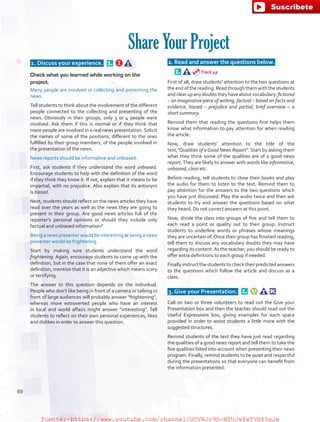
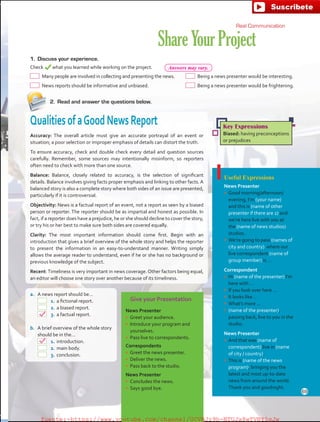
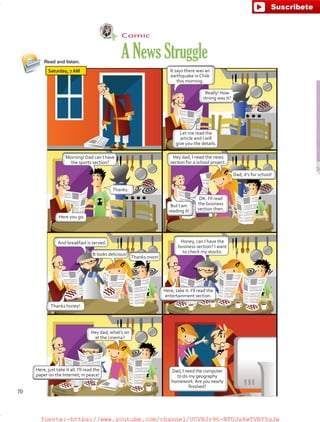
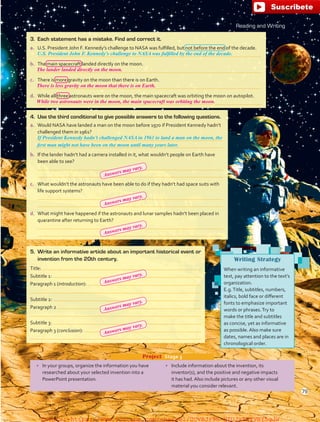
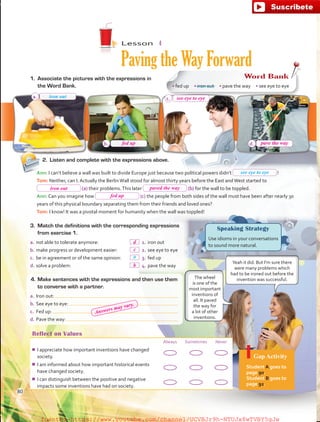
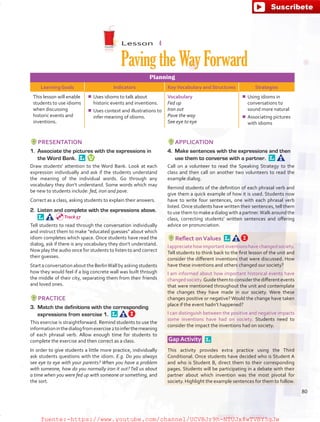
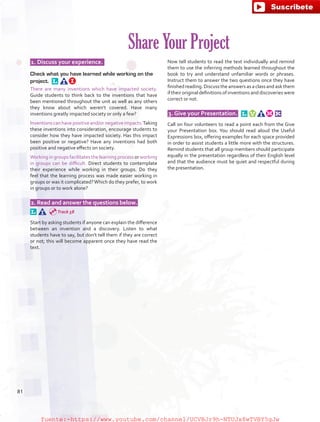
TEACHER´S BOOK
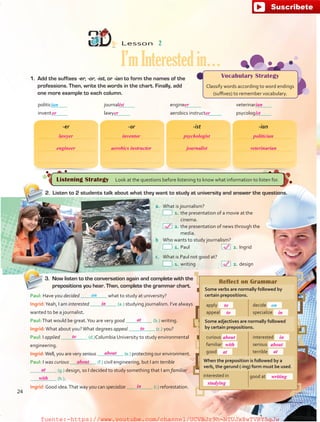
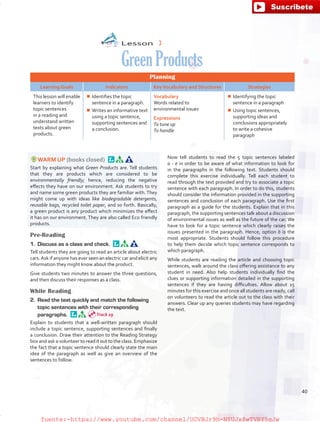
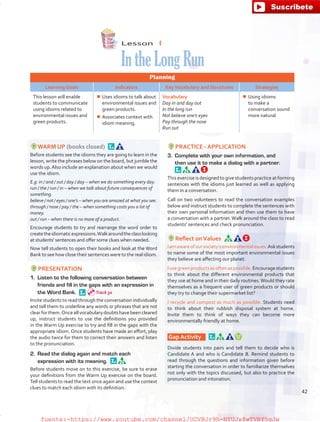
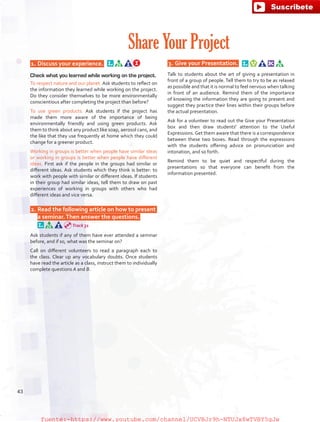
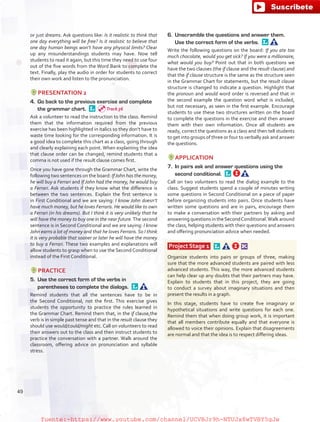
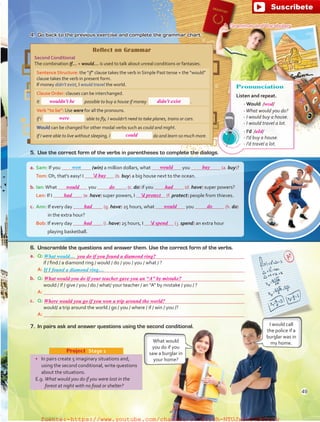
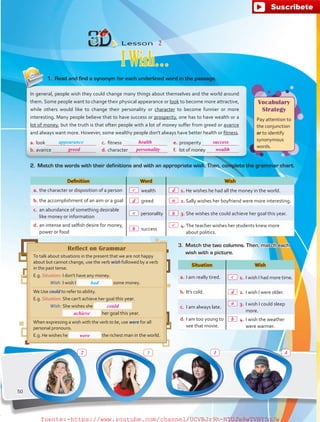
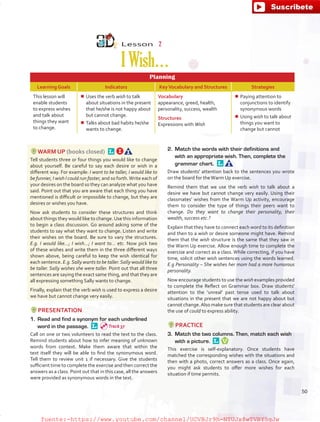
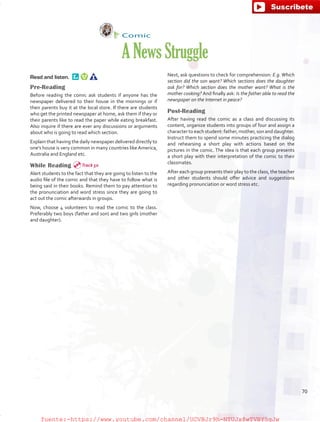
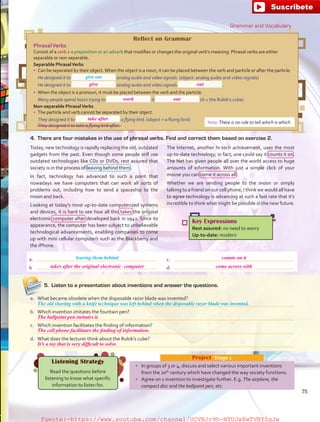
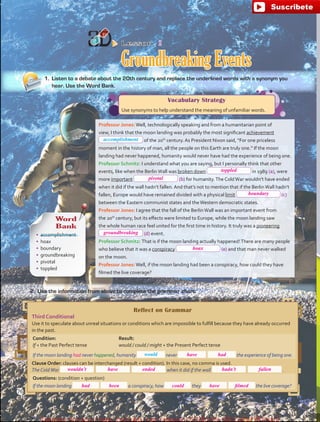
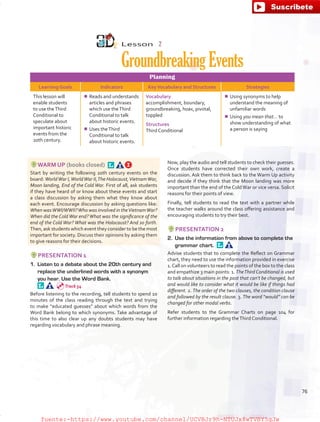
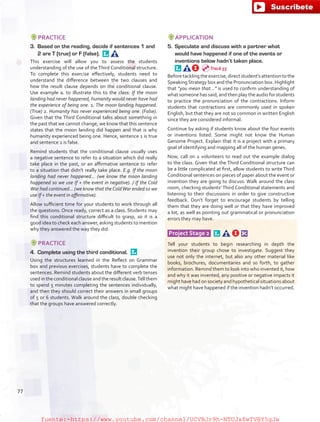
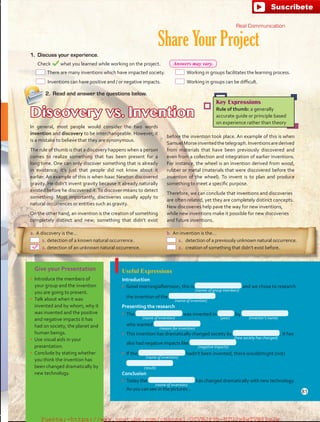
Level
ENGLISH
B1.2
Bachillerato General Unificado
OSWALDO TERCERO
fuente:-https://www.youtube.com/channel/UCVBJr9h-NTUJx8wTVBY5gJwfuente:-https://www.youtube.com/channel/UCVBJr9h-NTUJx8wTVBY5gJw
PRESIDENTE DE LA REPÚBLICA
Rafael Correa Delgado
MINISTRO DE EDUCACIÓN
Augusto Espinosa Andrade
Viceministro de Educación
Freddy Peñafiel Larrea
Viceministra de Gestión Educativa
DaysiValentina Rivadeneira Zambrano
Subsecretario de Fundamentos Educativos (E)
Miguel Ángel Herrera Pavo
Subsecretaria de Administración Escolar
Mirian Maribel Guerrero Segovia
Directora Nacional de Currículo (S)
María Cristina Espinosa Salas
Directora Nacional de Operaciones y Logística
Ada Leonora ChamorroVásquez
© Ministerio de Educación del Ecuador, 2016
Av. Amazonas N34-451 y Atahualpa
Quito, Ecuador
www.educacion.gob.ec
La reproducción parcial o total de esta publicación,
en cualquier forma y en cualquier medio mecánico o
electrónico, está permitida siempre y cuando sea autorizada
por los editores y se cite correctamente la fuente.
English B1.2,
Teacher’s Guide
Author
Mark Andrew Forbes
Editor-in-Chief
Javier AndrésTibaquirá Pinto
Editor
Carlos Sanabria Páez
Assistant Editors
Germán Obando, Adriana Molano,
Jonnathan Loaiza, Marisela Niño
Proofreaders
Andrea Peña, Margarita Orbegozo,
Francisco Castro, Nicolás Romero,
Marco Giraldo
Consulting Reviewers
Thomas Francis Frederick, Randall Barfield
Art Director
Gloria EsperanzaVásquez
Designers
Leonardo Rivas, Libardo Mahecha,
Juan CarlosVera, Nohora Betancourt
Illustrators
CarmeloVergara, Nelson Hernández,
John Joven, Miguel Jiménez, José Luis Jiménez
Photography
Shutterstock ®
© Grupo Editorial Norma SA
Avenida Isaac Albéniz E3-154,Wolfgang Mozart
Quito, Ecuador
ISBN
Primera impresión:
ADVERTENCIA
Un objetivo manifiesto del Ministerio de Educación es combatir el sexismo y la discriminación de género en la sociedad
ecuatoriana y promover, a través del sistema educativo, la equidad entre mujeres y hombres. Para alcanzar este objetivo,
promovemos el uso de un lenguaje que no reproduzca esquemas sexistas, y de conformidad con esta práctica preferimos
emplearennuestrosdocumentosoficialespalabrasneutras,talescomolaspersonas(enlugardeloshombres)oelprofesorado
(en lugar de los profesores), etc. Sólo en los casos en que tales expresiones no existan, se usará la forma masculina como
genérica tanto para hacer referencia a las personas del sexo femenino como masculino. Esta práctica comunicativa, que
es recomendada por la Real Academia Española en su Diccionario Panhispánico de Dudas, obedece a dos razones: (a) en
español es posible <referirse a colectivos mixtos a través del género gramatical masculino>, y (b) es preferible aplicar <la ley
lingüística de la economía expresiva> para así evitar el abultamiento gráfico y la consiguiente ilegibilidad que ocurriría en
caso de utilizar expresiones como las y los, os/as y otras fórmulas que buscan visibilizar la presencia de ambos sexos.
fuente:-https://www.youtube.com/channel/UCVBJr9h-NTUJx8wTVBY5gJwfuente:-https://www.youtube.com/channel/UCVBJr9h-NTUJx8wTVBY5gJw
English B1.2 is a highschool series of English
textbooks whose main purpose is to introduce students
to English and its culture through a variety of activities
and projects intended to tap into students’ real lives
and expectations. The series also intends to show
learners the variety of topics and subjects through
which they can learn English not only as a language,
but also as a vehicle to learn information from areas
such as social studies, natural science and popular
culture. Furthermore, English B1.2 makes an important
contribution to education by proposing discussions
about values and providing learners with academic and
citizenship tools to apply to their school life and their
adulthood.
   Objectives and Characteristics
The series is organized around a number of units whose
goals and standards mirror those of internationally
recognized organizations. The series offers a graded
and sequential syllabus which allows teachers to build
students’ language competences on previous work, in
the areas of content and language skills. Besides the
work in the areas of linguistic competence, the units
are designed to contribute to students’ cognitive and
social development.
I.GeneralDescription
Language-wise, each book of the series contains six
language units, which focus on specific topics that
are explored through listening, speaking, reading and
writingactivities,togetherwiththeconstructionofboth
vocabulary and grammar skills. The treatment of these
language components is also aided by the formulation
of a number of strategies aimed at giving students tools
to advance through their independent learning.
   B. Rationale
The series takes into consideration the fact that
students already possess a wealth of knowledge in
their L1 (Spanish), so the teacher’s job is to provide the
language input for students to be able to build on them
in their L2 (English).
In regards to students’ social development, the
series promotes language activities oriented towards
students’ language practice in real settings. Many of
the activities are structured around sample dialogs from
which students build a repertoire of vocabulary and
language expressions that they can use as a framework
for further practice. Besides the activities based on the
role-playofdialogs,studentsalsocarryoutcollaborative
projects and information gap activities to maximize
their chances of interaction using the language input.
5
T
5
T
fuente:-https://www.youtube.com/channel/UCVBJr9h-NTUJx8wTVBY5gJwfuente:-https://www.youtube.com/channel/UCVBJr9h-NTUJx8wTVBY5gJw
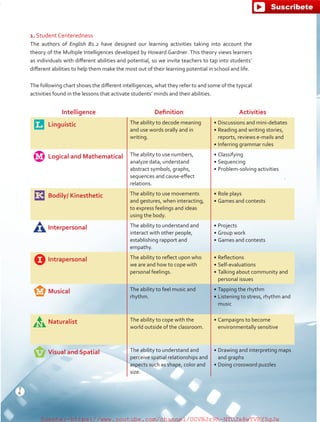
1. Student Centeredness
The authors of English B1.2 have designed our learning activities taking into account the
theory of the Multiple Intelligences developed by Howard Gardner. This theory views learners
as individuals with different abilities and potential, so we invite teachers to tap into students’
different abilities to help them make the most out of their learning potential in school and life.
The following chart shows the different intelligences, what they refer to and some of the typical
activities found in the lessons that activate students’ minds and their abilities.
Intelligence Definition Activities
Linguistic The ability to decode meaning
and use words orally and in
writing.
• Discussions and mini-debates
• Reading and writing stories,
reports, reviews e-mails and
• Inferring grammar rules
Logical and Mathematical The ability to use numbers,
analyze data, understand
abstract symbols, graphs,
sequences and cause-effect
relations.
• Classifying
• Sequencing
• Problem-solving activities
Bodily/ Kinesthetic The ability to use movements
and gestures, when interacting,
to express feelings and ideas
using the body.
• Role plays
• Games and contests
Interpersonal The ability to understand and
interact with other people,
establishing rapport and
empathy.
• Projects
• Group work
• Games and contests
Intrapersonal The ability to reflect upon who
we are and how to cope with
personal feelings.
• Reflections
• Self-evaluations
• Talking about community and
personal issues
Musical The ability to feel music and
rhythm.
• Tapping the rhythm
• Listening to stress, rhythm and
music
Naturalist The ability to cope with the
world outside of the classroom.
• Campaigns to become
environmentally sensitive
Visual and Spatial The ability to understand and
perceive spatial relationships and
aspects such as shape, color and
size.
• Drawing and interpreting maps
and graphs
• Doing crossword puzzles
6
T
6
T
fuente:-https://www.youtube.com/channel/UCVBJr9h-NTUJx8wTVBY5gJwfuente:-https://www.youtube.com/channel/UCVBJr9h-NTUJx8wTVBY5gJw
2. Teaching and Learning Approach
EnglishB1.2isbasedonaneclecticbutinformedseriesof
ideas and constructs in language teaching and learning.
However, English B1.2 has been developed taking B.
Kumaravadivelu’s (2003) ideas into account. He clearly
conceptualizes teaching as being enacted through the
parameters of particularity, practicality, and possibility.
Particularity has to do with the fact that teaching has
to be responsive to particular contexts where teachers
and learners are entitled to have their own ideas about
learning. Practicality is related to the idea that teachers
needtocometotermswiththedichotomyoftheoryand
practice, in order to empower themselves to figure out
their own theories of language and teaching through
their classroom practices. Lastly, the idea of Possibility
has to do with the empowering of learners so that they
can critically appraise both the social and historical
conditions of their learning, and therefore pursue new
forms of understanding and recreating reality.
English B1.2 also derives its theoretical foundations
from task-based instruction, cooperative learning,
cross-curricular studies and the cross-cultural approach
to language teaching and learning. The main idea
behind task-based learning is the fact that learners will
beengagedinaseriesofreal-lifelanguagetasksthatwill
help them improve their language skills and enhance
their world knowledge. The series approach also takes
into consideration the situation of both teachers and
students in EFL contexts.These textbooks therefore are
aided by focused instruction especially in the areas of
vocabulary and grammar as important building blocks
for students’ progress in their language proficiency.
Cooperative learning is the basis of many of the
activities in English B1.2, since students need to adopt
a variety of interaction patterns: individual, pair and
group work. One of the highlights of each unit is the
work students do progressively to create, develop
and present a group project related to the topic of the
unit. This project also involves the making of some
sort of product that helps students use the language
meaningfully when creating and presenting it.
In the design of other cooperative tasks, English
B1.2 has also considered the ideas of Spencer Kagan
(1994) who suggested the acronym PIES to stand
for the basic principles of cooperative work, where P
stands for Positive Interdependence, I is for Individual
Accountability, E stands for Equal Participation, and S
for Simultaneous Interaction. Positive Interdependence
means that group members need be aware of the fact
that there is no I in group work and that the group
benefitsfromthecontributionofallmembers.Individual
Accountability has to do with the responsibility that
each member has to have for the success of the entire
group’s project. Equal Participation calls for the idea
of an inclusive group where all members are entitled
to have a say regardless of the quality of their ideas
or, in the case of language learning, their accuracy
and fluency. Simultaneous Interaction has to do with
the amount of participation that each member of the
group has in different projects.
Cross-curricular activities are among the most
important features of English B1.2 since students
are exposed to a wide variety of topics and activities
from areas such as natural science, technology, social
studies, literature, arts, etc. Consequently, students
are engaged in activities that reflect what they need
to know in these subjects. For example, the use of
timelines for historic or personal events and the use
of graphs and tables to make sense of information in
social studies or science.
The cross-cultural approach also runs through the
entire series since students will be able to expand
their intercultural awareness by studying topics
in which they are able to see the contributions of
different countries and peoples to the world progress
in different fields. Moreover, the series contains topics
about family, school, and workplace interactions that
appeal to a wide variety of communities since they are
not necessarily related to English speaking countries or
cultures.
7
T
7
T
fuente:-https://www.youtube.com/channel/UCVBJr9h-NTUJx8wTVBY5gJwfuente:-https://www.youtube.com/channel/UCVBJr9h-NTUJx8wTVBY5gJw
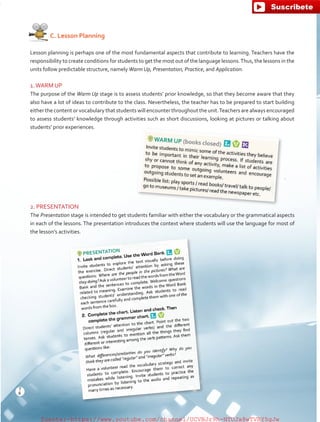
   C. Lesson Planning
Lesson planning is perhaps one of the most fundamental aspects that contribute to learning. Teachers have the
responsibility to create conditions for students to get the most out of the language lessons.Thus, the lessons in the
units follow predictable structure, namely Warm Up, Presentation, Practice, and Application.
1.WARM UP
The purpose of the Warm Up stage is to assess students’ prior knowledge, so that they become aware that they
also have a lot of ideas to contribute to the class. Nevertheless, the teacher has to be prepared to start building
either the content or vocabulary that students will encounter throughout the unit.Teachers are always encouraged
to assess students’ knowledge through activities such as short discussions, looking at pictures or talking about
students’ prior experiences.
2. PRESENTATION
The Presentation stage is intended to get students familiar with either the vocabulary or the grammatical aspects
in each of the lessons. The presentation introduces the context where students will use the language for most of
the lesson’s activities.
8
T
8
T
fuente:-https://www.youtube.com/channel/UCVBJr9h-NTUJx8wTVBY5gJwfuente:-https://www.youtube.com/channel/UCVBJr9h-NTUJx8wTVBY5gJw
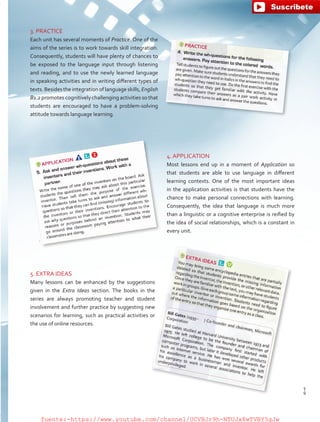
3. PRACTICE
Each unit has several moments of Practice. One of the
aims of the series is to work towards skill integration.
Consequently, students will have plenty of chances to
be exposed to the language input through listening
and reading, and to use the newly learned language
in speaking activities and in writing different types of
texts. Besides the integration of language skills, English
B1.2 promotes cognitively challenging activities so that
students are encouraged to have a problem-solving
attitude towards language learning.
4. APPLICATION
Most lessons end up in a moment of Application so
that students are able to use language in different
learning contexts. One of the most important ideas
in the application activities is that students have the
chance to make personal connections with learning.
Consequently, the idea that language is much more
than a linguistic or a cognitive enterprise is reified by
the idea of social relationships, which is a constant in
every unit.
5. EXTRA IDEAS
Many lessons can be enhanced by the suggestions
given in the Extra Ideas section. The books in the
series are always promoting teacher and student
involvement and further practice by suggesting new
scenarios for learning, such as practical activities or
the use of online resources.
9
T
9
T
fuente:-https://www.youtube.com/channel/UCVBJr9h-NTUJx8wTVBY5gJwfuente:-https://www.youtube.com/channel/UCVBJr9h-NTUJx8wTVBY5gJw
II.SeriesComponents
The series authors, editors and developers are well aware of the fact that students need constant exposure to the
language as well as to a variety of exercises and evaluations. For this reason, the series has a Student’s Book, a
Teacher’sGuide, an audioCD (within the student’s book) and two audioCDs for the teacher.A workbook, tests and
online support activities will soon be available.
   A. Students’ Book Structure
Each book begins with a Scope and Sequence which describes each of the six main units in the book.
Additionally, there is a Review Unit at the beginning of each book, where students are given another
opportunity to practice some of the contents and the language aspects studied in the previous book.
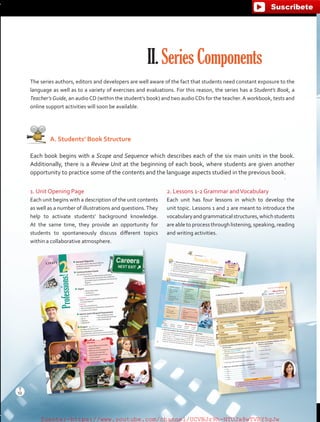
1. Unit Opening Page
Each unit begins with a description of the unit contents
as well as a number of illustrations and questions.They
help to activate students’ background knowledge.
At the same time, they provide an opportunity for
students to spontaneously discuss different topics
within a collaborative atmosphere.
2. Lessons 1-2 Grammar andVocabulary
Each unit has four lessons in which to develop the
unit topic. Lessons 1 and 2 are meant to introduce the
vocabularyandgrammaticalstructures,whichstudents
are able to process through listening, speaking, reading
and writing activities.
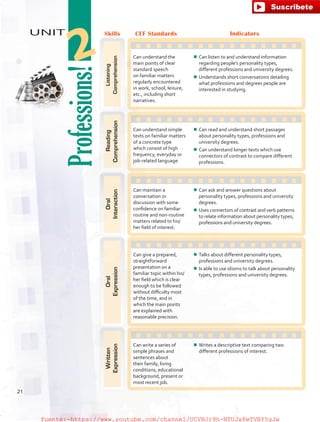
UNIT uuGeneral Objective
	 You	will	be	able	to	talk	about	different	
professions,	personality	types	and	
university	degrees.	
uuCommunication Goals
	 You	will	learn	how	to
•	 	describe	and	differentiate	professions.
•	 	ask	and	answer	questions	about	different	
personality	types,	professions	and	university	
degrees.
•	 	write	a	text	comparing	two	professions.
uuTopics
•	 Personality	Types
•	 Professions
•	 University	Degrees
	 Vocabulary
•	 Words	related	to	personality	types,	professions	and	
university	degrees
	 Grammar
•	 Gerunds	and	infinitives
•	 Verbs	and	adjectives	followed	by	prepositions
•	 Connectors	of	contrast
uuIdioms and Colloquial Expressions
•	 Cut out for
•	 Go on
•	 Drop out
•	 Fall behind
•	 Pass with flying colors
•	 Suit (someone/something)
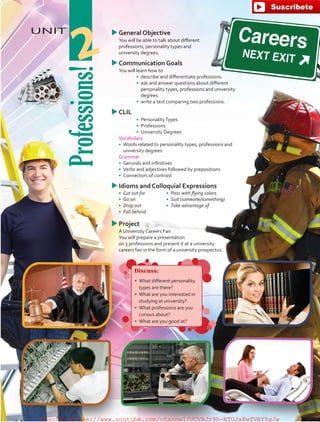
•	 Take advantage of
uuProject
	 A	University	Careers	Fair
	 You	will	prepare	a	presentation	
on	3	professions	and	present	it	at	a	university	
careers	fair	in	the	form	of	a	university	prospectus.
Professions!
2
Discuss:
•	 What	different	personality	
types	are	there?
•	 What	are	you	interested	in	
studying	at	university?
•	 What	professions	are	you	
curious	about?
•	 What	are	you	good	at?
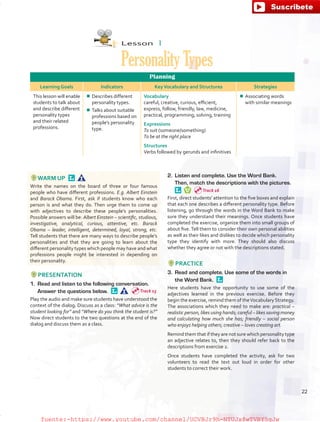
1. Read and listen to the following conversation. Answer the questions below.
A:	 	Hello,	I	want	to	investigate	my	career	options	and	find	out	which	professions	best	suit	me.
B:	 	Actually,	that	depends	on	your	personality	type.	You	might	be	artistic,	realistic,	
investigative,	conventional	or	social.	Everybody	is	different!
A:	 	Hmmm,	and	I	guess	it	also	depends	on	what	I’m	interested	in	and	what	my	abilities	are.
B:	 Well,	you’re	at	the	right	place!	a. Do	you	know	about	any	of	these	personality	types?
b. Do	you	think	it	is	possible	to	fit	into	more	than	one	personality	type?
Vocabulary
Strategy
Associate	words	with	similar	meanings	
to	increase	your	
vocabulary.	
Lesson	 1
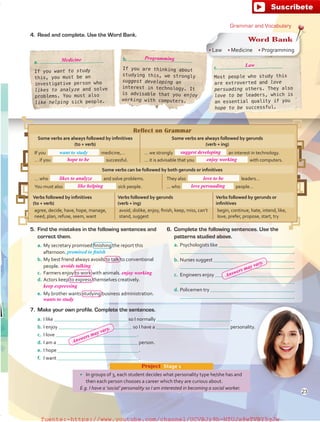
PersonalityTypes
Word Bank
follow
express
solving
training
efficient
friendly	
practical
careful
creative
curious	
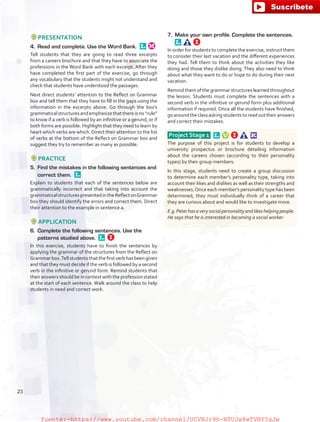
2. Listen and complete. Use the Word Bank. Then, match the descriptions with the pictures.
3. Read and complete. Use some of the words in the Word Bank.
I	am	a	very	realistic	person	and	I	like	using	my	hands	to	
build	 things.	 I	 am	 interested	 in	 becoming	 a	 carpenter	
because	 I	 am	 a	 very	
(a.)	 person.	 My	
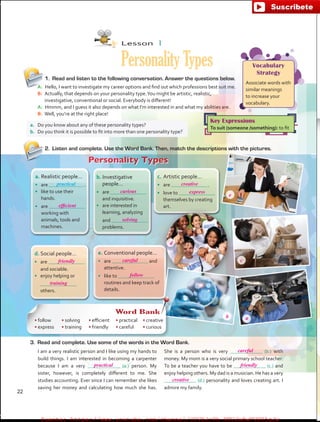
sister,	 however,	 is	 completely	 different	 to	 me.	 She	
studies	accounting.	Ever	since	I	can	remember	she	likes	
saving	 her	 money	 and	 calculating	 how	 much	 she	 has.	
She	 is	 a	 person	 who	 is	 very	
(b.) with	
money.	My	mom	is	a	very	social	primary	school	teacher.	
To	be	a	teacher	you	have	to	be	
(c.)	and	
enjoy	helping	others.	My	dad	is	a	musician.	He	has	a	very		
(d.)	personality	and	loves	creating	art.	I	
admire	my	family.
a. Realistic	people…•	 are	
	.•	 like	to	use	their	
hands.
•	 are	
working	with	
animals,	tools	and	machines.
b. Investigative	
people…
•	 are	
and	inquisitive.•	 are	interested	in	
learning,	analyzing	
and	
problems.
c. Artistic	people…
•	 are	
	.•	 love	to	
themselves	by	creating	art.
d. Social	people…
•	 are	
and	sociable.
•	 enjoy	helping	or	
others.
e. Conventional	people…•	 are	
	and	attentive.
•	 like to
routines	and	keep	track	of	details.
Personality Types
Key ExpressionsTo suit (someone /something):	to	fit
practical
22
5. Find the mistakes in the following sentences and
correct them.
a. My	secretary	promised	finishing	the	report	this	
afternoon.	
b. My	best	friend	always	avoids	to	talk	to	conventional	
people.	
c. Farmers	enjoy	to	work	with	animals.
d. Actors	keep	to	express	themselves	creatively.
e. My	brother	wants	studying	business	administration.	
6. Complete the following sentences. Use the
patterns studied above.
a. Psychologists	like	 	.
b. Nurses	understand	 	.
c. Engineers	enjoy	 	.
d. Policemen	try	 	.
Word Bank
Law	 Medicine	 Programming
•	 In	groups	of	3,	each	student	decides	what	personality	type	he/she	has	and	
then	each	person	chooses	a	career	which	they	are	curious	about.
E.g. I have a ‘social’ personality so I am interested in becoming a social worker.
Project Stage 1
c.
Most people who study this
are extroverted and love
persuading others. They also
love to be leaders, which is
an essential quality if you
hope to be successful.
b.
If you are thinking about
studying this, we strongly
suggest developing an
interest in technology. It
is advisable that you enjoy
working with computers.
a.
If you want to study
this, you must be an
investigative person who
likes to analyze and solve
problems. You must also
like helping sick people.
4. Read and complete. Use the Word Bank.
Verbs	followed	by	infinitives	
(to + verb)
Verbs followed by gerunds
(verb + ing)
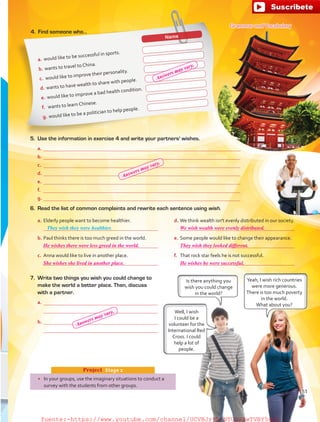
Verbs followed by gerunds or
infinitives
agree,	decide,	have,	hope,	manage,	
need,	plan,	refuse,	seem,	want
avoid,	dislike,	enjoy,	finish,	keep,	miss,	can’t	
stand,	suggest,	understand
begin,	continue,	hate,	intend,	like,	
love,	prefer,	propose,	start,	try
Reflect on Grammar
Some	verbs	are	always	followed	by	infinitives	
(to + verb)
Some verbs are always followed by gerunds
(verb + ing)
If	you		
		medicine,…
…	if	you		
		successful.
…	we	strongly		
		an	interest	in	technology.
…	it	is	advisable	that	you		
		with	computers.
Grammar and Vocabulary
7. Make your own profile. Complete the sentences.
a. I	like	
	so	I	normally	
.
b. I	enjoy	
	so	I	have	a	
	personality.
c. I	love	
.	
d. I	am	a	
	person.
e. I	hope	
.
f. I	want	
.
Some	verbs	can	be	followed	by	both	gerunds	or	infinitives
…	who	
		and	solve	problems. They	also	
		leaders…
You	must	also	
		sick	people. ...	who	
people…
want to study
promised to finish
23
10
T
10
T
fuente:-https://www.youtube.com/channel/UCVBJr9h-NTUJx8wTVBY5gJwfuente:-https://www.youtube.com/channel/UCVBJr9h-NTUJx8wTVBY5gJw
3. Lesson 3 Reading andWriting
Lesson 3 is entirely devoted to working on the reading process which is subdivided into Pre-Reading,While-Reading
and Post-Reading.These subdivisions are aimed at making students strategic and effective readers.
Pre-Reading Activities
ThepurposeofPre-Readingactivitiesistohelpstudents
get ready to read a text and be better prepared to
understand it. When students preview vocabulary, use
prior knowledge and predict, they feel more motivated
and connected to the text.
While-Reading Activities
While-Readingactivitiesaredesignedtohelpthereader
deal with the text while he or she is actively involved in
comprehension, using strategies like: stopping to think,
re-reading, asking themselves questions, visualizing,
making inferences, underlining or using context clues to
work out meaning.
Post-Reading Activities
Students need to apply some Post-Reading strategies
to achieve a deeper understanding of the text. For this
purpose, they can ask questions, make inferences,
find the main idea, summarize, and hold mini-debates
or discussions. These activities are also aimed at
enhancing readers’ ability to think about what they
read and take a critical position.
This section also provides students with writing models
and strategies. The idea is to help them determine
writing elements and give form to their ideas in an
organized way. Different strategies help students
generate, organize, connect, rephrase, and develop
their ideas effectively.
Reading Strategy
Identifying text purpose
Is the text trying to inform or persuade you?The text
type will help determine its purpose and content.
Informative texts try to provide as much factual
information as possible and support its arguments.
Persuasive texts provide some information, but also
try to convince the audience of something by stating
opinions.
Identifying the audience
Determine	who	the	text	is	written	for.	This	influences	
how the content is expressed.
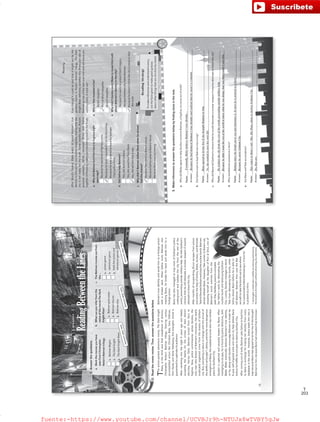
How many times have you said or heard someone say,
“I wish I could stop biting my nails”, or “I wish I didn't
procrastinate so much? Bad habits are extremely
common and people all around the world wish they could
break their bad habits. So, what exactly is a habit? A	
habit	is	something	you	do	consistently,	over	and	over	again	
. It generally doesn't require thinking. A bad habit is
simply a behavior pattern which is considered negative.
Common	 examples	 include:	 procrastination,	 fidgeting,	
overspending, nail-biting, and so forth. According to
some psychologists, breaking	bad	habits	should	be	one	of	
your	top	priorities	in	life	 .	At	first,	it	may	be	challenging	
to break a bad habit.You will need a lot of self-discipline,
but it will get easier. Here are 5 easy steps for changing
bad habits:
Key Expressions
Cold turkey: the sudden and complete cessation
of a bad habit
Fidgeting: small movements through nervousness
or impatience
Do the trick: bring the desired results
1. Conduct a survey of your classmates to find out how many people have the following bad habits.
Lesson 3
BreakingBadHabits
Bad Habit biting	your	fingernails
spending more money
than you should
procrastinating
having any other bad
habit you want to change
Number of
Classmates
2. Read and determine if the italicized sentences
are facts [F] or opinions [O]. Then, answer the
questions.
Awareness: You	must	become	aware	of	your	habits	 .
What	is	this	habit	exactly?	How	is	this	bad	habit	affecting	
you?	How	is	it	affecting	others?	For	example,	overspending	
might	also	have	negative	effects	on	your	family.
Wanting to Change: You must decide that breaking the
bad habit is a worthy goal. You must be convinced that a
change	is	worth	the	effort	involved.
Commitment:You must be determined to do whatever it
takes to break the bad habit so that you can be in better
control of your life. You have to make a decision that “no
matter what” you will do what is required to change the
habit.
F
52
Writing Strategy
Who is the text written for?Will it be persuasive orinformative?
Order your text into anintroductory paragraph,supporting paragraphs anda conclusion.
Remember to givearguments, stating factsand opinions to supportyour ideas.
4. Think of a bad habit that you have and write a short text on how to break it.
Introduction
(What is the bad habit?)
Supporting paragraph 1(Negative	influences)	
Supporting paragraph 2(How to break the habit)
Conclusion
(Your commitment to breaking the bad habit)
•	 Analyze the answers collected in thesurvey, and represent them on a graph
showing percentages. Organize theresults for a PowerPoint presentation.
E.g. 65%	of	the	people	interviewed	said	
they	would	build	a	shelter	using	trees	and	
build	a	fire	for	warmth.
Project Stage 3
Reading and Writing
Consistent Action: It is important to focus on changing just
one habit at a time. Take consistent daily actions to break
the bad habit. Try	doing	the	process	one	step	at	a	time	rather	
than	trying	to	do	it	all	at	once	 . However, it is important
to note that everyone	is	different	and	some	people	are	able	
to	change	a	habit	by	going	cold	turkey	while	others	prefer	a	
gradual	change	 .
Perseverance: Breaking bad habits is not easy. There	might	
be	times	when	you	question	whether	it	is	worth	it	 . You
may say to yourself that breaking the bad habit is too
difficult.	 You	 need	 to	 regularly	 visualize	 the	 rewards	 for	
following through and the costs of not following through on
breaking bad habits. Get support from others who also want
to make changes in their lives and read about people who
have been successful in breaking bad habits.Now, you are armed with a 5-step process for breaking bad
habits or other conditions that require changing. If you
have an addiction to something such as video games, these
steps alone may not be enough.You may require additional
professional help or a support group, but for most cases this
5-step process will do the trick!
a. You need self-discipline tobreak a bad habit.
true
false
doesn't mention
b. Bad habits are not verycommon.
true
false
doesn't mention
c. Bad habits are morecommon than good habits.
true
false
doesn't mention
3. Go over the reading strategy and answer the questions below.
a. What type of text is this? Give reasons for your answer.
an informative text
a persuasive text
both
Why?
b. Who is the text written for? Give reasons for your answer.
general public
educators
scientists
Why?
53
11
T
11
T
fuente:-https://www.youtube.com/channel/UCVBJr9h-NTUJx8wTVBY5gJwfuente:-https://www.youtube.com/channel/UCVBJr9h-NTUJx8wTVBY5gJw
4. Lesson 4 Real Communication
Lesson 4 is entitled Real Communication. The purpose
of this lesson is to help students widen their oral
skills through the learning of idiomatic expressions
associated to cultural aspects of the language. This
page ends with a Reflect on Values section, whose
purpose is to make students aware of cultural aspects
that underlie the lesson contents and to help them
learn to be self-critical about their attitudes and values.
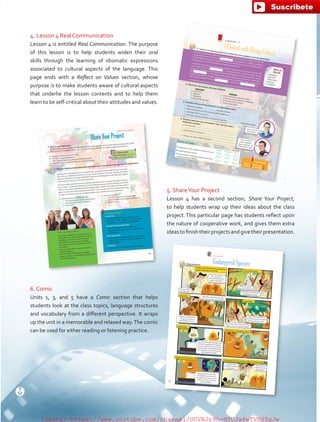
5. ShareYour Project
Lesson 4 has a second section, Share Your Project,
to help students wrap up their ideas about the class
project. This particular page has students reflect upon
the nature of cooperative work, and gives them extra
ideastofinishtheirprojectsandgivetheirpresentation.
6. Comic
Units 1, 3, and 5 have a Comic section that helps
students look at the class topics, language structures
and vocabulary from a different perspective. It wraps
up the unit in a memorable and relaxed way.The comic
can be used for either reading or listening practice.
Reflect on Values
Always Sometimes Never
¾ Happiness	is	more	important	to	me	than	money.	
¾ I	respect	people’s	choices.	¾ I	am	interested	in	studying	a	profession	that	fits	
my	personality	and	abilities.	
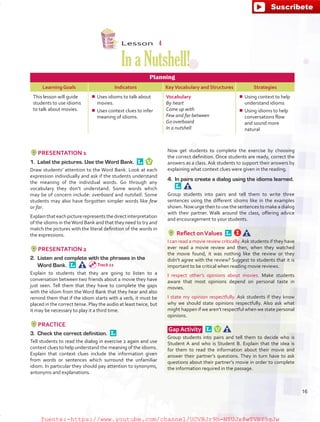
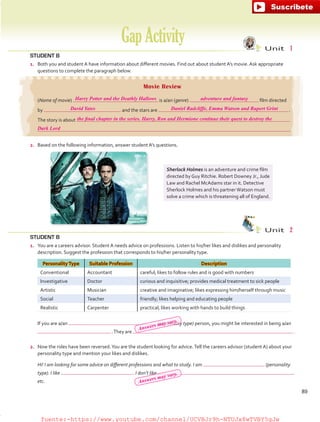
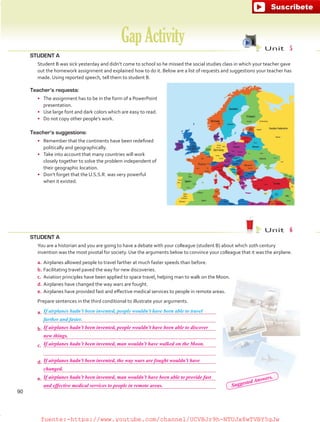
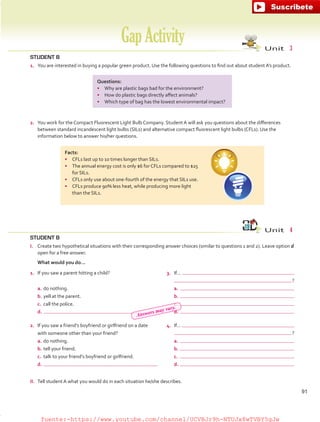
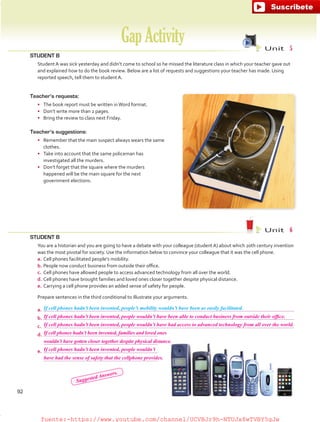
Gap ActivityStudent A goes to page 87.
Student B goes to page 89.
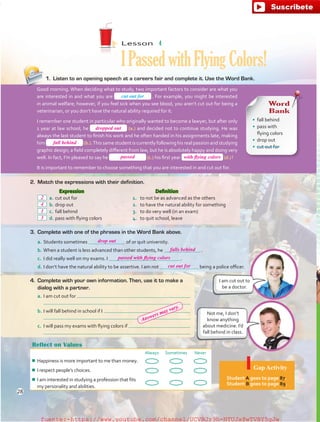
2. Match the expressions with their definition.
Not	me,	I	don’t	know	anything	about	medicine.	I’d	fall	behind	in	class.
Lesson	 4
IPassedwithFlyingColors!
1. Listen to an opening speech at a careers fair and complete it. Use the Word Bank.
Word
Bank
•	 fall	behind
•	 pass	with	
flying	colors•	 drop	out	
•	 cut	out	for
Good	morning.	When	deciding	what	to	study,	two	important	factors	to	consider	are	what	you	
are	interested	in	and	what	you	are
.	For	example,	you	might	be	interested	
in	animal	welfare;	however,	if	you	feel	sick	when	you	see	blood,	you	aren’t	cut	out	for	being	a	
veterinarian,	or	you	don’t	have	the	natural	ability	required	for	it.	
I	remember	one	student	in	particular	who	originally	wanted	to	become	a	lawyer,	but	after	only	
1	year	at	law	school,	he	
(a.) and	decided	not	to	continue	studying.	He	was	
always	the	last	student	to	finish	his	work	and	he	often	handed	in	his	assignments	late,	making	
him	
(b.).	This	same	student	is	currently	following	his	real	passion	and	studying	
graphic	design;	a	field	completely	different	from	law,	but	he	is	absolutely	happy	and	doing	very	
well.	In	fact,	I’m	pleased	to	say	he	
(c.)	his	first	year	
(d.)!
It	is	important	to	remember	to	choose	something	that	you	are	interested	in	and	cut	out	for.
4. Complete with your own information. Then, use it to make a
dialog with a partner.a. I	am	cut	out	for	
b. I	will	fall	behind	in	school	if	I	
c. I	will	pass	my	exams	with	flying	colors	if	
3. Complete with one of the phrases in the Word Bank above.
a. Students	sometimes
of	or	quit	university.
b. When	a	student	is	less	advanced	than	other	students,	he
.
c. I	did	really	well	on	my	exams.	I
.
d. I	don’t	have	the	natural	ability	to	be	assertive.	I	am	not
being	a	police	officer.
Expressiona. cut	out	for
b. drop	out
c. fall	behind
d. pass	with	flying	colors
Definition1. to	not	be	as	advanced	as	the	others
2. to	have	the	natural	ability	for	something
3. to	do	very	well	(in	an	exam)
4. to	quit	school,	leave
I	am	cut	out	to	be	a	doctor.
cut out for
28
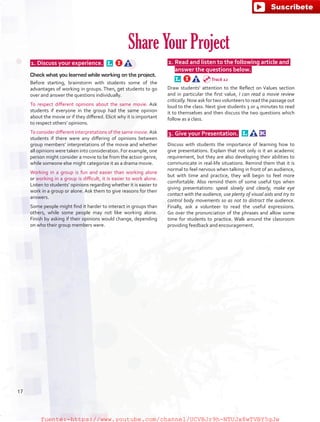
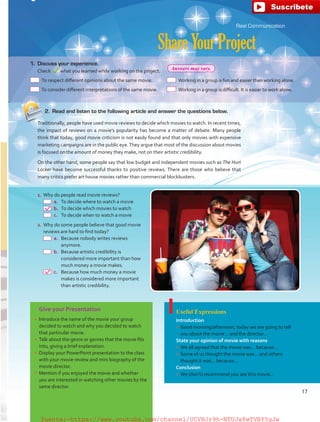
Give your Presentation
•	 Present	the	members	of	your	group	and	their	
personality	types.	Also	introduce	the	names	of	
the	different	careers	you	have	researched.
•	 Use	adjectives	to	describe	each	member’s	
personality	type	and	give	a	brief	description	of	
each	career.
•	 Give	your	presentation	using	your	university	
careers	prospectus.
•	 Mention	if	after	investigating	the	different	
careers,	any	of	you	are	interested	in	studying	the	
corresponding	degree.
ShareYourProject
Useful Expressions
Introduction
•	 Good morning/afternoon, my name is… and my
partners are… and….We have… personality types;
therefore we were interested in investigating…
Description of personality type
•	 John is a very creative and artistic person;
however, Kathy is curious and has an investigative
personality type…
Career description
•	 Doctors provide medical treatment to others.They
are generally curious people who like analyzing and
solving problems…
Conclusion
•	 I’m (not) interested in studying medicine because…
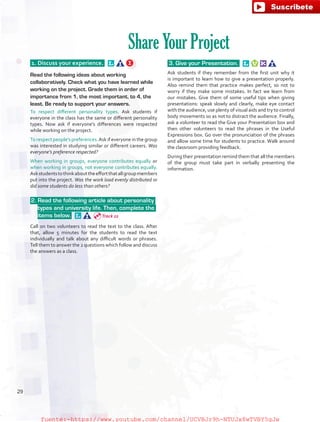
2. Read the following article about personality types and university life. Then, complete the items below.
Key Expressions
Take advantage of:	to	utilize,	
exploit,	use	to	one’s	benefit
Real Communication
1. Discuss your experience.
Read	the	following	ideas	about	working	collaboratively.	Check	what	you	learned	while	working	on	the	project.	Grade	
them	in	order	of	importance,	from	1,	the	most	important,	to	4,	the	least.	Be	ready	to	support	your	answers.
a. To	respect	different	personality	types.	
b. To	respect	people’s	preferences.	
c. When	working	in	groups,	everyone	contributes	equally.	
d. When	working	in	groups,	not	everyone	contributes	equally.	
A. Understanding	your	personality	type:	
1. will	improve	your	academic	performance.
2. will	improve	your	social	interaction.
3. both	1	and	2.
B. Your	learning	style:
1. is	determined	by	your	personality	type.
2. 	is	determined	by	your	academic	performance.
3. Neither	1	nor	2.
Knowing	and	understanding	your	personality	type	can	improve	every	aspect	of	your	university	
life,	from	your	academic	performance	to	your	social	experience.	How	you	interact	with	fellow	
students,	professors	and	college	staff	will	be	maximized,	allowing	you	to	really	take	advantage	of	
and	promote	success	in	your	university	experience.
Your	personality	type	determines	your	learning	style	and	how	you	make	decisions	about	what	you	
have	to	learn.	Consider	the	following:	an	extroverted	person	learns	best	by	studying	with	others	
while	an	introverted	individual	learns	best	studying	alone.	A	thinker	learns	best	with	logic,	while	a	
feeler	normally	learns	best	through	personal	values.	If	you	are	not	aware	of	your	personality	type,	
you	may	be	limiting	not	only	your	academic	performance,	but	also	your	social	experience.	
29
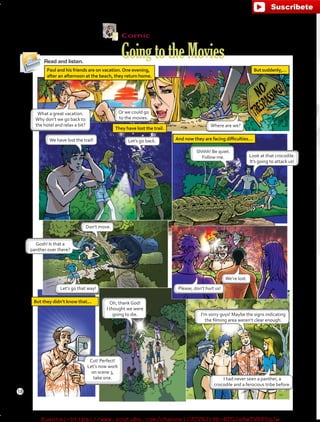
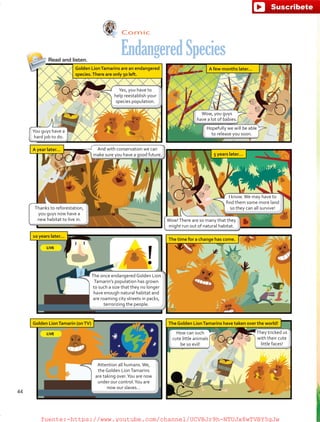
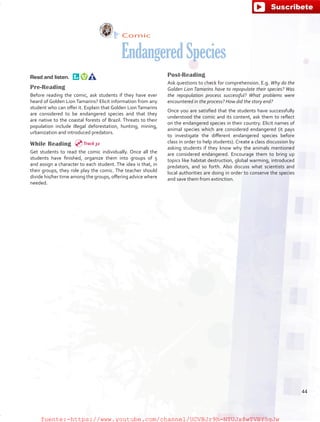
Comic
EndangeredSpeciesRead and listen.
Golden LionTamarins are an endangeredspecies.There are only 50 left. A few months later…
A year later…
5 years later…
10 years later…
Golden LionTamarin (onTV)
TheGolden LionTamarins have taken over the world!
The time for a change has come.
Thanks	to	reforestation,	
you guys now have a
new habitat to live in.
Wow!There are so many that theymight run out of natural habitat.
Attention	all	humans.	We,	
the Golden LionTamarins
are taking over.You are now
under our control.You are
now our slaves…
They tricked us
with their cute
little faces!
Yes,	you	have	to	
help	reestablish	your	
species	population.
I know.We may have to
find	them	some	more	land	
so they can all survive!
You guys have a
hard job to do.
Wow,	you	guys	
have a lot of babies.
Hopefully	we	will	be	able	
to release you soon.
And with conservation we canmake sure you have a good future.
The once endangered Golden LionTamarin’s	population	has	grown	to such a size that they no longerhave enough natural habitat andare	roaming	city	streets	in	packs,	
terrorizing	the	people.
How can such
cute little animals
be so evil!
44
12
T
12
T
fuente:-https://www.youtube.com/channel/UCVBJr9h-NTUJx8wTVBY5gJwfuente:-https://www.youtube.com/channel/UCVBJr9h-NTUJx8wTVBY5gJw
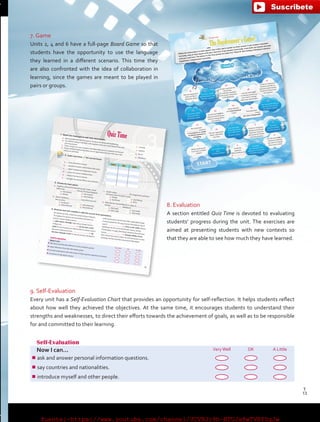
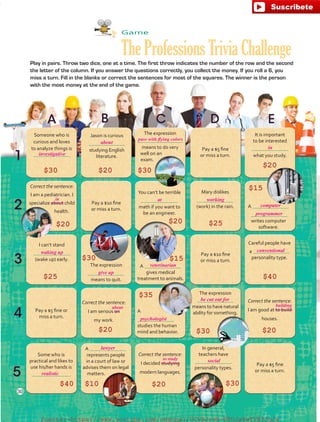
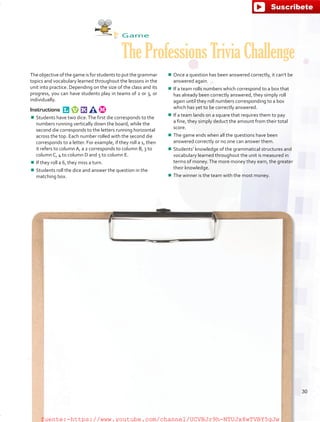
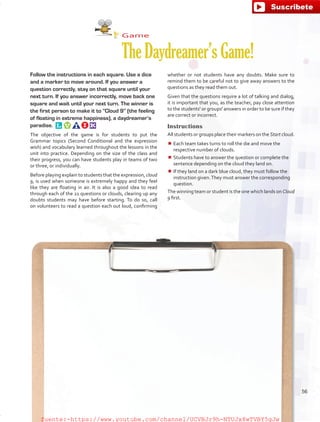
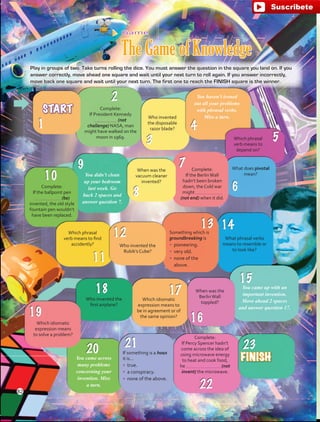
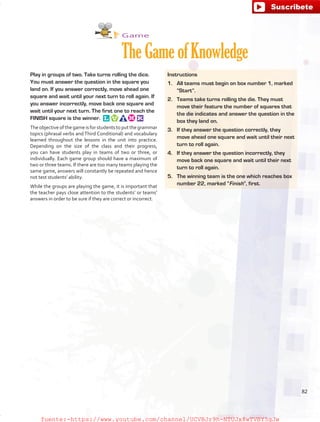
7. Game
Units 2, 4 and 6 have a full-page Board Game so that
students have the opportunity to use the language
they learned in a different scenario. This time they
are also confronted with the idea of collaboration in
learning, since the games are meant to be played in
pairs or groups.
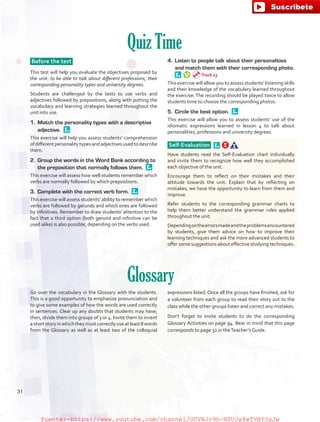
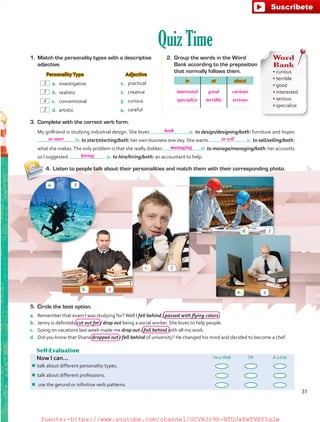
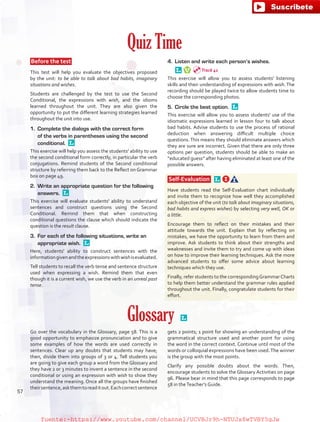
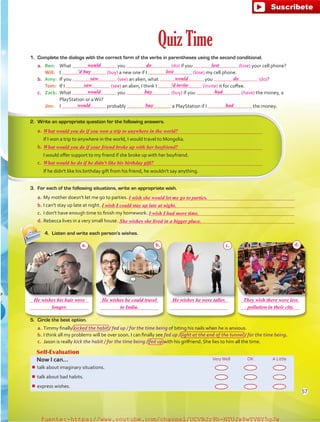
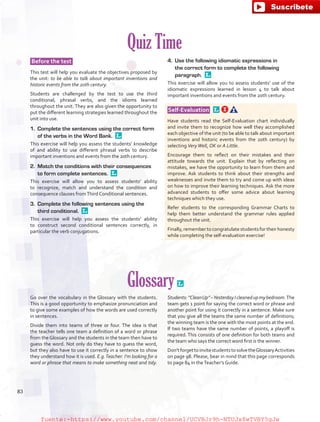
8. Evaluation
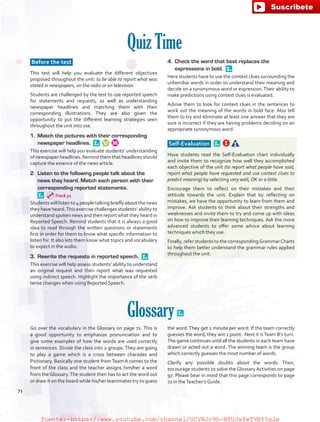
A section entitled Quiz Time is devoted to evaluating
students’ progress during the unit. The exercises are
aimed at presenting students with new contexts so
that they are able to see how much they have learned.
9. Self-Evaluation
Every unit has a Self-Evaluation Chart that provides an opportunity for self-reflection. It helps students reflect
about how well they achieved the objectives. At the same time, it encourages students to understand their
strengths and weaknesses, to direct their efforts towards the achievement of goals, as well as to be responsible
for and committed to their learning.
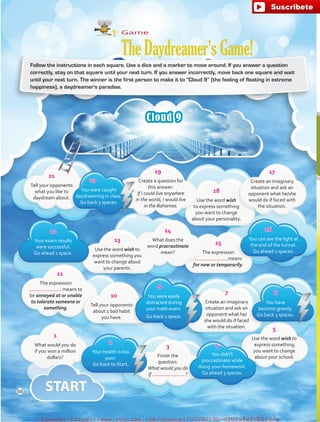
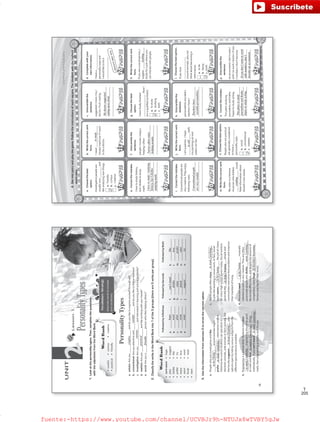
Follow the instructions in each square. Use a dice and a marker to move around. If you answer a question
correctly, stay on that square until your next turn. If you answer incorrectly, move back one square and wait
until your next turn. The winner is the first person to make it to “Cloud 9” (the feeling of floating in extreme
happiness), a daydreamer's paradise.
Cloud 9
Game
TheDaydreamer'sGame!
21
Tell your opponents
what you like to
daydream about.
20
You were caught
daydreaming in class.
Go back 3 spaces.
19
Create a question for
this answer:
If	I	could	live	anywhere		
in	the	world,	I	would	live	
in	the	Bahamas.
18
Use the word wish
to express something
you want to change
about your personality.
17
Create an imaginary
situation and ask an
opponent what he/she
would do if faced with
the situation.
12
Your exam results
were successful.
Go ahead 1 space.
13
Use the word wish to
express something you
want to change about
your parents.
14
What does the
word procrastinate
mean?
15
The expression
means
for now or temporarily.
16
You can see the light at
the end of the tunnel.
Go ahead 2 spaces.
11
The expression
means to
be annoyed at or unable
to tolerate someone or
something.
10
Tell your opponents
about 1 bad habit
you have.
8
You were easily
distracted during
your math exam.
Go back 1 space.
7
Create an imaginary
situation and ask an
opponent what he/
she would do if faced
with the situation.
6
You have
become greedy.
Go back 3 spaces.
1
What would you do
if you won a million
dollars?
2
Your health is too
poor.
Go back to Start.
3
Finish	the	
question:
What	would	you	do	
if	
	?
4
You didn't
procrastinate while
doing your homework.
Go ahead 3 spaces.
5
Use the word wish to
express something
you want to change
about your school.
56
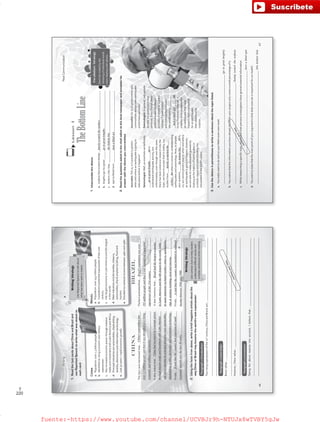
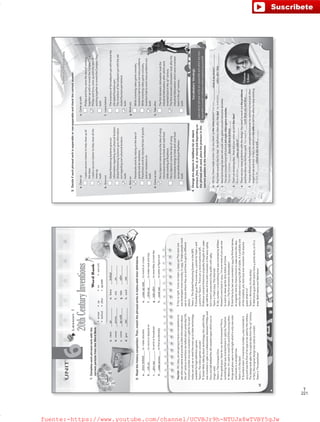
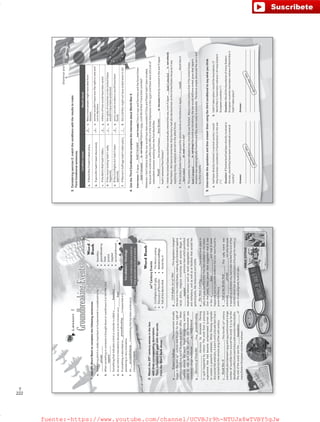
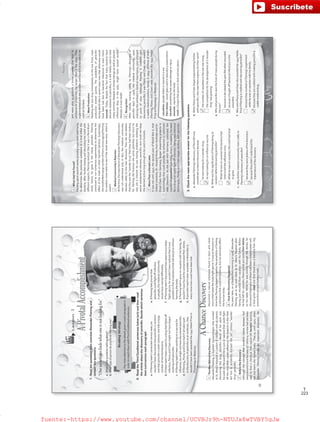
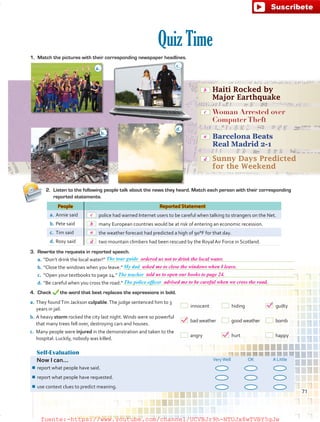
Quiz Time
Self-EvaluationNow I can...
Very	Well
OK
A Little
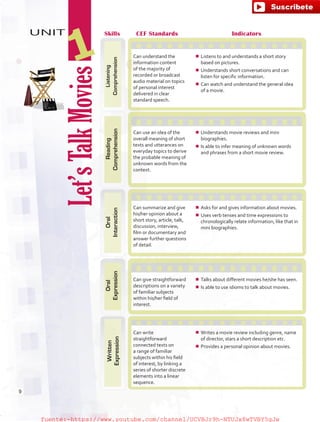
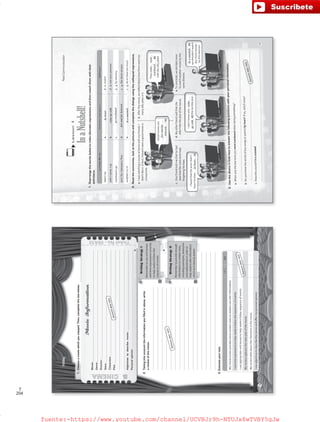
¾ talk	about	and	describe	different	movies	and	their	genres.
¾ make	inferences	from	the	information	given.¾ use	time	expressions	and	verb	tenses	to	help	organize	sequences	of	events.
¾ use	idioms	to	talk	about	movies.
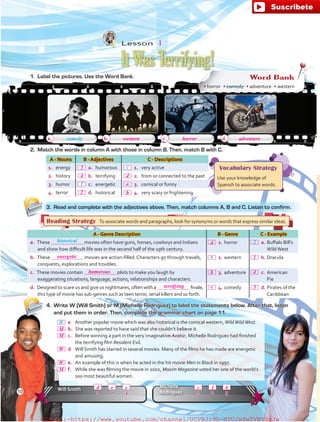
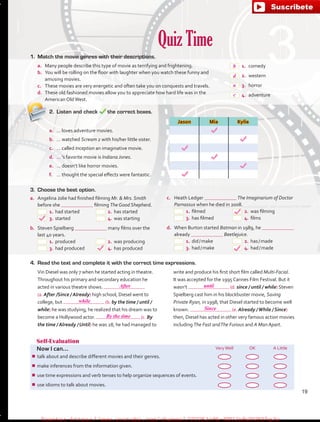
1. Match the movie genres with their descriptions.
a. Many	people	describe	this	type	of	movie	as	terrifying	and	frightening.
b. You	will	be	rolling	on	the	floor	with	laughter	when	you	watch	these	funny	and	
amusing	movies.c. These	movies	are	very	energetic	and	often	take	you	on	conquests	and	travels.
d. These	old	fashioned	movies	allow	you	to	appreciate	how	hard	life	was	in	the	
American	Old	West.
1. comedy
2. western
3. horror
4. adventure
2. Listen and check the correct boxes.
Jason
Mia
Kylie
a. …	loves	adventure	movies.b. …	watched	Scream 2	with	his/her	little	sister.c. …	called	Inception	an	imaginative	movie.d. …	’s	favorite	movie	is	IndianaJones.	e. …	doesn’t	like	horror	movies.f. …	thought	the	special	effects	were	fantastic.
4. Read the text and complete it with the correct time expressions.
Vin	Diesel	was	only	7	when	he	started	acting	in	theatre.	
Throughout	his	primary	and	secondary	education	he	
acted	in	various	theatre	shows.	(a.	After /Since / Already)	high	school,	Diesel	went	to	
college,	but	
(b.	by the time / until /
while)	he	was	studying,	he	realized	that	his	dream	was	to	
become	a	Hollywood	actor.	
(c.	By
the time / Already / Until)	he	was	28,	he	had	managed	to	
write	and	produce	his	first	short	film	called	Multi-Facial.	
It	was	accepted	for	the	1995	Cannes	Film	Festival.	But	it	
wasn’t	
(d.	since / until / while)	Steven	
Spielberg	cast	him	in	his	blockbuster	movie,	Saving
Private Ryan,	in	1998,	that	Diesel	started	to	become	well	
known.	
(e.	Already /While / Since)
then,	Diesel	has	acted	in	other	very	famous	action	movies	
including	The Fast andThe Furious	and	A Man Apart.
3. Choose the best option.a. Angelina	Jolie	had	finished	filming	Mr.  Mrs. Smith
before	she	
	filming	The Good Shepherd.
1. had	started	
2. has	started
3. started	
4. was	startingb. Steven	Spielberg	
	many	films	over	the	
last	40	years.
1. produced	
2. was	producing
3. had	produced	
4. has	produced
c. Heath	Ledger	
The Imaginarium of Doctor
Parnassus	when	he	died	in	2008.1. filmed	
2. was	filming
3. has	filmed	
4. filmsd. When	Burton	started	Batman	in	1989,	he	
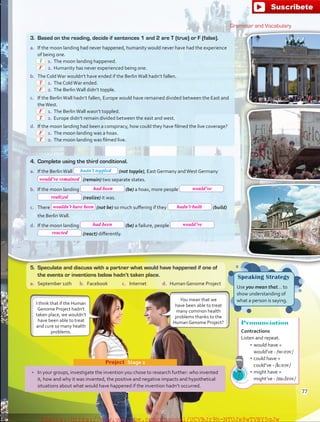
already	
Beetlejuice.1. did	/	make	
2. has	/	made
3. had	/	make	
4. had	/	made
19
1. Listen to the questions and check the
correct answer.
a. I’m 12 years old. I’m	fine,	thanks.
b. I’m	fine,	thanks.	 I’m 11 years old.
c. I’m Peter Smith. I’m from Portugal.
d. Mark It’s mark@e-pals.com.
2. Match column A with column B.
Column A Column B
a. Country Asia
b. Age Japanese
c. City 12 years old
d. Continent Tokyo
e. Nationality Japan
3. Check the correct option to complete the
sentences.
a. This is Mary. She American.
1. is 2. are 3. am
b. Hi, I Japanese.
1. is 2. are 3. am
c. Hello, you Susan, right?
1. is 2. are 3. am
d. This isThomas. is from Amsterdam.
1. She 2. It 3. He
e. I’m from Lima. is the capital of Peru.
1. She 2. It 3. He
f. Where you from?
1. is 2. are 3. am
g. What your name?
1. is 2. are 3. am
4. Read the profiles. Then, circle and correct the
mistakes in the sentences (a-f) below.
Self-Evaluation
Now I can... VeryWell OK A Little
¾ask and answer personal information questions.
¾say countries and nationalities.
¾introduce myself and other people.
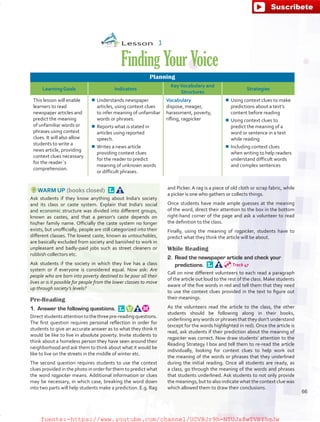
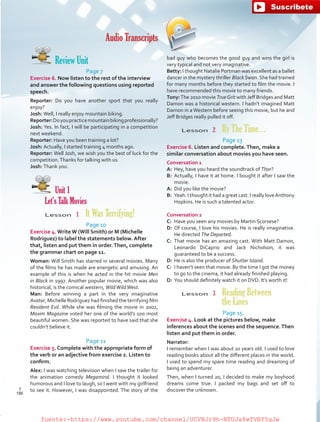
a. Larry Page is a computer scientist . He is
Portuguese.
b. Cristiano Ronaldo is Brazilian. He is a soccer
player.
c. Martina Garcia is Colombian. She is athletic.
d. Larry Page is sociable. He is a computer scientist.
e. Cristiano Ronaldo is 32 years old. He is athletic.
f. Martina García is creative. She is 28 years old.
This is Larry Page, the
creator of Google. He is a
computer scientist. He is
from Michigan in the USA.
He is 40 years old. He is
creative.
This is Cristiano Ronaldo.
He is a soccer player. He
is 28 years old. He is from
Madeira. It is a Portuguese
island. He is athletic.
This is Martina Garcia. She is
an actress. She is 32 years old.
She is Colombian. She is from
Bogota. She is sociable.
Quiz Time
19
13
T
13
T
fuente:-https://www.youtube.com/channel/UCVBJr9h-NTUJx8wTVBY5gJwfuente:-https://www.youtube.com/channel/UCVBJr9h-NTUJx8wTVBY5gJw
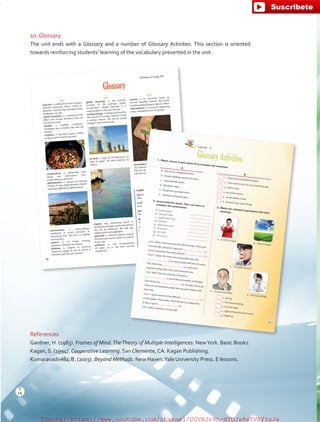
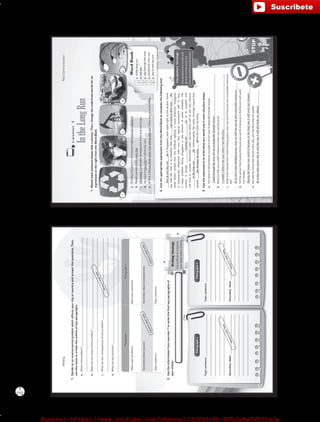
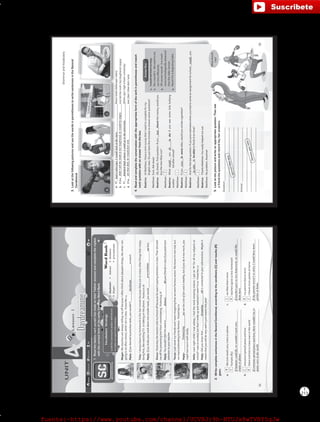
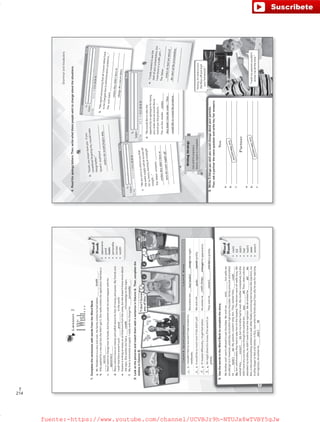
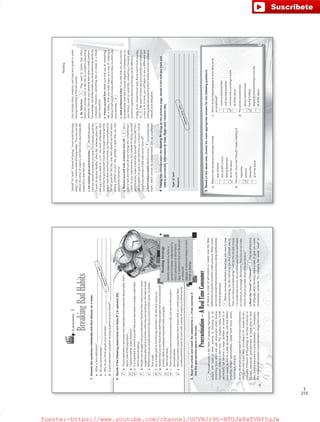
10. Glossary
The unit ends with a Glossary and a number of Glossary Activities. This section is oriented
towards reinforcing students’ learning of the vocabulary presented in the unit.
References
Gardner, H. (1983). Frames of Mind.TheTheory of Multiple Intelligences. NewYork. Basic Books.
Kagan, S. (1994). Cooperative Learning. San Clemente, CA. Kagan Publishing.
Kumaravadivelu, B. (2003). Beyond Methods. New Haven.Yale University Press. E lessons.
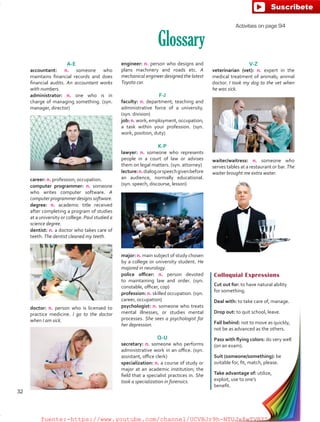
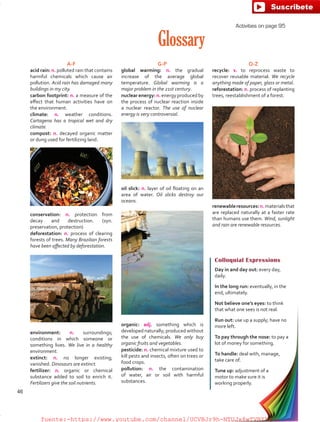
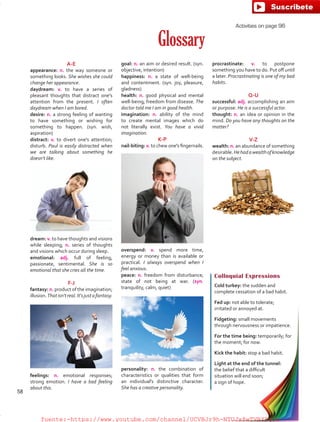
Glossary
A-F
acid rain: n.	polluted	rain	that	contains	
harmful chemicals which cause air
pollution.	Acid rain has damaged many
buildings in my city.
carbon footprint: n. a measure of the
effect	 that	 human	 activities	 have	 on	
the environment.
climate: n. weather conditions.
Cartagena has a tropical wet and dry
climate.
compost: n. decayed organic matter
or dung used for fertilizing land.
conservation: n.	 protection	 from	
decay	 and	 destruction.	 (syn.	
preservation,	protection)
deforestation: n.	 process	 of	 clearing	
forests of trees. Many Brazilian forests
have been affected by deforestation.
environment: n. surroundings;
conditions in which someone or
something lives. We live in a healthy
environment.
extinct: n.	 no	 longer	 existing;	
vanished. Dinosaurs are extinct.
fertilizer: n. organic or chemical
substance added to soil to enrich it.
Fertilizers give the soil nutrients.
G-P
global warming: n. the gradual
increase of the average global
temperature.	 Global warming is a
major problem in the 21st century.
nuclear energy: n.	energy	produced	by	
the	process	of	nuclear	reaction	inside	
a nuclear reactor. The use of nuclear
energy is very controversial.
oil slick: n.	layer	of	oil	floating	on	an	
area of water. Oil slicks destroy our
oceans.
organic: adj. something which is
developed	naturally;	produced	without	
the use of chemicals. We only buy
organic fruits and vegetables.
pesticide: n.	chemical	mixture	used	to	
kill	pests	and	insects,	often	on	trees	or	
food	crops.
pollution: n. the contamination
of	 water,	 air	 or	 soil	 with	 harmful	
substances.
Q-Z
recycle: v.	 to	 reprocess	 waste	 to	
recover reusable material. We recycle
anything made of paper, glass or metal.
reforestation: n.	process	of	replanting	
trees,	reestablishment	of	a	forest.	
renewableresources:n.materialsthat
are	replaced	naturally	at	a	faster	rate	
than humans use them. Wind, sunlight
and rain are renewable resources.
Colloquial Expressions
Day in and day out:	every	day,	
daily.
In the long run:	eventually,	in	the	
end,	ultimately.
Not believe one’s eyes: to think
that what one sees is not real.
Run out:	use	up	a	supply;	have	no	
more left.
To pay through the nose:	to	pay	a	
lot of money for something.
To handle:	deal	with,	manage,	
take care of.
Tune up: adjustment of a
motor to make sure it is
working	properly.
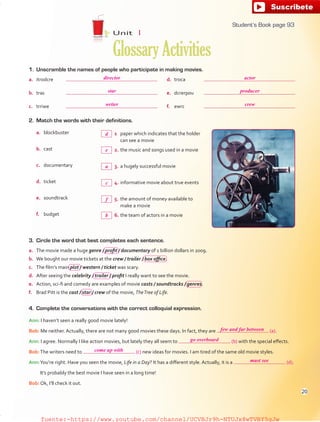
Activities on page 95
46
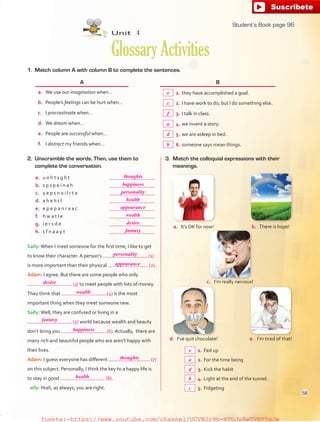
1. Match column A with column B to complete the sentences.
b. There is hope!
c. I’m really nervous!
e. I’m tired of that!
d. I’ve quit chocolate!
A
B
a. We use our imagination when…
1. they have accomplished a goal.
b. People’s feelings can be hurt when…
2. I have work to do, but I do something else.
c. I procrastinate when…
3. I talk in class.
d. We dream when…
4. we invent a story.
e. People are successful when…
5. we are asleep in bed.
f. I distract my friends when…
6. someone says mean things.
2. Unscramble the words. Then, use them to
complete the conversation.
a. u o h t s g h t
b. s p s p e i n a h
c. y e p s n o i l r t a
d. a h e h t l
e. e p e p a n r a a c
f. h w a t l e
g. i e r s d e
h. s f n a a y t
Sally:When I meet someone for the first time, I like to get
to know their character. A person’s
(1)
is more important than their physical
(2).
Adam: I agree. But there are some people who only
(3) to meet people with lots of money.
They think that
(4) is the mostimportant thing when they meet someone new.Sally:Well, they are confused or living in a
(5) world because wealth and beauty
don’t bring you
(6). Actually, there are
many rich and beautiful people who are aren’t happy with
their lives.
Adam: I guess everyone has different
(7)
on this subject. Personally, I think the key to a happy life is
to stay in good
(8).Sally:Yeah, as always, you are right.
1. Fed up
2. For the time being
3. Kick the habit
4. Light at the end of the tunnel.5. Fidgeting
Unit 4
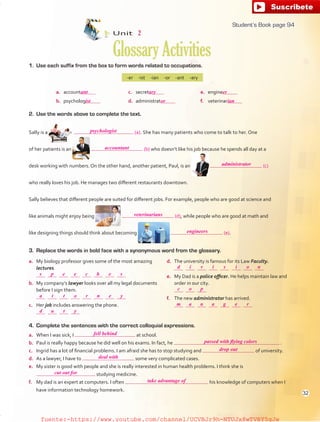
GlossaryActivities
3. Match the colloquial expressions with their
meanings.
a. It’s OK for now!
96
14
T
14
T
fuente:-https://www.youtube.com/channel/UCVBJr9h-NTUJx8wTVBY5gJwfuente:-https://www.youtube.com/channel/UCVBJr9h-NTUJx8wTVBY5gJw
To Our Students
The textbook that you have in your hands is a very important tool that will help
you learn in the best way possible. A textbook should not be your only source of
study and discovery; however, it will always be a good friend that will allow you to
discover for yourself the wonder of learning.
The Ministry of Education has made a curricular adjustment with the goal of
providing better opportunities for all students in the country as part of a project
that promotes full personal development and integration into a society that is
guided by the principles of Good Living, democratic participation and harmonious
coexistence.
To accompany the launching of this educational initiative, we have prepared
several resources according to age and years of schooling. Children in first grade
will receive a textbook that integrates stories and activities appropriate for their
age and that will help to develop the holistic curriculum designed for this Subnivel
de Educación General Básica. Teachers will receive a CD with songs in order to use
music to familiarize students with their first words in English as a complementary
material. From then on, until they complete the Bachillerato General Unificado,
students will receive textbooks, audio CDs and extra resources that will contribute
to the development of their learning in the areas of Science, Social Sciences,
Language and Literature, Mathematics and Foreign Language-English.Itisalso importanttoknowthatteacherswill receiveteachingguides(teacher’s
books) that will enhance the teaching-learning approach of the student book,
thereby allowing teachers to develop students’ research and learning outside the
classroom.
This resource should be considered a support for the teaching-learning
approach that must be guided by teachers and carried out by students in
order to achieve its goal.
We hope that this adventure of knowledge will be the pathto achieving Good Living.
Ministry of Education
2016
15
T
15
T
fuente:-https://www.youtube.com/channel/UCVBJr9h-NTUJx8wTVBY5gJwfuente:-https://www.youtube.com/channel/UCVBJr9h-NTUJx8wTVBY5gJw
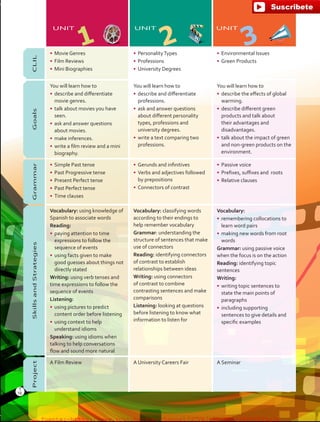
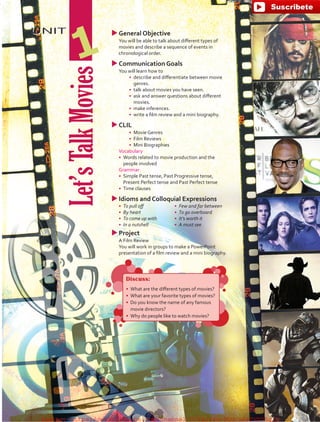
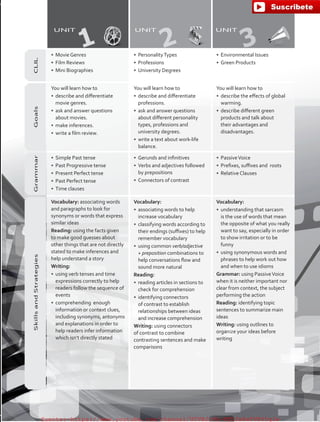
CLIL
• Movie Genres
• Film Reviews
• Mini Biographies
• PersonalityTypes
• Professions
• University Degrees
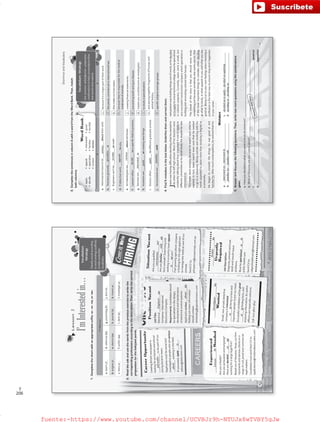
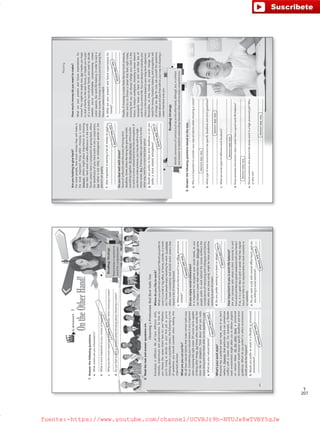
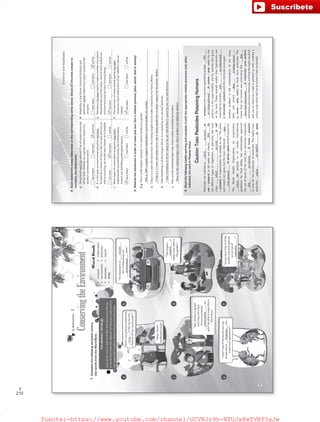
• Environmental Issues
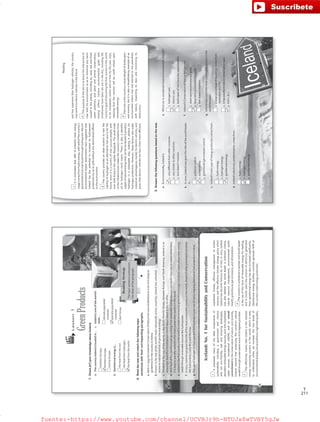
• Green Products
Goals
You will learn how to
• describe and differentiate
movie genres.
• talk about movies you have
seen.
• ask and answer questions
about movies.
• make inferences.
• write a film review and a mini
biography.
You will learn how to
• describe and differentiate
professions.
• ask and answer questions
about different personality
types, professions and
university degrees.
• write a text comparing two
professions.
You will learn how to
• describe the effects of global
warming.
• describe different green
products and talk about
their advantages and
disadvantages.
• talk about the impact of green
and non-green products on the
environment.
Grammar
• Simple Past tense
• Past Progressive tense
• Present Perfect tense
• Past Perfect tense
• Time clauses
• Gerunds and infinitives
• Verbs and adjectives followed
by prepositions
• Connectors of contrast
• Passive voice
• Prefixes, suffixes and roots
• Relative clauses
SkillsandStrategies
Vocabulary: using knowledge of
Spanish to associate words
Reading:
• paying attention to time
expressions to follow the
sequence of events
• using facts given to make
good guesses about things not
directly stated
Writing: using verb tenses and
time expressions to follow the
sequence of events
Listening:
• using pictures to predict
content order before listening
• using context to help
understand idioms
Speaking: using idioms when
talking to help conversations
flow and sound more natural
Vocabulary: classifying words
according to their endings to
help remember vocabulary
Grammar: understanding the
structure of sentences that make
use of connectors
Reading: identifying connectors
of contrast to establish
relationships between ideas
Writing: using connectors
of contrast to combine
contrasting sentences and make
comparisons
Listening: looking at questions
before listening to know what
information to listen for
Vocabulary:
• remembering collocations to
learn word pairs
• making new words from root
words
Grammar: using passive voice
when the focus is on the action
Reading: identifying topic
sentences
Writing:
• writing topic sentences to
state the main points of
paragraphs
• including supporting
sentences to give details and
specific examples
Project
A Film Review A University Careers Fair A Seminar
UNIT
1
UNIT
2
UNIT
3
16
T
fuente:-https://www.youtube.com/channel/UCVBJr9h-NTUJx8wTVBY5gJwfuente:-https://www.youtube.com/channel/UCVBJr9h-NTUJx8wTVBY5gJw
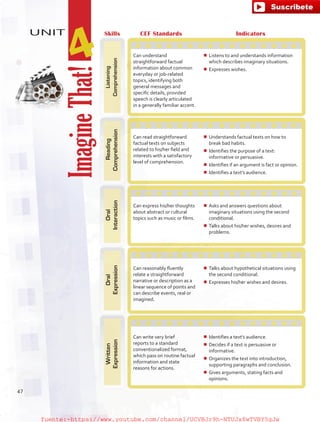
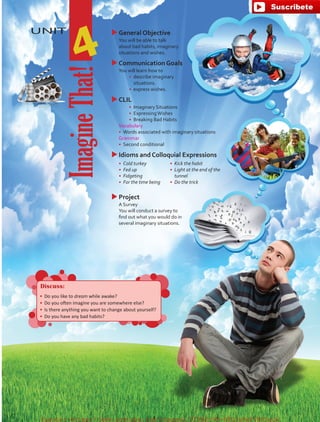
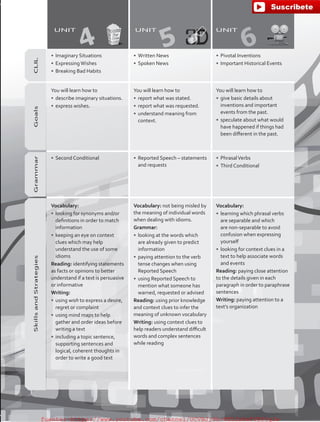
4
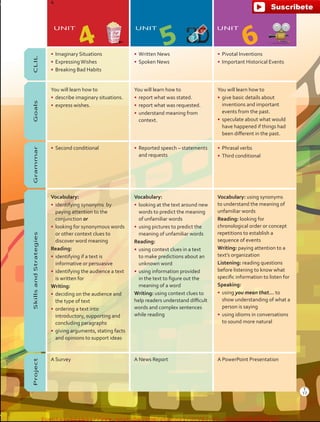
CLIL
• Imaginary Situations
• ExpressingWishes
• Breaking Bad Habits
• Written News
• Spoken News
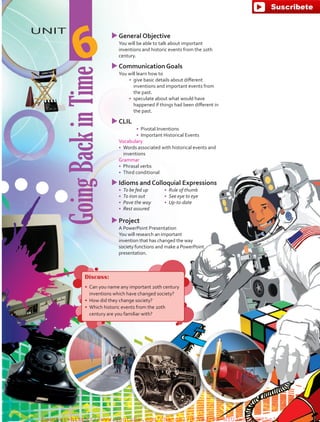
• Pivotal Inventions
• Important Historical Events
Goals
You will learn how to
• describe imaginary situations.
• express wishes.
You will learn how to
• report what was stated.
• report what was requested.
• understand meaning from
context.
You will learn how to
• give basic details about
inventions and important
events from the past.
• speculate about what would
have happened if things had
been different in the past.
Grammar
• Second conditional • Reported speech – statements
and requests
• Phrasal verbs
• Third conditional
SkillsandStrategies
Vocabulary:
• identifying synonyms by
paying attention to the
conjunction or
• looking for synonymous words
or other context clues to
discover word meaning
Reading:
• identifying if a text is
informative or persuasive
• identifying the audience a text
is written for
Writing:
• deciding on the audience and
the type of text
• ordering a text into
introductory, supporting and
concluding paragraphs
• giving arguments, stating facts
and opinions to support ideas
Vocabulary:
• looking at the text around new
words to predict the meaning
of unfamiliar words
• using pictures to predict the
meaning of unfamiliar words
Reading:
• using context clues in a text
to make predictions about an
unknown word
• using information provided
in the text to figure out the
meaning of a word
Writing: using context clues to
help readers understand difficult
words and complex sentences
while reading
Vocabulary: using synonyms
to understand the meaning of
unfamiliar words
Reading: looking for
chronological order or concept
repetitions to establish a
sequence of events
Writing: paying attention to a
text’s organization
Listening: reading questions
before listening to know what
specific information to listen for
Speaking:
• using you mean that… to
show understanding of what a
person is saying
• using idioms in conversations
to sound more natural
Project
A Survey A News Report A PowerPoint Presentation
UNIT
4
UNIT
5
UNIT
6
17
T
fuente:-https://www.youtube.com/channel/UCVBJr9h-NTUJx8wTVBY5gJwfuente:-https://www.youtube.com/channel/UCVBJr9h-NTUJx8wTVBY5gJw
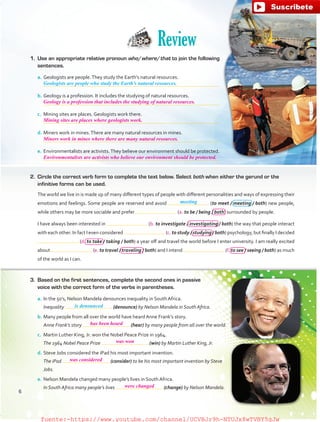
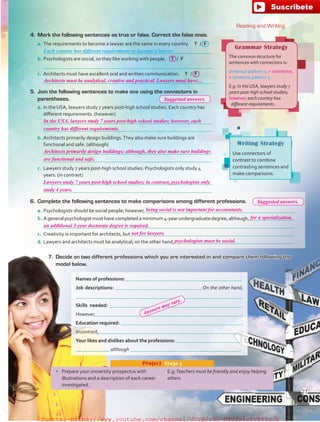
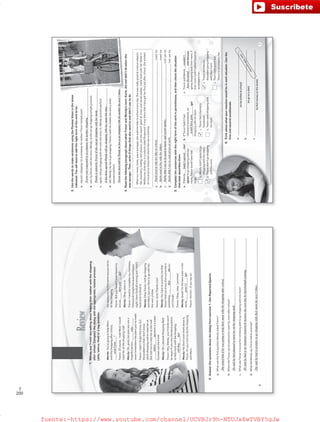
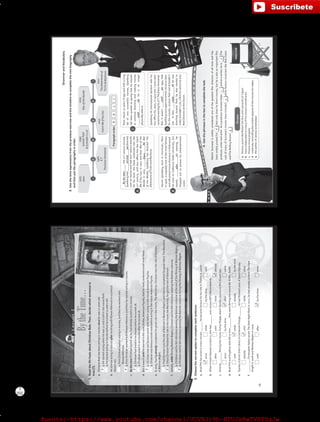
a.	Geologists are people.They study the Earth’s natural resources.
	
b.	Geology is a profession. It includes the studying of natural resources.
	
c.	 Mining sites are places. Geologists work there.
	
d.	Miners work in mines.There are many natural resources in mines.
	
e.	Environmentalists are activists.They believe our environment should be protected.
	
1.	 Use an appropriate relative pronoun who/where/that to join the following
sentences.
2.	 Circle the correct verb form to complete the text below. Select both when either the gerund or the
infinitive forms can be used.
The world we live in is made up of many different types of people with different personalities and ways of expressing their
emotions and feelings. Some people are reserved and avoid (to meet / meeting / both) new people,
while others may be more sociable and prefer (a. to be / being / both) surrounded by people.
I have always been interested in (b. to investigate / investigating / both) the way that people interact
with each other. In fact I even considered (c. to study / studying / both) psychology, but finally I decided
(d. to take / taking / both) a year off and travel the world before I enter university. I am really excited
about (e. to travel / traveling / both) and I intend (f. to see / seeing / both) as much
of the world as I can.
a.	In the 50’s, Nelson Mandela denounces inequality in South Africa.
	 Inequality (denounce) by Nelson Mandela in South Africa.
b.	Many people from all over the world have heard Anne Frank’s story.
	 Anne Frank’s story (hear) by many people from all over the world.
c.	 Martin Luther King, Jr. won the Nobel Peace Prize in 1964.
	 The 1964 Nobel Peace Prize (win) by Martin Luther King, Jr.
d.	Steve Jobs considered the iPad his most important invention.
	 The iPad (consider) to be his most important invention by Steve
Jobs.
e.	Nelson Mandela changed many people’s lives in South Africa.
	 In South Africa many people’s lives (change) by Nelson Mandela.
Review
Geologists are people who study the Earth’s natural resources.
meeting
is denounced
3.	 Based on the first sentences, complete the second ones in passive
voice with the correct form of the verbs in parentheses.
6
has been heard
was won
was considered
were changed
Geology is a profession that includes the studying of natural resources.
Mining sites are places where geologists work.
Miners work in mines where there are many natural resources.
Environmentalists are activists who believe our environment should be protected.
fuente:-https://www.youtube.com/channel/UCVBJr9h-NTUJx8wTVBY5gJwfuente:-https://www.youtube.com/channel/UCVBJr9h-NTUJx8wTVBY5gJw
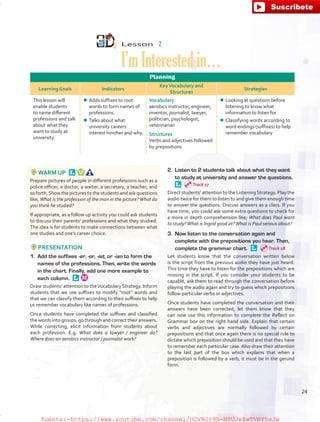
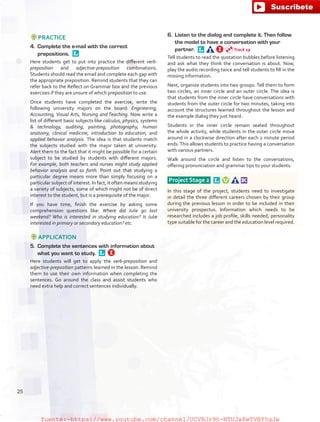
Planning
Learning Goals Indicators KeyVocabulary and Structures Strategies
This lesson
offers students
the chance to
review some of
the grammatical
structures and key
vocabulary learned
throughout book 5
of theViewpoints
series.
¾¾ Connects sentences using relative
pronouns.
¾¾ Identifies verbs followed by
gerunds and verbs followed by
infinitives.
¾¾ Completes sentences in Passive
Voice.
¾¾ Uses tag questions appropriately.
¾¾ Talks about what was stated using
Reported Speech.
¾¾ Uses the expression Used to.
¾¾ Identifies and correctly uses Second
andThird Conditional structures.
Vocabulary
Words related to diverse topics
Structures
Relative pronouns
Verbs followed by gerunds and
infinitives
PassiveVoice
Tag questions
Reported Speech
Used to
Second andThird Conditional
¾¾ Using relative
pronouns to join
two sentences
¾¾ Using Passive
Voice to change
the emphasis of a
sentence
¾¾ Using indirect
speech to report
what was said
¾¾ Using conditionals
to talk about
possible
consequences
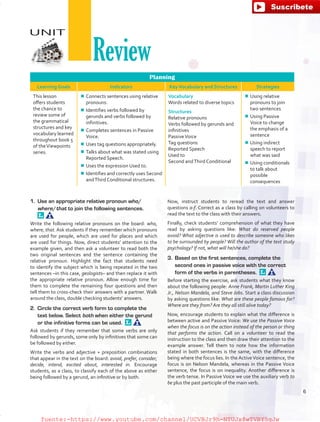
1.	 Use an appropriate relative pronoun who/
where/that to join the following sentences. 
Write the following relative pronouns on the board: who,
where, that. Ask students if they remember which pronouns
are used for people, which are used for places and which
are used for things. Now, direct students’ attention to the
example given, and then ask a volunteer to read both the
two original sentences and the sentence containing the
relative pronoun. Highlight the fact that students need
to identify the subject which is being repeated in the two
sentences –in this case, geologists– and then replace it with
the appropriate relative pronoun. Allow enough time for
them to complete the remaining four questions and then
tell them to cross-check their answers with a partner. Walk
around the class, double checking students’ answers.
2.	 Circle the correct verb form to complete the
text below. Select both when either the gerund
or the infinitive forms can be used. 
Ask students if they remember that some verbs are only
followed by gerunds, some only by infinitives that some can
be followed by either.
Write the verbs and adjective + preposition combinations
that appear in the text on the board: avoid, prefer, consider,
decide, intend, excited about, interested in. Encourage
students, as a class, to classify each of the above as either
being followed by a gerund, an infinitive or by both.
Now, instruct students to reread the text and answer
questions a-f. Correct as a class by calling on volunteers to
read the text to the class with their answers.
Finally, check students’ comprehension of what they have
read by asking questions like: What do reserved people
avoid? What adjective is used to describe someone who likes
to be surrounded by people? Will the author of the text study
psychology? If not, what will he/she do?
3.	 Based on the first sentences, complete the
second ones in passive voice with the correct
form of the verbs in parentheses. 
Before starting the exercise, ask students what they know
about the following people: Anne Frank, Martin Luther King
Jr., Nelson Mandela, and Steve Jobs. Start a class discussion
by asking questions like: What are these people famous for?
Where are they from? Are they all still alive today?
Now, encourage students to explain what the difference is
between active and Passive Voice: We use the Passive Voice
when the focus is on the action instead of the person or thing
that performs the action. Call on a volunteer to read the
instruction to the class and then draw their attention to the
example answer. Tell them to note how the information
stated in both sentences is the same, with the difference
being where the focus lies. In the ActiveVoice sentence, the
focus is on Nelson Mandela, whereas in the Passive Voice
sentence, the focus is on inequality. Another difference is
the verb tense. In Passive Voice we use the auxiliary verb to
be plus the past participle of the main verb.
UNIT
Review
6
fuente:-https://www.youtube.com/channel/UCVBJr9h-NTUJx8wTVBY5gJwfuente:-https://www.youtube.com/channel/UCVBJr9h-NTUJx8wTVBY5gJw
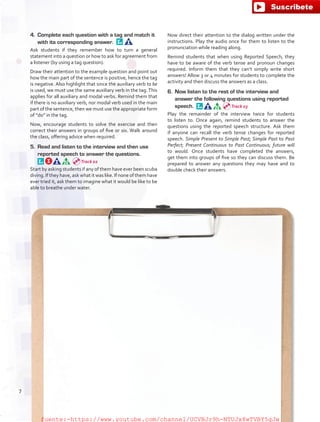
4.	 Complete each question with a tag and match it
with its corresponding answer. 
Ask students if they remember how to turn a general
statement into a question or how to ask for agreement from
a listener (by using a tag question).
Draw their attention to the example question and point out
how the main part of the sentence is positive, hence the tag
is negative. Also highlight that since the auxiliary verb to be
is used, we must use the same auxiliary verb in the tag. This
applies for all auxiliary and modal verbs. Remind them that
if there is no auxiliary verb, nor modal verb used in the main
part of the sentence, then we must use the appropriate form
of “do” in the tag.
Now, encourage students to solve the exercise and then
correct their answers in groups of five or six. Walk around
the class, offering advice when required.
5.	 Read and listen to the interview and then use
reported speech to answer the questions. 
Start by asking students if any of them have ever been scuba
diving. If they have, ask what it was like. If none of them have
ever tried it, ask them to imagine what it would be like to be
able to breathe under water.
Now direct their attention to the dialog written under the
instructions. Play the audio once for them to listen to the
pronunciation while reading along.
Remind students that when using Reported Speech, they
have to be aware of the verb tense and pronoun changes
required. Inform them that they can’t simply write short
answers! Allow 3 or 4 minutes for students to complete the
activity and then discuss the answers as a class.
6.	 Now listen to the rest of the interview and
answer the following questions using reported
speech. 
Play the remainder of the interview twice for students
to listen to. Once again, remind students to answer the
questions using the reported speech structure. Ask them
if anyone can recall the verb tense changes for reported
speech. Simple Present to Simple Past; Simple Past to Past
Perfect; Present Continuous to Past Continuous; future will
to would. Once students have completed the answers,
get them into groups of five so they can discuss them. Be
prepared to answer any questions they may have and to
double check their answers.
Track 02
Track 03
7
fuente:-https://www.youtube.com/channel/UCVBJr9h-NTUJx8wTVBY5gJwfuente:-https://www.youtube.com/channel/UCVBJr9h-NTUJx8wTVBY5gJw
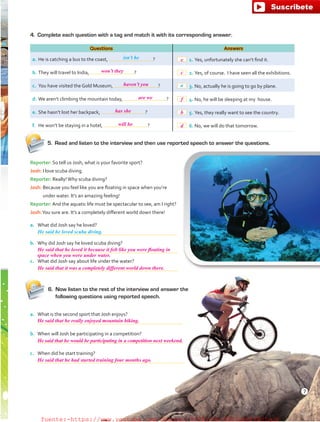
Reporter: So tell us Josh, what is your favorite sport?
Josh: I love scuba diving.
Reporter: Really!Why scuba diving?
Josh: Because you feel like you are floating in space when you’re
under water. It’s an amazing feeling!
Reporter: And the aquatic life must be spectacular to see, am I right?
Josh:You sure are. It’s a completely different world down there!
a.	 What did Josh say he loved?
	
b.	 Why did Josh say he loved scuba diving?
	
c.	 What did Josh say about life under the water?
	
4.	 Complete each question with a tag and match it with its corresponding answer.
Questions Answers
a.	He is catching a bus to the coast, ?  1.	Yes, unfortunately she can’t find it.
b.	They will travel to India, ?  2.	Yes, of course. I have seen all the exhibitions.
c.	 You have visited the Gold Museum, ?  3.	No, actually he is going to go by plane.
d.	We aren’t climbing the mountain today, ?  4.	No, he will be sleeping at my house.
e.	She hasn’t lost her backpack, ?  5.	Yes, they really want to see the country.
f.	 He won’t be staying in a hotel, ?  6.	No, we will do that tomorrow.
He said he loved scuba diving.
isn’t he
a
6.	 Now listen to the rest of the interview and answer the
following questions using reported speech.
a.	 What is the second sport that Josh enjoys?
	
b.	 When will Josh be participating in a competition?
	
c.	 When did he start training?
	
5.	 Read and listen to the interview and then use reported speech to answer the questions.
7
won’t they
haven’t you
e
c
f
b
d
are we
has she
will he
He said that he loved it because it felt like you were floating in
He said that it was a completely different world down there.
He said that he really enjoyed mountain biking.
He said that he would be participating in a competition next weekend.
He said that he had started training four months ago.
space when you were under water.
fuente:-https://www.youtube.com/channel/UCVBJr9h-NTUJx8wTVBY5gJwfuente:-https://www.youtube.com/channel/UCVBJr9h-NTUJx8wTVBY5gJw
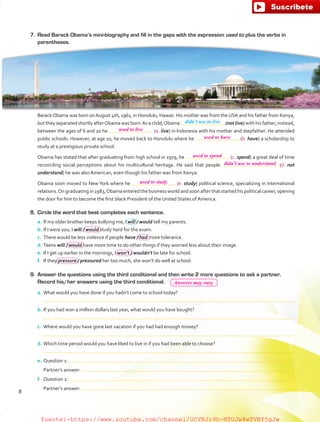
8.	 Circle the word that best completes each sentence.
a.	If my older brother keeps bullying me, I will / would tell my parents.
b.	If I were you, I will / would study hard for the exam.
c.	 There would be less violence if people have / had more tolerance.
d.	Teens will / would have more time to do other things if they worried less about their image.
e.	If I get up earlier in the mornings, I won’t / wouldn’t be late for school.
f.	 If they pressure / pressured her too much, she won’t do well at school.
9.	 Answer the questions using the third conditional and then write 2 more questions to ask a partner.
Record his/her answers using the third conditional.
a.	What would you have done if you hadn’t come to school today?
	
b.	If you had won a million dollars last year, what would you have bought?
	
c.	 Where would you have gone last vacation if you had had enough money?
	
d.	Which time period would you have liked to live in if you had been able to choose?
	
e.	Question 1:
	 Partner’s answer:
f.	 Question 2:
	 Partner’s answer:
7.	 Read Barack Obama’s mini-biography and fill in the gaps with the expression used to plus the verbs in
parentheses.
BarackObama was born onAugust 4th, 1961, in Honolulu, Hawaii. His mother was from the USA and his father from Kenya,
buttheyseparatedshortlyafterObamawasborn.Asachild,Obama (not live)withhisfather;instead,
between the ages of 6 and 10 he (a. live) in Indonesia with his mother and stepfather. He attended
public schools. However, at age 10, he moved back to Honolulu where he (b. have) a scholarship to
study at a prestigious private school.
Obama has stated that after graduating from high school in 1979, he (c. spend) a great deal of time
reconciling social perceptions about his multicultural heritage. He said that people (d. not
understand) he was also American, even though his father was from Kenya.
Obama soon moved to NewYork where he (e. study) political science, specializing in international
relations.Ongraduatingin1983,Obamaenteredthebusinessworldandsoonafterthatstartedhispoliticalcareer,opening
the door for him to become the first black President of the United States of America.
didn’t use to live
8
used to live
used to have
used to spend
didn’t use to understand
used to study
Answers may vary.
fuente:-https://www.youtube.com/channel/UCVBJr9h-NTUJx8wTVBY5gJwfuente:-https://www.youtube.com/channel/UCVBJr9h-NTUJx8wTVBY5gJw
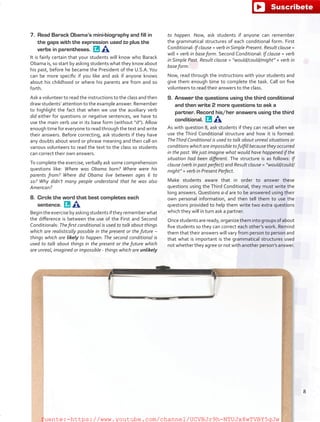
7.	 Read Barack Obama’s mini-biography and fill in
the gaps with the expression used to plus the
verbs in parentheses. 
It is fairly certain that your students will know who Barack
Obama is, so start by asking students what they know about
his past, before he became the President of the U.S.A. You
can be more specific if you like and ask if anyone knows
about his childhood or where his parents are from and so
forth.
Ask a volunteer to read the instructions to the class and then
draw students’ attention to the example answer. Remember
to highlight the fact that when we use the auxiliary verb
did either for questions or negative sentences, we have to
use the main verb use in its base form (without “d”). Allow
enough time for everyone to read through the text and write
their answers. Before correcting, ask students if they have
any doubts about word or phrase meaning and then call on
various volunteers to read the text to the class so students
can correct their own answers.
To complete the exercise, verbally ask some comprehension
questions like: Where was Obama born? Where were his
parents from? Where did Obama live between ages 6 to
10? Why didn’t many people understand that he was also
American?
8.	 Circle the word that best completes each
sentence. 
Begintheexercisebyaskingstudentsiftheyrememberwhat
the difference is between the use of the First and Second
Conditionals: The first conditional is used to talk about things
which are realistically possible in the present or the future –
things which are likely to happen. The second conditional is
used to talk about things in the present or the future which
are unreal, imagined or impossible - things which are unlikely
to happen. Now, ask students if anyone can remember
the grammatical structures of each conditional form. First
Conditional: If clause = verb inSimple Present. Result clause =
will + verb in base form. Second Conditional: If clause = verb
in Simple Past. Result clause = “would/could/might” + verb in
base form.
Now, read through the instructions with your students and
give them enough time to complete the task. Call on five
volunteers to read their answers to the class.
9.	 Answer the questions using the third conditional
and then write 2 more questions to ask a
partner. Record his/her answers using the third
conditional. 
As with question 8, ask students if they can recall when we
use the Third Conditional structure and how it is formed:
TheThird Conditional is used to talk about unreal situations or
conditions which are impossible to fulfill because they occurred
in the past.We just imagine what would have happened if the
situation had been different. The structure is as follows: If
clause (verb in past perfect) and Result clause = “would/could/
might” + verb in Present Perfect.
Make students aware that in order to answer these
questions using the Third Conditional, they must write the
long answers. Questions a-d are to be answered using their
own personal information, and then tell them to use the
questions provided to help them write two extra questions
which they will in turn ask a partner.
Oncestudentsareready,organizethemintogroupsofabout
five students so they can correct each other’s work. Remind
them that their answers will vary from person to person and
that what is important is the grammatical structures used
not whether they agree or not with another person’s answer.
8
fuente:-https://www.youtube.com/channel/UCVBJr9h-NTUJx8wTVBY5gJwfuente:-https://www.youtube.com/channel/UCVBJr9h-NTUJx8wTVBY5gJw
Let’sTalkMovies
UNIT
1
9
Skills CEF Standards Indicators
Listening
Comprehension
Can understand the
information content
of the majority of
recorded or broadcast
audio material on topics
of personal interest
delivered in clear
standard speech.
¾¾ Listens to and understands a short story
based on pictures.
¾¾ Understands short conversations and can
listen for specific information.
¾¾ Can watch and understand the general idea
of a movie.
Reading
Comprehension
Can use an idea of the
overall meaning of short
texts and utterances on
everyday topics to derive
the probable meaning of
unknown words from the
context.
¾¾ Understands movie reviews and mini
biographies.
¾¾ Is able to infer meaning of unknown words
and phrases from a short movie review.
Oral
Interaction
Can summarize and give
his/her opinion about a
short story, article, talk,
discussion, interview,
film or documentary and
answer further questions
of detail.
¾¾ Asks for and gives information about movies.
¾¾ Uses verb tenses and time expressions to
chronologically relate information, like that in
mini biographies.
Oral
Expression
Can give straightforward
descriptions on a variety
of familiar subjects
within his/her field of
interest.
¾¾ Talks about different movies he/she has seen.
¾¾ Is able to use idioms to talk about movies.
Written
Expression
Can write
straightforward
connected texts on
a range of familiar
subjects within his field
of interest, by linking a
series of shorter discrete
elements into a linear
sequence.
¾¾ Writes a movie review including genre, name
of director, stars a short description etc.
¾¾ Provides a personal opinion about movies.
fuente:-https://www.youtube.com/channel/UCVBJr9h-NTUJx8wTVBY5gJwfuente:-https://www.youtube.com/channel/UCVBJr9h-NTUJx8wTVBY5gJw
UNIT uuGeneral Objective
	 You will be able to talk about different types of
movies and describe a sequence of events in
chronological order.
uuCommunication Goals
	 You will learn how to
•	 describe and differentiate between movie
genres.
•	 talk about movies you have seen.
•	 ask and answer questions about different
movies.
•	 make inferences.
•	 write a film review and a mini biography.
uuCLIL
•	 Movie Genres
•	 Film Reviews
•	 Mini Biographies
	 Vocabulary
•	 Words related to movie production and the
people involved
	 Grammar
•	 Simple Past tense, Past Progressive tense,
Present Perfect tense and Past Perfect tense
•	 Time clauses
uuIdioms and Colloquial Expressions
•	 To pull off
•	 By heart
•	 To come up with
•	 In a nutshell
•	 Few and far between
•	 To go overboard
•	 It’s worth it
•	 A must see
uuProject
	 A Film Review
	 You will work in groups to make a PowerPoint
presentation of a film review and a mini biography.
Let’sTalkMovies
1
Discuss:
•	 What are the different types of movies?
•	 What are your favorite types of movies?
•	 Do you know the name of any famous
movie directors?
•	 Why do people like to watch movies?
fuente:-https://www.youtube.com/channel/UCVBJr9h-NTUJx8wTVBY5gJwfuente:-https://www.youtube.com/channel/UCVBJr9h-NTUJx8wTVBY5gJw
4.	 Write W (Will Smith) or M (Michelle Rodriguez) to label the statements below. After that, listen
and put them in order. Then, complete the grammar chart on page 11.
A - Genre Description B - Genre C - Example
a. These movies often have guns, horses, cowboys and Indians
and show how difficult life was in the second half of the 19th century.
 1.	horror  a.	Buffalo Bill’s
WildWest
b. These movies are action-filled. Characters go through travels,
conquests, explorations and troubles.
 2.	western  b.	Dracula
c. These movies contain plots to make you laugh by
exaggerating situations, language, actions, relationships and characters.
 3.	adventure  c.	American
Pie
d. Designed to scare us and give us nightmares, often with a finale,
this type of movie has sub-genres such as teen terror, serial killers and so forth.
 4.	comedy  d.	Pirates of the
Caribbean
A - Nouns B - Adjectives C - Descriptions
1.	 energy  a.	humorous  1.	very active
2.	 history  b.	terrifying  2.	from or connected to the past
3.	 humor  c.	 energetic  3.	comical or funny
4.	 terror  d.	historical  4.	very scary or frightening
1. 	Label the pictures. Use the Word Bank. Word Bank
• horror  • comedy  • adventure  • western
a. b. c. d.
2.	 Match the words in column A with those in column B. Then, match B with C.
3.	 Read and complete with the adjectives above. Then, match columns A, B and C. Listen to confirm.
Will Smith
Michelle
Rodriguez
comedy
historical
1 12 23 3
Reading Strategy  To associate words and paragraphs, look for synonyms or words that express similar ideas.
Vocabulary Strategy
Use your knowledge of
Spanish to associate words.1
a
c
2
Lesson  1
It Was Terrifying!
a
10
 a	 Another popular movie which was also historical is the comical western, WildWildWest.
 b.	She was reported to have said that she couldn’t believe it.
 c.	 Before winning a part in the very imaginative Avatar, Michelle Rodriguez had finished
the terrifying film Resident Evil.
 d	 Will Smith has starred in several movies. Many of the films he has made are energetic
and amusing.
 e.	An example of this is when he acted in the hit movie Men in Black in 1997.
 f.	 While she was filming the movie in 2002, Maxim Magazine voted her one of the world’s
100 most beautiful women.
W
western
M
W
W
M
d ce f b
horror adventure
M
d
b 4
1
3c
3
d
a
b
energetic
humorous
terrifying
4
2
fuente:-https://www.youtube.com/channel/UCVBJr9h-NTUJx8wTVBY5gJwfuente:-https://www.youtube.com/channel/UCVBJr9h-NTUJx8wTVBY5gJw
Lesson  1
ItWasTerrifying!
Planning
Learning Goals Indicators KeyVocabulary and Structures Strategies
This lesson will enable
students to talk about
and describe movies
and their respective
genres.
¾¾ Describes movie
genres.
¾¾ Talks about movies
he/she has seen.
Vocabulary
horror, comedy, adventure, western,
humorous, terrifying, energetic, historical
Expressions
To pull off
Structures
Simple Past, Past Progressive,
Present Perfect, Past Perfect
¾¾ Relating pictures to
words
¾¾ Identifying adjectives
from nouns
¾¾ Using knowledge of
Spanish to associate
words
¾¾ Using synonyms to
associate words
WARM UP (books closed) 
Explain to students that movies are classified into different
categories known as genres. Ask them to think of movies
they have seen recently and elicit the names of the genres
that the movies fit into.
Give a couple of examples of movies you have recently seen:
Last week I saw the movie, “Hunger Games”. It is an action
movie. I also saw the comedy, “American Reunion”, the week
before last.
PRESENTATION
1.	 Label the pictures. Use the Word Bank 
Direct students’ attention to the pictures and the words in
the Word Bank. Ask them if they know what these words
relate to and if they know their meaning. Allow sufficient
time for students to complete the task and then, while
checking the answers as a class, ask them to justify their
answers by talking about and describing the pictures. After
completing, ask students if they can name some movies
from each genre listed.
2.	 Match the words in column A with those in
column B. Then, match B with C. 
Go over the Vocabulary Strategy and tell students that
sometimes words in English are similar to the same
word in Spanish and that they should make use of their
knowledge of Spanish if they come across words they don’t
understand. Also explain that often in English, nouns and
adjectives share the same root word, which can also help
distinguish word meaning and how to use the word in a
sentence.
Draw students’ attention to the table in exercise 2, and
ask them to solve the exercise. Correct answers as a class,
soliciting student’s to use the noun and adjective forms in
sentences to show they understand their meaning.
PRACTICE
3.	 Read and complete with the adjectives above.
Then, match columns A, B and C. Listen to
confirm. 
Before starting the exercise, make sure students understand
that to complete column A of this exercise they will have to
look for synonymous words or phrases in the sentences to
help associate the adjectives. It would be a good idea to ask
students if they know any synonymous words or phrases of
the adjectives listed in exercise 2. E.g. historical– old, from
past, last century, etc.
Next, challenge students to associate the different genre
descriptions with the genres listed in column B. If they have
trouble, refer them back to the pictures from exercise 1.
Finally, before students match the examples in column C
with a movie genre, verify that the students have heard of
the movies listed. If they haven’t, give a brief description
of each movie, being careful not to state the genre in the
description. E.g. Buffalo Bill’sWildWest is set in the American
West and includes gun battles between cowboys and Indians
who ride on horses.
Once students have completed the exercise, listen to the
audio so they can correct their own answers.
Track 04
10
fuente:-https://www.youtube.com/channel/UCVBJr9h-NTUJx8wTVBY5gJwfuente:-https://www.youtube.com/channel/UCVBJr9h-NTUJx8wTVBY5gJw
4.	 Write W (Will Smith) or M (Michelle Rodriguez)
to label the statements below. After that, listen
and put them in order. Then complete the
grammar chart on page 11. 
Elicit information from students about the two movie stars,
Will Smith and Michelle Rodriguez. Any fact they know
about these two stars is of interest, especially movies which
they have starred in.
Next, tell students that they are going to read the six
sentences and that they should pay attention to the
information given, like movies listed and pronouns, in order
to decide if the sentences relate toWill or Michelle.
Oncetheyhavedecidedwhichsentencerelatestowhichstar,
tell them to read through the sentences again, paying close
attention to the verb tenses (Simple Past, Past Progressive,
Present Perfect and Past Perfect) in order to help them
place the sentences in the correct order.Once students have
completed the exercise, tell them to check their answers
with a partner to see if they agree or not. Finally, discuss as
a class.
Now, tell students to complete the Reflect on Grammar
chart on the following page by using the sentences in this
exercise. As a class, discuss the uses and sentence structure
of the different verb tenses. Ask students questions in the
different tenses and help them construct their answers using
the appropriate tense. E.g. Have you seen the movie, The
Illusionist?Yes, I have. / No, I haven’t. etc.
APPLICATION
5.	 Complete with the appropriate form of the
verb or an adjective from exercise 2. Listen to
confirm. 
Before answering this exercise draw students’ attention to
the Reflect on Grammar chart previously completed. Make
suretheyunderstandthedifferencebetweentheverbtenses
listed and that they know how and when to use each tense.
Next, tell students that they are going to read short movie
reviews from 3 different people and that they are required
to fill in the gaps with the correct tense of the verbs in
parenthesis or the adjective form of the noun noted. Also
discuss the meaning and use of the key expressions that
they will encounter in the reviews.
Once students have completed the activity, play the
audio so they can correct their own answers. Remember
to congratulate your students on their effort and offer
encouragement to those who are not as advanced.
 Project Stage 1  
Inform students about the purpose of the project they will
carry out. Let them know that, in groups, they will choose
a movie to watch and write a review about it. They will also
make a mini biography of the film’s director which will be
presented as a PowerPoint presentation.
In stage 1, students get into groups of three or four and
agree on a movie to watch together. While watching the
movie they need to take notes regarding genre, setting,
characters, director etc, and make a short summary about
the plot.
Track 05
Track 06
11
fuente:-https://www.youtube.com/channel/UCVBJr9h-NTUJx8wTVBY5gJwfuente:-https://www.youtube.com/channel/UCVBJr9h-NTUJx8wTVBY5gJw
Alex: I (watch) television when I (a. see) the
trailer for the animation comedy, Megamind. I thought it looked (b.)
and I love to laugh, so I (c. go) with my girlfriend to see it. However, I
was disappointed.The story of the bad guy who becomes the good guy and wins the girl
is very typical and not very imaginative.
Betty: I thought Natalie Portman (d. be) excellent as a ballet dancer
in the mystery thriller Black Swan. She (e. train) for many months
before they (f. start) to film the movie. I
(g. recommend) this movie to many friends.
Tony: The 2010 movie, True Grit, with Jeff Bridges and Matt Damon
(h. be) a (i.) western. I (j . not imagine) Matt
Damon in a western before seeing this movie, but he and Jeff Bridges really pulled it off.
Reflect on Grammar
•	 In groups of 3 or 4, decide on a movie
to watch at home.
•	 Take notes about its genre, setting,
plot, characters, etc.
•	 Make a short summary of the plot.
E.g. Name:True Grit; Cast: Jeff Bridges,
Matt Damon, etc.; Setting: American Old
West.
Main events: A girl was looking for a man
who had murdered her father…
Project  Stage 1
The Present Perfect tense describes actions that
started in the past and haven’t finished (or are relevant)
in the present.
He
has ________
in several movies.
hasn’t ________
_____ he ____________ in several movies?
The Past Perfect tense describes events that occurred in the
past before another past event.
She
______ finished
______________
the terrifying film Resident Evil
when she won a part in Avatar.
_____ she _____________
the terrifying film Resident Evil
when she won a part in Avatar?
The Past Progressive tense describes events that were in
process of occurring when a new event happened (at a certain
moment in the past).
She
was filming the movie when Maximum
Magazine voted her one of the
world’s 100 most beautiful women.______ filming
_____ she ____________
the movie when Maximum
Magazine voted her…?
Grammar and Vocabulary
The Simple Past tense describes acts that have
already concluded in the past.The time of occurrence is
usually known.
He
acted in the hit movie Men
in Black in 1997.didn’t ______
_____ he ____________
in the hit movie Men
in Black in 1997?
NOTE: In interrogative and negative sentences, use the auxiliary verbs be, have or do.
5.	 Complete with the appropriate form of the verb or an adjective from
exercise 2. Listen to confirm.
(past progressive) (simple past)
(simple past)
(simple past)
(simple past) (present perfect)
(past perfect)
(past perfect)
(simple past)
(adjective - humor)
(adjective - history)
was watching
Key Expressions
Pull off: to succeed
in something despite
difficulties
act
11
saw
WasDid
Has
Had
filmingact
starred
finished
wasn’t
starred
had
hadn’t finished
starred
humorous
went
was
had trained
started
was
hadn’t imaginedhistorical
have recommended
fuente:-https://www.youtube.com/channel/UCVBJr9h-NTUJx8wTVBY5gJwfuente:-https://www.youtube.com/channel/UCVBJr9h-NTUJx8wTVBY5gJw
Tim Burton is an American film director, producer and writer who studied character
animation at the California Institute of the Arts. By the time Burton started his most
famous movie, Batman, in 1989, he had already made Beetlejuice a year earlier and
Frankenweenie 4 years before. 3 years after making Batman he directed its sequel,
Batman Returns. Since the success of Batman Returns, he has directed and produced
other imaginative movies including Planet of the Apes in 2001 and Charlie and the
Chocolate Factory 4 years later.While filming the latter, he also produced Corpse Bride.
Finally, he didn’t make the creative remake of Alice inWonderland until 2010.The cast of
actors for Burton’s movies often includes his wife, Helen Bonham Carter, and his long-
time friend, Johnny Depp.The soundtracks to his movies have nearly all been produced
by another friend, Danny Elfman.
a.	 A film director is someone who acts in a movie / controls the artistic parts of a movie.
b.	 The writer is the author / an actor.
c.	 The cast is the director and producer of a movie / the group of actors in a movie.
d.	 A soundtrack is the name of a movie / the music from a movie.
e.	 A film producer writes the movie / provides the money for the movie.
Reading Strategy
Pay attention to the time
expressions used in order to
follow the sequence of events
in biographies and stories.
Lesson  2
BytheTime…
a.	 Who isTim Burton?
  •	 an actor
  •	 a film director
  •	 a graphic designer
b.	 Where is he from?
  •	 England
  •	 Italy
  •	 The United States
c.	 What did he study?
  •	 character animation
  •	 acting
  •	 business administration
1.	 Answer the following questions.
2.	 Discuss in groups what you know about the following movies (director, actors, main events).
Alice in Wonderland Batman Planet of the Apes Charlie and the Chocolate Factory
3.	 Read the text and underline the correct ending for sentences a to e. Then, complete the grammar chart.
Reflect on Grammar
TimeClauses
Time
Expressions
Definition
3 years __________ making Batman he directed its sequel,
Batman Returns.
a.	 while 1.	   following a certain point in time
Finally, he didn’t make the creative remake of Alice in
Wonderland __________ 2010.
b.	 since 2.	   before a certain (expected) time
__________ filming the latter, he also produced Corpse Bride. c.	 after 3.	   during a period of time
__________ Burton started his most famous movie, Batman,
in 1989, he had already made Beetlejuice and Frankenweenie.
d.	 by the time 4.	   from a particular time to now
__________ the success of Batman Returns, he has directed
and produced other imaginative movies…
e.	 already
5.	  before another event begins or
finishes
… in 1989, he had __________ made Beetlejuice… f.	 until 6.	   up to a time
after c
12
until
e
a
b
d
f
While
Since
already
By the time
fuente:-https://www.youtube.com/channel/UCVBJr9h-NTUJx8wTVBY5gJwfuente:-https://www.youtube.com/channel/UCVBJr9h-NTUJx8wTVBY5gJw
Lesson  2
BytheTime…
Planning
Learning Goals Indicators KeyVocabulary and Structures Strategies
This lesson will enable
students to talk about
movies and the people
involved in their
production, as well
as understand mini
biographies of directors,
producers and cast.
¾¾ Gives information
about directors,
producers and cast in
chronological order.
Vocabulary
director, producer, writer, cast,
soundtrack
Expressions
It’s worth it
Structures
Time expressions: while, since,
after, by the time, already, until
¾¾ Using time expressions
to follow the sequence of
events in biographies and
stories
¾¾ Using a timeline to
organize information into
chronological order
WARM UP (books closed) 
Write the title, “People Involved in Making Movies” on the
board. Now ask students if they can give you the names or
titles of the people who help to make a movie. E.g. actors,
director, producer, cameraman, make-up artist etc. Start a
discussion about what each person does.Ask students about
their favorite actors or movie directors. What type of movies
do they like to act in or direct?What was their best movie? Are
they both an actor and director, or just one or the other? Etc.
PRESENTATION
1.	 Answer the following questions. 
Tell students to open their books to page 12 and answer
the 3 questions corresponding to exercise 1.Tell students to
make an educated guess if they don’t know the answer. To
make an educated guess they should try to eliminate at least
one of the possible answers to reduce their options.
2.	 Discuss in groups what you know about the
following movies (director, actors, main events). 
Explain to students that the four movies listed are all very
famous films and ask if anyone has seen any of these movies.
Create a class discussion about the movies and try to elicit as
much information as possible from your students by asking
appropriate questions like: Who knows who directed…, Who
can tell me who the main actors were in the movie…, What
was the movie… about?When was the movie… made? etc.
3.	 Read the text and underline the correct ending
for sentences a to e. Then, complete the
grammar chart. 
Start by telling students that they are going to read a short
biography of Tim Burton and direct their attention to the
Reading Strategy box. Explain that time expressions are
very important when ordering information chronologically
and that they should pay close attention to not only the time
expressions, but also to the dates noted.
Afterallowingenoughtimeforstudentstoreadthetext,play
the audio version so students can listen to the pronunciation
of what they have read. Next, students must complete the
sentences with the most appropriate definition of the words
in blue. Once completed, write the following sentences on
the board (underline the same words which are underlined
below:)
Vin Diesel acted in ‘The Pacifier’ before he acted in ‘Fast Five’.
Since acting in ‘Transformers’, Megan Fox has acted in
‘Jennifer’s Body’.
By the time Steven Spielberg had directed ‘War Horse’, he had
already finished directing ‘War of theWorlds’.
Ask a volunteer to read each sentence out loud. After each
sentence, stop and ask the class which movie was first.
E.g. Did Vin Diesel act in ‘The Pacifier’ first or ‘Fast Five’? Did
Megan Fox act in ‘Transformers’ or ‘Jennifer’s Body’ first?
Which movie did Steven Spielberg direct first, ‘War Horse’ or
‘War of the Worlds’? Remember to draw students’ attention
to the underlined time expressions in the sentences
highlighting their importance when organizing information
into chronological order.
Now, students must focus their attention on the Reflect
on Grammar box. Explain that each example in the first
column is from the reading and that they should search it to
help them complete them. After completing the examples
column they need to use the context of the examples to
figure out the definition of each time expression. (Working
out the grammatical definitions of each expression might
be difficult for the students, so be prepared to provide
additional help if required.)
Track 07
12
fuente:-https://www.youtube.com/channel/UCVBJr9h-NTUJx8wTVBY5gJwfuente:-https://www.youtube.com/channel/UCVBJr9h-NTUJx8wTVBY5gJw
PRACTICE
4.	 Read the text again and complete Tim Burton’s
filmography timeline. 
Ask students to look at the timeline provided and pay
attention to the years listed as well as to the two examples
of movies noted under 1989 and 2010. Using these two
examples as a base, now direct students to readTim Burton’s
biography again and fill in the timeline. Remind students
of the importance of time expressions when organizing
information chronologically.
Finally, ask students to crosscheck answers in pairs.
5.	 Based on the timeline, correct the following
statements by using an appropriate time
expression. 
Point out that all four sentences are factually incorrect and
that the order of events or movies is incorrectly stated.
Students have to rewrite the sentences based on what
they read in exercise 3 and the filmography timeline they
completed in exercise 4. Remind them that more than one
answer is possible for each sentence and that they can use
the same time expression used in the incorrect statements
or use a completely different expression. E.g. Tim Burton
directed Beetlejuice before he made Batman. (correct)
APPLICATION
6.	 Listen and complete. Then, make a similar
conversation about movies you have seen. 
Tell students to read through the conversations before they
listen to them. Invite them to ask for the definition of any
word(s) they do not know. Also ask them to guess what the
conversations are about.
Now, listen to the audio and tell students to fill in the gaps
with the words they hear. Play each conversation at least
twice to make sure students have time to complete the
answers.
After completing, group students into pairs and get them
to practice the conversation with their partner. After that,
ask them to make similar conversations with their own
information.
 Project Stage 2  
Invite students to organize themselves into the same groups
from lesson 1.Tell them that they are now going to research
the director of the movie they saw. They need to take into
account the director’s name, nationality, a chronological list
of movies he/she has directed, special awards the director
has won or been nominated for and any other interesting
information the group considers relevant to their project.
Remind students that they need to use the appropriate time
expressions when making a chronological list of movies he/
she has directed.
Example:
The movie ‘True Grit’ was directed by the American brothers,
Ethan  Joel Cohen. Together they have directed various
films including their first hit, ‘Raising Arizona’ in 1987. Since
then they have directed various other hits like ‘Fargo’ in 1996
and ‘The Big Lebowski’ the year after that. By the time they
directed ‘True Grit’ in 2010, they had already directed over 20
movies, including ‘No Country for Old Men’ three years earlier
and ‘Burn after Reading’ one year later.
Track 08
13
fuente:-https://www.youtube.com/channel/UCVBJr9h-NTUJx8wTVBY5gJwfuente:-https://www.youtube.com/channel/UCVBJr9h-NTUJx8wTVBY5gJw
Conversation 2
C:	 (a.) any movies by Martin Scorsese?
D:	 Of course, I love his movies. He is really imaginative. He
(b.) The Departed.
C:	 That movie (c.) an amazing cast.With
Matt Damon, Leonardo DiCaprio and Jack Nicholson, it
was guaranteed to be a success.
D:	 He is also the producer of Shutter Island.
C:	I (d.) that movie. By the time
I (e.) the money to go to the cinema, it
(f.) already   (g.) playing.
D:	 You should definitely watch it on DVD. It’s worth it!
Key Expressions
It’s worth it: It is rewarding!
•	 In your group, investigate the film director of the
movie you saw in Stage 1.Take notes using the
new time expressions.
•	 E.g. After directing Batman, he directed Planet of
the Apes, and Batman Returns.
Project  Stage 2
Grammar and Vocabulary
4.	 Read the text again and complete Tim Burton’s filmography timeline.
5.	 Based on the timeline, correct the following statements by using an appropriate time expression.
a.	Tim Burton directed Batman before he made Beetlejuice.
	
b.	By the timeTim Burton produced Corpse Bride, he had already finished making Charlie and the
Chocolate Factory.
	
c.	 Tim Burton didn’t make Batman Returns until he had made Planet of the Apes and Charlie and the
Chocolate Factory.
	
d.	Since producing Charlie and theChocolate Factory he has made Planet of the Apes and Alice inWonderland.
	
6.	 Listen and complete. Then, make a similar conversation about movies you have seen.
Conversation 1
A:	 Hey, the soundtrack of Thor?
B:	 Actually, I have it at home. I (a.) it
after I (b.) the movie.
A:	 Did you like the movie?
B:	 Yeah. I (c.) it had a great cast. I really
love Anthony Hopkins. He is such a talented actor.
Alice in WonderlandBatman
Tim Burton directed Batman after he had made Beetlejuice.
1980 1990 2000 2010
1988
1984 1989 2001 2010
1992 2005
PRESENT
have you heard
13
Charlie and the Chocolate Factory
Frankenweenie Planet of the Apes
Batman ReturnsBeetlejuice
Corpse Bride
bought
Have you seen
directed
has
haven’t seen
got
finishedhad
saw
thought
Burton produced Corpse Bride while making Charlie and the Chocolate Factory.
Tim Burton made Batman Returns before making Planet of the Apes and Charlie and the Chocolate Factory.
Since producing Planet of the Apes, he has made Charlie and the Chocolate Factory, Corpse Bride
and Alice in Wonderland.
Suggested answers.
fuente:-https://www.youtube.com/channel/UCVBJr9h-NTUJx8wTVBY5gJwfuente:-https://www.youtube.com/channel/UCVBJr9h-NTUJx8wTVBY5gJw
a.	 Why hadn’t Blu learned how to find food?
 1.	Because he lived next to a supermarket.
 2.	Because Jewel flies and finds food for Blu.
 3.	Because he was a domesticated bird.
b.	 Why did Blu and Linda travel to Brazil?
 1.	To find Jewel.
 2.	To find a new home.
 3.	To learn to fly.
c.	 When did Linda and Blu travel to Brazil?
 1.	Before learning Blu was not the last Blue Macaw.
 2.	After learning Blu was not the last Blue Macaw.
 3.	Until learning Blu was not the last Blue Macaw.
d.	 How did Blu escape after being kidnapped?
 1.	Linda helped him.
 2.	He walked away.
 3.	He had to learn how to use his wings to fly.
e.	 What did Blu have to do in order to escape?
 1.	Travel to Brazil.
 2.	Find Jewel.
 3.	Learn how to fly and trust others.
Reading Strategy
To make inferences and understand a
story, use the facts given to make good
guesses about other things that are not
directly stated.
Key Expressions
A must see: a movie that you should really watch
Lesson  3
Reading Between the Lines
a.	 Look at the picture from
the movie Rio.What type of
movie do you think it is?
 1.	horror
 2.	animation
 3.	western
 4.	I don’t know.
b.	 Blue Macaws are:
 1.	 snakes
 2.	 birds
 3.	 cats
 4.	 I don’t know.
c.	 Can Blue Macaws fly?
 1.	 Yes, they can.
 2.	 No, they can’t.
 3.	 I don’t know.
d.	 Blue Macaws are from:
 1.	 South America
  2 	 Europe
 3.	 Asia
 4.	 I don’t know.
e.	 Are Blue Macaws an
endangered species?
 1.	 Yes, they are.
 2.	 No, they aren’t.
 3.	 I don’t know.
1.	 Answer the following questions.
2.	 Read the following movie review. Then, answer the questions below.
Blu lived a comfortable life with his owner and best
friend, Linda, so he never had to worry about learning
normal “bird” activities like flying or finding food.After
learning that Blu wasn’t the last bird from his species,
they began a long journey to the distant and exotic
land of Brazil to find Jewel, a female version of Blu,
who lived in Rio de Janeiro. There was hope of saving
the Blue Macaw species after all!
But not long after they had arrived in Rio, their plans
changed when Blu and Jewel were kidnapped. To
escape, Blu had to find the courage to learn how to
use his wings and to rely on the help of the bird of his
dreams, Jewel, and a group of amusing city birds.
The extremely imaginative script is excellent,
with colorful characters, funny jokes and beautiful
animation; it is for both adults and children. This
exciting and energetic movie will leave you wanting
more. A must see!
14
fuente:-https://www.youtube.com/channel/UCVBJr9h-NTUJx8wTVBY5gJwfuente:-https://www.youtube.com/channel/UCVBJr9h-NTUJx8wTVBY5gJw
Lesson  3
ReadingBetweentheLines
Planning
Learning Goals Indicators KeyVocabulary and Structures Strategies
This lesson will
enable students to
understand movie
reviews while
learning how to make
inferences about
information which is
not directly stated.
¾¾ Reads and
understands a movie
review.
¾¾ Makes inferences
about information
which isn’t directly
stated.
¾¾ Prepares and writes
a movie review.
Vocabulary
Blue Macaw, courage, script,
characters, animation, comedy,
funny
Expressions
A must see
¾¾ Using facts given to make
good guesses about other
things that are not directly
stated
¾¾ Choosing the most probable
explanation from the facts
(clues) given in a text
¾¾ Using pictures to predict
content and order before
listening
WARM UP (books closed) 
To explore in more detail the concept of inference,
write on the board, An inference is a guess, but it’s
an educated one, and then draw two common signs
(like these examples) next to it and ask students if
they know what they mean.
Explain that even though there are no words, and it is not
directly stated, we can “guess” that the signs mean no
campfires and no dogs allowed.
Next write this sentence on the board: Tim’s best friend
didn’t come to school today. Now asks students what they
can assume about Tim’s best friend. Possible answers: He is
sick; he is on vacation, he missed the school bus, etc. Explain
to students that even though it is not directly stated that
Tim’s best friend is sick, we can infer that he might be sick
or on vacation because they are the most common reasons
why kids miss school.
Pre-Reading
1.	 Answer the following questions. 
Effective readers are constantly making inferences about
information which hasn’t been directly stated. Invite
students to read the lesson’s title Reading Between the Lines
and ask them what they think this means. How do we read
between lines? Tell them that what we did in the Warm
Up exercises is exactly that, reading between the lines. It
means to use clues in the text or pictures and your own prior
knowledge to guess extra information which isn’t directly
written or stated.
Now tell students that they are going to read a movie review
about the movie, Rio. Direct them to the picture at the top of
the page to infer or predict the answers to the five questions
on the right-hand side. When correcting their answers
explain that the picture depicts an animation movie with
birds in it and that the name Rio is a clue that it is based in
South America.We can get all that from a simple diagram!.
While Reading
2.	 Read the following movie review. Then, answer
the questions below. 
Ask a student to read the Reading Strategy and remind
everyone to make use of strategies to enhance their reading
comprehension. Invite students to read the movie review
about Rio, reminding them to look for “clues” about extra
information that is not directly stated. Also draw their
attention to the Key Expressions box at the bottom of the
page. After they have read the text, direct their attention to
the comprehension questions directly below and tell them
to reread the text to look for the answers.Allow enough time
to complete the exercise and then discuss as a class. Ask
students to state the reasons for their answers and discuss
the context clues which lead to their answers as a class.
E.g. Question: a. Why hadn’t Blu learned how to find food?
Answer: 3. Because he was a domesticated bird. Clue: Blu
lived a comfortable life… he never had to worry about learning
normal “bird” activities like flying or finding food.
Track 09
14
fuente:-https://www.youtube.com/channel/UCVBJr9h-NTUJx8wTVBY5gJwfuente:-https://www.youtube.com/channel/UCVBJr9h-NTUJx8wTVBY5gJw
Post-Reading
3.	 Make inferences to answer the questions below
by finding clues in the text. 
This exercise gives students the opportunity to answer
questions by making inferences. In order for students
to better understand the process involved in making
inferences, use the example given in the text and explain
that we: 1. Ask ourselves a question about something in the
text. In this case the questions are provided for the students.
Use an example: Was Blu a typical Blue Macaw? 2. Look for
textual evidence written by the author which may give us
some clues. E.g. domesticated Macaw; lived a comfortable
life; never had to worry about learning normal “bird” activities
like flying or finding food, etc. 3. Think about what you know
about the evidence.What does your background knowledge
tell you about the clues provided? E.g.Typical Blue Macaws
can fly, hunt for food, and are not domesticated. 4. Using
the clues provided in the text and your own background
knowledge, try to answer the original question. E.g. No, Blu
was not a typical Blu Macaw.
4.	 Look at the pictures below, make inferences
about the scenes and the sequence. Then, listen
and put them in order. 
Remind students of the Warm-Up activity and how we
inferred the meaning of pictures on signs. Tell them that
we don’t need words to make inferences, that we can also
infer the meaning of pictures as is the case in exercise 4.Also
invite them to reflect on the Listening Strategy and explain
how pictures can offer us extra information.
Direct students’ attention to the four pictures and ask them
what they think the story is about. If they have trouble
inferring the meaning, make the observations that the boy
seems to be different ages in the pictures and that he is in
different countries and so forth.
Once students have realized what the story is about, ask
them to try to put the pictures in order.
Now tell students that they are going to listen to the story
in order to correct their answers and see if they were able to
infer the story correctly.
EXTRA IDEAS 
In order to practice making inferences, write short sentences
on the board and ask students questions where they have
to infer the answers. E.g. Shelly doesn’t like the movie she is
watching. She has spent most of the movie holding her dad’s
hand because she is scared.
What type of movie do you think Shelly is watching?
Writing
5.	 Imagine the story above is a movie. Give it a
name and invent the following information. Then
write a movie review. 
Explain to students that using the pictures and the story
they heard in exercise 4, they have to imagine that the story
has been made into a movie and invent the information
required. Then, they must write a short movie review.
Remind them that using verb tenses and time expressions
correctly will help readers follow the sequence of events.
 Project Stage 3  
Tell students that, using the information they have
researched in the previous stages, they have to write a
short movie review. Emphasize the importance of using the
correct verb tenses and time expressions to help organize
the text into a chronological order.
Also make sure they understand how to present the
movie review and visual aids in the form of a PowerPoint
presentation.
Track 10
15
fuente:-https://www.youtube.com/channel/UCVBJr9h-NTUJx8wTVBY5gJwfuente:-https://www.youtube.com/channel/UCVBJr9h-NTUJx8wTVBY5gJw
Reading
Strategy
To make inferences,
choose the
most probable
explanation from
the facts (and clues)
given in the text.
Listening Strategy
Use pictures to predict content and order before listening.
Writing Strategy
Remember to use verb tenses and time
expressions correctly to help readers
follow the sequence of events.
•	 Write a film review about the movie you watched and a mini
biography of the director.
•	 Prepare it in the form of a PowerPoint presentation with
photos.
•	 Remember to pay attention to connectors of sequence, time
expressions and verbs in all tenses.
Project  Stage 3
Reading and Writing
3.	 Make inferences to answer the questions below by finding clues in the text.
a.	 Was Blu a typical Blue Macaw?
	 Clues (facts):
	
	
	 Answer:
b.	 Why hadn’t Blu learned to fly before he
went to Brazil?
	 Clues (facts):
	
	 Answer:
c.	 Why did Blu learn to fly while in Brazil?
	 Clues (facts):
	
	 Answer:
d	 Why did Linda want Blu to meet Jewel?
	 Clues (facts):
	
	
	 Answer:
4.	 Look at the pictures below, make inferences about the scenes and the sequence. Then, listen and
put them in order.
5.	 Imagine the story above is a movie. Give it a name and invent the following information. Then, write
a movie review.
Name of movie: 
Movie genre: 
Stars (leading roles): 
Cast: 
Director: 
Adjectives to describe movie: 
Opinion: 
1. domesticated Macaw; 2. lived a
comfortable life; 3. never had to worry about learning
normal “bird” activities like flying or finding food
No
15
1. lived a comfortable life
3
1
2
4
1. to scape
1. Blu wasn’t the last one of
Because he didn’t have the need of.
Because he needed to scape.
To preserve the species.
his species.
Answers may vary.
fuente:-https://www.youtube.com/channel/UCVBJr9h-NTUJx8wTVBY5gJwfuente:-https://www.youtube.com/channel/UCVBJr9h-NTUJx8wTVBY5gJw
Reflect on Values
Always Sometimes Never
¾¾ I can read a movie review critically.
¾¾ I respect others’ opinions about movies.
¾¾ I state my opinion respectfully.
Gap Activity
Student A goes to page 87.
Student B goes to page 89.
Word
Bank
•	 go overboard
•	 come up with
•	 in a nutshell
•	 few and far
between
•	 by heart
No actor learns
all their lines by
heart.
I am sure actors
come up with
diverse memory
techniques.
Lesson  4
InaNutshell!
4.	 In pairs create a dialog using the idioms learned.
a.	go overboard:	   1.	do or have too much	   2.	not do or have enough	   3.	don’t care
b.	in a nutshell:	   1.	the long version	   2.	the short version	   3.	the detailed version
c.	 few and far between:	   1.	easy to find	   2.	very common	   3.	not very common
d.	by heart:	   1.	by memory	   2.	not by memory	   3.	written
e.	come up with:	   1.	copy	   2.	invent	   3.	duplicate
1.	 Label the pictures. Use the Word Bank.
come up with
2.	 Listen and complete with the phrases in the Word Bank.
Speaking Strategy
Using idioms when talking will
help your conversations flow and
sound more natural.
A:	 Wow!What do you think of the movie?
B:	 Well,  , I really liked it. I don’t know how the writers
(a.) such imaginative stories.
A:	 I know, I could never create a story like that. In fact, movies with really good storylines
are  (b.).
B:	 Actually, I think the same about actors.There aren’t many really good actors.
A:	 It must be difficult to be an actor.You have to learn all your lines
 (c.).You can’t just invent the words you are going to say.
B:	 What do you think about the special effects?
A:	 Personally, I think they were great.
B:	 I don’t agree. I think they (d.) with them.The movie was
energetic enough without so many special effects.
3.	Check the correct definition.
in a nutshell Listening
Strategy
Use context (words
or sentences
which surround
unfamiliar phrases)
to help understand
idioms.Watch
out for synonyms,
antonyms and
explanations.
a. b. c. d. e.
16
come up with
in a nutshell go overboard
few and far
between by heart
by heart
went overboard
few and far between
fuente:-https://www.youtube.com/channel/UCVBJr9h-NTUJx8wTVBY5gJwfuente:-https://www.youtube.com/channel/UCVBJr9h-NTUJx8wTVBY5gJw
Lesson  4
InaNutshell!
Planning
Learning Goals Indicators KeyVocabulary and Structures Strategies
This lesson will guide
students to use idioms
to talk about movies.
¾¾ Uses idioms to talk about
movies.
¾¾ Uses context clues to infer
meaning of idioms.
Vocabulary
By heart
Come up with
Few and far between
Go overboard
In a nutshell
¾¾ Using context to help
understand idioms
¾¾ Using idioms to help
conversations flow
and sound more
natural
PRESENTATION 1
1.	 Label the pictures. Use the Word Bank. 
Draw students’ attention to the Word Bank. Look at each
expression individually and ask if the students understand
the meaning of the individual words. Go through any
vocabulary they don’t understand. Some words which
may be of concern include: overboard and nutshell. Some
students may also have forgotten simpler words like few
or far.
Explainthateachpicturerepresentsthedirectinterpretation
of the idioms in theWord Bank and that they need to try and
match the pictures with the literal definition of the words in
the expressions.
PRESENTATION 2
2.	 Listen and complete with the phrases in the
Word Bank. 
Explain to students that they are going to listen to a
conversation between two friends about a movie they have
just seen. Tell them that they have to complete the gaps
with the idiom from the Word Bank that they hear and also
remind them that if the idiom starts with a verb, it must be
placed in the correct tense. Play the audio at least twice, but
it may be necessary to play it a third time.
PRACTICE
3.	 Check the correct definition. 
Tell students to read the dialog in exercise 2 again and use
context clues to help understand the meaning of the idioms.
Explain that context clues include the information given
from words or sentences which surround the unfamiliar
idiom. In particular they should pay attention to synonyms,
antonyms and explanations.
Now get students to complete the exercise by choosing
the correct definition. Once students are ready, correct the
answers as a class. Ask students to support their answers by
explaining what context clues were given in the reading.
4.	 In pairs create a dialog using the idioms learned. 
Group students into pairs and tell them to write three
sentences using the different idioms like in the examples
shown. Now urge then to use the sentences to make a dialog
with their partner. Walk around the class, offering advice
and encouragement to your students.
Reflect onValues 
I can read a movie review critically.Ask students if they have
ever read a movie review and then, when they watched
the movie found, it was nothing like the review or they
didn’t agree with the review? Suggest to students that it is
important to be critical when reading movie reviews.
I respect other’s opinions about movies. Make students
aware that most opinions depend on personal taste in
movies.
I state my opinion respectfully. Ask students if they know
why we should state opinions respectfully. Also ask what
might happen if we aren’t respectful when we state personal
opinions.
Gap Activity  
Group students into pairs and tell them to decide who is
Student A and who is Student B. Explain that the idea is
for them to read the information about their movie and
answer their partner’s questions. They in turn have to ask
questions about their partner’s movie in order to complete
the information required in the passage.
Track 11
16
fuente:-https://www.youtube.com/channel/UCVBJr9h-NTUJx8wTVBY5gJwfuente:-https://www.youtube.com/channel/UCVBJr9h-NTUJx8wTVBY5gJw
 1. Discuss your experience.  
Check what you learned while working on the project.
Before starting, brainstorm with students some of the
advantages of working in groups. Then, get students to go
over and answer the questions individually.
To respect different opinions about the same movie. Ask
students if everyone in the group had the same opinion
about the movie or if they differed. Elicit why it is important
to respect others’ opinions.
To consider different interpretations of the same movie.Ask
students if there were any differing of opinions between
group members’ interpretations of the movie and whether
all opinions were taken into consideration. For example, one
person might consider a movie to be from the action genre,
while someone else might categorize it as a drama movie.
Working in a group is fun and easier than working alone
or working in a group is difficult, it is easier to work alone.
Listen to students’ opinions regarding whether it is easier to
work in a group or alone. Ask them to give reasons for their
answers.
Some people might find it harder to interact in groups than
others, while some people may not like working alone.
Finish by asking if their opinions would change, depending
on who their group members were.
 2.	Read and listen to the following article and
answer the questions below.  
Draw students’ attention to the Reflect on Values section
and in particular the first value, I can read a movie review
critically. Now ask for two volunteers to read the passage out
loud to the class. Next give students 3 or 4 minutes to read
it to themselves and then discuss the two questions which
follow as a class.
 3.	Give your Presentation.  
Discuss with students the importance of learning how to
give presentations. Explain that not only is it an academic
requirement, but they are also developing their abilities to
communicate in real-life situations. Remind them that it is
normal to feel nervous when talking in front of an audience,
but with time and practice, they will begin to feel more
comfortable. Also remind them of some useful tips when
giving presentations: speak slowly and clearly, make eye
contact with the audience, use plenty of visual aids and try to
control body movements so as not to distract the audience.
Finally, ask a volunteer to read the useful expressions.
Go over the pronunciation of the phrases and allow some
time for students to practice. Walk around the classroom
providing feedback and encouragement.
Share Your Project
Track 12
17
fuente:-https://www.youtube.com/channel/UCVBJr9h-NTUJx8wTVBY5gJwfuente:-https://www.youtube.com/channel/UCVBJr9h-NTUJx8wTVBY5gJw
Give your Presentation
•	 Introduce the name of the movie your group
decided to watch and why you decided to watch
that particular movie.
•	 Talk about the genre or genres that the movie fits
into, giving a brief explanation.
•	 Display your PowerPoint presentation to the class
with your movie review and mini biography of the
movie director.
•	 Mention if you enjoyed the movie and whether
you are interested in watching other movies by the
same director.
Useful Expressions
Introduction
•	 Good morning/afternoon, today we are going to tell
you about the movie… and the director…
State your opinion of movie with reasons
•	 We all agreed that the movie was… because…
•	 Some of us thought the movie was… and others
thought it was… because…
Conclusion
•	 We (don’t) recommend you see this movie…
Real Communication
ShareYourProject
1.	Why do people read movie reviews?
 a.	To decide where to watch a movie
 b.	To decide which movies to watch
 c.	 To decide when to watch a movie
2.	Why do some people believe that good movie
reviews are hard to find today?
 a.	Because nobody writes reviews
anymore.
 b.	Because artistic credibility is
considered more important than how
much money a movie makes.
 c.	 Because how much money a movie
makes is considered more important
than artistic credibility.
1.	 Discuss your experience.
	 Check what you learned while working on the project.
 To respect different opinions about the same movie.
 To consider different interpretations of the same movie.
 Working in a group is fun and easier than working alone.
 Working in a group is difficult. It is easier to work alone.
2.	 Read and listen to the following article and answer the questions below.
Traditionally, people have used movie reviews to decide which movies to watch. In recent times,
the impact of reviews on a movie’s popularity has become a matter of debate. Many people
think that today, good movie criticism is not easily found and that only movies with expensive
marketing campaigns are in the public eye.They argue that most of the discussion about movies
is focused on the amount of money they make, not on their artistic credibility.
On the other hand, some people say that low budget and independent movies such as The Hurt
Locker have become successful thanks to positive reviews. There are those who believe that
many critics prefer art house movies rather than commercial blockbusters.
17
Answers may vary.
fuente:-https://www.youtube.com/channel/UCVBJr9h-NTUJx8wTVBY5gJwfuente:-https://www.youtube.com/channel/UCVBJr9h-NTUJx8wTVBY5gJw
Comic
GoingtotheMoviesRead and listen.
Paul and his friends are on vacation.One evening,
after an afternoon at the beach, they return home.
Butsuddenly,…
But they didn’t know that...
And now they are facing difficulties…
They have lost the trail.
What a great vacation.
Why don’t we go back to
the hotel and relax a bit?
Or we could go
to the movies.
Where are we?
We have lost the trail!
Shhhh! Be quiet.
Follow me. Look at that crocodile.
It’s going to attack us!
Please, don’t hurt us!Let’s go that way!
We’re lost.
I’m sorry guys! Maybe the signs indicating
the filming area weren’t clear enough.
Gosh! Is that a
panther over there?
Don’t move.
Let’s go back.
Oh, thank God!
I thought we were
going to die.
I had never seen a panther, a
crocodile and a ferocious tribe before.
Cut! Perfect!
Let’s now work
on scene 3,
take one.
18
fuente:-https://www.youtube.com/channel/UCVBJr9h-NTUJx8wTVBY5gJwfuente:-https://www.youtube.com/channel/UCVBJr9h-NTUJx8wTVBY5gJw
Comic
GoingtotheMovies
Read and listen. 
Pre-Reading
Before reading the comic, offer your students a personal
memory about a time when you got lost and didn’t know
where you were. Give details about your situation, including
how you felt, what you did and the outcome etc. Use this
story to help start a class discussion and ask students if they
have ever gotten lost and didn’t know where they were.
Elicit information about what happened by asking questions
and prompting other students to also ask questions: Where
were you?What were you doing there? How did you feel when
you realized you were lost? What did you do? Did you panic or
did you remain calm? How did you find your way again?
While Reading
Now, allow enough time for students to read the comic
individually.Once they have finished, ask questions to check
for comprehension. E.g.Where are the two boys and the girl?
Why are they scared?Who are the people they run into? Etc.
Next, organize the class into groups of five and assign a
character to each student. The five characters are: boy 1,
boy 2, girl, director and the narrator.The idea is that, in their
groups, they role-play the comic. Walk around, offering
individual advice where necessary.
Post-Reading
Ask students about how easy it is to get lost in their city.
Initiate a class discussion about reasons why people get lost.
These reasons may vary, but direct the discussion towards
the lack of or improper use of signs. This could be due to
the street numbers being changed (old and new addresses),
signs not being clear or even vandalized or physically turned
around to point in the wrong direction. Encourage students
to talk about specific places or situations when they have
seen signs being used incorrectly or not at all.
EXTRA IDEAS 
Get students into groups of four or five and tell them to
choose one of their group member’s stories about getting
lost. They have to assign each member a role or character
and write a script, loosely based on the original event.
Students may choose to change some of the ‘real’ events
of the story to make it more interesting or to include more
people.
If there is enough time, students have to rehearse the play
and then act it out in front of the class.
Track 13
18
fuente:-https://www.youtube.com/channel/UCVBJr9h-NTUJx8wTVBY5gJwfuente:-https://www.youtube.com/channel/UCVBJr9h-NTUJx8wTVBY5gJw
Quiz Time
 Before the test  
This test will help you evaluate the different objectives
proposed by the unit: to be able to talk about different types
of movies and describe a sequence of events in chronological
order. Students are challenged by the tests to put verbs into
the correct past tense, listen for information, and use time
expressions correctly.
1.	 Match the movie genres with their descriptions. 
This exercise will help you to assess students’ genre
vocabulary and ability to look for context clues in sentences,
including synonyms and explanations.
2.	 Listen and check the correct boxes.
 
This exercise will help you assess students’ listening
comprehension of short movie reviews where they must
identify general information and the speaker’s likes and
dislikes about movies.
Advise students to look over the statements before reading
in order to know what information to pay attention for. If
needed, tell students the speakers’ order of appearance in
the recording: voice 1 is Jason, voice 2 is Mia and voice 3 is
Kylie.
3.	 Choose the best option. 
This exercise will help you assess students’ knowledge of the
different past tenses and how and when to use them. It also
requires an understanding of time expressions.
4.	 Read the text and complete it with the correct
time expressions.
This exercise assesses students’ understanding of time
expressions and how they are used correctly. It also helps to
assess reading comprehension ability.
 Self-Evaluation  
Have students read the Self-Evaluation chart individually
and invite them to recognize how well they accomplished
each objective of the unit by selecting very well, OK or a little.
Encourage them to reflect on their mistakes and their
attitude towards the unit. Explain that by reflecting on
mistakes, we have the opportunity to learn from them and
improve.
Refer students to the corresponding grammar charts to
help them better understand the grammar rules applied
throughout the unit.
Glossary 
Go over the vocabulary in the Glossary with the students.
This is a good opportunity to emphasize pronunciation
and to maybe play a quick vocabulary game such as
Hangman, pictionary or charades. Another possibility is
to organize students into groups of four or five students.
One group chooses a word from the Glossary and a
second group has to use it correctly in a sentence. Each
word used correctly in a sentence gets a point.The winner
is the group with the most points. Don’t forget to invite
students to do the corresponding Glossary Activities on
page 93. Bear in mind that this page corresponds to page
20 in the Teacher’s Guide.
Track 14
19
fuente:-https://www.youtube.com/channel/UCVBJr9h-NTUJx8wTVBY5gJwfuente:-https://www.youtube.com/channel/UCVBJr9h-NTUJx8wTVBY5gJw
Quiz Time
Self-Evaluation
Now I can... VeryWell OK A Little
¾¾ talk about and describe different movies and their genres.
¾¾ make inferences from the information given.
¾¾ use time expressions and verb tenses to help organize sequences of events.
¾¾ use idioms to talk about movies.
1.	 Match the movie genres with their descriptions.
a.	 Many people describe this type of movie as terrifying and frightening.
b.	 You will be rolling on the floor with laughter when you watch these funny and
amusing movies.
c.	 These movies are very energetic and often take you on conquests and travels.
d.	 These old fashioned movies allow you to appreciate how hard life was in the
American OldWest.
 1.	comedy
 2.	western
 3.	horror
 4.	adventure
2.	 Listen and check the correct boxes.
Jason Mia Kylie
a.	 … loves adventure movies.
b.	 … watched Scream 2 with his/her little sister.
c.	 … called Inception an imaginative movie.
d.	 … ’s favorite movie is Indiana Jones.
e.	 … doesn’t like horror movies.
f.	 … thought the special effects were fantastic.
4.	 Read the text and complete it with the correct time expressions.
Vin Diesel was only 7 when he started acting in theatre.
Throughout his primary and secondary education he
acted in various theatre shows.
(a. After /Since / Already) high school, Diesel went to
college, but (b. by the time / until /
while) he was studying, he realized that his dream was to
become a Hollywood actor. (c. By
the time / Already / Until) he was 28, he had managed to
write and produce his first short film called Multi-Facial.
It was accepted for the 1995 Cannes Film Festival. But it
wasn’t (d. since / until / while) Steven
Spielberg cast him in his blockbuster movie, Saving
Private Ryan, in 1998, that Diesel started to become well
known. (e. Already /While / Since)
then, Diesel has acted in other very famous action movies
including The Fast andThe Furious and A Man Apart.
3.	 Choose the best option.
a.	 Angelina Jolie had finished filming Mr.  Mrs. Smith
before she filming The Good Shepherd.
 1.	had started	  2.	has started
 3.	started	  4.	was starting
b.	 Steven Spielberg many films over the
last 40 years.
 1.	produced	  2.	was producing
 3.	had produced	  4.	has produced
c.	 Heath Ledger The Imaginarium of Doctor
Parnassus when he died in 2008.
 1.	filmed	  2.	was filming
 3.	has filmed	  4.	films
d.	 When Burton started Batman in 1989, he
already Beetlejuice.
 1.	did / make	  2.	has / made
 3.	had / make	  4.	had / made
19
b
d
a
c
After until
Since
while
By the time
fuente:-https://www.youtube.com/channel/UCVBJr9h-NTUJx8wTVBY5gJwfuente:-https://www.youtube.com/channel/UCVBJr9h-NTUJx8wTVBY5gJw
Glossary
A-E
actor/actress: n. someone who acts
or performs in a movie or play. Johnny
Depp is a famous actor.
Colloquial Expressions
A must see: a movie that you really
should watch. It normally means that
the movie is excellent.
By heart: to learn something by
memory.
Few and far between: not many,
only a few.
In a nutshell: in short, in summary.
It’s worth it: it is rewarding or
beneficial.
To come up with: to think of or
invent an idea.
To go overboard: to do something in
an extreme way or too much.
To pull off: to succeed or
accomplish something despite
difficulties.
crew: n. the group of people working
together to produce a movie. (syn.
team, group)
ticket: n.printedpaperwhichindicates
that the holder can enter a movie. (syn.
entry pass)
budget: n. a financial plan; the amount
of money needed or available to make
a movie. The Harry Potter movies are
big-budget films.
cast: n.  the team of actors in a movie.  
(syn. actors, performers)
celebrity: n. a famous person.
soundtrack: n. the music and songs
used in a movie. I listen to the Slumdog
Millionaire soundtrack every day.
star: n. an actor who plays a leading
role in a movie. Leonardo DiCaprio is
the star of the movie Inception.
blockbuster: n. a hugely successful
movie or book. Avatar was a huge
blockbuster movie.
box office: n. place where admission
tickets are sold.
trailer: n. a preview of a movie or film.
V-Z
western: n. movie genre which tells
stories about cowboys and Indians;
mainly set in the late 19th century in
the American Old West. Unforgiven is a
famous western film.
writer: n. person who writes a movie.
(syn. author, scriptwriter)
director: n. a person who manages
the actors and crew in the making of
a movie. Tim Burton is a famous movie
director.
documentary: n. informative movie
about true events. The Cove is a
documentary about dolphin abuse.
F-J
genre: n. a style or category of movies.
Toy Story is from the animation genre.
K-P
plot: n. the main sequence of events
or story in a play, novel, or movie. (syn.
storyline, story)
producer: n. person who finances or
supervises the production of a movie.
profit: n. earnings, financial gain. (ant.
loss)
Q-U
set: n. filming location; stage and
scenery for a movie or television
program.  
Activities on page 93
20
fuente:-https://www.youtube.com/channel/UCVBJr9h-NTUJx8wTVBY5gJwfuente:-https://www.youtube.com/channel/UCVBJr9h-NTUJx8wTVBY5gJw
1. Unscramble the names of people who participate in making movies.
2. Match the words with their definitions.
a. blockbuster 1 paper which indicates that the holder
can see a movie
b. cast 2. the music and songs used in a movie
c. documentary 3. a hugely successful movie
d. ticket 4. informative movie about true events
e. soundtrack 5. the amount of money available to
make a movie
f. budget 6. the team of actors in a movie
3. Circle the word that best completes each sentence.
a. The movie made a huge genre / profit / documentary of 1 billion dollars in 2009.
b. We bought our movie tickets at the crew / trailer / box office.
c. The film’s main plot / western / ticket was scary.
d. After seeing the celebrity / trailer / profit I really want to see the movie.
e. Action, sci-fi and comedy are examples of movie casts / soundtracks / genres.
f. Brad Pitt is the cast / star / crew of the movie, TheTree of Life.
4. Complete the conversations with the correct colloquial expression.
Ann: I haven’t seen a really good movie lately!
Bob: Me neither. Actually, there are not many good movies these days. In fact, they are (a).
Ann: I agree. Normally I like action movies, but lately they all seem to (b) with the special effects.
Bob:The writers need to (c) new ideas for movies. I am tired of the same old movie styles.
Ann:You’re right. Have you seen the movie, Life in a Day? It has a different style. Actually, it is a (d).
It’s probably the best movie I have seen in a long time!
Bob: Ok, I’ll check it out.
a. itrodcre
b. tras
c. trriwe
d. troca
e. dcrerpou
f. ewrc
Unit 1
GlossaryActivities
93
d
director actor
star producer
writer crew
few and far between
go overboard
come up with
must see
e
a
c
f
b
Student’s Book page 93
20
fuente:-https://www.youtube.com/channel/UCVBJr9h-NTUJx8wTVBY5gJwfuente:-https://www.youtube.com/channel/UCVBJr9h-NTUJx8wTVBY5gJw
Professions!
UNIT
2
Skills CEF Standards Indicators
Listening
Comprehension
Can understand the
main points of clear
standard speech
on familiar matters
regularly encountered
in work, school, leisure,
etc., including short
narratives.
¾¾ Can listen to and understand information
regarding people’s personality types,
different professions and university degrees.
¾¾ Understands short conversations detailing
what professions and degrees people are
interested in studying.
Reading
Comprehension
Can understand simple
texts on familiar matters
of a concrete type
which consist of high
frequency, everyday or
job-related language.
¾¾ Can read and understand short passages
about personality types, professions and
university degrees.
¾¾ Can understand longer texts which use
connectors of contrast to compare different
professions.
Oral
Interaction
Can maintain a
conversation or
discussion with some
confidence on familiar
routine and non-routine
matters related to his/
her field of interest.
¾¾ Can ask and answer questions about
personality types, professions and university
degrees.
¾¾ Uses connectors of contrast and verb patterns
to relate information about personality types,
professions and university degrees.
Oral
Expression
Can give a prepared,
straightforward
presentation on a
familiar topic within his/
her field which is clear
enough to be followed
without difficulty most
of the time, and in
which the main points
are explained with
reasonable precision.
¾¾ Talks about different personality types,
professions and university degrees.
¾¾ Is able to use idioms to talk about personality
types, professions and university degrees.
Written
Expression
Can write a series of
simple phrases and
sentences about
their family, living
conditions, educational
background, present or
most recent job.
¾¾ Writes a descriptive text comparing two
different professions of interest.
21
fuente:-https://www.youtube.com/channel/UCVBJr9h-NTUJx8wTVBY5gJwfuente:-https://www.youtube.com/channel/UCVBJr9h-NTUJx8wTVBY5gJw
UNIT uuGeneral Objective
	 You will be able to talk about different
professions, personality types and
university degrees.
uuCommunication Goals
	 You will learn how to
•	 	describe and differentiate professions.
•	 	ask and answer questions about different
personality types, professions and university
degrees.
•	 	write a text comparing two professions.
uuCLIL
•	 PersonalityTypes
•	 Professions
•	 University Degrees
	 Vocabulary
•	 Words related to personality types, professions and
university degrees
	 Grammar
•	 Gerunds and infinitives
•	 Verbs and adjectives followed by prepositions
•	 Connectors of contrast
uuIdioms and Colloquial Expressions
•	 Cut out for
•	 Go on
•	 Drop out
•	 Fall behind
•	 Pass with flying colors
•	 Suit (someone/something)
•	 Take advantage of
uuProject
	 A University Careers Fair
	 You will prepare a presentation
on 3 professions and present it at a university
careers fair in the form of a university prospectus.
Professions!
2
Discuss:
•	 What different personality
types are there?
•	 What are you interested in
studying at university?
•	 What professions are you
curious about?
•	 What are you good at?
fuente:-https://www.youtube.com/channel/UCVBJr9h-NTUJx8wTVBY5gJwfuente:-https://www.youtube.com/channel/UCVBJr9h-NTUJx8wTVBY5gJw
1.	 Read and listen to the following conversation. Answer the questions below.
A:  Hello, I want to investigate my career options and find out which professions best suit me.
B:  Actually, that depends on your personality type.You might be artistic, realistic,
investigative, conventional or social. Everybody is different!
A:  Hmmm, and I guess it also depends on what I’m interested in and what my abilities are.
B:  Well, you’re at the right place!
a.	 Do you know about any of these personality types?
b.	 Do you think it is possible to fit into more than one personality type?
Vocabulary
Strategy
Associate words with
similar meanings
to increase your
vocabulary.
Lesson  1
PersonalityTypes
Word Bank
• follow
• express
• solving
• training
• efficient
• friendly
• practical
• careful
• creative
• curious
2.	 Listen and complete. Use the Word Bank. Then, match the descriptions with the pictures.
3.	 Read and complete. Use some of the words in the Word Bank.
I am a very realistic person and I like using my hands to
build things. I am interested in becoming a carpenter
because I am a very (a.) person. My
sister, however, is completely different to me. She
studies accounting. Ever since I can remember she likes
saving her money and calculating how much she has.
She is a person who is very (b.) with
money. My mom is a very social primary school teacher.
To be a teacher you have to be (c.) and
enjoy helping others. My dad is a musician. He has a very  
(d.) personality and loves creating art. I
admire my family.
a.	Realistic people…
•	 are  .
•	 like to use their
hands.
•	 are
working with
animals, tools and
machines.
b.	Investigative
people…
•	 are
and inquisitive.
•	 are interested in
learning, analyzing
and
problems.
c.	Artistic people…
•	 are  .
•	 love to
themselves by creating
art.
d.	Social people…
•	 are
and sociable.
•	 enjoy helping or
others.
e.	Conventional people…
•	 are and
attentive.
•	 like to
routines and keep track of
details.
Personality Types
Key Expressions
To suit (someone /something): to fit
practical
22
curious
solving
friendly
training
practical
careful
friendly
creative
careful
follow
creative
e
c
d
b a
express
efficient
fuente:-https://www.youtube.com/channel/UCVBJr9h-NTUJx8wTVBY5gJwfuente:-https://www.youtube.com/channel/UCVBJr9h-NTUJx8wTVBY5gJw
Lesson  1
PersonalityTypes
Planning
Learning Goals Indicators KeyVocabulary and Structures Strategies
This lesson will enable
students to talk about
and describe different
personality types
and their related
professions.
¾¾ Describes different
personality types.
¾¾ Talks about suitable
professions based on
people’s personality
type.
Vocabulary
careful, creative, curious, efficient,
express, follow, friendly, law, medicine,
practical, programming, solving, training
Expressions
To suit (someone/something)
To be at the right place
Structures
Verbs followed by gerunds and infinitives
¾¾ Associating words
with similar meanings
WARM UP 
Write the names on the board of three or four famous
people who have different professions. E.g. Albert Einstein
and Barack Obama. First, ask if students know who each
person is and what they do. Then urge them to come up
with adjectives to describe these people’s personalities.
Possible answers will be: Albert Einstein – scientific, studious,
investigative, analytical, curious, attentive, etc. Barack
Obama – leader, intelligent, determined, loyal, strong, etc.
Tell students that there are many ways to describe people’s
personalities and that they are going to learn about the
different personality types which people may have and what
professions people might be interested in depending on
their personality.
PRESENTATION
1.	 Read and listen to the following conversation.
Answer the questions below. 
Play the audio and make sure students have understood the
context of the dialog. Discuss as a class: “What advice is the
student looking for” and “Where do you think the student is?”
Now direct students to the two questions at the end of the
dialog and discuss them as a class.
2.	 Listen and complete. Use the Word Bank.
Then, match the descriptions with the pictures. 
First, direct students’ attention to the five boxes and explain
that each one describes a different personality type. Before
listening, go through the words in the Word Bank to make
sure they understand their meanings. Once students have
completed the exercise, organize them into small groups of
about five.Tell them to consider their own personal abilities
as well as their likes and dislikes to decide which personality
type they identify with more. They should also discuss
whether they agree or not with the descriptions stated.
PRACTICE
3.	 Read and complete. Use some of the words in
the Word Bank. 
Here students have the opportunity to use some of the
adjectives learned in the previous exercise. Before they
begin the exercise, remind them of theVocabulary Strategy.
The associations which they need to make are: practical –
realistic person, likes using hands; careful – likes saving money
and calculating how much she has; friendly – social person
who enjoys helping others; creative – loves creating art.
Remind them that if they are not sure which personality type
an adjective relates to, then they should refer back to the
descriptions from exercise 2.
Once students have completed the activity, ask for two
volunteers to read the text out loud in order for other
students to correct their work.
Track 15
Track 16
22
fuente:-https://www.youtube.com/channel/UCVBJr9h-NTUJx8wTVBY5gJwfuente:-https://www.youtube.com/channel/UCVBJr9h-NTUJx8wTVBY5gJw
PRESENTATION
4.	 Read and complete. Use the Word Bank. 
Tell students that they are going to read three excerpts
from a careers brochure and that they have to associate the
professions in the Word Bank with each excerpt. After they
have completed the first part of the exercise, go through
any vocabulary that the students might not understand and
check that students have understood the passages.
Next direct students’ attention to the Reflect on Grammar
box and tell them that they have to fill in the gaps using the
information in the excerpts above. Go through the box’s
grammaticalstructuresandemphasizethatthereisno“rule”
to know if a verb is followed by an infinitive or a gerund, or if
both forms are possible. Highlight that they need to learn by
heart which verbs are which. Direct their attention to the list
of verbs at the bottom of the Reflect on Grammar box and
suggest they try to remember as many as possible.
PRACTICE
5.	 Find the mistakes in the following sentences and
correct them. 
Explain to students that each of the sentences below are
grammatically incorrect and that taking into account the
grammaticalstructurespresentedintheReflectonGrammar
box they should identify the errors and correct them. Direct
their attention to the example in sentence a.
APPLICATION
6.	 Complete the following sentences. Use the
patterns studied above. 
In this exercise, students have to finish the sentences by
applying the grammar of the structures from the Reflect on
Grammarbox.Tell students that the first verb has been given
and that they must decide if the verb is followed by a second
verb in the infinitive or gerund form. Remind students that
their answers should be in context with the profession stated
at the start of each sentence. Walk around the class to help
students in need and correct work.
7.	 Make your own profile. Complete the sentences. 
In order for students to complete the exercise, instruct them
to consider their last vacation and the different experiences
they had. Tell them to think about the activities they like
doing and those they dislike doing. They also need to think
about what they want to do or hope to do during their next
vacation.
Remind them of the grammar structures learned throughout
the lesson. Students must complete the sentences with a
second verb in the infinitive or gerund form plus additional
information if required. Once all the students have finished,
goaroundtheclassaskingstudentstoreadouttheiranswers
and correct their mistakes.
Project Stage 1  
The purpose of this project is for students to develop a
university prospectus or brochure detailing information
about the careers chosen (according to their personality
types) by their group members.
In this stage, students need to create a group discussion
to determine each member’s personality type, taking into
account their likes and dislikes as well as their strengths and
weaknesses.Once each member’s personality type has been
determined, they must individually think of a career that
they are curious about and would like to investigate more.
E.g.Peterhasaverysocialpersonalityandlikeshelpingpeople.
He says that he is interested in becoming a social worker.
23
fuente:-https://www.youtube.com/channel/UCVBJr9h-NTUJx8wTVBY5gJwfuente:-https://www.youtube.com/channel/UCVBJr9h-NTUJx8wTVBY5gJw
5.	 Find the mistakes in the following sentences and
correct them.
a.	My secretary promised finishing the report this
afternoon.
b.	My best friend always avoids to talk to conventional
people.
c.	 Farmers enjoy to work with animals.
d.	Actors keep to express themselves creatively.
e.	My brother wants studying business administration.
6.	 Complete the following sentences. Use the
patterns studied above.
a.	Psychologists like
	  .
b.	Nurses suggest
	  .
c.	 Engineers enjoy
	  .
d.	Policemen try
	  .
Word Bank
• Law  • Medicine  • Programming
•	 In groups of 3, each student decides what personality type he/she has and
then each person chooses a career which they are curious about.
E.g. I have a ‘social’ personality so I am interested in becoming a social worker.
Project  Stage 1
c.
Most people who study this
are extroverted and love
persuading others. They also
love to be leaders, which is
an essential quality if you
hope to be successful.
b.
If you are thinking about
studying this, we strongly
suggest developing an
interest in technology. It
is advisable that you enjoy
working with computers.
a.
If you want to study
this, you must be an
investigative person who
likes to analyze and solve
problems. You must also
like helping sick people.
4.	 Read and complete. Use the Word Bank.
Verbs followed by infinitives
(to + verb)
Verbs followed by gerunds
(verb + ing)
Verbs followed by gerunds or
infinitives
agree, decide, have, hope, manage,
need, plan, refuse, seem, want
avoid, dislike, enjoy, finish, keep, miss, can’t
stand, suggest
begin, continue, hate, intend, like,
love, prefer, propose, start, try
Reflect on Grammar
Some verbs are always followed by infinitives
(to + verb)
Some verbs are always followed by gerunds
(verb + ing)
If you medicine,…
… if you successful.
… we strongly an interest in technology.
… it is advisable that you with computers.
Grammar and Vocabulary
7.	 Make your own profile. Complete the sentences.
a.	I like so I normally  .
b.	I enjoy so I have a personality.
c.	 I love  .
d.	I am a person.
e.	I hope  .
f.	 I want  .
Some verbs can be followed by both gerunds or infinitives
… who and solve problems. They also leaders…
You must also sick people. ... who people…
want to study
promised to finish
23
suggest developing
enjoy working
love to be
love persuading
hope to be
likes to analyze
like helping
Medicine Programming
Law
avoids talking
enjoy working
wants to study
keep expressing
Answers may vary.
Answers may vary.
fuente:-https://www.youtube.com/channel/UCVBJr9h-NTUJx8wTVBY5gJwfuente:-https://www.youtube.com/channel/UCVBJr9h-NTUJx8wTVBY5gJw
Listening Strategy  Look at the questions before listening to know what information to listen for.
Vocabulary Strategy
Classify words according to word endings
(suffixes) to remember vocabulary.
Reflect on Grammar
Some verbs are normally followed by
certain prepositions.
apply
appeal
decide
specialize
Some adjectives are normally followed
by certain prepositions.
curious
familiar
good
interested
serious
terrible
When the preposition is followed by a
verb, the gerund (-ing) form must be used.
interested in good at
Lesson  2
I’mInterestedin…
1.	 Add the suffixes -er, -or, -ist, or -ian to form the names of the
professions. Then, write the words in the chart. Finally, add
one more example to each column.
3.	 Now listen to the conversation again and complete with the
prepositions you hear. Then, complete the grammar chart.
Paul: Have you decided what to study at university?
Ingrid:Yeah, I am interested (a.) studying journalism. I’ve always
wanted to be a journalist.
Paul:That would be great.You are very good (b.) writing.
Ingrid:What about you?What degrees appeal (c.) you?
Paul: I applied (d.)Columbia University to study environmental
engineering.
Ingrid:Well, you are very serious (e.) protecting our environment.
Paul: I was curious (f.) civil engineering, but I am terrible
(g.) design, so I decided to study something that I am familiar
(h.).
Ingrid:Good idea.That way you can specialize (i.) reforestation.
-er -or -ist -ian
a.	 What is journalism?
 1.	the presentation of a movie at the
cinema.
 2.	the presentation of news through the
media.
b	 Who wants to study journalism?
 1.	Paul	  2.	Ingrid
c.	 What is Paul not good at?
 1.	writing	  2.	design
2.	 Listen to 2 students talk about what they want to study at university and answer the questions.
politic 	 journal 	 engine 	 veterinar
invent 	 lawy 	 aerobics instruct 	 psycolog
ian
on
on
24
lawyer
or er or ist
ist er ian
inventor psychologist politician
engineer aerobics instructor journalist veterinarian
in
at
to
to
with
about in
about
at
studying
writing
at
in
at
to
to
about
about
with
in
fuente:-https://www.youtube.com/channel/UCVBJr9h-NTUJx8wTVBY5gJwfuente:-https://www.youtube.com/channel/UCVBJr9h-NTUJx8wTVBY5gJw
Lesson  2
I’mInterestedin…
Planning
Learning Goals Indicators
KeyVocabulary and
Structures
Strategies
This lesson will
enable students
to name different
professions and talk
about what they
want to study at
university.
¾¾ Adds suffixes to root
words to form names of
professions.
¾¾ Talks about what
university careers
interest him/her and why.
Vocabulary
aerobics instructor, engineer,
inventor, journalist, lawyer,
politician, psychologist,
veterinarian
Structures
Verbs and adjectives followed
by prepositions
¾¾ Looking at questions before
listening to know what
information to listen for
¾¾ Classifying words according to
word endings (suffixes) to help
remember vocabulary
WARM UP 
Prepare pictures of people in different professions such as a
police officer, a doctor, a waiter, a secretary, a teacher, and
so forth.Show the pictures to the students and ask questions
like, What is the profession of the man in the picture?What do
you think he studied?
If appropriate, as a follow up activity you could ask students
to discuss their parents’ professions and what they studied.
The idea is for students to make connections between what
one studies and one’s career choice.
PRESENTATION
1.	 Add the suffixes -er, -or, -ist, or -ian to form the
names of the professions. Then, write the words
in the chart. Finally, add one more example to
each column. 
Draw students’ attention to theVocabulary Strategy. Inform
students that we use suffixes to modify “root” words and
that we can classify them according to their suffixes to help
us remember vocabulary like names of professions.
Once students have completed the suffixes and classified
the words into groups, go through and correct their answers.
While correcting, elicit information from students about
each profession. E.g. What does a lawyer / engineer do?
Where does an aerobics instructor / journalist work?
2.	 Listen to 2 students talk about what they want
to study at university and answer the questions. 
Direct students’ attention to the ListeningStrategy. Play the
audio twice for them to listen to and give them enough time
to answer the questions. Discuss answers as a class. If you
have time, you could ask some extra questions to check for
a more in depth comprehension like; What does Paul want
to study?What is Ingrid good at?What is Paul serious about?
3.	 Now listen to the conversation again and
complete with the prepositions you hear. Then,
complete the grammar chart. 
Let students know that the conversation written below
is the script from the previous audio they have just heard.
This time they have to listen for the prepositions which are
missing in the script. If you consider your students to be
capable, ask them to read through the conversation before
playing the audio again and try to guess which prepositions
follow particular verbs or adjectives.
Once students have completed the conversation and their
answers have been corrected, let them know that they
can now use this information to complete the Reflect on
Grammar box on the right hand side. Explain that certain
verbs and adjectives are normally followed by certain
prepositions and that once again there is no special rule to
dictate which preposition should be used and that they have
to remember each particular case. Also draw their attention
to the last part of the box which explains that when a
preposition is followed by a verb, it must be in the gerund
form.
Track 17
Track 18
24
fuente:-https://www.youtube.com/channel/UCVBJr9h-NTUJx8wTVBY5gJwfuente:-https://www.youtube.com/channel/UCVBJr9h-NTUJx8wTVBY5gJw
PRACTICE
4.	 Complete the e-mail with the correct
prepositions. 
Here students get to put into practice the different verb-
preposition and adjective-preposition combinations.
Students should read the email and complete each gap with
the appropriate preposition. Remind students that they can
refer back to the Reflect on Grammar box and the previous
exercises if they are unsure of which preposition to use.
Once students have completed the exercise, write the
following university majors on the board: Engineering,
Accounting, Visual Arts, Nursing and Teaching. Now write a
list of different basic subjects like calculus, physics, systems
 technology, auditing, painting, photography, human
anatomy, clinical medicine, introduction to education, and
applied behavior analysis. The idea is that students match
the subjects studied with the major taken at university.
Alert them to the fact that it might be possible for a certain
subject to be studied by students with different majors.
For example, both teachers and nurses might study applied
behavior analysis and so forth. Point out that studying a
particular degree means more than simply focusing on a
particular subject of interest. In fact, it often means studying
a variety of subjects, some of which might not be of direct
interest to the student, but is a prerequisite of the major.
If you have time, finish the exercise by asking some
comprehension questions like: Where did Julie go last
weekend? Who is interested in studying education? Is Julie
interested in primary or secondary education? etc.
APPLICATION
5.	 Complete the sentences with information about
what you want to study. 
Here students will get to apply the verb-preposition and
adjective-preposition patterns learned in the lesson. Remind
them to use their own information when completing the
sentences. Go around the class and assist students who
need extra help and correct sentences individually.
6.	 Listen to the dialog and complete it. Then follow
the model to have a conversation with your
partner. 
Tell students to read the quotation bubbles before listening
and ask what they think the conversation is about. Now,
play the audio recording twice and tell students to fill in the
missing information.
Next, organize students into two groups. Tell them to form
two circles, an inner circle and an outer circle. The idea is
that students from the inner circle have conversations with
students from the outer circle for two minutes, taking into
account the structures learned throughout the lesson and
the example dialog they just heard.
Students in the inner circle remain seated throughout
the whole activity, while students in the outer circle move
around in a clockwise direction after each 2 minute period
ends.This allows students to practice having a conversation
with various partners.
Walk around the circle and listen to the conversations,
offering pronunciation and grammar tips to your students.
Project Stage 2  
In this stage of the project, students need to investigate
in detail the three different careers chosen by their group
during the previous lesson in order to be included in their
university prospectus. Information which needs to be
researched includes a job profile, skills needed, personality
type suitable for the career and the education level required.
Track 19
25
fuente:-https://www.youtube.com/channel/UCVBJr9h-NTUJx8wTVBY5gJwfuente:-https://www.youtube.com/channel/UCVBJr9h-NTUJx8wTVBY5gJw
6.	 Listen to the dialog and complete it. Then, follow the model to have a conversation with your partner.
Dear Steven,
I know you are really serious (with/on/about) studying education
and have applied (a. to/on/about) Michigan University, so I
thought you would be curious (b. with/in/about) their open day
last weekend.
Actually, after hearing the head of the education faculty talk, I am also
interested (c. in/on/at) studying education.
If you want to study secondary education you have to specialize
(d. in/on/at) a specific subject, like economics or history. Personally, I would be
terrible (e. in/on/at) working with older kids. Primary school level
appeals (f. to/on/at) me more.
Maybe we will study together at university!
Take care,
Julie
I am interested in
(a.).
What about you?
Have you decided on what
to study at university?
•	 In your group, investigate 3 careers. Include a job
profile, skills, personality and the education level
required.
E.g. A nurse must be social and good at working with
patients and their families.The education level required
varies depending on what they specialize in.
Project  Stage 2
Grammar and Vocabulary
4.	 Complete the e-mail with the
correct prepositions.
5.	 Complete the sentences with information about what you want to study.
a.	I am curious  .
b.	I want to apply  .
c.	 I am not good  .
d.	I am familiar  .
Are you good
at math?
Great! A computer
programming
(d.) will let you…
I applied to
 (b.). I want
to study
 (c.).
Yes, I am. And I’m familiar
with computers, too.
steven@VP.com
Michigan Uni
about
25
to
about
in
in
at
to
Toronto
computer
University
studying biology
qualification
programming
Answers may vary.
fuente:-https://www.youtube.com/channel/UCVBJr9h-NTUJx8wTVBY5gJwfuente:-https://www.youtube.com/channel/UCVBJr9h-NTUJx8wTVBY5gJw
2.	 Read the following passage and fill out the table on the right.
Sociable
Analytical
Creative
Minimum 7 years
of studies required
Minimum 4 years
of studies required
Reading Strategy
Identify connectors of contrast such as on
the other hand, although, but and however
to establish relationships between ideas.
Key Expressions
go on: to continue
Lesson  3
OnTheOtherHand!1.	 Answer the following questions.
a.	Which profession would you prefer?Why?
 1.	architect	  2.	psychologist	  3.	lawyer
b.	Make a list of all the different occupations of your classmates’ parents.Then,
show the results as percentages on the chart.
3.	 Match each photo with its corresponding paragraph.
1.	 	2.		3.	
On the other hand, another field which is extremely popular is architecture. Although
architects primarily design buildings and decide on the way they look, they also make
sure buildings are functional and safe. An architect must be very analytical, but at the
same time creative and practical. It’s good to be familiar with the history of architecture.
To be a licensed architect in the USA you need to study a degree in architecture,
complete a period of practical training, and pass an architect registration examination.
In contrast, to become a general psychologist in the USA you have to complete a
4-year undergraduate degree, but if you want to go on with a specialization, you must
complete an additional 3-year doctorate degree. Psychologists study the human mind
and behavior.Generally, psychologists are social people who like helping others and are
good at working with people.
If you are a leader who is very persuasive and outgoing, then you should consider
studying law. A lawyer is licensed to represent and advise his or her clients on legal
matters. Lawyers need to have excellent oral and written communication skills, as well
as strong analytical skills and work ethics. In the USA, lawyers complete a minimum of
seven years post-high school education and are also required to pass a bar and ethics
exam; however, each country has different requirements to become a lawyer.
A
B
C
26
C A B
Answers may vary.
fuente:-https://www.youtube.com/channel/UCVBJr9h-NTUJx8wTVBY5gJwfuente:-https://www.youtube.com/channel/UCVBJr9h-NTUJx8wTVBY5gJw
Lesson  3
OnTheOtherHand!
Planning
Learning Goals Indicators KeyVocabulary and Structures Strategies
This lesson will
enable learners
to use connectors
of contrast to
combine sentences
and make
comparisons.
¾¾ Reads and understands
an article about different
professions and their
differences.
¾¾ Uses connectors of contrast
to show contrasting ideas
and make comparisons.
Vocabulary
Words related to personality
types and professions
Expressions
Go on
Connectors
On the other hand, in contrast,
although, but, however
¾¾ Identifying connectors
of contrast to establish
relationships between
ideas
¾¾ Using connectors of
contrast to combine
contrasting sentences and
make comparisons
WARM UP (books closed) 
Ask students to recall the first two lessons of the unit and
elicit information about the link between professions
and personality types. E.g. Which professions is a realistic /
conventional / social person suited to? Remind students that
this is not a rule and that not having a particular personality
type doesn’t mean that they won’t be suited to a particular
job or profession.
Pre-Reading
1.	 Answer the following questions. 
There are two parts to this section. First discuss part a as a
class. Make sure that all the students know what the three
listed professions are.Ask students to give reasons why they
chose their answer.
Part b requires students to conduct a survey about their
classmate’s parents’ occupations.To facilitate this activity in
larger classes, it will be easier to divide students into groups
of ten. Students take turns mentioning what their parents’
professions are, while one student is in charge of jotting
each profession down on a separate piece of paper. Advise
students that if one of their parents doesn’t work, but looks
after the house, etc. then this should be included under the
title “other.”
Students can then use this information to complete the
graph by showing percentages.
With an exercise like this, it is important to take into account
that some students may feel uncomfortable talking about
what their parents do. In this case, change the exercise
slightly by asking students to say what their dream
profession is and then chart the percentages on the graph.
While Reading
2.	 Read the following passage and fill out the table
on the right. 
Direct students’ attention to the Reading Strategy and
explain that by recognizing connectors of contrast, they
will be able to identify opposing ideas and understand
comparisons in the reading.
Before students start to read, guide their attention to the
box on the right hand side. Tell students that while reading
they are required to decide which adjective or level of study
corresponds to which profession.
Now, call on volunteers to read the text out loud to the
class. Then, allow students enough time to go over the text
by themselves, underlining any words or phrases that they
do not understand and filling out the chart. Once they have
completed the chart on the right hand side, spend some
time going over the meaning of any words or phrases that
students may have had problems with and correcting their
answers. While doing so, ask them to justify their answers
by quoting the text.
3.	 Match each photo with its corresponding
paragraph. 
This exercise is straightforward. Students need to associate
the pictures with their corresponding profession from the
text.
Track 20
26
fuente:-https://www.youtube.com/channel/UCVBJr9h-NTUJx8wTVBY5gJwfuente:-https://www.youtube.com/channel/UCVBJr9h-NTUJx8wTVBY5gJw
Post-Reading
4.	 Mark the following sentences as true or false.
Correct the false ones. 
This exercise evaluates the students’ comprehension of
the text. Based on what they read, they need to decide if
the sentences provided are true or false and then correct
the false ones. While correcting the answers as a class, ask
students to quote the parts of the text which support their
answers.
5.	 Join the following sentences to make one using
the connectors in parentheses. 
Before starting this exercise, guide students’ attention to
the Grammar Strategy box. Make sure they understand
the three parts of the sentence structure (two sentences
plus a connector). Explain that after the first sentence
pattern (or clause) we generally use a semi colon followed
by the connector of contrast and a comma, which in turn
is followed by a second sentence pattern (or clause). Also
highlight, by using examples from the text, that sometimes
connectors of contrast are used at the start of the sentence.
Both paragraphs B andC begin with a connector of contrast.
Read question a to the class and ask for a volunteer to read
out the example answer. Show students how the example
answer reflects the normal sentence structure provided.
Allow students enough time to complete the exercise and
then correct their answers as a class. Iron out any doubts the
students may have.
6.	 Complete the following sentences to make
comparisons among different professions. 
Direct students’ attention to the example answer in this
exercise. Let them know that they can make comparisons
among different professions or among different fields
within the same profession. Also let them know that all
the information they need to complete the sentences is
available in the text on the previous page.
Be aware that answers may vary among students so when
correcting the exercise as a class, ask if anyone has a
different answer.
Writing 
7.	 Decide on two different professions which you
are interested in and compare them following
the model below.
Students need to choose two professions which they know
about and provide basic job descriptions, the skills needed
to be suitable for the professions, the level of education
required and the student’s likes and dislike about the
two jobs. You could verbally give students an example
by inventing an answer. E.g. Teachers and Accountants. A
teacher helps students learn; on the other hand, an account
helps people and companies keep a record of their economic
situation. Teachers need to be social with the ability to
communicate with others; however, accountants don’t have
as much people contact.
Project Stage 3  
In this stage of the project, students have to prepare their
presentation by organizing the information they gathered
about the careers of interest into the form of a university
prospectus. As well as the prospectus, students need to
prepare a short speech about the different personality
types of the members in the group. Remind students to
include visual aids in their presentation. E.g. Paul is a very
social person who is interested in teaching.Teachers must be
friendly and enjoy helping others. To be a teacher one must
study… etc.
27
fuente:-https://www.youtube.com/channel/UCVBJr9h-NTUJx8wTVBY5gJwfuente:-https://www.youtube.com/channel/UCVBJr9h-NTUJx8wTVBY5gJw
4.	 Mark the following sentences as true or false. Correct the false ones.
a.	The requirements to become a lawyer are the same in every country.  T  /  F
	
b.	Psychologists are social, so they like working with people.  T  /  F
	
c.	 Architects must have excellent oral and written communication.  T  /  F
	
5.	 Join the following sentences to make one using the connectors in
parentheses.
a.	In the USA, lawyers study 7 years post-high school studies. Each country has
different requirements. (however)
	
	
b.	Architects primarily design buildings.They also make sure buildings are
functional and safe. (although)
	
	
c.	 Lawyers study 7 years post-high school studies. Psychologists only study 4
years. (in contrast)
	
	
Writing Strategy
Use connectors of
contrast to combine
contrasting sentences and
make comparisons.
•	 Prepare your university prospectus with
illustrations and a description of each career
investigated.
E.g.Teachers must be friendly and enjoy helping
others.
Project  Stage 3
Grammar Strategy
The common structure for
sentences with connectors is:
sentence pattern 1; + connector,
+ sentence pattern 2.
E.g. In theUSA, lawyers study 7
years post-high school studies;
however, each country has
different requirements.
7.	 Decide on two different professions which you are interested in and compare them following the
model below.
Names of professions:
Job descriptions:  . On the other hand,
Skills needed:  .
However,  .
Education required:  .
Incontrast,  .
Your likes and dislikes about the professions:
although  .
Reading and Writing
6.	 Complete the following sentences to make comparisons among different professions.
a.	Psychologists should be social people; however,  .
b.	A general psychologist must have completed a minimum 4-year undergraduate degree; although,
 .
c.	 Creativity is important for architects, but
d.	Lawyers and architects must be analytical; on the other hand,  .
Each country has different requirements to become a lawyer.
27
Architects must be analytical, creative and practical. Lawyers must have…
In the USA, lawyers study 7 years post-high school studies; however, each
Architects primarily design buildings; although, they also make sure buildings
Lawyers study 7 years post-high school studies; in contrast, psychologists only
being social is not important for accountants.
not for lawyers.
psychologists must be social.
for a specialization,
study 4 years.
are functional and safe.
country has different requirements.
an additional 3-year doctorate degree is required.
Answers may vary.
Suggested answers.
Suggested answers.
fuente:-https://www.youtube.com/channel/UCVBJr9h-NTUJx8wTVBY5gJwfuente:-https://www.youtube.com/channel/UCVBJr9h-NTUJx8wTVBY5gJw
Reflect on Values
Always Sometimes Never
¾¾ Happiness is more important to me than money.
¾¾ I respect people’s choices.
¾¾ I am interested in studying a profession that fits
my personality and abilities.
Gap Activity
Student A goes to page 87.
Student B goes to page 89.
2.	 Match the expressions with their definition.
Not me, I don’t
know anything
about medicine. I’d
fall behind in class.
Lesson  4
IPassedwithFlyingColors!
1.	 Listen to an opening speech at a careers fair and complete it. Use the Word Bank.
Word
Bank
•	 fall behind
•	 pass with
flying colors
•	 drop out
•	 cut out for
Good morning. When deciding what to study, two important factors to consider are what you
are interested in and what you are  . For example, you might be interested
in animal welfare; however, if you feel sick when you see blood, you aren’t cut out for being a
veterinarian, or you don’t have the natural ability required for it.
I remember one student in particular who originally wanted to become a lawyer, but after only
1 year at law school, he (a.) and decided not to continue studying. He was
always the last student to finish his work and he often handed in his assignments late, making
him (b.).This same student is currently following his real passion and studying
graphic design; a field completely different from law, but he is absolutely happy and doing very
well. In fact, I’m pleased to say he (c.) his first year (d.) !
It is important to remember to choose something that you are interested in and cut out for.
4.	 Complete with your own information. Then, use it to make a
dialog with a partner.
a.	I am cut out for
	
b.	I will fall behind in school if I
	
c.	 I will pass my exams with flying colors if
	
3.	 Complete with one of the phrases in the Word Bank above.
a.	Students sometimes of or quit university.
b.	When a student is less advanced than other students, he  .
c.	 I did really well on my exams. I  .
d.	I don’t have the natural ability to be assertive. I am not being a police officer.
	 Expression
 a.	cut out for
 b.	drop out
 c.	fall behind
 d.	pass with flying colors
	 Definition
1.	 to not be as advanced as the others
2.	 to have the natural ability for something
3.	 to do very well (in an exam)
4.	 to quit school, leave
I am cut out to
be a doctor.
cut out for
28
dropped out
passed
drop out
falls behind
2
4
1
3
cut out for
passed with flying colors
with flying colors
fall behind
Answers may vary.
fuente:-https://www.youtube.com/channel/UCVBJr9h-NTUJx8wTVBY5gJwfuente:-https://www.youtube.com/channel/UCVBJr9h-NTUJx8wTVBY5gJw
Lesson  4
I Passed with Flying Colors!
Planning
Learning Goals Indicators KeyVocabulary and Structures Strategies
This lesson will enable
students to use idioms to talk
about people’s personality
types, professions and
university careers.
¾¾ Uses idioms to talk about
personality types, professions and
university careers.
¾¾ Uses idioms to talk about what
professions he/she is interested in.
Vocabulary
Cut out for
Drop out
Fall behind
Pass with flying colors
¾¾ Using
context to
understand
idioms
PRESENTATION
1.	 Listen to an opening speech at a careers fair
and complete it. Use the Word Bank.
 
Tell students that they are going to listen to the audio of the
text below and that they have to fill in each space with the
idiomaticexpressiontheyhear.Itmightbeagoodideatoget
your students to read through the passage before listening
so they can get an idea of what the passage is about. Ask
them to underline any words or phrases that they do not
understand. Listen to the recording twice so students have
enough time to fill in all the gaps.Correct answers as a class.
2.	 Match the expressions with their definition. 
Tell students that in this exercise they need to look for the
meaning of the idioms in the context clues that surround the
idiomsinthetextofthepreviousexercise.Remindthemthat
context clues can be things like synonymous or antonymous
words, phrases, explanations, and the sort.
Allow enough time for students to complete the exercise
and then tell them to discuss their answers in groups of
three or four. While discussing their answers they need to
talk about what the context clues were that lead them to
their answers. Finally, write the answers a2, b4, c1, d3 on the
board for them to cross-check their own corrections.
PRACTICE
3.	 Complete with one of the phrases in the Word
Bank above. 
Thisisastraightforwardexercisewherestudentscanpractice
the use of the idioms in sentences. Remind them that they
have to pay attention to the tense of the verb if the idiom has
one and also if the context of the sentence requires the idiom
to be in its negative or affirmative form.Call on volunteers to
read out the answers and correct as a class.
APPLICATION
4.	 Complete with your own information. Then, use
it to make a dialog with a partner. 
Call on two volunteers to read the dialog on the right hand
side to the class.Tell students that they have to draw on their
own information and interests to complete the sentences.
It’s a good idea to walk around the class while students are
writing the sentences to offer individual help to any student
who may require assistance. Finally, ask them to act out
their dialogs with their partner.At this stage it is appropriate
to correct pronunciation and offer encouragement. Don’t
forget to also congratulate them on their participation in
class activities and their progress.
Reflect onValues 
Happiness is more important to me than money. You can
tackle this value by asking students if they would prefer to
earn less money while working in a profession that they
enjoy, or the other way around.
I respect people’s choices. Remind students that some people
may be interested in studying for a university degree while
others may want to study something more practical like car
mechanics or animal husbandry. Lead them to the idea that
the important thing is that their decisions get respected.
Iaminterestedinstudyingaprofessionthatfitsmypersonality
andabilities.Encouragestudentstoreflectontheirpersonality
type and which professions they are interested in.Ask them if
their personality type is suited to their profession of choice.
 Gap Activity  
Tell students to get in pairs and assign roles for each
one. Explain to students that each person has part of
the information. They have to share it by asking the
corresponding questions. Invite some pairs to role-play
the situations in front of the class and encourage them to
spontaneously expand and build on the conversation using
the exercise as the central part but including idioms and the
Key Expressions learned in the unit.
Track 21
28
fuente:-https://www.youtube.com/channel/UCVBJr9h-NTUJx8wTVBY5gJwfuente:-https://www.youtube.com/channel/UCVBJr9h-NTUJx8wTVBY5gJw
1. Discuss your experience.  
Read the following ideas about working
collaboratively. Check what you have learned while
working on the project. Grade them in order of
importance from 1, the most important, to 4, the
least. Be ready to support your answers.
To respect different personality types. Ask students if
everyone in the class has the same or different personality
types. Now ask if everyone’s differences were respected
while working on the project.
To respect people’s preferences.Ask if everyone in the group
was interested in studying similar or different careers. Was
everyone’s preference respected?
When working in groups, everyone contributes equally or
when working in groups, not everyone contributes equally.
Askstudentstothinkabouttheeffortthatallgroupmembers
put into the project. Was the work load evenly distributed or
did some students do less than others?
 2. Read the following article about personality
types and university life. Then, complete the
items below.  
Call on two volunteers to read the text to the class. After
that, allow 5 minutes for the students to read the text
individually and talk about any difficult words or phrases.
Tell them to answer the 2 questions which follow and discuss
the answers as a class.
3. Give your Presentation.  
Ask students if they remember from the first unit why it
is important to learn how to give a presentation properly.
Also remind them that practice makes perfect, so not to
worry if they make some mistakes. In fact we learn from
our mistakes. Give them of some useful tips when giving
presentations: speak slowly and clearly, make eye contact
with the audience, use plenty of visual aids and try to control
body movements so as not to distract the audience. Finally,
ask a volunteer to read the Give your Presentation box and
then other volunteers to read the phrases in the Useful
Expressions box. Go over the pronunciation of the phrases
and allow some time for students to practice. Walk around
the classroom providing feedback.
During their presentation remind them that all the members
of the group must take part in verbally presenting the
information.
Share Your Project
Track 22
29
fuente:-https://www.youtube.com/channel/UCVBJr9h-NTUJx8wTVBY5gJwfuente:-https://www.youtube.com/channel/UCVBJr9h-NTUJx8wTVBY5gJw
Give your Presentation
•	 Present the members of your group and their
personality types. Also introduce the names of
the different careers you have researched.
•	 Use adjectives to describe each member’s
personality type and give a brief description of
each career.
•	 Give your presentation using your university
careers prospectus.
•	 Mention if after investigating the different
careers, any of you are interested in studying the
corresponding degree.
ShareYourProject
Useful Expressions
Introduction
•	 Good morning/afternoon, my name is… and my
partners are… and….We have… personality types;
therefore we were interested in investigating…
Description of personality type
•	 John is a very creative and artistic person;
however, Kathy is curious and has an investigative
personality type…
Career description
•	 Doctors provide medical treatment to others.They
are generally curious people who like analyzing and
solving problems…
Conclusion
•	 I’m (not) interested in studying medicine because…
2.	 Read the following article about personality types and university life. Then, complete the items below.
Key Expressions
Take advantage of: to utilize,
exploit, use to one’s benefit
Real Communication
1.	 Discuss your experience.
	 Read the following ideas about working collaboratively. Check what you learned while working on the project. Grade
them in order of importance, from 1, the most important, to 4, the least. Be ready to support your answers.
a.	 To respect different personality types.	
b.	 To respect people’s preferences.	
c.	 When working in groups, everyone contributes equally.	
d.	 When working in groups, not everyone contributes equally.	
A.	 Understanding your personality type:
 1.	will improve your academic performance.
 2.	will improve your social interaction.
 3.	both 1 and 2.
B.	 Your learning style:
 1.	is determined by your personality type.
 2.	is determined by your academic performance.
 3.	Neither 1 nor 2.
Knowing and understanding your personality type can improve every aspect of your university
life, from your academic performance to your social experience. How you interact with fellow
students, professors and college staff will be maximized, allowing you to really take advantage of
and promote success in your university experience.
Your personality type determines your learning style and how you make decisions about what you
have to learn. Consider the following: an extroverted person learns best by studying with others
while an introverted individual learns best studying alone. A thinker learns best with logic, while a
feeler normally learns best through personal values. If you are not aware of your personality type,
you may be limiting not only your academic performance, but also your social experience.
29
Answers may vary.
fuente:-https://www.youtube.com/channel/UCVBJr9h-NTUJx8wTVBY5gJwfuente:-https://www.youtube.com/channel/UCVBJr9h-NTUJx8wTVBY5gJw
Game
TheProfessionsTriviaChallengePlay in pairs. Throw two dice, one at a time. The first throw indicates the number of the row and the second
the letter of the column. If you answer the questions correctly, you collect the money. If you roll a 6, you
miss a turn. Fill in the blanks or correct the sentences for most of the squares. The winner is the person
with the most money at the end of the game.
Someone who is
curious and loves
to analyze things is
Jason is curious
studying English
literature.
The expression
means to do very
well on an
exam.
Pay a $5 fine
or miss a turn.
It is important
to be interested
what you study.
Correct the sentence:
I am a pediatrician. I
specialize about child
health.
Pay a $10 fine
or miss a turn.
You can’t be terrible
math if you want to
be an engineer.
Mary dislikes
(work) in the rain. A
writes computer
software.
I can’t stand
(wake up) early.
The expression
means to quit.
A
gives medical
treatment to animals.
Pay a $10 fine
or miss a turn.
Careful people have
a
personality type.
Pay a $5 fine or
miss a turn.
Correct the sentence:
I am serious on
my work.
A
studies the human
mind and behavior.
The expression
means to have natural
ability for something.
Correct the sentence:
I am good at to build
houses.
Some who is
practical and likes to
use his/her hands is
 .
A
represents people
in a court of law or
advises them on legal
matters.
Correct the sentence:
I decided studying
modern languages.
In general,
teachers have
personality types.
Pay a $5 fine
or miss a turn.
$20$30 $30
$20
$20 $20 $25
$15
$15
$40
$20
$35
$30 $20
$30$20$10$40
$25
$30
30
investigative
about
in
about building
to study
pass with flying colors
in
at working
waking up
give up
veterinarian
psychologist
realistic
lawyer
computer
programmer
conventional
be cut out for
social
fuente:-https://www.youtube.com/channel/UCVBJr9h-NTUJx8wTVBY5gJwfuente:-https://www.youtube.com/channel/UCVBJr9h-NTUJx8wTVBY5gJw
Game
The Professions Trivia Challenge
The objective of the game is for students to put the grammar
topics and vocabulary learned throughout the lessons in the
unit into practice. Depending on the size of the class and its
progress, you can have students play in teams of 2 or 3, or
individually.
Instructions 
¾¾ Students have two dice.The first die corresponds to the
numbers running vertically down the board, while the
second die corresponds to the letters running horizontal
across the top. Each number rolled with the second die
corresponds to a letter. For example, if they roll a 1, then
it refers to column A, a 2 corresponds to column B, 3 to
column C, 4 to column D and 5 to column E.
¾¾ If they roll a 6, they miss a turn.
¾¾ Students roll the dice and answer the question in the
matching box.
¾¾ Once a question has been answered correctly, it can’t be
answered again.
¾¾ If a team rolls numbers which correspond to a box that
has already been correctly answered, they simply roll
again until they roll numbers corresponding to a box
which has yet to be correctly answered.
¾¾ If a team lands on a square that requires them to pay
a fine, they simply deduct the amount from their total
score.
¾¾ The game ends when all the questions have been
answered correctly or no one can answer them.
¾¾ Students’ knowledge of the grammatical structures and
vocabulary learned throughout the unit is measured in
terms of money.The more money they earn, the greater
their knowledge.
¾¾ The winner is the team with the most money.
30
fuente:-https://www.youtube.com/channel/UCVBJr9h-NTUJx8wTVBY5gJwfuente:-https://www.youtube.com/channel/UCVBJr9h-NTUJx8wTVBY5gJw
Quiz Time
Before the test
This test will help you evaluate the objectives proposed by
the unit: to be able to talk about different professions, their
corresponding personality types and university degrees.
Students are challenged by the tests to use verbs and
adjectives followed by prepositions, along with putting the
vocabulary and learning strategies learned throughout the
unit into use.
1.	 Match the personality types with a descriptive
adjective. 
This exercise will help you assess students’ comprehension
of different personality types and adjectives used to describe
them.
2.	 Group the words in the Word Bank according to
the preposition that normally follows them. 
This exercise will assess how well students remember which
verbs are normally followed by which prepositions.
3.	 Complete with the correct verb form. 
This exercise will assess students’ ability to remember which
verbs are followed by gerunds and which ones are followed
by infinitives. Remember to draw students’ attention to the
fact that a third option (both gerund and infinitive can be
used alike) is also possible, depending on the verbs used.
4.	 Listen to people talk about their personalities
and match them with their corresponding photo. 
This exercise will allow you to assess students’ listening skills
and their knowledge of the vocabulary learned throughout
the exercise. The recording should be played twice to allow
students time to choose the corresponding photos.
5.	 Circle the best option. 
This exercise will allow you to assess students’ use of the
idiomatic expressions learned in lesson 4 to talk about
personalities, professions and university degrees.
Self-Evaluation  
Have students read the Self-Evaluation chart individually
and invite them to recognize how well they accomplished
each objective of the unit.
Encourage them to reflect on their mistakes and their
attitude towards the unit. Explain that by reflecting on
mistakes, we have the opportunity to learn from them and
improve.
Refer students to the corresponding grammar charts to
help them better understand the grammar rules applied
throughout the unit.
Dependingontheerrorsmadeandtheproblemsencountered
by students, give them advice on how to improve their
learning techniques and ask the more advanced students to
offer some suggestions about effective studying techniques.
Glossary
Go over the vocabulary in the Glossary with the students.
This is a good opportunity to emphasize pronunciation and
to give some examples of how the words are used correctly
in sentences. Clear up any doubts that students may have;
then, divide them into groups of 3 or 4. Invite them to invent
ashortstoryinwhichtheymustcorrectlyuseatleast8words
from the Glossary as well as at least two of the colloquial
expressions listed. Once all the groups have finished, ask for
a volunteer from each group to read their story out to the
class while the other groups listen and correct any mistakes.
Don’t forget to invite students to do the corresponding
Glossary Activities on page 94. Bear in mind that this page
corresponds to page 32 in theTeacher’s Guide.
Track 23
31
fuente:-https://www.youtube.com/channel/UCVBJr9h-NTUJx8wTVBY5gJwfuente:-https://www.youtube.com/channel/UCVBJr9h-NTUJx8wTVBY5gJw
Quiz Time
Self-Evaluation
Now I can... VeryWell OK A Little
¾¾ talk about different personality types.
¾¾ talk about different professions.
¾¾ use the gerund or infinitive verb patterns.
5.	 Circle the best option.
a.	 Remember that exam I was studying for?Well I fell behind / passed with flying colors.
b.	 Jenny is definitely cut out for / drop out being a social worker. She loves to help people.
c.	 Going on vacations last week made me drop out / fall behind with all my work.
d.	 Did you know that Shane dropped out / fell behind of university? He changed his mind and decided to become a chef.
1.	 Match the personality types with a descriptive
adjective.
Personality Type Adjective
 a.	investigative 1.	 practical
 b.	realistic 2.	 creative
 c.	conventional 3.	 curious
 d.	artistic 4.	 careful
2.	 Group the words in the Word
Bank according to the preposition
that normally follows them.
in at about
Word
Bank
• curious
• terrible
• good
• interested
• serious
• specialize
3.	 Complete with the correct verb form.
My girlfriend is studying industrial design. She loves (a. to design/designing/both) furniture and hopes
(b. to start/starting/both) her own business one day. She wants (c. to sell/selling/both)
what she makes.The only problem is that she really dislikes (d. to manage/managing/both) her accounts
so I suggested (e. to hire/hiring/both) an accountant to help.
4.	 Listen to people talk about their personalities and match them with their corresponding photo.
a.
b.
c.
d.
e.
31
interested
specialize
good
terrible
curious
serious
both
to start to sell
managing
hiring
5
3
1
4
2
2
1
4
3
fuente:-https://www.youtube.com/channel/UCVBJr9h-NTUJx8wTVBY5gJwfuente:-https://www.youtube.com/channel/UCVBJr9h-NTUJx8wTVBY5gJw
Glossary
A-E
accountant: n. someone who
maintains financial records and does
financial audits. An accountant works
with numbers.
administrator: n. one who is in
charge of managing something. (syn.
manager, director)
career: n. profession; occupation.
computer programmer: n. someone
who writes computer software. A
computer programmer designs software.
degree: n. academic title received
after completing a program of studies
at a university or college. Paul studied a
science degree.
dentist: n. a doctor who takes care of
teeth. The dentist cleaned my teeth.
doctor: n. person who is licensed to
practice medicine. I go to the doctor
when I am sick.
Colloquial Expressions
Cut out for: to have natural ability
for something.
Deal with: to take care of, manage.
Drop out: to quit school, leave.
Fall behind: not to move as quickly,
not be as advanced as the others.
Pass with flying colors: do very well
(on an exam).
Suit (someone/something): be
suitable for, fit, match, please.
Take advantage of: utilize,
exploit, use to one’s
benefit.
engineer: n. person who designs and
plans machinery and roads etc. A
mechanical engineer designed the latest
Toyota car.
F-J
faculty: n. department; teaching and
administrative force of a university.
(syn. division)
job: n. work, employment, occupation;
a task within your profession. (syn.
work, position, duty)
K-P
lawyer: n. someone who represents
people in a court of law or advises
them on legal matters. (syn. attorney)
lecture:n.dialogorspeechgivenbefore
an audience, normally educational.
(syn. speech, discourse, lesson)
major: n. main subject of study chosen
by a college or university student. He
majored in neurology.
police officer: n. person devoted
to maintaining law and order. (syn.
constable, officer, cop)
profession: n. skilled occupation. (syn.
career, occupation)
psychologist: n. someone who treats
mental illnesses, or studies mental
processes. She sees a psychologist for
her depression.
Q-U
secretary: n. someone who performs
administrative work in an office. (syn.
assistant, office clerk)
specialization: n. a course of study or
major at an academic institution; the
field that a specialist practices in. She
took a specialization in forensics.
V-Z
veterinarian (vet): n. expert in the
medical treatment of animals; animal
doctor. I took my dog to the vet when
he was sick.
waiter/waitress: n. someone who
serves tables at a restaurant or bar. The
waiter brought me extra water.
Activities on page 94
32
fuente:-https://www.youtube.com/channel/UCVBJr9h-NTUJx8wTVBY5gJwfuente:-https://www.youtube.com/channel/UCVBJr9h-NTUJx8wTVBY5gJw
1. Use each suffix from the box to form words related to occupations.
a. account c. secret e. engine
b. psycholog d. administrat f. veterinar
-er -ist -ian -or -ant -ary
2. Use the words above to complete the text.
Sally is a (a). She has many patients who come to talk to her. One
of her patients is an (b) who doesn’t like his job because he spends all day at a
desk working with numbers. On the other hand, another patient, Paul, is an (c)
who really loves his job. He manages two different restaurants downtown.
Sally believes that different people are suited for different jobs. For example, people who are good at science and
like animals might enjoy being (d), while people who are good at math and
like designing things should think about becoming (e).
4. Complete the sentences with the correct colloquial expressions.
a. When I was sick, I at school.
b. Paul is really happy because he did well on his exams. In fact, he .
c. Ingrid has a lot of financial problems. I am afraid she has to stop studying and of university.
d. As a lawyer, I have to some very complicated cases.
e. My sister is good with people and she is really interested in human health problems. I think she is
studying medicine.
f. My dad is an expert at computers. I often his knowledge of computers when I
have information technology homework.
3. Replace the words in bold face with a synonymous word from the glossary.
a. My biology professor gives some of the most amazing
lectures.
b. My company’s lawyer looks over all my legal documents
before I sign them.
c. Her job includes answering the phone.
d. The university is famous for its Law Faculty.
e. My Dad is a police officer. He helps maintain law and
order in our city.
f. The new administrator has arrived.
Unit 2
GlossaryActivities
94
psychologist
accountant
administrator
veterinarians
engineers
fell behind
passed with flying colors
deal with
take advantage of
cut out for
drop out
s
d
c
m
a
d
p
i
o
a
t
u
e
v
p
n
t
t
e
i
a
o
y
c
s
g
r
h
i
e
n
e
o n
r
e
s
y
ant ary er
ist or ian
Student’s Book page 94
32
fuente:-https://www.youtube.com/channel/UCVBJr9h-NTUJx8wTVBY5gJwfuente:-https://www.youtube.com/channel/UCVBJr9h-NTUJx8wTVBY5gJw
This test assesses students’ achievements at level B1 of the
Common European Framework of Reference for Languages.
It covers the topics presented in units 1 and 2 including
exercises to evaluate all competences (listening, reading,
speaking and writing). At the same time it provides the
opportunity to practice test taking strategies.
Listening
You will hear a short biography. For questions 1-5,
check the correct answer in the answer box. You
will listen to the recording twice.
Tell students to read through the multiple choice questions
before you play the audio in order to know exactly what
information to listen for.
Strategy: Looking at questions before listening to know what
information to listen for
Test Training A
Speaking
Remind the students to use the information
provided.
First, Candidate B uses Card 2 to ask Candidate A questions.
Candidate A has to respond using the information provided
on Card 1. Given Candidate A’s responses, Candidate B now
has to use the pictures onCard 3 to suggest a possible career
for his/her partner.
Then, they swap roles. Now, Candidate A uses Card 2 to
ask Candidate B questions and Candidate B uses Card 1 to
answer his/her partner’s questions. Given Candidate B’s
responses, Candidate A now has to use the pictures on Card
3 to suggest a possible career for his/her partner.
Strategy: Read through the information provided and look at
the pictures before speaking in order to have a clear idea of
what the conversation will be about
Track 24
33
fuente:-https://www.youtube.com/channel/UCVBJr9h-NTUJx8wTVBY5gJwfuente:-https://www.youtube.com/channel/UCVBJr9h-NTUJx8wTVBY5gJw
Listening
Youwillhearashortbiography.Forquestions1-5,checkthecorrectanswer
intheanswerbox.Youwilllistentotherecordingtwice.
Answers
0ABC
1ABC
2ABC
3ABC
4ABC
5ABC
TestTrainingA
0.BenAffleckmethisfriendMattDamon
A.whilehewastakingdramaclasses.
B.afterhetookdramaclasses.
C.beforehetookdramaclasses.
1.BenAffleck’scharactersinhisfirstactingroleswere
A.terrifying.
B.adventurous.
C.humorous.
2.ThefirstmoviedirectedbyBenAffleckwas
A.TheTown.
B.GoneBabyGone.
C.ChasingAmy.
3.BenAffleckwasallowedtochoosehisroleinthemovie,GoodWill
Huntingbecause
A.hewasafamousactor.
B.hewasaclosefriendoftheproducers.
C.hewrotethescriptforthemovie.
SpeakingCandidateA
1.Usecard1toansweryourpartner’squestionsaboutyourlikesanddislikes.He/Shewillthen
suggestasuitablecareerforyou.
2.Usecard2toaskyourpartnerquestionsandcard3tosuggestapossiblecareerdependingon
his/heranswers.
teacherveterinarianmusicianchef
Likes
•investigatingandanalyzingthings
•solvingmysteries
•law
Dislikes
•buildingthings
•usingcomputers
Cardno.1Cardno.2
Cardno.3
Whatareyouinterestedin?
curiousabout?
goodat?
familiarwith?
4.BenAffleckmarriedJennifer
Garnerin
A.2010.
B.2009.
C.2005.
5.ThefirsttimeBenAffleckappearedwithhiswifein
amoviewasin
A.Daredevil.
B.PearlHarbor.
C.TheTown.
33
fuente:-https://www.youtube.com/channel/UCVBJr9h-NTUJx8wTVBY5gJwfuente:-https://www.youtube.com/channel/UCVBJr9h-NTUJx8wTVBY5gJw
DifferentPerspectives
Ihavealwaysbeencurious(0)whatmakespeoplelaugh.Somepeople
laughatanything,andincontrast,otherpeopledon’tlaughatall.LastweekendIhad
somefriendsoverandwe(6)thecomicalmovie,AmericanPie,when
myparentscameintotheroomand(7)iftheycouldwatchitwithus.My
friendsandIallagreedthatthemoviewasvery(8)andfunny,butmy
parentsneverlaughed;notonce!Fiveminuteslater,theystopped(9)
themovieandwenttobed.WhenIaskedthemifthey(10)themovie,
theysaidthattheydidn’tthinkitwasfunny.Theythoughtthatthehumorwastoo
rude.Theysaidthatthemoviedidn’tappeal(11)themandthatthey
weren’tinterestedin(12)theend.
ObviouslymyparentshavedifferentpersonalitytypesfrommyfriendsandI.They
arebothveryconventionalpeoplewholike(13)therules.They
haveadifferentsenseofhumorandIneverseethemwatchingcomedymovies.On
theotherhand,Iamasocialpersonwhoisvery(14)andIlove(15)
.Actually,myfriendsarealsoverysocialpeopleandliketolaughtoo.
That’swhyweareallsuchgoodfriends.
Answers
0ABCD
6ABCD
7ABCD
8ABCD
9ABCD
10ABCD
11ABCD
12ABCD
13ABCD
14ABCD
15ABCD
0.AwithBaboutConDin
6.AwerewatchingBhavewatchedChadwatchedDwatched
7.AhaveaskedBwasaskingCaskedDhadasked
8.AhumorBhumorousChumorouslyDhumors
9.AwatchingBhavewatchedCwaswatchingDwatch
10.AenjoyingBenjoyedChaveenjoyedDwereenjoying
11.AonBinCtoDfor
12.AwatchingBtowatchCwatchedDwatch
13.AfollowedBtofollowCtofollowingDfollow
14.AcarefulBefficientCcuriousDfriendly
15.AwaslaughingBlaughCtolaughDlaughed
about
Reading
Readthefollowingtext.Forquestions6-15,choosethecorrectoption.Markthecorrectletter
(A,B,C,orD)intheanswerbox.
SpeakingCandidateB
1.Usecard2toaskyourpartnerquestionsabouthis/herlikesanddislikes.Basedonhis/her
answers,usecard3tosuggestapossiblecareer.
2.Usecard1toansweryourpartner’squestionsaboutyourlikesanddislikes.He/Shewillalso
suggestasuitablecareerforyou.
Writing
Writeareviewofyourfavoritemovie.
Include
•Nameofmovie
•Directorandactors
•Descriptionoftheplot
•Youropinionofthemovie
Writebetween30and45words.
psychologistdetectivegraphicdesignercarpenter
Likes
•helpingandtrainingothers
•beingfriendlyandsociable
•education
Dislikes
•cooking
•animals
Cardno.1Cardno.2
Cardno.3
Whatareyouinterestedin?
curiousabout?
goodat?
familiarwith?
34
fuente:-https://www.youtube.com/channel/UCVBJr9h-NTUJx8wTVBY5gJwfuente:-https://www.youtube.com/channel/UCVBJr9h-NTUJx8wTVBY5gJw
Reading
Read the following text. For questions 6-15, choose
the correct option. Mark the correct letter (A, B, C,
or D) in the answer box.
Advisestudentsthattheyhavetocompletethetextwithone
of the options available. Invite them to preview the passage
and read it completely before choosing the options.This will
allow them to attain a general idea of what the text is about.
Now, direct students’ attention to reading the example and
have them notice how they should mark their answers on
the answer grid.
Strategy: Using context to predict verb tense and topic
Writing
Write a review of your favorite movie.
Encourage students to center their writing on the purpose
of the text: a 30- to 45- word movie review. Guide their
attention to the information required: name of movie, name
of director and actors, description of the plot, personal
opinion of the movie.
Strategy: Using verb tenses and time expressions correctly to
help readers follow the sequence of events
34
fuente:-https://www.youtube.com/channel/UCVBJr9h-NTUJx8wTVBY5gJwfuente:-https://www.youtube.com/channel/UCVBJr9h-NTUJx8wTVBY5gJw
EnvironmentallyFriendly!
UNIT
3
Skills CEF Standards Indicators
Listening
Comprehension
Can understand the main
points of radio news
bulletins and simpler
recorded material about
familiar subjects delivered
relatively slowly and
clearly.
¾¾ Listens to and extracts information about
environmental issues from passages.
¾¾ Understands factual passages on green
products.
Reading
Comprehension
Can read straightforward
factual texts on subjects
related to his/her field and
interest with a satisfactory
level of comprehension.
¾¾ Reads and understands factual texts on
environmental issues and green products.
Oral
Interaction
Can take part in routine
formal discussions of
familiar subjects which
are conducted in clearly
articulated speech in
the standard dialect
and which involve the
exchange of factual
information, receiving
instructions or the
discussion of solutions to
practical problems.
¾¾ Asks for and gives information about
environmental issues and green products.
¾¾ Uses idioms to sound more natural when
interacting.
Oral
Expression
Can give a short,
rehearsed presentation on
a topic pertinent to his/her
everyday life, briefly give
reasons and explanations
for opinions, plans and
actions. Can cope with
a limited number of
straightforward follow-up
questions.
¾¾ Talks about green products and
environmental issues.
¾¾ Uses relative pronouns to give additional
information about something without
starting another sentence.
Written
Expression
Can write straightforward,
detailed descriptions on a
range of familiar subjects
within his/her field of
interest.
¾¾ Writes a short descriptive article about an
environmentally friendly product.
¾¾ Organizes the article’s paragraphs into
logical and coherent order.
35
fuente:-https://www.youtube.com/channel/UCVBJr9h-NTUJx8wTVBY5gJwfuente:-https://www.youtube.com/channel/UCVBJr9h-NTUJx8wTVBY5gJw
UNIT
EnvironmentallyFriendly!
3
uuGeneral Objective
	 You will be able to talk about environmental
issues such as global warming and renewable
sources of energy.
uuCommunication Goals
	 You will learn how to
•	 describe the effects of global warming.
•	 describe different green products
and talk about their advantages and
disadvantages.
•	 talk about the impact that green
and non-green products on the
environment.
uuCLIL
•	 Environmental Issues
•	 Green Products
	Vocabulary
•	 Words related to environmental issues such
as global warming and ways of confronting
these issues
	Grammar
•	 PassiveVoice
•	 Prefixes, suffixes and roots
•	 Relative clauses
uuIdioms and Colloquial Expressions
•	 Day in and day out
•	 In the long run
•	 Not believe one’s eyes
•	 Pay through the nose
•	 Run out
•	 To handle
•	 Tune up
uuProject
	 A Seminar
	 You will hold a seminar about renewable
energy at a science fair.
Discuss:
•	 What are some of the
main environmental
issues we are facing
today?
•	 What are the main
causes of these
environmental
problems?
•	 What is your local
government doing to
confront these issues?
•	 What do you do to
help confront these
environmental issues?
fuente:-https://www.youtube.com/channel/UCVBJr9h-NTUJx8wTVBY5gJwfuente:-https://www.youtube.com/channel/UCVBJr9h-NTUJx8wTVBY5gJw
Lesson  1
RenewableEnergy
PREFIX WORD ROOT SUFFIX NEW WORD
en- danger -ed endangered
-- globe -al global
warm
develop
sustain
new
grow
nature
Vocabulary Strategy
Collocations are pairs (or
groups) of words that
always appear together.
Vocabulary Strategy
Making New Words from Roots
Prefix - a word part that can be added
to the beginning of a word to make a
new word.
Suffix - a word part that can be added to
the end of a word to make a new word.
Root - the word that is left over when
prefixes and suffixes have been
removed. (Remember: when a root
finishes in “-e”, drop the “-e” and add
the suffix.)
2.	 Complete each definition by using one of the concepts above. Listen to correct.
a.	 is the gradual increase of the average temperature of our planet.
b.	 is the method of planning city and economic growth in order to
avoid the depletion of natural resources.
c.	 are substances in the Earth’s atmosphere that prevent the release
of heat into space, therefore maintaining heat retention in the atmosphere of the planet.
d.	 are plants and animals that are at risk of becoming extinct.
e.	 is power which comes from natural sources such as sunlight, wind
or water.
 a.	greenhouse
 b.	global
 c.	sustainable
 d.	renewable
 e.	endangered
1.	development
2.	energy
3.	species
4.	gases
5.	warming
1.	 Listen to a radio commercial about environmental issues and match
the words below to make new concepts.
3.	 Look back at exercises 1 and 2. Add a prefix and/or suffix to each root word to
make a new word.
Global warming
1
36
Sustainable development
Greenhouse gases
Endangered species
Renewable energy
4
5
2
3
-- -ing warming
-- -ment development
-- -able sustainable
re- -able renewable
-- -th growth
-- -al natural
fuente:-https://www.youtube.com/channel/UCVBJr9h-NTUJx8wTVBY5gJwfuente:-https://www.youtube.com/channel/UCVBJr9h-NTUJx8wTVBY5gJw
Lesson  1
RenewableEnergy
Planning
Learning Goals Indicators KeyVocabulary and Structures Strategies
This lesson will
enable students
to talk about
renewable
energy sources
and different
environmental
issues.
¾¾ Talks about
different
environmental
issues.
¾¾ Uses Passive
Voice to talk
about renewable
energy.
Vocabulary
consumption, conversion, force, irrigation, rays,
resources, solar panels, windmills, endangered
species, global warming, greenhouse gases,
renewable energy, sustainable development
Structures
Collocations
Prefixes and suffixes
PassiveVoice in Simple Present, Present
Progressive and Simple Past
¾¾ Remembering
collocations
¾¾ Using prefixes and
suffixes to make new
words from root words
¾¾ Using PassiveVoice
when emphasizing
actions
WARM UP (books closed) 
Tell students that in this unit they will learn how to talk about
environmental problems and different forms of renewable
energy.
Start by asking students if they can name some of the
major problems that we face today. Some of the possible
answers students may give include: pollution, contamination,
global warming, habitat loss, endangered species, etc. Now,
ask students if they know of ways which we can combat
these problems. Some possible answers include: recycling,
captive breeding programs, saving water, renewable energy,
sustainable development, etc.
And to finish up touch the topic of renewable energy by
asking if they know of the different forms of renewable
energy: solar power, wind power, hydro power, geothermal
power, etc.
PRESENTATION 1
1.	 Listen to a radio commercial about
environmental issues and match the words
below to make new concepts. 
Start by directing students’ attention to the Vocabulary
Strategy box and remind them that collocations are groups
of individual words that often appear together to make
a new concept. Before listening to the audio, discuss the
meaning of the words in the first column (a-e) with students.
Ask volunteers to offer definitions and try to elicit ideas
about the words' use.
Now, encourage students to draw on their background
knowledge and try to match the words from the first column
with those in the second column. Allow enough time for
them to complete the exercise and then play the audio for
them to listen to and correct their answers. Finally socialize
answers as a class.
PRACTICE
2.	 Complete each definition by using one of the
concepts above. Listen to correct. 
Invite students to read through the definitions provided in
the exercise, underlining any word or phrase that they are
unsure of. Go through these words and phrases as a class.
Before giving students the meaning, encourage other
students to try and give the definition.
Now tell students to use the concepts from exercise 1 to
complete the definitions. Play the audio for students to
listen to and correct their work.
3.	 Look back at exercises 1 and 2. Add a prefix
and/or suffix to each root word to make a new
word. 
Draw students' attention to the Vocabulary Strategy box
on the right. Call on 3 volunteers to read the box out to the
class. Emphasize that a root word’s meaning is changed
when a suffix and/or a prefix is added. Use the examples in
the exercise to demonstrate this.
Tell students that the new words which they can make
from the root words given can all be found in the texts from
exercises 1 and 2, thus they should search through their
books if they cannot make new words by themselves.
To make the exercise a little more exciting, tell students that
they have to complete the chart individually and that the
first student to finish completing the table has to shout out
Finished. At this point, all other students must stop working
and then the teacher corrects the first student's work. If
Track 25
Track 26
36
fuente:-https://www.youtube.com/channel/UCVBJr9h-NTUJx8wTVBY5gJwfuente:-https://www.youtube.com/channel/UCVBJr9h-NTUJx8wTVBY5gJw
all his/her answers are correct, he/she is the winner, but if
there are mistakes, instruct the other students to continue
working and when they finish, the first students must shout
out “Finished” again. This continues until one student
correctly completes all the answers.
PRESENTATION 2
4.	 Listen and complete the following explanation
about different forms of renewable energy. Use
the Word Bank. Then, complete the Reflect on
Grammar chart. 
Let students know that they are going to listen to some
information about different forms of renewable energy.
Play the audio twice to allow students enough time to listen
for the answers. Once they have finished, call on different
volunteers in the class to read out their responses and
correct as a class. Take advantage of the time to clear up
any doubts students may have regarding word or phrase
meaning in the texts.
Nowdrawstudents’attentiontotheReflectonGrammarbox
and ask them to complete the missing information using the
previous exercise. It is important to explain the difference
between active and Passive Voice clearly. This can be a
difficult subject for many students.You could say something
like: Active Voice places emphasis on the subject, whereas
Passive Voice emphasizes the action and the person doing the
action is not important or is unknown. Use the first example
in present simple tense to explain what you mean. Point out
that the Passive Voice is formed by: subject + auxiliary verb
(be) + main verb (past participle) in the corresponding tense.
PRACTICE
5.	 Complete the sentences with Passive Voice,
or change them from Active Voice to Passive
Voice. 
Warn students that there are two types of questions in the
exercise.Onewheretheyhavetoputtheverbinparentheses
into Passive Voice using the tense indicated and another
where students have to change the sentence from active
voice into Passive Voice. Allow students sufficient time to
complete the exercise and go through the answers as a class.
EXTRA IDEAS 
Encourage students to reflect upon the different types of
renewable energy available in their society and what it is
used for. Instruct them to make four PassiveVoice sentences
which illustrate these ideas.
E.g. In my city many homes are heated by solar power. Now
tell students to get into groups of 5 and to socialize their
ideas with their group members, using the Passive Voice.
Walk around the class, offering assistance with sentences
and pronunciation.
 Project Stage 1  
Explain to students that in groups they are going to
investigate different types of renewable energy and then
prepare and give a presentation about one of the forms at
a science fair.
Track 27
37
fuente:-https://www.youtube.com/channel/UCVBJr9h-NTUJx8wTVBY5gJwfuente:-https://www.youtube.com/channel/UCVBJr9h-NTUJx8wTVBY5gJw
Wind Power is the
(b.) of the wind’s forces into a
useful form of energy.
Mechanical power is made by
(c.) and electricity
is made by wind turbines.
Solar Power is the conversion
of sunlight into electricity.
The sun’s (d.) are
captured by
(e.) and converted into
electricity.
Hydropower is the energy
derived from the
(f.) of moving water.
Before electricity, hydropower
was used for land
(g.) and to operate machines.
a.	 The Earth’s atmosphere (heat / simple present) by
greenhouse gases.
b.	 Windmills convert the wind’s force into energy.
c.	 Global warming (cause / simple present) by an
increase in greenhouse gasses.
d.	 Many years ago, renewable energy (consider /
simple past) very expensive.
e.	 Habitat loss causes endangered species.
 .
f.	 The ice at the poles (melt / present progressive)
by the warming of the Earth.
Reflect on Grammar
Tense Voice Subject Verb Object
Simple
Present
Active Solar panels capture the sun’s rays.
Passive The sun’s rays by solar panels.
Present
Progressive
Active Human consumption is depleting our planet’s natural resources.
Passive Our planet’s natural resources by human consumption.
Simple Past
Active They used
hydropower for land irrigation and to
operate machines.
Passive Hydropower for land irrigation and to operate machines.
To form the PassiveVoice, use: subject + auxiliary verb (be) + main verb (past participle) in the corresponding tense.
•	 In groups of 3 or 4, investigate the
different forms of renewable energy
available and choose one form to
investigate more about.
E.g.Wind power, solar energy, hydropower,
biofuel, geothermal energy, biomass.
Project  Stage 1
4.	 Listen and complete the following explanation about different forms of renewable energy. Use
the Word Bank.Then, complete the Reflect on Grammar chart.
Our planet’s natural are being depleted by human (a.) .We can help
protect our natural resources by using the following sources of renewable energy:
5.	 Complete the sentences with Passive Voice, or change them from Active Voice to Passive Voice.
Grammar Strategy
Use PassiveVoice when the focus is on the
action. It is not important or not known
who or what is performing the action.
Word
Bank
• consumption
• rays
• conversion
• resources
• force
• solar panels
• irrigation
• windmills
Grammar and Vocabulary
is heated
The wind’s force is
converted into energy by windmills.
resources
37
conversion
rays
force
irrigation
solar panels
are captured
are being depleted
was used
is caused
is being melted
was considered
Endangered species are caused
by habitat loss.
windmills
consumption
fuente:-https://www.youtube.com/channel/UCVBJr9h-NTUJx8wTVBY5gJwfuente:-https://www.youtube.com/channel/UCVBJr9h-NTUJx8wTVBY5gJw
Lesson  2
ConservingtheEnvironment
True/False
F
The use of many environmental groups has been approved by organic pesticides.

Many Australian farmers had been killed byTasmanianTigers before they became extinct.

Recycling has been used by many countries to lower human waste.

Hopefully new laws and legislations will be protected by endangered species.

Reforestation has been conserved through many animals’ natural habitats.

Sea levels will be increased by global warming.

Vocabulary
Strategy
Use a dictionary
to look up the
meaning of new
vocabulary.
2.	 Listen to some facts about environmental issues and mark true or false.
Correct the false statements. Then, complete the Reflect on Grammar chart.
1.	 Use the Word Bank to solve the crossword puzzle.
Across
a.	chemical mixture used to kill pests and insects
b.	contamination of water, air or soil with harmful substances
c.	 surroundings; conditions in which someone or something lives
d.	process of replanting trees; reestablishment of a forest
e.	mixture of smoke and fog
Down
f.	 the process of dying out or having no living members in existence
g.	preservation, protection from decay and destruction
h.	decayed organic material used as a fertilizer for growing plants
i.	 reprocessing of waste to recover reusable material
j.	 unusable or unwanted material
Word Bank
• compost
• pesticide
• conservation
• pollution
• environment
• recycling
• extinction
• reforestation
• waste
• smog
The use of organic pesticides has been approved by many environmental groups.
a
b
c
d
e
i
g
h
j
f
p e s t i c i d e
Reflect on Grammar
Tense Voice Subject Verb Object
Future
Active Global warming will increase sea levels.
Passive Sea levels by global warming.
Present Perfect
Active Many countries have used recycling.
Passive Recycling by many countries.
Past Perfect
Active Australian farmers had killed manyTasmanianTigers.
Passive ManyTasmanian tigers by Australian farmers.
To form the PassiveVoice, use: subject + auxiliary verb (be) + main verb (past participle) in the corresponding tense.
38
x
t
p o l l u t i o n c
n o
c m
t p
i o
o c s
e n v i r o n m e n t
n
r e f o r e s t a t i o n
e e
c r
y v
c a
l t
w i i
a n o
s m o g n
t
e
F
T
F
F
T
Many Tasmanian tigers had been killed by Australian farmers before they became extinct.
Endangered animals will hopefully be protected by new laws and legislations.
Many animals’ natural habitats have been conserved through reforestation.
will be increased
has been used
had been killed
fuente:-https://www.youtube.com/channel/UCVBJr9h-NTUJx8wTVBY5gJwfuente:-https://www.youtube.com/channel/UCVBJr9h-NTUJx8wTVBY5gJw
Lesson  2
ConservingtheEnvironment
Planning
Learning Goals Indicators KeyVocabulary and Structures Strategies
This lesson will
enable students to
talk about different
environmental
issues and ways
of conserving the
environment.
¾¾ Uses Passive
Voice to talk about
environmental issues
and how to conserve the
environment.
¾¾ Uses relative clauses to
connect sentences.
Vocabulary
compost, conservation, environment,
extinction, pesticide, pollution,
recycling, reforestation, smog, waste
Structures
PassiveVoice in Future, Present Perfect
and Past Perfect tenses
Relative Clauses
¾¾ Using a dictionary to
look up the meaning
of new vocabulary
WARM UP 
Divide the class into groups of 2 or 3 depending on the
number of students in the class. Using the environmental
terms from the first lesson (endangered species, global
warming, greenhouse gases, renewable energy, sustainable
development) give the students a quick quiz to see if they
remember each term’s meaning. Read out the definitions
of the terms which are on page 36 and ask students if they
remember which term corresponds to which definition.
You can also ask students to make a sentence to show that
they understand not only the meaning, but also how the
term is used.
PRESENTATION 1
1.	 Use the Word Bank to solve the crossword
puzzle. 
This exercise is straightforward. Let students know that the
words in the Word Bank all correspond to definitions given
in the crossword’s clues. If they are not sure which definition
corresponds to which word, tell them that they have two
options: 1. Use a dictionary to look the meaning up, or 2.
Use rational deduction. Students can count the number of
spaces provided in the crossword to eliminate obvious words
which are too long or too short. They can also eliminate
words previously used or words which they are sure don’t
match a certain definition. Allow enough time for students
to complete the exercise and then correct answers as a class,
calling on volunteers to say their answers.
2.	 Listen to some facts about environmental
issues and mark true or false. Correct the
false statements. Then complete the Reflect on
Grammar chart. 
Let students know that they are going to listen to a person
giving some environmental facts in active voice and that the
sentences written in the book are in Passive Voice. Explain
that some of the passive sentences are correct while others
are false and that depending on what they hear, they have
to correct the Passive Voice sentences to make them both
grammatically and textually correct. Play the audio two or
three times as needed. Allow enough time for students to
complete the exercise and then correct answers as a class.
After solving the exercise ask students to complete the
Reflect on Grammar box. Let them know that the rules
applying to changing active voice into Passive Voice are the
same as in the first lesson and that the structure learned is
also the same. The major difference is the verb tense. Once
students have completed the spaces, ask if they have any
doubts or questions.
Track 28
38
fuente:-https://www.youtube.com/channel/UCVBJr9h-NTUJx8wTVBY5gJwfuente:-https://www.youtube.com/channel/UCVBJr9h-NTUJx8wTVBY5gJw
PRACTICE
3.	 Complete the text with the Passive Voice. 
Explaintostudentsthattheyhavetocompletethesentences
in Passive Voice by placing the verb in parentheses into the
tense indicated. Tell them to use the Reflect on Grammar
box as a guide when structuring the sentences. Before
socializing answers as a class, instruct students to cross-
check their answers with the person sitting on their right.
4.	 Use the words to make Passive Voice sentences
in the tense indicated. 
Tell students that using the words and the verb tense given,
they have to create sentences in the Passive Voice. Draw
their attention to the Reflect on Grammar box, pointing
out that the appropriate structures, depending on the verb
tense, are explained. Tell them to follow the examples as a
guideline. Allow enough time for students to complete the
exercise and then correct answers as a class. If you have
time, you can also ask students to verbally say the sentence
in active voice in order to allow them to practice sentence
transformation.
PRESENTATION 2
5.	 Complete the following sentences with the
correct relative pronoun. 
Direct students' attention to the section titled, Remember,
directly under the pictures in the middle of the page. Call
on a volunteer to read the information out to the class.
Emphasize the fact that who is always for people and which
is always for animals or things, whereas that can be for either
people, animals or things. Whose expresses possession and
can be used for people, animals and things.
Don’t forget to explain that using relative pronouns helps
you sound more natural given that in English we tend to try
and join shorter sentences.
Now, ask students to solve the exercise. Once they have
finished, call on volunteers to read their answer to the class.
PRACTICE
6.	 Re-write the sentences using a relative pronoun
so they have the same meaning as the original
ones. 
Tell students that they have to join the two short sentences
given with a relative pronoun to make a longer one. Allow
enough time for students to answer the questions, and then
ask them to discuss their answers in groups of 4 or 5. Finally,
socialize answers as a class.
EXTRA IDEAS 
Pair students with a partner and instruct them to each
write three Active Voice sentences and three Passive Voice
sentences. Remind them to keep the topic of conserving the
environment.
The idea is that Student 1 reads his Passive and ActiveVoice
sentences one at a time to Student 2, who in turn has to
verbally transform the sentences into Active and Passive
Voice respectively.
Next, students swap roles and Student 2 reads out his/
her Passive and Active voice sentences which Student 1
has to verbally transform into Active and Passive Voice,
respectively.
It is important that the teacher walk around, correcting the
written sentences as well as listening and offering grammar
and pronunciation advice when students are speaking.
 Project Stage 2  
In the same groups from lesson 1, students need to
investigate the selected form or renewable energy in
depth. They should look for information pertaining to the
advantages and disadvantages of the type of renewable
energy as well as where it comes from, how it is made or
captured and what it is used for, etc.
39
fuente:-https://www.youtube.com/channel/UCVBJr9h-NTUJx8wTVBY5gJwfuente:-https://www.youtube.com/channel/UCVBJr9h-NTUJx8wTVBY5gJw
Remember:  Relative Clauses give additional information about something without starting another sentence.Your texts
will become more fluent and you can avoid repeating words if you use relative clauses.
Relative Pronoun Use Example
who / that subject or object pronoun for people Jason is a person who/that recycles.
which / that subject or object pronoun for animals and things Compost is a fertilizer which/that is organic.
whose possession for people, animals and things This is the lady whose house has solar panels.
•	 Investigate more about your group’s selected form of
renewable energy. Look for information about how it
is made, what it is used for and what advantages and
disadvantages it has.
E.g. Solar Energy:The Sun’s rays are captured and
converted into electricity by solar panels.That energy is
used for heating, lighting, etc.
Project  Stage 2
6.	 Re-write the sentences using a relative pronoun so they have the same meaning as the original ones.
a.	 Sally is a teacher. Her car creates a lot of pollution.
	 
b.	 There are a lot of health problems due to pesticides.They aren’t organic.
	 
c.	 Ingrid is a girl. She always recycles.
	 
d.	 Tim is an environmental scientist. His specialty is conservation.
	 
5.	 Complete the following sentences with the correct relative pronoun.
a.	 This is the paper (which / who / whose) is to be recycled.
b.	 My brother is the person (which / who / whose) does all the recycling in our house.
c.	 This is the man (which / that / whose) only uses organic pesticides.
d.	 She is the person (which / that / whose) car is electric.
3.	 Complete the text with the Passive Voice.
a.	 Organic food (grow / present perfect) by many farmers.
b.	 Hopefully endangered animals (save / future) by conservation activists.
c.	 A lot of smog (produce / present perfect) by cars since their invention.
d.	 By the year 2000, pesticides (use / past perfect) for decades.
4.	 Use the words to make Passive Voice sentences in the tense indicated.
a.	 (present perfect) car / cause / pollution
	 
b.	 (future) reduce / waste material / recycling
	 
c.	 (past perfect) the Earth / dinosaurs / inhabit / for ages / by the time a big meteorite hit it
	 
d.	 (future) our planet /conservation activists / help
	 
Sally is a teacher whose car creates a lot of pollution.
Pollution has been caused by cars.
which
has been grown
Grammar and Vocabulary
39
will be saved
has been produced
had been used
who
that
There are a lot of health problems with pesticides which aren’t organic.
Ingrid is a girl who always recycles.
Tim is an environmental scientist whose specialty is conservation.
whose
Waste material will be reduced by recycling.
The Earth had been inhabited by dinosaurs for ages by the time a big meteorite hit it.
Our planet will be helped by conservation activists.
fuente:-https://www.youtube.com/channel/UCVBJr9h-NTUJx8wTVBY5gJwfuente:-https://www.youtube.com/channel/UCVBJr9h-NTUJx8wTVBY5gJw
Lesson  3
Green Products


The discussion includes global warming, pollution and the
dependency on non-renewable oil. The global car industry
has already begun to show where the future of cars is going
and right now it looks like the electric car is the answer.


They use electrical energy stored in batteries or another
storage device. Although it might seem like science fiction,
the electric car is already here. In fact, electric cars were
popular in the late 19th
century and early 20th
century, until
advances in technology led to the mass production of
cheaper gasoline cars, hence the decline in the use of electric
cars.
Reading Strategy
The most important sentence in a paragraph
is the topic sentence. It clearly states the main
idea of the paragraph and gives an overview of
the sentences to follow. Usually, it is placed at
the beginning of a paragraph.
Key Expressions Tune up: adjustment of the motor to make sure it is working properly
Handle: to deal with, manage
The Electric CarA thing of the future or a thing of the past?
1.	 Discuss as a class and check .
2.	 Read the text quickly and match the following topic
sentences with their corresponding paragraphs.
a.	 Electric cars are mechanically simpler compared to gasoline cars.
b.	 In recent years there has been a lot of discussion about the future
of cars which use oil products as a means of energy.
c.	 One of the main problems with electric cars is that they cannot
go very far before they need to be recharged; something which
currently takes between three to six hours.
d.	 Electric cars are vehicles that are powered by an electric motor.
e.	 Now it might appear that electric cars are the answer to all our
environmental problems but that is far from the truth.
In recent years there has been a lot of discussion about the
a.	Today, most cars are powered by...   1.	electricity   2.	gasoline   3.	I don’t know.
b.	Electric cars are...   1.	a new invention   2.	an old invention   3.	I don’t know.
c.	 It’s better for the environment to have...   1.	gasoline cars   2.	electric cars   3.	I don’t know.
future of cars which use oil products as a means of energy.


You don’t have to worry about oil or air filter changes,
transmission problems, tune ups or emission tests. As for
the environmental advantages of electric cars, these include
increased health for both people and nature. It has been
proven that the use of oil products releases more pollution
into the air than nature can handle, hence, increasing risks of
bothcancerandlungdisease.Thepollutionwhichisproduced
by cars is one of the main causes of global warming.There are
some people who say that by using electric cars we are not
only helping nature, but we are also doing ourselves a favor.
40
Electric cars are vehicles that are powered by an electric
Electric cars are mechanically simpler compared to
motor.
gasoline cars.
Answers may vary.
fuente:-https://www.youtube.com/channel/UCVBJr9h-NTUJx8wTVBY5gJwfuente:-https://www.youtube.com/channel/UCVBJr9h-NTUJx8wTVBY5gJw
Lesson  3
GreenProducts
Planning
Learning Goals Indicators KeyVocabulary and Structures Strategies
This lesson will enable
learners to identify
topic sentences
in a reading and
understand written
texts about green
products.
¾¾ Identifies the topic
sentence in a paragraph.
¾¾ Writes an informative text
using a topic sentence,
supporting sentences and
a conclusion.
Vocabulary
Words related to
environmental issues
Expressions
To tune up
To handle
¾¾ Identifying the topic
sentence in a paragraph
¾¾ Using topic sentences,
supporting ideas and
conclusions appropriately
to write a cohesive
paragraph
WARM UP (books closed) 
Start by explaining what Green Products are. Tell students
that they are products which are considered to be
environmentally friendly; hence, reducing the negative
effects they have on our environment. Ask students to try
and name some green products they are familiar with.They
might come up with ideas like biodegradable detergents,
reusable bags, recycled toilet paper, and so forth. Basically,
a green product is any product which minimizes the effect
it has on our environment. They are also called Eco friendly
products.
Pre-Reading
1.	 Discuss as a class and check. 
Tell students they are going to read an article about electric
cars.Ask if anyone has ever seen an electric car and elicit any
information they might know about the product.
Give students two minutes to answer the three questions,
and then discuss their responses as a class.
While Reading
2.	 Read the text quickly and match the following
topic sentences with their corresponding
paragraphs. 
Explain to students that a well-written paragraph should
include a topic sentence, supporting sentences and finally
a conclusion. Draw their attention to the Reading Strategy
box and ask a volunteer to read it out to the class. Emphasize
the fact that a topic sentence should clearly state the main
idea of the paragraph as well as give an overview of the
sentences to follow.
Now tell students to read the 5 topic sentences labeled
a - e in order to be aware of what information to look for
in the paragraphs in the following text. Students should
complete this exercise individually. Tell each student to
read through the text provided and try to associate a topic
sentence with each paragraph. In order to do this, students
should consider the information provided in the supporting
sentences and conclusion of each paragraph. Use the first
paragraph as a guide for the students. Explain that in this
paragraph, the supporting sentences talk about a discussion
of environmental issues as well as the future of the car. We
have to look for a topic sentence which clearly raises the
issues presented in the paragraph. Hence, option b is the
most appropriate. Students should follow this procedure
to help them decide which topic sentence corresponds to
which paragraph.
While students are reading the article and choosing topic
sentences, walk around the class offering assistance to any
student in need. Also help students individually find the
clues or supporting information detailed in the supporting
sentences if they are having difficulties. Allow about 15
minutes for this exercise and once all students are ready, call
on volunteers to read the article out to the class with their
answers. Clear up any queries students may have regarding
the text.
Track 29
40
fuente:-https://www.youtube.com/channel/UCVBJr9h-NTUJx8wTVBY5gJwfuente:-https://www.youtube.com/channel/UCVBJr9h-NTUJx8wTVBY5gJw
Post-Reading
3.	 Answer the following questions based on
the text. 
Based on the text students have just read, ask them to
solve the exercise. Allow students enough time to complete
their answers and then correct as a class. While correcting,
ask students to justify their answers by quoting the
corresponding parts of the text.
If you have time, you can ask a few more comprehension
questions like: What are the problems with the electric car? or
If electric cars have been around for a long time, why haven’t
they been more popular?
Writing
4.	 Write a short descriptive article about an
environmentally friendly product. 
Direct students' attention to theWritingStrategy box on the
right hand side. Call on volunteers to read out each of the 4
points listed and discuss as a class. 1.Topic sentence: remind
students that a good topic sentence is one which clearly
states the main idea of the paragraph and provides an
overview of the information which is to follow. 2.Supporting
sentences: these sentences develop the main idea by giving
details and examples. 3. Organization: be sure ideas are
consistent and organized in a relevant order. 4. Conclusion:
this paragraph should give a brief summary of the main
points of the article without any examples.
If students have already decided on an environmentally
friendly product to write about, tell them to follow the
template given on page 41.Allow sufficient time for students
to write their article.Walk around the class helping students
individually as they write their article. If there is enough time
in the class, you can ask each student to read their article to
the class, encouraging other students to listen and correct
the mistakes and promote discussions.
 Project Stage 3  
By this stage of the project, students will already have
decided on a renewable form of energy and they should also
have finished their investigations about this energy source.
Now in the same groups, students need to coherently
organize all the information gathered and prepare a seminar
to be presented at a Science Fair.
In case students are unaware of what a seminar entails,
direct them to turn to the Share your Project section on
page 43. Direct their attention to the first paragraph of the
reading titled, Holding a Seminar. Call on a volunteer to read
only the first paragraph to the class and ask if anyone has
any queries or doubts regarding the definition of a seminar.
Remind them to use visual aids, etc., to make their
presentation more interesting.
41
fuente:-https://www.youtube.com/channel/UCVBJr9h-NTUJx8wTVBY5gJwfuente:-https://www.youtube.com/channel/UCVBJr9h-NTUJx8wTVBY5gJw
Reading and Writing
a.	 The electric car is…
  1.	a new invention.
  2.	an old invention.
  3.	still being designed.
b.	 Electric cars depend on
to run well.
  1.	oil products
  2.	gasoline
  3.	coal plants
Writing Strategy
To write a good paragraph
include:
1.	 a topic sentence stating the
main point of the paragraph.
2.	 supporting sentences
with details and specific
examples.
3.	 logical, coherent thoughts
that are developed in order.
4.	 a concluding idea that
summarizes the main point
of the paragraph.
•	 In your group, use the information found to prepare a seminar for a science fair
about the form of renewable energy chosen by your group.
E.g. Solar energy is the conversion of the sun’s rays, which are captured by solar
panels, into electricity. It can be used for lighting, heating, horticulture, etc.The
advantages are… and the disadvantages are …
Project  Stage 3


At the moment, the electric car simply can’t give the driver
the same sense of freedom that a standard car can.


Electric cars can be great for the environment and people’s
health, but unfortunately most of the electricity needed to
recharge electric cars is produced by coal plants which actually
create more pollution than the average gasoline car.Another
problem is that factories spend more energy to produce
electric cars than regular cars and although this is a problem
that will most likely be solved in the future, it is not a positive
thing for today.So, although electric cars will probably be the
vehicle of the future, they are not the vehicle of today.
Paragraph 1 (introduction of product) 


Paragraph 2 (specific features of product: e.g. runs on electricity, not gasoline or oil
products; recharges at home, mechanically simple,etc. 


Paragraph 3 (conclusion highlighting advantages  disadvantages of product: e.g.
advantages = lower fuel costs, less contamination, no tune-ups; disadvantages =
production uses a lot of electricity, lower traveling distances, etc.) 


4.	 Write a short descriptive article about an environmentally friendly product.
3.	 Answer the following questions based on the text.
c.	 The production of electricity used by electric cars causes…
  1.	more pollution than the average gasoline car.
  2.	less pollution than the average gasoline car.
  3.	the same pollution as the average gasoline car.
d.	 Electric cars can travel further than gasoline cars without
being charged.
  1.	True
  2.	False
  3.	Not mentioned
41
One of the main problems with electric cars is that they
Now it might appear that electric cars are the answer to all
cannot go very far before…
our environmental problems, but that is far from the truth.
Answers may vary.
fuente:-https://www.youtube.com/channel/UCVBJr9h-NTUJx8wTVBY5gJwfuente:-https://www.youtube.com/channel/UCVBJr9h-NTUJx8wTVBY5gJw
Lesson  4
IntheLongRun
1.	 Listen to the following conversation between friends and fill in
the gaps with an expression in the Word Bank.
A: Did you hear that Peter bought a new electric car?
B: Really? I heard that they are really expensive. He must have
.
A:Yeah, it was very expensive, but he says that (a.) it will
be cheaper.
B: I guess it is cheaper in the end because you don’t have to spend money on
gasoline or general maintenance.
A: And let’s not forget the environmental benefits of an electric car. Every day there
are traffic jams all over the city, that is, rows of gasoline cars puffing smoke into
the air we breathe.
B: I know. (b.) there are traffic jams. It’s horrible. I could
(c.) when I saw all the smog and pollution over our city.
A: Society really needs to change or one day we will (d.) of non-
renewable natural resources like oil.There will be none left for us to depend on.
B:Then everyone will be driving electric cars!
Reflect on Values
Always Sometimes Never
¾¾ I am aware of our society’s environmental issues.
¾¾ I use green products as often as possible.
¾¾ I recycle and compost as much as possible.
Gap Activity
Student A goes to page 88.
Student B goes to page 91.
You’re right, but I couldn’t believe
my eyes when I saw the price.
And besides that, if we don’t start to
use renewable energy, we will run out
of our non-renewable sources.
3.	 Complete with your own information, and then use it to make a dialog with a partner.
a.	 I paid through the nose for   .
b.	 Day in and day out I   .
c.	 In the long run   .
d.	 I couldn’t believe my eyes when   .
e.	 We will run out of if   .
2.	 Read the dialog again and match each expression with its meaning.
Expression Definition
a.	 pay through the nose  1.	eventually, in the end, ultimately
b.	 day in and day out  2.	to think that what one sees is not real
c.	 in the long run  3.	use up the supply; have no more left
d.	 not believe one’s eyes  4.	to pay a lot for something
e.	 run out  5.	every day, daily, day after day
Word Bank
•	 day in and day out
•	 in the long run
•	 not believe one’s eyes
•	 pay through the nose
•	 run out
paid through the nose for it
I paid through the nose
for these solar panels.
Yes, but in the long run they
will be cheaper because…
a
42
in the long run
Day in and day out
not believe my eyes
run out
c
d
e
b
Answers may vary.
fuente:-https://www.youtube.com/channel/UCVBJr9h-NTUJx8wTVBY5gJwfuente:-https://www.youtube.com/channel/UCVBJr9h-NTUJx8wTVBY5gJw
Lesson  4
IntheLongRun
Planning
Learning Goals Indicators KeyVocabulary and Structures Strategies
This lesson will enable
students to communicate
using idioms related to
environmental issues and
green products.
¾¾ Uses idioms to talk about
environmental issues and
green products.
¾¾ Associates context with
idiom meaning.
Vocabulary
Day in and day out
In the long run
Not believe one’s eyes
Pay through the nose
Run out
¾¾ Using idioms
to make a
conversation sound
more natural
WARM UP (books closed) 
Before students see the idioms they are going to learn in the
lesson, write the phrases below on the board, but jumble the
words up.Also include an explanation about when we would
use the idiom.
E.g: in / and / out / day / day – when we do something every day.
run / the / run / in – when we talk about future consequences of
something.
believe / not / eyes / one’s – when you are amazed at what you see.
through / nose / pay / the – when something costs you a lot of
money.
out / run – when there is no more of a product.
Encourage students to try and rearrange the word order to
createtheidiomaticexpressions.Walkaroundtheclasslooking
at students' sentences and offer some clues when needed.
Now tell students to open their books and look at the Word
Bank to see how close their sentences were to the real idiom.
PRESENTATION
1.	 Listen to the following conversation between
friends and fill in the gaps with an expression in
the Word Bank. 
Invite students to read through the conversation individually
and tell them to underline any words or phrases that are not
clearforthem.Onceallvocabularydoubtshavebeencleared
up, instruct students to use the definitions you provided
in the Warm Up exercise to try and fill in the gaps with the
appropriate idiom. Once students have made an effort, play
the audio twice for them to correct their answers and listen
to the pronunciation.
2.	 Read the dialog again and match each
expression with its meaning. 
Before students move on to this exercise, be sure to erase
your definitions from the Warm Up exercise on the board.
Tell students to read the text once again and use the context
clues to match each idiom with its definition.
PRACTICE - APPLICATION
3.	 Complete with your own information, and
then use it to make a dialog with a partner. 
This exercise is designed to give students practice at forming
sentences with the idioms just learned as well as applying
them in a conversation.
Call on two volunteers to read the conversation examples
below and instruct students to complete the sentences with
their own personal information and then use them to have
a conversation with a partner. Walk around the class to read
students' sentences and check pronunciation.
Reflect onValues 
Iamawareofoursociety’senvironmentalissues.Askstudents
to name some of the most important environmental issues
they believe are affecting our planet.
Iusegreenproductsasoftenaspossible.Encouragestudents
to think about the different environmental products that
they use at home and in their daily routines.Would they rate
themselves as a frequent user of green products or should
they try to change their supermarket list?
I recycle and compost as much as possible. Students need
to think about their rubbish disposal system at home.
Invite them to think of ways they can become more
environmentally friendly at home.
Gap Activity    
Divide students into pairs and tell them to decide who is
Candidate A and who is Candidate B. Remind students to
read through the questions and information given before
starting the conversation in order to familiarize themselves
not only with the topics discussed, but also to practice the
pronunciation and intonation.
Track 30
42
fuente:-https://www.youtube.com/channel/UCVBJr9h-NTUJx8wTVBY5gJwfuente:-https://www.youtube.com/channel/UCVBJr9h-NTUJx8wTVBY5gJw
 1.	Discuss your experience.  
Check what you learned while working on the project.
To respect nature and our planet. Ask students to reflect on
the information they learned while working on the project.
Do they consider themselves to be more environmentally
conscientious after completing the project than before?
To use green products. Ask students if the project has
made them more aware of the importance of being
environmentally friendly and using green products. Ask
them to think about any product like soap, aerosol cans, and
the like that they use frequently at home which they could
change for a greener product.
Working in groups is better when people have similar ideas
or working in groups is better when people have different
ideas. First ask if the people in the groups had similar or
different ideas. Ask students which they think is better: to
work with people with similar or different ideas. If students
in their group had similar ideas, tell them to draw on past
experiences of working in groups with others who had
different ideas and vice versa.
 2.	Read the following article on how to present
a seminar.Then answer the questions.  
Ask students if any of them have ever attended a seminar
before, and if so, what was the seminar on?
Call on different volunteers to read a paragraph each to
the class. Clear up any vocabulary doubts. Once students
have read the article as a class, instruct them to individually
complete questions A and B.
 3.	Give your Presentation.  
Talk to students about the art of giving a presentation in
front of a group of people. Tell them to try to be as relaxed
as possible and that it is normal to feel nervous when talking
in front of an audience. Remind them of the importance
of knowing the information they are going to present and
suggest they practice their lines within their groups before
the actual presentation.
Ask for a volunteer to read out the Give your Presentation
box and then draw students' attention to the Useful
Expressions.Get them aware that there is a correspondence
between these two boxes. Read through the expressions
with the students offering advice on pronunciation and
intonation, and so forth.
Remind them to be quiet and respectful during the
presentations so that everyone can benefit from the
information presented.
Share Your Project
Track 31
43
fuente:-https://www.youtube.com/channel/UCVBJr9h-NTUJx8wTVBY5gJwfuente:-https://www.youtube.com/channel/UCVBJr9h-NTUJx8wTVBY5gJw
Give your Presentation
•	 Introduce the name of the renewable energy source
your group chose and mention why you selected this
particular type of product.
•	 Talk about how it is made, what it is used for and what the
advantages and disadvantages of this form of energy are.
•	 Use visual aids in your presentation.
•	 Conclude by stating whether you think people should
use this energy form or not.
Useful Expressions
Introduction
•	 Good morning/afternoon, today we are going to
talk about a form of renewable energy called…
.
Description of the renewable energy
•	 is . It
can be used for .
Product advantages and disadvantages
•	 The advantages of this form of renewable energy
are . However, there
are some disadvantages too.These include
.
Conclusion
•	 People should use renewable energy because
.
1.	 Discuss your experience.
	 Check what you learned while working on the project.
2.	 Read the following article on how to present a seminar. Then, answer the questions.
ShareYourProject
Oneofthemostimportantthingstorememberistorehearse
your presentation many times before holding the seminar.
Make sure you know about the topic you are discussing
and know exactly what you want your audience to take
away from the seminar. But be careful not to memorize the
presentation word for word.This will be very boring for your
audience!
Finally, it is important to know that there are many different
styles of how to hold a seminar.What works for some people
might not work for others. With practice, you will eventually
develop your own style.
A.	 When practicing your presentation you shouldn’t:
 1.	memorize it word for word
 2.	practice it many times and rephrase what you
forget
 3.	make sure you know about the topic
B.	 During a seminar:
 1.	only the presenter speaks
 2.	there are open discussions between the presenter
and audience
 3.	a video is played and nobody speaks
Real Communication
  To respect nature and our planet.
  To use green products.
  Working in groups is better when people have similar ideas.
  Working in groups is better when people have different ideas.
Holding a SeminarAseminarisalectureorpresentationdeliveredtoanaudience
on a particular topic that is educational in nature. There are
generally activities and discussions running throughout the
session which encourage interaction between the students
and lecturer. It is usually held for groups of 10-50 individuals.
uuSome helpful hints when preparing and presenting your
seminar include:
1.	Effective public speaking:
•	 speak loudly and clearly, but don’t shout
•	 make eye contact with your audience
•	 be animated about your work and the topic
2.	Structure of a seminar: A lecture must have a clear
structure as follows
•	 introduction
•	 a question / hypothesis
•	 methods / strategies
•	 results
•	 summary / discussion
3.	Slide presentation:
•	 choose an appropriate font and point size
•	 choose an appropriate text color
•	 don’t put too much information on one slide
43
Answers may vary.
fuente:-https://www.youtube.com/channel/UCVBJr9h-NTUJx8wTVBY5gJwfuente:-https://www.youtube.com/channel/UCVBJr9h-NTUJx8wTVBY5gJw
Comic
EndangeredSpeciesRead and listen.
Golden LionTamarins are an endangered
species.There are only 50 left.
A few months later…
A year later…
5 years later…
10 years later…
Golden LionTamarin (onTV) TheGolden LionTamarins have taken over the world!
The time for a change has come.
Thanks to reforestation,
you guys now have a
new habitat to live in. Wow!There are so many that they
might run out of natural habitat.
Attention all humans.We,
the Golden LionTamarins
are taking over.You are now
under our control.You are
now our slaves…
They tricked us
with their cute
little faces!
Yes, you have to
help reestablish your
species population.
I know.We may have to
find them some more land
so they can all survive!
You guys have a
hard job to do.
Wow, you guys
have a lot of babies.
Hopefully we will be able
to release you soon.
And with conservation we can
make sure you have a good future.
The once endangered Golden Lion
Tamarin’s population has grown
to such a size that they no longer
have enough natural habitat and
are roaming city streets in packs,
terrorizing the people.
How can such
cute little animals
be so evil!
44
fuente:-https://www.youtube.com/channel/UCVBJr9h-NTUJx8wTVBY5gJwfuente:-https://www.youtube.com/channel/UCVBJr9h-NTUJx8wTVBY5gJw
Comic
EndangeredSpecies
Read and listen.  
Pre-Reading
Before reading the comic, ask students if they have ever
heard of Golden Lion Tamarins? Elicit information from any
student who can offer it. Explain that Golden Lion Tamarins
are considered to be endangered species and that they
are native to the coastal forests of Brazil. Threats to their
population include illegal deforestation, hunting, mining,
urbanization and introduced predators. 
While Reading
Get students to read the comic individually. Once all the
students have finished, organize them into groups of 5
and assign a character to each student. The idea is that, in
their groups, they role play the comic. The teacher should
divide his/her time among the groups, offering advice where
needed.
Post-Reading 
Ask questions to check for comprehension. E.g. Why do the
Golden Lion Tamarins have to repopulate their species? Was
the repopulation process successful? What problems were
encountered in the process? How did the story end?
Once you are satisfied that the students have successfully
understood the comic and its content, ask them to reflect
on the endangered species in their country. Elicit names of
animal species which are considered endangered (it pays
to investigate the different endangered species before
class in order to help students). Create a class discussion by
asking students if they know why the animals mentioned
are considered endangered. Encourage them to bring up
topics like habitat destruction, global warming, introduced
predators, and so forth. Also discuss what scientists and
local authorities are doing in order to conserve the species
and save them from extinction.
Track 32
44
fuente:-https://www.youtube.com/channel/UCVBJr9h-NTUJx8wTVBY5gJwfuente:-https://www.youtube.com/channel/UCVBJr9h-NTUJx8wTVBY5gJw
Quiz Time
Before the test
This test will help you evaluate the different objectives
proposed by the unit: to be able to talk about environmental
issues such as global warming and renewable sources of
energy.
Students are challenged by the tests to make and use
collocations, convert sentences from active to Passive
Voice, use relative pronouns and listen to and understand
vocabulary and information about environmental issues.
1.	 Complete the following sentences with an
appropriate collocation. 
This exercise will help you assess students' use and memory
of collocations. It might be useful to remind students that
collocations are pairs of words that are commonly used
together to make one definition.
2.	 Convert these sentences from the Active Voice
into the Passive Voice. 
This exercise will challenge students' understanding of the
difference between the active and Passive Voice structures
and assess their ability to convert sentences between
the two forms. Remind students that the object of the
active sentence becomes the subject when the sentence is
transformed into PassiveVoice.
3.	 Listen to the following passage and mark true or
false for the following sentences. 
Students will listen to a short passage about environmental
issues. By marking true or false for the sentences, you
will be able to assess students' listening ability in terms of
vocabulary and comprehension. Encourage students to read
the sentences in the table before listening. This way, they
will know what specific information to pay attention for.
4.	 Re-write the sentences using whose, who or
which so they have the same meaning as the
original ones. 
Studentshavetoconnectsentencesusingarelativepronoun.
You will be able to assess students' ability to not only use
relative pronouns to connect two sentences, but also their
understanding of the subject in a sentence. Quickly go over
the uses of whose, who or which before they complete the
exercise.
Self-Evaluation  
Have students read the Self-Evaluation chart individually and
invite them to recognize how well they accomplished each
objective of the unit by selecting very well, OK or a little.
Encourage them to reflect on their mistakes and their
attitude towards the unit. Explain that by reflecting on
mistakes, we have the opportunity to learn from them and
improve.
Refer students to the corresponding grammar charts to
help them better understand the grammar rules applied
throughout the unit.
Glossary
Play a game to go over the vocabulary listed in theGlossary.
Divide the class into groups of 3. Say clues like: Who can
find the noun that means no longer existing? or Which word
starting with “O” means a film or layer of oil floating on an
expanse of water? You might want to change the pace a
little and be more creative by trying to draw some clues on
the board.The team that correctly guesses the most words
wins.
If you want, you can also ask that the group not only give
the word, but also present it in the form of a sentence. For
example,iftheansweris“extinct,”thestudentscouldpresent
the answer as, “TasmanianTigers are an extinct species.”
Don’t forget to invite students to do the corresponding
Glossary Activities on page 95. Bear in mind that this page
corresponds to page 46 in theTeacher’s Guide.
Track 33
45
fuente:-https://www.youtube.com/channel/UCVBJr9h-NTUJx8wTVBY5gJwfuente:-https://www.youtube.com/channel/UCVBJr9h-NTUJx8wTVBY5gJw
Quiz Time
1. 	Complete the following sentences with an appropriate collocation.
a.	 Our planet’s surface temperature has been increasing, which is called  .
b.	 Solar, wind and hydro power are forms of  .
c.	 When a species is in danger of becoming extinct it is considered to be an  .
d.	 My city is growing very quickly. is a method to prevent the depletion
of our natural resources.
2.	 Convert these sentences from the Active Voice into the Passive Voice.
a.	 Solar panels turn the sun’s rays into thermal energy.
	 
b.	 Habitat loss endangers many species.
	 
c.	 Many countries have used reforestation to combat habitat loss.
	 
d.	 The oil slick in the Gulf of Mexico killed many animals.
	 
Self-Evaluation
Now I can... VeryWell OK A Little
¾¾ talk about environmental problems.
¾¾ understand and use compound nouns.
¾¾ use the PassiveVoice.
¾¾ use relative pronouns.
3.	 Listen to the following passage and mark (T) true or (F) false for the following
sentences.
True / False
F Human consumption is been depleted by our natural resources.
Renewable energy has been produced by windmills in many countries.
Many people believe our environment will be conserved for the future by green products.
Greenhouse gases are being produced by too much smog.
4.	 Re-write the sentences using whose, who or which so they have the same meaning as the
original ones.
a.	 Brittany is a girl. She doesn’t recycle.
	 
b.	 Moscow is a city. It is one of the most polluted cities in the world.
	 
c.	 Peter is a veterinarian. His goal is to protect endangered species.
	 
45
global warming
renewable energy
endangered species
The sun’s rays are converted into thermal energy by solar panels.
Many species are endangered by habitat loss.
Reforestation has been used by many countries to combat habitat loss.
Many animals were killed by the oil slick in the golf of Mexico.
Brittany is a girl who doesn’t recycle.
Moscow is a city which is one of the most polluted in the world.
Peter is a veterinarian whose goal is to protect endangered species.
Sustainable development
T
T
F
fuente:-https://www.youtube.com/channel/UCVBJr9h-NTUJx8wTVBY5gJwfuente:-https://www.youtube.com/channel/UCVBJr9h-NTUJx8wTVBY5gJw
Glossary
A-F
acid rain: n. polluted rain that contains
harmful chemicals which cause air
pollution. Acid rain has damaged many
buildings in my city.
carbon footprint: n. a measure of the
effect that human activities have on
the environment.
climate: n. weather conditions.
Cartagena has a tropical wet and dry
climate.
compost: n. decayed organic matter
or dung used for fertilizing land.
conservation: n. protection from
decay and destruction. (syn.
preservation, protection)
deforestation: n. process of clearing
forests of trees. Many Brazilian forests
have been affected by deforestation.
environment: n. surroundings;
conditions in which someone or
something lives. We live in a healthy
environment.
extinct: n. no longer existing;
vanished. Dinosaurs are extinct.
fertilizer: n. organic or chemical
substance added to soil to enrich it.
Fertilizers give the soil nutrients.
G-P
global warming: n. the gradual
increase of the average global
temperature. Global warming is a
major problem in the 21st century.
nuclear energy: n. energy produced by
the process of nuclear reaction inside
a nuclear reactor. The use of nuclear
energy is very controversial.
oil slick: n. layer of oil floating on an
area of water. Oil slicks destroy our
oceans.
organic: adj. something which is
developed naturally; produced without
the use of chemicals. We only buy
organic fruits and vegetables.
pesticide: n. chemical mixture used to
kill pests and insects, often on trees or
food crops.
pollution: n. the contamination
of water, air or soil with harmful
substances.
Q-Z
recycle: v. to reprocess waste to
recover reusable material. We recycle
anything made of paper, glass or metal.
reforestation: n. process of replanting
trees, reestablishment of a forest.
renewableresources:n.materialsthat
are replaced naturally at a faster rate
than humans use them. Wind, sunlight
and rain are renewable resources.
Colloquial Expressions
Day in and day out: every day,
daily.
In the long run: eventually, in the
end, ultimately.
Not believe one’s eyes: to think
that what one sees is not real.
Run out: use up a supply; have no
more left.
To pay through the nose: to pay a
lot of money for something.
To handle: deal with, manage,
take care of.
Tune up: adjustment of a
motor to make sure it is
working properly.
Activities on page 95
46
fuente:-https://www.youtube.com/channel/UCVBJr9h-NTUJx8wTVBY5gJwfuente:-https://www.youtube.com/channel/UCVBJr9h-NTUJx8wTVBY5gJw
1. Answer the crossword puzzle.
Down:
g. something which is developed naturally without any
chemicals
h. protection from decay and destruction
i. the contamination of water, air or soil with harmful
substances
j. to reprocess waste to recover reusable material
k. weather conditions
l. no longer existing
Across:
a. decayed organic matter or dung used for fertilizing land
b. conditions in which someone or something lives
c. process of replanting trees; reestablishment of a forest
d. chemical mixture used to kill pests and insects
e. process of clearing forests of trees
f. organic or chemical substance added to soil to enrich it
3. Use the concepts from exercise 2 and complete the sentences.
a. Wind, sunlight and rain are all .
b. is a way of measuring the effect that human activities have on the climate.
c. is a major problem in the 21st century.
d. Our oceans are destroyed by .
e. is polluted rain which damages many buildings and can be harmful to our health.
f. is a very controversial energy source.
2. Use the words in the Word Bank to make different concepts.
a. oil
b. carbon
c. global
d. nuclear
e. acid
f. renewable
Unit 3
GlossaryActivities
Word Bank
• energy
• rain
• slick
• resource
• warming
• footprint
a.
b.
d.
e.
f.
g.
h.
i.j.
k.
c.
l.
95
Carbon footprinting
renewable resources
slick energy
footprint rain
warming resource
Global warming
oil slicks
Nuclear energy
Acid rain
f e r t i l i z e r p
e o
c c l
d e f o r e s t a t i o n y l
c n c u
l c o m p o s t l t
i r e p e s t i c i d e
m g r o x
a a e n v i r o n m e n t t
t n a i
r e f o r e s t a t i o n t n
c i c
o t
n
Student’s Book page 95
46
fuente:-https://www.youtube.com/channel/UCVBJr9h-NTUJx8wTVBY5gJwfuente:-https://www.youtube.com/channel/UCVBJr9h-NTUJx8wTVBY5gJw
ImagineThat!
UNIT
4
Skills CEF Standards Indicators
Listening
Comprehension
Can understand
straightforward factual
information about common
everyday or job-related
topics, identifying both
general messages and
specific details, provided
speech is clearly articulated
in a generally familiar accent.
¾¾ Listens to and understands information
which describes imaginary situations.
¾¾ Expresses wishes.
Reading
Comprehension
Can read straightforward
factual texts on subjects
related to his/her field and
interests with a satisfactory
level of comprehension.
¾¾ Understands factual texts on how to
break bad habits.
¾¾ Identifies the purpose of a text:
informative or persuasive.
¾¾ Identifies if an argument is fact or opinion.
¾¾ Identifies a text’s audience.
Oral
Interaction
Can express his/her thoughts
about abstract or cultural
topics such as music or films.
¾¾ Asks and answers questions about
imaginary situations using the second
conditional.
¾¾ Talks about his/her wishes, desires and
problems.
Oral
Expression
Can reasonably fluently
relate a straightforward
narrative or description as a
linear sequence of points and
can describe events, real or
imagined.
¾¾ Talks about hypothetical situations using
the second conditional.
¾¾ Expresses his/her wishes and desires.
Written
Expression
Can write very brief
reports to a standard
conventionalized format,
which pass on routine factual
information and state
reasons for actions.
¾¾ Identifies a text’s audience.
¾¾ Decides if a text is persuasive or
informative.
¾¾ Organizes the text into introduction,
supporting paragraphs and conclusion.
¾¾ Gives arguments, stating facts and
opinions.
47
fuente:-https://www.youtube.com/channel/UCVBJr9h-NTUJx8wTVBY5gJwfuente:-https://www.youtube.com/channel/UCVBJr9h-NTUJx8wTVBY5gJw
UNIT uuGeneral Objective
	 You will be able to talk
about bad habits, imaginary
situations and wishes.
uuCommunication Goals
	 You will learn how to
•	 describe imaginary
situations.
•	 	express wishes.
uuCLIL
•	 Imaginary Situations
•	 ExpressingWishes
•	 Breaking Bad Habits
	Vocabulary
•	 	Words associated with imaginary situations
	Grammar
•	 	Second conditional
uuIdioms and Colloquial Expressions
•	 Cold turkey
•	 Fed up
•	 Fidgeting
•	 For the time being
•	 Kick the habit
•	 Light at the end of the
tunnel
•	 Do the trick
uuProject
	 A Survey
	 You will conduct a survey to
find out what you would do in
several imaginary situations.
4
ImagineThat!
Discuss:
•	 Do you like to dream while awake?
•	 Do you often imagine you are somewhere else?
•	 Is there anything you want to change about yourself?
•	 Do you have any bad habits?
fuente:-https://www.youtube.com/channel/UCVBJr9h-NTUJx8wTVBY5gJwfuente:-https://www.youtube.com/channel/UCVBJr9h-NTUJx8wTVBY5gJw
Lesson  1
Daydreaming
1.	 Listen and number (1-5) each picture according to the order you
hear. Then, complete the sentences below using the Word Bank.
3.	 Complete the text using words from the previous exercise. Then, listen and
check.
2.	 Based on the previous exercise, circle the best option that completes each
sentence.
a.	 If you delay or postpone doing something until later you daydream / imagine / procrastinate.
b.	 To have thoughts and visions while sleeping is to distract / dream / daydream.
c.	 If you prevent someone from concentrating, you fantasize / distract / procrastinate him/her.
d.	 To think about something pleasant while awake is to procrastinate / distract / daydream.
e.	 If you imagine something that is not likely to happen for real is to fantasize / distract /daydream.
a.	 Paul is about swimming in the ocean.
b.	 Sam is Matthew.
c.	 Tim is asleep and about playing football.
d.	 Sally is about eating as much chocolate as she can.
e.	 Linda is because she doesn't like writing reports.
e.	
c.	
a.	
b.	
d.	
I have an extremely lively imagination.This morning in math class I didn't hear a word my
teacher was saying. Instead I was (a) about what I would do if money
didn't exist. Can you imagine if everything was free? I decided that if money didn't exist, I would
travel the world and stay in five star hotels. If the hotels were full, I would buy a house for the
night. I didn't let rational thoughts like it wouldn't be possible to buy a house if money didn't exist
(b) me from my fantasy. Actually, as my daydream continued I also started
to (c) about having no physical limits. If I were able to fly, I wouldn't need to
take planes, trains or cars. If I were able to live without sleeping, I could do and learn so much more.
Daydreaming can be a lot of fun.The only bad thing about being a daydreamer is that I am easily
distracted, which makes me (d) when I should be studying.
Word
Bank
•	 distracting
•	 daydreaming
•	 dreaming
•	 fantasizing
•	 procrastinating
daydreaming
1
48
2
4
3
5
distracting
fantasizing
procrastinating
daydreaming
distract
fantasize
procrastinate
dreaming
fuente:-https://www.youtube.com/channel/UCVBJr9h-NTUJx8wTVBY5gJwfuente:-https://www.youtube.com/channel/UCVBJr9h-NTUJx8wTVBY5gJw
Lesson  1
Daydreaming
Planning
Learning Goals Indicators KeyVocabulary and Structures Strategies
This lesson will
enable students
to talk bad habits
and imaginary
situations.
¾¾ Uses the Second
Conditional to describe
about imaginary
situations.
¾¾ Uses appropriate words
to talk about bad habits.
Vocabulary
daydreaming, distracting, dreaming,
fantasizing, procrastinating
Structures
Second Conditional
¾¾ Learning words
by association to
remember them
¾¾ Relating words to
pictures
WARM UP (books closed) 
Encourage students to think about when they sit down to do
their homework after school or on weekends. Ask: Do you
sit down and stay concentrated on your work until you have
finished? You may find that initially most students will say,
yes.Ifthisisthecase,ask:DoanyofyouliketowatchTVortalk
to other people while doing your homework? Or: do you get up
toeatsomethingorgotothetoiletwhiledoingyourhomework?
You will probably find that more students will begin to say
they do these things. Try to begin a class discussion about
the different behaviors your students have while doing their
homework. Ask them what they do to “avoid” doing their
homework. Encourage conversation by asking if they do
things like play with their pet, talk on the phone, listen to
music, or dream about being somewhere else and so forth.
Now guide the conversation towards the recognition that
such behaviors are not positive. Ask them directly: Are these
behaviors positive or negative? Bring the discussion to an end
by extracting ideas from students about how they can avoid
doing such things while studying. Support ideas like; having
a snack or going to the toilet before they start working, or
studying in a quiet place where there are no distractions like
the television or other people to talk to etc.
PRESENTATION 1
1.	 Listen and number (1-5) each picture according
to the order you hear. Then, complete the
sentences below using the Word Bank.
 
Draw students' attention first to the pictures. Ask what the
students think is happening in each picture. Now go through
the words in the Word Bank, reading each one individually
in order for students to listen to the pronunciation. Ask
them to repeat after you in order to mimic the stress and
pronunciation of each word. Next, explain that each picture
corresponds to a sentence (a-e) below and that depending
on what they hear, they must complete the sentences and
number the pictures. Before listening, call on a volunteer
to read the example answer to the class and highlight the
connection betweenwhatiswrittenandthepicture.Play the
audio twice and allow enough time for students to complete
the exercise. Divide the class into groups of five to correct
and discuss their answers. Walk around to offer assistance
where needed.
2.	 Based on the previous exercise, circle the best
option that completes each sentence.
 
Remind students that when trying to work out the meaning
of vocabulary, they often need to infer meaning from
context. Make them aware that in this case they need to use
the pictures and information given in the previous exercise
to infer the meaning of each word given. Use the example
answer to highlight how to do this. Ask a volunteer to read
it to the class and then guide them to look at picture b and
sentence c from above. Encourage them to realize that
since Linda doesn’t like writing reports (as written in the
sentence), she is doing something else (as can be seen in the
picture). Hence we can assume that to procrastinate is to
delay or postpone doing something.
Now, allow sufficient time for students to complete the
exercise and tell them to check their answers with a partner.
Then, call on four volunteers to readthe answers to the class.
PRACTICE
3.	 Complete the text using words from the
previous exercise. Then, listen and check. 
First, ask students to go through the text and underline any
words or phrases that they don’t understand or that they
can’t infer the meaning off from the context. Emphasize
Second Conditional sentence structures like: If money didn’t
exist, I would travel the world and stay in five star hotels. Ask
if students think that these ideas are realistically possible
Track 34
Track 35
48
fuente:-https://www.youtube.com/channel/UCVBJr9h-NTUJx8wTVBY5gJwfuente:-https://www.youtube.com/channel/UCVBJr9h-NTUJx8wTVBY5gJw
or just dreams. Ask questions like: Is it realistic to think that
one day everything will be free? Is it realistic to believe that
one day human beings won’t have any physical limits? Clear
up any misunderstandings students may have. Now tell
students to read it again, but this time they need to use four
out of the five words from the Word Bank to complete the
text. Finally, play the audio in order for students to correct
their own work and listen to the pronunciation.
PRESENTATION 2
4.	 Go back to the previous exercise and complete
the grammar chart. 
Ask a volunteer to read the instruction to the class. Remind
them that the information required from the previous
exercise has been highlighted in italics so they don’t have to
waste time looking for the corresponding information. It is
a good idea to complete this chart as a class, going through
and clearly explaining each point. When explaining the idea
that clause order can be changed, remind students that a
comma is not used if the result clause comes first.
Once you have gone through the Grammar Chart, write the
following two sentences on the board: IfJohn has the money,
he will buy a Ferrari and If John had the money, he would buy
a Ferrari. Ask students if they know what the difference is
between the two sentences. Explain the first sentence is
in First Conditional and we are saying: I know John doesn’t
have much money, but he loves Ferraris. He would like to own
a Ferrari (in his dreams). But I think it is very unlikely that he
will have the money to buy one in the near future.The second
sentence is in Second Conditional and we are saying: I know
John earns a lot of money and that he loves Ferraris. So I think
it is very probable that sooner or later he will have the money
to buy a Ferrari. These two examples and explanations will
allow students to grasp when to use the Second Conditional
instead of the First Conditional.
PRACTICE
5.	 Use the correct form of the verbs in
parentheses to complete the dialogs. 
Remind students that all the sentences have to be in
the Second Conditional, not the first. This exercise gives
students the opportunity to practice the rules learned in
the Grammar Chart. Remind them that, in the if clause,the
verb is in simple past tense and that in the result clause they
should use would/could/might etc. Call on volunteers to read
their answers out to the class and then instruct students to
practice the conversation with a partner. Walk around the
classroom, offering advice on pronunciation and syllable
stress.
6.	 Unscramble the questions and answer them.
Use the correct form of the verbs. 
Write the following questions on the board: If you ate too
much chocolate, would you get sick? If you were a millionaire,
what would you buy? Point out that in both questions we
have the two clauses (the if clause and the result clause) and
that the if clause structure is the same as the structure seen
in the Grammar Chart for statements, but the result clause
structure is changed to indicate a question. Highlight that
the pronoun and would word order is reversed and that in
the second example the question word what is included,
but not necessary, as seen in the first example. Encourage
students to use these two structures written on the board
to complete the questions in the exercise and then answer
them with their own information. Once all students are
ready, correct the questions as a class and then tell students
to get into groups of three or four to verbally ask and answer
the questions.
APPLICATION
7.	 In pairs ask and answer questions using the
second conditional. 
Call on two volunteers to read the dialog example to the
class. Suggest students spend a couple of minutes writing
some questions in Second Conditional on a piece of paper
before organizing students into pairs. Once students have
written some questions and are in pairs, encourage them
to make a conversation with their partners by asking and
answering questions in theSecondConditional.Walk around
the class, helping students with their questions and answers
and offering pronunciation advice when needed.
Project Stage 1  
Organize students into pairs or groups of three, making
sure that the more advanced students are paired with less
advanced students. This way, the more advanced students
can help clear up any doubts that their partners may have.
Explain to students that in this project, they are going
to conduct a survey about imaginary situations and then
present the results in a graph.
In this stage, students have to create five imaginary or
hypothetical situations and write questions for each one.
Remind them that when doing group work, it is important
that all members contribute equally and that everyone is
allowed to voice their opinions. Explain that disagreements
are normal and that the idea is to respect differing ideas.
Track 36
49
fuente:-https://www.youtube.com/channel/UCVBJr9h-NTUJx8wTVBY5gJwfuente:-https://www.youtube.com/channel/UCVBJr9h-NTUJx8wTVBY5gJw
4.	 Go back to the previous exercise and complete the grammar chart.
6.	 Unscramble the questions and answer them. Use the correct form of the verbs.
•	 In pairs create 5 imaginary situations and,
using the second conditional, write questions
about the situations.
E.g. What would you do if you were lost in the
forest at night with no food or shelter?
Project  Stage 1
I would call
the police if a
burglar was in
my home.What would
you do if you
saw a burglar in
your home?
Reflect on Grammar
Second Conditional
The combination If… + would… is used to talk about unreal conditions or fantasies.
Sentence Structure: the “if” clause takes the verb in Simple Past tense + the “would”
clause takes the verb in present form.
If money didn't exist, I would travel the world.
Clause Order: clauses can be interchanged.
It possible to buy a house if money .
Verb “to be”: Use were for all the pronouns.
If I able to fly, I wouldn't need to take planes, trains or cars.
Would can be changed for other modal verbs such as could and might.
If I were able to live without sleeping, I do and learn so much more.
Grammar and Vocabulary
Pronunciation
Listen and repeat.
- Would /wʊd/
-What would you do?
- I would buy a house.
- I would travel a lot.
- I'd /aId/
- I'd buy a house.
- I'd travel a lot.
5.	 Use the correct form of the verbs in parentheses to complete the dialogs.
a.	Sam: If you (win) a million dollars, what you (a. buy)?
	 Tom: Oh, that's easy! I (b. buy) a big house next to the ocean.
b. 	Ian:What you (c. do) if you (d. have) super powers?
	 Len: If I (e. have) super powers, I (f. protect) people from thieves.
c.	 Ann: If every day (g. have) 25 hours, what you (h. do)
in the extra hour?
	 Bob: If every day (i. have) 25 hours, I ( j. spend) an extra hour
playing basketball.
7.	 In pairs ask and answer questions using the second conditional.
won
a.	 Q: 
	 if / find / a diamond ring / would / do / you / you / what / ?
	 A: 
b.	 Q: 
	 would / if / give / you / do / what/ your teacher / an “A” by mistake / you / ?
	 A: 
c.	 Q: 
	 would/ a trip around the world / go / you / where / if / win / you /?
	 A: 
If I found a diamond ring…
What would…
49
wouldn't be didn't exist
were
could
would buy
'd buy
would
had 'd protect
had would do
had 'd spend
do had
you do if you found a diamond ring?
What would you do if your teacher gave you an “A” by mistake?
Where would you go if you won a trip around the world?
fuente:-https://www.youtube.com/channel/UCVBJr9h-NTUJx8wTVBY5gJwfuente:-https://www.youtube.com/channel/UCVBJr9h-NTUJx8wTVBY5gJw
Vocabulary
Strategy
Pay attention to
the conjunction
or to identify
synonymous
words.
Definition Word Wish
a.	the character or disposition of a person  wealth  1.	He wishes he had all the money in the world.
b.	the accomplishment of an aim or a goal  greed  2.	Sally wishes her boyfriend were more interesting.
c.	 an abundance of something desirable
like money or information
 personality  3.	She wishes she could achieve her goal this year.
d.	an intense and selfish desire for money,
power or food
 success
 4.	The teacher wishes her students knew more
about politics.
a.	look 
b.	avarice 
c.	 fitness 
d.	character 
e.	prosperity 
f.	 lot of money 
Reflect on Grammar
To talk about situations in the present that we are not happy
about but cannot change, use the verb wish followed by a verb
in the past tense.
E.g. Situation:	I don't have any money.
	 Wish:	I wish I some money.
We Use could to refer to ability.
E.g. Situation:	She can't achieve her goal this year.
	 Wish:	She wishes she
		 her goal this year.
When expressing a wish with the verb to be, use were for all
personal pronouns.
E.g. He wishes he the richest man in the world.
Situation Wish
a.	I am really tired.  1.	I wish I had more time.
b.	It's cold.   2.	 I wish I were older.
c.	 I am always late.
 3.	I wish I could sleep
more.
d.	I am too young to
see that movie.
 4.	I wish the weather
were warmer.
Lesson  2
IWish…
In general, people wish they could change many things about themselves and the world around
them. Some people want to change their physical appearance or look to become more attractive,
while others would like to change their personality or character to become funnier or more
interesting. Many people believe that to have success or prosperity, one has to have wealth or a
lot of money, but the truth is that often people with a lot of money suffer from greed or avarice
and always want more. However, some wealthy people don't always have better health or fitness.
1.	 Read and find a synonym for each underlined word in the passage.
2.	 Match the words with their definitions and with an appropriate wish. Then, complete the grammar chart.
had
3.	 Match the two columns. Then, match each
wish with a picture.
appearance
3
a
50
health success
personality
could
achieve
were
wealthgreed
c d
c
d a
d
b
a
b
2 1 4
c
b
fuente:-https://www.youtube.com/channel/UCVBJr9h-NTUJx8wTVBY5gJwfuente:-https://www.youtube.com/channel/UCVBJr9h-NTUJx8wTVBY5gJw
Lesson  2
IWish…
Planning
Learning Goals Indicators KeyVocabulary and Structures Strategies
This lesson will
enable students
to express wishes
and talk about
things they want
to change.
¾¾ Uses the verb wish to talk
about situations in the present
that he/she is not happy about
but cannot change.
¾¾ Talks about bad habits he/she
wants to change.
Vocabulary
appearance, greed, health,
personality, success, wealth
Structures
Expressions with Wish
¾¾ Paying attention to
conjunctions to identify
synonymous words
¾¾ Using wish to talk about
things you want to
change but cannot
WARM UP (books closed) 
Tell students three or four things you would like to change
about yourself. Be careful to say each desire or wish in a
different way. For example: I want to be taller, I would like to
be funnier, I wish I could run faster, and so forth.Write each of
your desires on the board so they can analyze what you have
said. Point out that you are aware that each thing you have
mentioned is difficult or impossible to change, but they are
desires or wishes you have.
Now ask students to consider these structures and think
about things they would like to change.Use this information
to begin a class discussion. Go around asking some of the
students to say what they want to change. Listen and write
their wishes on the board. Be sure to vary the structures.
E.g. I would like…; I wish…; I want to… etc. Now pick two
of these wishes and write them in the three different ways
shown above, being careful to keep the wish identical for
each sentence. E.g.Sally wants to be taller.Sally would like to
be taller. Sally wishes she were taller. Point out that all three
sentences are saying the exact same thing, and that they are
all expressing something Sally wants to change.
Finally, explain that the verb wish is used to express a desire
we have but cannot change very easily.
PRESENTATION
1.	 Read and find a synonym for each underlined
word in the passage. 
Call on one or two volunteers to read the text to the class.
Remind students about how to infer meaning of unknown
words from context. Make them aware that within the
text itself they will be able to find the synonymous word.
Tell them to review unit 1 if necessary. Give the students
sufficient time to complete the exercise and then correct the
answers as a class. Point out that in this case, all the answers
were provided as synonymous words in the text.
2.	 Match the words with their definitions and
with an appropriate wish. Then, complete the
grammar chart. 
Draw students' attention back to the sentences you wrote
on the board for theWarm Up exercise.
Remind them that we use the verb wish to talk about a
desire we have but cannot change very easily. Using their
classmates’ wishes from the Warm Up activity, encourage
them to consider the type of things their peers want to
change. Do they want to change their personality, their
wealth, success etc.?
Explain that they have to connect each word to its definition
and then to a wish or desire someone might have. Remind
them that the wish structure is the same that they saw in
the Warm Up exercise. Allow enough time to complete the
exercise and correct as a class. While correcting, if you have
time, solicit other wish sentences using the words learned.
E.g Personality – She wishes her mom had a more humorous
personality.
Now encourage students to use the wish examples provided
to complete the Reflect on Grammar box. Draw students'
attention to the ‘unreal’ past tense used to talk about
situations in the present that we are not happy about but
cannot change.Also make sure that students are clear about
the use of could to express ability.
PRACTICE
3.	 Match the two columns. Then, match each wish
with a picture. 
This exercise is self-explanatory. Once students have
matched the corresponding wishes with the situations and
then with a photo, correct answers as a class. Once again,
you might ask students to offer more wishes for each
situation if time permits.
Track 37
50
fuente:-https://www.youtube.com/channel/UCVBJr9h-NTUJx8wTVBY5gJwfuente:-https://www.youtube.com/channel/UCVBJr9h-NTUJx8wTVBY5gJw
4.	 Find someone who… 
This exercise requires students to move around the class
and interact with other students. For larger groups, it might
pay to divide the class into groups of about 10 students to
facilitate the exercise. Start by asking for some suggestions
about how to make questions from the information given
in order to find out who would like to do the things listed.
E.g. Would you like to be successful at sports? Do you want
to travel to China? etc. Now tell students to mingle within
their groups and ask each other the appropriate questions in
order to find at least one person who wants to do one of the
things listed. Allow 5 or 10 minutes for students to gather
the information required and then get all the students to
take their seats and as a class discuss what students from
each group found.
5.	 Use the information in exercise 4 and write your
partners' wishes. 
Here students get to practice making sentences using the
“wish” structure and the information collected in exercise
4. Draw their attention to the Reflect on Grammar box and
the rules explained such as using the verb in an ‘unreal’ past
tense, using were instead of was and using could to express
ability.Students' answers may vary depending on the people
they spoke with, but in the general structure should be
similar. E.g. Paul/Any/Tim wishes he/she could be successful
at sports.
APPLICATION
6.	 Read the list of common complaints and rewrite
each sentence using wish. 
First, ask students if anyone can explain what a “complaint”
is (an expression of dissatisfaction).
Tell them to look at the complaints listed and ask if any of
them have a complaint they would like to voice about their
school or parents etc.You can offer them an example like: I
think too many people throw litter on the ground. I wish people
wouldn’t throw litter on the ground.
Drawtheirattentiontotheexampleanswerandtellstudents
to follow this example when completing the exercise. Again
highlight the importance of putting the verb into an unreal
past tense and using could to express ability when using the
word wish. Once students have finished, call on volunteers
to read their answers to the class and discuss any differences
they may have.Answers may differ as follows: Elderly people
want to become healthier.They wish they were healthier.They
wish they could be healthier. Emphasize that the second
answer implies that it is impossible for them to become
healthier, while the first answer implies that they are unfit,
but if they exercise, they can become healthier.
EXTRA IDEAS 
Encourage students to think about things they would like to
change about themselves and to make a wish list. Tell them
that their wish list can include anything from their physical
characteristics to their personality or abilities etc.
In groups of three they each have to swap their wish list so
every member has someone else’s list. The idea is that they
tell each other what the other person wants to change. E.g.
Paul wishes he were stronger. Maria wishes she could play
the guitar. Etc. Walk around the class, offering advice where
needed.
7.	 Write two things you wish you could change to
make the world a better place. Then, discuss
with a partner. 
Call on two volunteers to read the dialog example to the
class. Point out that they are talking about changing the
world for the better. Instruct students to use this dialog to
thinkoftwothingstheywouldliketochangeabouttheworld
and to write them in the spaces provided.Once students are
ready, place them into pairs so they can follow the model
and start a conversation with their partner. Walk around
the room, correcting students’ sentence structure and
pronunciation as necessary.As a follow-up activity, students
could prepare simple posters which give information about
what people can do to make the world a better place to live.
Remind them to use the grammatical structures learned in
class and the ideas presented in this exercise.
Project Stage 2  
Put students into the same groups that they had in the
first project stage. They now have to use the imaginary or
hypothetical situations and the five questions they wrote
for each one to conduct a survey of their classmates. It
might be easier to put two groups together. E.g. group 2
answers group 1’s questions and vice versa, while group 3
answers group 4’s questions and vice versa. This way there
will still be order in the classroom and we can make sure
that all students and groups get equal practice at asking and
answering questions.
51
fuente:-https://www.youtube.com/channel/UCVBJr9h-NTUJx8wTVBY5gJwfuente:-https://www.youtube.com/channel/UCVBJr9h-NTUJx8wTVBY5gJw
a.	Elderly people want to become healthier.
	 
b.	Paul thinks there is too much greed in the world.
	 
c.	 Anna would like to live in another place.
	 
d.	We think wealth isn't evenly distributed in our society.
	 
e.	Some people would like to change their appearance.
	 
f.	 That rock star feels he is not successful.
	 
6.	 Read the list of common complaints and rewrite each sentence using wish.
Name
a.	would like to be successful in sports.
b.	wants to travel to China.
c.	 would like to improve their personality.
d.	wants to have wealth to share with people.
e.	would like to improve a bad health condition.
f.	 wants to learn Chinese.
g.	would like to be a politician to help people.
•	 In your groups, use the imaginary situations to conduct a
survey with the students from other groups.
Project  Stage 2
Grammar and Vocabulary
4.	 Find someone who…
5.	 Use the information in exercise 4 and write your partners' wishes.
a.	
b.	
c.	 
d.	
e.	
f.	 
g.	
They wish they were healthier.
7.	 Write two things you wish you could change to
make the world a better place. Then, discuss
with a partner.
a.	
	 
b.	
	 
Yeah, I wish rich countries
were more generous.
There is too much poverty
in the world.
What about you?
Is there anything you
wish you could change
in the world?
Well, I wish
I could be a
volunteer for the
International Red
Cross. I could
help a lot of
people.
51
He wishes there were less greed in the world. They wish they looked different.
We wish wealth were evenly distributed.
She wishes she lived in another place. He wishes he were successful.
Answers may vary.
Answers may vary.
Answers may vary.
fuente:-https://www.youtube.com/channel/UCVBJr9h-NTUJx8wTVBY5gJwfuente:-https://www.youtube.com/channel/UCVBJr9h-NTUJx8wTVBY5gJw
Reading Strategy
Identifying text purpose
Is the text trying to inform or persuade you?The text
type will help determine its purpose and content.
Informative texts try to provide as much factual
information as possible and support its arguments.
Persuasive texts provide some information, but also
try to convince the audience of something by stating
opinions.
Identifying the audience
Determine who the text is written for.This influences
how the content is expressed.
How many times have you said or heard someone say,
“I wish I could stop biting my nails”, or “I wish I didn't
procrastinate so much? Bad habits are extremely
common and people all around the world wish they could
break their bad habits. So, what exactly is a habit? A
habit is something you do consistently, over and over again
 . It generally doesn't require thinking. A bad habit is
simply a behavior pattern which is considered negative.
Common examples include: procrastination, fidgeting,
overspending, nail-biting, and so forth. According to
some psychologists, breaking bad habits should be one of
your top priorities in life  .At first, it may be challenging
to break a bad habit.You will need a lot of self-discipline,
but it will get easier. Here are 5 easy steps for changing
bad habits:
Key Expressions
Cold turkey: the sudden and complete cessation
of a bad habit
Fidgeting: small movements through nervousness
or impatience
Do the trick: bring the desired results
1.	 Conduct a survey of your classmates to find out how many people have the following bad habits.
Lesson  3
BreakingBadHabits
Bad Habit biting your fingernails
spending more money
than you should
procrastinating
having any other bad
habit you want to change
Number of
Classmates
2.	 Read and determine if the italicized sentences
are facts [F] or opinions [O]. Then, answer the
questions.
Awareness: You must become aware of your habits .
What is this habit exactly? How is this bad habit affecting
you? How is it affecting others? For example,overspending
might also have negative effects on your family.
Wanting to Change: You must decide that breaking the
bad habit is a worthy goal. You must be convinced that a
change is worth the effort involved.
Commitment:You must be determined to do whatever it
takes to break the bad habit so that you can be in better
control of your life. You have to make a decision that “no
matter what” you will do what is required to change the
habit.
F
52
O
F
Answers may vary.
fuente:-https://www.youtube.com/channel/UCVBJr9h-NTUJx8wTVBY5gJwfuente:-https://www.youtube.com/channel/UCVBJr9h-NTUJx8wTVBY5gJw
Lesson  3
BreakingBadHabits
Planning
Learning Goals Indicators KeyVocabulary and Structures Strategies
This lesson will enable
learners to read and write
about how to break bad
habits as well as identify
whether an argument is
fact or opinion.
¾¾ Identifies facts
and opinions in an
argumentative text.
¾¾ Reads and writes about
bad habits.
Expressions
Fidgeting
Cold turkey
¾¾ Identifying text purpose
and audience
¾¾ Ordering texts logically
¾¾ Giving arguments to
support your ideas
WARM UP (books closed) 
Encourage students to mention any bad habits that they
might have and wish to change. For example, they might
procrastinate or spend a lot of time day-dreaming. As
students respond with bad habits that they have or that a
friend might have, ask the class: What can he/she do in order
to stop doing this bad habit or break the bad habit? Ask if
anyone has successfully broken a bad habit or if they know
anyone who has broken a bad habit like drinking too much
pop or having irregular sleeping habits. Find out how they
managed to break the bad habit. Did the person need help,
was it easy or hard? etc.
Pre-Reading
1.	 Conduct a survey of your classmates to find out
how many people have the following bad habits. 
This exercise is best done as a class. First make sure students
understand what each bad habit is and then ask them to raise
theirhandiftheyhavethebadhabitasyoureadeachoneout.
Keep a tally of the number of students which have each bad
habit.Thelastcolumnrequiresthatstudentsstateiftheyhave
any other bad habit which wasn’t mentioned that they want
to break. If students responded positively to this question,
find out what the bad habit is and ask them to consider why
they think they have this bad habit: Have they learned the bad
habit from another person, like a family member or a friend?
Also try to extract information about whether they have ever
tried to break this bad habit and if so, how?
While Reading
2.	 Read and determine if the italicized sentences
are facts (F) or opinions (O). Then answer the
questions. 
First, tell students to read the article individually trying to
infer the meaning of unknown words or phrases through the
context. If they still have doubts, offer definitions to help.
Before reading a second time, make sure that students
understand that they have to decide if each argument
written in italics is factual or opinionative.They have to write
F for fact or O for opinion in the boxes provided.
Invite students to offer differences between the meaning of
a fact and an opinion.Guide them to understand that a fact is
somethingwhichhasactuallyhappenedorthatisobjectively
true and can be supported by evidence. However, an opinion
is a belief; it is normally subjective, and can vary based on a
person’s perspective, emotions, or individual understanding
of something.
When the students are faced with an argument and they
are not sure if it is a fact or an opinion, tell them to consider
whethertheythinkthewriteristryingtoinformthemwithout
bias or trying to persuade them to agree with him/her.
Now, allow 10-15 minutes for students to read through the
text a second time and decide if the arguments are facts or
opinions. Once they have finished reading individually, read
the article again, but this time as a class.
Trytodividethetextintoenoughsectionssothatallstudents
have an opportunity to practice reading out loud. When
students say if the argument is a fact or an opinion, ask them
to explain why in order to create class discussion. After this,
direct students to the three true or false comprehension
questions at the end of the article and instruct them to
answer them. Correct as a class.
Track 38
52
fuente:-https://www.youtube.com/channel/UCVBJr9h-NTUJx8wTVBY5gJwfuente:-https://www.youtube.com/channel/UCVBJr9h-NTUJx8wTVBY5gJw
Post-Reading
3.	 Go over the reading strategy and answer the
questions below. 
Encourage students to state the characteristics of an
informative and a persuasive text based on what they just
read and write them on the board. Then, draw students'
attention to the Reading Strategy box and go through it
with them. Clarify that an informative text does not try to
convince or persuade the reader in any direction, instead
the arguments that are stated are proven and factual;
whereas when an article is persuasive, it is more inclined
to have arguments which are considered opinions or the
writer’s personal beliefs rather than true facts. Mention that
it is also important to identify who the text was written for.
Information will be given in different forms depending on
the planned audience.
Invite students to consider the information given in the
text along with their previous answers when answering the
two questions presented in this exercise. Instruct them to
keep in mind the Reading Strategy and what you have just
discussed with them. Allow 3 or 4 minutes and then correct
as a class. Go around asking if anyone had different answers
or different reasons why and discuss as a class.
Writing
4.	 Think of a bad habit that you have and write a
short text on how to break it. 
Direct students' attention to the Writing Strategy box
and call on a volunteer to read it to the class. Remind
students of the importance of having an intended audience
and deciding whether they are writing a persuasive or
informative article before they start writing. Also highlight
that the text should be ordered logically into an introductory
paragraph, supporting paragraphs and a conclusion while
giving arguments and stating facts and opinions to support
their ideas.
Now tell students to think about any bad habit they have
that they want to break. Some students may try to say that
they don’t have any bad habits, even though most people
have at least one bad habit. Don’t force students to come
up with one, instead tell them to think of a friend or family
member and write about his/her bad habit.
While students are writing, walk around the class, offering
help and advice where needed. Pay careful attention to
students' organization of their text as well as the arguments
which they provide. Are they factual or opinions? Is the text
persuasive in manner or informative? Etc.
Make sure you divide your time equally between all the
students and read all their texts.
EXTRA IDEAS 
As an extra speaking activity, you could mention different
types of bad habits that people may have and ask students
to verbally offer advice on how to break the habit. E.g. My
brother always turns the television on when he arrives home
from school,but neveractuallywatches it. He just likes hearing
the noise in the background. How can I help my brother break
this bad habit?Or another bad habit might be: In the morning
when my alarm clock sounds, I often turn it off and go back to
sleep.This is bad because it makes me late for school. How can
I break this bad habit?
You can use this exercise to help students verbally practice
not only vocabulary and the grammatical structure of wish
but also to practice giving advice. The advice that students
give can then be turned into a class discussion as you will
find that students won’t all agree with each other on the
best way to break a bad habit.
Project Stage 3  
Direct students to organize themselves into the same
groups from the first two stages of the project. Tell them to
analyze the information they gathered from the survey on
imaginative or hypothetical situations and then collectively
decide on an appropriate type of graph in order to present
their results. There are many styles of graphs which would
be appropriate for this information: pie charts, column
charts, line charts, bar charts, etc.
Tell them that not only do they have to represent this
information in graph format, but that they also need to
organize the final presentation into PowerPoint form.
53
fuente:-https://www.youtube.com/channel/UCVBJr9h-NTUJx8wTVBY5gJwfuente:-https://www.youtube.com/channel/UCVBJr9h-NTUJx8wTVBY5gJw
Writing Strategy
Who is the text written for?
Will it be persuasive or
informative?
Order your text into an
introductory paragraph,
supporting paragraphs and
a conclusion.
Remember to give
arguments, stating facts
and opinions to support
your ideas.
4.	 Think of a bad habit that you have and write a short text on how to break it.
	 Introduction
	 (What is the bad habit?) 
	 
	 Supporting paragraph 1
	 (Negative influences) 
	 
	 
	 Supporting paragraph 2
	 (How to break the habit) 
	 
	 
	 Conclusion
	 (Your commitment to breaking the bad habit) 
	 
	 
•	 Analyze the answers collected in the
survey, and represent them on a graph
showing percentages. Organize the
results for a PowerPoint presentation.
E.g. 65% of the people interviewed said
they would build a shelter using trees and
build a fire for warmth.
Project  Stage 3
Reading and Writing
Consistent Action: It is important to focus on changing just
one habit at a time. Take consistent daily actions to break
the bad habit. Try doing the process one step at a time rather
than trying to do it all at once  . However, it is important
to note that everyone is different and some people are able
to change a habit by going cold turkey while others prefer a
gradual change  .
Perseverance: Breaking bad habits is not easy. There might
be times when you question whether it is worth it  . You
may say to yourself that breaking the bad habit is too
difficult. You need to regularly visualize the rewards for
following through and the costs of not following through on
breaking bad habits. Get support from others who also want
to make changes in their lives and read about people who
have been successful in breaking bad habits.
Now, you are armed with a 5-step process for breaking bad
habits or other conditions that require changing. If you
have an addiction to something such as video games, these
steps alone may not be enough.You may require additional
professional help or a support group, but for most cases this
5-step process will do the trick!
a.	 You need self-discipline to
break a bad habit.
	 true
	 false
	 doesn't mention
b.	 Bad habits are not very
common.
	 true
	 false
	 doesn't mention
c.	 Bad habits are more
common than good habits.
	 true
	 false
	 doesn't mention
3.	 Go over the reading strategy and answer the questions below.
a.	What type of text is this? Give reasons for your answer.
	   an informative text	   a persuasive text	  both
	 Why? 
b.	Who is the text written for? Give reasons for your answer.
	   general public	  educators	  scientists
	 Why? 
53
O
F
F
Because it has factual information and it tries to convince the audience.
It's written in a non-complicated way and easy for anyone to understand.
Answers may vary.
fuente:-https://www.youtube.com/channel/UCVBJr9h-NTUJx8wTVBY5gJwfuente:-https://www.youtube.com/channel/UCVBJr9h-NTUJx8wTVBY5gJw
Reflect on Values
Always Sometimes Never
¾¾ I respect people's personal wishes.
¾¾ I respect people's differing opinions.
¾¾ I understand bad habits can be difficult to break.
Gap Activity
Student A goes to page 88.
Student B goes to page 91.
a.	 I have been trying to stop eating chocolate for 6 months
now, but I can't stop completely. I guess for now I am happy
that I have reduced my consumption to only 3 pieces a day.
	 
b.	 I am really tired of having so many bad habits. I should try to
break them.
	 
c.	 I was always hyperactive because I couldn't stop drinking so
much soda. But now I only drink one can a day. Finally I can
see a sign of hope.
	 
d.	 My best friend used to be a compulsive shopper. But finally
she has stopped the bad habit.
	 
3. Complete using your own information and discuss with a partner.
a.	For the time being  .
b.	I am fed up with  .
c.	 To kick the habit I need  .
d.	 so there is
light at the end of the tunnel.
Lesson  4
KickingtheHabit
1.	 Listen and replace the underlined words with an
expression you hear from the Word Bank. Then,
match each situation with a picture.
for the time being
2.	 Read the definitions and write the corresponding expression from the previous exercise.
a.	 Not able to tolerate, irritated at:

b.	 The belief that a difficult situation will end soon:

c.	 Temporarily, for the moment:

d.	 Stop a bad habit:

fed up with
I know what you
mean.
But don't worry.
There is light at
the end of the
tunnel. In fact,
my brother finally
kicked the same
habit last year.
I am really fed up with
my sister drinking
so much soda. She's
always hyperactive.
Word Bank
•	 kick the habit
•	 for the time being
•	 fed up with
•	 light at the end of the tunnel
54
fed up with
light at the end of the tunnel
for the time being
kick the habit
light at the end of the tunnel
kicked the habit
Answers may vary.
d
a
b
c
fuente:-https://www.youtube.com/channel/UCVBJr9h-NTUJx8wTVBY5gJwfuente:-https://www.youtube.com/channel/UCVBJr9h-NTUJx8wTVBY5gJw
Lesson  4
KickingtheHabit
Planning
Learning Goals Indicators KeyVocabulary and Structures Strategies
This lesson will enable
students to use idioms
when communicating their
wishes or talking about
hypothetical situations.
¾¾ Uses idioms to talk
about bad habits.
¾¾ Infers meaning of
idioms from context
and pictures.
Vocabulary
Kick the habit
For the time being
Fed up with
Light at the end of the tunnel
¾¾ Inferring idiom meaning
through context
¾¾ Associating pictures with
idioms
¾¾ Using idioms to sound
more natural
WARM UP (books closed) 
Write the four idioms from this lesson on the board and
ask students to get into groups of five and try and guess
what they think each expression might mean. First, start
by clearing up any doubts about individual word meaning.
Words like fed might be new to many students.Tell students
to try and write a sentence for each expression in order to
show their comprehension of the idiom.Go around the class
asking groups to read their sentences; the only response the
teacher should give to each sentence are the words correct
or incorrect. Students will see their mistakes once they
complete exercise 1.
PRESENTATION
1.	 Listen and replace the underlined words with an
expression you hear from the Word Bank. Then,
match each situation with a picture.
 
Tell students that they are going to listen to 4 people talking
and that they have to pay attention to the idiom used instead
of the bold words which are underlined. Play the audio twice.
Now ask four different volunteers to read the sentences to the
class, but with the expressions heard in the audio. Draw their
attention to the pictures on the right-hand side. Ask students
to match each picture with its corresponding idiom.Correct as
a class.
PRACTICE
2.	 Read the definitions and write the corresponding
expression from the previous exercise. 
Remind students of the inferring meaning from context and
pictures strategies learned in previous units (specifically
unit 1) and invite them to apply these strategies to answer
this exercise. Allow students sufficient time to complete the
exercise and then correct as a class.
APPLICATION
3.	 Complete using your own information and
discuss with a partner. 
First, call on two students to read the dialog to the class.
Depending on how comfortable your students have been in
the earlier lessons when using idioms, you can present this
exercise in two ways. For a more advanced class, you might
like to simply give a spoken example for each expression.
However if the class as a whole have had problems using the
previous expressions correctly, you may want to write an
example answer for each expression on the board, in order
to help them with the sentence structures. In this case, tell
students that they have to write a different answer to the
one you supply. As students are writing their answers, walk
around the class, checking what they have written. Once
each pair has finished writing, instruct them to use their
sentences to make a dialog with their partner. Continue
to walk around the class checking their sentences and
correcting pronunciation.
Reflect onValues 
I respect people’s personal wishes.
Ask students to think back to lesson 2 and the different
wishes that their class members had. Do the students feel
they respect the varying wishes of different students?
I respect people’s differing opinions.
Throughout this lesson students have had to express their
wishes and what they would do in hypothetical situations.
I understand bad habits can be difficult to break.
Refer students to lesson 3. Ask them to consider what they
took away from the article.
Gap Activity  
Tellstudentstogetpairsandassignrolesforeachone.Explain
to students that each person has part of the information.
They have to share it by asking the corresponding questions.
Track 39
54
fuente:-https://www.youtube.com/channel/UCVBJr9h-NTUJx8wTVBY5gJwfuente:-https://www.youtube.com/channel/UCVBJr9h-NTUJx8wTVBY5gJw
1.	 Discuss your experience. 
Check what you learned while working on the project.
Differentpeoplewouldreactdistinctlyindifferentsituations.
Invite students to think back to the hypothetical situations
in their surveys and the answers given by their fellow
classmates. Ask if, in general, most students would react
differently to each situation or similarly?
Different people have distinct wishes or desires.
Through the answers given, ask students to consider if the
survey takers have similar or different wishes and desires.
Working in groups is a good experience or working in groups
is not a good experience.
Tell students to think about the experience of working in a
group as a whole and decide if, in general, the experience
waspleasurableornot.Iftheydidn’thaveagoodexperience,
find out why.
 2.	 Read and answer the questions a - b.  
Pre-Reading
Askstudentsiftheyhaveeverhadtoconductasurveybefore
and elicit information from them about what the surveys
were for. Create a class discussion by asking questions like:
What questions were on the survey? What types of people
were represented in the survey? What was the goal of the
survey? How were the survey’s results shown? Etc.
Now, tell students to close their books and let them know
that they are going to listen to an article about how to
conduct a survey.Write the following questions on the board
so students know what information to pay attention for:
What type of questions and topics can a survey answer? (Any
topic), Do surveys gather factual information, about people or
collect people’s opinions? (Both are possible).
Play the audio twice for students to listen to and try to
answer the questions. Discuss their answers as a class, but
don’t tell them if they are correct or not until after they have
read the article.
While Reading
Now, tell students to open their book to page 55 and instruct
them to read the text which they have just heard and
underline any unfamiliar words or phrases that they can’t
infer meaning from context. Instead of simply giving them
definitions, create a class discussion and encourage other
students to offer meanings. Calling on volunteers, read the
article again as a class and tell them to, first, check their
answers to the Pre-Reading questions you previously wrote
on the board and, second, answer questions a and b which
follow the article. Discuss answers as a class.
Post-Reading
Encourage students to reflect on the steps given in the
article about how to conduct a successful survey. Create a
discussion about whether or not these steps were included
in the surveys they conducted throughout the project stage.
Ask them to consider what their groups’ surveys were
missing, and if they would make any changes if given the
opportunity to redo the activity.
 3.	 Give your Presentation.  
Call on a volunteer to read the Give your Presentation box
to the class. It is a good idea for the teacher to read out the
Useful Expressions box, offering examples for each space
provided in order to assist students a little more with the
structures. Remind students that all group members should
participate equally in the presentation and that it doesn’t
matter if some members have a lower level of English than
others. The important thing is for the audience to be quiet
and respectful during the presentation. Suggest that each
group can divide the presentation between their three
members as follows: Student 1 gives the introduction,
Student 2 presents the results of the survey and Student
3 offers a conclusion. Everyone in the audience should be
seated facing the group giving the presentation. Once a
group has finished presenting their results and conclusion,
encourage students from the audience to ask questions
relevant to what they have just heard.
Share Your Project
Track 40
55
fuente:-https://www.youtube.com/channel/UCVBJr9h-NTUJx8wTVBY5gJwfuente:-https://www.youtube.com/channel/UCVBJr9h-NTUJx8wTVBY5gJw
Give your Presentation
ShareYourProject
1.	 Discuss your experience.
	 Check what you learned while working on the project.
Real Communication
2.	 Read and answer the questions a - b.
How to Conduct a Survey
 Different people will react distinctly in different situations.
  Different people have distinct wishes or desires.
  Working in groups is a good experience.
  Working in groups is not a good experience.
•	 Introduce the members of your group and the 5
different imaginary situations you created.
•	 Talk about the results of your survey and
express the answers in percentage form.
•	 Use visual aids in
your presentation.
•	 Conclude by stating
which responses
were the most
practical and which
were not.
A survey is a data collection tool used to gather
information. A survey may focus on factual information
about individuals, or it might aim at collecting the
opinions of the survey takers.
Gathering information is an important way to help
people make decisions about topics of interest. Surveys
can help people decide what needs to be changed, where
money should be spent, what products to purchase, what
problemstoconfront.Thebestthingaboutsurveysisthat
they can be used to answer any question about any topic.
Here are four steps to carry out a successful survey:
1.	Create the questions – what questions do you want
to ask?
2.	Ask the questions – if it's a small group,
you can ask everyone. If it's a large one,
ask only a sample of the group (but
be sure to choose the sample people
randomly).
3.	Tally the results – add up the results and
analyze them.
4.	Present the results – you can present your results in a
table or a graph.
Remember to communicate your survey results
effectively to your audience and organize your survey
findings with background information, detailed data and
results, conclusions and recommendations.
a.	 A survey is…
	 a way of socializing and making friends.
	 a way of selling a product.
	 a way of gathering information and data.
b.	 If the survey group is large you should…
	 interview everyone.
	 interview only a sample group.
	 not interview anyone.
Useful Expressions
•	 Introduction
Good morning/afternoon, this is _______________________
and the 5 different imaginary situations we created were
___________________________________ .
•	 Results of survey
Our survey included the following 5 questions; ___________
______________________________________ For our first
imaginary situation, _______________________________ ,
however _______________________________  etc.
•	 Conclusion
We believe that the responses to the first imaginary situation
were practical because ______________________________ ,
however _______________________ wasn't practical
because _______________________ .
(names of group members)
(percentage of the people who said they would)
55
Answers may vary.
fuente:-https://www.youtube.com/channel/UCVBJr9h-NTUJx8wTVBY5gJwfuente:-https://www.youtube.com/channel/UCVBJr9h-NTUJx8wTVBY5gJw
Follow the instructions in each square. Use a dice and a marker to move around. If you answer a question
correctly, stay on that square until your next turn. If you answer incorrectly, move back one square and wait
until your next turn. The winner is the first person to make it to “Cloud 9” (the feeling of floating in extreme
happiness), a daydreamer's paradise.
Cloud 9
Game
TheDaydreamer'sGame!
21
Tell your opponents
what you like to
daydream about.
20
You were caught
daydreaming in class.
Go back 3 spaces.
19
Create a question for
this answer:
If I could live anywhere
in the world, I would live
in the Bahamas.
18
Use the word wish
to express something
you want to change
about your personality.
17
Create an imaginary
situation and ask an
opponent what he/she
would do if faced with
the situation.
12
Your exam results
were successful.
Go ahead 1 space.
13
Use the word wish to
express something you
want to change about
your parents.
14
What does the
word procrastinate
mean?
15
The expression
means
for now or temporarily.
16
You can see the light at
the end of the tunnel.
Go ahead 2 spaces.
11
The expression
means to
be annoyed at or unable
to tolerate someone or
something.
10
Tell your opponents
about 1 bad habit
you have.
8
You were easily
distracted during
your math exam.
Go back 1 space.
7
Create an imaginary
situation and ask an
opponent what he/
she would do if faced
with the situation.
6
You have
become greedy.
Go back 3 spaces.
1
What would you do
if you won a million
dollars?
2
Your health is too
poor.
Go back to Start.
3
Finish the
question:
What would you do
if  ?
4
You didn't
procrastinate while
doing your homework.
Go ahead 3 spaces.
5
Use the word wish to
express something
you want to change
about your school.
56
fuente:-https://www.youtube.com/channel/UCVBJr9h-NTUJx8wTVBY5gJwfuente:-https://www.youtube.com/channel/UCVBJr9h-NTUJx8wTVBY5gJw
Game
TheDaydreamer’sGame!
Follow the instructions in each square. Use a dice
and a marker to move around. If you answer a
question correctly, stay on that square until your
next turn. If you answer incorrectly, move back one
square and wait until your next turn. The winner is
the first person to make it to “Cloud 9” (the feeling
of floating in extreme happiness), a daydreamer’s
paradise. 
The objective of the game is for students to put the
Grammar topics (Second Conditional and the expression
wish) and vocabulary learned throughout the lessons in the
unit into practice. Depending on the size of the class and
their progress, you can have students play in teams of two
or three, or individually.
Before playing explain to students that the expression, cloud
9, is used when someone is extremely happy and they feel
like they are floating in air. It is also a good idea to read
through each of the 21 questions or clouds, clearing up any
doubts students may have before starting. To do so, call
on volunteers to read a question each out loud, confirming
whether or not students have any doubts. Make sure to
remind them to be careful not to give away answers to the
questions as they read them out.
Given that the questions require a lot of talking and dialog,
it is important that you, as the teacher, pay close attention
to the students' or groups' answers in order to be sure if they
are correct or incorrect.
Instructions
All students or groups place their markers on the Start cloud.
¾¾ Each team takes turns to roll the die and move the
respective number of clouds.
¾¾ Students have to answer the question or complete the
sentence depending on the cloud they land on.
¾¾ If they land on a dark blue cloud, they must follow the
instruction given.They must answer the corresponding
question.
The winning team or student is the one which lands on Cloud
9 first.
56
fuente:-https://www.youtube.com/channel/UCVBJr9h-NTUJx8wTVBY5gJwfuente:-https://www.youtube.com/channel/UCVBJr9h-NTUJx8wTVBY5gJw
Quiz Time
 Before the test 
This test will help you evaluate the objectives proposed
by the unit: to be able to talk about bad habits, imaginary
situations and wishes.
Students are challenged by the test to use the Second
Conditional, the expressions with wish, and the idioms
learned throughout the unit. They are also given the
opportunity to put the different learning strategies learned
throughout the unit into use.
1.	 Complete the dialogs with the correct form
of the verbs in parentheses using the second
conditional. 
This exercise will help you assess the students' ability to use
the second conditional form correctly, in particular the verb
conjugations. Remind students of the Second conditional
structure by referring them back to the Reflect on Grammar
box on page 49.
2.	 Write an appropriate question for the following
answers. 
This exercise will evaluate students' ability to understand
sentences and construct questions using the Second
Conditional. Remind them that when constructing
conditional questions the clause which should indicate the
question is the result clause.
3.	 For each of the following situations, write an
appropriate wish. 
Here, students' ability to construct sentences with the
informationgivenandtheexpressionswithwishisevaluated.
Tell students to recall the verb tense and sentence structure
used when expressing a wish. Remind them that even
though it is a current wish, we use the verb in an unreal past
tense.
4.	 Listen and write each person’s wishes. 
This exercise will allow you to assess students' listening
skills and their understanding of expressions with wish. The
recording should be played twice to allow students time to
choose the corresponding photos.
5.	 Circle the best option. 
This exercise will allow you to assess students' use of the
idiomatic expressions learned in lesson four to talk about
bad habits. Advise students to use the process of rational
deduction when answering difficult multiple choice
questions. This means they should eliminate answers which
they are sure are incorrect. Given that there are only three
options per question, students should be able to make an
“educated guess” after having eliminated at least one of the
possible answers.
Self-Evaluation  
Have students read the Self-Evaluation chart individually
and invite them to recognize how well they accomplished
each objective of the unit (to talk about imaginary situations,
bad habits and express wishes) by selecting very well, OK or
a little.
Encourage them to reflect on their mistakes and their
attitude towards the unit. Explain that by reflecting on
mistakes, we have the opportunity to learn from them and
improve. Ask students to think about their strengths and
weaknesses and invite them to try and come up with ideas
on how to improve their learning techniques. Ask the more
advanced students to offer some advice about learning
techniques which they use.
Finally, refer students to the correspondingGrammarCharts
to help them better understand the grammar rules applied
throughout the unit. Finally, congratulate students for their
effort.
Glossary  
Go over the vocabulary in the Glossary, page 58. This is a
good opportunity to emphasize pronunciation and to give
some examples of how the words are used correctly in
sentences. Clear up any doubts that students may have;
then, divide them into groups of 3 or 4. Tell students you
are going to give each group a word from the Glossary and
they have 2 or 3 minutes to invent a sentence in the second
conditional or using an expression with wish to show they
understand the meaning. Once all the groups have finished
theirsentence,askthemtoreaditout.Eachcorrectsentence
gets 2 points; 1 point for showing an understanding of the
grammatical structure used and another point for using
the word in the correct context. Continue until most of the
words or colloquial expressions have been used.The winner
is the group with the most points.
Clarify any possible doubts about the words. Then,
encourage students to solve the Glossary Activities on page
96. Please bear in mind that this page corresponds to page
58 in theTeacher’s Guide.
Track 41
57
fuente:-https://www.youtube.com/channel/UCVBJr9h-NTUJx8wTVBY5gJwfuente:-https://www.youtube.com/channel/UCVBJr9h-NTUJx8wTVBY5gJw
Quiz Time
5.	 Circle the best option.
a.	Timmy finally kicked the habit / fed up / for the time being of biting his nails when he is anxious.
b.	I think all my problems will be over soon. I can finally see fed up / light at the end of the tunnel / for the time being.
c.	 Jason is really kick the habit / for the time being / fed up with his girlfriend. She lies to him all the time.
Self-Evaluation
Now I can… VeryWell OK A Little
¾¾ talk about imaginary situations.
¾¾ talk about bad habits.
¾¾ express wishes.
4.	 Listen and write each person's wishes.
1.	 Complete the dialogs with the correct form of the verbs in parentheses using the second conditional.
a.	 Ben:	What you (do) if you (lose) your cell phone?
	 Will:	 I (buy) a new one if I (lose) my cell phone.
b.	 Amy:	 If you (see) an alien, what you (do)?
	 Tom:	 If I (see) an alien, I think I (invite) it for coffee.
c.	 Zack:	What you (buy) if you (have) the money, a
PlayStation or aWii?
	 Jim:	I probably a PlayStation if I the money.
2.	 Write an appropriate question for the following answers.
a.	 
	 If I won a trip to anywhere in the world, I would travel to Mongolia.
b.	
	 I would offer support to my friend if she broke up with her boyfriend.
c.	 
	 If he didn't like his birthday gift from his friend, he wouldn't say anything.
a. b. c. d.
3.	 For each of the following situations, write an appropriate wish.
a.	My mother doesn't let me go to parties. 
b.	I can't stay up late at night. 
c.	 I don't have enough time to finish my homework. 
d.	Rebecca lives in a very small house. 
57
would
saw
'd buy
saw
would
would
buy
buy
do
would
lost
'd invite
had
had
What would you do if you won a trip to anywhere in the world?
What would you do if your friend broke up with her boyfriend?
What would he do if he didn't like his birthday gift?
I wish she would let me go to parties.
She wishes she lived in a bigger place.
He wishes his hair were He wishes he could travel He wishes he were taller. They wish there were less
longer. to India. pollution in their city.
I wish I could stay up late at night.
I wish I had more time.
lost
do
fuente:-https://www.youtube.com/channel/UCVBJr9h-NTUJx8wTVBY5gJwfuente:-https://www.youtube.com/channel/UCVBJr9h-NTUJx8wTVBY5gJw
Glossary
A-E
appearance: n. the way someone or
something looks. She wishes she could
change her appearance.
daydream: v. to have a series of
pleasant thoughts that distract one's
attention from the present. I often
daydream when I am bored.
desire: n. a strong feeling of wanting
to have something or wishing for
something to happen. (syn. wish,
aspiration)
distract: v. to divert one's attention;
disturb. Paul is easily distracted when
we are talking about something he
doesn't like.
dream: v. to have thoughts and visions
while sleeping; n. series of thoughts
and visions which occur during sleep.
emotional: adj. full of feeling,
passionate, sentimental. She is so
emotional that she cries all the time.
F-J
fantasy: n. product of the imagination;
illusion.Thatisn'treal.It'sjustafantasy.
feelings: n. emotional responses;
strong emotion. I have a bad feeling
about this.
Colloquial Expressions
Cold turkey: the sudden and
complete cessation of a bad habit.
Fed up: not able to tolerate;
irritated or annoyed at.
Fidgeting: small movements
through nervousness or impatience.
For the time being: temporarily; for
the moment; for now.
Kick the habit: stop a bad habit.
Light at the end of the tunnel:
the belief that a difficult
situation will end soon;
a sign of hope.
goal: n. an aim or desired result. (syn.
objective, intention)
happiness: n. a state of well-being
and contentment. (syn. joy, pleasure,
gladness)
health: n. good physical and mental
well-being; freedom from disease. The
doctor told me I am in good health.
imagination: n. ability of the mind
to create mental images which do
not literally exist. You have a vivid
imagination.
K-P
nail-biting: v. to chew one's fingernails.
overspend: v. spend more time,
energy or money than is available or
practical. I always overspend when I
feel anxious.
peace: n. freedom from disturbance;
state of not being at war. (syn.
tranquility, calm, quiet)
personality: n. the combination of
characteristics or qualities that form
an individual's distinctive character.
She has a creative personality.
procrastinate: v. to postpone
something you have to do. Put off until
a later. Procrastinating is one of my bad
habits.
Q-U
successful: adj. accomplishing an aim
or purpose. He is a successful actor.
thought: n. an idea or opinion in the
mind. Do you have any thoughts on the
matter?
V-Z
wealth: n. an abundance of something
desirable.Hehadawealthofknowledge
on the subject.
Activities on page 96
58
fuente:-https://www.youtube.com/channel/UCVBJr9h-NTUJx8wTVBY5gJwfuente:-https://www.youtube.com/channel/UCVBJr9h-NTUJx8wTVBY5gJw
1. Match column A with column B to complete the sentences.
b. There is hope!
c. I’m really nervous!
e. I’m tired of that!d. I’ve quit chocolate!
A B
a. We use our imagination when… 1. they have accomplished a goal.
b. People’s feelings can be hurt when… 2. I have work to do, but I do something else.
c. I procrastinate when… 3. I talk in class.
d. We dream when… 4. we invent a story.
e. People are successful when… 5. we are asleep in bed.
f. I distract my friends when… 6. someone says mean things.
2. Unscramble the words. Then, use them to
complete the conversation.
a. u o h t s g h t
b. s p s p e i n a h
c. y e p s n o i l r t a
d. a h e h t l
e. e p e p a n r a a c
f. h w a t l e
g. i e r s d e
h. s f n a a y t
Sally:When I meet someone for the first time, I like to get
to know their character. A person’s (1)
is more important than their physical (2).
Adam: I agree. But there are some people who only
(3) to meet people with lots of money.
They think that (4) is the most
important thing when they meet someone new.
Sally:Well, they are confused or living in a
(5) world because wealth and beauty
don’t bring you (6). Actually, there are
many rich and beautiful people who are aren’t happy with
their lives.
Adam: I guess everyone has different (7)
on this subject. Personally, I think the key to a happy life is
to stay in good (8).
Sally:Yeah, as always, you are right.
1. Fed up
2. For the time being
3. Kick the habit
4. Light at the end of the tunnel.
5. Fidgeting
Unit 4
GlossaryActivities
3. Match the colloquial expressions with their
meanings.
a. It’s OK for now!
96
thoughts
happiness
personality
health
appearance
wealth
desire
fantasy
personality
appearance
desire
wealth
fantasy
happiness
thoughts
health
e
a
d
b
c
e
c
f
a
d
b
58
Student’s Book page 96
fuente:-https://www.youtube.com/channel/UCVBJr9h-NTUJx8wTVBY5gJwfuente:-https://www.youtube.com/channel/UCVBJr9h-NTUJx8wTVBY5gJw
Tell students that this test assesses their achievements at
level B1 of the Common European Framework of Reference
for Languages. It covers the topics presented in units 3 and
4 including exercises to evaluate all competences (listening,
reading, speaking and writing). At the same time it provides
them the opportunity to practice test-taking strategies.
Reading
The texts in the left column are blog entries about
common teenage problems. In the right column
there are eight titles. Decide which title would be
most suitable for each blog entry. For questions
1-5, check ✓ the correct answer in the box. Note
that 3 titles are not used.
Let students know that the idea is to match the titles on the
right with their blog entries on the left.Tell them to start by
reading all the blog entries and then reading each title. Draw
their attention to the example answer and have them notice
how they should mark their answers in the answer grid.
Strategy: Identifying text content in order to assign an
appropriate title
Speaking Candidate A
1.	 Tell candidate B that he/she is responsible for
promoting the use of renewable energy in his/
her community. Ask your partner what he/she
can do to promote the use of it.
Test Training B
2.	 Now Candidate B is going to tell you about a
problem in your community. Use the following
illustrations to answer your partner’s questions.
Organize students into pairs and tell them to decide who
candidate A is and who Candidate B is. Given that this is a
test, try and group students according to their English level.
This means pairing the more advanced students together
and the less advanced students together. In this way, the
students who are more advanced won’t be held back by
trying to hold a conversation with a student who doesn’t
have a similar speaking ability, and it will also prevent the
feeling of inadequacy in the less-advanced students. Remind
the students to use the information provided.
First, Candidate A must ask Candidate B how he/she can
promote renewable energy in his/her community. Let
Candidate B know that he/she must use the pictures
provided in order to come up with ideas for promoting
renewable energy.
Next, the roles change. Now Candidate B has to ask
Candidate A how he/she can promote recycling in his/her
community.This time Candidate A needs to use the pictures
provided in order to come up with ideas for promoting
recycling.
Strategy: Answering questions verbally by inferring
information from pictures provided
59
fuente:-https://www.youtube.com/channel/UCVBJr9h-NTUJx8wTVBY5gJwfuente:-https://www.youtube.com/channel/UCVBJr9h-NTUJx8wTVBY5gJw
Reading
Thetextsintheleftcolumnareblogentriesaboutcommonteenageproblems.Intheright
columnthereareeighttitles.Decidewhichtitlewouldbemostsuitableforeachblogentry.For
questions1-5,checkthecorrectanswerinthebox.Notethat3titlesarenotused.
0.WhydotodaywhatIcandotomorrow?ThatwashowIusedtothink,
butIhaverealizedthatifIwanttobesuccessful,Imuststopleaving
myworkuntilthelastminute.Likemanyotherstudents,IwishI
weren’tsoeasilydistracted;thatwayIcouldfinishallmyworkontime
andimprovemygrades.
PostedbyJulieonFeb23rd
1.IreallywishIcouldstoprepeatingmybadhabits!JustlastyearI
becameconsciousofthemwhenIstartedtogetalotofpainsinmy
stomachduetoovereatingwhenIamanxiousaboutschoolexams.
MydoctortoldmethatifIdidn’tstopeatingsomuch,itcouldleadto
serioushealthproblems.
PostedbyWallyonApr18th
2.Iaminmylastyearofhighschoolandourteachersgiveuswaytoo
muchhomework.SometimesIamstillstudyingat1inthemorning,
butifIdon’tdomyhomework,Iwon’tpassmyfinalyear.Iwishthat
ourteacherswouldn’tgiveussomuchhomework.Thatwaywewould
havemoretimetorelax.
PostedbySallyonMay02nd
Answers
0ABCDEFGHI
1ABCDEFGHI
2ABCDEFGHI
3ABCDEFGHI
4ABCDEFGHI
5ABCDEFGHI
TestTrainingB
(Units3-4)
A.AllWorkandNoPlay!
B.NoUniformEqualsBetter
Grades
C.BreakingBadHabits–AHard
ThingtoDo!
D.Greed–HoldingStudentsBack
E.Procrastination–ACommon
ProblemForStudents
SpeakingCandidateA
1.TellcandidateBthathe/sheisresponsibleforpromotingtheuseofrenewableenergyinhis/
hercommunity.Askyourpartnerwhathe/shecandotopromotetheuseofit.
2.NowCandidateBisgoingtotellyouaboutaprobleminyourcommunity.Usethefollowing
illustrationstoansweryourpartner’squestions.
F.StudentAngeratCostof
Education
G.TeachingEmpathyHelps
CombatBullying
H.TheWrongPlaceattheWrong
Time!
I.WakeMeUpFromMy
Daydream!
3.Iliketobefriendswithstudentswhoarevictimsofbullying.Ihadone
friendwhowasharassedeverydayforyears.IfIhadn’thelpedhim,his
schoollifewouldhavecontinuedtobemiserable.Iwishthatbullies
wouldhavemoreempathy.
PostedbyPaulonJun04th,2012
4.Mydadalwaystellsme,“Derek,wakeup!Stopdaydreamingandpay
attentiontowhat’shappeningaroundyou.”Actually,ifIdidn’tlive
inadaydream,Iwouldn’thavemissedsomanyimportantdateslike
birthdaysorspecialevents,etc.IwishIcouldpaymoreattentionto
whatishappeningaroundme,butIdon’tseemtobeableto.
PostedbyDerekonAug20th
5.Myschooliswaytoostrict.JustlastweekIgotintotroublebecauseI
wasn’twearingthecorrectschoolshoes.Iwishwedidn’thavetowear
aschooluniform.Personally,Ithinkwehavearighttowearwhatwe
want.Ifwecouldwearclothesthatwelikeandfeelcomfortablein,we
wouldbehappieranddobetteratschool.
PostedbyWendyonOct30th
ClassifyingwasteInvolvingauthoritiesInforming
59
fuente:-https://www.youtube.com/channel/UCVBJr9h-NTUJx8wTVBY5gJwfuente:-https://www.youtube.com/channel/UCVBJr9h-NTUJx8wTVBY5gJw
SpeakingCandidateB
1.Thinkabouthowyoucanpromotetheuseofrenewableenergyinyourcommunity.Usethe
picturesbelowtogetsomeideas.AnswerCandidateA’squestions.
Answers
0AB
6AB
7AB
8AB
9AB
10AB
Listening
Listentoanecologylectureatauniversity.
Decideifsentences6-10aretrueorfalse.
Ifitiscorrect,putacheckintheboxAforTrue.Ifitisnotcorrect,puta
checkintheboxBforFalse.
Youwilllistentotherecordingtwice.
0.Marineturtlenumbershavebeenaffectedbyhumans,climatechangeandpredators.
6.Turtlemeatandeggsarebeingconsumedbyhumans,thereforehavinganegativeimpact
onturtlenumbers.
7.Thedestructionoftheturtles’naturalhabitatiscausedbypredatorssuchasfoxes,crabs
andbirds.
8.Femaleturtlenumbersarebeingreducedbytheunusuallywarmseawaters.
9.Theamountoffoodavailabletothemarineturtleshasbeenreducedbylargerpredators
suchasfoxesandmarineanimals.
10.Femaleturtlesusuallylayhundredsofeggs,butgenerallyonlyafewbabiessurvive.
2.TellcandidateAthathe/sheisresponsibleforpromotingrecyclinginhis/hercommunity.Ask
yourpartnerwhathe/shecandotopromoterecyclingprogramsinhis/hercommunity.
SunlightWindInformingInvolvingauthorities
Writing
Herearesomesentencesaboutconservingtheenvironment.Foreachquestion,completethe
secondsentencesothatitmeansthesameasthefirst.
0.Hydropowerenergyiscreatedbytheforceofmovingwater.
Theforceof
11.Reforestationprogramswillhopefullybeimplementedbymanygovernmentsaroundtheworld.
Manygovernments
12.Somefamershaveusedcomposttofertilizethegroundformanyyears.
Composthas
13.Therecyclingofhumanwasteishelpingwiththeconservationofourenvironment.
Theconservationofourenvironment
14.Ifwehadmorelawsobligatingsustainabledevelopment,globalwarmingwouldn’tbesothreatening
nowadays.
Environmentalistswish
15.Scientistssaytherewouldbelesspollutionifsocietyusedmorerenewableenergy.
Scientistswish
16.Manypeoplewishfarmerswoulduseonlyorganicpesticidesbecauseourfoodhastoomanytoxic
chemicals.
Ifonlyorganicpesticides
17.Nativecommunitieswishthereweremorenaturalhabitatsandlessendangeredspecies.
Ifthereweremorenaturalhabitats
movingwatercreateshydropowerenergy.
60
fuente:-https://www.youtube.com/channel/UCVBJr9h-NTUJx8wTVBY5gJwfuente:-https://www.youtube.com/channel/UCVBJr9h-NTUJx8wTVBY5gJw
Listening
Listen to an ecology lecture at a university. Decide
if sentences 6-10 are true or false. If it is correct,
put a check ✓ in the box A for True. If it is not
correct, put a check ✓ in the box B for False. You
will listen to the recording twice.
Instruct students to read through the written sentences
before playing the audio so they know what information to
pay attention for. Suggest they pay special attention to the
wording of the sentences since the errors may be small.
Strategy: Paying attention to the wording of a sentence in
order to detect if the sentence is true or false
Writing
Here are some sentences about conserving the
environment. For each question, complete the
second sentence so that it means the same as
the first.
Remind students how using active and passive voice offers
the possibility to give the same information in different
ways.
Strategy: Using active and passive voice to give the same
information with different emphasis
Track 42
60
fuente:-https://www.youtube.com/channel/UCVBJr9h-NTUJx8wTVBY5gJwfuente:-https://www.youtube.com/channel/UCVBJr9h-NTUJx8wTVBY5gJw
IntheNews
UNIT
5
Skills CEF Standards Indicators
Listening
Comprehension
Can understand the main
points of radio news
bulletins and simple
recorded material about
familiar subjects delivered
relatively slowly and
clearly.
¾¾ Listens to and understands short news
programs and pieces of news.
¾¾ Understands news presented in the form of
reported speech.
Reading
Comprehension
Can recognize significant
points in straightforward
newspaper articles on
familiar subjects.
¾¾ Understands articles found in the different
sections of a newspaper.
¾¾ Predicts meaning of unfamiliar words and
sentences by using context clues.
Oral
Interaction
Can take part in a routine
formal discussion of
familiar subjects which
is conducted in clearly
articulated speech in
the standard dialect
and which involves the
exchange of factual
information, receiving
instructions or the
discussion of solutions to
practical problems.
¾¾ Asks for and talks about what was stated in
news reports or news articles.
¾¾ Uses reported speech to give information
about what was requested.
¾¾ Uses idioms to sound more natural.
Oral
Expression
Can deliver
short, rehearsed
announcements on a topic
pertinent to everyday
occurrences in his/her
field which, despite
possibly very foreign
stress and intonation,
are nevertheless clearly
intelligible.
¾¾ Uses reported speech to talk about what
was stated in the news.
¾¾ Uses reported speech to talk about what
was requested.
Written
Expression
Can write very brief
reports to a standard
conventionalized format,
which pass on routine
factual information and
state reasons for actions.
¾¾ Writes a newspaper article about an event
or situation of interest.
¾¾ Provides context clues in order for the
reader to predict or infer meaning of
unfamiliar words or phrases.
61
fuente:-https://www.youtube.com/channel/UCVBJr9h-NTUJx8wTVBY5gJwfuente:-https://www.youtube.com/channel/UCVBJr9h-NTUJx8wTVBY5gJw
UNIT
IntheNews
5
uuGeneral Objective
	 You will be able to report what was stated in
newspapers, on the radio or television.
uuCommunication Goals
	 You will learn how to
•	 report what was stated.
•	 report what was requested.
•	 	understand meaning from context.
uuCLIL
•	 Written News
•	 Spoken News
	Vocabulary
•	 	Words related to world news, local news,
business, sports, weather
	 Grammar
•	 	Reported speech - statements and requests
•	 	Making predictions
uuIdioms and Colloquial Expressions
•	 Barely scratch
the surface
•	 Bottom line
•	 Go to great lengths
•	 Turn a blind eye
•	 To fire
uuProject
	 A News Report
	 You will investigate a current event or situation from
around the world and develop a news report which
you will present as a television news program to your
classmates.
Discuss:
•	 How do you keep up-to-date with recent
news from around the world?
•	 Do you read newspapers / listen to the
news on the radio / watch news onTV?
•	 Do you prefer reading the news on the
Internet or in paper form?
•	 How do your parents keep up-to-date with
recent news from around the world?
fuente:-https://www.youtube.com/channel/UCVBJr9h-NTUJx8wTVBY5gJwfuente:-https://www.youtube.com/channel/UCVBJr9h-NTUJx8wTVBY5gJw
Lesson  1
TheForecast
2.	 Replace the italicized words with a synonymous word or phrase from the above
Word Banks.
3.	 Listen to news presenters reading the early morning news. Match each logo with the news
mentioned. Then, complete the grammar box on the next page.
1.	 Listen and complete the extracts from a newspaper with
words in the Word Banks. Then, write the section each
extract belongs to.
“In the early hours of the
morning, the Chilean coast
was (f)
by an (g)
measuring 8.8 on the
Richter scale.”
“The L.A. Lakers issued an
(d)
to the media about their
captain’s back problems
after (e)
Denver last night 88 – 84. It
was a great game!”
“TheUSA has
a warning of a possible
(a) in
Europe if the Euro doesn’t
stabilize.”
“According to the
 , (b)
temperatures should be
rising to a high of 84°F
next week.The forecast
(c)
that it will be a very hot
summer.”
Sections • Local News  • Sports  • Weather  • Financial
a.	 The car manufacturer, Ford, has given a
formal declaration, confirming the closure of
one of its factories.
b.	 Greece has entered a period of economic
decline.
c.	 The police said in advance that the thief was
a woman.
d.	 The local residents have been shaken by the
number of cars stolen in town this week.
e.	 The weather prediction shows heavy
rain developing this afternoon.
f.	 Spain defeated the Netherlands to win the
World Cup.
g.	 Local residents said they felt the earth tremor
in the afternoon.
h.	 The government has announced that it will
give free textbooks to all students this year.
Vocabulary
Strategy
Look at the text
around new words
to predict their
meaning.
Word Bank 1
Word Bank 2
• earthquake
• forecast
• official statement
• recession
• beating  • issued  • predicted  • rocked
issued
official statement
	 1.	…said that the forecast predicted low
temperatures and heavy rain the next day.
	 2.	…stated that Libya’s new government would
have a big job stabilizing the country.
	 3.	…said that firemen had rescued two tourists
after they drove their car into a lake.
	 4.	…mentioned that an earthquake had rocked
the northwest of China.
a.
b.
c.
d.
Local News
62
d
c
b
a
recession
recession beat
predicted earthquake
rocked
forecast
issued
forecast
predicted
beating
rocked
earthquake
official statement
Financial Weather Sports
fuente:-https://www.youtube.com/channel/UCVBJr9h-NTUJx8wTVBY5gJwfuente:-https://www.youtube.com/channel/UCVBJr9h-NTUJx8wTVBY5gJw
Lesson  1
TheForecast
Planning
Learning Goals Indicators KeyVocabulary and Structures Strategies
This lesson will enable
students to report
what was stated on
the radio, television or
in newspapers.
¾¾ Listens to a radio program
and reports what was stated.
¾¾ Reads newspaper headlines
and articles and reports what
was stated.
¾¾ Interviews a partner and
reports what he/she stated.
Vocabulary
beat, earthquake, forecast,
issue, official statement, predict,
recession, rock
Structures
Reported Speech in statements
¾¾ Looking at the text
around new words
to predict meaning
¾¾ Modifying time
expressions in
Reported Speech
WARM UP (books closed) 
Start by asking the students how they keep informed about
what is going on in the world. Direct their attention to the
box labeled, “Discuss”, on the cover page.Call on volunteers
to read each question and then discuss as a class. Find out if
they prefer to watch the news on television, listen to it on the
radio or read it in newspapers. If they say newspapers, ask if
they prefer to read the printed form or if they read it on the
internet. Bring a couple of different newspapers to class, or if
you have access to the Internet, direct students to the home
pages of different international newspapers (preferably the
ones listed in exercise 3 of this lesson).Instruct students to
look at the newspapers and ask them if they know the names
of the different sections. Some of the sections include: Local
News, International News, Business, Sports, Classifieds,
Financial, Weather, and Arts  Entertainment. Now ask if
they know what kind of information they might find in each
section. Explain that in this lesson they are going to look at
ways in which they can state what was reported in the news.
PRESENTATION 1
1.	 Listen and complete the extracts from a
newspaper with words in the Word Banks. Then,
write the section each extract belongs to. 
Make sure students understand that they are going to listen
to the audio files and that they have to listen for the missing
words. Direct their attention to the two Word Banks and
ask students if they know what types of words are in Word
Bank 1 (verbs) and what type of words are in Word Bank 2
(nouns). Let them know that each box below requires one
verb and one noun in order to complete the sentences. Play
the audio two or three times, depending on the progress of
your students. Once they have all completed the gaps, tell
them to read the extracts and decide if they are from the
Local News, Sports, Business or theWeather section.Call on
four, different volunteers to read their answers to the class.
PRACTICE
2.	 Replace the italicized words with a synonymous
word or phrase from the above Word Banks. 
Remind students that when we are not sure of the meaning
of a word or phrase, we look at the surrounding text and
try to infer the meaning. Direct students back to the first
unit of the book if necessary. Tell them that in order to
successfully answer this exercise, they will have to look
back at the extracts from exercise 1 in order to see how
the words are used and infer their meaning. Between the
context of the extracts in exercise 1 and the information
provided in the sentences pertaining to exercise 2, students
should have enough information to match the words with
their synonyms. Once all the students have completed the
exercise, call on eight different students to read out their
answers in order to correct as a class.
PRESENTATION 2
3.	 Listen to news presenters reading the early
morning news. Match each logo with the news
mentioned. Then, complete the grammar box on
the next page. 
Inform students that they are going to listen to radio news
presenters talking about news articles from different
newspapers. Point out the four different International
newspaper logos and ask students if they have ever heard of or
readanyofthesepapers.IfyouhadaccesstotheInternetinthe
WarmUp activity, encourage students to recall the newspaper
websites that you directed them to.The idea is that they listen
and then match the newspaper logos with the information
provided in each one. Before listening, call on four volunteers
toreadeachreportedspeechsentenceontherighttotheclass.
Clear up any misunderstandings students may have. Now play
the audio twice in order for students to complete the exercise.
Once ready, correct the answers as a class.
Track 43
Track 44
62
fuente:-https://www.youtube.com/channel/UCVBJr9h-NTUJx8wTVBY5gJwfuente:-https://www.youtube.com/channel/UCVBJr9h-NTUJx8wTVBY5gJw
The second part of this exercise is to complete the Reflect
on Grammar box. Tell students to use the information in
the first part of the exercise to complete the box. Once
students are ready, go through the information with them.
In particular, draw students’ attention to the changes in verb
tenses between original and reported speech. Also draw
their attention to the synonymous words for said in order for
them to have variety in their sentences.
Finally, refer students to the grammar charts on page 103 for
additional information about Reported Speech.
PRACTICE
4.	 Rewrite the following comments in reported
speech. 
This exercise gives students the opportunity to put the
Reported Speech rules they have learned into practice.
Remind students of the rules they just learned in the
Reflect on Grammar box, in particular those related to verb
tense changes. Also point out the Grammar Strategy box
which highlights how to make the appropriate changes to
the time expressions when using reported speech. Don’t
forget to suggest that they try to change the word said
for other words, like those mentioned or stated, in order
to give variety to their sentences. Allow enough time and
then correct as a class, calling on volunteers to read their
answers. Pay special attention, not only to the Reported
Speech verb changes, but also to the changes made to the
time expressions in questions b and d. Discuss any problems
or doubts your students may have.
APPLICATION
5.	 Interview a partner and write his/her answers
in reported speech. 
Tell students to get into pairs and ask and answer the
questions provided in the exercise. Suggest that they have
a separate piece of paper where they can jot down their
partner’s answers in original speech. Once both students
have finished asking and answering the questions, tell them
to use their notes in order to write their partner’s answers in
Reported Speech in the spaces provided.
Some groups might finish the exercise before others. Invite
these groups to write another two questions each to ask
their partner and then write his/her answers in Reported
Speech in order to get more practice using the rules learned.
EXTRA IDEAS 
Encourage students to think back to a conversation that
they have had recently with a friend or a family member. It
might have taken place in person, on the phone or through
an internet chat program. Urge students to write five
things (in Reported Speech) that the other person said. For
example: Paul told me that he had been to Cancun in Mexico
for vacation earlier in the year.
Once students are ready, tell them to find a new partner
to report the information to. Walk around the class,
checking students’ Reported Speech sentences and offering
pronunciation advice.
 Project Stage 1  
Explain that for this project, students are going to be
organizedintosmallgroupsandthattheyhavetoinvestigate
a current event or situation from around the world.They will
then develop a news report which they will present to their
classmates.
In this first stage of the project, organize students into
groups of four. Make sure that they are evenly distributed
depending on their English abilities.You don’t want the most
advanced students in the same group. Tell them that as a
group they need to agree on one or two sections of the news
they would like to read about (e.g.World News, Local News,
Sports, Business,Weather etc.) and then each student needs
to investigate a recent event, situation or headline that is
taking place around the world. E.g. Entertainment section.
New movie, Hunger Games makes more than $300 million
USD in the first 3 weeks.
63
fuente:-https://www.youtube.com/channel/UCVBJr9h-NTUJx8wTVBY5gJwfuente:-https://www.youtube.com/channel/UCVBJr9h-NTUJx8wTVBY5gJw
•	 In groups, agree on 1 or 2 sections of the television
news (world news, local news, sports, business,
weather).
•	 Investigate a recent event or situation that is taking
place around the world or a piece of news that has
made the headlines.
E.g. Entertainment. New movie, Hunger Games made
more than $300 million USD in the first 3 weeks.
Project  Stage 1
Reflect on Grammar
Reported Speech - Statements
When we quote what someone said in the past, we use reported speech.
Tense changes Original statement Reported statement
Simple Present
to Simple Past
“The forecast predicts low temperatures
and heavy rain tomorrow.”
The Age the forecast low
temperatures and heavy rain the next day.
Simple Past to
Past Perfect
“Firemen rescued two tourists after
they drove their car into a lake.”
The Guardian firemen two
tourists after they drove their car into a lake.
Present Perfect
to Past Perfect
“An earthquake has rocked the
northwest of China.”
USAToday an earthquake
the northwest of China.
Future (will)
to would
“Libya’s new government will have a
big job stabilizing the country.”
The NewYorkTimes Libya’s new government
a big job stabilizing the country.
1.	 Note how the main verb tense changes from the original statement to the reported statement.
2.	 With reported speech, the word that is optional after said, mentioned, stated or told.
4.	 Rewrite the following comments in reported speech.
a.	 Police officer: “We have caught the thief.”
	
b.	 President: “My office will issue an official statement tomorrow.”
	
c.	 Sports presenter: “Djokovic beat Nadal in an amazing final to theAustralianTennisOpen.”
	
d.	 Witness: “People are scared after the earthquake this morning.”
	
e.	 NASA: “The spaceship will return to earth at 2 PM.”
	
5.	 Interview a partner and write his/her answers in reported speech.
a.	 Do you prefer to read the newspaper or watch the news onTV?
	
b.	 When did you last read or watch the news?
	
c.	 What is something interesting you have heard in the news recently?
	
d.	 Which section of the news do you prefer to read?
	
He said that he preferred to…
The police officer said that they had caught the thief.
Grammar and Vocabulary
said that
I prefer to watch
the news onTV.
Grammar Strategy
Modify time expressions in
reported speech.
Direct
Speech
Reported
Speech
now then
tomorrow the next day
yesterday the day before
this (week) that (week)
last (year) the (year)
before
63
predicted
said that had rescued
said that had hit
said that
would have
The president said that his office would issue an official statement tomorrow.
The Sports presenter said that Djokovic had beaten Nadal in an amazing final to the Australian Tennis Open.
The witness said that the people were scared after the earthquake this morning.
The NASA said the spaceship would return to earth at 2 PM.
Answersmayvary.
fuente:-https://www.youtube.com/channel/UCVBJr9h-NTUJx8wTVBY5gJwfuente:-https://www.youtube.com/channel/UCVBJr9h-NTUJx8wTVBY5gJw
Lesson  2
MakingHeadlines
1.	 Listen and complete the newspaper headlines using the Word
Bank. Then, match each headline with a picture.
Climate Change
Honey Bees’
Survival
Police Dog
Boy
Scientists
Sheep
Airplane
into River
Judge
Thief to 3 Years
Police
Speeding Car
Driver
Vocabulary
Strategy
Use pictures to help
predict the meaning
of unfamiliar words.
2.	 Circle the most appropriate word to complete the sentences.
a.	The lawyer asked the judge to sentence / clone / threaten the man to 10 years in jail.
b.	The Iranian army rescued / arrested / sentenced pirates along their coasts.
c.	 Many scientists have warned against crashing / cloning / arresting animals.
d.	Bad floods continue to clone / sentence / threaten people inThailand.
e.	There are many organizations which arrest / rescue / crash animals in danger.
f.	 My brother warned me not to crash / clone / threaten his car.
3.	 Read and complete the text with some verbs in the Word Bank from exercise 1.
It was my boss, Mr. Kent, who forced me to participate in the bank robbery.
He threatened to fire me if I didn’t follow his instructions. First, he told me
to the front of the bank while he entered through the back
entrance. He ordered me to (a) the security guard if he
didn’t give me the keys. Once I had the keys, he asked me to
(b) all the computer programs and information used by the bank. He was
really nervous. As the police were getting closer, he warned me not to let
them (c) the hostages and reminded me that he would fire
me if I didn’t follow his orders. As we were leaving the bank, Mr. Kent ordered
me to (d) one of the cars into the patrol cars so they couldn’t
follow us. And that’s when the police ( e  ) me. I hurt my leg
when I crashed the car so I wasn’t able to run away!
Key Expressions
To fire: dismiss a person from a job
supervise
Word Bank
•	 Clone
•	 Rescues
•	 Crashes
•	 Sentences
•	 Arrest
•	 Threatens
Rescues
a
e.
d.
b.
f.
c.
a.
64
d
e
f
b
c
Threatens
Arrests
Crashes
Sentences
threaten
clone
rescue
crash
arrested
Clone
fuente:-https://www.youtube.com/channel/UCVBJr9h-NTUJx8wTVBY5gJwfuente:-https://www.youtube.com/channel/UCVBJr9h-NTUJx8wTVBY5gJw
Lesson  2
MakingHeadlines
Planning
Learning Goals Indicators KeyVocabulary and Structures Strategies
This lesson will
enable students to
report what people
have requested.
¾¾ Uses Reported Speech
to say what was
requested in written
material.
¾¾ Uses reported speech
in conversations.
Vocabulary
animal activist, arrest, clone, crash, lawyer,
lifeguard, parents, police officer, rescue,
sentence, threaten
Expressions
To fire
Structures
Reported Speech in Requests
¾¾ Using pictures
to help predict
the meaning of
unfamiliar words
¾¾ Using Reported
Speech to say what
was requested
WARM UP (books closed) 
Bring in to class various English newspapers and pass them
around. Tell students to pay attention to the headlines and
ask them to read a couple of them out so you can write
them on the board.Ask them what they all have in common.
(Generally headlines capture the main idea of the article.)
Ask them to think what the articles will be about, given their
headlines.
If you have time, you might also ask students to read a short
article each and then ask them to use the Reported Speech
structures learned in lesson 1 to relate the information they
read to the class.
PRESENTATION 1
1.	 Listen and complete the newspaper headlines
using the Word Bank. Then, match each headline
with a picture. 
Before playing the audio, instruct students to try and
use the words from the Word Bank to make “educated
guesses” about the newspaper headlines. Remind them
that an “educated guess” involves things like eliminating
words which are obviously incorrect or using the pictures to
understand a story etc. Tell them to look at the pictures to
help them select the appropriate verbs and then match each
picture with its corresponding headline. Once all students
are ready, play the audio twice for them to see if their
guesses were correct.
Ask studentsto say,in theirown words,what they think each
article will be about. E.g. “Police Dog Rescues Boy”- Maybe
the boy fell into a river and couldn’t get out etc. “Climate
Change Threatens Honey Bee’s Survival” – Global warming
might be making the climate too hostile for bees to survive etc.
2.	 Circle the most appropriate word to complete
the sentences. 
Go through the words in the Word Bank to make sure that
students understand their meaning. Ask them to say what
they think the definition of each word is, e.g. clone – to create
an identical copy of something; rescue – to save from harm,
crash – to smash into, sentence – to impose a punishment,
arrest – to take into custody, threaten – to intimidate. Now
tell students to choose the correct verb to complete each
sentence. Allow a couple of minutes to complete the
exercise and then tell students to swap their books with the
classmate to their left.The idea is that their classmate has to
correct his/her work. Finally, go through answers as a class.
PRACTICE
3.	 Read and complete the text with some verbs in
the Word Bank from exercise 1. 
Start by asking students what the expression bank robbery
means (bank robbery – the act of stealing from a bank by using
force or violence, or the threat of violence). Also draw their
attention to the Key Expressions box. Now tell the students
to read through the text, trying to fill in the gaps by using
the verbs in the correct tense. Tell them to ask the meaning
of any words they are unsure of. Once all the students are
ready, play the audio in order for the students to correct
their own work.
Track 45
Track 46
64
fuente:-https://www.youtube.com/channel/UCVBJr9h-NTUJx8wTVBY5gJwfuente:-https://www.youtube.com/channel/UCVBJr9h-NTUJx8wTVBY5gJw
PRESENTATION 2
4.	 Complete the Reflect on Grammar chart based
on the previous exercise. 
Direct students to fill in the grammar chart by using the
information from exercise 3. Once students are ready, ask
them to look at the main verb of each sentence. E.g. rescue,
supervise, threaten, clone and crash. Ask them what all the
verbs have in common.They should answer that all the main
verbs are in their infinitive form (with to). E.g. to supervise, to
threaten, to clone, to crash etc.
Now draw their attention to the other examples of Reported
Speechandtellthemtonotethatwhenusingthestructureshe
suggested I had to/should…; he requested that I…; he asked that
I…weput the main verb in its base or imperative form (without
to). E.g. He requested that I supervise the front of the bank.
Refer students to the grammar charts on page 103 for
additional information about Reported Speech.
PRACTICE
5.	 Decide who might have said the requests below
and rewrite them in reported speech. Use
the verbs in parentheses and the Word Bank. 
Begin by reading through the words in the Word Bank.
Make sure that students are familiar with each person or
occupation listed.
Now, instruct students to read through the requests and
decide which person from the Word Bank might have
made each request. Next, they have to write the request
in Reported Speech. Draw their attention to the example
answer in order for students to get a clear idea of what is
expected from them. Encourage them to pay attention to
the verb tense changes.
Draw special attention to request c, given that it is a request
with a statement in the same sentence. Therefore students
need to combine the Reported Speech structures for
requests and statements. E.g. The police office ordered me
to stop or he would shoot. Call on volunteers to read their
answers to the class.
APPLICATION
6.	 Write a piece of advice, a warning, and a request
for a partner using the topics in parentheses.
Then, exchange your sentences with your partner
and write his/her requests in reported speech. 
Start by calling on a volunteer to read the instruction to the
class. Ask if anyone can explain the difference between a
piece of advice, a warning and a request. (Advice - an opinion
suggesting a wise or proper course of action; warning – a
caution about danger; request – something that is asked for)
Instruct students to use the topics listed to write pieces of
advice, warnings or requests on a separate piece of paper
for a friend. Students are to swap their sentences with a
partner and write their partner’s original request, warning or
advice in the spaces provided in their books. Next they have
to write them in Reported Speech.
Now tell students to swap partners and have a conversation,
reporting what their first partner advised, warned or
requested.
Walk around the class, correcting students work and offering
pronunciation advice etc.
EXTRA IDEAS 
Organize students into groups of three. Student 1 verbally
offers some advice to Student 2. Student 2 verbally makes a
request to Student 3 and finally, Student 3 verbally issues a
warning to Student 1.
The idea is that, using Reported Speech, Student 1 now
tells Student 2 what Student 3 warned him, Student 2 tells
Student 3 what Student 1 advised him and Student 3 tells
Student 1 what Student 2 requested and so on. Students
can continue in this same manner, but alternating between
requests, warnings and pieces of advice as well as changing
who each student talks to.
Walk around the class, listening and offering assistance
where needed.
 Project Stage 2  
Students are to get into their groups which were decided
in lesson 1. Each student has to share with their group the
piece of news they researched. Remind students to apply
the Reported Speech structures learned throughout the
first two lessons when sharing their piece of news with their
group.
As a group, students must decide on one or two pieces of
news which they are going to present to the rest of the class.
Advise them to choose either one long piece of news or two
short pieces.
The next step in the project is for the groups to assign
each member with a role that they are going to play in the
news program which will be presented to the class. Some
examples of different roles include the news presenter,
the correspondent/reporter, weather presenter, executive
producer, etc.Their homework is to research what their role
entails.
65
fuente:-https://www.youtube.com/channel/UCVBJr9h-NTUJx8wTVBY5gJwfuente:-https://www.youtube.com/channel/UCVBJr9h-NTUJx8wTVBY5gJw
5.	 Decide who might have said the requests below and rewrite them in reported
speech. Use the verbs in parentheses and the Word Bank.
a.	 “Don’t clone animals!” 
b.	 “Sentence him to 5 years.” 
c.	 “Stop or I will arrest you!” 
d.	 “Rescue anyone in trouble in the water.” 
e.	 “Don’t crash my car!” 
•	 Share with your group the piece of news you
investigated.The group decides on 1 or 2 pieces of
news to present.
•	 Each student is assigned a role (news presenter,
correspondent, weather person, etc.) which s/he will
play in the news program.
Project  Stage 2
Reflect on Grammar
Reported Speech - Requests
Original request Reported request
“Supervise the front of the bank!” … to supervise the front of the bank…
“Threaten the security guard!” … to threaten the security guard…
“Clone the computer programs!” … to clone all the computer programs…
“Don’t let them rescue the hostages!” … not to let them rescue the hostages…
“Crash into the patrol cars!” Mr. Kent to crash one of the cars into the patrol cars…
Remember
Other examples of forms of reported speech include:
he advised me…; he reminded me…; he encouraged me…; he suggested I had to / should…; he requested that I…;
he asked that I…
4.	 Complete the Reflect on Grammar chart based on the previous exercise.
he told me
Sergio advised me to be careful
when typing my e-mail password
in cybercafés.
Paul told me to talk louder because
sometimes he can’t hear me.
The animal activists requested that we not clone animals.
And then he encouraged
me not to vote for Stacy
in the school elections.
He also suggested that I study
for next week’s math exam.
Grammar and Vocabulary
Word
Bank
•	 parents
•	 animal
activist
•	 lawyer
•	 police officer
•	 lifeguard
(request)
(ask)
(encourage)
(order)
(ask)
6.	 Write a piece of advice, a warning, and a request for a partner using the topics in parentheses. Then,
exchange your sentences with your partner and write his/her requests in reported speech.
a.	(homework) 
b.	(Internet use) 
c.	 (improve grades) 
d.	(sports class) 
65
he ordered me
he asked me
he warned me
ordered me
The lawyer asked to sentence him to 5 years.
The police officer ordered me to stop or he would arrest me!
The lifeguard encouraged us to rescue anyone in trouble in the water.
My parents asked me not to crash his car.
Answers may vary.
fuente:-https://www.youtube.com/channel/UCVBJr9h-NTUJx8wTVBY5gJwfuente:-https://www.youtube.com/channel/UCVBJr9h-NTUJx8wTVBY5gJw
Lesson  3
FindingYourVoice
A
fter a hard day at work, Manorama Begum has
problems not getting sick due to the horrible smell
that sticks to her clothes.
Ms. Begum is one of 300,000 trash collectors in India’s capital
who perform the important role of rifling through the city’s
trash. While they search the trash, they recycle what they
can and dispose of the rest.
More than 95 per cent of New Delhi has no formal system of
house-to-house trash collection, so the city’s ragpickers, one
of India’s poorest groups, provide this basic service.
They are not paid by the state, so they have to depend on
donations from local people and on meager profits from the
sale of discarded items. However, these profits are so small
that it is almost impossible to survive on them. Now, finally,
after centuries of submissive silence, the trash collectors are
demanding respect.
Adapted fromThe NewYorkTimes (1/10/07)
India’s Ragpickers
Find Their Voice
1.	 Answer the following questions.
a.	 What do you think it would
be like to live with no money,
food or shelter?
b.	 Use the photo below as a clue to predict
what you think the word ragpicker means
in the article’s headline.
c.	 After identifying the meaning of
ragpicker, predict what you think
the article might be about.
2.	 Read the newspaper article and check your
predictions.
Reading Strategy I
Predictions are not wild guesses.They are based
on context clues within the text such as pictures,
synonymous and antonymous words, and the plot
or context of the surrounding sentences and words.
Context clues can also come from readers’ prior
knowledge about the content.
Mr.Arora, a representative from the Delhi state government,
says that the government has agreed to make a small but
significant concession. It will supply about 6000 ragpickers
with protective gloves and boots. According to Mr. Arora,
this is an important step because it is the first time the
government has recognized this group of essential workers.
But the waste collectors are not happy with the government’s
donation. Ms. Begum says that they don’t want gloves.They
want wages, pensions, healthcare, education, houses to live
in and uniforms that they hope will stop police harassment
(ragpickersarefrequentlybotheredandbeatenbythepolice).
Ragpicker: trash collector; term used to talk about
the lower levels of Indian society, who literally “pick
rags” from the community’s trash.
66
Answers may vary.
fuente:-https://www.youtube.com/channel/UCVBJr9h-NTUJx8wTVBY5gJwfuente:-https://www.youtube.com/channel/UCVBJr9h-NTUJx8wTVBY5gJw
Lesson  3
FindingYourVoice
Planning
Learning Goals Indicators
KeyVocabulary and
Structures
Strategies
This lesson will enable
learners to read
newspaper articles and
predict the meaning
of unfamiliar words or
phrases using context
clues. It will also allow
students to write a
news article, providing
context clues necessary
for the reader´s
comprehension.
¾¾ Understands newspaper
articles, using context clues
to infer meaning of unfamiliar
words or phrases.
¾¾ Reports what is stated in
articles using reported
speech.
¾¾ Writes a news article
providing context clues
for the reader to predict
meaning of unknown words
or difficult phrases.
Vocabulary
dispose, meager,
harassment, poverty,
rifling, ragpicker
¾¾ Using context clues to make
predictions about a text’s
content before reading
¾¾ Using context clues to
predict the meaning of a
word or sentence in a text
while reading
¾¾ Including context clues
when writing to help readers
understand difficult words
and complex sentences
WARM UP (books closed) 
Ask students if they know anything about India’s society
and its class or caste system. Explain that India’s social
and economic structure was divided into different groups,
known as castes, and that a person’s caste depends on
his/her family name. Officially the caste system no longer
exists, but unofficially, people are still categorized into their
different classes. The lowest caste, known as untouchables,
are basically excluded from society and banished to work in
unpleasant and badly-paid jobs such as street cleaners or
rubbish collectors etc.
Ask students if the society in which they live has a class
system or if everyone is considered equal. Now ask: Are
people who are born into poverty destined to be poor all their
lives or is it possible for people from the lower classes to move
up through society’s levels?
Pre-Reading
1.	 Answer the following questions. 
Directstudentsattentiontothethreepre-readingquestions.
The first question requires personal reflection in order for
students to give an accurate answer as to what they think it
would be like to live in absolute poverty. Invite students to
think about a homeless person they have seen around their
neighborhood and ask them to think about what it would be
like to live on the streets in the middle of winter etc.
The second question requires students to use the context
clues provided in the photo in order for them to predict what
the word ragpicker means. Additional information or clues
may be necessary, in which case, breaking the word down
into two parts will help students make a prediction. E.g. Rag
and Picker. A rag is a piece of old cloth or scrap fabric, while
a picker is one who gathers or collects things.
Once students have made ample guesses at the meaning
of the word, direct their attention to the box in the bottom
right-hand corner of the page and ask a volunteer to read
the definition to the class.
Finally, using the meaning of ragpicker, students have to
predict what they think the article will be about.
While Reading
2.	 Read the newspaper article and check your
predictions. 
Call on nine different volunteers to each read a paragraph
of the article out loud to the rest of the class. Make students
aware of the five words in red and tell them that they need
to use the context clues provided in the text to figure out
their meanings.
As the volunteers read the article to the class, the other
students should be following along in their books,
underlining any words or phrases that they don’t understand
(except for the words highlighted in red). Once the article is
read, ask students if their prediction about the meaning of
ragpicker was correct. Now draw students’ attention to the
Reading Strategy I box and tell them to re-read the article
individually, looking for context clues to help work out
the meaning of the words or phrases that they underlined
during the initial reading. Once all students are ready, as
a class, go through the meaning of the words and phrases
that students underlined. Ask students to not only provide
the meanings, but to also indicate what the context clue was
which allowed them to draw their conclusions.
Track 47
66
fuente:-https://www.youtube.com/channel/UCVBJr9h-NTUJx8wTVBY5gJwfuente:-https://www.youtube.com/channel/UCVBJr9h-NTUJx8wTVBY5gJw
3.	 Go back to the text and find the words in red.
Predict their meaning using context clues. 
Draw students’ attention to the Reading Strategy II box and
then guide them to make their own predictions for the words
in red.The words should be easy enough for students to find,
but if they have difficulties, tell them that, rifling and dispose
are in paragraph 2, meager is in paragraph 4, harassment in
paragraph 6, and poverty is in paragraph 7.
Go through the example question with them, highlighting
the text where the context clue is given and explain how
the prediction was made. Walk around the class, helping
individual students when needed. Organize students into
groups of five or six and tell them to discuss their predictions
and the context clues used to arrive at their answer.
Finally, draw on different volunteers from each group to
read their answers to the class. Be aware that context clues
may vary slightly among students.
Post-Reading
4.	 Answer the following questions using reported
speech. 
These questions are designed to check students’
comprehension of the article. Depending on your students’
level and how well they grasped the Reported Speech
structures,itmightpaytoquicklygooverhowtoreportwhat
was stated by using the example answer. Remind students
to vary the reporting verb, e.g. said, mentioned, stated,
asked, etc. Walk around the class, providing personalized
assistance when necessary. Allow enough time for students
to complete the five questions and then discuss the answers
as a class.
Writing
5.	 Write a news article about an event or situation
of interest. 
Tellstudentstothinkofaninterestingpieceofnewsthatthey
have heard recently to write about. Once they have decided
on a topic, direct their attention to the Writing Strategy
box. Remind them that they should include context clues in
their writing to help the readers understand difficult words
or sentences. Also draw their attention to the description of
each paragraph: introduction, body and conclusion.
Instruct students to start by jotting down ideas which they
want to include in their writing. Once they have their ideas
noted down, the next step is to write a rough draft. The
concept behind a draft is for students to organize their ideas
into chronological order as learned in previous units. Doing
this in draft format allows students to make changes before
they write their final copy.
Walk around the class, offering personalized help and advice
to each student. Once all the students have completed their
writing, gather them all together and then hand them out
again, making sure that everyone gets a different article to
the one they wrote. Tell students to read their classmates
article, looking for errors and offering advice on how to
improve the writing.
Finally, ask each student to read his/her article to the class or
collect each article to correct after class.
 Project Stage 3  
In this stage of the project, students have to write the scripts
that each person will be responsible for in the news program.
In lesson 2, each group member was allocated a role and the
piece or pieces of news to be presented were decided upon.
Suggest that in order to correct their scripts, all members of
the group should individually read through each script and
offer advice or suggestions about ways of improving them.
If students feel it is necessary, they can ask the teacher to
quickly look over a script they are unsure of. Remind students
that the news presenter is the person who is in the studio,
presents each story and that they often pass live to the
correspondent or reporter in the field. The producer is the
person responsible for the overall production etc.
67
fuente:-https://www.youtube.com/channel/UCVBJr9h-NTUJx8wTVBY5gJwfuente:-https://www.youtube.com/channel/UCVBJr9h-NTUJx8wTVBY5gJw
a.	 Rifling: context clue: 
	 Prediction: 
b.	 Dispose: context clue: 
	 Prediction: 
c.	 Meager: context clue: 
	 Prediction: 
d.	 Harassment: context clue: 
	 Prediction: 
e.	 Poverty: context clue: 
	 Prediction: 
4.	 Answer the following questions using reported speech.
a.	 According to Mr. Arora, what will the government give the state’s ragpickers?
	 
b.	 Why did Mr. Arora consider the government’s concession an important step?
	 
c.	 What did Ms. Begum say that the ragpickers wanted?
	 
d.	 What did Ms. Begum say about the donations she receives from local communities?
	 
e.	 According to Ms. Begum, what makes her work as a trash collector?
	 
•	 Write the scripts that each person will be responsible for.
E.g. News Presenter: “And now we are going to pass to our Reuters’ correspondent,
Shelly Rowe, live in Syria.
Project  Stage 3
Reading Strategy II
Use context clues in a text
to make predictions about
a sentence or unknown
word before and during
reading. Use information
provided in the text and
make logical conclusions
to figure out the meaning
of the word.
rifling through the city’s trash. While they search the trash…
rifling means to search or look through something
Mr. Arora mentioned that the state would supply 6000 ragpickers with protective gloves and boots.
Writing
Strategy
Use context clues
to help readers
understand
difficult words
and complex
sentences while
reading.
Reading and Writing
India’s waste disposal system is informal, but very organized.
Its capacity to recycle is more efficient than most recycling
programs in the West. In a society where millions live in
poverty with no food, housing or education, everything has
a value.
Ms. Begum, now 35, has been working as a ragpicker for 14
years. She says that the donations she receives from the
local communities are not enough to support her family.
That’s why she also collects the food she finds in the trash to
give to farmers who feed it to their cows in exchange for milk
to help fill her children’s stomachs.
In her home made from recycled trash, Ms. Begum expresses
anger about her life and the government’s donation. “It is the
poverty that makes us do this work. If I had an alternative, I
wouldn’t be doing it. They are providing us with gloves and
boots just so we don’t get sick and stop working.”
5.	 Write a news article about an event or situation of interest.
Paragraph 1:


Paragraphs 23:


Paragraph 4:


3.	 Go back to the text and find the words in red. Predict their meaning using context clues.
Summary of event or situation
Detailed description of event or situation
Conclusion – comments and action taken
67
Answersmayvary.
they recycle what they can and dispose of the rest.
Dispose means to throw away.
people and on meager profits from the sale of discarded items.
small amount.
police harassment (ragpickers are frequently bothered …)
when someone is persecuted by others
millions live in poverty with no food, housing or education.
lack of the means
Mr. Arora, said that this was an important step because it is the first time the government has recognized this group of essential workers.
Ms. Begum said that they wanted wages, pensions, healthcare, education.
She said that the donations she received from the local communities weren’t enough to support her family.
She said that it was poverty that makes her work as a trash collector.
fuente:-https://www.youtube.com/channel/UCVBJr9h-NTUJx8wTVBY5gJwfuente:-https://www.youtube.com/channel/UCVBJr9h-NTUJx8wTVBY5gJw
a.	In the end is that we need more public education. Anyone who is
interested in our children’s future understands this.
b.	Some police officers seem to to the pirates working off the coast
of Somalia. Last week a group of six suspected pirates were released without a trial.
c.	 Many people to see the Dalai Lama when he speaks. One man
traveled from Argentina to Japan and camped outside the auditorium for a week, just to get
a seat in the front row.
d.	Investigations into crimes against humanity committed in Syria have
 . “It is very difficult to conduct a comprehensive investigation when the
government closes its doors to foreign monitors”, said a spokesperson for the United Nations.
Lesson  4
TheBottomLine
Reflect on Values
Always Sometimes Never
¾¾ I often read or listen to the news.
¾¾ I like to be informed about what’s going on in the world.
¾¾ I keep up-to-date with world news.
Gap Activity
Student A goes to
page 90.
Student B goes to
page 92.
1.	 Listen to the following excerpts from different newspapers and fill in the gaps
with expressions from the Word Bank.
The police
investigations into the
theft of the paintings have
barely scratched
the surface.
I know. Apparently
the thieves went to great
lengths not to leave any
evidence.
2.	 Read the excerpts again. Then, match the expressions with their corresponding meaning.
Expression Meaning
a.	 go to great lengths 1.	to only begin to explore or understand something
b.	 turn a blind eye 2.	the main point or the conclusion
c.	 the bottom line 3.	to consciously ignore something illegal or wrong without saying anything
d.	 barely scratch the surface 4.	to do a lot to achieve a certain goal
3.	 Use your own information to write sentences with the expressions in the Word Bank. Then, share with a
partner.
a.	barely scratch the surface: 
b.	bottom line: 
c.	 go to great lengths: 
d.	turn a blind eye: 
the bottom line
Word
Bank
•	 barely scratch
the surface
•	 the bottom line
•	 go to great
lengths
•	 turn a blind eye
68
turn a blind eye
go to great lengths
barely scratched the
surface
d
c
b
a
Answers may vary.
fuente:-https://www.youtube.com/channel/UCVBJr9h-NTUJx8wTVBY5gJwfuente:-https://www.youtube.com/channel/UCVBJr9h-NTUJx8wTVBY5gJw
Lesson  4
TheBottomLine
Planning
Learning Goals Indicators KeyVocabulary and Structures Strategies
This lesson will
enable students to
communicate using
idioms related to the
news and everyday
occurrences.
¾¾ Uses idioms to talk about
what was stated in the
newspapers.
¾¾ Uses context to help
understand colloquial
expressions.
Vocabulary
Barely scratch the surface
Go to great lengths
The bottom line
Turn a blind eye
¾¾ Inferring meaning of
idioms through context
¾¾ Using idioms to make
a conversation sound
natural
WARM UP 
Tell students to look at the four expressions in the Word
Bank and ask them to point out any individual words they
are unfamiliar with. Words like barely, scratch, surface, blind
and lengths might be some of the words that cause students
problems. Create a quick class discussion about the new
words by asking students to try and guess their meanings.
It is always preferable that other students offer vocabulary
meaning instead of the teacher.
PRESENTATION
1.	 Listen to the following excerpts from different
newspapers and fill in the gaps with expressions
from the Word Bank. 
Once all vocabulary doubts have been cleared up, play the
audio for students to listen to and fill in the gaps with the
expression that they hear.
Now, without giving the exact definition of the expressions
away, call on a volunteer to read out each excerpt and
discuss as a class what students think they are about and
what the meaning of each expression is. At this stage of
the lesson, don’t tell the students if their prediction about
the expression is right or wrong. Exercise 2 will clear up any
doubts students may have.
2.	 Read the excerpts again. Then, match the
expressions with their corresponding meaning. 
Now, based on the excerpts from exercise 1 and how each
colloquial expression was used, tell students to choose the
correct definition for each expression. Allow sufficient time
and then call on four volunteers to offer their answers.
APPLICATION
3.	 Use your own information to write sentences
with the expressions in the Word Bank. Then,
share with a partner. 
Ask for two volunteers to read out the dialog to the class.
Now instruct students to draw on their own information
and knowledge to write four sentences, one with each
idiom. Once students have finished writing the sentences,
tell them to get into pairs and to make a conversation using
the sentences they wrote. Walk around the class, correcting
each student’s written sentences and offering advice on
pronunciation and sentence structure.
Reflect onValues 
I often read or listen to the news. Ask students to reflect on
how they become aware of the news or events that happen
around them or in other countries. Do they listen to the
news on the radio, watch it on television, read newspapers
or read the news on the Internet?
I like to be informed about what’s going on in the world.Tell
studentstoconsidertheirlevelofinterestinworldeventsand
news.When they read the news, do they only look at certain
sections of the newspaper, like the sports or entertainment
section or do they only read the local news etc.
I keep up-to-date with world news. Here students should
evaluate how often they read, watch or listen to the world
news.
Gap Activity  
This Gap Activity is designed to allow students to apply the
Reported Speech structures they learned throughout the
unit.
Tell students to get into pairs and decide who will be
Candidate A and who will be Candidate B. As students are
carrying out the activity, walk around the class to offer
assistance and advice where necessary.
Track 48
68
fuente:-https://www.youtube.com/channel/UCVBJr9h-NTUJx8wTVBY5gJwfuente:-https://www.youtube.com/channel/UCVBJr9h-NTUJx8wTVBY5gJw
 1. Discuss your experience.  
Check what you learned while working on the
project.
Many people are involved in collecting and presenting the
news.
Tell students to think about the involvement of the different
people connected to the collecting and presenting of the
news. Obviously in their groups, only 3 or 4 people were
involved. Ask them if this is normal or if they think that
more people are involved in a real news presentation. Solicit
the names of some of the positions, different to the ones
fulfilled by their group members, of the people involved in
the presentation of the news.
News reports should be informative and unbiased.
First, ask students if they understand the word unbiased.
Encourage students to help with the definition of the word
if they think they know it. If not, explain that it means to be
impartial, with no prejudice. Also explain that its antonym
is biased.
Next, students should reflect on the news articles they have
read over the years as well as the news they are going to
present in their group. Are good news articles full of the
reporter’s personal opinions or should they include only
factual and unbiased information?
Being a news presenter would be interesting or being a news
presenter would be frightening.
Start by making sure students understand the word
frightening. Again, encourage students to come up with the
definition, but in the case that none of them offer an exact
definition, mention that it is an adjective which means scary
or terrifying.
The answer to this question depends on the individual.
People who don’t like being in front of a camera or talking in
front of large audiences will probably answer “frightening”,
whereas more extroverted people who have an interest
in local and world affairs might answer “interesting”. Tell
students to reflect on their own personal experiences, likes
and dislikes in order to answer this question.
 2. Read and answer the questions below.  
First of all, draw students’ attention to the two questions at
the end of the reading. Read through them with the students
andclearupanydoubtstheyhaveaboutvocabulary:fictional
– an imaginative piece of writing, factual – based on facts and
evidence, biased – prejudice and partial, brief overview – a
short summary.
Remind them that reading the questions first helps them
know what information to pay attention for when reading
the article.
Now, draw students’ attention to the title of the
text,“Qualities of a Good News Report”. Start by asking them
what they think some of the qualities are of a good news
report.They are likely to answer with words like informative,
unbiased, clear etc.
Before reading, tell students to close their books and play
the audio for them to listen to the text. Remind them to
pay attention for the answers to the two questions which
you have just discussed. Play the audio twice and then ask
students to try and answer the questions based on what
they heard. Do not correct answers at this point.
Now, divide the class into groups of five and tell them to
each read a point or quality out to their group. Instruct
students to underline words or phrases whose meanings
they are uncertain of. Once their group has finished reading,
tell them to discuss any vocabulary doubts they may have
regarding its content.As the teacher, you should be ready to
offer extra definitions to each group if needed.
Finallyinstructthestudentstochecktheirpredictedanswers
to the questions which follow the article and discuss as a
class.
 3. Give your Presentation.  
Call on two or three volunteers to read out the Give your
Presentation box and then the teacher should read out the
Useful Expressions box, giving examples for each space
provided in order to assist students a little more with the
suggested structures.
Remind students of the text they have just read regarding
the qualities of a good news report and tell them to take the
five qualities listed into account when presenting their news
program. Finally, remind students to be quiet and respectful
during the presentations so that everyone can benefit from
the information presented.
Share Your Project
Track 49
69
fuente:-https://www.youtube.com/channel/UCVBJr9h-NTUJx8wTVBY5gJwfuente:-https://www.youtube.com/channel/UCVBJr9h-NTUJx8wTVBY5gJw
Give your Presentation
News Presenter
•	 Greet your audience.
•	 Introduce your program and
yourselves.
•	 Pass live to correspondents.
Correspondents
•	 Greet the news presenter.
•	 Deliver the news.
•	 Pass back to the studio.
News Presenter
•	 Concludes the news.
•	 Says good bye.
ShareYourProject
2.	 Read and answer the questions below.
QualitiesofaGoodNewsReport
Accuracy: The overall article must give an accurate portrayal of an event or
situation; a poor selection or improper emphasis of details can distort the truth.
To ensure accuracy, check and double check every detail and question sources
carefully. Remember, some sources may intentionally misinform, so reporters
often need to check with more than one source.
Balance: Balance, closely related to accuracy, is the selection of significant
details. Balance involves giving facts proper emphasis and linking to other facts. A
balanced story is also a complete story where both sides of an issue are presented,
particularly if it is controversial.
Objectivity: News is a factual report of an event, not a report as seen by a biased
person or reporter. The reporter should be as impartial and honest as possible. In
fact, if a reporter does have a prejudice, he or she should decline to cover the story,
or try his or her best to make sure both sides are covered equally.
Clarity: The most important information should come first. Begin with an
introduction that gives a brief overview of the whole story and helps the reporter
to present the information in an easy-to-understand manner. Writing simply
allows the average reader to understand, even if he or she has no background or
previous knowledge of the subject.
Recent:Timeliness is very important in news coverage. Other factors being equal,
an editor will choose one story over another because of its timeliness.
Key Expressions
Biased: having preconceptions
or prejudices
Real Communication
1.	 Discuss your experience.
Check what you learned while working on the project.
 Many people are involved in collecting and presenting the news.
 News reports should be informative and unbiased.
 Being a news presenter would be interesting.
 Being a news presenter would be frightening.
Useful Expressions
News Presenter
•	 Good morning/afternoon/
evening, I’m (your name)
and this is (name of other
presenter if there are 2) and
we’re here live with you at
the (name of news studios)
studios.
•	 We’re going to pass (names of
city and country) where our
live correspondent (name of
group member) is …
Correspondent
•	 Hi (name of the presenter) I’m
here with …
•	 If you look over here …
•	 It looks like …
•	 What’s more …
•	 (name of the presenter),
passing back, live to you in the
studio.
News Presenter
•	 And that was (name of
correspondent) live in (name
of city / country).
•	 This is (name of the news
program), bringing you the
latest and most up-to-date
news from around the world.
Thank you and goodnight.
a.	 A news report should be…
	 1.	a fictional report.
	 2.	a biased report.
	 3.	a factual report.
b.	 A brief overview of the whole story
should be in the…
	 1.	introduction.
	 2.	main body.
	 3.	conclusion.
69
Answers may vary.
fuente:-https://www.youtube.com/channel/UCVBJr9h-NTUJx8wTVBY5gJwfuente:-https://www.youtube.com/channel/UCVBJr9h-NTUJx8wTVBY5gJw
Comic
ANewsStruggleRead and listen.
Saturday, 7AM It says there was an
earthquake in Chile
this morning.
Let me read the
article and I will
give you the details.
Here, take it. I’ll read the
entertainment section.
Here, just take it all. I’ll read the
paper on the Internet; in peace!
Morning! Dad can I have
the sports section?
Honey, can I have the
business section? I want
to check my stocks.
Hey dad, what’s on
at the cinema?
And breakfast is served.
Thanks honey!
It looks delicious!
Thanks mom!
Hey dad, I need the news
section for a school project.
Dad, I need the computer
to do my geography
homework.Are you nearly
finished?
Here you go.
But I am
reading it!
OK. I’ll read
the business
section then.
Thanks.
Dad, it’s for school!
Really! How
strong was it?
70
fuente:-https://www.youtube.com/channel/UCVBJr9h-NTUJx8wTVBY5gJwfuente:-https://www.youtube.com/channel/UCVBJr9h-NTUJx8wTVBY5gJw
Comic
ANewsStruggle
Read and listen. 
Pre-Reading
Before reading the comic ask students if anyone has the
newspaper delivered to their house in the mornings or if
their parents buy it at the local store. If there are students
who get the printed newspaper at home, ask them if they or
their parents like to read the paper while eating breakfast.
Also inquire if there are ever any discussions or arguments
about who is going to read which section.
Explain that having the daily newspaper delivered directly to
one’s house is very common in many countries like America,
Australia and England etc.
While Reading
Alert students to the fact that they are going to listen to the
audio file of the comic and that they have to follow what is
being said in their books. Remind them to pay attention to
the pronunciation and word stress since they are going to
act out the comic afterwards in groups.
Now, choose 4 volunteers to read the comic to the class.
Preferably two boys (father and son) and two girls (mother
and daughter).
Next, ask questions to check for comprehension: E.g. Which
section did the son want? Which sections does the daughter
ask for? Which section does the mother want? What is the
mother cooking? And finally ask: Is the father able to read the
newspaper on the Internet in peace?
Post-Reading
After having read the comic as a class and discussing its
content, organize students into groups of four and assign a
character to each student: father, mother, son and daughter.
Instruct them to spend some minutes practicing the dialog
and rehearsing a short play with actions based on the
pictures in the comic. The idea is that each group presents
a short play with their interpretation of the comic to their
classmates.
After each group presents their play to the class, the teacher
and other students should offer advice and suggestions
regarding pronunciation or word stress etc.
Track 50
70
fuente:-https://www.youtube.com/channel/UCVBJr9h-NTUJx8wTVBY5gJwfuente:-https://www.youtube.com/channel/UCVBJr9h-NTUJx8wTVBY5gJw
Quiz Time
Before the test
This test will help you evaluate the different objectives
proposed throughout the unit: to be able to report what was
stated in newspapers, on the radio or on television.
Students are challenged by the test to use reported speech
for statements and requests, as well as understanding
newspaper headlines and matching them with their
corresponding illustrations. They are also given the
opportunity to put the different learning strategies seen
throughout the unit into use.
1.	 Match the pictures with their corresponding
newspaper headlines. 
This exercise will help you evaluate students’ understanding
of newspaper headlines. Remind them that headlines should
capture the essence of the news article.
2.	 Listen to the following people talk about the
news they heard. Match each person with their
corresponding reported statements.
Students will listen to 4 people talking briefly about the news
they have heard.This exercise challenges students’ ability to
understand spoken news and then report what they heard in
Reported Speech. Remind students that it is always a good
idea to read through the written questions or statements
first in order for them to know what specific information to
listen for. It also lets them know what topics and vocabulary
to expect in the audio.
3.	 Rewrite the requests in reported speech. 
This exercise will help assess students’ ability to understand
an original request and then report what was requested
using indirect speech. Highlight the importance of the verb
tense changes when using Reported Speech.
4.	 Check the word that best replaces the
expressions in bold. 
Here students have to use the context clues surrounding the
unfamiliar words in order to understand their meaning and
decide on a synonymous word or expression.Their ability to
make predictions using context clues is evaluated.
Advise them to look for context clues in the sentences to
work out the meaning of the words in bold face. Also tell
them to try and eliminate at least one answer that they are
sure is incorrect if they are having problems deciding on an
appropriate synonymous word.
Self-Evaluation  
Have students read the Self-Evaluation chart individually
and invite them to recognize how well they accomplished
each objective of the unit (to report what people have said,
report what people have requested and use context clues to
predict meaning) by selecting very well, OK or a little.
Encourage them to reflect on their mistakes and their
attitude towards the unit. Explain that by reflecting on
mistakes, we have the opportunity to learn from them and
improve. Ask students to think about their strengths and
weaknesses and invite them to try and come up with ideas
on how to improve their learning techniques. Ask the more
advanced students to offer some advice about learning
techniques which they use.
Finally, refer students to the correspondingGrammarCharts
to help them better understand the grammar rules applied
throughout the unit.
Glossary 
Go over the vocabulary in the Glossary on page 72. This is
a good opportunity to emphasize pronunciation and to
give some examples of how the words are used correctly
in sentences. Divide the class into 2 groups. They are going
to play a game which is a cross between charades and
Pictionary. Basically one student from Team A comes to the
front of the class and the teacher assigns him/her a word
from the Glossary.The student then has to act the word out
or draw it on the board while his/her teammates try to guess
the word. They get 1 minute per word. If the team correctly
guesses the word, they win 1 point. Next it isTeam B’s turn.
The game continues until all the students in each team have
drawn or acted out a word. The winning team is the group
which correctly guesses the most number of words.
Clarify any possible doubts about the words. Then,
encourage students to solve the Glossary Activities on page
97. Please bear in mind that this page corresponds to page
72 in theTeacher’s Guide.
Track 51
71
fuente:-https://www.youtube.com/channel/UCVBJr9h-NTUJx8wTVBY5gJwfuente:-https://www.youtube.com/channel/UCVBJr9h-NTUJx8wTVBY5gJw
Quiz Time
Self-Evaluation
Now I can... VeryWell OK A Little
¾¾ report what people have said.
¾¾ report what people have requested.
¾¾ use context clues to predict meaning.
People Reported Statement
a.	Annie said   police had warned Internet users to be careful when talking to strangers on the Net.
b.	Pete said   many European countries would be at risk of entering an economic recession.
c.	 Tim said   the weather forecast had predicted a high of 90°F for that day.
d.	Rosy said   two mountain climbers had been rescued by the Royal Air Force in Scotland.
	 Haiti Rocked by
Major Earthquake
	 Woman Arrested over
Computer Theft
	 Barcelona Beats
Real Madrid 2-1
	 Sunny Days Predicted
for the Weekend
1.	 Match the pictures with their corresponding newspaper headlines.
2.	 Listen to the following people talk about the news they heard. Match each person with their corresponding
reported statements.
3.	 Rewrite the requests in reported speech.
a.	“Don’t drink the local water!” 
b.	“Close the windows when you leave.” 
c.	 “Open your textbooks to page 24.” 
d.	“Be careful when you cross the road.” 
4.	Check the word that best replaces the expressions in bold.
a.
c.
b.
d.
The tour guide
The teacher
My dad
The police officer
a.	They foundTim Jackson culpable.The judge sentenced him to 3
years in jail.
 innocent	  hiding	  guilty
b.	A heavy storm rocked the city last night.Winds were so powerful
that many trees fell over, destroying cars and houses.
  bad weather	   good weather	  bomb
c.	 Many people were injured in the demonstration and taken to the
hospital. Luckily, nobody was killed.
 angry	  hurt	  happy
71
b
c
a
d
c
b
a
d
ordered us not to drink the local water.
asked me to close the windows when I leave.
told us to open our books to page 24.
advised me to be careful when we cross the road.
fuente:-https://www.youtube.com/channel/UCVBJr9h-NTUJx8wTVBY5gJwfuente:-https://www.youtube.com/channel/UCVBJr9h-NTUJx8wTVBY5gJw
Activities on page 97
Glossary
A-E
arrest:	v. the act of capturing
someone. (syn. detain, capture, catch)
bank robbery: n. the crime of stealing
from a bank. The bank robbery took
place at 10 AM.
beat: v. to defeat. Liverpool beat
Newcastle last night.
biased: adj. having preconceptions or
prejudices.
catch: v. to capture or seize.The police
caught the criminal.
clone: v. to create identical copies of
a living being; to copy someone else’s
information into a memory device.
The scientists cloned the sheep.
crash: v. to collide into; to smash into.
distort:v.totwistoutthetruemeaning
or proportion. (syn. to falsify, deform,
contort)
earthquake: n. trembling of the earth.
The earthquake destroyed the city.
F-J
forecast: n. prediction of a future
event or condition. The weather
forecast predicted heavy rain.
healthcare: n. professional field
concerned with the maintenance or
restoration of good health. Australia’s
healthcare system is very good.
Colloquial Expressions
To barely scratch the surface:
to only begin to explore or
understand something.
The bottom line: the main point
or the conclusion.
To go to great lengths: to do a
lot to achieve a certain goal.
To turn a blind eye: to ignore;
let something illegal or
wrong happen without
saying anything.
hostages: n. a person taken by force
to secure the taker’s demands. (syn.
captive)
issue: v. to officially make something
public. (syn. publish, distribute,
circulate)
judge: n. one who presides over trials.
The judges sentenced the thief to 3
years in jail.
K-R
lifeguard: n. person responsible for
the safety of others in water.
meager: adj. lacking in the amount
of quantity. (syn. small, poor, little,
insufficient)
official statement: n. printed record or
account of activity. (syn. declaration,
official account)
poverty: n. the state of being poor or
destitute. The poverty in India is very
obvious.
profit: n. financial gain. (syn. earnings,
gain, proceeds)
ragpicker: n. trash collector; term
used to describe lower levels of Indian
society who collect waste from the
trash. Indian ragpickers are harassed by
the police.
recession: n. slow economy. The
recession in Europe is affecting many
countries.
rescue: v. to save from harm or danger.
The firemen rescued the little girl from
the tree.
Richter Scale: n. rating system used to
grade the intensity of earthquakes. The
earthquake measured 7.2 on the Richter
Scale.
rifle: v. to search frantically. (syn. look
through, rummage)
rock: v. to move backwards and
forwards. (syn. shock, sway)
S-Z 
sentence: v. to impose a punishment.
(syn. convict, penalize)
thief: n. a person who steals another
person’s property. (syn. robber,
burglar,)
threaten: v. to say you will cause
someone harm if they do not do what
you want.
72
fuente:-https://www.youtube.com/channel/UCVBJr9h-NTUJx8wTVBY5gJwfuente:-https://www.youtube.com/channel/UCVBJr9h-NTUJx8wTVBY5gJw
1. Find the 11 verbs from the glossary in the word
search.
E E C M F J T C Q R Z F
X L U A U R I A E T F M
O W N S O M E T L K G U
B B M T S I C C F A J K
S F S I M I N H I C A E
S I X U P W E W R V U K
D C J R G O T C R A S H
R F U V C Q N J B W I Z
E I R E L R E E A W F T
S P M T O A S J T V E I
C X I E N T R A Q Z Q S
U R Y D E U E P U I L S
E T Q F D B R O C K D U
I C G A R R E S T C M E
Unit 5
GlossaryActivities
3. Circle the correct words or phrases to complete the article.
The United Nations Development Program has issued an
official statement / bank robbery which declares that
one in five people lives in extreme forecast / poverty and
survives on less than one dollar a day; while half of the
world’s population is trying to manage below the poverty
level of two dollars a day.
Extreme poverty is classified as having no access to basic
human needs like recession / healthcare, clean water,
nutrition, education, clothing and shelter.
Unfortunately many experts consider that recent studies
onpovertyhaveonlybarelyscratchedthe surface/ gone
to great lengths and that as the world economic profit
/ recession worsens, we will start to see an increase of
poverty in developed countries.
In response to the recent studies, many socialist
governments have called for higher taxes on people and
companieswhichmakehugeprofits/hostages.According
to Susan Gilford of the World Poverty Association, these
people and companies have a “social obligation” to help
eradicate world poverty and homelessness. “They can no
longerbottomline/turnablindeyetoanever-increasing
social problem which is affecting an ever-increasing
percentage of the world’s population.”
So, is it time for large multinational companies and the
world’s economic elite to pay higher taxes in order to
combat world poverty? Let us know your thoughts by
writing to www.worldnews.com.
Scientists to
Mammoth
President
Truth Opposition says
Spain
Netherlands to Win
2010 World Cup
Planes into
World Trade Center
g. Police man
for Stealing Car
c. Huge Wave
Cruise Ship
h. Firefighters
Family
from House Fire
d. Chile
Earthquake Warning
2. Complete the following newspaper headlines with
verbs from the previous exercise.
e.
a.
b.
f.
97
Clone
Distorts
Beat
Crash
Arrest
Rocks
Rescue
Issues
Student’s Book page 97
72
fuente:-https://www.youtube.com/channel/UCVBJr9h-NTUJx8wTVBY5gJwfuente:-https://www.youtube.com/channel/UCVBJr9h-NTUJx8wTVBY5gJw
GoingBackinTime!
UNIT
6
Skills CEF Standards Indicators
Listening
Comprehension
Can understand the
information content of the
majority of recorded or
broadcast audio material
on topics of personal
interest delivered in clear
standard speech.
¾¾ Listens to and understands information
about important inventions and historical
events which have changed our society.
Reading
Comprehension
Can recognize the line
of argument in the
treatment of the issue
presented, though not
necessarily in detail.
¾¾ Understands factual texts on important
inventions and historical events
¾¾ Identifies the order of paragraphs in a text.
¾¾ Identifies subtitles in a text in regards to the
information presented.
Oral
Interaction
Can communicate with
some confidence on
familiar routine and non-
routine matters related
to his/her interests and
professional field.
¾¾ Gives his/her opinions about which historical
events or inventions were more important.
¾¾ Uses the third conditional to speculate about
what might have happened if things had
been different in the past.
¾¾ Uses phrasal verbs to talk about historical
events and inventions.
Oral
Expression
Can give a prepared
straightforward
presentation on a familiar
topic within his/her field
which is clear enough
to be followed without
difficulty most of the time,
and in which the main
points are explained with
reasonable precision.
¾¾ Participates in giving an informative
presentation about an important invention.
¾¾ Uses the third conditional to talk about
what might have happened if a particular
invention hadn’t taken place.
¾¾ Uses phrasal verbs to talk about 20th
century inventions and events.
Written
Expression
Can write straightforward
connected texts on a
range of familiar subjects
within his field of interest,
by linking a series of
shorter discrete elements
into a linear sequence.
¾¾ Writes an informative article about an
important historical event or invention from
the 20th century.
¾¾ Organizes a text into chronological order.
¾¾ Writes appropriate titles and subtitles to
help organize a text into a clear format.
73
fuente:-https://www.youtube.com/channel/UCVBJr9h-NTUJx8wTVBY5gJwfuente:-https://www.youtube.com/channel/UCVBJr9h-NTUJx8wTVBY5gJw
UNIT
GoingBackinTime
6
uuGeneral Objective
	 You will be able to talk about important
inventions and historic events from the 20th
century.
uuCommunication Goals
	 You will learn how to
•	 	give basic details about different
inventions and important events from
the past.
•	 	speculate about what would have
happened if things had been different in
the past.
uuCLIL
•	 	Pivotal Inventions
•	 	Important Historical Events
	Vocabulary
•	 Words associated with historical events and
inventions
	Grammar
•	 Phrasal verbs
•	 Third conditional
uuIdioms and Colloquial Expressions
•	 To be fed up
•	 To iron out
•	 Pave the way
•	 Rest assured
•	 Rule of thumb
•	 See eye to eye
•	 Up-to-date
uuProject
	 A PowerPoint Presentation
	 You will research an important
invention that has changed the way
society functions and make a PowerPoint
presentation.
Discuss:
•	 Can you name any important 20th century
inventions which have changed society?
•	 How did they change society?
•	 Which historic events from the 20th
century are you familiar with?
fuente:-https://www.youtube.com/channel/UCVBJr9h-NTUJx8wTVBY5gJwfuente:-https://www.youtube.com/channel/UCVBJr9h-NTUJx8wTVBY5gJw
e.	cell phone	
f.	 vacuum cleaner	
g.	disposable razor blade	
h.	Rubik’s cube	
Lesson  1
20th Century Inventions
a.	ballpoint pen	
b.	airplane	
c.	 television	
d.	microwave oven	
3.	 Use the definitions provided and the information from exercise 2 to complete the phrasal verbs.
a.	 e v   h d	to become obsolete
b.	r   n	 to count or depend on
c.	 l a   p	 to make neat and tidy
d.	 k   a t 	 to resemble; to look like
e.	 r   o 	 to solve or figure out
f.	 o e  p  i 	 to invent or create
g.	 i e  u 	 to emit or broadcast
h.	 e  c s 	 to find accidently
Word Bank
1938
• 1901 • 1903 • 1909 • 1926 • 1938 • 1946 • 1974 • 1977
1.	 Match each invention with its corresponding picture and guess the year of its
creation. Confirm your answers in exercise 2.
2.	 Listen and complete with the verbs in the Word Bank. Then,
complete the grammar chart.
a.	King Camp Gillette, in 1909, the invention of the first disposable razor
blade. It replaced the original straight razor, which was like putting a knife to your throat.
b.	Percy Spencer invented the microwave oven in 1946. He the idea of
using microwave energy to heat and cook food while working at Raytheon.
c.	 The vacuum cleaner was invented by Hubert Cecil Booth in 1901. It was designed to
dust and dirt by sucking them into a cylindrical
container.
d.	The invention of the cell phone in 1977 by Bell Labs previous
inventions of the telephone and radio to work efficiently.
e.	Hungarian inventor, Lazlo Biro, created the ballpoint pen in 1938.This invention
the old styled fountain pen  , making it obsolete.
f.	 TheWright brothers invented the first working airplane in 1903.They designed it to
a flying bird.
g.	The Rubik’s cube, invented in 1974 by Erno Rubik, is a toy puzzle which is very difficult to
solve. Many people spend hours trying to it  .
h.	The first television set was created by John Logie Baird in 1926. He designed it to
analog audio and video signals  .
•	 clean up
•	 left behind
•	 came across
•	 give out
•	 came up with
•	 work out
•	 relied on
•	 take after
came up with
l a b ie ne
a
74
1903
1926
1946
came across
clean up
counted on
left behind
take after
work out
outgive
1977
1901
1909
1974
e
c
h
b
f
g
d
e c
w
g
o
v o t
a r o smac
k u t
c
t
l m
e
a
o w t h
u
f re
y u
n
e
fuente:-https://www.youtube.com/channel/UCVBJr9h-NTUJx8wTVBY5gJwfuente:-https://www.youtube.com/channel/UCVBJr9h-NTUJx8wTVBY5gJw
Lesson  1
20thCenturyInventions
Planning
Learning Goals Indicators KeyVocabulary and Structures Strategies
This lesson
will enable
students to use
phrasal verbs to
discuss different
20th century
inventions.
¾¾ Uses pictures to identify
different inventions.
¾¾ Uses phrasal verbs to
give information about
inventions.
¾¾ Identifies and corrects
errors in phrasal verb
use.
Vocabulary
come across, come up with, clean up, give out,
leave behind, rely on, take after, work out
Expressions
Rest assured
Up-to-date
Structures
PhrasalVerbs
¾¾ Reading questions
before listening to
know what specific
information to
listen for
WARM UP (books closed) 
Bring into class a couple of pictures of important or famous
inventions that aren’t mentioned in the lesson, e.g. the light
bulb or the car. Show them to the students and ask if they
know who invented them and when: Light bulb - Humphrey
Davy in 1809 before Thomas Edison developed the first
commercial light bulb in 1879. Car - Karl Benz in 1886 before
Henry Ford developed the first commercial car in 1908.
Now, create a class discussion by asking students if they can
name any other important or interesting inventions. Keep
the discussion going by prompting extra information about
the inventions they mention. E.g.Who invented it?When was
it invented?What was/is it used for? And so forth.
Finally, let students know that throughout the unit they are
going to find out about different 20th century inventions
and events.
PRESENTATION 1
1.	 Match each invention with its corresponding
picture and guess the year of its creation.
Confirm your answers in exercise 2. 
Before tackling the exercise, inform students that they are
not expected to know the years when all the inventions
were invented, but that they should try and make “educated
guesses” (guesses based on evidence or knowledge that
students might already have about the topic).To correct their
answers, students have to wait until they finish exercise 2.
PRACTICE
2.	 Listen and complete with the verbs in the Word
Bank. Then, complete the grammar chart. 
Direct students to read through the texts and underline
individual words or phrases that they do not understand.
Discuss unfamiliar vocabulary as a class.
Next play the audio twice (maybe three times if necessary)
for students to be able to fill in the gaps with the phrasal
verbs they hear. Call on 8 different volunteers to read out a
paragraph each to the class in order for students to correct
their own work. Discuss any doubts students may have.
Now tell students to go back and correct their answers in
exercise 1.
Before continuing with the second part of this exercise –to
complete the Grammar Chart on page 75- guide students to
answer question 3.
PRESENTATION 2
3.	 Use the definitions provided and the information
from exercise 2 to complete the phrasal verbs. 
Instruct students to use the information provided in exercise
two to infer the definitions of the phrasal verbs. Use the
example answer to point out the inference: This invention
left the old-styled fountain pen behind, making it obsolete.
Explain that the clue is “making it obsolete.” which means to
no longer be in use.
Also point out that the phrasal verbs are in their base form
and that they already have some of the letters filled in,
making it easier for students to work out the answers.
Now direct students to fill in the Reflect on Grammar box
on the page 75. Remind them that to complete the chart,
they need to use the information from exercise 2. Call on
a couple of volunteers to read the Grammar Chart to the
class and remember to emphasize a couple of points: 1.
That phrasal verbs often have completely different meanings
to the same verb used without the particle. 2. There is no rule
to tell if a phrasal verb is separable or non-separable, so they
have to learn them by heart. 3. When using a pronoun with
a separable phrasal verb, it must be placed between the verb
and the particle.
74
Track 52
fuente:-https://www.youtube.com/channel/UCVBJr9h-NTUJx8wTVBY5gJwfuente:-https://www.youtube.com/channel/UCVBJr9h-NTUJx8wTVBY5gJw
Clear up any doubts students might have before moving on
to the next exercise.
PRACTICE
4.	 There are four mistakes in the use of phrasal
verbs. Find and correct them based on exercise 2. 
Instruct students to read through the text individually and
to identify all the phrasal verbs used throughout the text.
There are six in total, all from the previous Word Bank.
In order of appearance, they are: leave behind, work out,
take after, come up with, count on, and come across. Once
students have identified the six phrasal verbs, remind them
to use the information from the Reflect on Grammar box
regarding separable and non-separable phrasal verbs, along
with exercise 2 to figure out which are separable and which
are non-separable: Separable = leave behind, work out. Non-
separable = take after, come up with, count on, come across.
Given this information, students should now be able to
decide which phrasal verbs are used correctly in the passage
and which are not.
Tell students to check their answers with a partner and then
call on volunteers to read a paragraph each of the text to
the class. Alternatively, you can create discussions about
each phrasal verb you come across and its use. E.g. Is “leave
behind” separable or non-separable? What does it mean? Is it
used correctly in the passage?
5.	 Listen to a presentation about inventions and
answer the questions. 
Before listening, direct students’ attention to the Listening
Strategy. Remind them to read the questions before
listening in order for them to know what information to
pay attention for. From these questions we know some of
the things the recording will be talking about: disposable
razor blade, fountain pen, Rubik’s cube and something that
facilitates finding information.
Play the audio twice for students to listen to and then ask
them to try and answer the questions. In order to correct
their answers, play the audio a third time, but stopping
after each section relevant to the questions. This will give
you the opportunity to direct students’ attention only to the
relevant information regarding the specific question. Repeat
the section a second time if needed.
If there is still some extra time once the four questions
have been answered, ask students some other questions
regarding the audio. E.g. Apart from finding information,
according to the text, what else does the Internet do?
Project Stage 1  
Organizestudentsintogroupsofthreeorfourandalertthem
to the fact that they are going to investigate one invention
from the 20th century which has been important to society
and the way it functions. Tell students to each think of two
inventions to share with their group members and create a
discussion about why they think that these two inventions
were important and how they changed society.Walk around
the class to assist with the discussions.
Finally, once all the students have put forth their inventions,
tell the groups to agree on just one of the inventions to
further investigate. It would be good if each group decided
on a different invention, so be careful to help groups change
their choices if need be.
75
Track 53
fuente:-https://www.youtube.com/channel/UCVBJr9h-NTUJx8wTVBY5gJwfuente:-https://www.youtube.com/channel/UCVBJr9h-NTUJx8wTVBY5gJw
•	 In groups of 3 or 4, discuss and select various important inventions
from the 20th
century which have changed the way society functions.
•	 Agree on 1 invention to investigate further. E.g. The airplane, the
compact disc and the ballpoint pen, etc.
Project  Stage 1
Key Expressions
Rest assured: no need to worry
Up-to-date: modern
5.	 Listen to a presentation about inventions and answer the questions.
a.	 What became obsolete when the disposable razor blade was invented?
	
b.	 Which invention imitates the fountain pen?
	
c.	 Which invention facilitates the finding of information?
	
d.	 What does the lecturer think about the Rubik’s cube?
	
Listening Strategy
Read the questions before
listening to know what specific
information to listen for.
Reflect on Grammar
PhrasalVerbs
Consist of a verb + a preposition or an adverb that modifies or changes the original verb’s meaning. Phrasal verbs are either
separable or non-separable.
Separable PhrasalVerbs
•	Can be separated by their object.When the object is a noun, it can be placed between the verb and particle or after the particle.
He designed it to analog audio and video signals. (object: analog audio and video signals)
He designed it to analog audio and video signals  .
•	 When the object is a pronoun, it must be placed between the verb and the particle.
Many people spend hours trying to it (it = the Rubik’s cube)
Non-separable PhrasalVerbs
•	 The particle and verb cannot be separated by their object.
They designed it to a flying bird. (object = a flying bird)
They designed it to take a flying bird after.
give out
Today, new technology is rapidly replacing the old, outdated
gadgets from the past. Even though some people still use
outdated technologies like CDs or DVDs, rest assured that
society is in the process of leaving behind them.
In fact, technology has advanced to such a point that
nowadays we have computers that can work all sorts of
problems out, including how to send a spaceship to the
moon and back.
Looking at today’s most up-to-date computerized systems
and devices, it is hard to see how all this takes the original
electronic computer after developed back in 1942. Since its
appearance, the computer has been subject to unbelievable
technological advancements, enabling companies to come
up with mini cellular computers such as the Blackberry and
the iPhone.
4.	 There are four mistakes in the use of phrasal verbs. Find and correct them based on exercise 2.
The old shaving with a knife technique was left behind when the disposable razor blade was invented.
Grammar and Vocabulary
a.	
b	
c.	
d.	
The Internet, another hi-tech achievement, uses the most
up-to-date technology; in fact, one could say it counts it on.
The Net has given people all over the world access to huge
amounts of information. With just a simple click of your
mouse you can come it across all.
Whether we are sending people to the moon or simply
talking to a friend on our cell phone, I think we would all have
to agree technology is advancing at such a fast rate that it’s
incredible to think what might be possible in the near future.
Note:There is no rule to tell which is which.
leaving them behind
75
give
work
take after
out
out
counts on it
takes after the original electronic computer come across with
The ballpoint pen imitates it.
The cell phone facilitates the finding of information.
It’s a toy that is very difficult to solve.
fuente:-https://www.youtube.com/channel/UCVBJr9h-NTUJx8wTVBY5gJwfuente:-https://www.youtube.com/channel/UCVBJr9h-NTUJx8wTVBY5gJw
Lesson  2
Groundbreaking Events
2.	 Use the information from above to complete the grammar chart.
Vocabulary Strategy
Use synonyms to help understand the meaning of unfamiliar words.
Reflect on Grammar
Third Conditional
Use it to speculate about unreal situations or conditions which are impossible to fulfill because they have already occurred
in the past.
Condition:
If + the Past Perfect tense
Result:
would / could / might + the Present Perfect tense
If the moon landing had never happened, humanity never the experience of being one.
Clause Order: clauses can be interchanged (result + condition). In this case, no comma is used.
The ColdWar when it did if the wall  .
Questions: (condition + question)
If the moon landing a conspiracy, how they the live coverage?
1.	 Listen to a debate about the 20th century and replace the underlined words with a synonym you
hear. Use the Word Bank.
Word
Bank
•	 accomplishment
•	 hoax
•	 boundary
•	 groundbreaking
•	 pivotal
•	 toppled
Professor Jones:Well, technologically speaking and from a humanitarian point of
view, I think that the moon landing was probably the most significant achievement
of the 20th
century. As President Nixon said, “For one priceless
moment in the history of man, all the people on this Earth are truly one.” If the moon
landing had never happened, humanity would never have had the experience of being one.
Professor Schmitz: I understand what you are saying, but I personally think that other
events, like when the BerlinWall was broken down in 1989 (a), were
more important (b) for humanity.The ColdWar wouldn’t have ended
when it did if the wall hadn’t fallen. And that’s not to mention that if the BerlinWall hadn’t
fallen, Europe would have remained divided with a physical limit (c)
between the Eastern communist states and theWestern democratic states.
Professor Jones: I agree that the fall of the BerlinWall was an important event from
the 20th
century, but its effects were limited to Europe, while the moon landing saw
the whole human race feel united for the first time in history. It truly was a pioneering
(d) event.
Professor Schmitz: That is if the moon landing actually happened!There are many people
who believe that it was a conspiracy (e) and that man never walked
on the moon.
Professor Jones:Well, if the moon landing had been a conspiracy, how could they have
filmed the live coverage?
accomplishment
would
76
toppled
pivotal
boundary
groundbreaking
hoax
have
wouldn’t
had
have ended hadn’t
have
fallen
filmedcouldbeenhad
fuente:-https://www.youtube.com/channel/UCVBJr9h-NTUJx8wTVBY5gJwfuente:-https://www.youtube.com/channel/UCVBJr9h-NTUJx8wTVBY5gJw
Lesson  2
GroundbreakingEvents
Planning
Learning Goals Indicators KeyVocabulary and Structures Strategies
This lesson will
enable students
to use theThird
Conditional to
speculate about
important historic
events from the
20th century.
¾¾ Reads and understands
articles and phrases
which use theThird
Conditional to talk
about historic events.
¾¾ Uses theThird
Conditional to talk
about historic events.
Vocabulary
accomplishment, boundary,
groundbreaking, hoax, pivotal,
toppled
Structures
Third Conditional
¾¾ Using synonyms to help
understand the meaning of
unfamiliar words
¾¾ Using you mean that… to
show understanding of what
a person is saying
WARM UP (books closed) 
Start by writing the following 20th century events on the
board: WorldWar I,WorldWar II,The Holocaust,VietnamWar,
Moon landing, End of the Cold War. First of all, ask students
if they have heard of or know about these events and start
a class discussion by asking them what they know about
each event. Encourage discussion by asking questions like:
When wasWWI/WWII?Who was involved in theVietnamWar?
When did the Cold War end? What was the significance of the
end of the Cold War? What was the Holocaust? And so forth.
Then, ask students which event they consider to be the most
important for society. Discuss their opinions by asking them
to give reasons for their decisions.
PRESENTATION 1
1.	 Listen to a debate about the 20th century and
replace the underlined words with a synonym
you hear. Use the Word Bank. 
Before listening to the recording, tell students to spend 10
minutes of the class reading through the text and trying
to make “educated guesses” about which words from the
Word Bank belong to which synonyms. Take advantage of
this time to also clear up any doubts students may have
regarding vocabulary and phrase meaning.
Now, play the audio and tell students to check their guesses.
Once students have corrected their own work, create a
discussion. Ask them to think back to the Warm Up activity
and decide if they think that the Moon landing was more
important than the end of the Cold War or vice versa. Solicit
reasons for their points of view.
Finally, tell students to read the text with a partner while
the teacher walks around the class offering assistance and
encouraging students to try their best.
PRESENTATION 2
2.	 Use the information from above to complete the
grammar chart. 
Advise students that to complete the Reflect on Grammar
chart, they need to use the information provided in exercise
1.Call on volunteers to read the points of the box to the class
and empathize 3 main points: 1. TheThird Conditional is used
to talk about situations in the past that can’t be changed, but
and would like to consider what it would be like if things had
different. 2. The order of the two clauses, the condition clause
and followed by the result clause. 3. The word “would” can be
changed for other modal verbs.
Refer students to the Grammar Charts on page 104 for
further information regarding theThird Conditional.
Track 54
76
fuente:-https://www.youtube.com/channel/UCVBJr9h-NTUJx8wTVBY5gJwfuente:-https://www.youtube.com/channel/UCVBJr9h-NTUJx8wTVBY5gJw
PRACTICE
3.	 Based on the reading, decide if sentences 1 and
2 are T (true) or F (false). 
This exercise will allow you to assess the students
understanding of the use of the Third Conditional structure.
To complete this exercise effectively, students need to
understand the difference between the two clauses and
how the result clause depends on the conditional clause.
Use example a. to illustrate this to the class: If the moon
landing had never happened, humanity would never have had
the experience of being one. 1. The moon landing happened.
(True) 2. Humanity has never experienced being one. (False).
Given that the Third Conditional talks about something in
the past that we cannot change, we know that this sentence
states that the moon landing did happen and that is why
humanity experienced being one. Hence, sentence 1 is true
and sentence 2 is false.
Remind students that the conditional clause usually uses
a negative sentence to refer to a situation which did really
take place in the past, or an affirmative sentence to refer
to a situation that didn’t really take place. E.g. If the moon
landing had never happened… (we know the moon landing
happened so we use If + the event in negative). / If the Cold
War had continued… (we know that theColdWar ended so we
use If + the event in affirmative).
Allow sufficient time for your students to work through all
the questions. Once ready, correct as a class. Students may
find this conditional structure difficult to grasp, so it is a
good idea to check each answer, asking students to mention
why they answered the way they did.
PRACTICE
4.	 Complete using the third conditional. 
Using the structures learned in the Reflect on Grammar
box and previous exercises, students have to complete the
sentences. Remind students about the different verb tenses
used in the conditional clause and the result clause.Tell them
to spend 5 minutes completing the sentences individually,
and then they should correct their answers in small groups
of 5 or 6 students. Walk around the class, double checking
that the groups have answered correctly.
APPLICATION
5.	 Speculate and discuss with a partner what
would have happened if one of the events or
inventions below hadn’t taken place.
Beforetackling theexercise,direct student’s attention to the
SpeakingStrategy box and the Pronunciation box. Highlight
that “you mean that…” is used to confirm understanding of
what someone has said, and then play the audio for students
to practice the pronunciation of the contractions. Inform
students that contractions are commonly used in spoken
English, but that they are not so common in written English
since they are considered informal.
Continue by asking if students know about the four events
or inventions listed. Some might not know the Human
Genome Project. Explain that it is a project with a primary
goal of identifying and mapping all of the human genes.
Now, call on 2 volunteers to read out the example dialog
to the class. Given that the Third Conditional structure can
be a little complicated at first, allow students to write Third
Conditional sentences on pieces of paper about the event or
invention they are going to discuss. Walk around the class
room, checking students’ Third Conditional statements and
listening to their discussions in order to give constructive
feedback. Don’t forget to encourage students by telling
them that they are doing well or that they have improved
a lot, as well as pointing out grammatical or pronunciation
errors they may have.
Project Stage 2   
Tell your students to begin researching in depth the
invention their group chose to investigate. Suggest they
use not only the internet, but also any other material like
books, brochures, documentaries and so forth, to gather
information. Remind them to look into who invented it, how
and why it was invented, any positive or negative impacts it
might have had on society and hypothetical situations about
what might have happened if the invention hadn’t occurred.
Track 55
77
fuente:-https://www.youtube.com/channel/UCVBJr9h-NTUJx8wTVBY5gJwfuente:-https://www.youtube.com/channel/UCVBJr9h-NTUJx8wTVBY5gJw
Grammar and Vocabulary
3.	 Based on the reading, decide if sentences 1 and 2 are T (true) or F (false).
a.	 If the moon landing had never happened, humanity would never have had the experience
of being one.
 1.	The moon landing happened.
 2.	Humanity has never experienced being one.
b.	 The ColdWar wouldn’t have ended if the BerlinWall hadn’t fallen.
 1.	The ColdWar ended.
 2.	The BerlinWall didn’t topple.
c.	 If the BerlinWall hadn’t fallen, Europe would have remained divided between the East and
theWest.
 1.	The BerlinWall wasn’t toppled.
 2.	Europe didn’t remain divided between the east and west.
d.	 If the moon landing had been a conspiracy, how could they have filmed the live coverage?
 1.	The moon landing was a hoax.
 2.	The moon landing was filmed live.
T
•	 In your groups, investigate the invention you chose to research further: who invented
it, how and why it was invented, the positive and negative impacts and hypothetical
situations about what would have happened if the invention hadn’t occurred.
Project  Stage 2
Speaking Strategy
Use you mean that… to
show understanding of
what a person is saying.
I think that if the Human
Genome Project hadn’t
taken place, we wouldn’t
have been able to treat
and cure so many health
problems.
4.	 Complete using the third conditional.
a.	 If the BerlinWall (not topple), East Germany andWest Germany
(remain) two separate states.
b.	 If the moon landing (be) a hoax, more people
(realize) it was.
c.	 There (not be) so much suffering if they (build)
the BerlinWall.
d.	 If the moon landing (be) a failure, people
(react) differently.
Pronunciation
Contractions
Listen and repeat.
•	would have =
would’ve - /wʊrəv/
•	could have =
could’ve - /kʊrəv/
•	might have =
might’ve - /mɑIrəv/
hadn’t toppled
5.	 Speculate and discuss with a partner what would have happened if one of
the events or inventions below hadn’t taken place.
a.	 September 11th b.	 Facebook c.	 Internet d.	 Human Genome Project
You mean that we
have been able to treat
many common health
problems thanks to the
Human Genome Project?
77
F
T
F
F
T
F
T
would’ve remained
had been would’ve
realized
wouldn’t have been hadn’t built
had been would’ve
reacted
fuente:-https://www.youtube.com/channel/UCVBJr9h-NTUJx8wTVBY5gJwfuente:-https://www.youtube.com/channel/UCVBJr9h-NTUJx8wTVBY5gJw
Lesson  3
A Pivotal Accomplishment
Astronauts: Neil Armstrong,
Michael Collins and Edwin Aldrin
Subtitles
a.	Walking on the moon
b.	The Launch
c.	 Returning to Earth
d.	Leading up to the Launch
e.	The moon Landing
2.	 Read the following article, match each section with a subtitle and
put the sections in order. Then, listen and check.
The First Man On The Moon
 
Five days after leaving Earth, Commander Neil Armstrong
becamethefirstmanonthemoon.Hishistoricwords,“That’s
one small step for a man, one giant leap for mankind,” were
heard by people all over the world. A camera in the lander
provided people back on Earth live television coverage as the
event took place on July 16th, 1969.
To be able to walk on the moon’s surface, the astronauts
needed to wear a space suit with a life support system and
also had to get used to the reduced gravity which allowed
them to jump very high compared to jumping on Earth.
The astronauts spent a total of two and a half hours on the
moon’s surface. While there, they performed a variety of
experiments and collected lunar soil and rock samples to
bring back to Earth.
 
Astronauts NeilArmstrong, Edwin “Buzz”Aldrin and Michael
Collins left behind their friends and families as Apollo 11
launched from Kennedy SpaceCenter in Florida on July 16th,
1969.NeilArmstrongwasthecommanderofthemissionand
responsible for giving out the orders to his fellow astronauts.
They were headed to the moon!
 
In 1961, U.S. President John F. Kennedy challenged NASA
to land a man on the moon before the end of the decade
(before 1970). The race to meet his goal would count on the
greatest technological achievement the world has ever seen.
The subsequent Apollo missions (spaceflights) were used as
preparation for the first moon landing. Apollo 8 and Apollo
10 flew all the way to the moon, around it, and then back to
Earth. Finally, everything was ready.
 
After returning to the lander, they began the ascent stage
back to the main spacecraft which was being controlled by
astronaut Michael Collins as it orbited the moon.
The next step was to re-enter the Earth’s atmosphere, and
safely lower the spacecraft into the Pacific Ocean. The
spacecraftreturnedtoEarthonJuly24th,1969.Apollo11had
successfully completed its mission and President Kennedy’s
objective to land men on the moon and return them safely to
Earth had been accomplished.
After landing in the Ocean, the crew were retrieved by a
helicopter and taken to the recovery ship, the USS Hornet.
The crew and lunar samples were placed in quarantine until
their health and safety were confirmed. 
 
Once orbiting the moon, the lander separated from the
main spacecraft, taking two of the astronauts, Armstrong
and Aldrin, to the moon’s surface. The lander had four legs,
a storage area for experimental equipment, and a ladder for
the crew to climb down onto the moon’s surface.
Reading Strategy
Look for chronological order or concept
repetitions to establish a sequence.
Launch: the act of sending something out; the moment
a spacecraft leaves the Earth
Lander: mini spacecraft which separates from the main
spaceship and descends to and lands on the surface of an
astronomical body
1.	 Discuss the following questions as a class.
a.	 When did man first walk on the moon?
b.	 Who was the first man to walk on the moon?
c.	 What are the differences between walking on the moon
and walking on Earth?
Leading up to the Launch1.
78
The Launch
Walking on the moon
Returning to Earth
The moon landing
2.
4.
5.
3.
fuente:-https://www.youtube.com/channel/UCVBJr9h-NTUJx8wTVBY5gJwfuente:-https://www.youtube.com/channel/UCVBJr9h-NTUJx8wTVBY5gJw
Lesson  3
APivotalAccomplishment
Planning
Learning Goals Indicators
KeyVocabulary and
Structures
Strategies
This lesson will
enable learners to
read and write an
informative article
about events or
inventions from
the 20th century.
¾¾ Reads and writes an informative article
about an invention or event from the 20th
century.
¾¾ Organizes informative texts into
chronological order.
¾¾ Matches subtitles with different sections of
a text.
¾¾ Uses theThird Conditional to write about
events or inventions.
Vocabulary
lander, launch
¾¾ Looking for
chronological order or
concept repetitions to
establish a sequence
¾¾ Paying attention to the
text’s organization
WARM UP (books closed) 
Initiate a discussion by prompting students to come forward
with what they know about the space race. Ask questions
such as: What was the Space Race? (A race to see who would
be the first to explore space; in particular which country
would send the first man to the moon.) Which countries were
in theSpace Race? Russia and theU.S.A. When was theSpace
Race? (It was between 1957  1975.) And so forth.
Pre-Reading
1.	 Discuss the following questions as a class. 
Discuss the three questions listed. You can use this time to
ask if students know something else about the first moon
landing or any subsequent landings and space explorations.
Usequestionc.asaleadtoaskstudentstoreflectforaminute
about what they think it would be like to be an astronaut.Try
to elicit adjectives from them to describe what they think it
would be like: exciting, scary, adventurous etc. Continue the
discussion by asking some extra questions like: Do they think
that in the near future, people might live on the moon? Would
they like to travel to the moon? And the sort.
While reading
2.	 Read the following article, match each section
with a subtitle and put the sections in order.
Then, listen and check. 
Before reading, call on volunteers to read the definitions of
the words, launch and lander, in the box in the bottom right
corner of the page.
Guide students to individually read through the different
sections of the article. Remind them to underline words
or phrases that they don’t understand and can’t infer from
the surrounding context. Once all students have finished
reading all the parts of the text, ask them to list the words or
phrases that they don’t understand. Instead of simply giving
them the answers, ask other students to give definitions in
order to answer the questions. If other students are unable
to correctly explain the meaning, give them a hand.
Now instruct students to assign each of the five subtitles in
the box to the appropriate section of the article.Guide them
to use the context clues in the text to make connections
with the subtitles: E.g. Leading up to the Launch - the text
talks about the preparations for the first moon landing and
gives a summary of events before the moon landing etc.
Once students have assigned a subtitle to each section, go
through and discuss their answers as a class. Ask students
to support their answers by giving reasons for their choices.
Once ready, instruct them to finish the activity by putting
the five different sections of the article into order. To do
so, highlight the Reading Strategy box and also emphasize
the importance of paying attention to the connectors of
sequence. Allow enough time for students to order the text
and then play the audio for students to listen to and correct
their own work. Playing the audio just once is sufficient since
they are not required to listen for details.
Track 56
78
fuente:-https://www.youtube.com/channel/UCVBJr9h-NTUJx8wTVBY5gJwfuente:-https://www.youtube.com/channel/UCVBJr9h-NTUJx8wTVBY5gJw
Post-Reading
3.	 Each statement has a mistake. Find and
correct it. 
This exercise is self-explanatory and will allow you to assess
your students’ comprehension of the text. Allow enough
time for students to complete the exercise, and then discuss
answersasaclass.Rememberthatanswersmayvaryslightly
from student to student, so it pays to always ask: Does
anyone have anything different?, before moving on to the
next incorrect statement. It is also recommended to walk
around the class and correct students’ written grammar if
you have time.
4.	 Use the third conditional to give possible
answers to the following questions. 
Guide students back to lesson 2 so they can quickly review
the structure ofThird Conditional sentences.
Let students know that there are often two or more possible
answers for each of the following questions and that they
are only expected to give hypothetical answers.Also, remind
students of the different modal verbs that can be used in the
result clause: would, could, or might. “Would” is used for more
definite results; “could” shows ability; and “might” is used to
show possibility.
Get students to correct their own work in groups of four or
five. The idea is that they all read out their answers and talk
about them as a group. Go around the classroom answering
questions and offering advice as required.
Writing
5.	 Write an informative article about an important
historical event or invention from the 20th
century. 
Start by directing students’ attention to theWritingStrategy
box. Call on a volunteer to read it to the class. Remind
students that the article they just read about the first moon
landing incorporated this strategy.
Once students have decided on the historical event or
invention which they are going to write about, along with an
appropriate title for the article, tell them to think about what
information they want to include in the different sections
or paragraphs. The next step is for them to come up with a
concise yet informative subtitle for each section. Once they
have an appropriate subtitle for each section, the next step
is to decide on the order of the different sections. Finally,
once they have an order, it is time to write the paragraphs of
each section, including information which is relevant to the
section and its subtitle.
If there is enough time, tell students to get back into their
groups from exercise 4.The idea is for the groups to work on
one article at a time. They need to read through the articles
together, pointing out grammatical and/or factual mistakes
and offering advice.
Project Stage 3  
Direct students back into their original project groups. At
this stage of the project, students not only need to be able to
organizetheinformationtheyhavecollectedintoaPowerPoint
presentation, but they are also required to look for visual
aids such as pictures or graphs. Remind students that when
working in groups, the idea is to allocate the tasks equally.
While some students are looking for the visual aids, others
mightbepreparingthePowerPointpresentation,andsoforth.
Walk around the groups, offering advice and assistance when
needed. Don’t forget to encourage students and congratulate
them for the hard work during the project stages!
79
fuente:-https://www.youtube.com/channel/UCVBJr9h-NTUJx8wTVBY5gJwfuente:-https://www.youtube.com/channel/UCVBJr9h-NTUJx8wTVBY5gJw
4.	 Use the third conditional to give possible answers to the following questions.
a.	 Would NASA have landed a man on the moon before 1970 if President Kennedy hadn’t
challenged them in 1961?
	
	
b.	 If the lander hadn’t had a camera installed in it, what wouldn’t people on Earth have
been able to see?
	
	
c.	 What wouldn’t the astronauts have been able to do if they hadn’t had space suits with
life support systems?
	
	
d.	 What might have happened if the astronauts and lunar samples hadn’t been placed in
quarantine after returning to Earth?
	
	
Reading and Writing
3.	 Each statement has a mistake. Find and correct it.
a.	 U.S. President John F. Kennedy’s challenge to NASA was fulfilled, but not before the end of the decade.
	
b.	 The main spacecraft landed directly on the moon.
	
c.	 There is more gravity on the moon than there is on Earth.
	
d.	 While all three astronauts were on the moon, the main spacecraft was orbiting the moon on autopilot.
	
If President Kennedy hadn’t challenged NASA in 1961 to land a man on the moon, the
U.S. President John F. Kennedy’s challenge to NASA was fulfilled by the end of the decade.
first man might not have been on the moon until many years later.
Writing Strategy
When writing an informative
text, pay attention to the text’s
organization.
E.g.Title, subtitles, numbers,
italics, bold face or different
fonts to emphasize important
words or phrases.Try to
make the title and subtitles
as concise, yet as informative
as possible. Also make sure
dates, names and places are in
chronological order.
•	 In your groups, organize the information you have
researched about your selected invention into a
PowerPoint presentation.
•	 Include information about the invention, its
inventor(s), and the positive and negative impacts
it has had. Also include pictures or any other visual
material you consider relevant.
Project  Stage 3
5.	 Write an informative article about an important historical event or
invention from the 20th century.
Title:
Subtitle 1:
Paragraph 1 (introduction):
Subtitle 2:
Paragraph 2
Subtitle 3:
Paragraph 3 (conclusion):
79
The lander landed directly on the moon.
There is less gravity on the moon that there is on Earth.
While two astronauts were in the moon, the main spacecraft was orbiting the moon.
Answers may vary.
Answers may vary.
Answers may vary.
Answers may vary.
Answers may vary.
Answers may vary.
fuente:-https://www.youtube.com/channel/UCVBJr9h-NTUJx8wTVBY5gJwfuente:-https://www.youtube.com/channel/UCVBJr9h-NTUJx8wTVBY5gJw
Lesson  4
Paving the Way Forward
Reflect on Values
Always Sometimes Never
¾¾ I appreciate how important inventions have changed
society.
¾¾ I am informed about how important historical events
have changed society.
¾¾ I can distinguish between the positive and negative
impacts some inventions have had on society.
Gap Activity
Student A goes to
page 90.
Student B goes to
page 92.
3.	 Match the definitions with the corresponding expressions
from exercise 1.
a.	not able to tolerate anymore:	   1.	iron out
b.	make progress or development easier:	   2.	see eye to eye
c.	 be in agreement or of the same opinion:	   3.	fed up
d.	solve a problem:	   4.	pave the way
4.	Make sentences with the expressions and then use them
to converse with a partner.
a.	Iron out:
b.	See eye to eye:
c.	 Fed up:
d.	Pave the way:
Speaking Strategy
Use idioms in your conversations
to sound more natural.
1.	 Associate the pictures with the expressions in
the Word Bank.
Word Bank
• fed up  • iron out  • pave the way  • see eye to eye
Yeah it did. But I’m sure there
were many problems which
had to be ironed out before the
invention was successful.
a
2.	 Listen and complete with the expressions above.
Ann: I can’t believe a wall was built to divide Europe just because two political powers didn’t  !
Tom: Neither, can I. Actually the BerlinWall stood for almost thirty years before the East andWest started to
(a) their problems.This later (b) for the wall to be toppled.
Ann: Can you imagine how (c) the people from both sides of the wall must have been after nearly 30
years of this physical boundary separating them from their friends and loved ones?
Tom: I know! It was a pivotal moment for humanity when the wall was toppled!
a.
b.
c.
d.
The wheel
is one of the
most important
inventions of
all. It paved
the way for
a lot of other
inventions.
iron out
see eye to eye
80
fed up
see eye to eye
pave the way
iron out
fed up
paved the way
c
d
b
Answers may vary.
fuente:-https://www.youtube.com/channel/UCVBJr9h-NTUJx8wTVBY5gJwfuente:-https://www.youtube.com/channel/UCVBJr9h-NTUJx8wTVBY5gJw
Lesson  4
PavingtheWayForward
Planning
Learning Goals Indicators KeyVocabulary and Structures Strategies
This lesson will enable
students to use idioms
when discussing
historic events and
inventions.
¾¾ Uses idioms to talk about
historic events and inventions.
¾¾ Uses context and illustrations to
infer meaning of idioms.
Vocabulary
Fed up
Iron out
Pave the way
See eye to eye
¾¾ Using idioms in
conversations to
sound more natural
¾¾ Associating pictures
with idioms
PRESENTATION
1.	 Associate the pictures with the expressions in
the Word Bank. 
Draw students’ attention to the Word Bank. Look at each
expression individually and ask if the students understand
the meaning of the individual words. Go through any
vocabulary they don’t understand. Some words which may
be new to students include: fed, iron and pave.
Correct as a class, asking students to explain their answers.
2.	 Listen and complete with the expressions above. 
Tell students to read through the conversation individually
and instruct them to make “educated guesses” about which
idiom completes which space. Once students have read the
dialog, ask if there is any vocabulary they don’t understand.
Now play the audio once for students to listen to and correct
their guesses.
Start a conversation about the BerlinWall by asking students
how they would feel if a big concrete wall was built through
the middle of their city, separating them from their friends
and loved ones.
PRACTICE
3.	 Match the definitions with the corresponding
expressions from exercise 1. 
This exercise is straightforward. Remind students to use the
informationinthedialogfromexercise2toinferthemeaning
of each phrasal verb. Allow enough time for students to
complete the exercise and then correct as a class.
In order to give students a little more practice, individually
ask students questions with the idiom. E.g. Do you always
see eye to eye with your parents? When you have a problem
with someone, how do you normally iron it out?Tell us about
a time when you were fed up with someone or something, and
the sort.
APPLICATION
4.	 Make sentences with the expressions and then
use them to converse with a partner. 
Call on a volunteer to read the Speaking Strategy to the
class and then call on another two volunteers to read the
example dialog.
Remind students of the definition of each phrasal verb and
give them a quick example of how it is used. Students now
have to write four sentences, one with each phrasal verb
listed.Once students have written their sentences, tell them
to use them to make a dialog with a partner.Walk around the
class, correcting students’ written sentences and offering
advice on pronunciation.
Reflect onValues 
Iappreciatehowimportantinventionshavechangedsociety.
Tell students to think back to the first lesson of the unit and
consider the different inventions that were discussed. How
have these inventions and others changed our society?
I am informed about how important historical events have
changedsociety.Guidethemtoconsiderthedifferentevents
that were mentioned throughout the unit and contemplate
the changes they have made in our society. Were these
changes positive or negative? Would the change have taken
place if the event hadn’t happened?
I can distinguish between the positive and negative impacts
some inventions have had on society. Students need to
consider the impact the inventions had on society.
Gap Activity  
This activity provides extra practice using the Third
Conditional. Once students have decided who is Student A
and who is Student B, direct them to their corresponding
pages. Students will be participating in a debate with their
partner about which invention was the most pivotal for
society. Highlight the example sentences for them to follow.
Track 57
80
fuente:-https://www.youtube.com/channel/UCVBJr9h-NTUJx8wTVBY5gJwfuente:-https://www.youtube.com/channel/UCVBJr9h-NTUJx8wTVBY5gJw
 1. Discuss your experience.  
Check what you have learned while working on the
project. 
There are many inventions which have impacted society.
Guide students to think back to the inventions that have
been mentioned throughout the unit as well as any others
they know about which weren’t covered. Have many
inventions greatly impacted society or only a few?
Inventionscanhavepositiveand/ornegativeimpacts.Taking
these inventions into consideration, encourage students to
consider how they have impacted society. Has this impact
been positive or negative? Have any inventions had both
positive and negative effects on society.
Working in groups facilitates the learning process or working
in groups can be difficult. Direct students to contemplate
their experience while working in their groups. Do they
feel that the learning process was made easier working in
groups or was it complicated?Which do they prefer, to work
in groups or to work alone?
 2. Read and answer the questions below.  
Start by asking students if anyone can explain the difference
between an invention and a discovery. Listen to what
students have to say, but don’t tell them if they are correct
or not; this will become apparent once they have read the
text.
Now tell students to read the text individually and remind
them to use the inferring methods learned throughout the
book to try and understand unfamiliar words or phrases.
Instruct them to answer the two questions once they have
finished reading. Discuss the answers as a class and ask them
if their original definitions of inventions and discoveries were
correct or not.
 3. Give your Presentation.  
Call on four volunteers to read a point each from the Give
your Presentation box. You should read aloud the Useful
Expressions box, offering examples for each space provided
in order to assist students a little more with the structures.
Remind students that all group members should participate
equally in the presentation regardless of their English level
and that the audience must be quiet and respectful during
the presentation.
Share Your Project
Track 58
81
fuente:-https://www.youtube.com/channel/UCVBJr9h-NTUJx8wTVBY5gJwfuente:-https://www.youtube.com/channel/UCVBJr9h-NTUJx8wTVBY5gJw
Give your Presentation
•	 Introduce the members of
your group and the invention
you are going to present.
•	 Talk about when it was
invented and by whom, why it
was invented and the positive
and negative impacts it has
had on society, the planet and
human beings.
•	 Use visual aids in your
presentation.
•	 Conclude by stating whether
you think the invention has
been changed dramatically by
new technology.
Share Your Project
Useful Expressions
Introduction
•	 Good morning/afternoon, this is and we chose to research
the invention of the  .
Presenting the research
•	 The was invented in by
who wanted  .
•	 This invention has dramatically changed society by  . It has
also had negative impacts like  .
•	 If the hadn’t been invented, there would/might (not)
 .
Conclusion
•	 Today the has changed dramatically with new technology.
As you can see in the pictures…
2.	 Read and answer the questions below.
Discovery vs. Invention
In general, most people would consider the two words
invention and discovery to be interchangeable. However, it
is a mistake to believe that they are synonymous.
The rule of thumb is that a discovery happens when a person
comes to realize something that has been present for a
long time. One can only discover something that is already
in existence; it’s just that people did not know about it
earlier. An example of this is when Isaac Newton discovered
gravity. He didn’t invent gravity because it already naturally
existed before he discovered it.To discover means to detect
something. Most importantly, discoveries usually apply to
natural occurrences or entities such as gravity.
On the other hand, an invention is the creation of something
completely distinct and new; something that didn’t exist
Key Expressions
Rule of thumb: a generally
accurate guide or principle based
on experience rather than theory
1.	 Discuss your experience.
	 Check what you learned while working on the project.
before the invention took place. An example of this is when
SamuelMorseinventedthetelegraph.Inventionsarederived
from materials that have been previously discovered and
even from a collection and integration of earlier inventions.
For instance, the wheel is an invention derived from wood,
rubber or metal (materials that were discovered before the
invention of the wheel). To invent is to plan and produce
something to meet a specific purpose.
Therefore, we can conclude that inventions and discoveries
are often related, yet they are completely distinct concepts.
New discoveries help pave the way for new inventions,
while new inventions make it possible for new discoveries
and future inventions.
a.	A discovery is the…
  1.	detection of a known natural occurrence.
  2.	detection of an unknown natural occurrence.
b.	An invention is the…
  1.	 detection of a previously unknown natural occurrence.
  2.	 creation of something that didn’t exist before.
(names of group members)
(name of invention)
(name of invention)
(reason for invention)
(how society has changed)
(negative impacts)
(name of invention)
(name of invention)
(result)
(inventor’s name)(year)
 There are many inventions which have impacted society.
 Inventions can have positive and / or negative impacts.
 Working in groups facilitates the learning process.
 Working in groups can be difficult.
Real Communication
81
Answers may vary.
fuente:-https://www.youtube.com/channel/UCVBJr9h-NTUJx8wTVBY5gJwfuente:-https://www.youtube.com/channel/UCVBJr9h-NTUJx8wTVBY5gJw
START
FINISH
Complete:
If Percy Spencer hadn’t
come across the idea of
using microwave energy
to heat and cook food,
he (not
invent) the microwave.
If something is a hoax
it is…
•	 true.
•	 a conspiracy.
•	 none of the above.
You came across
many problems
concerning your
invention. Miss
a turn.
Which idiomatic
expression means
to solve a problem?
Who invented the
first airplane?
Which idiomatic
expression means to
be in agreement or of
the same opinion?
When was the
BerlinWall
toppled?
You came up with an
important invention.
Move ahead 2 spaces
and answer question 17.
What phrasal verbs
means to resemble or
to look like?
Play in groups of two. Take turns rolling the dice. You must answer the question in the square you land on. If you
answer correctly, move ahead one square and wait until your next turn to roll again. If you answer incorrectly,
move back one square and wait until your next turn. The first one to reach the FINISH square is the winner.
Game
The Game of Knowledge
Something which is
groundbreaking is
•	 pioneering.
•	 very old.
•	 none of the
above.
Who invented the
Rubik’s Cube?
Which phrasal
verb means to find
accidently?
Complete:
If the ballpoint pen
(be)
invented, the old style
fountain pen wouldn’t
have been replaced.
You didn’t clean
up your bedroom
last week. Go
back 2 spaces and
answer question 7.
When was the
vacuum cleaner
invented?
Complete:
If the BerlinWall
hadn’t been broken
down, the Cold war
might
(not end) when it did.
What does pivotal
mean?
Which phrasal
verb means to
depend on?
You haven’t ironed
out all your problems
with phrasal verbs.
Miss a turn.Who invented
the disposable
razor blade?
Complete:
If President Kennedy
(not
challenge) NASA, man
might have walked on the
moon in 1969.
82
fuente:-https://www.youtube.com/channel/UCVBJr9h-NTUJx8wTVBY5gJwfuente:-https://www.youtube.com/channel/UCVBJr9h-NTUJx8wTVBY5gJw
Game
TheGameofKnowledge
Play in groups of two. Take turns rolling the dice.
You must answer the question in the square you
land on. If you answer correctly, move ahead one
square and wait until your next turn to roll again. If
you answer incorrectly, move back one square and
wait until your next turn. The first one to reach the
FINISH square is the winner. 
The objective of the game is for students to put the grammar
topics (phrasal verbs and Third Conditional) and vocabulary
learned throughout the lessons in the unit into practice.
Depending on the size of the class and their progress,
you can have students play in teams of two or three, or
individually. Each game group should have a maximum of
two or three teams. If there are too many teams playing the
same game, answers will constantly be repeated and hence
not test students’ ability.
While the groups are playing the game, it is important that
the teacher pays close attention to the students’ or teams’
answers in order to be sure if they are correct or incorrect.
Instructions
1.	 All teams must begin on box number 1, marked
“Start”.
2.	 Teams take turns rolling the die. They must
move their feature the number of squares that
the die indicates and answer the question in the
box they land on.
3.	 If they answer the question correctly, they
move ahead one square and wait until their next
turn to roll again.
4.	 If they answer the question incorrectly, they
move back one square and wait until their next
turn to roll again.
5.	 The winning team is the one which reaches box
number 22, marked “Finish”, first.
82
fuente:-https://www.youtube.com/channel/UCVBJr9h-NTUJx8wTVBY5gJwfuente:-https://www.youtube.com/channel/UCVBJr9h-NTUJx8wTVBY5gJw
Quiz Time
Before the test
This test will help you evaluate the objectives proposed by
the unit: to be able to talk about important inventions and
historic events from the 20th century.
Students are challenged by the test to use the third
conditional, phrasal verbs, and the idioms learned
throughout the unit. They are also given the opportunity to
put the different learning strategies learned throughout the
unit into use.
1.	 Complete the sentences using the correct form
of the verbs in the Word Bank. 
This exercise will help you assess the students’ knowledge
of and ability to use different phrasal verbs to describe
important inventions and events from the 20th century.
2.	 Match the conditions with their consequences
to form complete sentences. 
This exercise will allow you to assess students’ ability
to recognize, match and understand the condition and
consequence clauses fromThird Conditional sentences.
3.	 Complete the following sentences using the
third conditional. 
This exercise will help you assess the students’ ability
to construct second conditional sentences correctly, in
particular the verb conjugations.
4.	 Use the following idiomatic expressions in
the correct form to complete the following
paragraph. 
This exercise will allow you to assess students’ use of the
idiomatic expressions learned in lesson 4 to talk about
important inventions and events from the 20th century.
 Self-Evaluation  
Have students read the Self-Evaluation chart individually
and invite them to recognize how well they accomplished
each objective of the unit (to be able to talk about important
inventions and historic events from the 20th century) by
selecting VeryWell, OK or A Little.
Encourage them to reflect on their mistakes and their
attitude towards the unit. Explain that by reflecting on
mistakes, we have the opportunity to learn from them and
improve. Ask students to think about their strengths and
weaknesses and invite them to try and come up with ideas
on how to improve their learning techniques. Ask the more
advanced students to offer some advice about learning
techniques which they use.
Refer students to the corresponding Grammar Charts to
help them better understand the grammar rules applied
throughout the unit.
Finally,remembertocongratulatestudentsfortheirhonesty
while completing the self-evaluation exercise!
Glossary 
Go over the vocabulary in the Glossary with the students.
This is a good opportunity to emphasize pronunciation and
to give some examples of how the words are used correctly
in sentences.
Divide them into teams of three or four. The idea is that
the teacher tells one team a definition of a word or phrase
from the Glossary and the students in the team then have to
guess the word. Not only do they have to guess the word,
but they also have to use it correctly in a sentence to show
they understand how it is used. E.g.Teacher: I’m looking for a
word or phrase that means to make something neat and tidy.
Students:“CleanUp”–YesterdayIcleanedupmybedroom.The
team gets 1 point for saying the correct word or phrase and
another point for using it correctly in a sentence. Make sure
that you give all the teams the same number of definitions;
the winning team is the one with the most points at the end.
If two teams have the same number of points, a playoff is
required. This consists of one definition for both teams and
the team who says the correct word first is the winner.
Don’tforgettoinvitestudentstosolvetheGlossaryActivities
on page 98. Please, bear in mind that this page corresponds
to page 84 in theTeacher’s Guide.
83
fuente:-https://www.youtube.com/channel/UCVBJr9h-NTUJx8wTVBY5gJwfuente:-https://www.youtube.com/channel/UCVBJr9h-NTUJx8wTVBY5gJw
Quiz Time
Self-Evaluation
Now I can... VeryWell OK A Little
¾¾ give details about groundbreaking inventions.
¾¾ offer information about pivotal historical events.
¾¾ speculate about events in the past and present.
Condition Consequence
a.	 If the BerlinWall had fallen earlier,
1.	 the space mission to the moon could have been a
disaster.
b.	 If Rubik hadn’t made the Rubik’s Cube so difficult,
2.	 communism in Eastern Europe might have ended
sooner.
c.	 If the astronauts hadn’t had proper training, 3.	 more people would have worked it out.
d.	 If the cell phone hadn’t been invented,
4.	 East andWest Germany wouldn’t have been divided
for so many years.
e.	 If the BerlinWall hadn’t been built,
5.	 the way people do business wouldn’t have changed
so drastically.
• fed up   • iron out   • pave the way   • see eye to eye
4.	 Use the following idiomatic expressions in the correct form to complete the following paragraph.
While inventing the airplane, the twoWright Brothers didn’t always  . In fact there were many times
when they were with each other, but they always managed to their problems and
for the eventual invention of the first airplane.
a.	 If the ballpoint pen hadn’t been invented,
	
b.	 We couldn’t have watched our favorite television
programs if
	
c.	 If the moon landing had been a hoax,
	
d.	 If theWright Brothers hadn’t spent time observing birds
flying,
	
Word
Bank
• clean up
• come across
• come up with
• rely on
• give out
• leave behind
• take after
• work out
1.	 Complete the sentences using the correct form of the verbs in the Word Bank.
a.	 Many new inventions today earlier inventions.
b.	 Microwave ovens microwave energy to cook and heat food.
c.	 While on the moon, the astronauts lots of lunar rocks.
d.	 Vacuum cleaners dust and dirt from floors and furniture.
e.	 The Rubik’s Cube is a toy which is almost impossible to  .
f.	 The cell phone the wireless telephone.
g.	 When the astronauts went to the moon, they their family.
h.	 The German Democratic Republic the idea to build the BerlinWall.
2.	 Match the conditions with their consequences to form complete sentences.
3.	 Complete the following sentences using the third conditional.
83
take after
give out
came across
clean up
work out
left behind
fed up
see eye to eye
iron out
pave the way
count on
came up with
c
a
b
e
d
Answers may vary.
Answers may vary.
Answers may vary.
Answers may vary.
fuente:-https://www.youtube.com/channel/UCVBJr9h-NTUJx8wTVBY5gJwfuente:-https://www.youtube.com/channel/UCVBJr9h-NTUJx8wTVBY5gJw
take after: ph. v. to resemble; to look
like.
toppled: adj. torn down or removed.
The dictator was toppled by the people.
work out: ph. v. to solve; to complete.
We worked out the problems and now
everything works properly.
Glossary
A-E
accomplishment: n. the act of
achieving a result gained by effort.
Inventing the light bulb was a great
achievement.
boundary: n. something that indicates
or fixes a limit or extent. The road
marks the boundary of our property.
F-J
give out: ph. v. to supply with or emit
(as in light or heat). The bulb gave out a
lot of light.
groundbreaking: adj. something
which is pioneering or innovative. He
was honored for his groundbreaking
work in physics.
hoax: n. an act intended to deceive or
trick. (syn. dupe)
invention:n.thecreationofsomething
completely new and distinct. (syn.
innovation)
K-P
lander: n. the mini spacecraft which
descends to and lands on the surface
of an astronomical body.
launch:v.theactofsendingsomething
out; the moment a spacecraft leaves
Earth.
leave behind: ph. v. to depart and
not take with. The astronauts left their
families behind.
NASA: n. (National Aeronautics and
Space Administration). American
agency dealing with space travel and
research. NASA launched its spacecraft.
pivotal: adj. of great importance. (syn.
fundamental, significant)
Q-Z
rely on: ph. v. to count on; depend on.
Hitler relied on his military.
resistance: n. act of fighting against.
(syn. opposition)
spacecraft: n. vehicle made to travel
into outer space.
Colloquial Expressions
Fed up: tired of; not able to tolerate
anymore.
Iron out: to solve a problem.
Pave the way: make progress or
development easier.
Rule of thumb: a generally
accurate principle, based on
experience rather than theory.
See eye to eye: be in
agreement or of the
same opinion.
clean up: ph. v. to make neat and tidy.
A vacuum cleaner is used to clean up
dust and dirt.
come across: ph. v. to find accidently.
While cleaning my room I came across
my sunglasses, which I had lost.
come up with: ph. v. to invent; to
create (an idea). Samuel Morse came
up with the idea of the telegraph.
coverage: n. news reporting. (syn.
reportage)
Activities on page 98
discovery: n. the detection of
a previously unknown natural
occurrence. The discovery of the gravity
was pivotal.
84
fuente:-https://www.youtube.com/channel/UCVBJr9h-NTUJx8wTVBY5gJwfuente:-https://www.youtube.com/channel/UCVBJr9h-NTUJx8wTVBY5gJw
Synonym PhrasalVerb
a. depend on
b. emit
c. find
d. invent
e. resemble
f. solve
1. Find phrasal verb synonyms in the glossary for the following words.
Unit 6
GlossaryActivities
3. Check the most appropriate word or expression to complete each sentence.
a. If the (1) of gravity hadn’t happened, we would never have sent a
(2) to the moon.
1. discovery invention launch
2. boundary spacecraft hoax
b. The BerlinWall wouldn’t have (3) when it did if there hadn’t been so
much international television (4).
3. groundbreaking pivotal toppled
4. invention coverage discovery
c. If the moon landing was a (5), the U.S government shouldn’t have
called it an (6).
5. hoax resistance boundary
6. invention accomplishment coverage
d. If the opposition had (7) with the president, they would not have put
up so much (8) to the new law.
7. fed up rule of thumb seen eye to eye
8. resistance boundary lander
2. Use the phrasal verbs above to complete the sentences.
a. While I was organizing my room, I my sunglasses which I lost last week.
b. Albert Einstein the special relativity theory.
c. My cat always sits on the hood of my car because the engine a lot of heat.
d. I my father; in fact, many people say my dad looked exactly like me when he was younger.
e. My girlfriend and I have our differences. I think now our relationship is stronger than ever.
f. When we work in groups, we have to all group members if we want the project to be successful.
98
came across
came up with
gives out
take after
worked out
rely on
rely on
come across
take after
give out
come up with
work out
84
Student’s Book page 98
fuente:-https://www.youtube.com/channel/UCVBJr9h-NTUJx8wTVBY5gJwfuente:-https://www.youtube.com/channel/UCVBJr9h-NTUJx8wTVBY5gJw
This test assesses students’ achievements at level B1 of the
Common European Framework of Reference for Languages.
It covers the topics presented in units 5 and 6 including
exercises to evaluate all competences (listening, reading,
speaking and writing). At the same time it provides the
opportunity to practice test-taking strategies.
Reading
Read the text below and answer the following
questions. For questions 1-5, choose the correct
letter in the answer box.
Invite students to read the text completely before answering
the comprehension questions which follow. Focus students’
attention on the example and have them notice how they
should mark their answers on the answer grid.
Strategy: Using context clues to make inferences
Speaking
Inform students that they are going to participate
in a debate about which invention has been the
most historic for humans.
Remind the students to use the information provided:
Candidate A believes that it was the printing press and
Candidate B believes that it was the computer.
Guide both students to use the information provided to
construct their arguments. Advise them to spend 5 minutes
preparing their arguments and practicing what they are
going to say.
Strategy: Supporting verbal discourse with body language
Test Training C
Listening
Listen to a news reporter read the breaking news
of the day. Then look at his notes and put the
missing information in the proper space. You will
listen to the recording twice.
Tell students to read through the texts before playing the
audio. This way they will know what information to listen
for. Draw their attention to the example answer to highlight
the fact that many of the answers require more than one
word to complete the sentences.
Strategy: Reading a text before listening to know what
specific information to listen for
Writing
Write an answer to one of the following questions
(12 or 13). Write about 100 words.
Tell students that they have to read both options (12 and 13)
and choose only one to write about. Irrespective of which
one they choice, they must write about 100 words.
Let them know that both topics require giving arguments
to support their ideas. Option 12 requires students to
give arguments to support their belief that the invention
of the wheel was more important than the invention of
the Internet, while option 13 requires students to provide
arguments to support their belief about which world events
which have most significantly shaped history.
Strategy: Giving arguments to support your ideas
Track 59
85
fuente:-https://www.youtube.com/channel/UCVBJr9h-NTUJx8wTVBY5gJwfuente:-https://www.youtube.com/channel/UCVBJr9h-NTUJx8wTVBY5gJw
Reading
Readthetextbelowandanswerthefollowingquestions.Forquestions1-5,
choosethecorrectletterintheanswerbox.
Answers
0ABCD
1ABCD
2ABCD
3ABCD
4ABCD
5ABCD
TestTrainingC
(Units5-6)
AnUnforgettableDay
September11th,2001,isadatethattheworldwillneverforget.Itwasthedaywhen2airplanes
crashedintotheTwinTowersoftheWorldTradeCenter,completelytopplingthem.Another
planealsocrashedintothePentagoninArlington,Virginia,butluckilyitdidn’tcausenearlyas
muchdamage.
Newsoftheattacksshockedpeopleallovertheglobe.Volunteersfromvariouscountriesflewto
NewYorktohelpwiththerescueeffortsandassistwiththeclean-up,butdespitetheseefforts
ithasbeencalculatedthatamongtheTwinTowers,thePentagonandtheairplanes,nearly3000
peoplediedthatday.
Theattackswerewidelyseentothreatenthevaluesofdemocracyandnationalsecurity.Oneworld
leaderstatedthatundernocircumstancescouldwejustturnablindeyetosuchhorribleattacks
andletourdemocraticvaluesbeatrisk.Otherworldleaders,likeGeorgeW.Bush,respondedby
declaring“waronterror,”somethingwhichhasbeenwidelycriticizedbymanyexperts.
Ithasnowbeenover10yearssincethetragiceventandtheeffectswhichwereleftbehindarestill
beingfeltallovertheworldtoday.TheWesternWorldasweknewithasbeenchangedforever.In
fact,arecentsurveyofpeoplefromdifferentcountriesaroundtheworldshowedthatthemajority
ofpeopleinterviewedsaythattheSeptember11thattacksarethereasonfortheincreased
securityatairportsandotherpublicplaces.Thereseemstobeageneralconsensusthat,ifthe
attackshadneverhappened,peoplewouldn’thavetospendhoursatsecuritycheckpointswhen
traveling.Infact,manypeoplesaidthattheyhavestoppedtravelingbyair,notbecausetheyare
scaredofanotherterroristattack,butbecausetheydon’twanttowastetheirtimewaitingfor
hoursinlinesandthenbeingsubjectedtointrusivequestionsandbodysearches.
Exactlyhoweffectivethetightsecurityproceduresandwaronterrorarehasyettobeseen.
Someexpertssaythatgovernmentsarefightingalosingwartostopterrorismandthattheir
effortshaven’tseenanynotableresults,whileothersdefendthestrategiessayingthattheyplay
anintegralroleinthesecurityoftheWesternWorld.
0.TheworldwillneverforgetthedateSeptember11th,2001,becauseit’sthedaywhen
A.peoplehadtowaitforhoursinlinesatairportsandsecuritycheckpoints.
B.the3000peoplewhodiedintheattackswereburied.
C.aseriesofterroristattackstookplaceintheUSA.
D.asurveyaboutnationalsecuritywasconducted.
SpeakingCandidateA
Youarehavingadebateatschoolastowhichinventionhasbeenthemostimportantfor
humans.Youbelievethatitwastheprintingpresswhichwasinventedin1440byJohannes
Gutenberg.UsetheideasbelowtoargueyourpointsofviewwithcandidateB.
PrintingPress
•massproductionofbooksandotherworks
•lowercostsofbooks
•circulationofinformationandideas
•education
•knowledge
•self-expression
1.Accordingtothearticle,thewaronterrorisaresultof
A.theSeptember11thattacks.
B.thegrowingdifferencesbetweenEasternandWesternvalues.
C.increasedsecurityatairportsandpublicplaces.
D.anincreaseinthenumberofpeopletravelingbyair.
2.SincetheSeptember11thattacks,
A.theEmpireStatebuildingisthenewsymbolofworldtrade.
B.democracynolongerexists.
C.nationalsecurityhasincreased.
D.nothinghaschanged.
3.Thesentence,“Iftheattackshadneverhappened,peoplewouldn’thavetospendhoursatsecuritycheckpoints
whentraveling”means:
A.theattacksneverhappened,thereforepeopledon’tspendhoursatsecuritycheckpoints.
B.theattacksneverhappenedthereforepeoplespendhoursatsecuritycheckpoints.
C.theattackshappenedbutthey’renotthereasonwhypeoplespendhoursatsecuritycheckpoints.
D.theattackshappenedandthey’rethereasonwhypeoplehavetospendhoursatsecuritycheckpoints.
4.Accordingtothesurvey,manypeoplehavestoppedtravelingbyairbecause
A.theyarescaredofanotherterroristattack.
B.theydon’tliketowaitinlinesandtobequestionedandsearched.
C.theyprefertotravelbyroad.
D.thereisnotenoughsecurityatairports.
5.Theauthorofthetext
A.agreeswiththeincreasednationalsecurity.
B.disagreeswiththeincreasednationalsecurity.
C.isnotsureifhe/sheagreesordisagreeswiththeincreaseinnationalsecurity.
D.doesn’tmentionifhe/sheagreesordisagreeswiththeincreasednationalsecurity.
85
Reading
Readthetextbelowandanswerthefollowingquestions.Forquestions1-5,
choosethecorrectletterintheanswerbox.
Answers
0ABCD
1ABCD
2ABCD
3ABCD
4ABCD
5ABCD
TestTrainingC
(Units5-6)
AnUnforgettableDay
September11th,2001,isadatethattheworldwillneverforget.Itwasthedaywhen2airplanes
crashedintotheTwinTowersoftheWorldTradeCenter,completelytopplingthem.Another
planealsocrashedintothePentagoninArlington,Virginia,butluckilyitdidn’tcausenearlyas
muchdamage.
Newsoftheattacksshockedpeopleallovertheglobe.Volunteersfromvariouscountriesflewto
NewYorktohelpwiththerescueeffortsandassistwiththeclean-up,butdespitetheseefforts
ithasbeencalculatedthatamongtheTwinTowers,thePentagonandtheairplanes,nearly3000
peoplediedthatday.
Theattackswerewidelyseentothreatenthevaluesofdemocracyandnationalsecurity.Oneworld
leaderstatedthatundernocircumstancescouldwejustturnablindeyetosuchhorribleattacks
andletourdemocraticvaluesbeatrisk.Otherworldleaders,likeGeorgeW.Bush,respondedby
declaring“waronterror,”somethingwhichhasbeenwidelycriticizedbymanyexperts.
Ithasnowbeenover10yearssincethetragiceventandtheeffectswhichwereleftbehindarestill
beingfeltallovertheworldtoday.TheWesternWorldasweknewithasbeenchangedforever.In
fact,arecentsurveyofpeoplefromdifferentcountriesaroundtheworldshowedthatthemajority
ofpeopleinterviewedsaythattheSeptember11thattacksarethereasonfortheincreased
securityatairportsandotherpublicplaces.Thereseemstobeageneralconsensusthat,ifthe
attackshadneverhappened,peoplewouldn’thavetospendhoursatsecuritycheckpointswhen
traveling.Infact,manypeoplesaidthattheyhavestoppedtravelingbyair,notbecausetheyare
scaredofanotherterroristattack,butbecausetheydon’twanttowastetheirtimewaitingfor
hoursinlinesandthenbeingsubjectedtointrusivequestionsandbodysearches.
Exactlyhoweffectivethetightsecurityproceduresandwaronterrorarehasyettobeseen.
Someexpertssaythatgovernmentsarefightingalosingwartostopterrorismandthattheir
effortshaven’tseenanynotableresults,whileothersdefendthestrategiessayingthattheyplay
anintegralroleinthesecurityoftheWesternWorld.
0.TheworldwillneverforgetthedateSeptember11th,2001,becauseit’sthedaywhen
A.peoplehadtowaitforhoursinlinesatairportsandsecuritycheckpoints.
B.the3000peoplewhodiedintheattackswereburied.
C.aseriesofterroristattackstookplaceintheUSA.
D.asurveyaboutnationalsecuritywasconducted.
fuente:-https://www.youtube.com/channel/UCVBJr9h-NTUJx8wTVBY5gJwfuente:-https://www.youtube.com/channel/UCVBJr9h-NTUJx8wTVBY5gJw
Listening
Listentoanewsreporterreadthebreakingnewsoftheday.Thenlookathisnotesandputthe
missinginformationintheproperspace.Youwilllistentotherecordingtwice.
BREAKINGNEWS
a.
•Thismorning,Apple(0)sayingthatthenewiPhonewillbeavailabletothe
publicbeforeJuly15th.
•Applehas(6)tocomeupwiththeirnewiPhone.
•TheiPhonecountsonthelatest(7).
•SometechnologyexpertssaytheiPhoneisprobablyoneofthemosttechnologicallyadvancedcellphones
onthemarkettoday.
b.
•Dollyisthe(8)ofanadultsheepcell.
•Shehasthreemothers,eachprovidingeithertheegg,theDNAorthesurrogacy.
•ScientistshavecalledthecloningofDollya(9).
•Manypeoplebelievethatthecloningofanimalsispavingthewayforthecloningofhumans.
c.
•The(10)ishavingahugeimpactonmanyEuropeancountries.
•ThecountriesmostnegativelyaffectedareGreeceandSpain.
•Ironingoutthetwocountries’economicproblemshasbeencontroversial.
•Manycountriesdon’t(11)ontheproblem.
•Acompleterecoveryispredictedtobeveryslowanddifficult.
SpeakingCandidateB
Youarehavingadebateatschoolastowhichinventionhasbeenthemostimportantfor
humans.Youbelievethatitwasthecomputer,whosetechnologyhasevolvedsince1960.Use
theinformationandideasbelowtoargueyourpointsofviewwithcandidateA.
Computer
•accesstoinformation
•easywaysofcommunication
•increasedefficiencyandproductivity
•facilitatestechnologicaldevelopment
•facilitatesschoolprojects
issuedanofficialstatement
Writing
Writeananswertooneofthefollowingquestions(12or13).Writeabout100words.
12.YouhavejustreadanarticleinthelocalnewspaperwhichstatesthattheInternetwasthemost
importantinventionformankind,butyoudisagree.Youbelievethatthewheelwasthemostpivotal
invention.
Writearesponsetothenewspaperarticlegivingyourreasonswhyyouthinkthatthewheelwasamore
importantinventionthantheInternet.
13.Yourteacherhasaskedyoutowriteanessayforyourhistoryclass.
Thetitleoftheessayis:WorldEventsThatHaveShapedHistory
86
Listening
Listentoanewsreporterreadthebreakingnewsoftheday.Thenlookathisnotesandputthe
missinginformationintheproperspace.Youwilllistentotherecordingtwice.
BREAKINGNEWS
a.
•Thismorning,Apple(0)sayingthatthenewiPhonewillbeavailabletothe
publicbeforeJuly15th.
•Applehas(6)tocomeupwiththeirnewiPhone.
•TheiPhonecountsonthelatest(7).
•SometechnologyexpertssaytheiPhoneisprobablyoneofthemosttechnologicallyadvancedcellphones
onthemarkettoday.
b.
•Dollyisthe(8)ofanadultsheepcell.
•Shehasthreemothers,eachprovidingeithertheegg,theDNAorthesurrogacy.
•ScientistshavecalledthecloningofDollya(9).
•Manypeoplebelievethatthecloningofanimalsispavingthewayforthecloningofhumans.
c.
•The(10)ishavingahugeimpactonmanyEuropeancountries.
•ThecountriesmostnegativelyaffectedareGreeceandSpain.
•Ironingoutthetwocountries’economicproblemshasbeencontroversial.
•Manycountriesdon’t(11)ontheproblem.
•Acompleterecoveryispredictedtobeveryslowanddifficult.
SpeakingCandidateB
Youarehavingadebateatschoolastowhichinventionhasbeenthemostimportantfor
humans.Youbelievethatitwasthecomputer,whosetechnologyhasevolvedsince1960.Use
theinformationandideasbelowtoargueyourpointsofviewwithcandidateA.
Computer
•accesstoinformation
•easywaysofcommunication
•increasedefficiencyandproductivity
•facilitatestechnologicaldevelopment
•facilitatesschoolprojects
issuedanofficialstatement
gonetogreatlengths
groundbreakingtechnology
thefirstanimaltobecloned
pivotalaccomplishment
worldeconomicrecession
seeeyetoeye
fuente:-https://www.youtube.com/channel/UCVBJr9h-NTUJx8wTVBY5gJwfuente:-https://www.youtube.com/channel/UCVBJr9h-NTUJx8wTVBY5gJw
STUDENT A
1.	 You are at a careers center looking for advice on professions of interest and what to study.Tell the careers advisor
(student B) about your personality type and mention your likes and dislikes.
	 Hi! I am looking for some advice on different professions and what to study. I am (personality
type). I like . I don’t like etc.
2.	 The roles have been reversed.You are the careers advisor. Listen to student B’s likes and dislikes and personality
description. Suggest the profession that corresponds to his/her personality type.
PersonalityType Suitable Profession Description
Conventional Customs Officer careful; likes to follow rules and be calm and assertive
Investigative Detective curious and inquisitive; investigates crimes
Artistic Actor creative and imaginative; likes expressing him/herself through acting
Social SocialWorker friendly; provides support to people who are experiencing a crisis
Realistic Mechanic practical; likes working with hands to fix things
GapActivity Unit  1
Unit  2
STUDENT A
1.	 Both you and student B have information about different movies. Student
B is going to ask you some questions about the movie Harry Potter and the
Deadly Hallows: Part 2.Answer them based on the following information.
Harry Potter and the Deathly Hallows: Part 2 is an
adventure and fantasy film directed by DavidYates.
The stars are by Daniel Radcliffe, EmmaWatson
and Rupert Grint. It is the final chapter in the series.
Harry, Ron and Hermione continue their quest to
destroy the Dark Lord.
2.	 Afterwards, find out about Student B’s movie. Ask appropriate questions to complete the paragraph below.
	 (Name of movie) is a/an (genre) film directed
by and the stars are  .
The story is about
 .
Movie Review
	 If you are a/an (personality type) person, you might be interested in being a/an
 .They are  .
87
Sherlock Holmes adventure and crime
Guy Ritchie Robert Downey Jr., Jude Law and Rachel McAdams
detective Sherlock Holmes and his partner Watson solving a crime which is threatening all of
England
Answers may vary.
Answers may vary.
fuente:-https://www.youtube.com/channel/UCVBJr9h-NTUJx8wTVBY5gJwfuente:-https://www.youtube.com/channel/UCVBJr9h-NTUJx8wTVBY5gJw
STUDENT A
1.	 You work for “The Clean Green Bag Company.” Student B will ask you questions about the differences between standard
plastic bags and reusable bags. Use the information below to answer his/her questions.
STUDENT A
I.	 Create two hypothetical situations with their corresponding answer choices (similar to questions 1 and 2). Leave option d
open for a free answer.
	 What would you do…
GapActivity Unit  3
Unit  4
2.	 You are interested in buying a popular green product. Use the questions below to find out about student B’s product.
Questions:
•	 Which light bulb lasts longer?
•	 Which light bulb uses less energy?
•	 Which light bulb produces more light?
Facts:
•	 Plastic bags never fully decompose.
•	 Sea animals are directly affected by plastic waste when they mistake the
plastic for food, causing a slow death.
•	 Reusable bags only need to be used 11 times to have a lower
environmental impact than using 11 different disposable plastic bags.
•	 The use of reusable bags over a 1 year period consumes only 9% of the
energy consumed by the production of plastic bags and produces only
10% of the greenhouse emissions produced by standard plastic bags.
II.	 Tell student B what you would do in each situation he/she describes.
1.	 If you saw a thief stealing something from another
person?
a.	do nothing.
b.	say something to the victim.
c.	 approach the thief.
d.	
2.	 If a friend gave you a large painting that was really ugly
for your birthday present?
a.	say thank you and hang it on the wall.
b.	say something nice and put it in the closet later.
c.	 tell your friend that you don’t like it.
d.	
3.	 If…
 ?
a.	
b.	
c.	
d.	
4.	 If…
 ?
a.	
b.	
c.	
d.	
88
Answers may vary.
Answers may vary.
fuente:-https://www.youtube.com/channel/UCVBJr9h-NTUJx8wTVBY5gJwfuente:-https://www.youtube.com/channel/UCVBJr9h-NTUJx8wTVBY5gJw
STUDENT B
1.	 Both you and student A have information about different movies. Find out about student A’s movie. Ask appropriate
questions to complete the paragraph below.
STUDENT B
1.	 You are a careers advisor. Student A needs advice on professions. Listen to his/her likes and dislikes and personality
description. Suggest the profession that corresponds to his/her personality type.
PersonalityType Suitable Profession Description
Conventional Accountant careful; likes to follow rules and is good with numbers
Investigative Doctor curious and inquisitive; provides medical treatment to sick people
Artistic Musician creative and imaginative; likes expressing him/herself through music
Social Teacher friendly; likes helping and educating people
Realistic Carpenter practical; likes working with hands to build things
	 If you are a/an (personality type) person, you might be interested in being a/an
 .They are  .
2.	 Now the roles have been reversed.You are the student looking for advice.Tell the careers advisor (student A) about your
personality type and mention your likes and dislikes.
	 Hi! I am looking for some advice on different professions and what to study. I am (personality
type). I like  . I don’t like
etc.
GapActivity Unit  1
Unit  2
2.	 Based on the following information, answer student A’s questions.
Movie Review
Sherlock Holmes is an adventure and crime film
directed by Guy Ritchie. Robert Downey Jr., Jude
Law and Rachel McAdams star in it. Detective
Sherlock Holmes and his partnerWatson must
solve a crime which is threatening all of England.
	 (Name of movie) is a/an (genre) film directed
by and the stars are  .
The story is about
 .
89
Answers may vary.
Answers may vary.
Harry Potter and the Deathly Hallows adventure and fantasy
David Yates Daniel Radcliffe, Emma Watson and Rupert Grint
the final chapter in the series. Harry, Ron and Hermione continue their quest to destroy the
Dark Lord
fuente:-https://www.youtube.com/channel/UCVBJr9h-NTUJx8wTVBY5gJwfuente:-https://www.youtube.com/channel/UCVBJr9h-NTUJx8wTVBY5gJw
STUDENT A
	 Student B was sick yesterday and didn’t come to school so he missed the social studies class in which your teacher gave
out the homework assignment and explained how to do it. Below are a list of requests and suggestions your teacher has
made. Using reported speech, tell them to student B.
GapActivity Unit  5
Unit  6
Teacher’s requests:
•	 The assignment has to be in the form of a PowerPoint
presentation.
•	 Use large font and dark colors which are easy to read.
•	 Do not copy other people’s work.
Teacher’s suggestions:
•	 Remember that the continents have been redefined
politically and geographically.
•	 Take into account that many countries will work
closely together to solve the problem independent of
their geographic location.
•	 Don’t forget that the U.S.S.R. was very powerful
when it existed.
STUDENT A
	 You are a historian and you are going to have a debate with your colleague (student B) about which 20th century
invention was the most pivotal for society. Use the arguments below to convince your colleague that it was the airplane.
a.	Airplanes allowed people to travel farther at much faster speeds than before.
b.	Facilitating travel paved the way for new discoveries.
c.	 Aviation principles have been applied to space travel, helping man to walk on the Moon.
d.	Airplanes have changed the way wars are fought.
e.	Airplanes have provided fast and effective medical services to people in remote areas.
	 Prepare sentences in the third conditional to illustrate your arguments.
a.	
	
b.	
	
c.	
	
d.	
	
e.	
	
If airplanes hadn’t been invented, people wouldn’t have been able to travel
farther and faster.
90
If airplanes hadn’t been invented, people wouldn’t have been able to discover
If airplanes hadn’t been invented, man wouldn’t have walked on the Moon.
If airplanes hadn’t been invented, the way wars are fought wouldn’t have
If airplanes hadn’t been invented, man wouldn’t have been able to provide fast
new things.
changed.
and effective medical services to people in remote areas. Suggested Answers.
fuente:-https://www.youtube.com/channel/UCVBJr9h-NTUJx8wTVBY5gJwfuente:-https://www.youtube.com/channel/UCVBJr9h-NTUJx8wTVBY5gJw
STUDENT B
1. 	 You are interested in buying a popular green product. Use the following questions to find out about student A’s product.
STUDENT B
I.	 Create two hypothetical situations with their corresponding answer choices (similar to questions 1 and 2). Leave option d
open for a free answer.
	 What would you do…
GapActivity Unit  3
Unit  4
Questions:
•	 Why are plastic bags bad for the environment?
•	 How do plastic bags directly affect animals?
•	 Which type of bag has the lowest environmental impact?
Facts:
•	 CFLs last up to 10 times longer than SILs.
•	 The annual energy cost is only $6 for CFLs compared to $25
for SILs.
•	 CFLs only use about one-fourth of the energy that SILs use.
•	 CFLs produce 90% less heat, while producing more light
than the SILs.
2.	 You work for the Compact Fluorescent Light Bulb Company. Student A will ask you questions about the differences
between standard incandescent light bulbs (SILs) and alternative compact fluorescent light bulbs (CFLs). Use the
information below to answer his/her questions.
1.	 If you saw a parent hitting a child?
a.	do nothing.
b.	yell at the parent.
c.	 call the police.
d.	
2.	 If you saw a friend’s boyfriend or girlfriend on a date
with someone other than your friend?
a.	do nothing.
b.	tell your friend.
c.	 talk to your friend’s boyfriend or girlfriend.
d.	
3.	 If…
 ?
a.	
b.	
c.	
d.	
4.	 If…
 ?
a.	
b.	
c.	
d.	
II.	 Tell student A what you would do in each situation he/she describes.
91
Answers may vary.
fuente:-https://www.youtube.com/channel/UCVBJr9h-NTUJx8wTVBY5gJwfuente:-https://www.youtube.com/channel/UCVBJr9h-NTUJx8wTVBY5gJw
STUDENT B
	 Student A was sick yesterday and didn’t come to school so he missed the literature class in which your teacher gave out
and explained how to do the book review. Below are a list of requests and suggestions your teacher has made. Using
reported speech, tell them to student A.
GapActivity Unit  5
Unit  6
Teacher’s requests:
•	 The book report must be written inWord format.
•	 Don’t write more than 2 pages.
•	 Bring the review to class next Friday.
Teacher’s suggestions:
•	 Remember that the main suspect always wears the same
clothes.
•	 Take into account that the same policeman has
investigated all the murders.
•	 Don’t forget that the square where the murders
happened will be the main square for the next
government elections.
STUDENT B
	 You are a historian and you are going to have a debate with your colleague (studentA) about which 20th century invention
was the most pivotal for society. Use the information below to convince your colleague that it was the cell phone.
a.	Cell phones facilitated people’s mobility.
b.	People now conduct business from outside their office.
c.	 Cell phones have allowed people to access advanced technology from all over the world.
d.	Cell phones have brought families and loved ones closer together despite physical distance.
e.	Carrying a cell phone provides an added sense of safety for people.
	 Prepare sentences in the third conditional to illustrate your arguments.
a.	
b.	
c.	
d.	
	
e.	
	
If cell phones hadn’t been invented, people’s mobility wouldn’t have been as easily facilitated.
92
If cell phones hadn’t been invented, people wouldn’t have been able to conduct business from outside their office.
If cell phones hadn’t been invented, people wouldn’t have had access to advanced technology from all over the world.
If cell phones hadn’t been invented, people wouldn’t
If cell phones hadn’t been invented, families and loved ones
have had the sense of safety that the cellphone provides.
wouldn’t have gotten closer together despite physical distance.
Suggested Answers.
fuente:-https://www.youtube.com/channel/UCVBJr9h-NTUJx8wTVBY5gJwfuente:-https://www.youtube.com/channel/UCVBJr9h-NTUJx8wTVBY5gJw
T
185
fuente:-https://www.youtube.com/channel/UCVBJr9h-NTUJx8wTVBY5gJwfuente:-https://www.youtube.com/channel/UCVBJr9h-NTUJx8wTVBY5gJw
Audio Transcripts
Review Unit
Page 7
Exercise 6. Now listen to the rest of the interview
and answer the following questions using reported
speech.
Reporter: Do you have another sport that you really
enjoy?
Josh: Well, I really enjoy mountain biking.
Reporter:Doyoupracticemountainbikingprofessionally?
Josh: Yes. In fact, I will be participating in a competition
next weekend.
Reporter: Have you been training a lot?
Josh: Actually, I started training 4 months ago.
Reporter: Well Josh, we wish you the best of luck for the
competition.Thanks for talking with us.
Josh: Thank you.
Unit 1
Let’s Talk Movies
Lesson  1  It Was Terrifying!
Page 10
Exercise 4. Write W (Will Smith) or M (Michelle
Rodriguez) to label the statements below. After
that, listen and put them in order.Then, complete
the grammar chart on page 11.
Woman: Will Smith has starred in several movies. Many
of the films he has made are energetic and amusing. An
example of this is when he acted in the hit movie Men
in Black in 1997. Another popular movie, which was also
historical, is the comical western, WildWildWest.
Man: Before winning a part in the very imaginative
Avatar, Michelle Rodriguez had finished the terrifying film
Resident Evil. While she was filming the movie in 2002,
Maxim Magazine voted her one of the world’s 100 most
beautiful women. She was reported to have said that she
couldn’t believe it.
Page 11
Exercise 5. Complete with the appropriate form of
the verb or an adjective from exercise 2. Listen to
confirm.
Alex: I was watching television when I saw the trailer for
the animation comedy Megamind. I thought it looked
humorous and I love to laugh, so I went with my girlfriend
to see it. However, I was disappointed. The story of the
bad guy who becomes the good guy and wins the girl is
very typical and not very imaginative.
Betty: I thought Natalie Portman was excellent as a ballet
dancer in the mystery thriller BlackSwan. She had trained
for many months before they started to film the movie. I
have recommended this movie to many friends.
Tony:The 2010 movie TrueGrit with Jeff Bridges and Matt
Damon was a historical western. I hadn’t imagined Matt
Damon in a Western before seeing this movie, but he and
Jeff Bridges really pulled it off.
Lesson  2  By The Time…
Page 13
Exercise 6. Listen and complete.Then, make a
similar conversation about movies you have seen.
Conversation 1
A:	 Hey, have you heard the soundtrack of Thor?
B:	 Actually, I have it at home. I bought it after I saw the
movie.
A:	 Did you like the movie?
B:	 Yeah. I thought it had a great cast. I really loveAnthony
Hopkins. He is such a talented actor.
Conversation 2
C:	 Have you seen any movies by Martin Scorsese?
D:	Of course, I love his movies. He is really imaginative.
He directed The Departed.
C:	 That movie has an amazing cast. With Matt Damon,
Leonardo DiCaprio and Jack Nicholson, it was
guaranteed to be a success.
D:	 He is also the producer of Shutter Island.
C:	 I haven’t seen that movie. By the time I got the money
to go to the cinema, it had already finished playing.
D:	 You should definitely watch it on DVD. It’s worth it!
Lesson  3 Reading Between
the Lines
Page 15.
Exercise 4. Look at the pictures below, make
inferences about the scenes and the sequence.Then
listen and put them in order.
Narrator:
I remember when I was about 10 years old. I used to love
reading books about all the different places in the world.
I used to spend my spare time reading and dreaming of
being an adventurer.
Then, when I turned 20, I decided to make my boyhood
dreams come true. I packed my bags and set off to
discover the unknown.
186
T
186
T
fuente:-https://www.youtube.com/channel/UCVBJr9h-NTUJx8wTVBY5gJwfuente:-https://www.youtube.com/channel/UCVBJr9h-NTUJx8wTVBY5gJw
I traveled to many famous cities and exotic places in
Europe, Africa, South America and Asia.
And now all I have are my memories…And what beautiful
memories they are… Oh how I wish I could pack my bags
and be as free as a bird, just like I was back then. But now I
am too old to be backpacking around the world.
Lesson  4  In a Nutshell!
Page 16
Exercise 2. Listen and complete with the phrases in
the Word Bank.
A:	 Wow!What do you think of the movie?
B:	 Well, in a nutshell, I really liked it. I don’t know how
the writers come up with such imaginative stories.
A:	 I know, I could never create a story like that. In fact,
movies with really good storylines are few and far
between.
B:	 Actually, I think the same about actors.There aren’t
many really good actors.
A:	 It must be difficult to be an actor.You have to learn
all your lines by heart.You can’t just invent the words
you are going to say.
B:	 What do you think about the special effects?
A:	 Personally, I think they were great.
B:	 I don’t agree. I think they went overboard with them.
The movie was energetic enough without so many
special effects.
Quiz Time
Page 19
Exercise 2. Listen and check the correct boxes.
Jason: The director of Inception, which stars Leonardo
DiCaprio, definitely came up with an imaginative movie. I
loved the main story line which was about a man who has
the power to enter into other people’s dreams and steal
their ideas. The special effects in the sci-fi movie were
fantastic.
Mia: I really like adventure movies because they are so
energetic and make me dream of traveling to exotic
places. Indiana Jones is definitely my favorite adventure
movie.The cast is great. A must see!
Kylie: I think horror movies are boring. They normally
go so overboard with all the terror that I don’t find them
terrifying at all. Last weekend I saw the movie Scream
2 with my little sister. She obviously wasn’t very scared
since she fell asleep in the middle of the movie.
Unit 2
Professions!
Lesson  1  Personality Types
Page 22
Exercise 2. Listen and complete. Use the Word
Bank.Then, match the descriptions with the
pictures.
Narrator:
a.	 Realistic people are practical.They like to use their
hands.They are efficient working with animals, tools
and machines.
b.	 Investigative people are curious and inquisitive.They
are interested in learning, analyzing and solving
problems.
c.	 Artistic people are creative.They love to express
themselves by creating art.
d.	 Social people are friendly and sociable.They enjoy
helping or training others.
e.	 Conventional people are careful and attentive.They
like to follow routines and keep track of details.
Lesson  2  I’m Interested in…
Page 24
Exercise 3. Now listen to the conversation again
and complete with the prepositions you hear.Then,
complete the grammar Chart.
Paul: Have you decided on what to study at university?
Ingrid:Yeah, I am interested in studying journalism. I’ve
always wanted to be a journalist.
Paul:That would be great.You are very good at writing.
Ingrid:What about you?What degrees appeal to you?
Paul: I applied to Columbia University to study
environmental engineering.
Ingrid:Well, you are very serious about protecting our
environment.
Paul: I was curious about civil engineering, but I am
terrible at design, so I decided to study something that I
am familiar with.
Ingrid: Good idea.That way you can specialize in
reforestation.
Page 25
Exercise 6. Listen to the dialog and complete it.
Then, follow the model to have a conversation with
your partner.
A:	 Have you decided on what to study at university?
B:	 I am interested in studying biology.What about you?
A:	I applied to Toronto University. I want to study
computer programming.
B:	 Are you good at math? T
187
T
187
fuente:-https://www.youtube.com/channel/UCVBJr9h-NTUJx8wTVBY5gJwfuente:-https://www.youtube.com/channel/UCVBJr9h-NTUJx8wTVBY5gJw
Test Training A
Page 33
Listening
You will hear a short biography. For questions 1-5,
check (✓) the correct answer in the answer box.You
will listen to the recording twice.
Narrator:
Ben Affleck, born on August 15, 1972 in California, USA, is
an American actor, film director, writer, and producer. His
father, Tim, was a social worker while his mother was a
schoolteacher.Hisyoungerbrother,Casey,isalsoanactor.
Ben wanted to be an actor ever since he could remember.
His first acting experience was for a Burger King
commercial in 1984 when he was 12. It was also at that
age, while Ben was taking drama classes, that he met his
lifelong friend and fellow actor, Matt Damon.
Ben first became well known for his humorous roles in
independent comedy movies like Mallrats in 1995 and
Chasing Amy in 1997. He also won an Academy Award
and aGoldenGlobeAward for his screenplay for GoodWill
Hunting, which he wrote with Matt Damon in 1997.
Ben also acted in the film and was, for the first time, given
the chance to choose his role instead of having to go
through difficult auditions.
Affleckisalsoacriticallyacclaimedfilmmaker.Hedirected
Gone Baby Gone in 2007 and then TheTown in 2010.
Affleck has been married to Jennifer Garner since June
2005. Together, they have two daughters, Violet Anne,
born December 2005, andSeraphina Rose Elizabeth, born
January 2009. In fact, when Ben appeared with his wife in
the movie Pearl Harbor he had already worked with her in
Daredevil.
Unit 3
Environmentally Friendly!
Lesson  1  Renewable Energy
Page 36
Exercise 1. Listen to a radio commercial about
environmental issues and match the words below to
make new concepts.
Narrator:
Hi! this is Jim from the Save the Planet Association, we
would like to invite you to dial this station on Friday 8th
at 7 PM and participate on the forum about Greenhouse
gases, Global warming, Sustainable development,
Renewable energy and Endangered species.
A:Yes, I am. And I’m familiar with computers, too.
B: Great! A computer programming qualification will let
you…
Lesson  4  I Passed with Flying
Colors!
Page 28
Exercise 1. Listen to an opening speech at a careers
fair and complete it. Use the Word Bank.
Narrator:
Good morning. When deciding what to study, two
important factors to consider are what are you interested
in and what you are cut out for. For example, you might
be interested in animal welfare; however, if you feel
sick when you see blood, you aren’t cut out for being a
veterinarian, or you don’t have the natural ability required
for it.
I remember one student in particular who originally
wanted to become a lawyer, but after only 1 year at law
school, he dropped out and decided not to continue
studying. He was always the last student to finish his
work and he often handed in his assignments late, making
him fall behind. This same student is currently following
his real passion and studying graphic design; a field
completely different from law, but he is absolutely happy
and doing very well. In fact, I’m pleased to say he passed
his first year with flying colors!
It is important to remember to choose something that
you are interested in and cut out for.
Quiz Time
Page 31
Exercise 4. Listen to people talk about their
personalities and match them with their
corresponding photo.
a.	 I am creative and I am good at designing things. I
especially love designing machines.
b.	 I am really artistic and I love drawing. I dislike sitting
in an office.
c.	 I am an outgoing person and I am very serious when
making a decision at work.
d.	 I like working with numbers. I am a very careful
person.
e.	 I am very curious about animals that live in the ocean.
I love being close to the sea.
188
T
188
T
fuente:-https://www.youtube.com/channel/UCVBJr9h-NTUJx8wTVBY5gJwfuente:-https://www.youtube.com/channel/UCVBJr9h-NTUJx8wTVBY5gJw
Exercise 2. Complete each definition by using one of
the concepts above. Listen to correct.
a.	 Global warming is the gradual increase of the average
temperature of our planet.
b.	 Sustainable development is the method of planning
city and economic growth in order to avoid the
depletion of natural resources.
c.	 Greenhouse gases are substances in the Earth’s
atmosphere that prevent the release of heat into
space, therefore maintaining heat retention in the
atmosphere of the planet.
d.	 Endangered species are plants and animals that are at
risk of becoming extinct.
e.	 Renewable energy is power which comes from natural
sources such as sunlight, wind or water.
Page 37
Exercise 4. Listen and complete the following
explanation about different forms of renewable
energy. Use the Word Bank.Then, complete the
Reflect on Grammar chart.
Narrator:
Our planet’s natural resources are being depleted by
human consumption. We can help protect our natural
resources by using the following sources of renewable
energy:
Wind Power is the conversion of the wind’s forces into
a useful form of energy. Mechanical power is made by
windmills and electricity is made by wind turbines.
Solar Power is the conversion of sunlight into electricity.
The sun’s rays are captured by solar panels and converted
into electricity.
Hydropower is the energy derived from the force of
moving water. Before electricity, hydropower was used
for land irrigation and to operate machines
Lesson  2 Conserving the
Environment
Page 38
Exercise 2. Listen to some facts about
environmental issues and mark true or false. Correct
the false statements.Then, complete the Reflect on
Grammar chart.
Narrator:
Did you know that:
The use of organic pesticides has been approved by many
environmental groups.
By the beginning of the 20th Century, many Tasmanian
Tigers had been killed by Australian farmers before they
became extinct.
Recycling has been used by many countries to lower
human waste.
Hopefully new laws and legislations will protect
endangered species.
Many animals’ natural habitats have been conserved
through reforestation.
Sea levels will be increased by global warming.
Lesson  3  Green Products
Page 40
Exercise 2. Read the text quickly and match the
following topic sentences with their corresponding
paragraphs.
Narrator:
In recent years there has been a lot of discussion about
the future of cars which use oil products as a means of
energy.The discussion includes global warming, pollution
and the dependency on non-renewable oil.The global car
industry has already begun to show where the future of
cars is going and right now it looks like the electric car is
the answer.
Electric cars are vehicles that are powered by an electric
motor. They use electrical energy stored in batteries
or another storage device. Although it might seem like
science fiction, the electric car is already here. In fact,
electric cars were popular in the late 19th century and
early 20th century, until advances in technology led to
the mass production of cheaper gasoline cars, hence the
decline in the use of electric cars.
Electric cars are mechanically simpler compared to
gasoline cars.You don’t have to worry about oil or air filter
changes, transmission problems, tune ups or emission
tests. As for the environmental advantages of electric
cars, these include increased health for both people and
nature. It has been proven that the use of oil products
releases more pollution into the air than nature can
handle, hence, increasing risks of both cancer and lung
disease. The pollution which is produced by cars is one
of the main causes of global warming. There are some
people who say that by using electric cars we are not only
helping nature, but we are also doing ourselves a favor.
One of the main problems with electric cars is that they
cannot go very far before they need to be recharged;
something which currently takes between three to six
hours. At the moment, the electric car simply can’t give
the driver the same sense of freedom that a standard car
can.
Now it might appear that electric cars are the answer to
all our environmental problems but that is far from the
truth. Electric cars can be great for the environment and
people’s health, but unfortunately most of the electricity T
189
T
189
fuente:-https://www.youtube.com/channel/UCVBJr9h-NTUJx8wTVBY5gJwfuente:-https://www.youtube.com/channel/UCVBJr9h-NTUJx8wTVBY5gJw
needed to recharge electric cars is produced by coal
plants which actually create more pollution than the
average gasoline car. Another problem is that factories
spend more energy to produce electric cars than regular
cars and although this is a problem that will most likely be
solved in the future, it is not a positive thing for today. So,
although electric cars will probably be the vehicle of the
future, they are not the vehicle of today.
Lesson  4  In the Long Run
Page 42
Exercise 1. Listen to the following conversation
between friends and fill in the gaps with an
expression in theWord Bank.
A: Did you hear that Peter bought a new electric car?
B: Really? I heard that they are really expensive. He must
have paid through the nose for it.
A:Yeah, it was very expensive, but he says that in the
long run it will be cheaper.
B: I guess it is cheaper in the end because you don’t have
to spend money on gasoline or general maintenance.
A: And let’s not forget the environmental benefits of an
electric car. Every day there are traffic jams all over the
city, that is, rows of gasoline cars puffing smoke into the
air we breathe.
B: I know. Day in and day out there are traffic jams. It’s
horrible. I could not believe my eyes when I saw all the
smog and pollution over our city.
A: Society really needs to change or one day we will run
out of non-renewable natural resources like oil.There will
be none left for us to depend on.
B:Then everyone will be driving electric cars!
Quiz Time
Page 45
Exercise 3. Listen to the following passage and mark
true or false for the following sentences.
Narrator:
Human consumption is depleting our natural resources;
that is why windmills have produced renewable energy in
many countries. Many people believe that green products
will conserve our environment for the future. They say
that smog is producing too much greenhouse gases and
we need to change. It’s time to clean the air we breathe
and help save our planet.
Unit 4
Imagine That!
Lesson  1  Daydreaming
Page 48
Exercise 1. Listen and number (1-5) each picture
according to the order you hear.Then, complete the
sentences below using theWord Bank.
1.	 Paul is daydreaming about swimming in the ocean.
2.	 Sam is distracting Matthew.
3.	 Tim is asleep and dreaming about playing football.
4.	 Sally is fantasizing about eating as much chocolate as
she can.
5.	 Linda is procrastinating because she doesn’t like
writing reports.
Exercise 3. Complete the text using words from the
previous exercise.Then, listen and check.
Narrator:
I have an extremely lively imagination. This morning in
math class I didn’t hear a word my teacher was saying.
Instead I was daydreaming about what I would do if
money didn’t exist. Can you imagine if everything was
free? I decided that if money didn’t exist, I would travel
the world and stay in five star hotels. If the hotels were
full, I would buy a house for the night. I didn’t let rational
thoughts like, it wouldn’t be possible to buy a house if
money didn’t exist, distract me from my fantasy.Actually,
as my daydream continued I also started to fantasize
about having no physical limits. If I were able to fly, I
wouldn’t need to take planes, trains or cars. If I were able
to live without sleeping, I could do and learn so much
more.
Daydreaming can be a lot of fun.The only bad thing about
being a daydreamer is that I am easily distracted, which
makes me procrastinate when I should be studying.
Lesson  4  Kicking the Habit
Page 54
Exercise 1. Listen and replace the underlined words
with an expression you hear from theWord Bank.
Then, match each situation with a picture.
a.	 I have been trying to stop eating chocolate for 6
months now, but I can’t stop completely. I guess for
the time being I am happy that I have reduced my
consumption to only 3 pieces a day.
b.	 I am really fed up with having so many bad habits. I
should try to break them.
c.	 I was always hyperactive because I couldn’t stop
drinking so much soda. But now I drink only one can a
190
T
190
T
fuente:-https://www.youtube.com/channel/UCVBJr9h-NTUJx8wTVBY5gJwfuente:-https://www.youtube.com/channel/UCVBJr9h-NTUJx8wTVBY5gJw
day. Finally I can see light at the end of the tunnel.
d.	 My best friend used to be a compulsive shopper. But
finally she has kicked the habit.
Quiz Time
Page 57
Exercise 4. Listen and write each person’s wishes.
a.	 My haircut is extremely short. I’m almost bald. I wish
my hair were longer.
b.	 I love Indian culture and food. I wish I could travel to
India, but I don’t have the money.
c.	 Look at me! I am really short. I wish I were taller.
d.	 This morning in class the children talked about the
environment.They wish there was less pollution in
our city.
Test Training B
Page 60
Listening
Listen to an ecology lecture at an university. Decide
if sentences 6-10 are true or false. If it is correct, put
a check (✓) in the box A for True. If it is not correct,
put a check (✓) in the box r B for False.You will
listen to the recording twice.
Narrator:
Good morning students.Today we are going to talk about
a fascinating little animal, the marine turtle. Three out of
the seven species of marine turtles are considered to be
endangered. There are three main causes for the decline
in marine turtles’ numbers: humans, climate change, and
natural predators.
Humans directly threaten the existence of marine turtles
in many different ways. Not only are we accustomed to
eating turtle meat and turtle eggs, but over the years we
have also destroyed large areas of their natural habitat,
the beaches which they used to build their nests on and
lay their eggs.
Climate change has also had a profound negative impact
on marine turtles. Unusually warm waters caused by
global warming have seen turtles negatively affected.
Warmer waters have caused a reduction in the number of
male baby turtles being born and they have also brought
aboutareductioninhuntingareasandfoodfortheturtles.
Although female marine turtles frequently lay hundreds
of eggs in one nesting season, even under natural
conditions, relatively few baby turtles survive their first
year of life. Predators such as crabs, foxes, and birds often
kill the babies as they leave the nest and move along the
beach towards the sea.
The marine turtles’ conservation depends on us, humans.
We need to reduce the pollution on our beaches and in our
oceans, as well as educate communities about the effects
of eating turtle eggs or killing turtles for the consumption
of their meat.
Unit 5
In the News
Lesson  1  The Forecast
Page 62
Exercise 1. Listen and complete the extracts from
a newspaper with words in theWord Banks.Then,
write the section each extract belongs to.
1.	 The USA has issued a warning of a possible recession
in Europe if the Euro doesn’t stabilize.”
2.	 According to the forecast, temperatures should be
rising to a high of 84°Farentheit next week.The
forecast predicted that it will be a very hot summer.”
3.	 The L.A. Lakers issued an official statement to the
media about their captain’s back problems after
beating Denver last night 88 – 84. It was a great
game!”
4.	 In the early hours of the morning, the Chilean coast
was rocked by an earthquake measuring 8.8 on the
Richter scale.”
Exercise 3. Listen to news presenters reading the
early morning news. Match each logo with the news
mentioned.Then, complete the grammar box on
the next page.
Paul: Good morning and welcome to the early morning
news on Triple R FM. Look, Tim, it says here in The
Guardian newspaper that yesterday afternoon firemen
rescued two tourists after they drove their car into a lake.
I have to ask, how is that possible? Didn’t they see the
water in front of them?
Tim: I don’t know, Paul. But changing the topic to
something a little more serious; The New York Times
mentions that Libya´s new government will have a big job
stabilizing the country.
Paul: That’s very true. Hey Tim, did you know that there
was a natural disaster in China this morning? USA Today
reports that an earthquake has rocked the northwest of
China. Thousands of people are believed to have been
affected.
Tim:That’s really sad.The world is changing very quickly.
The Age newspaper says that the forecast predicts low
temperatures and heavy rain tomorrow.
Paul: But that’s crazy, it’s still summer!
T
191
T
191
fuente:-https://www.youtube.com/channel/UCVBJr9h-NTUJx8wTVBY5gJwfuente:-https://www.youtube.com/channel/UCVBJr9h-NTUJx8wTVBY5gJw
Quiz Time
Page 71
Exercise 2. Listen to the following people talk about
the news they heard. Match each person with their
corresponding reported statements.
a.
Paul: Hi, Annie. How are you? It’s really cold today, isn’t
it?
Annie: Hi, Paul! Yeah. It’s very cold, which is strange
because the weather forecast predicted a high of 90°
Farenheit.The world is…
b.
Pete: Every day the world economic situation is getting
worst. Listen, the radio news says that many European
countries will be at risk of an economic recession.
Mary:Calm down, Pete.There is nothing we can do about
it.
c.
Bob: HeyTim, what’s up?
Tim: Hey, Bob! Look at the newspaper. It says that the
police have warned Internet users to be careful when
talking to strangers on the Net. Apparently online crimes
are increasing dramatically.
d.
Teacher: Rosy, please tell us what you found in the news
today.
Rosy: The papers say that two climbers were rescued by
the Royal Air Force.
Teacher: Really!Where?
Rosy: In Scotland. It was…
Unit 6
Going Back in Time
Lesson  1  20th Century Inventions
Page 74
Exercise 2. Listen and complete with the verbs in
the Word Bank.Then, complete the grammar chart.
a.	 King Camp Gillette, in 1909, came up with the
invention of the first disposable razor blade. It
replaced the original straight razor, which was like
putting a knife to your throat.
b.	 Percy Spencer invented the microwave oven in 1946.
He came across the idea of using microwave energy
to heat and cook food while working at Raytheon.
c.	 The vacuum cleaner was invented by Hubert Cecil
Booth in 1901. It was designed to clean dust and dirt
up by sucking them into a cylindrical container.
d.	 The invention of the cell phone in 1977 by Bell Labs
Lesson  2  Making Headlines
Page 64
Exercise 1. Listen and complete the newspaper
headlines using theWord Bank.Then, match each
headline with a picture.
a.	 Police dog rescues Boy
b.	 Climate change threatens honey bees’ survival
c.	 Airplane crashes into river
d.	 Judge sentences thief to 3 years
e.	 Scientists clone sheep
f.	 Police arrests speeding car driver
Exercise 3. Read and complete the text with some
verbs in the Word Bank from exercise 1.
Narrator:
It was my boss, Mr. Kent, who forced me to participate in
the bank robbery. He threatened to fire me if I didn’t follow
his instructions. First, he told me to supervise the front of
the bank while he entered through the back entrance. He
ordered me to threaten the security guard if he didn’t give
me the keys. Once I had the keys, he asked me to clone
all the computer programs and information used by the
bank. He was really nervous. As the police were getting
closer, he warned me not to let them rescue the hostages
and reminded me that he would fire me if I didn’t follow his
orders. As we were leaving the bank, Mr. Kent ordered me
to crash one of the cars into the patrol cars so they couldn’t
follow us. And that’s when the police arrested me. I hurt
my leg when I crashed the car so I wasn’t able to run away!
Lesson  4  The Bottom Line
Page 68
Exercise 1. Listen to the following excerpts from
different newspapers and fill in the gaps with
expressions from theWord Bank.
a.	 In the end, the bottom line is that we need more
public education. Anyone who is interested in our
children’s future understands this.
b.	 Some police officers seem to turn a blind eye to the
pirates working off the coast of Somalia. Last week a
group of six suspected pirates were released without
a trial.
c.	 Many people go to great lengths to see the Dalai Lama
when he speaks.One man traveled fromArgentina to
Japan and camped outside the auditorium for a week,
just to get a seat in the front row.
d.	 Investigations into crimes against humanity
committed in Syria have barely scratched the surface.
“It is very difficult to conduct a comprehensive
investigation when the government closes its doors
to foreign monitors,” said a spokesperson for the
United Nations.
192
T
192
T
fuente:-https://www.youtube.com/channel/UCVBJr9h-NTUJx8wTVBY5gJwfuente:-https://www.youtube.com/channel/UCVBJr9h-NTUJx8wTVBY5gJw
Lesson  2  Groundbreaking Events
Page 76
Exercise 1. Listen to a debate about the 20th
century and replace the underlined words with a
synonym you hear. Use the Word Bank.
Professor Jones: Well, technologically speaking and from
a humanitarian point of view, I think that the Moon landing
was probably the most significant accomplishment of the
20th century. As President Nixon said, “For one priceless
moment in the history of man, all the people on this Earth
are truly one.” If the Moon landing had never happened,
humanity would never have had the experience of being one.
ProfessorSchimtz: I understand what you are saying, but
I personally think other events, like when the Berlin Wall
was toppled, in 1989, were more pivotal for humanity. The
ColdWar wouldn’t have ended when it did if the wall hadn’t
fallen. And that’s not to mention that if the Berlin Wall
hadn’t fallen, Europe would have remained divided with
a physical boundary between the Eastern communist
states and theWestern democratic states.
ProfessorJones: I agree that the fall of the BerlinWall was
an important event from the 20th century, but its effects
were limited to Europe, while the Moon landing saw the
whole human race feel united for the first time in history.
It truly was a groundbreaking event.
Professor Schimtz: That is if the Moon landing actually
happened!There are many people who believe that it was
a hoax and that man never walked on the Moon.
Professor Jones: Well, if the Moon landing had been a
conspiracy, how could they have filmed the live coverage?
Lesson  3 A Pivotal
Accomplishment
Page 78
Exercise 2. Read the following article, match each
section with a subtitle and put the sections in order.
Then, listen and check.
Narrator:
The First Man on the Moon
Leading up to the Launch
In 1961, U.S. President John F. Kennedy challenged NASA
to land a man on the Moon before the end of the decade
(before1970).Theracetomeethisgoalwouldcountonthe
greatest technological achievement the world has ever
seen.The subsequent Apollo missions (spaceflights) were
used as preparation for the first Moon landing. Apollo 8
andApollo 10 flew all the way to the Moon, around it, and
then back to Earth. Finally, everything was ready.
The Launch
Astronauts Neil Armstrong, Edwin “Buzz” Aldrin and
Michael Collins left behind their friends and families as
relied on previous inventions of the telephone and
radio to work efficiently.
e.	 Hungarian inventor, Lazlo Biro, created the ballpoint
pen in 1938.This invention left the old styled fountain
pen behind making it obsolete.
f.	 TheWright brothers invented the first working airplane
in 1903.They designed it to take after a flying bird.
g.	 The Rubik’s cube, invented in 1974 by Erno Rubik,
is a toy puzzle which is very difficult to solve. Many
people spend hours trying to work it out.
h.	 The first television set was created by John Logie
Baird in 1926. He designed it to give analog audio and
video signals out.
Page 75
Exercise 5. Listen to a presentation about
inventions and answer the questions.
Narrator:
Many inventions from the 20th century were designed to
make general everyday life easier. Take for example the
disposable razor blade. King Camp Gillette came up with
this invention to make shaving in the morning quicker and
easier. Over time, disposable razor blades have caused
the old and slow shaving with a knife technique to be left
behind. Other examples of inventions which facilitate day-
to-day life include the ballpoint pen, which takes after the
oldstylefountainpenwiththebigdifferenceofpracticality,
and the vacuum cleaner which assists with cleaning up.
However, there is one invention that has facilitated our
day to day lives more than any other, to the point of
making some people lazy. I am talking about the Internet
of course. Not only has the Internet brought people from
all over the world closer together and enabled us to come
across the information we are looking for at the click of
a button, but nowadays people also use the Internet to
shop for clothes and food as well as meet their future
husband or wife; all this without leaving their house.
Over the years, inventions like those mentioned above
have generally made our lives much easier. Whether it’s
a simple ballpoint pen or the complex Internet, many
inventions have played a role in making our lives easier
and their importance on our forever changing society
should not be underestimated.
Oh, and one last thing. If you’re trying to work out why
the Rubik’s cube was invented, personally, I think it was to
annoy as many people as possible!
T
193
T
193
fuente:-https://www.youtube.com/channel/UCVBJr9h-NTUJx8wTVBY5gJwfuente:-https://www.youtube.com/channel/UCVBJr9h-NTUJx8wTVBY5gJw
Ann: Can you imagine how fed up the people from both
sides of the wall must have been after nearly 30 years of
this physical boundary separating them from their friends
and loved ones.
Tom: I know! It was a pivotal moment for humanity when
the wall was toppled!
Test Training C
Page 86
Listening
Listen to a news reporter read the breaking news of
the day.Then look at his notes and put the missing
information in the proper space.You will listen to
the recording twice.
Narrator:
Hello, It’s BREAKING NEWS time
a.	 Let’s begin with the multinational corporation
Apple.This morning, Apple issued an official
statement saying that the new iPhone will be
available to the public before July 15.
	 Resources say that Apple has gone to great lengths to
come up with their new iPhone which counts on the
latest groundbreaking technology. In fact, according
to some technology experts, the iPhone is probably
one of the most technologically advanced cell phones
on the market today.
b.	 Moving on to the science field, scientists encourage
us to meet Dolly, the first animal to be cloned of an
adult sheep cell. She has three mothers, one who
provided an egg, another who provided the DNA and
the third her surrogate mother inside of whom she
was developed.
	 Throughout the scientific world, the cloning of Dolly
has been called a pivotal accomplishment; however,
there are many who still believe that the cloning of
animals is paving the way for the cloning of humans,
a much more sensitive topic.
c.	 Let’s finish this brief report taking about the global
financial crisis.The world economic recession is
having a huge impact on many European countries,
with the worst affected being Greece and Spain.
How to iron out the economic problems in these
two countries has been the topic of debate for some
time, with many countries not seeing eye to eye
on the problem. Unfortunately, many economists
predict that a complete recovery will be very slow and
difficult.
Apollo 11 launched from Kennedy Space Center in Florida
on July 16, 1969. Neil Armstrong was the commander of
the mission and responsible for giving out the orders to
his fellow astronauts.They were headed to the Moon!
The Moon Landing
Once orbiting the Moon, the lander separated from the
main spacecraft, taking two of the astronauts,Armstrong
andAldrin,totheMoon’ssurface.Thelanderhadfourlegs,
a storage area for experimental equipment, and a ladder
for the crew to climb down onto the Moon’s surface.
Walking on the Moon
Five days after leaving Earth,Commander NeilArmstrong
became the first man on the Moon. His historic words,
“That’s one small step for a man, one giant leap for
mankind,” were heard by people all over the world. A
camera in the lander provided people back on Earth
live television coverage as the event took place on July
16, 1969. To be able to walk on the Moon’s surface, the
astronauts needed to wear a space suit with a life support
system and also had to get used to the reduced gravity
which allowed them to jump very high compared to
jumping on Earth.
The astronauts spent a total of two and a half hours on the
Moon’s surface. While there, they performed a variety of
experiments and collected lunar soil and rock samples to
bring back to Earth.
Returning to Earth
After returning to the lander, they began the ascent stage
back to the main spacecraft which was being controlled
by astronaut Michael Collins as it orbited the Moon. The
next step was to re-enter the Earth’s atmosphere, and
safely lower the spacecraft into the Pacific Ocean. The
spacecraft returned to Earth on July 24, 1969. Apollo 11
had successfully completed its mission and President
Kennedy’s objective to land men on the Moon and return
them safely to Earth had been accomplished.
After landing in the Ocean, the crew were retrieved by a
helicopterandtakentotherecoveryship,theUSSHornet.
The crew and lunar samples were placed in quarantine
until their health and safety were confirmed.
Lesson  4  Paving the Way Forward
Page 80
Exercise 2. Listen and complete with the
expressions above.
Ann: I can’t believe a wall was built to divide Europe just
because two political powers didn’t see eye to eye!
Tom: Neither can I. Actually the Berlin Wall stood for
almost thirty years before the East and West started to
iron out their problems. This later paved the way for the
wall to be toppled.
194
T
194
T
fuente:-https://www.youtube.com/channel/UCVBJr9h-NTUJx8wTVBY5gJwfuente:-https://www.youtube.com/channel/UCVBJr9h-NTUJx8wTVBY5gJw
WORKBOOK
Level
ENGLISH
B1.2
Bachillerato General Unificado
fuente:-https://www.youtube.com/channel/UCVBJr9h-NTUJx8wTVBY5gJwfuente:-https://www.youtube.com/channel/UCVBJr9h-NTUJx8wTVBY5gJw
PRESIDENTE DE LA REPÚBLICA
Rafael Correa Delgado
MINISTRO DE EDUCACIÓN
Augusto Espinosa Andrade
Viceministro de Educación
Freddy Peñafiel Larrea
Viceministra de Gestión Educativa
DaysiValentina Rivadeneira Zambrano
Subsecretario de Fundamentos Educativos (E)
Miguel Ángel Herrera Pavo
Subsecretaria de Administración Escolar
Mirian Maribel Guerrero Segovia
Directora Nacional de Currículo (S)
María Cristina Espinosa Salas
Directora Nacional de Operaciones y Logística
Ada Leonora ChamorroVásquez
© Ministerio de Educación del Ecuador, 2016
Av. Amazonas N34-451 y Atahualpa
Quito, Ecuador
www.educacion.gob.ec
La reproducción parcial o total de esta publicación,
en cualquier forma y en cualquier medio mecánico o
electrónico, está permitida siempre y cuando sea autorizada
por los editores y se cite correctamente la fuente.
English B1.2,
Workbook
Author
Mark Andrew Forbes
Editor-in-Chief
Javier AndrésTibaquirá Pinto
Editors
Carlos Sanabria Páez, Ángela Sierra Galvis
Proofreader
Germán Obando
Consulting Reviewer
Thomas Francis Frederick
Art Director
Gloria EsperanzaVásquez
Designers
Leonardo Rivas, Libardo Mahecha,
Alexandra Romero, Nohora Betancourt
Illustrators
Edwin Cruz, Gisela Bohórquez,
Diego Delgado
Photography
Shutterstock ®
© Grupo Editorial Norma SA
Avenida Isaac Albéniz E3-154,Wolfgang Mozart
Quito, Ecuador
ADVERTENCIA
Un objetivo manifiesto del Ministerio de Educación es combatir el sexismo y la discriminación de género en la sociedad
ecuatoriana y promover, a través del sistema educativo, la equidad entre mujeres y hombres. Para alcanzar este objetivo,
promovemos el uso de un lenguaje que no reproduzca esquemas sexistas, y de conformidad con esta práctica preferimos
emplearennuestrosdocumentosoficialespalabrasneutras,talescomolaspersonas(enlugardeloshombres)oelprofesorado
(en lugar de los profesores), etc. Sólo en los casos en que tales expresiones no existan, se usará la forma masculina como
genérica tanto para hacer referencia a las personas del sexo femenino como masculino. Esta práctica comunicativa, que es
recomendada por la RealAcademia Española en su Diccionario Panhispánico de Dudas, obedece a dos razones: (a) en español
es posible referirse a colectivos mixtos a través del género gramatical masculino, y (b) es preferible aplicar la ley lingüísti-
ca de la economía expresiva para así evitar el abultamiento gráfico y la consiguiente ilegibilidad que ocurriría en caso de
utilizar expresiones como las y los, os/as y otras fórmulas que buscan visibilizar la presencia de ambos sexos.
fuente:-https://www.youtube.com/channel/UCVBJr9h-NTUJx8wTVBY5gJwfuente:-https://www.youtube.com/channel/UCVBJr9h-NTUJx8wTVBY5gJw
To Our Students
The textbook that you have in your hands is a very important tool that will help
you learn in the best way possible. A textbook should not be your only source of
study and discovery; however, it will always be a good friend that will allow you to
discover for yourself the wonder of learning.
The Ministry of Education has made a curricular adjustment with the goal of
providing better opportunities for all students in the country as part of a project
that promotes full personal development and integration into a society that is
guided by the principles of Good Living, democratic participation and harmonious
coexistence.
To accompany the launching of this educational initiative, we have prepared
several resources according to age and years of schooling. Children in first grade
will receive a textbook that integrates stories and activities appropriate for their
age and that will help to develop the holistic curriculum designed for this Subnivel
de Educación General Básica. Teachers will receive a CD with songs in order to use
music to familiarize students with their first words in English as a complementary
material. From then on, until they complete the Bachillerato General Unificado,
students will receive textbooks, audio CDs and extra resources that will contribute
to the development of their learning in the areas of Science, Social Sciences,
Language and Literature, Mathematics and Foreign Language-English.Itisalso importanttoknowthatteacherswill receiveteachingguides(teacher’s
books) that will enhance the teaching-learning approach of the student book,
thereby allowing teachers to develop students’ research and learning outside the
classroom.
This resource should be considered a support for the teaching-learning
approach that must be guided by teachers and carried out by students in
order to achieve its goal.
We hope that this adventure of knowledge will be the pathto achieving Good Living.
Ministry of Education
2016
fuente:-https://www.youtube.com/channel/UCVBJr9h-NTUJx8wTVBY5gJwfuente:-https://www.youtube.com/channel/UCVBJr9h-NTUJx8wTVBY5gJw
CLIL
•	 Movie Genres
•	 Film Reviews
•	 Mini Biographies
•	 PersonalityTypes
•	 Professions
•	 University Degrees
•	 Environmental Issues
•	 Green Products
Goals
You will learn how to
•	 describe and differentiate
movie genres.
•	 ask and answer questions
about movies.
•	 make inferences.
•	 write a film review.
You will learn how to
•	 describe and differentiate
professions.
•	 ask and answer questions
about different personality
types, professions and
university degrees.
•	 write a text about work-life
balance.
You will learn how to
•	 describe the effects of global
warming.
•	 describe different green
products and talk about
their advantages and
disadvantages.
Grammar
•	 Simple Past tense
•	 Past Progressive tense
•	 Present Perfect tense
•	 Past Perfect tense
•	 Time clauses
•	 Gerunds and infinitives
•	 Verbs and adjectives followed
by prepositions
•	 Connectors of contrast
•	 PassiveVoice
•	 Prefixes, suffixes and roots
•	 Relative Clauses
SkillsandStrategies
Vocabulary: associating words
and paragraphs to look for
synonyms or words that express
similar ideas
Reading: using the facts given
to make good guesses about
other things that are not directly
stated to make inferences and
help understand a story
Writing:
•	 using verb tenses and time
expressions correctly to help
readers follow the sequence of
events
•	 comprehending enough
information or context clues,
including synonyms, antonyms
and explanations in order to
help readers infer information
which isn’t directly stated
Vocabulary:
•	 associating words to help
increase vocabulary
•	 classifying words according to
their endings (suffixes) to help
remember vocabulary
•	 using common verb/adjective
+ preposition combinations to
help conversations flow and
sound more natural
Reading:
•	 reading articles in sections to
check for comprehension
•	 identifying connectors
of contrast to establish
relationships between ideas
and increase comprehension
Writing: using connectors
of contrast to combine
contrasting sentences and make
comparisons
Vocabulary:
•	 understanding that sarcasm
is the use of words that mean
the opposite of what you really
want to say, especially in order
to show irritation or to be
funny
•	 using synonymous words and
phrases to help work out how
and when to use idioms
Grammar: using PassiveVoice
when it is neither important nor
clear from context, the subject
performing the action
Reading: identifying topic
sentences to summarize main
ideas
Writing: using outlines to
organize your ideas before
writing
UNIT
1
UNIT
2
UNIT
3
fuente:-https://www.youtube.com/channel/UCVBJr9h-NTUJx8wTVBY5gJwfuente:-https://www.youtube.com/channel/UCVBJr9h-NTUJx8wTVBY5gJw
CLIL
•	 Imaginary Situations
•	 ExpressingWishes
•	 Breaking Bad Habits
•	 Written News
•	 Spoken News
•	 Pivotal Inventions
•	 Important Historical Events
Goals
You will learn how to
•	 describe imaginary situations.
•	 express wishes.
You will learn how to
•	 report what was stated.
•	 report what was requested.
•	 understand meaning from
context.
You will learn how to
•	 give basic details about
inventions and important
events from the past.
•	 speculate about what would
have happened if things had
been different in the past.
Grammar
•	 Second Conditional •	 Reported Speech – statements
and requests
•	 PhrasalVerbs
•	 Third Conditional
SkillsandStrategies
Vocabulary:
•	 looking for synonyms and/or
definitions in order to match
information
•	 keeping an eye on context
clues which may help
understand the use of some
idioms
Reading: identifying statements
as facts or opinions to better
understand if a text is persuasive
or informative
Writing:
•	 using wish to express a desire,
regret or complaint
•	 using mind maps to help
gather and order ideas before
writing a text
•	 including a topic sentence,
supporting sentences and
logical, coherent thoughts in
order to write a good text
Vocabulary: not being misled by
the meaning of individual words
when dealing with idioms.
Grammar:
•	 looking at the words which
are already given to predict
information
•	 paying attention to the verb
tense changes when using
Reported Speech
•	 using Reported Speech to
mention what someone has
warned, requested or advised
Reading: using prior knowledge
and context clues to infer the
meaning of unknown vocabulary
Writing: using context clues to
help readers understand difficult
words and complex sentences
while reading
Vocabulary:
•	 learning which phrasal verbs
are separable and which
are non-separable to avoid
confusion when expressing
yourself
•	 looking for context clues in a
text to help associate words
and events
Reading: paying close attention
to the details given in each
paragraph in order to paraphrase
sentences
Writing: paying attention to a
text’s organization
UNIT
4
UNIT
5
UNIT
6
fuente:-https://www.youtube.com/channel/UCVBJr9h-NTUJx8wTVBY5gJwfuente:-https://www.youtube.com/channel/UCVBJr9h-NTUJx8wTVBY5gJw
200
T
Review
a.WhatwasthefirstquestionWendyaskedTrevor?
__________________________________________________________________________________________________
b.WheredidTrevorsayheplannedtomeethismomafterschool?
__________________________________________________________________________________________________
c.WhatwasTrevor’sexcusefornotbeingabletogoshoppingwithhismom?
__________________________________________________________________________________________________
d.WhatdidWendysayTrevorhadtopromise?
__________________________________________________________________________________________________
1.WendyandTrevoraretalkingabouthelpingtheirmotherwiththeshopping
afterschool.Completethedialogwiththeappropriaterelativepronoun
(who/where/that)oratagquestion.
Wendy:You’regoingtohelpMom
withtheshoppingafterschool,
_________________?
Trevor:Ofcourse.ItoldMomIwould
meetherattheshoppingmall.
Wendy:Oh,good,becauseyouarea
forgetfulperson_________________
neverrememberstheplansyou’vemade.
Trevor:Ididn’tforgetthistime,but
theproblemisthatIdon’tknow
whichshoppingmalltomeetherat.
Shetoldmetomeetheratthemall
_________________(a)thereisawater
fountainoutthefront!
Wendy:Oh,LakesideShoppingMall!
Trevor:Hey,Wendy,yourfriendswon’t
beangryifyoumissthebandpractice
tohelpmomwiththeshopping,
_________________(b)?
Wendy:Ha!Don’teventhinkaboutit,
Trevor.It’syourturntodotheshopping
withMom.
Youalwaystrytofindsomeexcusenotto
dotheshopping.
Trevor:Butyouhaven’tevenheardmy
excuse,_________________(c)?
Wendy:Okay,whatisit.
Trevor:Ineedtocompletemychemistry
homeworktonightbecausetomorrow
nightIhavefootballtrainingandIwon’t
havetimetofinishit.
Wendy:OkayTrevor,Iwillgoshopping
withMom,butyouhavetogowithher
thenext3times.
Trevor:Sure!Thanksalot!
Wendy:Youhavetopromisemethat
Trevor!Andyouknowthatapromiseis
something_________________(d)you
can’tbreak!
Trevor:Okay,relax.Ipromise!
Wendy:Good!I’mthebestsisterinthe
world,_________________(e)?
Trevor:Hmmm…ifyousayso!
2.Answerthequestionsaboutthedialogfromexercise1.UseReportedSpeech.
aren’tyou
who
6
where
willthey
haveyou
that
aren’tI
Sheaskedhimifhewasgoingtohelptheirmomwiththeshoppingafterschool.
Hesaidhehadplannedtomeetherattheshoppingmall.
Hesaidhehadtodochemistryhomeworkbecausethenextdayhehadfootballtraining.
Shesaidhehadtopromisetogoshoppingwiththeirmomthenext3times.
VP6_WB_Review.indd63/31/169:27AM
GrammarandVocabulary
a.IfWendy_________________(not
agree)togoshoppingwithher
mom,Trevorwouldhavehad
togo.
1.Wendydidn’tagreetogo
shoppingwithhermom.
2.Trevordidn’tgoshopping
withhismom.
3.UsethewordstomakesentencesusingthePassiveVoiceinthetense
indicated.Youwillneedtoaddtherightformoftheverbtobe.
a.request/shopping/toaccompanyhismother/Trevor(simplepast)
______________________________________________________________________
b.ask/byTrevor/withhermom/Wendy/ifshecangoshopping(simplepresent)
______________________________________________________________________
c.agree/willgoshoppingwithhermomthistime/it/Wendy(presentperfect)
______________________________________________________________________
d.tell/Wendy/hehastogoshopping/Trevor/withhismotherthenext3times
(presentperfect)
______________________________________________________________________
4.ReadthefollowingparagraphaboutwhatTrevorandWendy’smom,Karla,didanddidn’tdowhenshe
wasyounger.Then,write4thingsthatsheusedtoanddidn’tusetodo.
Whenourmom,Karla,wasateenager,sherodeherbiketoschooleveryday.Shewasreallygoodatsciencesubjects
likechemistry,biologyandphysics,butshewasn’tgoodatmusicandsocialstudies.Karlalivedwithherfatherin
Melbourne,Australia,inasuburbcalledRingwood.ItwastherethatKarlagotherfirstjobafterschool.Sheworked
atalocalpizzarestaurantwhereshewasawaitress.
a.__________________________________________________________________________________________(usedto)
b.__________________________________________________________________________________________(usedto)
c.________________________________________________________________________________________(notuseto)
d.________________________________________________________________________________________(notuseto)
6.Thinkaboutwhatyourreactionwouldbeineachsituation.Usethe
firstandsecondconditionals.
a._______________________________________________________________
(tobebulliedatschool)
b._______________________________________________________________
(togoonadiet)
c._______________________________________________________________
(tofindmoneyonthestreet)
5.Completethesentenceswiththerightformoftheverbinparentheses,andthencheckthesituation
thatbestdescribesthem.
b.IfTrevorhadn’thad
chemistryhomework,he
______________________(go)
shoppingwithhismom.
1.Trevorhadchemistry
homework.
2.Trevorwentshoppingwith
hismom.
c.TrevorandWendy_____________
_________________(notdiscuss)
goingshoppingwiththeirmom,if
theirmomhadn’taskedTrevorto
accompanyher.
1.TrevorandWendy
discussedgoingshopping
withtheirmom.
2.Theirmomdidn’task
Trevortoaccompanyher.
Karlausedtorideherbiketoschool.
7
Trevorwasrequestedtoaccompanyhismothershopping.
WendyisaskedbyTrevorifshecangoshoppingwithhermom.
IthasbeenagreedWendywillgoshoppingwithhermomthistime.
TrevorhasbeentoldbyWendyhehastogoshoppingwithhismotherthenext3times.
Karlausedtolivewithherfather.
Karladidn’tusetobegoodatmusicandsocialstudies.
Karladidn’tusetocookpizzasatwork.
hadn’tagreed
wouldhavegone
wouldn’t
havediscussed
Answersmayvary.
VP6_WB_Review.indd73/31/169:27AM
fuente:-https://www.youtube.com/channel/UCVBJr9h-NTUJx8wTVBY5gJwfuente:-https://www.youtube.com/channel/UCVBJr9h-NTUJx8wTVBY5gJw
201
T
UNIT
1Lesson1
ItWasTerrifying!
1.ReadthefollowingmoviedescriptionsanduseWordBanks1and2tocompletethe
missinginformation.
2.Completethequestionswiththeverbs
intheWordBankandthenmatchthem
withtheiranswers.
Genre:
a.3:10toYumastarstwovery
famousactors,RussellCroweand
ChristianBale.Thismovieissetin
thesecondhalfofthe19th
century
andcontainscowboysonhorses
whohavegunfightswiththelocal
Indians.
Description:
a._______BradPittwonaGoldenGlobeaward?
b._______VinDieselcastintheBatmanmovie,
TheDarkNightRises?
c._______SofiaVergararecordingTheSmurfs
whenshestartedtorecordHappyFeet2?
d._______ScarletJohanssonactinthemovie,
AmericanPie?
e._______LeonardoDiCapriofinishedfilming
TheDepartedwhenhestartedtofilmShutter
Island?
Genre:
b.Theextremelyfunny,Crazy,
StupidLove,isastar-packed
moviewithactorslikeSteveCarell,
RyanGoslingandEmmaStone.The
relationshipsandjokesinthismovie
willhaveyourollingonthefloorwith
laughter.
Description:
Genre:
d.TheBourneLegacy,thelatest
intheBourneseries,isanaction-
packedmoviestarringJeremy
Renner.Thismovieisfulloflife-
or-deathexperiencesthatwillleave
youwantingmore.
Description:
Genre:
c.TheoriginalANightmareonElmStreetwas
oneofthemostfrighteningmoviesever.
Recently,in2010,thescaryicon,Freddy
Krueger,camebacktolife,provokingfear
inlocalresidents.Becarefulnottowatch
thismoviewhenyouarehomealone;who
knowswhoishidinginthecorner!
Description:
Vocabulary
Strategy
Toassociatewords
andparagraphs,
lookforsynonymsor
wordsthatexpress
similarideas.
•energetic
•historical
•humorous
•terrifying
Word
Bank2
•action
•comedy
•horror
•western
Word
Bank1
Yesshewas.Sherecordedthembothat
thesametime
Noshedidn’t,butshedidactinthemovie,
VickyCristinaBarcelona.
Yeshehas.Hewonitforhisperformance
inthemovie,12Monkeys.
Yeshehad.Hehadfinishedfilmingthe
firstmovie4yearsbeforestartingthesecondone.
Nohewasn’t.Infact,hehasneveractedin
aChristopherNolanmovie.
WordBank
•had•did•has•was(2X)
western
historical
a
Has
8
comedy
humorous
horror
terrifying
action
energetic
Was
Was
Did
Had
c
d
e
b
VP6_WB_UNIT_1.indd84/25/1610:19AM
Interviewer:Goodeveningandwelcometoourradioprogram,BehindtheScenes.Todaywearetalkingwithmovie
critic,PeterGould.Peter,thankyouforparticipatinginourprogram!
MovieCritic:It’sapleasuretobehere.
Interviewer:Tellus,Peter,___________________________________________________________________________
thenewJamesBondmovie/have/Skyfall/seen/you/?
MovieCritic:Isurehave!Isawitbeforeitcameoutonthebigscreeninthecinema.That’soneoftheadvantagesof
myjob.Igettowatchthemoviesbeforetheyareofficiallyreleased.
Interviewer:_______________________________________________________________________________________
movie/like/did/the/you/?
MovieCritic:YesIdid.It’sanadventure/actionmoviewhichisveryenergetic.Amustsee!
Interviewer:_______________________________________________________________________________________
JamesBondmovies/have/all/seen/the/you/?
MovieCritic:Yes,Ihaveseenall23films.IamahugeBondfan.
Interviewer:_______________________________________________________________________________________
DanielCraig/had/Skyfall/filming/starredin/JamesBondmovies/other/before/?
MovieCritic:Yes,hehad.InfactheplayedJamesBondinCasinoRoyalein2006andinQuantumofSolacein2008.
Interviewer:Andforourlastquestionthisevening,_______________________________________________________
__________________________________________________________________________________________________
TheAdventuresofTintin/tofilm/whenhestarted/DanielCraig/was/filming/Skyfall/?
MovieCritic:Nohewasn’t.HehadalreadyfinishedfilmingTintinwhenhestartedtofilmSkyfallinNovemberof2011.
GrammarandVocabulary
3.Completetheminibiographyusingthecorrectformoftheverbsinparentheses.
UsetheSimplePast,PastProgressive,PastPerfectandPresentPerfecttenses.
4.Unscramblethewordstomakeappropriatequestionsbasedontheresponsesgiven.
HughJackman,bornOctober12th
1968,isanAustralianactorand
producerwho______________(act)inmanyfamousmoviesovertheyears
includingSwordfish,X-Men,ThePrestige,FlushedAway,HappyFeet,andAustralia.
He______________(a.become)famousforhisroleasWolverineinthehugely
popularX-Menfilmseries.
In2001,whenJackman______________(b.start)filmingSwordfish,alongside
HalleBerryandJohnTravolta,he________already______________(c.finish)
recordingthefirstX-Menfilm.Theyear2006wasanextremelybusyonefor
Jackman.Whilehe__________________(d.provide)hisvoicefortheanimation
movie,FlushedAway,he________also______________(e.record)another
animatedfilm,HappyFeet.
Earlierthatsameyear,Jackman__________________(f.complete)filmingthebox
officehit,ThePrestige.Next,in2008,cameAustralia,amovieclosetoJackman’s
heart,giventhatitisabouthishomecountry.Jackmantrulyisanaccomplished
actorwho____________(g.win)anEmmyAward,and____________(h.be)also
votedthesexiestmanintheworldin2008byPeopleMagazine.Iftherumorsare
true,wecanexpecttoseemoreofJackmanonthemoviescreeninthenearfuture.
hasacted
9
haveyouseenthenewJamesBondmovie,Skyfall?
Didyoulikethemovie?
HaveyouseenalltheJamesBondmovies?
HadDanielCraigstarredinotherJamesBondmoviesbeforefilmingSkyfall?
wasDanielCraigfilmingTheAdventuresofTintinwhenhe
startedtofilmSkyfall?
became
started
finishedhad
wasproviding
recordingwas
hadcompleted
haswon
was
VP6_WB_UNIT_1.indd93/31/169:48AM
fuente:-https://www.youtube.com/channel/UCVBJr9h-NTUJx8wTVBY5gJwfuente:-https://www.youtube.com/channel/UCVBJr9h-NTUJx8wTVBY5gJw
202
T
Lesson2
BytheTime…1.ReadthelifefactsaboutChristianBale.Then,decidewhichsentenceis
true(T).
a.ChristianBalehasbeenactinginmoviessincehewas12yearsold.
1.Hestartedactingwhenhewas12andisstillinthemoviefield.
2.Hestartedactinginmoviesbeforeheturned12yearsold.
b.HestartedactinginmoviesafterworkingwithRowanAtkinsoninacomical
theatreact.
1.FirstChristianstartedactinginmovies,andthenheworkedwith
RowanAtkinson.
2.FirstChristianworkedwithRowanAtkinson,andthenhestartedactinginmovies.
c.BythetimeChristianturned18,hehadalreadyactedinsixmovies.
1.Christianhadactedinsixmoviesbeforeheturned18.
2.Christianactedinsixmoviesafterheturned18.
d.Butitwasn’tuntilhestarredinthe2000thriller,AmericanPsycho,thathereallyachievedworld-widefame.
1.Christianwasnotfamousworld-widebeforeactinginthemovieAmericanPsycho.
2.Christianwasfamousworld-widebeforeactinginthemovieAmericanPsycho.
e.In2005,havingalreadycompletedhisgreatroleinthemovie,TheMachinist,ChristianwontheroleofBatman,
inBatmanBegins.
1.FirstChristianwontheroleofBatmaninBatmanBegins,andthenhecompletedhisgreatroleinTheMachinist.
2.OnceChristianfinishedhisroleinthemovietheMachinist,hegottheroleofBatman.
f.Initially,whilefilmingBatmanBegins,ChristiansaidhefeltridiculouswearingtheBatmancostume.
1.ChristiansaidhefeltridiculouswearingtheBatmancostumeattheendofthefilmingofBatmanBegins.
2.ChristiansaidhefeltridiculouswearingtheBatmancostumeduringthefilmingofBatmanBegins.
a.BradPitthasactedinmanymovies_______hebecamefamousforhisroleinThelmaLouise.
sincewhilebythetimeuntil
b.WhenKristenStewartturned22,shehad_______wonvariousMTVMovieAwards.
afteruntilsincealready
c.Directly_______filmingthemovie,FunnyPeople,AdamSandlerstartedtofilmGrownUps.
sincebythetimeafterwhile
d.BradPittandAngelinaJoliefellinlove_______theywerefilmingthemovieMr.Mrs.Smith.
untilwhilealreadybythetime
e.StanleyKubrickdidn’tdirectAClockworkOrange_______hehadfinished2001:ASpaceOdyssey.
alreadyuntilwhilesince
f._________ChristopherNolanwroteTheDarkNightRisesin2012,hehadalreadywrittenTheDark
Knightin2008andBatmanBeginsin2005.
untilafterbythetimesince
2.Choosethecorrectoptiontocompleteeachsentence.
10
T
T
T
T
T
T
VP6_WB_UNIT_1.indd103/31/169:48AM
GrammarandVocabulary
3.Usethetimeexpressionsfromthepreviousexerciseandthetimelinetocompletetheminibiography
andthenputtheparagraphsinorder.
1993
JurassicPark
Schindler’sList
1975
Jaws
2005
WaroftheWorlds
1982
E.T.
TheExtra-Terrestrial
2002
CatchMeIfYouCan
2011
TheAdventuresof
TinTinWarhorse
Paragraphorder:B
StevenSpielberg,borninCincinnati,Ohio
in1946,isarguablyoneofthemostfamous
andinfluentialmoviedirectorsinHollywood.
HewenttoCaliforniaStateUniversity,but
shortly_______________(c)starting,he
droppedouttopursuehisentertainment
career.
B
Now,nearly70yearsofageandwithalong
listofverysuccessfulmovies,Spielberg
hasbeenquotedassayingthatheintends
tocontinuedirectingandmakingmovies
_________________(d)heisnolonger
physicallyableto.
C
Spielberghitinternationalstardomwithhis
boxofficehit,Jaws,in1975and7yearslater
camehisnextbighit,E.T.TheExtra-Terrestrial.
But,Itwasn’t_____________(e)1993that
Spielbergonceagainreceivedcriticalacclaim
forthemovies,JurassicParkandSchindler’s
List.Infact,________________(f)hewas
directingJurassicPark,healsostartedto
makeSchindler’sList,afilmforwhichhewon
BestDirectorattheOscars.
D
4.Usethephrasesintheboxtocompletethetext.
MartinScorseseiswidelyconsideredoneofthegreatestfilmdirectorsofalltimeandhas
beenwidelypraisedfor.Notonlydoeshedirectmovies,butheisalsoanimportantfilm
producer,writerandactor.Asaproducer,Scorsesehelps,andasawriter,heis.The
castofmanyofScorsese’smovieshaveincluded,whilefamousmusicianslikeBobDylan
andTheRollingStones.
_________________the21st
centuryarrived,
Spielberghad________________(a)directed
over30moviesandhadwonvariousawards
forhiswork.Hisfamecontinuedintothe
21st
century,withboxofficehitslikeCatch
MeIfYouCan,in2002andthenWarofthe
Worldsin2005.________________(b)War
oftheWorlds,SpielberghasdirectedThe
AdventuresofTintinandWarhorse.
A
Bythetime
a.famousactorslikeRobertDeNiroandLeonardoDiCaprio
b.havecollaboratedonmanyofhismovie’ssoundtracks
c.financemovieprojects
d.creativelycontrollingtheartisticaspectsofthemovieshemakes
e.theauthorofvariousscreenplays
Phrases
11
DAC
already
Since
after
until
until
while
d
ce
a
b
VP6_WB_UNIT_1.indd113/31/169:48AM
fuente:-https://www.youtube.com/channel/UCVBJr9h-NTUJx8wTVBY5gJwfuente:-https://www.youtube.com/channel/UCVBJr9h-NTUJx8wTVBY5gJw
203
T
Lesson3
ReadingBetweentheLines
1.Answerthequestions.
c.TheBatmanmoviesarefrom
the…
1.actiongenre
2.adventuregenre
3.boththeactionand
adventuregenres
a.Markthemoviesyouhave
seenfromChristopher
Nolan’sBatmantrilogy.
1.BatmanBegins
2.TheDarkKnight
3.TheDarkKnightRises
b.Whatcanyouinferfromthe
nameofthemovieTheDark
KnightRises?
1.Batmangoesaway
2.Batmanreturns
3.Batmandies
2.Readthemoviereview.Then,answerthequestionsbelow.
Theaction-packedadventuremovie,TheDarkKnight
Rises,isthethirdandfinalinstallmentofdirector,
ChristopherNolan’sBatmantrilogy.Starringvarious
accomplishedactorslikeChristianBale,GaryOldman,
TomHardyandAnneHathaway,thisenergeticmovieis
guaranteedtocaptivateitsaudience.
Aftervanishingintothenight8yearsagoandfalsely
acceptingtheblameforthecrimesofthendistrict
attorney,HarveyDent,Batmanturnedfromheroto
fugitive.Now,policecommissionerJamesGordon,the
onlymanwhoknowsofBatman’sinnocence,hasnearly
eradicatedorganizedcrimefromthestreetsofGotham
city.But,everythingisabouttochangewiththearrivalof
theskillfulcatburglar*,Selina,andthefarmoredangerous
emergenceofBane,themaskedterroristwhohasruthless
plansforGothamCity.
GordoniscapturedandseverelybeatenbyBane.After
managingtoescape,heisfoundbypolicedetective,John
Blake.BlakeeventuallydeducesBatman’strueidentity,
sohe,alongwithGordonencourageBatmantobreakhis
8-yearself-imposedexileandreturntohelpdefeatBane
beforehefulfillshisevilplantodestroyGothamCity.
Aftercomingoutofexile,BatmanasksSelinatoleadhim
toBaneinexchangeforerasingheridentityfromevery
databaseintheworld.However,Selinaleadshimintoa
trapbecauseBanehadagreedtoletherliveifshebrought
Batmantohim,becauseBanehadrevealedthatheknows
Batman’strueidentityandsendshimtoaforeignprison
withabrokenback.WhenSelinatricksBatmaninto
meetingBane,hebreakshisbackandsendshimtoa
foreignprison.
BanehasalsomanagedtotrapmostofGotham’spolice
undergroundandisolatesthecityfromtherestofthe
world,preventingoutsidemilitaryhelp.HetellsGotham’s
citizensthathewilldetonateanuclearweaponifanyone
attemptstoleavethecity.
Aftermonthsofrecuperating,Bruceescapesfromprison
andenliststhehelpofSelina,Blake,Gordon,andMiranda
TatetoliberateGothamandstopthenuclearbomb.Batman
almostdefeatsBane.However,TatecomestoBane’said,
revealingherselfasthedaughterofRa’salGhul,oneof
Batman’sworstenemiesfromthe
past.She,likeBane,planstocomplete
herfather’sworkbydetonatingthe
nuclearbombanddestroyingGotham
City.Luckily,Gordonmanagestoblock
Tatefromdetonatingthebomb,while
SelinashootsBanebeforeheisableto
killBatman.BatmanthenusestheBat
aircrafttotakethebombouttoseawhere
heispresumablykilleddetonatingit.Inturnhe
ispraisedasahero.
*catburglar:athiefwhoisskillfulatenteringandleaving
thelocationshetargetswithoutattractinganyattention.
12
Answersmayvary.
Answersmayvary.
Answersmayvary.
VP6_WB_UNIT_1.indd123/31/169:49AM
Reading
ReadingStrategy
Tomakeinferencesandunderstandastory,
usethefactsgiventomakegoodguesses
aboutotherthingsthatarenotdirectlystated.
AfterBruce’sfuneral,BlakewantstorevealBatman’strue
identitytotheworld,butGordondisagrees,statingthatthe
cityisnotreadyforthetruth.Somemonthslater,Bruce’s
personalassistant,Alfred,witnessesBruceandSelina
togetherinFlorence,makinganinterestingtwisttothefinale.
a.WhydidBatmanturnfromherotofugitiveeight
yearsago?
Becausehewastiredoffightingcrime.
BecausehetookresponsibilityforDent’scrimes.
BecausehewasorderedtoleavebyGotham
City’spoliceforce.
b.DidSelinahelpBatman?
Yes,sheledhimtoBane.
Yes,shesavedhimfromBane.
No,sheledhimintoatrap.
c.Whydidn’tBatmandefeatBanewhenhealmost
hadthechance?
BecauseTatecametoBane’srescue.
BecauseSelinacametoBane’srescue.
BecauseBanewastoostrong.
d.WhoisTaterevealedtobe?
Bane’sdaughter
Ra’salGhul’sdaughter
Bruce’sdaughter
e.Whydidn’tGordonwantBlaketorevealthetruth
aboutBatman’sidentitytothecity?
BecausehewantstoprotectDent’slegacy.
BecauseGothamcityhatesBatman.
Becausehedoesn’tthinkthecityisreadytohear
thetruth.
Eventhoughitcouldbesaidthatitmightnotbethe
greatestmovieinNolan’sBatmantrilogy,TheDark
KnightRisesdefinitelysolidifiesthisthree-parttaleof
Batmanasoneofthebestevertoldandwillleaveyou
wantingmore.Amustsee!
3.Makeinferencestoanswerthequestionsbelowbyfindingcluesinthetext.
a.WhydidBlakeagreetohelpGordonconvinceBatman,afugitive,tocomeoutofexile?
Facts:____________________________________________________________________________________________
Answer:__________________________________________________________________________________________
b.DidSelinawanttoleadBatmanintoatrap?
Facts:____________________________________________________________________________________________
Answer:__________________________________________________________________________________________
c.WhydidBanetellGotham’scitizensthathewoulddetonateanuclearweaponifanyoneattemptstoleavethecity?
Facts:____________________________________________________________________________________________
Answer:__________________________________________________________________________________________
d.WhywasBatmanpraisedasahero?
Facts:____________________________________________________________________________________________
Answer:__________________________________________________________________________________________
e.AreBaneandTateaccomplices?
Facts:____________________________________________________________________________________________
Answer:__________________________________________________________________________________________
Eventually,BlakededucesBatman’strueidentity…
BecausehehaddeducedBatman’strueidentityandrealizedthathewasn’tacriminal.
13
BaneagreedtoletherliveifshebroughtBatmantohim.
No,shewantedtosaveherownlife.
Heisolatesthecityfromtherestoftheworld,preventingoutsidemilitaryhelp.
Becausehedidn’twanttherestoftheworldtoknowwhathewasdoing;thatwaytheycouldn’tstophim.
Batmantakesthebombouttoseaanddetonatesit.Inturnheispraisedasahero.
BecausehesavesGothamCity.
TatecomestoBane’said/She,likeBane,planstodestroyGothamCity.
Yes,theyare.
VP6_WB_UNIT_1.indd133/31/169:49AM
fuente:-https://www.youtube.com/channel/UCVBJr9h-NTUJx8wTVBY5gJwfuente:-https://www.youtube.com/channel/UCVBJr9h-NTUJx8wTVBY5gJw
204
T
Writing
WritingStrategyI
Remembertouseverbtenses
andtimeexpressionscorrectly
tohelpreadersfollowthe
sequenceofevents.
2.Takingintoaccounttheinformationyoufilledinabove,write
areviewofthemovie.
1.Chooseamoviewhichyouenjoyed.Then,completetheboxbelow.
MovieInformation
Movie:__________________________________________________________________________________
Genre:__________________________________________________________________________________
Director:________________________________________________________________________________
Stars:___________________________________________________________________________________
Characters:______________________________________________________________________________
Plot:___________________________________________________________________________________
______________________________________________________________________________________
__________________________________________________________________________________
Adjectivestodescribemovie:___________________________________________________________
Personalopinion:________________________________________________________________________
_____________________________________________________________
_____________________________________________________________
_____________________________________________________________
_____________________________________________________________
_____________________________________________________________
_____________________________________________________________
_____________________________________________________________
_____________________________________________________________
_____________________________________________________________
_____________________________________________________________
_____________________________________________________________
_______________________________________________________________________________________
_______________________________________________________________________________________
_______________________________________________________________________________________
_______________________________________________________________________________________
3.Evaluateyourtext.
YESNO
Mymoviereviewprovidesextracontextcluessoreaderscaninferinformation.
Iusetimeexpressionstohelpreadersfollowthesequenceofevents.
Iuseappropriateverbtensestohelpreadersfollowsequenceofevents.
Myreviewcapturesthemainplotofthemovie.
Myreviewtalksaboutthecharactersinthemovie.
Iuseadjectivestodescribethemovieandoffermypersonalopinion.
WritingStrategyII
Remembertoprovideenough
informationorcontextclues,
includingsynonyms,antonyms
andexplanationsinorderto
helpreadersinferinformation
whichisn’tdirectlystated.
14
Answersmayvary.
Answersmayvary.
Answersmayvary.
VP6_WB_UNIT_1.indd143/31/169:49AM
1.Rearrangethewordsbelowtomakeidiomaticexpressionsandthenmatchthemwiththeir
definitions.
Lesson4
InaNutshell!
2.Readthecomments,lookatthepicturesandcompletethedialogsusingthecolloquialexpressions.
3.Usetheidiomsinboldfacetoanswerthefollowingquestionswithyourpersonalinformation.
a.Whenwasthelasttimeyouwentoverboardwhendoingsomething?
________________________________________________________________________________________________
b.Doyouknowthewordsofanysongsorpoemsbyheart?Ifso,whichones?
________________________________________________________________________________________________
c.Describeyourselfinanutshell.
________________________________________________________________________________________________
RealCommunication
JumbledWordsIdiomaticExpressionDefinition
heart/bya._________________________________1.invent
with/come/upb._________________________________2.notverycommon
overboard/goc._________________________________3.bymemory
and/far/between/fewd._________________________________4.theshortversion
nutshell/a/ine._________________________________5.doorhavetoomuch
b
d
a
e
c
byheart
a.Iwaswatchingamovieathomewithmyfriends.I
didn’tlikeit.Infact,Ihaven’tseenagoodmoviein
alongtime.
b.Afterthemovie,wetalkedabouthowthereweretoo
manysillyjokesinit.
Iheardthattheactordidn’t
learnhislines___________.(c)
Idon’tknowwho________
________(d)theterribleplot.
c.Onefriendtoldmethathehad
readthatthemainactorkept
forgettinghislines.
d.Myotherfriendsaidthatshe
didn’tliketheplotofthemovie.
e.Toconclude,wedecidednever
towatchanothermoviebythe
samedirector.
Goodmoviesare
_______________
_______________!(a)
Theyreally________
_____________(b)
withthesillyjokes!
_____________(e)
weshouldn’twatch
anymoremovies
bythisdirector!
15
comeupwith
gooverboard
fewandfarbetween
inanutshell
byheart
came
upwith
Answersmayvary.
fewandfar
between
went
overboard
Inanutshell,
VP6_WB_UNIT_1.indd153/31/169:49AM
fuente:-https://www.youtube.com/channel/UCVBJr9h-NTUJx8wTVBY5gJwfuente:-https://www.youtube.com/channel/UCVBJr9h-NTUJx8wTVBY5gJw
205
T
Lesson1
PersonalityTypes
UNIT
21.Lookatthepersonalitytypes.Then,completethequestions
withtheadjectivesfromtheWordBank.
FollowedbyBoth
k.________________
l.________________
m.________________
n.________________
o.________________
FollowedbyGerunds
f.________________
g.________________
h.________________
i.________________
j.________________
FollowedbyInfinitives
a.________________
b.________________
c.________________
d.________________
e.________________
2.ClassifytheverbsintheWordBankinto1ofthe3groups(thereare5verbspergroup).
3.Usetheinformationfromexercise2tocirclethecorrectoption.
a.Peoplewhoareinvestigativeandlike
___________________aroundanimalsmight
prefer___________________veterinarianscience.
Veterinariansciencestudentscanspecializein
domesticanimals,wildanimalsorfarmanimals,but
thefacultysuggests___________________your
optionsopenbytakingvarioussubjectsfromthe
differentspecializationsavailable.
b.Engineeringisadiversefield.Studentswhoplan
___________________engineeringshouldbegood
atmathandlove_____________________things
methodically.Ifyoucan’tstand___________________
math,thenengineeringprobablyisn’tforyou.
c.Socialpeopleoftenenjoy___________________
injobsliketeachingorsocialwork.Infact,social
workseems___________________thejobofchoice
formanyhighschoolleaverstoday.Socialworkers
generallytry___________________peopleand
communitiesovercometheirproblemsandimprove
theirstandardofliving.
d.Musiciansneed___________________musically
talentedaswellasverycreative.Theyareoften
passionatepeoplewhodislike___________________
tonormalofficehours,anddespitetheamountof
competition,manyhope_____________________
famousonedayfortheirmusic.
WordBank
•careful•curious•creative
•practical•friendly
VocabularyStrategy
Associatewordstoincrease
yourvocabulary.
PersonalityTypes
a.artistic:Areyou_________________anddoyouliketoexpressyourselfthroughart?
b.conventional:Areyouattentiveand_________________anddoyouliketofollowroutines?
c.investigative:Areyou_________________andinterestedinlearningandsolvingproblems?
d.realistic:Areyou_________________andlikeworkingwithyourhands?
e.social:Areyoua_________________personwholikeshelpingothers?
WordBank
•can’tstand
•plan
•dislike
•prefer
•enjoy
•seem
•finish
•start
•hope
•suggest
•like
•try
•love
•want
•need
tobe/being
tostudy/studying
tokeep/keeping
tostudy/studying
toanalyze/analyzing
tostudy/studying
towork/working
tobe/being
tohelp/helping
tobe/being
work/working
tobecome/becoming
can’tstand
16
careful
curious
practical
friendly
hope
need
plan
seem
want
dislike
enjoy
finish
suggest
like
love
prefer
start
try
creative
VP6_WB_UNIT_2.indd163/31/1610:03AM
GrammarandVocabulary
4.Getintopairsandplaythegame.Followtheinstructionsofeachsquare.Thestudentwiththehighest
scorewins.
a.Choosethebest
option.
Investigativepeopleare
usuallyvery________and
likeanalyzingnewthings.
a.friendly
b.curious
c.creative
d.Completewithyour
owninformation.
Ihavea________________
personalitytypeand
Iwouldliketobea
________________.
c.Unscramblethe
sentence.
suggested/more/my/
doctor/fruit/eating
______________________
______________________
______________________
g.Choosethebest
option.
Ihavefinallyfinished
________________.NowI
amaqualifiedarchitect.
a.tostudy
b.studying
c.both
f.Unscramblethe
sentence.
people/nurses/enjoy/
helping/often
______________________
______________________
______________________
e.Correctthemistake.
Ilovetostudyhistory,
butIdisliketostudy
math.
______________________
______________________
______________________
k.Unscramblethe
sentence.
personalities/sociable/
teachers/have/
______________________
______________________
______________________
j.Writethecorrectverb
form.
Iamapainter.Ihope
________________(sell)
mypaintingsatnext
week’sartfair.
i.Correctthemistake.
Conventionalpeopleare
verycreative.Theyenjoy
followingrules.
______________________
______________________
______________________
m.Writethecorrectverb
form.
Mysisterisafamous
musicianwhodislikes
________________(read)
falseinformationabout
herselfinthemedia.
o.Correctthemistake.
Timplansstudying
journalism,andKathy
hopestostudyacting.
______________________
______________________
______________________
b.Writethecorrectverb
form.
Ineed________________
(study)medicineifIwant
tobeadoctor.
h.Writethecorrectverb
form.
Ifyouareasocialperson,I
suggest________________
(look)forajobwhereyou
caninteractwithpeople.
l.Choosethebestoption.
Ifyoulove
________________
aroundanimals,whynot
thinkaboutbecominga
veterinarian.
a.tobe
b.being
c.both
n.Choosethebestoption.
Peoplewhoarepractical
aregenerallyconsidered
tohavea___________
personalitytype.
a.social
b.conventional
c.realistic
p.Unscramblethe
sentence.
anaccountant/don’twant/
with/towork/doctor/ifyou
/numbers/don’tbecome
______________________
______________________
______________________
17
tostudy
Mydoctorsuggested
eatingmorefruit.
Ilovetostudy/studying
history,butIdislike
studyingmath.
Nursesoftenenjoy
helpingpeople.
looking
Conventionalpeople
areverycareful.
tosell
Teachershave
sociablepersonalities.
reading
Timplanstostudy
journalismandKathy
hopestostudyacting.
Ifyoudon’twanttowork
withnumbers,don’t
becomeanaccountant.
Answersmayvary.
VP6_WB_UNIT_2.indd173/31/1610:03AM
fuente:-https://www.youtube.com/channel/UCVBJr9h-NTUJx8wTVBY5gJwfuente:-https://www.youtube.com/channel/UCVBJr9h-NTUJx8wTVBY5gJw
206
T
Profession
a.teach____d.veterinar____g.psycholog____j.doct____
b.engine____e.electric____h.journal____k.invent____
c.lawy____f.politic____i.dent____l.investigat____
Lesson2
I’mInterestedin…
1.Completethechartwithanappropriatesuffix;-er,-or,-ist,or-ian.
2.Readtheadsandusethewordsfromthepreviousexercisetowritethe
correspondingprofessionsaccordingtothedescription.Then,writethecorrect
prepositionfortheitalicizedwords.
CareerOpportunity
LeadingBritishnewspaperis
lookingforanhonestandethical
______________tobepartofour
youngdynamicteam.
Applicantsmustbesocialand
investigativepeoplewhoareserious
_________workinginthefield.
Ifinterested,apply_______:
editor@dailynews.com
PositionVacant
JobTitle:
Electrical_____________(a)
Company:International
ElectronicsCompany
Requirements:Candidatesshould
bespecializedinthedesign,
developmentandmaintenance
ofelectricalcontrolsystems.
Applicantscurious__________(b)
findingoutmoreinformation
shouldcontact:
timharding@opecelectronics.com
SituationVacant
Areyouaqualified
____________________(c)?
Areyoufamiliar_________(d)
farmanimals?Doeslivingand
workinginacountrytownappeal
_________(e)you?
Fastgrowingagriculturecompany
islookingfortherightapplicant
tomanagethemedicalcareofour
animals.
SendCVto:
johnpierce@ecoanimals.com.au
_______________________(h)
Wanted
Small,newprivatedetective
companyisinterested
_________(i)hiringcuriousand
inquisitivepeopletojoinourteam.
Successfulcandidateswillbegood
_________(j)findingfacts,and
analyzinginformation.Ex-police
officersareespeciallywelcome.
Call:(02)9870-3647
Experienced
________________(f)Needed
Areyoualeader?
Areyoupersuasiveandoutgoing?
Haveyoudecided_________(g)
workingforalargelegalfirm?
BasedoutofHouston,Texas,ourfirm
representsandadvisesclientsona
rangeofcivil,penalandcommercial
legalmatters.
CandidatesmustsendtheirCVto:
applications@mullensassociates.com
___________________(k)
Urgently
Required
JobDescription:
Diagnose,preventandtreat
teethandmouthtissue
problems.
Mustbespecialized______(l)
publichealthcare.
SendCVto:
calgaryhealthcare@hotmail.com
Vocabulary
Strategy
Classifywordsaccording
towordendings(suffixes)
tohelpremember
vocabulary.
journalist
about
to
18
Engineer
about
veterinarian
with
to
Lawyer
on
Investigator
in
at
Dentist
in
er
er
er
ian
ian
ian
ist
ist
ist
or
or
or
VP6_WB_UNIT_2.indd183/31/1610:03AM
GrammarandVocabulary
3.CompletethesentencesincolumnAwithawordfromtheWordBank.Then,match
bothcolumns.
AB
a.Veterinarianshavetobe____________abouttheirworkbecauseitisamajorpartoftheirwork.
b.Teachersgenerally____________inlikepenal,commercialorinternationallaw.
c.Engineerscan’tbe____________atmaththatmakeourliveseasier.
d.Ifdetectivework____________toyou,
becausethey’reresponsibleforthemedical
treatmentofanimals.
e.Archaeologistsare____________aboutoldbonescreatingfinancialstatements.
f.Lawyersoften____________onaspecificfieldtopractice,preventingteethandgumdisease.
g.Dentistsare____________inmaybeyoucouldbecomeaninvestigator.
h.Inventorsare____________atcreatingnewthingstostudyaspecialization.
i.Doctorsoften____________todifferentgraduateschools
andpiecingtogetherfragmentsofhumanand
animalhistory.
j.Accountantsare____________withspecificsubjectsandagegroups.
Jasonwashavingdifficultiesdecidingwhathewantedto
dowhenhelefthighschool.Mostofhisteacherswere
constantlytalkingabouthowimportantitwastoapplyto
differentuniversitiessohecouldstudythedegreehewas
interestedon.
ThismadeJasonanxious,becausehewasn’tsurewhathe
wanted;infact,Jasonwasn’tevensurethathewanted
togotoauniversity.Beingoutsideandworkingwithhis
handsappealedtoJasonmorethanstudyingadegreeat
auniversity.
Hebegantoconsiderthethingshewasgoodatand
familiarfor.Aftermuchcontemplation,herealizedthathis
realpassionwasbuildingthingsoutofwood,sohedecided
ontoapplytoalocaltechnicalcollegewherehespecialized
incolonialcarpentry.Currently,Jasonownsasmall,but
verysuccessfulconstructioncompanywhichspecializesin
buildingandrenovatingcolonialstylehouses.
Themoralofthisstoryisthatyoushouldneverstudy
somethingjustbecausesomebodyelsewantsyouto.One
ofthemostimportantthingstoconsiderwhendeciding
atwhattostudy,iswhatappealstoyouandwhatyouare
goodat.Beingtruetoyourownfeelingswhenchoosinga
professionisthebestwaytoensurelong-termhappiness
inyourcareer.
4.Find5mistakesinthetextbelow.Underlinethemandcorrectthem.
5.Answeranddiscussthefollowingquestions.Then,writetwomorequestionsusingthecombinations
given.
a.Haveyoudecidedonwhatyouwanttostudyatuniversity?__________________________________________________
b.Whatprofessionsareyoucuriousabout?________________________________________________________________
c.___________________________________________________________________________________________(goodat)
d.__________________________________________________________________________________________(appealto)
WordBank
•apply
•decide
•appeal
•specialize
•curious
•interested
•familiar
•serious
•good
•terrible
Mistakes
a.____________________________________________
b.____________________________________________
c.____________________________________________
d.____________________________________________
VocabularyStrategy
Usecommonverb/adjective+preposition
combinationstohelpconversationsflow
andsoundmorenatural.
a.
interestedon–interestedin
serious
19
familiarfor–familiarwith
decidedontoapply–decidedonapplying
decidingat–decidingon
c.
f.
h.
j.
g.
d.
i.
e.
b.
specialize
terrible
appeals
curious
decide
interested
good
apply
familiar
Answersmayvary.
VP6_WB_UNIT_2.indd193/31/1610:03AM
fuente:-https://www.youtube.com/channel/UCVBJr9h-NTUJx8wTVBY5gJwfuente:-https://www.youtube.com/channel/UCVBJr9h-NTUJx8wTVBY5gJw
207
T
Lesson3
OntheOtherHand!1.Answerthefollowingquestions.
a.Whatcareersareyouinterestedin?
_____________________________________________________________
b.Whatismoreimportanttoyou,moneyorhappiness?
_____________________________________________________________
c.Whatarethemostimportantthingstoconsiderwhenchoosingacareer?
_____________________________________________________________
d.Doyoufeelscaredoranxiouswhenthinkingaboutchoosingacareer?
_____________________________________________________________
2.Readthetextandanswerquestionsa-h.
ChoosingaProfessionthatBestSuitsYou
Everybodyisdifferent.Weallhavedifferentskills,
interests,experiencesandexpectations.Sohowdo
youchoosethecareerthat’sbestforyou?Whether
you’retryingtodecideonyourfirstjoboryou’re
thinkingaboutapossiblecareer,thefollowingisalist
ofquestionsyoushouldconsiderwhenmakingthis
importantdecision.
Whatareyoucutoutfor?
Weallhavenaturaltalentsthatmakecertaintaskseasy
forus.Consideringyournaturaltalentsisveryimportant
whenchoosingtherightcareer.Ofcoursewe’recapable
ofdoingotherthings,butthoseothertasksusuallyfeel
morelikeanobligation.Thinkaboutwhatyoureally
enjoydoingandhowthoseskillscanbeappliedtoajob.
a.Whatareyournaturaltalents?___________________
_____________________________________________
What’syourworkstyle?
Everyonehasapreferredworkstyle,evenifwedon’t
realizeit.However,thatparticularstylecansometimes
conflictwithacareerchoice.Forexample,aflexible
workenvironmentmightallowyoutodeliverprojects
onvariousdates.Ontheotherhand,astructured
environmentwouldrequirespecificdeadlinesandstrict
guidelines.Whichdoyouprefer?Inwhichenvironment
wouldyoubethehappiest?
b.Wouldyouprefertoworkinaflexibleorstructured
environment?_________________________________
_____________________________________________
Wheredoyouliketowork?
What’syourpreferredworklocation?Wouldyoupreferto
workinasmallorbigoffice,athome,outside,inahotel
etc.?Somepeopleenjoytravelingforwork.Incontrast,
othersneedconsistencyandshouldavoidcareersthat
requirealotofmovingaround.
c.Wherewouldyouliketowork?Inanoffice,athomeor
outside?_____________________________________
____________________________________________
Doyouenjoysocialinteraction?
Itisimportanttorecognizeyoursocialneeds,soyou
canchooseacareerthatmatchesthem.Althoughsome
peopleprefertoworkbehindthescenes(withoutthe
complicationsofinteractingwithcolleaguesandclients),
others,whoaremoresocial,mightbemoreproductive
workingaspartofateam.
d.Doyoupreferworkinginateamoralone?________
____________________________________________
___________________________________________
Howimportanttoyouiswork-lifebalance?
Areyousomeonewhovaluesashortcommutetoand
fromworkandlikestospendweekendswithyourfamily?
Ifso,itisagoodideatopickacareerthathasregular
hoursandlittletonorequirementstoworkovertimeor
onweekends.
e.Doyouwantajobwithnormalofficehours,andare
youwillingtoworkovertime?____________________
_____________________________________________
ReadingStrategy
Readarticlesinsectionsto
checkforcomprehension.
20
Answersmayvary.
Answersmayvary.
Answersmayvary.
Answersmayvary.
Answersmayvary.
Answersmayvary.
VP6_WB_UNIT_2.indd203/31/1610:03AM
Reading
3.Answerthefollowingquestionsbasedonthetext.
a.Whyisitimportanttoconsideryournaturaltalentswhenchoosingacareer?
_______________________________________________________________
_______________________________________________________________
b.Whattypeofworkenvironmenthasspecificdeadlinesandstrictguidelines?
_______________________________________________________________
_______________________________________________________________
c.Whataresometypesofdifferentworklocations?
_______________________________________________________________
_______________________________________________________________
d.Doessomeonewhoworks7daysaweekhaveagoodwork-lifebalance?
_______________________________________________________________
_______________________________________________________________
e.Shouldsomeonewhodoesn’tlikestressworkinahigh-pressuredjob?Why
orwhynot?
_______________________________________________________________
_______________________________________________________________
Areyoulookingtogiveback?
Forsomepeople,howmuchmoneytheywillmakeis
themostimportantthingwhenchoosingacareer.
However,othersmightplaceimportanceonknowing
thattheirhardworkmakesadifferenceintheworld.
Somecareershaveacomponentofgivingback,where
thebeneficiaryofyourhardworkisnotacorporation,
butratherasickchild,anendangeredspeciesorthe
planet’sairquality.
f.Howimportantisearningalotofmoneytoyou?__
____________________________________________
____________________________________________
Doyoudealwellwithstress?
Someofusflourishwiththestressofhavingstrict
deadlines.Someotherslikebeingthegluethatholds
everythingtogether.Ontheotherhand,othersprefer
toworkinamorerelaxedandstressfreeatmosphere.If
youthriveunderpressure,youmaydowellinahigh-
stresscareer.But,ifstressmakesyouwanttorunthe
otherway,lookforamorelaid-backoption.
g.Wouldyouprefertohavestrictdeadlinesordoyou
preferamorerelaxedatmosphere?_____________
____________________________________________
____________________________________________
Howmuchmoneydoyouwanttomake?
Whatareyourpresentandfutureexpectationsfor
money?Youmightbesinglenow,butmaybeyouhope
tostartafamilyinthenearfuture,ormaybeyou’repart
ofasuccessfultwo-incomefamilyandneedtodecide
whetheryou’recomfortablecompromisingcertain
careeraspects,likework-lifebalance,inordertoearna
betterincome.Ifmoneyistherewardyou’relookingfor,
therearecareerstomatch.
h.Whatareyourpresentandfutureexpectationsfor
money?______________________________________
_____________________________________________
_____________________________________________
Finally,ifchoosingacareerfeelsliketoomuchpressure,
relaxandtrytochooseacareerthatfeelsrighttoday,
knowingthatyoucanalwayschangeyourmindinthe
future.Intoday’sworkplace,choosingacareerdoesn’t
necessarilymeanyouhavetostickwiththatlineof
workforyourentirelife.Youcanalwaysre-evaluateyour
choiceinthefuturebasedonyourlong-termobjectives.
Remember,astimemoveson,peoplechange.Your
needsformoney,freedom,balance,andrecognitionwill
allchangetoo.Butfornow,askyourselfthequestions
listedaboveandyou’llbewellonyourwaytochoosinga
careerthatbestsuitsyou.
ReadingStrategy
Identifyconnectorsofcontrastsuchasontheotherhand,although,but,incontrast
andhowevertoestablishrelationshipsbetweenideasandincreasecomprehension.
21
Answersmayvary.
Answersmayvary.
Answersmayvary.
Answersmayvary.
Answersmayvary.
Answersmayvary.
Answersmayvary.
Answersmayvary.
VP6_WB_UNIT_2.indd213/31/1610:03AM
fuente:-https://www.youtube.com/channel/UCVBJr9h-NTUJx8wTVBY5gJwfuente:-https://www.youtube.com/channel/UCVBJr9h-NTUJx8wTVBY5gJw
208
T
SubjectContrastingIdeasSentence
Balancingworkand
personallife(Onthe
otherhand)
1.Somepeople_______________________
__________________________________
2.Otherpeople_______________________
__________________________________
___________________________________
____Ontheotherhand,_______________
___________________________________
___________________________________
Exploringnatural
talents(However)
1.Somepeople_______________________
__________________________________
2.Otherpeople_______________________
__________________________________
___________________________________
H0wever,_____________________________
_____________________________________
_____________________________________
1.Eachsubjectisdescribedintwosentences.Jointhemtomakeone.
Usetheconnectorofcontrastindicated.
a.Socialinteractionatwork:
Somepeopleenjoyworkinginateamenvironment.Otherpeopleprefer
workingalone.(however)
________________________________________________________________
________________________________________________________________
b.Reasonswhywework:
Makingalotofmoneyisimportanttosomepeople.Otherpeoplepreferto
knowtheyaremakingadifferenceintheworld.(ontheotherhand)
_________________________________________________________________
_________________________________________________________________
c.Stresslevelsatwork:
Somepeopledon’tlikeworkingunderstress.Otherpeopledoreallywell
workingunderpressure.(incontrast)
______________________________________________________________
______________________________________________________________
Writing
3.Writeabriefreflectionaboutyourviewpointregardingwork-lifebalance.Usetheprevious
informationonthistopictodevelopyourideas.
Fig.6
WritingStrategyI
Rememberthenormal
structureforsentenceswith
connectors:
sentencepattern1;+connector,
+sentencepattern2.
Somepeopleenjoyworkinginateamenvironment.However,
otherpeoplepreferworkingalone.
2.Basedonthegivensubjects,writetwocontrastingideas.
Then,usetheconnectorsindicatedtowriteonesentence.
_________________________________________________________________________________________
_________________________________________________________________________________________
_________________________________________________________________________________________
_________________________________________________________________________________________
_________________________________________________________________________________________
________________________________________________________________________________________
_______________________________________________________________________________
_______________________________________________________________________________
_________________________________________________________________________________________
________________________________________________________________________________________
_______________________________________________________________________________
_______________________________________________________________________________
WritingStrategyII
Useconnectorsofcontrastto
combinecontrastingsentences
andmakecomparisons.
22
Makingalotofmoneyisimportanttosomepeople.Ontheotherhand,
otherpeopleprefertoknowtheyaremakingadifferenceintheworld.
Somepeopledon’tlikeworkingunderstress.Incontrast,othersdoreally
wellworkingunderpressure.
Answersmayvary.
Answersmayvary.
Answersmayvary.
VP6_WB_UNIT_2.indd223/31/1610:03AM
Lesson4
IPassedwithFlyingColors!
1.Readthesituationsdescribed,matchthemwitha
pictureandthenwithanappropriateexpressionin
theWordBank.
a.Youhavebeensickforthepastweekandhaven’tattended
classes.Youhavejustreturnedtoschoolandfoundoutthat
youarenotup-to-datewithallyourwork.
b.Youareveryhappywithyourselfbecause,notonlydidyou
passallyoursubjectsatschool,butyoudidextremelywellon
yourendofyearexams.
c.Aftercompletingthefirstyear,youhavejustrealizedthat
ChemicalEngineeringisnotwhatyouareinterestedin.
Youdecidetostopstudyingthatdegreeandbeginstudying
EnvironmentalScience.
d.Eventhoughithastakenyoualongtimetochoosea
profession,youhavefinallylearnedthatyouhaveanatural
abilitywithanimalsandwanttobecomeaveterinarian.
2.Completetheconversationwiththecorrectexpressions.
Rachel:HeyTerry,haveyougottheresultsofyourexamsyet?
Terry:IsurehaveandIampleasedtosaythatI________________________everything______________________(a)!
Whataboutyou?Howdidyougo?
R:Well,IwentreallywellinthesubjectsthatIaminterestedin.But,Ihaddifficultieswithchemistryandphysics.I’m
simplynot________________________(b)those.
T:Haveyoueverthoughtaboutgettinganafter-schooltutortohelpyouwiththesubjectsyou’rehavingdifficultieswith?
R:Ihave.Infact,Iamstartingclassesnextweekwithanewtutor.Hopefullyhewillhelpmegetup-to-date.Iwasin
Spainwithmydadforthelast2weeksandnowIhavereally________________________(c).
T:Spain,that’sgreat!Butbecareful.Weareinourfinalyearofhighschool,sowehavetogetthebestgradespossible.
Ourfuturedependsonit!
R:Wowthatscaresme!Sometimeswhenthingsarereallyhard,Ifeellike________________________(d).
T:That’snormal.Everyonefeelslikethatatsomestage.Theimportantthingisnottoletthosefeelingstakeover.Don’t
letonebadexamresultgetyoudown!
R:You’reright!I’llstudyharderandpaymoreattentioninclass.ThanksTerry!
T:Hey,noproblem.That’swhatfriendsarefor!
RealCommunication
Vocabulary
Strategy
Learnidiomstohelp
understandand
explaincommon
everydaysituations.
WordBank
___Ipassedwithflyingcolors!___Ohno,I’vefallenbehind!
___Idroppedoutofthatdegree___Iamdefinitelycutoutforthis!
KeyExpressions
Getyoudown:tomake
youfeelsad.
a.
a
23
b.
c.
d.
withflyingcolors
cutoutfor
fallenbehind
droppingout
d
c
b
passed
VP6_WB_UNIT_2.indd233/31/1610:03AM
fuente:-https://www.youtube.com/channel/UCVBJr9h-NTUJx8wTVBY5gJwfuente:-https://www.youtube.com/channel/UCVBJr9h-NTUJx8wTVBY5gJw
209
T
3Lesson1
RenewableEnergy
UNIT
1.UsetheappropriateprefixesorsuffixesintheWordBank
tocompletetheconceptsontheleft.
a.______danger______species
b.sustain______develop______
c.glob______warm______
d.______new______energy
Currently,theamountofsubstancesintheEarth’satmospherethatprevent
thereleaseofheatintospaceisontherise.Thisriseisoneofthemaincauses
ofthegradualincreaseintheaveragetemperatureofourplanet.Inorderto
combatthisenvironmentalproblem,thegrowthofcitiesshouldbeplanned
insuchawayastoavoidthedepletionofnaturalresources.Onewayofdoing
thisistousepowerwhichcomesfromnaturalsourcessuchassunlightand
wind.
Ifwealltakeresponsibilityforourplanet:theairwebreathe,the
landwewalkon,andthewaterwedrinkfrom,notonlywillwe
liveinacleanerplanetwithlesscontamination,butthenumberof
plantsandanimalsthatareatriskofbecomingextinctwillbeginto
decrease.
Currently,therearemanydifferentformsofrenewableenergyavailable.First,wehavesolarpower,wherethesun’s
rays____________________(a.convert–simplepresent)intoelectricity.Thisisprobablythemostwell-knownformof
renewableenergy.However,itisnotthemostwidelyused.Actually,hydropoweraccountsfor16%oftheworld’selectricity
consumption.Infact,nowadays,hydropower____________________(b.produce–presentprogressive)by150countries
worldwide,withthelargestproducerbeingChina.Anotherrenewableenergyform,windpower,useslittlelandandisvery
clean;absolutelynogreenhousegasemissions____________________(c.emit–presentsimple)duringtheprocess.Wind
poweraccountsfor2.5%ofthetotalworldwideelectricityusage,with83countriesusingit.Inthepast,onlynonrenewable
formsofenergy____________________(d.consume–simplepast)bytheworld’slargestcities,butwitheducationand
research,thisisslowlychanging.In2008,renewableenergy____________________(e.use–simplepast)togenerate10%
oftheworld’selectricityconsumption,withtheforecastbeingthatby2035,renewablesourceswillaccountfornearly23%
oftheworld’stotalelectricitygeneration.
WordBank
Suffixes
•-able(2x)
•-ing
•-al
•-ment
•-ed
Prefixes
•en-
•re-
2.ReadthetextfromanenvironmentalorganizationandmatchtheconceptsintheWordBank
withthecorrespondinglinesfromtheparagraphs.
WordBank
a.globalwarming
b.endangeredspecies
c.sustainable
development
d.renewable
resources
e.greenhousegases
3.Completetherenewableenergyorganizationinformation.UsethePassiveVoiceandtheverbtense
indicated.
a
areconverted
24
ened
ablement
aling
reable
e
c
d
b
isbeingproduced
areemitted
wereconsumed
wasused
VP6_WB_UNIT_3.indd243/31/1610:11AM
GrammarandVocabulary
4.ChangetheActiveVoicesentencesintothePassiveVoice.
a.Windmillscapturethewind’sforceandconvertitintowindpower.
____________________________________________________________________
b.Humankindconsumedmuchlessenergy50yearsago.
____________________________________________________________________
c.Manycountriesarepromotingtheusageofrenewableenergy.
____________________________________________________________________
d.Irrigationprovideswatertonaturallydryland.
____________________________________________________________________
e.TheEgyptianPharaohsusedwindandhydropowertosailtheirsailboatsupanddowntheRiverNile.
__________________________________________________________________________________________
5.Unscramblethewords.Usethewordsgiventowriteabouttheprocessofmakingcompost.
UsetheverbsinparenthesesinthePassiveVoiceandinthecorrecttense.
HowtoMakeaCompost
a.appropriate/an/compostbin/(choose-present)
_______________________________________________________________________
b.ofbins/composting/for/manytypes/(use-present)
_______________________________________________________________________
c.tostore/alevelandwell-drained/yourcompost/site/(select-present)
_______________________________________________________________________
d.oversoil/compostbins/concrete/ratherthan/(place-present)
_______________________________________________________________________
e.leaves,vegetablescrapsandplantcuttings/materials/like/(collect-present)
_______________________________________________________________________
f.byhumans/vegetablescrapsare/which/vegetableparts/(notconsume-past)
_______________________________________________________________________
g.incompostmixtures/dairyproductsandmeats/materialslike/(notinclude-present)
_______________________________________________________________________
h.arethose/frommilk/dairyproducts/(produce-present)
_______________________________________________________________________
i.tothecompost/moistenedwithwater/and/collectedmaterials/(add-present)
_______________________________________________________________________
j.every/thecompost/7to10days/(turn-present)
_______________________________________________________________________
k.theingredients/inthecompostbin/(decompose-presentcontinuous)
_______________________________________________________________________
l.tofertilize/inthegarden/thesoil/finally/thecompost/(use-present)
_______________________________________________________________________
Grammar
Strategy
UsePassiveVoicewhenit
isneitherimportantnor
clearfromcontext,the
subjectperformingthe
action.
Anappropriatecompostbinischosen.
25
Thewind’sforceiscapturedandconvertedintowindpower(bywindmills).
50yearsago,muchlessenergywasconsumedbyhumandkind.
Renewableenergyusageisbeingpromotedbymanycountries.
Naturallydrylandisprovidedwithwaterby/throughirrigation
WindandhydropowerwereusedbytheEgyptianPharaohstosailsailboatsupanddowntheRiverNile.
Manytypesofbinsareusedforcomposting.
Alevelandwell-drainedsiteisselectedtostoreyourcompost.
Compostbinsareplacedoversoilratherthanconcrete.
Materialslikeleaves,vegetablescrapsandplantcuttingsarecollected.
Vegetablescrapsarevegetablepartswhichweren’tconsumedbyhumans.
Materialslikedairyproductsandmeatsarenotincludedincompostmixtures.
Dairyproductsarethosewhichareproducedfrommilk.
Collectedmaterialsareaddedtothecompostandmoistenedwithwater.
Thecompostisturnedevery7to10days.
Inthecompostbin,theingredientsarebeingdecomposed.
Finally,thecompostisusedtofertilizethesoilinthegarden.
VP6_WB_UNIT_3.indd253/31/1610:11AM
fuente:-https://www.youtube.com/channel/UCVBJr9h-NTUJx8wTVBY5gJwfuente:-https://www.youtube.com/channel/UCVBJr9h-NTUJx8wTVBY5gJw
210
T
Lesson2
ConservingtheEnvironment
1.Completethefollowingsarcasticcomics.
UsewordsfromtheWordBank.
VocabularyStrategy
Lookatthecomicsandrememberthatsarcasmistheuse
ofwordsthatmeantheoppositeofwhatyoureallywantto
say,especiallyinordertoshowirritationortobefunny.
WordBank
•compost
•environment
•pesticides
•smog
•conservation
•extinction
•recycle
ab
cd
ef
“Aren’tyougladwetradedthe
_________inthecityforthe
freshairofthecountryside?”
smog
“Help!IthinkI
swallowedabug!”
“It’simportantto_____________
son.Ithelpskeepour
_________________clean.”
“Son,thankstoglobal
warmingandalack
ofenvironmental
__________________,we
won’tbeabletoenjoythisin
thefuture.”
“Theorganic
_____________is
readytobeusedin
thegarden.”
“Idon’tcareiftheworldrunsout
ofpetroleum._____________are
madefrompetroleum!”
“Itsaysherethat¼ofthe
world’smammalspecies
areatriskof
___________________!”
26
recycle
environment
conservation
compost
Pesticides
extinction
VP6_WB_UNIT_3.indd264/25/1610:29AM
GrammarandVocabulary
a.Smoglevelswon’tbereducedifweallsimplymoveout
ofthecities.Instead,weurgentlyneedtoreduceour
society’scontaminationlevels.
d.Hopefully,inthefuture,chemicalfertilizersand
pesticideswillbereplacedbyorganicproductslike
compost.
havebeenhadbeenwon’tbehavebeenhadbeenwillbe
b.If,inthepast,environmentaleducationhadbeen
focusedonavarietyoftopics,likecartypeandsize,as
wellasrecycling,wewouldhavecleanerairtobreathe.
e.Petroleumhasbeenusedtomakeanumberofproducts
likepesticidesovertheyears;mostofthempolluteour
environmentandaretoxictolivingthings.
hasbeenhadbeenwillbehasbeenhadbeenwillbe
c.Manytypesofconservationprogramshavebeen
implementedaroundtheworld,butunfortunately
huntersarestillkillingendangeredspecies.
f.Theextinctionofmanyanimalspecieshasbeen
causedbyman’sdestructionofourwildlife’snatural
habitat.
havebeenhadbeenwillbehasbeenhadbeenwillbe
Caution:ToxicPesticidesPoisoningHumans
Pesticidesaresubstances________________________(a.
use–present)tokillpestsandinsects___________(b)
eatdifferenttypesofvegetation,inparticular,thefood
crops_____________________________________(c.sell
–present)insupermarketsforpeopletoeat.Thepests
andinsectsaregone,butthetoxicchemicals__________
____________________(d.spray–past)onthefruitarenot.
TheWorldHealthOrganization,anorganization
___________(e)purposeistocreateinternational
guidelinesforfoodsafety,hasunfortunatelyapproved
theuseofsevenofthemosttoxicchemicalscompounds
_____________________________(f.know–present)
tomanfortheproductionofpesticides.Thehighlytoxic
pesticides______________________________(g.apply
–present)tothecropsareingestedbypeople__________
______________________(h.poison–pres.cont.)bythe
productsinthesupermarkets,andbyanimalsthatgraze
ontheland.Theseanimalsand/ortheirbyproductsare
consumedbyhumans______________________________
(i.intoxicate–present)withthechemicalsonceagain.
Anotherproblemisthecontaminationofourrivers,
lakesandoceans_____________________________
(j.cause–pres.cont.)bythesetoxicpesticides.This
meansthatwehumansareconsumingfish__________
_________________________(k.intoxicate–pres.perfect)
withthesepoisonouschemicals,andthatthewaterwedrink
andusetowaterourcropsispollutedaswell,creatinga
viciouscyclewhichwillnotbebrokenifleftunchecked.
4.Readthefollowinghealthwarningandcompleteitwiththeappropriaterelativepronounsand,when
indicated,theverbinPassiveVoice.
E.g.Thisis100%organiccompost.Itisusedtofertilizemygarden.
_____________________________________________________________________________________________________
a.Craigisa17-year-oldnaturelover.Heisbeingtaughthowtomakecompostbyhisfriend,Melisa.
______________________________________________________________________________________
b.Ihatebreathinginallthesmogintheair.Itiscausedbyourcarsandfactories.
____________________________________________________________________________________________
c.Theyaretheorphanedtigercubs.Theirmotherwaskilledbyhunters.
_______________________________________________________________________________________
3.Rewritethesentencesinordertomakejustone.Usearelativepronoun(who,which,thatorwhose).
2.	Each	statement	below	elaborates	on	the	corresponding	comic	above.	Check	(√)	the	best	answer	to	
completethestatements.
Thisis100%organiccompostwhich/thatisusedtofertilizemygarden.
whichareused
that
27
whicharesold
that
weresprayed
that
which
thatisbeingcaused
Craigisa17-year-oldnatureloverwhoisbeingtaughthowtomakecompostbyhisfriend,Melisa.
Ihatebreathinginallthesmogintheairwhich/thatiscausedbyourcarsandfactories.
Theyaretheorphanedtigercubswhosemotherwaskilledbyhunters.
whose
who
that
havebeenintoxicated
areknown
areapplied
who
arebeingpoisoned
areintoxicated
VP6_WB_UNIT_3.indd273/31/1610:11AM
fuente:-https://www.youtube.com/channel/UCVBJr9h-NTUJx8wTVBY5gJwfuente:-https://www.youtube.com/channel/UCVBJr9h-NTUJx8wTVBY5gJw
211
T
Lesson3
GreenProducts
1.Check(✔)yourknowledgeaboutIceland.
a.ThecountryIcelandislocatedin…
SouthernEurope.
NorthernEurope.
CentralEurope.
b.Geothermalenergyis…
theheatfromthesun.
theheatfromhydrogen.
theheatfromtheearth.
2.Readthetextandmatchthefollowingtopic
sentenceswiththeircorrespondingparagraphs.
a.Backin1999theIcelandicConservationofNatureActwasestablishedasasetofecological
guidelinesforthecountrytofollow.
b.Knowntobeoneoftheworld’smostvolcanicallyactivecountries,Icelandhasunlimited
accesstonaturalsourcesofgeothermalenergy.
c.Situatedatthetopoftheworld,intheNorthAtlanticOcean,betweenEuropeandNorthAmerica,Icelandisan
amazinglybeautifulmountainousislandnationwhichislikenoother.
d.With84%ofthecountry’senergycomingfromrenewableenergysourcesandworldclassnatureconservationlaws,
itiseasytoseewhyIcelandisthemostsustainablecountryintheworld.
e.Icelandisthefirstcountryintheworldtocreateaneconomygeneratedthroughindustrieswhichobtaintheirenergy
needsthroughrenewablesourceslikehydropower.
f.In2012,Icelandwasgiventhetitleofthemostsustainablecountryintheworld,aheadofotherprominentcountries
likeSwitzerland,CostaRicaandNorway.
g.TheuseofhydrogentofuelcarsandfishingboatsisjustoneofmanyongoingalternativefuelprojectsinIceland.
Iceland:No.1forSustainabilityandConservation
Itpossessesmanyoftheidealcomponentsof
sustainabilityincludingagovernmentandcitizens
whoareeco-friendly,vastandamazinglandscapes,
abundantrenewableenergysources,pureandunpolluted
watersources,exceptionalwildlife,andanoverall
commitmenttotheconservationofnature.Justrecently,
Icelandclaimedthatpreservingthecountry’snatural
wealththroughconservationisoneofitshighestpriorities.
ThiseffectivelymeansthatIcelandisthecleanest
energyconsumingcountryintheworld,whichiseasy
tounderstandwhenweconsiderthelowlevelsof
environmentaldisease,lowairpollution,highwaterquality,
unpollutedforests,effectivemanagementoftimber
reserves,andtheeffectiveclimatechangepolicywhich
Icelandhasbecomefamousfor.Infact,in2010,Iceland
wasalsolabeledtheworldleaderinpollutioncontrol,
naturalresourcemanagement,environmentalpublic
health,greenhousegasemissions,andreforestation.
Thecountryisconsideredapioneerandworldleader
intheuseofthisformofrenewableenergyforheating,
andinrecentyearstheamountofelectricitygenerated
fromgeothermalenergyhasalsoincreasedsignificantly.
Geothermalenergyfacilitiescurrentlygenerate66%of
thecountry’stotalenergyproduction.
c.Icelandisoneoftheworld’s
most…
denselypopulated
countries
sparselypopulated
countries
don’tknow
ReadingStrategy
Thetopicsentencesummarizes
theideasoftheparagraph.
c
28
f
b
VP6_WB_UNIT_3.indd283/31/1610:11AM
Reading
a.Environmentally,Icelandis
1.verydifferentfromothercountries.
2.verysimilartoothercountries.
3.textdoesn’tmention.
b.In2012,Icelandwasgiventhetitleoftheworldleader
in…
1.pollutioncontrol.
2.sustainability.
3.greenhousegasemissioncontrol.
c.Iceland’smaintypeofenergyproductioncomesfrom…
1.hydroenergy.
2.hydrogenenergy.
3.geothermalenergy.
d.Iceland’selectricitypredominantlycomesfrom…
1.hydroenergy.
2.hydrogenenergy.
3.geothermalenergy.
e.Whichcarisconsideredmoreenvironmentallyfriendly?
1.hydrogencars
2.electriccars
3.bothtypesofcarshavethesamebenefits
f.Iceland’sConservationofNatureActsetsout
1.short-termenvironmentalgoals.
2.long-termenvironmentalgoals.
3.textdoesn’tmention.
g.Icelandwasvotedthemostsustainablecountryinthe
worldbecause…
1.alargepercentageofitsenergycomesfrom
renewablesources.
2.ithasexcellentnatureconservationlaws.
3.both12.
3.Answerthefollowingquestionsbasedonthetext.
Itisestimatedthat18%ofIceland’stotalenergy
usagecomesfromhydroenergy,with75%ofthecountry’s
generalelectricityharnessedthroughhydropower.Recent
environmentalimpactassessmentshavesuggestedthat
Icelandhasthepotentialtoincreaseitshydropower
productionbyupto30%withoutanydetrimentaleffects
totheenvironment.
Thecountryprovidesanideallocationtotestthe
viabilityofhydrogenasanalternativefuelsourceforthe
future,sinceitisacountryofonly320,000people,with
over60%livinginthecapital,Reykjavik.Thesmallscale
oftheinfrastructuremakesthecountry’stransitionfrom
oiltohydrogenmucheasier.Thereisalsoaplentiful
supplyofnaturalenergythatcanbeharnessedtoproduce
hydrogeninarenewableway,makingitperfectfor
hydrogenproduction.However,thesefactorsalsomake
Icelandanadvantageousmarketforelectricvehicles,and
giventhatelectricvehiclesarefourtimesmoreefficient,
andlessexpensivethanhydrogenvehicles,thecountry
mayswitchtoelectricvehiclesinthefuture.
ThepurposeofthisActistodirecttheinteractionof
manwithhisenvironmentsoastominimizeanyharm
causedtotheplanet,includingair,land,seaandfresh
waterpollution,andplantandanimalconservation,
amongothers.Variousenvironmentalgoalsand
timeframeshavebeensetoutintheAct,includingthe
country’sgoalofbecomingthefirstcountryintheworld
tobecompletelycarbonandoilfreebytheyear2050,
meaningthatthecountrywillbe100%reliantupon
renewableenergy.
Notonlyisthecountryavisualdelightoflandscapes
andscenery,butitisalsoabreathtakingexampleofan
environmentwheremanhaslearnedtolivepeacefully
withnature,respectingitslawsandminimizingits
destruction.
29
e
g
a
d
VP6_WB_UNIT_3.indd293/31/1610:11AM
fuente:-https://www.youtube.com/channel/UCVBJr9h-NTUJx8wTVBY5gJwfuente:-https://www.youtube.com/channel/UCVBJr9h-NTUJx8wTVBY5gJw
212
T
Paragraph1Paragraph2
Maintopic(problem):Maintopic(solution):
Secondaryideas(causes):Secondaryideas(consequences):
Topicsentence:Topicsentence:
Writing
1.Decideonanenvironmentalproblemwhichaffectsyourcityorcountryandanswerthequestions.Then,
usethisissuetocreatetheoutlineoftwoparagraphs.
a.Whatistheproblem?________________________________________________________________________________
_____________________________________________________________________________________________
b.Whatarethecausesofthisproblem?___________________________________________________________________
_____________________________________________________________________________________________
c.Whataretheconsequencesoftheproblem?____________________________________________________________
_____________________________________________________________________________________________
d.Whatarethesolutions?______________________________________________________________________________
_____________________________________________________________________________________________
2.Usetheinformationfromexercise1towritethefirsttwoparagraphsof
yourarticle.
Paragraph1
Topicsentence:_______________________________
____________________________________________
_____________________________________________
_____________________________________________
_____________________________________________
Secondaryideas:_____________________________
____________________________________________
_____________________________________________
_____________________________________________
_____________________________________________
Paragraph2
Topicsentence:_______________________________
____________________________________________
_____________________________________________
_____________________________________________
_____________________________________________
Secondaryideas:_____________________________
____________________________________________
_____________________________________________
_____________________________________________
_____________________________________________
(Title)
WritingStrategy
Useoutlinestoorganiza
yourideasbeforewriting.
30
Answersmayvary.
Answersmayvary.
Answersmayvary.
Answersmayvary.
Answersmayvary.
VP6_WB_UNIT_3.indd303/31/1610:11AM
Lesson4
IntheLongRun
1.Matcheachsentencebelowwithapicture.Then,changetheunderlinedwordsforan
expressionontherightfromtheWordBank.
a.Oneday,theplanet’soilreservesmightbecomeexhausted.
b.Peopleuseelectricityeveryday.
c.Ultimately,sustainabledevelopmentistheonlywaytogo!
d.Youhavetopayalotforelectroniccars.
e.Atfirst,IdidnotthinkwhatIwasseeingwasreal.Therewassomuchsmog.
2.UsetheappropriateexpressionfromtheWordBanktocompletethefollowingtext.
_______________________(a)inSingapore,neonlightslightuptheskyline.Some
saythattheviewissobeautifulthatthey___________________________(b),
whileothersremarkhowthisartificiallightingisvisualpollution.Singapore
isimpressivelyurbanizedwithveryfewnaturalecosystemsleft.Infact,
amajorproblemfacingSingaporeistheamountofwateravailable.The
countryisquickly_____________________________(c)ofitssuppliesand
willhavetoconsideralternativewatersourceswhichwillbetheonlysolution
__________________________(d).Unfortunately,thewatershortagemeansthat
people___________________________(e)forthisbasicnecessity.
3.Usetheexpressionstowritewhatyouwouldsayineachsituationbelow.
a.Youwanttotellsomeoneyoupaidalotforyourecologicallyfriendlyhouse.
_________________________________________________________________________________
b.Mentionthatyoucouldn’tbelieveitwhenyousawtheprice.
_________________________________________________________________________________
c.Statethatifpeopledon’tstartthinkinggreen,soonwewon’thaveanynon-renewableresources
left.
__________________________________________________________________________
d.Tellthepersonthatbuyingthehousewasworthitbecauseinthefutureitwillwork
outcheaper.
_______________________________________________________________________
e.Saythatbyusingsolarpowereveryday,youwillalsohelpourplanet.
_____________________________________________________________________
RealCommunication
VocabularyStrategy
Usesynonymouswordsand
phrasestohelpworkout
howandwhentouseidioms.
WordBank
1.inthelongrun
2.runout
3.paythroughthenose
4.notbelieveone’seye
5.dayinanddayout
a
a
Ipaidthroughthenoseformyecologicallyfriendlyhouse.
runningout
31
Icouldn’tbelievemyeyeswhenIsawtheprice.
Ifwedon’tstartthinkinggreen,soonwewillrunoutofnon-renewableresources.
Buyingthehousewasworthitbecauseinthelongrunitwillworkoutcheaper.
Byusingsolarpowerdayinanddayout,Iwillalsohelpourplanet.
Dayinanddayout
can’tbelievetheireyes
inthelongrun
paythroughthenose
c
d
e
b
cedb
VP6_WB_UNIT_3.indd313/31/1610:11AM
fuente:-https://www.youtube.com/channel/UCVBJr9h-NTUJx8wTVBY5gJwfuente:-https://www.youtube.com/channel/UCVBJr9h-NTUJx8wTVBY5gJw
213
T
Megan:MyteachersarealwaystellingmeoffbecauseIoftenthinkaboutpleasantthings,likewhatIam
goingtodoafterschool,whileIaminclass.PostedMar14
Reply:Ifyoulearnedtoprioritizetasks,youwouldn’t___________________________somuch.
Lesson1
Daydreaming
UNIT
4
a.We(notneed)cars,trainsorplanes
humans(fly)
_____________________________________________
_____________________________________________
b.everyone(spread)peaceandlove
there(notbe)somanywarsintheworld
_____________________________________________
_____________________________________________
Toby:IalwaysleavemyhomeworktothelastminutebecausetherearesomanyotherthingsthatIenjoy
doingfirst,likewatchingT.V.ortalkingonthephone.PostedJun08
Reply:Ifyoubrokeyourworkdownintosmallertasks,youwould___________________________(a)less.
Shaun:Yesterdaytheteachertoldmyfriendoffbecausehewasn’tpayingattentioninclass.Thenshetold
meoffforpreventinghimfromconcentrating.PostedAug28
Reply:Youwouldn’tfeeltheneedto___________________________(b)yourfriendsinclassifyoupaidmore
attentiontoyourteacher.
Tanya:LastweekmyfriendsandIwereimaginingthatwewerefamousactors.Weknowit’snotreal,but
weenjoypretendingtobefamous.PostedSept01
Reply:___________________________(c)canbealotoffunandishealthy,butifyoudoittoomuch,you
mightlosetouchwithreality.
daydream
VocabularyStrategy
Lookforsynonymsand/ordefinitions
inordertomatchinformation.
WordBank
•daydream•distract•fantasize
•dream•procrastinate
1.ReadthetweetseachpersonhasmadeontheirTwitteraccountandcompletethereplies
withthecorrectformoftheverbsfromtheWordBank.
2.WritecompletesentencesintheSecondConditional,accordingtotheconditions(C)andresults(R)
given.
Nelly:LastnightwhileIwasasleep,Ihadthemostamazingvisions.Igotan“A”forallmysubjectsat
school!Iwassoexcited,butthenIwokeupandrealizeditwasn’ttrue.PostedNov17
Reply:Didyouknowthat___________________________(d)isconnectedtoyoursubconscious.Maybeit
meansthatyouwilldoverywellinyourexamsthisyear!
c.we(like)themmore
teachers(give)uslesshomework
_____________________________________________
_____________________________________________
d.myparents(be)sostrict
I(have)morepartiesathome
_____________________________________________
_____________________________________________
R
C
Ifhumanscouldfly,wewouldn’tneedcars,
trainsorplanes
32
procrastinate
distract
Fantasizing
dreaming
C
R
Ifeveryonespreadpeaceandlove,therewouldn’tbeso
manywarsintheworld.
C
R
R
C
Ifteachersgaveuslesshomework,wewouldlike
themmore.
Ifmyparentsweren’tsostrict,Iwouldhavemore
partiesathome.
VP6_WB_UNIT_4.indd323/31/1610:17AM
GrammarandVocabulary
3.LookatthefollowingpicturesandusethewordsinparenthesestowritesentencesintheSecond
Conditional.
a.IfI________________________________________________________(have/look)(telescope/stars)
b.Ifshe______________________________________________________(nottellthetruth/be)(boyfriend/angry)
c.IfI________________________________________________________(finish/go)(highschool/university)
d.Ifhe______________________________________________________(eat/feel)(thatdish/sick)
hadatelescope,Iwouldlookatthestars.
4.Readandcompletetheconversationwiththeappropriateformoftheverbinparenthesesandmatch
eachquestionwithananswerfromthebox.
Beatrice:HiMatthew,Ihaveamini-surveythatIneedtocompleteformy
Englishclass.Doyouhavefiveminutestoanswersomequestions?
Matthew:Sure.Askaway!
Beatrice:Ok,thanks.Firstquestion:Ifyou_______(have)themoney,wouldyou
buythenewXbox720?
Matthew:
Beatrice:What_______you_______(a.do)ifyousawsomekidsbullying
anotherkidafterschool?
Matthew:1
Beatrice:Ifyou_______(b.were)older,wouldyousmokecigarettes?
Matthew:
Beatrice:Andforthelastquestion:Ifyouprocrastinatedwhenyouhadtowriteanassignmentforschool,_______you
__________(c.beable)tofinishitontime?
Matthew:
Beatrice:ThanksMatthew.Youreallyhelpedmeout.
Matthew:Noproblem.Anytime!
had
5.Lookatthepictureandwriteanappropriatequestion.Thenask
afriendthequestionsandrecordhis/heranswers.
Question:_______________________________________
_______________________________________________
_______________________________________________
_______________________________________________
Answer:________________________________________
______________________________________________
_______________________________________________
_______________________________________________
abcd
AnswerBox
1.Iwouldtellthemtostop.
2.NoIwouldn’t.Weneedtouse
ourtimeefficiently.
3.OfcourseIwould.Itismuch
moretechnologicallyadvanced
thantheolderversion.
4.Never!It’sadisgustinghabit.
Whatshould
Ido?
33
didn’ttellthetruthtoherboyfriend,hewouldbeangry.
finishedhighschool,Icouldgototheuniversity.
atethatdish,hewouldfeelsick.
woulddo
were
would
beable
3
4
2
Answersmayvary.
Answersmayvary.
VP6_WB_UNIT_4.indd333/31/1610:17AM
fuente:-https://www.youtube.com/channel/UCVBJr9h-NTUJx8wTVBY5gJwfuente:-https://www.youtube.com/channel/UCVBJr9h-NTUJx8wTVBY5gJw
214
T
Lesson2
IWish…
1.CompletethesentenceswithwordsfromtheWordBank.
3.UsethewordsintheWordBanktocompletethestory.
MybrotherandIaren’tallowedtoeatchocolate.Wewishwe________________,butsadlywe
areallergictoit.However,yesterdaymybrotherhadsomechocolate.Hebecamesickandwished
he_______________(a).Myparentscouldn’thelphim.Theywishedthey________________
(b),butunfortunatelytheyhadtotakehimtothehospital.Thedoctorswereallreallybusy.We
wishedthey________________(c),butmybrotherhadtowait.Mymothercomplained,butshe
didn’thaveanysuccess;eventhoughshewishedshe________________(d).Then,whenadoctor
attendedmybrother,hedidn’twanttohavetheinjection.Weallwishedhe______________(e).
But,intheendeverythingworkedoutwell.Afterfinallyconvincinghimtohavetheinjection,my
brotherbegantofeelalotbetter.Infact,nowwhenhethinksabouthowsillyhewasforrejecting
theinjection,hewisheshe________________(f).
were
a.Mr.Hendersonisaverysickman.Hisfamilywisheshehadbetter__________________.
b.Aikaappliedforanewjobbutshedidn’tgetit.Shereallywishesherapplicationhadbeena
__________________.
c.Nasifwantstochangehowhelooks,buthisparentswishhewerehappierwithhis
__________________.
d.Manynationshaveanintenseandselfishdesireforlotsofmoneyandpower.Myfriendsand
Iwishthatthereweren’tsuch__________________intheworld.
e.Susanaiswritinganessayonarchitecturefromthe1700s,butshedoesn’tknowmuchabout
thetopic.Shewishesshehada__________________ofknowledgeonthetopic.
f.Mybossisextremelyarrogant.Ireallywishhechangehis__________________.
2.LookatthepicturesandmatchthemwithasentenceinColumnA.Then,completethe
wishesinColumnB.
health
abcd
ColumnA-SecondConditionalColumnB-Wishes
____1.Iwouldn’tfeelsoworriedifIhadrevisedmy
notebooks.
Shewishesshe__________________(study)lastnight.
____2.Itwouldbesomuchnicerifshedidn’tyell.Wewishshe____________________(speak)quietly.
____3.IfIlookeddifferently,Imightfeelbetter.Hewisheshe_________________(change)hisappearance.
____4.Hemightsharehismoneyifheweren’tso
greedy.
Theywishhe___________________(notbe)sogreedy.
Word
Bank
•could
•did
•didn’t
•had
•hadn’t
•were
•weren’t
Word
Bank
•appearance
•greed
•health
•personality
•success
•wealth
aspoke
34
success
appearance
greed
wealth
personality
c
d
b
hadstudied
couldchange
weren’t
hadn’tcould
weren’t
had
did
didn’t
VP6_WB_UNIT_4.indd343/31/1610:17AM
GrammarandVocabulary
b.“Weregretannouncingthatallconcertdateshavetobechangedduetoadministrationproblems…”Therockband________________________________________________________________________________________________________________
a.“Sarah,youknowIloveyou.Ifyou
consideredforgivingme,Iwouldmake
thingsbetter.”
Sarah’sboyfriend__________________
________________________________
_________________________________
c.“Wearesorrytoinformyouthat
thewatersupplywillbeturnedoff
for24hours,startingatmidnight
tonight…”
TheWatercompany___________
_____________________________
_____________________________
_____________________________
d.“Wewouldliketotakethe
opportunitytoapologizeforlosing
yourorderandwewouldliketo
resendyoutheproducts…”
Theon-lineretailer_____________
______________________________
_____________________________
_____________________________
e.“Ireallywantedtoseethestartofyourpresentation,butIwasstuckinatrafficjam...”Thefather________________
_________________________
_________________________
_________________________
4.Readtheapologyletters.Then,writewhatthesepeoplewishtochangeaboutthesituations.
You
a._____________________________________________________________
b._____________________________________________________________
c._____________________________________________________________
Partner
a._____________________________________________________________
b._____________________________________________________________
c._____________________________________________________________
“Iwishmyparentswouldn’t
annoymeallthetime.”
5.Write3thingsyouwishyoucouldchangeaboutyourparents.
Then,askapartnerthesamequestionandwritehis/heranswers.
“Jimmy,it’stimetoturn
theXboxoffandstart
yourhomework.”
WritingStrategy
Usewishtoexpressa
desire,regretorcomplaint.
wishesshewouldforgivehim.
35
wishes
theyhadn´tlosttheorder./They
wouldliketoresendtheproducts.
wishestheydidn’thaveto
changetheconcertdates.
wishestheydidn’thaveto
turnthewatersupplyoff.
wisheshehadnotmissed
thestartofthepresentation.
Answersmayvary.
Answersmayvary.
VP6_WB_UNIT_4.indd353/31/1610:17AM
fuente:-https://www.youtube.com/channel/UCVBJr9h-NTUJx8wTVBY5gJwfuente:-https://www.youtube.com/channel/UCVBJr9h-NTUJx8wTVBY5gJw
215
T
Lesson3
BreakingBadHabits
iProcrastinationisthehabitofreplacinghigh-priority
actionswithtasksoflowerpriority,orchoosingtodo
somethingfromwhichonegetsenjoymentwhilstleaving
importanttaskstoalatertime.Thisnegativehabit,ifleft
unchecked,canbecomeamajorproblematschoolorin
yourcareer,aswellasinyourpersonallife,withsideeffects
includingmissedopportunities,crazedworkhours,stress,
resentment,andguilt.
Sowhydopeopleprocrastinateifitcanhavesuchdisastrous
effectsontheirlives?Well,accordingtoDr.JosephFerrari,
AssociateProfessorofPsychologyatDePaulUniversityin
Chicago,everybodyprocrastinatesatsometimeintheir
lives,butnoteveryoneisaprocrastinator.heexplains.
Thereasonswhypeople’sprocrastinationrangefromafear
offailuretoalackofself-controlormaybeeventhefalse
beliefthatoneperformsbetterunderpressure.Othercauses
canincludesimplyfeelingtiredandlazy,beingaperfectionist
orfeelingdepressed.
Below,wehavedetailedalistoftipsandwaystostop
procrastinating.So,thenexttimeyoufindyourselfasking,
“howcanIstopprocrastinating?”refertothislistandchoose
2or3ideasthatsuityou.Donotallowpastfailuresandhabits
tocontrolyouanylonger.Remember,“thechoiceswemake,
notthechanceswetake,determineourdestiny.”
1.Neversay“Imust”or“Ishould”:Theuseofthiskind
oflanguagewhenthinkingaboutataskorgoalcancreate
unnecessarypressure.Trychangingthewords“must”or
1.Answerthequestionsindividuallyandthendiscussasaclass.
a.Whatisprocrastination?_____________________________________________________________________________
b.Doyouprocrastinate?_______________________________________________________________________________
c.Whydoyouthinkpeopleprocrastinate?________________________________________________________________
d.Isprocrastinationaproblemamongstudentsatyourschool?_______________________________________________
ReadingStrategy
Identifystatementsasfactsor
opinionstobetterunderstandifa
textispersuasiveorinformative.
Fact:Astatementthatcanbeproven
ormeasured.
Opinion:Astatementbasedonone’s
beliefsorfeelings.
2.Decideifthefollowingstatementsarefacts(F)oropinions(O).
a.“Aprocrastinatorissomeonewhohabituallyandconsistentlydelaystasks;that’s
about20%ofthepopulation”,
b.“Iperformbetterunderpressure”,
c.Itisimportanttoremindyourselfthatprocrastinationissimplyabadhabit
whichneedsbreaking.
d.Peoplewhostrugglewithprocrastinationfindthattheirsubconsciousstarts
suggestingalternativeactivitieswhiletheyareworkingonthetaskathand.
e.Perfectionistsarepeoplewhodon’tlikeanyerrorsintheirwork,nomatter
howsmall,
f.Setasinglegoalforthefirstdayandthen2forthenextandsoon,
g.Studieshaveproventhatstressreliefhelpspeoplefeelmoremotivated
andlesslikelytopostponeimportanttasksandgoals.
h.Takesmallsteps.
i.Therearemanywaystoavoidsuccessinlife,butoneofthesurestis
procrastination!
j.Wordassociationexperimentshaveshownthatourmindshavebeen
conditionedfrombirthtoreactwithasenseofurgencytothesewords.
3.Readthearticleandinsertthestatementsa-jfromexercise2
intotheappropriateplacesinthetext.
Procrastination–ARealTimeConsumer
F
O
36
O
O
F
F
O
F
O
F
a
c
j
Answersmayvary.
VP6_WB_UNIT_4.indd363/31/1610:17AM
Reading
a.Reasonswhypeopleprocrastinateinclude
fearoffailure
lackofself-control
feelingdepressed
alloftheabove
b.Thewords“mustand“should”createafeelingof
happiness
pressure
tranquility
alloftheabove
c.Whichofthefollowinggoalsismorelikelytobe
accomplished?
Iwanttobecomefitter
Iwillbecomehealthier
Iwillexercise4eveningsaweek
alloftheabove
d.Thearticlerecommends
beingaperfectionist
havinghobbies
stoppingprocrastinatinginoneday
alloftheabove
“should”for“wish”.Insteadofsaying,“Imustwritetheessay
today”,say“Iwishtowritetheessaytoday”.Thiswayyouwill
reducethesenseofurgencyandfeelmorepsychologically
preparedtostartthetask.
2.Setrealisticgoalsandtimelimits:Bedefiniteabout
howyouintendtoachieveyourgoal.Forexample,goalslike
“Iwanttobecomehealthy”oftenfail,whereasplanslike“I
willjog3timesaweekat7a.m.”aremoreachievable.Also
remembertogiveyourselfmorethanenoughtimetogetthe
goalortaskdoneandifyoufindthatyouhavecompletedall
thesetgoalsfortheday,onlythenshouldyouthinkabout
addinganothertoyourlist;perhapsagoalthatyouhad
plannedfortomorrow.
3.Rewardyourselfwithscheduledtimeoff:Seta
goalortaskandthenputallyourenergyintocompletingit.
Listentoyoursubconscious,butinsteadoflettingyourself
getdistracted,makeadealwithyourself.Tellyourself,firstI
willcompletemygoalortaskandthenasareward,Iwilllet
myselfprocrastinatealittlewithsome“time-off”.
4.Don’tbelievemyths:Mythssuchasareexactlythat,
mythswhichcannotbesubstantiated.Setupaschedule
thatincludesshort,medium,andlong-termgoalstoavoid
leavingeverythingtothelastminute.
5.BeSelective:Theyneedtorealizethatoften
thereisn’tenoughtimeinthedaytocompleteeverything
perfectly.Onlydoyourabsolutebestwhenitreallymatters.
Forexample,notalltheemailsyousendneedtobeperfectly
composed.However,somethinglikeanessayorabook
reportshouldbe.
6.Pleaseyourselffirst:Makesurethatyoudosomething,
likeahobby,thatyoureallyenjoyasawayofcreatinga
feelingofself-worthinareasdifferenttothoseinwhichyou
procrastinate.
7.Seekprofessionalhelp:Ifyoufeelthatyouareachronic
procrastinatorandthisishavingnegativeconsequenceson
yourschool,workorsociallife,contactingatherapistwho
practicescognitivebehavioraltherapycanbeeffective.
Finally,asDr.JosephFerrarisaid,Romewasn’tbuiltinaday,
so.Beawareofwhenyouprocrastinateandslowlyput
astoptoit.Intime,youwillbegintoseeadifferenceand
settinggoalsandachievingthemwillbecomeafunendeavor
insteadofanobligation.
4.TakingintoconsiderationtheReadingStrategyonthepreviouspage,decideifthetextyouhavejust
readispersuasive,informativeorboth.Stateyourreasonswhy.
Typeoftext:______________________________________________________________________________________
Reasons:_____________________________________________________________________________________________
_________________________________________________________________________________________________________
___________________________________________________________________________________________________
___________________________________________________________________________________________________
5.Basedontheabovetext,choosethemostappropriateanswerforthefollowingquestions.
37
f
d
b
e
g
h
Answersmayvary.
VP6_WB_UNIT_4.indd373/31/1610:17AM
fuente:-https://www.youtube.com/channel/UCVBJr9h-NTUJx8wTVBY5gJwfuente:-https://www.youtube.com/channel/UCVBJr9h-NTUJx8wTVBY5gJw
216
T
Sampletopicsentence:_____________________________________________
__________________________________________________________________
Topicsentence:____________________________________________________
__________________________________________________________________
__________________________________________________________________
__________________________________________________________________
Topicsentence:____________________________________________________
__________________________________________________________________
__________________________________________________________________
__________________________________________________________________
Writing
ExampleWish
IwishIweretaller.
___________________
___________________
___________________
___________________ThingsIwishto
changeabout
myself
Wish2
WritingStrategy
Usemindmapstohelp
gatherandorderideas
beforewritingatext.
1.Write4thingsyouwishyoucouldchangeaboutyourpersonality,appearanceorhealth.
WritingStrategy
Towriteagoodtext,each
paragraphshouldinclude:
1.atopicsentence
statingthemainpoint
oftheparagraph.
2.supportingsentences
/secondaryideaswith
detailsandspecific
examples.
3.logical,coherent
thoughtsthatare
developedinorder.
4.Usingyourwishesandthetopicsentencesyouwroteinexercise3,write
atwoparagraphtextaboutwhatyouwishtochangeinyourpersonality,
appearanceand/orhealth.
3.Now,consideringyourwisheswriteatopicsentenceforeachwish
thatexplainswhyyourwishisimportant.
2.Consideringthequestion“whydoIwishtochangemypersonality,appearanceorhealth”?write
sentencesusingthesecondconditionaltoanswerthequestionforeachwishyoulistedabove.
Examplewish:________________________________________________________________________________________
Wish1:_______________________________________________________________________________________________
Wish2:_______________________________________________________________________________________________
IfIweretaller,Iwouldbeabetterbasketballplayer.
IwishIweretallerbecauseheightisamajor
factorforbasketballplayers.
________________________________________________________________________
________________________________________________________________________
________________________________________________________________________
________________________________________________________________________
________________________________________________________________________
________________________________________________________________________
________________________________________________________________________
________________________________________________________________________
___________________
___________________
___________________
___________________
___________________
___________________
___________________
___________________
38
Answersmayvary.
Answersmayvary.
Answersmayvary.
Answersmayvary.
Answersmayvary.
Answersmayvary.
VP6_WB_UNIT_4.indd383/31/1610:17AM
Lesson4
KickingtheHabit
RealCommunication
1.ReadthetextabouttheproblemsbetweenOwenandhisfamilyand
thencompletesentencesa-dwithidiomsfromtheWordBank.
Owenisaverymessy15-year-oldboywhohastoshareabedroomwithhis
twinbrotherJake.Hisparentsarereallytiredofhavingtocleanupafterhim
allthetime,nottomentionhowtiredtheyareofhearingJakecomplainabout
sharingabedroomwithOwen.WhatJakereallywantsishisownbedroom,but
fornowthatisn’tpossible.Hehastowaituntilhisoldersister,Tahlia,movesout
ofthestatetogotouniversity.AsforTahlia,shedoesn’tlikeallthearguments
betweenhertwoyoungerbrothers,butsherefusestoletthemannoyher.
Afterall,shecanseeasignofhopeasnextyearsheismovingtoChicago.
a.______________________,JakeandOwencan’thavetheirownbedrooms.
b.Tahliaknowsthereis_________________________________,that’swhy
sheisrelaxed.
c.Owen’sparentsare_________________________withhismessiness.
d.Owenreallyneedsto__________________________ofbeingmessy.
2.Lookbackattheprevioustextandwriteadefinitionforeachidiom.
WordBank
•fedupwith
•forthetimebeing
•kickthehabit
•lightattheendofthetunnel
VocabularyStrategy
Keepaneyeoncontextclues
whichmayhelpyouunderstand
theuseofsomeidioms.
a.fedup:______________________________________________________
b.forthetimebeing:____________________________________________
c.kickthehabit:________________________________________________
d.lightattheendofthetunnel:___________________________________
3.Answerthefollowingquestionsusingtheidiomsinitalicsandthendiscusswithapartner.
a.Describeasituationwhenyoufeltfedupwithsomeoneorsomething.
__________________________________________________________________________________________________
__________________________________________________________________________________________________
b.Mentionsomethingyouwouldliketochange,whichforthetimebeing,isn’tpossible.
__________________________________________________________________________________________________
__________________________________________________________________________________________________
c.Writeaboutwhenyouorsomeoneyouknowmanagedtokickahabit.
__________________________________________________________________________________________________
__________________________________________________________________________________________________
d.Discussasituationwhereyouthoughttherewasnosolutiontoaproblemandthen,suddenlyyoucouldseelightat
theendofthetunnel.
__________________________________________________________________________________________________
__________________________________________________________________________________________________
Forthetimebeing
fornow
39
lightattheendofthetunnel
fedup
kickthehabit
tiredof
stopabadhabit
seeasignofhope
Answersmayvary.
Answersmayvary.
Answersmayvary.
Answersmayvary.
VP6_WB_UNIT_4.indd393/31/1610:17AM
fuente:-https://www.youtube.com/channel/UCVBJr9h-NTUJx8wTVBY5gJwfuente:-https://www.youtube.com/channel/UCVBJr9h-NTUJx8wTVBY5gJw
217
T
Lesson1
TheForecast
UNIT
51.UsethecluestocompletethecrosswordpuzzlewithwordsfromtheWordBank.
FINANCIAL
PortugueseEconomy
__________________________
by
__________________________(a)
ENTERTAINMENT
NBCUniversal’s
AnnualViewing
_________________________(b)
RiseinViewersfor2013
WORLDNEWS
HaitianGovernment
_________________________
CriticizesUnitedNations
after2010
_________________________(c)
SPORTS
BocaJuniors____________
commemorativeFlagaFter
_____________________(d)
riverPlate,4-0
Across
a.formaldeclaration
d.toforetellorsayinadvance
e.toshakeorshock
f.togiveormakeavailable
g.earthtremor
Down
b.economic
decline
c.prediction
h.todefeat
2.CompletetheheadlineswithwordsfromtheWordBank,makingchangesifnecessary.
Then,matchthemwiththestatementsbelow.
1.Itsaidthattheyhadwonthegameveryeasily.
2.Itstatedthatthenumberofpeoplewhowatchedthe
channelwouldincrease.
3.Itmentionedthatpeoplemarchedagainstthebudgetcutsimposedbythegovernment.
4.Itsaidthattheinternationalcommunityhadfailedthevictimsofthenaturaldisaster.
Clues
Word
Bank
•beat
•earthquake
•forecast
•issue
•official
statement
•predict
•recession
•rock
Grammar
Strategy
Lookatthewordswhich
arealreadygiventohelp
predictthewordsthat
completetheheadlines.
g.
b.
f.
a.
c.
e.
d.
h.
officialstatement
a
Rocked
Recession
40
d
b
c
Issued
Beating
Earthquake
OfficialStatement
earthquake
issue
predict
rock
e
c
e
s
o
n
b
a
t
f
r
e
a
s
ForecastPredicts
VP6_WB_UNIT_5.indd403/31/1610:24AM
GrammarandVocabulary
3.ReadtheBreakingNewscaptionsfromdifferentnewspaperwebsites
andthencompletethesentencesreportingwhattheysay.
BreakingNewsCaptions
TheWashingtonPost:Kenya’smainoppositionparty’sofficialstatementdenouncesthat
noteveryonehadachancetovoteintheelections.
Itsaidtheofficialstatement__________________________(a)thatnoteveryone
__________________________(b)thechancetovoteintheelections.
TheSun:Meteorologistspredictedthetorrentialstormswhichhaverockedtheeastcoast.
Itsaidmeteorologists__________________________(c)thetorrentialstormswhich
__________________________(d)theeastcoast.
TheMorningHerald:Frenchgovernmentissuesawarningnottodrinkthelocalwater.
ItmentionedthattheFrenchgovernment__________________________(e)awarningnotto
drinkthelocalwater.
a.First,Stevensaidthat_____________________________________________________
________________________________________________________________________
b.Healsomentionedthat____________________________________________________
________________________________________________________________________
c.Then,Stevenstatedthat___________________________________________________
________________________________________________________________________
d.Next,hementionedthat___________________________________________________
_______________________________________________________________________
e.Finally,hesaidthat_______________________________________________________
_______________________________________________________________________
Steven:HeyMatt,listentothis.ItsayshereintheBBC
websitethatlastnighttheyfoundamonkeyrunning
aroundashoppingmallparkinglotinAmerica!
Matt:Really,whosemonkeywasit?
Steven:Theydon’tknow.Apparently,animalrescue
officerscaughtthemonkeyandhavetakenittoan
animalsanctuary.
Matt:Poorlittlething.Peopleshouldn’tkeepmonkeys
aspets.Theyarewildanimals!
Steven:Wow!Didyouknowthattheyhaveinventeda
motorcyclethatisalmostimpossibletotipover?
Matt:You’rejokingright?That’simpossible!
Steven:WellaccordingtowhatIamreading,ituses
technologyusedontheInternationalSpaceStation,soit
mustbereallyhi-tech.
Matt:Cool!
Steven:Well,ifit’strue,itwillmakeriding
motorcyclesmuchsafer…
4.ReadthefollowingconversationandthenuseReportedSpeechtomentionwhatStevensaid.
Grammar
Strategy
Payattentionto
theverbtense
changeswhen
usingReported
Speech.
thenightbeforetheyhadfoundamonkeyrunningarounda
parkinglotinAmerica.
41
theyhadcaughtthemonkeyandhadtakenittoananimal
hadpredicted
issued
hadrocked
sanctuary.
theyhadinventedamotorcyclethatisalmostimpossibleto
tipover.
itusedtechnologyfoundontheInternationalSpaceStation.
ifitwastrue,itwouldmakeridingmotorcyclesmuchsafer.
denounced
hadhad
VP6_WB_UNIT_5.indd413/31/1610:24AM
fuente:-https://www.youtube.com/channel/UCVBJr9h-NTUJx8wTVBY5gJwfuente:-https://www.youtube.com/channel/UCVBJr9h-NTUJx8wTVBY5gJw
218
T
Lesson2
MakingHeadlines
1.Usethepicturestocompletetherequests,warnings
orpiecesofadvicewithwordsfromtheWordBank.
PoliceChief:Officers,
____________(a)anyonewho
lookslikethethief.
Lawyer:Judge,please
______________(b)the
criminalto3yearsinjail.
Scientists:Pleasedonot
________________(c)human
beings,colleagues.
Bestfriend:Peter,donot
____________(d)mycar.
Guide:(onthephone)
Emergencyservices?Please
_______________(e)us;weare
lostinthemountains.
EnvironmentalActivist:High
mercurylevelsinoceans
______________(f)global
health.
arrest
2.Nowwriteeachrequest,warningorpieceofadvicefromexercise1inreportedspeech.
3.Thinkofapieceofadvice,awarningorarequestthateachofthefollowingpeoplemightmake.
Then,writeitinreportedspeech.
WordBank
•arrest
•rescue
•clone
•sentence
•crash
•threaten
Grammar
Strategy
UseReported
Speechtomention
whatsomeonehas
warned,requested
oradvised.
a.Thepolicechief______________________________________________________________
___________________________________________________________________________
b.Thelawyer__________________________________________________________________
___________________________________________________________________________
c.Manyscientists______________________________________________________________
___________________________________________________________________________
d.Peter’sbestfriend____________________________________________________________
___________________________________________________________________________
e.Ourguidecalledtheemergencyservicesand______________________________________
____________________________________________________________________________
f.Thelocalcouncil______________________________________________________________
___________________________________________________________________________
toldhisofficerstoarrestanyonewholookedlikethethief.
E.g.Parentstochildren:_______________________________________________________________________________
____________________________________________________________________________________________
a.Brothertosisterorsistertobrother:
____________________________________________
____________________________________________
____________________________________________
b.Teachertostudents:
_____________________________________________
____________________________________________
____________________________________________
“Don’ttalkwithyourmouthfull.”
Myparentstoldmenottotalkwithmymouthfull.
42
sentence
clone
crash
rescue
threaten
requestedthatthejudgesentencedthecriminalto3yearsinjail.
haveadvisedtheircolleaguesnottoclonehumanbeing.
warnedhimnottocrashhiscar.
askedthemtorescueusbecausewewere
lostinthemountains.
hasordereddogownersnottolettheirdogstothreatenpeopleon
thestreets.
Answersmayvary.
Answersmayvary.
VP6_WB_UNIT_5.indd423/31/1610:24AM
GrammarandVocabulary
What?Buttheteacher
reminded_________________
___________(d)onourreports.
Ohno!Iforgotto
writemynameon
mybookreport.
Putitonthepileoverthere.Don’t
forgettowriteyournameonit!
4.ReadandcompletethecomicusingReportedSpeech.
Day1.Morning:Studentsareinliteratureclass…
Day2.Morning:Beforeclass…Day2.Morning:Inliteratureclass…
Day2.Studentsarehandingintheirbookreports...Day2.Afternoon:Afterschool…
Kids,pleasewritethe
bookreportbyhand.
Donotuseacomputer!
Howdidyougowith
thebookreport?
Didyouwriteiton
thecomputer?
Good.Butmydadtold
_________________(a)
onthecomputer.
Ofcoursenot!I
wroteitbyhand!
Whatdid
hesay?
Heordered_______________
___________________(b)
beforetheendoftheday.
Hereismy
bookreport.
Hesaid_________________
____(c)thepileoverthere.
When?Ididn’t
hearhimsaythat!
Ithinkyouhavea
hearingproblem!
Day1.Afternoon:Athome…
Butdad,ourteachertold
________________________
byhand.Hewarnedusnot
____________acomputer.
Son,writeyour
bookreportsonthe
computer,notbyhand.
Students,youhaveto
handinyourbookreports
beforetheendoftheday.
Wheredidhetell
ustoputthem?
ustowritethereport
touse
43
metowriteit
ustohandin
ourbookreports
toputthemon
ustowriteour
names
VP6_WB_UNIT_5.indd433/31/1610:24AM
fuente:-https://www.youtube.com/channel/UCVBJr9h-NTUJx8wTVBY5gJwfuente:-https://www.youtube.com/channel/UCVBJr9h-NTUJx8wTVBY5gJw
219
T
Lesson3
FindingYourVoice
1.Lookatthetitleofthearticle.Answerthequestionstopredictwhat
youthinkthearticleisabout.
a.Whoiscurrentlyconsideredtheworld’sleadingsuperpower?
______________________________________________________________________________
b.Howdocountriesbecomeworldsuperpowers?
______________________________________________________________________________
c.Whichcountrydoyouthinkwillbecometheworld’snextsuperpower?
______________________________________________________________________________
2.Readthenewspaperarticle.Inferthemeaningofthewordsinboldfaceandunderlinethe
“clues”thathelpyouwiththedefinition.
Inthepast,thesuperpowersoftheworldhavealwaysbeen
definedaccordingtotheirpoliticalandmilitarystrength,
orpower.EventhestrugglebetweentheUnitedStatesand
theUSSRtobecomethebiggestsuperpoweraftertheCold
WarwasresolvedbecausetheUSwaspoliticallysuperior.
Itbecamethesolesuperpoweroftheworldasitwasmore
technologicallyadvancedandmorepowerfulmilitarilythan
anyotherintheworld,butaboveallithadthebestpolitical
strategy-makingtechniquesandthatiswhyithasremaineda
superpowerforsuchalongtime.
a.strength:___________________________________
b.struggle:___________________________________
However,todaythescenarioisquicklychanging.Itis
becomingclearthatthefighttobecomethenextsuperpower
cannotbewononthebasisofpoliticsandforcealone.The
factofthematteristhatitisnolongeraboutwhoismore
powerful.Ratherthefightisnowaboutwhichcountryismore
sustainable.Thecountrywhichcansustainitselfbetterthan
TheWorld’sNewSuperpower
ReadingStrategy
Usepriorknowledgeandcontextcluessuchaspictures,synonymousandantonymouswords,and
thecontextofthesurroundingsentencesandwordstoinferthemeaningofunknownvocabulary.
othersandcanexceedothersintermsofeconomicstability
willprobablybethenewsuperpower.
AccordingtoanewAmericanintelligenceforecastissued
earlierthisweekbytheDirectorofNationalIntelligence,the
worldwilllookverydifferentbytheyear2030andtheUnited
Stateswillnolongerbethesuperpowerthatitistoday.In
fact,itpredictsthatnosinglenationwillhavethatkindof
influence,withpowerinsteadbeingredirectedtocoalitionsor
alliancesbetweencountries.
TheintelligenceforecastalsostatesthatAsia’seconomic
powerispredictedtorisesubstantiallyoverthecomingyears.
ItsuggeststhattheeconomyinAsiawillbecomelargerthan
thatofNorthAmericaandEuropecombined,withChina
overtakingtheUnitedStatestohavethelargesteconomyin
theworld.
c.coalition:___________________________________
d.overtake:___________________________________
___________________________________________
averygreatorviolenteffortin
ordertodosomething
thequalityofbeingstrong
44
allianceorunion
topassorbecomebiggerorstronger
thansomething,e.g.arivalcountry
Answersmayvary.
VP6_WB_UNIT_5.indd443/31/1610:24AM
Reading
higherandmoreexhaustivedemandonnaturalresourcesas
theworld’spopulationexpandsfrom7.1billiontodaytoeight
billionpeopleoverthenexttwodecades.Itispredictedthat
nearlyhalfoftheworld’spopulationwillliveinareasthat
sufferfromextremelylimitedwaterresourcesandfarmland,
inturn,increasingtheriskorthreatofconflictinpartsof
Africa,theMiddleEastandSouthAsia.
g.risk:_______________________________________
Finally,theforecasthasalsosuggestedthattheUnitedStates
maybecomemoreactiveinsettlinginternationaldisputes
inthefuture.Asamediator,Americacouldworktowards
preventingwhattheforecastcallsviolencecreatedfrom
insecurityinSoutheastAsiaandtheMiddleEast,adding
thatiftheUnitedStatesandChinaworktogetherto
leadandsetthepathforinternationalcooperation,
abrighterandmorepeacefulfuturecanbeshared
byall.
h.settle:_____________________________________
3.Gobacktoyouranswersfromtheexercise1anddecideifyourpredictionswereright.
a.Accordingtothearticle,howhavesuperpowersbeendefinedinthepast?
______________________________________________________________________________________
_______________________________________________________________________________________
_______________________________________________________________________________________
b.Whatcharacteristicsdoestheauthorpredictnewsuperpowerswillhave?
______________________________________________________________________________________
_______________________________________________________________________________________
_______________________________________________________________________________________
c.AccordingtothenewAmericanintelligenceforecast,whowillbecomethenextsuperpower?
______________________________________________________________________________________
_______________________________________________________________________________________
_______________________________________________________________________________________
d.Bytheyear2030whowillhavetheworld’slargesteconomy?
______________________________________________________________________________________
_______________________________________________________________________________________
____________________________________________________________________________________
e.WhatobstacledoesPatrickChovanecbelievetobeinChina’swayofbeingbestowedwiththe
titleofthelargesteconomyintheworld?
_______________________________________________________________________________
______________________________________________________________________________
________________________________________________________________________________
f.Whatdoestheforecastsayneedstohappentoensurethebestpossiblefutureforeveryone?
______________________________________________________________________________________
_______________________________________________________________________________________
_______________________________________________________________________________________
4.Usereportedspeechtoanswerthefollowingquestions.
Although,therearesomeexpertswhosaythatthereareacouple
ofobstaclesinChina’swayandsomecriticalstepsneedtobe
takenbeforeitcanbebestowedwiththehonorofthetitleof
theworld’sbiggesteconomy.PatrickChovanecfromBeijing’s
TsinghuaUniversity’sSchoolofEconomicsandManagement
believesthatthereareseveralfactorswhichcouldaffect
China’srapideconomicgrowth.HecitesthefactthatChinais
extremelyresourcedependentandthattoday,thoseresources
aremuchscarcerthanbefore.Inparticularhementionswater
shortagesinnorthernChina,whichalongwithotherresource
constraints,mightlimitChina’sprospectsofmovingforward.
e.bestow:____________________________________
f.scarce:_____________________________________
ThelatestforecastbytheAmericanIntelligenceDepartment
alsopointsoutthat,inthefuture,theworldeconomywillbe
muchmoredependentonthehealthofdevelopingcountries,
insteadoftheWest.Itmentionsthattherewillbeamuch
45
tobegivenorpresentedwith
inshortsupply
adangerorthreat
resolveaproblem
SuggestedAnswer:Thearticlementionsthatinthepast,thesuperpowersoftheworldhadalways
beendefinedaccordingtotheirpoliticalandmilitarystrength.
SuggestedAnswer:Theauthorpredictedthatinthefuturethecountrywhichcouldsustainitself
betterthanothersandcouldexceedothersintermsofeconomicstabilitywouldprobablybethenew
superpower.
SuggestedAnswer:ThenewAmericanintelligenceforecastsuggestedthatnosinglenationwould
havesuchdominantinfluence,withpowerinsteadbeingredirectedtocoalitionsoralliancesbetween
countries.
SuggestedAnswer:TheforecastsaidthatChinawouldovertaketheUnitedStatesandhavethe
largesteconomyintheworld.
SuggestedAnswer:PatrickChovaneccitedthefactthatChinawasextremelyresource
dependentandthatthoseresourcesweremuchscarcerthanbefore.Inparticularhe
mentionedwatershortagesandotherresourceconstraints.
SuggestedAnswer:TheforecaststatesthatiftheUnitedStatesandChinaworkedtogethertosetthe
pathforinternationalcooperation,abrighterandmorepeacefulfuturecouldbesharedbyall.
VP6_WB_UNIT_5.indd453/31/1610:24AM
fuente:-https://www.youtube.com/channel/UCVBJr9h-NTUJx8wTVBY5gJwfuente:-https://www.youtube.com/channel/UCVBJr9h-NTUJx8wTVBY5gJw
220
T
Writing
1.ReadthefactcardsaboutChinaandBraziland
useReportedSpeechtowritewhatwasstatedon
eachcard.
Brazil
a.Population:over193millionpeople.
b.Consideredapotentialsuperpowerofthe21st
century.
c.HaslargesteconomyinLatinAmericaand6thlargest
intheworld.
d.Mainindustriesincludetextiles,tobacco,
automobiles,shipairplanebuilding,foodand
tourism.
e.Doubleditsnationalincomebetween1960and1980.
China
a.Population:over1.3billionpeople.
b.Identifiedasrisingeconomicandmilitary
superpower.
c.Hasincreasedeconomicpowerthroughmassive
tradeandinvestmentwithLatinAmericaandAfrica.
d.Principalindustriesareautomobiles,shipbuilding,
textiles,electronicsandinformationtechnology.
e.Last30years=rapideconomicgrowth.
Tworisingsuperpowersofthe21st
century,ChinaandBrazil,are…______________________________________________
___________________________________________________________________________________________________
__________________________________________________________________________________________________________
Brazilis/has…_________________________________________________________________________________________
____________________________________________________________________________________________________.
However,Chinais/has…________________________________________________________________________________
_____________________________________________________________________________________________________
Takingtheabovereasonsintoaccount,Ibelievethat…__________________________________________________
_________________________________________________________________________________________________
__________________________________________________________________________________________________________
2.Usingthefactsfromabove,writeabriefmagazinearticleaboutthe
wayChinaorBrazilmaybecometheworld’snextsuperpower.
WritingStrategy
Usecontextcluestohelpreaders
understanddifficultwordsand
complexsentenceswhilereading.
Paragraph1(introduction):
Paragraph2(mainbody):
Paragraph3(conclusion):
China
Thefactcardmentionedthat…_______________________
__________________________________________________
__________________________________________________
Italsostatedthat…_________________________________
__________________________________________________
__________________________________________________
__________________________________________________
Finally…___________________________________________
__________________________________________________
Brazil
Thefactcardstatedthat…_____________________________
__________________________________________________
__________________________________________________
Italsomentionsthat…______________________________
__________________________________________________
__________________________________________________
__________________________________________________
Finally…___________________________________________
__________________________________________________
WritingStrategy
UseReportedSpeechtotalkabout
whathasbeensaidorstated.
46
China’spopulationwas
over1.3billionpeopleandthatitwasidentifiedasarising
economicandmilitarysuperpower.
Chinahadincreaseditseconomicpower
throughmassivetradeandinvestmentwithLatinAmerica
andAfricaandthatitsprincipalindustrieswereautomobiles,
shipbuilding,textiles,electronicsandinformationtechnology.
itsaidthatthecountryhadexperiencedrapid
economicgrowthoverthelast30years.
Brazil’spopulationwasover
193millionpeopleandthatitwasconsideredapotential
superpowerofthe21stcentury.
Brazilhadthelargesteconomy
inLatinAmericaandthe6thlargestintheworld,while
itsmainindustriesincludedtextiles,tobacco,automobiles,
shipairplanebuilding,foodandtourism.
itsaidthatthecountryhaddoubleditsnational
incomebetween1960and1980.
Answersmayvary.
VP6_WB_UNIT_5.indd463/31/1610:24AM
Lesson4
TheBottomLine
Journalist:Tellus,isitpossibletopredict
whenandwhereanearthquakeisgoingto
takeplacebeforeithappens?
Seismologist:Well,asscientistswedefinitely
__________________________(a)to
understandearthquakeactivity,but
unfortunately,eventhoughovertheyears
therehasbeenextensiveresearchintothe
topic,wehavetoacceptthatinreality,our
studieshave________________________
_________(b)whenitcomestounderstanding
earthquakesandseismology.Now,toanswer
yourquestion,______________________(c)is,
no,wecannotpredictexactlywhenandwhere
anearthquakeisgoingtohappen;however,
weareabletomakeeducatedguessesby
lookingatthehistoryofearthquakesin
acertainregionandunderstandingthe
movementoftheEarth’splates.
Journalist:Dolocalgovernmentsand
communitiesalwaystakeearthquake
predictionsseriously?
Seismologist:Ingeneral,yes,people
dotakeourpredictionsvery
seriously.Eventhoughthese
predictionsarenotalways
accurate,itwouldbeagrave
mistakeifgovernments
andcommunitiesaround
theworldwereto________
______________________(d)
toourforecasts.Afterall,it
isbettertobepreparedfor
anearthquakethatnever
happensthanunprepared
foranearthquake
thatcatchesusby
surprise…
VocabularyStrategy
Don’tbemisledbythe
meaningofindividualwords
whendealingwithidioms.
1.Unscrambletheidioms.
a.surface/the/scratch/barely:_____________________________________________
b.lengths/go/to/great:__________________________________________________
c.bottom/the/line:_____________________________________________________
d.eye/a/blind/turn:_____________________________________________________
2.Readthequestionsaskedtothechiefeditoratthelocalnewspaperandcompletehis
answerwiththeidiomsyouunscrambled.
3.Usetheidiomsinparenthesestowriteasentenceaboutthetopiclisted.
a.YoureallywanttodowellonyourMathexamnextweek.
________________________________________________________________________________(gotogreatlengths)
b.Yourealizethattheinformationyouhavealreadyfoundforyourprojectonlycoversasmallpercentageofit.
__________________________________________________________________________(barelyscratchthesurface)
c.Whileresearchingaspecifictopic,yourealizethatpreviousinvestigatorshaveignoredessentialinformation.
___________________________________________________________________________________(turnablindeye)
d.Youwanttostatethatthemainpointofyourargumentisthatdailyexerciseisimportantforourhealth’.
___________________________________________________________________________________(thebottomline)
RealCommunication
barelyscratchthesurface
barelyscratchedthe
surface
47
gotogreatlengths
thebottomline
turnablindeye
gotogreatlengths
thebottomline
turnablindeye
Answersmayvary.
VP6_WB_UNIT_5.indd473/31/1610:24AM
fuente:-https://www.youtube.com/channel/UCVBJr9h-NTUJx8wTVBY5gJwfuente:-https://www.youtube.com/channel/UCVBJr9h-NTUJx8wTVBY5gJw
221
T
Lesson1
20thCenturyInventions
UNIT
61.Completeeachphrasalverbwiththe
correctparticlefromtheWordBank.
a.clean______________
b.come______________
c.come______________
d.give______________
e.leave______________
f.rely______________
g.take______________
h.work______________
2.Readthehistorycompetition.Then,matchthephrasalverbsinitalicswiththeirdefinitions.
a.________________:tomakeobsolete
b.________________:tocountordependon
c.________________:toemitorbroadcast
d.________________:tofindaccidentally
Teacher:OKclass,wearegoingtohaveacompetitionto
seewhocannameandprovidealittleinformationabout
the20th
centuryinventionswetalkedaboutyesterday!OK,
inventionnumberonewasinventedin1968forfunand
todaywerelyonorneedthemostup-to-datetechnology
availableforhighdefinitiongames.
Team1:Thevideogamesconsole!
T:Great!Well,talkingabouttechnology,thisusefulthing
wasinventedin1980inacollaborationbetweenPhillipsand
Sonyandleftbehindtheoldcassettetapeswhichareno
longerused.
Team2:TheCompactDisc.
T:Verygoodguys.Nowforourthirdinvention!Thisis
somethingthatwasinventedbackin1960byTheodore
H.Maiman.It’susedtoreadCDsandDVDsamongother
thingsandgivesoutoremitslightwhichisonlyonecolor
andtravelsinastraightline.
Team2:It’sthelaser.
T:Excellentteam2!Inventionnumber4wasinventedin
1913andwasthefirstofitstypetobeusedbythemilitary.
Thedesigntookaftertheoriginalideafromthe15th
century.
Infact,thisoriginaldesignwasusedasamodel.
Team2:Theparachute!
T:You’reright.Comeonteam1,keepup!Thisnextone
wasdevelopedmorerecently,in1993.Ithelpspeoplework
outorlocatewheretheyareandhowtogettodifferent
places.
Team1:TheGlobalPositioningSystemortheGPS.
T:Excellentguys!Thescoresare,2pointsforTeam1and
3pointsforTeam2.Thereare3moreinventionsleft.
ProfessorLeonardKlienrockoriginallythoughtoforcame
upwiththeideaofthissixthinventionintheearly1960s,
butitwasn’tpresentedtothepublicuntil1969.
Team2:That’seasy.TheInternet!
T:Ok,number7issomethingthatwasinventedbyWilliam
HowardLivensbackin1924.I’msuremostofyouuseone
towashorcleanupthedirtydishesathome.
Team1:Thefirstdomesticdishwasher!
T:Andtheluckylastwasinventedin1945byRichardJames,
anengineerwhobychancefoundorcameacrosstheidea
whenheobservedaspringfalloffatable.Itisprobablyone
ofthesimplest;yet,besttoyseverinvented.Cananyone
guesswhatitis?
Team1:Weknow;it’stheslinky!
T:Welldoneguys!Bothteamshave4pointseach,soit’sa
draw.Bothteamswin!Welldone!
e._______________:toinventorcreate
f._______________:tomakeneatandtidy
g._______________:toresemble;tolooklike
h._______________:tosolveorfigureout
upwith
WordBank
•across
•behind
•up
•after
•on
•upwith
•out(2X)
comeupwith
48
up
across
out
leavebehind
relyon
giveout
comeacross
cleanup
takeafter
workout
behind
on
after
out
VP6_WB_UNIT_6.indd483/31/1610:29AM
GrammarandVocabulary
4.Changetheobjectsinboldfaceforanobject
pronoun(him,her,it,orthem)anddependingon
thephrasalverbused,placethepronouninthe
correctpositioninthesentence.
a.Cleanup
Iusedavacuumcleanertohelpcleanupall
themess.
Iusedavacuumcleanertohelpcleanallthe
messup.
both
b.Giveout
GlobalPositioningSystemsgiveout
informationregardingone’sphysicallocation.
GlobalPositioningSystemsgiveinformation
outregardingone’sphysicallocation.
both
c.Relyon
Parachutesworkbyrelyingonthelawof
gravityandairresistance.
Parachutesworkbyrelyingthelawofgravity
andairresistanceon.
both
d.Comeacross
PercySpencercameacrosstheideaofusing
microwaveenergytoheatandcookfood
whileworkingatRaytheon.
PercySpencercametheideaofusing
microwaveenergytoheatandcookfood
acrosswhileworkingatRaytheon.
both
3.Decideifeachphrasalverbisseparableornon-separableandcheckthecorrectanswer.
a.Ohno,Ihavemadeamess.Canyoucleanupthemessplease?Canyou___________________________________
b.Paullooksexactlylikehisdad.Hedefinitelytakesafterhisdad.Hedefinitely______________________________
c.Newtechnologyhasseenold-stylevideogameconsolesbecomeobsolete.
Thenewconsoleshaveleftbehindoldstylevideogameconsoles.
Thenewconsoles______________________________
d.That’sanamazingidea.Howdidyoucomeupwiththeidea?
Howdidyou______________________________
e.Therearetoomanyproblemswiththedesign.Youneedtoworkouttheproblems
andthenshowmethefinalresult.Youneedto______________________________
f.ThomasEdison’swifefrequentlycomplainedbecauseheworkedsohardandoften
forgottoeatandrest.Infact,hereliedonhiswifetotellhimwhentostopworking.
Infact,he______________________________
e.Comeupwith
PhillipsandSonycametheideaofworking
togetherupwithtoinventtheCompactDisc.
PhillipsandSonycameupwiththeideaof
workingtogethertoinventtheCompactDisc.
both
f.Leavebehind
Theinventionoftheballpointpenleftbehindthe
old-styledfountainpen.
Theinventionoftheballpointpenlefttheold-
styledfountainpenbehind.
both
g.Workout
Whileinventingvideogameconsoles,
inventorshadtoworkoutmanyproblems.
Whileinventingvideogameconsoles,
inventorshadtoworkmanyproblemsout.
both
h.Takeafter
Thefirstdomesticdishwashertookthe
industrialdishwashersafterwhichwere
inventedbackinthe19th
century.
Thefirstdomesticdishwashertookafterthe
industrialdishwasherswhichwereinvented
backinthe19th
century.
both
VocabularyStrategy
Learnwhichphrasalverbsareseparableandwhicharenon-
separabletoavoidconfusionwhenexpressingyourself.
Thomas
Edison
cleanitupplease?
49
takesafterhim.
haveleftthembehind.
comeupwithit?
workthemoutandthen…
reliedonhertotell…
VP6_WB_UNIT_6.indd493/31/1610:29AM
fuente:-https://www.youtube.com/channel/UCVBJr9h-NTUJx8wTVBY5gJwfuente:-https://www.youtube.com/channel/UCVBJr9h-NTUJx8wTVBY5gJw
222
T
Lesson2
GroundbreakingEvents
1.UsetheWordBanktocompletethefollowingsentences.
a.Somethingwhichisvitallyimportantorfundamentalisconsideredtobe
___________________.
b.Whensomethingorsomeoneisbroughtdownoroverthrownitorhe/she/itis
___________________.
c.Somethingthatindicatesalimitoraborderiscalleda___________________.
d.Anactwhichisintendedtodeceiveortrickisknownasa___________________.
e.Ifsomethingisdescribedas___________________,itmeansthatitis
pioneeringorveryinnovative.
f.An___________________issomethingthathasbeenachievedor
asuccessfulresult.
2.Matchthe20th
centuryeventsinthebox
withtheircorrespondingdescription.
Then,completethegapswiththewords
fromtheWordBankabove.
a.___________________________:Thismovementactually
beganinthelate19th
centuryandfoughtfortherightof
womenaroundtheworldtovoteandrunforoffice.When
countriesaroundtheworldbeganrecognizingwomen’s
rightstovoteandrunforoffice,themovementwas
consideredahugeworldwide_________________________.
b.___________________________:This_________________
__________________discoverybyAlexanderFleming
in1928happenedbychance.Themoldfromaprevious
experimentthathadbecomecontaminatedturnedout
tocontainapowerfulantibiotic.WhileFlemingoriginally
discoveredtheantibiotic,itwasn’tuntiladecadelaterthatit
wasturnedintothemiracledrugofthe20thcentury.
c.___________________________:Thishorrific20th
century
eventtookplacebetween1939and1945andinvolvedalarge
numberofcountriesfromaroundtheworld.Itisbyfarthe
deadliestconflictinhumanhistorywithover60milliondeaths.
Theendoftheeventsawthe______________________of
manyEasternEuropeancountriesredrawn.
d.___________________________:Thislegislationchanged
thelawsintheUnitedStates,makingdiscriminationagainst
racial,ethnic,religiousminoritiesandwomenillegal.It
________________________previouslawswhichpermitted
deplorablebehaviorsuchasracialsegregationinschools,
andworkplace,andaswellasatfacilitiesthatservedthe
generalpublic,likerestaurantsandtoilets.
e.___________________________:Thiseventtookplacein
1969andwasthefirsttimethatmanwalkedonthemoon.
Overtheyears,manypeoplehavesuggestedthatitwas
infacta__________________________,andthatitnever
happened,butnoconcreteevidencehaseverbeenfoundto
provethistheory.
f.___________________________:This1989eventwas
extremely__________________________,notonlybecause
itopenedupadividedcity,butitalsomarkedtheendofthe
ColdWarwhichhaddevastatedpartsofEuropefornearly45
years.Itwasoriginallybuiltin1961.
•	boundary
•	groundbreaking
•	hoax
•	pivotal
•	toppled
•	accomplishment
Word
Bank
VocabularyStrategy
Lookforcontextcluesinatextto
helpassociatewordsandevents.
WordBank
20th
CenturyEvents
•CivilRightsActof1964
•	DiscoveryofPenicillin
•	FalloftheBerlinWall
•	TheMoonLanding
•	Women’sSuffrage
•	WorldWarII
Women’sSuffrage
accomplishment
50
pivotal
toppled
boundary
hoax
groundbreaking
accomplishment
DiscoveryofPenicillingroundbreaking
WorldWarII
boundaries
CivilRightsActof1964
toppled
TheMoonLanding
hoax
FalloftheBerlinWall
pivotal
VP6_WB_UNIT_6.indd503/31/1610:29AM
GrammarandVocabulary
3.Consideringexercise2,matchtheconditionswiththeresultstomake
ThirdConditionalsentences.
ConditionclauseResultclause
a.IfWorldWarIIhadn’ttakenplace,
____1.Manymorepeoplemighthavediedfrom
diseases.
b.Ifpenicillinhadn’tbeendiscovered,
____2.womenwouldn’thavewontherighttovoteand
runinelections.
c.IftheBerlinWallhadn’tfallen,____3.millionsofliveswouldhavebeensaved.
d.Ifthemoonlandinghadn’treally
happened,
____4.therightsofminoritiesintheUnitedStates
wouldn’thavebeenprotected.
e.IftheCivilRightsActhadn’tbeen
approved,
____5.someconcreteevidencewouldhavebeen
found.
f.IfWomen’sSuffragehadn’ttakenplace,____6.theColdWarmightnothaveendedwhenitdid.
4.UsetheThirdConditionaltocompletetheinterviewaboutWorldWarII.
Interviewer:IfJapan___________________(notinvade)Chinain1937andGermanyandtheSovietUnion
___________________(a.notinvade)Polandin1939,couldWorldWarIIhavebeenavoided?
Historian:Idon’tbelievethatthewarwouldhavebeenavoidedifChinaandPolandhadn’tbeeninvaded,
becausetheworldwassufferingtheeffectsoftheGreatDepressioninthe1930’sandtherewerestillalotof
nationalistictensionsresultingfromtheFirstWorldWar.
I:___________________theUnitedStates___________________(b.become)directlyinvolvedinthewarifJapan
hadn’tattackedPearlHarbor?
H:IthinktheUnitedStateswouldhaveeventuallyenteredthewar,evenifJapan___________________(c.notattack)
PearlHarbor.WehavetorememberthatGermanyhadalsodeclaredwarontheUnitedStatesbecauseitwas
supplyingmoney,weaponsandaidtothealliedforces.
I:IftheUnitedStateshadn’tdroppedtheatomicbombonHiroshimainJapan,___________________WorldWarII
___________________(d.end)whenitdid?
H:Thisquestionhasbeendebatedeversincethewarfinished.ManyscholarsbelievethatiftheUnitedStates
___________________(e.notdrop)thebombonHiroshima,thewarwouldstillhaveendedgiventhatJapan’s
situationwascatastrophicallyhopelessandtheywerereadytosurrender.Thebombsimplyadvancedthewar’send
byafewmonths.
5.Unscramblethequestionsandthenanswerthemusingthethirdconditionaltosaywhatyouthink.
a.hadbeendirectlyinvolved/aneutralcountry/would
theyhavebeenconsidered/ifSwitzerland/inthewar
/?/
Question:IfSwitzerlandhadbeendirectlyinvolvedin
thewar,wouldtheyhavebeenconsideredaneutral
country?
Answer:
______________________________________________
______________________________________________
______________________________________________
______________________________________________
b.hadn’ttakenplace/wouldtheboundaries/if
WorldWarII/havebeenredrawn/ofmanyEastern
Europeancountries/?/
Question:WouldtheboundariesofmanyEastern
EuropeancountrieshavebeenredrawnifWorldWarII
hadn’ttakenplace?
Answer:
______________________________________________
______________________________________________
______________________________________________
______________________________________________
hadn’tinvaded
a
51
b
f
e
d
c
hadn’tinvaded
Wouldhavebecome
hadn’tattacked
would
haveended
hadn’tdropped
Answersmayvary.
Answersmayvary.
VP6_WB_UNIT_6.indd513/31/1610:29AM
fuente:-https://www.youtube.com/channel/UCVBJr9h-NTUJx8wTVBY5gJwfuente:-https://www.youtube.com/channel/UCVBJr9h-NTUJx8wTVBY5gJw
223
T
Lesson3
APivotalAccomplishment
1.ReadthequotationfromscientistAlexanderFlemingand
answerthequestions.
“Onesometimesfindswhatoneisnotlookingfor.”
a.Whatisthequotationtalkingabout?
b.WhattypeofpersondoyouthinkFlemingwas?
cTheManBehindtheDiscovery
AlexanderFleming,aScottishbacteriologistwhoworked
atSt.Mary’sHospitalinLondoniscreditedwithaccidently
discoveringthedrug,penicillin.Muchofhisworkwas
focusedonthesearchforacureorvaccinethatcouldfight
offthevirusthatcausesinfluenza.Hisresearchinthisfield
ledhimtoaccidentlydiscoverthe20th
century“wonder
drug”,penicillin.
BeforetheDiscovery
Althoughtheconceptthatbacteriacausesdiseaseshad
beenaroundsincethelate19th
century,noonehadyetbeen
abletofindachemicalthatwouldkillharmfulbacteria,
butnotharmthehumanbody.Thatis,until1922,when
AlexanderFlemingmadeanimportantdiscovery.He
discoveredanaturalsubstancefoundintearsandnasal
mucusthathelpsthebodyfightgerms.Itwasatthispointin
timethatFlemingbegantorealizethepossibilityoffinding
asubstancethatcouldkillbacteria,butnotadverselyaffect
thehumanbody.
HowtheDiscoveryHappened
Sixyearslater,onaSeptembermorningin1928,Alexander
FlemingsatathisworktableatSt.Mary’sHospitalafter
havingjustreturnedfromvacationwithhisfamily.Before
hehadleftforvacation,FleminghadputsomePetridishes
onhistable.Whilehewassortingthroughthedishes,he
discoveredthatmanyofthemhadbeencontaminatedwith
ablue-greenmoldandthattherewasabacteria-freering
aroundthisunusuallookingmold.
2.ReadtheThirdConditionalsentencesbelow(a-h)andthenread
thearticleaboutthediscoveryofpenicillin.Decidewhichsentence
bestsummarizeseachparagraph.
a.IfFleminghadn’tconductedvarioustests,he
wouldn’thavediscoveredthatpenicillinisnontoxic
andthatpenicillinisbothnontoxicandkillsalarge
numberofharmfulbacteria.
b.Iftherehadn’tbeenaneedforadrugthatfightsoff
infection,FloreyandChainmightnothavebegun
workingwithpenicillin.
c.IfFleminghadn’tbeenworkingonavaccinefor
influenza,hemightnothavediscoveredpenicillin.
d.IfFleming,FloreyandChainhadn’talltakenpart
inthediscoveryofpenicillinasanantibiotic,they
wouldn’thavebeenawardedthe1945NobelPrizein
PhysiologyorMedicine.
e.IfFleminghadproventhat
penicillincouldfightoffinfection
inpeople,themedicalcommunity
wouldhavereacteddifferently.
f.IfFleminghadn’tdiscoveredthatnasalmucushelps
fightsgerms,hewouldn’thaverealizedthatitwas
possibletofindasubstancethatkillsbacteriawithout
harmingthebody.
g.IfFleminghadn’tgoneonvacationwithhisfamily,he
wouldn’thavefoundthecontaminatedPetridishes.
h.Ifpenicillinhadn’tbeenavailableinWorldWarII,
manymorelivescouldhavebeenlost.
AChanceDiscovery
ReadingStrategy
Paycloseattentiontothedetailsgivenineachparagraphin
ordertomatchthemwithThirdConditionalsentences.
52
f
g
VP6_WB_UNIT_6.indd523/31/1610:29AM
Reading
3.Checkthemostappropriateanswerforthefollowingquestions.
a.AlexanderFleming’sdiscoveryofPenicillinwas
consideredachancediscoverybecause
hewaslookingforawonderdrug.
hewaslookingforaninfluenzavaccine.
b.WhatwasthesignificanceofFlemingbeingon
vacationbeforediscoveringpenicillin?
Whilehewasonvacationthebacteriahad
timetokilltheinfluenzavirus.
Whilehewasonvacation,themoldhadtime
togrow.
c.Whydidthemedicalcommunityreactcoldlyto
Fleming’sdiscoveryofpenicillin?
becausetheywerejealousofhisdiscovery.
becausetheydidn’tunderstandthe
importanceofthediscovery.
d.WhenFloreyandChainbeganexperimentingfurther
withpenicillin,whywasthereurgencyfortheirwork?
thenumberofcasualtiesinthewarwasrising.
thecompetitionforthedevelopmentofa‘wonder
drug’wasgrowing.
e.Whydidpenicillinsavethelivesofmanypeopleduring
thewar?
becauseitdecreasedthepainfeltwhenwounded.
becauseitfoughtoffbacterialinfectionsinthe
wounded.
f.WhywereFloreyandChainalsoawardedthe1945Noble
PrizeifFlemingiscreditedwithdiscoveringpenicillin?
becausetheyworkedonFleming’sexperiment
whilehewasonvacationwithhisfamily.
becausetheyarecreditedwithmakingpenicillina
usablemedicaldrug.
WhatHadHeFound?
Flemingspentseveralweeksgrowingmoremoldandtrying
todeterminetheparticularsubstanceinitthatkilledthe
bacteria.Afterfurthertestinganddiscussingthemoldwith
differentexperts,FlemingrealizedthatitwasaPenicillium
mold;hence,hegaveitthename,penicillin.Fleming
continuedtorunnumerousexperimentstodeterminethe
effectofthemoldonotherharmfulbacteria.Surprisingly,
themoldkilledalargenumberofthem,encouragingFleming
toconductmoreteststoseeifthemoldwastoxic,whichit
wasn’t.
MedicalCommunity’sReaction
Atthetime,theimportanceofAlexanderFleming’sdiscovery
wasnotunderstoodand,infact,themedicalcommunity
reactedcoldlytothisnewdiscovery.Theydidnotbelieve
thatthiswasthe“wonderdrug”thattheyhadbeenlooking
for.Flemingdidhoweverseesomepotential,butsincehe
wasnotachemisthewashavingproblemsisolatingthe
activeantibacterialelement,penicillin,andcouldnotkeep
theelementactivelongenoughtobeusedinhumans.
MoreThanaDecadeLater
Itwasnotuntil1940,thesecondyearofWorldWarII,that
Oxfordscientists,Dr.HowardFloreyfromAustraliaandDr.
ErnstChainfromGermany,beganresearchingprojectsin
bacteriologythatcouldpossiblybeenhancedorcontinued
withchemistry.AsthewarwithGermanycontinued,the
numberofcasualtieskeptrising,inturn,increasingtheneed
foradrugthatcouldfightoffinfection.Usingnewchemical
techniques,FloreyandChainbeganworkingwithpenicillin
andwereabletoproduceabrownpowderthatkeptits
antibacterialpropertiesforlongerthanafewdays.They
experimentedwiththepowderandfoundittobesafetobe
usedonhumans.
MassProduction
Needingthenewdrugimmediatelyonthewarfront,mass
productionstartedquickly.Theavailabilityofpenicillin
duringWorldWarIIsavedmanylivesthatotherwisewould
havebeenlostduetobacterialinfectionsinevenminor
wounds.Today,despitethefactthatmanybacteriahave
becomeresistanttopenicillin,itisstillwidelyusedtotreat
manycommondiseasesinhumanbeingsaswellasprevent
infectionsthat,inthepast,mighthavecausedserious
illnessesorevendeath.
Recognition
AfterinitiallyreactingcoldlytoFleming’sdiscoveryof
penicillinbackin1928,themedicalcommunity,upon
realizingtheantibiotic’smedicalimportance,soonchanged
itspointofview.AlthoughFlemingiscreditedwith
discoveringpenicillin,itwasFloreyandChainwhomadeit
ausablemedicalproduct;hence,in1945,allthreeofthem
(Fleming,FloreyandChain)wereawardedthe1945Nobel
PrizeinPhysiologyorMedicine.
casualties:peoplekilledorinjuredinawar
Petridishes:roundglassusedinlaboratoryexperiments
harmful:somethingthatcausesdamageorinjury
wounds:injuriestothebody
mold:afungusthatgrowsindarkandwetplaces
53
a
e
b
h
d
VP6_WB_UNIT_6.indd533/31/1610:29AM
fuente:-https://www.youtube.com/channel/UCVBJr9h-NTUJx8wTVBY5gJwfuente:-https://www.youtube.com/channel/UCVBJr9h-NTUJx8wTVBY5gJw
224
T
Writing
Introduction
Whoareyouandwhatisthe
invention?
_________________________
_________________________
________________________
Conclusion
Summaryofyouropinionof
theinvention.
_________________________
_________________________
________________________
Discovery/Invention
____________________________
1.Youareafamousinventorwhomadeanimportantinventioninthe20th
century.Youhavenowbeen
invitedtowriteanarticleforascientificmagazineabouthowyoucameupwiththeinvention.Before
writingthearticle,completethegraphicorganizerbelow.
Introduction:Itwastheyear_______andIwasinmyworkshop,lookingfor/workingon___________________when
_____________________________________________________________________________________________________
______________________________________________________________________________________________
Paragraph1:Atthetime,therewasnootherinventionlikethe_______________.Itwasamuchneededinvention
because_____________________________________________________________________________________________
______________________________________________________________________________________________
Paragraph2:Ioriginallycameupwiththeideaofinventingthe_______________backin_________.Iwas_______
_____________________________________________________________________________________________
______________________________________________________________________________________________
Paragraph3:Thisinventionhashadmanyeffectsonsociety:bothpositiveandnegative.It______________________
_____________________________________________________________________________________________
______________________________________________________________________________________________
Conclusion:Itcanbeconcludedthatthe__________________is/hasbeen______________________________
_______________________________________________________________________________________________
______________________________________________________________________________________________
WritingStrategy
Whenwritinganinformativetext,payattentiontothetext’sorganization.
Considerhow,titles,subtitles,numbers,italics,andtheuseofboldfaceordifferentfontstoemphasize
importantwordsorphrasescanhelpyoutoorganizeyourwriting.Trytomakethetitleandsubtitlesas
concise,yetasinformativeaspossible.Alsomakesuredates,namesandplacesareinchronologicalorder.
Paragraph1
Whywastheinvention
needed?
_________________________
_________________________
________________________
Paragraph2
Howandwhendidthe
inventiontakeplace?
_________________________
_________________________
________________________
Paragraph3
Whateffects(positive
negative)hasithadonsociety?
_________________________
_________________________
________________________
2.Takingthearticleonpenicillinandthenotesyouwroteinthegraphicorganizer
aboveintoconsideration,writeyourarticleforascientificmagazine.
54
Answersmayvary.
Answersmayvary.
Answersmayvary.
Answersmayvary.
Answersmayvary.
Answersmayvary.
Answersmayvary.
VP6_WB_UNIT_6.indd543/31/1610:29AM
Lesson4
PavingtheWayForward
1.Readthesituationsdescribedandmatcheachonewithasentencefromthebox.
Sentences
Theywerefedupwith
theoriginalcomputer.
Theydon’tseeeyeto
eye.
Theyironedoutthe
problems.
Theypavedtheway
forfuturecreations.
a.Computersareoneofthemostamazinginventions.Theyhavefacilitated
thedevelopmentofgadgetslikethecellphone,theInternet,andofcourse
videogameconsoles!
b.Decidingwhoactuallyinventedthecomputerhasbeenatopicof
discussionformanyyearswithvariousscholarsdisagreeingonwhoshould
becreditedwiththeinvention.
c.Theoriginalcomputerswereverybigandheavy;nottomentionslowto
use.Peoplequicklybecametiredofthesedisadvantagesandsoon,faster
andmorecompactcomputersweredeveloped.
d.Theinventionofthecomputerhasn’tbeenwithoutitsproblems.However,
astechnologyhasadvanced,thesehavegraduallybeensolvedandtoday
computerscanbefoundinmosthomesaroundtheworld.
2.Lookatthefollowingpicturesanduseanidiomtocompletethedescriptionsbelow.
a.ThepowersthatruledEastGermanydidnot
__________________withthepowersthatruledWest
GermanyandthereforetheBerlinWallwasbuilt.
b.Peoplefrombothsidesofthewallbecame__________
withbeingseparatedfromtheirfriendsandfamily.
c.Therulingpartiesfrombothsidesbeganto
__________________theirproblems.
d.Negotiations__________________fortheBerlinWall
tofinallybetoppledin1989.
3.Answerthequestionsusingtheidiomsinitalics.
a.WhathastheinventionoftheInternetpavedthewayfor?___________________________________________________
______________________________________________________________________________________________
b.Whywouldpeoplehavebecomefedupwiththeoriginalcomputers?_______________________________________
______________________________________________________________________________________________
c.Arethereanylittlegrammarmistakesyoukeepmakingwhichyouneedtoironout?____________________________
______________________________________________________________________________________________
d.WhatfamouspoliticalfigureswouldtheleadersoftheWomen’sSuffragemovementhaveseeneyetoeyewith?
______________________________________________________________________________________________
RealCommunication
a
55
seeeyetoeye
fedup
ironout
pavedtheway
c
b
d
Answersmayvary.
VP6_WB_UNIT_6.indd553/31/1610:29AM
fuente:-https://www.youtube.com/channel/UCVBJr9h-NTUJx8wTVBY5gJwfuente:-https://www.youtube.com/channel/UCVBJr9h-NTUJx8wTVBY5gJw
English B1.2
InEnglishB1.2,threeTestTrainingshavebeenpreparedtopromotecontinuous
evaluation and to have a more accurate picture of students’ progress
throughout the book. The format of the tests resembles the one used in
diverseinternationalexaminations.Thisdecisionisbasedondifferentreasons.
First, it has been widely recognized that international tests measure the levels
of the CEF performance descriptors appropriately; second, by providing an
international examination format and linking it to the CEF standards, both
teachers and students will have a consistent point of reference concerning
foreign language achievement; finally, by using this format students will have
the opportunity to become familiar with and develop the strategies needed
to take an international exam for evaluating foreign or second language
proficiency.
These tests can serve two purposes: a) as an opportunity for teachers to work
on ongoing assessment practices; b) as summative or cumulative evaluations
to get a sense of the CEF standards consolidated through the program and
what areas need further practice.
The editors
TestTrainingSections–RubricsandGrading
T
225
fuente:-https://www.youtube.com/channel/UCVBJr9h-NTUJx8wTVBY5gJwfuente:-https://www.youtube.com/channel/UCVBJr9h-NTUJx8wTVBY5gJw
For grading the speaking and writing tasks, the following rubrics should
be used. Each rubric corresponds to a different aspect of the tasks and to
a score that has been specified at the top of each column. The sum of the
corresponding scores per rubric, including all aspects, should yield the final
score.
Test Training A (Units 1 and 2) - Rubrics
Qualitative Aspects of Spoken Language: Interaction (10 points)
Grading Scale 0.5 1.0 1.5 2.0
Vocabulary
range
Has an insufficient
repertoire of words
and simple phrases
to talk about his /
her topics of interest
or to recommend
careers based on
information provided
in advance. His /
Her low vocabulary
range impedes
communication.
Has a limited
repertoire of words
and expressions to
talk about his / her
topics of interest
or to recommend
careers based on
information provided
in advance. Most of
the time confuses the
meaning of words or
expressions, making
the message unclear.
Has a good
repertoire of words
and expressions to
talk about his / her
topics of interests
or to recommend
careers based
on information
provided in
advance. Confuses
or lacks some of
the vocabulary
at times, but this
does not affect
communication.
Has an outstanding
repertoire of words
and expressions to
talk about his / her
topics of interests or
to recommend careers
based on information
provided in advance.
His / Her vocabulary
control facilitates
communication.
Accuracy
Shows very
limited control
of grammatical
structures and
patterns to talk
about his / her topics
of interests or to
recommend careers
based on information
provided previously.
Excessive confusion
and inaccurate use
of these structures
and patterns impedes
communication.
Uses, with a lot of
effort, grammatical
structures and
patterns to talk
about his / her topics
of interests or to
recommend careers
based on information
provided previously.
Confuses grammatical
structures
and patterns
systematically,
which usually causes
communication
breakdowns.
Uses a basic
repertoire of
grammatical
structures and
patterns to talk
about his / her
topics of interests
or to recommend
careers based
on information
provided
previously. Some
confusion may be
present, but this
does not affect
communication.
Uses structures
and patterns to talk
about his / her topics
of interests or to
recommend careers
based on information
provided previously.
The appropriate use
of the structures and
patterns facilitates
communication.
226
T
fuente:-https://www.youtube.com/channel/UCVBJr9h-NTUJx8wTVBY5gJwfuente:-https://www.youtube.com/channel/UCVBJr9h-NTUJx8wTVBY5gJw
Fluency
Manages only
isolated sentences
and confuses tenses.
Struggles to handle
pre-packaged
utterances, with a lot
of pausing to search
for expressions.
Speech is slow and
hesitant.
Can make himself /
herself understood in
very short utterances,
even though pauses,
false starts and
reformulation are very
evident. Speech is still
slow and hesitant.
Has enough
language to
keep going
comprehensively,
even though
pauses for
grammatical and
lexical planning.
Repair is evident,
especially in
longer stretches of
production.
Has an outstanding
language command
to keep going
comprehensively,
even though
occasionally pauses
for grammatical and
lexical planning.
Interaction
Has great difficulty
to talk about his / her
topics of interests or
to recommend careers
based on information
provided in advance.
Finds it hard to
initiate, maintain,
respond and close
the conversation.
Requires constant
repetition of the
message delivered by
the other speaker.
Can, with a lot of
effort, talk about his /
her topics of interests
or recommend
careers based on
information provided
in advance.Very rarely
understands enough
to keep the discussion
going of his /her own
accord. Repetition
on part of the other
speaker is required.
Can, with some
hesitation, talk
about his / her
topics of interests
or recommend
careers based
on information
provided in
advance.
Responses are
adequate in
the ongoing
conversation most
of the time.
Can successfully
talk about his / her
topics of interests or
recommend careers
based on information
provided in advance.
Is able to provide extra
details spontaneously
in the ongoing
conversation.
Coherence
Presents the required
information (based on
a suggested plan) in a
very inconsistent way.
Finds it very difficult
to organize his / her
ideas especially when
asking questions or
when following the
conversation.Total or
notable omission of
task input. Meaning is
not conveyed.
Connects ideas
inappropriately,
especially when
asking questions.
Natural conversation
tone is not achieved.
Task input is
inadequately covered
or omitted. Meaning
is usually lost.
Organizes, with
some sufficiency,
his / her ideas
when talking about
his / her interests
or recommend
careers based
on information
provided before.
The message is
clear, although
there are some
hesitant sentences.
Task input is used.
Organizes his / her
ideas successfully,
especially when
talking about his
/ her interests or
recommending careers
based on information
provided before.The
message is clear and
concrete and the task
input is fully used.
T
227
fuente:-https://www.youtube.com/channel/UCVBJr9h-NTUJx8wTVBY5gJwfuente:-https://www.youtube.com/channel/UCVBJr9h-NTUJx8wTVBY5gJw
Test Training A (Units 1 and 2) - Rubrics
Qualitative Aspects of Writing (10)
Grading Scale 0.5 1.0 1.5 2.0
Content
The text largely
lacks data or it is
hardly related to
the information
suggested in the
prompt (review
of his/her favorite
movie).
The information
included in the text
is sometimes unclear
and confusing.
A lot of the
information related
to the task prompt
(review of his/her
favorite movie) is
missing.
The text presents the
intended message.
However, some
circumlocutions
make sentences
too long and
unconnected,
impeding
communication to a
certain extent.
The text clearly
presents the
information
suggested (review
of his/her favorite
movie).
Grammatical
accuracy
Inappropriate use
of past tenses
(Simple Past, Past
Progressive and
Present Perfect),
gerunds, infinitives
and connectors of
contrast to review
his / her favorite
movie. Little
demonstration or
no understanding of
their use.
Attempts to use past
tenses (Simple Past,
Past Progressive and
Present Perfect),
gerunds, infinitives
and connectors of
contrast to review
his / her favorite
movie. Sometimes
demonstrates
understanding of
their use; however,
the message is still
confusing.
Appropriate use
of past tenses
(Simple Past, Past
Progressive and
Present Perfect),
gerunds, infinitives
and connectors of
contrast to review
his / her favorite
movie. A few
mistakes may be
present, but they do
not impede a clear
message
Past tenses
(Simple Past, Past
Progressive and
Present Perfect),
gerunds, infinitives
and connectors
of contrast to
review his / her
favorite movie are
successfully used.
This makes the
message clear.
228
T
fuente:-https://www.youtube.com/channel/UCVBJr9h-NTUJx8wTVBY5gJwfuente:-https://www.youtube.com/channel/UCVBJr9h-NTUJx8wTVBY5gJw
Vocabulary range
Very limited control
and range of words
and expressions
related to the field
of cinema. Frequent
misuse of vocabulary
completely obscures
the message.
Limited control
of words and
expressions
related to the
field of cinema.
Lexical limitations
may obscure the
message.
Shows control of
an average range
of vocabulary
related to the field
of cinema. Some
confusion might be
present, but it does
not greatly impede
communication.
Shows an excellent
and accurate
control of words
and expressions
related to the field of
cinema.
Organization and
cohesion
The text lacks of
punctuation marks
and capitals.The
message consists
mostly of a vague
arguments and
unconnected
supporting
sentences.The poor
organization and
cohesion make the
message mostly
incomprehensible.
Too far below the
number of words
required by the task
(between 30 and 45
words).
The text shows
some attempts at
capitalizing and
using punctuation
marks, but most
of the time this is
done incorrectly.
Attempts to connect
the argument to
its supporting
sentences, but
this is not done
consistently.The
text is still shorter
than suggested in
the task (between 30
and 45 words).
Capitals and
punctuation
marks are used
appropriately
most of the time.
The argument
and supporting
sentences of the
text are connected
appropriately.The
text covers most of
the prompts asked
for in the task.
Capitals and
punctuation
marks are used
when necessary.
The argument
and supporting
sentences of the
text are linked with
the appropriate
connectors.The
message is clear,
precise and within
the number of words
required (between
30 and 45 words).
Appropriateness
of register and
format
The expressions
and the layout used
make the text’s
register (formal)
and format (movie
review) mostly
inappropriate for or
inconsistent with the
task.
The expressions
and the layout used
make the text’s
register (formal)
and format (movie
review) somewhat
inappropriate for or
inconsistent with the
task.
The expressions
and the layout used
make, most of the
time, the text’s
register (formal)
and format (movie
review) appropriate
for the task.
The expressions
and the layout used
consistently make
the text’s register
(formal) and format
(movie review)
appropriate for the
task.
T
229
fuente:-https://www.youtube.com/channel/UCVBJr9h-NTUJx8wTVBY5gJwfuente:-https://www.youtube.com/channel/UCVBJr9h-NTUJx8wTVBY5gJw
Test Training A (Units 1 and 2) – How to Grade
Section CEF Standard Performance Descriptor
Listening
(5 points)
Can follow a
lecture or talk
within his/her own
field, provided the
subject matter is
familiar and the
presentation is
straightforward
and clearly
structured.
Excellent
(5)
Easily understands the general topic and extracts the essential
information from a straightforward and clearly structured talk.
Good
(3-4)
Understands the general topic and extracts the essential
information from a straightforward and clearly structured talk,
but shows some misunderstanding at times.
Needs practice
(0-2)
Has difficulty to understand the general topic and extract
the essential information from a straightforward and clearly
structured talk.
Reading
(10 points)
Can scan longer
texts in order to
locate desired
information,
and gather
information from
different parts of
a text to fulfill a
specific task.
Excellent
(10)
Successfully draws logical conclusions based on the
information provided in long texts.
Good
(6-9)
Draws logical conclusions based on the information provided
in long texts. Difficulties may be present when inferring some
ideas, but these do not affect comprehension.
Needs practice
(0-5)
Fails to draw logical conclusions based on the information
provided in long texts.
Writing
(10 points)
Can write
straightforward
connected texts
on a range of
familiar subjects
within his / her
field of interest,
by linking a
series of diverse
elements into a
linear sequence.
Excellent
(10)
Accurately writes a coherent short text including a general
statement and cause-effect relations to support facts,
reflections and conclusions.
Good
(6-9)
Writes a short text including a general statement and cause-
effect relations to support facts, reflections and conclusions.
However, still has language problems in terms of grammar,
vocabulary, and spelling.
Needs practice
(0-5)
Fails to write a coherent short text including a general
statement and cause-effect relations to support facts,
reflections and conclusions.
Speaking
(10 points)
Can give or seek
personal views
and opinions
when discussing
topics of interest.
Excellent
(10)
Is able to talk about his / her interests or recommend careers
based on information provided before. Is able to ask for
information and give his / her personal views and opinions in
order to interact appropriately.
Good
(6-9)
Although can talk about his / her interests or recommend
careers based on information provided before, some
occasional language mistakes do not allow him / her to
complete the task appropriately.
Needs practice
(0-5)
Fails to talk about his / her interests or to recommend careers
based on information provided before. Grammar problems
cause misunderstandings and a lack of interaction.Very limited
fluency because of hesitant speech and a lack of appropriate
structures.
230
T
fuente:-https://www.youtube.com/channel/UCVBJr9h-NTUJx8wTVBY5gJwfuente:-https://www.youtube.com/channel/UCVBJr9h-NTUJx8wTVBY5gJw
Test Training B (Units 3 and 4) - Rubrics
Qualitative Aspects of Spoken Language: Interaction (10 points)
Grading Scale 0.5 1.0 1.5 2.0
Vocabulary
range
Has a very limited
repertoire of words
and expressions to
discuss solutions to
ecological problems.
Has a limited
repertoire of words
and expressions to
discuss solutions to
ecological problems.
Uses some memorized
phrases.
Has a good
repertoire of words
and expressions to
discuss solutions
to ecological
problems.
Has an outstanding
repertoire of words
and expressions to
discuss solutions to
ecological problems.
Accuracy
Does not manage the
PassiveVoice and
Second Conditional
to discuss solutions to
ecological problems.
Grammar aspects
studied in previous
levels are wrongly
used.
Shows limited control
of the grammatical
structures (Passive
Voice and Second
Conditional) to
discuss solutions to
ecological problems.
Confuses expressions
systematically,
which may cause
communication
failure.
Correctly uses the
PassiveVoice and
Second Conditional
to discuss solutions
to ecological
problems.
Sometimes
confuses the use
of verb tenses and
expressions, but
monitors himself /
herself; so, those
mistakes do not
greatly affect
communication.
Uses in an appropriate
way the Passive
Voice and Second
Conditional to discuss
solutions to ecological
problems.
T
231
fuente:-https://www.youtube.com/channel/UCVBJr9h-NTUJx8wTVBY5gJwfuente:-https://www.youtube.com/channel/UCVBJr9h-NTUJx8wTVBY5gJw
Fluency
Manages very short
and isolated sentences
with mainly pre-
packaged utterances.
Too much pausing to
search for expressions
and speech is
slow and hesitant.
Communication is
greatly affected.
Can make himself /
herself understood in
very short utterances,
even though pauses,
false starts and
reformulation are very
evident. Speech is still
slow and hesitant.
Has enough
language to
keep going
comprehensively,
even though
pauses for
grammatical and
lexical planning.
Repair is evident,
especially in
longer stretches of
production.
Has an outstanding
language command
to keep going
comprehensively, even
though some pausing
for grammatical and
lexical planning may
occur.
Interaction
Has great difficulty
responding to simple
statements and asking
questions. Finds it
hard to initiate and
hold a face-to-face
conversation when
discussing solutions to
ecological problems.
Requires repetition of
the message delivered
by the other speaker
because he / she is
unable to understand.
Can, with a lot of
effort, respond to
simple statements
and initiate and
hold a face-to-face
conversation.Very
rarely understands
enough to keep the
conversation going.
Repetition on part of
the other speaker is
required to maintain
the conversation.
Can, with some
hesitation,
respond to simple
statements and
hold a face-to-
face conversation
about solutions
to ecological
problems. Both,
responses and
questions, are
adequate in
the ongoing
conversation most
of the time.
Can successfully
respond to simple
statements and
hold a face-to-face
conversation about
solutions to ecological
problems. Is able to
provide extra details
spontaneously in the
ongoing conversation.
Coherence
Finds it very difficult
to organize his / her
ideas, especially when
asking questions
or following the
conversation where
using PassiveVoice
and / or Second
Conditional is needed.
Total or notable
omission of task input
and meaning is not
conveyed.
Connects ideas
inappropriately,
especially when asking
questions or following
the conversation
where using Passive
Voice and / or Second
Conditional is
needed.Task input is
inadequately covered
or omitted. Meaning
usually gets lost.
Can organize, with
some sufficiency,
his / her ideas when
asking questions
or following the
conversation where
using Passive
Voice and / or
Second Conditional
is needed.The
message is clear
although there
are some hesitant
sentences.Task
input is used.
Is able to organize his /
her ideas successfully,
especially when
asking questions or
when following the
conversation where
using PassiveVoice
and / or Second
Conditional is needed.
The message is clear
and concrete.
232
T
fuente:-https://www.youtube.com/channel/UCVBJr9h-NTUJx8wTVBY5gJwfuente:-https://www.youtube.com/channel/UCVBJr9h-NTUJx8wTVBY5gJw
Test Training B (Units 3 and 4) - Rubrics
Qualitative Aspects of Writing (10)
Grading Scale 0.5 1.0 1.5 2.0
Content
The topic and
the task are not
developed. It
lacks the intended
message. Does
not paraphrase
the information
provided originally.
The topic and
the task are
not completely
developed. It lacks
most of the intended
message. Reflects
a failed effort to
paraphrase the
original sentences.
The topic and the
task are developed,
but the paraphrased
sentences lack part of
the intended message.
Provides most of the
information delivered
in the main sentences,
but some relevant
points are missing.
The topic and
the task are
well-developed,
achieving the
intended message.
All the original
information
requested to be
paraphrased is
provided.
Grammatical
accuracy
Shows insufficient
control of simple
and complex
grammatical
structures (Passive
Voice and Second
Conditional) to
paraphrase the
original information.
Excessive confusion
and inaccurate use of
these structures and
patterns impedes
communication.
Uses, with a lot
of effort, simple
and complex
grammatical
structures (Passive
Voice and Second
Conditional) to
paraphrase the
original information.
Confuses these
structures
and patterns
systematically,
which causes
communication
breakdowns.
Uses a basic repertoire
of simple and
complex grammatical
structures (Passive
Voice and Second
Conditional) to
paraphrase the
original information.
Some confusion may
be present, but this
does not impede
communication.
Successfully
uses simple
and complex
grammatical
structures (Passive
Voice and Second
Conditional)
to paraphrase
the original
information.
The appropriate
use of these
structures and
patterns facilitates
communication.
Vocabulary range
The range of
vocabulary to
paraphrase the
original information
is very limited.
Frequent misuse
of vocabulary
completely obscures
the message.
The range of
vocabulary to
paraphrase the
original information
is limited. Lexical
limitations may
obscure the
message.
Shows control of
an average range
of vocabulary to
paraphrase the original
information. Some
circumlocutions might
be present, but they
do not greatly impede
communication.
Shows an excellent
range and accurate
control of words
to paraphrase
the original
information.
T
233
fuente:-https://www.youtube.com/channel/UCVBJr9h-NTUJx8wTVBY5gJwfuente:-https://www.youtube.com/channel/UCVBJr9h-NTUJx8wTVBY5gJw
Organization and
cohesion
Paraphrases
the original
information ignoring
the suggested
indications. Incorrect
use of the input
provided makes the
message mostly
incomprehensible.
Does not include
all information
delivered in the
original sentences.
Recurrent incorrect
use of the input
provided to carry out
the task.
Paraphrases the
sentences with most of
information in them.
Most of the time the
input is used correctly.
Excellent
completion of
the paraphrased
sentences. Correct
use of the input
provided makes
the message
clear and easily
understandable.
Appropriateness
of register and
format
The register
(formal) and format
(paraphrase) are
inappropriate or
inconsistent with the
task.
The register
(formal) and format
(paraphrase)
are sometimes
inappropriate or
inconsistent with the
task.
Paraphrased
sentences have a
formal register and are
well-structured, which
are, most of the time,
appropriate for the
task.
Paraphrased
sentences have
a formal register
and are well-
structured, which
are consistently
appropriate for the
task.
234
T
fuente:-https://www.youtube.com/channel/UCVBJr9h-NTUJx8wTVBY5gJwfuente:-https://www.youtube.com/channel/UCVBJr9h-NTUJx8wTVBY5gJw
Test Training B (Units 3 and 4) – How to Grade
Section CEF Standard Performance Descriptor
Listening
(5 points)
Can follow a
lecture or talk
within his/her own
field, provided the
subject matter is
familiar and the
presentation is
straightforward
and clearly
structured.
Excellent
(5)
Easily understands the general topic and extracts the
essential information from a straightforward and clearly
structured talk.
Good
(3-4)
Understands the general topic and extracts the
essential information from a straightforward and clearly
structured talk, but shows some misunderstanding at
times.
Needs practice
(0-2)
Has difficulty to understand the general topic and
extract the essential information from a straightforward
and clearly structured talk.
Reading
(5 points)
Can scan longer
texts in order to
locate desired
information, and
gather information
from different
parts of a text to
fulfill a specific
task.
Excellent
(5)
Successfully draws logical conclusions based on the
information provided in long texts.
Good
(3-4)
Draws logical conclusions based on the information
provided in long texts. Difficulties may be present
when inferring some ideas, but these do not affect
comprehension.
Needs practice
(0-2)
Fails to draw logical conclusions based on the
information provided in long texts.
Writing
(10 points)
Can take messages
that communciate
enquiries and
explain problems.
Excellent
(10)
Excels at paraphrasing information related to the
environmental conservation.
Good
(6-9)
Is able to paraphrase information related to the
environmental conservation. Some inaccuracies in
grammar and vocabulary may be present, but they do
not affect communication.
Needs practice
(0-5)
Fails to paraphrase information related to the
environmental conservation. Incorrect use of grammar
and vocabulary.
Speaking
(10 points)
Can explain the
main points of an
idea or problem.
Excellent
(10)
Successfully proposes strategies to solve an ecological
problem.
Good
(6-9)
Proposes strategies to solve an ecological problem.
Some lexical and grammatical mistakes and hesitations
may be present, but these do not greatly affect
communication.
Needs practice
(0-5)
Shows difficulty to propose strategies to solve an
ecological problem.Very often uses inappropriate
vocabulary and patterns to express ideas, which may
cause communication failure.
T
235
fuente:-https://www.youtube.com/channel/UCVBJr9h-NTUJx8wTVBY5gJwfuente:-https://www.youtube.com/channel/UCVBJr9h-NTUJx8wTVBY5gJw
Test Training C (Units 5 and 6) - Rubrics
Qualitative Aspects of Spoken Language: Interaction (10 points)
Grading Scale 0.5 1.0 1.5 2.0
Vocabulary
range
Has an insufficient
repertoire of words
and expressions to
be part of a debate
about two important
inventions for
humans.
Has a basic repertoire
of words and
expressions to be part
of a debate about two
important inventions
for humans.
Has a good repertoire
of words and
expressions to be part
of a debate about two
important inventions
for humans.
Has an outstanding
repertoire of words
and expressions to
be part of a debate
about two important
inventions for
humans.
Accuracy
Shows very
limited control
of grammatical
structures and
patterns to provide
arguments and stand
up for his / her ideas.
Excessive confusion
and inaccurate use
of these structures
and patterns impedes
communication.
Uses, with a lot of
effort, grammatical
structures and
patterns to provide
arguments and
stand up for his /
her ideas. Confuses
these structures
and patterns
systematically,
which causes
communication
failure.
Uses grammatical
structures and
patterns to provide
arguments and stand
up for his / her ideas.
Sometimes confuses
these structures
and patterns, but
communication is not
greatly affected.
Successfully uses
grammatical
structures and
patterns to provide
arguments and
stand up for his
/ her ideas.The
appropriate use of
these structures and
patterns facilitates
communication.
Fluency
Manages only very
short, isolated
sentences and
fragmented speech.
Utterances are mainly
pre-packaged, with
a lot of pausing
to search for
expressions. Speech is
slow and hesitant.
Can make himself /
herself understood in
very short utterances,
even though pauses,
false starts and
reformulation are
evident. Speech is
slow and hesitant
and takes time to
complete sentences
with fluency.
Has enough language
to keep going
comprehensively,
even though pauses
for grammatical and
lexical planning.
Repair is evident,
especially in
longer stretches
of production.
However, this does
not greatly affect
communication.
Has an outstanding
language command
to keep going
comprehensively,
even though
occasionally pauses
for grammatical and
lexical planning.
236
T
fuente:-https://www.youtube.com/channel/UCVBJr9h-NTUJx8wTVBY5gJwfuente:-https://www.youtube.com/channel/UCVBJr9h-NTUJx8wTVBY5gJw
Interaction
His/Her ability to
ask and answer
questions, initiate,
maintain and close a
face-to-face debate
about two important
inventions for humans
is very limited.
Communication is
totally dependent on
the repetition of pre-
fabricated patterns.
Can, with a lot of
effort, ask and
answer questions,
initiate, maintain and
close a face-to-face
debate about two
important inventions
for humans. Rarely
understands enough
to keep the debate
going of his / her own
accord.
Can, with some
hesitation, ask and
answer questions,
and initiate, maintain
and close a face-to-
face debate about
two important
inventions for
humans. Responses
are adequate in the
ongoing debate most
of the time.
Can successfully
ask and answer
questions, and
initiate, maintain and
close a face-to-face
debate about two
important inventions
for humans. Is able to
provide extra details
spontaneously in the
ongoing debate.
Coherence
Does not organize
his / her ideas,
especially when
debating about two
important inventions
for humans.Total or
notable omission of
task input. Meaning is
not conveyed.
Connects ideas
inappropriately,
especially when
debating about two
important inventions
for humans.Task
input is inadequately
covered or omitted
and the meaning
usually gets lost.
Can organize, with
some sufficiency,
his / her ideas.The
message is clear
although there
are some hesitant
sentences.Task input
is used to a certain
extent.
Is able to organize
his / her ideas
successfully when
talking about two
important inventions
for humans.The
message is clear and
concrete, and task
input is fully used.
T
237
fuente:-https://www.youtube.com/channel/UCVBJr9h-NTUJx8wTVBY5gJwfuente:-https://www.youtube.com/channel/UCVBJr9h-NTUJx8wTVBY5gJw
Test Training C (Units 5 and 6) - Rubrics
Qualitative Aspects of Writing (10)
Grading Scale 0.5 1.0 1.5 2.0
Content
The text largely
lacks data or it is
poorly related to the
information requested
(providing arguments
that support the
importance of an
invention).
Reduced writing.Too
many circumlocutions,
which make the text
incomprehensible.
The information
provided in
the text is
disorganized.
Arguments are
not supported
by consistent
ideas. Some
circumlocutions
make the
message
confusing.
The text presents
the intended
message. Some
of the task input
is used. Some
circumlocutions are
still present, but
they do not obscure
communication.
The text fully
presents the
information
requested. It
includes arguments
to show the
importance of an
invention. Ideas
are clear.Task
input is entirely
used and letter
sections are clearly
differentiated.
Grammatical
accuracy
Inappropriate use of
Reported Speech and
Third Conditional to
provide arguments that
support the importance
of an invention. Little
demonstration or no
understanding of their
use.
Attempts to
use Reported
Speech and
Third Conditional
to provide
arguments that
support the
importance of
an invention.
Sometimes
demonstrates
understanding
of their use;
however, the
message is still
confusing.
Appropriate
use of Reported
Speech andThird
Conditional to
provide arguments
that support the
importance of an
invention. A few
mistakes may be
present, but they do
not impede a clear
message.
Reported Speech
andThird
Conditional to
provide arguments
that support the
importance of an
invention are used
correctly.This
makes the message
clear.
Vocabulary range
Low range of
vocabulary to provide
arguments that support
the importance of an
invention. Permanent
use of inappropriate
words impedes
communication.
Limited range
of vocabulary
to provide
arguments that
support the
importance of
an invention.
Lexical limitations
may distort
communication.
Average range
and control of
vocabulary to
provide arguments
that support the
importance of an
invention. Some
circumlocutions
might be present,
but they do not
greatly impede
communication.
Shows sufficient
range and
accurate control
of vocabulary to
provide arguments
that support the
importance of an
invention.
238
T
fuente:-https://www.youtube.com/channel/UCVBJr9h-NTUJx8wTVBY5gJwfuente:-https://www.youtube.com/channel/UCVBJr9h-NTUJx8wTVBY5gJw
Organization and
cohesion
The text lacks
punctuation marks
and capitals.Wrong or
no attempts at using
connectors. Sentences
do not seem to connect
together or to follow a
logical sequence.The
message is too short
and simple.Too far
below the number of
words required by the
task (about 100 words).
Attempts to
capitalize and
use punctuation
marks, but most
of the time
this is done
incorrectly.The
text is confusing.
Attempts to use
connectors, the
text doesn’t flow
logically.The
message is much
shorter than
requested in the
task (about 100
words).
Capitals and
punctuation marks,
most of the time,
used appropriately.
Use of connectors
helps to make the
text flow logically.
The text is close
to the number of
words required (100
words).
The structure
of the text does
not lead itself to
confusion because
of its clarity. Capitals
and punctuation
marks are used
when necessary.
The message flows
naturally as a result
of the excellent
use of connectors.
The message is
clear, precise and
within the number
of words required
(about 100 words).
Appropriateness
of register and
format
The expressions and
the layout used make
the text’s register
(formal) and format
(argumentative) mostly
inappropriate for or
inconsistent with the
task and its audience.
The expressions
and the layout
used make the
text’s register
(formal)
and format
(argumentative)
somewhat
inappropriate for
or inconsistent
with the task and
its audience.
The expressions
and the layout used
in general make
the text’s register
(formal) and format
(argumentative)
appropriate for
the task and its
audience.
The expressions
and the layout
used make the
text’s register
(format) and format
(argumentative)
consistently
appropriate for
the task and its
audience.
T
239
fuente:-https://www.youtube.com/channel/UCVBJr9h-NTUJx8wTVBY5gJwfuente:-https://www.youtube.com/channel/UCVBJr9h-NTUJx8wTVBY5gJw
Test Training C (Units 5 and 6) – How to Grade
Section CEF Standard Performance Descriptor
Listening
(6 points)
Can understand
the main points of
radio news bulletins
and simpler
recorded material
about familiar
subjects.
Excellent
(6)
Easily understands the general topic and extracts the
essential information from a straightforward and clearly
structured report.
Good
(4-5)
Understands the general topic and extracts the
essential information from a straightforward and clearly
structured report, but shows some misunderstanding at
times.
Needs practice
(0-3)
Has difficulty to understand the general topic and
extract the essential information from a straightforward
and clearly structured report.
Reading
(5 points)
Can recognize
significant points
in straightforward
newspaper
articles on familiar
subjects.
Excellent
(5)
Easily understands straightforward newspaper articles
and reports about contemporary issues.
Good
(3-4)
Understands straightforward newspaper articles and
reports about contemporary issues, but gets confused
at times, affecting comprehension.
Needs practice
(0-2)
Shows great difficulty to understand straightforward
newspaper articles and reports about contemporary
issues.This clearly indicates that comprehension has
not occurred.
Writing
(10 points)
Can write an
essay or report
which develops an
argument, giving
reasons in support
of or against a
particular point.
Excellent
(10)
Accurately produces an argumentative text that aims at
arguing the importance of an invention.
Good
(6-9)
Is able to produce an argumentative text that aims
at arguing the importance of an invention. Some
inaccuracies in text structure, grammar and vocabulary
may be present, but they do not greatly affect
communication.
Needs practice
(0-5)
Fails to produce an argumentative text that aims at
arguing the importance of an invention.
Speaking
(10 points)
Can express his / her
ideas and opinions
with precision,
and present and
respond to complex
lines of arguments
convincingly.
Excellent
(10)
Excels at making a brief oral presentation providing
arguments to show the importance of an invention.
Good
(6-9)
Makes a brief oral presentation providing arguments
to show the importance of an invention, and uses
expressions to sound more natural. Some grammatical
and lexical mistakes are sometimes identified. However,
they do not greatly hinder communication.
Needs practice
(0-5)
Has many difficulties making a brief oral presentation
providing arguments to show the importance of an
invention. Often does not use expressions to sound
more natural, and cannot reject his / her partner’s
arguments.
240
T
fuente:-https://www.youtube.com/channel/UCVBJr9h-NTUJx8wTVBY5gJwfuente:-https://www.youtube.com/channel/UCVBJr9h-NTUJx8wTVBY5gJw
SUBSECRETARÍADEFUNDAMENTOSEDUCATIV0S
DIRECCIÓNNACIONALDECURRÍCULO
EducamosparatenerPatria
Av.AmazonasN34-451yAv.Atahualpa,PBX(593-2)3961322,3961508
Quito-Ecuadorwww.educacion.gob.ec
MICROCURRICULARPLANNINGBYSKILLSANDPERFORMANCECRITERIA
School’sName:_______________________________________________________________________Year:________________________
1.INFORMATIVEDATA
Teacher:Area:EnglishasaForeignLanguageGrade/Course:3rd
BGUClass:
Book:EnglishB1.2Unit:1
Let’sTalkMovies
Objectives:
O.EFL5.2Drawonthisestablishedpropensityforcuriosityandtolerancetowardsdifferentculturestocomprehendtheroleofdiversityin
buildinganinterculturalandmultinationalsociety.
O.EFL5.4Deployarangeoflearningstrategies,therebyincreasingdispositionandabilitytoindependentlyaccessfurther(language)learning
andpracticeopportunities.Respectthemselvesandotherswithinthecommunicationprocess,cultivatinghabitsofhonestyandintegrityinto
responsibleacademicbehavior.
O.EFL5.7Interactquiteclearly,confidently,andappropriatelyinarangeofformalandinformalsocialsituationswithalimitedbuteffective
commandofthespokenlanguage.(CEFRB1level).
Periods:30,6classperiodsperlessonWeeks:6
2.UNITPLAN
SkillsandPerformanceCriteriaEvaluationCriteria
CommunicationandCulturalAwareness
EFL5.1.4IdentifyandinterprethowculturalandlanguagepatternsinEnglishareusedwhen
exchangingideasonfamiliartopicsaccordingtoaB1.2level.(Example:slang,idioms,humor,
levelsofformality,etc.).
CE.EFL.5.3InterpretculturalandlanguagepatternsinEnglish,includingnonverbal
communication,andapplytheminappropriatecontexts.
OralCommunication:(ListeningandSpeaking)
EFL5.2.11Expressopinionsonabstracttopics,suchasfilmandmusic,andconcretetopics,
suchaspersonalexperiences,whiledescribingone’sreactionstothemandothers’opinions.
EFL5.2.14Requestandprovideinformationandassistanceorallyforpersonal,socialand
academicpurposesinordertoclarifyandextendmeaninginspokeninteractions.
CE.EFL.5.8Interaction–Interpersonal:Respondtoandbuildonotherpeople’sideasinextended
conversationsonfamiliarsocialandacademictopicsbyexpressingopinionsandfeelingsand
clarifyingmeaning.
Reading
EFL5.3.2Identifyandusereadingstrategiestomakeinformativeandnarrativetexts
comprehensibleandmeaningful.(Example:skimming,scanning,previewing,readingformain
ideasanddetails,usingstructuralandcontextclues,cognates,format,sequence,etc.).
CE.EFL.5.11Identifyandapplyarangeofreadingstrategiesinordertomaketextsmeaningfuland
toselectinformationwithinatextthatmightbeofpracticaluseforone’sownacademicneeds.
Writing
EFL5.4.3Applynewandpriorknowledgeinordertoplanandcreatetextsanddetermineifthe
newknowledgeaddsvaluetoorcontradictspriorinformation.
EFL5.4.5Justifyandexplaintherationaleforapositiononanargument,usingpersuasive
language,tone,evidenceandwell-developedargumentsthroughessays,editorials,movieand
bookreviews,positionpapersandbrochures.
CE.EFL.5.15Planandproducewell-constructedinformationaltextsbyapplyingthewritingprocess
andwhiledemonstratinganabilitytojustifyone’spositiononanargumentthroughcarefully
selectedinformationandappropriatelanguage,toneandevidence.
LanguagethroughtheArts
EFL5.5.4Readaloudwithconfidence,accuracy,fluencyandexpressiontodemonstrate
understandingandtoconveyaninterpretationofmeaning.
CE.EFL.5.18Usearangeofcriteriatoevaluateandrecommendliterarytextstoothers,and
recognizehowchosencriteriaaffectsevaluation.
MethodologicalStrategiesResourcesPerformanceIndicatorsActivities/Techniques/Instruments
CommunicationandCulturalAwareness
•Participatinginshortroleplaysusingarangeofverbaland
nonverbalcommunication.
•Talkinginpairsaboutavideolearnershavewatchedusingonly
English.
•Demonstratingappropriatelanguageuseduringclass,groupand
pairdiscussions
•Watchingavideoandidentifyingdesirablelanguageuse.
•ComparingnonverbalandbodylanguagebetweenL1andL2
•NewCurriculumEFL
forSubnivelBGU
•Student’sBookEnglish
B1.2(including
interactiveversion)
•AudioCD
•Teacher’sGuide
•Photocopiable
worksheets(TG)
CommunicationandCulturalAwareness
I.EFL.5.3.1Learnerscaninterpretculturaland
languagepatternsinEnglish,including
nonverbalcommunication,andapplythemin
appropriatecontexts.(I.3,I.4,S.1,S.2)
OralCommunication
I.EFL.5.8.1Learnerscanrespondtoandbuild
onotherpeople’sideasinextended
conversationsonfamiliarsocialandacademic
Activities
•Decideonamovietowatchathome.
•Takenotesaboutitsgenre,setting,plot,
characters,etc.
•Makeashortsummaryoftheplot:Name:
TrueGrit;Cast:JeffBridges,MattDamon,
etc.;Setting:AmericanOldWest.Mainevents:
Agirlwaslookingforaman
whohadmurderedherfather…
T
241
fuente:-https://www.youtube.com/channel/UCVBJr9h-NTUJx8wTVBY5gJwfuente:-https://www.youtube.com/channel/UCVBJr9h-NTUJx8wTVBY5gJw
SUBSECRETARÍADEFUNDAMENTOSEDUCATIV0S
DIRECCIÓNNACIONALDECURRÍCULO
EducamosparatenerPatria
Av.AmazonasN34-451yAv.Atahualpa,PBX(593-2)3961322,3961508
Quito-Ecuadorwww.educacion.gob.ec
cultures.
•Creatingselfievideosforclassassignmentsandsharingthemona
classblog.
OralCommunication:(ListeningandSpeaking)
•Showingamovietrailerandaskinglearnerstosharetheir
opinionsinpairsandsaywhethertheywouldgoseethatmovieor
not.
•Doingamingleactivitywherelearnersaskandanswerquestions
aboutthingstheyhaveorhaven’tdone,inordertoextendthe
exchange.
•EstablishingaclearexpectationofEnglishuseforclassroom
functions.Informalassessmentcouldinvolvepersonalnotesfrom
theteachertolearnerswhouseL2regularly.
Reading
•Underlininginterestingfactsinatextandthendoingalittle
researchonthetopic.
•Usinganinterestingideafromatexttoinspireextraresearchona
topic.
•Predictingmainideasbyreadingthetitleandusingother
contextualclues(e.g.,illustrations,subheadings,etc.).
•Skimmingonlinereferencewebsitesforonesthathavethe
informationneededforaresearchproject.
•Scanningatextforthemaincharacters.
Writing
•Writingnewwordsandphrasesinavocabularynotebookandthen
writingatextusingthreewordsfromyourvocabularynotebook.
•Usingnewwordsorinformationfromaclasslessonandcreating
anonlinegametopracticethem,thensharingandplayingthe
gamewiththerestoftheclass.
•Exchangingwritinginpairsinordertomakesuggestionsabout
thingsthatcouldbeimproved.
LanguagethroughtheArts
•Brainstormingfeaturesandconventionsofagenreandthen
readinganexampleinordertolocateeachone.
•Discussinghowvisualpresentationcanchangeyourresponsetoa
literarytext.
•QuizTime(SB)topicsbyexpressingopinionsandfeelingsand
clarifyingmeaning.(I.3,I.4,S.1,J.3,J.4)
Reading
I.EFL.5.11.1LearnerscanIdentifyandapplya
rangeofreadingstrategiesinordertomake
textsmeaningfulandtoselectinformationwithin
atextthatmightbeofpracticaluseforone’s
ownacademicneeds.(I.1,I.2,I.4,S.3)
Writing
I.EFL.5.15.1Learnerscanplanandproduce
well-constructedinformationaltextsbyapplying
thewritingprocessandwhiledemonstratingan
abilitytojustifyone’spositiononanargument
throughcarefullyselectedinformationand
appropriatelanguage,toneandevidence.(I.2,
I.3,I.4,S.3,J.1)
LanguagethroughtheArts
I.EFL.5.17.1Learnerscandemonstrateand
conveydifferentlevelsofmeaninginliterary
textsbyidentifyingdistinguishingfeatures,
interpretingimplicitandexplicitmessagesand
respondinginavarietyofways.(I.3,I.4,J.3)
•Investigatethefilmdirectorofthemovieyou
sawinStage1.Takenotesusingthenew
timeexpressions:AfterdirectingBatman,he
directedPlanetoftheApes,andBatman
Returns.
•Writeafilmreviewaboutthemovieyou
watchedandaminibiographyofthedirector.
•Payattentiontoconnectorsofsequence,
timeexpressionsandverbsinalltenses.
Techniques
Reading
•Useknowledgetoassociatewordmeanings.
•Payattentiontothetimeexpressions.
Listening
•Usepicturestopredictcontentandorder
beforelistening.
•Usecontextcluestounderstandidioms.
Speaking
•Useidiomaticexpressionstosharean
experience.
Writing
•Useverbtensesandtimeexpressionsto
helpreadersfollowthesequenceofevents.
Instrumentsfororalandwrittenevaluation
•Rubrics
•Portfolio
•Oralinterviewsindividual/inpairs
•EssayTests
•PracticalExams
•WritingTests
•TrainingTest
3.ADAPTEDCURRICULUM
StudentswithSpecialNeedsSpecificationsoftheMaterialtoBeApplied
Teacherswhoworkwithstudentswithspecialneedslearnhowtoidentify
disabilitiesinordertodesignpersonalizedplansbasedonassessmentresultsand
empiricaldata.Thus,theyshouldmodifytheobjectivesandindicatorsin
accordancewiththoseresults,andadaptthecorrespondingactivities.
Itisadvisabletousemainlyvisualmaterialsandmusic,aswellasshorttasks.Inthecaseofassessment,
teachersshouldonlyfocusonthoseskillsstudentshavedeveloped.Classroomstrategiestobeimplemented
include:listingobjectivesandgoalsperlesson;differentiatinginstructionbytiersorlearningstyles/multiple
intelligences;presentinginformationinmultipleformats;usingreviewgamestomakelearningfun.
CLILComponents
Science/Technology/Arts:WorkingroupstomakeaPowerPointpresentationofafilmreviewandaminibiography.
TransversalAxes
Interculturalawareness,tolerance,respect,multiculturalism,responsibility,
solidarity,etc.
PreparedbyRevisedbyApprovedby
Teacher:Teacher:Teacher:
Signature:Signature:Signature:
Date:Date:Date:
242
T
fuente:-https://www.youtube.com/channel/UCVBJr9h-NTUJx8wTVBY5gJwfuente:-https://www.youtube.com/channel/UCVBJr9h-NTUJx8wTVBY5gJw
SUBSECRETARÍADEFUNDAMENTOSEDUCATIV0S
DIRECCIÓNNACIONALDECURRÍCULO
EducamosparatenerPatria
Av.AmazonasN34-451yAv.Atahualpa,PBX(593-2)3961322,3961508
Quito-Ecuadorwww.educacion.gob.ec
MICROCURRICULARPLANNINGBYSKILLSANDPERFORMANCECRITERIA
School’sName:_______________________________________________________________________Year:________________________
1.INFORMATIVEDATA
Teacher:Area:EnglishasaForeignLanguageGrade/Course:3rd
BGUClass:
Book:EnglishB1.2Unit:2
Professions!
Objectives:
O.EFL5.1Encountersocio-culturalaspectsoftheirownandothercountriesinathoughtfulandinquisitivemanner,maturely,andopenly
experiencingotherculturesandlanguagesfromthesecurestandpointoftheirownnationalandculturalidentity.
O.EFL5.6Throughselectedmedia,participateinreasonablyextendedspokenorwrittendialoguewithpeersfromdifferentL1backgroundson
work,study,orgeneraltopicsofcommoninterest,expressingideasandopinionseffectivelyandappropriately.
Periods:30,6classperiodsperlessonWeeks:6
2.UNITPLAN
SkillsandPerformanceCriteriaEvaluationCriteria
CommunicationandCulturalAwareness
EFL5.1.11Applyself-correctingandself-monitoringstrategiesinsocialandclassroom
interactionsbyadjustingpresentationandlanguageproductiontoeffectivelyexpressopinions
andmakeevaluations.(Example:askingquestions,startingover,rephrasing,exploring
alternativepronunciations,etc.).
CE.EFL.5.4Communicateeffectivelyusingavarietyofmediaandformats,includingICT,bysaying
thingsinalternativewaysandapplyingself-correctingandself-monitoringstrategieswhenneeded.
OralCommunication:(ListeningandSpeaking)
EFL5.2.14Requestandprovideinformationandassistanceorallyforpersonal,socialand
academicpurposesinordertoclarifyandextendmeaninginspokeninteractions.
CE.EFL.5.8Interaction–Interpersonal:Respondtoandbuildonotherpeople’sideasinextended
conversationsonfamiliarsocialandacademictopicsbyexpressingopinionsandfeelingsand
clarifyingmeaning.
Reading
EFL5.3.9Skimandscanreferencematerials,inprintoronline,inordertoidentifyinformation
thatmightbeofpracticaluseforone’sownresearchandacademicneeds.
CE.EFL.5.11Identifyandapplyarangeofreadingstrategiesinordertomaketextsmeaningfuland
toselectinformationwithinatextthatmightbeofpracticaluseforone’sownacademicneeds
Writing
EFL5.4.2Identifyavarietyoftypesandformatsofpotentialresourcesandthevalue,purpose
andaudienceofeachforuseintheeducationaldomain.(Example:audio/video,multimedia,
website,database,book,thesaurus,scholarly/popular,current/historical,etc.)
EFL5.4.4Selectandmakeeffectiveuseofarangeofdigitaltoolstowrite,edit,reviseand
publishwrittenworkinawaythatsupportscollaboration,learningandproductivity.(Example:
imageediting,GoogleDrive,infographicmakers,audioandvideoediting,presentationapps,
etc.).
CE.EFL.5.14Identify,criticallyevaluateandrecommendavarietyofpotentialresourcesand
references,includingdigitaltools,thatsupportcollaborationandproductivity,foreducationaland
academicuse.
CE.EFL.5.15Planandproducewell-constructedinformationaltextsbyapplyingthewritingprocess
andwhiledemonstratinganabilitytojustifyone’spositiononanargumentthroughcarefully
selectedinformationandappropriatelanguage,toneandevidence.
LanguagethroughtheArts
EFL5.5.8Contributetoteamprojectstoproduceoriginalworksandsolveproblemswhile
effectivelynegotiatingandmanaginginteractionstoaccomplishsocialandclassroomtasks.
CE.EFL.5.19Engageincollaborativeactivitiesthroughavarietyofstudentgroupingsinorderto
solveproblemsandreflectonliterarytexts,andproducecriteriaforevaluatingtheeffectivenessof
thegroup.
MethodologicalStrategiesResourcesPerformanceIndicatorsActivities/Techniques/Instruments
CommunicationandCulturalAwareness
•Participatinginshortroleplaysusingarangeofverbaland
nonverbalcommunication.
•Usingadefinitionorexampletoexplainaconceptorwordthat
onedoesnotyethavetheexactlanguagefor.
•Watchingavideoandidentifyingdesirablelanguageuse.
•ComparingnonverbalandbodylanguagebetweenL1andL2
cultures.
•Respondingtoclassroomactivitiesandpairworkthroughshort
expressionsoremoticons.
OralCommunication:(ListeningandSpeaking)
•Playingaconversationgame,wherelearnersmovetheirtokens
aroundtheboardafterchoosingacardandansweringthe
•NewCurriculumEFL
forSubnivelBGU
•Student’sBookEnglish
B1.2(including
interactiveversion)
•AudioCD
•Teacher’sGuide
•Photocopiable
worksheets(TG)
•QuizTime(SB)
CommunicationandCulturalAwareness
I.EFL.5.4.1Learnerscancommunicate
effectivelyusingavarietyofmediaandformats,
includingICT,bysayingthingsinalternative
waysandapplyingself-correctingandself-
monitoringstrategieswhenneeded.(I.1,I.3,J.4)
OralCommunication
I.EFL.5.8.1Learnerscanrespondtoandbuild
onotherpeople’sideasinextended
conversationsonfamiliarsocialandacademic
topicsbyexpressingopinionsandfeelingsand
clarifyingmeaning.(I.3,I.4,S.1,J.3,J.4)
Activities
•Dosomeresearchaboutajobprofile,skills,
personalityandtheeducationlevelrequired:A
nursemustbesocialandgoodatworkingwith
patientsandtheirfamilies.
•Prepareyouruniversityprospectuswith
illustrationsandadescriptionofeachcareer
investigated.
Techniques
Reading
•Associatewordswithsimilarmeaningsto
increasevocabulary.
T
243
fuente:-https://www.youtube.com/channel/UCVBJr9h-NTUJx8wTVBY5gJwfuente:-https://www.youtube.com/channel/UCVBJr9h-NTUJx8wTVBY5gJw
SUBSECRETARÍADEFUNDAMENTOSEDUCATIV0S
DIRECCIÓNNACIONALDECURRÍCULO
EducamosparatenerPatria
Av.AmazonasN34-451yAv.Atahualpa,PBX(593-2)3961322,3961508
Quito-Ecuadorwww.educacion.gob.ec
question.
•Workinginpairstocompleteaninformationgapactivity.
•Doingamingleactivitywherelearnersaskandanswerquestions
aboutthingstheyhaveorhaven’tdone,inordertoextendthe
exchange.
•EstablishingaclearexpectationofEnglishuseforclassroom
functions.Informalassessmentcouldinvolvepersonalnotesfrom
theteachertolearnerswhouseL2regularly.
Reading
•Doingamingleactivitywherelearnersaskandanswerquestions
aboutthingstheyhaveorhaven’tdone.Observingtoseewhether
thelearnerscaninteracteffectivelyandwhethertheyareableto
askfollowupquestionsinordertoextendtheexchange.
•Showingamovietrailerandaskinglearnerstosharetheir
opinionsinpairsandsaywhethertheywouldgoseethatmovieor
not.
•Askingclassmatestorepeatananswerorstatementifneededto
clarifysomethingEstablishingaclearexpectationofEnglishuse
forclassroomfunctions
Writing
•Identifyingthebestresourcesforawritingprojectinpairs.
•Usingalistofcriteriainordertoevaluateawebsite.
•Analyzingthreedifferenttypesofdictionaries.
LanguagethroughtheArts
•Writingachecklistinpairstousetoevaluateanothergroup’s
project.
•SearchingtheInternetforillustrationsandexamplesofeffective
groupcollaborationsandthensharingwhytheyareeffective.
•Comparinganswersinpairsinordertohelpeachotherunderstand
errorsorconcepts.
Reading
I.EFL.5.12.1Learnerscanengagewithavariety
ofdigitalandprinttextsandresourcesby
evaluatinganddetectingcomplexitiesand
discrepanciesintheinformationinordertofind
themostappropriatesourcestosupportanidea
orargument.(I.2,I.4,J.3)
Writing
I.EFL.5.14.1Learnerscanidentify,critically
evaluateandrecommendavarietyofpotential
resourcesandreferences,includingdigitaltools,
thatsupportcollaborationandproductivity,for
educationalandacademicuse.(I.1,I.2,S.3,S.4)
LanguagethroughtheArts
I.EFL.5.19.1Learnerscanengagein
collaborativeactivitiesthroughavarietyof
studentgroupingsinordertosolveproblemsand
reflectonliterarytexts,andproducecriteriafor
evaluatingtheeffectivenessofthegroup.(I.1,
I.2,S.2,S.3,S.4,J.3,J.4)
•Classifywordsaccordingtowordendingsto
remembervocabulary.
Listening
•Usepicturestopredictcontentandorder
beforelistening.
Speaking
•Useconnectorsofcontrasttomake
comparisons.
Writing
•Useconnectorsofcontrastinatext.
Instrumentsfororalandwrittenevaluation
•Rubrics
•Portfolio
•Oralinterviewsindividual/inpairs
•EssayTests
•PracticalExams
•WritingTests
•TrainingTest
3.ADAPTEDCURRICULUM
StudentswithSpecialNeedsSpecificationsoftheMaterialtoBeApplied
Teacherswhoworkwithstudentswithspecialneedslearnhowtoidentify
disabilitiesinordertodesignpersonalizedplansbasedonassessmentresultsand
empiricaldata.Thus,theyshouldmodifytheobjectivesandindicatorsin
accordancewiththoseresults,andadaptthecorrespondingactivities.
Itisadvisabletousemainlyvisualmaterialsandmusic,aswellasshorttasks.Inthecaseofassessment,
teachersshouldonlyfocusonthoseskillsstudentshavedeveloped.Classroomstrategiestobeimplemented
include:listingobjectivesandgoalsperlesson;differentiatinginstructionbytiersorlearningstyles/multiple
intelligences;presentinginformationinmultipleformats;usingreviewgamestomakelearningfun.
CLILComponents
Science/Technology/Arts:Prepareapresentationon3professionsandpresentitatauniversitycareersfairinthe
formofauniversityprospectus.
TransversalAxes
Interculturalawareness,tolerance,respect,multiculturalism,responsibility,
solidarity,etc.
PreparedbyRevisedbyApprovedby
Teacher:Teacher:Teacher:
Signature:Signature:Signature:
Date:Date:Date:
244
T
fuente:-https://www.youtube.com/channel/UCVBJr9h-NTUJx8wTVBY5gJwfuente:-https://www.youtube.com/channel/UCVBJr9h-NTUJx8wTVBY5gJw
SUBSECRETARÍADEFUNDAMENTOSEDUCATIV0S
DIRECCIÓNNACIONALDECURRÍCULO
EducamosparatenerPatria
Av.AmazonasN34-451yAv.Atahualpa,PBX(593-2)3961322,3961508
Quito-Ecuadorwww.educacion.gob.ec
MICROCURRICULARPLANNINGBYSKILLSANDPERFORMANCECRITERIA
School’sName:_______________________________________________________________________Year:________________________
1.INFORMATIVEDATA
Teacher:Area:EnglishasaForeignLanguageGrade/Course:3rd
BGUClass:
Book:EnglishB1.2Unit:3
Environmentally
friendly!
Objectives:
O.EFL5.2Drawonthisestablishedpropensityforcuriosityandtolerancetowardsdifferentculturestocomprehendtheroleofdiversityin
buildinganinterculturalandmultinationalsociety.
O.EFL5.5Directlyaccessthemainpointsandimportantdetailsofup-to-dateEnglishlanguagetexts,suchasthosepublishedontheweb,for
professionalorgeneralinvestigation,throughtheefficientuseofICTandreferencetoolswhererequired.
O.EFL5.6Throughselectedmedia,participateinreasonablyextendedspokenorwrittendialoguewithpeersfromdifferentL1backgroundson
work,study,orgeneraltopicsofcommoninterest,expressingideasandopinionseffectivelyandappropriately.
Periods:30,6classperiodsperlessonWeeks:6
2.UNITPLAN
SkillsandPerformanceCriteriaEvaluationCriteria
CommunicationandCulturalAwareness
EFL5.1.6Demonstrateanabilitytomakeinformedchoicesaboutandtakeactiononissuesof
prejudiceanddiscrimination.
CE.EFL.5.2Demonstrateanabilitytodiscussculturebyanalyzingculturalproductsandreferents
fromEcuadorandothercountrieswhilemakinginformedchoicesaboutandtakingactionon
issuesofprejudiceanddiscrimination.
OralCommunication:(ListeningandSpeaking)
EFL5.2.15Engageinanextendedconversationonmostgeneraltopicsandkeepitgoingby
expressingandrespondingtosuggestions,opinions,attitudes,advice,feelings,etc.
CE.EFL.5.8Interaction–Interpersonal:Respondtoandbuildonotherpeople’sideasinextended
conversationsonfamiliarsocialandacademictopicsbyexpressingopinionsandfeelingsand
clarifyingmeaning.
Reading
EFL5.3.3Determinethemainconclusionintextswhichclearlyargueapointofviewinorderto
makeinformeddecisionsaboutone’sownopinionandreactiontothetext.
CE.EFL.5.10Findspecificinformationandidentifythemainpointsinsimple,straightforwardtexts
onsubjectsofpersonalinterestorfamiliaracademictopicswhilemakinginformeddecisionsabout
one’sownreactiontothetext.
Writing
EFL5.4.1Criticallyevaluateinformationfromreferences,includingthosefoundontheweb,and
recommendprintanddigitalsourcestootherlearners.
EFL5.4.2Identifyavarietyoftypesandformatsofpotentialresourcesandthevalue,purpose
andaudienceofeachforuseintheeducationaldomain.(Example:audio/video,multimedia,
website,database,book,thesaurus,scholarly/popular,current/historical,etc.)
CE.EFL.5.14Identify,criticallyevaluateandrecommendavarietyofpotentialresourcesand
references,includingdigitaltools,thatsupportcollaborationandproductivity,foreducationaland
academicuse.
LanguagethroughtheArts
EFL5.5.9Engageincollaborativeactivitiesthroughavarietyofstudentgroupingstoshare,
reflecton,expressandinterpretopinionsandevaluationsofarangeofliterarytexts.(Example:
smallgroups,cooperativelearninggroups,literaturecircles,processwritinggroups,etc.)
CE.EFL.5.19Engageincollaborativeactivitiesthroughavarietyofstudentgroupingsinorderto
solveproblemsandreflectonliterarytexts,andproducecriteriaforevaluatingtheeffectivenessof
thegroup.
MethodologicalStrategiesResourcesPerformanceIndicatorsActivities/Techniques/Instruments
CommunicationandCulturalAwareness
•Recognizinginstancesofdiscriminationorprejudiceinone’sdaily
lifeandanalyzingreasonsfortheminsmallgroups.
•Invitingaguestspeakerfromanothercountrytoclassandasking
andansweringquestionsabouthis/herculture/country.
•ResearchingthroughtheInternetaboutotherculturesandwaysof
lifeandpresentingthemtotheclassusingdigitaltools.
•Workinginsmallgroupstocompleteaculturalproject.
OralCommunication:(ListeningandSpeaking)
•Researchingatopicandpreparingapresentationfortheclass.
•Recordingavideoaboutone’sopinionofastoryreadinclass.
•Sharingopinionsinawaythatencouragesotherstoperforma
specificaction.(Example:Convincingtheclassthatyoushould
alwayswearyourhelmetwhenridingabike,etc.)
•Usingintonationtoconvinceapartnertotakeaction
•NewCurriculumEFL
forSubnivelBGU
•Student’sBookEnglish
B1.2(including
interactiveversion)
•AudioCD
•Teacher’sGuide
•Postersandpictures
aboutthetopic
•Photocopiable
worksheets(TG)
•QuizTime(SB)
CommunicationandCulturalAwareness
I.EFL.5.2.1Learnerscanexhibitanabilityto
discussculturebyanalyzingculturalproducts
andreferentsfromEcuadorandothercountries
whilemakinginformedchoicesaboutandtaking
actiononissuesofprejudiceanddiscrimination.
(I.1,I.2,S.2,J.1,J.3)
OralCommunication
I.EFL.5.9.1Learnerscanpresentinformation
clearlyandinfluenceanaudienceeffectively
throughwell-developedargumentsinprepared
presentationsandotherformsoforal
communication.(I.2,I.3,J.2)
Reading
I.EFL.5.10.1Learnerscanfindspecific
Activities
•Investigatethedifferentformsofrenewable
energyavailableandchooseoneformto
investigatemoreabout:Windpower,solar
energy,hydropower,biofuel,geothermal
energy,biomass.
•Investigatemoreaboutyourgroup’sselected
formofrenewableenergy.Lookfor
informationabouthowitismade,whatitis
usedforandwhatadvantagesand
disadvantagesithas:SolarEnergy:TheSun’s
raysarecapturedandconvertedinto
electricitybysolarpanels.Thatenergyisused
forheating,lighting,etc.
•Usetheinformationfoundtopreparea
T
245
fuente:-https://www.youtube.com/channel/UCVBJr9h-NTUJx8wTVBY5gJwfuente:-https://www.youtube.com/channel/UCVBJr9h-NTUJx8wTVBY5gJw
SUBSECRETARÍADEFUNDAMENTOSEDUCATIV0S
DIRECCIÓNNACIONALDECURRÍCULO
EducamosparatenerPatria
Av.AmazonasN34-451yAv.Atahualpa,PBX(593-2)3961322,3961508
Quito-Ecuadorwww.educacion.gob.ec
Reading
•Readquicklylookingforwordseachparagraph.
•Togetfamiliarwiththetopicofatext,takeaquicklookatthe
Readingatextandansweringinformationquestions.
•Choosingfromalistofwordstocompletegapsfromareading.
•Readingaparagraphaboutafamiliarcontentareasubjectand
thencorrectingincorrectsentences.
Writing
•Findingavarietyofonlinereferencestopracticeagrammar
structure,thenrecommendingthebestonetotheclass.
•Usingnewwordsorinformationfromaclasslessonandcreating
anonlinegametopracticethem,thensharingandplayingthe
gamewiththerestoftheclass.
•Readingadialoguewhichservesasamodeltext,thenwritinga
similardialogueonadifferenttopicwhileimplementingnew
words/expressionsfromtheunit.
LanguagethroughtheArts
•Analyzingthreedifferentrubricsanddiscussinghoweachone
mightinfluencethewayitisevaluated.
•Discussinghowvisualpresentationcanchangeyourresponsetoa
literarytext.
•Creatingagrouppresentationusingbiteslide.com.
•Findingareliablesourcetobackupastatement
informationandidentifythemainpointsin
simple,straightforwardtextsonsubjectsof
personalinterestorfamiliaracademictopics
whilemakinginformeddecisionsaboutone’s
ownreactiontothetext.(I.1,I.2,S.2)
Writing
I.EFL.5.14.1Learnerscanidentify,critically
evaluateandrecommendavarietyofpotential
resourcesandreferences,includingdigitaltools,
thatsupportcollaborationandproductivity,for
educationalandacademicuse.(I.1,I.2,S.3,S.4)
LanguagethroughtheArts
I.EFL.5.18.1Learnerscanuseavarietyof
criteriaforevaluatingandrecommendingliterary
textstoothers,andrecognizehowchosen
criteriaaffectsevaluation.(S.1,S.4,J.2,J.4)
seminarforasciencefairabouttheformof
renewableenergychosenbyyourgroup:
Solarenergyistheconversionofthesun’s
rays,whicharecapturedbysolarpanels,into
electricity.Itcanbeusedforlighting,heating,
horticulture,etc.Theadvantagesare…and
thedisadvantagesare...
Techniques
Reading
•Identifythemainideaofaparagraph.
Listening
•Understandsomecompoundnounsand
relativepronouns.
Speaking
•Usesomecompoundnounsandrelative
pronouns.
Writing
•Usepassivevoicewhenthefocusisonthe
action.
Instrumentsfororalandwrittenevaluation
▪Rubrics
▪Portfolio
▪Oralinterviewsindividual/inpairs
▪EssayTests
▪PracticalExams
▪WritingTests
▪TrainingTest
3.ADAPTEDCURRICULUM
StudentswithSpecialNeedsSpecificationsoftheMaterialtoBeApplied
Teacherswhoworkwithstudentswithspecialneedslearnhowtoidentify
disabilitiesinordertodesignpersonalizedplansbasedonassessmentresultsand
empiricaldata.Thus,theyshouldmodifytheobjectivesandindicatorsin
accordancewiththoseresults,andadaptthecorrespondingactivities.
Itisadvisabletousemainlyvisualmaterialsandmusic,aswellasshorttasks.Inthecaseofassessment,
teachersshouldonlyfocusonthoseskillsstudentshavedeveloped.Classroomstrategiestobeimplemented
include:listingobjectivesandgoalsperlesson;differentiatinginstructionbytiersorlearningstyles/multiple
intelligences;presentinginformationinmultipleformats;usingreviewgamestomakelearningfun.
CLILComponents
Science/Technology/Arts:Prepareseminaraboutrenewableenergyatasciencefair.
TransversalAxes
Interculturalawareness,tolerance,respect,multiculturalism,responsibility,
solidarity,etc.
PreparedbyRevisedbyApprovedby
Teacher:Teacher:Teacher:
Signature:Signature:Signature:
Date:Date:Date:
246
T
fuente:-https://www.youtube.com/channel/UCVBJr9h-NTUJx8wTVBY5gJwfuente:-https://www.youtube.com/channel/UCVBJr9h-NTUJx8wTVBY5gJw
SUBSECRETARÍADEFUNDAMENTOSEDUCATIV0S
DIRECCIÓNNACIONALDECURRÍCULO
EducamosparatenerPatria
Av.AmazonasN34-451yAv.Atahualpa,PBX(593-2)3961322,3961508
Quito-Ecuadorwww.educacion.gob.ec
MICROCURRICULARPLANNINGBYSKILLSANDPERFORMANCECRITERIA
School’sName:_______________________________________________________________________Year:________________________
1.INFORMATIVEDATA
Teacher:Area:EnglishasaForeignLanguageGrade/Course:3rd
BGUClass:
Book:EnglishB1.2Unit:4
ImagineThat!
Objectives:
O.EFL5.1Encountersocio-culturalaspectsoftheirownandothercountriesinathoughtfulandinquisitivemanner,maturely,andopenly
experiencingotherculturesandlanguagesfromthesecurestandpointoftheirownnationalandculturalidentity.
O.EFL5.4Deployarangeoflearningstrategies,therebyincreasingdispositionandabilitytoindependentlyaccessfurther(language)learning
andpracticeopportunities.Respectthemselvesandotherswithinthecommunicationprocess,cultivatinghabitsofhonestyandintegrityinto
responsibleacademicbehavior.
O.EFL5.7Interactquiteclearly,confidently,andappropriatelyinarangeofformalandinformalsocialsituationswithalimitedbuteffective
commandofthespokenlanguage.(CEFRB1level).
Periods:30,6classperiodsperlessonWeeks:6
2.UNITPLAN
SkillsandPerformanceCriteriaEvaluationCriteria
CommunicationandCulturalAwareness
EFL5.1.2Demonstratemindfulness,empathy,toleranceandanoverallrespectfortheintegrity
ofculturesindailyclassroomactivities.
CE.EFL.5.1Displayanunderstandingoftheintegrityofdifferentculturesbysharingexperiences
andbyparticipatinginclassactivitiesanddiscussionsinawaythatshowsempathyandrespect
forothers.
OralCommunication:(ListeningandSpeaking)
EFL5.2.12Useappropriatevocabulary,expressions,language,routinesandinteractionstylesin
formalandinformalsocialoracademicsituationsbyaskingpermission,thankingsomeone,
apologizingtofriends,givingadvice,makingasuggestion,etc.
CE.EFL.5.7Production–AccuracyandIntelligibility:Useappropriatevocabularyandlanguagein
avarietyoforalinteractionsforarangeofaudiencesandlevel-appropriatepurposes.
Reading
EFL5.3.6Displayanappreciationofthelanguagebyinteractingandengagingwithavarietyof
digitalandprinttextsandresourcesandbyselectingandevaluatingthesematerialsasameans
topromoteandstrengthenliteracyskillsandlanguageacquisition.
CE.EFL.5.12Engagewithavarietyofdigitalandprinttextsandresourcesbyevaluatingand
detectingcomplexitiesanddiscrepanciesintheinformationinordertofindthemostappropriate
sourcestosupportanideaorargument.
Writing
EFL5.4.9Useavarietyoforal,printandelectronicformsforwritingtoothersorforwritingfor
self,applyingtheconventionsofsocialwriting.(Example:notes,invitations,emails,blogentries
andcomments,notestoself,etc.)
CE.EFL.5.13Produceemails,blogpostsandotherwrittentextsusinganeffectivevoiceanda
varietyofappropriatewritingstylesandconventions.
LanguagethroughtheArts
EFL5.5.1Compareandpresentpersonalandformalresponsestoandinterpretationsof
publishedliterarytextsandtheworksofpeers,referringtodetailsandfeaturesofthetext.
(Example:textstructure,plot,ideas,events,vocabulary,etc.)
CE.EFL.5.16Respondtoandinterpretliterarytexts,includingoriginalstorieswrittenbypeers,
referringtodetailsandliteraryelementsofthetext.
MethodologicalStrategiesResourcesPerformanceIndicatorsActivities/Techniques/Instruments
CommunicationandCulturalAwareness
•Writingaweeklyjournalentryaboutacross-culturalexperience.
•Readingamythfromanotherregion/cultureandsharingasimilar
experience.
•Reflectingondifferencesbetweenpeoplefromothercountriesand
regions.
•ComparingnonverbalandbodylanguagebetweenL1andL2
cultures.
•Watchingavideoorreadingatextaboutdifferentculturalpractices
andtalkingaboutsimilaritiesanddifferencesinsmallgroups.
OralCommunication:(ListeningandSpeaking)
•Recordingin-classconversationsanddialoguesinordertomake
noteofcorrectandappropriatelanguageusageandintelligibility.
•Havinglearnersmakeaselfievideotosaywhattheyknowabout
•NewCurriculumEFL
forSubnivelBGU
•Student’sBookEnglish
B1.2(including
interactiveversion)
•AudioCD
•Teacher’sGuide
•Postersandpictures
aboutthetopic
•Photocopiable
worksheets(TG)
•QuizTime(SB)
CommunicationandCulturalAwareness
I.EFL.5.1.1Learnerscandemonstratean
understandingoftheintegrityofdifferentcultures
bysharingexperiencesandbyparticipatingin
classactivitiesanddiscussionsinawaythat
showsempathyandrespectforothers.(I.3,S.1,
S.2,J.1,J.3)
OralCommunication
I.EFL.5.7.1Learnerscancommunicateclearly
andeffectivelybyusingappropriatevocabulary
andlanguageinavarietyoforalinteractionsfor
arangeofaudiencesandlevel-appropriate
purposes.(I.2,I.3,J.2)
Reading
Activities
•Create5imaginarysituationsand,usingthe
secondconditional,writequestionsaboutthe
situations:Whatwouldyoudoifyouwerelost
intheforestatnightwithnofoodorshelter?
•Usetheimaginarysituationstoconducta
surveywiththestudentsfromothergroups.
•Analyzetheanswerscollectedinthesurvey,
andrepresentthemonagraphshowing
percentages.Organizetheresultsfora
PowerPointpresentation:65%ofthepeople
interviewedsaidtheywouldbuildashelter
usingtreesandbuildafireforwarmth.
T
247
fuente:-https://www.youtube.com/channel/UCVBJr9h-NTUJx8wTVBY5gJwfuente:-https://www.youtube.com/channel/UCVBJr9h-NTUJx8wTVBY5gJw
SUBSECRETARÍADEFUNDAMENTOSEDUCATIV0S
DIRECCIÓNNACIONALDECURRÍCULO
EducamosparatenerPatria
Av.AmazonasN34-451yAv.Atahualpa,PBX(593-2)3961322,3961508
Quito-Ecuadorwww.educacion.gob.ec
atopicbeforecomingtoclass.Observingthattheycansaywhat
theywantwithouttoomanylongpauses.
•Singingsongsthatpracticehelpfullanguage.
•Askingthelearnerstoreadadialogueinpairs.Learnersrecord
themselvesandthenlistentotherecordinginordertoassess
clarityofsounds,productionofphonemes,rhythmandintonation
Reading
•Readquicklylookingforwordseachparagraph.
•Togetfamiliarwiththetopicofatext,takeaquicklookatthe
vocabularyitcontains.
•Comparingandcontrastingtheopinionsoftwoexpertsonatopic
ofpersonalinterest.
•IdentifyingunreliableresourcesontheInternet.
•Readingaboutatopicandthenidentifyingreferencematerialsand
sourcesthatcouldbeusedtofindoutmoreinformation.
Writing
•Findingavarietyofonlinereferencestopracticeagrammar
structure,thenrecommendingthebestonetotheclass.
•Usingnewwordsorinformationfromaclasslessonandcreating
anonlinegametopracticethem,thensharingandplayingthe
gamewiththerestoftheclass.
•Writinganemailtoafriendrecommendingamovieyou’veseen.
•Watchingashortvideoandwritingadescriptionofwhatyousaw
orhowitmadeyoufeel,thencomparingideasinpairs.
LanguagethroughtheArts
•Takingpicturestotellastoryusingadigitalstoryboard.
•Producingshort,creativetextsusingdigitalstorytelling.
•Convertingacorneroftheroomintoawriter’sworkshop,where
learnerscanaccesswritingpromptsandauthentictextswhich
mayhelpinspiretheirowncreativewriting.
•Usingachecklisttomarkoffliteraryelementspresentinatext.
I.EFL.5.12.1Learnerscanengagewithavariety
ofdigitalandprinttextsandresourcesby
evaluatinganddetectingcomplexitiesand
discrepanciesintheinformationinordertofind
themostappropriatesourcestosupportanidea
orargument.(I.2,I.4,J.3)
Writing
I.EFL.5.13.1Learnerscanproduceemails,blog
postsandotherwrittentextsusinganeffective
voiceandavarietyofappropriatewritingstyles
andconventions.(I.3,S.3,J.2)
LanguagethroughtheArts
I.EFL.5.16.1Learnerscanrespondtoand
interpretliterarytexts,includingoriginalstories
writtenbypeers,referringtodetailsandliterary
elementsofthetext.(S.1,S.4,J.2)
Techniques
Reading
•Payattentiontotheconjunctionortoidentify
synonymouswords.
Listening
•Differentiatemainideasandsupporting
ideas.
Speaking
•Useidiomaticexpressionstosharean
experience.
Writing
•Giveargumentsandstatefactstosupport
ideasinatext.
Instrumentsfororalandwrittenevaluation
•Rubrics
•Portfolio
•Oralinterviewsindividual/inpairs
•EssayTests
•PracticalExams
•WritingTests
•TrainingTest
3.ADAPTEDCURRICULUM
StudentswithSpecialNeedsSpecificationsoftheMaterialtoBeApplied
Teacherswhoworkwithstudentswithspecialneedslearnhowtoidentify
disabilitiesinordertodesignpersonalizedplansbasedonassessmentresultsand
empiricaldata.Thus,theyshouldmodifytheobjectivesandindicatorsin
accordancewiththoseresults,andadaptthecorrespondingactivities.
Itisadvisabletousemainlyvisualmaterialsandmusic,aswellasshorttasks.Inthecaseofassessment,
teachersshouldonlyfocusonthoseskillsstudentshavedeveloped.Classroomstrategiestobeimplemented
include:listingobjectivesandgoalsperlesson;differentiatinginstructionbytiersorlearningstyles/multiple
intelligences;presentinginformationinmultipleformats;usingreviewgamestomakelearningfun.
CLILComponents
Science/Technology/Arts:Conductasurveytofindoutwhatyouwoulddoinseveralimaginarysituations.
TransversalAxes
Interculturalawareness,tolerance,respect,multiculturalism,responsibility,
solidarity,etc.
PreparedbyRevisedbyApprovedby
Teacher:Teacher:Teacher:
Signature:Signature:Signature:
Date:Date:Date:
248
T
fuente:-https://www.youtube.com/channel/UCVBJr9h-NTUJx8wTVBY5gJwfuente:-https://www.youtube.com/channel/UCVBJr9h-NTUJx8wTVBY5gJw
SUBSECRETARÍADEFUNDAMENTOSEDUCATIV0S
DIRECCIÓNNACIONALDECURRÍCULO
EducamosparatenerPatria
Av.AmazonasN34-451yAv.Atahualpa,PBX(593-2)3961322,3961508
Quito-Ecuadorwww.educacion.gob.ec
MICROCURRICULARPLANNINGBYSKILLSANDPERFORMANCECRITERIA
School’sName:_______________________________________________________________________Year:________________________
1.INFORMATIVEDATA
Teacher:Area:EnglishasaForeignLanguageGrade/Course:3rd
BGUClass:
Book:EnglishB1.2Unit:5
InTheNews
Objectives:
O.EFL5.2Drawonthisestablishedpropensityforcuriosityandtolerancetowardsdifferentculturestocomprehendtheroleofdiversityin
buildinganinterculturalandmultinationalsociety.
O.EFL5.3Accessgreaterflexibilityofmind,creativity,enhancedlinguisticintelligence,andcriticalthinkingskillsthroughanappreciationof
linguisticdifferences.EnjoyanenrichedperspectiveoftheirownL1andoflanguageuseforcommunicationandlearning.
O.EFL5.5Directlyaccessthemainpointsandimportantdetailsofup-to-dateEnglishlanguagetexts,suchasthosepublishedontheweb,for
professionalorgeneralinvestigation,throughtheefficientuseofICTandreferencetoolswhererequired.
Periods:30,6classperiodsperlessonWeeks:6
2.UNITPLAN
SkillsandPerformanceCriteriaEvaluationCriteria
CommunicationandCulturalAwareness
EFL5.1.6Demonstrateanabilitytomakeinformedchoicesaboutandtakeactiononissuesof
prejudiceanddiscrimination.
CE.EFL.5.2Demonstrateanabilitytodiscussculturebyanalyzingculturalproductsandreferents
fromEcuadorandothercountrieswhilemakinginformedchoicesaboutandtakingactionon
issuesofprejudiceanddiscrimination.
OralCommunication:(ListeningandSpeaking)
EFL5.2.7Presentinformationclearlyandeffectivelyinavarietyoforalformsforarangeof
audiencesandpurposes.(Example:summarizing,paraphrasing,personalnarratives,research
reports,essays,articles,posters,chartsandothergraphics,etc.)
CE.EFL.5.9Production–Fluency:Presentinformationclearlyandinfluenceanaudience
effectivelythroughwell-developedargumentsinpreparedpresentationsandotherformsoforal
communication.
Reading
EFL5.3.3Determinethemainconclusionintextswhichclearlyargueapointofviewinorderto
makeinformeddecisionsaboutone’sownopinionandreactiontothetext.
CE.EFL.5.10Findspecificinformationandidentifythemainpointsinsimple,straightforwardtexts
onsubjectsofpersonalinterestorfamiliaracademictopicswhilemakinginformeddecisionsabout
one’sownreactiontothetext.
Writing
EFL5.4.5Justifyandexplaintherationaleforapositiononanargument,usingpersuasive
language,tone,evidenceandwell-developedargumentsthroughessays,editorials,movieand
bookreviews,positionpapersandbrochures.
CE.EFL.5.15Planandproducewell-constructedinformationaltextsbyapplyingthewritingprocess
andwhiledemonstratinganabilitytojustifyone’spositiononanargumentthroughcarefully
selectedinformationandappropriatelanguage,toneandevidence.
LanguagethroughtheArts
EFL5.5.5Createoriginal,imaginativestoriesusingappropriatevocabularyandelementsofthe
literaturelearnershavereadorheard.
CE.EFL.5.16Respondtoandinterpretliterarytexts,includingoriginalstorieswrittenbypeers,
referringtodetailsandliteraryelementsofthetext.
MethodologicalStrategiesResourcesPerformanceIndicatorsActivities/Techniques/Instruments
CommunicationandCulturalAwareness
•Recognizinginstancesofdiscriminationorprejudiceinone’sdaily
lifeandanalyzingreasonsfortheminsmallgroups
•ResearchingthroughtheInternetaboutotherculturesandwaysof
lifeandpresentingthemtotheclassusingdigitaltools.
•Workinginsmallgroupstocompleteaculturalproject.(Example:
differentmusicalgenresinEcuador,traditionalfoodinLatin
America,etc.)
•Readingalistofactionspeopletakeandevaluatinganddiscussing
theconsequencesonothers(includingontheenvironment).
•Simulatingdesirablesocialandculturalbehaviorsthroughroleplay
activities
OralCommunication:(ListeningandSpeaking)
•Researchingatopicandpreparingapresentationfortheclass.
•Recordingavideoaboutone’sopinionofastoryreadinclass.
•NewCurriculumEFL
forSubnivelBGU
•Student’sBookEnglish
B1.2(including
interactiveversion)
•AudioCD
•Teacher’sGuide
•Postersandpictures
aboutthetopic
•Photocopiable
worksheets(TG)
•QuizTime(SB)
CommunicationandCulturalAwareness
I.EFL.5.2.1Learnerscanexhibitanabilityto
discussculturebyanalyzingculturalproducts
andreferentsfromEcuadorandothercountries
whilemakinginformedchoicesaboutandtaking
actiononissuesofprejudiceanddiscrimination.
(I.1,I.2,S.2,J.1,J.3)
OralCommunication
I.EFL.5.9.1Learnerscanpresentinformation
clearlyandinfluenceanaudienceeffectively
throughwell-developedargumentsinprepared
presentationsandotherformsoforal
communication.(I.2,I.3,J.2)
Activities
•Agreeon1or2sectionsofthetelevision
news(worldnews,localnews,sports,
business,weather).
•Investigatearecenteventorsituationthatis
takingplacearoundtheworldorapieceof
newsthathasmadetheheadlines:
Entertainment.Newmovie,HungerGames
mademorethan$300millionUSDinthefirst
3weeks.
•Sharewithyourgroupthepieceofnewsyou
investigated.Thegroupdecideson1or2
piecesofnewstopresent.
•Writethescriptsthateachpersonwillbe
responsiblefor:“Andnowwearegoingto
T
249
fuente:-https://www.youtube.com/channel/UCVBJr9h-NTUJx8wTVBY5gJwfuente:-https://www.youtube.com/channel/UCVBJr9h-NTUJx8wTVBY5gJw
SUBSECRETARÍADEFUNDAMENTOSEDUCATIV0S
DIRECCIÓNNACIONALDECURRÍCULO
EducamosparatenerPatria
Av.AmazonasN34-451yAv.Atahualpa,PBX(593-2)3961322,3961508
Quito-Ecuadorwww.educacion.gob.ec
•Sharingopinionsinawaythatencouragesotherstoperforma
specificaction.
•Usingadigitalpresentationtoraiseawarenessaboutalocalissue.
Reading
•Readingashortnewsarticleandcompletinganoutline.
•Readinganadaptednewsarticleaboutacurrenteventand
formulatingapersonalresponsetoit.
•Readingablogpostandwritingacomment.
•Readingashorttextandshowingcomprehensionbycompleting
theaccompanyinggraphicorganizer.
•Agreeingordisagreeingwithastrongopinionstatedinatextand
givingreasonsforone’sownresponse.
•Readingatextandansweringinformationquestions.
•Choosingfromalistofwordstocompletegapsfromareading.
Writing
•Findingavarietyofonlinereferencestopracticeagrammar
structure,thenrecommendingthebestonetotheclass.
•Usingnewwordsorinformationfromaclasslessonandcreating
anonlinegametopracticethem,thensharingandplayingthe
gamewiththerestoftheclass.
•Readingadialoguewhichservesasamodeltext,thenwritinga
similardialogueonadifferenttopicwhileimplementingnew
words/expressionsfromtheunit.
•Writingnewwordsandphrasesandvocabularyinyournotebook..
LanguagethroughtheArts
•Usingachecklisttomarkoffliteraryelementspresentinatext.
(Example:setting,maincharacter,title,etc.)
•Explainingthroughpictures,physicalexpressionorcharts(ICT)
howatextmakesthelearnerfeel.
•UsingICTtoresearchaboutatopicoflearners’choiceandwriting
ashort,creativestorywiththefindings.
Reading
I.EFL.5.10.1Learnerscanfindspecific
informationandidentifythemainpointsin
simple,straightforwardtextsonsubjectsof
personalinterestorfamiliaracademictopics
whilemakinginformeddecisionsaboutone’s
ownreactiontothetext.(I.1,I.2,S.2
Writing
I.EFL.5.15.1Learnerscanplanandproduce
well-constructedinformationaltextsbyapplying
thewritingprocessandwhiledemonstratingan
abilitytojustifyone’spositiononanargument
throughcarefullyselectedinformationand
appropriatelanguage,toneandevidence.(I.2,
I.3,I.4,S.3,J.1)
LanguagethroughtheArts
I.EFL.5.16.1Learnerscanrespondtoand
interpretliterarytexts,includingoriginalstories
writtenbypeers,referringtodetailsandliterary
elementsofthetext.(S.1,S.4,J.2)
passtoourReuters’correspondent,Shelly
Rowe,liveinSyria.
Techniques
Reading
•Lookatthetextaroundnewwordstopredict
theirmeaning.
Listening
•Useinformationtomakelogicalconclusions.
Speaking
•Usecluestohelplistenerstounderstanda
message.
Writing
•Usecontextcluestohelpreadersunderstand
difficultwordsandcomplexsentences.
Instrumentsfororalandwrittenevaluation
•Rubrics
•Portfolio
•Oralinterviewsindividual/inpairs
•EssayTests
•PracticalExams
•WritingTests
•TrainingTest
3.ADAPTEDCURRICULUM
StudentswithSpecialNeedsSpecificationsoftheMaterialtoBeApplied
Teacherswhoworkwithstudentswithspecialneedslearnhowtoidentify
disabilitiesinordertodesignpersonalizedplansbasedonassessmentresultsand
empiricaldata.Thus,theyshouldmodifytheobjectivesandindicatorsin
accordancewiththoseresults,andadaptthecorrespondingactivities.
Itisadvisabletousemainlyvisualmaterialsandmusic,aswellasshorttasks.Inthecaseofassessment,
teachersshouldonlyfocusonthoseskillsstudentshavedeveloped.Classroomstrategiestobeimplemented
include:listingobjectivesandgoalsperlesson;differentiatinginstructionbytiersorlearningstyles/multiple
intelligences;presentinginformationinmultipleformats;usingreviewgamestomakelearningfun.
CLILComponents
Science/Technology/Arts:Investigateacurrenteventorsituationfromaroundtheworldanddevelopanewsreport
whichyouwillpresentasatelevisionnewsprogramtoyourclassmates.
TransversalAxes
Interculturalawareness,tolerance,respect,multiculturalism,responsibility,
solidarity,etc.
PreparedbyRevisedbyApprovedby
Teacher:Teacher:Teacher:
Signature:Signature:Signature:
Date:Date:Date:
250
T
fuente:-https://www.youtube.com/channel/UCVBJr9h-NTUJx8wTVBY5gJwfuente:-https://www.youtube.com/channel/UCVBJr9h-NTUJx8wTVBY5gJw
SUBSECRETARÍADEFUNDAMENTOSEDUCATIV0S
DIRECCIÓNNACIONALDECURRÍCULO
EducamosparatenerPatria
Av.AmazonasN34-451yAv.Atahualpa,PBX(593-2)3961322,3961508
Quito-Ecuadorwww.educacion.gob.ec
MICROCURRICULARPLANNINGBYSKILLSANDPERFORMANCECRITERIA
School’sName:_______________________________________________________________________Year:________________________
1.INFORMATIVEDATA
Teacher:Area:EnglishasaForeignLanguageGrade/Course:3rd
BGUClass:
Book:EnglishB1.2Unit:6
GoingBackInTime
Objectives:
O.EFL5.3Accessgreaterflexibilityofmind,creativity,enhancedlinguisticintelligence,andcriticalthinkingskillsthroughanappreciationof
linguisticdifferences.EnjoyanenrichedperspectiveoftheirownL1andoflanguageuseforcommunicationandlearning.
O.EFL5.7Interactquiteclearly,confidently,andappropriatelyinarangeofformalandinformalsocialsituationswithalimitedbuteffective
commandofthespokenlanguage.(CEFRB1level).
Periods:30,6classperiodsperlessonWeeks:6
2.UNITPLAN
SkillsandPerformanceCriteriaEvaluationCriteria
CommunicationandCulturalAwareness
EFL5.1.11Applyself-correctingandself-monitoringstrategiesinsocialandclassroom
interactionsbyadjustingpresentationandlanguageproductiontoeffectivelyexpressopinions
andmakeevaluations.(Example:askingquestions,startingover,rephrasing,exploring
alternativepronunciations,etc.)
EFL5.1.9Communicateinformationandideaseffectivelytodiverseaudiencesusingavarietyof
mediaandformats.
CE.EFL.5.4Communicateeffectivelyusingavarietyofmediaandformats,includingICT,bysaying
thingsinalternativewaysandapplyingself-correctingandself-monitoringstrategieswhenneeded.
OralCommunication:(ListeningandSpeaking)
EFL5.2.7Presentinformationclearlyandeffectivelyinavarietyoforalformsforarangeof
audiencesandpurposes.(Example:summarizing,paraphrasing,personalnarratives,research
reports,essays,articles,posters,chartsandothergraphics,etc.)
CE.EFL.5.9Production–Fluency:Presentinformationclearlyandinfluenceanaudience
effectivelythroughwell-developedargumentsinpreparedpresentationsandotherformsoforal
communication.
Reading
EFL5.3.9Skimandscanreferencematerials,inprintoronline,inordertoidentifyinformation
thatmightbeofpracticaluseforone’sownresearchandacademicneeds.
CE.EFL.5.11Identifyandapplyarangeofreadingstrategiesinordertomaketextsmeaningfuland
toselectinformationwithinatextthatmightbeofpracticaluseforone’sownacademicneeds.
Writing
EFL5.4.4Selectandmakeeffectiveuseofarangeofdigitaltoolstowrite,edit,reviseand
publishwrittenworkinawaythatsupportscollaboration,learningandproductivity.(Example:
imageediting,GoogleDrive,infographicmakers,audioandvideoediting,presentationapps,
etc.)
EFL5.4.7Usetheprocessofprewriting,drafting,revising,peereditingandproofreading(i.e.,
“thewritingprocess”)toproducewell-constructedinformationaltexts.
CE.EFL.5.14Identify,criticallyevaluateandrecommendavarietyofpotentialresourcesand
references,includingdigitaltools,thatsupportcollaborationandproductivity,foreducationaland
academicuse.
CE.EFL.5.15Planandproducewell-constructedinformationaltextsbyapplyingthewritingprocess
andwhiledemonstratinganabilitytojustifyone’spositiononanargumentthroughcarefully
selectedinformationandappropriatelanguage,toneandevidence.
LanguagethroughtheArts
EFL5.5.2Makepredictions,inferencesanddeductionstodemonstratedifferentlevelsof
meaningofliterarytextspresentedorallyorindigitalform,includingliteralandimpliedmeanings.
(Example:summarizing,explainingandidentifying,wordchoice,symbols,pointsofview,etc.)
CE.EFL.5.17Demonstrateandconveydifferentlevelsofmeaninginliterarytextsbyidentifying
distinguishingfeatures,interpretingimplicitandexplicitmessagesandrespondinginavarietyof
ways.
MethodologicalStrategiesResourcesPerformanceIndicatorsActivities/Techniques/Instruments
CommunicationandCulturalAwareness
•Participatinginshortroleplaysusingarangeofverbaland
nonverbalcommunication.
•Talkinginpairsaboutavideolearnershavewatchedusingonly
English.
•Watchingavideoandidentifyingdesirablelanguageuse.
•ComparingnonverbalandbodylanguagebetweenL1andL2
cultures.
•Creatingselfievideosforclassassignmentsandsharingthemona
classblog.
•Paraphrasinganideawhenapeerasksforclarification.
▪NewCurriculumEFL
forSubnivelBGU
▪Student’sBookEnglish
B1.2(including
interactiveversion)
▪AudioCD
▪Teacher’sGuide
▪Postersandpictures
aboutthetopic
▪Photocopiable
worksheets(TG)
CommunicationandCulturalAwareness
I.EFL.5.3.1.Learnerscaninterpretculturaland
languagepatternsinEnglish,including
nonverbalcommunication,andapplythemin
appropriatecontexts.(I.3,I.4,S.1,S.2)
I.EFL.5.4.1.Learnerscancommunicate
effectivelyusingavarietyofmediaandformats,
includingICT,bysayingthingsinalternative
waysandapplyingself-correctingandself-
monitoringstrategieswhenneeded.(I.1,I.3,J.4)
Activities
•Discussandselectvariousimportant
inventionsfromthe20thcenturywhichhave
changedthewaysocietyfunctions.
•Agreeon1inventiontoinvestigatefurther:
Theairplane,thecompactdiscandthe
ballpointpen,etc.
•Investigatetheinventionyouchoseto
researchfurther:whoinventedit,howand
whyitwasinvented,thepositiveandnegative
impactsandhypotheticalsituationsabout
T
251
fuente:-https://www.youtube.com/channel/UCVBJr9h-NTUJx8wTVBY5gJwfuente:-https://www.youtube.com/channel/UCVBJr9h-NTUJx8wTVBY5gJw
SUBSECRETARÍADEFUNDAMENTOSEDUCATIV0S
DIRECCIÓNNACIONALDECURRÍCULO
EducamosparatenerPatria
Av.AmazonasN34-451yAv.Atahualpa,PBX(593-2)3961322,3961508
Quito-Ecuadorwww.educacion.gob.ec
•Usingadefinitionorexampletoexplainaconceptorwordthat
onedoesnotyethavetheexactlanguagefor.
OralCommunication:(ListeningandSpeaking)
•Researchingatopicandpreparingapresentationfortheclass.
•Recordingavideoaboutone’sopinionofastoryreadinclass.
•Sharingopinionsinawaythatencouragesotherstoperforma
specificaction.
•Usingintonationtoconvinceapartnertotakeaction.
•Summarizingapeer’sopinionaboutavideoseeninclass.
Reading
•Scanningatextforthemaincharacters.
•Readingaboutatopicandthenidentifyingreferencematerialsand
sourcesthatcouldbeusedtofindoutmoreinformation.
•Usingalisttochoosethebestsourcesforfindinginformationona
topic.
•Readingtextsfromdifferentsubjectareasandchoosingthebest
titleforeach.
•Underliningmainideasfromtextsandthenusingthemtowrite
questionsthelearnerhasaboutthetopic.
•Identifyingthecorrectformatforanacademictext.
Writing
•Findingavarietyofonlinereferencestopracticeagrammar
structure,thenrecommendingthebestonetotheclass.
•Usingnewwordsorinformationfromaclasslessonandcreating
anonlinegametopracticethem,thensharingandplayingthe
gamewiththerestoftheclass.
•Readingadialoguewhichservesasamodeltext,thenwritinga
similardialogueonadifferenttopicwhileimplementingnew
words/expressionsfromtheunit.
LanguagethroughtheArts
•Identifyingaliterarytraditionfromanothercultureortimeperiod
andfindinganexampleofittosharewiththeclass.(Example:
haiku,blankverse,acouplet,etc.)
•Predictingthecontentofastoryusingthetitleandpictures.
•Summarizingthemainideaofasong.
•Underliningthewordsinatextthatinfluencethereader.
▪QuizTime(SB)OralCommunication
I.EFL.5.9.1Learnerscanpresentinformation
clearlyandinfluenceanaudienceeffectively
throughwell-developedargumentsinprepared
presentationsandotherformsoforal
communication.(I.2,I.3,J.2)
Reading
I.EFL.5.11.1LearnerscanIdentifyandapplya
rangeofreadingstrategiesinordertomake
textsmeaningfulandtoselectinformationwithin
atextthatmightbeofpracticaluseforone’s
ownacademicneeds.(I.1,I.2,I.4,S.3)
Writing
I.EFL.5.15.1Learnerscanplanandproduce
well-constructedinformationaltextsbyapplying
thewritingprocessandwhiledemonstratingan
abilitytojustifyone’spositiononanargument
throughcarefullyselectedinformationand
appropriatelanguage,toneandevidence.(I.2,
I.3,I.4,S.3,J.1)
LanguagethroughtheArts
I.EFL.5.17.1Learnerscandemonstrateand
conveydifferentlevelsofmeaninginliterary
textsbyidentifyingdistinguishingfeatures,
interpretingimplicitandexplicitmessagesand
respondinginavarietyofways.(I.3,I.4,J.3)
whatwouldhavehappenediftheinvention
hadn’toccurred.
•Inyourgroups,organizetheinformationyou
haveresearchedaboutyourselected
inventionintoaPowerPointpresentation.
•Includeinformationabouttheinvention,its
inventor(s),andthepositiveandnegative
impactsithashad.Alsoincludepicturesor
anyothervisualmaterialyouconsider
relevant.
Techniques
Reading
•Lookforchronologicalorderorconcept
repetitionstoestablishasequence.
•Usepicturesandothercontextcluesto
predictmeaningsofunknownvocabulary.
Listening
•Understandasequenceofevents.
Speaking
•Useyoumeanthat…toshowunderstanding
ofwhatapersonissaying.
Writing
•Usetitles,subtitles,numbers,italics,bold
faceordifferentfontstoorganizeand/or
emphasizeinformation.
Instrumentsfororalandwrittenevaluation
•Rubrics
•Portfolio
•Oralinterviewsindividual/inpairs
•EssayTests
•PracticalExams
•WritingTests
•TrainingTest
3.ADAPTEDCURRICULUM
StudentswithSpecialNeedsSpecificationsoftheMaterialtoBeApplied
Teacherswhoworkwithstudentswithspecialneedslearnhowtoidentify
disabilitiesinordertodesignpersonalizedplansbasedonassessmentresultsand
empiricaldata.Thus,theyshouldmodifytheobjectivesandindicatorsin
accordancewiththoseresults,andadaptthecorrespondingactivities.
Itisadvisabletousemainlyvisualmaterialsandmusic,aswellasshorttasks.Inthecaseofassessment,
teachersshouldonlyfocusonthoseskillsstudentshavedeveloped.Classroomstrategiestobeimplemented
include:listingobjectivesandgoalsperlesson;differentiatinginstructionbytiersorlearningstyles/multiple
intelligences;presentinginformationinmultipleformats;usingreviewgamestomakelearningfun.
CLILComponents
Science/Technology/Arts:Researchanimportantinventionthathaschangedthewaysocietyfunctionsandmakea
PowerPointpresentation.
TransversalAxes
Interculturalawareness,tolerance,respect,multiculturalism,responsibility,
solidarity,etc.
PreparedbyRevisedbyApprovedby
Teacher:Teacher:Teacher:
Signature:Signature:Signature:
Date:Date:Date:
252
T
fuente:-https://www.youtube.com/channel/UCVBJr9h-NTUJx8wTVBY5gJwfuente:-https://www.youtube.com/channel/UCVBJr9h-NTUJx8wTVBY5gJw
SuggestedOnlineResourcesUsefulWebsites
Students
*	 www.bbc.co.uk/worldservice/learningenglish
*	 esl.about.com/od/beginningenglish/u/start/htm
*	 learnenglishteens.britishcouncil.org
*	 www.eslpod.com
*	 vocabsushi.com
*	 www.examenglish.com
*	 dictionary.cambridge.org
*	 www.elllo.org
*	 www.nationalgeographic.com
*	 education.nationalgeographic.com/education/st/?ar_a=4
*	 www.youtube.com/user/CCProse
*	 www.brainpop.com
*	 www.discoveryeducation.com/students
*	 www.phrasemix.com
Teachers / Parents
*	 teachingenglish.org.uk
*	 vocabsushi.com/pro/teachers
*	 www.englishgrammar.org
*	 education.nationalgeographic.com/education/
?ar_a=1
*	 education.nationalgeographic.com/education/fm/?ar_a=3
*	 www.discoveryeducation.com/teachers
*	 www.discoveryeducation.com/parents
Unit 1
*	 Biography ofTim Burton
http://www.biography.com/people/tim-burton-9542431#early-films
*	 Watching Movies at Home or Going to theTheater
http://theeverygirl.com/this-or-that-going-to-the-movies-or-watching-movies-at-home
Unit 2
*	 What AreYou Into?
https://bigfuture.collegeboard.org/explore-careers
*	 The Choice that Challenges Us All
http://liveyourlegend.net/avoid-the-wrong-path/
Unit 3
*	 Documentary: Home
https://www.youtube.com/watch?v=jqxENMKaeCU
*	 The Story of BottledWater
http://storyofstuff.org/movies/story-of-bottled-water/
*	 Documentary: Earthflight
https://www.youtube.com/watch?v=62-F5PyEEck
Unit 4
*	 Why DoWe Daydream?
http://www.abc.net.au/health/features/stories/2014/05/06/3998712.htm
*	 The Importance of Imagination
http://operationmeditation.com/discover/the-importance-of-imagination/
*	 Ways to Break Bad Habits
http://lifehacker.com/top-10-ways-to-break-bad-habits-1694247761
Unit 5
*	 What Is Journalism?
http://www.robertniles.com/journalism/
*	 Why Journalism Matters
http://www.scilogs.com/communication_breakdown/why-journalism-matters/
*	 The Importance of StudentWriting
http://www.contributoria.com/issue/2014-03/52d1a80f86b560a448000034/
Unit 6
*	 Top 10 Inventions of the 20th Century
http://www.toptenz.net/top-10-inventions-of-the-20th-century.php?utm_source=feedburnerutm_
medium=emailutm_campaign=Feed:+toptenzlist+(Top+10+Lists+-+TopTenz.net)
*	 Great Inventions
http://www.scientificamerican.com/article/inventions-what-are-the-10-greatest-of-our-time/
T
253
fuente:-https://www.youtube.com/channel/UCVBJr9h-NTUJx8wTVBY5gJwfuente:-https://www.youtube.com/channel/UCVBJr9h-NTUJx8wTVBY5gJw
References Most texts included in this book are the result of the authors’ creativity and academic background.
In specific cases, the texts were based on the following sources:
*	 Breen, M.P. (1997) “Theory and Practice of Education”, in Signs 19, October-December
(ISSN 11318600).
*	 Brow, D. (2001) “Teaching by Principles”, inTeaching by Principles: an Interactive Approach
to Language Pedagogy, AddisonWesley Longman.
*	 Christison, MA (2005) Multiple Intelligences and Language Learning: A Guidebook ofTheory,
Activities, Inventories and Resources, Alta Book Center Publishers.
*	 Gardner, H. (1983). Frames of Mind.TheTheory of Multiple Intelligences. NewYork. Basic Books.
*	 Kagan, S. (1994). Cooperative Learning. San Clemente, CA. Kagan Publishing.
*	 Kumaravadivelu, B. (2003). Beyond Methods. New Haven.Yale University Press. E lessons.
*	 Oxford, R. (1990) Language Learning Strategies:What EveryTeacher Should Know, Heinle
Cengage Learning.
254
T
fuente:-https://www.youtube.com/channel/UCVBJr9h-NTUJx8wTVBY5gJwfuente:-https://www.youtube.com/channel/UCVBJr9h-NTUJx8wTVBY5gJw
TRACKLIST
Track Contents
Track 01 Credits
Track 02 Page 7, Exercise 5
Track 03 Page 7, Exercise 6
Track 04 Page 10, Exercise 3
Track 05 Page 10, Exercise 4
Track 06 Page 11, Exercise 5
Track 07 Page 12, Exercise 3
Track 08 Page 13, Exercise 6
Track 09 Page 14, Exercise 2
Track 10 Page 15, Exercise 4
Track 11 Page 16, Exercise 2
Track 12 Page 17, Exercise 2
Track 13 Page 18, Comic
Track 14 Page 19, Exercise 2
Track 15 Page 22, Exercise 1
Track 16 Page 22, Exercise 2
Track 17 Page 24, Exercise 2
Track 18 Page 24, Exercise 3
Track 19 Page 25, Exercise 6
Track 20 Page 26, Exercise 2
Track 21 Page 28, Exercise 1
Track 22 Page 29, Exercise 2
Track 23 Page 31, Exercise 4
Track 24 Page 33, Test Training A
Track 25 Page 36, Exercise 1
Track 26 Page 36, Exercise 2
Track 27 Page 37, Exercise 4
Track 28 Page 38, Exercise 2
Track 29 Page 40, Exercise 2
Track 30 Page 42, Exercise 1
Track 31 Page 43, Exercise 2
Track 32 Page 44, Comic
Track 33 Page 45, Exercise 3
T
255
fuente:-https://www.youtube.com/channel/UCVBJr9h-NTUJx8wTVBY5gJwfuente:-https://www.youtube.com/channel/UCVBJr9h-NTUJx8wTVBY5gJw
TRACKLIST
Track Contents
Track 34 Page 48, Exercise 1
Track 35 Page 48, Exercise 3
Track 36 Page 49, Pronunciation
Track 37 Page 50, Exercise 1
Track 38 Page 52, Exercise 2
Track 39 Page 54, Exercise 1
Track 40 Page 55, Exercise 2
Track 41 Page 57, Exercise 4
Track 42 Page 60, Test Training B
Track 43 Page 62, Exercise 1
Track 44 Page 62, Exercise 3
Track 45 Page 64, Exercise 1
Track 46 Page 64, Exercise 3
Track 47 Page 66, Exercise 2
Track 48 Page 68, Exercise 1
Track 49 Page 69, Exercise 2
Track 50 Page 70, Comic
Track 51 Page 71, Exercise 2
Track 52 Page 74, Exercise 2
Track 53 Page 75, Exercise 5
Track 54 Page 76, Exercise 1
Track 55 Page 77, Pronunciation
Track 56 Page 78, Exercise 2
Track 57 Page 80, Exercise 2
Track 58 Page 81, Exercise 2
Track 59 Page 86, Test Training C
256
T
fuente:-https://www.youtube.com/channel/UCVBJr9h-NTUJx8wTVBY5gJwfuente:-https://www.youtube.com/channel/UCVBJr9h-NTUJx8wTVBY5gJw

Book English Techaer B1.2 compressed