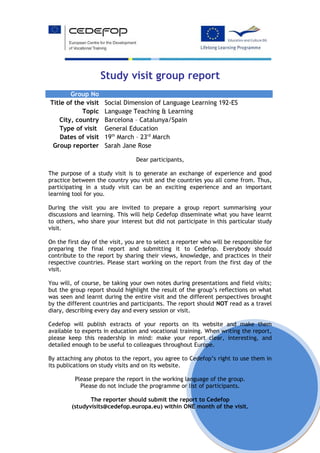
Study visit group report
       Group No
Title of the visit   Social Dimension of Language Learning 192-ES
           Topic     Language Teaching & Learning
   City, country     Barcelona – Catalunya/Spain
   Type of visit     General Education
    Dates of visit   19th March – 23rd March
 Group reporter      Sarah Jane Rose

                                  Dear participants,

The purpose of a study visit is to generate an exchange of experience and good
practice between the country you visit and the countries you all come from. Thus,
participating in a study visit can be an exciting experience and an important
learning tool for you.

During the visit you are invited to prepare a group report summarising your
discussions and learning. This will help Cedefop disseminate what you have learnt
to others, who share your interest but did not participate in this particular study
visit.

On the first day of the visit, you are to select a reporter who will be responsible for
preparing the final report and submitting it to Cedefop. Everybody should
contribute to the report by sharing their views, knowledge, and practices in their
respective countries. Please start working on the report from the first day of the
visit.

You will, of course, be taking your own notes during presentations and field visits;
but the group report should highlight the result of the group’s reflections on what
was seen and learnt during the entire visit and the different perspectives brought
by the different countries and participants. The report should NOT read as a travel
diary, describing every day and every session or visit.

Cedefop will publish extracts of your reports on its website and make them
available to experts in education and vocational training. When writing the report,
please keep this readership in mind: make your report clear, interesting, and
detailed enough to be useful to colleagues throughout Europe.

By attaching any photos to the report, you agree to Cedefop’s right to use them in
its publications on study visits and on its website.

          Please prepare the report in the working language of the group.
            Please do not include the programme or list of participants.

                The reporter should submit the report to Cedefop
         (studyvisits@cedefop.europa.eu) within ONE month of the visit.


                                                                                          1
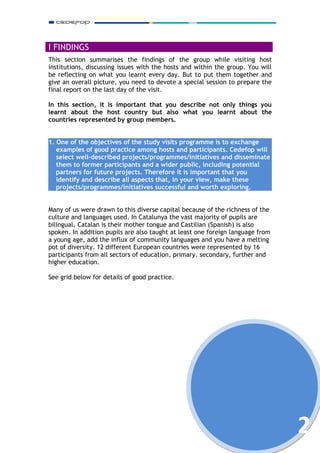
I FINDINGS
This section summarises the findings of the group while visiting host
institutions, discussing issues with the hosts and within the group. You will
be reflecting on what you learnt every day. But to put them together and
give an overall picture, you need to devote a special session to prepare the
final report on the last day of the visit.

In this section, it is important that you describe not only things you
learnt about the host country but also what you learnt about the
countries represented by group members.


1. One of the objectives of the study visits programme is to exchange
   examples of good practice among hosts and participants. Cedefop will
   select well-described projects/programmes/initiatives and disseminate
   them to former participants and a wider public, including potential
   partners for future projects. Therefore it is important that you
   identify and describe all aspects that, in your view, make these
   projects/programmes/initiatives successful and worth exploring.


Many of us were drawn to this diverse capital because of the richness of the
culture and languages used. In Catalunya the vast majority of pupils are
bilingual, Catalan is their mother tongue and Castilian (Spanish) is also
spoken. In addition pupils are also taught at least one foreign language from
a young age, add the influx of community languages and you have a melting
pot of diversity. 12 different European countries were represented by 16
participants from all sectors of education, primary, secondary, further and
higher education.

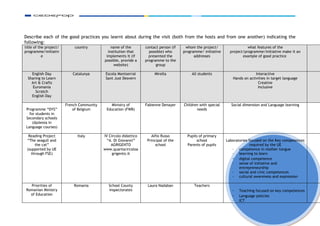
See grid below for details of good practice.


                                                                                2
Describe each of the good practices you learnt about during the visit (both from the hosts and from one another) indicating the
following:
title of the project/       country            name of the        contact person (if    whom the project/                  what features of the
programme/initiativ                          institution that       possible) who      programme/ initiative     project/programme/initiative make it an
           e                                implements it (if       presented the            addresses                  example of good practice
                                           possible, provide a    programme to the
                                                 website)               group

    English Day            Catalunya        Escola Montserrat          Mirella             All students                        Interactive
  Sharing to Learn                          Sant Just Desvern                                                     Hands on activities in target language
    Art & Crafts                                                                                                                 Creative
     Euromania                                                                                                                  Inclusive
      Scratch
    English Day

                        French Community      Ministry of         Fabienne Denayer     Children with special     Social dimension and Language learning
 Programme “DYS”            of Belgium      Education (FWB)                                   needs
   for students in
 Secondary schools
     (dyslexia in
 Language courses)

  Reading Project             Italy        IV Circolo didattico      Alfio Russo         Pupils of primary
 “The seagull and                            “A. Di Giovanni”      Principal of the           school           Laboratories focused on the Key competences
     the cat”                                  AGRIGENTO                school           Parents of pupils                   required by the UE
 (supported by UE                          www.quartocircoloa                                                     - competence in mother tongue
   through FSE)                                 grigento.it                                                       - learning to learn
                                                                                                                  - digital competence
                                                                                                                  - sense of initiative and
                                                                                                                      entrepreneurship
                                                                                                                  - social and civic competences
                                                                                                                  - cultural awareness and expression

   Priorities of            Romania           School County        Laura Nadaban             Teachers
 Romanian Ministry                            Inspectorates                                                       -   Teaching focused on key competences


                                                                                                                                                             3
   of Education                                                                                                   -   Language policies
                                                                                                                  -   ICT
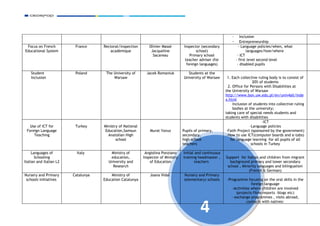
-   Inclusion
                                                                                                                 - Entrepreneurship
 Focus on French          France     Rectorat/inspection       Olivier Massé         Inspector (secondary           - Language policies/when, what
Educational System                      académique              Jacqueline                   school)                     languages/how/where
                                                                 Sacareau                Primary school            - ICT
                                                                                      teacher adviser (for        - first level second level
                                                                                       foreign languages)          - disabled pupils

    Student               Poland      The University of       Jacek Romaniuk          Students at the
    Inclusion                             Warsaw                                    University of Warsaw      1. Each collective ruling body is to consist of
                                                                                                                               20% of students
                                                                                                               2. Office for Persons with Disabilities at
                                                                                                             the University of Warsaw
                                                                                                             http://www.bon.uw.edu.pl/en/univ4all/inde
                                                                                                             x.html
                                                                                                                  Inclusion of students into collective ruling
                                                                                                                  bodies at the university;
                                                                                                             taking care of special needs students and
                                                                                                             students with disabilities
                                                                                                                                    -ICT
   Use of ICT for         Turkey     Ministry of National                                                                    -Language policies
 Foreign Language                    Education,Samsun           Murat Yavuz         Pupils of primary,       -Fatih Project (sponsored by the government)
     Teaching                          Anatolian High                               secondary,                -How to use ICT(computer boards and e-tabs)
                                            school                                  high school                 for language learning for all pupils of all
                                                                                    teachers                                  schools in Turkey

     Languages of          Italy        Ministry of          Angiolina Ponziano     Initial and continuous
       Schooling                        education,          Inspector of Ministry   training headmaster ,    Support for Italian and children from migrant
Italian and Italian L2                 University and           of Education                teachers           background primary and lower secondary
                                         Research                                                             school , Minority languages and bilingualism
                                                                                                                          (French & German)
Nursery and Primary      Catalunya       Ministry of            Joana Vidal         Nursery and Primary
 schools initiatives                 Education Catalunya                            (elementary) schools     -Programme focusing on the oral skills in the
                                                                                                                            foreign language
                                                                                                                -Activities where children are involved
                                                                                                                   (projects-films-reports –blogs etc)
                                                                                                                - exchange programmes , visits abroad,


                                                                                              4
                                                                                                                         contacts with natives:
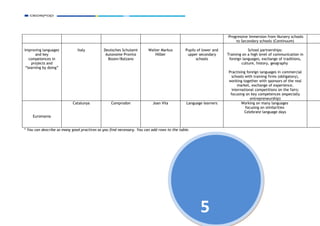
-Progressive Immersion from Nursery schools
                                                                                                                       to Secondary schools (Continuum)

Improving languages           Italy          Deutsches Schulamt        Walter Markus        Pupils of lower and               School partnerships:
       and key                                Autonome Provinz            Hilber             upper secondary      Training on a high level of communication in
   competences in                              Bozen/Bolzano                                      schools          foreign languages, exchange of traditions,
    projects and                                                                                                          culture, history, geography
 “learning by doing”
                                                                                                                  Practising foreign languages in commercial
                                                                                                                    schools with training firms (obligatory),
                                                                                                                  working together with sponsors of the real
                                                                                                                       market, exchange of experience,
                                                                                                                    international competitions on the fairs;
                                                                                                                   focusing on key competences (especially
                                                                                                                               entrepreneurship)
                           Catalunya             Comprodon               Joan Vila           Language learners            Working on many languages
                                                                                                                            focusing on similarities
                                                                                                                            Celebrate language days
    Euromania


* You can describe as many good practices as you find necessary. You can add rows to the table.


                                                                                                    5
2. The study visits programme aims to promote and support policy
   development and cooperation in lifelong learning. That is why it is
   important to know what you learnt about such policies and their
   implementation during your visit. You are invited to describe your findings
   concerning the following:

        2.1     APPROACHES    TAKEN BY PARTICIPATING COUNTRIES     (BOTH   HOST AND PARTICIPANTS’)
                REGARDING THE THEME OF THE VISIT.   ARE   THERE ANY SIMILAR APPROACHES/MEASURES IN
                PARTICIPATING COUNTRIES?   WHAT   ASPECTS ARE SIMILAR AND WHY?    WHAT   ASPECTS ARE
                DIFFERENT AND WHY?


        •   In some countries the concept of sharing to learn is implemented in
            school life.
        •   There is no Euromania but it is substituted by other projects for
            example E-twinning, Comenius and cross border cooperation.
        •   Welcoming classes are organised in countries with large numbers of
            immigrants, for example Norway, Belgium, Spain, UK and France and
            we feel it is a good way to involve a child in regular school life. In
            Hungary such classes are organised for children with speaking and
            learning difficulties.
        •   The National Reading Plan here is implemented with the aim of
            enhancing the reading skill and promoting reading for pleasure, it is a
            cross curricular strategy involving activities organised by local
            authorities.


        2.2     CHALLENGES    FACED BY PARTICIPATING COUNTRIES   (INCLUDING   HOST) IN THEIR EFFORTS
                TO IMPLEMENT POLICIES RELATED TO THE THEME OF THE VISIT.            WHAT    ARE THE
                CHALLENGES?   ARE   THEY COMMON CHALLENGES? IF SO, WHY? IF NOT, WHY NOT?


     Challenges:

        •   How to create an interactive community (social cohesion)
        •   How to become an active citizen in plurilingual Catalunya: for both
            Spanish people (Catalan and Castilian speakers) and immigrants, by
            maintaining the language and the culture of each one, protect and
            preserve.
        •   How to incorporate additional foreign languages in the curriculum in
            order to enrich the European dimension of future citizens.

     The realities are somewhat different in the participating countries, we
     could speak of a more multilingual situation (with a few exceptions) due to
     historical heritage and everyday reality.


                                                                                                       6
2.3   NAME   AND DESCRIBE EFFECTIVE AND INNOVATIVE SOLUTIONS YOU HAVE IDENTIFIED THAT
               PARTICIPATING COUNTRIES   (BOTH    HOST AND PARTICIPANTS) APPLY TO ADDRESS THE
               CHALLENGES   MENTIONED    IN   QUESTION   2.2. PLEASE    MENTION    SPECIFIC   COUNTRY
               EXAMPLES.


     The National Reading Plan – A project that promotes the implementation of
     key competences in the mother tongue and in foreign languages, and
     increases the level of literacy among the learners. Effective in boosting
     students´ cultural awareness and expression however it must be developed
     in such a way as to not hinder speaking skills.

     Welcoming classes/Inclusion programme – A project aimed at personalising
     the curriculum and adopting flexible ways to improve individual skills of the
     learners.

     Promoting community languages – Project that takes into account the
     existence of numerous ethnic minorities in Catalunya aimed at retaining
     their unique language and culture. At the same time the project makes
     them a basis on which competences in foreign languages are built and
     developed.


         2.4   ASSESSMENT   OF THE   TRANSFERABILITY     OF POLICIES   AND   PRACTICES.   COULD   ANY
               EXAMPLES OF GOOD PRACTICE PRESENTED IN THIS REPORT BE APPLIED AND TRANSFERRED
               TO OTHER COUNTRIES? IF SO, WHY? IF NOT, WHY NOT?


CLIL – Content and Language Integrated Learning

One example we all agreed is good practice was CLIL, this project though still in
its infancy, in some countries, is gaining popularity. Using immersion
methodology CLIL is particularly effective when started at an early age and have
the opportunity to continue with other curriculum subjects. Not only does CLIL
improve student’s linguistic competence but simultaneously improves verbal and
non-verbal reasoning, creativity, cognitive processing and autonomy. We saw
evidence of the learner voice in the form of written comments, these reflected
its benefits.
 On the other hand the degree of success relies heavily on the competence of the
teacher in the target language. Therefore we foresee issues in other European
countries because the standardisation of teaching qualifications is not always
regulated.
On balance we conclude that CLIL is an excellent programme to foster
continuous professional development and increases the learner’s mobility and
employment opportunities throughout Europe.


3. Creating networks of experts, building partnerships for future projects is
   another important objective of the study visit programme.


                                                                                                        7
Please state whether and which ideas for future cooperation have evolved
during meetings and discussions.

Jacqueline Sacareau spoke to Joana Vidal regarding a link between her
schools and rural schools in here. In addition there are future plans to
initiate an exchange between classes of primary schools with Alfio Russo.

Dr Margit Engelmann spoke to Nuria Batlle, they decided that when she
returns with her students they will visit Institut Montserrat and lessons.

Laura Nadaban will be working with two other participants fostering an
educational exchange between Samsun and Schulsprengel Ritten,
Klobenstein/Collalbo (headmaster Walter Markus Hilber).

Jacek Romaniuk and Sarah Rose discussed a possible exchange.

Angiolina Ponziano spoke to Joana to suggest a link on the ministerial
website at project languages of schooling-. www.istruzione.it.


                                                                             8

20_Group report_Barcelona 2012

  • 1.
    Study visit groupreport Group No Title of the visit Social Dimension of Language Learning 192-ES Topic Language Teaching & Learning City, country Barcelona – Catalunya/Spain Type of visit General Education Dates of visit 19th March – 23rd March Group reporter Sarah Jane Rose Dear participants, The purpose of a study visit is to generate an exchange of experience and good practice between the country you visit and the countries you all come from. Thus, participating in a study visit can be an exciting experience and an important learning tool for you. During the visit you are invited to prepare a group report summarising your discussions and learning. This will help Cedefop disseminate what you have learnt to others, who share your interest but did not participate in this particular study visit. On the first day of the visit, you are to select a reporter who will be responsible for preparing the final report and submitting it to Cedefop. Everybody should contribute to the report by sharing their views, knowledge, and practices in their respective countries. Please start working on the report from the first day of the visit. You will, of course, be taking your own notes during presentations and field visits; but the group report should highlight the result of the group’s reflections on what was seen and learnt during the entire visit and the different perspectives brought by the different countries and participants. The report should NOT read as a travel diary, describing every day and every session or visit. Cedefop will publish extracts of your reports on its website and make them available to experts in education and vocational training. When writing the report, please keep this readership in mind: make your report clear, interesting, and detailed enough to be useful to colleagues throughout Europe. By attaching any photos to the report, you agree to Cedefop’s right to use them in its publications on study visits and on its website. Please prepare the report in the working language of the group. Please do not include the programme or list of participants. The reporter should submit the report to Cedefop (studyvisits@cedefop.europa.eu) within ONE month of the visit. 1
  • 2.
    I FINDINGS This sectionsummarises the findings of the group while visiting host institutions, discussing issues with the hosts and within the group. You will be reflecting on what you learnt every day. But to put them together and give an overall picture, you need to devote a special session to prepare the final report on the last day of the visit. In this section, it is important that you describe not only things you learnt about the host country but also what you learnt about the countries represented by group members. 1. One of the objectives of the study visits programme is to exchange examples of good practice among hosts and participants. Cedefop will select well-described projects/programmes/initiatives and disseminate them to former participants and a wider public, including potential partners for future projects. Therefore it is important that you identify and describe all aspects that, in your view, make these projects/programmes/initiatives successful and worth exploring. Many of us were drawn to this diverse capital because of the richness of the culture and languages used. In Catalunya the vast majority of pupils are bilingual, Catalan is their mother tongue and Castilian (Spanish) is also spoken. In addition pupils are also taught at least one foreign language from a young age, add the influx of community languages and you have a melting pot of diversity. 12 different European countries were represented by 16 participants from all sectors of education, primary, secondary, further and higher education. See grid below for details of good practice. 2
  • 3.
    Describe each ofthe good practices you learnt about during the visit (both from the hosts and from one another) indicating the following: title of the project/ country name of the contact person (if whom the project/ what features of the programme/initiativ institution that possible) who programme/ initiative project/programme/initiative make it an e implements it (if presented the addresses example of good practice possible, provide a programme to the website) group English Day Catalunya Escola Montserrat Mirella All students Interactive Sharing to Learn Sant Just Desvern Hands on activities in target language Art & Crafts Creative Euromania Inclusive Scratch English Day French Community Ministry of Fabienne Denayer Children with special Social dimension and Language learning Programme “DYS” of Belgium Education (FWB) needs for students in Secondary schools (dyslexia in Language courses) Reading Project Italy IV Circolo didattico Alfio Russo Pupils of primary “The seagull and “A. Di Giovanni” Principal of the school Laboratories focused on the Key competences the cat” AGRIGENTO school Parents of pupils required by the UE (supported by UE www.quartocircoloa - competence in mother tongue through FSE) grigento.it - learning to learn - digital competence - sense of initiative and entrepreneurship - social and civic competences - cultural awareness and expression Priorities of Romania School County Laura Nadaban Teachers Romanian Ministry Inspectorates - Teaching focused on key competences 3 of Education - Language policies - ICT
  • 4.
    - Inclusion - Entrepreneurship Focus on French France Rectorat/inspection Olivier Massé Inspector (secondary - Language policies/when, what Educational System académique Jacqueline school) languages/how/where Sacareau Primary school - ICT teacher adviser (for - first level second level foreign languages) - disabled pupils Student Poland The University of Jacek Romaniuk Students at the Inclusion Warsaw University of Warsaw 1. Each collective ruling body is to consist of 20% of students 2. Office for Persons with Disabilities at the University of Warsaw http://www.bon.uw.edu.pl/en/univ4all/inde x.html Inclusion of students into collective ruling bodies at the university; taking care of special needs students and students with disabilities -ICT Use of ICT for Turkey Ministry of National -Language policies Foreign Language Education,Samsun Murat Yavuz Pupils of primary, -Fatih Project (sponsored by the government) Teaching Anatolian High secondary, -How to use ICT(computer boards and e-tabs) school high school for language learning for all pupils of all teachers schools in Turkey Languages of Italy Ministry of Angiolina Ponziano Initial and continuous Schooling education, Inspector of Ministry training headmaster , Support for Italian and children from migrant Italian and Italian L2 University and of Education teachers background primary and lower secondary Research school , Minority languages and bilingualism (French & German) Nursery and Primary Catalunya Ministry of Joana Vidal Nursery and Primary schools initiatives Education Catalunya (elementary) schools -Programme focusing on the oral skills in the foreign language -Activities where children are involved (projects-films-reports –blogs etc) - exchange programmes , visits abroad, 4 contacts with natives:
  • 5.
    -Progressive Immersion fromNursery schools to Secondary schools (Continuum) Improving languages Italy Deutsches Schulamt Walter Markus Pupils of lower and School partnerships: and key Autonome Provinz Hilber upper secondary Training on a high level of communication in competences in Bozen/Bolzano schools foreign languages, exchange of traditions, projects and culture, history, geography “learning by doing” Practising foreign languages in commercial schools with training firms (obligatory), working together with sponsors of the real market, exchange of experience, international competitions on the fairs; focusing on key competences (especially entrepreneurship) Catalunya Comprodon Joan Vila Language learners Working on many languages focusing on similarities Celebrate language days Euromania * You can describe as many good practices as you find necessary. You can add rows to the table. 5
  • 6.
    2. The studyvisits programme aims to promote and support policy development and cooperation in lifelong learning. That is why it is important to know what you learnt about such policies and their implementation during your visit. You are invited to describe your findings concerning the following: 2.1 APPROACHES TAKEN BY PARTICIPATING COUNTRIES (BOTH HOST AND PARTICIPANTS’) REGARDING THE THEME OF THE VISIT. ARE THERE ANY SIMILAR APPROACHES/MEASURES IN PARTICIPATING COUNTRIES? WHAT ASPECTS ARE SIMILAR AND WHY? WHAT ASPECTS ARE DIFFERENT AND WHY? • In some countries the concept of sharing to learn is implemented in school life. • There is no Euromania but it is substituted by other projects for example E-twinning, Comenius and cross border cooperation. • Welcoming classes are organised in countries with large numbers of immigrants, for example Norway, Belgium, Spain, UK and France and we feel it is a good way to involve a child in regular school life. In Hungary such classes are organised for children with speaking and learning difficulties. • The National Reading Plan here is implemented with the aim of enhancing the reading skill and promoting reading for pleasure, it is a cross curricular strategy involving activities organised by local authorities. 2.2 CHALLENGES FACED BY PARTICIPATING COUNTRIES (INCLUDING HOST) IN THEIR EFFORTS TO IMPLEMENT POLICIES RELATED TO THE THEME OF THE VISIT. WHAT ARE THE CHALLENGES? ARE THEY COMMON CHALLENGES? IF SO, WHY? IF NOT, WHY NOT? Challenges: • How to create an interactive community (social cohesion) • How to become an active citizen in plurilingual Catalunya: for both Spanish people (Catalan and Castilian speakers) and immigrants, by maintaining the language and the culture of each one, protect and preserve. • How to incorporate additional foreign languages in the curriculum in order to enrich the European dimension of future citizens. The realities are somewhat different in the participating countries, we could speak of a more multilingual situation (with a few exceptions) due to historical heritage and everyday reality. 6
  • 7.
    2.3 NAME AND DESCRIBE EFFECTIVE AND INNOVATIVE SOLUTIONS YOU HAVE IDENTIFIED THAT PARTICIPATING COUNTRIES (BOTH HOST AND PARTICIPANTS) APPLY TO ADDRESS THE CHALLENGES MENTIONED IN QUESTION 2.2. PLEASE MENTION SPECIFIC COUNTRY EXAMPLES. The National Reading Plan – A project that promotes the implementation of key competences in the mother tongue and in foreign languages, and increases the level of literacy among the learners. Effective in boosting students´ cultural awareness and expression however it must be developed in such a way as to not hinder speaking skills. Welcoming classes/Inclusion programme – A project aimed at personalising the curriculum and adopting flexible ways to improve individual skills of the learners. Promoting community languages – Project that takes into account the existence of numerous ethnic minorities in Catalunya aimed at retaining their unique language and culture. At the same time the project makes them a basis on which competences in foreign languages are built and developed. 2.4 ASSESSMENT OF THE TRANSFERABILITY OF POLICIES AND PRACTICES. COULD ANY EXAMPLES OF GOOD PRACTICE PRESENTED IN THIS REPORT BE APPLIED AND TRANSFERRED TO OTHER COUNTRIES? IF SO, WHY? IF NOT, WHY NOT? CLIL – Content and Language Integrated Learning One example we all agreed is good practice was CLIL, this project though still in its infancy, in some countries, is gaining popularity. Using immersion methodology CLIL is particularly effective when started at an early age and have the opportunity to continue with other curriculum subjects. Not only does CLIL improve student’s linguistic competence but simultaneously improves verbal and non-verbal reasoning, creativity, cognitive processing and autonomy. We saw evidence of the learner voice in the form of written comments, these reflected its benefits. On the other hand the degree of success relies heavily on the competence of the teacher in the target language. Therefore we foresee issues in other European countries because the standardisation of teaching qualifications is not always regulated. On balance we conclude that CLIL is an excellent programme to foster continuous professional development and increases the learner’s mobility and employment opportunities throughout Europe. 3. Creating networks of experts, building partnerships for future projects is another important objective of the study visit programme. 7
  • 8.
    Please state whetherand which ideas for future cooperation have evolved during meetings and discussions. Jacqueline Sacareau spoke to Joana Vidal regarding a link between her schools and rural schools in here. In addition there are future plans to initiate an exchange between classes of primary schools with Alfio Russo. Dr Margit Engelmann spoke to Nuria Batlle, they decided that when she returns with her students they will visit Institut Montserrat and lessons. Laura Nadaban will be working with two other participants fostering an educational exchange between Samsun and Schulsprengel Ritten, Klobenstein/Collalbo (headmaster Walter Markus Hilber). Jacek Romaniuk and Sarah Rose discussed a possible exchange. Angiolina Ponziano spoke to Joana to suggest a link on the ministerial website at project languages of schooling-. www.istruzione.it. 8