Australian Curriculum: Languages

Lucie Sorensen
Senior Project Officer, Languages
MLTA NSW
8 March 2013
Outline of Presentation
• ACARA update
• Architecture of the Australian Curriculum: Languages
• Overarching design features of the Australian
  Curriculum: Languages
• Overview of draft curriculum (design features realised in
  curriculum documents)
   – orientation of the teaching and learning of all
     languages (key concepts and organisational
     structure)
ACARA Update


Language specific
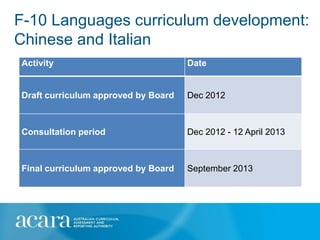
F-10 Languages curriculum development:
Chinese and Italian
Activity                             Date


Draft curriculum approved by Board   Dec 2012


Consultation period                  Dec 2012 - 12 April 2013


Final curriculum approved by Board   September 2013
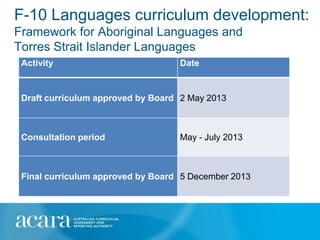
F-10 Languages curriculum development:
Framework for Aboriginal Languages and
Torres Strait Islander Languages
 Activity                          Date


 Draft curriculum approved by Board 2 May 2013


 Consultation period               May - July 2013


 Final curriculum approved by Board 5 December 2013
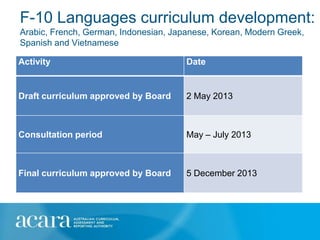
F-10 Languages curriculum development:
Arabic, French, German, Indonesian, Japanese, Korean, Modern Greek,
Spanish and Vietnamese

Activity                               Date


Draft curriculum approved by Board     2 May 2013


Consultation period                    May – July 2013


Final curriculum approved by Board     5 December 2013
Architecture of the Australian
Curriculum: Languages
Architecture of the Australian
Curriculum: Languages

• Pathways
  – Second language learners
  – Background language learners
  – First language learners
• Time on task
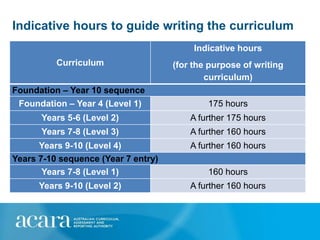
Indicative hours to guide writing the curriculum
                                          Indicative hours
          Curriculum                 (for the purpose of writing
                                             curriculum)
Foundation – Year 10 sequence
 Foundation – Year 4 (Level 1)               175 hours
      Years 5-6 (Level 2)                A further 175 hours
      Years 7-8 (Level 3)                A further 160 hours
      Years 9-10 (Level 4)               A further 160 hours
Years 7-10 sequence (Year 7 entry)
       Years 7-8 (Level 1)                   160 hours
      Years 9-10 (Level 2)               A further 160 hours
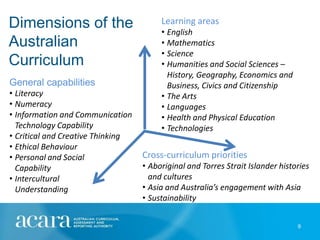
Dimensions of the                       Learning areas
                                        • English
Australian                              • Mathematics
                                        • Science
Curriculum                              • Humanities and Social Sciences –
                                          History, Geography, Economics and
General capabilities                      Business, Civics and Citizenship
• Literacy                              • The Arts
• Numeracy                              • Languages
• Information and Communication         • Health and Physical Education
  Technology Capability                 • Technologies
• Critical and Creative Thinking
• Ethical Behaviour
• Personal and Social              Cross-curriculum priorities
  Capability                       • Aboriginal and Torres Strait Islander histories
• Intercultural                      and cultures
  Understanding                    • Asia and Australia’s engagement with Asia
                                   • Sustainability


                                                                                9
Intercultural understanding
• a central aim of learning languages
• learning languages involves comparison
  and reflection (linguistic, social, and
  cultural)
• language learners actively engage in
  intercultural interpretation
Australian Curriculum:
Languages
F – 10 Curriculum Design
Language, culture and learning
Through learning languages, students acquire:

• essential communication skills in the target language
• an intercultural capability, and
• an understanding of the role of language and culture in human
  communication.

• Learning language involves:
   – Student Performance
   – Analysis
   – Reflection
Aims
The Australian Curriculum: Languages aims to develop the
knowledge, understanding, and skills to ensure students:

• communicate in the target language
• understand language, culture, and learning and their
  relationship, and thereby develop an intercultural
  capability in communication
• understand themselves as communicators.
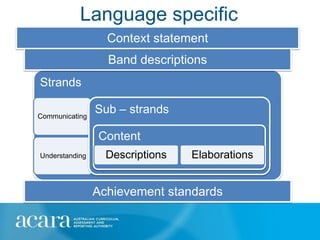
Language specific
                  Context statement
                  Band descriptions
Strands

Communicating
                Sub – strands

                Content
Understanding     Descriptions   Elaborations


                Achievement standards
Content structure – two strands

• Communicating: using language for
  communicative purposes in interpreting,
  creating, and exchanging meaning.
• Understanding: analysing language and
  culture as a resource for interpreting and
  creating meaning.
Overview of Communicating
strand – sub strands
• Socialising and taking action
• Obtaining and using information
• Responding to and expressing imaginative
  experience
• Moving between/translating
• Expressing and performing identity
• Reflecting on intercultural language use
Overview of Understanding
strand – sub strands

•   Systems of language
•   Variability in language use
•   Language awareness
•   Role of language and culture
Achievement standard

• Achievement standards describe what
  students are typically able to understand
  and able to do. They describe expected
  achievement and emphasise the depth of
  conceptual understanding and the
  sophistication of skills
Chinese Foundation to Year 4 (Level 1)
Achievement Standard
•   By the end of Level 1, students ask and respond to questions to exchange personal information
    and interests. They participate in creative performances in collaboration with others. They use
    gestures and movement to support their oral communication. They create short texts in characters
    by copying from word lists to convey personal information using models, or produce cards and
    posters for special occasions and events. They identify key words in texts glossed in Pinyin, or
    locate familiar words in texts presented in characters. They recognise familiar word order in
    Chinese sentences and use model sentence patterns to incorporate their own meanings in
    communication. Sentences are short, following the basic subject-verb-object structure with
    occasional use of adjective predicates. Numbers are used to describe age, family members and to
    quantify objects (with measure word).
•   By the end of Level 1, students understand that Pinyin provides access to the sounds of the
    spoken language and use it to practise speaking with attention to pronunciation and tone. They
    recognise features of the Chinese writing system: the range of strokes and their sequences in
    character writing and how component knowledge can assist in learning characters. They
    recognise that Modern Standard Chinese is a language of global importance and identify
    examples of Chinese use particularly within their own community. They describe features of
    Chinese culture and display awareness of cultural values when participating in interactions with
    Chinese people.
Online delivery


                  20
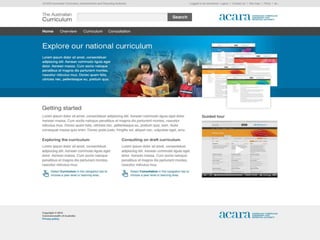
Consultation Portal
• The Australian Curriculum has been published
  online
• ACARA works with Education Services Australia
  to publish draft material on the consultation
  portal and when approved the online curriculum
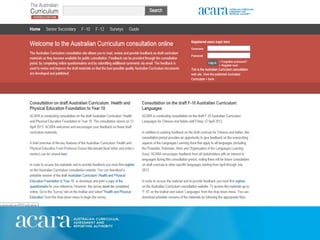
http://consultation.australiancurriculum.edu.au/
• Australian Curriculum Connect project linking
   state/territory digital resources to support the
   teaching of the curriculum

                                                      21
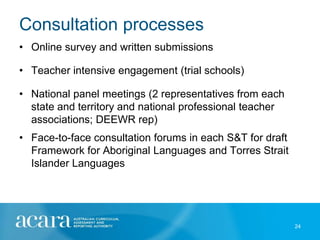
Consultation processes
• Online survey and written submissions

• Teacher intensive engagement (trial schools)

• National panel meetings (2 representatives from each
  state and territory and national professional teacher
  associations; DEEWR rep)
• Face-to-face consultation forums in each S&T for draft
  Framework for Aboriginal Languages and Torres Strait
  Islander Languages


                                                           24
Feedback
•   Broad feedback is sought on the Languages curriculum overall in relation to:
     – Rationale and Aims for the Languages: Learning area
     – Structure of the curriculum

•   More specific feedback in each Language is sought in relation to:
     – Context statement
     – Band descriptions
     – Curriculum content (clarity, coverage, pitch and sequence)
     – Achievement standards (clarity, coherence, pitch, sequence, usability)
     – Manageability for teachers
More information …

ACARA Website
www.acara.edu.au

Australian Curriculum Website
http://www.australiancurriculum.edu.au/Home
Chinese
German, Modern Greek, Spanish, Vietnamese

Lucie Sorensen
Senior Project Officer, Languages
Australian Curriculum, Assessment and
Reporting Authority (ACARA)
Level 10 | 255 Pitt Street | SYDNEY | NSW | 2000
Ph: 02 8098 3267| Fax: 1300 995 468
Email: lucie.sorensen@acara.edu.au
Italian
Aboriginal Languages and Torres Strait Islander Languages
Arabic, French, Indonesian, Japanese, Korean
Suzanne Bradshaw
Senior Project Officer, Languages
Australian Curriculum, Assessment and Reporting
Authority (ACARA)
Level 10 | 255 Pitt Street | SYDNEY | NSW | 2000
Ph: 02 8098 3149| Fax: 1300 995 468
Ph: +618 8302 4794 (Adelaide)
Email: suzanne.bradshaw@acara.edu.au

Acara Update

  • 1.
    Australian Curriculum: Languages LucieSorensen Senior Project Officer, Languages MLTA NSW 8 March 2013
  • 2.
    Outline of Presentation •ACARA update • Architecture of the Australian Curriculum: Languages • Overarching design features of the Australian Curriculum: Languages • Overview of draft curriculum (design features realised in curriculum documents) – orientation of the teaching and learning of all languages (key concepts and organisational structure)
  • 3.
  • 4.
    F-10 Languages curriculumdevelopment: Chinese and Italian Activity Date Draft curriculum approved by Board Dec 2012 Consultation period Dec 2012 - 12 April 2013 Final curriculum approved by Board September 2013
  • 5.
    F-10 Languages curriculumdevelopment: Framework for Aboriginal Languages and Torres Strait Islander Languages Activity Date Draft curriculum approved by Board 2 May 2013 Consultation period May - July 2013 Final curriculum approved by Board 5 December 2013
  • 6.
    F-10 Languages curriculumdevelopment: Arabic, French, German, Indonesian, Japanese, Korean, Modern Greek, Spanish and Vietnamese Activity Date Draft curriculum approved by Board 2 May 2013 Consultation period May – July 2013 Final curriculum approved by Board 5 December 2013
  • 7.
    Architecture of theAustralian Curriculum: Languages
  • 8.
    Architecture of theAustralian Curriculum: Languages • Pathways – Second language learners – Background language learners – First language learners • Time on task
  • 9.
    Indicative hours toguide writing the curriculum Indicative hours Curriculum (for the purpose of writing curriculum) Foundation – Year 10 sequence Foundation – Year 4 (Level 1) 175 hours Years 5-6 (Level 2) A further 175 hours Years 7-8 (Level 3) A further 160 hours Years 9-10 (Level 4) A further 160 hours Years 7-10 sequence (Year 7 entry) Years 7-8 (Level 1) 160 hours Years 9-10 (Level 2) A further 160 hours
  • 10.
    Dimensions of the Learning areas • English Australian • Mathematics • Science Curriculum • Humanities and Social Sciences – History, Geography, Economics and General capabilities Business, Civics and Citizenship • Literacy • The Arts • Numeracy • Languages • Information and Communication • Health and Physical Education Technology Capability • Technologies • Critical and Creative Thinking • Ethical Behaviour • Personal and Social Cross-curriculum priorities Capability • Aboriginal and Torres Strait Islander histories • Intercultural and cultures Understanding • Asia and Australia’s engagement with Asia • Sustainability 9
  • 11.
    Intercultural understanding • acentral aim of learning languages • learning languages involves comparison and reflection (linguistic, social, and cultural) • language learners actively engage in intercultural interpretation
  • 12.
  • 13.
    Language, culture andlearning Through learning languages, students acquire: • essential communication skills in the target language • an intercultural capability, and • an understanding of the role of language and culture in human communication. • Learning language involves: – Student Performance – Analysis – Reflection
  • 14.
    Aims The Australian Curriculum:Languages aims to develop the knowledge, understanding, and skills to ensure students: • communicate in the target language • understand language, culture, and learning and their relationship, and thereby develop an intercultural capability in communication • understand themselves as communicators.
  • 15.
    Language specific Context statement Band descriptions Strands Communicating Sub – strands Content Understanding Descriptions Elaborations Achievement standards
  • 16.
    Content structure –two strands • Communicating: using language for communicative purposes in interpreting, creating, and exchanging meaning. • Understanding: analysing language and culture as a resource for interpreting and creating meaning.
  • 17.
    Overview of Communicating strand– sub strands • Socialising and taking action • Obtaining and using information • Responding to and expressing imaginative experience • Moving between/translating • Expressing and performing identity • Reflecting on intercultural language use
  • 18.
    Overview of Understanding strand– sub strands • Systems of language • Variability in language use • Language awareness • Role of language and culture
  • 19.
    Achievement standard • Achievementstandards describe what students are typically able to understand and able to do. They describe expected achievement and emphasise the depth of conceptual understanding and the sophistication of skills
  • 20.
    Chinese Foundation toYear 4 (Level 1) Achievement Standard • By the end of Level 1, students ask and respond to questions to exchange personal information and interests. They participate in creative performances in collaboration with others. They use gestures and movement to support their oral communication. They create short texts in characters by copying from word lists to convey personal information using models, or produce cards and posters for special occasions and events. They identify key words in texts glossed in Pinyin, or locate familiar words in texts presented in characters. They recognise familiar word order in Chinese sentences and use model sentence patterns to incorporate their own meanings in communication. Sentences are short, following the basic subject-verb-object structure with occasional use of adjective predicates. Numbers are used to describe age, family members and to quantify objects (with measure word). • By the end of Level 1, students understand that Pinyin provides access to the sounds of the spoken language and use it to practise speaking with attention to pronunciation and tone. They recognise features of the Chinese writing system: the range of strokes and their sequences in character writing and how component knowledge can assist in learning characters. They recognise that Modern Standard Chinese is a language of global importance and identify examples of Chinese use particularly within their own community. They describe features of Chinese culture and display awareness of cultural values when participating in interactions with Chinese people.
  • 21.
  • 22.
    Consultation Portal • TheAustralian Curriculum has been published online • ACARA works with Education Services Australia to publish draft material on the consultation portal and when approved the online curriculum http://consultation.australiancurriculum.edu.au/ • Australian Curriculum Connect project linking state/territory digital resources to support the teaching of the curriculum 21
  • 25.
    Consultation processes • Onlinesurvey and written submissions • Teacher intensive engagement (trial schools) • National panel meetings (2 representatives from each state and territory and national professional teacher associations; DEEWR rep) • Face-to-face consultation forums in each S&T for draft Framework for Aboriginal Languages and Torres Strait Islander Languages 24
  • 26.
    Feedback • Broad feedback is sought on the Languages curriculum overall in relation to: – Rationale and Aims for the Languages: Learning area – Structure of the curriculum • More specific feedback in each Language is sought in relation to: – Context statement – Band descriptions – Curriculum content (clarity, coverage, pitch and sequence) – Achievement standards (clarity, coherence, pitch, sequence, usability) – Manageability for teachers
  • 27.
    More information … ACARAWebsite www.acara.edu.au Australian Curriculum Website http://www.australiancurriculum.edu.au/Home
  • 28.
    Chinese German, Modern Greek,Spanish, Vietnamese Lucie Sorensen Senior Project Officer, Languages Australian Curriculum, Assessment and Reporting Authority (ACARA) Level 10 | 255 Pitt Street | SYDNEY | NSW | 2000 Ph: 02 8098 3267| Fax: 1300 995 468 Email: lucie.sorensen@acara.edu.au
  • 29.
    Italian Aboriginal Languages andTorres Strait Islander Languages Arabic, French, Indonesian, Japanese, Korean Suzanne Bradshaw Senior Project Officer, Languages Australian Curriculum, Assessment and Reporting Authority (ACARA) Level 10 | 255 Pitt Street | SYDNEY | NSW | 2000 Ph: 02 8098 3149| Fax: 1300 995 468 Ph: +618 8302 4794 (Adelaide) Email: suzanne.bradshaw@acara.edu.au

Editor's Notes

  • #8 In the Australian Curriculum: Languages, pathways for second language learners, background language learners and first language learners have been developed as appropriate to cater for the dominant cohort(s) of students learning each specific language within the current Australian context. Two variables influence the curriculum architecture: learner background and time on taskSecond language learners are those who are introduced to learning the target language at school as an additional, new language for them. The first language used before they start school and/or the language they use at home is not the target language. Background language learners are those who may use the target language at home (not necessarily exclusively) and have knowledge of the target language to varying degrees such as vocabulary, phonological accuracy, fluency, and readiness to use the language. They have a base for literacy development in that language. First language learners are users of the target language who have undertaken at least primary schooling in the target language. They have had their primary socialisation as well as initial literacy development in that language, and they use the target language at home. It also relates to students learning Aboriginal languages and Torres Strait Islander languages and includes learners whose primary socialisation is in the target language and who may or may not have yet developed initial literacy. Within each of these groups, there are differences in proficiency in using the target language. It is acknowledged that the span of language experiences of background learners is particularly wide, and learners in this group are likely to have quite diverse affiliations with the target language. Nevertheless, for pragmatic reasons, it is not feasible to identify more groupings than these.For Aboriginal languages and Torres Strait Islander languages, a framework is being developed that caters for different learner pathways that also take account of the state of the particular language involved:we are developing second language, first language and language revival pathways.