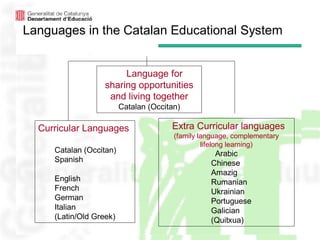
The Catalan educational System Servei de Llengües Subdirecció General de Llengua i Entorn Departament d’Educació   Neus Lorenzo Galés, 2010 [email_address]
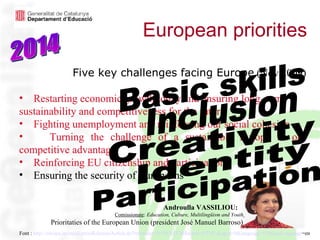
European priorities   Font :  http:// europa . eu / rapid / pressReleasesAction .do? reference =IP/09/1837& format =HTML& aged =0& language =EN& guiLanguage =en   2014 Five key challenges facing Europe   (Nov.2009) Restarting economic growth today and ensuring long–term sustainability and competitiveness for the future Fighting unemployment and reinforcing our social cohesion Turning the challenge of a sustainable Europe to our competitive advantage  Reinforcing EU citizenship and participation Ensuring the security of Europeans Five key challenges facing Europe   (Nov.2009) Restarting economic growth today and ensuring long–term sustainability and competitiveness for the future Fighting unemployment and reinforcing our social cohesion Turning the challenge of a sustainable Europe to our competitive advantage Reinforcing EU citizenship and participation. Ensuring the security of Europeans Basic skills Inclusion Creativity Identity Participation  Androulla VASSILIOU:    Comissionate :  Education, Culture, Multilingüism and Youth   Prioritaties of the European Union (president José Manuel Barroso)
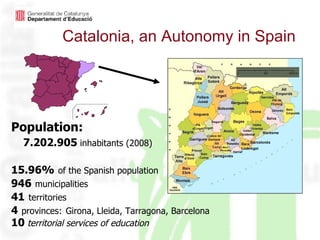
Catalonia, an Autonomy in Spain Population: 7.202.905  inhabitants (2008) 15.96%   of the Spanish population 946   municipalities 41   territories 4   provinces:   Girona, Lleida, Tarragona, Barcelona 10   territorial services of education
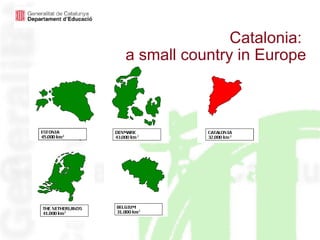
Catalonia:  a small country in Europe
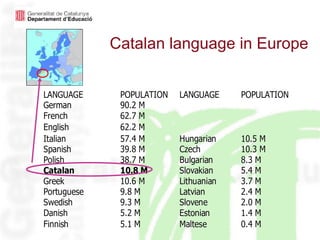
Catalan language in Europe
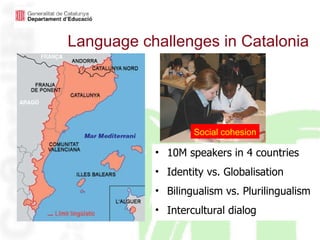
Language challenges in Catalonia 10M speakers in 4 countries Identity vs. Globalisation Bilingualism vs. Plurilingualism Intercultural dialog  Social cohesion
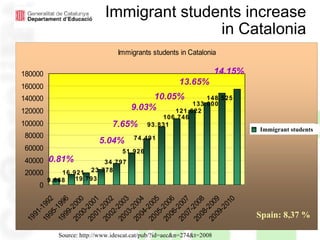
Immigrant students increase  in Catalonia Source: http://www.idescat.cat/pub/?id=aec&n=274&t=2008 Spain: 8,37 % Immigrant   students 0.81% 13.65% 10.05% 7.65% 5.04% 9.03% 14.15% 23.778 148.525 93.831 106.746 121.622 133.000 34.797 51.926 74.491 19.793 16.921 9.868
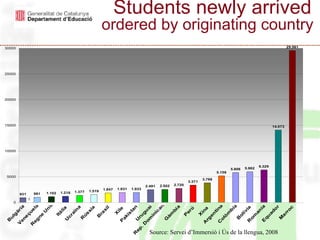
Students newly arrived  ordered by originating country   Source: Servei d’Immersió i Ús de la llengua, 2008
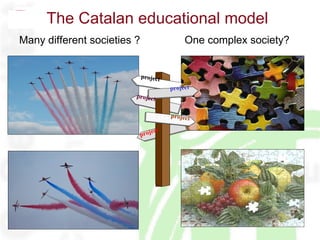
The Catalan educational model   Many different societies ? One complex society? project project project project project
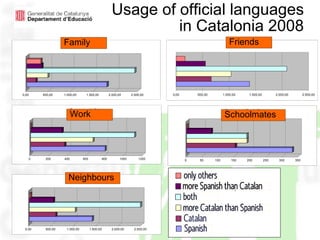
Usage of official languages in Catalonia 2008 Family Friends Neighbours Work Schoolmates
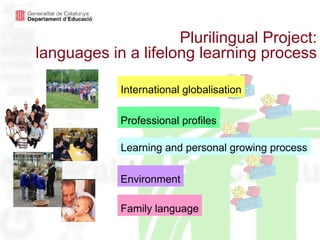
Plurilingual Project: languages in a lifelong learning process Family language Learning and personal growing process International globalisation Professional profiles Environment
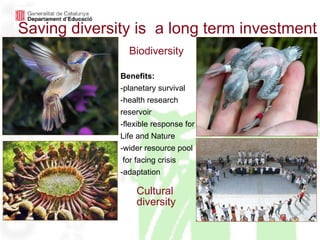
Saving diversity is  a long term investment Benefits: -planetary survival -health research reservoir -flexible response for Life and Nature -wider resource pool for facing crisis -adaptation Biodiversity Cultural  diversity
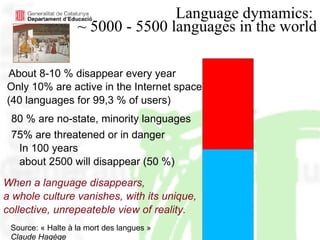
Language dymamics:  ~ 5000 - 5500 languages in the world Source: « Halte à la mort des langues »  Claude Hagège When a language disappears,  a whole culture vanishes, with its unique, collective, unrepeateble view of reality. Only 10% are active in the Internet space (40 languages for 99,3 % of users) 80 % are no-state, minority languages 75% are threatened or in danger About 8-10 % disappear every year In 100 years  about 2500 will disappear (50 %)
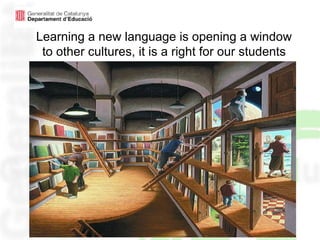
Learning a new language is opening a window  to other cultures, it is a right for our students  and a benefit for the whole community
 
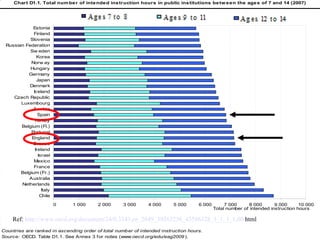
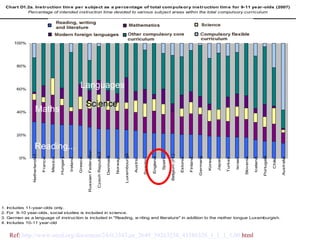
Ref:  http:// www . oecd . org / document /24/0,3343,en_2649_39263238_43586328_1_1_1_1,00. html
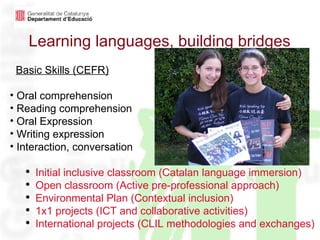
Learning languages, building bridges Basic Skills (CEFR) Oral comprehension Reading comprehension Oral Expression Writing expression Interaction, conversation Initial inclusive classroom (Catalan language immersion) Open classroom (Active pre-professional approach) Environmental Plan (Contextual inclusion) 1x1 projects (ICT and collaborative activities) International projects (CLIL methodologies and exchanges)
 
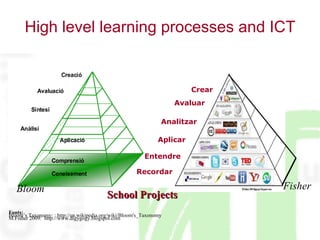
High level learning processes and ICT Fonts: Bloom’s Taxonomy: : http://en.wikipedia.org/wiki/Bloom's_Taxonomy M.Fisher 2009:  http://www.digygogy.blogspot.com School Projects Bloom Entendre Crear Aplicar Avaluar Analitzar Recordar Fisher
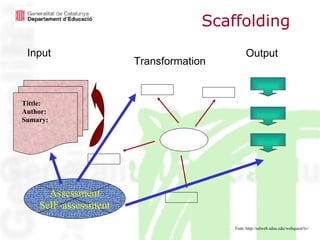
Scaffolding Font: http://edweb.sdsu.edu/webquest/tv/ Tittle: Author: Sumary: Input Transformation Output Assessment SelF-assessment
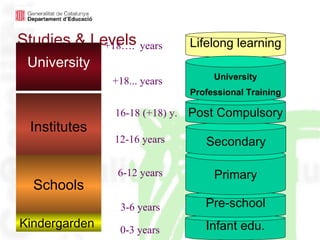
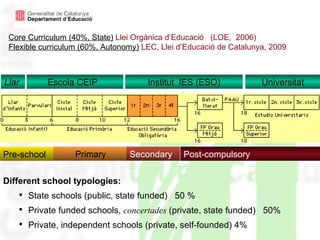
Studies & Levels University Institutes Schools Kindergarden  Infant edu. 0-3 years Pre-school 3-6 years Primary 6-12 years Secondary 12-16 years Lifelong learning +18….  years Post  Compulsory 16-18 (+18) y. University Professional Training +18... years
Core Curriculum (40%, State)  Llei Orgànica d’Educació  (LOE,  2006) Flexible curriculum (60%, Autonomy)  LEC, Llei d’Educació de Catalunya, 2009 Different school typologies: State schools (public, state funded)  50 % Private funded schools,  concertades  (private, state funded)  50% Private, independent schools (private, self-founded) 4% Pre-school Primary Secondary Post-compulsory Universitat Institut  IES (ESO) Escola CEIP  Llar
Ref:  http:// www . oecd . org / document /24/0,3343,en_2649_39263238_43586328_1_1_1_1,00. html   Reading... Languages Science Maths
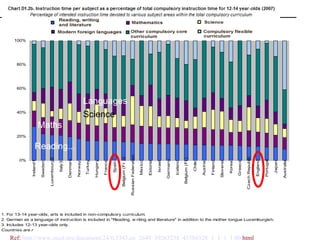
Reading... Languages Science Maths Ref:  http:// www . oecd . org / document /24/0,3343,en_2649_39263238_43586328_1_1_1_1,00. html
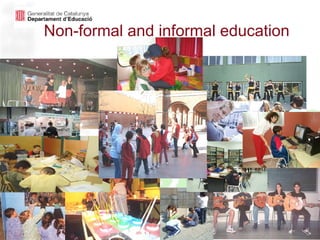
Non-formal and informal education
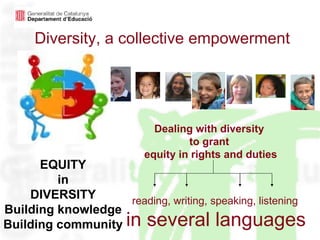
Diversity, a collective empowerment reading, writing, speaking, listening in several languages Dealing with diversity  to grant  equity in rights and duties EQUITY in DIVERSITY Building knowledge Building community
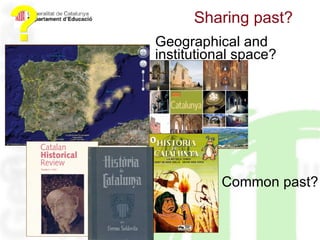
Sharing past? ? Geographical and institutional space? Common past?
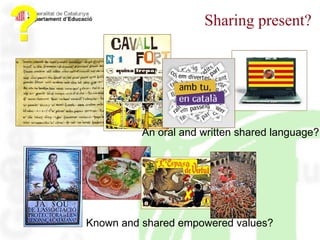
Sharing present? ? An oral and written shared language? Known and shared empowered values?
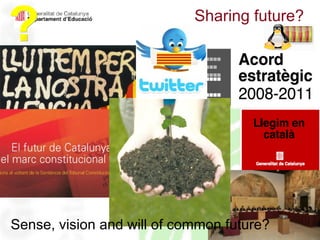
Sharing future?   ? Sense, vision and will of common future?
The Catalan educational System Servei de Llengües Subdirecció General de Llengua i Entorn Departament d’Educació   Neus Lorenzo Galés, 2010 [email_address]

Visita estudis2010nl

  • 1.
    The Catalan educationalSystem Servei de Llengües Subdirecció General de Llengua i Entorn Departament d’Educació Neus Lorenzo Galés, 2010 [email_address]
  • 2.
    European priorities Font : http:// europa . eu / rapid / pressReleasesAction .do? reference =IP/09/1837& format =HTML& aged =0& language =EN& guiLanguage =en 2014 Five key challenges facing Europe (Nov.2009) Restarting economic growth today and ensuring long–term sustainability and competitiveness for the future Fighting unemployment and reinforcing our social cohesion Turning the challenge of a sustainable Europe to our competitive advantage Reinforcing EU citizenship and participation Ensuring the security of Europeans Five key challenges facing Europe (Nov.2009) Restarting economic growth today and ensuring long–term sustainability and competitiveness for the future Fighting unemployment and reinforcing our social cohesion Turning the challenge of a sustainable Europe to our competitive advantage Reinforcing EU citizenship and participation. Ensuring the security of Europeans Basic skills Inclusion Creativity Identity Participation Androulla VASSILIOU: Comissionate : Education, Culture, Multilingüism and Youth Prioritaties of the European Union (president José Manuel Barroso)
  • 3.
    Catalonia, an Autonomyin Spain Population: 7.202.905 inhabitants (2008) 15.96% of the Spanish population 946 municipalities 41 territories 4 provinces: Girona, Lleida, Tarragona, Barcelona 10 territorial services of education
  • 4.
    Catalonia: asmall country in Europe
  • 5.
  • 6.
    Language challenges inCatalonia 10M speakers in 4 countries Identity vs. Globalisation Bilingualism vs. Plurilingualism Intercultural dialog Social cohesion
  • 7.
    Immigrant students increase in Catalonia Source: http://www.idescat.cat/pub/?id=aec&n=274&t=2008 Spain: 8,37 % Immigrant students 0.81% 13.65% 10.05% 7.65% 5.04% 9.03% 14.15% 23.778 148.525 93.831 106.746 121.622 133.000 34.797 51.926 74.491 19.793 16.921 9.868
  • 8.
    Students newly arrived ordered by originating country Source: Servei d’Immersió i Ús de la llengua, 2008
  • 9.
    The Catalan educationalmodel Many different societies ? One complex society? project project project project project
  • 10.
    Usage of officiallanguages in Catalonia 2008 Family Friends Neighbours Work Schoolmates
  • 11.
    Plurilingual Project: languagesin a lifelong learning process Family language Learning and personal growing process International globalisation Professional profiles Environment
  • 12.
    Saving diversity is a long term investment Benefits: -planetary survival -health research reservoir -flexible response for Life and Nature -wider resource pool for facing crisis -adaptation Biodiversity Cultural diversity
  • 13.
    Language dymamics: ~ 5000 - 5500 languages in the world Source: « Halte à la mort des langues » Claude Hagège When a language disappears, a whole culture vanishes, with its unique, collective, unrepeateble view of reality. Only 10% are active in the Internet space (40 languages for 99,3 % of users) 80 % are no-state, minority languages 75% are threatened or in danger About 8-10 % disappear every year In 100 years about 2500 will disappear (50 %)
  • 14.
    Learning a newlanguage is opening a window to other cultures, it is a right for our students and a benefit for the whole community
  • 15.
  • 16.
    Ref: http://www . oecd . org / document /24/0,3343,en_2649_39263238_43586328_1_1_1_1,00. html
  • 17.
    Learning languages, buildingbridges Basic Skills (CEFR) Oral comprehension Reading comprehension Oral Expression Writing expression Interaction, conversation Initial inclusive classroom (Catalan language immersion) Open classroom (Active pre-professional approach) Environmental Plan (Contextual inclusion) 1x1 projects (ICT and collaborative activities) International projects (CLIL methodologies and exchanges)
  • 18.
  • 19.
    High level learningprocesses and ICT Fonts: Bloom’s Taxonomy: : http://en.wikipedia.org/wiki/Bloom's_Taxonomy M.Fisher 2009: http://www.digygogy.blogspot.com School Projects Bloom Entendre Crear Aplicar Avaluar Analitzar Recordar Fisher
  • 20.
    Scaffolding Font: http://edweb.sdsu.edu/webquest/tv/Tittle: Author: Sumary: Input Transformation Output Assessment SelF-assessment
  • 21.
    Studies & LevelsUniversity Institutes Schools Kindergarden Infant edu. 0-3 years Pre-school 3-6 years Primary 6-12 years Secondary 12-16 years Lifelong learning +18…. years Post Compulsory 16-18 (+18) y. University Professional Training +18... years
  • 22.
    Core Curriculum (40%,State) Llei Orgànica d’Educació (LOE, 2006) Flexible curriculum (60%, Autonomy) LEC, Llei d’Educació de Catalunya, 2009 Different school typologies: State schools (public, state funded) 50 % Private funded schools, concertades (private, state funded) 50% Private, independent schools (private, self-founded) 4% Pre-school Primary Secondary Post-compulsory Universitat Institut IES (ESO) Escola CEIP Llar
  • 23.
    Ref: http://www . oecd . org / document /24/0,3343,en_2649_39263238_43586328_1_1_1_1,00. html Reading... Languages Science Maths
  • 24.
    Reading... Languages ScienceMaths Ref: http:// www . oecd . org / document /24/0,3343,en_2649_39263238_43586328_1_1_1_1,00. html
  • 25.
  • 26.
    Diversity, a collectiveempowerment reading, writing, speaking, listening in several languages Dealing with diversity to grant equity in rights and duties EQUITY in DIVERSITY Building knowledge Building community
  • 27.
    Sharing past? ?Geographical and institutional space? Common past?
  • 28.
    Sharing present? ?An oral and written shared language? Known and shared empowered values?
  • 29.
    Sharing future? ? Sense, vision and will of common future?
  • 30.
    The Catalan educationalSystem Servei de Llengües Subdirecció General de Llengua i Entorn Departament d’Educació Neus Lorenzo Galés, 2010 [email_address]

Editor's Notes

  • #22 La coherència i la continuitat educativa han de ser un continuum en tot el procés d‘aprenentatge i desenvolupament de l’alumnat