POST ANAESTHESIA CARE UNIT (PACU) DR.SHAILENDRA.V.L. SPECIALIST IN ANAESTHESIA . AL BUKARIYA GENERAL HOSPITAL .
Introduction  Importance of PACU Adequate preparedness Sudden complication
History of PACU 1947: Anaesthesia Study Commission report Experience of trauma management in 2nd  World War Advances in Surgery in 50’s and 60’s Day care surgery concept of the 90s
Design of PACU Location:  Close to Operating Rooms Easy access to Lab, X-ray, Blood bank Close to ICU Size: Ideal 1.5 PACU bed for every OR 120 square foot per patient Minimum of 7 feet between beds
Design of PACU Facilities: Fowler’s cot with side rails Piped Oxygen, Vacuum and Air Multiple electrical outlets Large doors Good lighting Isolation for Immuno-compromised patients
Equipments in PACU Tray with labeled Emergency drugs Airway maintenance kit: Laryngoscope with all size blades All sizes Endotracheal tubes Face masks, Airways, Ambu Bag, Venturi masks Tracheostomy set ICD set Transport ventilator
Equipments in PACU Personnel: Requirement varies 1 : 1 ratio good 1 : 3 ratio acceptable for busy OR’s Monitors: ECG Pulse oximeter Non invasive BP  EtCO 2 Invasive pressure monitor Temperature
Routine Post-Anaesthesia Care Criteria for shifting from OR---to---PACU Conscious, awake, responds to simple commands Haemo dynamic stability Clinical evaluation for NM blockade recovery Maintainance of Oxygen Saturation Normothermia
Transportation to PACU Fowler’s cot with side rails Patient handed over to PACU nurse by the Anaesthesiologist
Care in PACU Monitoring : ECG, SpO 2 , Blood pressure Oxygen therapy Pain therapy, anti-emetics Blood Pressure recording: Every 5 minutes for 30 minutes Every 15 minutes for next 30 minutes
Post Operative  Complications Respiratory Complications: Airway obstruction Hypoxemia Increased Left to Right shunt
Post Operative Complications Airway Obstruction: Sagging tongue: Treated with triple maneuver Laryngeal Spasm: Due to secretions Due to irritable airways (smokers) Rx: 100% Oxygen through face mask Hydrocoritsone 100 mg IV If no improvement rapid intubation to secure the airway
Post operative Complications Hypoxemia: Low FIO 2 :  Diffusion hypoxemia (N 2 O 31 times more soluble than O 2 ) Hypoventilation: Inadequate N.M. blockade recovery Respiratory depressant effect of volatile agents, narcotics, benzodiazepines Hypocarbia intra operatively Upper abdominal incisions
Post operative Complications Increased Right to Left Shunt: Atelectasis:  Inadvertent endobroncial intubation Ateclectasis of the lung Increased Shunt ( R to L ) Blockage of Brochus by blood or mucous plug Pnemothorax:  following rib injury following CVP placement
Post operative Complications Circulatory Complications: Hypotension: Decreased preload Decreased myocardial contractility Increased after load
Post operative Complications Decreased preload: Increased blood loss Increased III space loss Un diagnosed urinary loss Septicemia Decreased myocardial contractility: Depressant effect of GA drugs Pre-existing ventricular dysfunction Per operative Myocardial infarction Decreased After load: Volatile agents depression Septic shock Profound decreased SVR Septic shock Volatile agents effects
Post operative Complications Hypertension: Pain Hypercapnia Hypothermia Hypoxemia Excess Intra vascular volume Pre-existing hypertension
Post operative Complications Arrythmias: Electrolyte imbalance ( K ) Hypoxia Hypercarbia Metabolic acidosis
Post operative Complications Post-operative pain & agitation: Ascertain adequacy of Blood-Gas exchange Evaluate for any gastric or urinary distension Rx: small doses of narcotics.
Post operative Complications Nausea & Vomiting: Frequently seen after  lapraroscopic surgeries Strabismus surgeries Rx with Ondansetron 4mg IV adults / child 0.1mg/kg Metoclopromide 0.15mg/kg IV
Post operative Complications Hypothermia & shivering: Air-conditioning : excessive cooling Cold IV fluids transfused Cold  irrigating fluids used by the surgeon Halothane anaesthesia Rx by warm blankets Warm IV fluids Inj. Pethidine 10mg IV
Discharge criteria from  PACU “  Neither an arbitrary time limit nor a discharge score can be used to define a medically appropriate length stay in the recovery room accurately ”
Discharge criteria from PACU All patients must be evaluated by anesthesiologist prior to discharge from PACU Criteria for discharge developed by the Anesthesia department  Criteria depends on where the patient is sent – ward, ICU, home
Discharge criteria from PACU Easy arousability Full orientation Ability to maintain & protect airway Stable vital signs for at least 15 – 30 minutes The ability to call for help if necessary No obvious surgical complication (active bleeding)
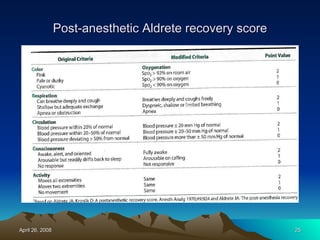
Post-anesthetic Aldrete recovery score
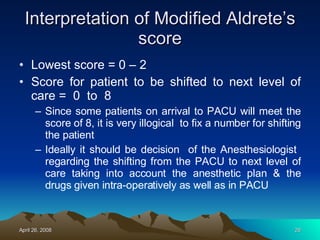
Interpretation of Modified Aldrete’s score Lowest score = 0 – 2 Score for patient to be shifted to next level of care =  0  to  8 Since some patients on arrival to PACU will meet the score of 8, it is very illogical  to fix a number for shifting the patient Ideally it should be decision  of the Anesthesiologist  regarding the shifting from the PACU to next level of care taking into account the anesthetic plan & the drugs given intra-operatively as well as in PACU
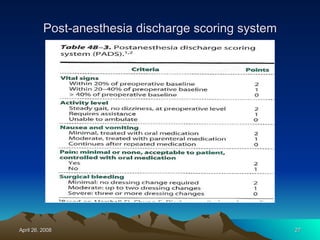
Post-anesthesia discharge scoring system
Safe guidelines for discharging  home after ambulatory surgery Patient should be able to stand & take a few steps ( sit on bed if C/ I for standing) Should be able to sip fluids Should be able to urinate Should be able to repeat  post-operative management Should be able to identify the escort (cognitive function)
Thank you

Post Anesthesia Care Unit

  • 1.
    POST ANAESTHESIA CAREUNIT (PACU) DR.SHAILENDRA.V.L. SPECIALIST IN ANAESTHESIA . AL BUKARIYA GENERAL HOSPITAL .
  • 2.
    Introduction Importanceof PACU Adequate preparedness Sudden complication
  • 3.
    History of PACU1947: Anaesthesia Study Commission report Experience of trauma management in 2nd World War Advances in Surgery in 50’s and 60’s Day care surgery concept of the 90s
  • 4.
    Design of PACULocation: Close to Operating Rooms Easy access to Lab, X-ray, Blood bank Close to ICU Size: Ideal 1.5 PACU bed for every OR 120 square foot per patient Minimum of 7 feet between beds
  • 5.
    Design of PACUFacilities: Fowler’s cot with side rails Piped Oxygen, Vacuum and Air Multiple electrical outlets Large doors Good lighting Isolation for Immuno-compromised patients
  • 6.
    Equipments in PACUTray with labeled Emergency drugs Airway maintenance kit: Laryngoscope with all size blades All sizes Endotracheal tubes Face masks, Airways, Ambu Bag, Venturi masks Tracheostomy set ICD set Transport ventilator
  • 7.
    Equipments in PACUPersonnel: Requirement varies 1 : 1 ratio good 1 : 3 ratio acceptable for busy OR’s Monitors: ECG Pulse oximeter Non invasive BP EtCO 2 Invasive pressure monitor Temperature
  • 8.
    Routine Post-Anaesthesia CareCriteria for shifting from OR---to---PACU Conscious, awake, responds to simple commands Haemo dynamic stability Clinical evaluation for NM blockade recovery Maintainance of Oxygen Saturation Normothermia
  • 9.
    Transportation to PACUFowler’s cot with side rails Patient handed over to PACU nurse by the Anaesthesiologist
  • 10.
    Care in PACUMonitoring : ECG, SpO 2 , Blood pressure Oxygen therapy Pain therapy, anti-emetics Blood Pressure recording: Every 5 minutes for 30 minutes Every 15 minutes for next 30 minutes
  • 11.
    Post Operative Complications Respiratory Complications: Airway obstruction Hypoxemia Increased Left to Right shunt
  • 12.
    Post Operative ComplicationsAirway Obstruction: Sagging tongue: Treated with triple maneuver Laryngeal Spasm: Due to secretions Due to irritable airways (smokers) Rx: 100% Oxygen through face mask Hydrocoritsone 100 mg IV If no improvement rapid intubation to secure the airway
  • 13.
    Post operative ComplicationsHypoxemia: Low FIO 2 : Diffusion hypoxemia (N 2 O 31 times more soluble than O 2 ) Hypoventilation: Inadequate N.M. blockade recovery Respiratory depressant effect of volatile agents, narcotics, benzodiazepines Hypocarbia intra operatively Upper abdominal incisions
  • 14.
    Post operative ComplicationsIncreased Right to Left Shunt: Atelectasis: Inadvertent endobroncial intubation Ateclectasis of the lung Increased Shunt ( R to L ) Blockage of Brochus by blood or mucous plug Pnemothorax: following rib injury following CVP placement
  • 15.
    Post operative ComplicationsCirculatory Complications: Hypotension: Decreased preload Decreased myocardial contractility Increased after load
  • 16.
    Post operative ComplicationsDecreased preload: Increased blood loss Increased III space loss Un diagnosed urinary loss Septicemia Decreased myocardial contractility: Depressant effect of GA drugs Pre-existing ventricular dysfunction Per operative Myocardial infarction Decreased After load: Volatile agents depression Septic shock Profound decreased SVR Septic shock Volatile agents effects
  • 17.
    Post operative ComplicationsHypertension: Pain Hypercapnia Hypothermia Hypoxemia Excess Intra vascular volume Pre-existing hypertension
  • 18.
    Post operative ComplicationsArrythmias: Electrolyte imbalance ( K ) Hypoxia Hypercarbia Metabolic acidosis
  • 19.
    Post operative ComplicationsPost-operative pain & agitation: Ascertain adequacy of Blood-Gas exchange Evaluate for any gastric or urinary distension Rx: small doses of narcotics.
  • 20.
    Post operative ComplicationsNausea & Vomiting: Frequently seen after lapraroscopic surgeries Strabismus surgeries Rx with Ondansetron 4mg IV adults / child 0.1mg/kg Metoclopromide 0.15mg/kg IV
  • 21.
    Post operative ComplicationsHypothermia & shivering: Air-conditioning : excessive cooling Cold IV fluids transfused Cold irrigating fluids used by the surgeon Halothane anaesthesia Rx by warm blankets Warm IV fluids Inj. Pethidine 10mg IV
  • 22.
    Discharge criteria from PACU “ Neither an arbitrary time limit nor a discharge score can be used to define a medically appropriate length stay in the recovery room accurately ”
  • 23.
    Discharge criteria fromPACU All patients must be evaluated by anesthesiologist prior to discharge from PACU Criteria for discharge developed by the Anesthesia department Criteria depends on where the patient is sent – ward, ICU, home
  • 24.
    Discharge criteria fromPACU Easy arousability Full orientation Ability to maintain & protect airway Stable vital signs for at least 15 – 30 minutes The ability to call for help if necessary No obvious surgical complication (active bleeding)
  • 25.
  • 26.
    Interpretation of ModifiedAldrete’s score Lowest score = 0 – 2 Score for patient to be shifted to next level of care = 0 to 8 Since some patients on arrival to PACU will meet the score of 8, it is very illogical to fix a number for shifting the patient Ideally it should be decision of the Anesthesiologist regarding the shifting from the PACU to next level of care taking into account the anesthetic plan & the drugs given intra-operatively as well as in PACU
  • 27.
  • 28.
    Safe guidelines fordischarging home after ambulatory surgery Patient should be able to stand & take a few steps ( sit on bed if C/ I for standing) Should be able to sip fluids Should be able to urinate Should be able to repeat post-operative management Should be able to identify the escort (cognitive function)
  • 29.