



1
 Introduction
 Problem of Existing system
 Key Features
 Advantage
 Propose System
 Process
 Hardware
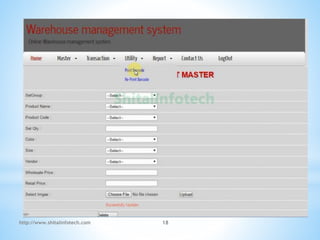
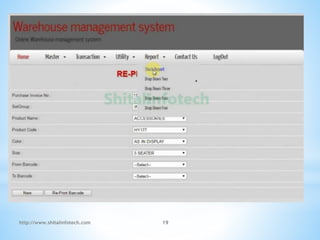
 Screen
 Video
http://www.shitalinfotech.com
 Manual Errors: manually-driven procedures in the Store cause a number
of higher level operational issues in the Store (like Inventory may show
in stock when in actuality there is an out-of-stock condition, and vice
versa.)
 Wrong identification of the items: Labels on shipments may be damaged
or illegible, causing a long delay in processing, and resulting in
congestion at the receiving dock or wrong dispatch/receipt.
 Poor utilization of costly Store space.
 Poor inventory visibility and accuracy which results into erroneous out-
of-stock conditions and lost sales.
 Manual Product counts results into higher labour costs.
 Locating the items: improper sorting, which results in the misplacement
of materials on the Store shelves & also time consuming.
 Reduced Customer Satisfaction: Mis-ships and other shipment delays
that ultimately impact customer service satisfaction and retention.
http://www.shitalinfotech.com 3
 Key part of the Inventory and primarily aims to control the movement and storage of
materials within a Store and process the associated transactions, including shipping,
receiving, put away and picking.
 The systems also direct and optimize stock put away based on real-time information
about the status of bin utilization. Store management systems often utilize Auto ID Data
Capture (AIDC) technology, such as barcode scanners, mobile computers, wireless
LANs and potentially Radio-frequency identification (RFID) to efficiently monitor the
flow of products.
 Once data has been collected, there is either batch synchronization with, or a real-time
wireless transmission to a central database. The database can then provide useful reports
about the status of goods in the Store.
 Inventory Management monitors the progress of products through the Store. It involves
the physical Store infrastructure, tracking systems, and communication between product
stations.
 Inventory management deals with receipt, storage and movement of goods, normally
finished goods, to intermediate storage locations or to final customer. In the multi-
echelon model for distribution, there are levels of Stores, starting with the Central
Warehouse(s), regional warehouses services by the central warehouses and retail
warehouses at the third level services by the regional warehouses and so on.
http://www.shitalinfotech.com 4
 Reduce Costs
 Increase Employee Productivity & efficiency.
 Valuable Data for Analysis
 Client-server based inventory management software with Barcode
enabled data capturing system.
 Complete visibility to management (from HO) on the inventory at factory
as well as depot.
 Paperless
 User friendly
 FIFO for Dispatch.
 100% accurate automatic data capturing facility in the dusty environment
inside the factory. Eliminates any change of manipulations thus gives an
accurate report online.
 Daily/Weekly/Monthly- Sales/Purchase/Profit
http://www.shitalinfotech.com 5
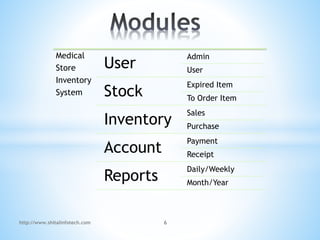
http://www.shitalinfotech.com 6
Medical
Store
Inventory
System
User
Admin
User
Stock
Expired Item
To Order Item
Inventory
Sales
Purchase
Account
Payment
Receipt
Reports
Daily/Weekly
Month/Year
http://www.shitalinfotech.com 7
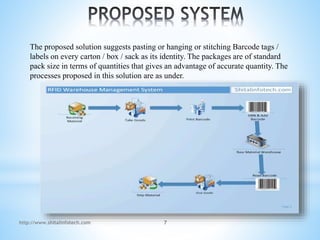
The proposed solution suggests pasting or hanging or stitching Barcode tags /
labels on every carton / box / sack as its identity. The packages are of standard
pack size in terms of quantities that gives an advantage of accurate quantity. The
processes proposed in this solution are as under.
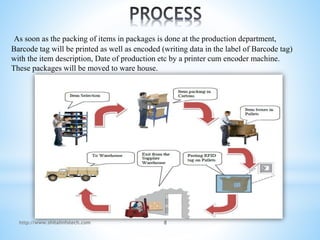
As soon as the packing of items in packages is done at the production department,
Barcode tag will be printed as well as encoded (writing data in the label of Barcode tag)
with the item description, Date of production etc by a printer cum encoder machine.
These packages will be moved to ware house.
http://www.shitalinfotech.com 8
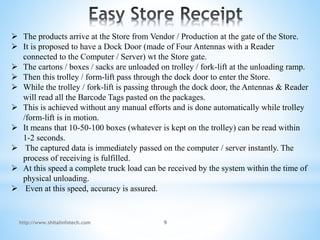
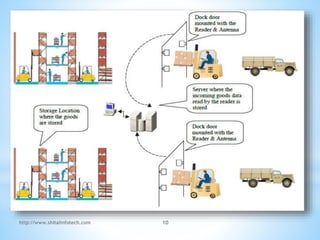
 The products arrive at the Store from Vendor / Production at the gate of the Store.
 It is proposed to have a Dock Door (made of Four Antennas with a Reader
connected to the Computer / Server) wt the Store gate.
 The cartons / boxes / sacks are unloaded on trolley / fork-lift at the unloading ramp.
 Then this trolley / form-lift pass through the dock door to enter the Store.
 While the trolley / fork-lift is passing through the dock door, the Antennas & Reader
will read all the Barcode Tags pasted on the packages.
 This is achieved without any manual efforts and is done automatically while trolley
/form-lift is in motion.
 It means that 10-50-100 boxes (whatever is kept on the trolley) can be read within
1-2 seconds.
 The captured data is immediately passed on the computer / server instantly. The
process of receiving is fulfilled.
 At this speed a complete truck load can be received by the system within the time of
physical unloading.
 Even at this speed, accuracy is assured.
http://www.shitalinfotech.com 9
http://www.shitalinfotech.com 10
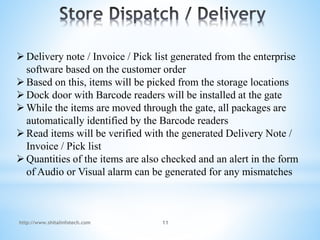
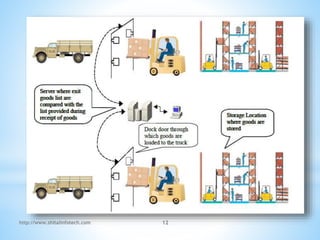
Delivery note / Invoice / Pick list generated from the enterprise
software based on the customer order
Based on this, items will be picked from the storage locations
Dock door with Barcode readers will be installed at the gate
While the items are moved through the gate, all packages are
automatically identified by the Barcode readers
Read items will be verified with the generated Delivery Note /
Invoice / Pick list
Quantities of the items are also checked and an alert in the form
of Audio or Visual alarm can be generated for any mismatches
http://www.shitalinfotech.com 11
http://www.shitalinfotech.com 12
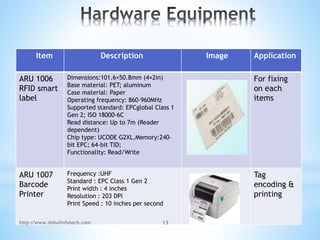
Item Description Image Application
ARU 1006
RFID smart
label
Dimensions:101.6×50.8mm (4×2in)
Base material: PET; aluminum
Case material: Paper
Operating frequency: 860-960MHz
Supported standard: EPCglobal Class 1
Gen 2; ISO 18000-6C
Read distance: Up to 7m (Reader
dependent)
Chip type: UCODE G2XL,Memory:240-
bit EPC; 64-bit TID;
Functionality: Read/Write
For fixing
on each
items
ARU 1007
Barcode
Printer
Frequency :UHF
Standard : EPC Class 1 Gen 2
Print width : 4 inches
Resolution : 203 DPI
Print Speed : 10 inches per second
Tag
encoding &
printing
http://www.shitalinfotech.com 13
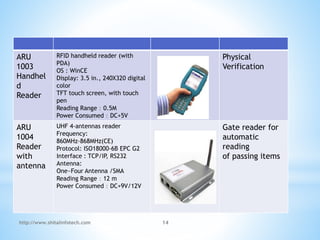
ARU
1003
Handhel
d
Reader
RFID handheld reader (with
PDA)
OS : WinCE
Display: 3.5 in., 240X320 digital
color
TFT touch screen, with touch
pen
Reading Range:0.5M
Power Consumed:DC+5V
Physical
Verification
ARU
1004
Reader
with
antenna
UHF 4-antennas reader
Frequency:
860MHz-868MHz(CE)
Protocol: ISO18000-6B EPC G2
Interface : TCP/IP, RS232
Antenna:
One~Four Antenna /SMA
Reading Range:12 m
Power Consumed:DC+9V/12V
Gate reader for
automatic
reading
of passing items
http://www.shitalinfotech.com 14
 Easy Fast and Accurate Store Receipt and Dispatch
 Accuracy of data input (error free)
 Aid effective management of resources and inventories
 Real time data collection
 Measurement of work in progress throughout the factory
 Rapid access to total production costs
 More accurate dispatch
 Accurate and efficient in data reading
 No queuing even during peak time
 No need of experienced hands to operate the machine
http://www.shitalinfotech.com 15
http://www.shitalinfotech.com 16
http://www.shitalinfotech.com 17
http://www.shitalinfotech.com 18
http://www.shitalinfotech.com 19
http://www.shitalinfotech.com 20
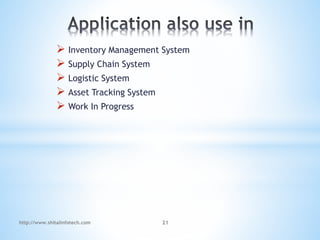
 Inventory Management System
 Supply Chain System
 Logistic System
 Asset Tracking System
 Work In Progress
http://www.shitalinfotech.com 21
http://www.shitalinfotech.com 22

Medical store inventory system using barcode

  • 1.
  • 2.
     Introduction  Problemof Existing system  Key Features  Advantage  Propose System  Process  Hardware  Screen  Video http://www.shitalinfotech.com
  • 3.
     Manual Errors:manually-driven procedures in the Store cause a number of higher level operational issues in the Store (like Inventory may show in stock when in actuality there is an out-of-stock condition, and vice versa.)  Wrong identification of the items: Labels on shipments may be damaged or illegible, causing a long delay in processing, and resulting in congestion at the receiving dock or wrong dispatch/receipt.  Poor utilization of costly Store space.  Poor inventory visibility and accuracy which results into erroneous out- of-stock conditions and lost sales.  Manual Product counts results into higher labour costs.  Locating the items: improper sorting, which results in the misplacement of materials on the Store shelves & also time consuming.  Reduced Customer Satisfaction: Mis-ships and other shipment delays that ultimately impact customer service satisfaction and retention. http://www.shitalinfotech.com 3
  • 4.
     Key partof the Inventory and primarily aims to control the movement and storage of materials within a Store and process the associated transactions, including shipping, receiving, put away and picking.  The systems also direct and optimize stock put away based on real-time information about the status of bin utilization. Store management systems often utilize Auto ID Data Capture (AIDC) technology, such as barcode scanners, mobile computers, wireless LANs and potentially Radio-frequency identification (RFID) to efficiently monitor the flow of products.  Once data has been collected, there is either batch synchronization with, or a real-time wireless transmission to a central database. The database can then provide useful reports about the status of goods in the Store.  Inventory Management monitors the progress of products through the Store. It involves the physical Store infrastructure, tracking systems, and communication between product stations.  Inventory management deals with receipt, storage and movement of goods, normally finished goods, to intermediate storage locations or to final customer. In the multi- echelon model for distribution, there are levels of Stores, starting with the Central Warehouse(s), regional warehouses services by the central warehouses and retail warehouses at the third level services by the regional warehouses and so on. http://www.shitalinfotech.com 4
  • 5.
     Reduce Costs Increase Employee Productivity & efficiency.  Valuable Data for Analysis  Client-server based inventory management software with Barcode enabled data capturing system.  Complete visibility to management (from HO) on the inventory at factory as well as depot.  Paperless  User friendly  FIFO for Dispatch.  100% accurate automatic data capturing facility in the dusty environment inside the factory. Eliminates any change of manipulations thus gives an accurate report online.  Daily/Weekly/Monthly- Sales/Purchase/Profit http://www.shitalinfotech.com 5
  • 6.
    http://www.shitalinfotech.com 6 Medical Store Inventory System User Admin User Stock Expired Item ToOrder Item Inventory Sales Purchase Account Payment Receipt Reports Daily/Weekly Month/Year
  • 7.
    http://www.shitalinfotech.com 7 The proposedsolution suggests pasting or hanging or stitching Barcode tags / labels on every carton / box / sack as its identity. The packages are of standard pack size in terms of quantities that gives an advantage of accurate quantity. The processes proposed in this solution are as under.
  • 8.
    As soon asthe packing of items in packages is done at the production department, Barcode tag will be printed as well as encoded (writing data in the label of Barcode tag) with the item description, Date of production etc by a printer cum encoder machine. These packages will be moved to ware house. http://www.shitalinfotech.com 8
  • 9.
     The productsarrive at the Store from Vendor / Production at the gate of the Store.  It is proposed to have a Dock Door (made of Four Antennas with a Reader connected to the Computer / Server) wt the Store gate.  The cartons / boxes / sacks are unloaded on trolley / fork-lift at the unloading ramp.  Then this trolley / form-lift pass through the dock door to enter the Store.  While the trolley / fork-lift is passing through the dock door, the Antennas & Reader will read all the Barcode Tags pasted on the packages.  This is achieved without any manual efforts and is done automatically while trolley /form-lift is in motion.  It means that 10-50-100 boxes (whatever is kept on the trolley) can be read within 1-2 seconds.  The captured data is immediately passed on the computer / server instantly. The process of receiving is fulfilled.  At this speed a complete truck load can be received by the system within the time of physical unloading.  Even at this speed, accuracy is assured. http://www.shitalinfotech.com 9
  • 10.
  • 11.
    Delivery note /Invoice / Pick list generated from the enterprise software based on the customer order Based on this, items will be picked from the storage locations Dock door with Barcode readers will be installed at the gate While the items are moved through the gate, all packages are automatically identified by the Barcode readers Read items will be verified with the generated Delivery Note / Invoice / Pick list Quantities of the items are also checked and an alert in the form of Audio or Visual alarm can be generated for any mismatches http://www.shitalinfotech.com 11
  • 12.
  • 13.
    Item Description ImageApplication ARU 1006 RFID smart label Dimensions:101.6×50.8mm (4×2in) Base material: PET; aluminum Case material: Paper Operating frequency: 860-960MHz Supported standard: EPCglobal Class 1 Gen 2; ISO 18000-6C Read distance: Up to 7m (Reader dependent) Chip type: UCODE G2XL,Memory:240- bit EPC; 64-bit TID; Functionality: Read/Write For fixing on each items ARU 1007 Barcode Printer Frequency :UHF Standard : EPC Class 1 Gen 2 Print width : 4 inches Resolution : 203 DPI Print Speed : 10 inches per second Tag encoding & printing http://www.shitalinfotech.com 13
  • 14.
    ARU 1003 Handhel d Reader RFID handheld reader(with PDA) OS : WinCE Display: 3.5 in., 240X320 digital color TFT touch screen, with touch pen Reading Range:0.5M Power Consumed:DC+5V Physical Verification ARU 1004 Reader with antenna UHF 4-antennas reader Frequency: 860MHz-868MHz(CE) Protocol: ISO18000-6B EPC G2 Interface : TCP/IP, RS232 Antenna: One~Four Antenna /SMA Reading Range:12 m Power Consumed:DC+9V/12V Gate reader for automatic reading of passing items http://www.shitalinfotech.com 14
  • 15.
     Easy Fastand Accurate Store Receipt and Dispatch  Accuracy of data input (error free)  Aid effective management of resources and inventories  Real time data collection  Measurement of work in progress throughout the factory  Rapid access to total production costs  More accurate dispatch  Accurate and efficient in data reading  No queuing even during peak time  No need of experienced hands to operate the machine http://www.shitalinfotech.com 15
  • 16.
  • 17.
  • 18.
  • 19.
  • 20.
  • 21.
     Inventory ManagementSystem  Supply Chain System  Logistic System  Asset Tracking System  Work In Progress http://www.shitalinfotech.com 21
  • 22.