
1
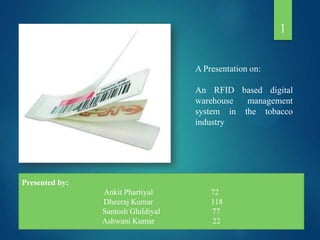
A Presentation on:
An RFID based digital
warehouse
management
system in the tobacco
industry

Presented by:

Ankit Phartiyal
Dheeraj Kumar
Santosh Ghildiyal
Ashwani Kumar

72
118
77
22
 Introduction:
•

2

Firstly, is the plane warehouse (Normal warehouse) that are without high racks
or automatic equipment (e.g. . Robotic arms, automated guided vehicles).

• Traditionally, in such a plane warehouse, the products are randomly placed
on the floor without pallets, and the operation performances mostly depend
on the operator’s memory and experiences, which results in more operation
time and mistakes.
•

So, with the increasing types of products and more and more complex
customer orders, the warehouse mangers have been facing a dramatic
challenge on changing the traditional mode of manual operation.

•

In a plane warehouse following are some significant problems faced by
managers :-

1. How to identify a storage/retrieval assignment strategy for fast moving
products?
2. How to help the operators to pick the products more rapidly and accurately
once the assignment decisions have been made?
3. How to improve the operational efficiency of the warehouse as customer
3
orders become more complex?
4. How to improve inventory visibility in the supply chain, so as to better
synchronise material and information flows and reduce inventory discrepancies?
•

RFID ( Radio frequency identification) based digital warehouse management
system (RFID- DWMS) to improve the warehouse operations have been
introduced

•

This system benefits from the advantages of RFID in data collection, such as
wireless object identification, multi-object identification and more storage
space

•

RFID allows objects to communicate
automatically without human intervention

•

RFID-DWMS design helps to improve the operations in a plane warehouse, by
integrating RFID, computer and wireless Communication technology

•

The proposed system enables a plane warehouse to achieve the functions of
automatic
storage
retrieval
management,
real
time
inventory
management, and accurate shelf management

information

about

themselves
 Literature review:

4

 Warehouse management –

• The main warehousing operations consist of inventory storage, order product
mixing, cross docking and customer service. The most important of them is
inventory management, including storage/retrieval management and
inventory control
•

Vast amount of literature focuses on the use of the warehouse management
which can be organised into the following two categories- optimal order
picking and modelling as a job shop scheduling problem

•

In the past decade, RFID has become popular in the fields of business and
industry, Particularly in the logistics and SCM domain
5
 Modules:

6

1- DWMS
1.1 Digital Shelf ManagerMonitor the inventory events in warehouse and
provide a platform for operators to manage the inventory visually.
1.2 Reader Adapter• It enhance the flexibility of DWMS.
• Performs as a bridge between DWMS and RFID readers.
• It specifies a virtualised API (Application Programming
Interface)

7

1.3 Storage/ Retrieval Manager-

Digital Pallet Packing- Helps the operators to gather the barcodes of
palletising products and write these barcodes into the corresponding
pallet tag with an RFID reader.
S/R Assignment Engine- Designed to improve S/R assignment.
Its actions are based on a set of basic S/R rules, which are predefined
and stored in ECA rule base.
If assignment decision is made the S/R assignment engine will lock the
shelves and generate relevant commands for despatching to FGS.
1.4 Event Processor Manager8
The input events are accepted in the event
buffer, and then move through the series of components with specific
functions including decomposition, grouping, filtering and complex
event processing.
2. Forklift Guided System (FGS)
FGS is installed on Forklift.

Guide the forklift driver
to the operation
location

Cache the series of
commands.

9
3. Back End Module

Recognise specific
situation and react
to them without
user intervention.
It enable a system
to have
autonomous
response to an
event.

10

Contain all the
basic rules in
ECA forms.
ECA rules are
well establishes
in active
database.
User can
add, modify
and delete
rules in the
rulebase.
 Storage/Retrieval Rules:

11

 For the benefits of,
reduced picking travel time
less congestion
enhanced space utilization

For different requirements in practice, the storage rules must be
accordingly various
Here is given 10 most common rules used in practice
1. Random
Any available digital shelf is equally likely to be an
assignment

12
2. Closest
An available digital shelf, closer to I/O point, has the higher
priority to be assigned, regardless of its velocity

3. Velocity
Similar to the “closest” rule, it considers the velocity of
turnover

4. Weight
The heavier goods should be placed on the lower digital shelf
on the racks

13
5. Comparability
Similar products should be placed separately to avoid
mistakes

6. Identity
The same products should be placed together for convenient
to manage inventory

7. Balance
Distribute velocity across zones as evenly as possible for
reduction of congestion

14
8. Shape
An item with a special shape should be placed in a special
space to enhance the space utilization

9. FIFO
The first unit into inventory will be delivered first

10. LIFO
Contrary to FIFO, the first unit into inventory will be delivered
last

15
 Warehouse process analysis

16

Problems • In a typical flow of a warehouse operation, when new products are
received, an operator makes a storage assignment decision depending on his
memory and experience, and folk carriers carry them to the appointed place
•

When a delivering task arrives, an operator makes a retrieval assignment
decision depending on his memory and experience. Then, folk carriers carry
these products to the delivering space

•

At the exit, two operators take charge of scanning the corresponding
barcode one by one when the products pass through the door
Optimal solution –

17

•

There may be some mistakes happening when scanning so, there is a need
for one person to stay at the front of the computer, so as to monitor the results
and make sure that the obtained barcode information is correct

•

Every day after all operations are finished, the operators should make an
inventory of the products in the warehouse by manual checking

•

So, after the process analysis researcher identified some of the core business
processes that could be improved –
1. Storage process
2. Delivering process
3. Scanning barcode process
4. And, inventory management process
18

Requirements analysis –
Requirements for RFID-DWMS.
Stakeholders

Requirements for RFID-DWMS

• Warehouse manager

-Using racks to increase warehouse capacity
-Using RFID tag to store the barcode information and
improve operation procedure
- To maintain operator records
-Provide a visual view of the entire warehouse inventory
information
-Record the inventory in and out situations
-Provide inventory reports

• Warehouse operators

-Provide an automatic decision for storage/retrieval
assignment
- Provide a guide map for storage/retrieval operations
- Provide a reminder and alert of the inaccurate
operations
Warehouse layout design

19
Receiving Space

20

•Products to be stored are palletised onto digital pallets
•Tag writing & data collection is done by Barcode Scanner & RFID reader
simultaneously

Shipping Space ( Info of Delivered Products)
•Designed for delivery operations
•UHF RFID Reader 2 scannes product in real time when Forklift passes at certain
distance.
•Forklift has touch screen computer installed FGS.

Temporary Storage Space
•Consists of Database server
-Specific databases like inventory information, human resources,
storage/retrieval rules and RFID information.
 System design

21

RFID-DWMS architecture, divide system into six subsystems based on
functionality:
• Human resources subsystem

• Stock in subsystem
• Stock out subsystem,
• Digital shelf management subsystem
• Forklift guided subsystem
• Rules management subsystem
Stock in subsystem

22

This subsystem has four main functions.
1. Provides an automatic storage assignment function for the incoming
products.
Storage assignment decisions depends on the storage rules specified in
the rule base.
2. Operators can use this subsystem to generate the corresponding
storage commands,
And dispatch to the forklift guided subsystem for drivers to execute
them.
3. Helps the operator to compress the corresponding barcodes into a new
data format, and drives the reader to write it into the RFID tags

4. Finally, after it receives the confirmation from FGS, (e.g., inventory
information, commands status or shelves status) is updated by this
subsystem.
Human resources management subsystem

23

Maintain the operator record information, including personal
information, training arrangement, checking attendance and appraisal
evaluation.

Stock out subsystem
•Designed for stock out procedures.
•Helps to generate the retrieval commands, dispatches them to
FGS and updates then information.
•When the RFID scanner detects the transported digital pallets, this
subsystem also helps to decompress the barcodes from the RFID tags.

Digital shelf management subsystem
• Visual view of the entire warehouse inventory
• Provide a precise inventory statistical report
• The report contains the beginning inventory data, store in and out
quantities, specifications of products
• Provides a shelf adjustment function to assist monitoring the racks
situation.
24
Forklift guided subsystem
•A touch screen computer is fixed with forklift for executing commands
•Provides a guide map to assist in executing the operation commands
•Communicate with other subsystems via a wireless network, including receiving
commands, returning command status, updating inventory information

Rules Management Subsystem
•Designed to provide a rules maintenance platform for users to add, modify
and delete rules in the rulebase.
 System Implementation :

Barcode 1
Barcode 2
Barcode 3
.
.
.
.
Barcode N

Common
data

+

Serial num 1
Serial num 2
Serial num 3
.
.
.
.
Serial num N

Exist 3 potential problems :
Compressing the barcode data ?
Procedures of storage ?
Procedures of retrievals ?

25

+Checksum

Compress
Barcode set
1. Compressing Barcodes :

26

Capacity of digital pallet = 30 boxes
Barcode data of each box = 32 digit number
19 digits
A common
number, which has :
Company name
Production area, date
and specification

+

13 digits
A serial number to
identify each box
uniquely

In order to save storage space of RFID tag and enhance communication
efficiency, the barcodes are compressed in to “Barcode-set” as
“common data + SN 1+SN 2 + SN 3 +….+SN N+ checksum”
** cheksum is a certain no. of check bits, determines agreement with the
barcode data
2. The innovative procedures of storage operations :

27

** Year in 2004
3. The innovative procedures of retrieval operations :

28

Separate, If it
needs to deliver
only part of it, not
whole pallet
** Year in 2004
 Performance with and without RFID-DWMS :

29
By implementing RFID-DWMS, operating performance of distribution
centre has improved by following points• Inventory visualised management
• Automatic storage/ retrieval assignment
• Forklift automated guided
• Loading time is reduced

Capacity of warehouse- Increased by 52.5 %
Manpower- Reduced by half
Loading Time- Reduced by 64%
Loading Ratio- Dropped to 60%
Inventory Accuracy- increased to 99%
 Comparison of Inventory Accuracy :

Reasons• Storage/ Retrieval
assignment was based on
operators memory and
experience
• Similar appearance of
the products

30

Reason• Transaction errors were mostly
generated by misreading of
RFID readers
31

Thanks…

RFID

  • 1.
    1 A Presentation on: AnRFID based digital warehouse management system in the tobacco industry Presented by: Ankit Phartiyal Dheeraj Kumar Santosh Ghildiyal Ashwani Kumar 72 118 77 22
  • 2.
     Introduction: • 2 Firstly, isthe plane warehouse (Normal warehouse) that are without high racks or automatic equipment (e.g. . Robotic arms, automated guided vehicles). • Traditionally, in such a plane warehouse, the products are randomly placed on the floor without pallets, and the operation performances mostly depend on the operator’s memory and experiences, which results in more operation time and mistakes. • So, with the increasing types of products and more and more complex customer orders, the warehouse mangers have been facing a dramatic challenge on changing the traditional mode of manual operation. • In a plane warehouse following are some significant problems faced by managers :- 1. How to identify a storage/retrieval assignment strategy for fast moving products? 2. How to help the operators to pick the products more rapidly and accurately once the assignment decisions have been made?
  • 3.
    3. How toimprove the operational efficiency of the warehouse as customer 3 orders become more complex? 4. How to improve inventory visibility in the supply chain, so as to better synchronise material and information flows and reduce inventory discrepancies? • RFID ( Radio frequency identification) based digital warehouse management system (RFID- DWMS) to improve the warehouse operations have been introduced • This system benefits from the advantages of RFID in data collection, such as wireless object identification, multi-object identification and more storage space • RFID allows objects to communicate automatically without human intervention • RFID-DWMS design helps to improve the operations in a plane warehouse, by integrating RFID, computer and wireless Communication technology • The proposed system enables a plane warehouse to achieve the functions of automatic storage retrieval management, real time inventory management, and accurate shelf management information about themselves
  • 4.
     Literature review: 4 Warehouse management – • The main warehousing operations consist of inventory storage, order product mixing, cross docking and customer service. The most important of them is inventory management, including storage/retrieval management and inventory control • Vast amount of literature focuses on the use of the warehouse management which can be organised into the following two categories- optimal order picking and modelling as a job shop scheduling problem • In the past decade, RFID has become popular in the fields of business and industry, Particularly in the logistics and SCM domain
  • 5.
  • 6.
     Modules: 6 1- DWMS 1.1Digital Shelf ManagerMonitor the inventory events in warehouse and provide a platform for operators to manage the inventory visually.
  • 7.
    1.2 Reader Adapter•It enhance the flexibility of DWMS. • Performs as a bridge between DWMS and RFID readers. • It specifies a virtualised API (Application Programming Interface) 7 1.3 Storage/ Retrieval Manager- Digital Pallet Packing- Helps the operators to gather the barcodes of palletising products and write these barcodes into the corresponding pallet tag with an RFID reader. S/R Assignment Engine- Designed to improve S/R assignment. Its actions are based on a set of basic S/R rules, which are predefined and stored in ECA rule base. If assignment decision is made the S/R assignment engine will lock the shelves and generate relevant commands for despatching to FGS.
  • 8.
    1.4 Event ProcessorManager8 The input events are accepted in the event buffer, and then move through the series of components with specific functions including decomposition, grouping, filtering and complex event processing.
  • 9.
    2. Forklift GuidedSystem (FGS) FGS is installed on Forklift. Guide the forklift driver to the operation location Cache the series of commands. 9
  • 10.
    3. Back EndModule Recognise specific situation and react to them without user intervention. It enable a system to have autonomous response to an event. 10 Contain all the basic rules in ECA forms. ECA rules are well establishes in active database. User can add, modify and delete rules in the rulebase.
  • 11.
     Storage/Retrieval Rules: 11 For the benefits of, reduced picking travel time less congestion enhanced space utilization For different requirements in practice, the storage rules must be accordingly various Here is given 10 most common rules used in practice
  • 12.
    1. Random Any availabledigital shelf is equally likely to be an assignment 12
  • 13.
    2. Closest An availabledigital shelf, closer to I/O point, has the higher priority to be assigned, regardless of its velocity 3. Velocity Similar to the “closest” rule, it considers the velocity of turnover 4. Weight The heavier goods should be placed on the lower digital shelf on the racks 13
  • 14.
    5. Comparability Similar productsshould be placed separately to avoid mistakes 6. Identity The same products should be placed together for convenient to manage inventory 7. Balance Distribute velocity across zones as evenly as possible for reduction of congestion 14
  • 15.
    8. Shape An itemwith a special shape should be placed in a special space to enhance the space utilization 9. FIFO The first unit into inventory will be delivered first 10. LIFO Contrary to FIFO, the first unit into inventory will be delivered last 15
  • 16.
     Warehouse processanalysis 16 Problems • In a typical flow of a warehouse operation, when new products are received, an operator makes a storage assignment decision depending on his memory and experience, and folk carriers carry them to the appointed place • When a delivering task arrives, an operator makes a retrieval assignment decision depending on his memory and experience. Then, folk carriers carry these products to the delivering space • At the exit, two operators take charge of scanning the corresponding barcode one by one when the products pass through the door
  • 17.
    Optimal solution – 17 • Theremay be some mistakes happening when scanning so, there is a need for one person to stay at the front of the computer, so as to monitor the results and make sure that the obtained barcode information is correct • Every day after all operations are finished, the operators should make an inventory of the products in the warehouse by manual checking • So, after the process analysis researcher identified some of the core business processes that could be improved – 1. Storage process 2. Delivering process 3. Scanning barcode process 4. And, inventory management process
  • 18.
    18 Requirements analysis – Requirementsfor RFID-DWMS. Stakeholders Requirements for RFID-DWMS • Warehouse manager -Using racks to increase warehouse capacity -Using RFID tag to store the barcode information and improve operation procedure - To maintain operator records -Provide a visual view of the entire warehouse inventory information -Record the inventory in and out situations -Provide inventory reports • Warehouse operators -Provide an automatic decision for storage/retrieval assignment - Provide a guide map for storage/retrieval operations - Provide a reminder and alert of the inaccurate operations
  • 19.
  • 20.
    Receiving Space 20 •Products tobe stored are palletised onto digital pallets •Tag writing & data collection is done by Barcode Scanner & RFID reader simultaneously Shipping Space ( Info of Delivered Products) •Designed for delivery operations •UHF RFID Reader 2 scannes product in real time when Forklift passes at certain distance. •Forklift has touch screen computer installed FGS. Temporary Storage Space •Consists of Database server -Specific databases like inventory information, human resources, storage/retrieval rules and RFID information.
  • 21.
     System design 21 RFID-DWMSarchitecture, divide system into six subsystems based on functionality: • Human resources subsystem • Stock in subsystem • Stock out subsystem, • Digital shelf management subsystem • Forklift guided subsystem • Rules management subsystem
  • 22.
    Stock in subsystem 22 Thissubsystem has four main functions. 1. Provides an automatic storage assignment function for the incoming products. Storage assignment decisions depends on the storage rules specified in the rule base. 2. Operators can use this subsystem to generate the corresponding storage commands, And dispatch to the forklift guided subsystem for drivers to execute them. 3. Helps the operator to compress the corresponding barcodes into a new data format, and drives the reader to write it into the RFID tags 4. Finally, after it receives the confirmation from FGS, (e.g., inventory information, commands status or shelves status) is updated by this subsystem.
  • 23.
    Human resources managementsubsystem 23 Maintain the operator record information, including personal information, training arrangement, checking attendance and appraisal evaluation. Stock out subsystem •Designed for stock out procedures. •Helps to generate the retrieval commands, dispatches them to FGS and updates then information. •When the RFID scanner detects the transported digital pallets, this subsystem also helps to decompress the barcodes from the RFID tags. Digital shelf management subsystem • Visual view of the entire warehouse inventory • Provide a precise inventory statistical report • The report contains the beginning inventory data, store in and out quantities, specifications of products • Provides a shelf adjustment function to assist monitoring the racks situation.
  • 24.
    24 Forklift guided subsystem •Atouch screen computer is fixed with forklift for executing commands •Provides a guide map to assist in executing the operation commands •Communicate with other subsystems via a wireless network, including receiving commands, returning command status, updating inventory information Rules Management Subsystem •Designed to provide a rules maintenance platform for users to add, modify and delete rules in the rulebase.
  • 25.
     System Implementation: Barcode 1 Barcode 2 Barcode 3 . . . . Barcode N Common data + Serial num 1 Serial num 2 Serial num 3 . . . . Serial num N Exist 3 potential problems : Compressing the barcode data ? Procedures of storage ? Procedures of retrievals ? 25 +Checksum Compress Barcode set
  • 26.
    1. Compressing Barcodes: 26 Capacity of digital pallet = 30 boxes Barcode data of each box = 32 digit number 19 digits A common number, which has : Company name Production area, date and specification + 13 digits A serial number to identify each box uniquely In order to save storage space of RFID tag and enhance communication efficiency, the barcodes are compressed in to “Barcode-set” as “common data + SN 1+SN 2 + SN 3 +….+SN N+ checksum” ** cheksum is a certain no. of check bits, determines agreement with the barcode data
  • 27.
    2. The innovativeprocedures of storage operations : 27 ** Year in 2004
  • 28.
    3. The innovativeprocedures of retrieval operations : 28 Separate, If it needs to deliver only part of it, not whole pallet ** Year in 2004
  • 29.
     Performance withand without RFID-DWMS : 29 By implementing RFID-DWMS, operating performance of distribution centre has improved by following points• Inventory visualised management • Automatic storage/ retrieval assignment • Forklift automated guided • Loading time is reduced Capacity of warehouse- Increased by 52.5 % Manpower- Reduced by half Loading Time- Reduced by 64% Loading Ratio- Dropped to 60% Inventory Accuracy- increased to 99%
  • 30.
     Comparison ofInventory Accuracy : Reasons• Storage/ Retrieval assignment was based on operators memory and experience • Similar appearance of the products 30 Reason• Transaction errors were mostly generated by misreading of RFID readers
  • 31.