End-to-End EPC RFID Solutions: Making It Play . . . And Pay George Reynolds Vice President, RFID Tyco Fire & Security
Discussion Topics Company overview EPC pilots A closer look at several deployments  Critical next steps
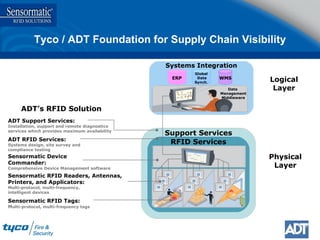
Tyco / ADT Foundation for Supply Chain Visibility Logical Layer Physical Layer ADT’s RFID Solution ADT Support Services: Installation, support and remote diagnostics services which provides maximum availability ADT RFID Services:   Systems design, site survey and compliance testing Sensormatic RFID Readers, Antennas, Printers, and Applicators: Multi-protocol, multi-frequency, intelligent devices  Sensormatic RFID Tags:  M ulti-protocol, multi-frequency tags Sensormatic Device  Commander:  Comprehensive Device Management software RFID Services Support Services Global  Data Synch. WMS ERP Systems Integration Data  Management Middleware
Depth of Experience 22 years  of RFID history Eureka – first RFID product to show anti-collision (1980) Charter member of Auto-ID Center Atlanta Olympic Games (1996) EAS Experience Tagging and Tracking 80,000 UHF  systems deployed  and over 1 million  antennas installed 10 billion chip-based UHF  labels made and sold  at ten cent ASP 4.0 billion items  tagged at point of manufacturer  in FY04 with MOQ of $210 15,000 items  certified for tag design, automated placement, performance Source-tagged  items from 3,500 manufacturers sold at 25,000 retail outlets Note:  the technology / application is different, but the expertise required for label placement and antenna calibration is similar.
Service Portfolio Lab & Design Services Site Solutions Compliance Testing Unique RFID Physical Applications Custom antenna and label design Support and Maintenance Deployment Services Limited “Launch” solutions Source Tagging  Large scale, programmatic roll-outs Everything in between Site Surveys (e.g., noise, physical constraints) Requirements analysis (e.g., read points, work flows, volumes, integration needs) Solution design High availability architecture Remote monitoring and management On-site technical support
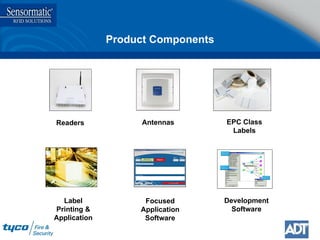
Product Components Antennas Focused Application Software Development Software Readers EPC Class Labels Label Printing & Application
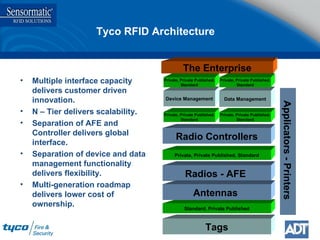
Tyco RFID Architecture Multiple interface capacity delivers customer driven innovation. N – Tier delivers scalability. Separation of AFE and Controller delivers global interface.  Separation of device and data management functionality delivers flexibility. Multi-generation roadmap delivers lower cost of ownership. Radios - AFE  Radio Controllers Device Management Data Management Tags Standard, Private Published Private, Private Published, Standard Private, Private Published, Standard The Enterprise Private, Private Published, Standard Private, Private Published, Standard Private, Private Published, Standard Antennas  Applicators - Printers
Discussion Topics Company overview EPC pilots A closer look at several deployments  Critical next steps
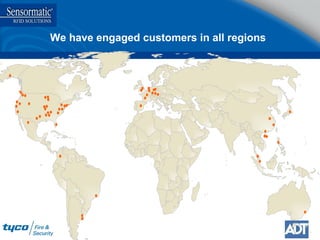
We have engaged customers in all regions
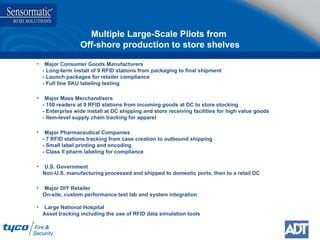
Multiple Large-Scale Pilots from  Off-shore production to store shelves Major Consumer Goods Manufacturers - Long-term install of 9 RFID stations from packaging to final shipment - Launch packages for retailer compliance - Full line SKU labeling testing Major Mass Merchandisers - 150 readers at 9 RFID stations from incoming goods at DC to store stocking - Enterprise wide install at DC shipping and store receiving facilities for high value goods - Item-level supply chain tracking for apparel Major Pharmaceutical Companies - 7 RFID stations tracking from case creation to outbound shipping - Small label printing and encoding - Class II pharm labeling for compliance U.S. Government Non-U.S. manufacturing processed and shipped to domestic ports, then to a retail DC Major DIY Retailer On-site, custom performance test lab and system integration  Large National Hospital  Asset tracking including the use of RFID data simulation tools
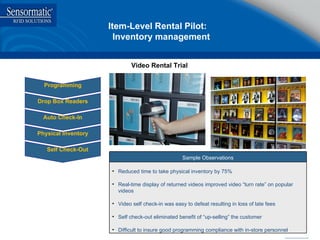
Item-Level Rental Pilot:   Inventory management Video Rental Trial Programming Drop Box Readers Physical Inventory Self Check-Out Auto Check-In Sample Observations Reduced time to take physical inventory by 75% Real-time display of returned videos improved video “turn rate” on popular videos Video self check-in was easy to defeat resulting in loss of late fees Self check-out eliminated benefit of “up-selling” the customer Difficult to insure good programming compliance with in-store personnel
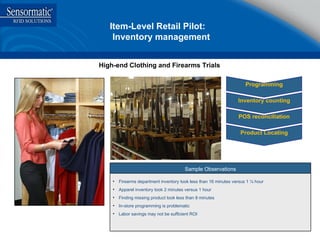
Item-Level Retail Pilot:   Inventory management High-end Clothing and Firearms Trials Programming Inventory counting Product Locating POS reconciliation Sample Observations Firearms department inventory took less than 16 minutes versus 1 ¼ hour Apparel inventory took 2 minutes versus 1 hour Finding missing product took less than 8 minutes  In-store programming is problematic Labor savings may not be sufficient ROI
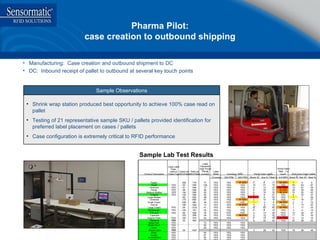
Pharma Pilot: case creation to outbound shipping Manufacturing:  Case creation and outbound shipment to DC DC:  Inbound receipt of pallet to outbound at several key touch points  Sample Lab Test Results Sample Observations Shrink wrap station produced best opportunity to achieve 100% case read on pallet Testing of 21 representative sample SKU / pallets provided identification for preferred label placement on cases / pallets Case configuration is extremely critical to RFID performance Product Description Case Label  Pass  without  Pallet Tag  Cases per  SKU/Pallet Tests per  SKU/Pallet Label  Placement  High Power  Range  (inches) 3 Label  Write Portal Pallet  Tags - 1 or  more 2 12 inches 200 FPM 400 FPM Worst % Ave % Best % 4-8 MPH Worst % Ave % Best % Plastic 308 719 77 YES YES 97.22% 3 6 6 6 11 6 92.59% 1 4 9 Drops YES 60 548 108 YES YES YES 15 41 75 YES 40 63 97 Ointment YES 91 548 77 YES YES YES 4 13 27 81.48% 10 27 39 Packs YES 96 548 84 YES YES YES 9 20 37 92.59% 25 39 58 Medium Bottles YES 144 548 82 YES YES YES 9 16 32 96.30% 15 32 43 Softgels YES 126 548 62 YES YES YES 6 8 21 YES 6 23 37 Large Bottles 80 836 68 YES YES YES 0 6 20 YES 1 2 26 Ointment 175 692 81 YES YES 97.22% 5 10 18 YES 11 19 27 Small Cream 238 980 54 YES YES 5 YES 5 1 4 8 96.30% 2 5 10 Test kit 180 548 73 YES YES 95.80% 4 6 13 YES 7 14 25 Large Cream YES 95 1232 61 YES YES YES 16 6 28 6 36 6 92.59% 7 17 25 Mouthwash YES 126 791 52 YES YES YES 4 6 8 6 12 6 YES 2 9 18 Anti-acid YES 90 908 76 YES YES 5 YES 5 4 13 29 YES 12 25 47 Capsules 120 908 54 YES YES 98.61% 3 10 22 YES 11 18 30 Hygene Pads YES 100 575 53 YES YES YES 4 6 12 6 18 6 77.78% 5 10 16 Medicine YES 52 854 6 22 42 YES 23 28 53 Spray Can YES 74 YES YES YES Blister Pack YES 60 YES YES YES Lotion YES 94 YES YES YES Mixed cases YES 50 1007 3 29 54 YES 18 39 48 Soda YES 46 YES YES YES Cereal YES 67 YES YES YES Small Bottles YES 60 YES YES YES Papers YES 76 YES YES YES Dock Door Case Labels 1 Conveyor 100% 4 Portal Case Labels 1
Discussion Topics Company overview EPC pilots A closer look at several deployments  Critical next steps
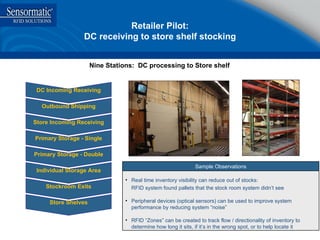
Retailer Pilot: DC receiving to store shelf stocking DC Incoming Receiving Outbound Shipping Primary Storage - Single Primary Storage - Double Individual Storage Area Store Incoming Receiving Stockroom Exits Store Shelves Nine Stations:  DC processing to Store shelf Sample Observations Real time inventory visibility can reduce out of stocks: RFID system found pallets that the stock room system didn’t see  Peripheral devices (optical sensors) can be used to improve system performance by reducing system “noise”  RFID “Zones” can be created to track flow / directionality of inventory to determine how long it sits, if it’s in the wrong spot, or to help locate it
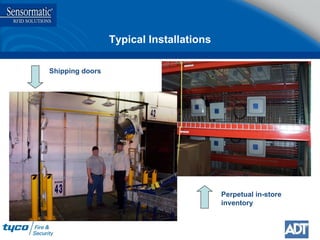
Typical Installations Shipping doors Perpetual in-store inventory
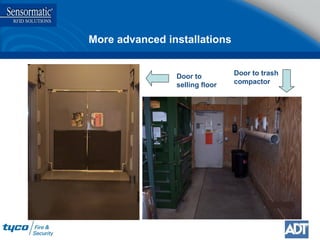
More advanced installations Door to trash compactor Door to selling floor
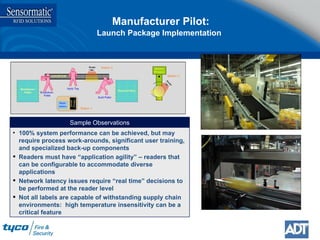
Manufacturer Pilot: Launch Package Implementation   Sample Observations 100% system performance can be achieved, but may require process work-arounds, significant user training, and specialized back-up components Readers must have “application agility” – readers that can be configurable to accommodate diverse applications Network latency issues require “real time” decisions to be performed at the reader level  Not all labels are capable of withstanding supply chain environments:  high temperature insensitivity can be a critical feature
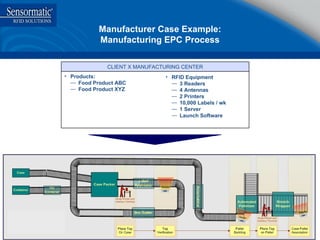
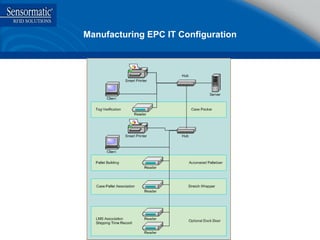
Manufacturer Case Example: Manufacturing EPC Process CLIENT X MANUFACTURING CENTER Products: Food Product ABC Food Product XYZ RFID Equipment 3 Readers 4 Antennas 2 Printers 10,000 Labels / wk 1 Server Launch Software
Manufacturing EPC IT Configuration
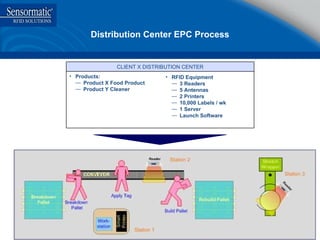
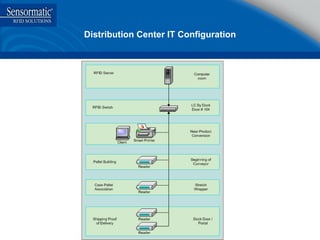
Distribution Center EPC Process CLIENT X DISTRIBUTION CENTER Products: Product X Food Product Product Y Cleaner RFID Equipment 3 Readers 5 Antennas 2 Printers 10,000 Labels / wk 1 Server Launch Software
Distribution Center IT Configuration 1
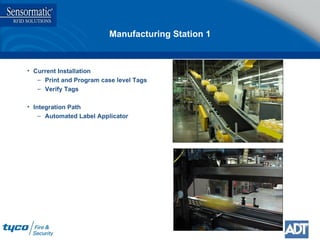
Manufacturing Station 1 Current Installation Print and Program case level Tags Verify Tags Integration Path Automated Label Applicator
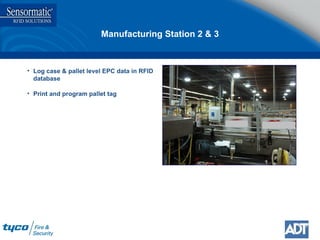
Log case & pallet level EPC data in RFID database Print and program pallet tag Manufacturing Station 2 & 3
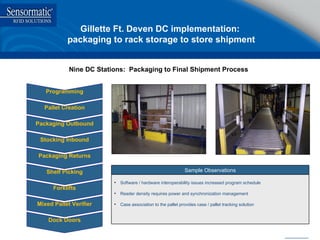
Gillette Ft. Deven DC implementation:  packaging to rack storage to store shipment Nine DC Stations:  Packaging to Final Shipment Process  Programming Pallet Creation Stocking Inbound Packaging Returns Shelf Picking Packaging Outbound Forklifts Mixed Pallet Verifier Dock Doors Sample Observations Software / hardware interoperability issues increased program schedule Reader density requires power and synchronization management Case association to the pallet provides case / pallet tracking solution
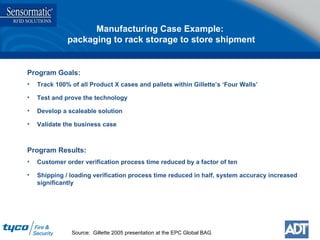
Program Goals: Track 100% of all Product X cases and pallets within Gillette’s ‘Four Walls’ Test and prove the technology Develop a scaleable solution Validate the business case Program Results: Customer order verification process time reduced by a factor of ten Shipping / loading verification process time reduced in half, system accuracy increased significantly Manufacturing Case Example:  packaging to rack storage to store shipment Source:  Gillette 2005 presentation at the EPC Global BAG
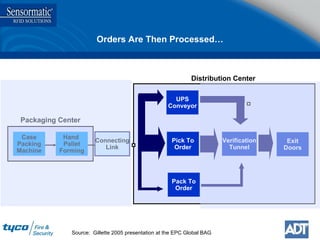
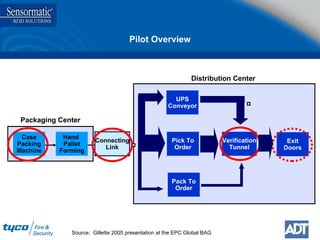
Pilot Overview UPS Conveyor Exit Doors Pack To Order Packaging Center Distribution Center Verification Tunnel Case Packing Machine Connecting Link Pick To Order Hand  Pallet Forming Source:  Gillette 2005 presentation at the EPC Global BAG
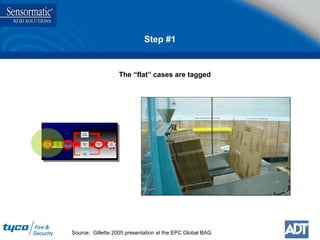
Step #1 Source:  Gillette 2005 presentation at the EPC Global BAG The “flat” cases are tagged UPS Conveyor Exit Doors Pack To Order Packaging Center Distribution Center Verification Tunnel Case Packing Machine Connecting Link Pick To Order Hand  Pallet Forming
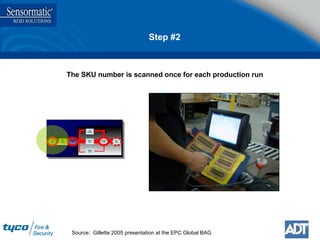
Step #2 Source:  Gillette 2005 presentation at the EPC Global BAG The SKU number is scanned once for each production run UPS Conveyor Exit Doors Pack To Order Packaging Center Distribution Center Verification Tunnel Case Packing Machine Connecting Link Pick To Order Hand  Pallet Forming
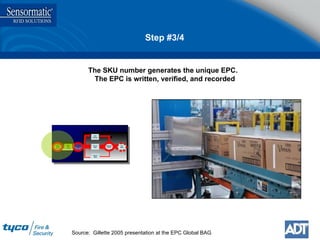
Step #3/4 Source:  Gillette 2005 presentation at the EPC Global BAG The SKU number generates the unique EPC.  The EPC is written, verified, and recorded UPS Conveyor Exit Doors Pack To Order Packaging Center Distribution Center Verification Tunnel Case Packing Machine Connecting Link Pick To Order Hand  Pallet Forming
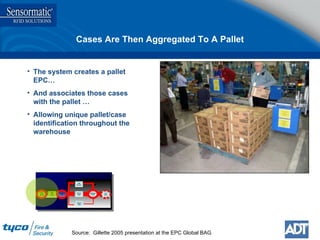
Cases Are Then Aggregated To A Pallet The system creates a pallet EPC… And associates those cases with the pallet … Allowing unique pallet/case identification throughout the warehouse Source:  Gillette 2005 presentation at the EPC Global BAG UPS Conveyor Exit Doors Pack To Order Packaging Center Distribution Center Verification Tunnel Case Packing Machine Connecting Link Pick To Order Hand  Pallet Forming
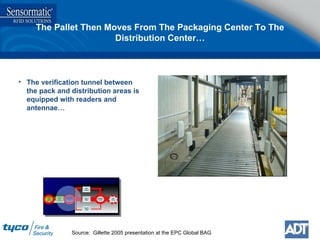
The Pallet Then Moves From The Packaging Center To The Distribution Center… The verification tunnel between the pack and distribution areas is equipped with readers and antennae… Source:  Gillette 2005 presentation at the EPC Global BAG UPS Conveyor Exit Doors Pack To Order Packaging Center Distribution Center Verification Tunnel Case Packing Machine Connecting Link Pick To Order Hand  Pallet Forming
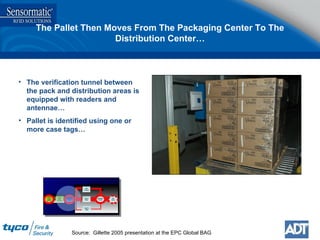
The Pallet Then Moves From The Packaging Center To The Distribution Center… The verification tunnel between the pack and distribution areas is equipped with readers and antennae… Pallet is identified using one or more case tags… Source:  Gillette 2005 presentation at the EPC Global BAG UPS Conveyor Exit Doors Pack To Order Packaging Center Distribution Center Verification Tunnel Case Packing Machine Connecting Link Pick To Order Hand  Pallet Forming
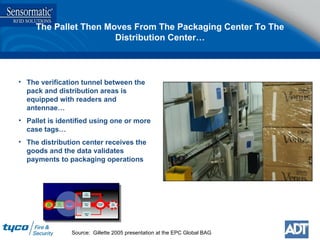
The Pallet Then Moves From The Packaging Center To The Distribution Center… The verification tunnel between the pack and distribution areas is equipped with readers and antennae… Pallet is identified using one or more case tags… The distribution center receives the goods and the data validates payments to packaging operations Source:  Gillette 2005 presentation at the EPC Global BAG UPS Conveyor Exit Doors Pack To Order Packaging Center Distribution Center Verification Tunnel Case Packing Machine Connecting Link Pick To Order Hand  Pallet Forming
Comparing The Old Process To The New Process Reveals Significant Benefits… Current Receiving Process Five Scans Three keyboard entries 20 Seconds  Per Pallet Read container barcode for Part # & Quantity Enter Part # & Quantity Scan Unit of Measure Barcode Scan Reason Barcode Tab to Lot Code Field Scan Lot Code Barcode Scan Pallet ID from TIN Scan Bill of Lading Press [Enter] Source:  Gillette 2005 presentation at the EPC Global BAG
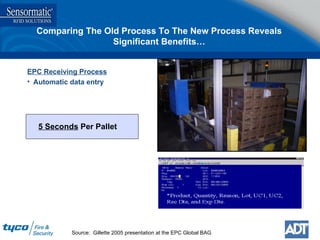
Comparing The Old Process To The New Process Reveals Significant Benefits… EPC Receiving Process Automatic data entry 5 Seconds  Per Pallet Source:  Gillette 2005 presentation at the EPC Global BAG
Orders Are Then Processed… Source:  Gillette 2005 presentation at the EPC Global BAG UPS Conveyor Exit Doors Pack To Order Packaging Center Distribution Center Verification Tunnel Case Packing Machine Connecting Link Pick To Order Hand  Pallet Forming
Customer Orders Are Verified… The pallet is spun within a verification tunnel… Source:  Gillette 2005 presentation at the EPC Global BAG
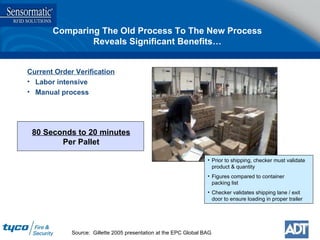
Comparing The Old Process To The New Process Reveals Significant Benefits… Current Order Verification Labor intensive Manual process 80 Seconds to 20 minutes Per Pallet Source:  Gillette 2005 presentation at the EPC Global BAG Prior to shipping, checker must validate product & quantity Figures compared to container packing list  Checker validates shipping lane / exit door to ensure loading in proper trailer
Comparing The Old Process To The New Process Reveals Significant Benefits… EPC Order Verification Automatic data verification Source:  Gillette 2005 presentation at the EPC Global BAG 20 Seconds  Per Pallet
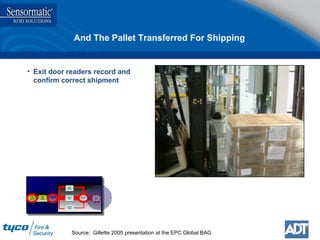
And The Pallet Transferred For Shipping Exit door readers record and confirm correct shipment Source:  Gillette 2005 presentation at the EPC Global BAG UPS Conveyor Exit Doors Pack To Order Packaging Center Distribution Center Verification Tunnel Case Packing Machine Connecting Link Pick To Order Hand  Pallet Forming
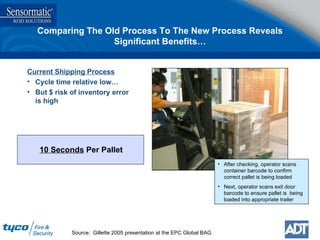
Comparing The Old Process To The New Process Reveals Significant Benefits… Current Shipping Process Cycle time relative low… But $ risk of inventory error is high After checking, operator scans container barcode to confirm correct pallet is being loaded Next, operator scans exit door barcode to ensure pallet is  being loaded into appropriate trailer Source:  Gillette 2005 presentation at the EPC Global BAG 10 Seconds  Per Pallet
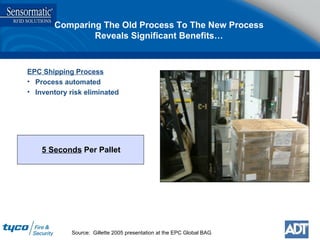
Comparing The Old Process To The New Process Reveals Significant Benefits… EPC Shipping Process Process automated Inventory risk eliminated Source:  Gillette 2005 presentation at the EPC Global BAG 5 Seconds  Per Pallet
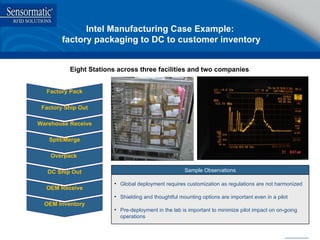
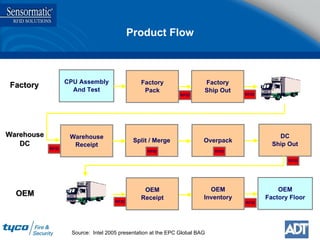
Intel Manufacturing Case Example:  factory packaging to DC to customer inventory Eight Stations across three facilities and two companies Factory Pack Factory Ship Out Split/Merge Overpack  DC Ship Out Warehouse Receive OEM Receive OEM Inventory Sample Observations Global deployment requires customization as regulations are not harmonized Shielding and thoughtful mounting options are important even in a pilot Pre-deployment in the lab is important to minimize pilot impact on on-going operations
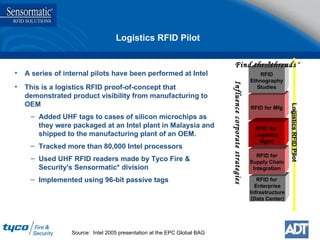
Logistics RFID Pilot A series of internal pilots have been performed at Intel This is a logistics RFID proof-of-concept that demonstrated product visibility from manufacturing to OEM  Added UHF tags to cases of silicon microchips as they were packaged at an Intel plant in Malaysia and shipped to the manufacturing plant of an OEM. Tracked more than 80,000 Intel processors  Used UHF RFID readers made by Tyco Fire & Security's Sensormatic* division  Implemented using 96-bit passive tags Source:  Intel 2005 presentation at the EPC Global BAG RFID for Mfg RFID for  Logistics Mgmt RFID for  Enterprise Infrastructure (Data Center) RFID Ethnography Studies RFID for Supply Chain Integration Find the “threads ” Influence corporate strategies Logistics RFID Pilot
Product Flow Warehouse DC Factory Pack Factory Ship Out Warehouse Receipt Split / Merge Overpack DC Ship Out OEM Receipt OEM Inventory CPU Assembly And Test Factory OEM RFID RFID RFID RFID RFID RFID RFID RFID OEM Factory Floor Source:  Intel 2005 presentation at the EPC Global BAG
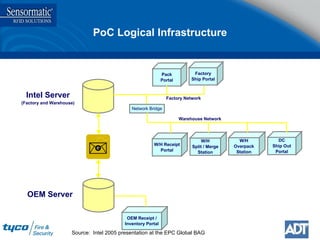
PoC Logical Infrastructure Source:  Intel 2005 presentation at the EPC Global BAG Intel Server (Factory and Warehouse) OEM Server Pack Portal Factory Ship Portal W/H Receipt Portal W/H Split / Merge Station W/H Overpack Station OEM Receipt / Inventory Portal DC Ship Out Portal Network Bridge Factory Network Warehouse Network
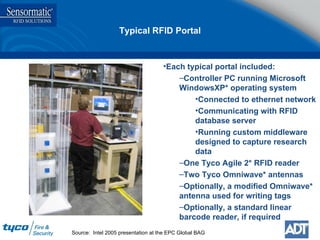
Typical RFID Portal Each typical portal included: Controller PC running Microsoft WindowsXP* operating system Connected to ethernet network Communicating with RFID database server Running custom middleware designed to capture research data One Tyco Agile 2* RFID reader Two Tyco Omniwave* antennas Optionally, a modified Omniwave* antenna used for writing tags Optionally, a standard linear barcode reader, if required  Source:  Intel 2005 presentation at the EPC Global BAG
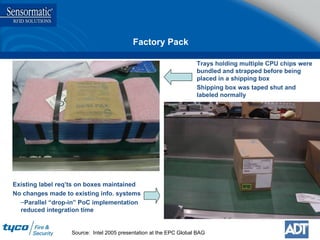
Trays holding multiple CPU chips were bundled and strapped before being placed in a shipping box Shipping box was taped shut and labeled normally Existing label req’ts on boxes maintained No changes made to existing info. systems Parallel “drop-in” PoC implementation reduced integration time Source:  Intel 2005 presentation at the EPC Global BAG Factory Pack
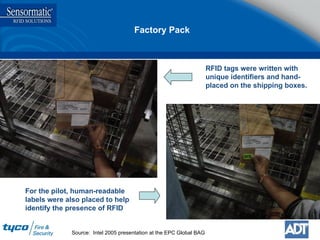
RFID tags were written with unique identifiers and hand-placed on the shipping boxes. For the pilot, human-readable labels were also placed to help identify the presence of RFID Source:  Intel 2005 presentation at the EPC Global BAG Factory Pack
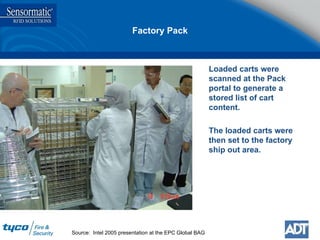
Loaded carts were scanned at the Pack portal to generate a stored list of cart content. The loaded carts were then set to the factory ship out area. Source:  Intel 2005 presentation at the EPC Global BAG Factory Pack
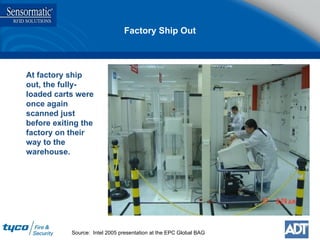
At factory ship out, the fully-loaded carts were once again scanned just before exiting the factory on their way to the warehouse. Source:  Intel 2005 presentation at the EPC Global BAG Factory Ship Out
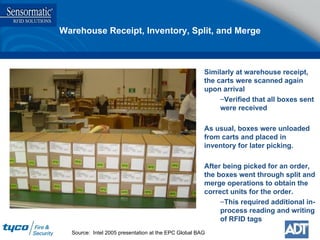
Similarly at warehouse receipt, the carts were scanned again upon arrival Verified that all boxes sent were received As usual, boxes were unloaded from carts and placed in inventory for later picking. After being picked for an order, the boxes went through split and merge operations to obtain the correct units for the order. This required additional in-process reading and writing of RFID tags Source:  Intel 2005 presentation at the EPC Global BAG Warehouse Receipt, Inventory, Split, and Merge
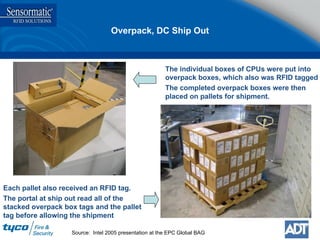
The individual boxes of CPUs were put into overpack boxes, which also was RFID tagged The completed overpack boxes were then placed on pallets for shipment. Source:  Intel 2005 presentation at the EPC Global BAG Overpack, DC Ship Out Each pallet also received an RFID tag. The portal at ship out read all of the stacked overpack box tags and the pallet tag before allowing the shipment
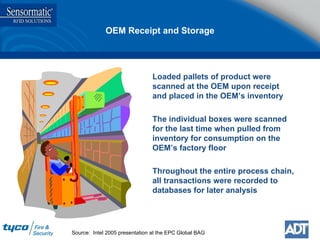
Loaded pallets of product were scanned at the OEM upon receipt and placed in the OEM’s inventory The individual boxes were scanned for the last time when pulled from inventory for consumption on the OEM’s factory floor Throughout the entire process chain, all transactions were recorded to databases for later analysis Source:  Intel 2005 presentation at the EPC Global BAG OEM Receipt and Storage
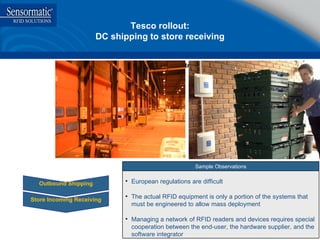
Tesco rollout: DC shipping to store receiving Outbound Shipping Store Incoming Receiving Two:  DC processing to Store shelf Sample Observations European regulations are difficult  The actual RFID equipment is only a portion of the systems that must be engineered to allow mass deployment  Managing a network of RFID readers and devices requires special cooperation between the end-user, the hardware supplier, and the software integrator
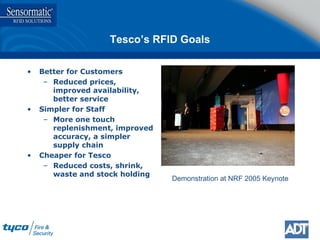
Tesco’s RFID Goals Better for Customers Reduced prices, improved availability, better service  Simpler for Staff More one touch replenishment, improved accuracy, a simpler supply chain Cheaper for Tesco Reduced costs, shrink, waste and stock holding Demonstration at NRF 2005 Keynote
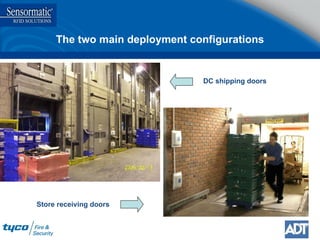
The two main deployment configurations DC shipping doors Store receiving doors
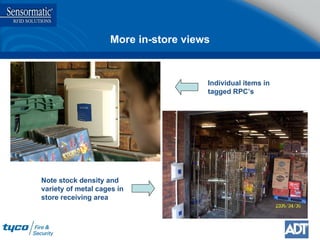
More in-store views Individual items in tagged RPC’s Note stock density and variety of metal cages in store receiving area
Discussion Topics Company overview EPC pilots A closer look at several deployments  Critical next steps
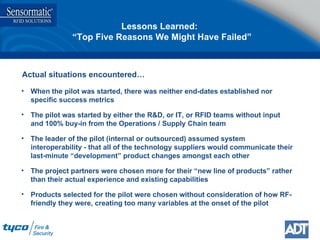
Lessons Learned:  “Top Five Reasons We Might Have Failed” When the pilot was started, there was neither end-dates established nor  specific success metrics The pilot was started by either the R&D, or IT, or RFID teams without input and 100% buy-in from the Operations / Supply Chain team The leader of the pilot (internal or outsourced) assumed system interoperability - that all of the technology suppliers would communicate their last-minute “development” product changes amongst each other The project partners were chosen more for their “new line of products” rather than their actual experience and existing capabilities Products selected for the pilot were chosen without consideration of how RF-friendly they were, creating too many variables at the onset of the pilot Actual situations encountered…
What are the goals of any technical purchase? Avoid obsolescence Support scalability Avoid technical dead ends Support extensibility Getting the Systems Architecture Right. Is it stackable? Are the interfaces discrete? Does it comply with standards? Is there a test for interoperability . . . . and an escalation path? Lessons Applied: Choose Appropriate RFID Technologies
Customer Required Features for RFID Readers Customer Driven Innovation Interface Backward Compatibility and Flexibility Air Protocol Flexibility – Multi-Protocol Operation Global Deployability Application Specific Form Factors Software-defined radio  . . . With enough hardware horsepower for the mid-term future
Device and System Performance Management Deployment Support Identification and Discovery Configuration Management Firmware management Activity Monitoring  Health monitoring  Interference management Trend Analysis and Reporting Alarm Condition Detection and Communication Alert Distribution and Event Logging
Key Next Steps Whether on your own or with a partner, it is important that you begin the RFID implementation process today Act now Key competitors and trading partners are moving forward 3-12 months to implement Demand executive attention and resources Not just another IT project on the wish-list Integral to the success of all IT, Ops and LP projects Involve business functions in design and implementation It’s your time that’s being wasted if not Take advantage of the change to redesign/streamline internal processes Leverage outside help – they want you on board EPC Global and partners Early adopters Commercial solution providers
Thank You! George Reynolds Vice President, RFID Tyco Fire & Security [email_address]

Conference Board 03 May 05 Tyco Rfid

  • 1.
    End-to-End EPC RFIDSolutions: Making It Play . . . And Pay George Reynolds Vice President, RFID Tyco Fire & Security
  • 2.
    Discussion Topics Companyoverview EPC pilots A closer look at several deployments Critical next steps
  • 3.
    Tyco / ADTFoundation for Supply Chain Visibility Logical Layer Physical Layer ADT’s RFID Solution ADT Support Services: Installation, support and remote diagnostics services which provides maximum availability ADT RFID Services: Systems design, site survey and compliance testing Sensormatic RFID Readers, Antennas, Printers, and Applicators: Multi-protocol, multi-frequency, intelligent devices Sensormatic RFID Tags: M ulti-protocol, multi-frequency tags Sensormatic Device Commander: Comprehensive Device Management software RFID Services Support Services Global Data Synch. WMS ERP Systems Integration Data Management Middleware
  • 4.
    Depth of Experience22 years of RFID history Eureka – first RFID product to show anti-collision (1980) Charter member of Auto-ID Center Atlanta Olympic Games (1996) EAS Experience Tagging and Tracking 80,000 UHF systems deployed and over 1 million antennas installed 10 billion chip-based UHF labels made and sold at ten cent ASP 4.0 billion items tagged at point of manufacturer in FY04 with MOQ of $210 15,000 items certified for tag design, automated placement, performance Source-tagged items from 3,500 manufacturers sold at 25,000 retail outlets Note: the technology / application is different, but the expertise required for label placement and antenna calibration is similar.
  • 5.
    Service Portfolio Lab& Design Services Site Solutions Compliance Testing Unique RFID Physical Applications Custom antenna and label design Support and Maintenance Deployment Services Limited “Launch” solutions Source Tagging Large scale, programmatic roll-outs Everything in between Site Surveys (e.g., noise, physical constraints) Requirements analysis (e.g., read points, work flows, volumes, integration needs) Solution design High availability architecture Remote monitoring and management On-site technical support
  • 6.
    Product Components AntennasFocused Application Software Development Software Readers EPC Class Labels Label Printing & Application
  • 7.
    Tyco RFID ArchitectureMultiple interface capacity delivers customer driven innovation. N – Tier delivers scalability. Separation of AFE and Controller delivers global interface. Separation of device and data management functionality delivers flexibility. Multi-generation roadmap delivers lower cost of ownership. Radios - AFE Radio Controllers Device Management Data Management Tags Standard, Private Published Private, Private Published, Standard Private, Private Published, Standard The Enterprise Private, Private Published, Standard Private, Private Published, Standard Private, Private Published, Standard Antennas Applicators - Printers
  • 8.
    Discussion Topics Companyoverview EPC pilots A closer look at several deployments Critical next steps
  • 9.
    We have engagedcustomers in all regions
  • 10.
    Multiple Large-Scale Pilotsfrom Off-shore production to store shelves Major Consumer Goods Manufacturers - Long-term install of 9 RFID stations from packaging to final shipment - Launch packages for retailer compliance - Full line SKU labeling testing Major Mass Merchandisers - 150 readers at 9 RFID stations from incoming goods at DC to store stocking - Enterprise wide install at DC shipping and store receiving facilities for high value goods - Item-level supply chain tracking for apparel Major Pharmaceutical Companies - 7 RFID stations tracking from case creation to outbound shipping - Small label printing and encoding - Class II pharm labeling for compliance U.S. Government Non-U.S. manufacturing processed and shipped to domestic ports, then to a retail DC Major DIY Retailer On-site, custom performance test lab and system integration Large National Hospital Asset tracking including the use of RFID data simulation tools
  • 11.
    Item-Level Rental Pilot: Inventory management Video Rental Trial Programming Drop Box Readers Physical Inventory Self Check-Out Auto Check-In Sample Observations Reduced time to take physical inventory by 75% Real-time display of returned videos improved video “turn rate” on popular videos Video self check-in was easy to defeat resulting in loss of late fees Self check-out eliminated benefit of “up-selling” the customer Difficult to insure good programming compliance with in-store personnel
  • 12.
    Item-Level Retail Pilot: Inventory management High-end Clothing and Firearms Trials Programming Inventory counting Product Locating POS reconciliation Sample Observations Firearms department inventory took less than 16 minutes versus 1 ¼ hour Apparel inventory took 2 minutes versus 1 hour Finding missing product took less than 8 minutes In-store programming is problematic Labor savings may not be sufficient ROI
  • 13.
    Pharma Pilot: casecreation to outbound shipping Manufacturing: Case creation and outbound shipment to DC DC: Inbound receipt of pallet to outbound at several key touch points Sample Lab Test Results Sample Observations Shrink wrap station produced best opportunity to achieve 100% case read on pallet Testing of 21 representative sample SKU / pallets provided identification for preferred label placement on cases / pallets Case configuration is extremely critical to RFID performance Product Description Case Label Pass without Pallet Tag Cases per SKU/Pallet Tests per SKU/Pallet Label Placement High Power Range (inches) 3 Label Write Portal Pallet Tags - 1 or more 2 12 inches 200 FPM 400 FPM Worst % Ave % Best % 4-8 MPH Worst % Ave % Best % Plastic 308 719 77 YES YES 97.22% 3 6 6 6 11 6 92.59% 1 4 9 Drops YES 60 548 108 YES YES YES 15 41 75 YES 40 63 97 Ointment YES 91 548 77 YES YES YES 4 13 27 81.48% 10 27 39 Packs YES 96 548 84 YES YES YES 9 20 37 92.59% 25 39 58 Medium Bottles YES 144 548 82 YES YES YES 9 16 32 96.30% 15 32 43 Softgels YES 126 548 62 YES YES YES 6 8 21 YES 6 23 37 Large Bottles 80 836 68 YES YES YES 0 6 20 YES 1 2 26 Ointment 175 692 81 YES YES 97.22% 5 10 18 YES 11 19 27 Small Cream 238 980 54 YES YES 5 YES 5 1 4 8 96.30% 2 5 10 Test kit 180 548 73 YES YES 95.80% 4 6 13 YES 7 14 25 Large Cream YES 95 1232 61 YES YES YES 16 6 28 6 36 6 92.59% 7 17 25 Mouthwash YES 126 791 52 YES YES YES 4 6 8 6 12 6 YES 2 9 18 Anti-acid YES 90 908 76 YES YES 5 YES 5 4 13 29 YES 12 25 47 Capsules 120 908 54 YES YES 98.61% 3 10 22 YES 11 18 30 Hygene Pads YES 100 575 53 YES YES YES 4 6 12 6 18 6 77.78% 5 10 16 Medicine YES 52 854 6 22 42 YES 23 28 53 Spray Can YES 74 YES YES YES Blister Pack YES 60 YES YES YES Lotion YES 94 YES YES YES Mixed cases YES 50 1007 3 29 54 YES 18 39 48 Soda YES 46 YES YES YES Cereal YES 67 YES YES YES Small Bottles YES 60 YES YES YES Papers YES 76 YES YES YES Dock Door Case Labels 1 Conveyor 100% 4 Portal Case Labels 1
  • 14.
    Discussion Topics Companyoverview EPC pilots A closer look at several deployments Critical next steps
  • 15.
    Retailer Pilot: DCreceiving to store shelf stocking DC Incoming Receiving Outbound Shipping Primary Storage - Single Primary Storage - Double Individual Storage Area Store Incoming Receiving Stockroom Exits Store Shelves Nine Stations: DC processing to Store shelf Sample Observations Real time inventory visibility can reduce out of stocks: RFID system found pallets that the stock room system didn’t see Peripheral devices (optical sensors) can be used to improve system performance by reducing system “noise” RFID “Zones” can be created to track flow / directionality of inventory to determine how long it sits, if it’s in the wrong spot, or to help locate it
  • 16.
    Typical Installations Shippingdoors Perpetual in-store inventory
  • 17.
    More advanced installationsDoor to trash compactor Door to selling floor
  • 18.
    Manufacturer Pilot: LaunchPackage Implementation Sample Observations 100% system performance can be achieved, but may require process work-arounds, significant user training, and specialized back-up components Readers must have “application agility” – readers that can be configurable to accommodate diverse applications Network latency issues require “real time” decisions to be performed at the reader level Not all labels are capable of withstanding supply chain environments: high temperature insensitivity can be a critical feature
  • 19.
    Manufacturer Case Example:Manufacturing EPC Process CLIENT X MANUFACTURING CENTER Products: Food Product ABC Food Product XYZ RFID Equipment 3 Readers 4 Antennas 2 Printers 10,000 Labels / wk 1 Server Launch Software
  • 20.
    Manufacturing EPC ITConfiguration
  • 21.
    Distribution Center EPCProcess CLIENT X DISTRIBUTION CENTER Products: Product X Food Product Product Y Cleaner RFID Equipment 3 Readers 5 Antennas 2 Printers 10,000 Labels / wk 1 Server Launch Software
  • 22.
    Distribution Center ITConfiguration 1
  • 23.
    Manufacturing Station 1Current Installation Print and Program case level Tags Verify Tags Integration Path Automated Label Applicator
  • 24.
    Log case &pallet level EPC data in RFID database Print and program pallet tag Manufacturing Station 2 & 3
  • 25.
    Gillette Ft. DevenDC implementation: packaging to rack storage to store shipment Nine DC Stations: Packaging to Final Shipment Process Programming Pallet Creation Stocking Inbound Packaging Returns Shelf Picking Packaging Outbound Forklifts Mixed Pallet Verifier Dock Doors Sample Observations Software / hardware interoperability issues increased program schedule Reader density requires power and synchronization management Case association to the pallet provides case / pallet tracking solution
  • 26.
    Program Goals: Track100% of all Product X cases and pallets within Gillette’s ‘Four Walls’ Test and prove the technology Develop a scaleable solution Validate the business case Program Results: Customer order verification process time reduced by a factor of ten Shipping / loading verification process time reduced in half, system accuracy increased significantly Manufacturing Case Example: packaging to rack storage to store shipment Source: Gillette 2005 presentation at the EPC Global BAG
  • 27.
    Pilot Overview UPSConveyor Exit Doors Pack To Order Packaging Center Distribution Center Verification Tunnel Case Packing Machine Connecting Link Pick To Order Hand Pallet Forming Source: Gillette 2005 presentation at the EPC Global BAG
  • 28.
    Step #1 Source: Gillette 2005 presentation at the EPC Global BAG The “flat” cases are tagged UPS Conveyor Exit Doors Pack To Order Packaging Center Distribution Center Verification Tunnel Case Packing Machine Connecting Link Pick To Order Hand Pallet Forming
  • 29.
    Step #2 Source: Gillette 2005 presentation at the EPC Global BAG The SKU number is scanned once for each production run UPS Conveyor Exit Doors Pack To Order Packaging Center Distribution Center Verification Tunnel Case Packing Machine Connecting Link Pick To Order Hand Pallet Forming
  • 30.
    Step #3/4 Source: Gillette 2005 presentation at the EPC Global BAG The SKU number generates the unique EPC. The EPC is written, verified, and recorded UPS Conveyor Exit Doors Pack To Order Packaging Center Distribution Center Verification Tunnel Case Packing Machine Connecting Link Pick To Order Hand Pallet Forming
  • 31.
    Cases Are ThenAggregated To A Pallet The system creates a pallet EPC… And associates those cases with the pallet … Allowing unique pallet/case identification throughout the warehouse Source: Gillette 2005 presentation at the EPC Global BAG UPS Conveyor Exit Doors Pack To Order Packaging Center Distribution Center Verification Tunnel Case Packing Machine Connecting Link Pick To Order Hand Pallet Forming
  • 32.
    The Pallet ThenMoves From The Packaging Center To The Distribution Center… The verification tunnel between the pack and distribution areas is equipped with readers and antennae… Source: Gillette 2005 presentation at the EPC Global BAG UPS Conveyor Exit Doors Pack To Order Packaging Center Distribution Center Verification Tunnel Case Packing Machine Connecting Link Pick To Order Hand Pallet Forming
  • 33.
    The Pallet ThenMoves From The Packaging Center To The Distribution Center… The verification tunnel between the pack and distribution areas is equipped with readers and antennae… Pallet is identified using one or more case tags… Source: Gillette 2005 presentation at the EPC Global BAG UPS Conveyor Exit Doors Pack To Order Packaging Center Distribution Center Verification Tunnel Case Packing Machine Connecting Link Pick To Order Hand Pallet Forming
  • 34.
    The Pallet ThenMoves From The Packaging Center To The Distribution Center… The verification tunnel between the pack and distribution areas is equipped with readers and antennae… Pallet is identified using one or more case tags… The distribution center receives the goods and the data validates payments to packaging operations Source: Gillette 2005 presentation at the EPC Global BAG UPS Conveyor Exit Doors Pack To Order Packaging Center Distribution Center Verification Tunnel Case Packing Machine Connecting Link Pick To Order Hand Pallet Forming
  • 35.
    Comparing The OldProcess To The New Process Reveals Significant Benefits… Current Receiving Process Five Scans Three keyboard entries 20 Seconds Per Pallet Read container barcode for Part # & Quantity Enter Part # & Quantity Scan Unit of Measure Barcode Scan Reason Barcode Tab to Lot Code Field Scan Lot Code Barcode Scan Pallet ID from TIN Scan Bill of Lading Press [Enter] Source: Gillette 2005 presentation at the EPC Global BAG
  • 36.
    Comparing The OldProcess To The New Process Reveals Significant Benefits… EPC Receiving Process Automatic data entry 5 Seconds Per Pallet Source: Gillette 2005 presentation at the EPC Global BAG
  • 37.
    Orders Are ThenProcessed… Source: Gillette 2005 presentation at the EPC Global BAG UPS Conveyor Exit Doors Pack To Order Packaging Center Distribution Center Verification Tunnel Case Packing Machine Connecting Link Pick To Order Hand Pallet Forming
  • 38.
    Customer Orders AreVerified… The pallet is spun within a verification tunnel… Source: Gillette 2005 presentation at the EPC Global BAG
  • 39.
    Comparing The OldProcess To The New Process Reveals Significant Benefits… Current Order Verification Labor intensive Manual process 80 Seconds to 20 minutes Per Pallet Source: Gillette 2005 presentation at the EPC Global BAG Prior to shipping, checker must validate product & quantity Figures compared to container packing list Checker validates shipping lane / exit door to ensure loading in proper trailer
  • 40.
    Comparing The OldProcess To The New Process Reveals Significant Benefits… EPC Order Verification Automatic data verification Source: Gillette 2005 presentation at the EPC Global BAG 20 Seconds Per Pallet
  • 41.
    And The PalletTransferred For Shipping Exit door readers record and confirm correct shipment Source: Gillette 2005 presentation at the EPC Global BAG UPS Conveyor Exit Doors Pack To Order Packaging Center Distribution Center Verification Tunnel Case Packing Machine Connecting Link Pick To Order Hand Pallet Forming
  • 42.
    Comparing The OldProcess To The New Process Reveals Significant Benefits… Current Shipping Process Cycle time relative low… But $ risk of inventory error is high After checking, operator scans container barcode to confirm correct pallet is being loaded Next, operator scans exit door barcode to ensure pallet is being loaded into appropriate trailer Source: Gillette 2005 presentation at the EPC Global BAG 10 Seconds Per Pallet
  • 43.
    Comparing The OldProcess To The New Process Reveals Significant Benefits… EPC Shipping Process Process automated Inventory risk eliminated Source: Gillette 2005 presentation at the EPC Global BAG 5 Seconds Per Pallet
  • 44.
    Intel Manufacturing CaseExample: factory packaging to DC to customer inventory Eight Stations across three facilities and two companies Factory Pack Factory Ship Out Split/Merge Overpack DC Ship Out Warehouse Receive OEM Receive OEM Inventory Sample Observations Global deployment requires customization as regulations are not harmonized Shielding and thoughtful mounting options are important even in a pilot Pre-deployment in the lab is important to minimize pilot impact on on-going operations
  • 45.
    Logistics RFID PilotA series of internal pilots have been performed at Intel This is a logistics RFID proof-of-concept that demonstrated product visibility from manufacturing to OEM Added UHF tags to cases of silicon microchips as they were packaged at an Intel plant in Malaysia and shipped to the manufacturing plant of an OEM. Tracked more than 80,000 Intel processors Used UHF RFID readers made by Tyco Fire & Security's Sensormatic* division Implemented using 96-bit passive tags Source: Intel 2005 presentation at the EPC Global BAG RFID for Mfg RFID for Logistics Mgmt RFID for Enterprise Infrastructure (Data Center) RFID Ethnography Studies RFID for Supply Chain Integration Find the “threads ” Influence corporate strategies Logistics RFID Pilot
  • 46.
    Product Flow WarehouseDC Factory Pack Factory Ship Out Warehouse Receipt Split / Merge Overpack DC Ship Out OEM Receipt OEM Inventory CPU Assembly And Test Factory OEM RFID RFID RFID RFID RFID RFID RFID RFID OEM Factory Floor Source: Intel 2005 presentation at the EPC Global BAG
  • 47.
    PoC Logical InfrastructureSource: Intel 2005 presentation at the EPC Global BAG Intel Server (Factory and Warehouse) OEM Server Pack Portal Factory Ship Portal W/H Receipt Portal W/H Split / Merge Station W/H Overpack Station OEM Receipt / Inventory Portal DC Ship Out Portal Network Bridge Factory Network Warehouse Network
  • 48.
    Typical RFID PortalEach typical portal included: Controller PC running Microsoft WindowsXP* operating system Connected to ethernet network Communicating with RFID database server Running custom middleware designed to capture research data One Tyco Agile 2* RFID reader Two Tyco Omniwave* antennas Optionally, a modified Omniwave* antenna used for writing tags Optionally, a standard linear barcode reader, if required Source: Intel 2005 presentation at the EPC Global BAG
  • 49.
    Trays holding multipleCPU chips were bundled and strapped before being placed in a shipping box Shipping box was taped shut and labeled normally Existing label req’ts on boxes maintained No changes made to existing info. systems Parallel “drop-in” PoC implementation reduced integration time Source: Intel 2005 presentation at the EPC Global BAG Factory Pack
  • 50.
    RFID tags werewritten with unique identifiers and hand-placed on the shipping boxes. For the pilot, human-readable labels were also placed to help identify the presence of RFID Source: Intel 2005 presentation at the EPC Global BAG Factory Pack
  • 51.
    Loaded carts werescanned at the Pack portal to generate a stored list of cart content. The loaded carts were then set to the factory ship out area. Source: Intel 2005 presentation at the EPC Global BAG Factory Pack
  • 52.
    At factory shipout, the fully-loaded carts were once again scanned just before exiting the factory on their way to the warehouse. Source: Intel 2005 presentation at the EPC Global BAG Factory Ship Out
  • 53.
    Similarly at warehousereceipt, the carts were scanned again upon arrival Verified that all boxes sent were received As usual, boxes were unloaded from carts and placed in inventory for later picking. After being picked for an order, the boxes went through split and merge operations to obtain the correct units for the order. This required additional in-process reading and writing of RFID tags Source: Intel 2005 presentation at the EPC Global BAG Warehouse Receipt, Inventory, Split, and Merge
  • 54.
    The individual boxesof CPUs were put into overpack boxes, which also was RFID tagged The completed overpack boxes were then placed on pallets for shipment. Source: Intel 2005 presentation at the EPC Global BAG Overpack, DC Ship Out Each pallet also received an RFID tag. The portal at ship out read all of the stacked overpack box tags and the pallet tag before allowing the shipment
  • 55.
    Loaded pallets ofproduct were scanned at the OEM upon receipt and placed in the OEM’s inventory The individual boxes were scanned for the last time when pulled from inventory for consumption on the OEM’s factory floor Throughout the entire process chain, all transactions were recorded to databases for later analysis Source: Intel 2005 presentation at the EPC Global BAG OEM Receipt and Storage
  • 56.
    Tesco rollout: DCshipping to store receiving Outbound Shipping Store Incoming Receiving Two: DC processing to Store shelf Sample Observations European regulations are difficult The actual RFID equipment is only a portion of the systems that must be engineered to allow mass deployment Managing a network of RFID readers and devices requires special cooperation between the end-user, the hardware supplier, and the software integrator
  • 57.
    Tesco’s RFID GoalsBetter for Customers Reduced prices, improved availability, better service Simpler for Staff More one touch replenishment, improved accuracy, a simpler supply chain Cheaper for Tesco Reduced costs, shrink, waste and stock holding Demonstration at NRF 2005 Keynote
  • 58.
    The two maindeployment configurations DC shipping doors Store receiving doors
  • 59.
    More in-store viewsIndividual items in tagged RPC’s Note stock density and variety of metal cages in store receiving area
  • 60.
    Discussion Topics Companyoverview EPC pilots A closer look at several deployments Critical next steps
  • 61.
    Lessons Learned: “Top Five Reasons We Might Have Failed” When the pilot was started, there was neither end-dates established nor specific success metrics The pilot was started by either the R&D, or IT, or RFID teams without input and 100% buy-in from the Operations / Supply Chain team The leader of the pilot (internal or outsourced) assumed system interoperability - that all of the technology suppliers would communicate their last-minute “development” product changes amongst each other The project partners were chosen more for their “new line of products” rather than their actual experience and existing capabilities Products selected for the pilot were chosen without consideration of how RF-friendly they were, creating too many variables at the onset of the pilot Actual situations encountered…
  • 62.
    What are thegoals of any technical purchase? Avoid obsolescence Support scalability Avoid technical dead ends Support extensibility Getting the Systems Architecture Right. Is it stackable? Are the interfaces discrete? Does it comply with standards? Is there a test for interoperability . . . . and an escalation path? Lessons Applied: Choose Appropriate RFID Technologies
  • 63.
    Customer Required Featuresfor RFID Readers Customer Driven Innovation Interface Backward Compatibility and Flexibility Air Protocol Flexibility – Multi-Protocol Operation Global Deployability Application Specific Form Factors Software-defined radio . . . With enough hardware horsepower for the mid-term future
  • 64.
    Device and SystemPerformance Management Deployment Support Identification and Discovery Configuration Management Firmware management Activity Monitoring Health monitoring Interference management Trend Analysis and Reporting Alarm Condition Detection and Communication Alert Distribution and Event Logging
  • 65.
    Key Next StepsWhether on your own or with a partner, it is important that you begin the RFID implementation process today Act now Key competitors and trading partners are moving forward 3-12 months to implement Demand executive attention and resources Not just another IT project on the wish-list Integral to the success of all IT, Ops and LP projects Involve business functions in design and implementation It’s your time that’s being wasted if not Take advantage of the change to redesign/streamline internal processes Leverage outside help – they want you on board EPC Global and partners Early adopters Commercial solution providers
  • 66.
    Thank You! GeorgeReynolds Vice President, RFID Tyco Fire & Security [email_address]