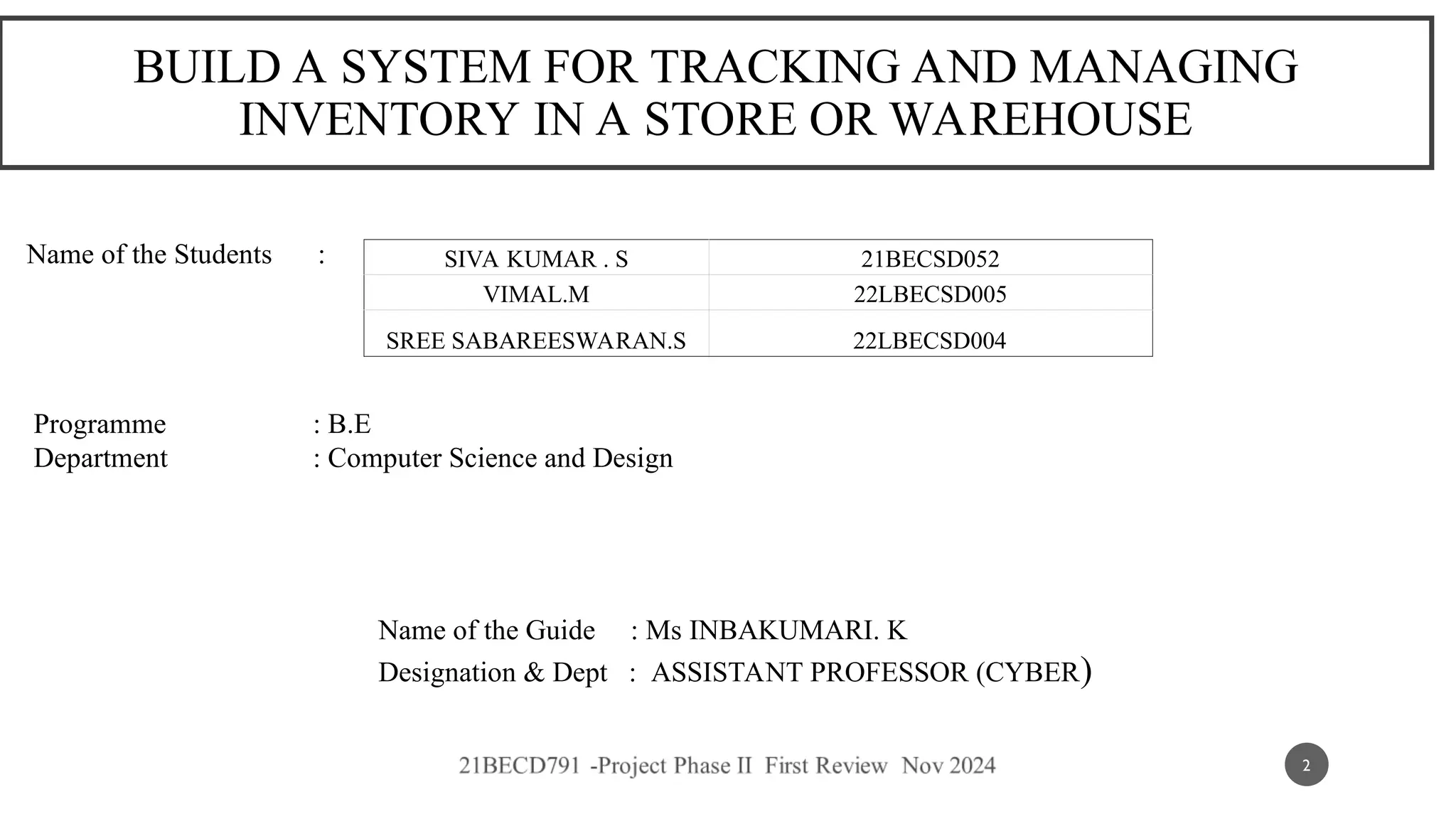
BUILD A SYSTEMFOR TRACKING AND MANAGING
INVENTORY IN A STORE OR WAREHOUSE
Name of the Students :
Programme : B.E
Department : Computer Science and Design
Name of the Guide : Ms INBAKUMARI. K
Designation & Dept : ASSISTANT PROFESSOR (CYBER)
SIVA KUMAR . S 21BECSD052
VIMAL.M 22LBECSD005
SREE SABAREESWARAN.S 22LBECSD004
2
3.
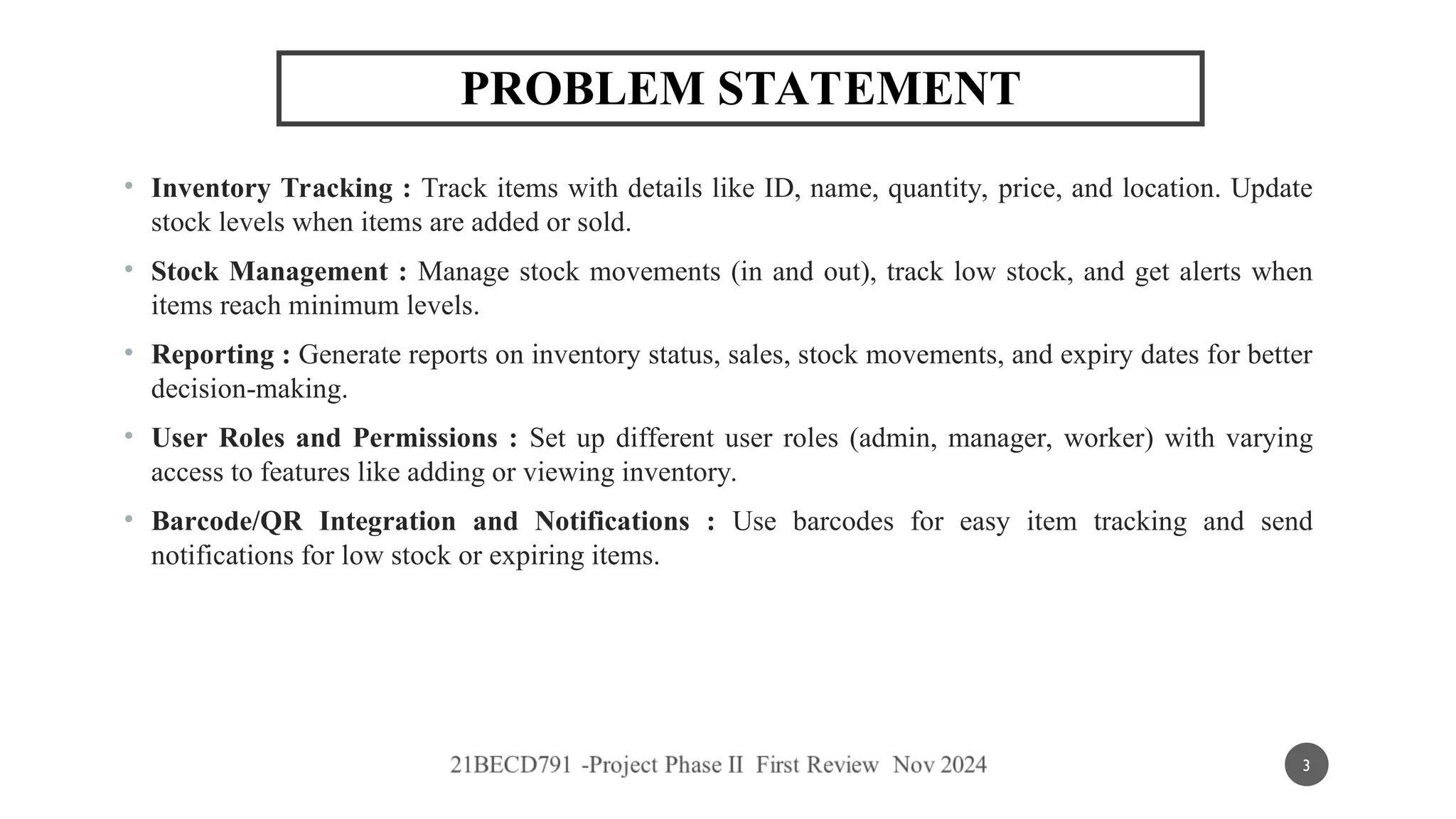
PROBLEM STATEMENT
• InventoryTracking : Track items with details like ID, name, quantity, price, and location. Update
stock levels when items are added or sold.
• Stock Management : Manage stock movements (in and out), track low stock, and get alerts when
items reach minimum levels.
• Reporting : Generate reports on inventory status, sales, stock movements, and expiry dates for better
decision-making.
• User Roles and Permissions : Set up different user roles (admin, manager, worker) with varying
access to features like adding or viewing inventory.
• Barcode/QR Integration and Notifications : Use barcodes for easy item tracking and send
notifications for low stock or expiring items.
3
4.
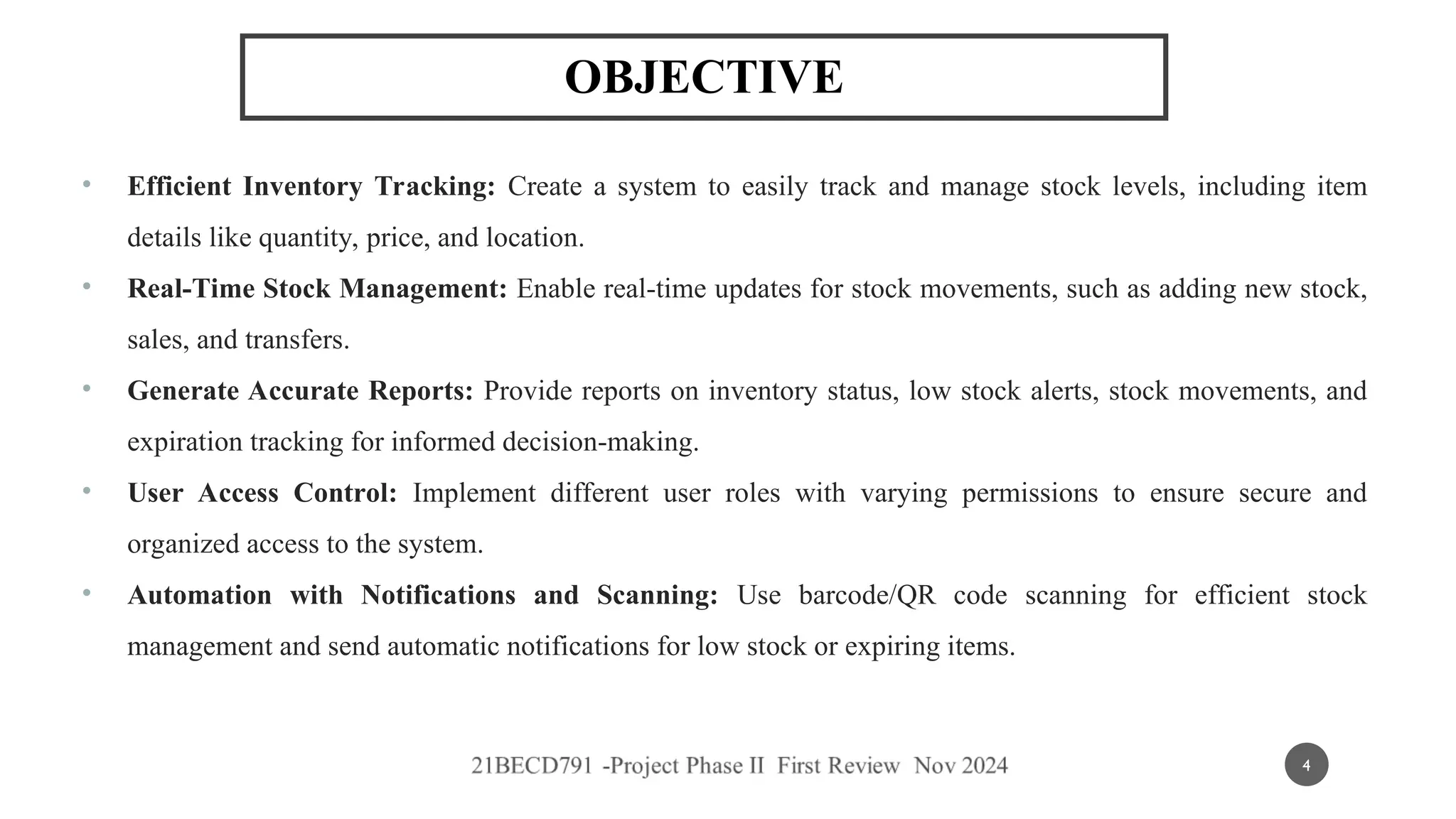
OBJECTIVE
• Efficient InventoryTracking: Create a system to easily track and manage stock levels, including item
details like quantity, price, and location.
• Real-Time Stock Management: Enable real-time updates for stock movements, such as adding new stock,
sales, and transfers.
• Generate Accurate Reports: Provide reports on inventory status, low stock alerts, stock movements, and
expiration tracking for informed decision-making.
• User Access Control: Implement different user roles with varying permissions to ensure secure and
organized access to the system.
• Automation with Notifications and Scanning: Use barcode/QR code scanning for efficient stock
management and send automatic notifications for low stock or expiring items.
4
5.
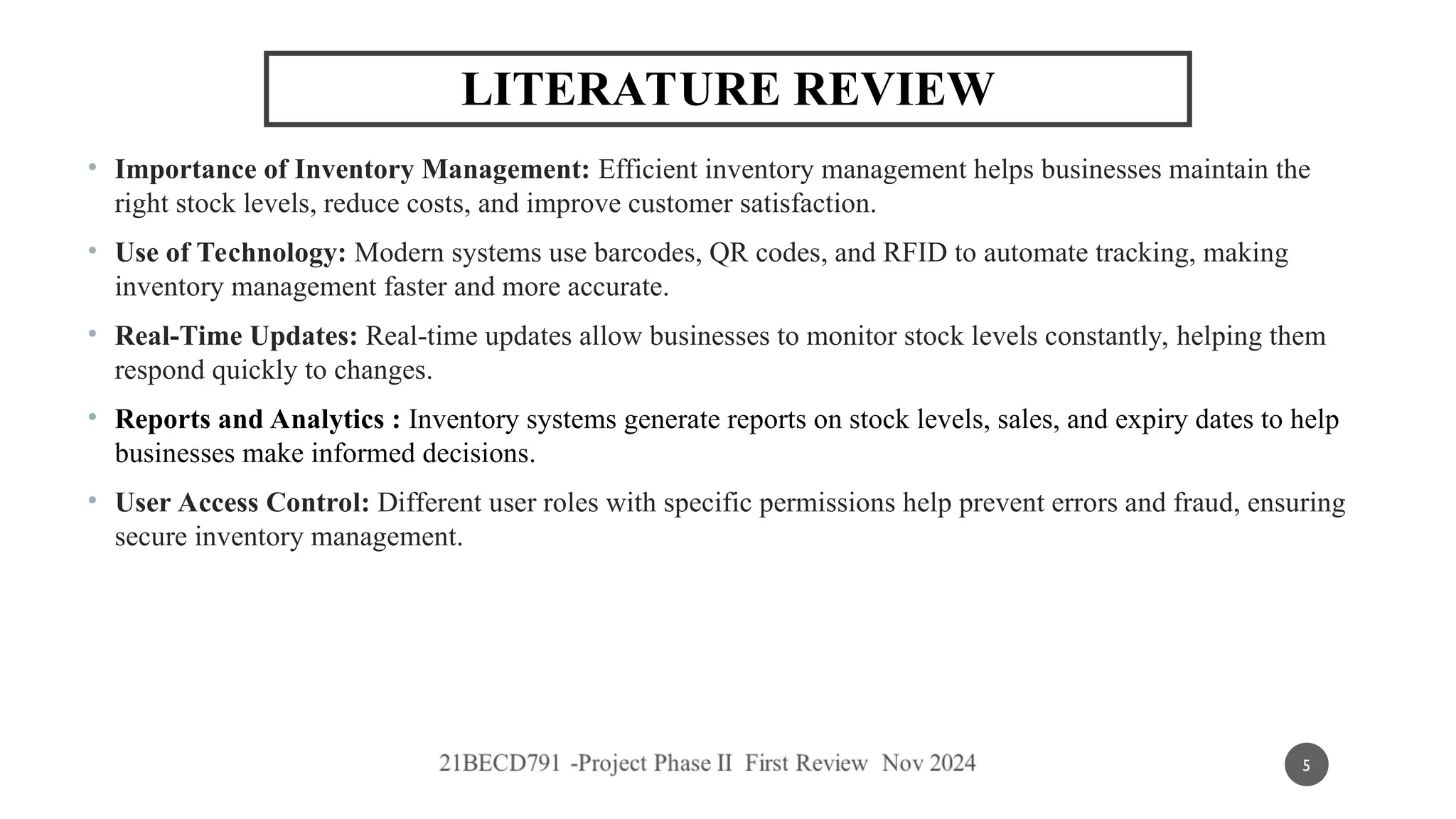
• Importance ofInventory Management: Efficient inventory management helps businesses maintain the
right stock levels, reduce costs, and improve customer satisfaction.
• Use of Technology: Modern systems use barcodes, QR codes, and RFID to automate tracking, making
inventory management faster and more accurate.
• Real-Time Updates: Real-time updates allow businesses to monitor stock levels constantly, helping them
respond quickly to changes.
• Reports and Analytics : Inventory systems generate reports on stock levels, sales, and expiry dates to help
businesses make informed decisions.
• User Access Control: Different user roles with specific permissions help prevent errors and fraud, ensuring
secure inventory management.
LITERATURE REVIEW
5
6.
PROPOSED ALGORITHMS
• StockUpdate : Update inventory when new stock is received or items are sold by adjusting quantities in the
system.
• Low Stock Alert : Monitor stock levels and send notifications when items fall below a set threshold.
• Stock Movement Tracking: Track items moving in and out of the inventory, updating quantities at both
source and destination locations.
• Expiration Monitoring : Check expiration dates for perishable goods and alert users when items are close to
expiring.
• Report Generation : Generate reports on inventory, stock movements, and sales trends for easy tracking and
decision-making.
6
7.
ALGORITHM I
•Identify Item:When a stock update is needed, identify the item using its unique ID, barcode, or QR code.
•Check Stock Action:Determine if the action is an addition (new stock received) or subtraction (sale or
removal of stock).
•Update Inventory Quantity:Update the item's quantity in the database based on the action (increase or
decrease).
•Validate Stock Levels:Check if the updated stock is within the acceptable range (e.g., not negative or
exceeding capacity).
•Save Changes and Notify: Save the updated information to the database and send notifications if needed
(e.g., low stock alerts).
7
8.
ARCHITECTURE
• User Interface(UI): A front-end interface where users can interact with the system to view inventory,
update stock levels, and generate reports. It should be intuitive and accessible for different roles (admin,
manager, worker).
• Backend System : A server-side system that handles business logic, such as adding/removing inventory,
managing stock movements, and processing user requests. It ensures data consistency and executes
operations.
• Database Layer: A centralized database that stores all inventory data, including item details, stock
levels, user roles, transactions, and reports. It should support fast queries and secure data storage.
• Barcode/QR Code Integration: A component that integrates barcode or QR code scanners to
facilitate quick stock updates, item tracking, and management.
• Notification and Reporting System: A module that sends real-time alerts for low stock, expiry dates,
or any inventory changes. It also generates reports on stock levels, sales, and movements.
8
REFERENCES
• Chopra, S.,& Meindl, P. (2016). Supply Chain Management: Strategy, Planning, and Operation (6th
ed.).
Pearson.
• Römer, C., Reichhart, A., Kranz, J., & Picot, A. (2011). The role of smart metering and decentralized electricity
storage for smart grids: The importance of positive externalities. Energy Policy, 39(5), 2289-2298.
• Christopher, M. (2016). Logistics & Supply Chain Management (5th
ed.). Pearson.
• Zhang, Z., & Chen, L. (2017). The Impact of RFID Technology on Warehouse Process Efficiency in China.
Journal of Business Logistics, 38(3), 167-184.
• Kaur, R., & Singh, A. (2015). Review on inventory management using Internet of Things (IoT). International
Journal of Advanced Research in Computer and Communication Engineering, 4(6), 398-401.
• Bhuptani, M., & Moradpour, S. (2005). RFID Field Guide: Deploying Radio Frequency Identification Systems.
Prentice Hall.
10




![Project Report Of Inventory Management Software [POS]](https://cdn.slidesharecdn.com/ss_thumbnails/projectreportofinventorymanagement-191028102858-thumbnail.jpg?width=640&height=640&fit=bounds)


