Download to read offline
![International Research Journal of Engineering and Technology (IRJET) e-ISSN: 2395-0056
Volume: 06 Issue: 06 | June 2019 www.irjet.net p-ISSN: 2395-0072
© 2019, IRJET | Impact Factor value: 7.211 | ISO 9001:2008 Certified Journal | Page 3454
Inventory Management System for Warehouse
Miss. Supriya P. Gawande1, Prof. Dr. Sagar B. Tambe2
1Miss. Supriya P. Gawande, Dept. of Computer Engineering, PREC, Loni, Maharashtra, India
2Prof. Dr. Sagar B. Tambe, Dept. of Computer Engineering, PREC, Loni, Maharashtra, India
----------------------------------------------------------------------***---------------------------------------------------------------------
Abstract - A proposedInventoryManagementsystemwhich
is used in industry providing automation, efficiency and
convenience in everyday life. An enterprise has a variety of
components which are used by the employees for the routine
activities. Keeping track of these components becomes
problematic wherein the components might go missing at the
hands of employees. To remedy this, various types of
technologies like Bar-code Scanner or RFID (Radio- frequency
Identification) based on Tracking Component system is
developed for providing automation, withdrawing the
components and keeping better track of them. In this system
we can maintain login session forauthorizedpersonwhich are
tracked by using RFID tags. The componentsaretracked when
they get in range of RFID Reader to scan RFID tags. When a
person withdraws the components, the system maintains a
record of them. If any employee fails to return the component,
it goes under the pending state. If any component illegally
crossed exit doors then system generates an alarm and also
displays shortage of componentwarning, quantityofavailable
components and required components is to be displayed
enabling automated inventory management with minimal
manual intervention. We are also incorporating machine
learning which will help us understand the product ratingsi.e.
which products are used more etc. Using machine learning
with RFID tags will make the system more efficient and
profitable as it will generate demand of the products on its
own. The data will be stored on the cloud which will make it
accessible from anywhere remotely. The data can also be
viewed on mobile using cloud.
Key Words: Automation, RFID (Radio-Frequency
Identification), Alarm generation, Machine Learning,
Cloud Computing, Mobile Computing.
1. INTRODUCTION
The world is emerging into digitization andeverysector
is getting digitized with software solutions.Everyindustryis
looking smart solution to get into digital way. Digitization
gives many advantages like data can be accessed anywhere,
any information or record can be found within time, and
most important is less paper work as everything goes on
server database. This paper gives idea how an inventory
management system can be helpful to reduce manual efforts
and bring the productivity of any industry though it is small
or big. Inventory management system (IMS) keeps track of
all records seamlessly. Products can be categorized with
quantity can be managed easily with real time data
availability. System generated reports can be downloaded
and process can be improvised according to report analysis.
Efficiency of worker can be increased with the help of IMS.
All the respective departments can be involved in system
and use role based IMS. Project Idea Register the
student/supervisor by using bar-code and detailed
information of studentandsupervisor.Thissystemisusedto
track the component and reduce the manual work of lab-
assistant. The feature of this system is to keep the record of
component and stock of component using bar-code. The
system with user friendly GUI which is understand by all
normal users of the system. Any normal user uses this
system and register itself with the help of supervisor. Thus
our project paper will be organized into steps such as:
1. Literature Survey which will explain the existing
works and their limitations.
2. Proposed System which will explain the steps to
achieve a successful implementation.
3. Conclusion which will explain the overall
achievement of the project.
4. References which will list the papers that are to be
referred.
2. LITERATURE SURVEY
Smart Shopping Cart Ever since the debut of wireless
technology, electronic commerce has developed to such an
extent to provide convenience, comfort, and efficiency in
day-to-day life. The main purpose of this paper is to provide
centralized and automated billing system using RFID and
ZigBee communication Each productofshoppingmall,super
markets will be supplied with an RFID tag, to identify its
type. Every cart containsPID (ProductIdentificationDevice).
Specifically, PID contains a microcontroller, LCD, an RFID
reader, EEPROM, and ZigBee module. There will also be a
centralized database from which we can give product
recommendation to the customer [3].
Library Management System: A library is a
collection of information, sources, resources,books,services
and the structure in which it is housed. Apart from books
many libraries are also repositories and access points for
maps, prints or other documents on various storage media
such as microform (microfilm/microfiche),audiotapes,CDs,
LPs, cassettes, videotapes, and DVDs. RFID is a technology
which improves the tracking of books and documents,
significantly reduces management costs and increases the
time that librarians spend with patrons by enabling
automated bookhandlingat check-ins,checkouts,collections](https://image.slidesharecdn.com/irjet-v6i6692-191217062630/85/IRJET-Inventory-Management-System-for-Warehouse-1-320.jpg)
![International Research Journal of Engineering and Technology (IRJET) e-ISSN: 2395-0056
Volume: 06 Issue: 06 | June 2019 www.irjet.net p-ISSN: 2395-0072
© 2019, IRJET | Impact Factor value: 7.211 | ISO 9001:2008 Certified Journal | Page 3454
Inventory Management System for Warehouse
Miss. Supriya P. Gawande1, Prof. Dr. Sagar B. Tambe2
1Miss. Supriya P. Gawande, Dept. of Computer Engineering, PREC, Loni, Maharashtra, India
2Prof. Dr. Sagar B. Tambe, Dept. of Computer Engineering, PREC, Loni, Maharashtra, India
----------------------------------------------------------------------***---------------------------------------------------------------------
Abstract - A proposedInventoryManagementsystemwhich
is used in industry providing automation, efficiency and
convenience in everyday life. An enterprise has a variety of
components which are used by the employees for the routine
activities. Keeping track of these components becomes
problematic wherein the components might go missing at the
hands of employees. To remedy this, various types of
technologies like Bar-code Scanner or RFID (Radio- frequency
Identification) based on Tracking Component system is
developed for providing automation, withdrawing the
components and keeping better track of them. In this system
we can maintain login session forauthorizedpersonwhich are
tracked by using RFID tags. The componentsaretracked when
they get in range of RFID Reader to scan RFID tags. When a
person withdraws the components, the system maintains a
record of them. If any employee fails to return the component,
it goes under the pending state. If any component illegally
crossed exit doors then system generates an alarm and also
displays shortage of componentwarning, quantityofavailable
components and required components is to be displayed
enabling automated inventory management with minimal
manual intervention. We are also incorporating machine
learning which will help us understand the product ratingsi.e.
which products are used more etc. Using machine learning
with RFID tags will make the system more efficient and
profitable as it will generate demand of the products on its
own. The data will be stored on the cloud which will make it
accessible from anywhere remotely. The data can also be
viewed on mobile using cloud.
Key Words: Automation, RFID (Radio-Frequency
Identification), Alarm generation, Machine Learning,
Cloud Computing, Mobile Computing.
1. INTRODUCTION
The world is emerging into digitization andeverysector
is getting digitized with software solutions.Everyindustryis
looking smart solution to get into digital way. Digitization
gives many advantages like data can be accessed anywhere,
any information or record can be found within time, and
most important is less paper work as everything goes on
server database. This paper gives idea how an inventory
management system can be helpful to reduce manual efforts
and bring the productivity of any industry though it is small
or big. Inventory management system (IMS) keeps track of
all records seamlessly. Products can be categorized with
quantity can be managed easily with real time data
availability. System generated reports can be downloaded
and process can be improvised according to report analysis.
Efficiency of worker can be increased with the help of IMS.
All the respective departments can be involved in system
and use role based IMS. Project Idea Register the
student/supervisor by using bar-code and detailed
information of studentandsupervisor.Thissystemisusedto
track the component and reduce the manual work of lab-
assistant. The feature of this system is to keep the record of
component and stock of component using bar-code. The
system with user friendly GUI which is understand by all
normal users of the system. Any normal user uses this
system and register itself with the help of supervisor. Thus
our project paper will be organized into steps such as:
1. Literature Survey which will explain the existing
works and their limitations.
2. Proposed System which will explain the steps to
achieve a successful implementation.
3. Conclusion which will explain the overall
achievement of the project.
4. References which will list the papers that are to be
referred.
2. LITERATURE SURVEY
Smart Shopping Cart Ever since the debut of wireless
technology, electronic commerce has developed to such an
extent to provide convenience, comfort, and efficiency in
day-to-day life. The main purpose of this paper is to provide
centralized and automated billing system using RFID and
ZigBee communication Each productofshoppingmall,super
markets will be supplied with an RFID tag, to identify its
type. Every cart containsPID (ProductIdentificationDevice).
Specifically, PID contains a microcontroller, LCD, an RFID
reader, EEPROM, and ZigBee module. There will also be a
centralized database from which we can give product
recommendation to the customer [3].
Library Management System: A library is a
collection of information, sources, resources,books,services
and the structure in which it is housed. Apart from books
many libraries are also repositories and access points for
maps, prints or other documents on various storage media
such as microform (microfilm/microfiche),audiotapes,CDs,
LPs, cassettes, videotapes, and DVDs. RFID is a technology
which improves the tracking of books and documents,
significantly reduces management costs and increases the
time that librarians spend with patrons by enabling
automated bookhandlingat check-ins,checkouts,collections](https://image.slidesharecdn.com/irjet-v6i6692-191217062630/75/IRJET-Inventory-Management-System-for-Warehouse-1-2048.jpg)
![International Research Journal of Engineering and Technology (IRJET) e-ISSN: 2395-0056
Volume: 06 Issue: 06 | June 2019 www.irjet.net p-ISSN: 2395-0072
© 2019, IRJET | Impact Factor value: 7.211 | ISO 9001:2008 Certified Journal | Page 3455
inventories, book sorting and theft deterrence. RFID plays
vital role in redefining the library process, increases
efficiency, productivity and enhances user satisfaction [4].
Storage Management System: This paper proposes
a digital warehouse management system (DWMS) in the
tobacco industry based on radio frequency identification
(RFID) technology.TheDWMShelpswarehousemanagersto
achieve better inventory control, as well as to improve the
operation efficiency. In this system, a set of basic events and
storage/retrieval rules are definedasevent-conditionaction
(ECA) rules to improve the feasibility and flexibility DWMS.
By using RFID technology, the DWMS enables a plane
warehouse to achieve visualized inventory management,
automatic storage/retrieval assignmentandhighaccuracyof
inventory control as an automatic warehouse. A case in the
tobacco industry is studied to illustrate the feasibility and
rationality of the proposed system. Based on theECArules,a
storage/retrieval methodology is proposed to improve the
storage/retrieval operations. The results of this case study
illustrate that RFID-DWMS can help a plane warehouse to
improve operation efficiency, enhance the utilization of
warehouse capacity, increaseinventoryaccuracyandreduce
manpower and loading time significantly [10].
3. PROPOSED SYSTEM
In Component tracking system we are going to do an
inventory management system of a lab where the
components will have a RFID tag. The data of thecomponent
then can be saved to cloud. A RFID monitor having a scanner
will be on which will detect the in and out stock of the
component and also find out the theft of the component by
seeding alert which the admin can view on his mobile.
3.1 Goal and Objectives
1. To Secure Lab Components from Theft.
2. To maintain inventory of a lab.
3. To use Machine Learning.
4. To use Cloud Computing.
5. To use Mobile Computing.
3.2 Statement of Scope
There are few scopes of the system to achieve
successful Inventory Management System:
1. RFID handler: The System will first assign RFIDtags
to component and users and then maintain in stock
and out stock on the cloud.
2. Cloud Computing: The System will use Google Drive
and Google Spreadsheet as the cloud.
3. Machine Learning: The system will use SVM
(Support Vector Machine) algorithmforgradingthe
products of much use.
4. Mobile Computing: The system can view the data on
the mobile from cloud.
4. SYSTEM ARCHITECTURE
4.1 System Architecture
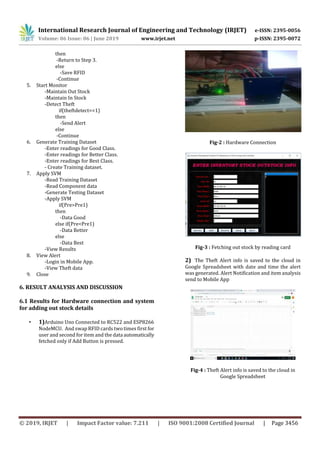
1) Upload and View Data: In the screenshot a
communication with the cloud is made and the data can be
uploaded and downloaded using the application.
Fig-1: System Architecture
4.2 Details
1. Internet of Things: In this module a Arduino Uno
will be used with RFID reader to read the RFID
tags and send the data to the assigned desktop
using Wi-Fi and ESP 8266.
2. Desktop: In this module the desktop will receive
the data from IoT and save data to cloud for
further processing. It will also have a RFID
monitor which will continuously monitor new
RFID tags and thus help in maintaining the in
stock and out stock of the components. It will
also detect the component theft and send the
alert with data to the cloud.
3. Cloud: This module will store the data using
Google Drive and Google Spreadsheet API.
4. SVM: This module will rate components so that
the user will understand which products are
used more.
5. Mobile: This module will view the data on an
Android phone and view alerts using an Mobile
App.
5. ALGORITHM
1. Start
2. Initialize IoT
3. Read RFID tag
4. Send Readings to Desktop
if(sendsuccess==0)](https://image.slidesharecdn.com/irjet-v6i6692-191217062630/85/IRJET-Inventory-Management-System-for-Warehouse-2-320.jpg)
![International Research Journal of Engineering and Technology (IRJET) e-ISSN: 2395-0056
Volume: 06 Issue: 06 | June 2019 www.irjet.net p-ISSN: 2395-0072
© 2019, IRJET | Impact Factor value: 7.211 | ISO 9001:2008 Certified Journal | Page 3457
Fig-5 : Theft Alert on Mobile App
6.2 Discussion for communication with cloud
And item Analysis
1) The Usage analysis of previous and current
items data is generated and send to mobile phone and
Google spreadsheet.
Fig-6 : Item analysis of old and new data
Fig-7: Time to communicate with cloud
7. CONCLUSION
In this paper a novel approach is explained which
will increase the ease of inventory management system
using IoT, RFID, Desktop, Cloud, Mobile and Machine
learning together to develop a smart and intelligent
inventory management system. After analyzing, we can
conclude that the system which we are going to implement
will lead to an automation in tracking the components
present at the Training Center.Thesystemwill alsomaintain
a digital record such as timely report for all categories of
components. Thus, it will result in the reductionofworkload
of the Administrator or Supervisor.
REFERENCES
[1] Yan Tang Demey, and Mikael Wolff SIMISS: A Model
based Searching Strategy for Inventory Management
Systems,2327-4662 (c) 2016 IEEE
[2] Komal Machhirke, Priyanka Goche, Rupali Rathod: A
New Technology of Smart Shopping CartusingRFIDand
ZIGBEE. International Journal on RecentandInnovation
Trends in Computing and Communication Volume: 5
Issue: 2
[3] Dr.Annaraman, P. Thamarai, Dr. T.V.U. Kiran Kumar:
Smart Library Management System using RFID.
International Journal ofAdvancedResearchinElectrical,
Electronics and Instrumentation Engineering Vol. 4,
Issue 4, April 2015
[4] Design and Application of the RFID Technology in ERP
Juan Tian, Xiujuan Wang and Lanhua ZhangCollege of
Information Engineering, Taishan Medical University,
Taian 271016, China
[5] Athul Jayaram, An IIoT QualityGlobal Enterprise
Inventory Management Model for Automation and
Demand ForecastingBased on Cloud, International
Conference on Computing, Communication and
Automation, IEEE, pp. 1258-1263, 2017
[6] Liu Jinping, Under the IT environment inventory
accounting and management studies, 29th Chinese
Control And Decision Conference, pp. 2579-2583, 2017
[7] Fitra Lestari, Ulfah, Fitri Roza Aprianis, Suherman,
Inventory Management Information System in Blood
Transfusion Unit, International ConferenceonIndustrial
Engineering and EngineeringManagement, pp.268-272,
December. 2018
[8] D. Mo, D. C. K. Ho, N. Chan, Excess Inventories
Redeployment Strategy for Spare PartsServiceLogistics
Management, Decmber 2017
[9] N. Nemtajela and C. Mbohwa, Inventory Management
Models and Their Effects on Uncertain Demand,
International Conference on Industrial Engineeringand](https://image.slidesharecdn.com/irjet-v6i6692-191217062630/85/IRJET-Inventory-Management-System-for-Warehouse-4-320.jpg)
![International Research Journal of Engineering and Technology (IRJET) e-ISSN: 2395-0056
Volume: 06 Issue: 06 | June 2019 www.irjet.net p-ISSN: 2395-0072
© 2019, IRJET | Impact Factor value: 7.211 | ISO 9001:2008 Certified Journal | Page 3458
Engineering Management, pp. 1046-1049, December
2016
[10] Inventory Management using Passive RFID Tags: A
Survey Cherian Abraham, Vinay Ahuja, Arnab Kumar
Ghosh, Praveen Pakanati
[11] Rodolfo Zare and Carlos Raymundo, pedro Chavez, Jose
Rojas, Collaborative Culture Management model to
improve the performance in the inventorymanagement
of a supply chain, IEEE, 2018 [12] An Efficient Tag
Identification Algorithm Based on Improved Collision
Detection Ya-Ning Yan1 and Jian Xiong2 [13] Fast and
Reliable Unknown Tag Detection in Large-Scale RFID
Systems Wei Gong*, Jiangchuan Liu*, and Zhe Yang*](https://image.slidesharecdn.com/irjet-v6i6692-191217062630/85/IRJET-Inventory-Management-System-for-Warehouse-5-320.jpg)

This document describes a proposed inventory management system for a warehouse using RFID technology. Key aspects of the system include: 1. Components in the warehouse will have RFID tags attached to track inventory levels in real-time as items are withdrawn or returned. 2. An RFID reader will continuously scan tags to monitor inventory levels and generate alerts if items are removed without being checked out properly. 3. Machine learning algorithms will be used to analyze usage data and provide recommendations on popular products. 4. Inventory data will be stored on the cloud to allow remote access from any device. This will help automate inventory management with minimal manual work.


