Damanhur University
Faculty of Science
Chemistry department
Hydroboration
Name: Sherif Ahmed Mohamed Kolkaela
Supervision: Dr/ Ramadan Elsokry
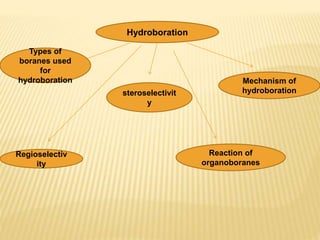
Hydroboration
Types of
boranes used
for
hydroboration
steroselectivit
y
Mechanism of
hydroboration
Reaction of
organoboranes
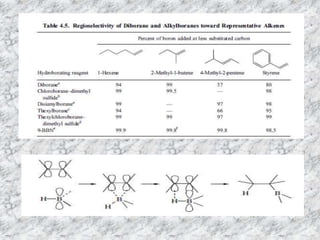
Regioselectiv
ity
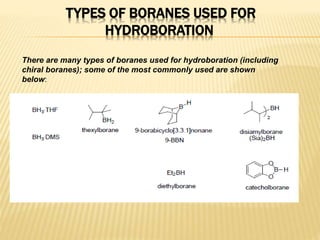
TYPES OF BORANES USED FOR
HYDROBORATION
There are many types of boranes used for hydroboration (including
chiral boranes); some of the most commonly used are shown
below:
HYDROBORATION
Definition:
hydroboration refers to the addition of a
hydrogen-boron bond to C-C, C-N, and C-O
double bonds, as well as C-C triple bonds.
This chemical reaction is useful in
the organic synthesis of organic compounds
5
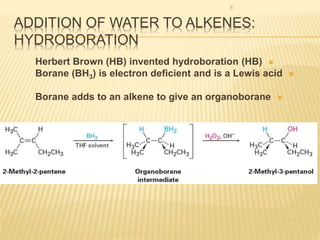
ADDITION OF WATER TO ALKENES:
HYDROBORATION
Herbert Brown (HB) invented hydroboration (HB)
Borane (BH3) is electron deficient and is a Lewis acid
Borane adds to an alkene to give an organoborane
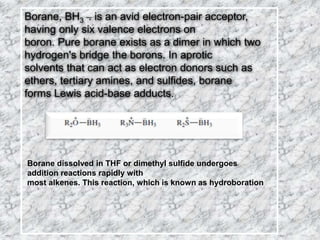
Borane, BH3 . is an avid electron-pair acceptor,
having only six valence electrons on
boron. Pure borane exists as a dimer in which two
hydrogen's bridge the borons. In aprotic
solvents that can act as electron donors such as
ethers, tertiary amines, and sulfides, borane
forms Lewis acid-base adducts.
Borane dissolved in THF or dimethyl sulfide undergoes
addition reactions rapidly with
most alkenes. This reaction, which is known as hydroboration
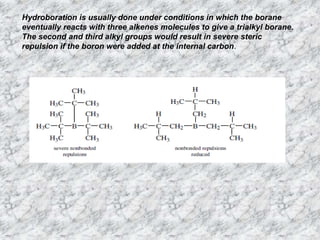
Hydroboration is usually done under conditions in which the borane
eventually reacts with three alkenes molecules to give a trialkyl borane.
The second and third alkyl groups would result in severe steric
repulsion if the boron were added at the internal carbon.
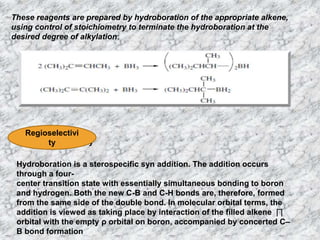
These reagents are prepared by hydroboration of the appropriate alkene,
using control of stoichiometry to terminate the hydroboration at the
desired degree of alkylation:
Hydroboration is a sterospecific syn addition. The addition occurs
through a four-
center transition state with essentially simultaneous bonding to boron
and hydrogen. Both the new C-B and C-H bonds are, therefore, formed
from the same side of the double bond. In molecular orbital terms, the
addition is viewed as taking place by interaction of the filled alkene ∏
orbital with the empty ρ orbital on boron, accompanied by concerted C–
B bond formation
steroselectivity
Regioselectivi
ty
steroselectivit
y
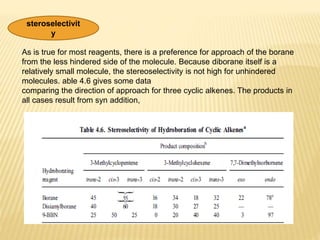
As is true for most reagents, there is a preference for approach of the borane
from the less hindered side of the molecule. Because diborane itself is a
relatively small molecule, the stereoselectivity is not high for unhindered
molecules. able 4.6 gives some data
comparing the direction of approach for three cyclic alkenes. The products in
all cases result from syn addition,
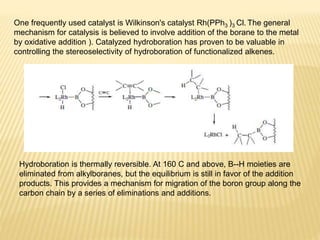
One frequently used catalyst is Wilkinson's catalyst Rh(PPh3 )3 Cl. The general
mechanism for catalysis is believed to involve addition of the borane to the metal
by oxidative addition ). Catalyzed hydroboration has proven to be valuable in
controlling the stereoselectivity of hydroboration of functionalized alkenes.
Hydroboration is thermally reversible. At 160 C and above, B--H moieties are
eliminated from alkylboranes, but the equilibrium is still in favor of the addition
products. This provides a mechanism for migration of the boron group along the
carbon chain by a series of eliminations and additions.
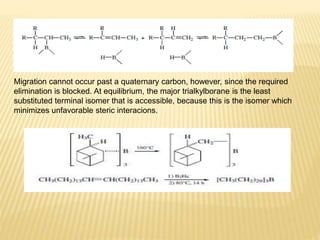
Migration cannot occur past a quaternary carbon, however, since the required
elimination is blocked. At equilibrium, the major trialkylborane is the least
substituted terminal isomer that is accessible, because this is the isomer which
minimizes unfavorable steric interacions.
13
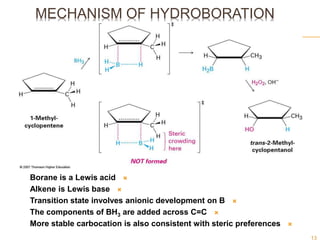
MECHANISM OF HYDROBORATION
Borane is a Lewis acid
Alkene is Lewis base
Transition state involves anionic development on B
The components of BH3 are added across C=C
More stable carbocation is also consistent with steric preferences
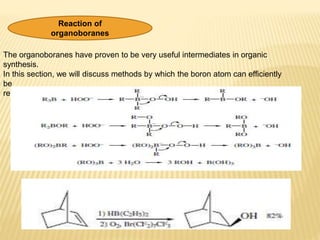
Reaction of
organoboranes
The organoboranes have proven to be very useful intermediates in organic
synthesis.
In this section, we will discuss methods by which the boron atom can efficiently
be
replaced by hydroxyl, halogen, or amino groups.
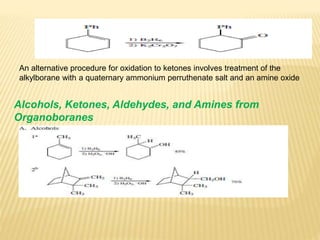
An alternative procedure for oxidation to ketones involves treatment of the
alkylborane with a quaternary ammonium perruthenate salt and an amine oxide
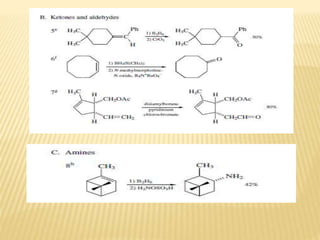
Alcohols, Ketones, Aldehydes, and Amines from
Organoboranes
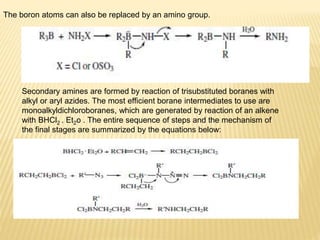
The boron atoms can also be replaced by an amino group.
Secondary amines are formed by reaction of trisubstituted boranes with
alkyl or aryl azides. The most efficient borane intermediates to use are
monoalkyldichloroboranes, which are generated by reaction of an alkene
with BHCl2 . Et2o . The entire sequence of steps and the mechanism of
the final stages are summarized by the equations below:
Enantioselectiv
e
Several alkylboranes are available in enantiomerically enriched or
enantiomerically
pure form, and they can be used to prepare enantiomerically enriched alcohols
and other compounds available via organoborane intermediates
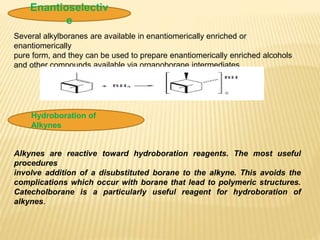
Hydroboration of
Alkynes
Alkynes are reactive toward hydroboration reagents. The most useful
procedures
involve addition of a disubstituted borane to the alkyne. This avoids the
complications which occur with borane that lead to polymeric structures.
Catecholborane is a particularly useful reagent for hydroboration of
alkynes.
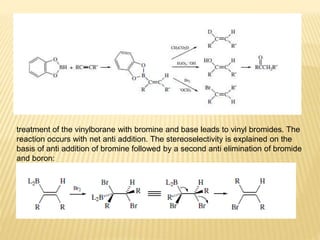
treatment of the vinylborane with bromine and base leads to vinyl bromides. The
reaction occurs with net anti addition. The stereoselectivity is explained on the
basis of anti addition of bromine followed by a second anti elimination of bromide
and boron:
Summary
1. Hydroboration is a highly regioselective and syn-stereospecific process.
2. A wide variety of boranes are available. The number of hydrogen substituents
on the borane determines the number of olefins with which it can react.
3. The rate of hydroboration is strongly affected by the substituents on the B
atom - sterically bulky substituents can appreciably reduce the rate of successive
hydroboration reactions.
4 . sp3- C−B bonds can be manipulated in a number of ways including
oxidation and amination

Hydroboration

  • 1.
    Damanhur University Faculty ofScience Chemistry department Hydroboration Name: Sherif Ahmed Mohamed Kolkaela Supervision: Dr/ Ramadan Elsokry
  • 2.
    Hydroboration Types of boranes used for hydroboration steroselectivit y Mechanismof hydroboration Reaction of organoboranes Regioselectiv ity
  • 3.
    TYPES OF BORANESUSED FOR HYDROBORATION There are many types of boranes used for hydroboration (including chiral boranes); some of the most commonly used are shown below:
  • 4.
    HYDROBORATION Definition: hydroboration refers tothe addition of a hydrogen-boron bond to C-C, C-N, and C-O double bonds, as well as C-C triple bonds. This chemical reaction is useful in the organic synthesis of organic compounds
  • 5.
    5 ADDITION OF WATERTO ALKENES: HYDROBORATION Herbert Brown (HB) invented hydroboration (HB) Borane (BH3) is electron deficient and is a Lewis acid Borane adds to an alkene to give an organoborane
  • 6.
    Borane, BH3 .is an avid electron-pair acceptor, having only six valence electrons on boron. Pure borane exists as a dimer in which two hydrogen's bridge the borons. In aprotic solvents that can act as electron donors such as ethers, tertiary amines, and sulfides, borane forms Lewis acid-base adducts. Borane dissolved in THF or dimethyl sulfide undergoes addition reactions rapidly with most alkenes. This reaction, which is known as hydroboration
  • 7.
    Hydroboration is usuallydone under conditions in which the borane eventually reacts with three alkenes molecules to give a trialkyl borane. The second and third alkyl groups would result in severe steric repulsion if the boron were added at the internal carbon.
  • 8.
    These reagents areprepared by hydroboration of the appropriate alkene, using control of stoichiometry to terminate the hydroboration at the desired degree of alkylation: Hydroboration is a sterospecific syn addition. The addition occurs through a four- center transition state with essentially simultaneous bonding to boron and hydrogen. Both the new C-B and C-H bonds are, therefore, formed from the same side of the double bond. In molecular orbital terms, the addition is viewed as taking place by interaction of the filled alkene ∏ orbital with the empty ρ orbital on boron, accompanied by concerted C– B bond formation steroselectivity Regioselectivi ty
  • 10.
    steroselectivit y As is truefor most reagents, there is a preference for approach of the borane from the less hindered side of the molecule. Because diborane itself is a relatively small molecule, the stereoselectivity is not high for unhindered molecules. able 4.6 gives some data comparing the direction of approach for three cyclic alkenes. The products in all cases result from syn addition,
  • 11.
    One frequently usedcatalyst is Wilkinson's catalyst Rh(PPh3 )3 Cl. The general mechanism for catalysis is believed to involve addition of the borane to the metal by oxidative addition ). Catalyzed hydroboration has proven to be valuable in controlling the stereoselectivity of hydroboration of functionalized alkenes. Hydroboration is thermally reversible. At 160 C and above, B--H moieties are eliminated from alkylboranes, but the equilibrium is still in favor of the addition products. This provides a mechanism for migration of the boron group along the carbon chain by a series of eliminations and additions.
  • 12.
    Migration cannot occurpast a quaternary carbon, however, since the required elimination is blocked. At equilibrium, the major trialkylborane is the least substituted terminal isomer that is accessible, because this is the isomer which minimizes unfavorable steric interacions.
  • 13.
    13 MECHANISM OF HYDROBORATION Boraneis a Lewis acid Alkene is Lewis base Transition state involves anionic development on B The components of BH3 are added across C=C More stable carbocation is also consistent with steric preferences
  • 14.
    Reaction of organoboranes The organoboraneshave proven to be very useful intermediates in organic synthesis. In this section, we will discuss methods by which the boron atom can efficiently be replaced by hydroxyl, halogen, or amino groups.
  • 15.
    An alternative procedurefor oxidation to ketones involves treatment of the alkylborane with a quaternary ammonium perruthenate salt and an amine oxide Alcohols, Ketones, Aldehydes, and Amines from Organoboranes
  • 17.
    The boron atomscan also be replaced by an amino group. Secondary amines are formed by reaction of trisubstituted boranes with alkyl or aryl azides. The most efficient borane intermediates to use are monoalkyldichloroboranes, which are generated by reaction of an alkene with BHCl2 . Et2o . The entire sequence of steps and the mechanism of the final stages are summarized by the equations below:
  • 18.
    Enantioselectiv e Several alkylboranes areavailable in enantiomerically enriched or enantiomerically pure form, and they can be used to prepare enantiomerically enriched alcohols and other compounds available via organoborane intermediates Hydroboration of Alkynes Alkynes are reactive toward hydroboration reagents. The most useful procedures involve addition of a disubstituted borane to the alkyne. This avoids the complications which occur with borane that lead to polymeric structures. Catecholborane is a particularly useful reagent for hydroboration of alkynes.
  • 19.
    treatment of thevinylborane with bromine and base leads to vinyl bromides. The reaction occurs with net anti addition. The stereoselectivity is explained on the basis of anti addition of bromine followed by a second anti elimination of bromide and boron:
  • 20.
    Summary 1. Hydroboration isa highly regioselective and syn-stereospecific process. 2. A wide variety of boranes are available. The number of hydrogen substituents on the borane determines the number of olefins with which it can react. 3. The rate of hydroboration is strongly affected by the substituents on the B atom - sterically bulky substituents can appreciably reduce the rate of successive hydroboration reactions. 4 . sp3- C−B bonds can be manipulated in a number of ways including oxidation and amination