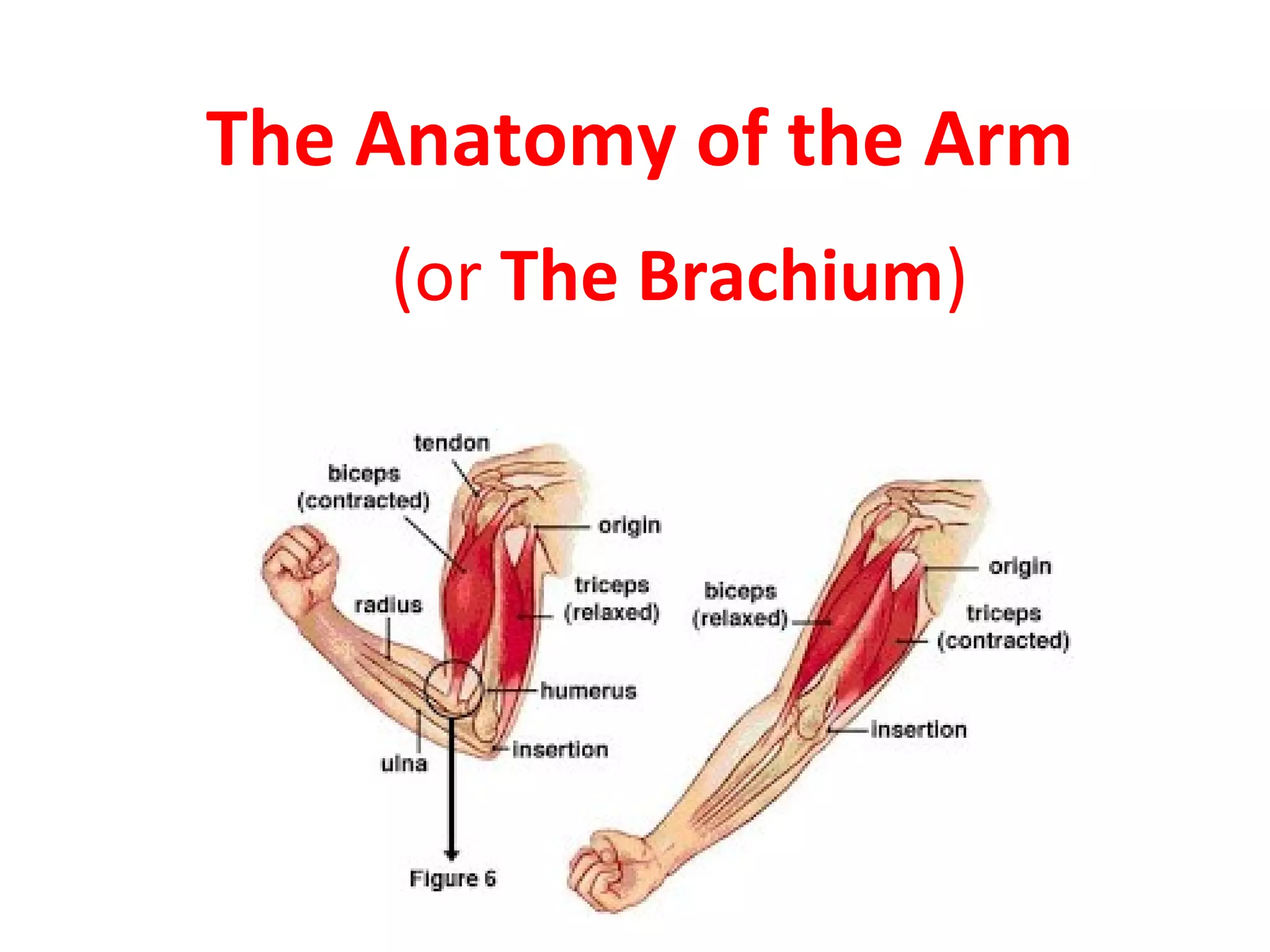
The Anatomy of the Arm
(or The Brachium)
Biceps brachii
Origin
Short head: tip of coracoid process of
scapula; Long head:
supraglenoid tubercle of scapula,
passes through the shoulder joint
and emerges from the joint through
the intertubercular groove.
Insertion Tuberosity of radius and
fascia of forearm via bicipital
aponeurosis
Action
Supinates forearm and, when it is
supine, flexes forearm
Weak flexion of arm
Innervation Musculocutaneous nerve
(C5, C6)
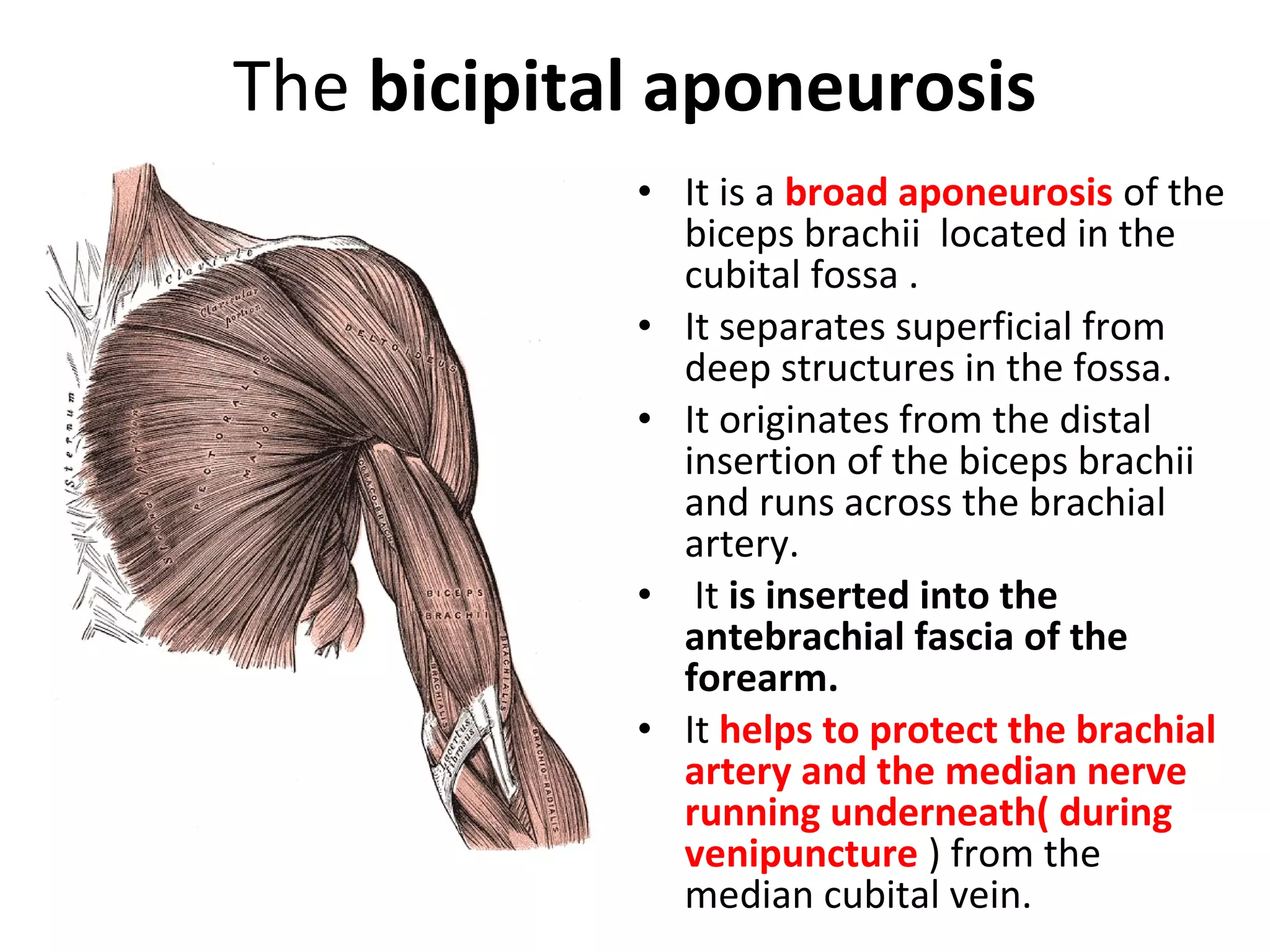
The bicipital aponeurosis
• It is a broad aponeurosis of the
biceps brachii located in the
cubital fossa .
• It separates superficial from
deep structures in the fossa.
• It originates from the distal
insertion of the biceps brachii
and runs across the brachial
artery.
• It is inserted into the
antebrachial fascia of the
forearm.
• It helps to protect the brachial
artery and the median nerve
running underneath( during
venipuncture ) from the
median cubital vein.
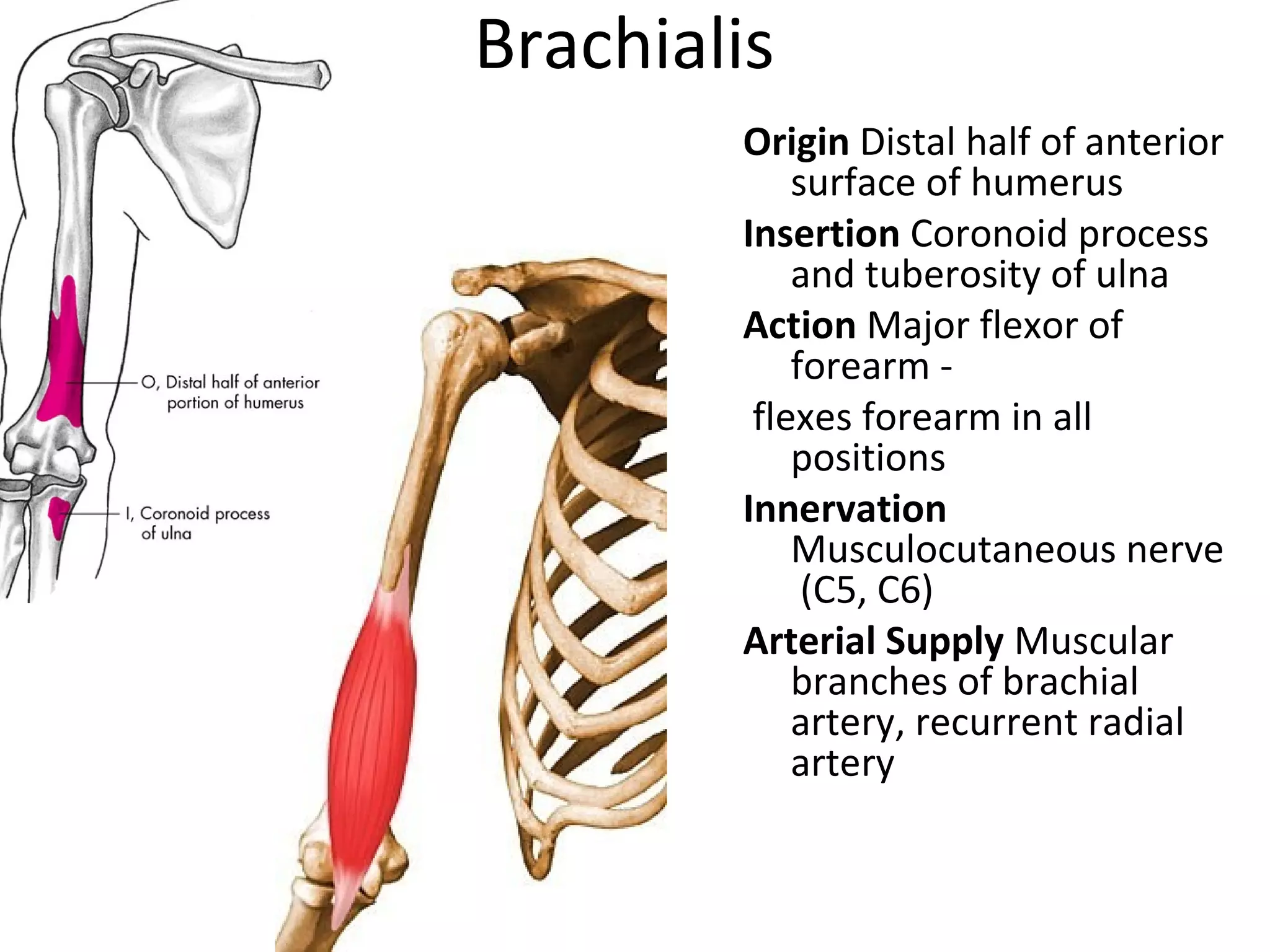
Brachialis
Origin Distal half of anterior
surface of humerus
Insertion Coronoid process
and tuberosity of ulna
Action Major flexor of
forearm -
flexes forearm in all
positions
Innervation
Musculocutaneous nerve
(C5, C6)
Arterial Supply Muscular
branches of brachial
artery, recurrent radial
artery
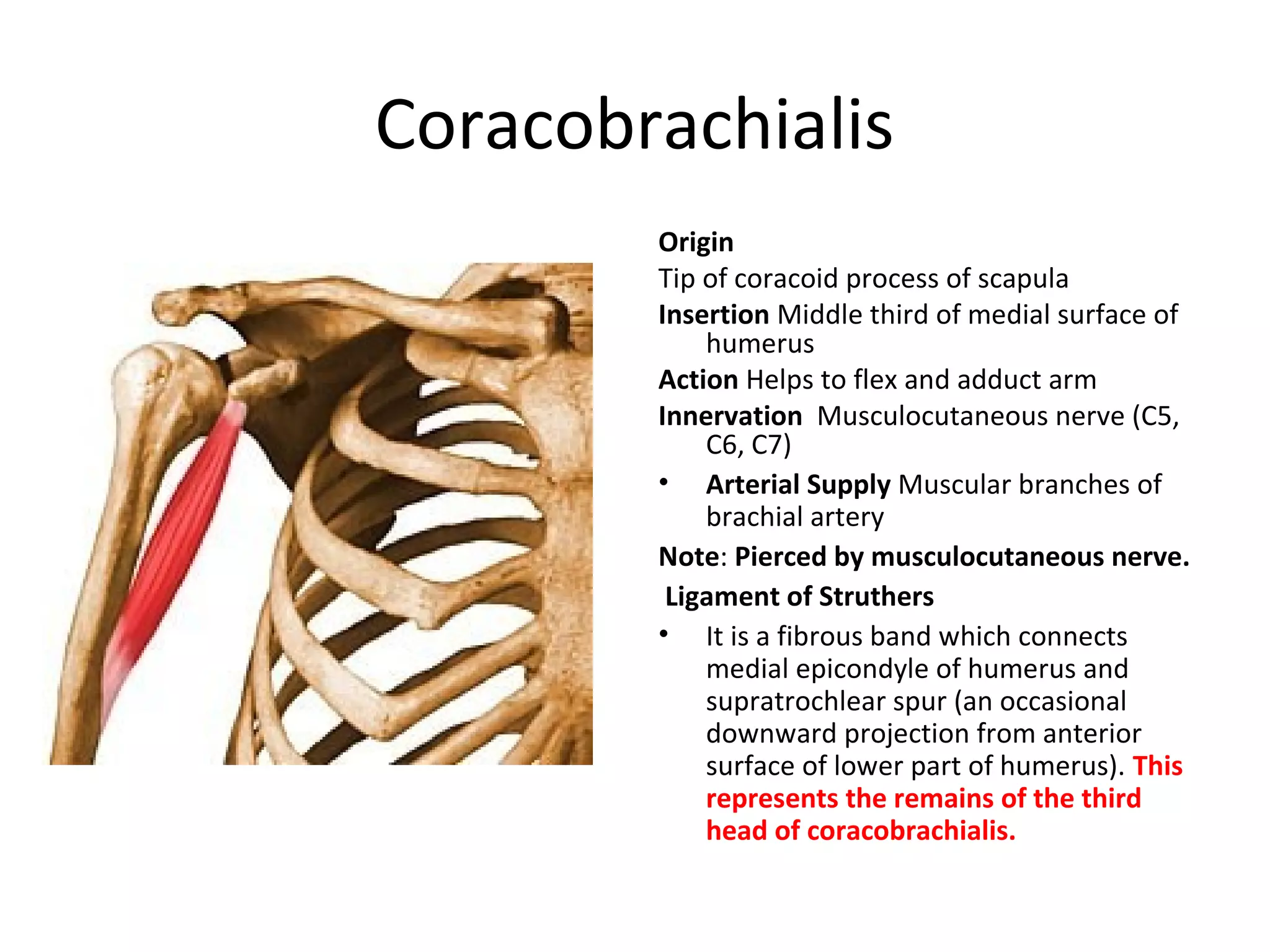
Coracobrachialis
Origin
Tip of coracoid process of scapula
Insertion Middle third of medial surface of
humerus
Action Helps to flex and adduct arm
Innervation Musculocutaneous nerve (C5,
C6, C7)
• Arterial Supply Muscular branches of
brachial artery
Note: Pierced by musculocutaneous nerve.
Ligament of Struthers
• It is a fibrous band which connects
medial epicondyle of humerus and
supratrochlear spur (an occasional
downward projection from anterior
surface of lower part of humerus). This
represents the remains of the third
head of coracobrachialis.
Musculocutaneous nerve(C,5&6)
It arises from lateral cord
of brachial plexus
It pierces the
coracobrachialis and
supplies
Biceps brachii
Brachialis
Coracobrachialis
It continues as lateral
cutaneous nerve of
forearm.
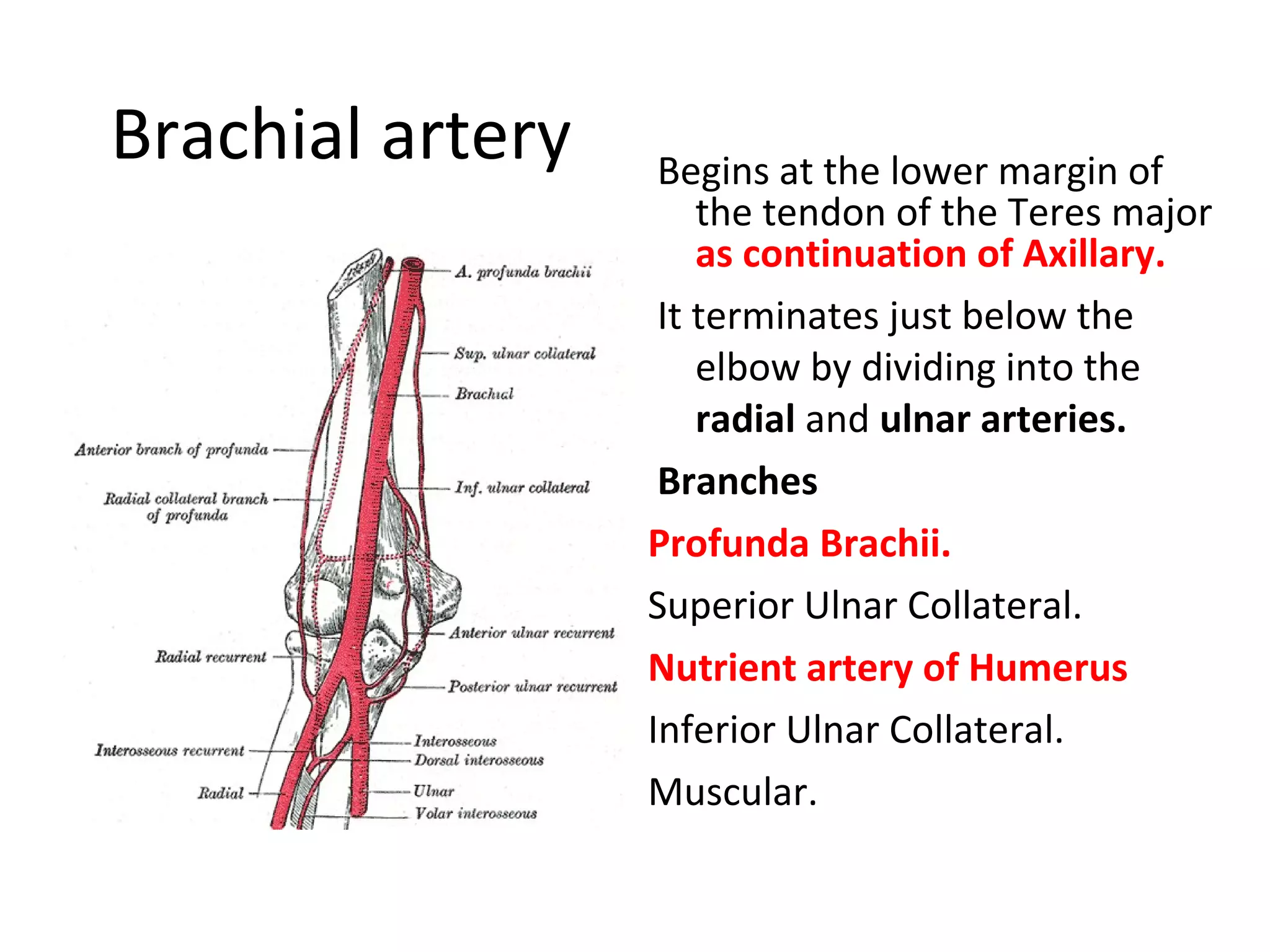
Brachial artery Begins at the lower margin of
the tendon of the Teres major
as continuation of Axillary.
It terminates just below the
elbow by dividing into the
radial and ulnar arteries.
Branches
Profunda Brachii.
Superior Ulnar Collateral.
Nutrient artery of Humerus
Inferior Ulnar Collateral.
Muscular.
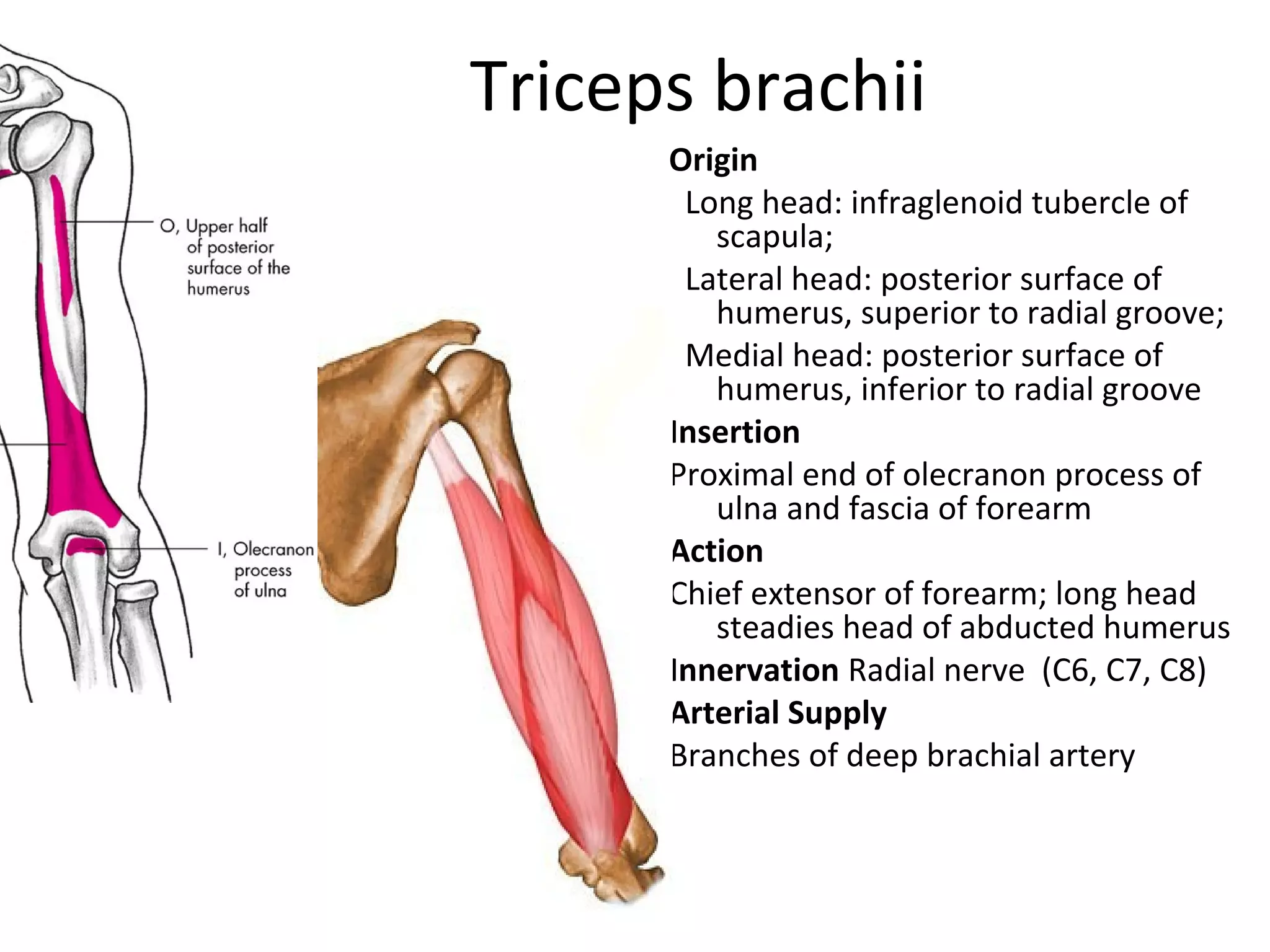
Triceps brachii
Origin
Long head: infraglenoid tubercle of
scapula;
Lateral head: posterior surface of
humerus, superior to radial groove;
Medial head: posterior surface of
humerus, inferior to radial groove
Insertion
Proximal end of olecranon process of
ulna and fascia of forearm
Action
Chief extensor of forearm; long head
steadies head of abducted humerus
Innervation Radial nerve (C6, C7, C8)
Arterial Supply
Branches of deep brachial artery
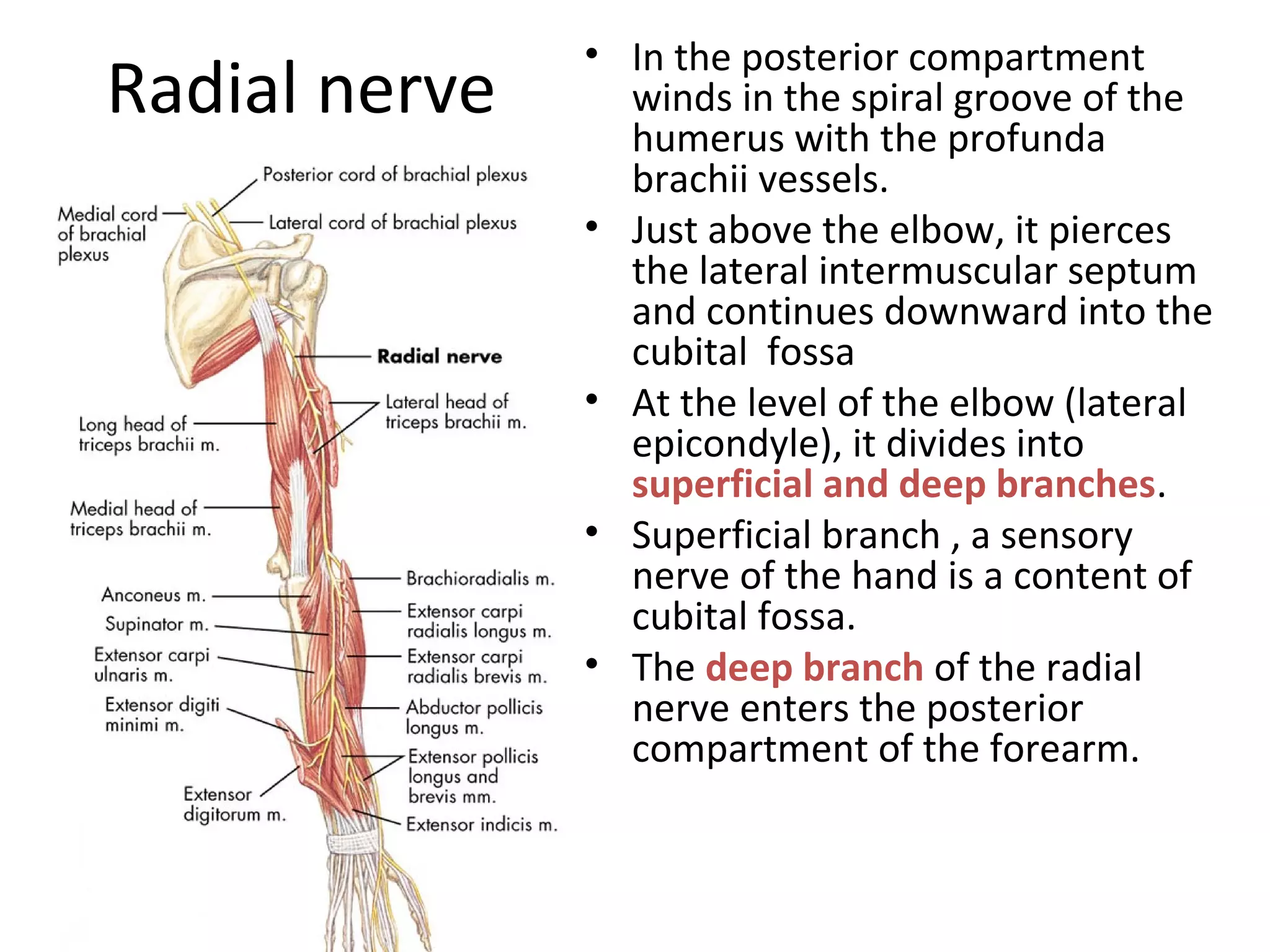
Radial nerve
• In the posterior compartment
winds in the spiral groove of the
humerus with the profunda
brachii vessels.
• Just above the elbow, it pierces
the lateral intermuscular septum
and continues downward into the
cubital fossa
• At the level of the elbow (lateral
epicondyle), it divides into
superficial and deep branches.
• Superficial branch , a sensory
nerve of the hand is a content of
cubital fossa.
• The deep branch of the radial
nerve enters the posterior
compartment of the forearm.
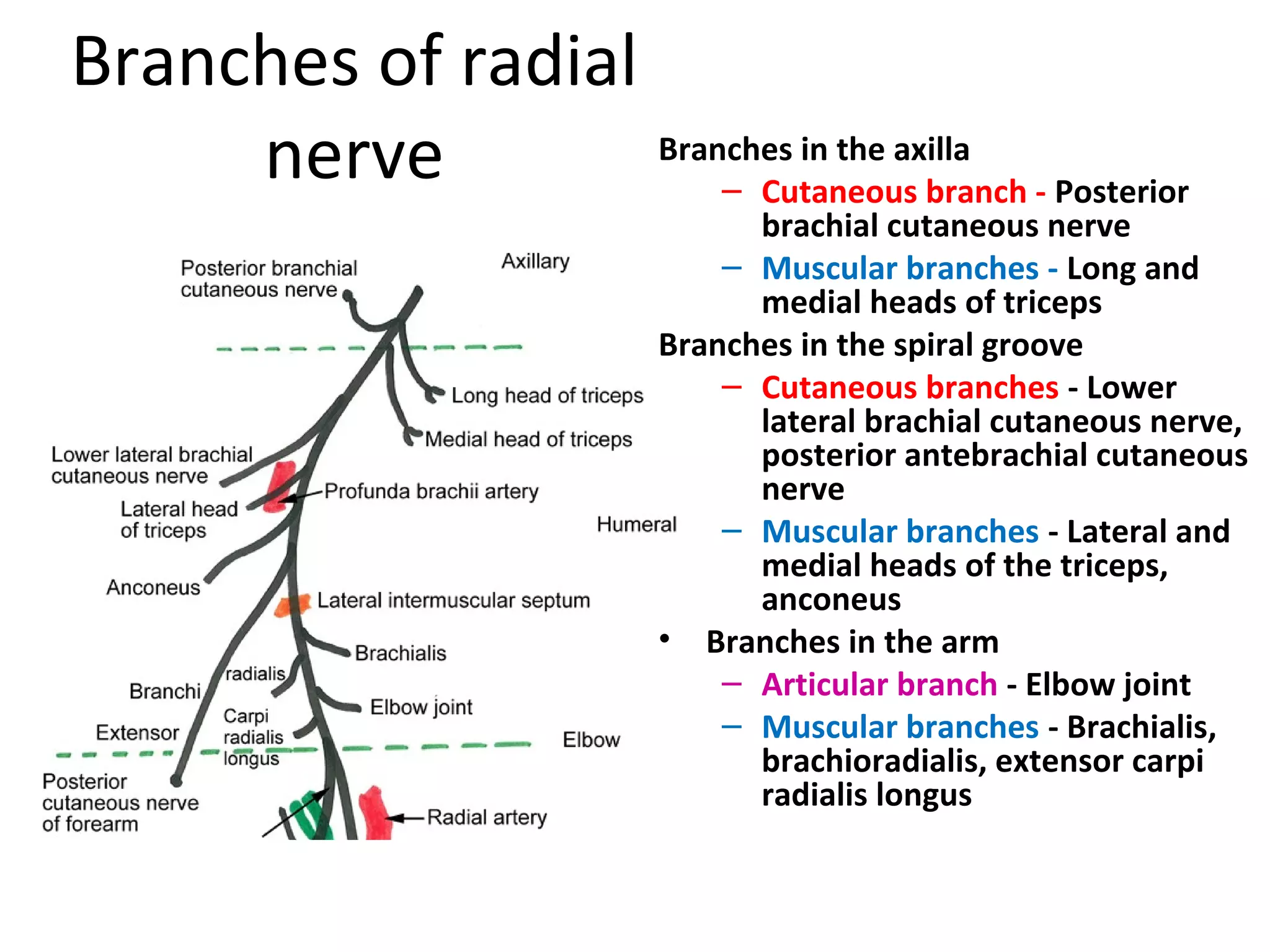
Branches of radial
nerve Branches in the axilla
– Cutaneous branch - Posterior
brachial cutaneous nerve
– Muscular branches - Long and
medial heads of triceps
Branches in the spiral groove
– Cutaneous branches - Lower
lateral brachial cutaneous nerve,
posterior antebrachial cutaneous
nerve
– Muscular branches - Lateral and
medial heads of the triceps,
anconeus
• Branches in the arm
– Articular branch - Elbow joint
– Muscular branches - Brachialis,
brachioradialis, extensor carpi
radialis longus
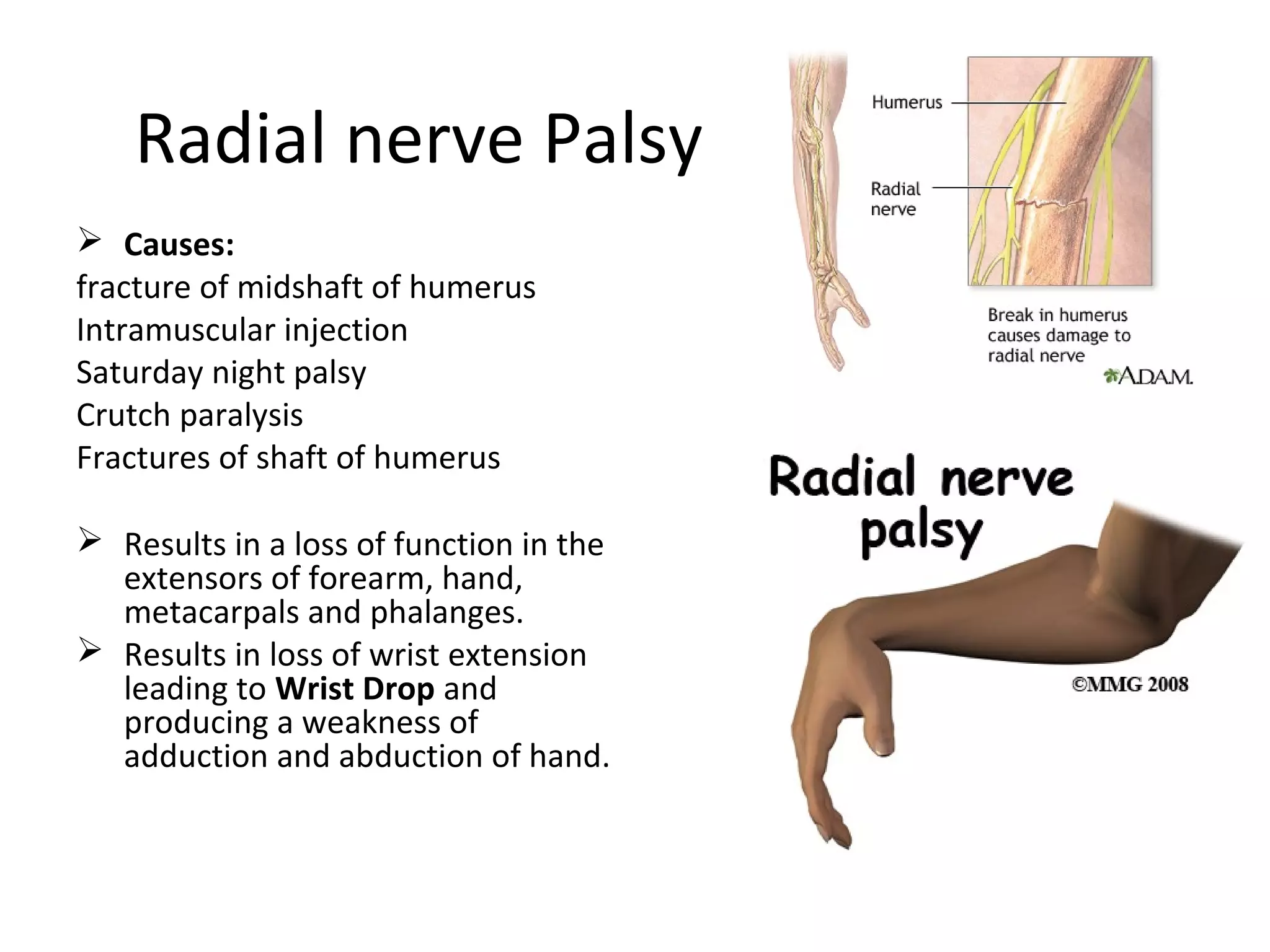
Radial nerve Palsy
 Causes:
fracture of midshaft of humerus
Intramuscular injection
Saturday night palsy
Crutch paralysis
Fractures of shaft of humerus
 Results in a loss of function in the
extensors of forearm, hand,
metacarpals and phalanges.
 Results in loss of wrist extension
leading to Wrist Drop and
producing a weakness of
adduction and abduction of hand.
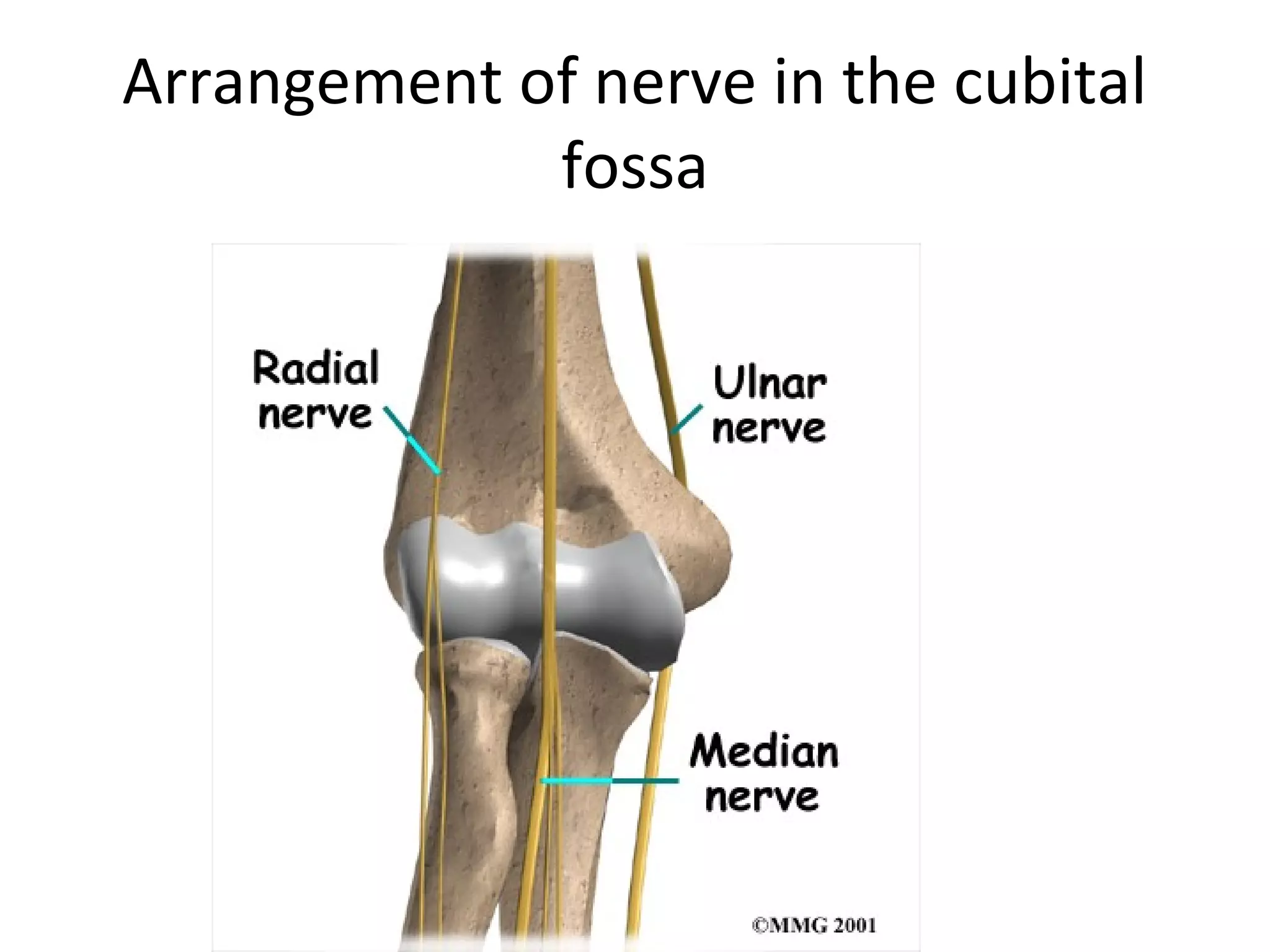
Arrangement of nerve in the cubital
fossa
The elbow joint
• Humerus, radius and ulna form a hinge
joint.
• The capitulum of the humerus articulates
with the upper aspect of the head of the
radius (humeroradial joint)
• The trochlea of the humerus articulates
with the trochlear notch of the ulna
(humero-ulnar joint).
• These two parts of the elbow joint are
continuous with each other and share a
common cavity with the proximal radio-
ulnar joint.
Movements
• Flexion is done by biceps, brachialis and
coracobrachialis.
• Extension is performed by triceps,
particularly medial head.
• The extended ulna makes with the
humerus an angle of 170 degrees. This is
carrying angle. It is 10-15degrees It fits
the elbow into the waist when the arm is
at the side.
Proximal radioulnar joint
• The circumference of the head of the
radius fits into the radial notch of ulna to
form a pivot joint.
• Strong annular ligament :attached to the
anterior and posterior margins of the
notch.
• Some fibres extend from the lower margin
of the notch to the neck of radius(quadrate
ligament)
• The synovial membrane is continuous with
that of the elbow joint.
Movements-Supination &Pronation
• The axis of movement extends from the
middle of the head of the radius to the
lower end of the ulna.
• Although the head of the radius merely
rotates within the annular ligament, its
inferior end describes an arc around the
lower end of the ulna and carries the hand
with it.
• The supinators are supinator and biceps.
• The pronators are pronator quadratus and
pronator teres.
The Cubital Fossa
Boundaries
• Lateral: medial border of
Brachioradialis
• Medial : Lateral border of
pronator teres
• Base: Imaginary line
connecting medial and
lateral epicondyles of
humerus
• Apex: Site of overlap of
pronator teres by
brachioradialis
Structures in roof of
cubital fossa
•   • Skin
• Superficial fascia
• Deep fascia with bicipital 
aponeurosis
• Cephalic vein
• Basilic vein
• Median cubital vein 
connecting the cephalic 
and basilic veins
• Lateral and medial 
cutaneous nerves of 
forearm
Contents of cubital fossa
• Median nerve 
• Brachial artery dividing into 
radial and ulnar arteries
• Tendon of biceps brachii
• Radial nerve and its two 
terminal branches 
(superficial and deep)
• Applied Aspect
• The median cubital vein is
often the vein of choice for
intravenous injections.

The anatomy of the arm

  • 1.
    The Anatomy ofthe Arm (or The Brachium)
  • 2.
    Biceps brachii Origin Short head:tip of coracoid process of scapula; Long head: supraglenoid tubercle of scapula, passes through the shoulder joint and emerges from the joint through the intertubercular groove. Insertion Tuberosity of radius and fascia of forearm via bicipital aponeurosis Action Supinates forearm and, when it is supine, flexes forearm Weak flexion of arm Innervation Musculocutaneous nerve (C5, C6)
  • 3.
    The bicipital aponeurosis •It is a broad aponeurosis of the biceps brachii located in the cubital fossa . • It separates superficial from deep structures in the fossa. • It originates from the distal insertion of the biceps brachii and runs across the brachial artery. • It is inserted into the antebrachial fascia of the forearm. • It helps to protect the brachial artery and the median nerve running underneath( during venipuncture ) from the median cubital vein.
  • 4.
    Brachialis Origin Distal halfof anterior surface of humerus Insertion Coronoid process and tuberosity of ulna Action Major flexor of forearm - flexes forearm in all positions Innervation Musculocutaneous nerve (C5, C6) Arterial Supply Muscular branches of brachial artery, recurrent radial artery
  • 5.
    Coracobrachialis Origin Tip of coracoidprocess of scapula Insertion Middle third of medial surface of humerus Action Helps to flex and adduct arm Innervation Musculocutaneous nerve (C5, C6, C7) • Arterial Supply Muscular branches of brachial artery Note: Pierced by musculocutaneous nerve. Ligament of Struthers • It is a fibrous band which connects medial epicondyle of humerus and supratrochlear spur (an occasional downward projection from anterior surface of lower part of humerus). This represents the remains of the third head of coracobrachialis.
  • 6.
    Musculocutaneous nerve(C,5&6) It arisesfrom lateral cord of brachial plexus It pierces the coracobrachialis and supplies Biceps brachii Brachialis Coracobrachialis It continues as lateral cutaneous nerve of forearm.
  • 7.
    Brachial artery Beginsat the lower margin of the tendon of the Teres major as continuation of Axillary. It terminates just below the elbow by dividing into the radial and ulnar arteries. Branches Profunda Brachii. Superior Ulnar Collateral. Nutrient artery of Humerus Inferior Ulnar Collateral. Muscular.
  • 8.
    Triceps brachii Origin Long head:infraglenoid tubercle of scapula; Lateral head: posterior surface of humerus, superior to radial groove; Medial head: posterior surface of humerus, inferior to radial groove Insertion Proximal end of olecranon process of ulna and fascia of forearm Action Chief extensor of forearm; long head steadies head of abducted humerus Innervation Radial nerve (C6, C7, C8) Arterial Supply Branches of deep brachial artery
  • 9.
    Radial nerve • Inthe posterior compartment winds in the spiral groove of the humerus with the profunda brachii vessels. • Just above the elbow, it pierces the lateral intermuscular septum and continues downward into the cubital fossa • At the level of the elbow (lateral epicondyle), it divides into superficial and deep branches. • Superficial branch , a sensory nerve of the hand is a content of cubital fossa. • The deep branch of the radial nerve enters the posterior compartment of the forearm.
  • 10.
    Branches of radial nerveBranches in the axilla – Cutaneous branch - Posterior brachial cutaneous nerve – Muscular branches - Long and medial heads of triceps Branches in the spiral groove – Cutaneous branches - Lower lateral brachial cutaneous nerve, posterior antebrachial cutaneous nerve – Muscular branches - Lateral and medial heads of the triceps, anconeus • Branches in the arm – Articular branch - Elbow joint – Muscular branches - Brachialis, brachioradialis, extensor carpi radialis longus
  • 11.
    Radial nerve Palsy Causes: fracture of midshaft of humerus Intramuscular injection Saturday night palsy Crutch paralysis Fractures of shaft of humerus  Results in a loss of function in the extensors of forearm, hand, metacarpals and phalanges.  Results in loss of wrist extension leading to Wrist Drop and producing a weakness of adduction and abduction of hand.
  • 12.
    Arrangement of nervein the cubital fossa
  • 13.
    The elbow joint •Humerus, radius and ulna form a hinge joint. • The capitulum of the humerus articulates with the upper aspect of the head of the radius (humeroradial joint) • The trochlea of the humerus articulates with the trochlear notch of the ulna (humero-ulnar joint). • These two parts of the elbow joint are continuous with each other and share a common cavity with the proximal radio- ulnar joint. Movements • Flexion is done by biceps, brachialis and coracobrachialis. • Extension is performed by triceps, particularly medial head. • The extended ulna makes with the humerus an angle of 170 degrees. This is carrying angle. It is 10-15degrees It fits the elbow into the waist when the arm is at the side.
  • 14.
    Proximal radioulnar joint •The circumference of the head of the radius fits into the radial notch of ulna to form a pivot joint. • Strong annular ligament :attached to the anterior and posterior margins of the notch. • Some fibres extend from the lower margin of the notch to the neck of radius(quadrate ligament) • The synovial membrane is continuous with that of the elbow joint. Movements-Supination &Pronation • The axis of movement extends from the middle of the head of the radius to the lower end of the ulna. • Although the head of the radius merely rotates within the annular ligament, its inferior end describes an arc around the lower end of the ulna and carries the hand with it. • The supinators are supinator and biceps. • The pronators are pronator quadratus and pronator teres.
  • 15.
    The Cubital Fossa Boundaries •Lateral: medial border of Brachioradialis • Medial : Lateral border of pronator teres • Base: Imaginary line connecting medial and lateral epicondyles of humerus • Apex: Site of overlap of pronator teres by brachioradialis
  • 16.
    Structures in roofof cubital fossa •   • Skin • Superficial fascia • Deep fascia with bicipital  aponeurosis • Cephalic vein • Basilic vein • Median cubital vein  connecting the cephalic  and basilic veins • Lateral and medial  cutaneous nerves of  forearm
  • 17.
    Contents of cubitalfossa • Median nerve  • Brachial artery dividing into  radial and ulnar arteries • Tendon of biceps brachii • Radial nerve and its two  terminal branches  (superficial and deep) • Applied Aspect • The median cubital vein is often the vein of choice for intravenous injections.