Topic Learning Outcome :
1. Describe the overall hazard analysis techniques.
2. Describe basic principle of risk assessment
3. Explains the safety management concern on the
hazard prevention.
Topic 3 :
Hazard Analysis, prevention and safety
management
Contents :
3.1 Preliminary Hazard analysis (PHA)
3.2 Detailed Hazard analysis
3.3 Hazard Prevention and Deterrence
3.4 Safety Management concerns
Example of Hazards at Office workplace
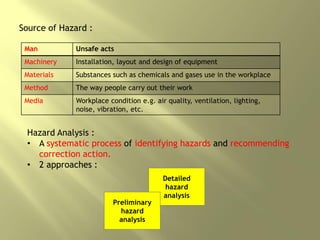
Hazard Analysis :
• A systematic process of identifying hazards and recommending
correction action.
• 2 approaches :
Detailed
hazard
analysis
Preliminary
hazard
analysis
Man Unsafe acts
Machinery Installation, layout and design of equipment
Materials Substances such as chemicals and gases use in the workplace
Method The way people carry out their work
Media Workplace condition e.g. air quality, ventilation, lighting,
noise, vibration, etc.
Source of Hazard :
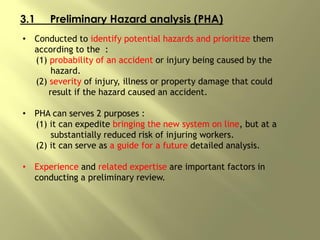
3.1 Preliminary Hazard analysis (PHA)
• Conducted to identify potential hazards and prioritize them
according to the :
(1) probability of an accident or injury being caused by the
hazard.
(2) severity of injury, illness or property damage that could
result if the hazard caused an accident.
• PHA can serves 2 purposes :
(1) it can expedite bringing the new system on line, but at a
substantially reduced risk of injuring workers.
(2) it can serve as a guide for a future detailed analysis.
• Experience and related expertise are important factors in
conducting a preliminary review.
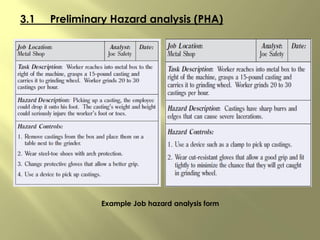
3.1 Preliminary Hazard analysis (PHA)
Example Job hazard analysis form
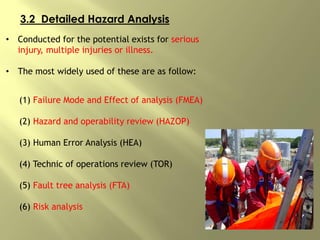
3.2 Detailed Hazard Analysis
• Conducted for the potential exists for serious
injury, multiple injuries or illness.
• The most widely used of these are as follow:
(1) Failure Mode and Effect of analysis (FMEA)
(2) Hazard and operability review (HAZOP)
(3) Human Error Analysis (HEA)
(4) Technic of operations review (TOR)
(5) Fault tree analysis (FTA)
(6) Risk analysis
3.2 Detailed Hazard Analysis
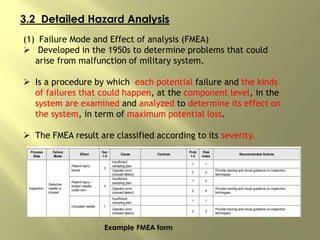
(1) Failure Mode and Effect of analysis (FMEA)
 Developed in the 1950s to determine problems that could
arise from malfunction of military system.
 Is a procedure by which each potential failure and the kinds
of failures that could happen, at the component level, in the
system are examined and analyzed to determine its effect on
the system, in term of maximum potential loss.
 The FMEA result are classified according to its severity.
Example FMEA form
3.2 Detailed Hazard Analysis
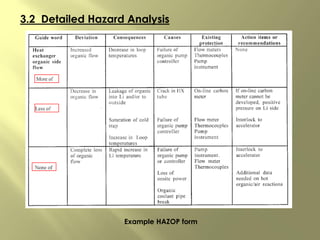
(2) Hazard And Operability Review (HAZOP)
 Developed in the 1970s by Imperial Chemical Industries Ltd
 Can be defined : formal systematic critical examination of
the process and engineering intentions of new or existing
facilities to assess the hazard potential that arise from
deviation in design specifications and the consequential
effects on the facilities as a whole.
 This techniques is usually performed using a set of
guidewords : NO/NOT, MORE OR/ LESS OF, AS WELL AS,…
 Gained wide acceptance in the process industries as a
effective tool for plant safety and operability improvements.
E.g. on fire and explosion endpoints, toxic release.
3.2 Detailed Hazard Analysis
Example HAZOP form
3.2 Detailed Hazard Analysis
(3) Fault Tree Analysis (FTA)
 Is an analytical method that uses a graphic model to display
the analysis process visually.
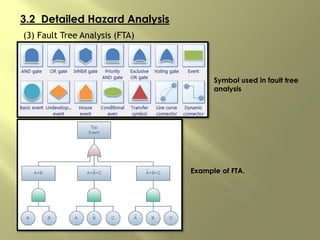
 FTA is built using special symbols, some derived from Boolean
algebra.
 FTA is qualitative in nature, but it can be made quantitative
by assigning “probability figure” to the various events.
 However, it is rarely done because reliable probability figures
are seldom available.
3.2 Detailed Hazard Analysis
(3) Fault Tree Analysis (FTA)
Symbol used in fault tree
analysis
Example of FTA.
3.2 Detailed Hazard Analysis
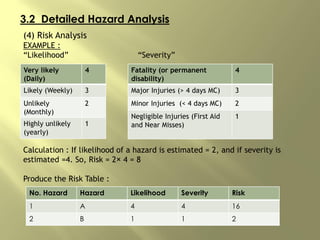
(4) Risk Analysis
• Risk is the combination of the likelihood and severity of a
specified hazardous event occurring.
• In Mathematical term, risk can be calculated by equation :
RISK = Likelihood × Severity
Risk analysis method :
• Step 1 : Gather information about each hazard identified.
• Step 2 : Use the information to assess the likelihood and
severity of each hazard.
• Step 3 : produce a qualitative risk table.
3.2 Detailed Hazard Analysis
(4) Risk Analysis
EXAMPLE :
“Likelihood” “Severity”
Calculation : If likelihood of a hazard is estimated = 2, and if severity is
estimated =4. So, Risk = 2× 4 = 8
Produce the Risk Table :
Very likely
(Daily)
4
Likely (Weekly) 3
Unlikely
(Monthly)
2
Highly unlikely
(yearly)
1
Fatality (or permanent
disability)
4
Major Injuries (> 4 days MC) 3
Minor Injuries (< 4 days MC) 2
Negligible Injuries (First Aid
and Near Misses)
1
No. Hazard Hazard Likelihood Severity Risk
1 A 4 4 16
2 B 1 1 2
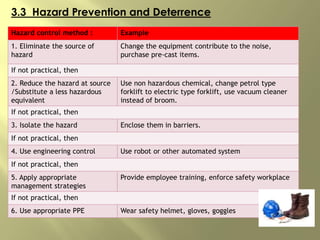
3.3 Hazard Prevention and Deterrence
Hazard control method : Example
1. Eliminate the source of
hazard
Change the equipment contribute to the noise,
purchase pre-cast items.
If not practical, then
2. Reduce the hazard at source
/Substitute a less hazardous
equivalent
Use non hazardous chemical, change petrol type
forklift to electric type forklift, use vacuum cleaner
instead of broom.
If not practical, then
3. Isolate the hazard Enclose them in barriers.
If not practical, then
4. Use engineering control Use robot or other automated system
If not practical, then
5. Apply appropriate
management strategies
Provide employee training, enforce safety workplace
If not practical, then
6. Use appropriate PPE Wear safety helmet, gloves, goggles
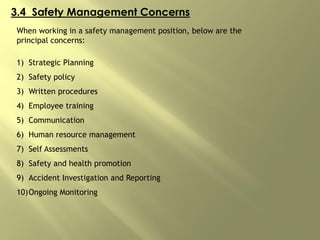
3.4 Safety Management Concerns
When working in a safety management position, below are the
principal concerns:
1) Strategic Planning
2) Safety policy
3) Written procedures
4) Employee training
5) Communication
6) Human resource management
7) Self Assessments
8) Safety and health promotion
9) Accident Investigation and Reporting
10)Ongoing Monitoring
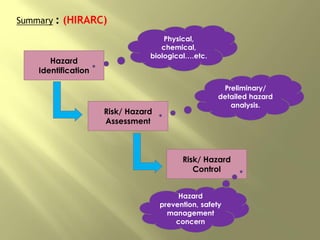
Summary : (HIRARC)
Hazard
Identification
Risk/ Hazard
Assessment
Risk/ Hazard
Control
Physical,
chemical,
biological….etc.
Preliminary/
detailed hazard
analysis.
Hazard
prevention, safety
management
concern

Lecture 4-_hazard_analysis_prevention_and_safety_management

  • 1.
    Topic Learning Outcome: 1. Describe the overall hazard analysis techniques. 2. Describe basic principle of risk assessment 3. Explains the safety management concern on the hazard prevention.
  • 2.
    Topic 3 : HazardAnalysis, prevention and safety management Contents : 3.1 Preliminary Hazard analysis (PHA) 3.2 Detailed Hazard analysis 3.3 Hazard Prevention and Deterrence 3.4 Safety Management concerns
  • 3.
    Example of Hazardsat Office workplace
  • 4.
    Hazard Analysis : •A systematic process of identifying hazards and recommending correction action. • 2 approaches : Detailed hazard analysis Preliminary hazard analysis Man Unsafe acts Machinery Installation, layout and design of equipment Materials Substances such as chemicals and gases use in the workplace Method The way people carry out their work Media Workplace condition e.g. air quality, ventilation, lighting, noise, vibration, etc. Source of Hazard :
  • 5.
    3.1 Preliminary Hazardanalysis (PHA) • Conducted to identify potential hazards and prioritize them according to the : (1) probability of an accident or injury being caused by the hazard. (2) severity of injury, illness or property damage that could result if the hazard caused an accident. • PHA can serves 2 purposes : (1) it can expedite bringing the new system on line, but at a substantially reduced risk of injuring workers. (2) it can serve as a guide for a future detailed analysis. • Experience and related expertise are important factors in conducting a preliminary review.
  • 6.
    3.1 Preliminary Hazardanalysis (PHA) Example Job hazard analysis form
  • 7.
    3.2 Detailed HazardAnalysis • Conducted for the potential exists for serious injury, multiple injuries or illness. • The most widely used of these are as follow: (1) Failure Mode and Effect of analysis (FMEA) (2) Hazard and operability review (HAZOP) (3) Human Error Analysis (HEA) (4) Technic of operations review (TOR) (5) Fault tree analysis (FTA) (6) Risk analysis
  • 8.
    3.2 Detailed HazardAnalysis (1) Failure Mode and Effect of analysis (FMEA)  Developed in the 1950s to determine problems that could arise from malfunction of military system.  Is a procedure by which each potential failure and the kinds of failures that could happen, at the component level, in the system are examined and analyzed to determine its effect on the system, in term of maximum potential loss.  The FMEA result are classified according to its severity. Example FMEA form
  • 9.
    3.2 Detailed HazardAnalysis (2) Hazard And Operability Review (HAZOP)  Developed in the 1970s by Imperial Chemical Industries Ltd  Can be defined : formal systematic critical examination of the process and engineering intentions of new or existing facilities to assess the hazard potential that arise from deviation in design specifications and the consequential effects on the facilities as a whole.  This techniques is usually performed using a set of guidewords : NO/NOT, MORE OR/ LESS OF, AS WELL AS,…  Gained wide acceptance in the process industries as a effective tool for plant safety and operability improvements. E.g. on fire and explosion endpoints, toxic release.
  • 10.
    3.2 Detailed HazardAnalysis Example HAZOP form
  • 11.
    3.2 Detailed HazardAnalysis (3) Fault Tree Analysis (FTA)  Is an analytical method that uses a graphic model to display the analysis process visually.  FTA is built using special symbols, some derived from Boolean algebra.  FTA is qualitative in nature, but it can be made quantitative by assigning “probability figure” to the various events.  However, it is rarely done because reliable probability figures are seldom available.
  • 12.
    3.2 Detailed HazardAnalysis (3) Fault Tree Analysis (FTA) Symbol used in fault tree analysis Example of FTA.
  • 13.
    3.2 Detailed HazardAnalysis (4) Risk Analysis • Risk is the combination of the likelihood and severity of a specified hazardous event occurring. • In Mathematical term, risk can be calculated by equation : RISK = Likelihood × Severity Risk analysis method : • Step 1 : Gather information about each hazard identified. • Step 2 : Use the information to assess the likelihood and severity of each hazard. • Step 3 : produce a qualitative risk table.
  • 14.
    3.2 Detailed HazardAnalysis (4) Risk Analysis EXAMPLE : “Likelihood” “Severity” Calculation : If likelihood of a hazard is estimated = 2, and if severity is estimated =4. So, Risk = 2× 4 = 8 Produce the Risk Table : Very likely (Daily) 4 Likely (Weekly) 3 Unlikely (Monthly) 2 Highly unlikely (yearly) 1 Fatality (or permanent disability) 4 Major Injuries (> 4 days MC) 3 Minor Injuries (< 4 days MC) 2 Negligible Injuries (First Aid and Near Misses) 1 No. Hazard Hazard Likelihood Severity Risk 1 A 4 4 16 2 B 1 1 2
  • 15.
    3.3 Hazard Preventionand Deterrence Hazard control method : Example 1. Eliminate the source of hazard Change the equipment contribute to the noise, purchase pre-cast items. If not practical, then 2. Reduce the hazard at source /Substitute a less hazardous equivalent Use non hazardous chemical, change petrol type forklift to electric type forklift, use vacuum cleaner instead of broom. If not practical, then 3. Isolate the hazard Enclose them in barriers. If not practical, then 4. Use engineering control Use robot or other automated system If not practical, then 5. Apply appropriate management strategies Provide employee training, enforce safety workplace If not practical, then 6. Use appropriate PPE Wear safety helmet, gloves, goggles
  • 16.
    3.4 Safety ManagementConcerns When working in a safety management position, below are the principal concerns: 1) Strategic Planning 2) Safety policy 3) Written procedures 4) Employee training 5) Communication 6) Human resource management 7) Self Assessments 8) Safety and health promotion 9) Accident Investigation and Reporting 10)Ongoing Monitoring
  • 17.
    Summary : (HIRARC) Hazard Identification Risk/Hazard Assessment Risk/ Hazard Control Physical, chemical, biological….etc. Preliminary/ detailed hazard analysis. Hazard prevention, safety management concern