Ceph:
Massively Scalable Distributed Storage
Patrick McGarry
Director Community, Inktank
Who am I?

●

Patrick McGarry

●

Dir Community, Inktank

●

/. → ALU → P4 → Inktank

●

@scuttlemonkey

●

patrick@inktank.com
Outline
●

What is Ceph?

●

Ceph History

●

How does Ceph work?

●

CRUSH Fundamentals

●

Applications

●

Testing

●

Performance

●

Moving forward

●

Questions
What is Ceph?
Ceph at a glance

So ftw a re

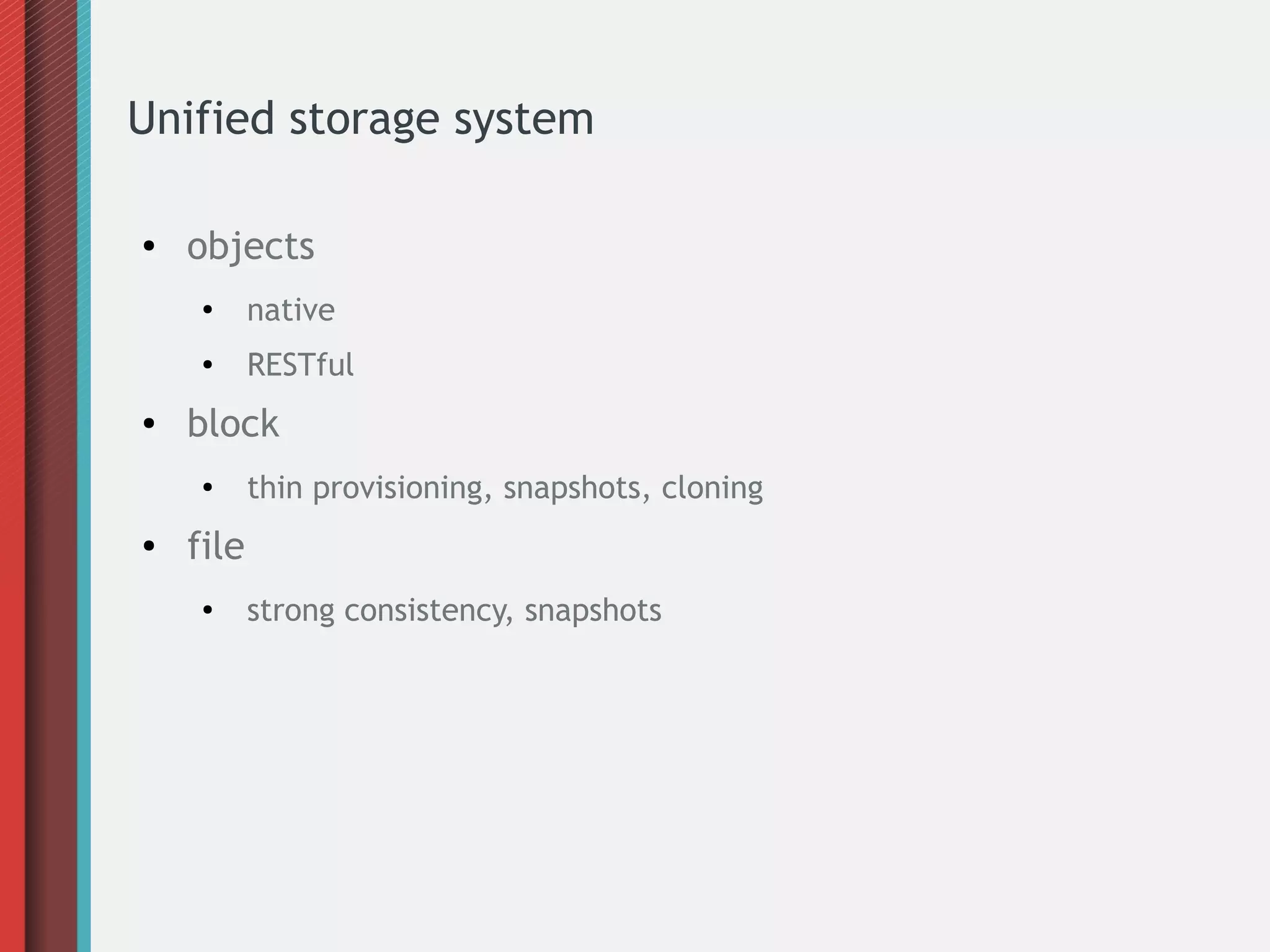
A ll- in - 1

CR U SH

S c a le

O n c o m m o d ity h a rd w a re

O b je c t , b lo c k , a n d file

A w esom esauce

H uge and b eyond

C e p h ca n ru n o n a n y
in f r a s t r u c t u r e , m e t a l
o r v ir t u a liz e d t o
p r o v id e a c h e a p a n d
p o w e rfu l sto ra g e
c lu s t e r .

L o w o ve rh e a d
d o e sn ’t m e a n ju st
h a r d w a r e , it m e a n s
p e o p le t o o !

In f r a s t r u c t u r e - a w a r e
p la c e m e n t a lg o r it h m
a llo w s y o u t o d o
r e a lly c o o l s t u f f .

D e s ig n e d f o r
e x a b yte , cu rre n t
im p le m e n t a t io n s in
t h e m u lt i- p e t a b y t e .
H P C , B ig D a t a ,
C lo u d , r a w s t o r a g e .
Unified storage system
●

objects
●

●

●

native
RESTful

block
●

●

thin provisioning, snapshots, cloning

file
●

strong consistency, snapshots
Distributed storage system
●

data center scale
●

●

●

10s to 10,000s of machines
terabytes to exabytes

fault tolerant
●

●

●

no single point of failure
commodity hardware

self-managing, self-healing
Where did Ceph come from?
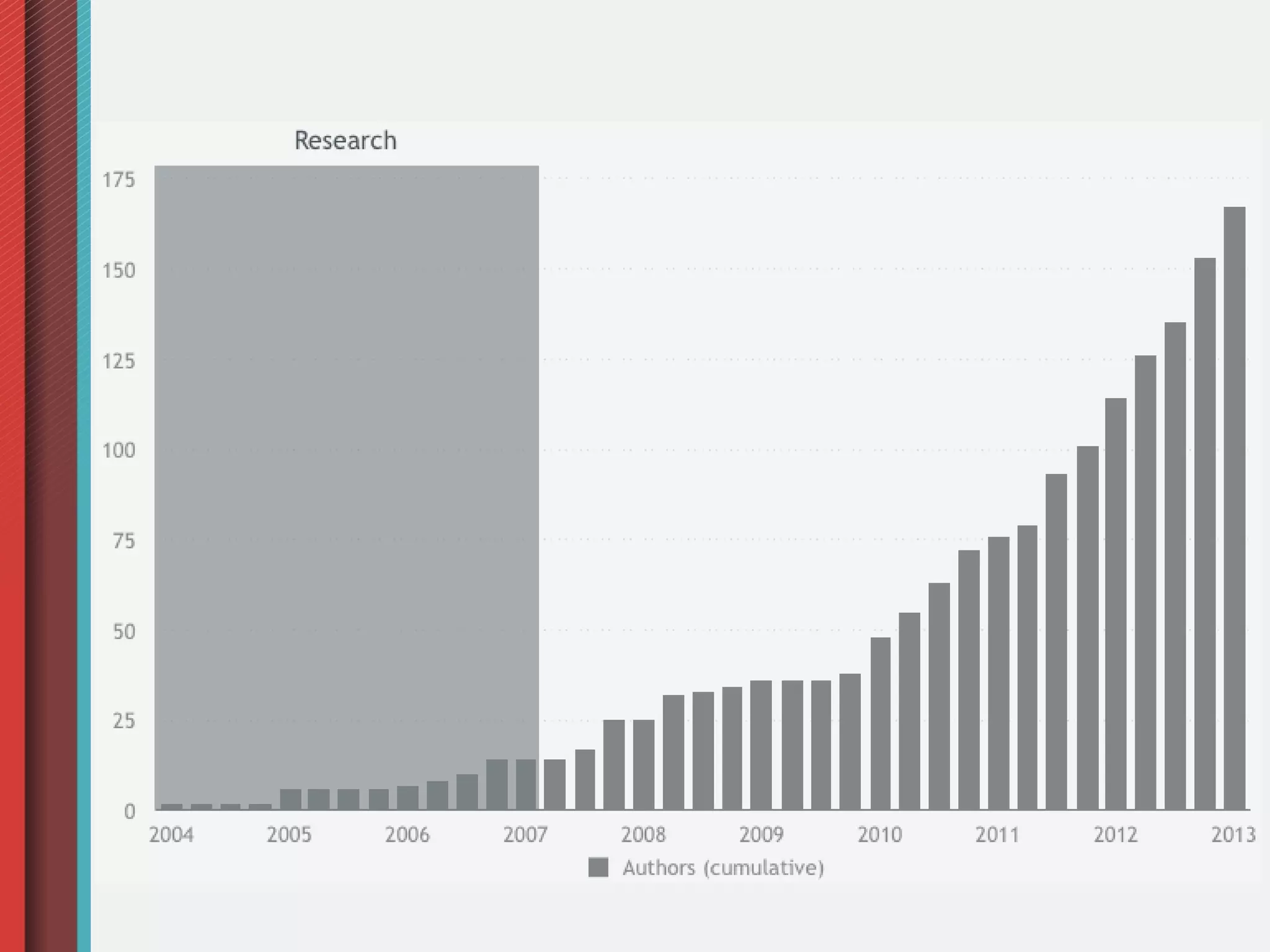
UCSC research grant
●

“Petascale object storage”
●

DOE: LANL, LLNL, Sandia

●

Scalability

●

Reliability

●

Performance
●

●

Raw IO bandwidth, metadata ops/sec

HPC file system workloads
●

Thousands of clients writing to same file, directory
Distributed metadata management
●

Innovative design
●

Subtree-based partitioning for locality, efficiency

●

Dynamically adapt to current workload

●

Embedded inodes

●

Prototype simulator in Java (2004)

●

First line of Ceph code
●

Summer internship at LLNL

●

High security national lab environment

●

Could write anything, as long as it was OSS
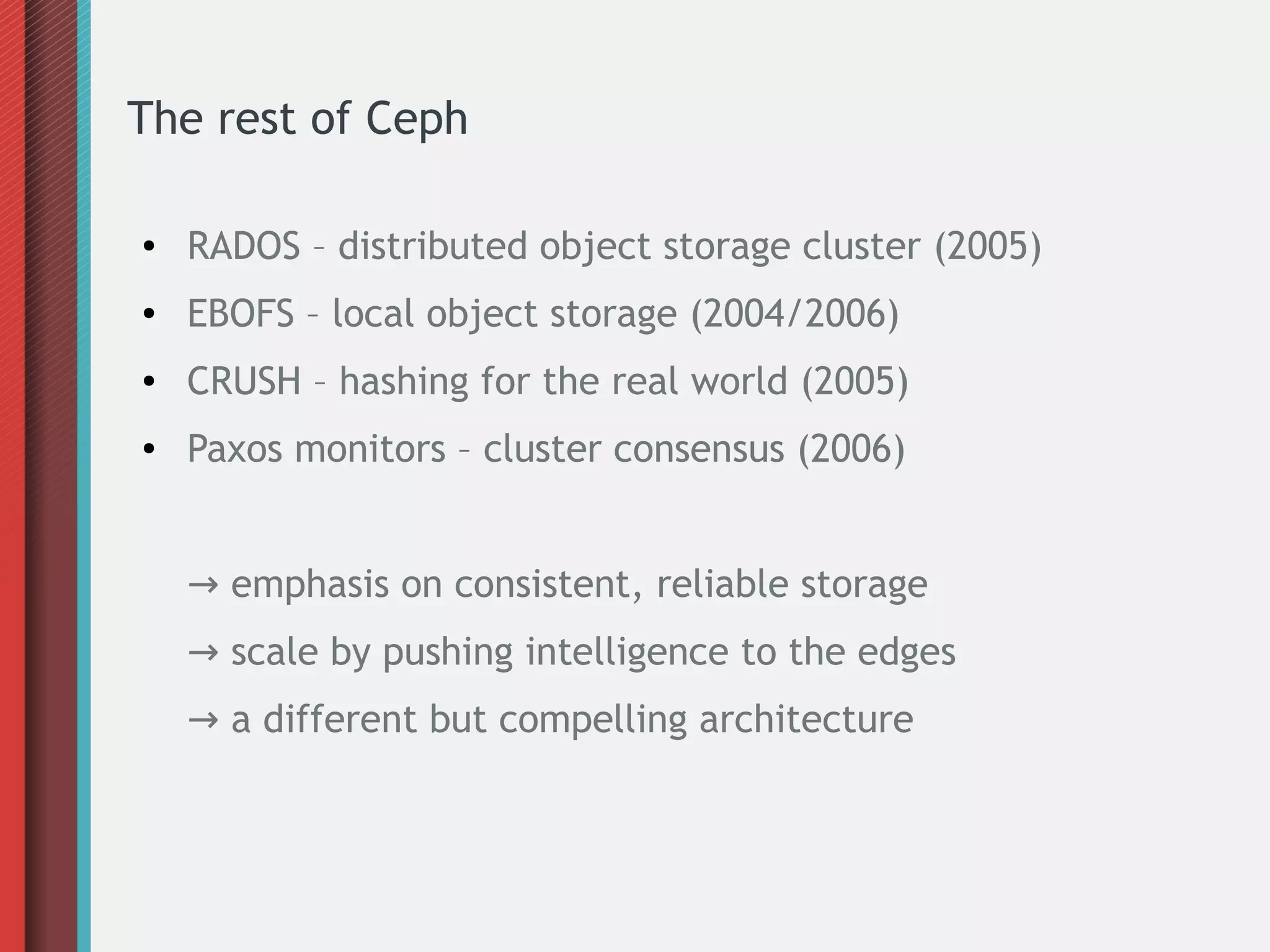
The rest of Ceph
●

RADOS – distributed object storage cluster (2005)

●

EBOFS – local object storage (2004/2006)

●

CRUSH – hashing for the real world (2005)

●

Paxos monitors – cluster consensus (2006)
→ emphasis on consistent, reliable storage
→ scale by pushing intelligence to the edges
→ a different but compelling architecture
Industry black hole
●

Many large storage vendors
●

●

Proprietary solutions that don't scale well

Few open source alternatives (2006)
●

●

Limited community and architecture (Lustre)

●

●

Very limited scale, or
No enterprise feature sets (snapshots, quotas)

PhD grads all built interesting systems...
●

●

...and then went to work for Netapp, DDN, EMC, Veritas.

They want you, not your project
A different path
●

Change the world with open source
●

●

●

Do what Linux did to Solaris, Irix, Ultrix, etc.
What could go wrong?

License
●

●

●

GPL, BSD...
LGPL: share changes, okay to link to proprietary code

Avoid unsavory practices
●

Dual licensing

●

Copyright assignment
How does Ceph work?
APP
APP

LIBRADOS
LIBRADOS

APP
APP

RADOSGW
RADOSGW

AA bucket-based
bucket-based
AA library allowing REST gateway,
library allowing
REST gateway,
apps to directly
compatible with S3
apps to directly
compatible with S3
access RADOS,
and Swift
access RADOS,
and Swift
with support for
with support for
C, C++, Java,
C, C++, Java,
Python, Ruby,
Python, Ruby,
and PHP
and PHP

HOST/VM
HOST/VM

CLIENT
CLIENT

RBD
RBD

CEPH FS
CEPH FS

AA reliable and fullyreliable and fullydistributed block
distributed block
device, with a a Linux
device, with Linux
kernel client and a a
kernel client and
QEMU/KVM driver
QEMU/KVM driver

AA POSIX-compliant
POSIX-compliant
distributed file system,
with a a Linux kernel
with Linux kernel
client and support for
FUSE
FUSE

RADOS
RADOS
AA reliable, autonomous, distributed object store comprised of self-healing, self-managing,
reliable, autonomous, distributed object store comprised of self-healing, self-managing,
intelligent storage nodes
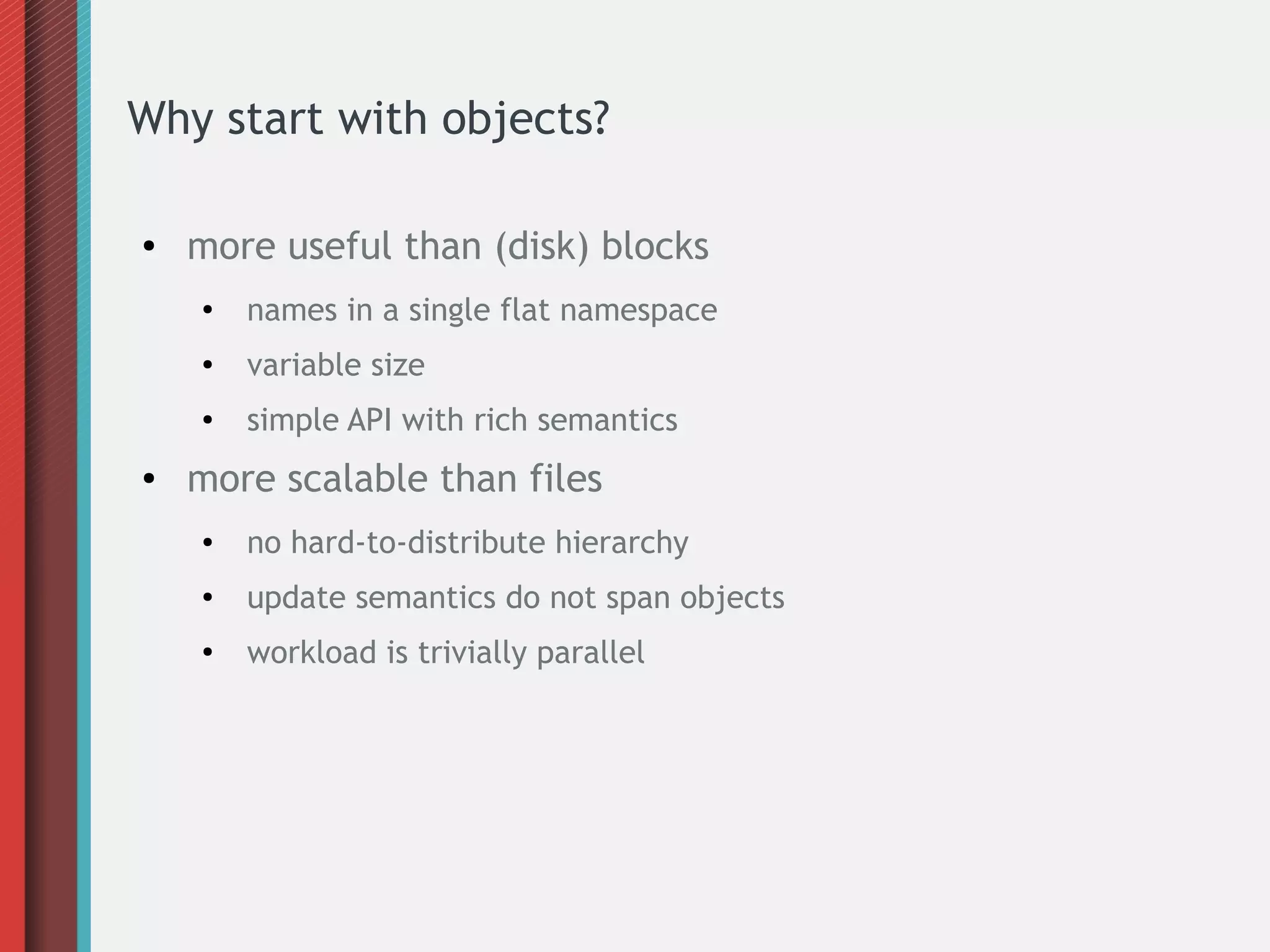
Why start with objects?
●

more useful than (disk) blocks
●

●

variable size

●

●

names in a single flat namespace
simple API with rich semantics

more scalable than files
●

no hard-to-distribute hierarchy

●

update semantics do not span objects

●

workload is trivially parallel
Ceph object model
●

pools
●

●

independent namespaces or object collections

●

●

1s to 100s
replication level, placement policy

objects
●

bazillions

●

blob of data (bytes to gigabytes)

●

attributes (e.g., “version=12”; bytes to kilobytes)

●

key/value bundle (bytes to gigabytes)
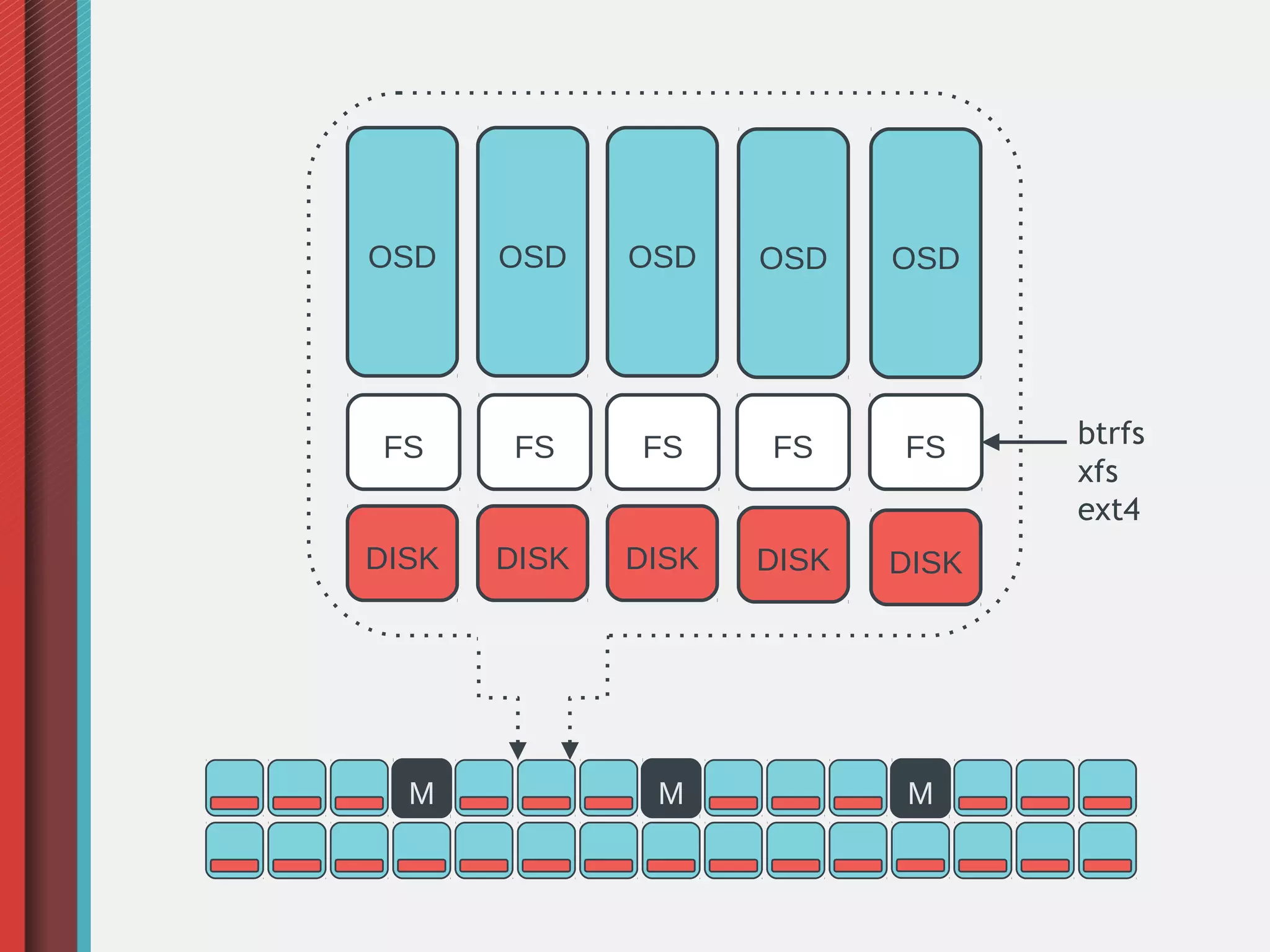
OSD

OSD

OSD

OSD

OSD

FS

FS

FS

FS

FS

DISK

DISK

DISK

DISK

DISK

M

M

M

btrfs
xfs
ext4
Object Storage Daemons (OSDs)
●

10s to 10000s in a cluster

●

one per disk, SSD, or RAID group, or ...
●

●

●

hardware agnostic

serve stored objects to clients
intelligently peer to perform replication and
recovery tasks

Monitors

M

●

●

maintain cluster membership and state
provide consensus for distributed decisionmaking

●

small, odd number

●

these do not served stored objects to clients
Data distribution
●

●

●

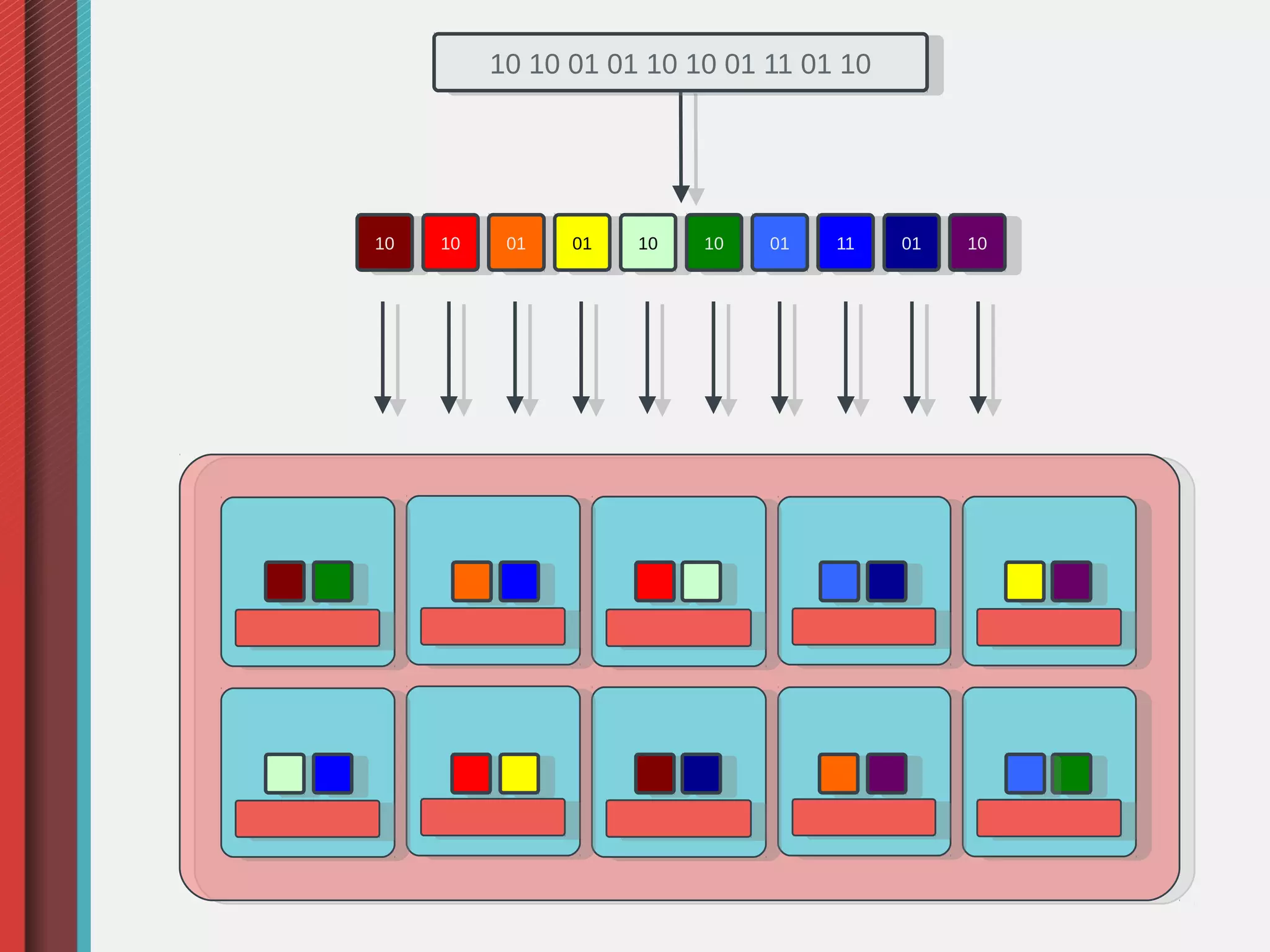
all objects are replicated N times
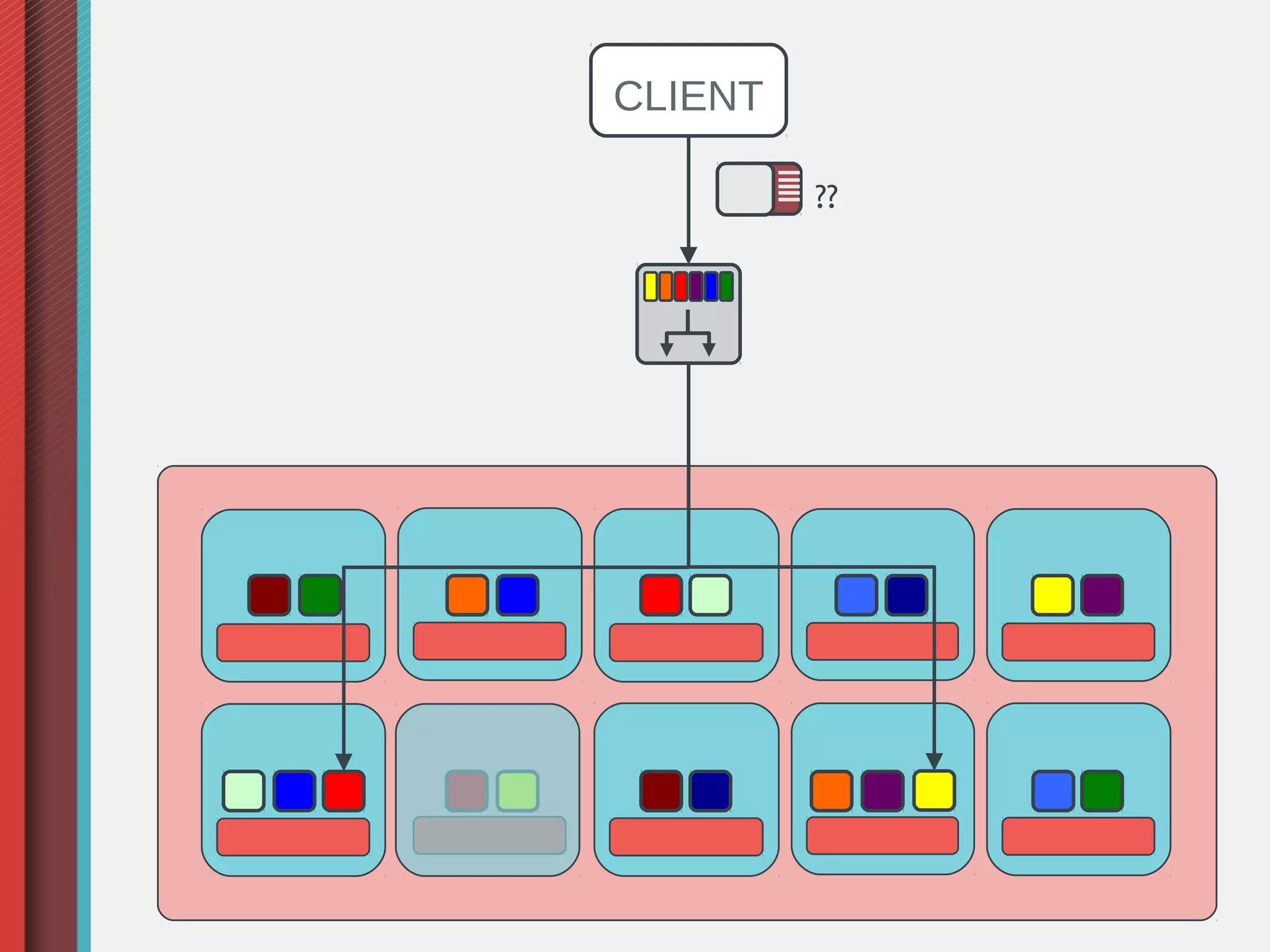
objects are automatically placed, balanced, migrated in a
dynamic cluster
must consider physical infrastructure
●

●

ceph-osds on hosts in racks in rows in data centers

three approaches
●

pick a spot; remember where you put it

●

pick a spot; write down where you put it

●

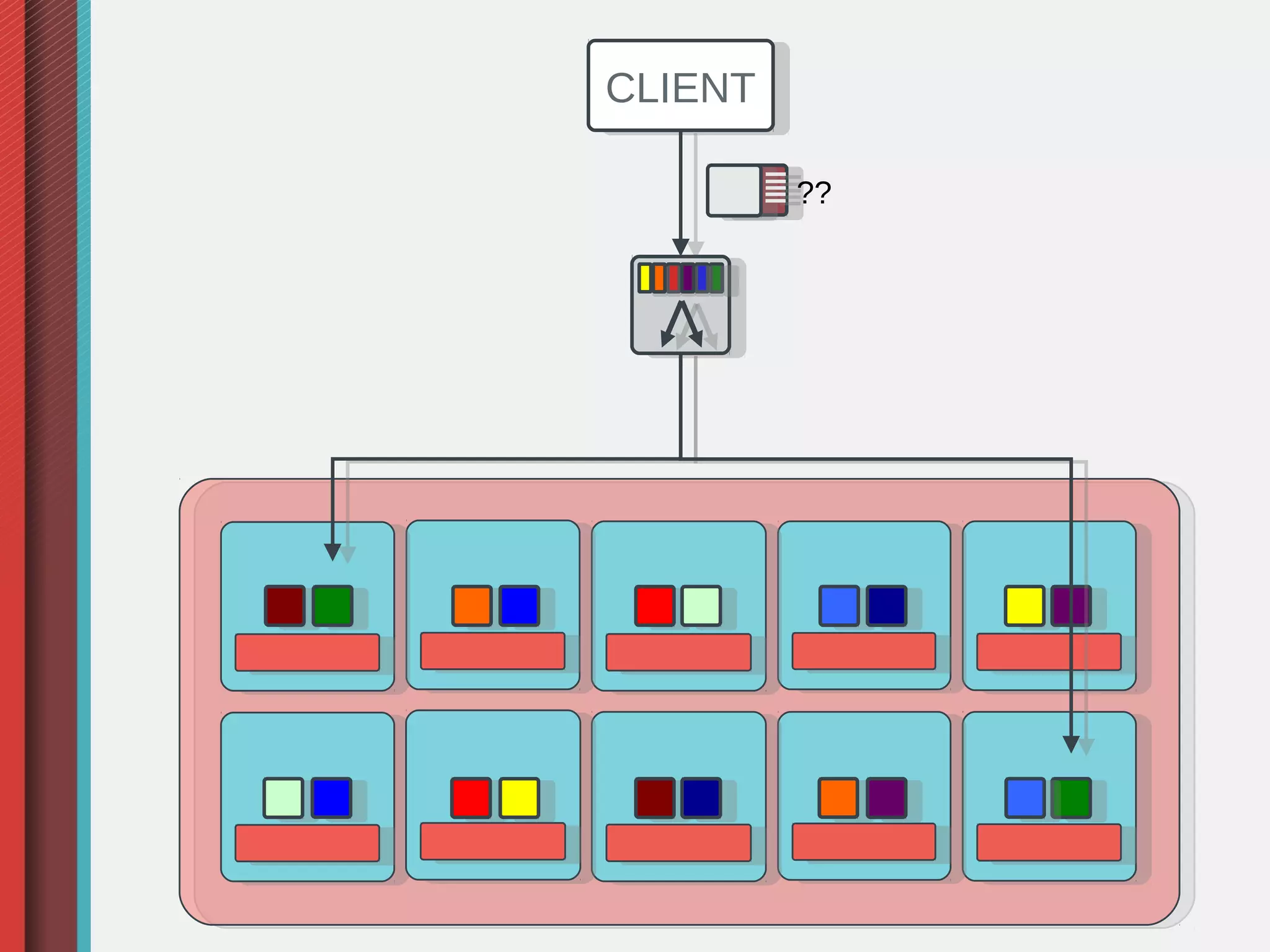
calculate where to put it, where to find it
CRUSH fundamentals
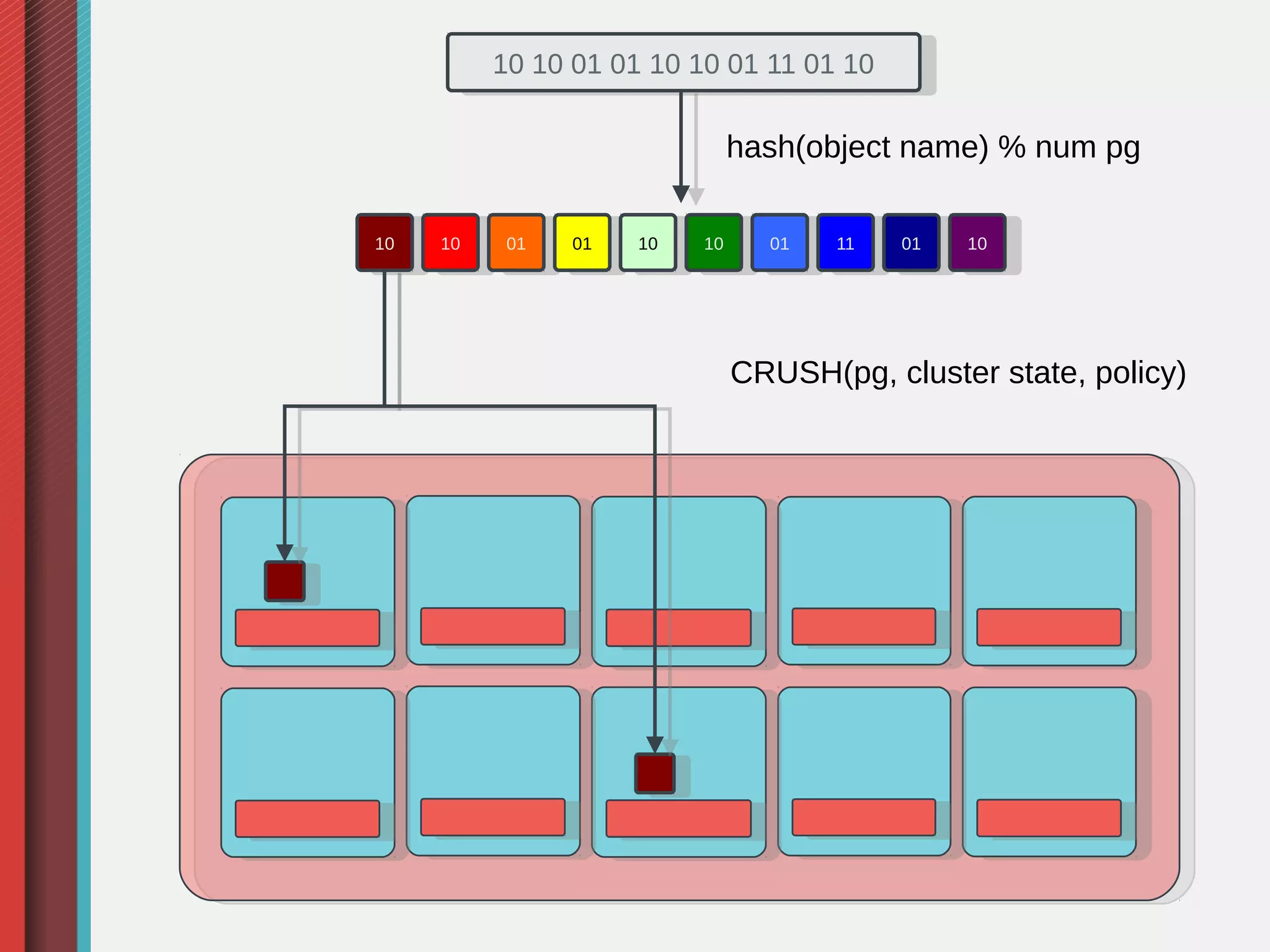
CRUSH
●

pseudo-random placement algorithm
●

fast calculation, no lookup

●

repeatable, deterministic

●

statistically uniform distribution

●

stable mapping
●

●

limited data migration on change

rule-based configuration
●

infrastructure topology aware

●

adjustable replication

●

allows weighting
[Mapping]

[Buckets]

[Rules]

[Map]
10 10 01 01 10 10 01 11 01 10
10 10 01 01 10 10 01 11 01 10

hash(object name) % num pg
10
10

10
10

01
01

01
01

10
10

10
10

01
01

1111

01
01

10
10

CRUSH(pg, cluster state, policy)
10 10 01 01 10 10 01 11 01 10
10 10 01 01 10 10 01 11 01 10

10
10

10
10

01
01

01
01

10
10

10
10

01
01

1111

01
01

10
10
CLIENT
CLIENT
??
CLIENT
??
Applications
APP
APP

LIBRADOS
LIBRADOS

APP
APP

RADOSGW
RADOSGW

AA bucket-based
bucket-based
AA library allowing REST gateway,
library allowing
REST gateway,
apps to directly
compatible with S3
apps to directly
compatible with S3
access RADOS,
and Swift
access RADOS,
and Swift
with support for
with support for
C, C++, Java,
C, C++, Java,
Python, Ruby,
Python, Ruby,
and PHP
and PHP

HOST/VM
HOST/VM

CLIENT
CLIENT

RBD
RBD

CEPH FS
CEPH FS

AA reliable and fullyreliable and fullydistributed block
distributed block
device, with a a Linux
device, with Linux
kernel client and a a
kernel client and
QEMU/KVM driver
QEMU/KVM driver

AA POSIX-compliant
POSIX-compliant
distributed file system,
with a a Linux kernel
with Linux kernel
client and support for
FUSE
FUSE

RADOS
RADOS
AA reliable, autonomous, distributed object store comprised of self-healing, self-managing,
reliable, autonomous, distributed object store comprised of self-healing, self-managing,
intelligent storage nodes
RADOS Gateway
●

REST-based object storage proxy

●

uses RADOS to store objects

●

API supports buckets, accounting

●

usage accounting for billing purposes

●

compatible with S3, Swift APIs
RADOS Block Device
●

storage of disk images in RADOS

●

decouple VM from host

●

images striped across entire cluster (pool)

●

snapshots

●

copy-on-write clones

●

support in
●

Qemu/KVM, Xen

●

mainline Linux kernel (2.6.34+)

●

OpenStack, CloudStack

●

Ganeti, OpenNebula
Metadata Server (MDS)
●

manages metadata for POSIX shared file system
●

directory hierarchy

●

file metadata (size, owner, timestamps)

●

stores metadata in RADOS

●

does not serve file data to clients

●

only required for the shared file system
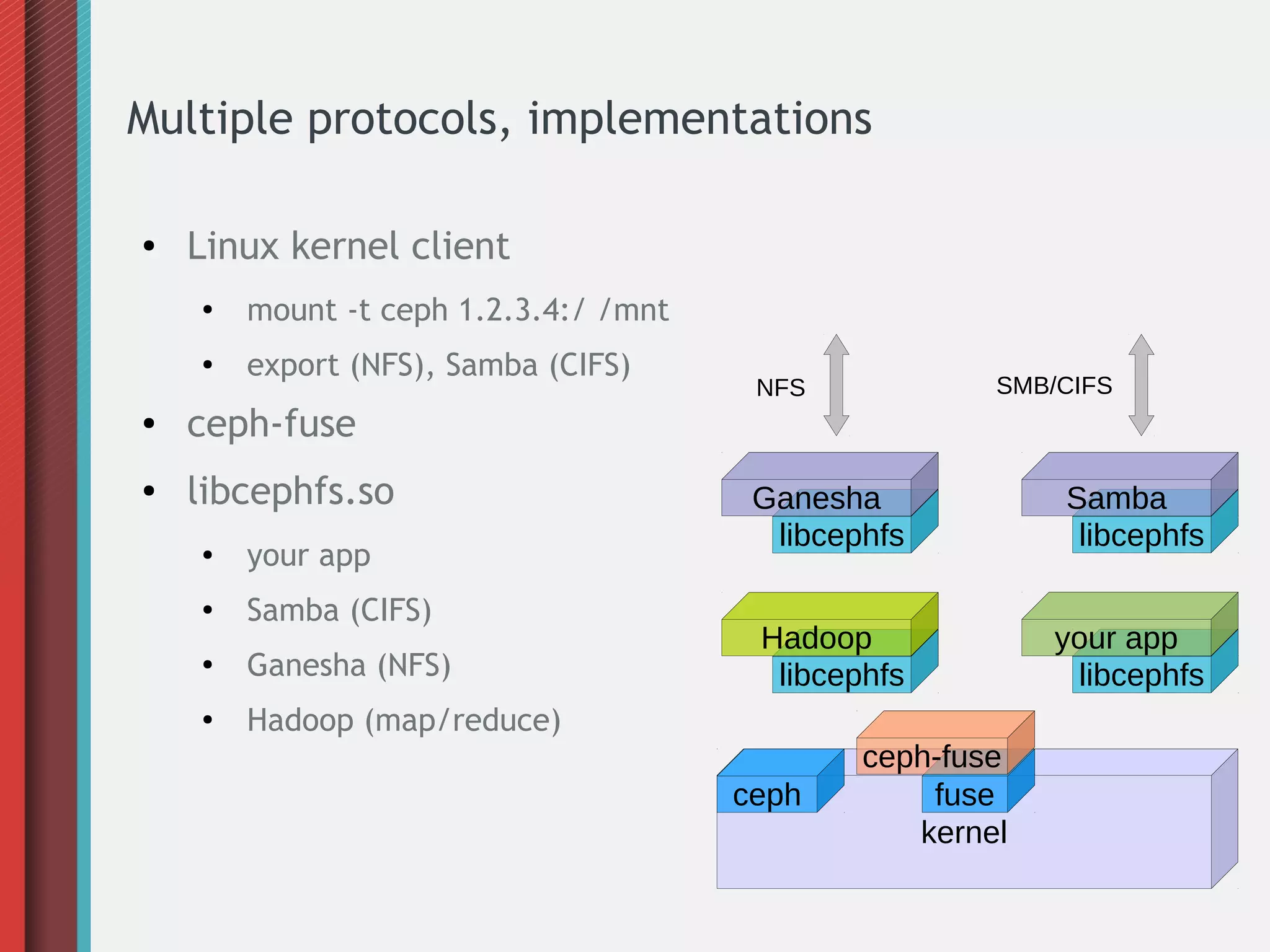
Multiple protocols, implementations
●

Linux kernel client
●

mount -t ceph 1.2.3.4:/ /mnt

●

export (NFS), Samba (CIFS)

●

ceph-fuse

●

libcephfs.so
●

your app

●

Samba (CIFS)

●

Ganesha (NFS)

●

SMB/CIFS

NFS

Ganesha
libcephfs

Samba
libcephfs

Hadoop
libcephfs

your app
libcephfs

Hadoop (map/reduce)
ceph

ceph-fuse
fuse
kernel
Testing
Package Building
●

GitBuilder
●

●

Very basic tool, works well though

●

Push to get → .deb && .rpm for all platforms

●

●

Build packages / tarballs

autosigned

Pbuilder
●

Used for major releases

●

Clean room type of build

●

Signed using different key

●

As many distros as possible (All Debian, Ubuntu, Fedora 17&18,
CentOS, SLES, OpenSUSE, tarball)
Teuthology
●

Our own custom test framework

●

Allocates machines you define to cluster you define

●

Runs tasks against that environment
●

Set up ceph

●

Run workloads

●

Pull from SAMBA gitbuilder → mount Ceph → run NFS client → mount
it → run workload

●

Makes it easy to stack things up, map them to hosts, run

●

Suite of tests on our github

●

Active community development underway!
Performance
4K Relative Performance

All Workloads: QEMU/KVM, BTRFS, or XFS
Read Heavy Only Workloads: Kernel RBD, EXT4, or XFS
128K Relative Performance

All Workloads: QEMU/KVM, or XFS
Read Heavy Only Workloads: Kernel RBD, BTRFS, or EXT4
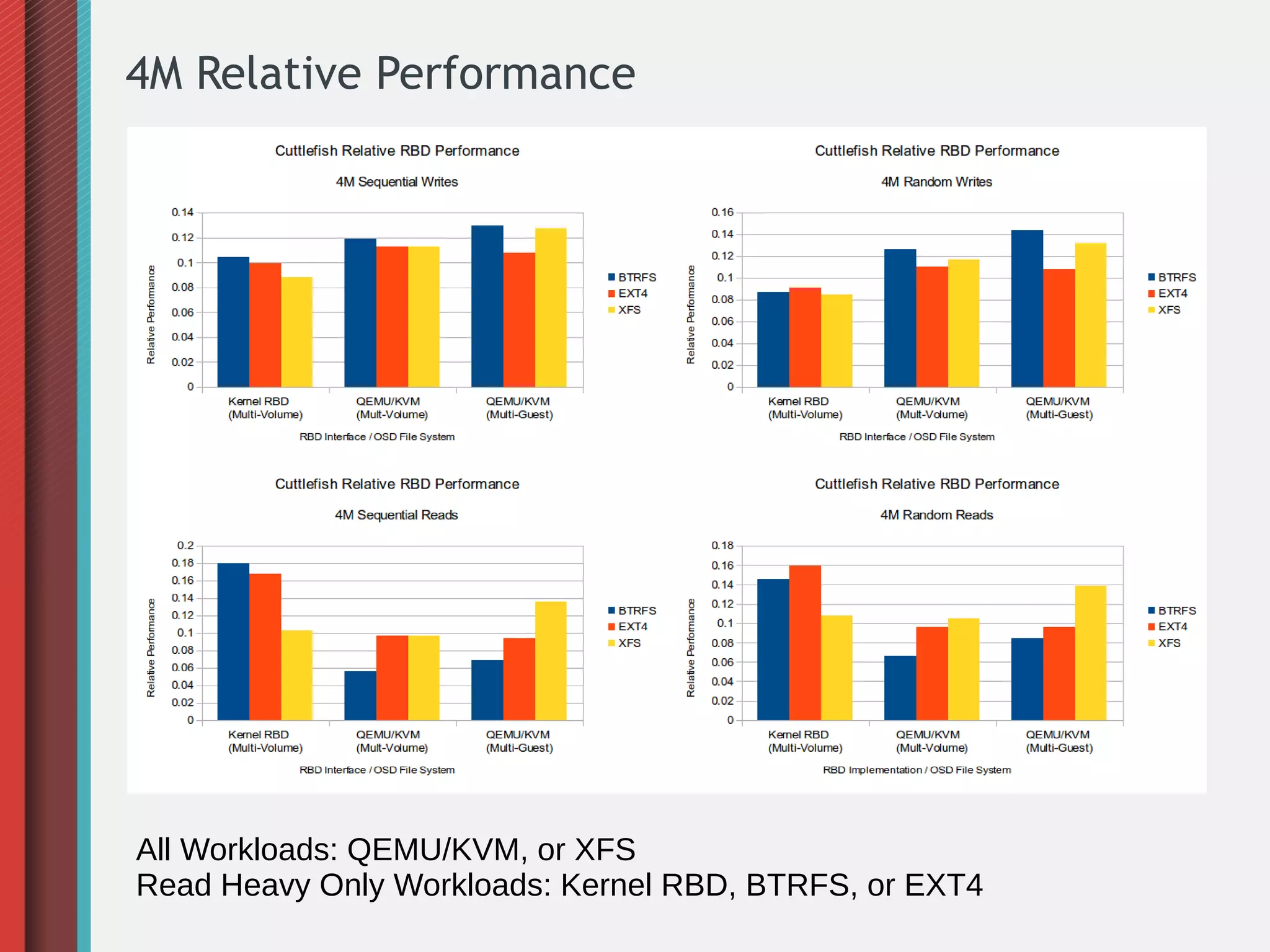
4M Relative Performance

All Workloads: QEMU/KVM, or XFS
Read Heavy Only Workloads: Kernel RBD, BTRFS, or EXT4
What does this mean?
●

Anecdotal results are great!

●

Concrete evidence coming soon

●

Performance is complicated
●

Workload

●

Hardware (especially network!)

●

Lots and lots of tuneables

●

Mark Nelson (nhm on #ceph) is the performance geek

●

Lots of reading on ceph.com blog

●

We welcome testing and comparison help
●

Anyone want to help with an EMC / NetApp showdown?
Moving forward
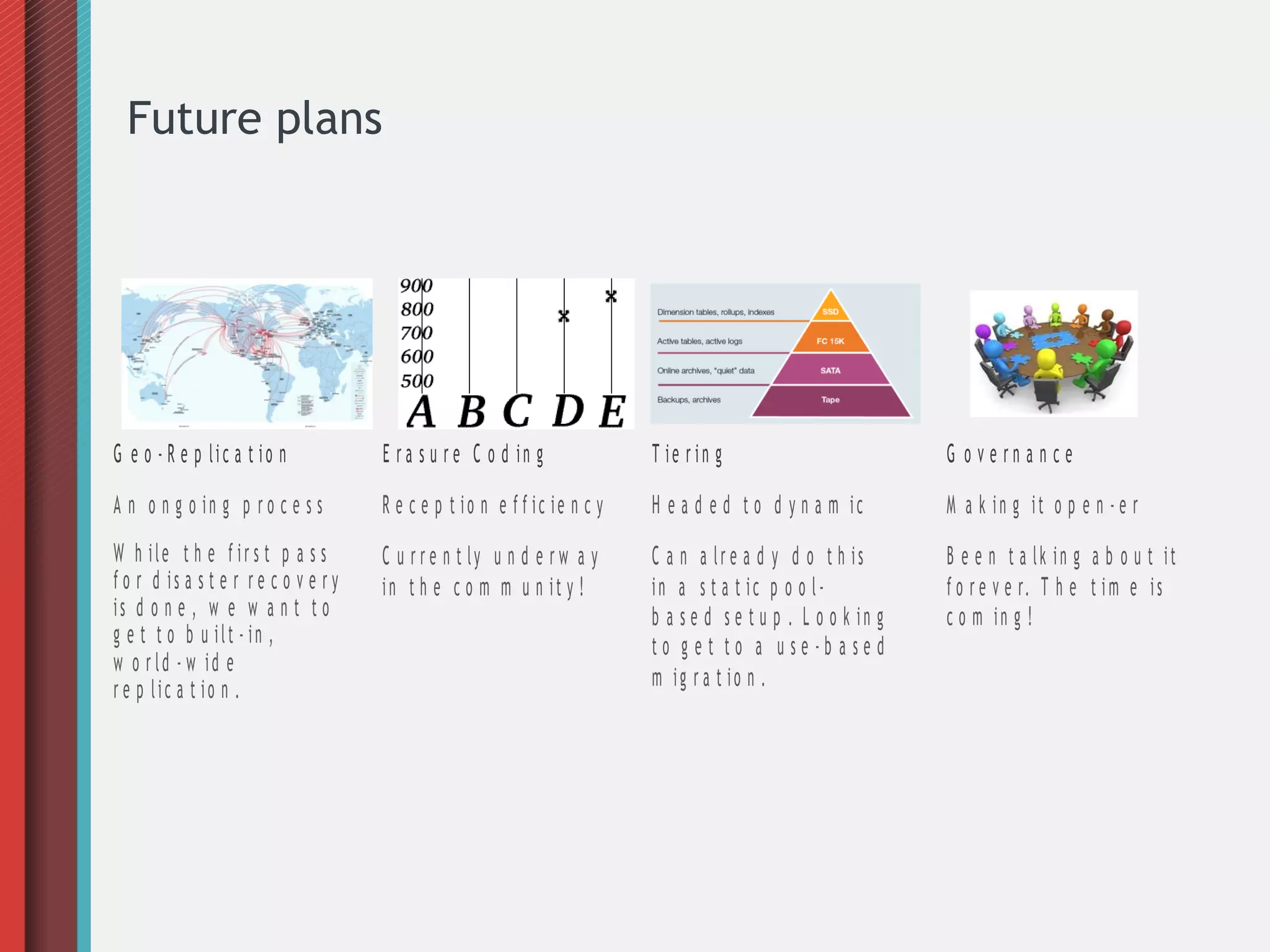
Future plans

G e o - R e p lic a t io n

E r a s u r e C o d in g

T ie r in g

G o v e rn a n c e

A n o n g o in g p r o c e s s

R e c e p t io n e f f ic ie n c y

H e a d e d t o d y n a m ic

M a k in g it o p e n - e r

W h ile t h e f ir s t p a s s
f o r d is a s t e r r e c o v e r y
is d o n e , w e w a n t t o
g e t t o b u ilt - in ,
w o r ld - w id e
r e p lic a t io n .

C u r r e n t ly u n d e r w a y
in t h e c o m m u n it y !

C a n a lr e a d y d o t h is
in a s t a t ic p o o lb a s e d s e t u p . L o o k in g
to g e t to a u se -b a se d
m ig r a t io n .

B e e n t a lk in g a b o u t it
f o r e v e r. T h e t i m e i s
c o m in g !
Get Involved!

CDS

Q u a r t e r ly O n li n e S u m m i t

Ceph Day

IR C

N o t ju st fo r N Y C

G e e k -o n -d u ty

E m a i l m a k e s t h e w o r ld g o

O n lin e s u m m it p u t s
th e c o re d e vs
t o g e t h e r w it h t h e
C e p h c o m m u n it y.

M o r e p la n n e d ,
in c lu d in g S a n t a C la r a
and London. Keep an
eye out:

D u r in g t h e w e e k
t h e r e a r e t im e s
w h e n C e p h e x p e rts
a r e a v a ila b le t o
h e lp . S t o p b y
o ftc.n e t/ ce p h

O u r m a ilin g lis t s a r e
v e r y a c t iv e , c h e c k
o u t ce p h .co m fo r
d e t a ils o n h o w t o
j o in in !

h ttp : / / in k ta n k . c o m / c e p h d a y
s/

L is t s
E - M A IL
p a tr ic k @ in k ta n k . c o m

W E B S IT E
C ep h .co m

S O C IA L
@ s c u t t le m o n k e y
@ ceph
F a ce b o o k .co m / ce p h sto ra g e

Questions?

DEVIEW 2013

  • 1.
    Ceph: Massively Scalable DistributedStorage Patrick McGarry Director Community, Inktank
  • 2.
    Who am I? ● PatrickMcGarry ● Dir Community, Inktank ● /. → ALU → P4 → Inktank ● @scuttlemonkey ● patrick@inktank.com
  • 3.
    Outline ● What is Ceph? ● CephHistory ● How does Ceph work? ● CRUSH Fundamentals ● Applications ● Testing ● Performance ● Moving forward ● Questions
  • 4.
  • 5.
    Ceph at aglance So ftw a re A ll- in - 1 CR U SH S c a le O n c o m m o d ity h a rd w a re O b je c t , b lo c k , a n d file A w esom esauce H uge and b eyond C e p h ca n ru n o n a n y in f r a s t r u c t u r e , m e t a l o r v ir t u a liz e d t o p r o v id e a c h e a p a n d p o w e rfu l sto ra g e c lu s t e r . L o w o ve rh e a d d o e sn ’t m e a n ju st h a r d w a r e , it m e a n s p e o p le t o o ! In f r a s t r u c t u r e - a w a r e p la c e m e n t a lg o r it h m a llo w s y o u t o d o r e a lly c o o l s t u f f . D e s ig n e d f o r e x a b yte , cu rre n t im p le m e n t a t io n s in t h e m u lt i- p e t a b y t e . H P C , B ig D a t a , C lo u d , r a w s t o r a g e .
  • 6.
    Unified storage system ● objects ● ● ● native RESTful block ● ● thinprovisioning, snapshots, cloning file ● strong consistency, snapshots
  • 7.
    Distributed storage system ● datacenter scale ● ● ● 10s to 10,000s of machines terabytes to exabytes fault tolerant ● ● ● no single point of failure commodity hardware self-managing, self-healing
  • 8.
    Where did Cephcome from?
  • 15.
    UCSC research grant ● “Petascaleobject storage” ● DOE: LANL, LLNL, Sandia ● Scalability ● Reliability ● Performance ● ● Raw IO bandwidth, metadata ops/sec HPC file system workloads ● Thousands of clients writing to same file, directory
  • 16.
    Distributed metadata management ● Innovativedesign ● Subtree-based partitioning for locality, efficiency ● Dynamically adapt to current workload ● Embedded inodes ● Prototype simulator in Java (2004) ● First line of Ceph code ● Summer internship at LLNL ● High security national lab environment ● Could write anything, as long as it was OSS
  • 17.
    The rest ofCeph ● RADOS – distributed object storage cluster (2005) ● EBOFS – local object storage (2004/2006) ● CRUSH – hashing for the real world (2005) ● Paxos monitors – cluster consensus (2006) → emphasis on consistent, reliable storage → scale by pushing intelligence to the edges → a different but compelling architecture
  • 18.
    Industry black hole ● Manylarge storage vendors ● ● Proprietary solutions that don't scale well Few open source alternatives (2006) ● ● Limited community and architecture (Lustre) ● ● Very limited scale, or No enterprise feature sets (snapshots, quotas) PhD grads all built interesting systems... ● ● ...and then went to work for Netapp, DDN, EMC, Veritas. They want you, not your project
  • 19.
    A different path ● Changethe world with open source ● ● ● Do what Linux did to Solaris, Irix, Ultrix, etc. What could go wrong? License ● ● ● GPL, BSD... LGPL: share changes, okay to link to proprietary code Avoid unsavory practices ● Dual licensing ● Copyright assignment
  • 20.
  • 21.
    APP APP LIBRADOS LIBRADOS APP APP RADOSGW RADOSGW AA bucket-based bucket-based AA libraryallowing REST gateway, library allowing REST gateway, apps to directly compatible with S3 apps to directly compatible with S3 access RADOS, and Swift access RADOS, and Swift with support for with support for C, C++, Java, C, C++, Java, Python, Ruby, Python, Ruby, and PHP and PHP HOST/VM HOST/VM CLIENT CLIENT RBD RBD CEPH FS CEPH FS AA reliable and fullyreliable and fullydistributed block distributed block device, with a a Linux device, with Linux kernel client and a a kernel client and QEMU/KVM driver QEMU/KVM driver AA POSIX-compliant POSIX-compliant distributed file system, distributed file system, with a a Linux kernel with Linux kernel client and support for client and support for FUSE FUSE RADOS RADOS AA reliable, autonomous, distributed object store comprised of self-healing, self-managing, reliable, autonomous, distributed object store comprised of self-healing, self-managing, intelligent storage nodes intelligent storage nodes
  • 22.
    Why start withobjects? ● more useful than (disk) blocks ● ● variable size ● ● names in a single flat namespace simple API with rich semantics more scalable than files ● no hard-to-distribute hierarchy ● update semantics do not span objects ● workload is trivially parallel
  • 23.
    Ceph object model ● pools ● ● independentnamespaces or object collections ● ● 1s to 100s replication level, placement policy objects ● bazillions ● blob of data (bytes to gigabytes) ● attributes (e.g., “version=12”; bytes to kilobytes) ● key/value bundle (bytes to gigabytes)
  • 24.
  • 25.
    Object Storage Daemons(OSDs) ● 10s to 10000s in a cluster ● one per disk, SSD, or RAID group, or ... ● ● ● hardware agnostic serve stored objects to clients intelligently peer to perform replication and recovery tasks Monitors M ● ● maintain cluster membership and state provide consensus for distributed decisionmaking ● small, odd number ● these do not served stored objects to clients
  • 26.
    Data distribution ● ● ● all objectsare replicated N times objects are automatically placed, balanced, migrated in a dynamic cluster must consider physical infrastructure ● ● ceph-osds on hosts in racks in rows in data centers three approaches ● pick a spot; remember where you put it ● pick a spot; write down where you put it ● calculate where to put it, where to find it
  • 27.
  • 28.
    CRUSH ● pseudo-random placement algorithm ● fastcalculation, no lookup ● repeatable, deterministic ● statistically uniform distribution ● stable mapping ● ● limited data migration on change rule-based configuration ● infrastructure topology aware ● adjustable replication ● allows weighting
  • 29.
  • 30.
    10 10 0101 10 10 01 11 01 10 10 10 01 01 10 10 01 11 01 10 hash(object name) % num pg 10 10 10 10 01 01 01 01 10 10 10 10 01 01 1111 01 01 10 10 CRUSH(pg, cluster state, policy)
  • 31.
    10 10 0101 10 10 01 11 01 10 10 10 01 01 10 10 01 11 01 10 10 10 10 10 01 01 01 01 10 10 10 10 01 01 1111 01 01 10 10
  • 32.
  • 35.
  • 36.
  • 37.
    APP APP LIBRADOS LIBRADOS APP APP RADOSGW RADOSGW AA bucket-based bucket-based AA libraryallowing REST gateway, library allowing REST gateway, apps to directly compatible with S3 apps to directly compatible with S3 access RADOS, and Swift access RADOS, and Swift with support for with support for C, C++, Java, C, C++, Java, Python, Ruby, Python, Ruby, and PHP and PHP HOST/VM HOST/VM CLIENT CLIENT RBD RBD CEPH FS CEPH FS AA reliable and fullyreliable and fullydistributed block distributed block device, with a a Linux device, with Linux kernel client and a a kernel client and QEMU/KVM driver QEMU/KVM driver AA POSIX-compliant POSIX-compliant distributed file system, distributed file system, with a a Linux kernel with Linux kernel client and support for client and support for FUSE FUSE RADOS RADOS AA reliable, autonomous, distributed object store comprised of self-healing, self-managing, reliable, autonomous, distributed object store comprised of self-healing, self-managing, intelligent storage nodes intelligent storage nodes
  • 38.
    RADOS Gateway ● REST-based objectstorage proxy ● uses RADOS to store objects ● API supports buckets, accounting ● usage accounting for billing purposes ● compatible with S3, Swift APIs
  • 39.
    RADOS Block Device ● storageof disk images in RADOS ● decouple VM from host ● images striped across entire cluster (pool) ● snapshots ● copy-on-write clones ● support in ● Qemu/KVM, Xen ● mainline Linux kernel (2.6.34+) ● OpenStack, CloudStack ● Ganeti, OpenNebula
  • 40.
    Metadata Server (MDS) ● managesmetadata for POSIX shared file system ● directory hierarchy ● file metadata (size, owner, timestamps) ● stores metadata in RADOS ● does not serve file data to clients ● only required for the shared file system
  • 41.
    Multiple protocols, implementations ● Linuxkernel client ● mount -t ceph 1.2.3.4:/ /mnt ● export (NFS), Samba (CIFS) ● ceph-fuse ● libcephfs.so ● your app ● Samba (CIFS) ● Ganesha (NFS) ● SMB/CIFS NFS Ganesha libcephfs Samba libcephfs Hadoop libcephfs your app libcephfs Hadoop (map/reduce) ceph ceph-fuse fuse kernel
  • 42.
  • 43.
    Package Building ● GitBuilder ● ● Very basictool, works well though ● Push to get → .deb && .rpm for all platforms ● ● Build packages / tarballs autosigned Pbuilder ● Used for major releases ● Clean room type of build ● Signed using different key ● As many distros as possible (All Debian, Ubuntu, Fedora 17&18, CentOS, SLES, OpenSUSE, tarball)
  • 44.
    Teuthology ● Our own customtest framework ● Allocates machines you define to cluster you define ● Runs tasks against that environment ● Set up ceph ● Run workloads ● Pull from SAMBA gitbuilder → mount Ceph → run NFS client → mount it → run workload ● Makes it easy to stack things up, map them to hosts, run ● Suite of tests on our github ● Active community development underway!
  • 45.
  • 46.
    4K Relative Performance AllWorkloads: QEMU/KVM, BTRFS, or XFS Read Heavy Only Workloads: Kernel RBD, EXT4, or XFS
  • 47.
    128K Relative Performance AllWorkloads: QEMU/KVM, or XFS Read Heavy Only Workloads: Kernel RBD, BTRFS, or EXT4
  • 48.
    4M Relative Performance AllWorkloads: QEMU/KVM, or XFS Read Heavy Only Workloads: Kernel RBD, BTRFS, or EXT4
  • 49.
    What does thismean? ● Anecdotal results are great! ● Concrete evidence coming soon ● Performance is complicated ● Workload ● Hardware (especially network!) ● Lots and lots of tuneables ● Mark Nelson (nhm on #ceph) is the performance geek ● Lots of reading on ceph.com blog ● We welcome testing and comparison help ● Anyone want to help with an EMC / NetApp showdown?
  • 50.
  • 51.
    Future plans G eo - R e p lic a t io n E r a s u r e C o d in g T ie r in g G o v e rn a n c e A n o n g o in g p r o c e s s R e c e p t io n e f f ic ie n c y H e a d e d t o d y n a m ic M a k in g it o p e n - e r W h ile t h e f ir s t p a s s f o r d is a s t e r r e c o v e r y is d o n e , w e w a n t t o g e t t o b u ilt - in , w o r ld - w id e r e p lic a t io n . C u r r e n t ly u n d e r w a y in t h e c o m m u n it y ! C a n a lr e a d y d o t h is in a s t a t ic p o o lb a s e d s e t u p . L o o k in g to g e t to a u se -b a se d m ig r a t io n . B e e n t a lk in g a b o u t it f o r e v e r. T h e t i m e i s c o m in g !
  • 52.
    Get Involved! CDS Q ua r t e r ly O n li n e S u m m i t Ceph Day IR C N o t ju st fo r N Y C G e e k -o n -d u ty E m a i l m a k e s t h e w o r ld g o O n lin e s u m m it p u t s th e c o re d e vs t o g e t h e r w it h t h e C e p h c o m m u n it y. M o r e p la n n e d , in c lu d in g S a n t a C la r a and London. Keep an eye out: D u r in g t h e w e e k t h e r e a r e t im e s w h e n C e p h e x p e rts a r e a v a ila b le t o h e lp . S t o p b y o ftc.n e t/ ce p h O u r m a ilin g lis t s a r e v e r y a c t iv e , c h e c k o u t ce p h .co m fo r d e t a ils o n h o w t o j o in in ! h ttp : / / in k ta n k . c o m / c e p h d a y s/ L is t s
  • 53.
    E - MA IL p a tr ic k @ in k ta n k . c o m W E B S IT E C ep h .co m S O C IA L @ s c u t t le m o n k e y @ ceph F a ce b o o k .co m / ce p h sto ra g e Questions?