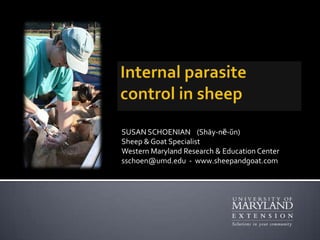
Internal parasite control in sheepSUSAN SCHOENIAN    (Shāy-nē-ŭn)Sheep & Goat SpecialistWestern Maryland Research & Education Centersschoen@umd.edu  -  www.sheepandgoat.com
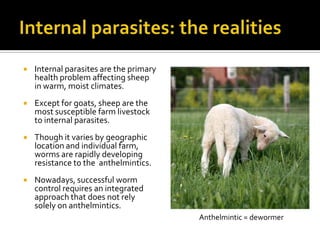
Internal parasites: the realitiesInternal parasites are the primary health problem affecting sheep in warm, moist climates.Except for goats, sheep are the most susceptible farm livestock to internal parasites.Though it varies by geographic location and individual farm, worms are rapidly developing resistance to the  anthelmintics.Nowadays, successful worm control requires an integrated approach that does not rely solely on anthelmintics.Anthelmintic = dewormer
What is a parasite?A (generally undesirable) living organism that exists by stealing the resources  produced or collected by another living organismSource: Wiktionary
There are two kinds of parasites.Internal (endo) - a parasite that lives inside another organism.External (ecto) - a parasite that lives on the blood of the host or lays eggs on their hide or in their nose.
There are two general kinds of internal parasites.Parasites “tend” to be species-specific.1)  Helminths       (multi-cellular)Nematodes (roundworms)Cestodes (tapeworms)Trematodes (flukes)2)  Protozoa       (single cell)CoccidiaGiardiaCryptospordium
HELMINTHSNematodes (roundworms)Over 20,000 species
Long
Round
Not segmented
Microscopic
Sexual reproduction
Male and female worms
Haemonchus contortus   Barber pole wormScour wormsTrichostrongylus spp.   Hair worm
Teladorsagia  Brown stomach wormOesophagostomum  Nodule wormNematodirus spp.  ThreadwormOtherLungworms
Meningeal wormNEMATODEBlood sucker
Found in abomasum
Most pathogenic
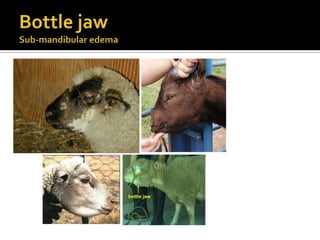
Causes anemia, bottle    jaw, and death.
Prolific egg producer
Direct life cycle
Requires warmth (60°F)      and  moisture to complete  its life cycle
Short 3 week life cycleBarber pole wormHaemonchus contortus
NEMATODESFound in abomasum and   Intestines.
Usually found in mixed   infections with barber pole worm.
Not as pathogenic as barber pole worm.
Cause digestive problems (scouring) and ill thrift.
Similar life cycle and pre- patent period as barber pole worm.
Egg laying capacity varies.
Eggs look the same as barber pole worm.“Scour” wormsImage source:  NADIS UK
HELMINTHSTapeworms (cestodes)Over 1,000 species
Ribbon-like
Flat
Segmented
Hermaphrodites
Intermediate host
Visible in fecesUsuallyNon- pathogenic
Non disease-causing
No benefit to treatmentHELMINTHSFlukes (trematodes)Flat
Oval-shape
Leaf-like
Hermaphroditic

Parasite control in sheep