Mathematical
Reasoning & Aptitude
UGC NET PAPER 1 UNIT 5
Types of
reasoning.
Number series, Letter
series, Codes, and
Relationships.
Mathematical Aptitude (Fraction,
Time & Distance, Ratio,
Proportion and Percentage, Profit
and Loss, Interest and
Discounting, Averages etc.).
Unit-V
Mathematical
Reasoning
and Aptitude
What is
Reasoning ?
When making a choice or addressing an issue,
reasoning is the ability to appraise things rationally
by using logic based on new or existing information.
Reasoning allows you to balance the advantages and
cons of two or more options before deciding on the
best option or the one that best meets your goals. It
also assists you in solving difficulties, dealing with
uncertainty, verifying claims, and carefully
assessing situations to ensure that the decision you
make is in your best interests.
Types of
Reasoning
1. Deductive reasoning:
Deductive reasoning is a
method of proving a theory or
hypothesis using formal logic
and observations. Deductive
reasoning starts with a
hypothesis that is then
supported or disproved
through observations or
rational thought.
A marketing division, for
example, analyses data and
confirms that their company’s
most important demographic is
young parents. They opt to give
more of the marketing money to
social media channels that
target that category based on
this information.
2. Inductive
reasoning:
To validate observations,
inductive reasoning employs
theories and assumptions. It’s
the polar opposite of
deductive reasoning in that it
requires deducing a general
rule from a specific case or
cases.
Because it employs conclusions
from observations to make
generalisations, the outcomes of
inductive reasoning are not always
certain. Extrapolation, forecasts,
and part-to-whole arguments all
benefit from inductive reasoning.
3. Analogical reasoning:
Analogical reasoning is a
style of reasoning that
looks for similarities
between two or more
objects and then uses

those similarities to find
other properties they
share. It is based on the
brain’s tendency to notice
patterns and make
connections.
4. Abductive reasoning:
Abductive reasoning is a style of reasoning that
reaches a logical conclusion based on an
observation or group of observations. Abductive
reasoning is similar to inductive reasoning, but it
allows you to make the greatest estimates to get
the simplest conclusions. Abduction can help with
both troubleshooting and decision-making,
especially when dealing with uncertainties.
5. Cause-and-effect
reasoning:
Cause-and-effect reasoning is a style of
reasoning in which the relationship
between two events is demonstrated.
This logic is used to describe what
might happen if a certain action is
taken or why certain things happen
when certain circumstances are met.
When people draw on personal
experience and a drive to improve, this
form of reasoning is frequently used to
guide daily decision-making.
Critical thinking entails delving
deeply into a topic’s rationale in
order to reach a definitive
conclusion. Computing, engineering,
social sciences, and logic all benefit
from it. When it comes to problem-

solving, critical thinking is especially
important when dealing with
technological challenges. It’s used to
determine the validity of artworks,
literature, films, and other forms of
art.
6. Critical
thinking:
7. Decompositional
reasoning:
Decompositional reasoning is the
process of breaking things down into
their basic components in order to
comprehend how each component
contributes to the overall
functionality of the object.
Decompositional reasoning allows an
observer to derive powerful
conclusions about the total by
evaluating each portion separately.
Syllogism
A form of arguing in which two
statements are used to prove
that a third statement is true,
for example, ‘All humans are
mortal; I am a human,
therefore I am mortal.’
What is Syllogism ?
Modus Ponens and
Modus Tollens
In propositional logic, the
modus ponens and
modus tollens are two
types of inference that
can be derived from a
hypothetical proposition
—that is, from a
statement of the form “If
A, then B”
E.g. When an angle is
inscribed in a semicircle,
it is a right angle;
however, this angle is not
a right angle, hence it is
not inscribed in a
semicircle.
Number Series
Number series is an order of numbers which are
not arranged randomly but follow a pattern. Here
in these notes, we will understand how to identify
which kind of pattern is following because
without this it is next to impossible to have a
command on number series. Number series is a
form
of numbers in a certain sequence, where some
numbers are mistakenly put into the series of
numbers and some number is missing in that
series, we need to observe first and then find the
accurate number to that series of numbers.
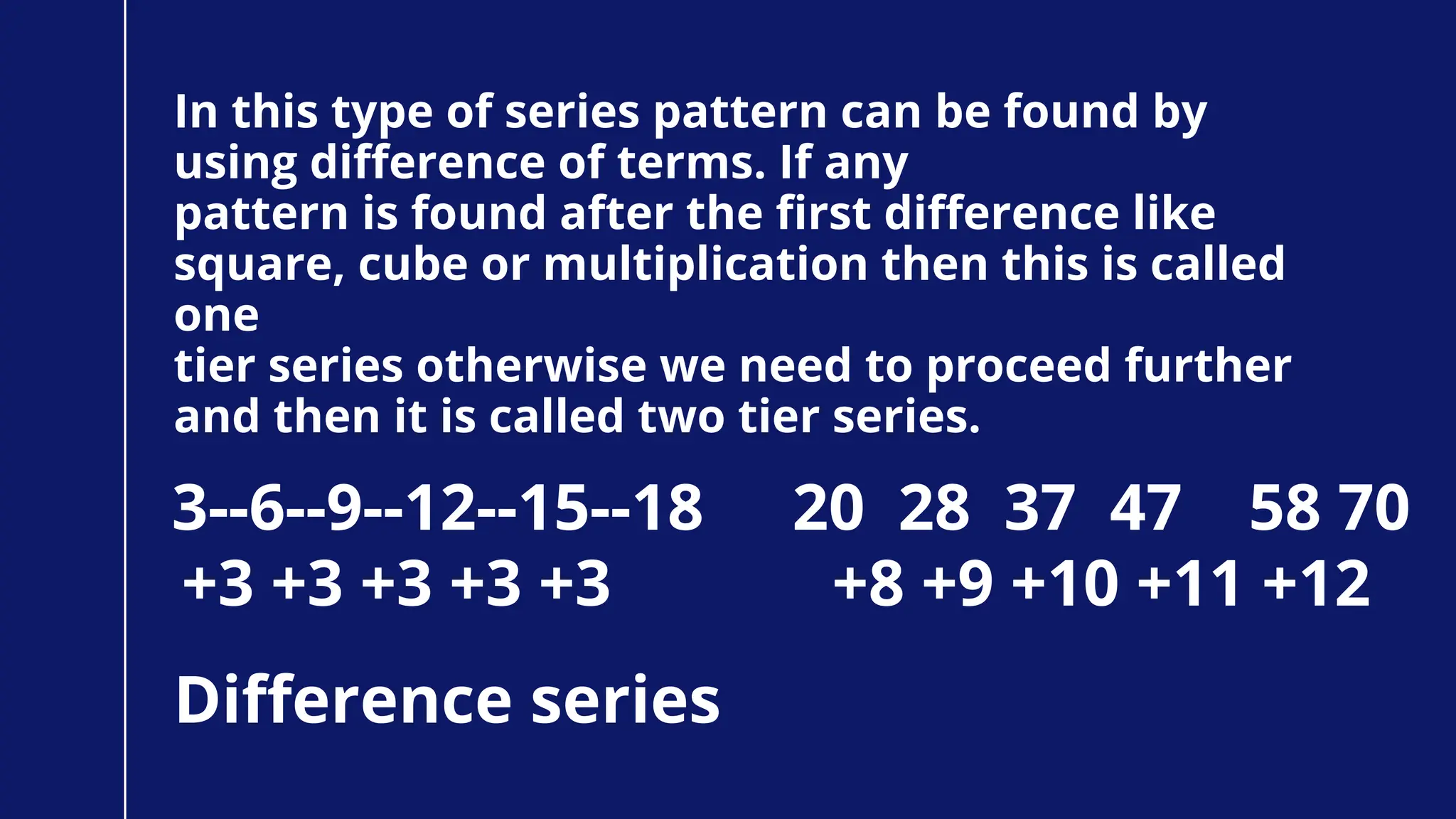
In this type of series pattern can be found by
using difference of terms. If any
pattern is found after the first difference like
square, cube or multiplication then this is called
one
tier series otherwise we need to proceed further
and then it is called two tier series.
Difference series
3--6--9--12--15--18
+3 +3 +3 +3 +3
20 28 37 47 58 70
+8 +9 +10 +11 +12
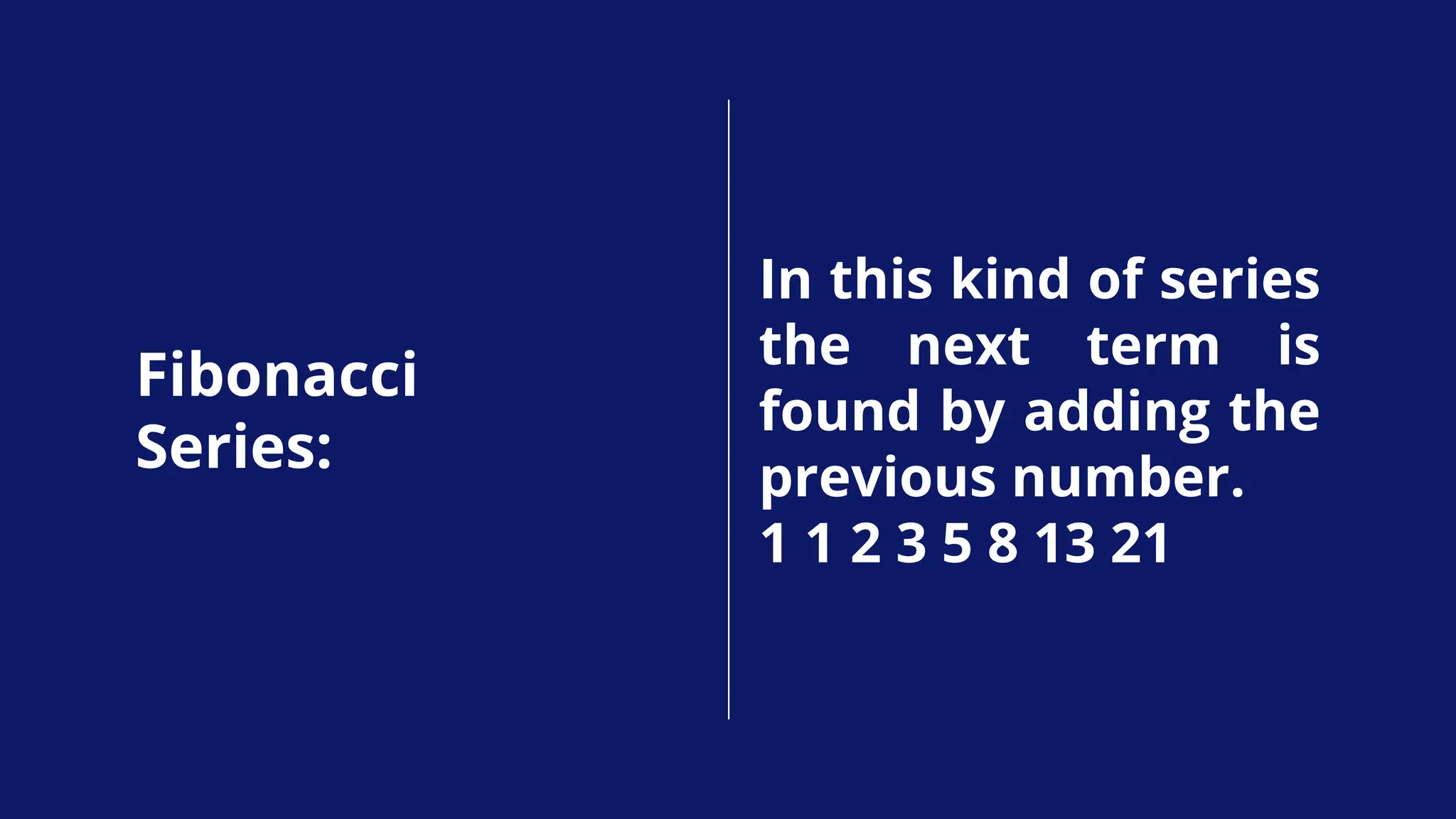
In this kind of series
the next term is
found by adding the
previous number.
1 1 2 3 5 8 13 21
Fibonacci
Series:
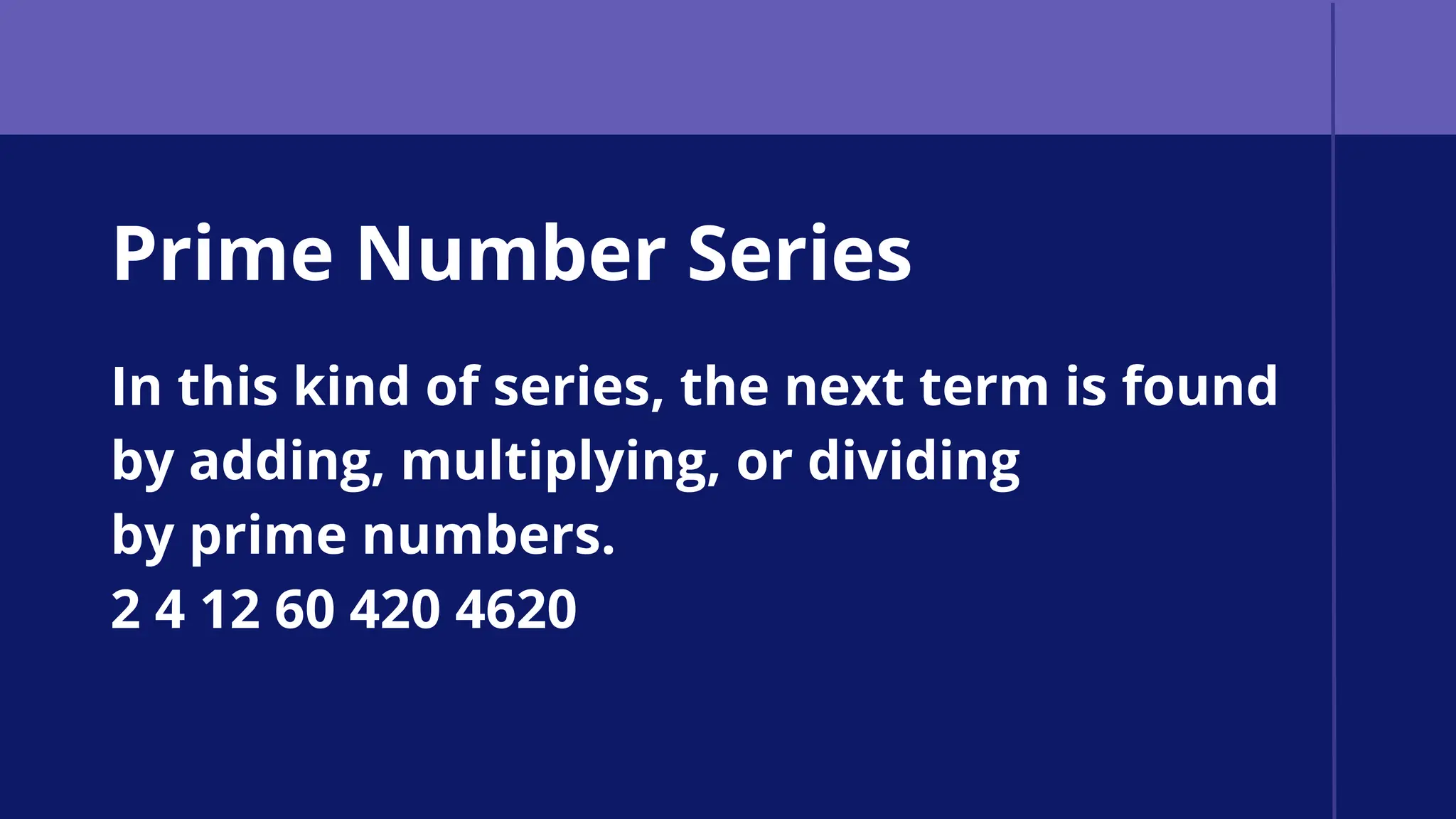
Prime Number Series
In this kind of series, the next term is found
by adding, multiplying, or dividing
by prime numbers.
2 4 12 60 420 4620
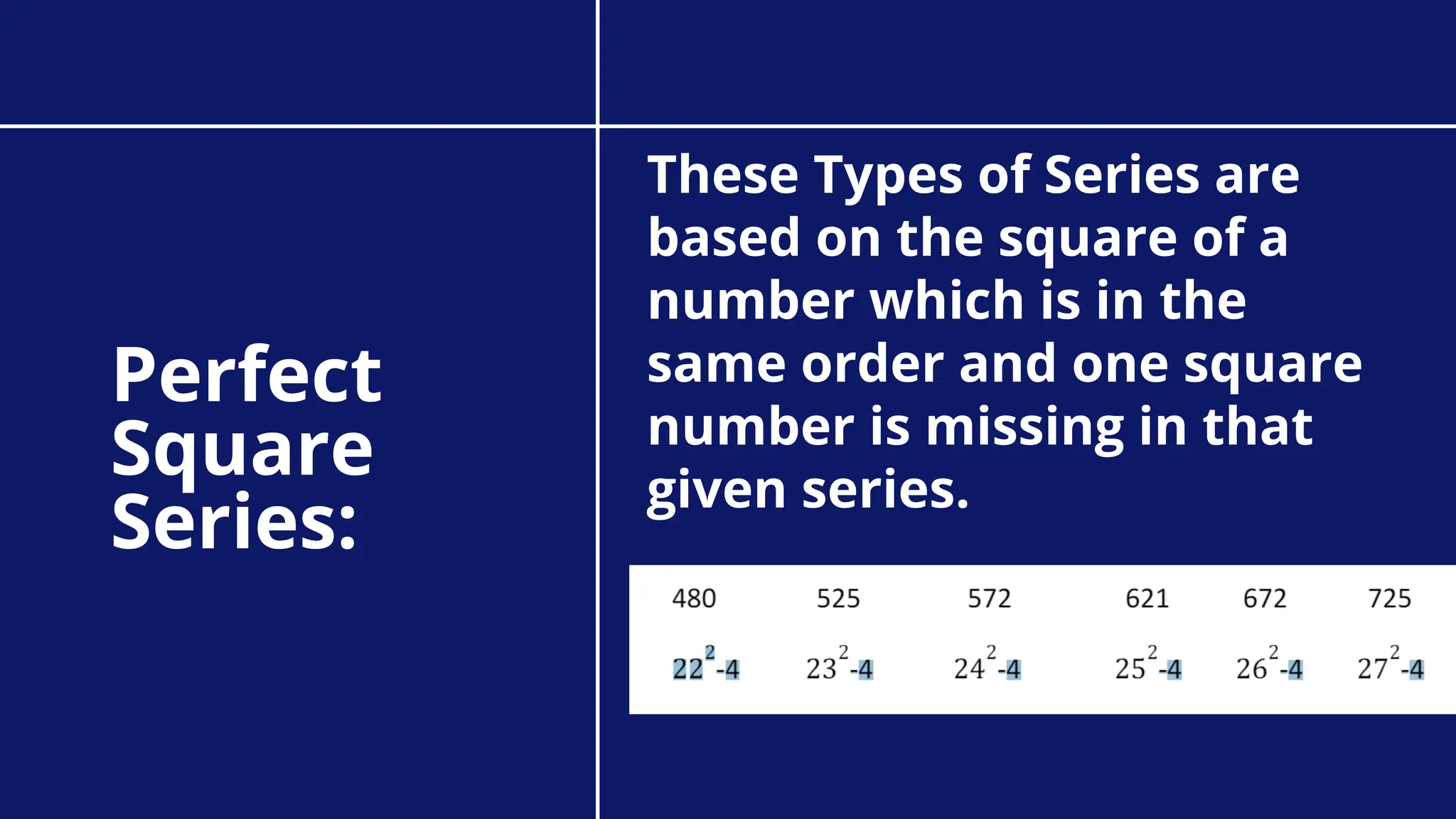
Perfect
Square
Series:
These Types of Series are
based on the square of a
number which is in the
same order and one square
number is missing in that
given series.
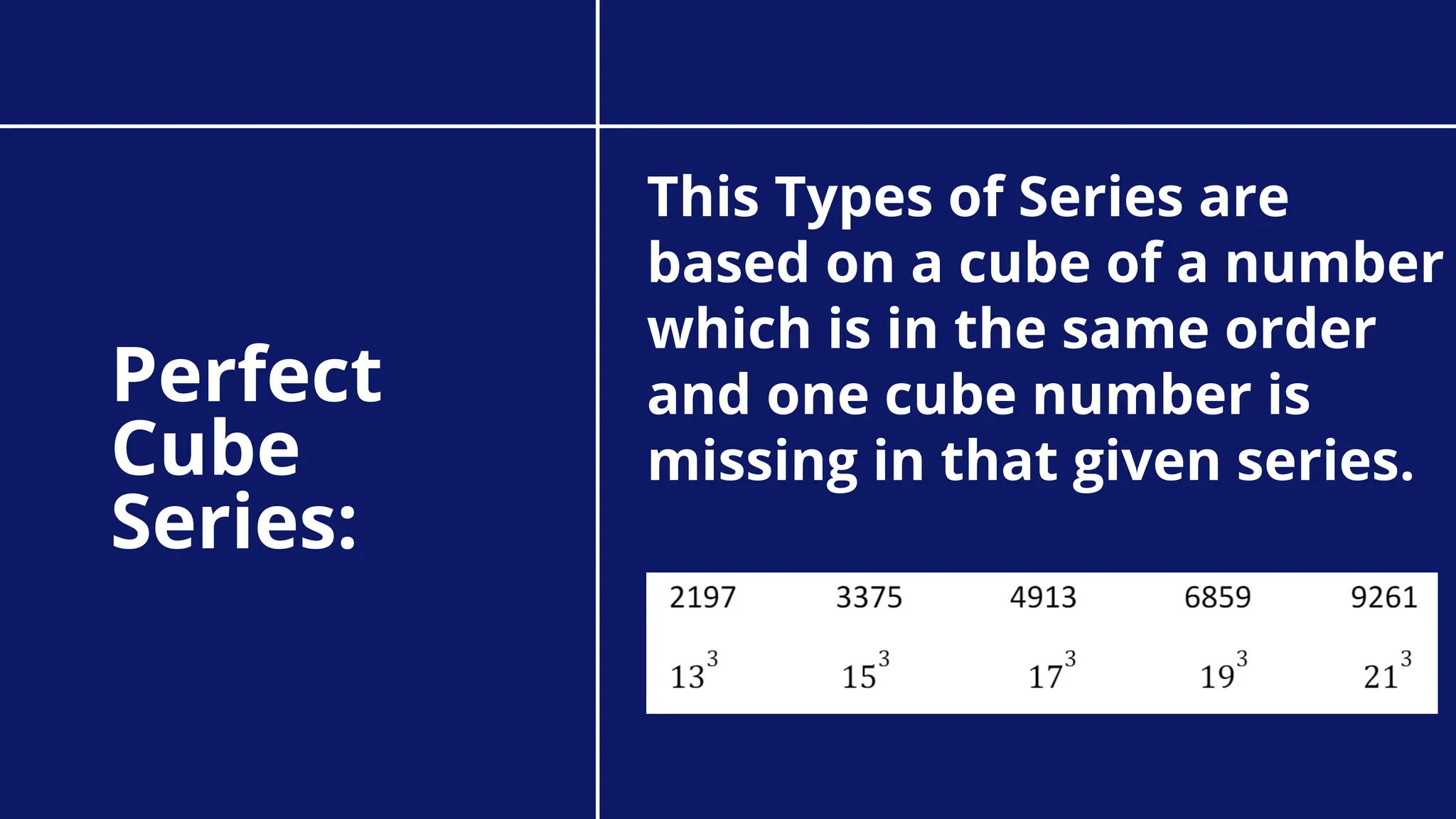
Perfect
Cube
Series:
This Types of Series are
based on a cube of a number
which is in the same order
and one cube number is
missing in that given series.
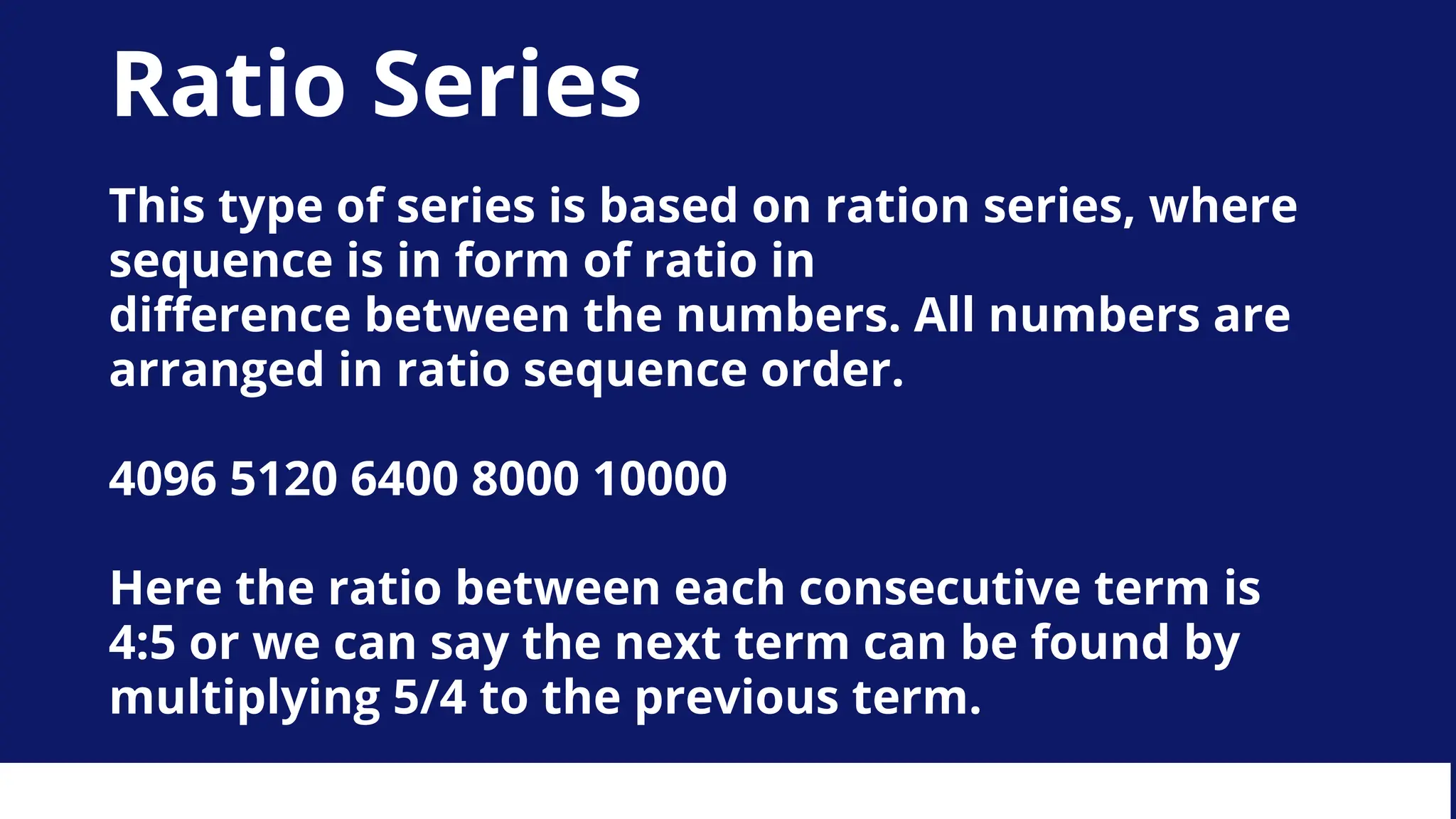
Ratio Series
This type of series is based on ration series, where
sequence is in form of ratio in
difference between the numbers. All numbers are
arranged in ratio sequence order.
4096 5120 6400 8000 10000
Here the ratio between each consecutive term is
4:5 or we can say the next term can be found by
multiplying 5/4 to the previous term.
A few things
to notice
while solving
Number
Series
Questions
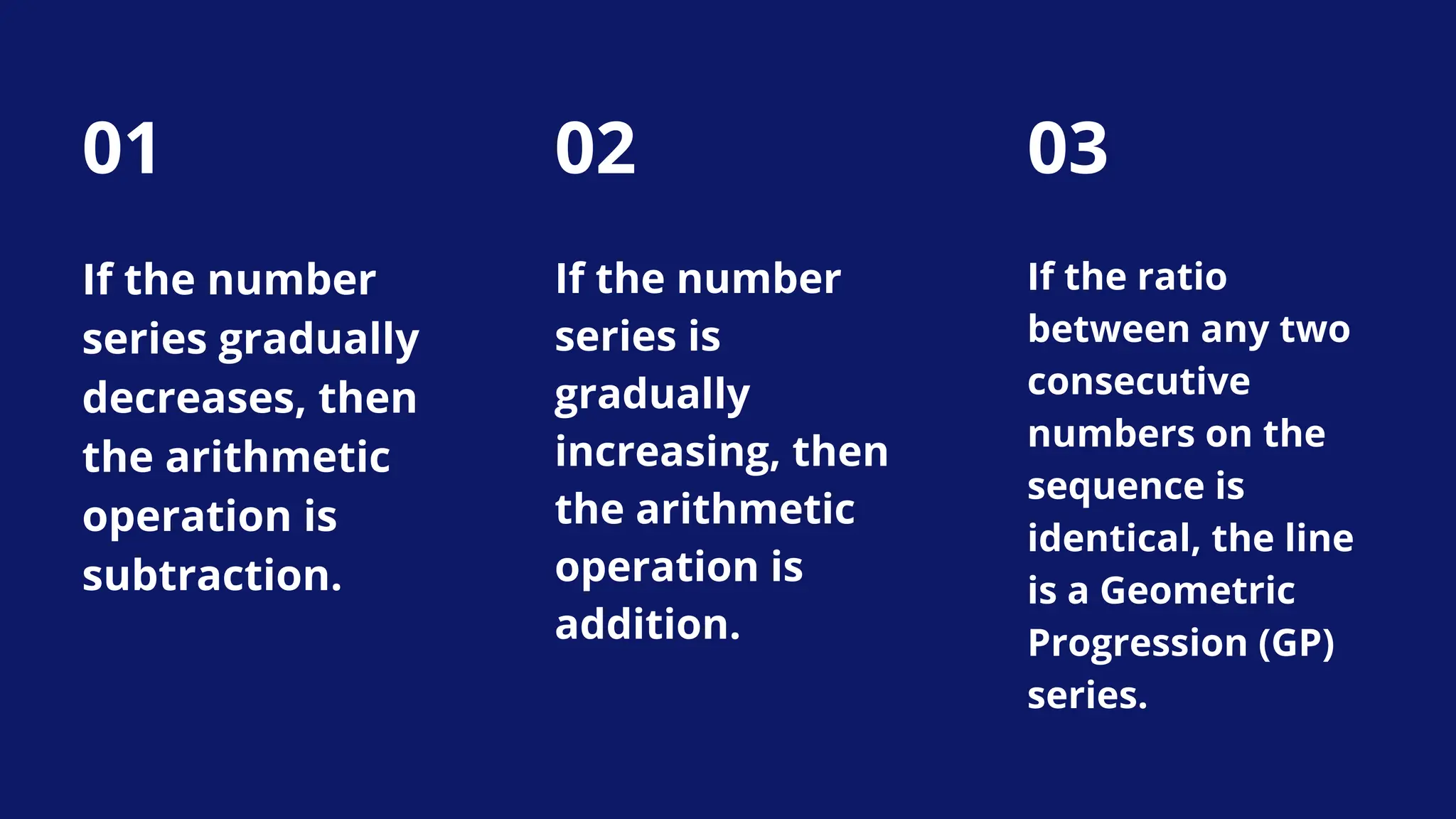
01
If the number
series gradually
decreases, then
the arithmetic
operation is
subtraction.
02
If the number
series is
gradually
increasing, then
the arithmetic
operation is
addition.
03
If the ratio
between any two
consecutive
numbers on the
sequence is
identical, the line
is a Geometric
Progression (GP)
series.
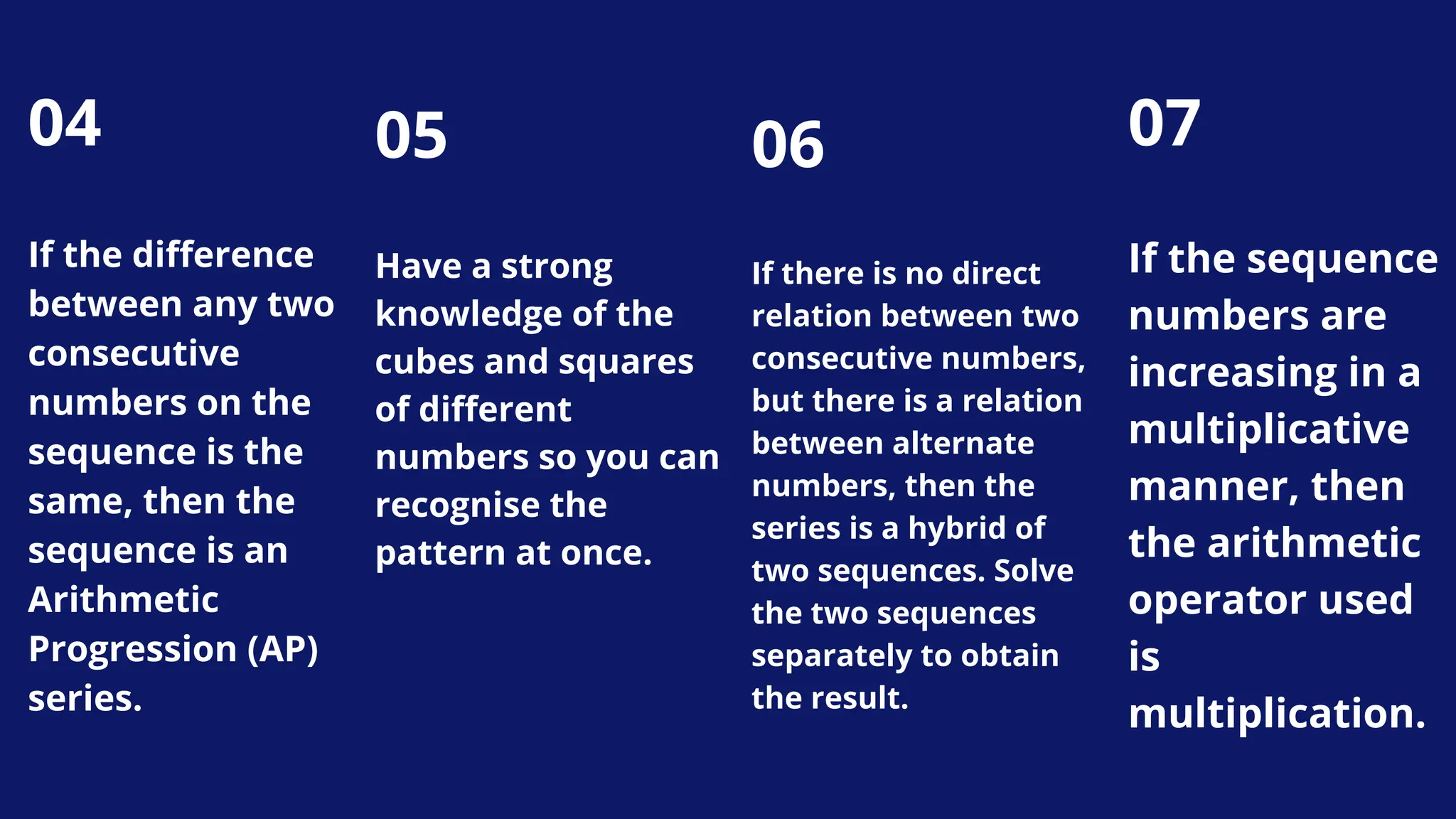
04
If the difference
between any two
consecutive
numbers on the
sequence is the
same, then the
sequence is an
Arithmetic
Progression (AP)
series.
06
If there is no direct
relation between two
consecutive numbers,
but there is a relation
between alternate
numbers, then the
series is a hybrid of
two sequences. Solve
the two sequences
separately to obtain
the result.
07
If the sequence
numbers are
increasing in a
multiplicative
manner, then
the arithmetic
operator used
is
multiplication.
05
Have a strong
knowledge of the
cubes and squares
of different
numbers so you can
recognise the
pattern at once.
Questions on
Number Series
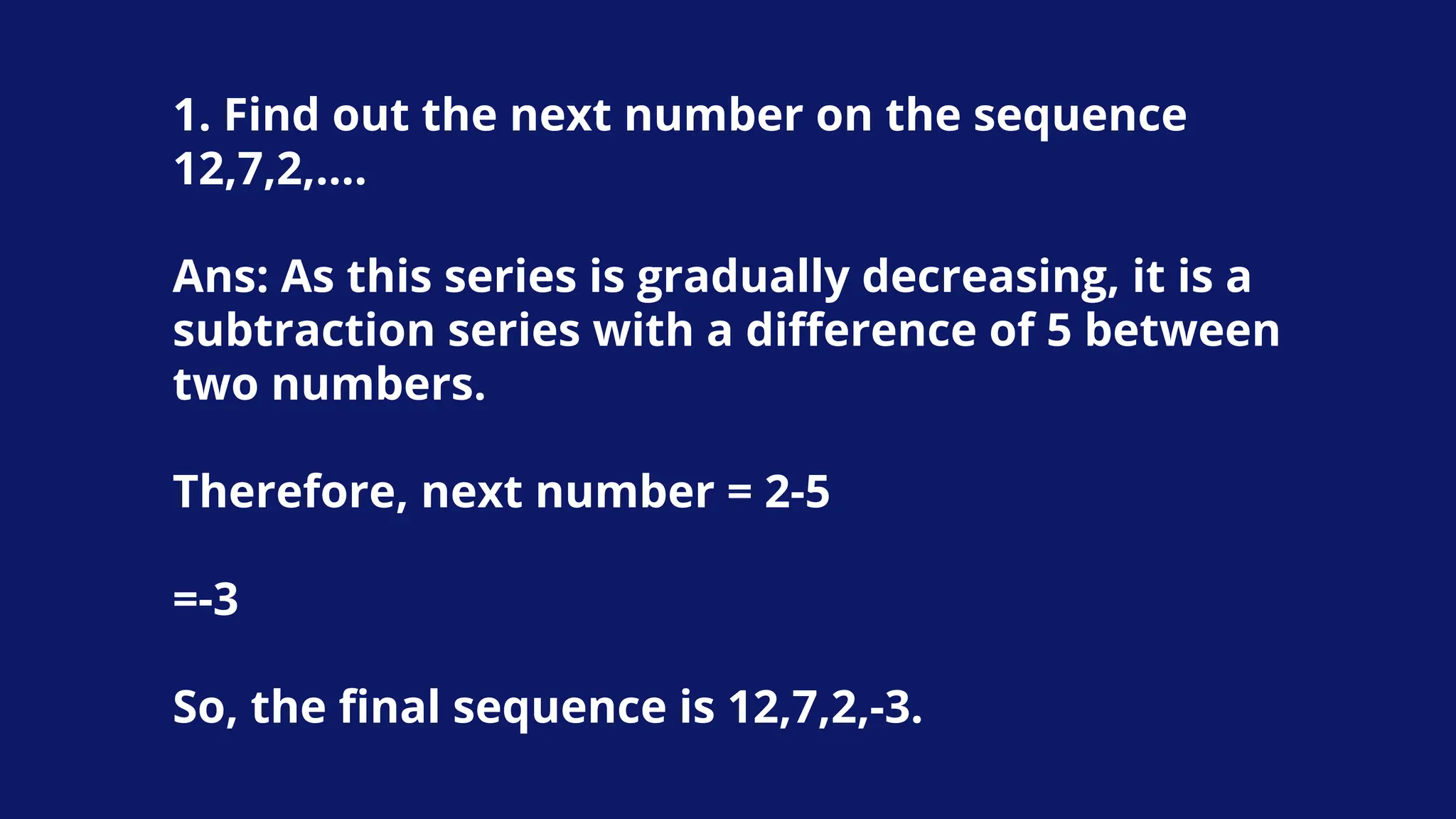
1. Find out the next number on the sequence
12,7,2,….
Ans: As this series is gradually decreasing, it is a
subtraction series with a difference of 5 between
two numbers.
Therefore, next number = 2-5
=-3
So, the final sequence is 12,7,2,-3.
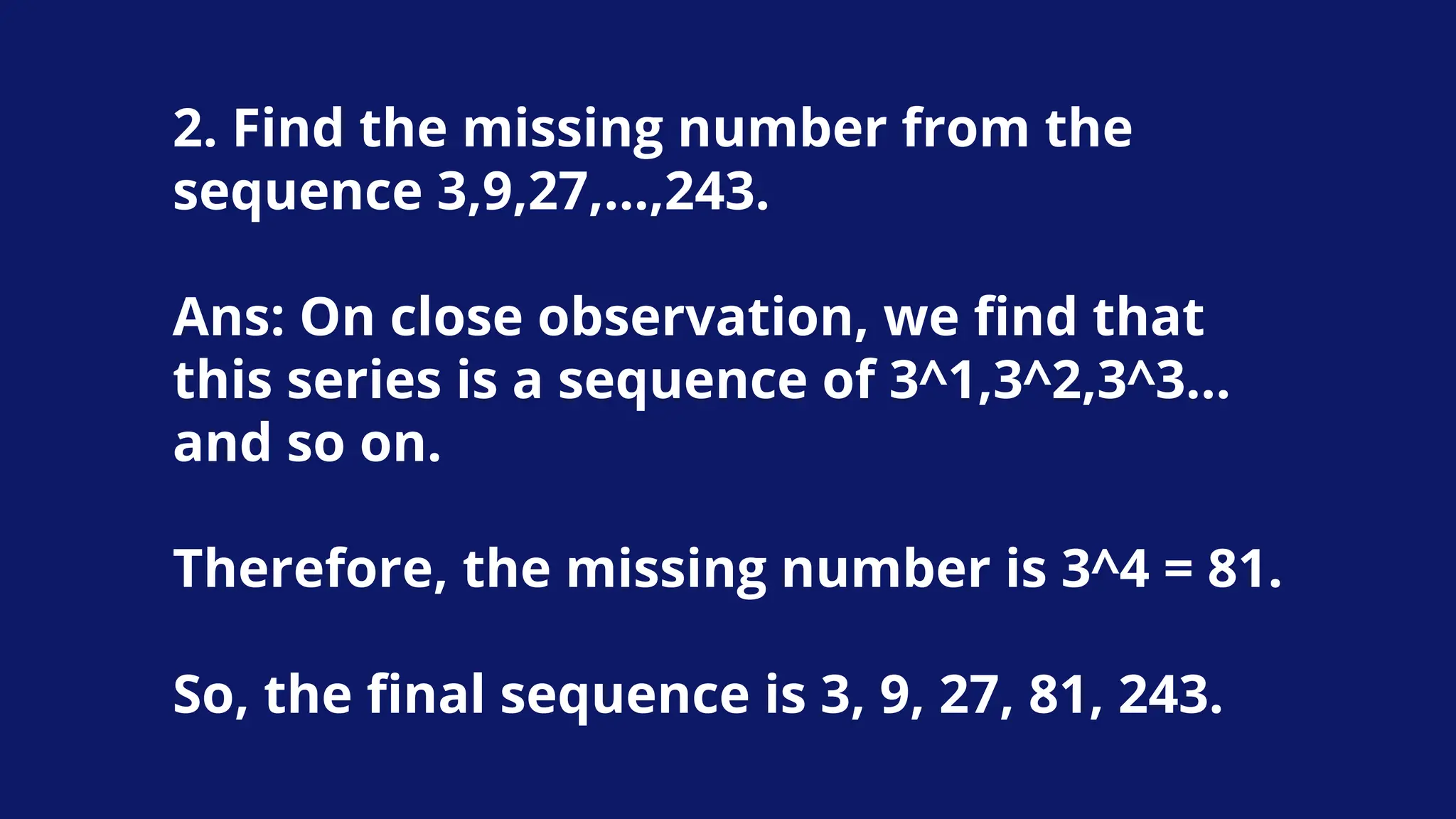
2. Find the missing number from the
sequence 3,9,27,…,243.
Ans: On close observation, we find that
this series is a sequence of 3^1,3^2,3^3…
and so on.
Therefore, the missing number is 3^4 = 81.
So, the final sequence is 3, 9, 27, 81, 243.
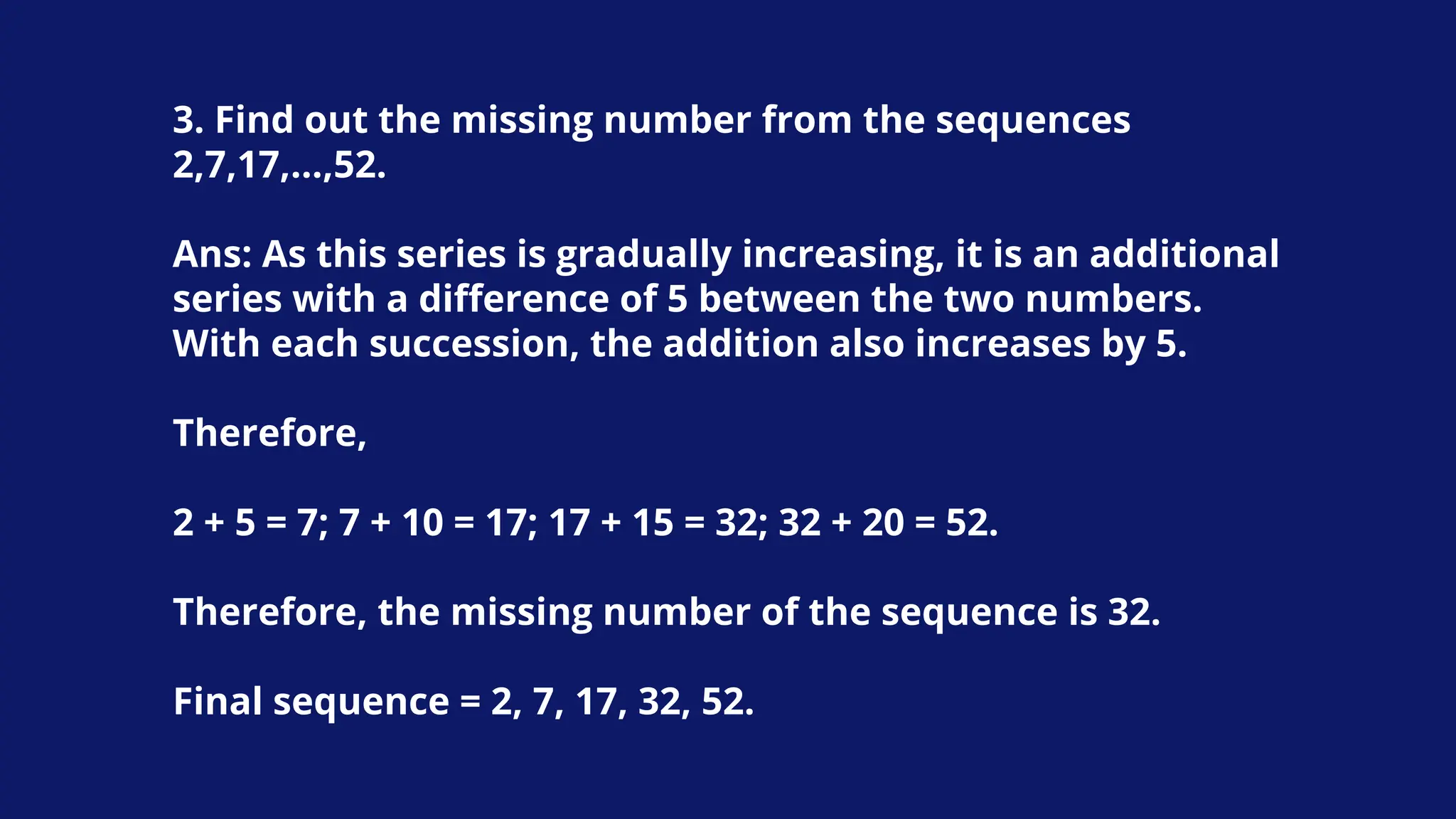
3. Find out the missing number from the sequences
2,7,17,…,52.
Ans: As this series is gradually increasing, it is an additional
series with a difference of 5 between the two numbers.
With each succession, the addition also increases by 5.
Therefore,
2 + 5 = 7; 7 + 10 = 17; 17 + 15 = 32; 32 + 20 = 52.
Therefore, the missing number of the sequence is 32.
Final sequence = 2, 7, 17, 32, 52.
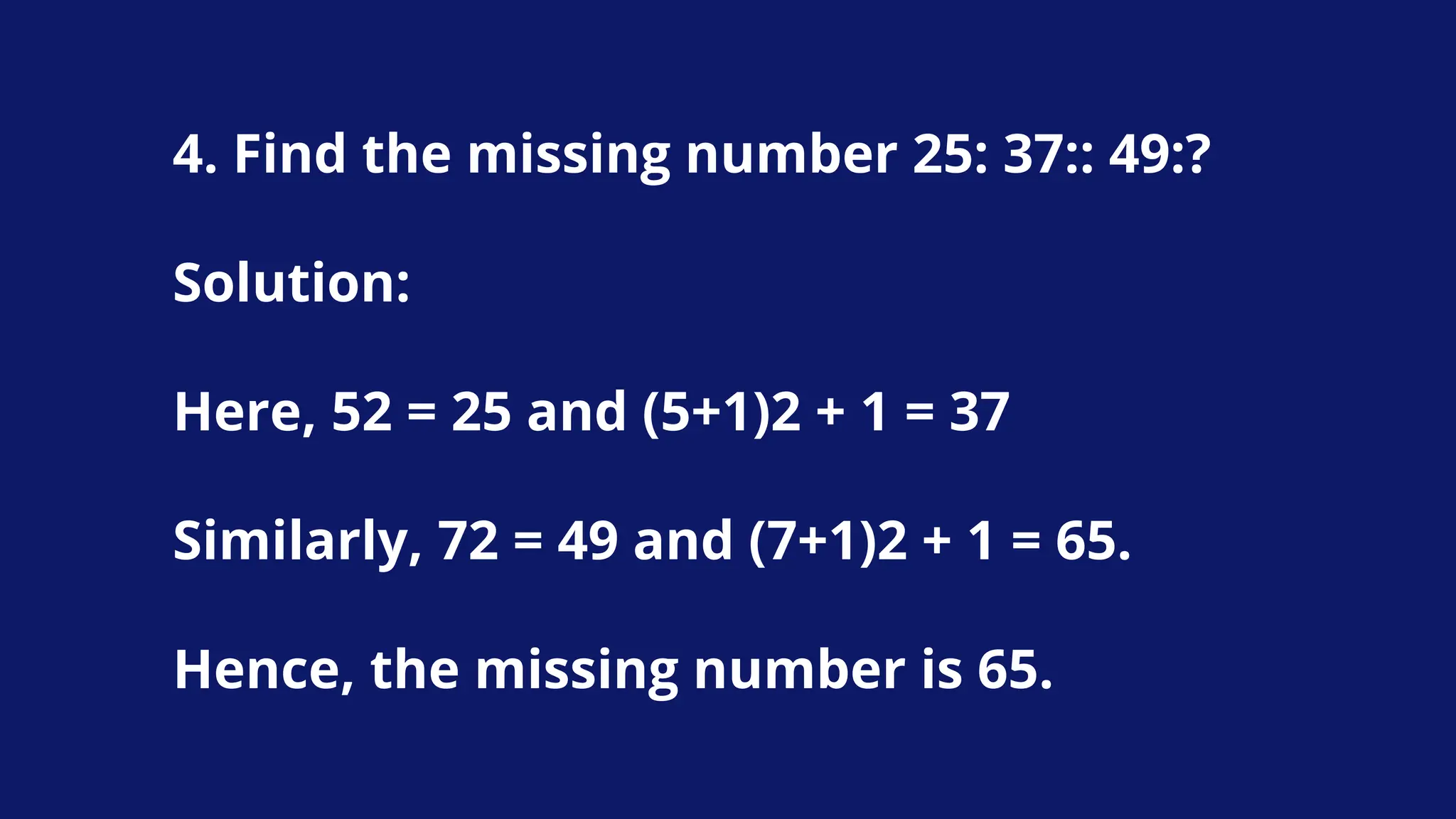
4. Find the missing number 25: 37:: 49:?
Solution:
Here, 52 = 25 and (5+1)2 + 1 = 37
Similarly, 72 = 49 and (7+1)2 + 1 = 65.
Hence, the missing number is 65.
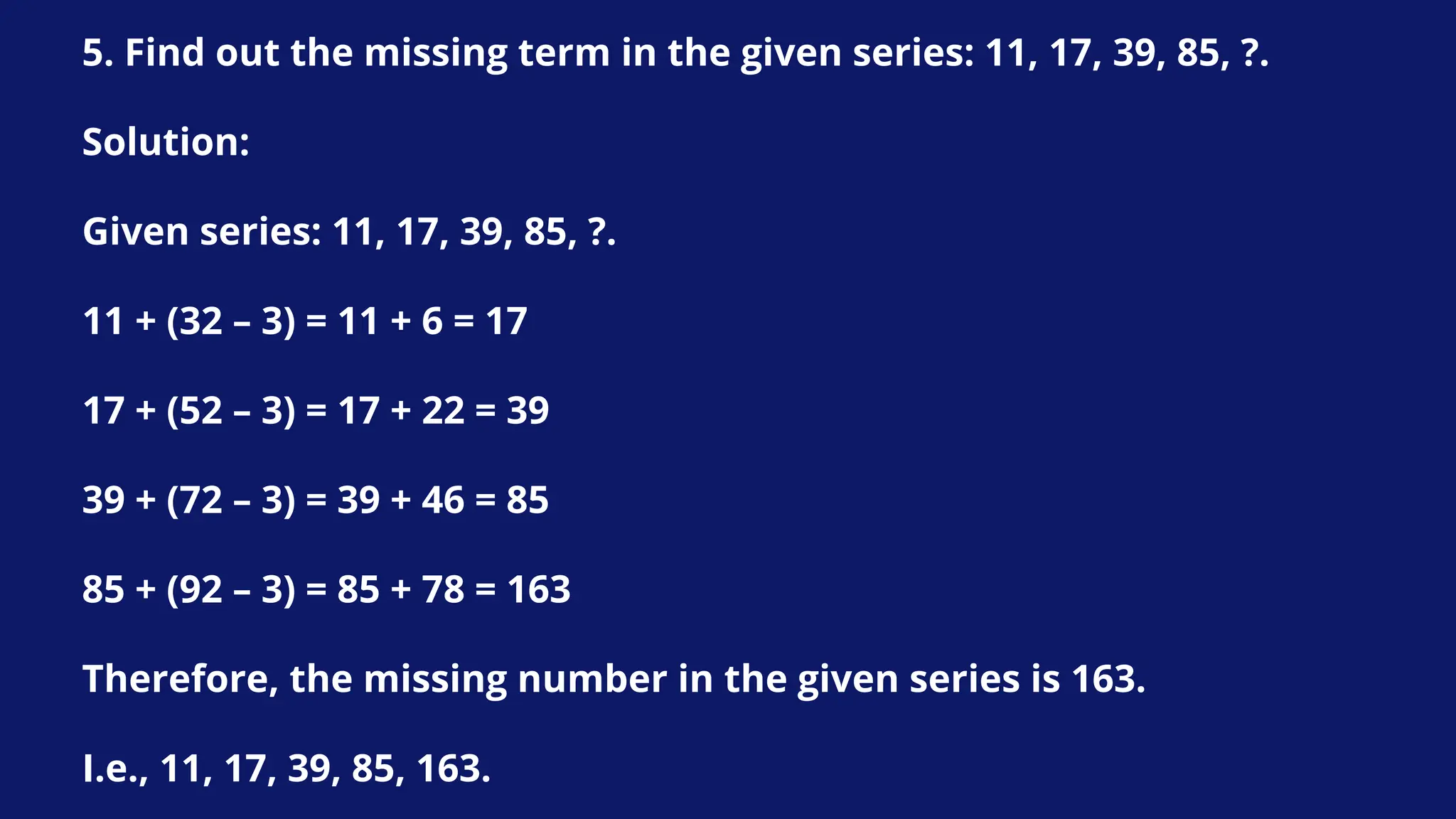
5. Find out the missing term in the given series: 11, 17, 39, 85, ?.
Solution:
Given series: 11, 17, 39, 85, ?.
11 + (32 – 3) = 11 + 6 = 17
17 + (52 – 3) = 17 + 22 = 39
39 + (72 – 3) = 39 + 46 = 85
85 + (92 – 3) = 85 + 78 = 163
Therefore, the missing number in the given series is 163.
I.e., 11, 17, 39, 85, 163.
6. Determine the missing numbers in the series 5, 6, 9, 14, 21, ?.
Solution:
Given the number series: 5, 6, 9, 14, 21, ?.
5 + 1 = 6
6 + 3 = 9
9 + 5 = 14
14 + 7 = 21
21 + 9 = 30.
Hence, the missing number here is 30.
Here, the series follows a pattern of the sum of consecutive odd
numbers.
So, the complete number series is 5, 6, 9, 14, 21, 30.
Letter Series
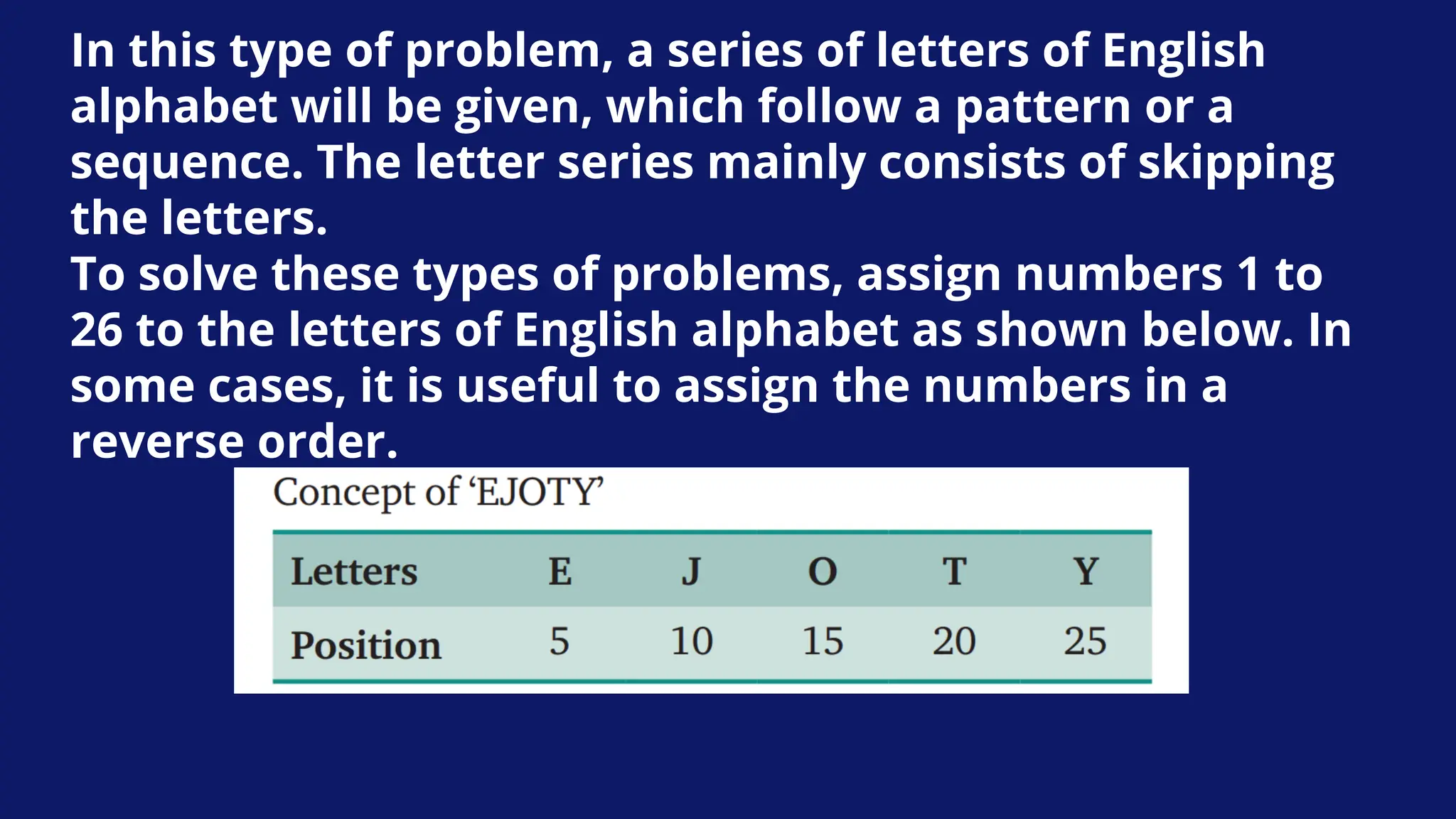
In this type of problem, a series of letters of English
alphabet will be given, which follow a pattern or a
sequence. The letter series mainly consists of skipping
the letters.
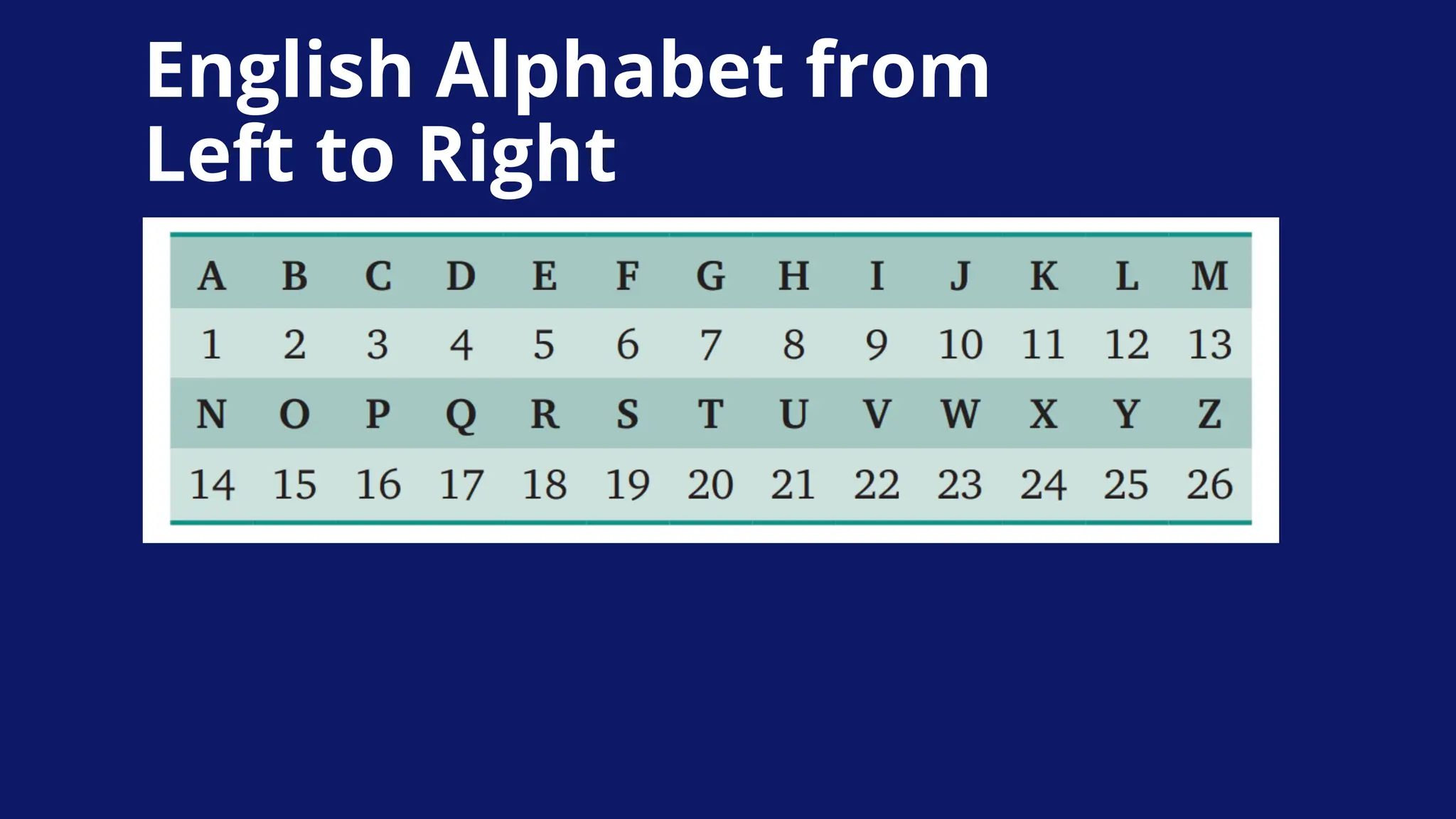
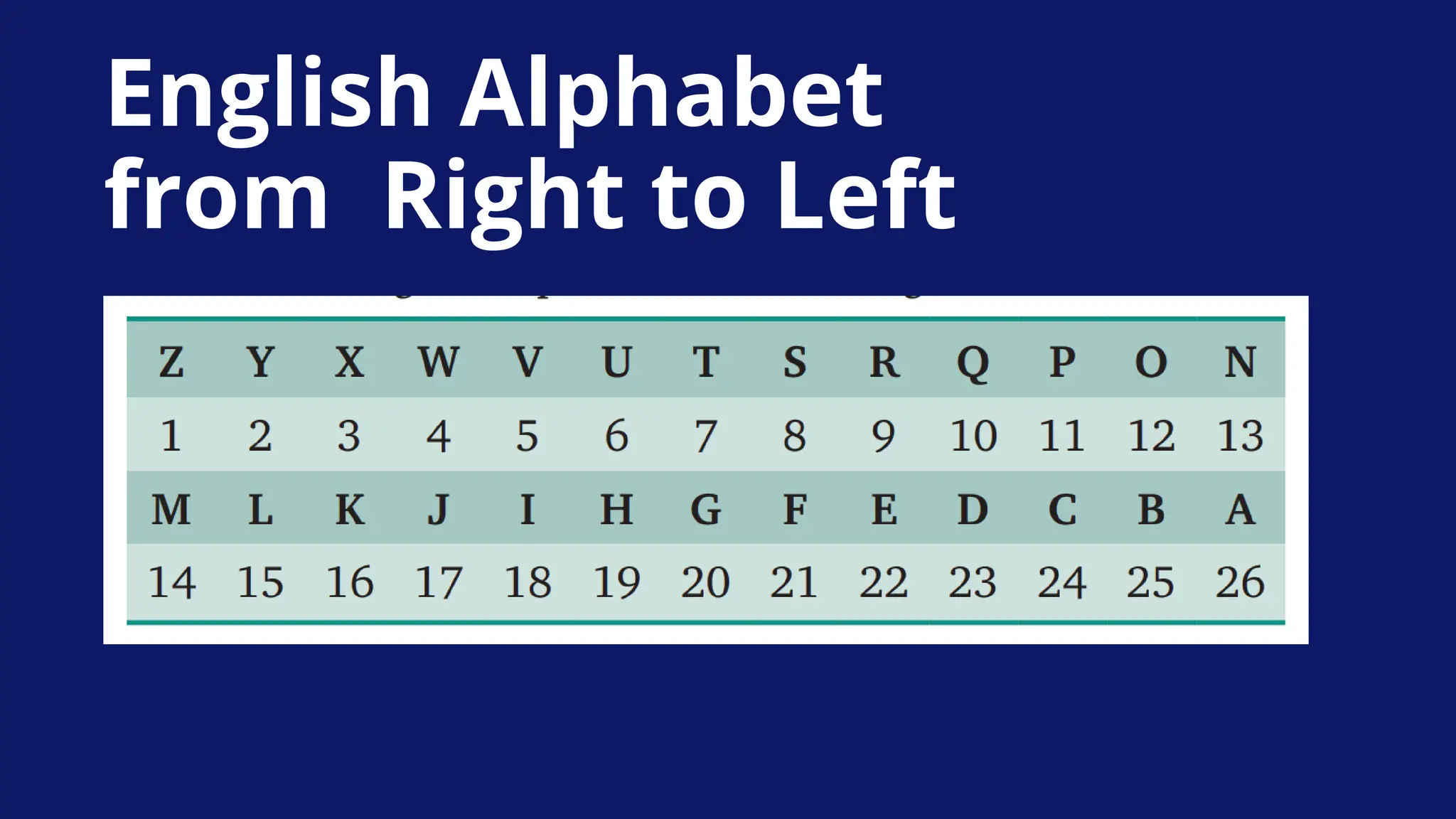
To solve these types of problems, assign numbers 1 to
26 to the letters of English alphabet as shown below. In
some cases, it is useful to assign the numbers in a
reverse order.
English Alphabet from
Left to Right
English Alphabet
from Right to Left
One Letter Series
Example 1
A, C, E, G, …, K
(a) I (b) H (c) J (d) M
Solution
The series is A + 2 = C, C + 2 = E, E + 2
= G; G + 2 = I, I +2 = K. The missing
letter is I.
Example 2
B, E, H, K, N, …
(a) P (b) O (c) Q (d) R
Solution
The series is +3. The missing letter is
N + 3 = Q.
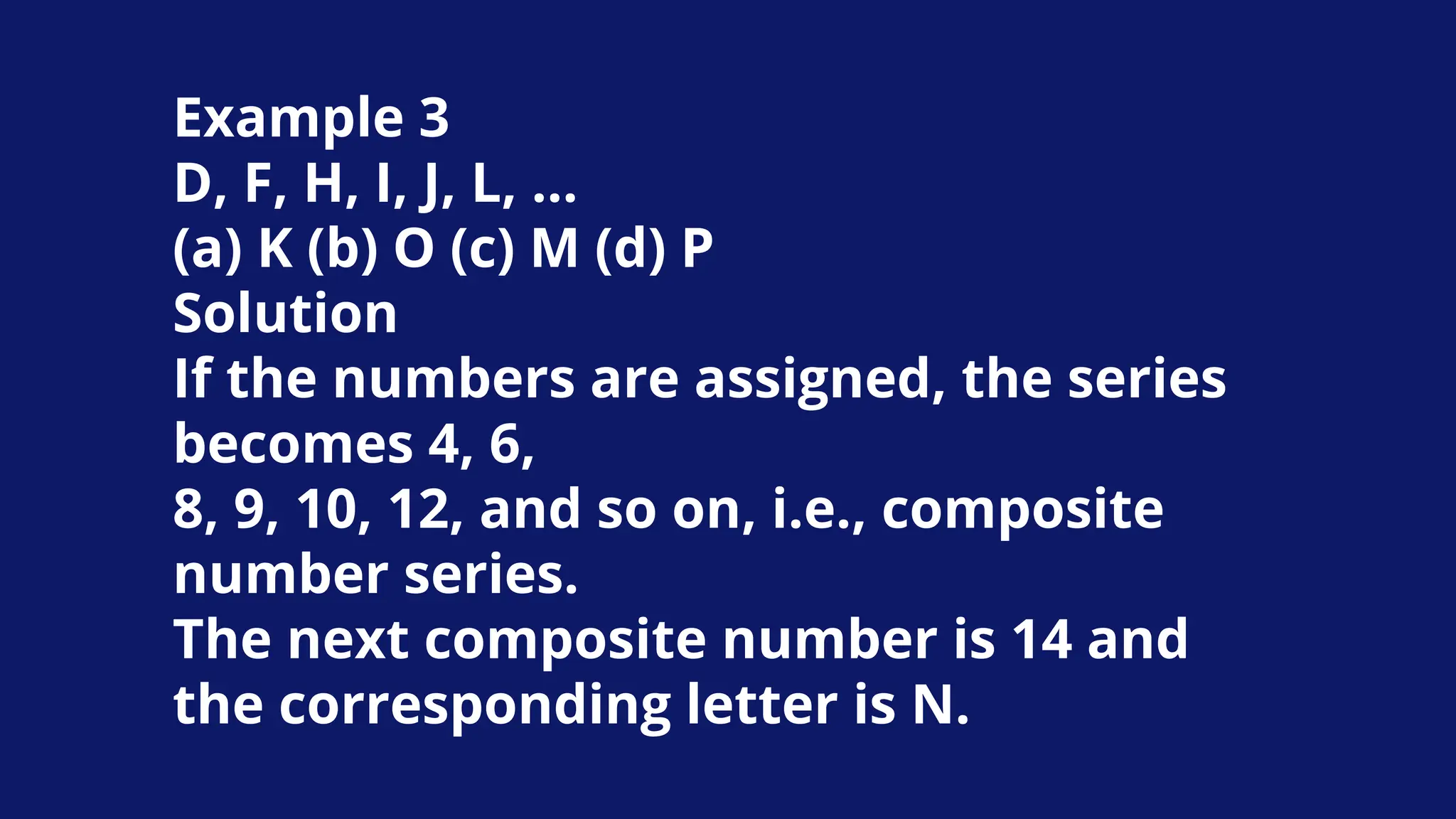
Example 3
D, F, H, I, J, L, …
(a) K (b) O (c) M (d) P
Solution
If the numbers are assigned, the series
becomes 4, 6,
8, 9, 10, 12, and so on, i.e., composite
number series.
The next composite number is 14 and
the corresponding letter is N.
Combined two
letter series
The first letters of the series follow one logic
and the second letters follow another logic,
and then they pair with each other.
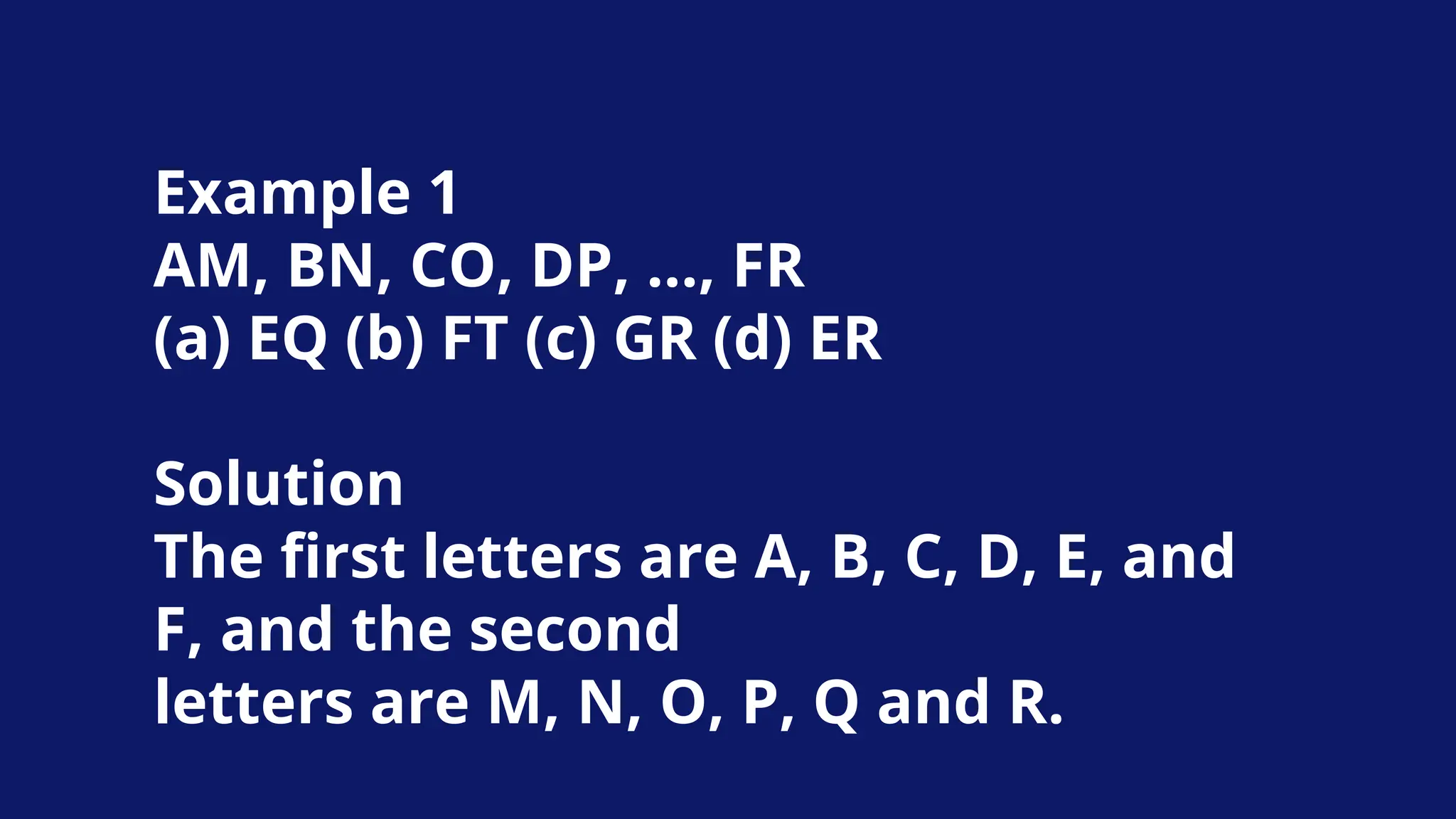
Example 1
AM, BN, CO, DP, …, FR
(a) EQ (b) FT (c) GR (d) ER
Solution
The first letters are A, B, C, D, E, and
F, and the second
letters are M, N, O, P, Q and R.
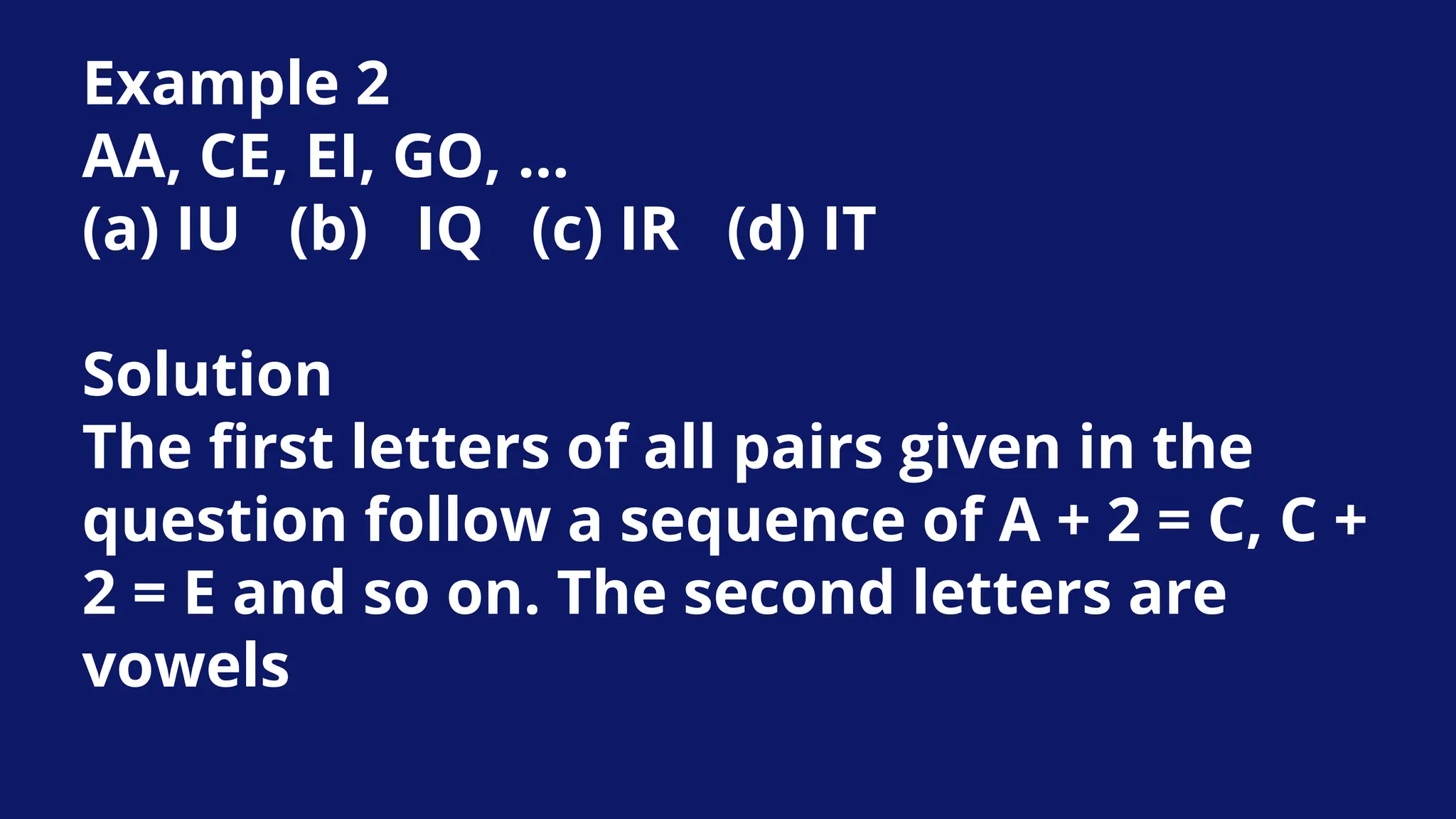
Example 2
AA, CE, EI, GO, …
(a) IU (b) IQ (c) IR (d) IT
Solution
The first letters of all pairs given in the
question follow a sequence of A + 2 = C, C +
2 = E and so on. The second letters are
vowels
Three letter series
This sequence consists of three letters in each term.
The first letters follow one logic, Where the second
letters follow another logic and the third letters
follow some other logic (or the same logic in all the
three cases).
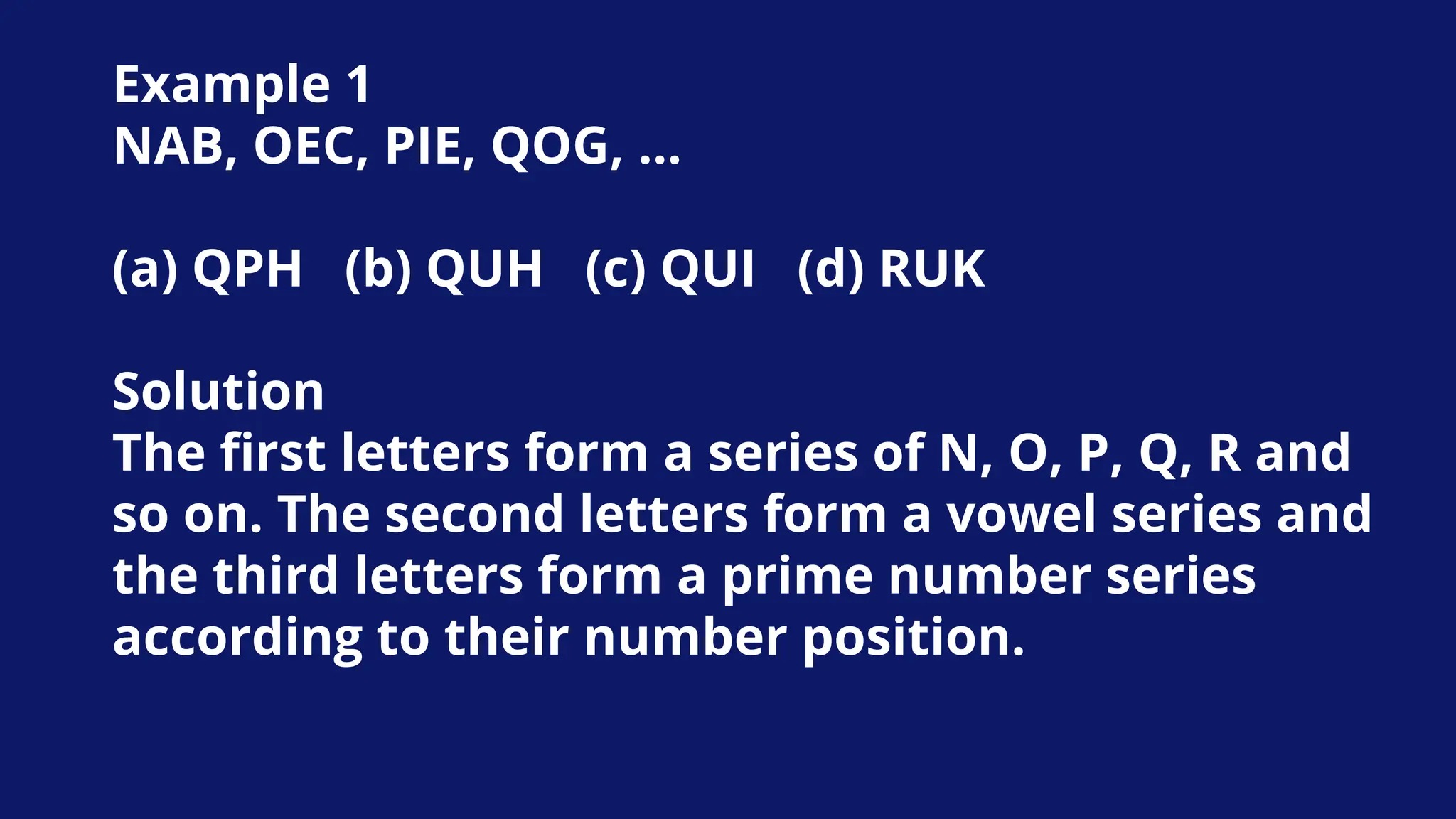
Example 1
NAB, OEC, PIE, QOG, …
(a) QPH (b) QUH (c) QUI (d) RUK
Solution
The first letters form a series of N, O, P, Q, R and
so on. The second letters form a vowel series and
the third letters form a prime number series
according to their number position.
Coding &
Decoding
In these types of questions,
the letters of the alphabet
are exclusively used. These
letters do not stand for
themselves but are allotted
some artificial values based
on logical patterns or
analogies. By applying
those principles or
observing the pattern
involved, the candidates
are required to decode a
coded word or encode a
word. Alphabetical Coding
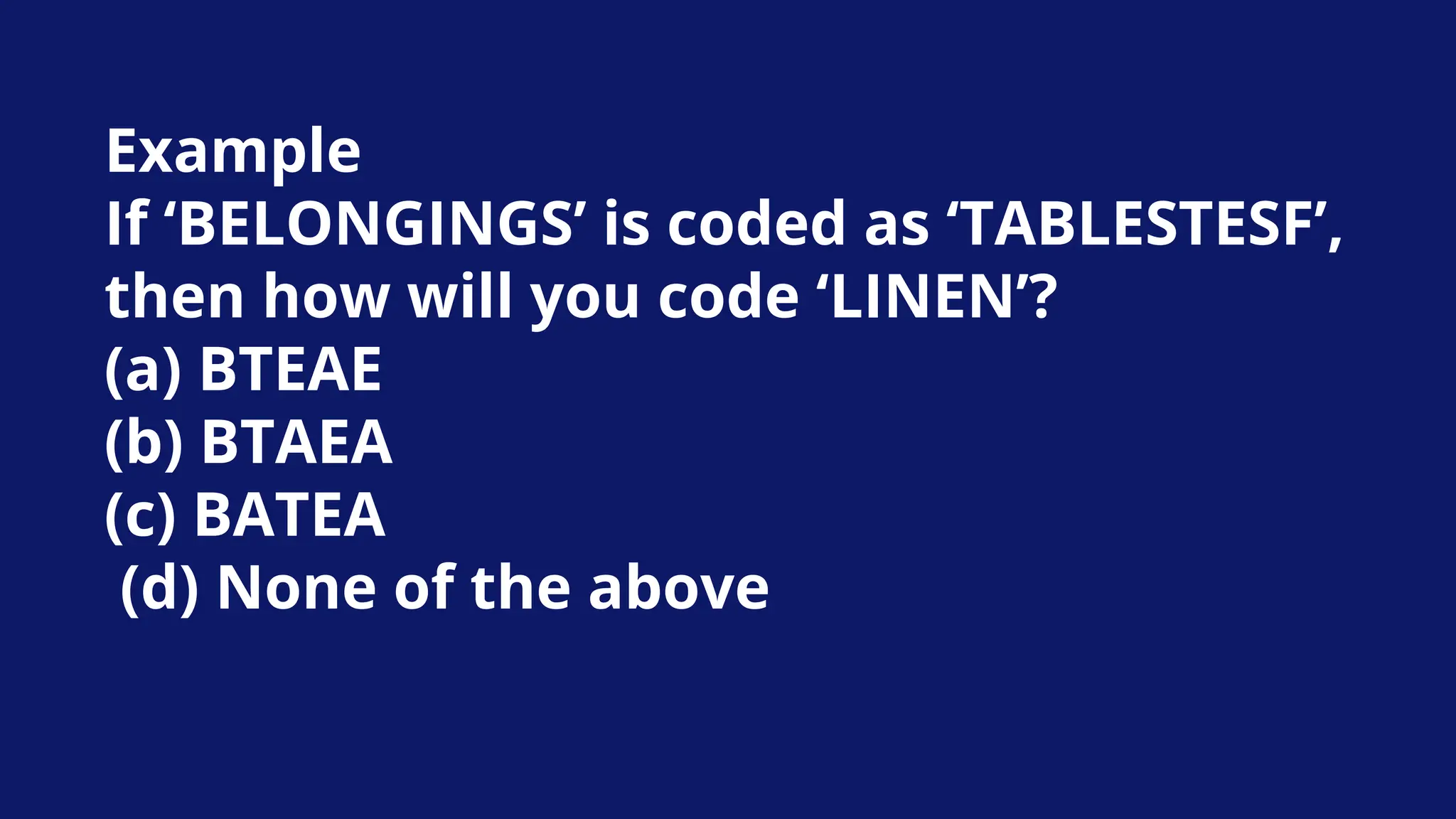
Example
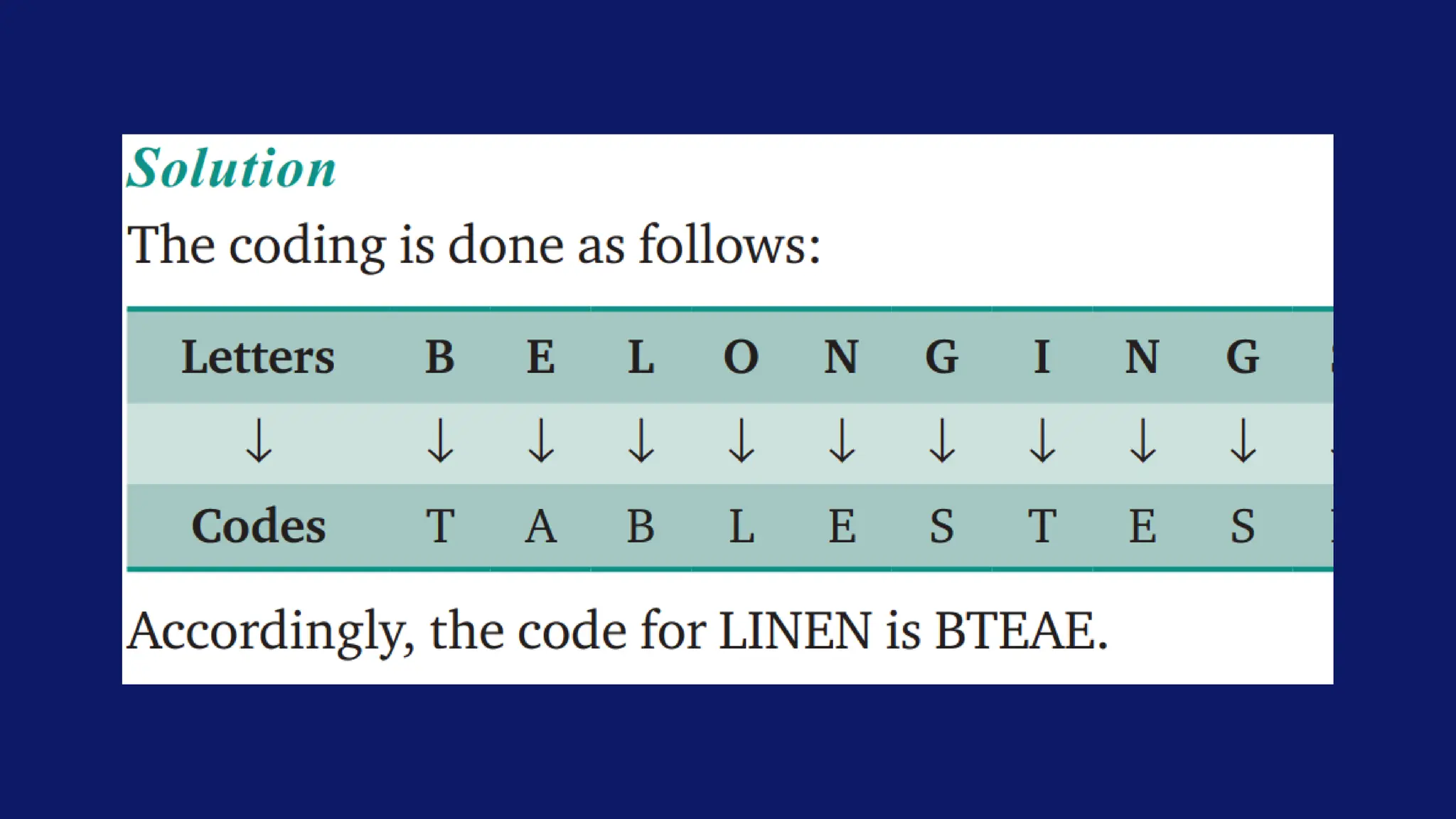
If ‘BELONGINGS’ is coded as ‘TABLESTESF’,
then how will you code ‘LINEN’?
(a) BTEAE
(b) BTAEA
(c) BATEA
(d) None of the above
Example
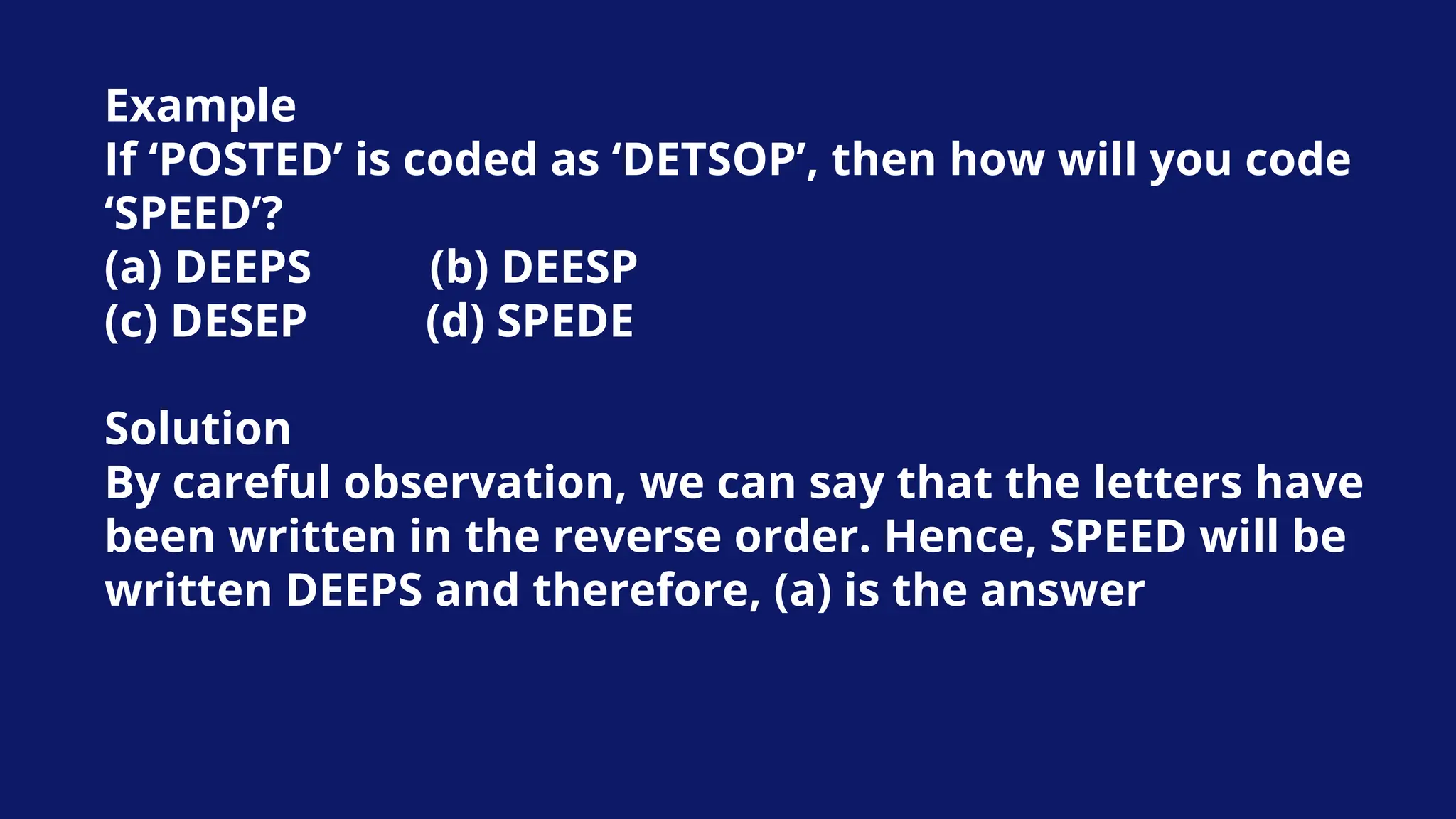
If ‘POSTED’ is coded as ‘DETSOP’, then how will you code
‘SPEED’?
(a) DEEPS (b) DEESP
(c) DESEP (d) SPEDE
Solution
By careful observation, we can say that the letters have
been written in the reverse order. Hence, SPEED will be
written DEEPS and therefore, (a) is the answer
Example
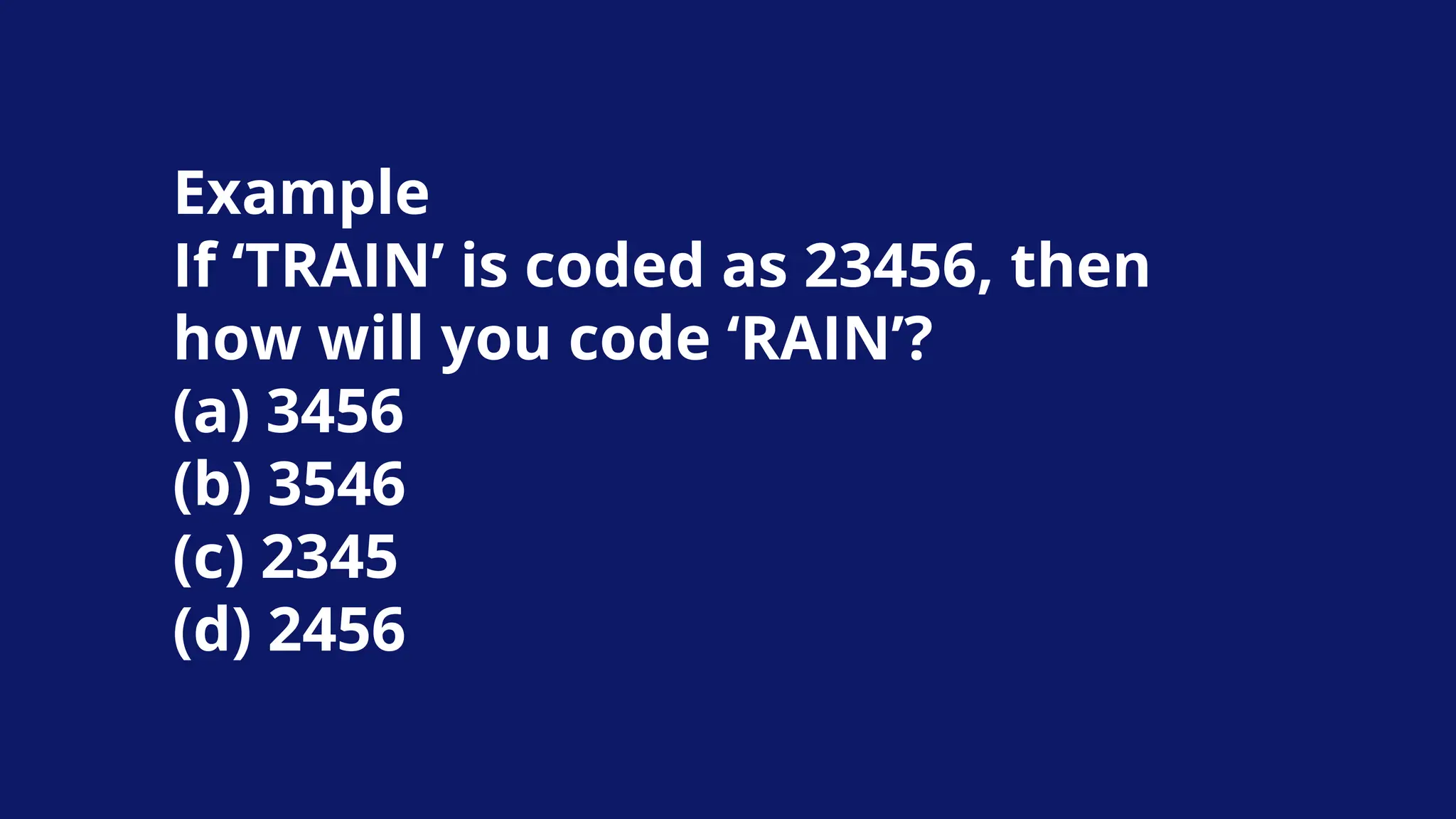
If ‘TRAIN’ is coded as 23456, then
how will you code ‘RAIN’?
(a) 3456
(b) 3546
(c) 2345
(d) 2456
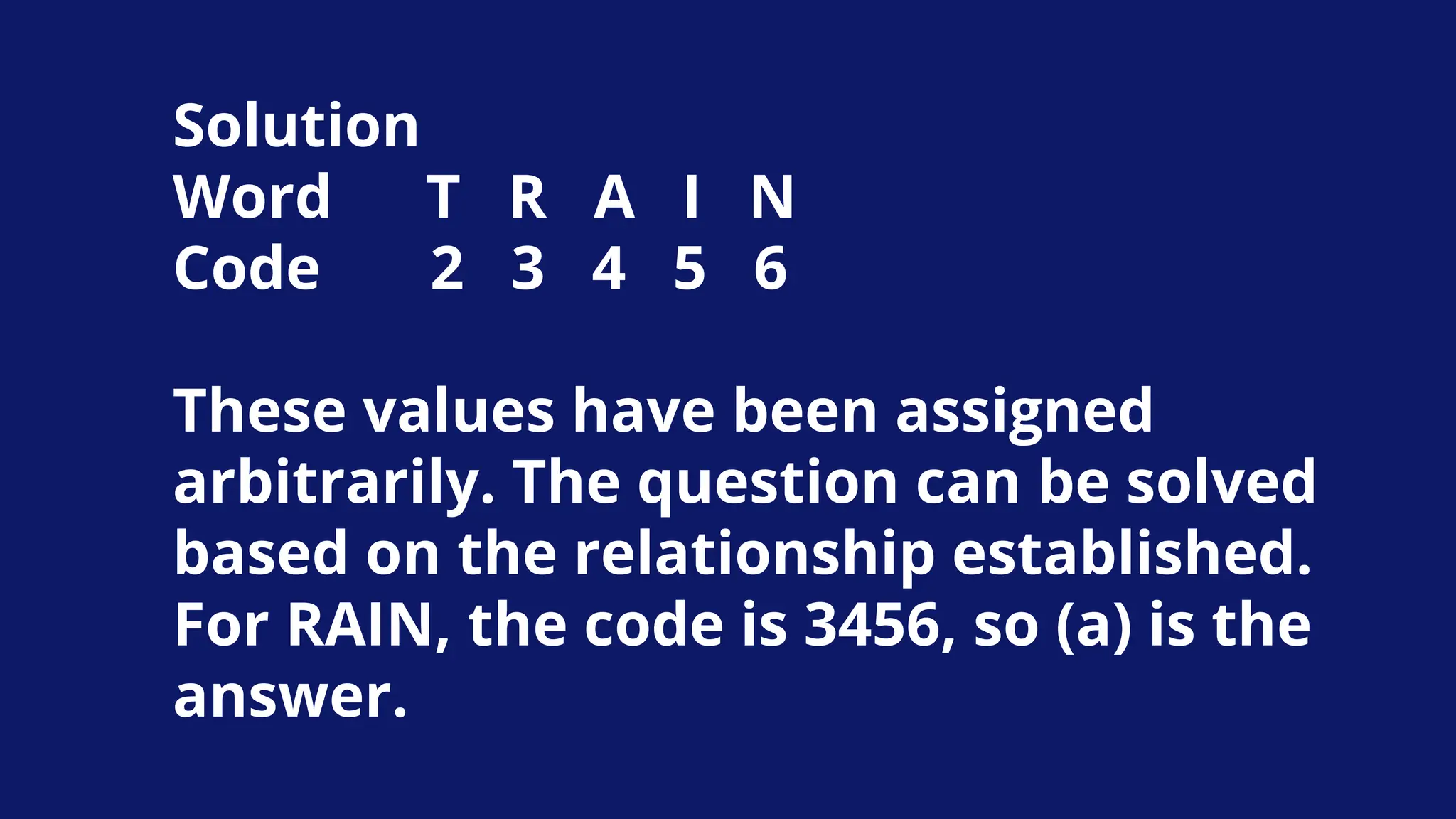
Solution
Word T R A I N
Code 2 3 4 5 6
These values have been assigned
arbitrarily. The question can be solved
based on the relationship established.
For RAIN, the code is 3456, so (a) is the
answer.
If rain is water, water is road, road is cloud,
cloud is sky, sky is sea and sea is path, where do
aeroplanes fly?
(a) Road (b) Sea
(c) Cloud (d) Water
Explanation
The aeroplanes fly in the ‘sky’ and the ‘sky’ is
called ‘sea’. Hence, the aeroplanes fly in the
‘sea’.
Further
Questions
Choosing the Odd Word
Choosing the Odd Number
Choosing the Odd Letter
Choosing the Group of Odd
Words/Letters/Numbers
ANALOGY
The meaning of analogy is correspondence. In the
questions based on analogy, a particular relationship is
given and another similar relationship has to be identified
from the alternatives provided to us. Therefore, analogy
tests are meant to test a candidate for the overall
knowledge, power of reasoning, and the ability to
think concisely and accurately.
Example 1
As delicious is related to taste, melodious is
related to
(a) Voice (b) Speak
(c) Music (d) Highness
Answer: (a)
Explanation
Delicious represents good taste. Similarly,
melody describes pleasant voice.
Example 2
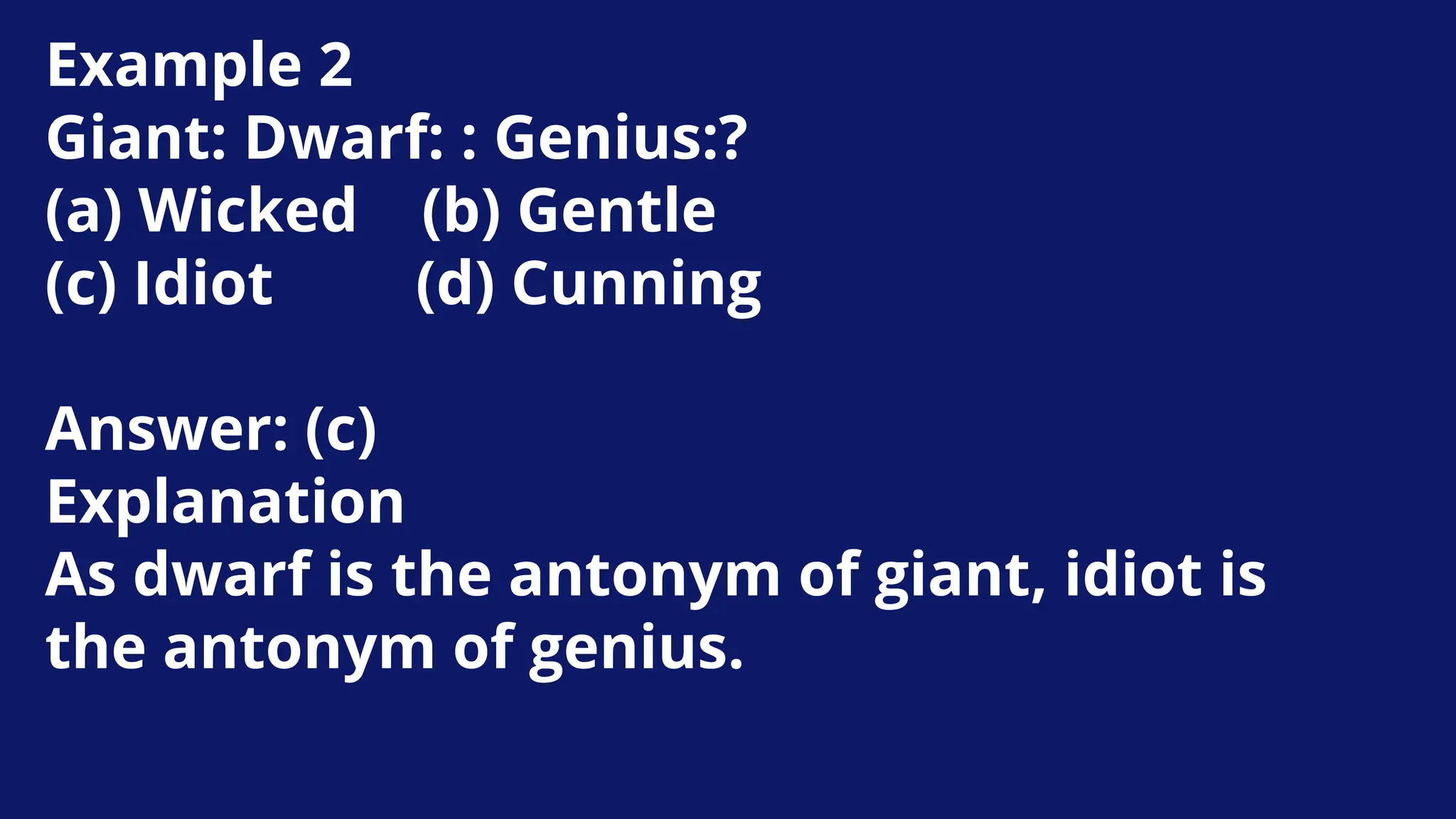
Giant: Dwarf: : Genius:?
(a) Wicked (b) Gentle
(c) Idiot (d) Cunning
Answer: (c)
Explanation
As dwarf is the antonym of giant, idiot is
the antonym of genius.
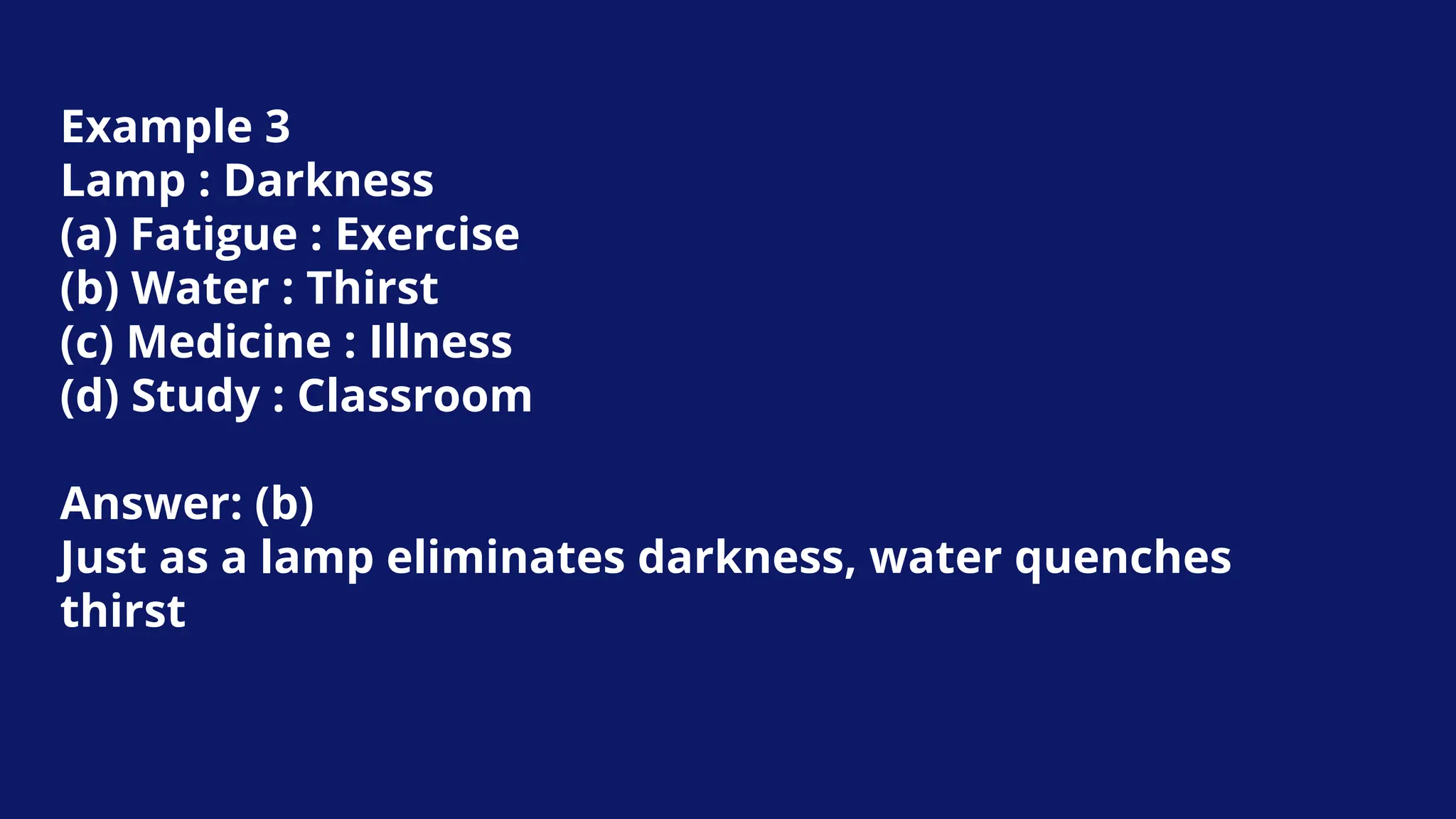
Example 3
Lamp : Darkness
(a) Fatigue : Exercise
(b) Water : Thirst
(c) Medicine : Illness
(d) Study : Classroom
Answer: (b)
Just as a lamp eliminates darkness, water quenches
thirst
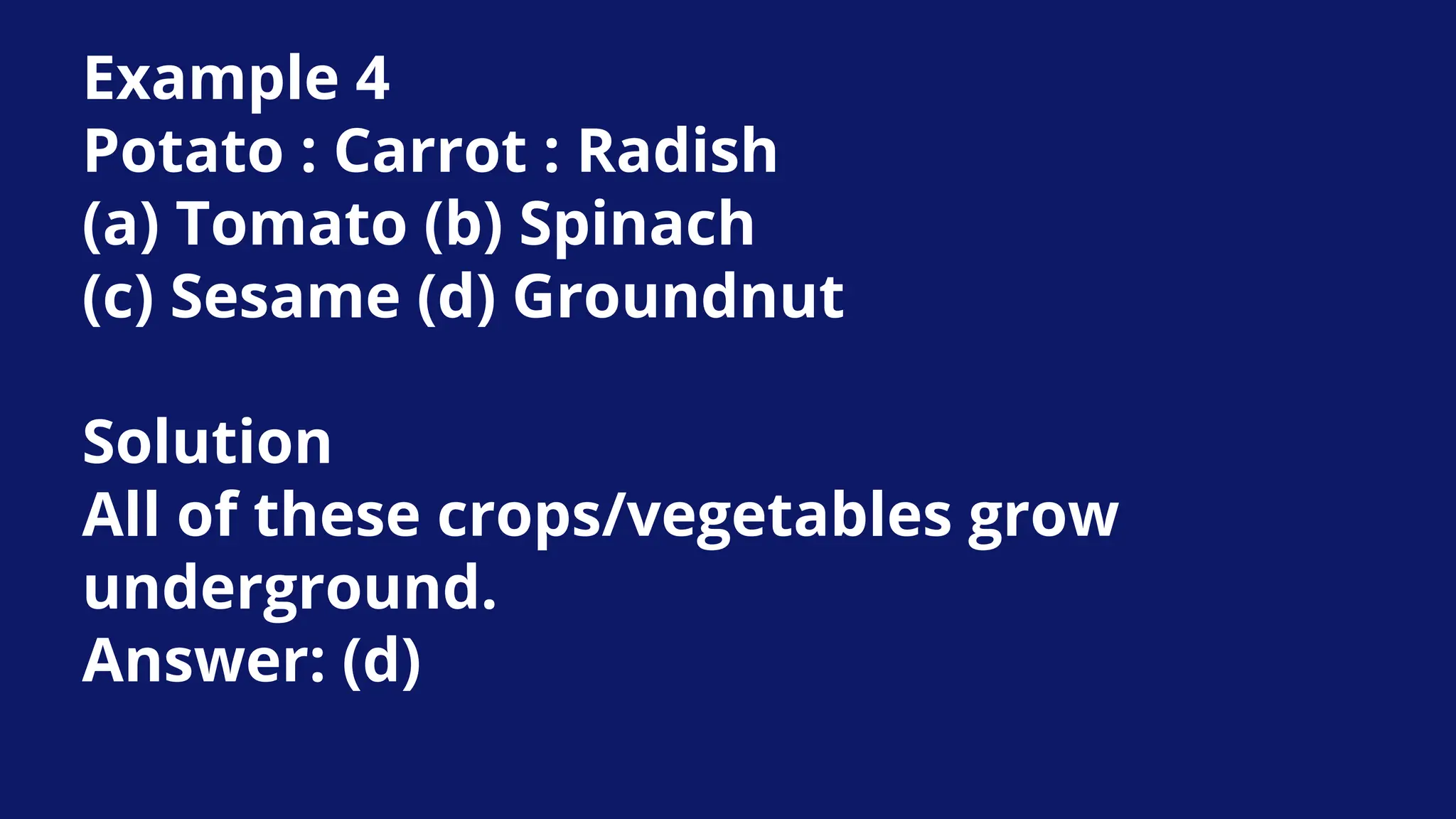
Example 4
Potato : Carrot : Radish
(a) Tomato (b) Spinach
(c) Sesame (d) Groundnut
Solution
All of these crops/vegetables grow
underground.
Answer: (d)
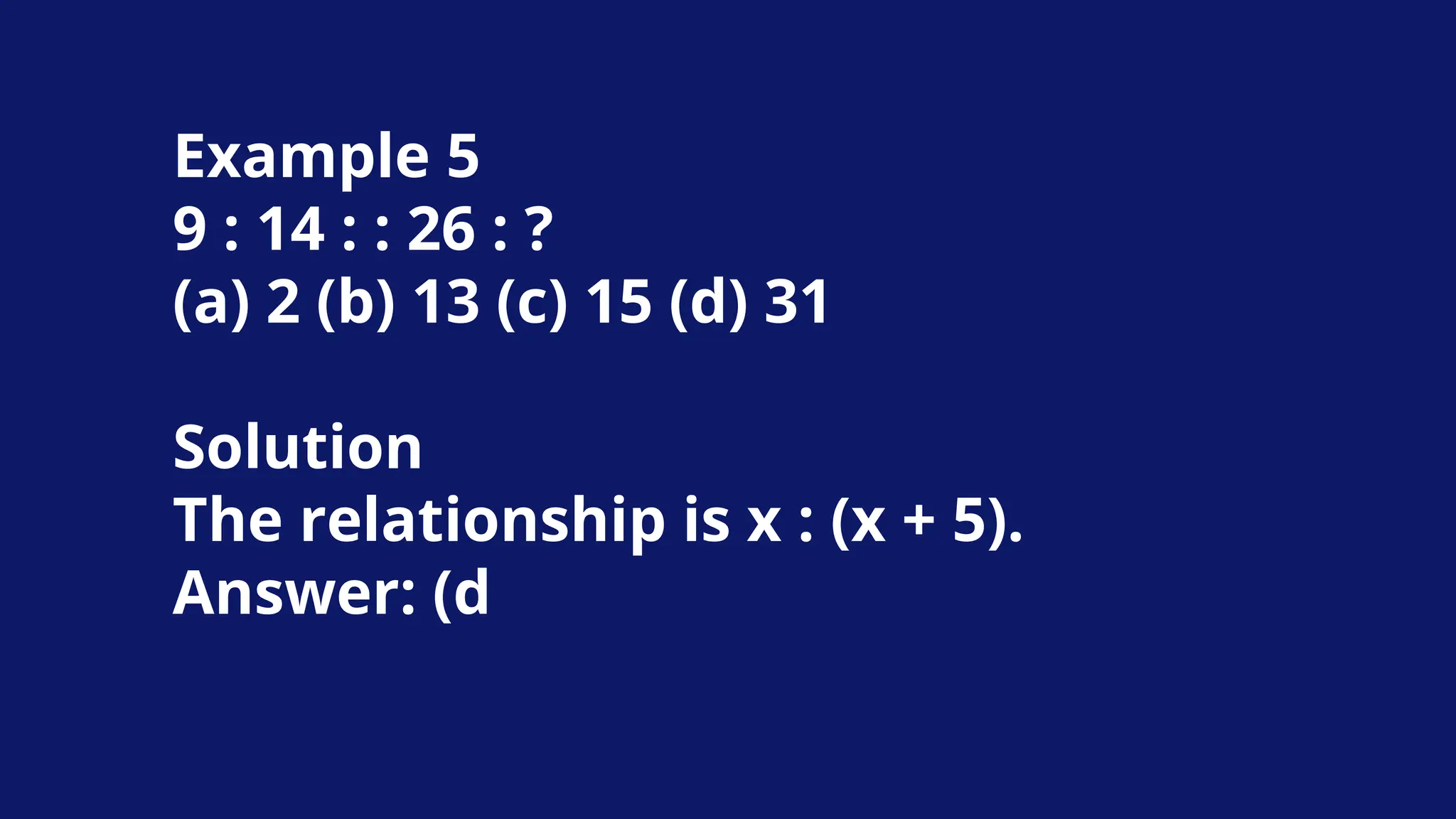
Example 5
9 : 14 : : 26 : ?
(a) 2 (b) 13 (c) 15 (d) 31
Solution
The relationship is x : (x + 5).
Answer: (d
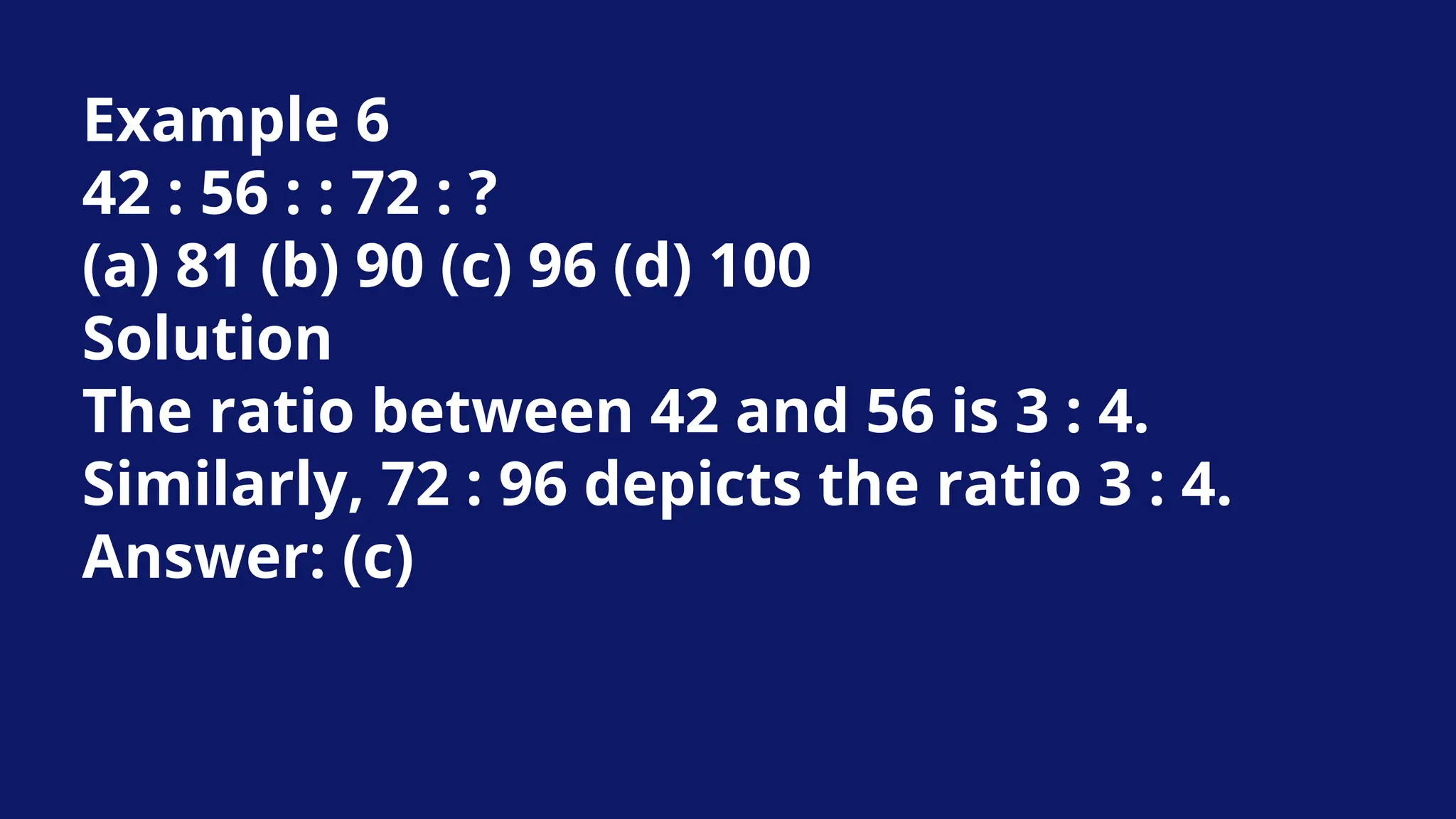
Example 6
42 : 56 : : 72 : ?
(a) 81 (b) 90 (c) 96 (d) 100
Solution
The ratio between 42 and 56 is 3 : 4.
Similarly, 72 : 96 depicts the ratio 3 : 4.
Answer: (c)
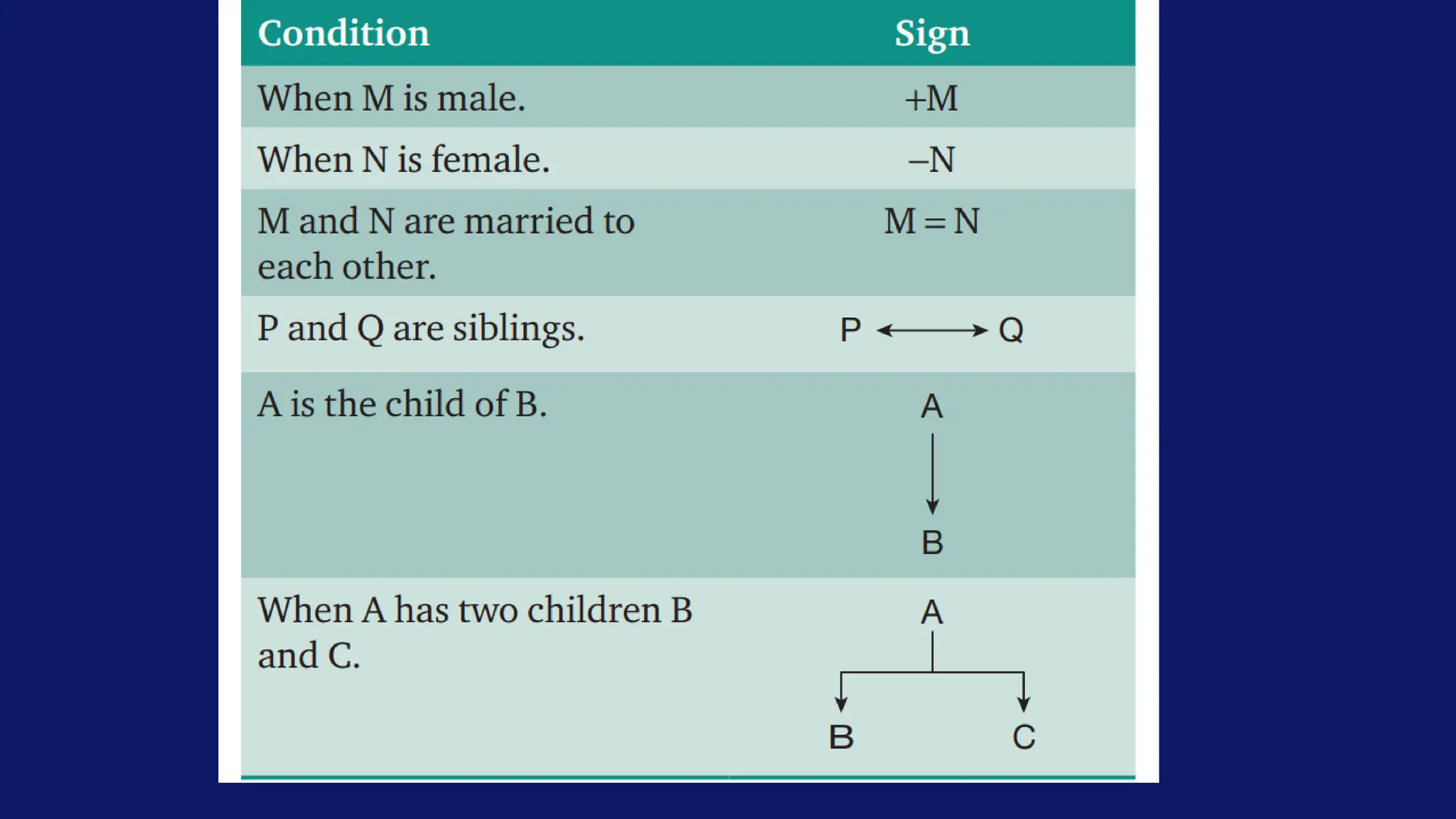
Blood Relations
Example 1
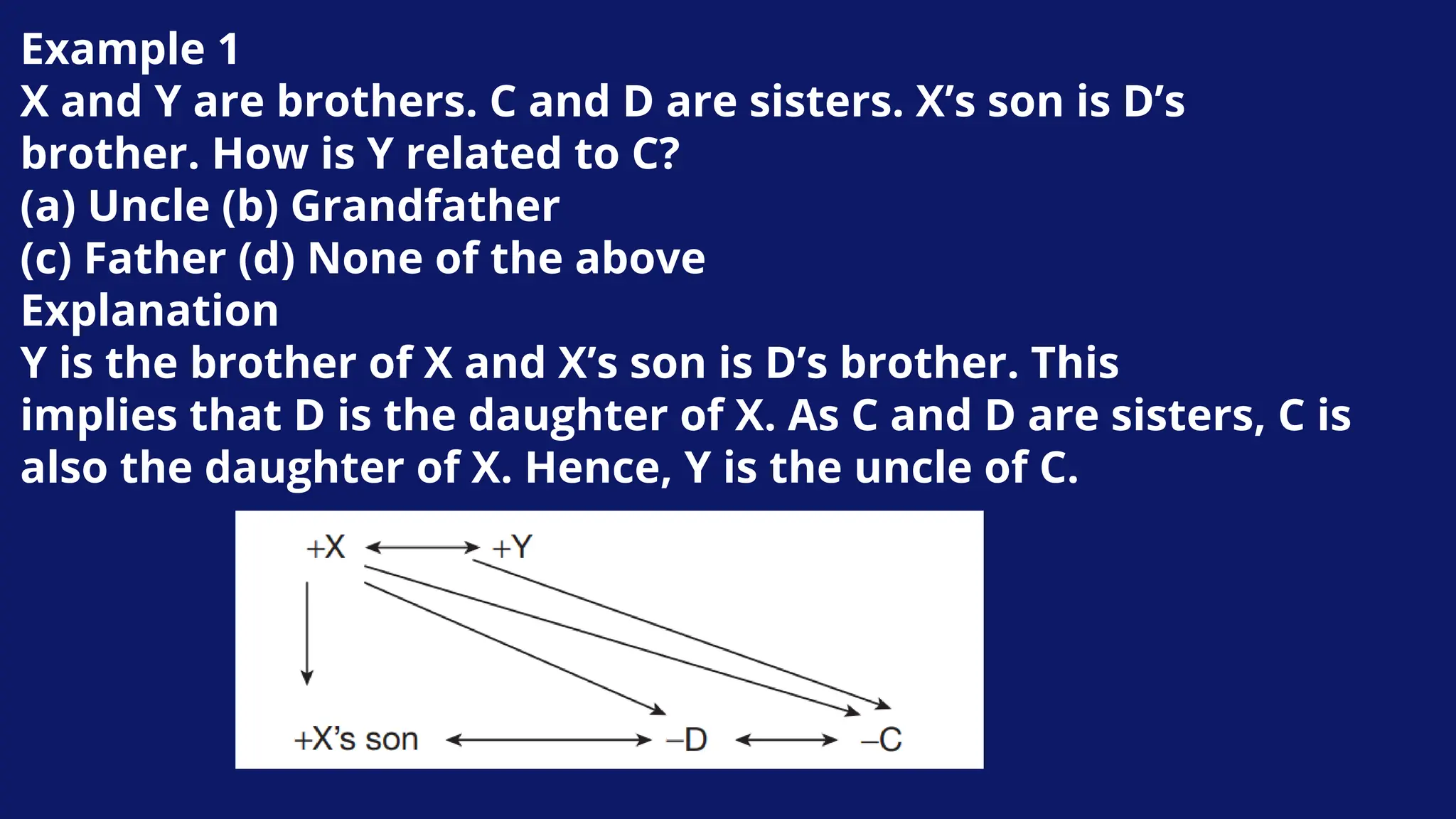
X and Y are brothers. C and D are sisters. X’s son is D’s
brother. How is Y related to C?
(a) Uncle (b) Grandfather
(c) Father (d) None of the above
Explanation
Y is the brother of X and X’s son is D’s brother. This
implies that D is the daughter of X. As C and D are sisters, C is
also the daughter of X. Hence, Y is the uncle of C.
Direction Sense
Seating
Arrangement
Mathematical
Aptitude
Mathematical
Aptitude
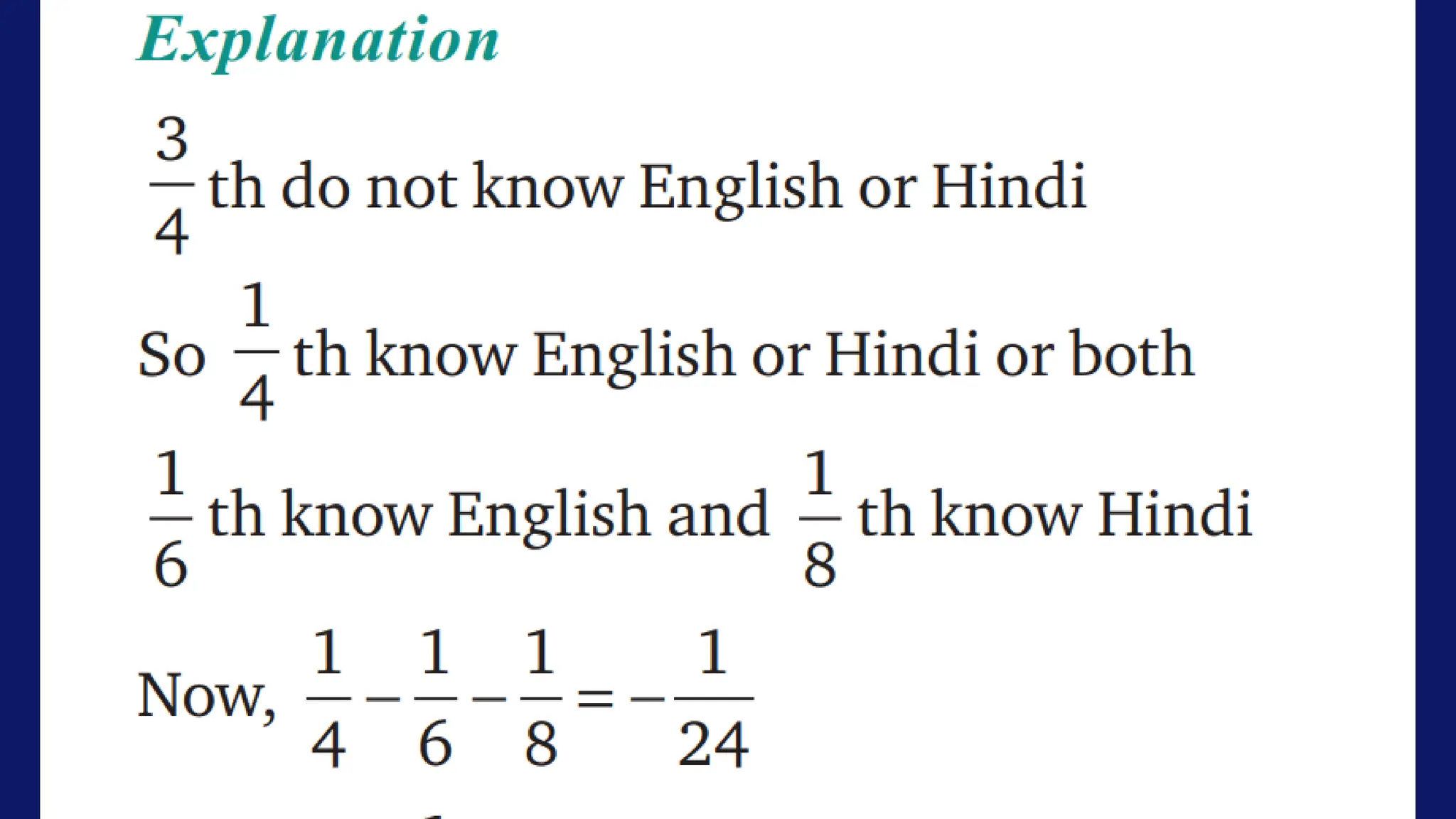
Fraction
Time & Distance
Ratio, Proportion, and Percentage
Profit and Loss
Interest and Discounting
Averages
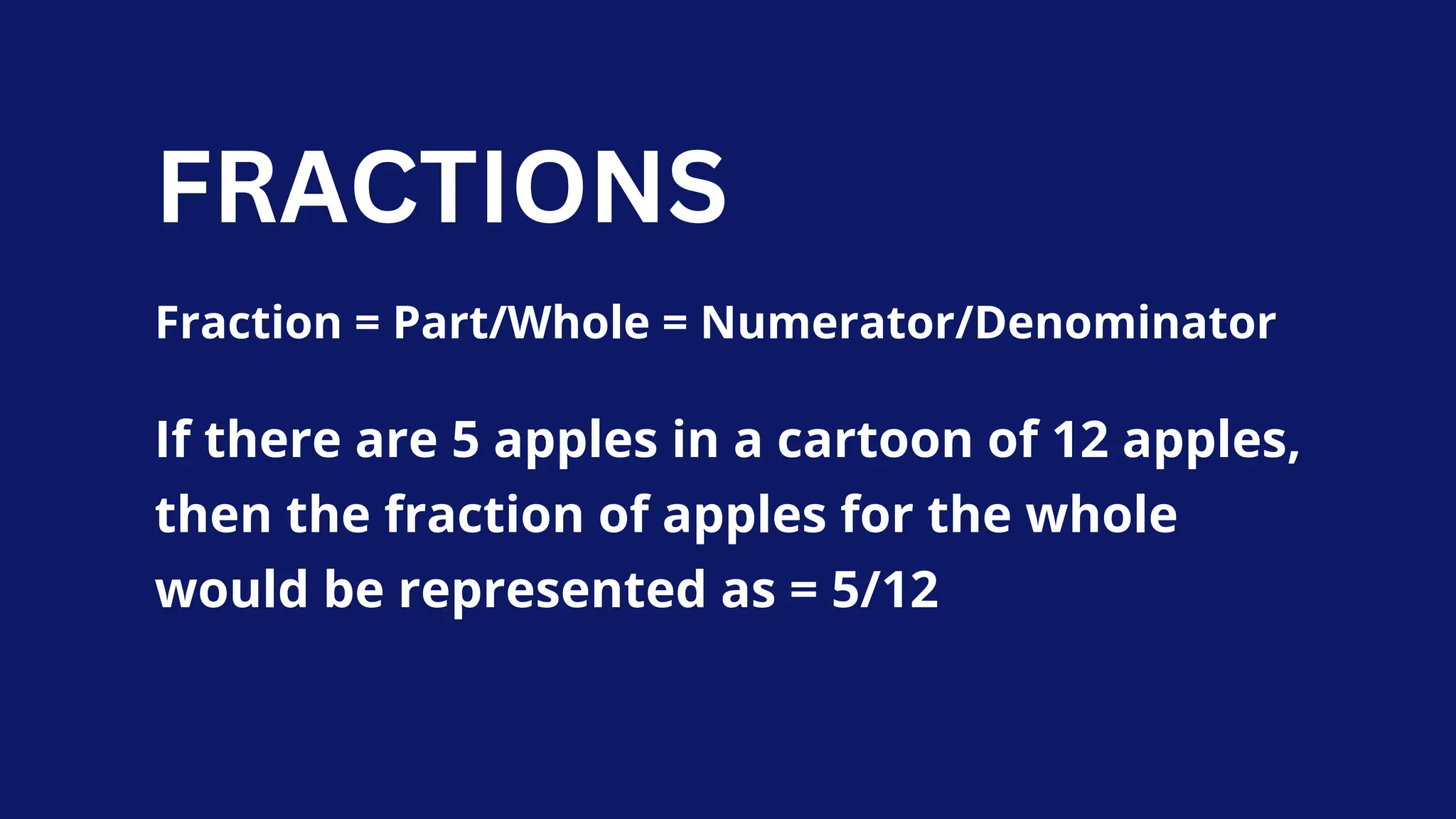
If there are 5 apples in a cartoon of 12 apples,
then the fraction of apples for the whole
would be represented as = 5/12
Fraction = Part/Whole = Numerator/Denominator
FRACTIONS
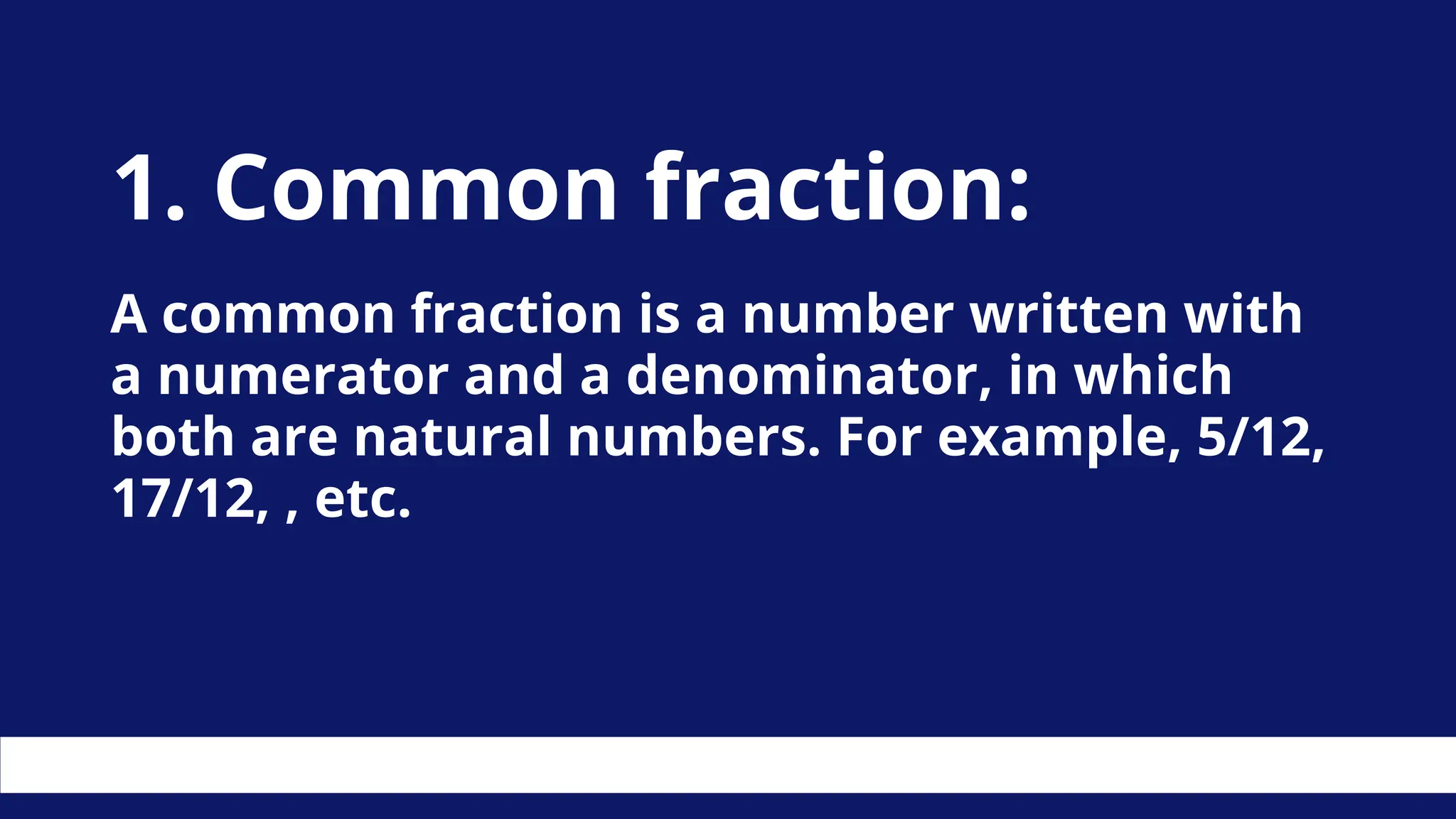
1. Common fraction:
A common fraction is a number written with
a numerator and a denominator, in which
both are natural numbers. For example, 5/12,
17/12, , etc.
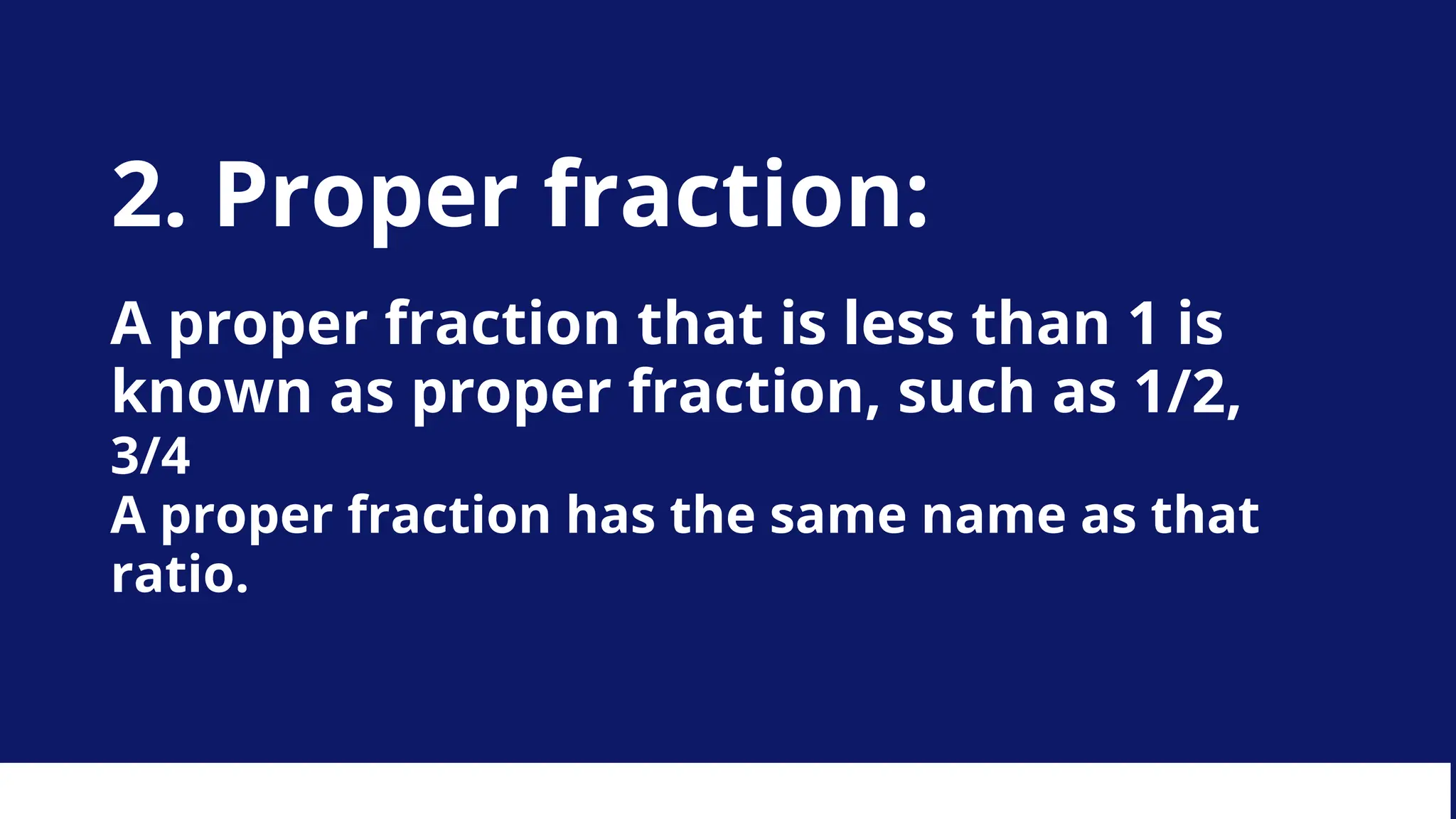
2. Proper fraction:
A proper fraction that is less than 1 is
known as proper fraction, such as 1/2,
3/4
A proper fraction has the same name as that
ratio.
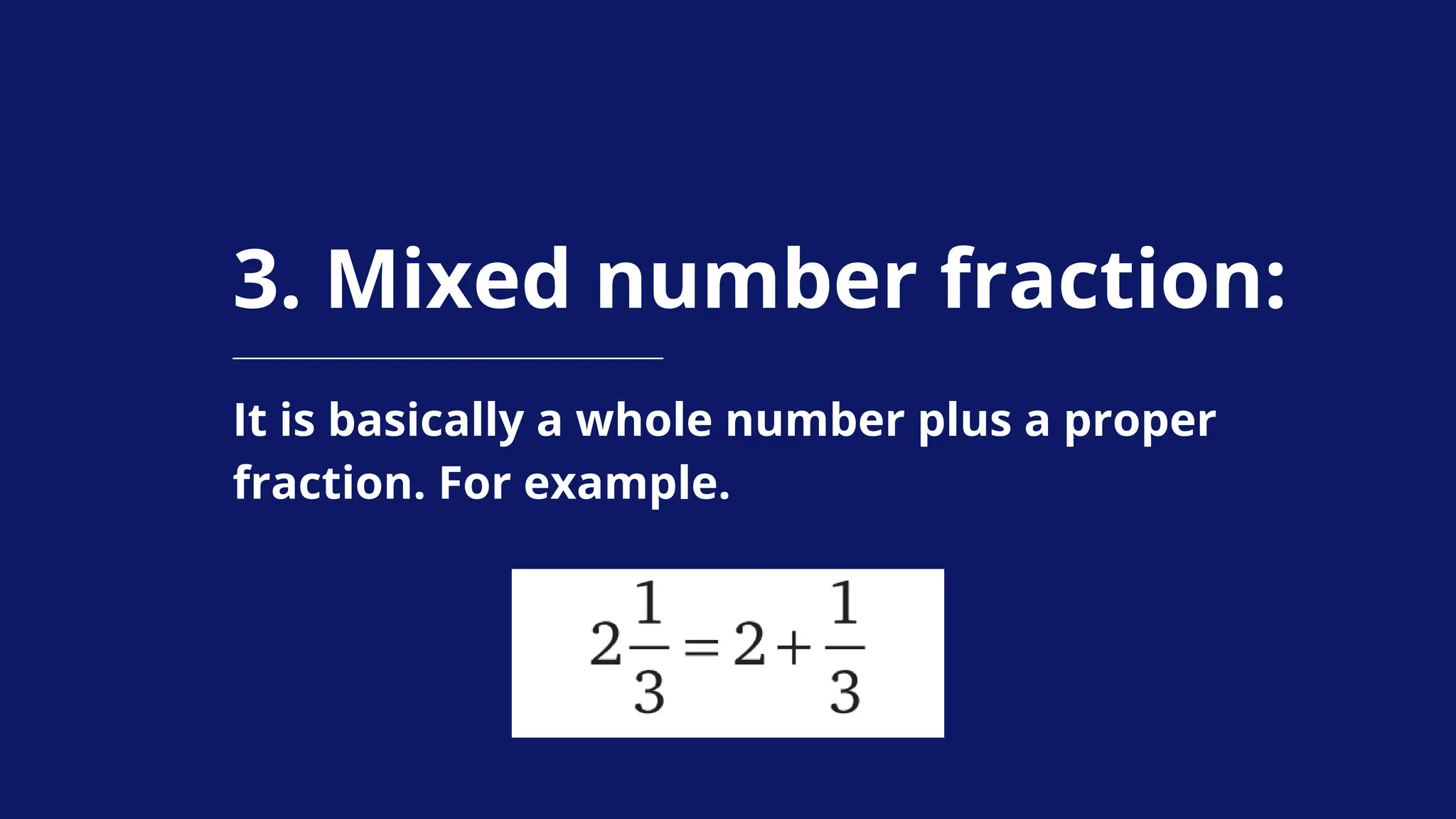
3. Mixed number fraction:
It is basically a whole number plus a proper
fraction. For example.
4. Improper
fractions:
If we divide each whole unit
into thirds, say, and keep
counting them, then we
will come to 3/3, 4/3, 5/3
and so on. That is, we will
come to fractions that are
equal to or greater than -1.
We call those improper
fractions.
Questions on
Fractions
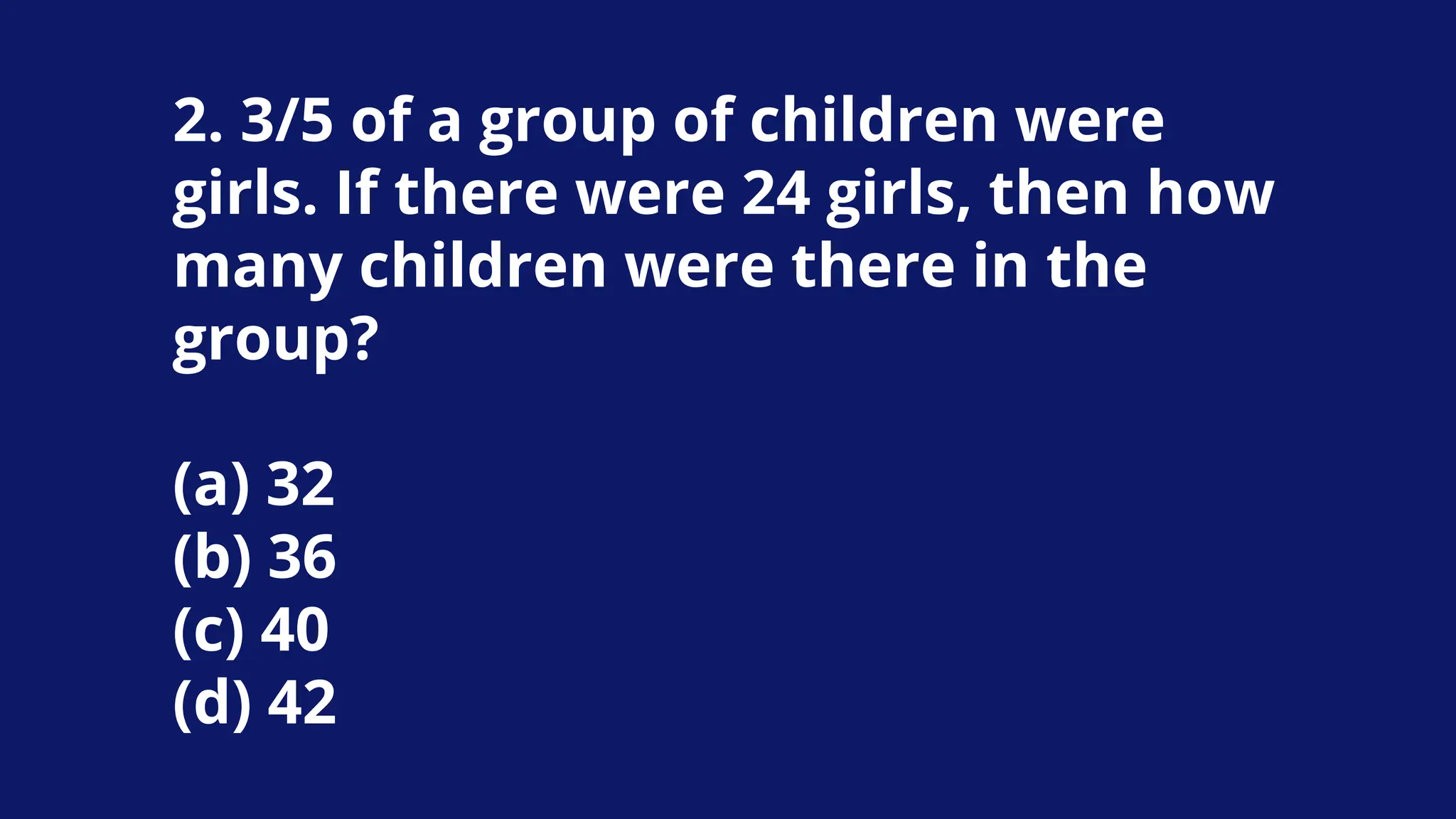
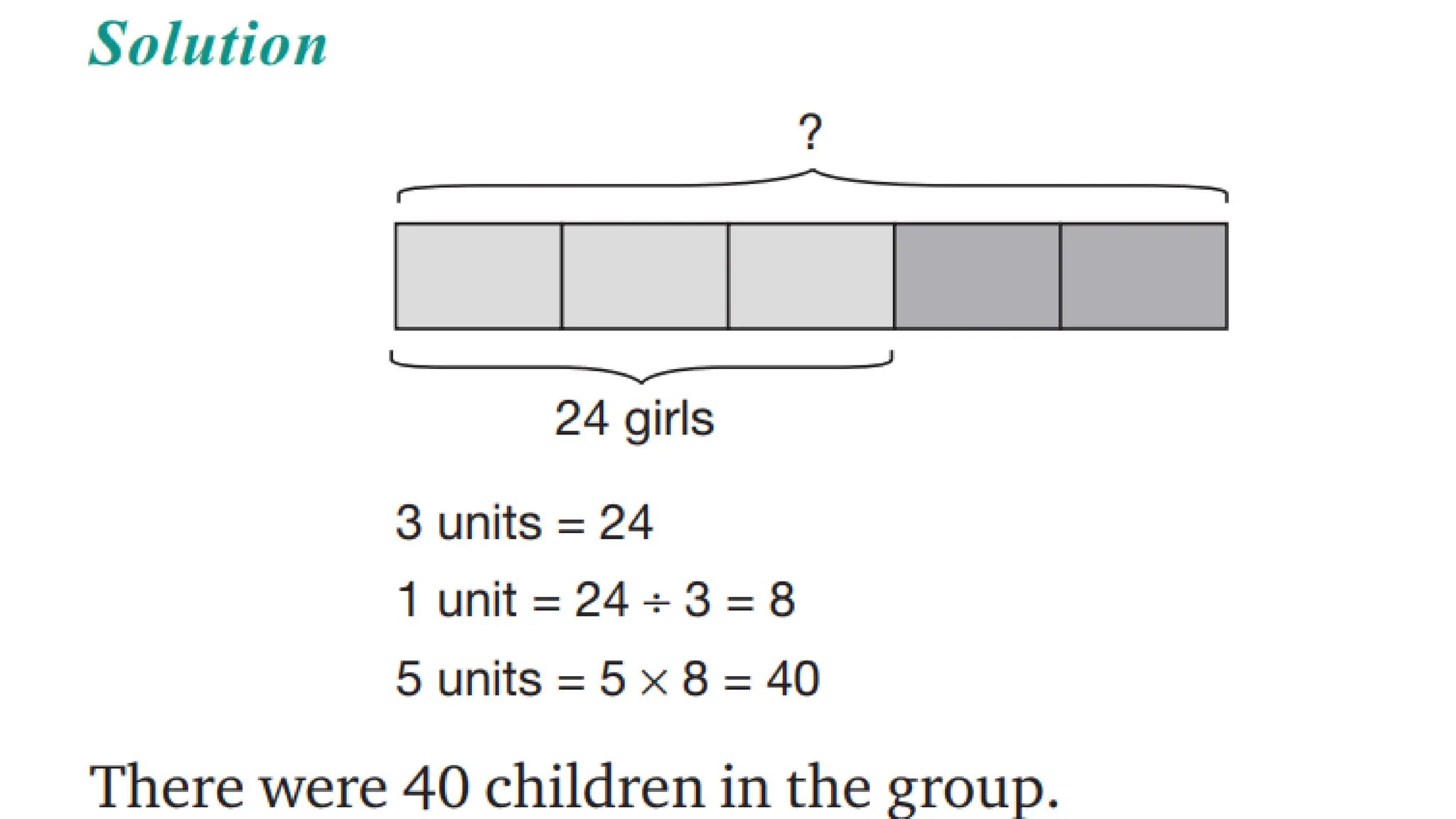
2. 3/5 of a group of children were
girls. If there were 24 girls, then how
many children were there in the
group?
(a) 32
(b) 36
(c) 40
(d) 42
Time & Distance
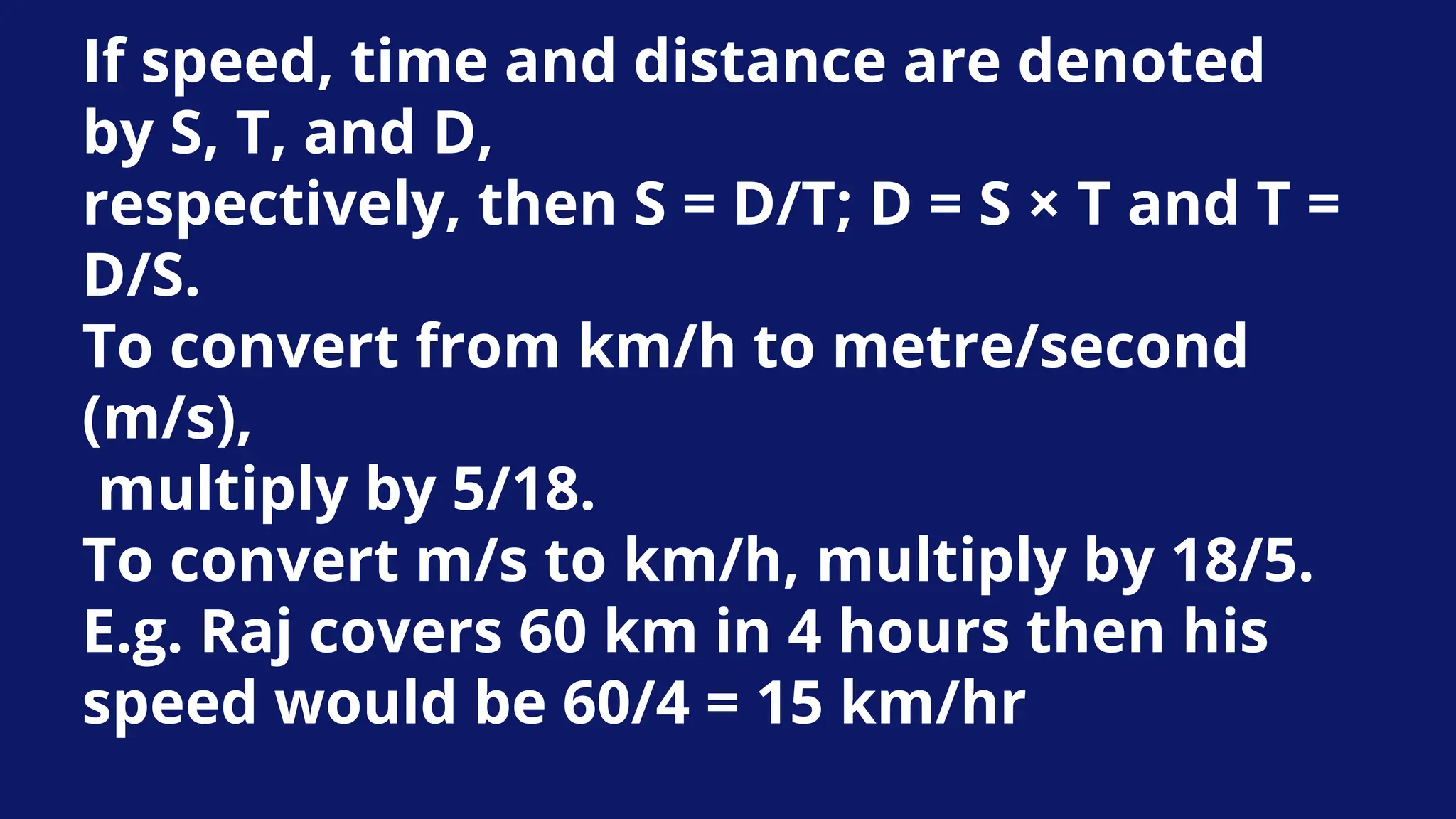
If speed, time and distance are denoted
by S, T, and D,
respectively, then S = D/T; D = S × T and T =
D/S.
To convert from km/h to metre/second
(m/s),
multiply by 5/18.
To convert m/s to km/h, multiply by 18/5.
E.g. Raj covers 60 km in 4 hours then his
speed would be 60/4 = 15 km/hr
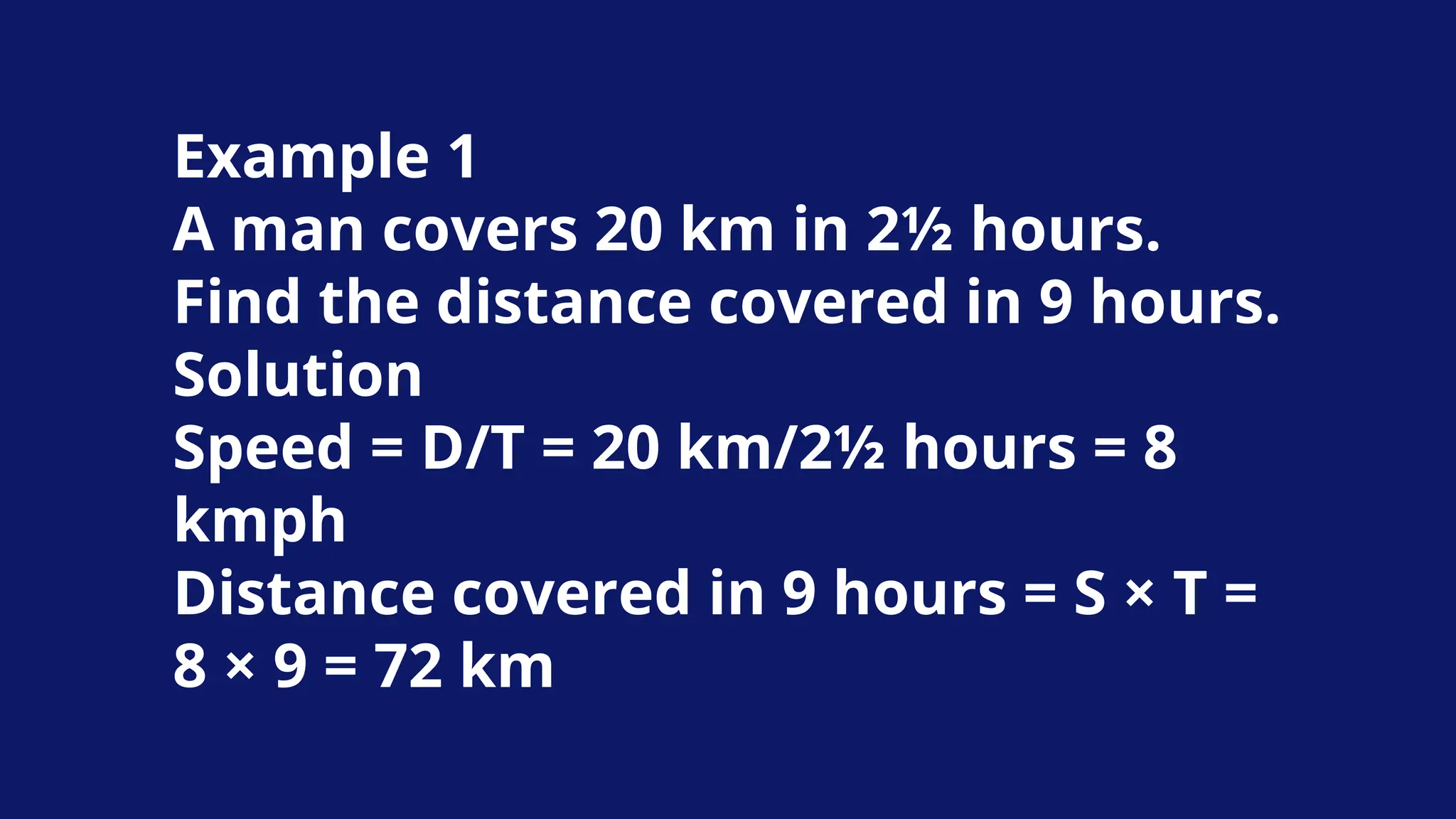
Example 1
A man covers 20 km in 2½ hours.
Find the distance covered in 9 hours.
Solution
Speed = D/T = 20 km/2½ hours = 8
kmph
Distance covered in 9 hours = S × T =
8 × 9 = 72 km
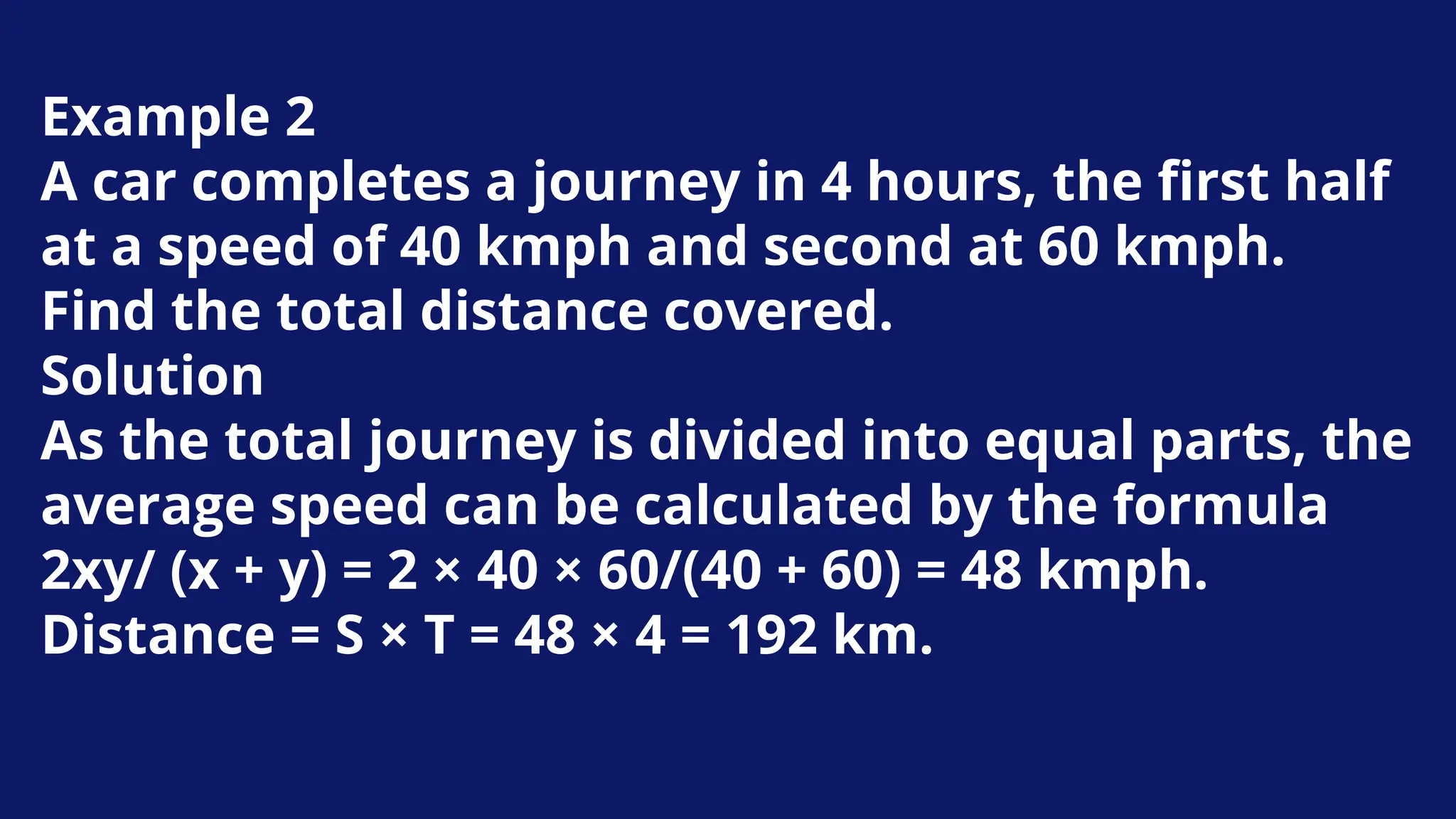
Example 2
A car completes a journey in 4 hours, the first half
at a speed of 40 kmph and second at 60 kmph.
Find the total distance covered.
Solution
As the total journey is divided into equal parts, the
average speed can be calculated by the formula
2xy/ (x + y) = 2 × 40 × 60/(40 + 60) = 48 kmph.
Distance = S × T = 48 × 4 = 192 km.
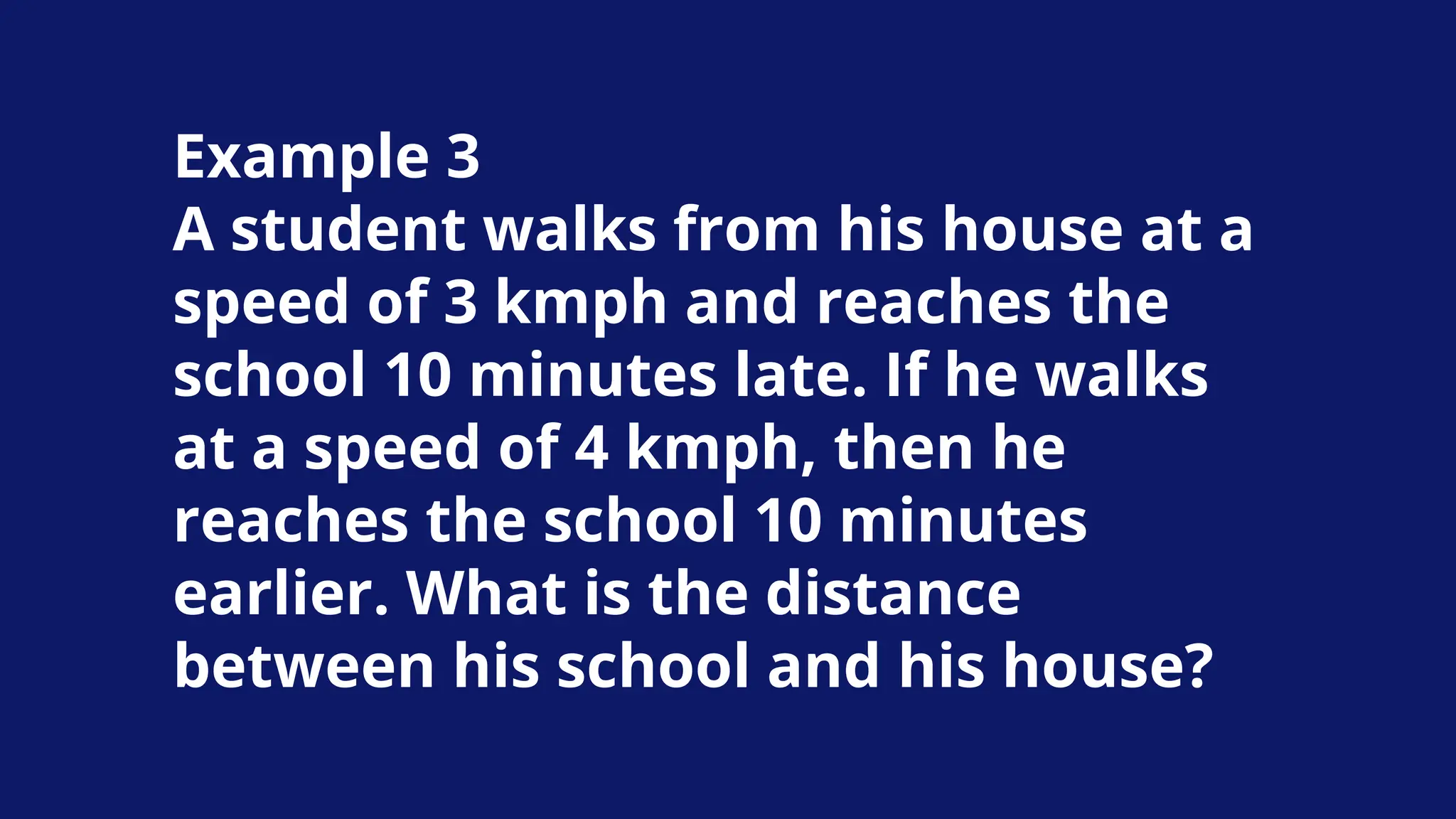
Example 3
A student walks from his house at a
speed of 3 kmph and reaches the
school 10 minutes late. If he walks
at a speed of 4 kmph, then he
reaches the school 10 minutes
earlier. What is the distance
between his school and his house?
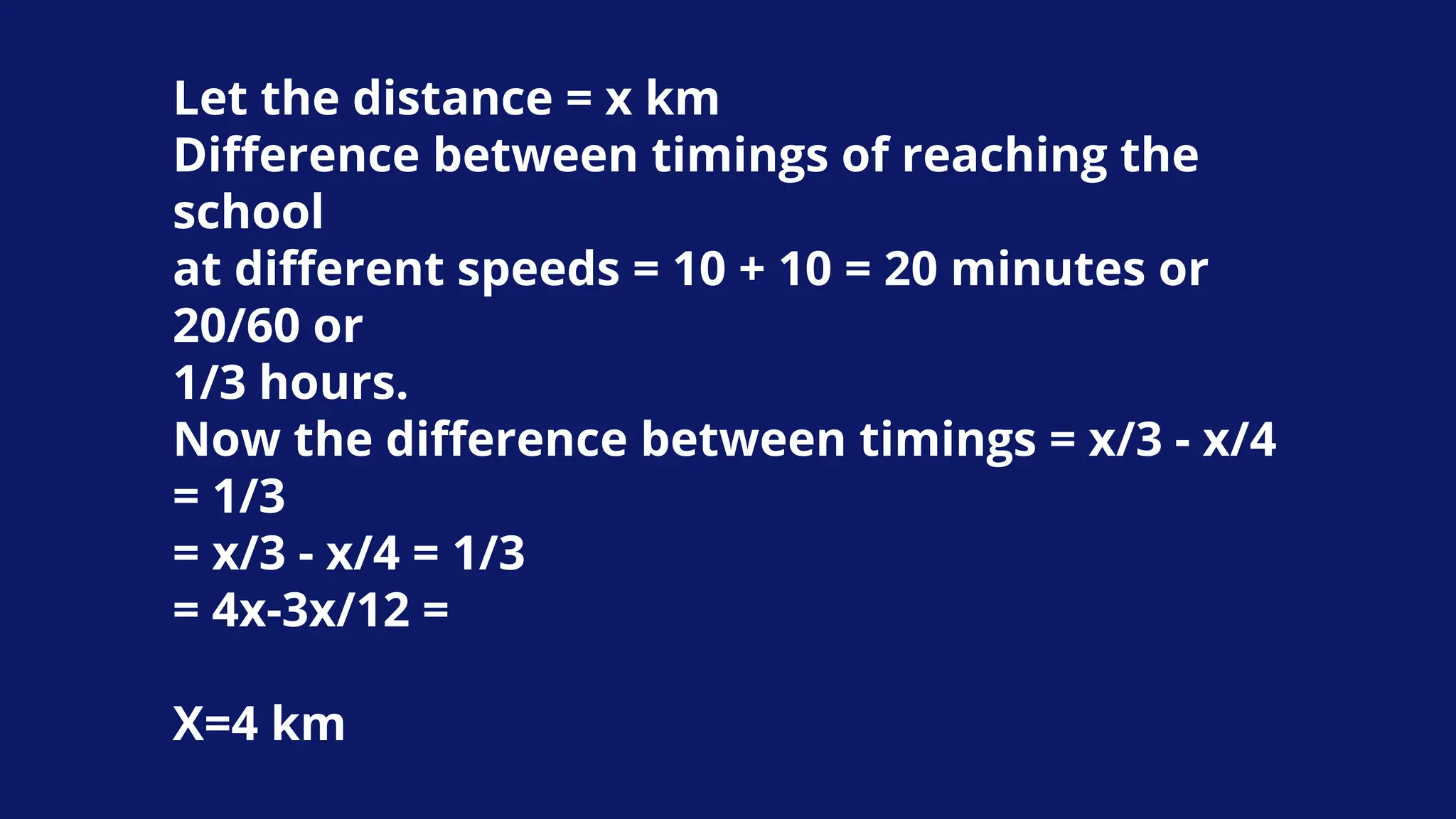
Let the distance = x km
Difference between timings of reaching the
school
at different speeds = 10 + 10 = 20 minutes or
20/60 or
1/3 hours.
Now the difference between timings = x/3 - x/4
= 1/3
= x/3 - x/4 = 1/3
= 4x-3x/12 =
X=4 km
Ratio, Proportion and
Percentage
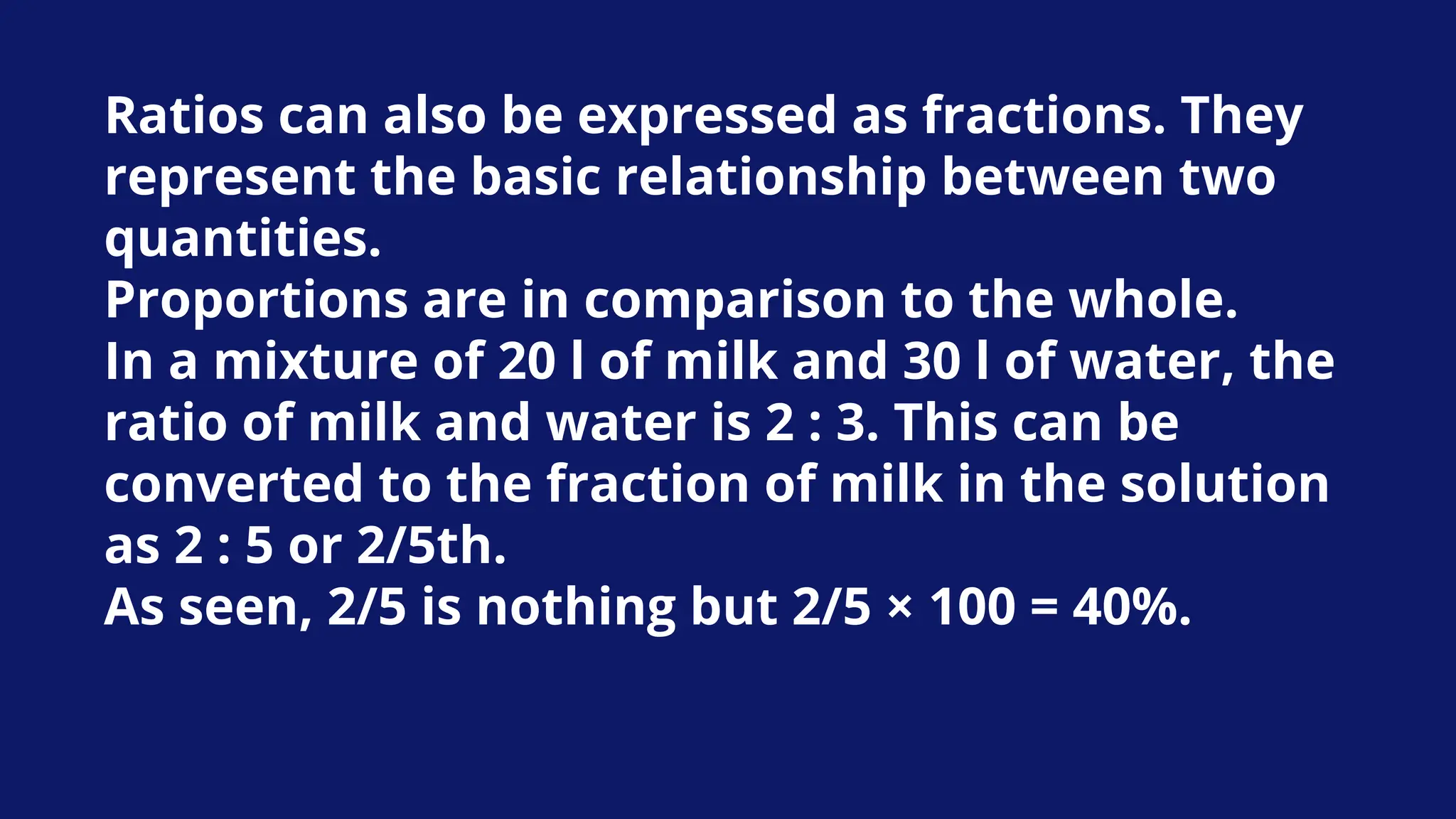
Ratios can also be expressed as fractions. They
represent the basic relationship between two
quantities.
Proportions are in comparison to the whole.
In a mixture of 20 l of milk and 30 l of water, the
ratio of milk and water is 2 : 3. This can be
converted to the fraction of milk in the solution
as 2 : 5 or 2/5th.
As seen, 2/5 is nothing but 2/5 × 100 = 40%.
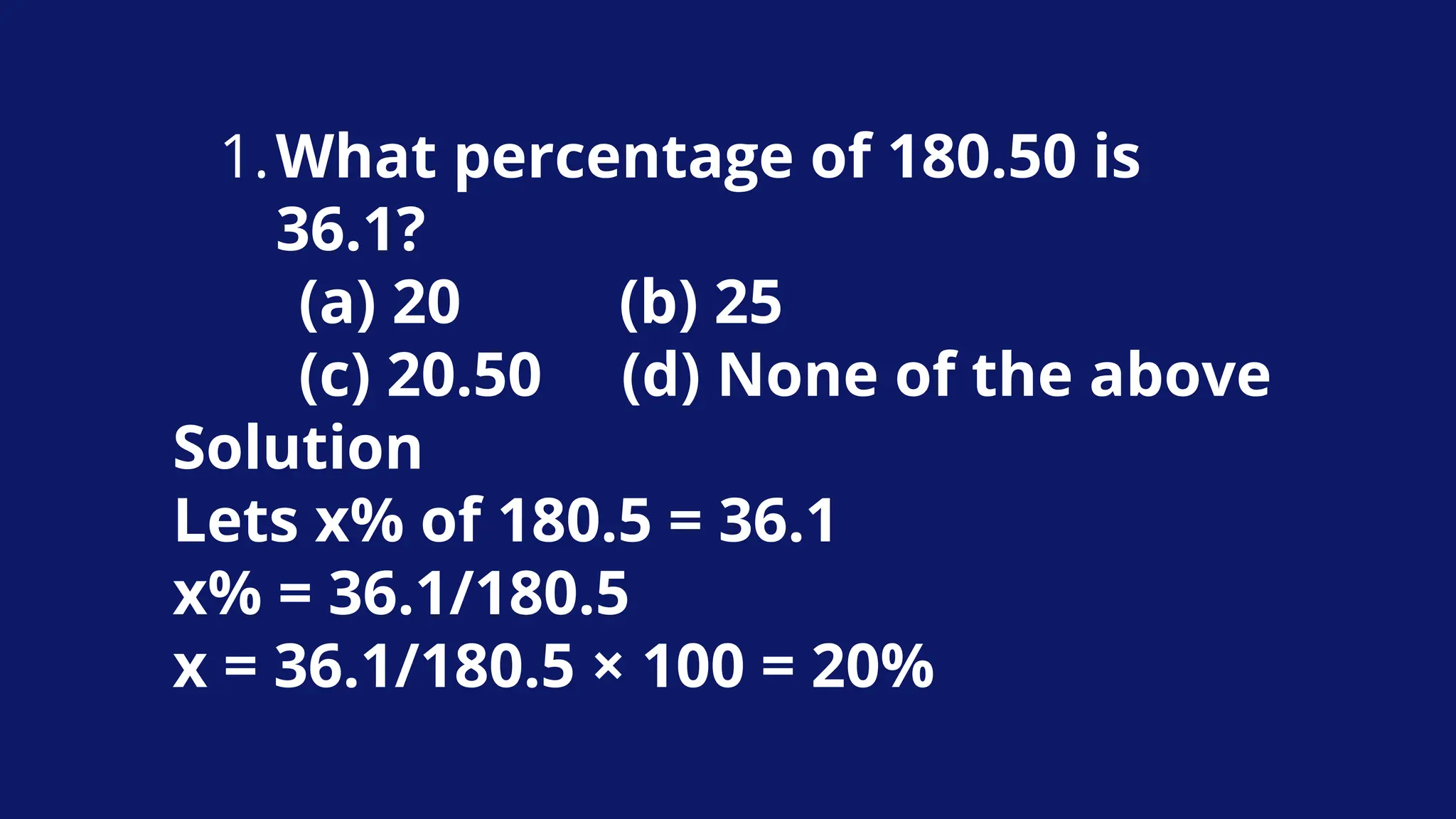
What percentage of 180.50 is
36.1?
1.
(a) 20 (b) 25
(c) 20.50 (d) None of the above
Solution
Lets x% of 180.5 = 36.1
x% = 36.1/180.5
x = 36.1/180.5 × 100 = 20%
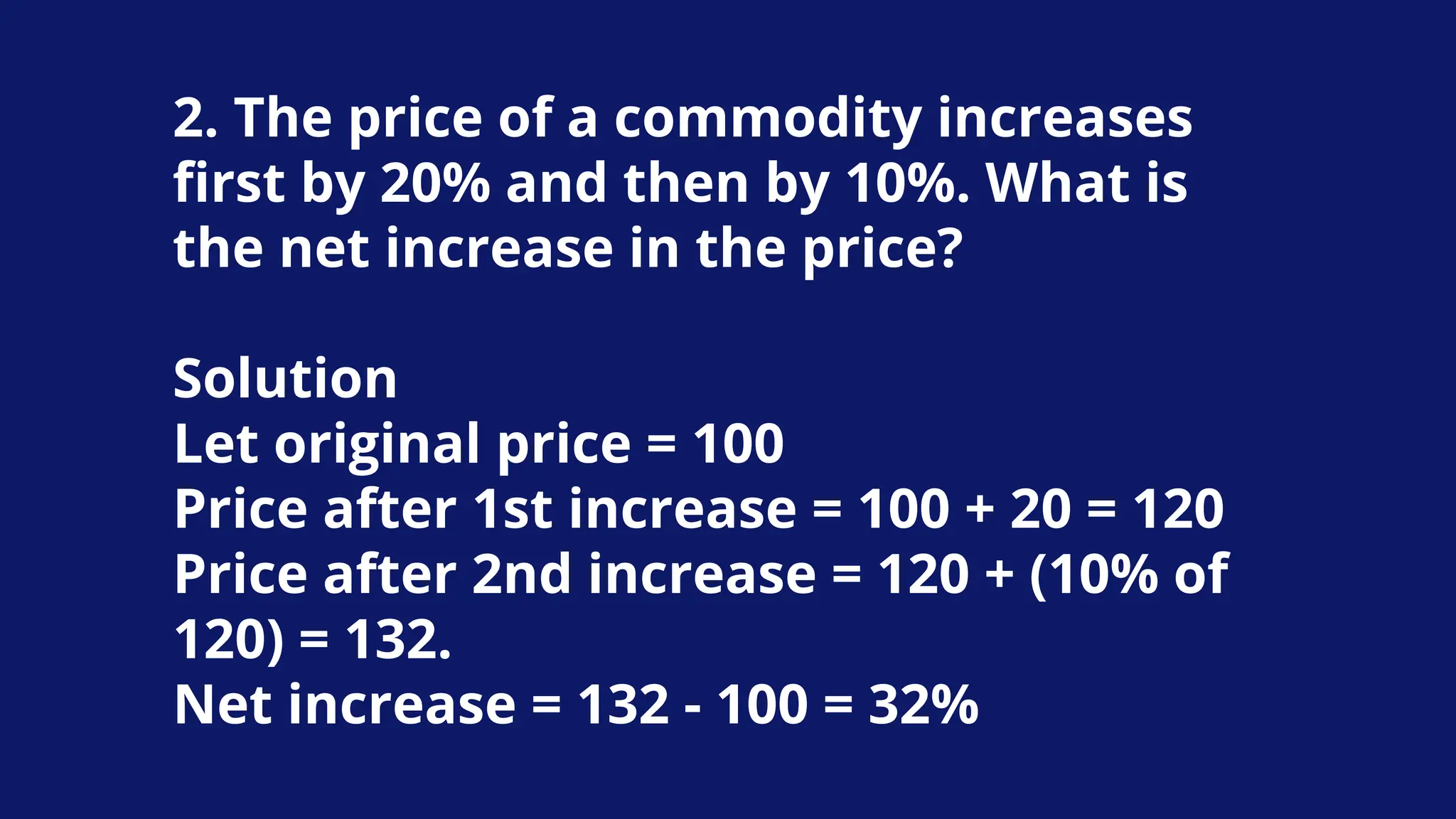
2. The price of a commodity increases
first by 20% and then by 10%. What is
the net increase in the price?
Solution
Let original price = 100
Price after 1st increase = 100 + 20 = 120
Price after 2nd increase = 120 + (10% of
120) = 132.
Net increase = 132 - 100 = 32%
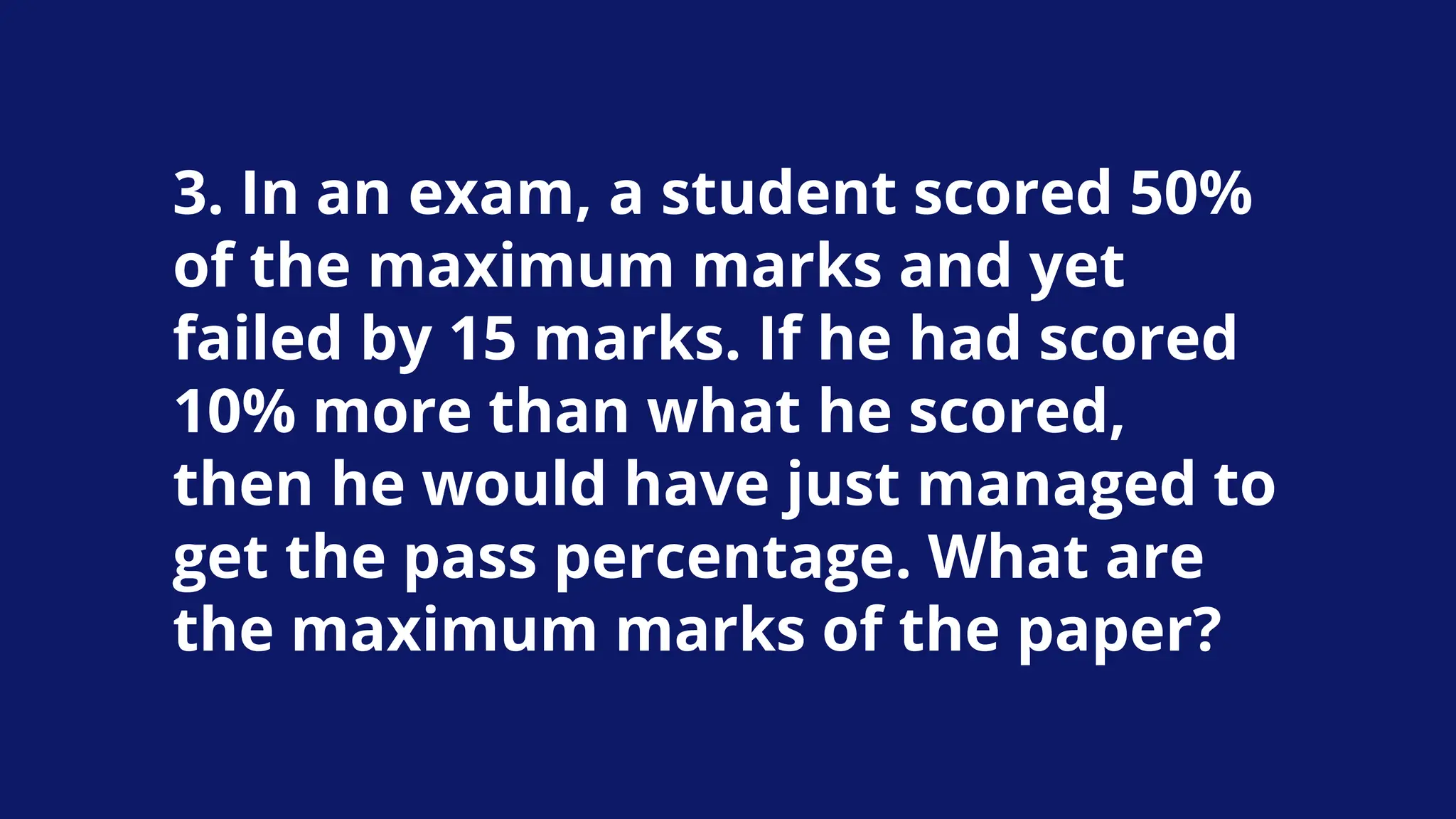
3. In an exam, a student scored 50%
of the maximum marks and yet
failed by 15 marks. If he had scored
10% more than what he scored,
then he would have just managed to
get the pass percentage. What are
the maximum marks of the paper?
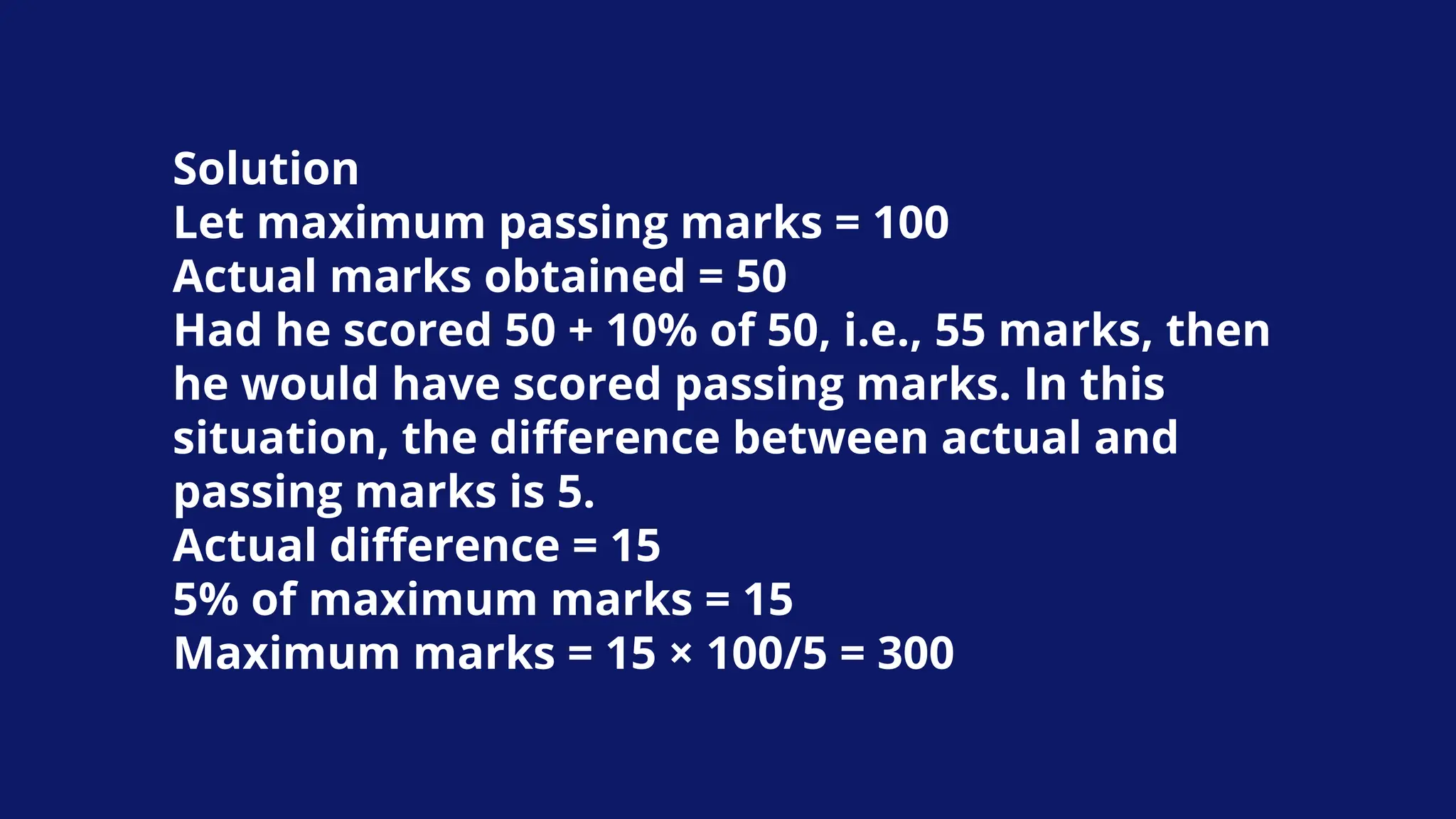
Solution
Let maximum passing marks = 100
Actual marks obtained = 50
Had he scored 50 + 10% of 50, i.e., 55 marks, then
he would have scored passing marks. In this
situation, the difference between actual and
passing marks is 5.
Actual difference = 15
5% of maximum marks = 15
Maximum marks = 15 × 100/5 = 300
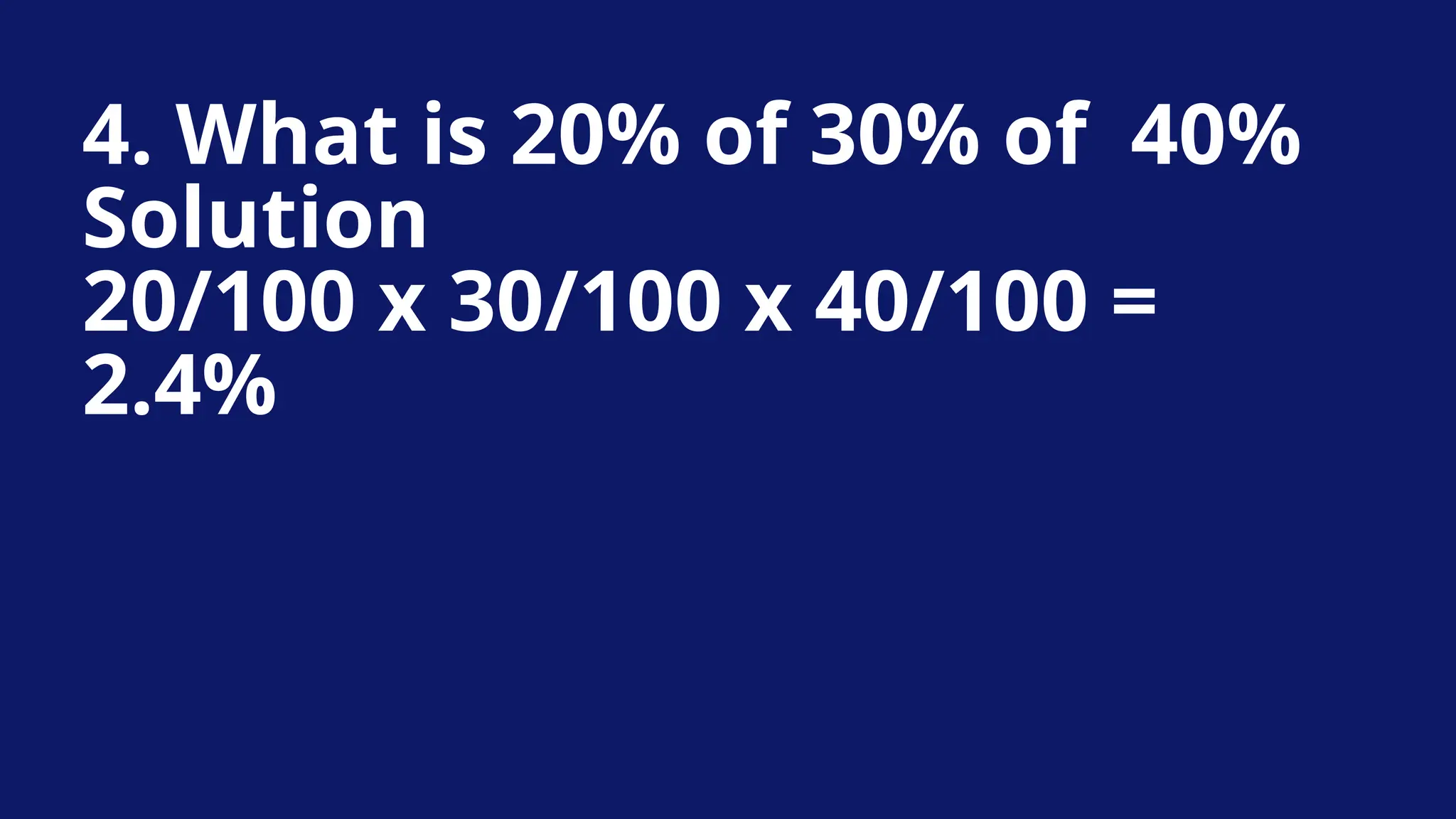
4. What is 20% of 30% of 40%
Solution
20/100 x 30/100 x 40/100 =
2.4%
Profit & Loss
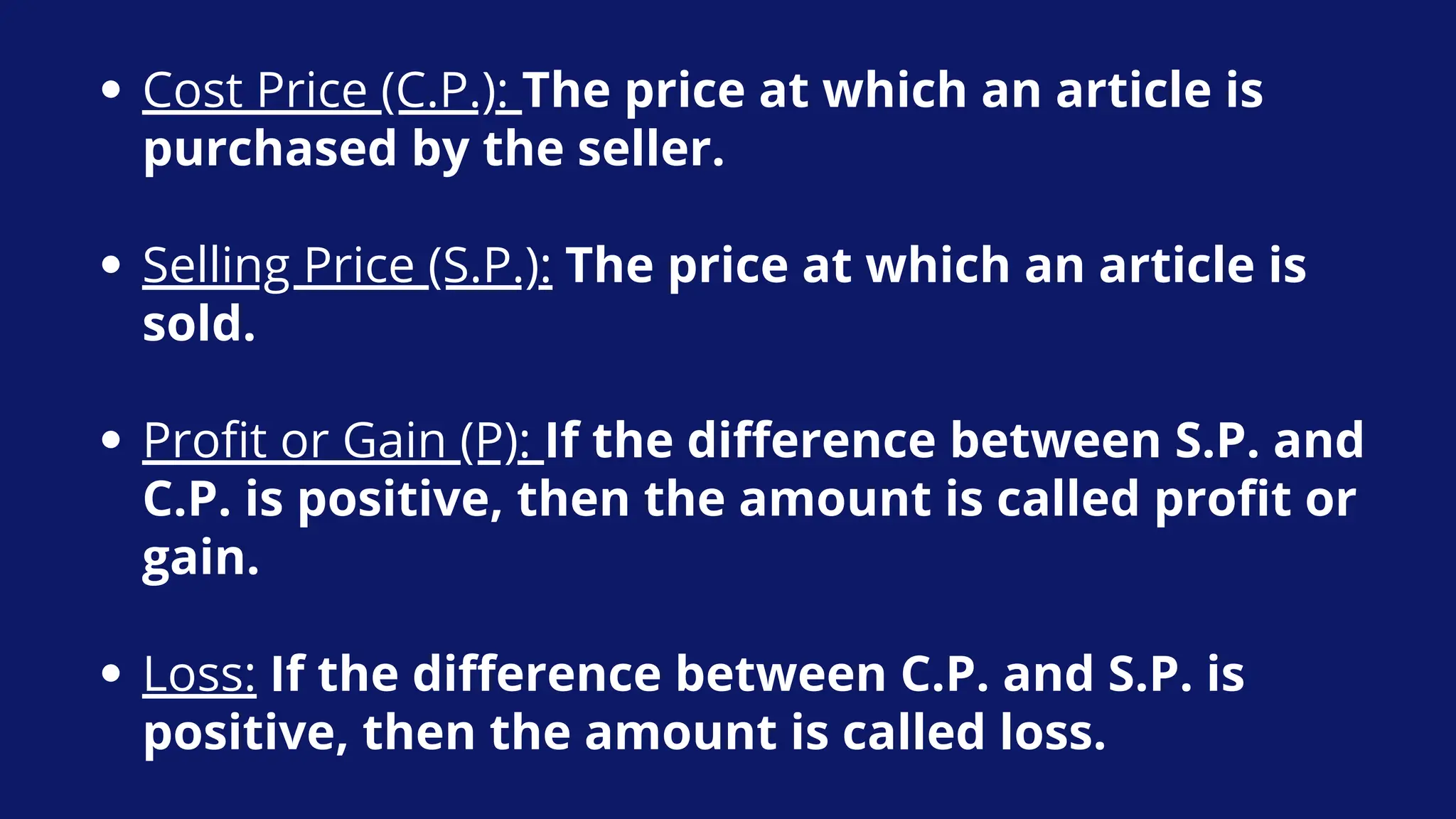
Cost Price (C.P.): The price at which an article is
purchased by the seller.
Selling Price (S.P.): The price at which an article is
sold.
Profit or Gain (P): If the difference between S.P. and
C.P. is positive, then the amount is called profit or
gain.
Loss: If the difference between C.P. and S.P. is
positive, then the amount is called loss.
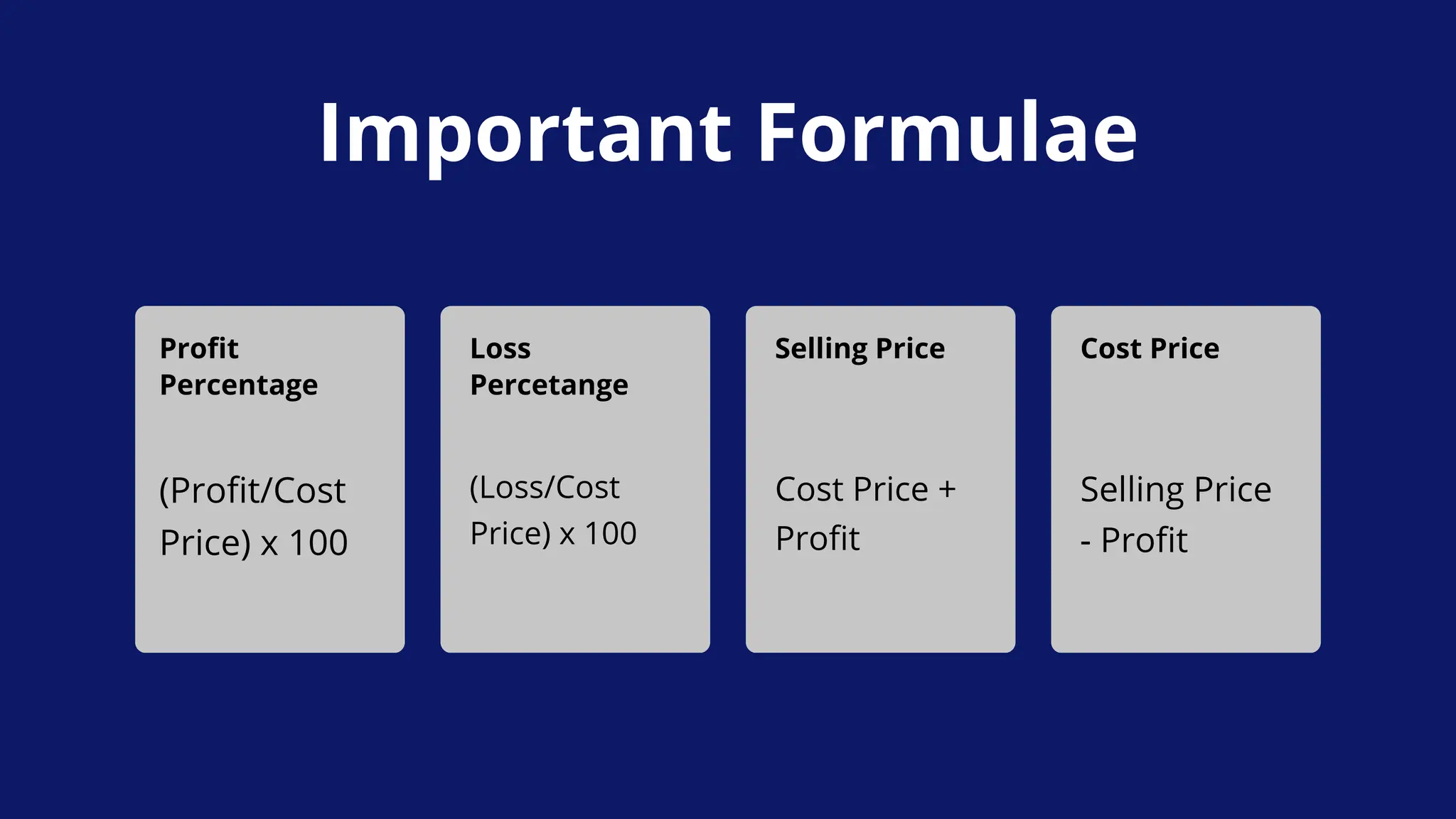
Profit
Percentage
(Profit/Cost
Price) x 100
Loss
Percetange
(Loss/Cost
Price) x 100
Selling Price
Cost Price +
Profit
Cost Price
Selling Price
- Profit
Important Formulae
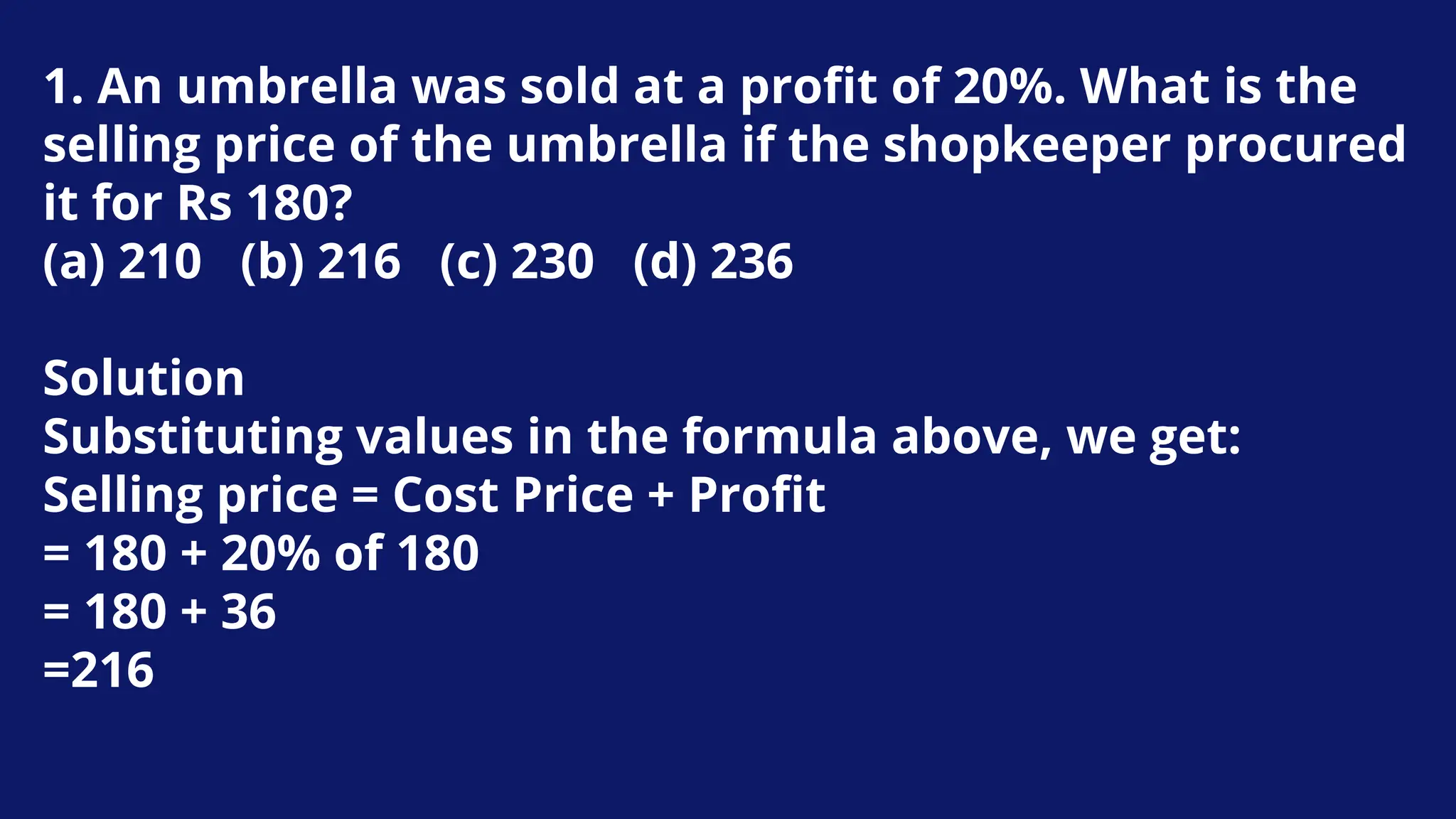
1. An umbrella was sold at a profit of 20%. What is the
selling price of the umbrella if the shopkeeper procured
it for Rs 180?
(a) 210 (b) 216 (c) 230 (d) 236
Solution
Substituting values in the formula above, we get:
Selling price = Cost Price + Profit
= 180 + 20% of 180
= 180 + 36
=216
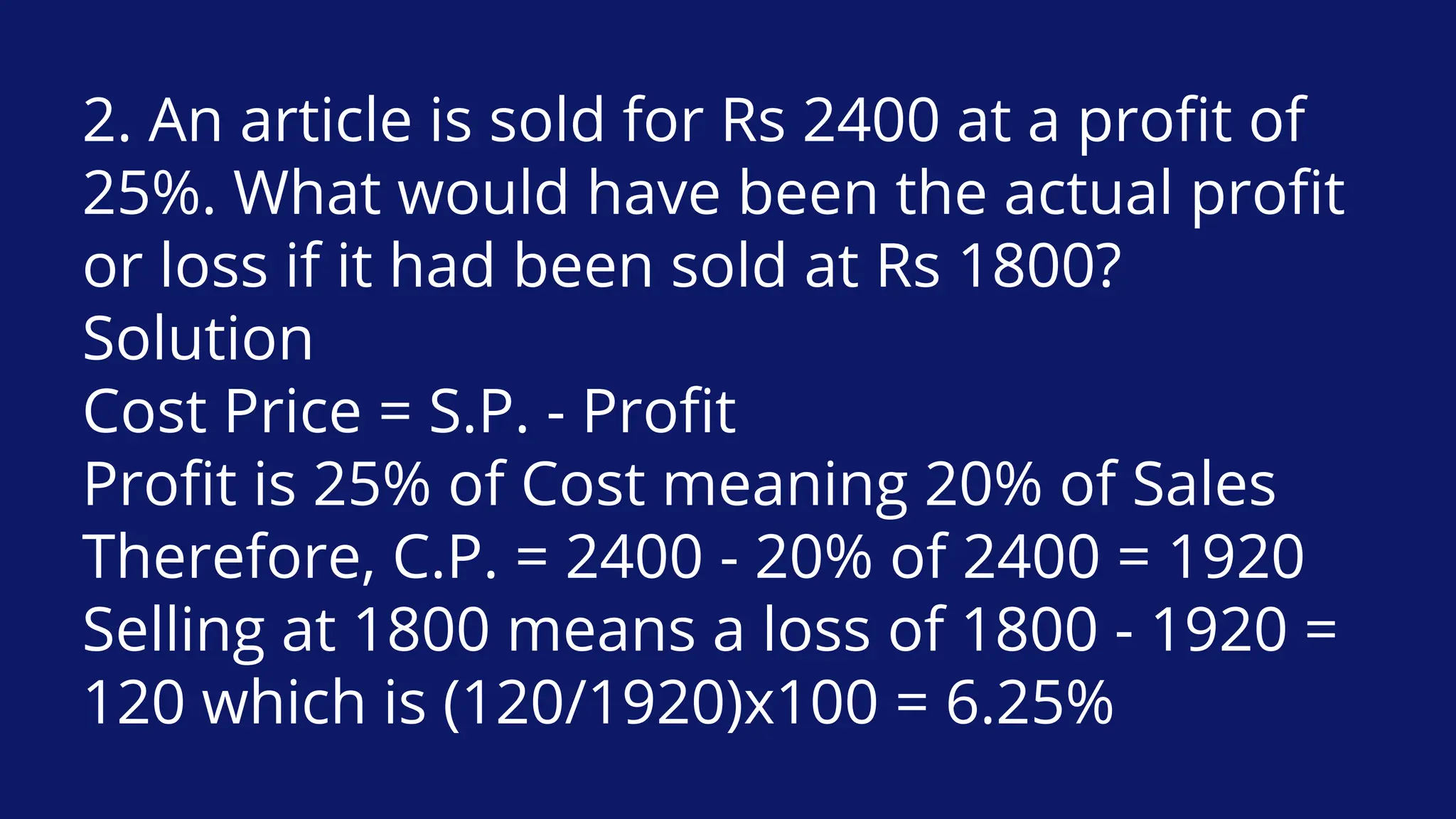
2. An article is sold for Rs 2400 at a profit of
25%. What would have been the actual profit
or loss if it had been sold at Rs 1800?
Solution
Cost Price = S.P. - Profit
Profit is 25% of Cost meaning 20% of Sales
Therefore, C.P. = 2400 - 20% of 2400 = 1920
Selling at 1800 means a loss of 1800 - 1920 =
120 which is (120/1920)x100 = 6.25%
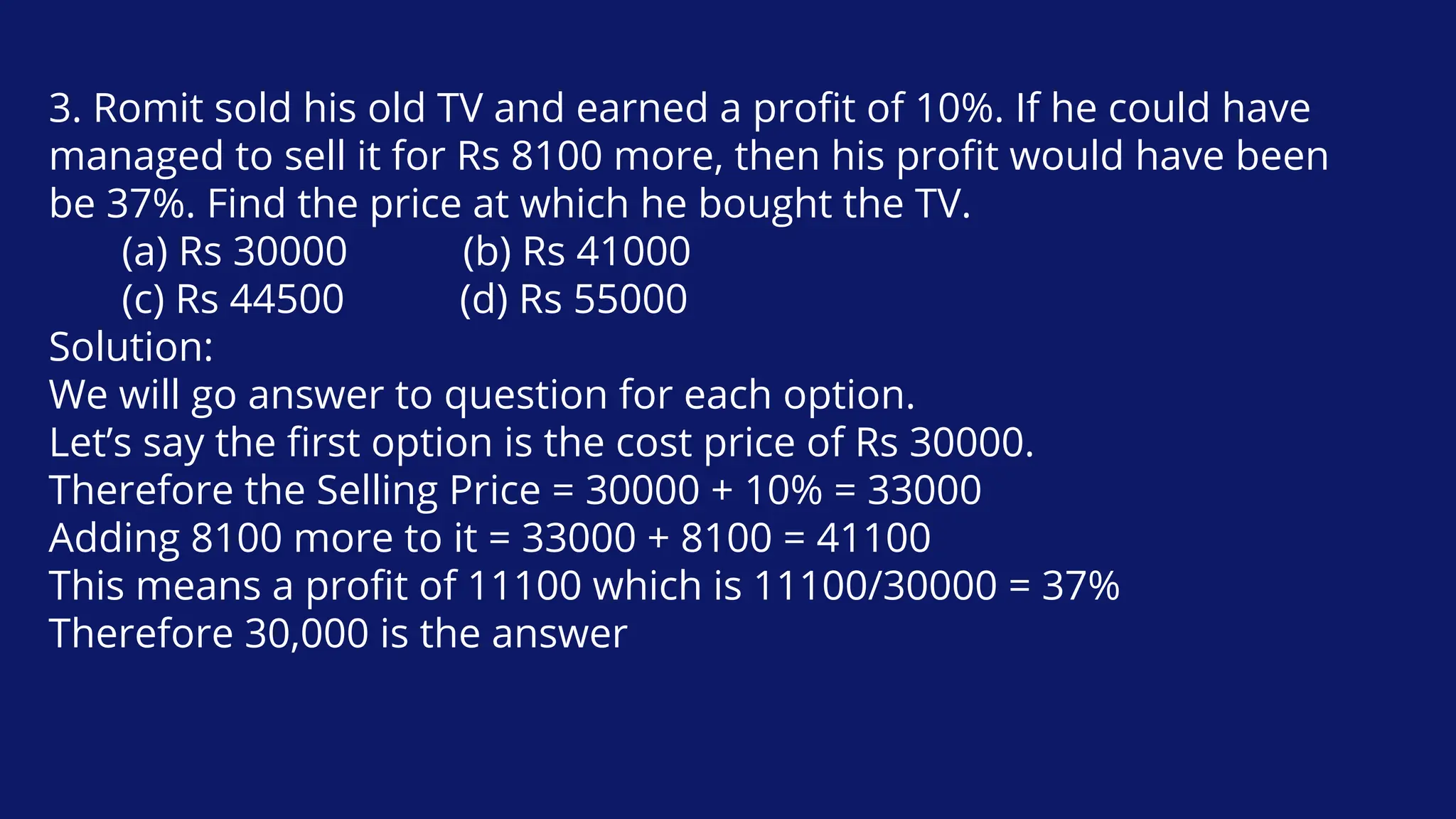
3. Romit sold his old TV and earned a profit of 10%. If he could have
managed to sell it for Rs 8100 more, then his profit would have been
be 37%. Find the price at which he bought the TV.
(a) Rs 30000 (b) Rs 41000
(c) Rs 44500 (d) Rs 55000
Solution:
We will go answer to question for each option.
Let’s say the first option is the cost price of Rs 30000.
Therefore the Selling Price = 30000 + 10% = 33000
Adding 8100 more to it = 33000 + 8100 = 41100
This means a profit of 11100 which is 11100/30000 = 37%
Therefore 30,000 is the answer
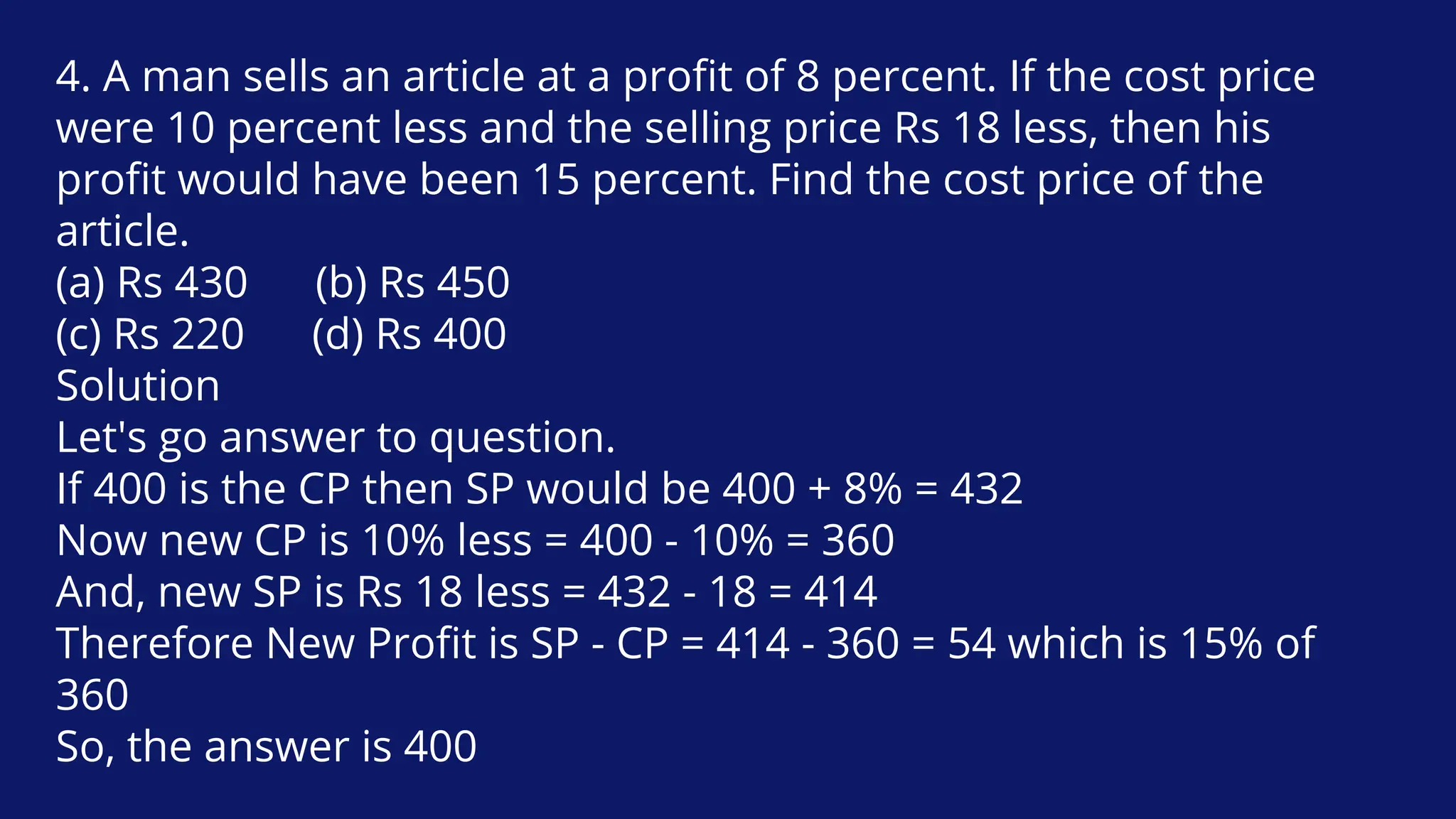
4. A man sells an article at a profit of 8 percent. If the cost price
were 10 percent less and the selling price Rs 18 less, then his
profit would have been 15 percent. Find the cost price of the
article.
(a) Rs 430 (b) Rs 450
(c) Rs 220 (d) Rs 400
Solution
Let's go answer to question.
If 400 is the CP then SP would be 400 + 8% = 432
Now new CP is 10% less = 400 - 10% = 360
And, new SP is Rs 18 less = 432 - 18 = 414
Therefore New Profit is SP - CP = 414 - 360 = 54 which is 15% of
360
So, the answer is 400
Interest &
Discounting
Compound Interest
Simple Interest
Principal -
The money borrowed or lent out for a certain period is called
the principal or the sum. It is denoted by P.
Simple interest calculations -
Interest is the extra money that the borrower pays for using
the lender’s money. Simple interest is denoted by S.I.
SI = P X N X R/100
P = Principal
N - Number of Years
R = Rate of Interest Per Annum
Simple Interest
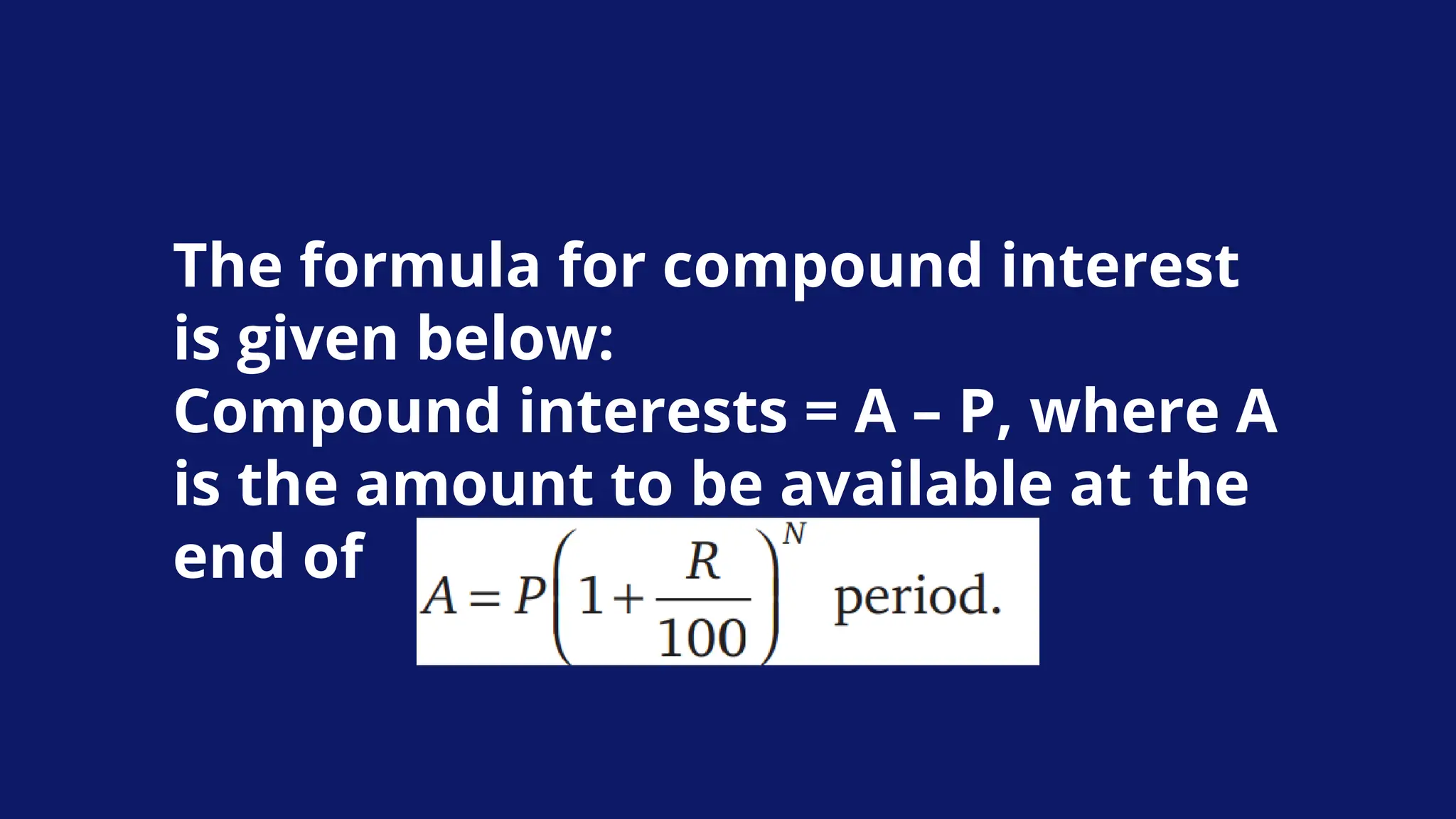
The formula for compound interest
is given below:
Compound interests = A – P, where A
is the amount to be available at the
end of
How much time will it take for an amount of
Rs 900 to yield Rs 81 as interest at 4.5% per
annum of simple interest?
1.
(a) 2 years (b) 3 years
(c) 1 year (d) 4 years
Solution
For one year the Interest @4.5% on 900 would be
40.5
In two years it would be 40.5 x 2 = 81
Therefore it would take two years
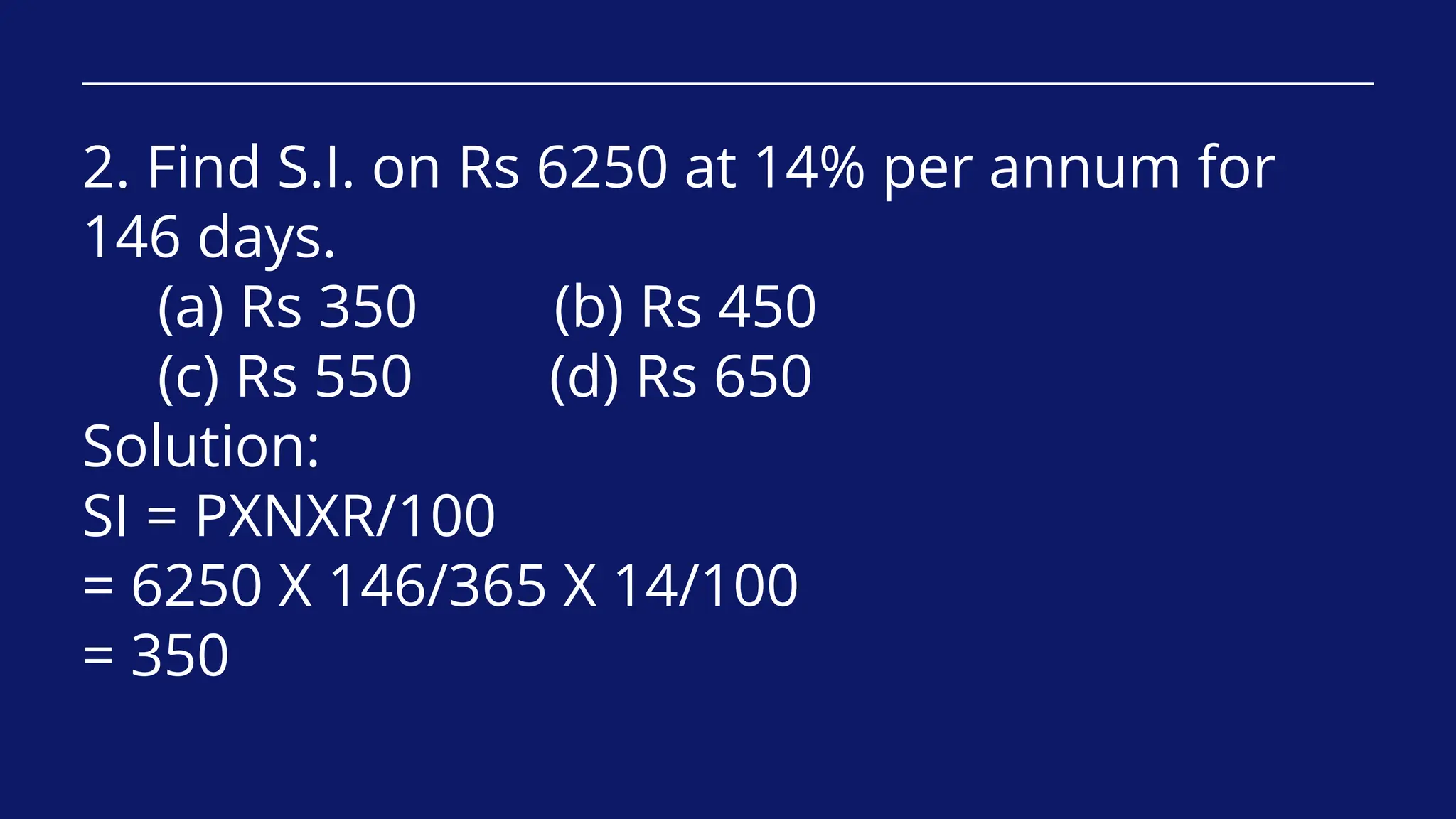
2. Find S.I. on Rs 6250 at 14% per annum for
146 days.
(a) Rs 350 (b) Rs 450
(c) Rs 550 (d) Rs 650
Solution:
SI = PXNXR/100
= 6250 X 146/365 X 14/100
= 350
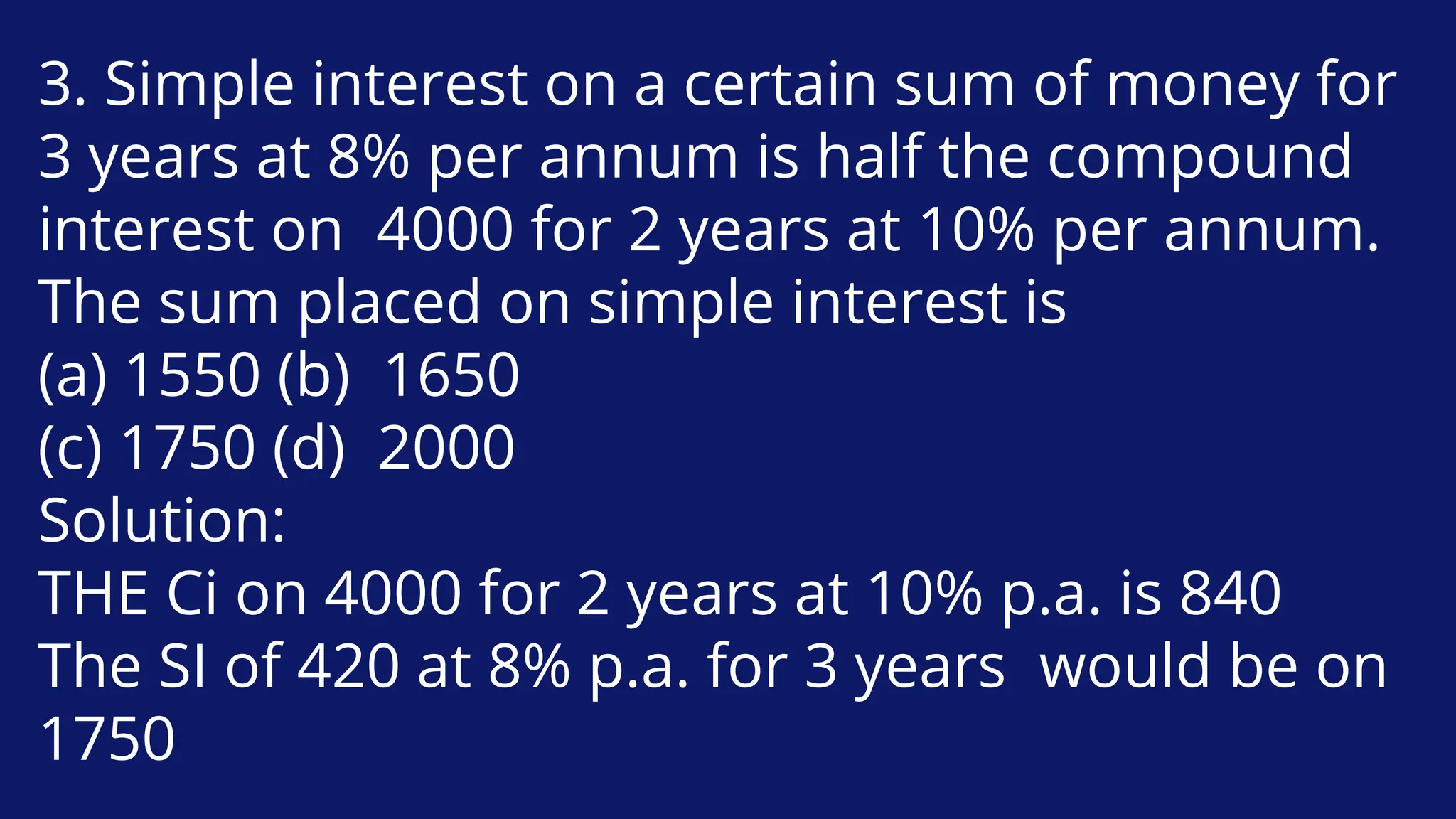
3. Simple interest on a certain sum of money for
3 years at 8% per annum is half the compound
interest on 4000 for 2 years at 10% per annum.
The sum placed on simple interest is
(a) 1550 (b) 1650
(c) 1750 (d) 2000
Solution:
THE Ci on 4000 for 2 years at 10% p.a. is 840
The SI of 420 at 8% p.a. for 3 years would be on
1750
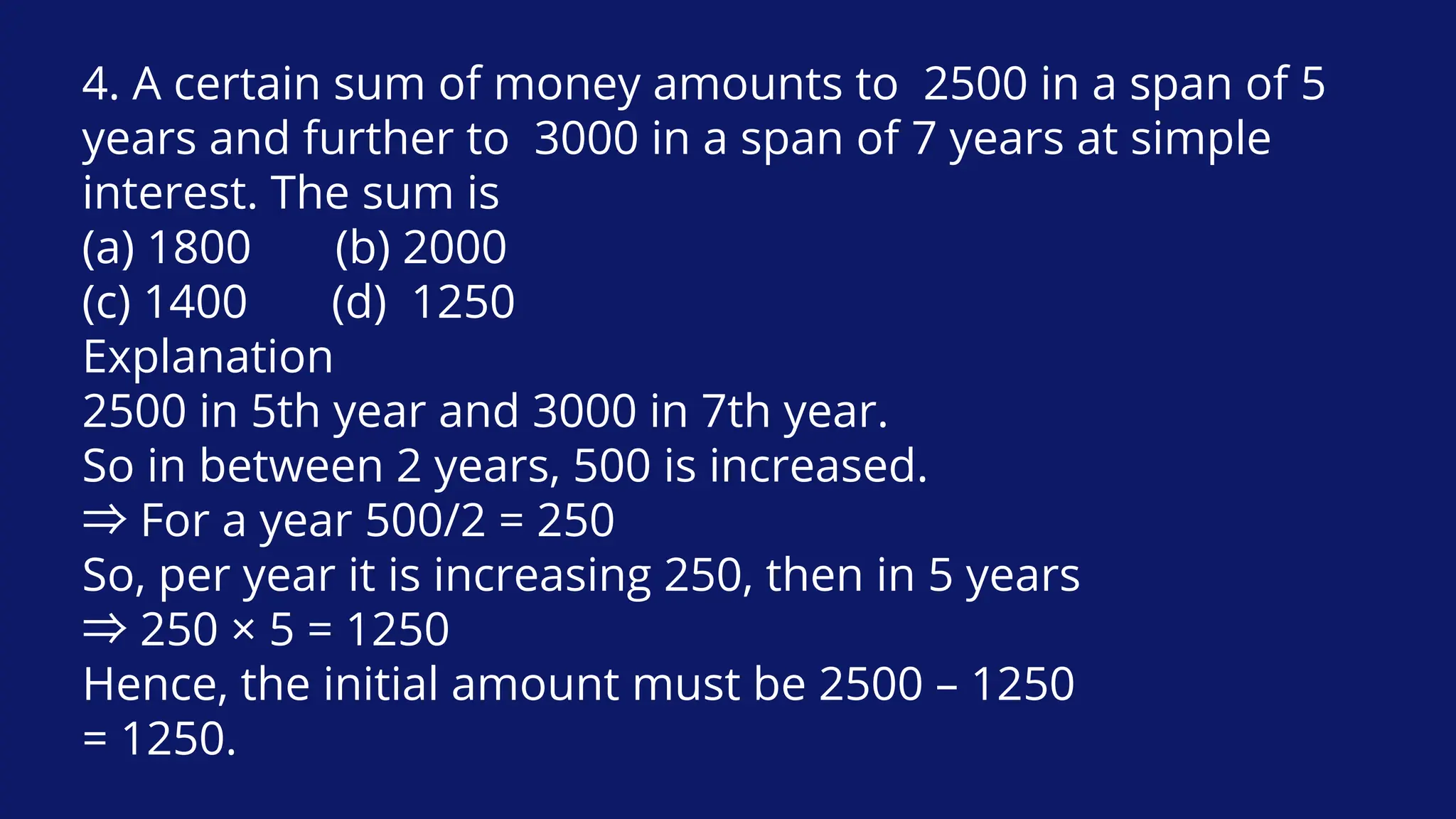
4. A certain sum of money amounts to 2500 in a span of 5
years and further to 3000 in a span of 7 years at simple
interest. The sum is
(a) 1800 (b) 2000
(c) 1400 (d) 1250
Explanation
2500 in 5th year and 3000 in 7th year.
So in between 2 years, 500 is increased.
⇒For a year 500/2 = 250
So, per year it is increasing 250, then in 5 years
⇒250 × 5 = 1250
Hence, the initial amount must be 2500 – 1250
= 1250.
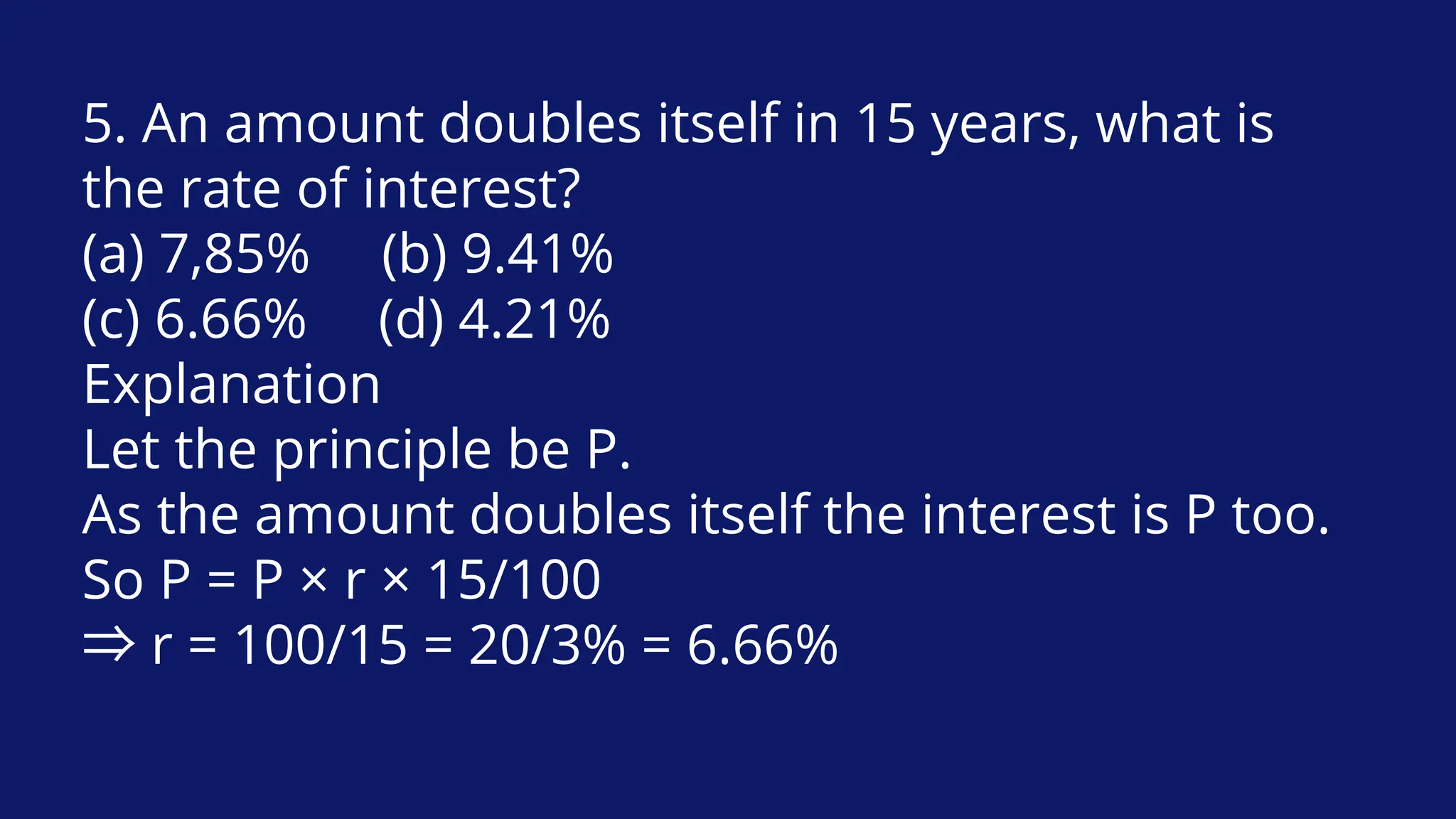
5. An amount doubles itself in 15 years, what is
the rate of interest?
(a) 7,85% (b) 9.41%
(c) 6.66% (d) 4.21%
Explanation
Let the principle be P.
As the amount doubles itself the interest is P too.
So P = P × r × 15/100
⇒r = 100/15 = 20/3% = 6.66%
6. An amount doubles itself in 6 years, what is
the rate of interest under Compound Interest?
(a) 11% (b) 12%
(c) 14% (d) 10%
Explanation
Use Rule of 72
Time taken to double the amount = 72/Rate of
Interest
= 72/12 = 6 years
Therefore answer is 12%
Averages
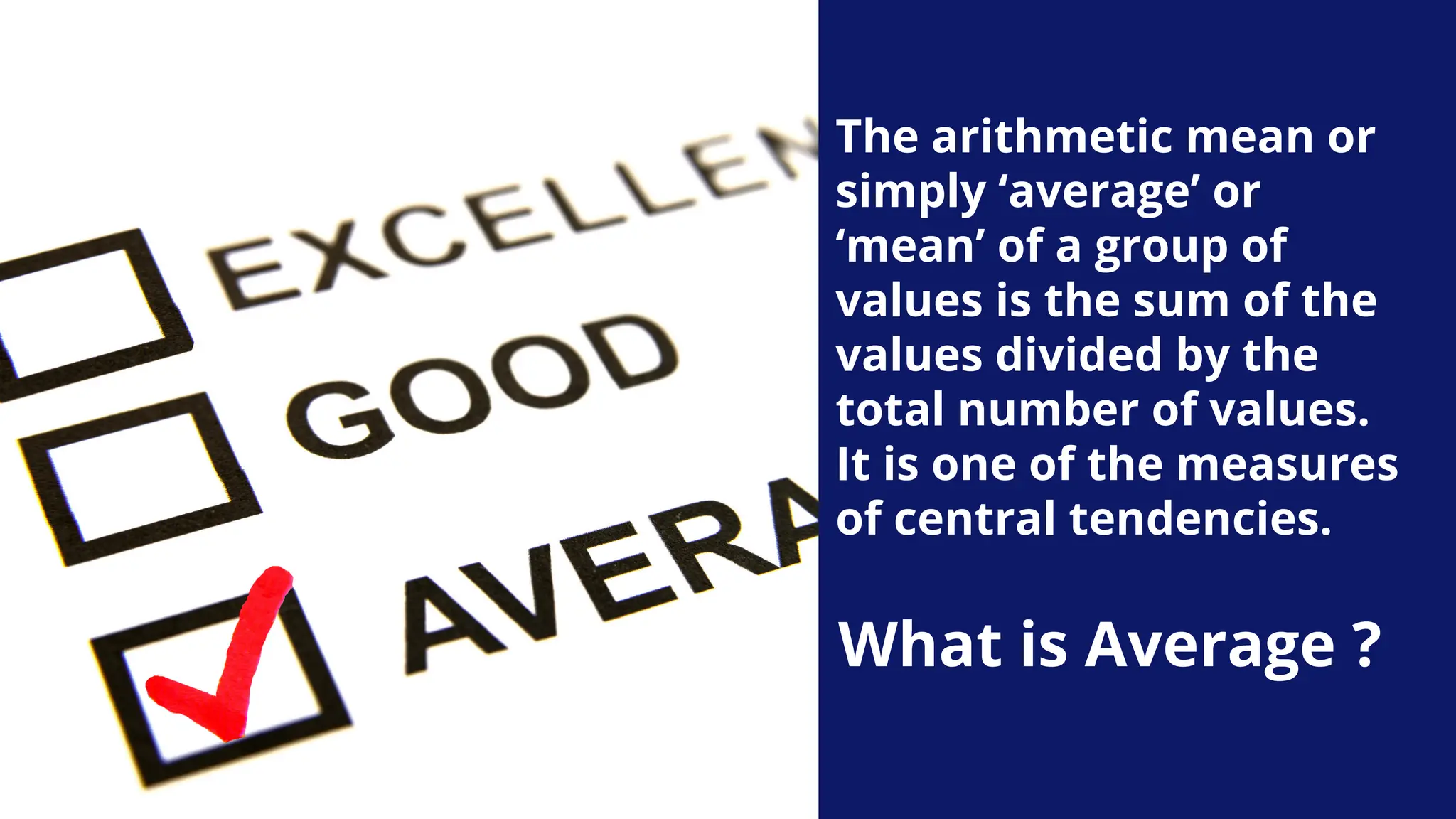
The arithmetic mean or
simply ‘average’ or
‘mean’ of a group of
values is the sum of the
values divided by the
total number of values.
It is one of the measures
of central tendencies.
What is Average ?
Example 1
If a candidate scores 5, 15, 25, 10, and 15
marks in different subjects, then calculate
the mean marks scored
Solution:
Average /Mean Marks
= (5+15+25+10+15)/ 5 = 70/5 = 14
Example 2
The average age of 30 boys in a class is 15
years. If the age of teacher is also included,
then the new average age becomes 16 years.
What is the age of teacher?
Solution:
The Average age of 30 Boys is 15 which means the total age
is 30 boys x 15 years = 350 years
Whereas the Average age of 31 people (30 boys+1 teacher) is
16 years meaning the total age is 31 x 16 = 496 years
Therefore the age of teacher is 496-450 = 46 years
Example 3
The average monthly income of A and B is 5050. The average
monthly income of B and C is 6250 and the average monthly income
of A and C is 5200. The monthly income of A is
(a) 3500 (b) 4000
(c) 4050 (d) 5000
Solution
Total of A and B = (5,050 × 2) = 10,100 --------- (i)
Similarly, total income of B and C = (6250 × 2) =12,500 -----(ii)
And total of A and C = (5200 × 2) = 10,400 ---------- (iii)
Adding (i), (ii), and (iii), we get, 2(A + B + C) =33,000
Or A + B + C = 16,500
But B + C = 12,500 from Equation (ii)
Hence, A = 16,500 - 12,500 = 4000
Calendar
Questions
Odd days: In a
given period,
the number of
days more than
the complete
weeks is called
odd days.
Leap year: A leap year
has 366 days. Every
year divisible by 4 is
a leap year, if it is not
a century. Only every
4th century is a leap
year and no other
century is a leap year.
Ordinary year: The
year that is not a
leap year is called
an ordinary year.
An ordinary year
has 365 days.
01 January 0001 is assumed to be Monday.
1 ordinary year = 365 days = 52 weeks + ‘1
day’.
That one extra day is counted as odd day.
1 leap year = 366 days = (52 weeks + 2 days)
1 leap year has 2 odd days.
100 years = 76 ordinary years + 24 leap years
= (76 × 1 + 24 × 2) odd days = 124 odd days
= (17 weeks + 5 days). It means 5 odd days.
Example
What was the day of the week on January 1, 2001?
[June 2009]
(a) Friday (b) Tuesday
(c) Sunday (d) Wednesday
Answer: (b)
Explanation
By the end of centuries 400, 800, 1200, 1600, 2000, 2400,
and so on, there are no extra days left. It means that the
last year 2000 was Sunday. As per convention, the week
starts with Monday and hence, the next day after last
day of year 2000, i.e., January 1, 2001, is Monday.
Example
January 1, 1995 was a Sunday. What would be the day of
the week on January 1, 1996? [December 2009]
(a) Sunday (b) Monday
(c) Wednesday (d) Saturday
Answer: (b)
Explanation
There is increase of 1 day (odd day) in the subsequent
year. In case of leap year (if the day is after February),
then there will be increase of two days.
Although 1996 is a leap year, the day in question is in
January month, so there will be increase of one day. Thus,
January 1, 1996 is Monday.
VENN DIAGRAMS
THANK YOU

UGC NET Paper 1 Mathematical Reasoning & Aptitude.pdf

  • 1.
  • 2.
    Types of reasoning. Number series,Letter series, Codes, and Relationships. Mathematical Aptitude (Fraction, Time & Distance, Ratio, Proportion and Percentage, Profit and Loss, Interest and Discounting, Averages etc.). Unit-V Mathematical Reasoning and Aptitude
  • 3.
  • 4.
    When making achoice or addressing an issue, reasoning is the ability to appraise things rationally by using logic based on new or existing information. Reasoning allows you to balance the advantages and cons of two or more options before deciding on the best option or the one that best meets your goals. It also assists you in solving difficulties, dealing with uncertainty, verifying claims, and carefully assessing situations to ensure that the decision you make is in your best interests.
  • 5.
  • 6.
    1. Deductive reasoning: Deductivereasoning is a method of proving a theory or hypothesis using formal logic and observations. Deductive reasoning starts with a hypothesis that is then supported or disproved through observations or rational thought. A marketing division, for example, analyses data and confirms that their company’s most important demographic is young parents. They opt to give more of the marketing money to social media channels that target that category based on this information.
  • 7.
    2. Inductive reasoning: To validateobservations, inductive reasoning employs theories and assumptions. It’s the polar opposite of deductive reasoning in that it requires deducing a general rule from a specific case or cases. Because it employs conclusions from observations to make generalisations, the outcomes of inductive reasoning are not always certain. Extrapolation, forecasts, and part-to-whole arguments all benefit from inductive reasoning.
  • 8.
    3. Analogical reasoning: Analogicalreasoning is a style of reasoning that looks for similarities between two or more objects and then uses those similarities to find other properties they share. It is based on the brain’s tendency to notice patterns and make connections.
  • 9.
    4. Abductive reasoning: Abductivereasoning is a style of reasoning that reaches a logical conclusion based on an observation or group of observations. Abductive reasoning is similar to inductive reasoning, but it allows you to make the greatest estimates to get the simplest conclusions. Abduction can help with both troubleshooting and decision-making, especially when dealing with uncertainties.
  • 10.
    5. Cause-and-effect reasoning: Cause-and-effect reasoningis a style of reasoning in which the relationship between two events is demonstrated. This logic is used to describe what might happen if a certain action is taken or why certain things happen when certain circumstances are met. When people draw on personal experience and a drive to improve, this form of reasoning is frequently used to guide daily decision-making.
  • 11.
    Critical thinking entailsdelving deeply into a topic’s rationale in order to reach a definitive conclusion. Computing, engineering, social sciences, and logic all benefit from it. When it comes to problem- solving, critical thinking is especially important when dealing with technological challenges. It’s used to determine the validity of artworks, literature, films, and other forms of art. 6. Critical thinking:
  • 12.
    7. Decompositional reasoning: Decompositional reasoningis the process of breaking things down into their basic components in order to comprehend how each component contributes to the overall functionality of the object. Decompositional reasoning allows an observer to derive powerful conclusions about the total by evaluating each portion separately.
  • 13.
  • 14.
    A form ofarguing in which two statements are used to prove that a third statement is true, for example, ‘All humans are mortal; I am a human, therefore I am mortal.’ What is Syllogism ?
  • 15.
  • 16.
    In propositional logic,the modus ponens and modus tollens are two types of inference that can be derived from a hypothetical proposition —that is, from a statement of the form “If A, then B” E.g. When an angle is inscribed in a semicircle, it is a right angle; however, this angle is not a right angle, hence it is not inscribed in a semicircle.
  • 17.
  • 18.
    Number series isan order of numbers which are not arranged randomly but follow a pattern. Here in these notes, we will understand how to identify which kind of pattern is following because without this it is next to impossible to have a command on number series. Number series is a form of numbers in a certain sequence, where some numbers are mistakenly put into the series of numbers and some number is missing in that series, we need to observe first and then find the accurate number to that series of numbers.
  • 19.
    In this typeof series pattern can be found by using difference of terms. If any pattern is found after the first difference like square, cube or multiplication then this is called one tier series otherwise we need to proceed further and then it is called two tier series. Difference series 3--6--9--12--15--18 +3 +3 +3 +3 +3 20 28 37 47 58 70 +8 +9 +10 +11 +12
  • 20.
    In this kindof series the next term is found by adding the previous number. 1 1 2 3 5 8 13 21 Fibonacci Series:
  • 21.
    Prime Number Series Inthis kind of series, the next term is found by adding, multiplying, or dividing by prime numbers. 2 4 12 60 420 4620
  • 22.
    Perfect Square Series: These Types ofSeries are based on the square of a number which is in the same order and one square number is missing in that given series.
  • 23.
    Perfect Cube Series: This Types ofSeries are based on a cube of a number which is in the same order and one cube number is missing in that given series.
  • 24.
    Ratio Series This typeof series is based on ration series, where sequence is in form of ratio in difference between the numbers. All numbers are arranged in ratio sequence order. 4096 5120 6400 8000 10000 Here the ratio between each consecutive term is 4:5 or we can say the next term can be found by multiplying 5/4 to the previous term.
  • 25.
    A few things tonotice while solving Number Series Questions
  • 26.
    01 If the number seriesgradually decreases, then the arithmetic operation is subtraction. 02 If the number series is gradually increasing, then the arithmetic operation is addition. 03 If the ratio between any two consecutive numbers on the sequence is identical, the line is a Geometric Progression (GP) series.
  • 27.
    04 If the difference betweenany two consecutive numbers on the sequence is the same, then the sequence is an Arithmetic Progression (AP) series. 06 If there is no direct relation between two consecutive numbers, but there is a relation between alternate numbers, then the series is a hybrid of two sequences. Solve the two sequences separately to obtain the result. 07 If the sequence numbers are increasing in a multiplicative manner, then the arithmetic operator used is multiplication. 05 Have a strong knowledge of the cubes and squares of different numbers so you can recognise the pattern at once.
  • 28.
  • 29.
    1. Find outthe next number on the sequence 12,7,2,…. Ans: As this series is gradually decreasing, it is a subtraction series with a difference of 5 between two numbers. Therefore, next number = 2-5 =-3 So, the final sequence is 12,7,2,-3.
  • 30.
    2. Find themissing number from the sequence 3,9,27,…,243. Ans: On close observation, we find that this series is a sequence of 3^1,3^2,3^3… and so on. Therefore, the missing number is 3^4 = 81. So, the final sequence is 3, 9, 27, 81, 243.
  • 31.
    3. Find outthe missing number from the sequences 2,7,17,…,52. Ans: As this series is gradually increasing, it is an additional series with a difference of 5 between the two numbers. With each succession, the addition also increases by 5. Therefore, 2 + 5 = 7; 7 + 10 = 17; 17 + 15 = 32; 32 + 20 = 52. Therefore, the missing number of the sequence is 32. Final sequence = 2, 7, 17, 32, 52.
  • 32.
    4. Find themissing number 25: 37:: 49:? Solution: Here, 52 = 25 and (5+1)2 + 1 = 37 Similarly, 72 = 49 and (7+1)2 + 1 = 65. Hence, the missing number is 65.
  • 33.
    5. Find outthe missing term in the given series: 11, 17, 39, 85, ?. Solution: Given series: 11, 17, 39, 85, ?. 11 + (32 – 3) = 11 + 6 = 17 17 + (52 – 3) = 17 + 22 = 39 39 + (72 – 3) = 39 + 46 = 85 85 + (92 – 3) = 85 + 78 = 163 Therefore, the missing number in the given series is 163. I.e., 11, 17, 39, 85, 163.
  • 34.
    6. Determine themissing numbers in the series 5, 6, 9, 14, 21, ?. Solution: Given the number series: 5, 6, 9, 14, 21, ?. 5 + 1 = 6 6 + 3 = 9 9 + 5 = 14 14 + 7 = 21 21 + 9 = 30. Hence, the missing number here is 30. Here, the series follows a pattern of the sum of consecutive odd numbers. So, the complete number series is 5, 6, 9, 14, 21, 30.
  • 35.
  • 36.
    In this typeof problem, a series of letters of English alphabet will be given, which follow a pattern or a sequence. The letter series mainly consists of skipping the letters. To solve these types of problems, assign numbers 1 to 26 to the letters of English alphabet as shown below. In some cases, it is useful to assign the numbers in a reverse order.
  • 37.
  • 38.
  • 39.
  • 40.
    Example 1 A, C,E, G, …, K (a) I (b) H (c) J (d) M Solution The series is A + 2 = C, C + 2 = E, E + 2 = G; G + 2 = I, I +2 = K. The missing letter is I.
  • 41.
    Example 2 B, E,H, K, N, … (a) P (b) O (c) Q (d) R Solution The series is +3. The missing letter is N + 3 = Q.
  • 42.
    Example 3 D, F,H, I, J, L, … (a) K (b) O (c) M (d) P Solution If the numbers are assigned, the series becomes 4, 6, 8, 9, 10, 12, and so on, i.e., composite number series. The next composite number is 14 and the corresponding letter is N.
  • 43.
    Combined two letter series Thefirst letters of the series follow one logic and the second letters follow another logic, and then they pair with each other.
  • 44.
    Example 1 AM, BN,CO, DP, …, FR (a) EQ (b) FT (c) GR (d) ER Solution The first letters are A, B, C, D, E, and F, and the second letters are M, N, O, P, Q and R.
  • 45.
    Example 2 AA, CE,EI, GO, … (a) IU (b) IQ (c) IR (d) IT Solution The first letters of all pairs given in the question follow a sequence of A + 2 = C, C + 2 = E and so on. The second letters are vowels
  • 46.
    Three letter series Thissequence consists of three letters in each term. The first letters follow one logic, Where the second letters follow another logic and the third letters follow some other logic (or the same logic in all the three cases).
  • 47.
    Example 1 NAB, OEC,PIE, QOG, … (a) QPH (b) QUH (c) QUI (d) RUK Solution The first letters form a series of N, O, P, Q, R and so on. The second letters form a vowel series and the third letters form a prime number series according to their number position.
  • 48.
  • 49.
    In these typesof questions, the letters of the alphabet are exclusively used. These letters do not stand for themselves but are allotted some artificial values based on logical patterns or analogies. By applying those principles or observing the pattern involved, the candidates are required to decode a coded word or encode a word. Alphabetical Coding
  • 50.
    Example If ‘BELONGINGS’ iscoded as ‘TABLESTESF’, then how will you code ‘LINEN’? (a) BTEAE (b) BTAEA (c) BATEA (d) None of the above
  • 52.
    Example If ‘POSTED’ iscoded as ‘DETSOP’, then how will you code ‘SPEED’? (a) DEEPS (b) DEESP (c) DESEP (d) SPEDE Solution By careful observation, we can say that the letters have been written in the reverse order. Hence, SPEED will be written DEEPS and therefore, (a) is the answer
  • 53.
    Example If ‘TRAIN’ iscoded as 23456, then how will you code ‘RAIN’? (a) 3456 (b) 3546 (c) 2345 (d) 2456
  • 54.
    Solution Word T RA I N Code 2 3 4 5 6 These values have been assigned arbitrarily. The question can be solved based on the relationship established. For RAIN, the code is 3456, so (a) is the answer.
  • 55.
    If rain iswater, water is road, road is cloud, cloud is sky, sky is sea and sea is path, where do aeroplanes fly? (a) Road (b) Sea (c) Cloud (d) Water Explanation The aeroplanes fly in the ‘sky’ and the ‘sky’ is called ‘sea’. Hence, the aeroplanes fly in the ‘sea’.
  • 56.
    Further Questions Choosing the OddWord Choosing the Odd Number Choosing the Odd Letter Choosing the Group of Odd Words/Letters/Numbers
  • 57.
    ANALOGY The meaning ofanalogy is correspondence. In the questions based on analogy, a particular relationship is given and another similar relationship has to be identified from the alternatives provided to us. Therefore, analogy tests are meant to test a candidate for the overall knowledge, power of reasoning, and the ability to think concisely and accurately.
  • 58.
    Example 1 As deliciousis related to taste, melodious is related to (a) Voice (b) Speak (c) Music (d) Highness Answer: (a) Explanation Delicious represents good taste. Similarly, melody describes pleasant voice.
  • 59.
    Example 2 Giant: Dwarf:: Genius:? (a) Wicked (b) Gentle (c) Idiot (d) Cunning Answer: (c) Explanation As dwarf is the antonym of giant, idiot is the antonym of genius.
  • 60.
    Example 3 Lamp :Darkness (a) Fatigue : Exercise (b) Water : Thirst (c) Medicine : Illness (d) Study : Classroom Answer: (b) Just as a lamp eliminates darkness, water quenches thirst
  • 61.
    Example 4 Potato :Carrot : Radish (a) Tomato (b) Spinach (c) Sesame (d) Groundnut Solution All of these crops/vegetables grow underground. Answer: (d)
  • 62.
    Example 5 9 :14 : : 26 : ? (a) 2 (b) 13 (c) 15 (d) 31 Solution The relationship is x : (x + 5). Answer: (d
  • 63.
    Example 6 42 :56 : : 72 : ? (a) 81 (b) 90 (c) 96 (d) 100 Solution The ratio between 42 and 56 is 3 : 4. Similarly, 72 : 96 depicts the ratio 3 : 4. Answer: (c)
  • 64.
  • 69.
    Example 1 X andY are brothers. C and D are sisters. X’s son is D’s brother. How is Y related to C? (a) Uncle (b) Grandfather (c) Father (d) None of the above Explanation Y is the brother of X and X’s son is D’s brother. This implies that D is the daughter of X. As C and D are sisters, C is also the daughter of X. Hence, Y is the uncle of C.
  • 70.
  • 71.
  • 72.
  • 73.
    Mathematical Aptitude Fraction Time & Distance Ratio,Proportion, and Percentage Profit and Loss Interest and Discounting Averages
  • 74.
    If there are5 apples in a cartoon of 12 apples, then the fraction of apples for the whole would be represented as = 5/12 Fraction = Part/Whole = Numerator/Denominator FRACTIONS
  • 75.
    1. Common fraction: Acommon fraction is a number written with a numerator and a denominator, in which both are natural numbers. For example, 5/12, 17/12, , etc.
  • 76.
    2. Proper fraction: Aproper fraction that is less than 1 is known as proper fraction, such as 1/2, 3/4 A proper fraction has the same name as that ratio.
  • 77.
    3. Mixed numberfraction: It is basically a whole number plus a proper fraction. For example.
  • 78.
    4. Improper fractions: If wedivide each whole unit into thirds, say, and keep counting them, then we will come to 3/3, 4/3, 5/3 and so on. That is, we will come to fractions that are equal to or greater than -1. We call those improper fractions.
  • 79.
  • 82.
    2. 3/5 ofa group of children were girls. If there were 24 girls, then how many children were there in the group? (a) 32 (b) 36 (c) 40 (d) 42
  • 84.
  • 85.
    If speed, timeand distance are denoted by S, T, and D, respectively, then S = D/T; D = S × T and T = D/S. To convert from km/h to metre/second (m/s), multiply by 5/18. To convert m/s to km/h, multiply by 18/5. E.g. Raj covers 60 km in 4 hours then his speed would be 60/4 = 15 km/hr
  • 86.
    Example 1 A mancovers 20 km in 2½ hours. Find the distance covered in 9 hours. Solution Speed = D/T = 20 km/2½ hours = 8 kmph Distance covered in 9 hours = S × T = 8 × 9 = 72 km
  • 87.
    Example 2 A carcompletes a journey in 4 hours, the first half at a speed of 40 kmph and second at 60 kmph. Find the total distance covered. Solution As the total journey is divided into equal parts, the average speed can be calculated by the formula 2xy/ (x + y) = 2 × 40 × 60/(40 + 60) = 48 kmph. Distance = S × T = 48 × 4 = 192 km.
  • 88.
    Example 3 A studentwalks from his house at a speed of 3 kmph and reaches the school 10 minutes late. If he walks at a speed of 4 kmph, then he reaches the school 10 minutes earlier. What is the distance between his school and his house?
  • 89.
    Let the distance= x km Difference between timings of reaching the school at different speeds = 10 + 10 = 20 minutes or 20/60 or 1/3 hours. Now the difference between timings = x/3 - x/4 = 1/3 = x/3 - x/4 = 1/3 = 4x-3x/12 = X=4 km
  • 90.
  • 91.
    Ratios can alsobe expressed as fractions. They represent the basic relationship between two quantities. Proportions are in comparison to the whole. In a mixture of 20 l of milk and 30 l of water, the ratio of milk and water is 2 : 3. This can be converted to the fraction of milk in the solution as 2 : 5 or 2/5th. As seen, 2/5 is nothing but 2/5 × 100 = 40%.
  • 92.
    What percentage of180.50 is 36.1? 1. (a) 20 (b) 25 (c) 20.50 (d) None of the above Solution Lets x% of 180.5 = 36.1 x% = 36.1/180.5 x = 36.1/180.5 × 100 = 20%
  • 93.
    2. The priceof a commodity increases first by 20% and then by 10%. What is the net increase in the price? Solution Let original price = 100 Price after 1st increase = 100 + 20 = 120 Price after 2nd increase = 120 + (10% of 120) = 132. Net increase = 132 - 100 = 32%
  • 94.
    3. In anexam, a student scored 50% of the maximum marks and yet failed by 15 marks. If he had scored 10% more than what he scored, then he would have just managed to get the pass percentage. What are the maximum marks of the paper?
  • 95.
    Solution Let maximum passingmarks = 100 Actual marks obtained = 50 Had he scored 50 + 10% of 50, i.e., 55 marks, then he would have scored passing marks. In this situation, the difference between actual and passing marks is 5. Actual difference = 15 5% of maximum marks = 15 Maximum marks = 15 × 100/5 = 300
  • 96.
    4. What is20% of 30% of 40% Solution 20/100 x 30/100 x 40/100 = 2.4%
  • 97.
  • 98.
    Cost Price (C.P.):The price at which an article is purchased by the seller. Selling Price (S.P.): The price at which an article is sold. Profit or Gain (P): If the difference between S.P. and C.P. is positive, then the amount is called profit or gain. Loss: If the difference between C.P. and S.P. is positive, then the amount is called loss.
  • 99.
    Profit Percentage (Profit/Cost Price) x 100 Loss Percetange (Loss/Cost Price)x 100 Selling Price Cost Price + Profit Cost Price Selling Price - Profit Important Formulae
  • 100.
    1. An umbrellawas sold at a profit of 20%. What is the selling price of the umbrella if the shopkeeper procured it for Rs 180? (a) 210 (b) 216 (c) 230 (d) 236 Solution Substituting values in the formula above, we get: Selling price = Cost Price + Profit = 180 + 20% of 180 = 180 + 36 =216
  • 101.
    2. An articleis sold for Rs 2400 at a profit of 25%. What would have been the actual profit or loss if it had been sold at Rs 1800? Solution Cost Price = S.P. - Profit Profit is 25% of Cost meaning 20% of Sales Therefore, C.P. = 2400 - 20% of 2400 = 1920 Selling at 1800 means a loss of 1800 - 1920 = 120 which is (120/1920)x100 = 6.25%
  • 102.
    3. Romit soldhis old TV and earned a profit of 10%. If he could have managed to sell it for Rs 8100 more, then his profit would have been be 37%. Find the price at which he bought the TV. (a) Rs 30000 (b) Rs 41000 (c) Rs 44500 (d) Rs 55000 Solution: We will go answer to question for each option. Let’s say the first option is the cost price of Rs 30000. Therefore the Selling Price = 30000 + 10% = 33000 Adding 8100 more to it = 33000 + 8100 = 41100 This means a profit of 11100 which is 11100/30000 = 37% Therefore 30,000 is the answer
  • 103.
    4. A mansells an article at a profit of 8 percent. If the cost price were 10 percent less and the selling price Rs 18 less, then his profit would have been 15 percent. Find the cost price of the article. (a) Rs 430 (b) Rs 450 (c) Rs 220 (d) Rs 400 Solution Let's go answer to question. If 400 is the CP then SP would be 400 + 8% = 432 Now new CP is 10% less = 400 - 10% = 360 And, new SP is Rs 18 less = 432 - 18 = 414 Therefore New Profit is SP - CP = 414 - 360 = 54 which is 15% of 360 So, the answer is 400
  • 104.
  • 105.
  • 106.
    Principal - The moneyborrowed or lent out for a certain period is called the principal or the sum. It is denoted by P. Simple interest calculations - Interest is the extra money that the borrower pays for using the lender’s money. Simple interest is denoted by S.I. SI = P X N X R/100 P = Principal N - Number of Years R = Rate of Interest Per Annum Simple Interest
  • 107.
    The formula forcompound interest is given below: Compound interests = A – P, where A is the amount to be available at the end of
  • 108.
    How much timewill it take for an amount of Rs 900 to yield Rs 81 as interest at 4.5% per annum of simple interest? 1. (a) 2 years (b) 3 years (c) 1 year (d) 4 years Solution For one year the Interest @4.5% on 900 would be 40.5 In two years it would be 40.5 x 2 = 81 Therefore it would take two years
  • 109.
    2. Find S.I.on Rs 6250 at 14% per annum for 146 days. (a) Rs 350 (b) Rs 450 (c) Rs 550 (d) Rs 650 Solution: SI = PXNXR/100 = 6250 X 146/365 X 14/100 = 350
  • 110.
    3. Simple intereston a certain sum of money for 3 years at 8% per annum is half the compound interest on 4000 for 2 years at 10% per annum. The sum placed on simple interest is (a) 1550 (b) 1650 (c) 1750 (d) 2000 Solution: THE Ci on 4000 for 2 years at 10% p.a. is 840 The SI of 420 at 8% p.a. for 3 years would be on 1750
  • 111.
    4. A certainsum of money amounts to 2500 in a span of 5 years and further to 3000 in a span of 7 years at simple interest. The sum is (a) 1800 (b) 2000 (c) 1400 (d) 1250 Explanation 2500 in 5th year and 3000 in 7th year. So in between 2 years, 500 is increased. ⇒For a year 500/2 = 250 So, per year it is increasing 250, then in 5 years ⇒250 × 5 = 1250 Hence, the initial amount must be 2500 – 1250 = 1250.
  • 112.
    5. An amountdoubles itself in 15 years, what is the rate of interest? (a) 7,85% (b) 9.41% (c) 6.66% (d) 4.21% Explanation Let the principle be P. As the amount doubles itself the interest is P too. So P = P × r × 15/100 ⇒r = 100/15 = 20/3% = 6.66%
  • 113.
    6. An amountdoubles itself in 6 years, what is the rate of interest under Compound Interest? (a) 11% (b) 12% (c) 14% (d) 10% Explanation Use Rule of 72 Time taken to double the amount = 72/Rate of Interest = 72/12 = 6 years Therefore answer is 12%
  • 114.
  • 115.
    The arithmetic meanor simply ‘average’ or ‘mean’ of a group of values is the sum of the values divided by the total number of values. It is one of the measures of central tendencies. What is Average ?
  • 116.
    Example 1 If acandidate scores 5, 15, 25, 10, and 15 marks in different subjects, then calculate the mean marks scored Solution: Average /Mean Marks = (5+15+25+10+15)/ 5 = 70/5 = 14
  • 117.
    Example 2 The averageage of 30 boys in a class is 15 years. If the age of teacher is also included, then the new average age becomes 16 years. What is the age of teacher? Solution: The Average age of 30 Boys is 15 which means the total age is 30 boys x 15 years = 350 years Whereas the Average age of 31 people (30 boys+1 teacher) is 16 years meaning the total age is 31 x 16 = 496 years Therefore the age of teacher is 496-450 = 46 years
  • 118.
    Example 3 The averagemonthly income of A and B is 5050. The average monthly income of B and C is 6250 and the average monthly income of A and C is 5200. The monthly income of A is (a) 3500 (b) 4000 (c) 4050 (d) 5000 Solution Total of A and B = (5,050 × 2) = 10,100 --------- (i) Similarly, total income of B and C = (6250 × 2) =12,500 -----(ii) And total of A and C = (5200 × 2) = 10,400 ---------- (iii) Adding (i), (ii), and (iii), we get, 2(A + B + C) =33,000 Or A + B + C = 16,500 But B + C = 12,500 from Equation (ii) Hence, A = 16,500 - 12,500 = 4000
  • 119.
  • 120.
    Odd days: Ina given period, the number of days more than the complete weeks is called odd days. Leap year: A leap year has 366 days. Every year divisible by 4 is a leap year, if it is not a century. Only every 4th century is a leap year and no other century is a leap year. Ordinary year: The year that is not a leap year is called an ordinary year. An ordinary year has 365 days.
  • 121.
    01 January 0001is assumed to be Monday. 1 ordinary year = 365 days = 52 weeks + ‘1 day’. That one extra day is counted as odd day. 1 leap year = 366 days = (52 weeks + 2 days) 1 leap year has 2 odd days. 100 years = 76 ordinary years + 24 leap years = (76 × 1 + 24 × 2) odd days = 124 odd days = (17 weeks + 5 days). It means 5 odd days.
  • 122.
    Example What was theday of the week on January 1, 2001? [June 2009] (a) Friday (b) Tuesday (c) Sunday (d) Wednesday Answer: (b) Explanation By the end of centuries 400, 800, 1200, 1600, 2000, 2400, and so on, there are no extra days left. It means that the last year 2000 was Sunday. As per convention, the week starts with Monday and hence, the next day after last day of year 2000, i.e., January 1, 2001, is Monday.
  • 123.
    Example January 1, 1995was a Sunday. What would be the day of the week on January 1, 1996? [December 2009] (a) Sunday (b) Monday (c) Wednesday (d) Saturday Answer: (b) Explanation There is increase of 1 day (odd day) in the subsequent year. In case of leap year (if the day is after February), then there will be increase of two days. Although 1996 is a leap year, the day in question is in January month, so there will be increase of one day. Thus, January 1, 1996 is Monday.
  • 124.
  • 129.