Neural Processes
Sangwoo Mo
KAIST ALIN Lab.
August 28, 2018
1
Table of Contents
Overview
Conditional Neural Processes (ICML 2018)
Neural Processes (ICML Workshop 2018)
2
Table of Contents
Overview
Conditional Neural Processes (ICML 2018)
Neural Processes (ICML Workshop 2018)
3
Overview
Motivation: Can we learn a distribution of functions f ∼ P(f )
instead of a single function f with NN?
4
Overview
Motivation: Can we learn a distribution of functions f ∼ P(f )
instead of a single function f with NN?
Traditional NN: Dataset D is fixed, and infer with f
4
Overview
Motivation: Can we learn a distribution of functions f ∼ P(f )
instead of a single function f with NN?
Traditional NN: Dataset D is fixed, and infer with f
Neural Process: Given observation O, sample f ∼ P(f | O)
4
Overview
Motivation: Can we learn a distribution of functions f ∼ P(f )
instead of a single function f with NN?
Traditional NN: Dataset D is fixed, and infer with f
Neural Process: Given observation O, sample f ∼ P(f | O)
In modern language, NP does meta learning
4
Overview
Motivation: Can we learn a distribution of functions f ∼ P(f )
instead of a single function f with NN?
Traditional NN: Dataset D is fixed, and infer with f
Neural Process: Given observation O, sample f ∼ P(f | O)
We know GP is a good solution for this problem
4
Overview
Motivation: Can we learn a distribution of functions f ∼ P(f )
instead of a single function f with NN?
Traditional NN: Dataset D is fixed, and infer with f
Neural Process: Given observation O, sample f ∼ P(f | O)
We know GP is a good solution for this problem
However, GP suffers from high complexity O(n3)
4
Overview
Motivation: Can we learn a distribution of functions f ∼ P(f )
instead of a single function f with NN?
Traditional NN: Dataset D is fixed, and infer with f
Neural Process: Given observation O, sample f ∼ P(f | O)
We know GP is a good solution for this problem
However, GP suffers from high complexity O(n3)
NP combines both advantages of NN and GP
4
Table of Contents
Overview
Conditional Neural Processes (ICML 2018)
Neural Processes (ICML Workshop 2018)
5
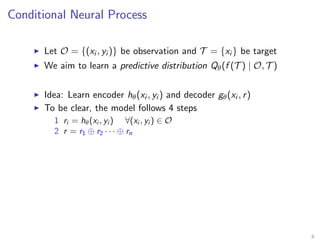
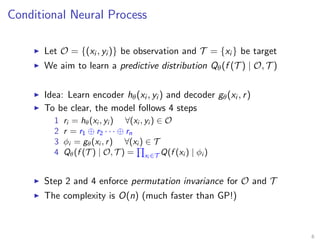
Conditional Neural Process
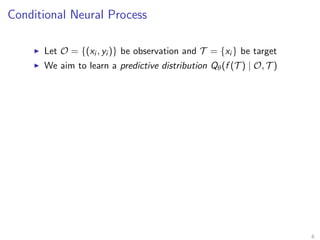
Let O = {(xi , yi )} be observation and T = {xi } be target
We aim to learn a predictive distribution Qθ(f (T ) | O, T )
6
Conditional Neural Process
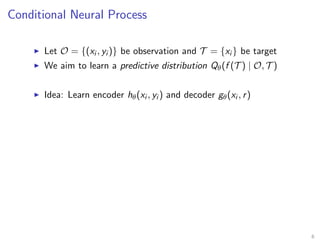
Let O = {(xi , yi )} be observation and T = {xi } be target
We aim to learn a predictive distribution Qθ(f (T ) | O, T )
Idea: Learn encoder hθ(xi , yi ) and decoder gθ(xi , r)
6
Conditional Neural Process
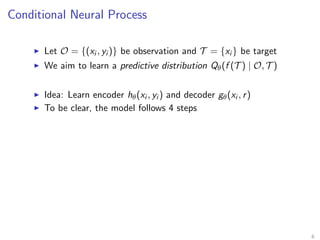
Let O = {(xi , yi )} be observation and T = {xi } be target
We aim to learn a predictive distribution Qθ(f (T ) | O, T )
Idea: Learn encoder hθ(xi , yi ) and decoder gθ(xi , r)
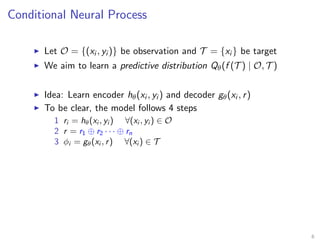
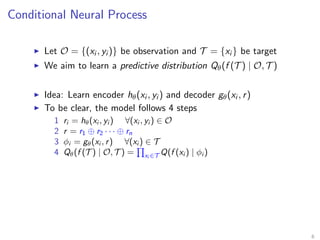
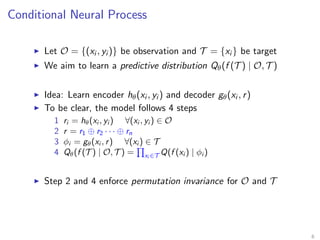
To be clear, the model follows 4 steps
6
Conditional Neural Process
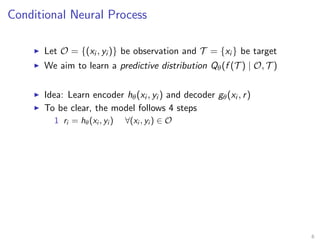
Let O = {(xi , yi )} be observation and T = {xi } be target
We aim to learn a predictive distribution Qθ(f (T ) | O, T )
Idea: Learn encoder hθ(xi , yi ) and decoder gθ(xi , r)
To be clear, the model follows 4 steps
1 ri = hθ(xi , yi ) ∀(xi , yi ) ∈ O
6
Conditional Neural Process
Let O = {(xi , yi )} be observation and T = {xi } be target
We aim to learn a predictive distribution Qθ(f (T ) | O, T )
Idea: Learn encoder hθ(xi , yi ) and decoder gθ(xi , r)
To be clear, the model follows 4 steps
1 ri = hθ(xi , yi ) ∀(xi , yi ) ∈ O
2 r = r1 ⊕ r2 · · · ⊕ rn
6
Conditional Neural Process
Let O = {(xi , yi )} be observation and T = {xi } be target
We aim to learn a predictive distribution Qθ(f (T ) | O, T )
Idea: Learn encoder hθ(xi , yi ) and decoder gθ(xi , r)
To be clear, the model follows 4 steps
1 ri = hθ(xi , yi ) ∀(xi , yi ) ∈ O
2 r = r1 ⊕ r2 · · · ⊕ rn
3 φi = gθ(xi , r) ∀(xi ) ∈ T
6
Conditional Neural Process
Let O = {(xi , yi )} be observation and T = {xi } be target
We aim to learn a predictive distribution Qθ(f (T ) | O, T )
Idea: Learn encoder hθ(xi , yi ) and decoder gθ(xi , r)
To be clear, the model follows 4 steps
1 ri = hθ(xi , yi ) ∀(xi , yi ) ∈ O
2 r = r1 ⊕ r2 · · · ⊕ rn
3 φi = gθ(xi , r) ∀(xi ) ∈ T
4 Qθ(f (T ) | O, T ) = xi ∈T Q(f (xi ) | φi )
6
Conditional Neural Process
Let O = {(xi , yi )} be observation and T = {xi } be target
We aim to learn a predictive distribution Qθ(f (T ) | O, T )
Idea: Learn encoder hθ(xi , yi ) and decoder gθ(xi , r)
To be clear, the model follows 4 steps
1 ri = hθ(xi , yi ) ∀(xi , yi ) ∈ O
2 r = r1 ⊕ r2 · · · ⊕ rn
3 φi = gθ(xi , r) ∀(xi ) ∈ T
4 Qθ(f (T ) | O, T ) = xi ∈T Q(f (xi ) | φi )
Step 2 and 4 enforce permutation invariance for O and T
6
Conditional Neural Process
Let O = {(xi , yi )} be observation and T = {xi } be target
We aim to learn a predictive distribution Qθ(f (T ) | O, T )
Idea: Learn encoder hθ(xi , yi ) and decoder gθ(xi , r)
To be clear, the model follows 4 steps
1 ri = hθ(xi , yi ) ∀(xi , yi ) ∈ O
2 r = r1 ⊕ r2 · · · ⊕ rn
3 φi = gθ(xi , r) ∀(xi ) ∈ T
4 Qθ(f (T ) | O, T ) = xi ∈T Q(f (xi ) | φi )
Step 2 and 4 enforce permutation invariance for O and T
The complexity is O(n) (much faster than GP!)
6
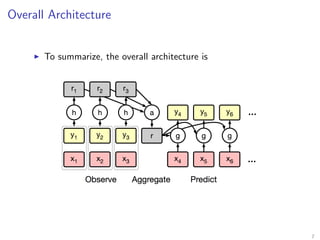
Overall Architecture
To summarize, the overall architecture is
7
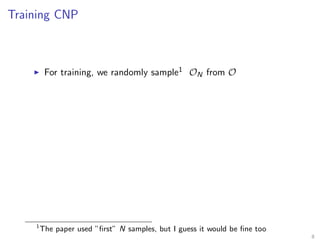
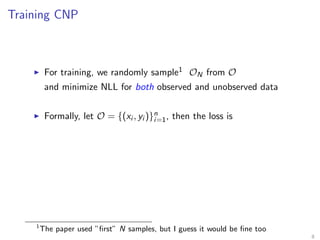
Training CNP
For training, we randomly sample1 ON from O
1
The paper used ”first” N samples, but I guess it would be fine too
8
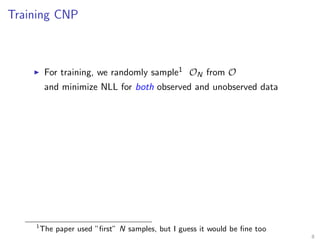
Training CNP
For training, we randomly sample1 ON from O
and minimize NLL for both observed and unobserved data
1
The paper used ”first” N samples, but I guess it would be fine too
8
Training CNP
For training, we randomly sample1 ON from O
and minimize NLL for both observed and unobserved data
Formally, let O = {(xi , yi )}n
i=1, then the loss is
1
The paper used ”first” N samples, but I guess it would be fine too
8
Training CNP
For training, we randomly sample1 ON from O
and minimize NLL for both observed and unobserved data
Formally, let O = {(xi , yi )}n
i=1, then the loss is
L(θ) = −Ef ∼P [EN [log Qθ(y1:n | ON, x1:n)]]
1
The paper used ”first” N samples, but I guess it would be fine too
8
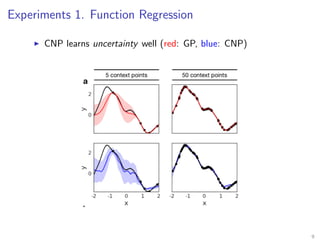
Experiments 1. Function Regression
CNP learns uncertainty well (red: GP, blue: CNP)
9
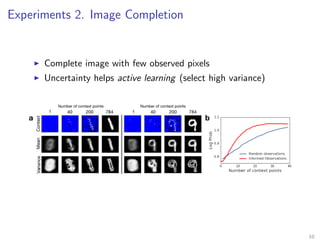
Experiments 2. Image Completion
Complete image with few observed pixels
Uncertainty helps active learning (select high variance)
10
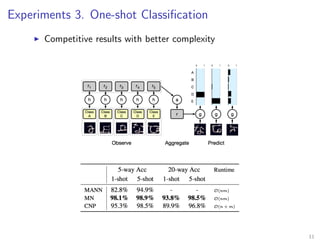
Experiments 3. One-shot Classification
Competitive results with better complexity
11
Table of Contents
Overview
Conditional Neural Processes (ICML 2018)
Neural Processes (ICML Workshop 2018)
12
Neural Process
CNP only gets the mean and variance
However, we may want to sample smooth functions
13
Neural Process
CNP only gets the mean and variance
However, we may want to sample smooth functions
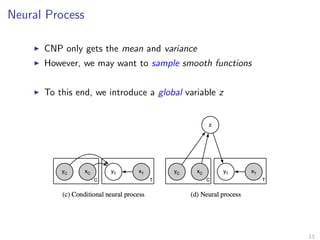
To this end, we introduce a global variable z
13
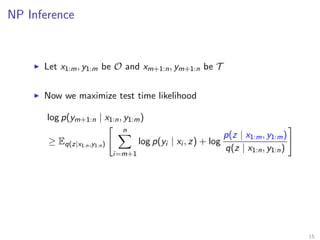
NP Inference
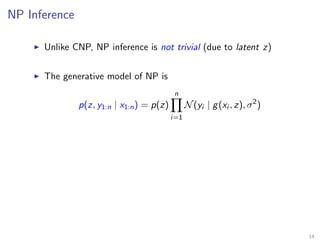
Unlike CNP, NP inference is not trivial (due to latent z)
14
NP Inference
Unlike CNP, NP inference is not trivial (due to latent z)
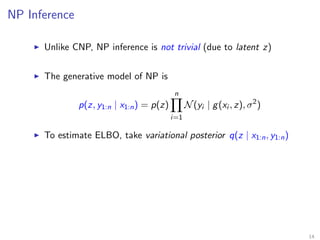
The generative model of NP is
p(z, y1:n | x1:n) = p(z)
n
i=1
N(yi | g(xi , z), σ2
)
14
NP Inference
Unlike CNP, NP inference is not trivial (due to latent z)
The generative model of NP is
p(z, y1:n | x1:n) = p(z)
n
i=1
N(yi | g(xi , z), σ2
)
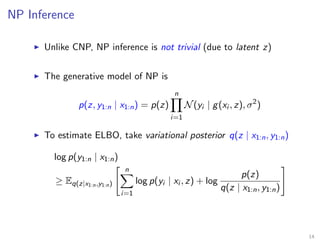
To estimate ELBO, take variational posterior q(z | x1:n, y1:n)
14
NP Inference
Unlike CNP, NP inference is not trivial (due to latent z)
The generative model of NP is
p(z, y1:n | x1:n) = p(z)
n
i=1
N(yi | g(xi , z), σ2
)
To estimate ELBO, take variational posterior q(z | x1:n, y1:n)
log p(y1:n | x1:n)
≥ Eq(z|x1:n,y1:n)
n
i=1
log p(yi | xi , z) + log
p(z)
q(z | x1:n, y1:n)
14
NP Inference
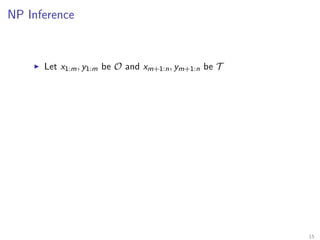
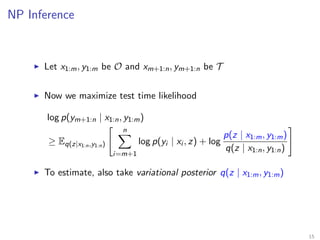
Let x1:m, y1:m be O and xm+1:n, ym+1:n be T
15
NP Inference
Let x1:m, y1:m be O and xm+1:n, ym+1:n be T
Now we maximize test time likelihood
log p(ym+1:n | x1:n, y1:m)
≥ Eq(z|x1:n,y1:n)
n
i=m+1
log p(yi | xi , z) + log
p(z | x1:m, y1:m)
q(z | x1:n, y1:n)
15
NP Inference
Let x1:m, y1:m be O and xm+1:n, ym+1:n be T
Now we maximize test time likelihood
log p(ym+1:n | x1:n, y1:m)
≥ Eq(z|x1:n,y1:n)
n
i=m+1
log p(yi | xi , z) + log
p(z | x1:m, y1:m)
q(z | x1:n, y1:n)
To estimate, also take variational posterior q(z | x1:m, y1:m)
15
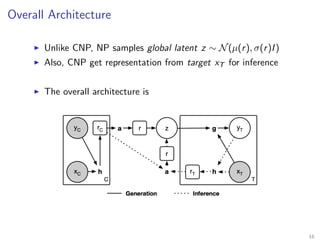
Overall Architecture
Unlike CNP, NP samples global latent z ∼ N(µ(r), σ(r)I)
Also, CNP get representation from target xT for inference
The overall architecture is
16
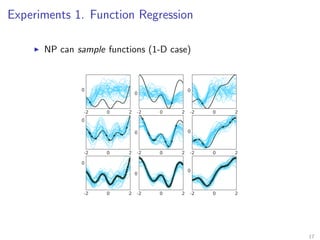
Experiments 1. Function Regression
NP can sample functions (1-D case)
17
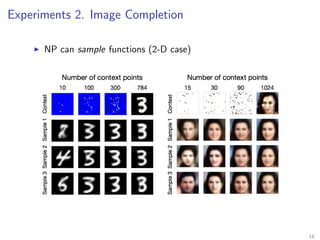
Experiments 2. Image Completion
NP can sample functions (2-D case)
18
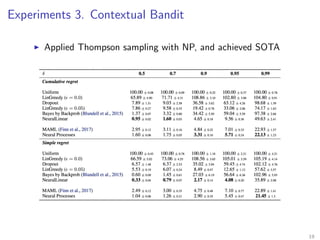
Experiments 3. Contextual Bandit
Applied Thompson sampling with NP, and achieved SOTA
19
Summary
Introduced NP, combination of NN and GP
Introduced two variants: CNP and NP
CNP predicts uncertainty locally, and get mean & variance
NP predicts uncertainty globally, and get samples
Both has own advantages, and may can use on situation
20

Neural Processes

  • 1.
    Neural Processes Sangwoo Mo KAISTALIN Lab. August 28, 2018 1
  • 2.
    Table of Contents Overview ConditionalNeural Processes (ICML 2018) Neural Processes (ICML Workshop 2018) 2
  • 3.
    Table of Contents Overview ConditionalNeural Processes (ICML 2018) Neural Processes (ICML Workshop 2018) 3
  • 4.
    Overview Motivation: Can welearn a distribution of functions f ∼ P(f ) instead of a single function f with NN? 4
  • 5.
    Overview Motivation: Can welearn a distribution of functions f ∼ P(f ) instead of a single function f with NN? Traditional NN: Dataset D is fixed, and infer with f 4
  • 6.
    Overview Motivation: Can welearn a distribution of functions f ∼ P(f ) instead of a single function f with NN? Traditional NN: Dataset D is fixed, and infer with f Neural Process: Given observation O, sample f ∼ P(f | O) 4
  • 7.
    Overview Motivation: Can welearn a distribution of functions f ∼ P(f ) instead of a single function f with NN? Traditional NN: Dataset D is fixed, and infer with f Neural Process: Given observation O, sample f ∼ P(f | O) In modern language, NP does meta learning 4
  • 8.
    Overview Motivation: Can welearn a distribution of functions f ∼ P(f ) instead of a single function f with NN? Traditional NN: Dataset D is fixed, and infer with f Neural Process: Given observation O, sample f ∼ P(f | O) We know GP is a good solution for this problem 4
  • 9.
    Overview Motivation: Can welearn a distribution of functions f ∼ P(f ) instead of a single function f with NN? Traditional NN: Dataset D is fixed, and infer with f Neural Process: Given observation O, sample f ∼ P(f | O) We know GP is a good solution for this problem However, GP suffers from high complexity O(n3) 4
  • 10.
    Overview Motivation: Can welearn a distribution of functions f ∼ P(f ) instead of a single function f with NN? Traditional NN: Dataset D is fixed, and infer with f Neural Process: Given observation O, sample f ∼ P(f | O) We know GP is a good solution for this problem However, GP suffers from high complexity O(n3) NP combines both advantages of NN and GP 4
  • 11.
    Table of Contents Overview ConditionalNeural Processes (ICML 2018) Neural Processes (ICML Workshop 2018) 5
  • 12.
    Conditional Neural Process LetO = {(xi , yi )} be observation and T = {xi } be target We aim to learn a predictive distribution Qθ(f (T ) | O, T ) 6
  • 13.
    Conditional Neural Process LetO = {(xi , yi )} be observation and T = {xi } be target We aim to learn a predictive distribution Qθ(f (T ) | O, T ) Idea: Learn encoder hθ(xi , yi ) and decoder gθ(xi , r) 6
  • 14.
    Conditional Neural Process LetO = {(xi , yi )} be observation and T = {xi } be target We aim to learn a predictive distribution Qθ(f (T ) | O, T ) Idea: Learn encoder hθ(xi , yi ) and decoder gθ(xi , r) To be clear, the model follows 4 steps 6
  • 15.
    Conditional Neural Process LetO = {(xi , yi )} be observation and T = {xi } be target We aim to learn a predictive distribution Qθ(f (T ) | O, T ) Idea: Learn encoder hθ(xi , yi ) and decoder gθ(xi , r) To be clear, the model follows 4 steps 1 ri = hθ(xi , yi ) ∀(xi , yi ) ∈ O 6
  • 16.
    Conditional Neural Process LetO = {(xi , yi )} be observation and T = {xi } be target We aim to learn a predictive distribution Qθ(f (T ) | O, T ) Idea: Learn encoder hθ(xi , yi ) and decoder gθ(xi , r) To be clear, the model follows 4 steps 1 ri = hθ(xi , yi ) ∀(xi , yi ) ∈ O 2 r = r1 ⊕ r2 · · · ⊕ rn 6
  • 17.
    Conditional Neural Process LetO = {(xi , yi )} be observation and T = {xi } be target We aim to learn a predictive distribution Qθ(f (T ) | O, T ) Idea: Learn encoder hθ(xi , yi ) and decoder gθ(xi , r) To be clear, the model follows 4 steps 1 ri = hθ(xi , yi ) ∀(xi , yi ) ∈ O 2 r = r1 ⊕ r2 · · · ⊕ rn 3 φi = gθ(xi , r) ∀(xi ) ∈ T 6
  • 18.
    Conditional Neural Process LetO = {(xi , yi )} be observation and T = {xi } be target We aim to learn a predictive distribution Qθ(f (T ) | O, T ) Idea: Learn encoder hθ(xi , yi ) and decoder gθ(xi , r) To be clear, the model follows 4 steps 1 ri = hθ(xi , yi ) ∀(xi , yi ) ∈ O 2 r = r1 ⊕ r2 · · · ⊕ rn 3 φi = gθ(xi , r) ∀(xi ) ∈ T 4 Qθ(f (T ) | O, T ) = xi ∈T Q(f (xi ) | φi ) 6
  • 19.
    Conditional Neural Process LetO = {(xi , yi )} be observation and T = {xi } be target We aim to learn a predictive distribution Qθ(f (T ) | O, T ) Idea: Learn encoder hθ(xi , yi ) and decoder gθ(xi , r) To be clear, the model follows 4 steps 1 ri = hθ(xi , yi ) ∀(xi , yi ) ∈ O 2 r = r1 ⊕ r2 · · · ⊕ rn 3 φi = gθ(xi , r) ∀(xi ) ∈ T 4 Qθ(f (T ) | O, T ) = xi ∈T Q(f (xi ) | φi ) Step 2 and 4 enforce permutation invariance for O and T 6
  • 20.
    Conditional Neural Process LetO = {(xi , yi )} be observation and T = {xi } be target We aim to learn a predictive distribution Qθ(f (T ) | O, T ) Idea: Learn encoder hθ(xi , yi ) and decoder gθ(xi , r) To be clear, the model follows 4 steps 1 ri = hθ(xi , yi ) ∀(xi , yi ) ∈ O 2 r = r1 ⊕ r2 · · · ⊕ rn 3 φi = gθ(xi , r) ∀(xi ) ∈ T 4 Qθ(f (T ) | O, T ) = xi ∈T Q(f (xi ) | φi ) Step 2 and 4 enforce permutation invariance for O and T The complexity is O(n) (much faster than GP!) 6
  • 21.
    Overall Architecture To summarize,the overall architecture is 7
  • 22.
    Training CNP For training,we randomly sample1 ON from O 1 The paper used ”first” N samples, but I guess it would be fine too 8
  • 23.
    Training CNP For training,we randomly sample1 ON from O and minimize NLL for both observed and unobserved data 1 The paper used ”first” N samples, but I guess it would be fine too 8
  • 24.
    Training CNP For training,we randomly sample1 ON from O and minimize NLL for both observed and unobserved data Formally, let O = {(xi , yi )}n i=1, then the loss is 1 The paper used ”first” N samples, but I guess it would be fine too 8
  • 25.
    Training CNP For training,we randomly sample1 ON from O and minimize NLL for both observed and unobserved data Formally, let O = {(xi , yi )}n i=1, then the loss is L(θ) = −Ef ∼P [EN [log Qθ(y1:n | ON, x1:n)]] 1 The paper used ”first” N samples, but I guess it would be fine too 8
  • 26.
    Experiments 1. FunctionRegression CNP learns uncertainty well (red: GP, blue: CNP) 9
  • 27.
    Experiments 2. ImageCompletion Complete image with few observed pixels Uncertainty helps active learning (select high variance) 10
  • 28.
    Experiments 3. One-shotClassification Competitive results with better complexity 11
  • 29.
    Table of Contents Overview ConditionalNeural Processes (ICML 2018) Neural Processes (ICML Workshop 2018) 12
  • 30.
    Neural Process CNP onlygets the mean and variance However, we may want to sample smooth functions 13
  • 31.
    Neural Process CNP onlygets the mean and variance However, we may want to sample smooth functions To this end, we introduce a global variable z 13
  • 32.
    NP Inference Unlike CNP,NP inference is not trivial (due to latent z) 14
  • 33.
    NP Inference Unlike CNP,NP inference is not trivial (due to latent z) The generative model of NP is p(z, y1:n | x1:n) = p(z) n i=1 N(yi | g(xi , z), σ2 ) 14
  • 34.
    NP Inference Unlike CNP,NP inference is not trivial (due to latent z) The generative model of NP is p(z, y1:n | x1:n) = p(z) n i=1 N(yi | g(xi , z), σ2 ) To estimate ELBO, take variational posterior q(z | x1:n, y1:n) 14
  • 35.
    NP Inference Unlike CNP,NP inference is not trivial (due to latent z) The generative model of NP is p(z, y1:n | x1:n) = p(z) n i=1 N(yi | g(xi , z), σ2 ) To estimate ELBO, take variational posterior q(z | x1:n, y1:n) log p(y1:n | x1:n) ≥ Eq(z|x1:n,y1:n) n i=1 log p(yi | xi , z) + log p(z) q(z | x1:n, y1:n) 14
  • 36.
    NP Inference Let x1:m,y1:m be O and xm+1:n, ym+1:n be T 15
  • 37.
    NP Inference Let x1:m,y1:m be O and xm+1:n, ym+1:n be T Now we maximize test time likelihood log p(ym+1:n | x1:n, y1:m) ≥ Eq(z|x1:n,y1:n) n i=m+1 log p(yi | xi , z) + log p(z | x1:m, y1:m) q(z | x1:n, y1:n) 15
  • 38.
    NP Inference Let x1:m,y1:m be O and xm+1:n, ym+1:n be T Now we maximize test time likelihood log p(ym+1:n | x1:n, y1:m) ≥ Eq(z|x1:n,y1:n) n i=m+1 log p(yi | xi , z) + log p(z | x1:m, y1:m) q(z | x1:n, y1:n) To estimate, also take variational posterior q(z | x1:m, y1:m) 15
  • 39.
    Overall Architecture Unlike CNP,NP samples global latent z ∼ N(µ(r), σ(r)I) Also, CNP get representation from target xT for inference The overall architecture is 16
  • 40.
    Experiments 1. FunctionRegression NP can sample functions (1-D case) 17
  • 41.
    Experiments 2. ImageCompletion NP can sample functions (2-D case) 18
  • 42.
    Experiments 3. ContextualBandit Applied Thompson sampling with NP, and achieved SOTA 19
  • 43.
    Summary Introduced NP, combinationof NN and GP Introduced two variants: CNP and NP CNP predicts uncertainty locally, and get mean & variance NP predicts uncertainty globally, and get samples Both has own advantages, and may can use on situation 20