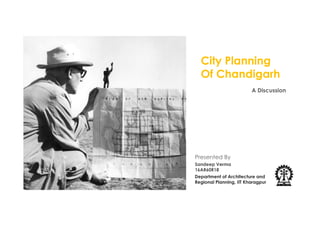
City Planning
Of Chandigarh
A Discussion
Department of Architecture and
Regional Planning, IIT Kharagpur
Presented By
Sandeep Verma
16AR60R18
Aim
Department of Architecture and
Regional Planning, IIT Kharagpur
To study the city planning of Chandigarh.
Objective
• To understand historic background and planning concept of
Chandigarh.
• To analyse the pros and cons of planning Chandigarh.
• To understand the planning approach for a new city
planning.
Scope
• Study deals with planning took place in initial phase.
• Study is not a detailed investigation of any specific aspect.
• Study is rather qualitative in approach with study of criticism
of various researchers.
• Study focusing on sector planning and capital complex.
Limitations
• Study doesn’t relate to other works of Le Corbusier.
• Study doesn’t deal with the present urban issues of
Chandigarh.
• Study does not deal with the city evolution over the time or
the challenges encountering.
Overview
• Historical Background
• Mayer’s Plan
• Corbusier’s intervention and revised
plan
• Discussion on Sector
• Conception of plan as Human body
• Road Network Planning
• Capitol complex Discussion
• Critical Review
• Conclusion
Background
Source:
Department of Architecture and
Regional Planning, IIT Kharagpur
1947
Malik, B. (2004). City Planning and Realities: A Case Study of Chandigarh.
International Conference on "City Futures". Chicago : University of Illinois.
India’s Partition
Something Good Cometh
Out of “Evil”
“Let this be a new town, symbolic of freedom of India unfettered
by the traditions of the past. An expression of the nations faith in the
future”
JAWAHARLAL NEHRU
About Site
Source:
• Mountainous region
• Central location
• Natural drainage
• Sufficient water supply
• Foothills of Shivalik
• Moderate climate
• sub mountainous area of the Ambala district
• 150 miles north of New Delhi
• Flatter Area
• gentle sloping plain of agriculture land dotted with grooves of mango trees
• consisting of 59 villages
Department of Architecture and
Regional Planning, IIT Kharagpur
Fry, E. M., & B, J. D. (1955, April 1). Chandigarh and planning
development in India. Royal Society of Arts, 103(4948), 315-333.
New Capital City and Administration Centre
accommodating half a million people and expandable to
1 million.
Mayer’s Plan
Albert Mayer and Mathew Nowicky
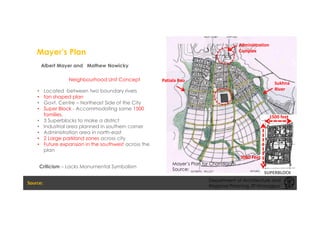
• Located between two boundary rivers
• fan shaped plan
• Govt. Centre – Northeast Side of the City
• Super Block - Accommodating some 1500
families.
• 3 Superblocks to make a district
• Industrial area planned in southern corner
• Administration area in north-east
• 2 Large parkland zones across city
• Future expansion in the southwest across the
plan
1500 feet
3000 Feet
Sukhna
River
Patiala Rao
Administration
Complex
SUPERBLOCK
Neighbourhood Unit Concept
Criticism – Lacks Monumental Symbolism
Department of Architecture and
Regional Planning, IIT Kharagpur
Mayer’s Plan for Chandigarh
Source:
Mathew Nowicky’s Death
Turning Point
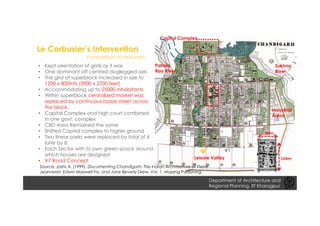
Le Corbusier’s Intervention
Formulation of new plan
• Kept orientation of grids as it was
• One dominant off centred doglegged axis
• The grid of superblock increased in size to
1200 x 800mts (3900 x 2700 feet)
• Accommodating up to 25000 inhabitants
• Within superblock centralized market was
replaced by continuous bazar street across
the block.
• Capital Complex and high court combined
in one govt. complex
• CBD Area Remained the same
• Shifted Capital complex to higher ground
• Two linear parks were replaced by total of 6
later by 8.
• Each Sector with its own green space around
which houses are designed
• V7 Road Concept
Leisure Valley
Capitol Complex
V1
Industrial
Areas
Sukhna
River
Patiala
Rao River
800m
1200m
Department of Architecture and
Regional Planning, IIT Kharagpur
Source: Joshi, K. (1999). Documenting Chandigarh: The Indian Architecture of Pierre
Jeanneret, Edwin Maxwell Fry, and Jane Beverly Drew, Vol. 1. Maping Publishing.
Sectors
V3
V4
Shops
School
Health
Centre
Arrom
hotel
School
V5
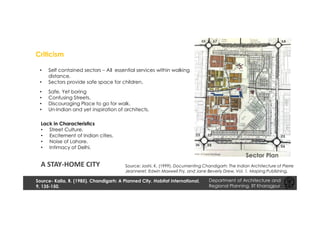
• Total 30 sectors - 24 residential
• 70% building private
• Autonomous unit including
housing, school, shops,
recreational spaces.
• 3000-25000 accommodating
capacity
• Surrounded by high speed
roads
• Bus stops every 400mts
• No pedestrian needs to walk
more than 10 minutes
Department of Architecture and
Regional Planning, IIT Kharagpur
Joshi, K. (1999). Documenting Chandigarh: The
Indian Architecture of Pierre Jeanneret, Edwin
Maxwell Fry, and Jane Beverly Drew, Vol. 1. Maping
Publishing.
Source: Joshi, K. (1999). Documenting Chandigarh: The Indian Architecture of Pierre Jeanneret,
Edwin Maxwell Fry, and Jane Beverly Drew, Vol. 1. Maping Publishing.
Sector Plan
Criticism
Department of Architecture and
Regional Planning, IIT Kharagpur
• Self contained sectors – All essential services within walking
distance.
• Sectors provide safe space for children.
• Safe, Yet boring
• Confusing Streets.
• Discouraging Place to go for walk.
• Un-Indian and yet inspiration of architects.
Lack in Characteristics
• Street Culture.
• Excitement of Indian cities.
• Noise of Lahore.
• Intimacy of Delhi.
A STAY-HOME CITY
Source- Kalia, R. (1985). Chandigarh: A Planned City. Habitat International,
9, 135-150.
Sector Plan
Source: Joshi, K. (1999). Documenting Chandigarh: The Indian Architecture of Pierre
Jeanneret, Edwin Maxwell Fry, and Jane Beverly Drew, Vol. 1. Maping Publishing.
City totally European
Designed without regard of fierce north Indian climate or
Indian ways of life.
City segregated by income, and civil ranks
Inappropriate decision of hiring western designers to plan
cities for non western culture
Sector 17 - not valued much as would have valued in
Europe
Decorative
Peter Hall
Department of Architecture and
Regional Planning, IIT Kharagpur
Source - Turner, T. (Director). (2015). Chandigarh 1 (of 4): Le Corbusier’s urban
design and planning [Motion Picture].
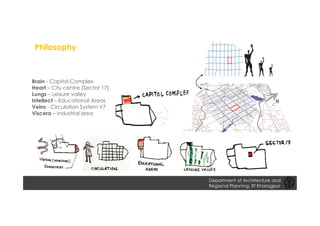
Philosophy
Brain - Capitol Complex
Heart – City centre (Sector 17)
Lungs – Leisure valley
Intellect – Educational Areas
Veins - Circulation System V7
Viscera – Industrial area
N
Department of Architecture and
Regional Planning, IIT Kharagpur
V7 ROAD CONCEPT
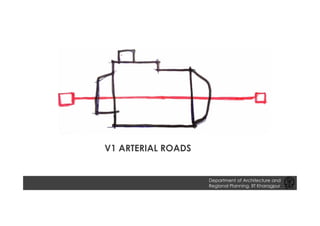
V1 ARTERIAL ROADS
Department of Architecture and
Regional Planning, IIT Kharagpur
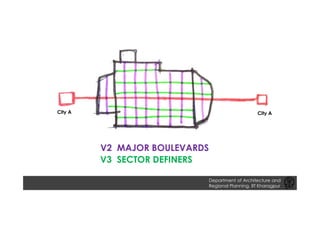
V2 MAJOR BOULEVARDS
V3 SECTOR DEFINERS
Department of Architecture and
Regional Planning, IIT Kharagpur
City A City A
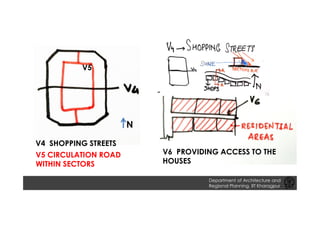
V4 SHOPPING STREETS
V5 CIRCULATION ROAD
WITHIN SECTORS
N
V6 PROVIDING ACCESS TO THE
HOUSES
Department of Architecture and
Regional Planning, IIT Kharagpur
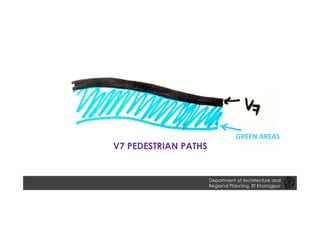
V5
GREEN AREAS
V7 PEDESTRIAN PATHS
Department of Architecture and
Regional Planning, IIT Kharagpur
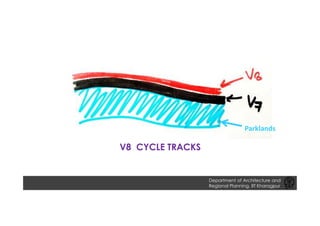
Parklands
V8 CYCLE TRACKS
Department of Architecture and
Regional Planning, IIT Kharagpur
CAPITOL COMPLEX
WORLD HERITAGE SITE,
JULY 2016
Source - Turner, T. (Director). (2015). Chandigarh 1 (of 4): Le Corbusier’s urban
design and planning [Motion Picture].
Plan of Chandigarh
Source - Turner, T. (Director). (2015). Chandigarh 1 (of 4): Le Corbusier’s urban
design and planning [Motion Picture].
Department of Architecture and
Regional Planning, IIT Kharagpur
 Shows Corbusier's interest in
symbols.
 Capital landscape as a sacred
place with layers of cosmic
significance
 Complex as head of
vastupurush.
 linked the site as microcosm
with the cosmos.
Source - Turner, T. (Director). (2015). Chandigarh 1 (of 4): Le Corbusier’s urban
design and planning [Motion Picture].
Department of Architecture and
Regional Planning, IIT Kharagpur
Tower of Shadows
High court Building
Assembly Building Secretariat Building Pedestrian Plaza
Source - Turner, T. (Director). (2015). Chandigarh 1 (of 4): Le Corbusier’s urban
design and planning [Motion Picture].
Department of Architecture and
Regional Planning, IIT Kharagpur
Source - Turner, T. (Director). (2015). Chandigarh 1 (of 4): Le Corbusier’s urban
design and planning [Motion Picture].
High Court Building
Source - Turner, T. (Director). (2015). Chandigarh 1 (of 4): Le Corbusier’s urban
design and planning [Motion Picture].
Assembly Building with giant plaza
A great pedestrian plaza which embodies spirit of exultation, power and permanence, experienced by Indians
on acquiring self governance.
• Neglected space and Empty
• Area treated as high security zone and
controlled by military
• Emptier than intended
• Museum of knowledge ( Governors palace)
never built
• Huge Expense
Corbusier to be blamed?
Source - Turner, T. (Director). (2015). Chandigarh 1 (of 4): Le Corbusier’s urban
design and planning [Motion Picture].
Department of Architecture and
Regional Planning, IIT Kharagpur
Martus Memorial
Source - Turner, T. (Director). (2015). Chandigarh 1 (of 4): Le Corbusier’s urban design and planning [Motion Picture].
Swastika Symbol
Source - Turner, T. (Director). (2015). Chandigarh 1 (of 4): Le Corbusier’s urban design and planning [Motion Picture].
Open Hand
Trench of Consideration
Source - Turner, T. (Director). (2015). Chandigarh 1 (of 4): Le Corbusier’s urban design and planning [Motion Picture].
Conclusions
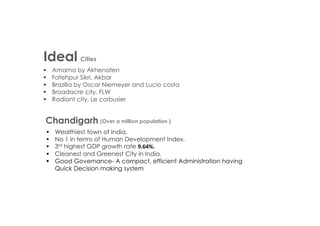
Ideal Cities
 Amarna by Akhenaten
 Fatehpur Sikri, Akbar
 Brazilia by Oscar Niemeyer and Lucio costa
 Broadacre city, FLW
 Radiant city, Le corbusier
Chandigarh
 Wealthiest town of India.
 No 1 in terms of Human Development Index.
 3rd highest GDP growth rate 9.64%.
 Cleanest and Greenest City in India.
 Good Governance- A compact, efficient Administration having
Quick Decision making system
(Over a million population )
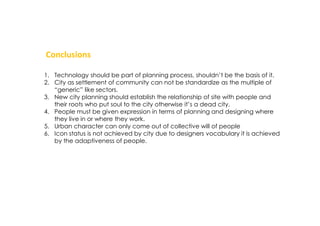
Conclusions
1. Technology should be part of planning process, shouldn’t be the basis of it.
2. City as settlement of community can not be standardize as the multiple of
“generic” like sectors.
3. New city planning should establish the relationship of site with people and
their roots who put soul to the city otherwise it’s a dead city.
4. People must be given expression in terms of planning and designing where
they live in or where they work.
5. Urban character can only come out of collective will of people
6. Icon status is not achieved by city due to designers vocabulary it is achieved
by the adaptiveness of people.
1.Shaw, A. (2009). Town Planning in Post Colonial India, 1947-1965: Chandigarh Re-Examined . Urban Geography
, 857-876.
2.Fry, E. M., & B, J. D. (1955, April 1). Chandigarh and planning development in India. Royal Society of Arts,
103(4948), 315-333.
3.Malik, B. (2004). City Planning and Realities: A Case Study of Chandigarh. International Conference on "City
Futures". Chicago : University of Illinois.
4. Fitting, P. (2002). Urban Planning/Utopian Dreaming Le Corbusier's Chandigarh Today. Utopian Studies, 69-93.
5.Gethin, C. (1973). Chandigarh: A memorial to arrogance. Built Environment, 291-294.
6.Kalia, R. (1985). Chandigarh: A Planned City. Habitat International, 9, 135-150.
7.Morris, A. E. (1975). Chandigarh: The plan Corb tore up? Built Environment Quarterly December , 229-234.
8.Turner, T. (Director). (2015). Chandigarh 1 (of 4): Le Corbusier’s urban design and planning [Motion Picture].
9. D'Souza, V. S. (1976, Sept 18). People Prevail over Plan. Economic and Political Weekly Vol 11 No.11(38), 1626-
1528.
10. Joshi, K. (1999). Documenting Chandigarh: The Indian Architecture of Pierre Jeanneret, Edwin Maxwell Fry,
and Jane Beverly Drew, Vol. 1. Maping Publishing.
References
Thank You
Source - Turner, T. (Director). (2015). Chandigarh 1 (of 4): Le Corbusier’s urban
design and planning [Motion Picture].

Chandigarh City Planning

  • 1.
    City Planning Of Chandigarh ADiscussion Department of Architecture and Regional Planning, IIT Kharagpur Presented By Sandeep Verma 16AR60R18
  • 2.
    Aim Department of Architectureand Regional Planning, IIT Kharagpur To study the city planning of Chandigarh. Objective • To understand historic background and planning concept of Chandigarh. • To analyse the pros and cons of planning Chandigarh. • To understand the planning approach for a new city planning. Scope • Study deals with planning took place in initial phase. • Study is not a detailed investigation of any specific aspect. • Study is rather qualitative in approach with study of criticism of various researchers. • Study focusing on sector planning and capital complex. Limitations • Study doesn’t relate to other works of Le Corbusier. • Study doesn’t deal with the present urban issues of Chandigarh. • Study does not deal with the city evolution over the time or the challenges encountering.
  • 3.
    Overview • Historical Background •Mayer’s Plan • Corbusier’s intervention and revised plan • Discussion on Sector • Conception of plan as Human body • Road Network Planning • Capitol complex Discussion • Critical Review • Conclusion
  • 4.
    Background Source: Department of Architectureand Regional Planning, IIT Kharagpur 1947 Malik, B. (2004). City Planning and Realities: A Case Study of Chandigarh. International Conference on "City Futures". Chicago : University of Illinois. India’s Partition
  • 5.
  • 6.
    “Let this bea new town, symbolic of freedom of India unfettered by the traditions of the past. An expression of the nations faith in the future” JAWAHARLAL NEHRU
  • 7.
    About Site Source: • Mountainousregion • Central location • Natural drainage • Sufficient water supply • Foothills of Shivalik • Moderate climate • sub mountainous area of the Ambala district • 150 miles north of New Delhi • Flatter Area • gentle sloping plain of agriculture land dotted with grooves of mango trees • consisting of 59 villages Department of Architecture and Regional Planning, IIT Kharagpur Fry, E. M., & B, J. D. (1955, April 1). Chandigarh and planning development in India. Royal Society of Arts, 103(4948), 315-333.
  • 8.
    New Capital Cityand Administration Centre accommodating half a million people and expandable to 1 million.
  • 9.
    Mayer’s Plan Albert Mayerand Mathew Nowicky • Located between two boundary rivers • fan shaped plan • Govt. Centre – Northeast Side of the City • Super Block - Accommodating some 1500 families. • 3 Superblocks to make a district • Industrial area planned in southern corner • Administration area in north-east • 2 Large parkland zones across city • Future expansion in the southwest across the plan 1500 feet 3000 Feet Sukhna River Patiala Rao Administration Complex SUPERBLOCK Neighbourhood Unit Concept Criticism – Lacks Monumental Symbolism Department of Architecture and Regional Planning, IIT Kharagpur Mayer’s Plan for Chandigarh Source:
  • 10.
  • 11.
    Le Corbusier’s Intervention Formulationof new plan • Kept orientation of grids as it was • One dominant off centred doglegged axis • The grid of superblock increased in size to 1200 x 800mts (3900 x 2700 feet) • Accommodating up to 25000 inhabitants • Within superblock centralized market was replaced by continuous bazar street across the block. • Capital Complex and high court combined in one govt. complex • CBD Area Remained the same • Shifted Capital complex to higher ground • Two linear parks were replaced by total of 6 later by 8. • Each Sector with its own green space around which houses are designed • V7 Road Concept Leisure Valley Capitol Complex V1 Industrial Areas Sukhna River Patiala Rao River 800m 1200m Department of Architecture and Regional Planning, IIT Kharagpur Source: Joshi, K. (1999). Documenting Chandigarh: The Indian Architecture of Pierre Jeanneret, Edwin Maxwell Fry, and Jane Beverly Drew, Vol. 1. Maping Publishing.
  • 12.
    Sectors V3 V4 Shops School Health Centre Arrom hotel School V5 • Total 30sectors - 24 residential • 70% building private • Autonomous unit including housing, school, shops, recreational spaces. • 3000-25000 accommodating capacity • Surrounded by high speed roads • Bus stops every 400mts • No pedestrian needs to walk more than 10 minutes Department of Architecture and Regional Planning, IIT Kharagpur Joshi, K. (1999). Documenting Chandigarh: The Indian Architecture of Pierre Jeanneret, Edwin Maxwell Fry, and Jane Beverly Drew, Vol. 1. Maping Publishing. Source: Joshi, K. (1999). Documenting Chandigarh: The Indian Architecture of Pierre Jeanneret, Edwin Maxwell Fry, and Jane Beverly Drew, Vol. 1. Maping Publishing. Sector Plan
  • 13.
    Criticism Department of Architectureand Regional Planning, IIT Kharagpur • Self contained sectors – All essential services within walking distance. • Sectors provide safe space for children. • Safe, Yet boring • Confusing Streets. • Discouraging Place to go for walk. • Un-Indian and yet inspiration of architects. Lack in Characteristics • Street Culture. • Excitement of Indian cities. • Noise of Lahore. • Intimacy of Delhi. A STAY-HOME CITY Source- Kalia, R. (1985). Chandigarh: A Planned City. Habitat International, 9, 135-150. Sector Plan Source: Joshi, K. (1999). Documenting Chandigarh: The Indian Architecture of Pierre Jeanneret, Edwin Maxwell Fry, and Jane Beverly Drew, Vol. 1. Maping Publishing.
  • 14.
    City totally European Designedwithout regard of fierce north Indian climate or Indian ways of life. City segregated by income, and civil ranks Inappropriate decision of hiring western designers to plan cities for non western culture Sector 17 - not valued much as would have valued in Europe Decorative Peter Hall Department of Architecture and Regional Planning, IIT Kharagpur Source - Turner, T. (Director). (2015). Chandigarh 1 (of 4): Le Corbusier’s urban design and planning [Motion Picture].
  • 15.
    Philosophy Brain - CapitolComplex Heart – City centre (Sector 17) Lungs – Leisure valley Intellect – Educational Areas Veins - Circulation System V7 Viscera – Industrial area N Department of Architecture and Regional Planning, IIT Kharagpur
  • 16.
  • 17.
    V1 ARTERIAL ROADS Departmentof Architecture and Regional Planning, IIT Kharagpur
  • 18.
    V2 MAJOR BOULEVARDS V3SECTOR DEFINERS Department of Architecture and Regional Planning, IIT Kharagpur City A City A
  • 19.
    V4 SHOPPING STREETS V5CIRCULATION ROAD WITHIN SECTORS N V6 PROVIDING ACCESS TO THE HOUSES Department of Architecture and Regional Planning, IIT Kharagpur V5
  • 20.
    GREEN AREAS V7 PEDESTRIANPATHS Department of Architecture and Regional Planning, IIT Kharagpur
  • 21.
    Parklands V8 CYCLE TRACKS Departmentof Architecture and Regional Planning, IIT Kharagpur
  • 22.
  • 23.
    Source - Turner,T. (Director). (2015). Chandigarh 1 (of 4): Le Corbusier’s urban design and planning [Motion Picture]. Plan of Chandigarh
  • 24.
    Source - Turner,T. (Director). (2015). Chandigarh 1 (of 4): Le Corbusier’s urban design and planning [Motion Picture]. Department of Architecture and Regional Planning, IIT Kharagpur  Shows Corbusier's interest in symbols.  Capital landscape as a sacred place with layers of cosmic significance  Complex as head of vastupurush.  linked the site as microcosm with the cosmos.
  • 25.
    Source - Turner,T. (Director). (2015). Chandigarh 1 (of 4): Le Corbusier’s urban design and planning [Motion Picture]. Department of Architecture and Regional Planning, IIT Kharagpur
  • 26.
    Tower of Shadows Highcourt Building Assembly Building Secretariat Building Pedestrian Plaza Source - Turner, T. (Director). (2015). Chandigarh 1 (of 4): Le Corbusier’s urban design and planning [Motion Picture]. Department of Architecture and Regional Planning, IIT Kharagpur
  • 27.
    Source - Turner,T. (Director). (2015). Chandigarh 1 (of 4): Le Corbusier’s urban design and planning [Motion Picture]. High Court Building
  • 28.
    Source - Turner,T. (Director). (2015). Chandigarh 1 (of 4): Le Corbusier’s urban design and planning [Motion Picture]. Assembly Building with giant plaza
  • 29.
    A great pedestrianplaza which embodies spirit of exultation, power and permanence, experienced by Indians on acquiring self governance. • Neglected space and Empty • Area treated as high security zone and controlled by military • Emptier than intended • Museum of knowledge ( Governors palace) never built • Huge Expense Corbusier to be blamed? Source - Turner, T. (Director). (2015). Chandigarh 1 (of 4): Le Corbusier’s urban design and planning [Motion Picture]. Department of Architecture and Regional Planning, IIT Kharagpur
  • 30.
    Martus Memorial Source -Turner, T. (Director). (2015). Chandigarh 1 (of 4): Le Corbusier’s urban design and planning [Motion Picture].
  • 31.
    Swastika Symbol Source -Turner, T. (Director). (2015). Chandigarh 1 (of 4): Le Corbusier’s urban design and planning [Motion Picture].
  • 32.
    Source - Turner,T. (Director). (2015). Chandigarh 1 (of 4): Le Corbusier’s urban design and planning [Motion Picture]. Open Hand
  • 33.
    Trench of Consideration Source- Turner, T. (Director). (2015). Chandigarh 1 (of 4): Le Corbusier’s urban design and planning [Motion Picture].
  • 34.
  • 35.
    Ideal Cities  Amarnaby Akhenaten  Fatehpur Sikri, Akbar  Brazilia by Oscar Niemeyer and Lucio costa  Broadacre city, FLW  Radiant city, Le corbusier Chandigarh  Wealthiest town of India.  No 1 in terms of Human Development Index.  3rd highest GDP growth rate 9.64%.  Cleanest and Greenest City in India.  Good Governance- A compact, efficient Administration having Quick Decision making system (Over a million population )
  • 36.
    Conclusions 1. Technology shouldbe part of planning process, shouldn’t be the basis of it. 2. City as settlement of community can not be standardize as the multiple of “generic” like sectors. 3. New city planning should establish the relationship of site with people and their roots who put soul to the city otherwise it’s a dead city. 4. People must be given expression in terms of planning and designing where they live in or where they work. 5. Urban character can only come out of collective will of people 6. Icon status is not achieved by city due to designers vocabulary it is achieved by the adaptiveness of people.
  • 37.
    1.Shaw, A. (2009).Town Planning in Post Colonial India, 1947-1965: Chandigarh Re-Examined . Urban Geography , 857-876. 2.Fry, E. M., & B, J. D. (1955, April 1). Chandigarh and planning development in India. Royal Society of Arts, 103(4948), 315-333. 3.Malik, B. (2004). City Planning and Realities: A Case Study of Chandigarh. International Conference on "City Futures". Chicago : University of Illinois. 4. Fitting, P. (2002). Urban Planning/Utopian Dreaming Le Corbusier's Chandigarh Today. Utopian Studies, 69-93. 5.Gethin, C. (1973). Chandigarh: A memorial to arrogance. Built Environment, 291-294. 6.Kalia, R. (1985). Chandigarh: A Planned City. Habitat International, 9, 135-150. 7.Morris, A. E. (1975). Chandigarh: The plan Corb tore up? Built Environment Quarterly December , 229-234. 8.Turner, T. (Director). (2015). Chandigarh 1 (of 4): Le Corbusier’s urban design and planning [Motion Picture]. 9. D'Souza, V. S. (1976, Sept 18). People Prevail over Plan. Economic and Political Weekly Vol 11 No.11(38), 1626- 1528. 10. Joshi, K. (1999). Documenting Chandigarh: The Indian Architecture of Pierre Jeanneret, Edwin Maxwell Fry, and Jane Beverly Drew, Vol. 1. Maping Publishing. References
  • 38.
    Thank You Source -Turner, T. (Director). (2015). Chandigarh 1 (of 4): Le Corbusier’s urban design and planning [Motion Picture].