Uncertainties in
Deep Learning
in a nutshell
Sungjoon Choi

CPSLAB, SNU
Introduction
2
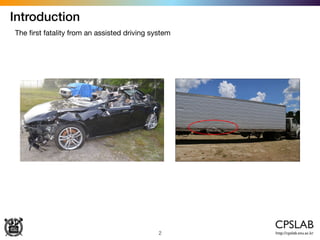
The first fatality from an assisted driving system
Introduction
3
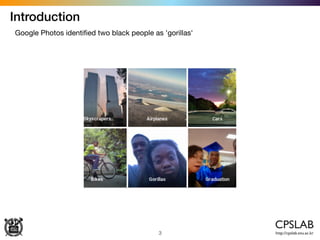
Google Photos identified two black people as 'gorillas'
Introduction
4
Contents
5
Contents
6
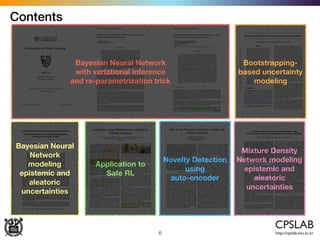
Bayesian Neural Network
with variational inference
and re-parametrization trick
Bootstrapping-
based uncertainty
modeling
Bayesian Neural
Network
modeling
epistemic and
aleatoric
uncertainties
Application to
Safe RL
Novelty Detection
using
auto-encoder
Mixture Density
Network modeling
epistemic and
aleatoric
uncertainties
7
Y. Gal, Uncertainty in Deep Learning, 2016
Gal (2016)
8
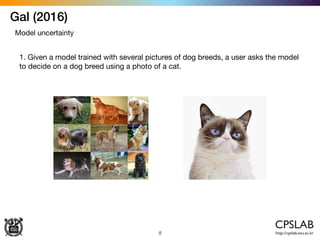
Model uncertainty
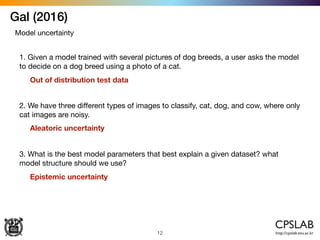
1. Given a model trained with several pictures of dog breeds, a user asks the model
to decide on a dog breed using a photo of a cat.
Gal (2016)
9
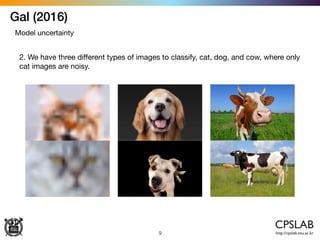
Model uncertainty
2. We have three different types of images to classify, cat, dog, and cow, where only
cat images are noisy.
Gal (2016)
10
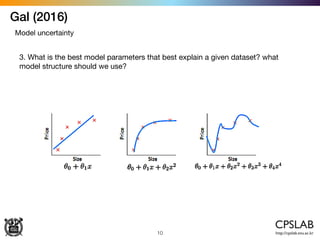
Model uncertainty
3. What is the best model parameters that best explain a given dataset? what
model structure should we use?
Gal (2016)
11
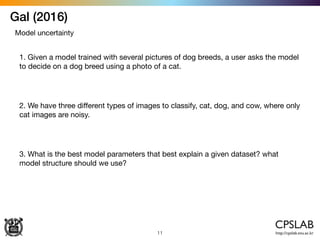
Model uncertainty
1. Given a model trained with several pictures of dog breeds, a user asks the model
to decide on a dog breed using a photo of a cat.
2. We have three different types of images to classify, cat, dog, and cow, where only
cat images are noisy.
3. What is the best model parameters that best explain a given dataset? what
model structure should we use?
Gal (2016)
12
Model uncertainty
1. Given a model trained with several pictures of dog breeds, a user asks the model
to decide on a dog breed using a photo of a cat.
2. We have three different types of images to classify, cat, dog, and cow, where only
cat images are noisy.
3. What is the best model parameters that best explain a given dataset? what
model structure should we use?
Out of distribution test data
Aleatoric uncertainty
Epistemic uncertainty
Gal (2016)
13
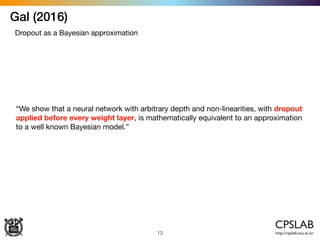
Dropout as a Bayesian approximation
“We show that a neural network with arbitrary depth and non-linearities, with dropout
applied before every weight layer, is mathematically equivalent to an approximation
to a well known Bayesian model.”
Gal (2016)
14
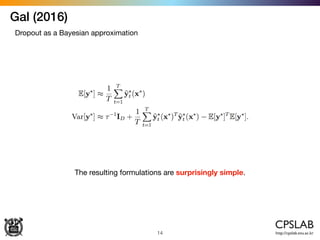
Dropout as a Bayesian approximation
The resulting formulations are surprisingly simple.
Gal (2016)
15
Bayesian Neural Network
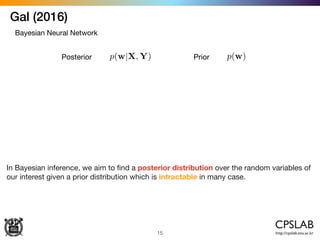
Posterior p(w|X, Y) Prior p(w)
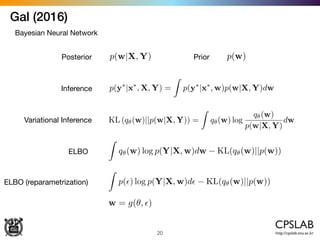
In Bayesian inference, we aim to find a posterior distribution over the random variables of
our interest given a prior distribution which is intractable in many case.
Gal (2016)
16
Bayesian Neural Network
p(y⇤
|x⇤
, X, Y) =
Z
p(y⇤
|x⇤
, w)p(w|X, Y)dw
Posterior p(w|X, Y)
Inference
Prior p(w)
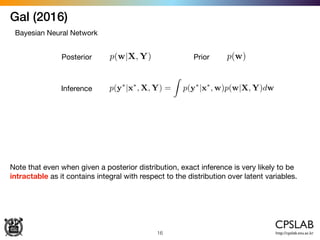
Note that even when given a posterior distribution, exact inference is very likely to be
intractable as it contains integral with respect to the distribution over latent variables.
Gal (2016)
17
Bayesian Neural Network
p(y⇤
|x⇤
, X, Y) =
Z
p(y⇤
|x⇤
, w)p(w|X, Y)dw
Posterior p(w|X, Y)
Inference
Variational Inference KL (q✓(w)||p(w|X, Y)) =
Z
q✓(w) log
q✓(w)
p(w|X, Y)
dw
Prior p(w)
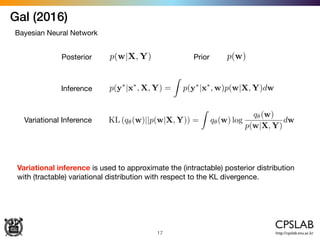
Variational inference is used to approximate the (intractable) posterior distribution
with (tractable) variational distribution with respect to the KL divergence.
Gal (2016)
18
Bayesian Neural Network
p(y⇤
|x⇤
, X, Y) =
Z
p(y⇤
|x⇤
, w)p(w|X, Y)dw
Posterior p(w|X, Y)
Inference
Variational Inference KL (q✓(w)||p(w|X, Y)) =
Z
q✓(w) log
q✓(w)
p(w|X, Y)
dw
ELBO
Z
q✓(w) log p(Y|X, w)dw KL(q✓(w)||p(w))
Prior p(w)
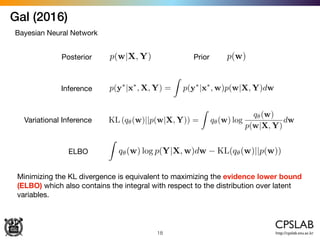
Minimizing the KL divergence is equivalent to maximizing the evidence lower bound
(ELBO) which also contains the integral with respect to the distribution over latent
variables.
Gal (2016)
19
Bayesian Neural Network
p(y⇤
|x⇤
, X, Y) =
Z
p(y⇤
|x⇤
, w)p(w|X, Y)dw
Posterior p(w|X, Y)
Inference
Variational Inference KL (q✓(w)||p(w|X, Y)) =
Z
q✓(w) log
q✓(w)
p(w|X, Y)
dw
ELBO
Z
q✓(w) log p(Y|X, w)dw KL(q✓(w)||p(w))
Prior p(w)
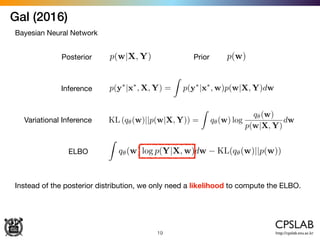
Instead of the posterior distribution, we only need a likelihood to compute the ELBO.
Gal (2016)
20
Bayesian Neural Network
p(y⇤
|x⇤
, X, Y) =
Z
p(y⇤
|x⇤
, w)p(w|X, Y)dw
Posterior p(w|X, Y)
Inference
Variational Inference KL (q✓(w)||p(w|X, Y)) =
Z
q✓(w) log
q✓(w)
p(w|X, Y)
dw
ELBO
Z
q✓(w) log p(Y|X, w)dw KL(q✓(w)||p(w))
ELBO (reparametrization)
Z
p(✏) log p(Y|X, w)d✏ KL(q✓(w)||p(w))
w = g(✓, ✏)
Prior p(w)
Gal (2016)
21
Bayesian Neural Network
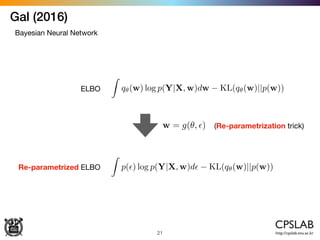
ELBO
Z
q✓(w) log p(Y|X, w)dw KL(q✓(w)||p(w))
Re-parametrized ELBO
Z
p(✏) log p(Y|X, w)d✏ KL(q✓(w)||p(w))
w = g(✓, ✏) (Re-parametrization trick)
Gal (2016)
22
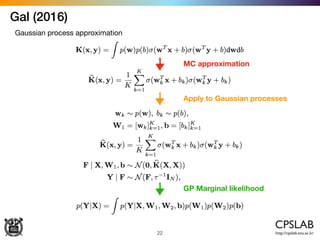
Gaussian process approximation
MC approximation
Apply to Gaussian processes
GP Marginal likelihood
Gal (2016)
23
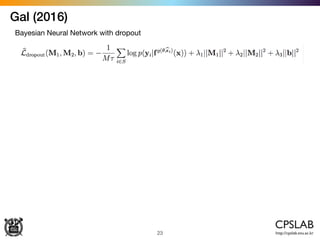
Bayesian Neural Network with dropout
Gal (2016)
24
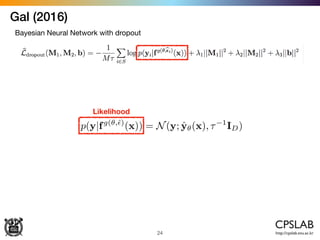
Bayesian Neural Network with dropout
p(y|fg(✓,ˆ✏)
(x)) = N(y; ˆy✓(x), ⌧ 1
ID)
Likelihood
Gal (2016)
25
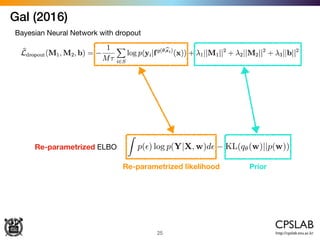
Bayesian Neural Network with dropout
Re-parametrized ELBO
Z
p(✏) log p(Y|X, w)d✏ KL(q✓(w)||p(w))
Re-parametrized likelihood Prior
Gal (2016)
26
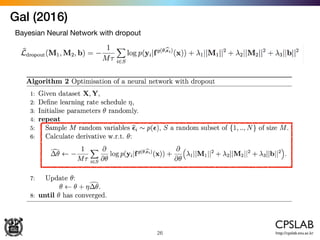
Bayesian Neural Network with dropout
Gal (2016)
27
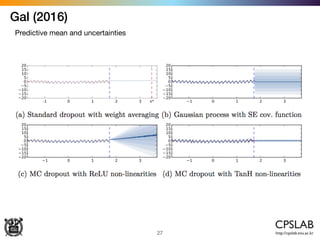
Predictive mean and uncertainties
28
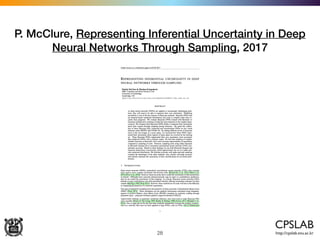
P. McClure, Representing Inferential Uncertainty in Deep
Neural Networks Through Sampling, 2017
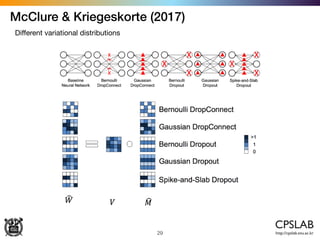
McClure & Kriegeskorte (2017)
29
Different variational distributions
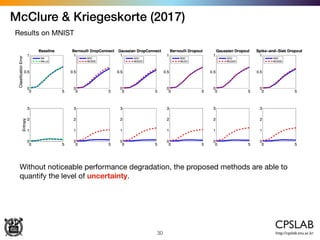
McClure & Kriegeskorte (2017)
30
Results on MNIST
Without noticeable performance degradation, the proposed methods are able to
quantify the level of uncertainty.
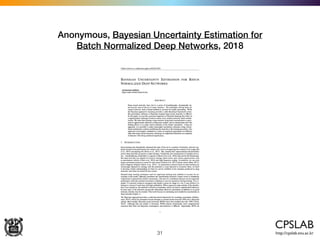
31
Anonymous, Bayesian Uncertainty Estimation for
Batch Normalized Deep Networks, 2018
Anonymous (2018)
32
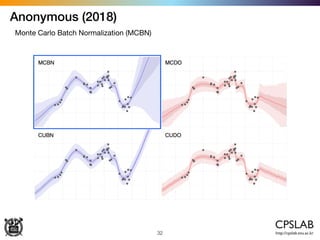
Monte Carlo Batch Normalization (MCBN)
Anonymous (2018)
33
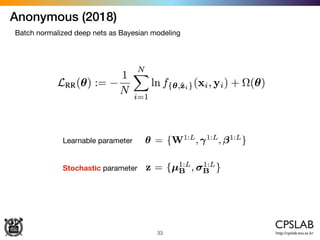
Batch normalized deep nets as Bayesian modeling
Learnable parameter
Stochastic parameter
Anonymous (2018)
34
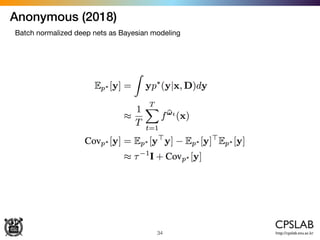
Batch normalized deep nets as Bayesian modeling
Anonymous (2018)
35
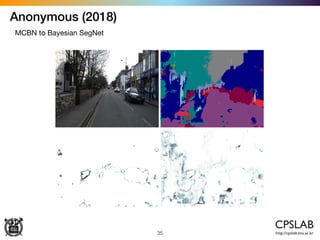
MCBN to Bayesian SegNet
36
B. Lakshminarayanan et al., Simple and Scalable Predictive Uncertainty
Estimation using Deep Ensembles, 2017
Lakshminarayanan et al. (2017)
37
Proper scoring rule
“A scoring rule assigns a numerical score to a predictive distribution
rewarding better calibrated predictions over worse. (…) It turns out many
common neural network loss functions are proper scoring rules.”
Lakshminarayanan et al. (2017)
38
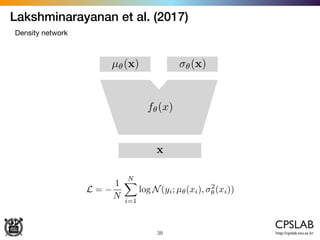
Density network
x
µ✓(x) ✓(x)
L =
1
N
NX
i=1
log N(yi; µ✓(xi), 2
✓(xi))
f✓(x)
Lakshminarayanan et al. (2017)
39
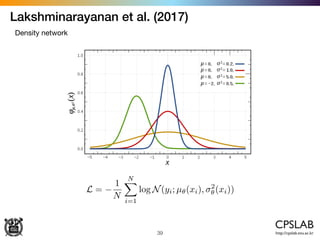
Density network
L =
1
N
NX
i=1
log N(yi; µ✓(xi), 2
✓(xi))
Lakshminarayanan et al. (2017)
40
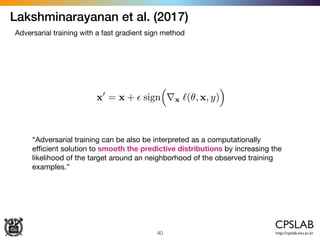
Adversarial training with a fast gradient sign method
“Adversarial training can be also be interpreted as a computationally
efficient solution to smooth the predictive distributions by increasing the
likelihood of the target around an neighborhood of the observed training
examples.”
Lakshminarayanan et al. (2017)
41
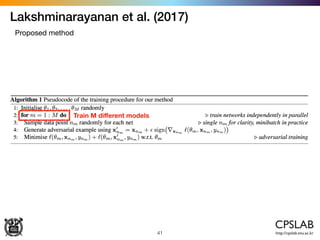
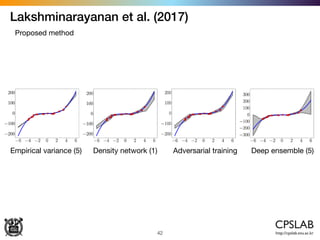
Proposed method
Train M different models
Lakshminarayanan et al. (2017)
42
Proposed method
Empirical variance (5) Density network (1) Adversarial training Deep ensemble (5)
43
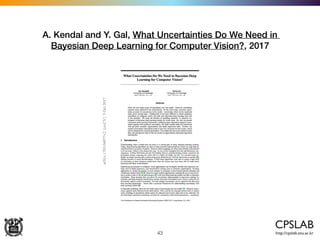
A. Kendal and Y. Gal, What Uncertainties Do We Need in
Bayesian Deep Learning for Computer Vision?, 2017
Kendal & Gal (2017)
44
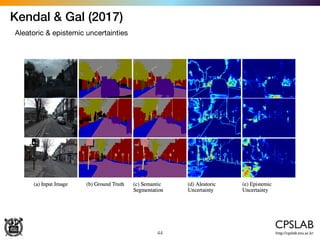
Aleatoric & epistemic uncertainties
Kendal & Gal (2017)
45
Aleatoric & epistemic uncertainties
ˆW ⇠ q(W)
x
ˆy ˆW(x) ˆ2
ˆW
(x)
[ˆy, ˆ2
] = f
ˆW
(x)
L =
1
N
NX
i=1
log N(yi; ˆy ˆW(x), ˆ2
ˆW
(x))
Kendal & Gal (2017)
46
Heteroscedastic uncertainty as loss attenuation
ˆW ⇠ q(W)
x
ˆy ˆW(x) ˆ2
ˆW
(x)
[ˆy, ˆ2
] = f
ˆW
(x)
Kendal & Gal (2017)
47
Aleatoric & epistemic uncertainties
ˆW ⇠ q(W)
x
ˆy ˆW(x) ˆ2
ˆW
(x)
[ˆy, ˆ2
] = f
ˆW
(x)
Var(y) ⇡
1
T
TX
t=1
ˆy2
t
TX
t=1
ˆyt
!2
+
1
T
TX
t=1
ˆ2
t
Epistemic unct. Aleatoric unct,
Kendal & Gal (2017)
48
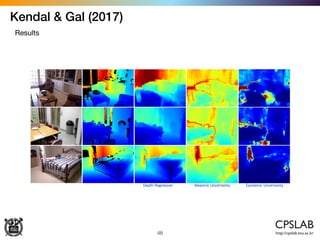
Results
49
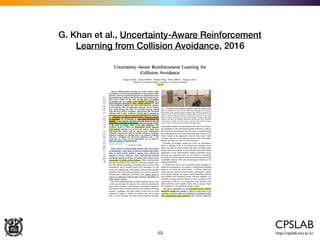
G. Khan et al., Uncertainty-Aware Reinforcement
Learning from Collision Avoidance, 2016
Khan et al. (2016)
50
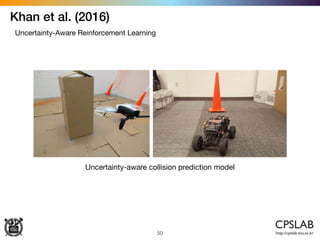
Uncertainty-Aware Reinforcement Learning
Uncertainty-aware collision prediction model
Khan et al. (2016)
51
Uncertainty-Aware Reinforcement Learning
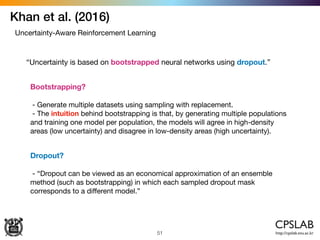
“Uncertainty is based on bootstrapped neural networks using dropout.”
Bootstrapping?

- Generate multiple datasets using sampling with replacement. 

- The intuition behind bootstrapping is that, by generating multiple populations
and training one model per population, the models will agree in high-density
areas (low uncertainty) and disagree in low-density areas (high uncertainty).
Dropout?

- “Dropout can be viewed as an economical approximation of an ensemble
method (such as bootstrapping) in which each sampled dropout mask
corresponds to a different model.”
Khan et al. (2016)
52
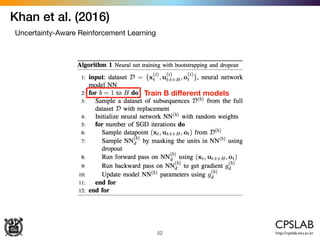
Uncertainty-Aware Reinforcement Learning
Train B different models
53
Richer & Roy (2017)
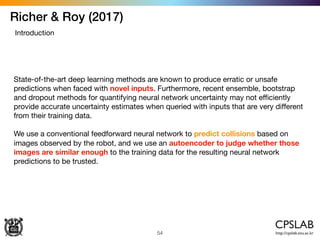
54
Introduction
State-of-the-art deep learning methods are known to produce erratic or unsafe
predictions when faced with novel inputs. Furthermore, recent ensemble, bootstrap
and dropout methods for quantifying neural network uncertainty may not efficiently
provide accurate uncertainty estimates when queried with inputs that are very different
from their training data. 

We use a conventional feedforward neural network to predict collisions based on
images observed by the robot, and we use an autoencoder to judge whether those
images are similar enough to the training data for the resulting neural network
predictions to be trusted.
Richer & Roy (2017)
55
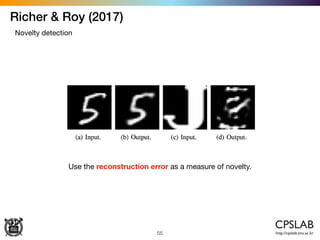
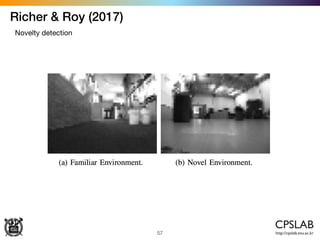
Novelty detection
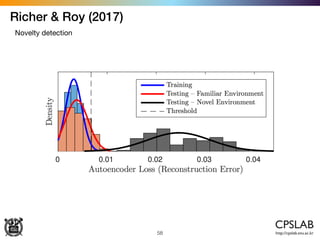
Use the reconstruction error as a measure of novelty.
Richer & Roy (2017)
56
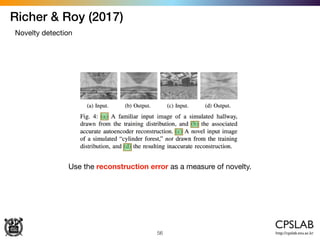
Novelty detection
Use the reconstruction error as a measure of novelty.
Richer & Roy (2017)
57
Novelty detection
Richer & Roy (2017)
58
Novelty detection
Richer & Roy (2017)
59
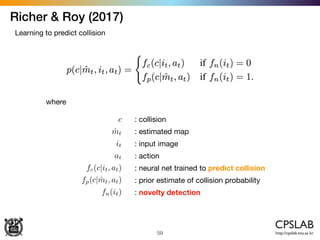
Learning to predict collision
c
ˆmt
it
at
fc(c|it, at)
fp(c| ˆmt, at)
fn(it)
where
: collision
: estimated map
: input image
: action
: neural net trained to predict collision
: prior estimate of collision probability
: novelty detection
Richer & Roy (2017)
60
Experiments
“Using an autoencoder as a measure of uncertainty in our collision prediction
network, we can transition intelligently between the high performance of the learned
model and the safe, conservative performance of a simple prior, depending on
whether the system has been trained on the relevant data.”
Richer & Roy (2017)
61
Experiments
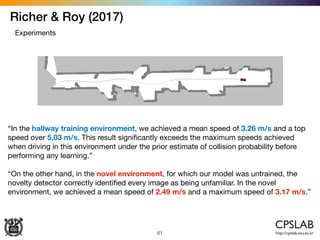
“In the hallway training environment, we achieved a mean speed of 3.26 m/s and a top
speed over 5.03 m/s. This result significantly exceeds the maximum speeds achieved
when driving in this environment under the prior estimate of collision probability before
performing any learning.”

“On the other hand, in the novel environment, for which our model was untrained, the
novelty detector correctly identified every image as being unfamiliar. In the novel
environment, we achieved a mean speed of 2.49 m/s and a maximum speed of 3.17 m/s.”
62
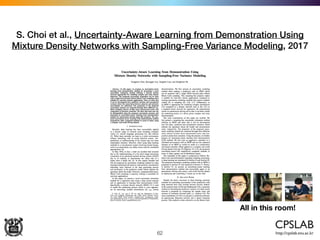
S. Choi et al., Uncertainty-Aware Learning from Demonstration Using
Mixture Density Networks with Sampling-Free Variance Modeling, 2017
All in this room!
Choi et al. (2017)
63
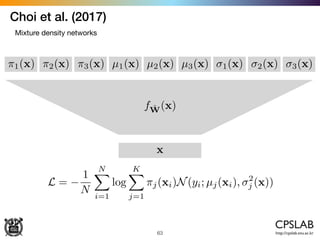
Mixture density networks
x
µ1(x) µ2(x) µ3(x)⇡1(x) ⇡2(x) ⇡3(x) 1(x) 2(x) 3(x)
f ˆW(x)
L =
1
N
NX
i=1
log
KX
j=1
⇡j(xi)N(yi; µj(xi), 2
j (x))
64
Choi et al. (2017)
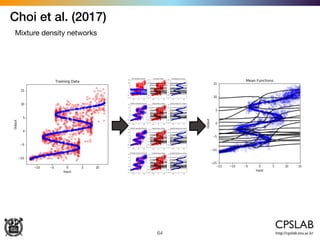
Mixture density networks
65
Choi et al. (2017)
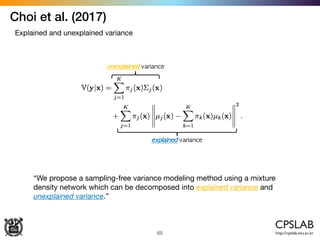
Explained and unexplained variance
“We propose a sampling-free variance modeling method using a mixture
density network which can be decomposed into explained variance and
unexplained variance.”
66
Choi et al. (2017)
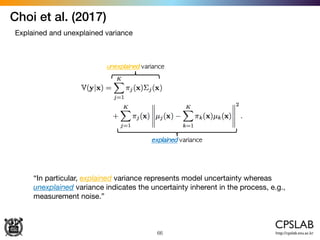
Explained and unexplained variance
“In particular, explained variance represents model uncertainty whereas
unexplained variance indicates the uncertainty inherent in the process, e.g.,
measurement noise.”
67
Choi et al. (2017)
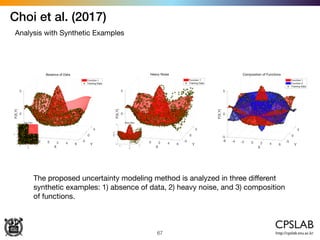
Analysis with Synthetic Examples
The proposed uncertainty modeling method is analyzed in three different
synthetic examples: 1) absence of data, 2) heavy noise, and 3) composition
of functions.
68
Choi et al. (2017)
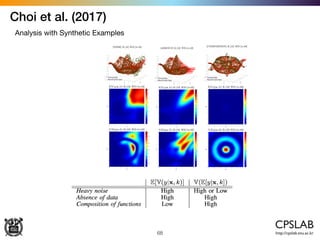
Analysis with Synthetic Examples
69
Choi et al. (2017)
Explained and unexplained variance
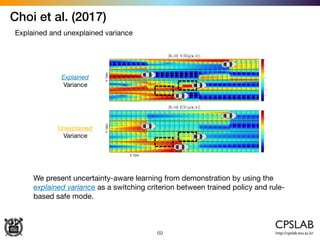
We present uncertainty-aware learning from demonstration by using the
explained variance as a switching criterion between trained policy and rule-
based safe mode.
Unexplained
Variance
Explained
Variance
70
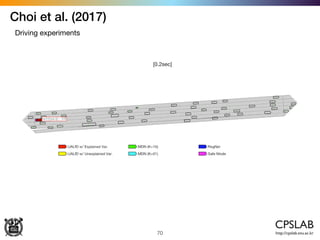
Choi et al. (2017)
Driving experiments
71
)
( . )

Modeling uncertainty in deep learning

  • 1.
    Uncertainties in Deep Learning ina nutshell Sungjoon Choi CPSLAB, SNU
  • 2.
    Introduction 2 The first fatalityfrom an assisted driving system
  • 3.
    Introduction 3 Google Photos identifiedtwo black people as 'gorillas'
  • 4.
  • 5.
  • 6.
    Contents 6 Bayesian Neural Network withvariational inference and re-parametrization trick Bootstrapping- based uncertainty modeling Bayesian Neural Network modeling epistemic and aleatoric uncertainties Application to Safe RL Novelty Detection using auto-encoder Mixture Density Network modeling epistemic and aleatoric uncertainties
  • 7.
    7 Y. Gal, Uncertaintyin Deep Learning, 2016
  • 8.
    Gal (2016) 8 Model uncertainty 1.Given a model trained with several pictures of dog breeds, a user asks the model to decide on a dog breed using a photo of a cat.
  • 9.
    Gal (2016) 9 Model uncertainty 2.We have three different types of images to classify, cat, dog, and cow, where only cat images are noisy.
  • 10.
    Gal (2016) 10 Model uncertainty 3.What is the best model parameters that best explain a given dataset? what model structure should we use?
  • 11.
    Gal (2016) 11 Model uncertainty 1.Given a model trained with several pictures of dog breeds, a user asks the model to decide on a dog breed using a photo of a cat. 2. We have three different types of images to classify, cat, dog, and cow, where only cat images are noisy. 3. What is the best model parameters that best explain a given dataset? what model structure should we use?
  • 12.
    Gal (2016) 12 Model uncertainty 1.Given a model trained with several pictures of dog breeds, a user asks the model to decide on a dog breed using a photo of a cat. 2. We have three different types of images to classify, cat, dog, and cow, where only cat images are noisy. 3. What is the best model parameters that best explain a given dataset? what model structure should we use? Out of distribution test data Aleatoric uncertainty Epistemic uncertainty
  • 13.
    Gal (2016) 13 Dropout asa Bayesian approximation “We show that a neural network with arbitrary depth and non-linearities, with dropout applied before every weight layer, is mathematically equivalent to an approximation to a well known Bayesian model.”
  • 14.
    Gal (2016) 14 Dropout asa Bayesian approximation The resulting formulations are surprisingly simple.
  • 15.
    Gal (2016) 15 Bayesian NeuralNetwork Posterior p(w|X, Y) Prior p(w) In Bayesian inference, we aim to find a posterior distribution over the random variables of our interest given a prior distribution which is intractable in many case.
  • 16.
    Gal (2016) 16 Bayesian NeuralNetwork p(y⇤ |x⇤ , X, Y) = Z p(y⇤ |x⇤ , w)p(w|X, Y)dw Posterior p(w|X, Y) Inference Prior p(w) Note that even when given a posterior distribution, exact inference is very likely to be intractable as it contains integral with respect to the distribution over latent variables.
  • 17.
    Gal (2016) 17 Bayesian NeuralNetwork p(y⇤ |x⇤ , X, Y) = Z p(y⇤ |x⇤ , w)p(w|X, Y)dw Posterior p(w|X, Y) Inference Variational Inference KL (q✓(w)||p(w|X, Y)) = Z q✓(w) log q✓(w) p(w|X, Y) dw Prior p(w) Variational inference is used to approximate the (intractable) posterior distribution with (tractable) variational distribution with respect to the KL divergence.
  • 18.
    Gal (2016) 18 Bayesian NeuralNetwork p(y⇤ |x⇤ , X, Y) = Z p(y⇤ |x⇤ , w)p(w|X, Y)dw Posterior p(w|X, Y) Inference Variational Inference KL (q✓(w)||p(w|X, Y)) = Z q✓(w) log q✓(w) p(w|X, Y) dw ELBO Z q✓(w) log p(Y|X, w)dw KL(q✓(w)||p(w)) Prior p(w) Minimizing the KL divergence is equivalent to maximizing the evidence lower bound (ELBO) which also contains the integral with respect to the distribution over latent variables.
  • 19.
    Gal (2016) 19 Bayesian NeuralNetwork p(y⇤ |x⇤ , X, Y) = Z p(y⇤ |x⇤ , w)p(w|X, Y)dw Posterior p(w|X, Y) Inference Variational Inference KL (q✓(w)||p(w|X, Y)) = Z q✓(w) log q✓(w) p(w|X, Y) dw ELBO Z q✓(w) log p(Y|X, w)dw KL(q✓(w)||p(w)) Prior p(w) Instead of the posterior distribution, we only need a likelihood to compute the ELBO.
  • 20.
    Gal (2016) 20 Bayesian NeuralNetwork p(y⇤ |x⇤ , X, Y) = Z p(y⇤ |x⇤ , w)p(w|X, Y)dw Posterior p(w|X, Y) Inference Variational Inference KL (q✓(w)||p(w|X, Y)) = Z q✓(w) log q✓(w) p(w|X, Y) dw ELBO Z q✓(w) log p(Y|X, w)dw KL(q✓(w)||p(w)) ELBO (reparametrization) Z p(✏) log p(Y|X, w)d✏ KL(q✓(w)||p(w)) w = g(✓, ✏) Prior p(w)
  • 21.
    Gal (2016) 21 Bayesian NeuralNetwork ELBO Z q✓(w) log p(Y|X, w)dw KL(q✓(w)||p(w)) Re-parametrized ELBO Z p(✏) log p(Y|X, w)d✏ KL(q✓(w)||p(w)) w = g(✓, ✏) (Re-parametrization trick)
  • 22.
    Gal (2016) 22 Gaussian processapproximation MC approximation Apply to Gaussian processes GP Marginal likelihood
  • 23.
    Gal (2016) 23 Bayesian NeuralNetwork with dropout
  • 24.
    Gal (2016) 24 Bayesian NeuralNetwork with dropout p(y|fg(✓,ˆ✏) (x)) = N(y; ˆy✓(x), ⌧ 1 ID) Likelihood
  • 25.
    Gal (2016) 25 Bayesian NeuralNetwork with dropout Re-parametrized ELBO Z p(✏) log p(Y|X, w)d✏ KL(q✓(w)||p(w)) Re-parametrized likelihood Prior
  • 26.
    Gal (2016) 26 Bayesian NeuralNetwork with dropout
  • 27.
  • 28.
    28 P. McClure, RepresentingInferential Uncertainty in Deep Neural Networks Through Sampling, 2017
  • 29.
    McClure & Kriegeskorte(2017) 29 Different variational distributions
  • 30.
    McClure & Kriegeskorte(2017) 30 Results on MNIST Without noticeable performance degradation, the proposed methods are able to quantify the level of uncertainty.
  • 31.
    31 Anonymous, Bayesian UncertaintyEstimation for Batch Normalized Deep Networks, 2018
  • 32.
    Anonymous (2018) 32 Monte CarloBatch Normalization (MCBN)
  • 33.
    Anonymous (2018) 33 Batch normalizeddeep nets as Bayesian modeling Learnable parameter Stochastic parameter
  • 34.
    Anonymous (2018) 34 Batch normalizeddeep nets as Bayesian modeling
  • 35.
  • 36.
    36 B. Lakshminarayanan etal., Simple and Scalable Predictive Uncertainty Estimation using Deep Ensembles, 2017
  • 37.
    Lakshminarayanan et al.(2017) 37 Proper scoring rule “A scoring rule assigns a numerical score to a predictive distribution rewarding better calibrated predictions over worse. (…) It turns out many common neural network loss functions are proper scoring rules.”
  • 38.
    Lakshminarayanan et al.(2017) 38 Density network x µ✓(x) ✓(x) L = 1 N NX i=1 log N(yi; µ✓(xi), 2 ✓(xi)) f✓(x)
  • 39.
    Lakshminarayanan et al.(2017) 39 Density network L = 1 N NX i=1 log N(yi; µ✓(xi), 2 ✓(xi))
  • 40.
    Lakshminarayanan et al.(2017) 40 Adversarial training with a fast gradient sign method “Adversarial training can be also be interpreted as a computationally efficient solution to smooth the predictive distributions by increasing the likelihood of the target around an neighborhood of the observed training examples.”
  • 41.
    Lakshminarayanan et al.(2017) 41 Proposed method Train M different models
  • 42.
    Lakshminarayanan et al.(2017) 42 Proposed method Empirical variance (5) Density network (1) Adversarial training Deep ensemble (5)
  • 43.
    43 A. Kendal andY. Gal, What Uncertainties Do We Need in Bayesian Deep Learning for Computer Vision?, 2017
  • 44.
    Kendal & Gal(2017) 44 Aleatoric & epistemic uncertainties
  • 45.
    Kendal & Gal(2017) 45 Aleatoric & epistemic uncertainties ˆW ⇠ q(W) x ˆy ˆW(x) ˆ2 ˆW (x) [ˆy, ˆ2 ] = f ˆW (x) L = 1 N NX i=1 log N(yi; ˆy ˆW(x), ˆ2 ˆW (x))
  • 46.
    Kendal & Gal(2017) 46 Heteroscedastic uncertainty as loss attenuation ˆW ⇠ q(W) x ˆy ˆW(x) ˆ2 ˆW (x) [ˆy, ˆ2 ] = f ˆW (x)
  • 47.
    Kendal & Gal(2017) 47 Aleatoric & epistemic uncertainties ˆW ⇠ q(W) x ˆy ˆW(x) ˆ2 ˆW (x) [ˆy, ˆ2 ] = f ˆW (x) Var(y) ⇡ 1 T TX t=1 ˆy2 t TX t=1 ˆyt !2 + 1 T TX t=1 ˆ2 t Epistemic unct. Aleatoric unct,
  • 48.
    Kendal & Gal(2017) 48 Results
  • 49.
    49 G. Khan etal., Uncertainty-Aware Reinforcement Learning from Collision Avoidance, 2016
  • 50.
    Khan et al.(2016) 50 Uncertainty-Aware Reinforcement Learning Uncertainty-aware collision prediction model
  • 51.
    Khan et al.(2016) 51 Uncertainty-Aware Reinforcement Learning “Uncertainty is based on bootstrapped neural networks using dropout.” Bootstrapping? - Generate multiple datasets using sampling with replacement. - The intuition behind bootstrapping is that, by generating multiple populations and training one model per population, the models will agree in high-density areas (low uncertainty) and disagree in low-density areas (high uncertainty). Dropout? - “Dropout can be viewed as an economical approximation of an ensemble method (such as bootstrapping) in which each sampled dropout mask corresponds to a different model.”
  • 52.
    Khan et al.(2016) 52 Uncertainty-Aware Reinforcement Learning Train B different models
  • 53.
  • 54.
    Richer & Roy(2017) 54 Introduction State-of-the-art deep learning methods are known to produce erratic or unsafe predictions when faced with novel inputs. Furthermore, recent ensemble, bootstrap and dropout methods for quantifying neural network uncertainty may not efficiently provide accurate uncertainty estimates when queried with inputs that are very different from their training data. We use a conventional feedforward neural network to predict collisions based on images observed by the robot, and we use an autoencoder to judge whether those images are similar enough to the training data for the resulting neural network predictions to be trusted.
  • 55.
    Richer & Roy(2017) 55 Novelty detection Use the reconstruction error as a measure of novelty.
  • 56.
    Richer & Roy(2017) 56 Novelty detection Use the reconstruction error as a measure of novelty.
  • 57.
    Richer & Roy(2017) 57 Novelty detection
  • 58.
    Richer & Roy(2017) 58 Novelty detection
  • 59.
    Richer & Roy(2017) 59 Learning to predict collision c ˆmt it at fc(c|it, at) fp(c| ˆmt, at) fn(it) where : collision : estimated map : input image : action : neural net trained to predict collision : prior estimate of collision probability : novelty detection
  • 60.
    Richer & Roy(2017) 60 Experiments “Using an autoencoder as a measure of uncertainty in our collision prediction network, we can transition intelligently between the high performance of the learned model and the safe, conservative performance of a simple prior, depending on whether the system has been trained on the relevant data.”
  • 61.
    Richer & Roy(2017) 61 Experiments “In the hallway training environment, we achieved a mean speed of 3.26 m/s and a top speed over 5.03 m/s. This result significantly exceeds the maximum speeds achieved when driving in this environment under the prior estimate of collision probability before performing any learning.” “On the other hand, in the novel environment, for which our model was untrained, the novelty detector correctly identified every image as being unfamiliar. In the novel environment, we achieved a mean speed of 2.49 m/s and a maximum speed of 3.17 m/s.”
  • 62.
    62 S. Choi etal., Uncertainty-Aware Learning from Demonstration Using Mixture Density Networks with Sampling-Free Variance Modeling, 2017 All in this room!
  • 63.
    Choi et al.(2017) 63 Mixture density networks x µ1(x) µ2(x) µ3(x)⇡1(x) ⇡2(x) ⇡3(x) 1(x) 2(x) 3(x) f ˆW(x) L = 1 N NX i=1 log KX j=1 ⇡j(xi)N(yi; µj(xi), 2 j (x))
  • 64.
    64 Choi et al.(2017) Mixture density networks
  • 65.
    65 Choi et al.(2017) Explained and unexplained variance “We propose a sampling-free variance modeling method using a mixture density network which can be decomposed into explained variance and unexplained variance.”
  • 66.
    66 Choi et al.(2017) Explained and unexplained variance “In particular, explained variance represents model uncertainty whereas unexplained variance indicates the uncertainty inherent in the process, e.g., measurement noise.”
  • 67.
    67 Choi et al.(2017) Analysis with Synthetic Examples The proposed uncertainty modeling method is analyzed in three different synthetic examples: 1) absence of data, 2) heavy noise, and 3) composition of functions.
  • 68.
    68 Choi et al.(2017) Analysis with Synthetic Examples
  • 69.
    69 Choi et al.(2017) Explained and unexplained variance We present uncertainty-aware learning from demonstration by using the explained variance as a switching criterion between trained policy and rule- based safe mode. Unexplained Variance Explained Variance
  • 70.
    70 Choi et al.(2017) Driving experiments
  • 71.