Kernel, RKHS, and
Gaussian Processes
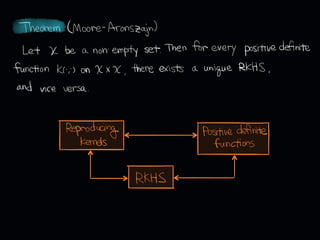
Caution! No proof will be given.
Sungjoon Choi, SNU
Leveraged
Gaussian	
  Process	
  Regression
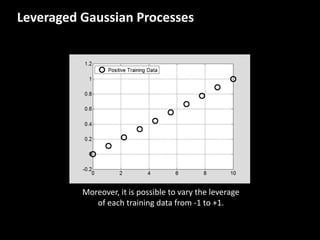
Leveraged	
  Gaussian	
  Processes
The	
  original	
  Gaussian	
  process	
  regression	
  
anchors	
  positive training	
  data.
The	
  proposed	
  leveraged	
  Gaussian	
  process	
  regression	
  anchors	
  positive data	
  
while	
  avoiding	
  negative data.
Moreover,	
  it	
  is	
  possible	
  to	
  vary	
  the	
  leverage	
  
of	
  each	
  training	
  data	
  from	
  -­‐1	
  to	
  +1.
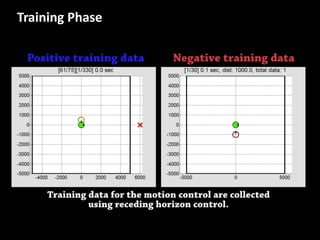
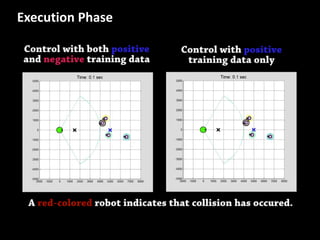
Positive and	
  Negative Motion	
  
Control	
  Data	
  for	
  Autonomous	
  
Navigation
Training	
  Phase
Execution	
  Phase
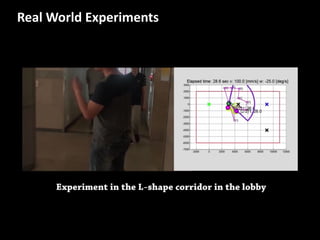
Real	
  World	
  Experiments
Leverage	
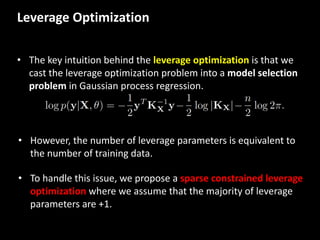
  Optimization
Leverage	
  Optimization
• The	
  key	
  intuition	
  behind	
  the	
  leverage	
  optimization	
  is	
  that	
  we	
  
cast	
  the	
  leverage	
  optimization	
  problem	
  into	
  a	
  model	
  selection	
  
problem in	
  Gaussian	
  process	
  regression.	
  
• However,	
  the	
  number	
  of	
  leverage	
  parameters	
  is	
  equivalent	
  to	
  
the	
  number	
  of	
  training	
  data.	
  
• To	
  handle	
  this	
  issue,	
  we	
  propose	
  a	
  sparse	
  constrained	
  leverage	
  
optimization where	
  we	
  assume	
  that	
  the	
  majority	
  of	
  leverage	
  
parameters	
  are	
  +1.	
  
Leverage	
  Optimization	
  (v1)
Using	
  proximal	
  linearized	
  minimization	
  [1],	
  the	
  update	
  rule	
  for	
  solving	
  above	
  
optimization	
  is	
  
[1]  J.  Bolte,  S.  Sabach,  and  M.  Teboulle,  “Proximal  alternating  linearized  minimization  for  nonconvex  and  nonsmooth  problems,”  
Mathematical  Programming,  vol.  146,  no.  1-­2,  pp.  459–494,  2014.
where	
  the	
  proximal	
  mapping	
  becomes	
  soft-­‐thresholding:
where	
   𝛾̅ = 𝛾 − 1.	
  
Leverage	
  Optimization	
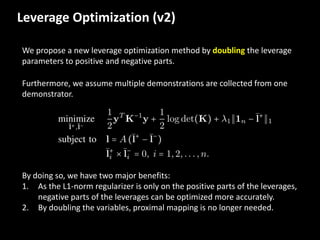
  (v2)
We	
  propose	
  a	
  new	
  leverage	
  optimization	
  method	
  by	
  doubling the	
  leverage	
  
parameters	
  to	
  positive	
  and	
  negative	
  parts.	
  
Furthermore,	
  we	
  assume	
  multiple	
  demonstrations	
  are	
  collected	
  from	
  one	
  
demonstrator.	
  
By	
  doing	
  so,	
  we	
  have	
  two	
  major	
  benefits:
1. As	
  the	
  L1-­‐norm	
  regularizer is	
  only	
  on	
  the	
  positive	
  parts	
  of	
  the	
  leverages,	
  
negative	
  parts	
  of	
  the	
  leverages	
  can	
  be	
  optimized	
  more	
  accurately.	
  
2. By	
  doubling	
  the	
  variables,	
  proximal	
  mapping	
  is	
  no	
  longer	
  needed.	
  
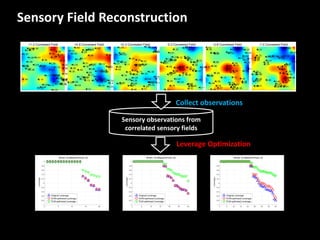
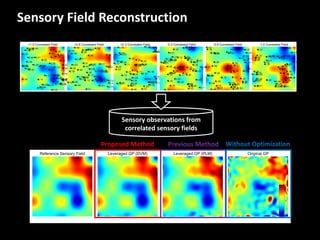
Sensory	
  Field	
  Reconstruction
Sensory	
  observations	
  from	
  
correlated	
  sensory	
  fields
Leverage	
  Optimization	
  
Collect	
  observations
Sensory	
  observations	
  from	
  
correlated	
  sensory	
  fields
Proposed	
  Method Previous	
  Method Without	
  Optimization
Sensory	
  Field	
  Reconstruction
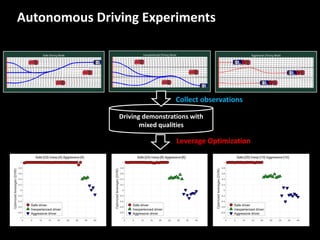
Autonomous	
  Driving	
  Experiments
Driving	
  demonstrations	
  with	
  
mixed	
  qualities
Leverage	
  Optimization	
  
Collect	
  observations
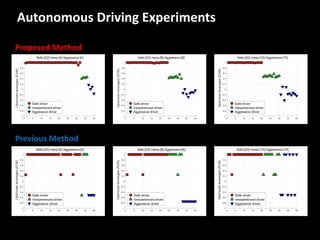
Proposed	
  Method
Previous	
  Method
Autonomous	
  Driving	
  Experiments
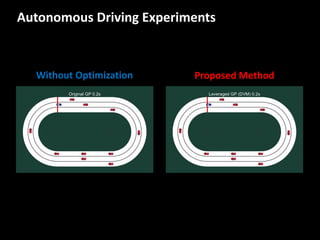
Proposed	
  MethodWithout	
  Optimization
Autonomous	
  Driving	
  Experiments
Kernel, RKHS, and Gaussian Processes

Kernel, RKHS, and Gaussian Processes

  • 1.
    Kernel, RKHS, and GaussianProcesses Caution! No proof will be given. Sungjoon Choi, SNU
  • 31.
  • 32.
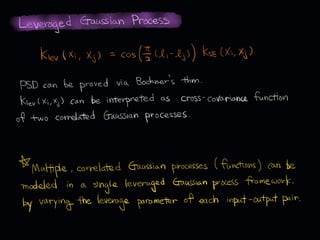
    Leveraged  Gaussian  Processes The  original  Gaussian  process  regression   anchors  positive training  data. The  proposed  leveraged  Gaussian  process  regression  anchors  positive data   while  avoiding  negative data. Moreover,  it  is  possible  to  vary  the  leverage   of  each  training  data  from  -­‐1  to  +1.
  • 33.
    Positive and  NegativeMotion   Control  Data  for  Autonomous   Navigation
  • 34.
  • 35.
  • 36.
  • 37.
  • 38.
    Leverage  Optimization • The  key  intuition  behind  the  leverage  optimization  is  that  we   cast  the  leverage  optimization  problem  into  a  model  selection   problem in  Gaussian  process  regression.   • However,  the  number  of  leverage  parameters  is  equivalent  to   the  number  of  training  data.   • To  handle  this  issue,  we  propose  a  sparse  constrained  leverage   optimization where  we  assume  that  the  majority  of  leverage   parameters  are  +1.  
  • 39.
    Leverage  Optimization  (v1) Using  proximal  linearized  minimization  [1],  the  update  rule  for  solving  above   optimization  is   [1]  J.  Bolte,  S.  Sabach,  and  M.  Teboulle,  “Proximal  alternating  linearized  minimization  for  nonconvex  and  nonsmooth  problems,”   Mathematical  Programming,  vol.  146,  no.  1-­2,  pp.  459–494,  2014. where  the  proximal  mapping  becomes  soft-­‐thresholding: where   𝛾̅ = 𝛾 − 1.  
  • 40.
    Leverage  Optimization  (v2) We  propose  a  new  leverage  optimization  method  by  doubling the  leverage   parameters  to  positive  and  negative  parts.   Furthermore,  we  assume  multiple  demonstrations  are  collected  from  one   demonstrator.   By  doing  so,  we  have  two  major  benefits: 1. As  the  L1-­‐norm  regularizer is  only  on  the  positive  parts  of  the  leverages,   negative  parts  of  the  leverages  can  be  optimized  more  accurately.   2. By  doubling  the  variables,  proximal  mapping  is  no  longer  needed.  
  • 41.
    Sensory  Field  Reconstruction Sensory  observations  from   correlated  sensory  fields Leverage  Optimization   Collect  observations
  • 42.
    Sensory  observations  from   correlated  sensory  fields Proposed  Method Previous  Method Without  Optimization Sensory  Field  Reconstruction
  • 43.
    Autonomous  Driving  Experiments Driving  demonstrations  with   mixed  qualities Leverage  Optimization   Collect  observations
  • 44.
  • 45.