Communication is the process of exchanging
information in the form of messages, symbols,
thoughts, signs, and opinions. There are mainly
four types of communication, which are used in
varying ways depending on the medium used or
the way in which information is exchanged.
It would be extremely hard to imagine a world without some
form of interpersonal interaction. This interaction or act of
sharing information is known as communication.
Some of the basic ways by which we communicate with one
another is through speech, sign language, body language, touch,
and eye contact.
 These means of communication are used for transferring
information from one entity to the other, and always
involve a sender and receiver. The cycle of
communication is said to be complete only when the
receiver has understood the sender's message and intent.
 There are mainly four types of communication
which are used in various ways to convey the
final message to the receiver.
 Verbal Communication
 Nonverbal Communication
 Written Communication
 Visual Communication
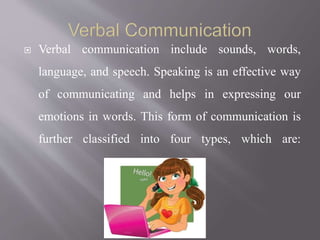
 Verbal communication include sounds, words,
language, and speech. Speaking is an effective way
of communicating and helps in expressing our
emotions in words. This form of communication is
further classified into four types, which are:
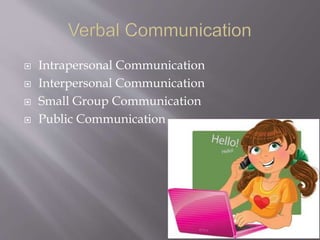
 Intrapersonal Communication
 Interpersonal Communication
 Small Group Communication
 Public Communication
 This form of communication is extremely private and
restricted to ourselves. It includes the silent
conversations we have with ourselves, wherein we
juggle roles between the sender and receiver who are
processing our thoughts and actions. This process of
communication when analyzed can either be conveyed
verbally to someone or stay confined as thoughts.
 This form of communication takes place between
two individuals and is thus a one-on-one
conversation. Here, the two individuals involved
will swap their roles of sender and receiver in order
to communicate in a clearer manner.
 This type of communication can take place only
when there are more than two people involved.
Here the number of people will be small enough to
allow each participant to interact and converse
with the rest. Press conferences, board meetings,
and team meetings are examples of group
communication. Unless a specific issue is being
discussed, small group discussions can become
chaotic and difficult to interpret by everybody.
This lag in understanding information completely
can result in miscommunication.
 This type of communication takes place when one
individual addresses a large gathering of people.
Election campaigns and public speeches are example of
this type of communication. In such cases, there is
usually a single sender of information and several
receivers who are being addressed.
 Nonverbal communication manages to convey the
sender's message without having to use words.
 This form of communication supersedes all other
forms because of its usage and effectiveness.
Nonverbal communication involves the use of
physical ways of communication, such as tone of
the voice, touch, and expressions.
 Symbols and sign language are also included in
nonverbal communication. Body posture and
language convey a lot of nonverbal messages when
communicating verbally with someone.
 Facial expressions, gestures and eye contact are all
different ways of communication. Creative and
aesthetic nonverbal forms of communication
include music, dancing and sculpturing.
 Written communication is the medium through
which the message of the sender is conveyed with
the help of written words.
 Letters, personal journals, e-mails, reports, articles,
and memos are some forms of written
communication.
 Unlike other forms of communication, written
messages can be edited and rectified before it is
communicated to the receiver. Thereby, making
written communication an indispensable part of
informal and formal communication.
 This form of communication encapsulates features
of visual communication as well, especially when
the messages are conveyed through electronic
devices such as laptops, phones, and visual
presentations that involve the use of text or words.
 This form of communication involves the visual display
of information, wherein the message is understood or
expressed with the help of visual aids. For example,
topography, photography, signs, symbols, maps, colors,
posters, banners and designs help the viewer understand
the message visually.
 Movies and plays, television shows and video
clips are all electronic form of visual
communication.
 Visual communication also involves the
transfer of information in the form of text,
which is received through an electronic
medium such as a computer, phone, etc.
 Icons and emoticons are a form of visual communication.
When these icons are used in a public place, phone or
computer, they instruct the user about their meaning and
usage.
 The greatest example of visual communication is the World
Wide Web which communicates with the masses, using a
combination of text, design, links, images, and color. All of
these visual features require us to view the screen in order to
understand the message being conveyed.

Types of communication

  • 2.
    Communication is theprocess of exchanging information in the form of messages, symbols, thoughts, signs, and opinions. There are mainly four types of communication, which are used in varying ways depending on the medium used or the way in which information is exchanged.
  • 3.
    It would beextremely hard to imagine a world without some form of interpersonal interaction. This interaction or act of sharing information is known as communication. Some of the basic ways by which we communicate with one another is through speech, sign language, body language, touch, and eye contact.
  • 4.
     These meansof communication are used for transferring information from one entity to the other, and always involve a sender and receiver. The cycle of communication is said to be complete only when the receiver has understood the sender's message and intent.
  • 5.
     There aremainly four types of communication which are used in various ways to convey the final message to the receiver.  Verbal Communication  Nonverbal Communication  Written Communication  Visual Communication
  • 6.
     Verbal communicationinclude sounds, words, language, and speech. Speaking is an effective way of communicating and helps in expressing our emotions in words. This form of communication is further classified into four types, which are:
  • 7.
     Intrapersonal Communication Interpersonal Communication  Small Group Communication  Public Communication
  • 8.
     This formof communication is extremely private and restricted to ourselves. It includes the silent conversations we have with ourselves, wherein we juggle roles between the sender and receiver who are processing our thoughts and actions. This process of communication when analyzed can either be conveyed verbally to someone or stay confined as thoughts.
  • 9.
     This formof communication takes place between two individuals and is thus a one-on-one conversation. Here, the two individuals involved will swap their roles of sender and receiver in order to communicate in a clearer manner.
  • 10.
     This typeof communication can take place only when there are more than two people involved. Here the number of people will be small enough to allow each participant to interact and converse with the rest. Press conferences, board meetings, and team meetings are examples of group communication. Unless a specific issue is being discussed, small group discussions can become chaotic and difficult to interpret by everybody. This lag in understanding information completely can result in miscommunication.
  • 11.
     This typeof communication takes place when one individual addresses a large gathering of people. Election campaigns and public speeches are example of this type of communication. In such cases, there is usually a single sender of information and several receivers who are being addressed.
  • 12.
     Nonverbal communicationmanages to convey the sender's message without having to use words.  This form of communication supersedes all other forms because of its usage and effectiveness. Nonverbal communication involves the use of physical ways of communication, such as tone of the voice, touch, and expressions.
  • 13.
     Symbols andsign language are also included in nonverbal communication. Body posture and language convey a lot of nonverbal messages when communicating verbally with someone.  Facial expressions, gestures and eye contact are all different ways of communication. Creative and aesthetic nonverbal forms of communication include music, dancing and sculpturing.
  • 14.
     Written communicationis the medium through which the message of the sender is conveyed with the help of written words.  Letters, personal journals, e-mails, reports, articles, and memos are some forms of written communication.  Unlike other forms of communication, written messages can be edited and rectified before it is communicated to the receiver. Thereby, making written communication an indispensable part of informal and formal communication.
  • 15.
     This formof communication encapsulates features of visual communication as well, especially when the messages are conveyed through electronic devices such as laptops, phones, and visual presentations that involve the use of text or words.
  • 16.
     This formof communication involves the visual display of information, wherein the message is understood or expressed with the help of visual aids. For example, topography, photography, signs, symbols, maps, colors, posters, banners and designs help the viewer understand the message visually.
  • 17.
     Movies andplays, television shows and video clips are all electronic form of visual communication.  Visual communication also involves the transfer of information in the form of text, which is received through an electronic medium such as a computer, phone, etc.
  • 18.
     Icons andemoticons are a form of visual communication. When these icons are used in a public place, phone or computer, they instruct the user about their meaning and usage.  The greatest example of visual communication is the World Wide Web which communicates with the masses, using a combination of text, design, links, images, and color. All of these visual features require us to view the screen in order to understand the message being conveyed.