INTRODUCTION
Human beings communicate to share
ideas,feelings,desires,emotions etc.
We observe and take part in several
communicative interactions everyday.
We all either giving or receiving information
throughout the day.
 Communication, "The imparting or exchanging of
information by speaking, writing, or using some other
medium. …The successful conveying or sharing of
ideas and feelings”(Oxford English Dictionary)
 Communication refers to the exchange of message
between two or more people.
 It also includes exchange of feelings and emotions.
DEFINITION
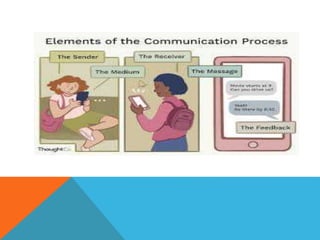
ELEMENTS
 There are four things which are necessary for
communication process-
 The speaker
 The listener
 Message
 Medium
CONT.…….
 The process of communication is incomplete in the
absence of nay above mentioned components.
 Communication is an active and intentional process.
 The speaker intentionally transmits information and the
listener intentionally receives it and subsequently they
may exchange their roles.
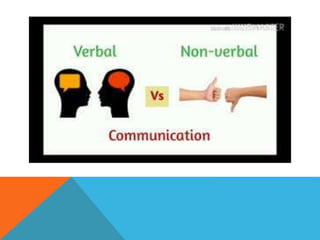
TYPES OF COMMUNICATION
 Communication divided mainly in two parts-
 Verbal communication
 Nonverbal communication
VERBAL COMMUNICATION
 Communication involving speech is called verbal
communication
 Verbal communication is the use of language to transfer
information through speaking or sign language.
 It is one of the most common types, often used during
presentations, video conferences and phone calls, meetings
and one-on-one conversations.
 Verbal communication is important because it is efficient. It
can be helpful to support verbal communication with both
nonverbal and written communication.
NONVERBAL COMMUNICATION
 Communication involving modes other than speech are considered
as Nonverbal.
 Nonverbal communication is the use of body language, gestures and
facial expressions to convey information to others.
 It can be used both intentionally and unintentionally. For example,
you might smile unintentionally when you hear a pleasing or
enjoyable idea or piece of information.
 Sometimes nonverbal methods may be developed to supplement the
speech communication.
FUNCTIONS OF COMMUNICATION
 INSTRUMENTAL- to satisfy one’s needs
 REGULATRORY- to control other’s behavior, persuade
,convince ,correct ,criticize ,threaten demand
 INTERACTION- to greet ,express various social
routine and to mix with other fellows
 PERSONAL-to be aware of one’s self and to be
regulate one’s own behavior
CONT.…..
 HEURISTIC-to seek information, concept formation
relating to development of ideas and knowledge
 IMAGINATIVE-to involve in imagination fantasy
,artistic use of language ,to comment or think about
language
 INFORMATIVE- to convey information ,protest ,anger
,madness
REFERENCE
 SkillsYouNeed.com
 BusinessJargons.com
 Awareness cum training packages in Disability
 Manual on developing communication skills in Mentally
Restarted persons
COMMUNICATION- Introduction, definition, elements, types & function

COMMUNICATION- Introduction, definition, elements, types & function

  • 3.
    INTRODUCTION Human beings communicateto share ideas,feelings,desires,emotions etc. We observe and take part in several communicative interactions everyday. We all either giving or receiving information throughout the day.
  • 4.
     Communication, "Theimparting or exchanging of information by speaking, writing, or using some other medium. …The successful conveying or sharing of ideas and feelings”(Oxford English Dictionary)  Communication refers to the exchange of message between two or more people.  It also includes exchange of feelings and emotions. DEFINITION
  • 6.
    ELEMENTS  There arefour things which are necessary for communication process-  The speaker  The listener  Message  Medium
  • 7.
    CONT.…….  The processof communication is incomplete in the absence of nay above mentioned components.  Communication is an active and intentional process.  The speaker intentionally transmits information and the listener intentionally receives it and subsequently they may exchange their roles.
  • 8.
    TYPES OF COMMUNICATION Communication divided mainly in two parts-  Verbal communication  Nonverbal communication
  • 10.
    VERBAL COMMUNICATION  Communicationinvolving speech is called verbal communication  Verbal communication is the use of language to transfer information through speaking or sign language.  It is one of the most common types, often used during presentations, video conferences and phone calls, meetings and one-on-one conversations.  Verbal communication is important because it is efficient. It can be helpful to support verbal communication with both nonverbal and written communication.
  • 11.
    NONVERBAL COMMUNICATION  Communicationinvolving modes other than speech are considered as Nonverbal.  Nonverbal communication is the use of body language, gestures and facial expressions to convey information to others.  It can be used both intentionally and unintentionally. For example, you might smile unintentionally when you hear a pleasing or enjoyable idea or piece of information.  Sometimes nonverbal methods may be developed to supplement the speech communication.
  • 12.
    FUNCTIONS OF COMMUNICATION INSTRUMENTAL- to satisfy one’s needs  REGULATRORY- to control other’s behavior, persuade ,convince ,correct ,criticize ,threaten demand  INTERACTION- to greet ,express various social routine and to mix with other fellows  PERSONAL-to be aware of one’s self and to be regulate one’s own behavior
  • 13.
    CONT.…..  HEURISTIC-to seekinformation, concept formation relating to development of ideas and knowledge  IMAGINATIVE-to involve in imagination fantasy ,artistic use of language ,to comment or think about language  INFORMATIVE- to convey information ,protest ,anger ,madness
  • 14.
    REFERENCE  SkillsYouNeed.com  BusinessJargons.com Awareness cum training packages in Disability  Manual on developing communication skills in Mentally Restarted persons