Mr. (I.T .Teacher)
Name :-
 What is Communication
 Introduction
 Way of Communication
 Elements of Communication
 Importance Of Communication
 Verbal & Non verbal Methods of Communication
 Introduction
 Types of Communication
 Visual & Written Methods Of Communication
 Introduction
 Visual Communication
 Written Communication
 Communication is the act of giving, receiving, and
sharing information -- in other words, talking or writing,
and listening or reading. Good communicators listen
carefully, speak or write clearly, and respect different
opinions.
 Strong communication skills can help kids interact both
face-to-face and in the online world. Texting, chatting,
and posting responsibly depends on understanding how
words and images affect others. You can help kids
develop their communication abilities by teaching them
to use social media responsibly, modeling positive
communication, and watching movies and TV shows that
emphasize the value of healthy communication.
What is Communication
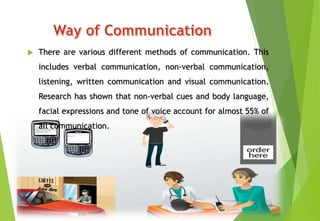
 There are various different methods of communication. This
includes verbal communication, non-verbal communication,
listening, written communication and visual communication.
Research has shown that non-verbal cues and body language,
facial expressions and tone of voice account for almost 55% of
all communication.
 Communication is a two way process, wherein interchange of
message connects the sender and receiver, towards an
agreed direction, consisting seven elements:
1. Sender: Otherwise known as a source, it is the person who
has something to pass on, to another individual.
2. Encoding: The sender of the message, selects appropriate
words or non-verbal techniques to convert the idea into
the message, which is called as encoding.
3. Message: Message implies something that the sender wants
to communicate, to the receiver. Without a message, no
communication is possible.
4. Medium: Medium alludes to the channel or mode, through
which message is communicated to the receiver, i.e. it can
be sent by way of electronic word processing system,
graphic, symbol, etc.Message has been received and
interpreted in the same manner as directed.
5. Receiver: The one to whom the message is directed, is called
receiver. He/she notices and conveys some meaning to the
message.
6. Decoding: The act of interpreting message by the receiver, is
termed as decoding. The receiver’s outlook, experience, and
attitude play a vital role in decoding message.
7. Feedback: The process of communication can never be
completed, if the response of the receiver is missing. It enables
the communicator of a message to know whether the
 The importance of communication can't be overstated.
After all, you can't have culture, society, or civilization
without the ability to communicate with one another.
Good communication prevents wars and
misunderstandings, helps us meet our needs,
establishes rules and laws that aid in the structuring of
society, helps people find and keep employment,
provides information and guidance to people, and
passes down cultural traditions, norms, and values.
 Two adages to keep in mind about communication:
 You can't not communicate (i.e. we're always
communicating, even subconsciously)
 You can't take back what you communicate once it's
been put out into the universe (i.e. be careful how and
what you communicate)
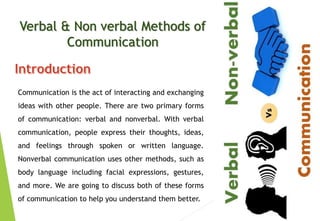
Verbal & Non verbal Methods of
Communication
Communication is the act of interacting and exchanging
ideas with other people. There are two primary forms
of communication: verbal and nonverbal. With verbal
communication, people express their thoughts, ideas,
and feelings through spoken or written language.
Nonverbal communication uses other methods, such as
body language including facial expressions, gestures,
and more. We are going to discuss both of these forms
of communication to help you understand them better.
 4 Types of communication
 While it is easy to think of communication as simply
the verbal transmission of information from one person
to another, it is so much more than that.
 Communication ranges from non-verbal, such as a
glance and raised eyebrows, to verbal, such as a
change in pitch and tone. Let’s take an in-depth look
at all the ways that we communicate with each other.
1. Non-verbal communication
2. Verbal communication
3. Written communication
4. Visual communication
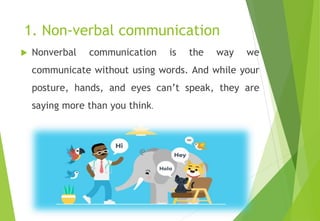
1. Non-verbal communication
 Nonverbal communication is the way we
communicate without using words. And while your
posture, hands, and eyes can’t speak, they are
saying more than you think.
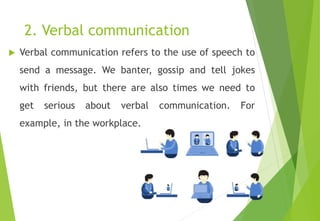
2. Verbal communication
 Verbal communication refers to the use of speech to
send a message. We banter, gossip and tell jokes
with friends, but there are also times we need to
get serious about verbal communication. For
example, in the workplace.
Written communication
 Written communication is using the written
word to convey information. The best attribute
of written communication is that it can send
large amounts of information without the risk of
someone forgetting because it can be referred
back to for reminders
Visual Communication
 Visual communication is delivering information and messages
using methods that can be seen. Any time a message can only
be received using eyesight, it is a form of visual
communication.
Visual & Written Methods Of
Communication
 Message transferred between at least two people through the
written form is known as “Written Communication, ”
whereas utilizing visual elements to communicate a message
is known as “Visual Communication”
 Visual has become the most used type of communication,
driven by social media, YouTube, and other platforms of the
digital era.
 As more and more people and organisations use these
channels of communication, the more we are used to, and
even dependent upon, using visual communication to stand
out in a crowded platform.
 Understanding that your visual communication must be in
line with your brand and marketing, and knowing that there
must be a developed and cohesive strategy for that, is
crucial.
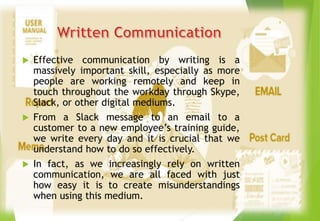
 Effective communication by writing is a
massively important skill, especially as more
people are working remotely and keep in
touch throughout the workday through Skype,
Slack, or other digital mediums.
 From a Slack message to an email to a
customer to a new employee’s training guide,
we write every day and it is crucial that we
understand how to do so effectively.
 In fact, as we increasingly rely on written
communication, we are all faced with just
how easy it is to create misunderstandings
when using this medium.
 Unclear messages, the information gone missing, or an
incorrect understanding of tone or content are all
problems that happen with written communication every
day.
 Sometimes the reader will misread the tone of a message
because they are having a bad day, or just had a run-in
with an unpleasant person.
 No matter what, one important skill to have when relying on
written communication is knowing when you need to stop
using it. A simple call, in almost all cases, can solve these
communication problems.
 If you sense that there is a miscommunication happening, or
just starting, nip it in the bud with a quick verbal chat and
you’ll save a lot of time and frustration for all parties
communication skill.pptx

communication skill.pptx

  • 2.
  • 3.
     What isCommunication  Introduction  Way of Communication  Elements of Communication  Importance Of Communication  Verbal & Non verbal Methods of Communication  Introduction  Types of Communication  Visual & Written Methods Of Communication  Introduction  Visual Communication  Written Communication
  • 4.
     Communication isthe act of giving, receiving, and sharing information -- in other words, talking or writing, and listening or reading. Good communicators listen carefully, speak or write clearly, and respect different opinions.  Strong communication skills can help kids interact both face-to-face and in the online world. Texting, chatting, and posting responsibly depends on understanding how words and images affect others. You can help kids develop their communication abilities by teaching them to use social media responsibly, modeling positive communication, and watching movies and TV shows that emphasize the value of healthy communication. What is Communication
  • 5.
     There arevarious different methods of communication. This includes verbal communication, non-verbal communication, listening, written communication and visual communication. Research has shown that non-verbal cues and body language, facial expressions and tone of voice account for almost 55% of all communication.
  • 6.
     Communication isa two way process, wherein interchange of message connects the sender and receiver, towards an agreed direction, consisting seven elements: 1. Sender: Otherwise known as a source, it is the person who has something to pass on, to another individual. 2. Encoding: The sender of the message, selects appropriate words or non-verbal techniques to convert the idea into the message, which is called as encoding. 3. Message: Message implies something that the sender wants to communicate, to the receiver. Without a message, no communication is possible. 4. Medium: Medium alludes to the channel or mode, through which message is communicated to the receiver, i.e. it can be sent by way of electronic word processing system, graphic, symbol, etc.Message has been received and interpreted in the same manner as directed.
  • 7.
    5. Receiver: Theone to whom the message is directed, is called receiver. He/she notices and conveys some meaning to the message. 6. Decoding: The act of interpreting message by the receiver, is termed as decoding. The receiver’s outlook, experience, and attitude play a vital role in decoding message. 7. Feedback: The process of communication can never be completed, if the response of the receiver is missing. It enables the communicator of a message to know whether the
  • 8.
     The importanceof communication can't be overstated. After all, you can't have culture, society, or civilization without the ability to communicate with one another. Good communication prevents wars and misunderstandings, helps us meet our needs, establishes rules and laws that aid in the structuring of society, helps people find and keep employment, provides information and guidance to people, and passes down cultural traditions, norms, and values.  Two adages to keep in mind about communication:  You can't not communicate (i.e. we're always communicating, even subconsciously)  You can't take back what you communicate once it's been put out into the universe (i.e. be careful how and what you communicate)
  • 9.
    Verbal & Nonverbal Methods of Communication Communication is the act of interacting and exchanging ideas with other people. There are two primary forms of communication: verbal and nonverbal. With verbal communication, people express their thoughts, ideas, and feelings through spoken or written language. Nonverbal communication uses other methods, such as body language including facial expressions, gestures, and more. We are going to discuss both of these forms of communication to help you understand them better.
  • 10.
     4 Typesof communication  While it is easy to think of communication as simply the verbal transmission of information from one person to another, it is so much more than that.  Communication ranges from non-verbal, such as a glance and raised eyebrows, to verbal, such as a change in pitch and tone. Let’s take an in-depth look at all the ways that we communicate with each other. 1. Non-verbal communication 2. Verbal communication 3. Written communication 4. Visual communication
  • 11.
    1. Non-verbal communication Nonverbal communication is the way we communicate without using words. And while your posture, hands, and eyes can’t speak, they are saying more than you think.
  • 12.
    2. Verbal communication Verbal communication refers to the use of speech to send a message. We banter, gossip and tell jokes with friends, but there are also times we need to get serious about verbal communication. For example, in the workplace.
  • 13.
    Written communication  Writtencommunication is using the written word to convey information. The best attribute of written communication is that it can send large amounts of information without the risk of someone forgetting because it can be referred back to for reminders
  • 14.
    Visual Communication  Visualcommunication is delivering information and messages using methods that can be seen. Any time a message can only be received using eyesight, it is a form of visual communication.
  • 15.
    Visual & WrittenMethods Of Communication  Message transferred between at least two people through the written form is known as “Written Communication, ” whereas utilizing visual elements to communicate a message is known as “Visual Communication”
  • 16.
     Visual hasbecome the most used type of communication, driven by social media, YouTube, and other platforms of the digital era.  As more and more people and organisations use these channels of communication, the more we are used to, and even dependent upon, using visual communication to stand out in a crowded platform.  Understanding that your visual communication must be in line with your brand and marketing, and knowing that there must be a developed and cohesive strategy for that, is crucial.
  • 17.
     Effective communicationby writing is a massively important skill, especially as more people are working remotely and keep in touch throughout the workday through Skype, Slack, or other digital mediums.  From a Slack message to an email to a customer to a new employee’s training guide, we write every day and it is crucial that we understand how to do so effectively.  In fact, as we increasingly rely on written communication, we are all faced with just how easy it is to create misunderstandings when using this medium.
  • 18.
     Unclear messages,the information gone missing, or an incorrect understanding of tone or content are all problems that happen with written communication every day.  Sometimes the reader will misread the tone of a message because they are having a bad day, or just had a run-in with an unpleasant person.
  • 19.
     No matterwhat, one important skill to have when relying on written communication is knowing when you need to stop using it. A simple call, in almost all cases, can solve these communication problems.  If you sense that there is a miscommunication happening, or just starting, nip it in the bud with a quick verbal chat and you’ll save a lot of time and frustration for all parties