Communication Models
How we try to understand
communication
What are models?
• Drawings
• Charts
• Diagrams
• Pictograms
• Schematics
• Cartoons
Models represent
relationships, flows,
structures, or
interactions.
Why are models useful?
• They help simplify complex ideas
– For teaching purposes
– For evaluation purposes
• They offer an organized way of looking
at a complex process
What makes a model “good”?
• All the main points of the relationship or
process are described
• The description is simple and clear
• The description contains as little textual
explanation as possible
The Shannon and Weaver
Communication Model
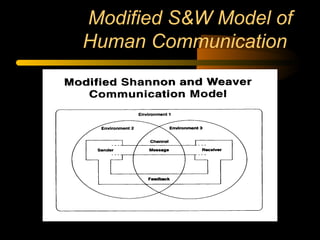
Modified S&W Model of
Human Communication
Noise in the Modified
Shannon and Weaver Model
• Physical:
– Occurrences in the physical surroundings
or in the media that can distort a message
• Physiological:
– Physical discomfort in the body of either
the sender or the receiver
• Psychological:
– Negative feelings in the mind of either the
sender or the receiver
Noise, cont’d
• Perceptual
– Incorrect perceptions of the message and
the receiver by the sender, and vice-versa
• Semantic
– Misinterpretation of words and sentences
by the sender or receiver
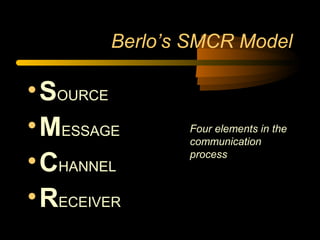
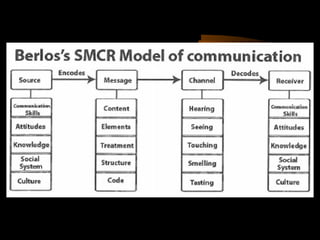
Berlo’s SMCR Model
•SOURCE
•MESSAGE
•CHANNEL
•RECEIVER
Four elements in the
communication
process
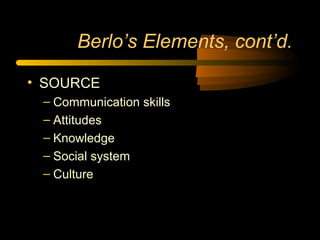
Berlo’s Elements, cont’d.
• SOURCE
– Communication skills
– Attitudes
– Knowledge
– Social system
– Culture
Berlo’s Elements, cont’d.
• MESSAGE
– Content
– Elements
– Treatment
– Structure
– Code
Berlo’s Elements, cont’d.
• CHANNEL
– Seeing
– Hearing
– Touching
– Smelling
– Tasting
Berlo’s Elements, cont’d.
• RECEIVER
– Communication skills
– Attitudes
– Knowledge
– Social system
– Culture

Communication models

  • 1.
    Communication Models How wetry to understand communication
  • 2.
    What are models? •Drawings • Charts • Diagrams • Pictograms • Schematics • Cartoons Models represent relationships, flows, structures, or interactions.
  • 3.
    Why are modelsuseful? • They help simplify complex ideas – For teaching purposes – For evaluation purposes • They offer an organized way of looking at a complex process
  • 4.
    What makes amodel “good”? • All the main points of the relationship or process are described • The description is simple and clear • The description contains as little textual explanation as possible
  • 5.
    The Shannon andWeaver Communication Model
  • 6.
    Modified S&W Modelof Human Communication
  • 7.
    Noise in theModified Shannon and Weaver Model • Physical: – Occurrences in the physical surroundings or in the media that can distort a message • Physiological: – Physical discomfort in the body of either the sender or the receiver • Psychological: – Negative feelings in the mind of either the sender or the receiver
  • 8.
    Noise, cont’d • Perceptual –Incorrect perceptions of the message and the receiver by the sender, and vice-versa • Semantic – Misinterpretation of words and sentences by the sender or receiver
  • 9.
  • 11.
    Berlo’s Elements, cont’d. •SOURCE – Communication skills – Attitudes – Knowledge – Social system – Culture
  • 12.
    Berlo’s Elements, cont’d. •MESSAGE – Content – Elements – Treatment – Structure – Code
  • 13.
    Berlo’s Elements, cont’d. •CHANNEL – Seeing – Hearing – Touching – Smelling – Tasting
  • 14.
    Berlo’s Elements, cont’d. •RECEIVER – Communication skills – Attitudes – Knowledge – Social system – Culture