Combustion Theory
Lecture 12
Combustion in Boilers
Learning Outcomes
1. Overview of general boiler designs and applications
– Heat balance/heat transfer/ heat availability/excess air/size and shape of
the combustor
– Boiler configurations: Smoke tube (Fire tube) and water tube/ Water wall
designs Natural Circulation and Forced Circulation

2. Type of fuels used and different combustion configurations
– Gas, liquid and solid fuels burn in boilers

3. Types of burners used and the related emission control
methods in boiler designs
– Gas burner designs/Liquid fuel burner designs/Solid fuel PC burners,
burning beds etc.

4. Emission cleaning methods in boiler operation
– Species of concerns and appropriate techniques/layouts
Overview of Boiler Operations
• Boilers are being used since 18th century
• Applications range from:
small hot water/steam
applications in
domestic/industrial use

large scale steam
production for power
generation

• Improvements in the quality of steam produced for
industrial applications
A couple of Bars Pressure
& a few 100’s °C
Temperature
(Saturated Steam)

~ 200-300 Bars pressure &
600 °C Temperature
(Superheated Steam)
[Large power generation
systems]
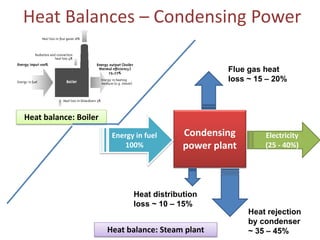
Heat Balances – Condensing Power
Flue gas heat
loss ~ 15 – 20%

Heat balance: Boiler
Energy in fuel
100%

Condensing
power plant

Electricity
(25 - 40%)

Heat distribution
loss ~ 10 – 15%

Heat balance: Steam plant

Heat rejection
by condenser
~ 35 – 45%
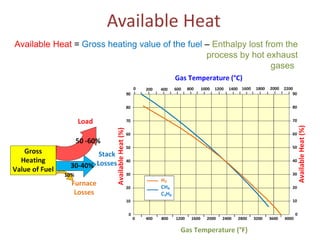
Available Heat
Available Heat = Gross heating value of the fuel – Enthalpy lost from the
process by hot exhaust
gases
Optimum Excess Air
Depends on
• Fuel type - coal, gas, oil, and rate of combustion
• Furnace/ combustor design - influences
– Combustion time
– Mixing
– Temperature

• Type and number of burners which affect fuel/air
mixing
• Burner turndown
• Air preheat, oxidant
– enhances combustion rate
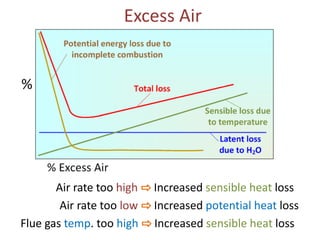
Excess Air

Air rate too high ⇨ Increased sensible heat loss
Air rate too low ⇨ Increased potential heat loss
Flue gas temp. too high ⇨ Increased sensible heat loss
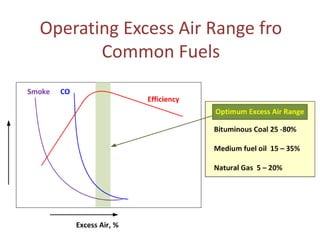
Operating Excess Air Range fro
Common Fuels
Estimation of the Shape & Size of a
Combustion Chamber
• Useful criteria:
– Cross sectional surface loading QC = Qfuel/Ac [MW/m2]
– Volumetric Loading QV = Qfuel/V [MW/m3]
Where
AC – Cross sectional area of the furnace [m2]
V – volume of furnace [m3]
Qfuel – fuel power [MW]; This is related to electrical power Qe by
Qe = Qfuel · ηboiler · ηcycle
(ηboiler -Boiler efficiency; ηcycle- efficiency of the thermodynamic cycle)

• At a given air excess,

– QC - associated with cross sectional average gas velocity
– QV - connected to gas residence time
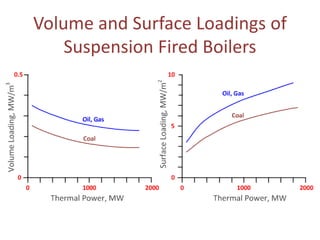
Volume and Surface Loadings of
Suspension Fired Boilers
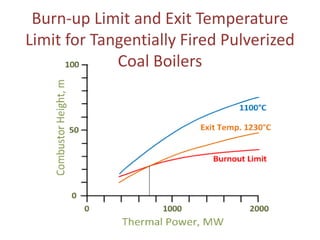
Burn-up Limit and Exit Temperature
Limit for Tangentially Fired Pulverized
Coal Boilers
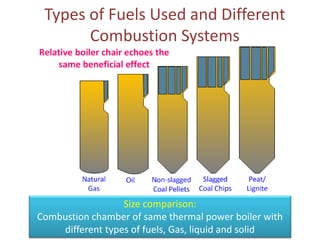
Types of Fuels Used and Different
Combustion Systems

Size comparison:
Combustion chamber of same thermal power boiler with
different types of fuels, Gas, liquid and solid
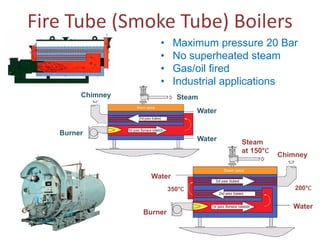
Fire Tube (Smoke Tube) Boilers
•
•
•
•

Maximum pressure 20 Bar
No superheated steam
Gas/oil fired
Industrial applications

Chimney

Steam
Water

Burner

Water

Steam
at 150°C

Chimney

Water
350°C

Burner

200°C

Water
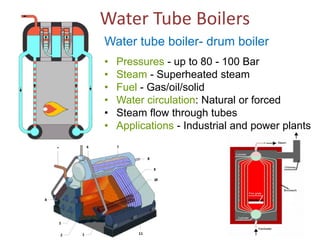
Water Tube Boilers
Water tube boiler- drum boiler
•
•
•
•
•
•

Pressures - up to 80 - 100 Bar
Steam - Superheated steam
Fuel - Gas/oil/solid
Water circulation: Natural or forced
Steam flow through tubes
Applications - Industrial and power plants
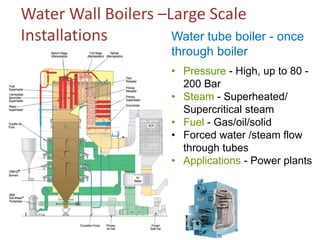
Water Wall Boilers –Large Scale
Water tube boiler - once
Installations
through boiler
• Pressure - High, up to 80 200 Bar
• Steam - Superheated/
Supercritical steam
• Fuel - Gas/oil/solid
• Forced water /steam flow
through tubes
• Applications - Power plants
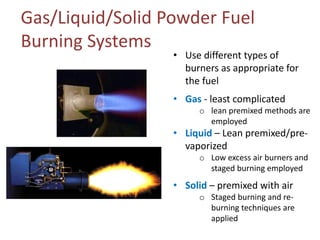
Gas/Liquid/Solid Powder Fuel
Burning Systems

• Use different types of
burners as appropriate for
the fuel
• Gas - least complicated

o lean premixed methods are
employed

• Liquid – Lean premixed/prevaporized

o Low excess air burners and
staged burning employed

• Solid – premixed with air

o Staged burning and reburning techniques are
applied
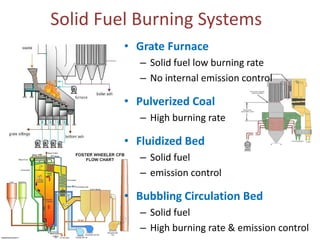
Solid Fuel Burning Systems
• Grate Furnace
– Solid fuel low burning rate
– No internal emission control

• Pulverized Coal
– High burning rate

• Fluidized Bed
– Solid fuel
– emission control

• Bubbling Circulation Bed
– Solid fuel
– High burning rate & emission control
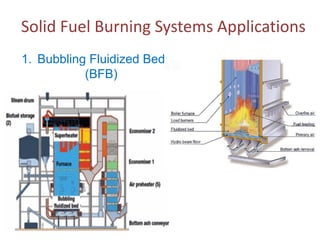
Solid Fuel Burning Systems Applications
1. Bubbling Fluidized Bed
(BFB)
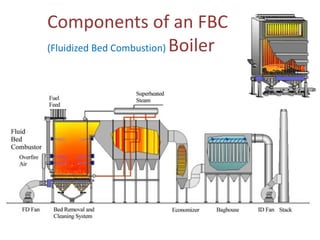
Components of an FBC
(Fluidized Bed Combustion) Boiler
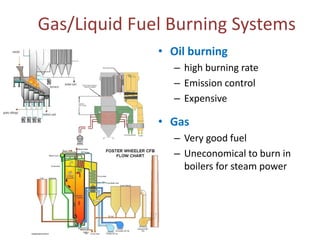
Gas/Liquid Fuel Burning Systems
• Oil burning
– high burning rate
– Emission control
– Expensive

• Gas
– Very good fuel
– Uneconomical to burn in
boilers for steam power
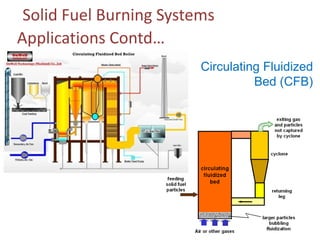
Solid Fuel Burning Systems
Applications Contd…
Circulating Fluidized
Bed (CFB)
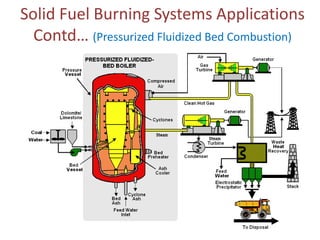
Solid Fuel Burning Systems Applications
Contd… (Pressurized Fluidized Bed Combustion)
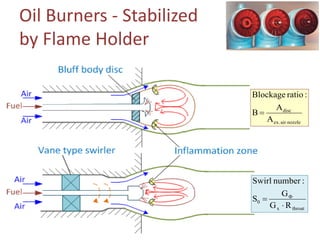
Oil Burners - Stabilized
by Flame Holder
Blockage ratio :
A disc
B=
A ex. air nozzle

Swirl number :
S0 =

GΦ
G x ⋅ R throat
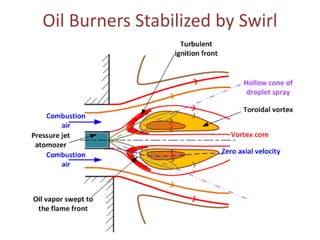
Oil Burners Stabilized by Swirl
Solid Fuel Burning Systems
Burners for Powder

• Factors influencing ignition
– Size distribution of the fuel
– Properties of the fuel
– Burner design and interaction with the
combustion chamber

• Two main groups of pulverized fuel burners
1. Jet burners
2. Swirl Burners
Solid Fuel Burning Systems
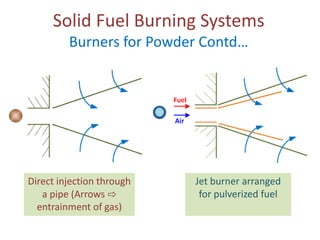
Burners for Powder Contd…

Direct injection through
a pipe (Arrows ⇨
entrainment of gas)

Jet burner arranged
for pulverized fuel
Solid Fuel Burning Systems
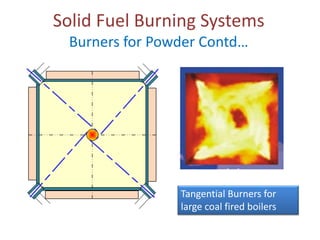
Burners for Powder Contd…

Tangential Burners for
large coal fired boilers
Solid Fuel Burning Systems
(Pulverized Coal Combustion)
courtesy of Hitachi Ltd. Group

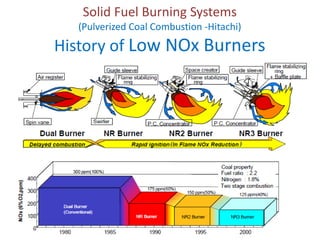
• 1st generation: Low-NOx burner ‘HT-NR burner’
– based on "In-flame NOx reduction” concept

• 2nd generation: Low-NOx burner ‘HT-NR2’
– with further enhanced NOx decomposition capability
– extremely reliable and has many applications in both the domestic and
foreign industrial and power boiler markets

• 3rd generation: Low-NOx burner ‘HT-NR3’
– further reduced NOx emission levels, improved combustion efficiency
and ease of maintenance
– a wider and shorter, highly stable flame for excellent fuel combustion
characteristics with extremely Low NOx levels.
Solid Fuel Burning Systems

(Pulverized Coal Combustion) Contd…
courtesy of Hitachi Ltd. Group

• Features of the 3rd generation HT-NR3
– Rapid ignition with Flame Stabilizing Ring
– Effective separation of outer air to produce reducing
conditions in the center zone
– PC concentration for higher combustion efficiency in
reducing condition
Emission Control Methods in
Boiler Designs
Nox Reduction
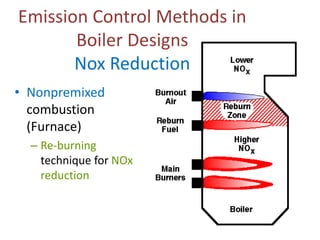
• Nonpremixed
combustion
(Furnace)
– Re-burning
technique for NOx
reduction
Solid Fuel Burning Systems

(Pulverized Coal Combustion -Hitachi)

History of Low NOx Burners
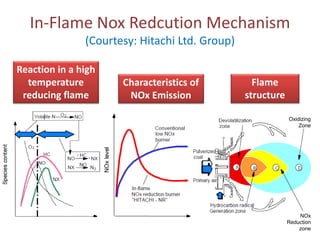
In-Flame Nox Redcution Mechanism
(Courtesy: Hitachi Ltd. Group)

Reaction in a high
temperature
reducing flame

Characteristics of
NOx Emission

Flame
structure
Oxidizing
Zone

NOx
Reduction
zone
Premixed/Nonpremixed Combustion
Exhaust Treatment for NOx Reduction in
Industrial Applications
• Selective Catalytic Reduction (SCR)
• Selective Non Catalytic Reduction (SNCR)
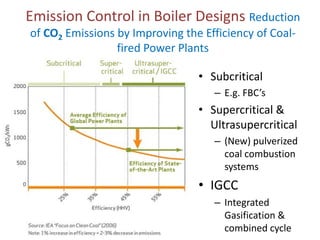
Emission Control in Boiler Designs Reduction
of CO2 Emissions by Improving the Efficiency of Coalfired Power Plants
• Subcritical
– E.g. FBC’s

• Supercritical &
Ultrasupercritical
– (New) pulverized
coal combustion
systems

• IGCC
– Integrated
Gasification &
combined cycle
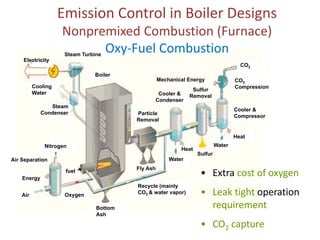
Emission Control in Boiler Designs
Nonpremixed Combustion (Furnace)
Oxy-Fuel Combustion
Steam Turbine

Electricity
CO2
Boiler
Cooling
Water

Mechanical Energy
Cooler &
Condenser

Steam
Condenser

CO2
Compression

Sulfur
Removal

Cooler &
Compressor

Particle
Removal

Heat
Nitrogen

Heat

Water
Sulfur

Water

Air Separation
fuel

Fly Ash

• Extra cost of oxygen

Oxygen

Recycle (mainly
CO2 & water vapor)

• Leak tight operation
requirement

Energy
Air

Bottom
Ash

• CO2 capture
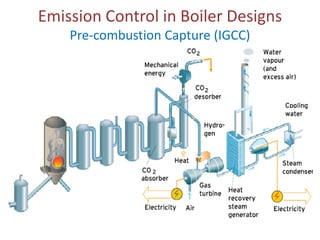
Emission Control in Boiler Designs
Pre-combustion Capture (IGCC)
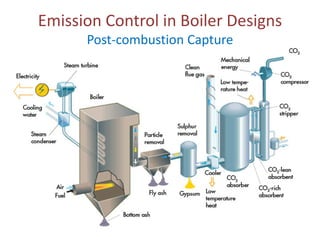
Emission Control in Boiler Designs
Post-combustion Capture
Summary
This section was focused on different aspects on
combustion in boilers such as,
• An overview - general boiler designs and applications
– Heat balance/heat transfer/ heat availability/excess air/size and shape of
the combustor
– Boiler configurations: Smoke tube (Fire tube) and water tube/ Water wall
designs Natural Circulation and Forced Circulation

• Types of fuels used and different combustion configurations
– Gas, liquid and solid fuels

• Types of burners used and the related emission control
– Gas burner designs/Liquid fuel burner designs/Solid fuel PC burners,
burning beds etc.

• Emission cleaning methods in boiler operation
– Species of concerns and appropriate techniques/layouts

combustion in boilers

  • 1.
  • 2.
    Learning Outcomes 1. Overviewof general boiler designs and applications – Heat balance/heat transfer/ heat availability/excess air/size and shape of the combustor – Boiler configurations: Smoke tube (Fire tube) and water tube/ Water wall designs Natural Circulation and Forced Circulation 2. Type of fuels used and different combustion configurations – Gas, liquid and solid fuels burn in boilers 3. Types of burners used and the related emission control methods in boiler designs – Gas burner designs/Liquid fuel burner designs/Solid fuel PC burners, burning beds etc. 4. Emission cleaning methods in boiler operation – Species of concerns and appropriate techniques/layouts
  • 3.
    Overview of BoilerOperations • Boilers are being used since 18th century • Applications range from: small hot water/steam applications in domestic/industrial use large scale steam production for power generation • Improvements in the quality of steam produced for industrial applications A couple of Bars Pressure & a few 100’s °C Temperature (Saturated Steam) ~ 200-300 Bars pressure & 600 °C Temperature (Superheated Steam) [Large power generation systems]
  • 4.
    Heat Balances –Condensing Power Flue gas heat loss ~ 15 – 20% Heat balance: Boiler Energy in fuel 100% Condensing power plant Electricity (25 - 40%) Heat distribution loss ~ 10 – 15% Heat balance: Steam plant Heat rejection by condenser ~ 35 – 45%
  • 5.
    Available Heat Available Heat= Gross heating value of the fuel – Enthalpy lost from the process by hot exhaust gases
  • 7.
    Optimum Excess Air Dependson • Fuel type - coal, gas, oil, and rate of combustion • Furnace/ combustor design - influences – Combustion time – Mixing – Temperature • Type and number of burners which affect fuel/air mixing • Burner turndown • Air preheat, oxidant – enhances combustion rate
  • 8.
    Excess Air Air ratetoo high ⇨ Increased sensible heat loss Air rate too low ⇨ Increased potential heat loss Flue gas temp. too high ⇨ Increased sensible heat loss
  • 9.
    Operating Excess AirRange fro Common Fuels
  • 10.
    Estimation of theShape & Size of a Combustion Chamber • Useful criteria: – Cross sectional surface loading QC = Qfuel/Ac [MW/m2] – Volumetric Loading QV = Qfuel/V [MW/m3] Where AC – Cross sectional area of the furnace [m2] V – volume of furnace [m3] Qfuel – fuel power [MW]; This is related to electrical power Qe by Qe = Qfuel · ηboiler · ηcycle (ηboiler -Boiler efficiency; ηcycle- efficiency of the thermodynamic cycle) • At a given air excess, – QC - associated with cross sectional average gas velocity – QV - connected to gas residence time
  • 11.
    Volume and SurfaceLoadings of Suspension Fired Boilers
  • 12.
    Burn-up Limit andExit Temperature Limit for Tangentially Fired Pulverized Coal Boilers
  • 13.
    Types of FuelsUsed and Different Combustion Systems Size comparison: Combustion chamber of same thermal power boiler with different types of fuels, Gas, liquid and solid
  • 14.
    Fire Tube (SmokeTube) Boilers • • • • Maximum pressure 20 Bar No superheated steam Gas/oil fired Industrial applications Chimney Steam Water Burner Water Steam at 150°C Chimney Water 350°C Burner 200°C Water
  • 15.
    Water Tube Boilers Watertube boiler- drum boiler • • • • • • Pressures - up to 80 - 100 Bar Steam - Superheated steam Fuel - Gas/oil/solid Water circulation: Natural or forced Steam flow through tubes Applications - Industrial and power plants
  • 16.
    Water Wall Boilers–Large Scale Water tube boiler - once Installations through boiler • Pressure - High, up to 80 200 Bar • Steam - Superheated/ Supercritical steam • Fuel - Gas/oil/solid • Forced water /steam flow through tubes • Applications - Power plants
  • 17.
    Gas/Liquid/Solid Powder Fuel BurningSystems • Use different types of burners as appropriate for the fuel • Gas - least complicated o lean premixed methods are employed • Liquid – Lean premixed/prevaporized o Low excess air burners and staged burning employed • Solid – premixed with air o Staged burning and reburning techniques are applied
  • 18.
    Solid Fuel BurningSystems • Grate Furnace – Solid fuel low burning rate – No internal emission control • Pulverized Coal – High burning rate • Fluidized Bed – Solid fuel – emission control • Bubbling Circulation Bed – Solid fuel – High burning rate & emission control
  • 19.
    Solid Fuel BurningSystems Applications 1. Bubbling Fluidized Bed (BFB)
  • 20.
    Components of anFBC (Fluidized Bed Combustion) Boiler
  • 21.
    Gas/Liquid Fuel BurningSystems • Oil burning – high burning rate – Emission control – Expensive • Gas – Very good fuel – Uneconomical to burn in boilers for steam power
  • 22.
    Solid Fuel BurningSystems Applications Contd… Circulating Fluidized Bed (CFB)
  • 23.
    Solid Fuel BurningSystems Applications Contd… (Pressurized Fluidized Bed Combustion)
  • 24.
    Oil Burners -Stabilized by Flame Holder Blockage ratio : A disc B= A ex. air nozzle Swirl number : S0 = GΦ G x ⋅ R throat
  • 25.
  • 26.
    Solid Fuel BurningSystems Burners for Powder • Factors influencing ignition – Size distribution of the fuel – Properties of the fuel – Burner design and interaction with the combustion chamber • Two main groups of pulverized fuel burners 1. Jet burners 2. Swirl Burners
  • 27.
    Solid Fuel BurningSystems Burners for Powder Contd… Direct injection through a pipe (Arrows ⇨ entrainment of gas) Jet burner arranged for pulverized fuel
  • 28.
    Solid Fuel BurningSystems Burners for Powder Contd… Tangential Burners for large coal fired boilers
  • 29.
    Solid Fuel BurningSystems (Pulverized Coal Combustion) courtesy of Hitachi Ltd. Group • 1st generation: Low-NOx burner ‘HT-NR burner’ – based on "In-flame NOx reduction” concept • 2nd generation: Low-NOx burner ‘HT-NR2’ – with further enhanced NOx decomposition capability – extremely reliable and has many applications in both the domestic and foreign industrial and power boiler markets • 3rd generation: Low-NOx burner ‘HT-NR3’ – further reduced NOx emission levels, improved combustion efficiency and ease of maintenance – a wider and shorter, highly stable flame for excellent fuel combustion characteristics with extremely Low NOx levels.
  • 30.
    Solid Fuel BurningSystems (Pulverized Coal Combustion) Contd… courtesy of Hitachi Ltd. Group • Features of the 3rd generation HT-NR3 – Rapid ignition with Flame Stabilizing Ring – Effective separation of outer air to produce reducing conditions in the center zone – PC concentration for higher combustion efficiency in reducing condition
  • 31.
    Emission Control Methodsin Boiler Designs Nox Reduction • Nonpremixed combustion (Furnace) – Re-burning technique for NOx reduction
  • 32.
    Solid Fuel BurningSystems (Pulverized Coal Combustion -Hitachi) History of Low NOx Burners
  • 33.
    In-Flame Nox RedcutionMechanism (Courtesy: Hitachi Ltd. Group) Reaction in a high temperature reducing flame Characteristics of NOx Emission Flame structure Oxidizing Zone NOx Reduction zone
  • 34.
    Premixed/Nonpremixed Combustion Exhaust Treatmentfor NOx Reduction in Industrial Applications • Selective Catalytic Reduction (SCR) • Selective Non Catalytic Reduction (SNCR)
  • 35.
    Emission Control inBoiler Designs Reduction of CO2 Emissions by Improving the Efficiency of Coalfired Power Plants • Subcritical – E.g. FBC’s • Supercritical & Ultrasupercritical – (New) pulverized coal combustion systems • IGCC – Integrated Gasification & combined cycle
  • 36.
    Emission Control inBoiler Designs Nonpremixed Combustion (Furnace) Oxy-Fuel Combustion Steam Turbine Electricity CO2 Boiler Cooling Water Mechanical Energy Cooler & Condenser Steam Condenser CO2 Compression Sulfur Removal Cooler & Compressor Particle Removal Heat Nitrogen Heat Water Sulfur Water Air Separation fuel Fly Ash • Extra cost of oxygen Oxygen Recycle (mainly CO2 & water vapor) • Leak tight operation requirement Energy Air Bottom Ash • CO2 capture
  • 37.
    Emission Control inBoiler Designs Pre-combustion Capture (IGCC)
  • 38.
    Emission Control inBoiler Designs Post-combustion Capture
  • 40.
    Summary This section wasfocused on different aspects on combustion in boilers such as, • An overview - general boiler designs and applications – Heat balance/heat transfer/ heat availability/excess air/size and shape of the combustor – Boiler configurations: Smoke tube (Fire tube) and water tube/ Water wall designs Natural Circulation and Forced Circulation • Types of fuels used and different combustion configurations – Gas, liquid and solid fuels • Types of burners used and the related emission control – Gas burner designs/Liquid fuel burner designs/Solid fuel PC burners, burning beds etc. • Emission cleaning methods in boiler operation – Species of concerns and appropriate techniques/layouts