BOILER
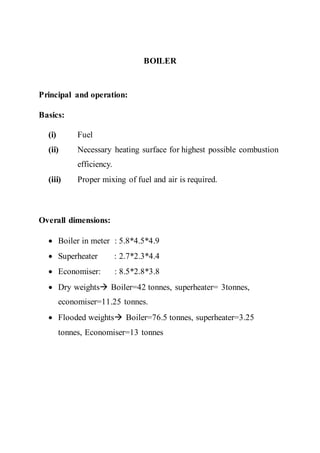
Principal and operation:
Basics:
(i) Fuel
(ii) Necessary heating surface for highest possible combustion
efficiency.
(iii) Proper mixing of fuel and air is required.
Overall dimensions:
 Boiler in meter : 5.8*4.5*4.9
 Superheater : 2.7*2.3*4.4
 Economiser: : 8.5*2.8*3.8
 Dry weights Boiler=42 tonnes, superheater= 3tonnes,
economiser=11.25 tonnes.
 Flooded weights Boiler=76.5 tonnes, superheater=3.25
tonnes, Economiser=13 tonnes
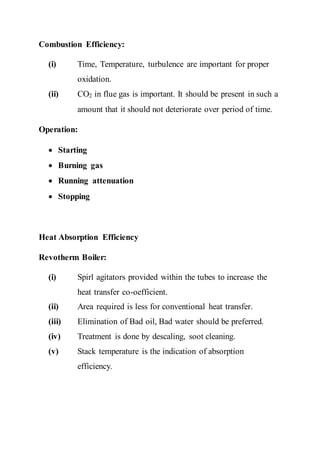
Combustion Efficiency:
(i) Time, Temperature, turbulence are important for proper
oxidation.
(ii) CO2 in flue gas is important. It should be present in such a
amount that it should not deteriorate over period of time.
Operation:
 Starting
 Burning gas
 Running attenuation
 Stopping
Heat Absorption Efficiency
Revotherm Boiler:
(i) Spirl agitators provided within the tubes to increase the
heat transfer co-oefficient.
(ii) Area required is less for conventional heat transfer.
(iii) Elimination of Bad oil, Bad water should be preferred.
(iv) Treatment is done by descaling, soot cleaning.
(v) Stack temperature is the indication of absorption
efficiency.
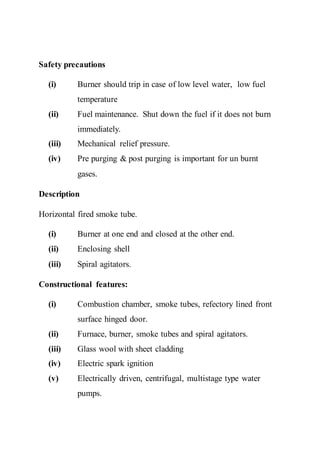
Safety precautions
(i) Burner should trip in case of low level water, low fuel
temperature
(ii) Fuel maintenance. Shut down the fuel if it does not burn
immediately.
(iii) Mechanical relief pressure.
(iv) Pre purging & post purging is important for un burnt
gases.
Description
Horizontal fired smoke tube.
(i) Burner at one end and closed at the other end.
(ii) Enclosing shell
(iii) Spiral agitators.
Constructional features:
(i) Combustion chamber, smoke tubes, refectory lined front
surface hinged door.
(ii) Furnace, burner, smoke tubes and spiral agitators.
(iii) Glass wool with sheet cladding
(iv) Electric spark ignition
(v) Electrically driven, centrifugal, multistage type water
pumps.
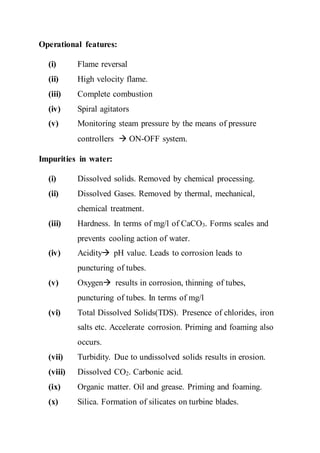
Operational features:
(i) Flame reversal
(ii) High velocity flame.
(iii) Complete combustion
(iv) Spiral agitators
(v) Monitoring steam pressure by the means of pressure
controllers  ON-OFF system.
Impurities in water:
(i) Dissolved solids. Removed by chemical processing.
(ii) Dissolved Gases. Removed by thermal, mechanical,
chemical treatment.
(iii) Hardness. In terms of mg/l of CaCO3. Forms scales and
prevents cooling action of water.
(iv) Acidity pH value. Leads to corrosion leads to
puncturing of tubes.
(v) Oxygen results in corrosion, thinning of tubes,
puncturing of tubes. In terms of mg/l
(vi) Total Dissolved Solids(TDS). Presence of chlorides, iron
salts etc. Accelerate corrosion. Priming and foaming also
occurs.
(vii) Turbidity. Due to undissolved solids results in erosion.
(viii) Dissolved CO2. Carbonic acid.
(ix) Organic matter. Oil and grease. Priming and foaming.
(x) Silica. Formation of silicates on turbine blades.
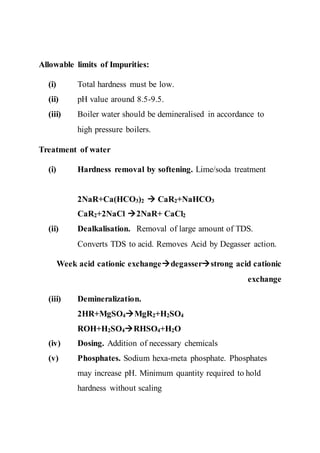
Allowable limits of Impurities:
(i) Total hardness must be low.
(ii) pH value around 8.5-9.5.
(iii) Boiler water should be demineralised in accordance to
high pressure boilers.
Treatment of water
(i) Hardness removal by softening. Lime/soda treatment
2NaR+Ca(HCO3)2  CaR2+NaHCO3
CaR2+2NaCl 2NaR+ CaCl2
(ii) Dealkalisation. Removal of large amount of TDS.
Converts TDS to acid. Removes Acid by Degasser action.
Week acid cationic exchangedegasserstrong acid cationic
exchange
(iii) Demineralization.
2HR+MgSO4MgR2+H2SO4
ROH+H2SO4RHSO4+H2O
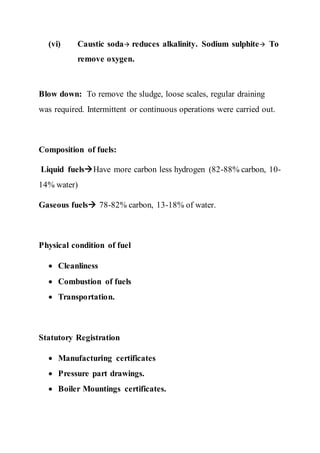
(iv) Dosing. Addition of necessary chemicals
(v) Phosphates. Sodium hexa-meta phosphate. Phosphates
may increase pH. Minimum quantity required to hold
hardness without scaling
(vi) Caustic soda reduces alkalinity. Sodium sulphite To
remove oxygen.
Blow down: To remove the sludge, loose scales, regular draining
was required. Intermittent or continuous operations were carried out.
Composition of fuels:
Liquid fuelsHave more carbon less hydrogen (82-88% carbon, 10-
14% water)
Gaseous fuels 78-82% carbon, 13-18% of water.
Physical condition of fuel
 Cleanliness
 Combustion of fuels
 Transportation.
Statutory Registration
 Manufacturing certificates
 Pressure part drawings.
 Boiler Mountings certificates.
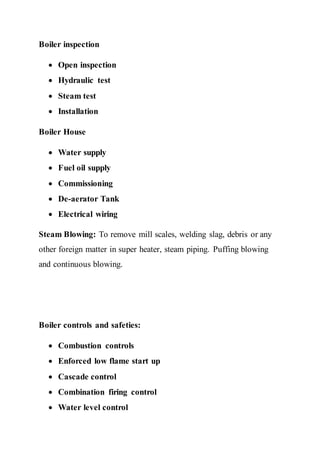
Boiler inspection
 Open inspection
 Hydraulic test
 Steam test
 Installation
Boiler House
 Water supply
 Fuel oil supply
 Commissioning
 De-aerator Tank
 Electrical wiring
Steam Blowing: To remove mill scales, welding slag, debris or any
other foreign matter in super heater, steam piping. Puffing blowing
and continuous blowing.
Boiler controls and safeties:
 Combustion controls
 Enforced low flame start up
 Cascade control
 Combination firing control
 Water level control
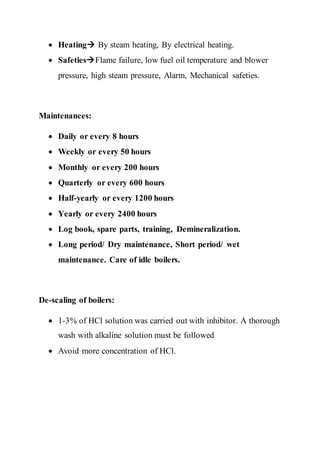
 Heating By steam heating, By electrical heating.
 SafetiesFlame failure, low fuel oil temperature and blower
pressure, high steam pressure, Alarm, Mechanical safeties.
Maintenances:
 Daily or every 8 hours
 Weekly or every 50 hours
 Monthly or every 200 hours
 Quarterly or every 600 hours
 Half-yearly or every 1200 hours
 Yearly or every 2400 hours
 Log book, spare parts, training, Demineralization.
 Long period/ Dry maintenance, Short period/ wet
maintenance. Care of idle boilers.
De-scaling of boilers:
 1-3% of HCl solution was carried out with inhibitor. A thorough
wash with alkaline solution must be followed
 Avoid more concentration of HCl.

BOILER

  • 1.
    BOILER Principal and operation: Basics: (i)Fuel (ii) Necessary heating surface for highest possible combustion efficiency. (iii) Proper mixing of fuel and air is required. Overall dimensions:  Boiler in meter : 5.8*4.5*4.9  Superheater : 2.7*2.3*4.4  Economiser: : 8.5*2.8*3.8  Dry weights Boiler=42 tonnes, superheater= 3tonnes, economiser=11.25 tonnes.  Flooded weights Boiler=76.5 tonnes, superheater=3.25 tonnes, Economiser=13 tonnes
  • 2.
    Combustion Efficiency: (i) Time,Temperature, turbulence are important for proper oxidation. (ii) CO2 in flue gas is important. It should be present in such a amount that it should not deteriorate over period of time. Operation:  Starting  Burning gas  Running attenuation  Stopping Heat Absorption Efficiency Revotherm Boiler: (i) Spirl agitators provided within the tubes to increase the heat transfer co-oefficient. (ii) Area required is less for conventional heat transfer. (iii) Elimination of Bad oil, Bad water should be preferred. (iv) Treatment is done by descaling, soot cleaning. (v) Stack temperature is the indication of absorption efficiency.
  • 3.
    Safety precautions (i) Burnershould trip in case of low level water, low fuel temperature (ii) Fuel maintenance. Shut down the fuel if it does not burn immediately. (iii) Mechanical relief pressure. (iv) Pre purging & post purging is important for un burnt gases. Description Horizontal fired smoke tube. (i) Burner at one end and closed at the other end. (ii) Enclosing shell (iii) Spiral agitators. Constructional features: (i) Combustion chamber, smoke tubes, refectory lined front surface hinged door. (ii) Furnace, burner, smoke tubes and spiral agitators. (iii) Glass wool with sheet cladding (iv) Electric spark ignition (v) Electrically driven, centrifugal, multistage type water pumps.
  • 4.
    Operational features: (i) Flamereversal (ii) High velocity flame. (iii) Complete combustion (iv) Spiral agitators (v) Monitoring steam pressure by the means of pressure controllers  ON-OFF system. Impurities in water: (i) Dissolved solids. Removed by chemical processing. (ii) Dissolved Gases. Removed by thermal, mechanical, chemical treatment. (iii) Hardness. In terms of mg/l of CaCO3. Forms scales and prevents cooling action of water. (iv) Acidity pH value. Leads to corrosion leads to puncturing of tubes. (v) Oxygen results in corrosion, thinning of tubes, puncturing of tubes. In terms of mg/l (vi) Total Dissolved Solids(TDS). Presence of chlorides, iron salts etc. Accelerate corrosion. Priming and foaming also occurs. (vii) Turbidity. Due to undissolved solids results in erosion. (viii) Dissolved CO2. Carbonic acid. (ix) Organic matter. Oil and grease. Priming and foaming. (x) Silica. Formation of silicates on turbine blades.
  • 5.
    Allowable limits ofImpurities: (i) Total hardness must be low. (ii) pH value around 8.5-9.5. (iii) Boiler water should be demineralised in accordance to high pressure boilers. Treatment of water (i) Hardness removal by softening. Lime/soda treatment 2NaR+Ca(HCO3)2  CaR2+NaHCO3 CaR2+2NaCl 2NaR+ CaCl2 (ii) Dealkalisation. Removal of large amount of TDS. Converts TDS to acid. Removes Acid by Degasser action. Week acid cationic exchangedegasserstrong acid cationic exchange (iii) Demineralization. 2HR+MgSO4MgR2+H2SO4 ROH+H2SO4RHSO4+H2O (iv) Dosing. Addition of necessary chemicals (v) Phosphates. Sodium hexa-meta phosphate. Phosphates may increase pH. Minimum quantity required to hold hardness without scaling
  • 6.
    (vi) Caustic sodareduces alkalinity. Sodium sulphite To remove oxygen. Blow down: To remove the sludge, loose scales, regular draining was required. Intermittent or continuous operations were carried out. Composition of fuels: Liquid fuelsHave more carbon less hydrogen (82-88% carbon, 10- 14% water) Gaseous fuels 78-82% carbon, 13-18% of water. Physical condition of fuel  Cleanliness  Combustion of fuels  Transportation. Statutory Registration  Manufacturing certificates  Pressure part drawings.  Boiler Mountings certificates.
  • 7.
    Boiler inspection  Openinspection  Hydraulic test  Steam test  Installation Boiler House  Water supply  Fuel oil supply  Commissioning  De-aerator Tank  Electrical wiring Steam Blowing: To remove mill scales, welding slag, debris or any other foreign matter in super heater, steam piping. Puffing blowing and continuous blowing. Boiler controls and safeties:  Combustion controls  Enforced low flame start up  Cascade control  Combination firing control  Water level control
  • 8.
     Heating Bysteam heating, By electrical heating.  SafetiesFlame failure, low fuel oil temperature and blower pressure, high steam pressure, Alarm, Mechanical safeties. Maintenances:  Daily or every 8 hours  Weekly or every 50 hours  Monthly or every 200 hours  Quarterly or every 600 hours  Half-yearly or every 1200 hours  Yearly or every 2400 hours  Log book, spare parts, training, Demineralization.  Long period/ Dry maintenance, Short period/ wet maintenance. Care of idle boilers. De-scaling of boilers:  1-3% of HCl solution was carried out with inhibitor. A thorough wash with alkaline solution must be followed  Avoid more concentration of HCl.