(Types and Characteristics) 
Md. Saiful Islam (2010135017) 
Nujath Tasnim (2010135027)
 Types of Erosional Landform: 
V-Shaped Valley 
Gorge and Canyon 
Waterfall 
 Pot hole 
 River Terraces 
 River Meanders
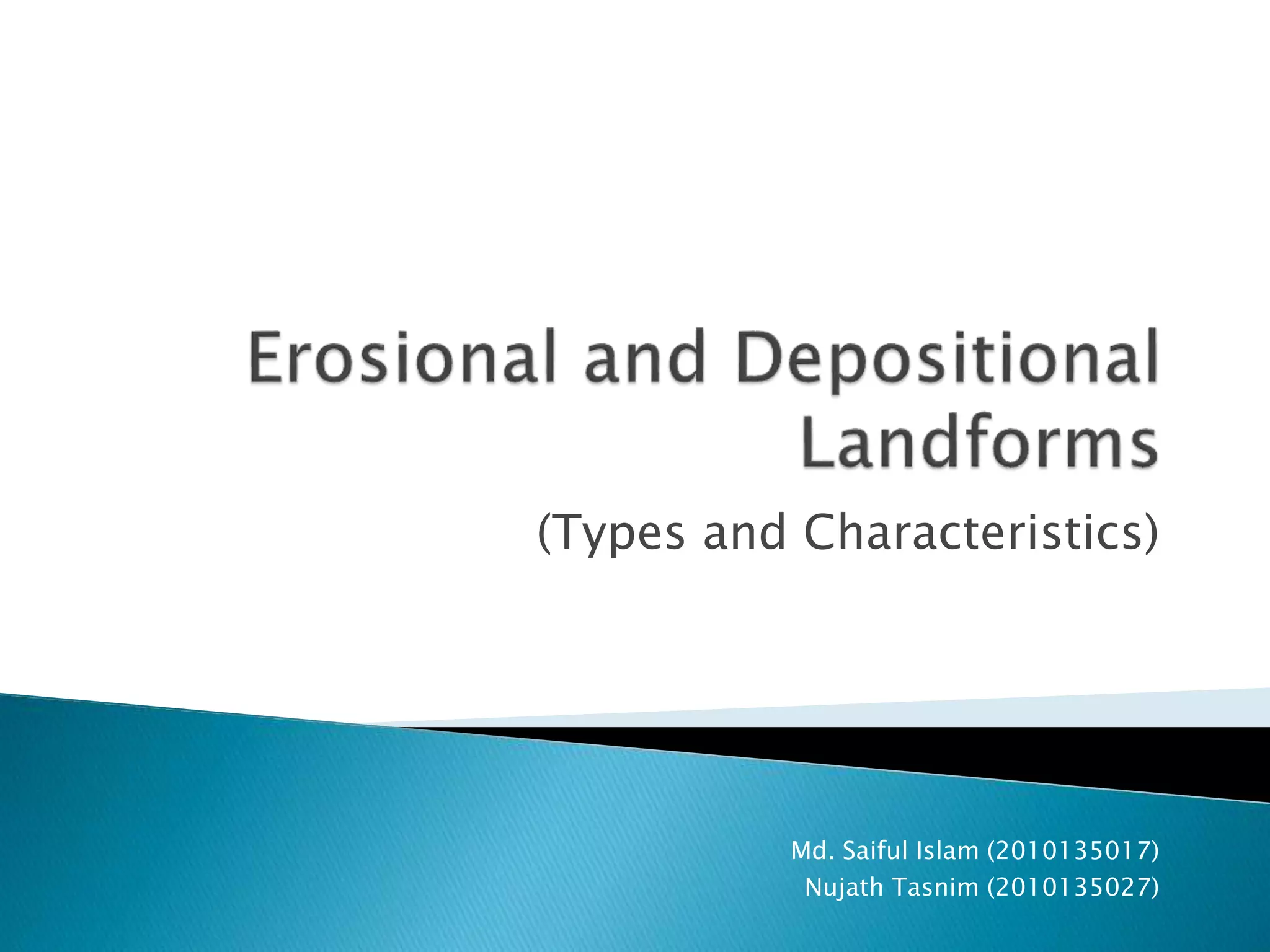
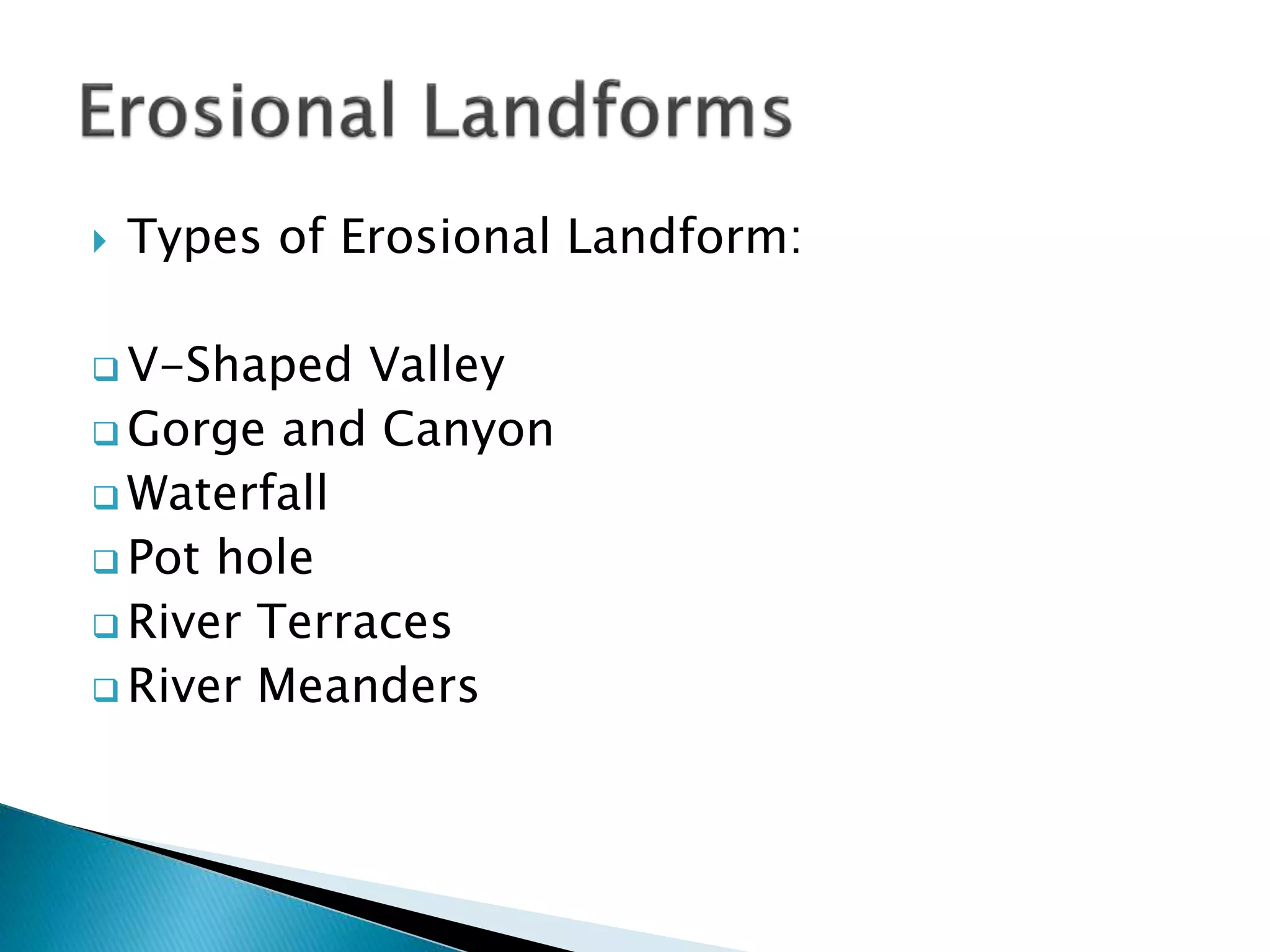
 The valleys curved out by the rivers are significant erosional landforms. 
 The valley is very deep and narrow, both the valley sides meet together at the 
valley floor thus water always touches the valley sides. 
 The valley formed in the youthful stage of fluvial cycle of erosion and in the initial 
stage of valley development is V-shaped having steep valley side slope of convex 
element. 
 The valleys are gradually widened due to lateral erosion.
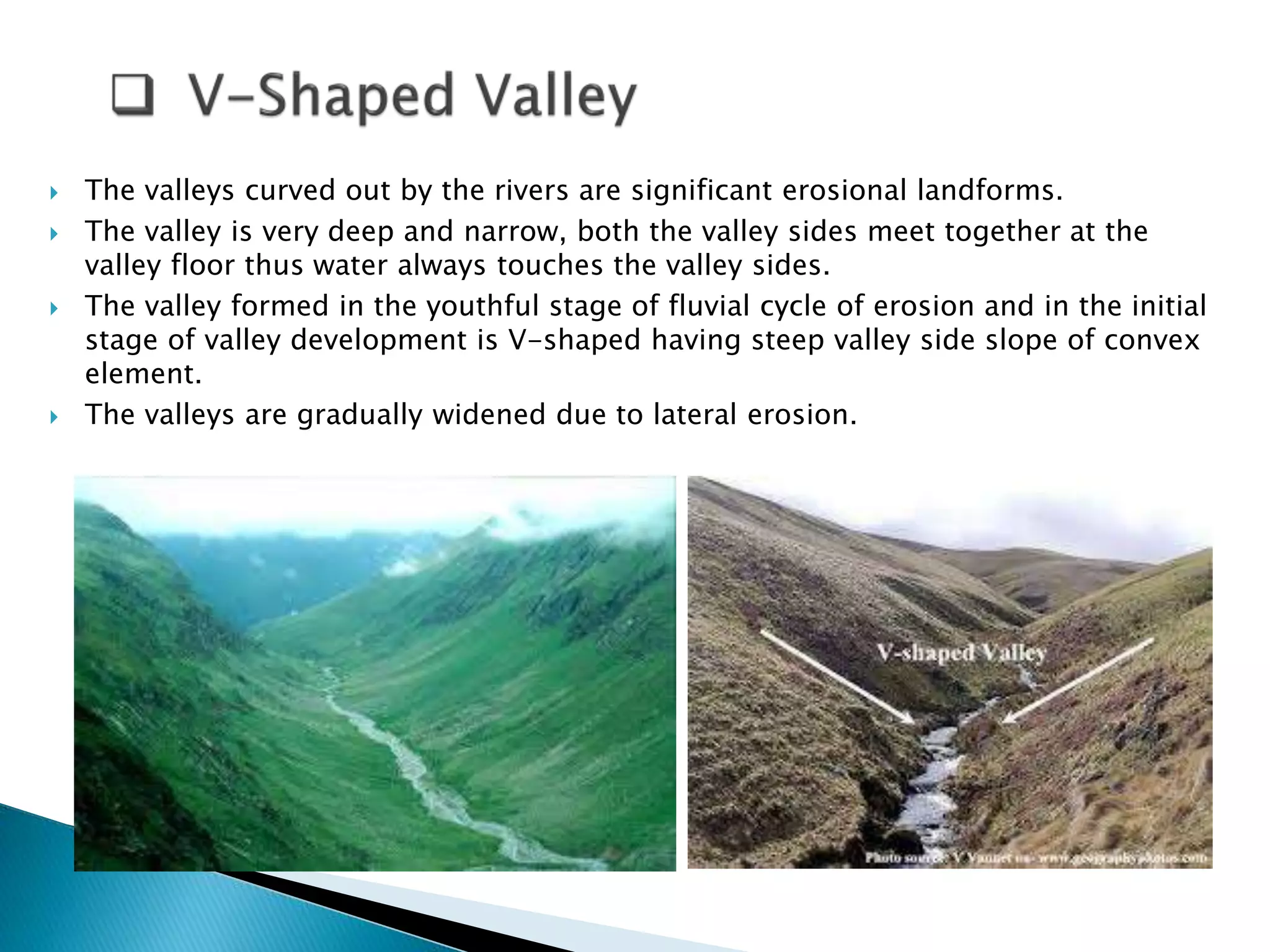
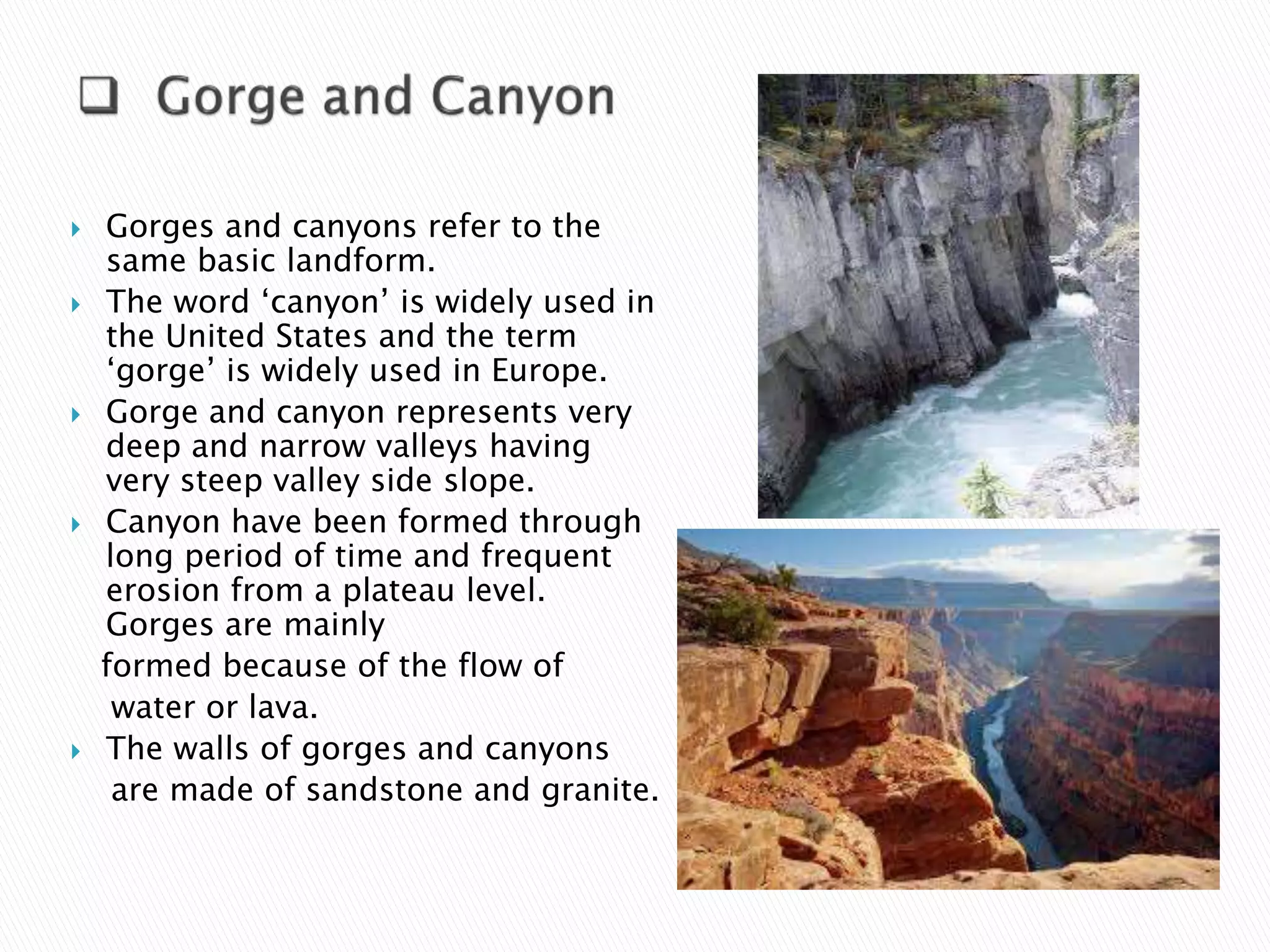
 Gorges and canyons refer to the 
same basic landform. 
 The word ‘canyon’ is widely used in 
the United States and the term 
‘gorge’ is widely used in Europe. 
 Gorge and canyon represents very 
deep and narrow valleys having 
very steep valley side slope. 
 Canyon have been formed through 
long period of time and frequent 
erosion from a plateau level. 
Gorges are mainly 
formed because of the flow of 
water or lava. 
 The walls of gorges and canyons 
are made of sandstone and granite.
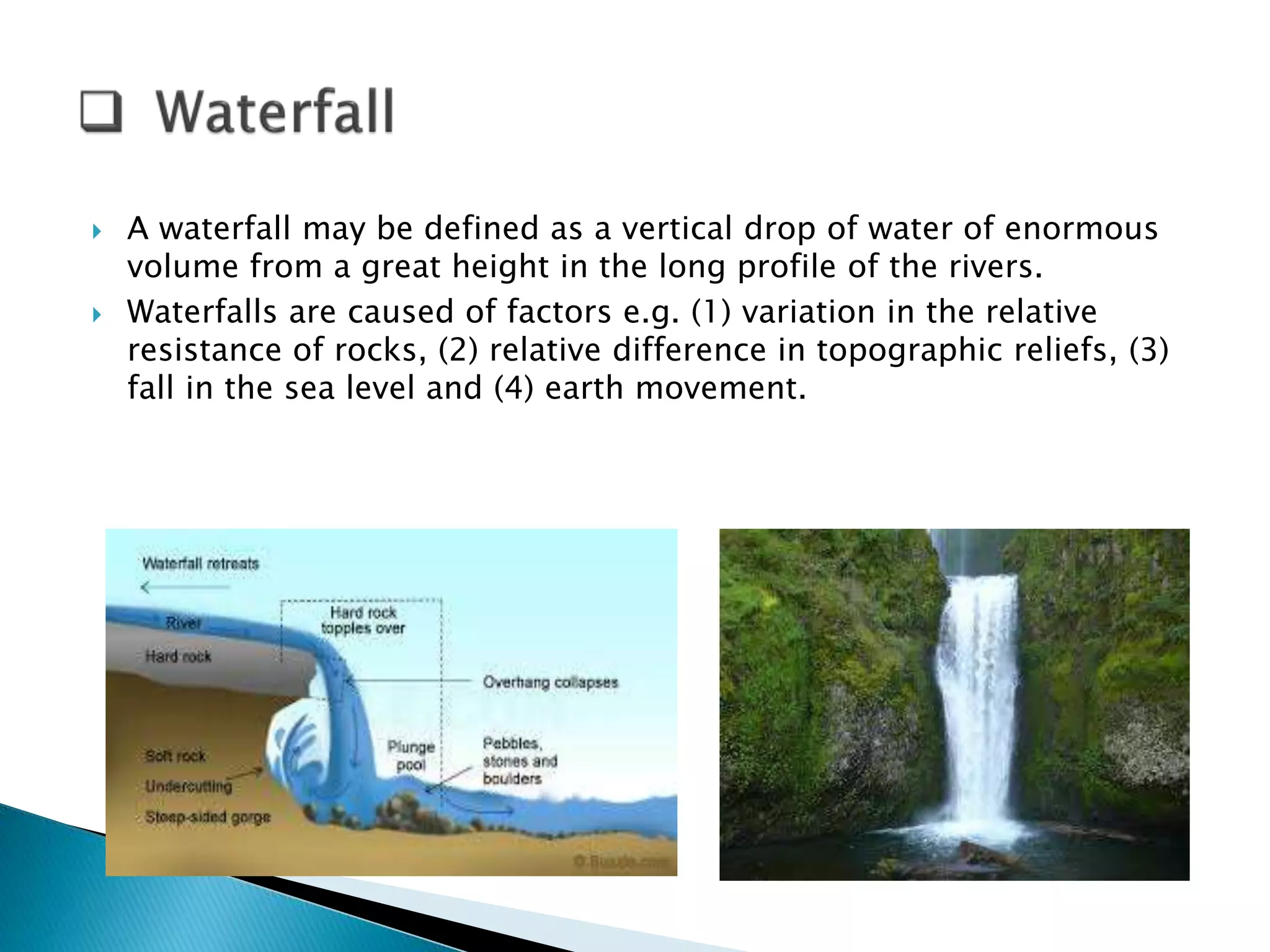
 A waterfall may be defined as a vertical drop of water of enormous 
volume from a great height in the long profile of the rivers. 
 Waterfalls are caused of factors e.g. (1) variation in the relative 
resistance of rocks, (2) relative difference in topographic reliefs, (3) 
fall in the sea level and (4) earth movement.
 A kettle-like small depressions in the rocky beds of the river valleys 
are called pot holes which are usually cylindrical in shape. 
 Pot holes are generally formed in coarse-grained rocks e.g. 
sandstone and granites. 
 The diameter of pot holes ranges from a few centimeters to several 
meters. 
 They are found in the upper course of a river where it has enough 
potential energy to erode vertically. 
 The pot holes go on increasing in both diameter and depth.
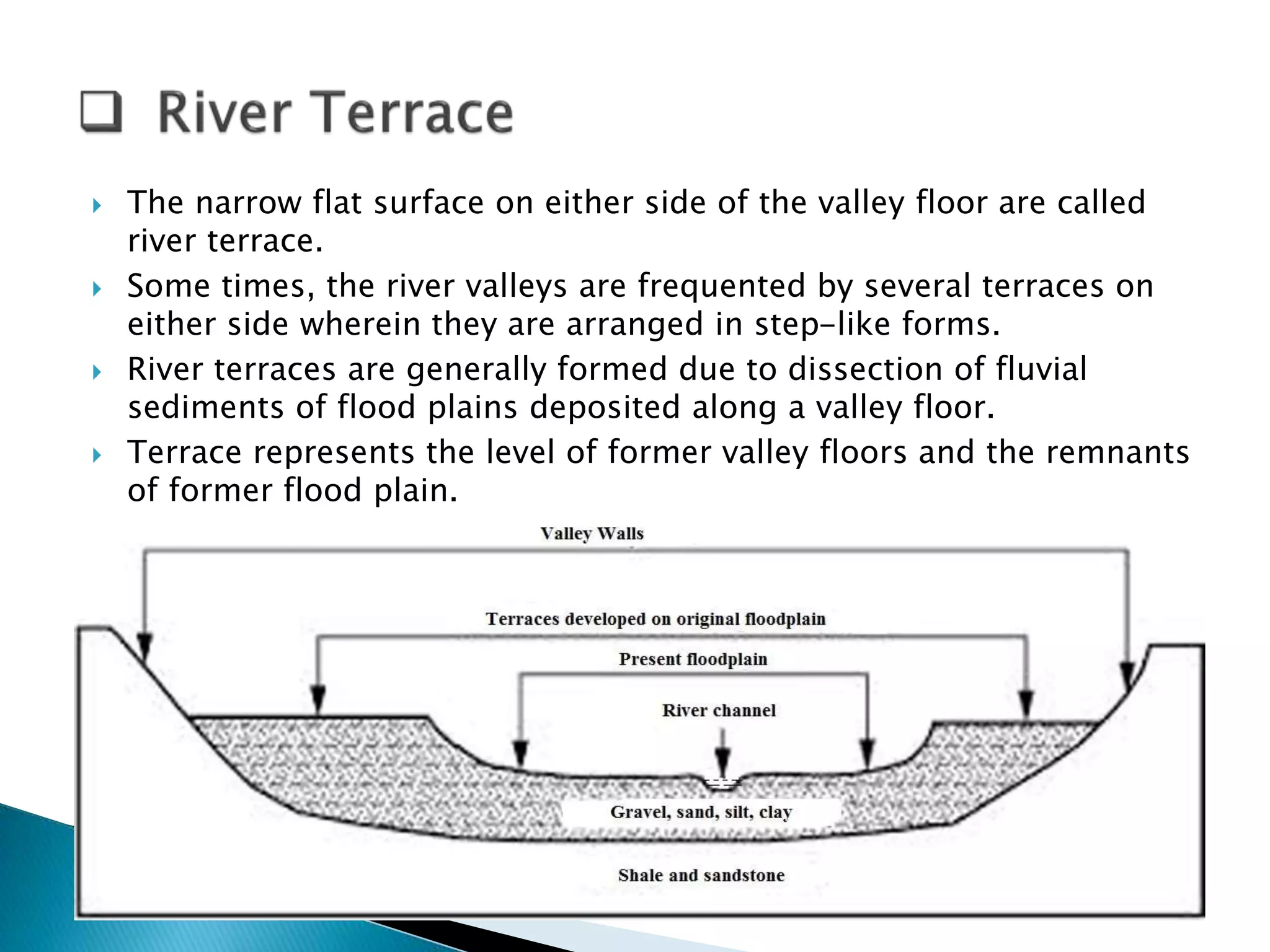
 The narrow flat surface on either side of the valley floor are called 
river terrace. 
 Some times, the river valleys are frequented by several terraces on 
either side wherein they are arranged in step-like forms. 
 River terraces are generally formed due to dissection of fluvial 
sediments of flood plains deposited along a valley floor. 
 Terrace represents the level of former valley floors and the remnants 
of former flood plain.
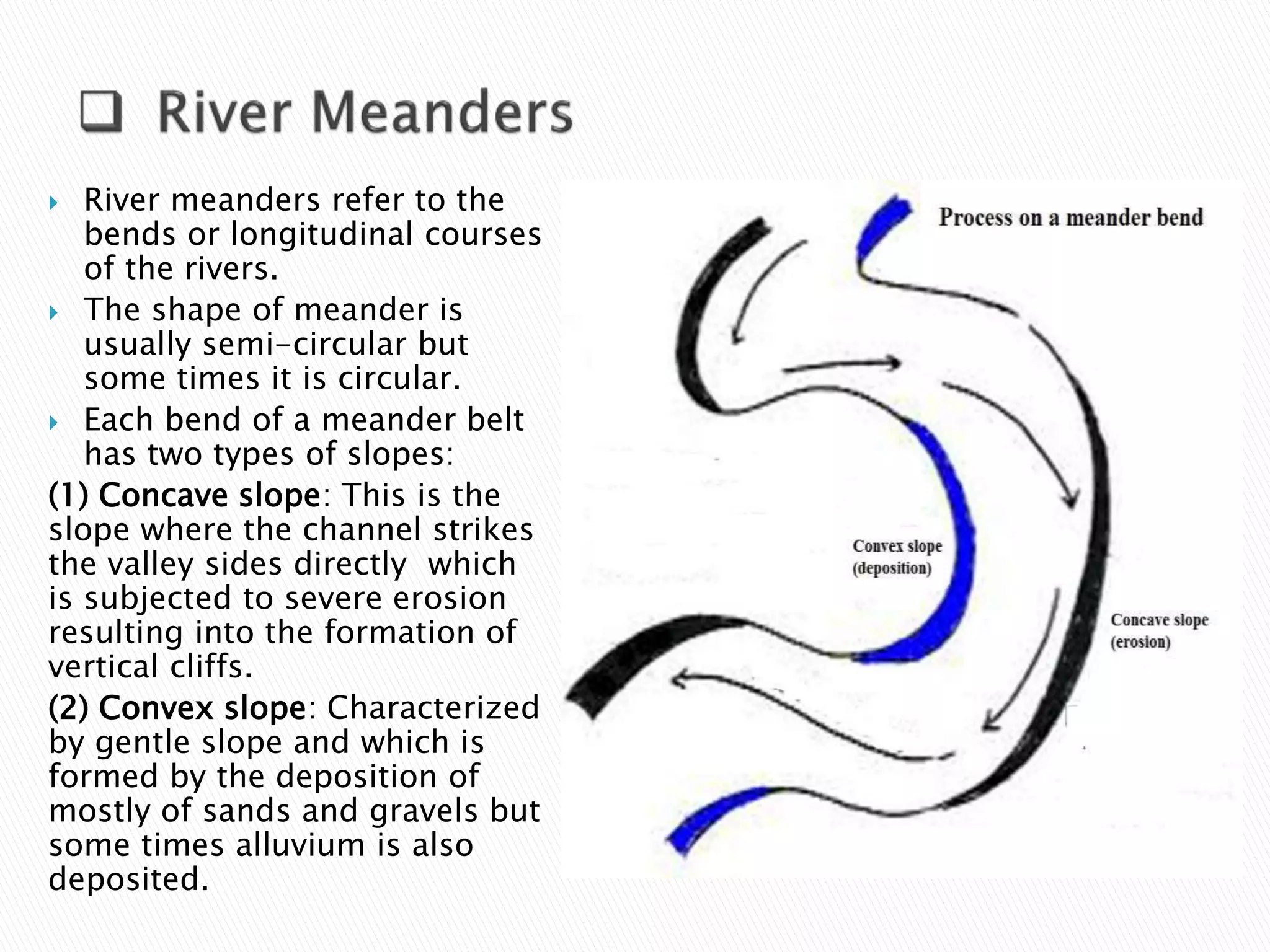
 River meanders refer to the 
bends or longitudinal courses 
of the rivers. 
 The shape of meander is 
usually semi-circular but 
some times it is circular. 
 Each bend of a meander belt 
has two types of slopes: 
(1) Concave slope: This is the 
slope where the channel strikes 
the valley sides directly which 
is subjected to severe erosion 
resulting into the formation of 
vertical cliffs. 
(2) Convex slope: Characterized 
by gentle slope and which is 
formed by the deposition of 
mostly of sands and gravels but 
some times alluvium is also 
deposited.
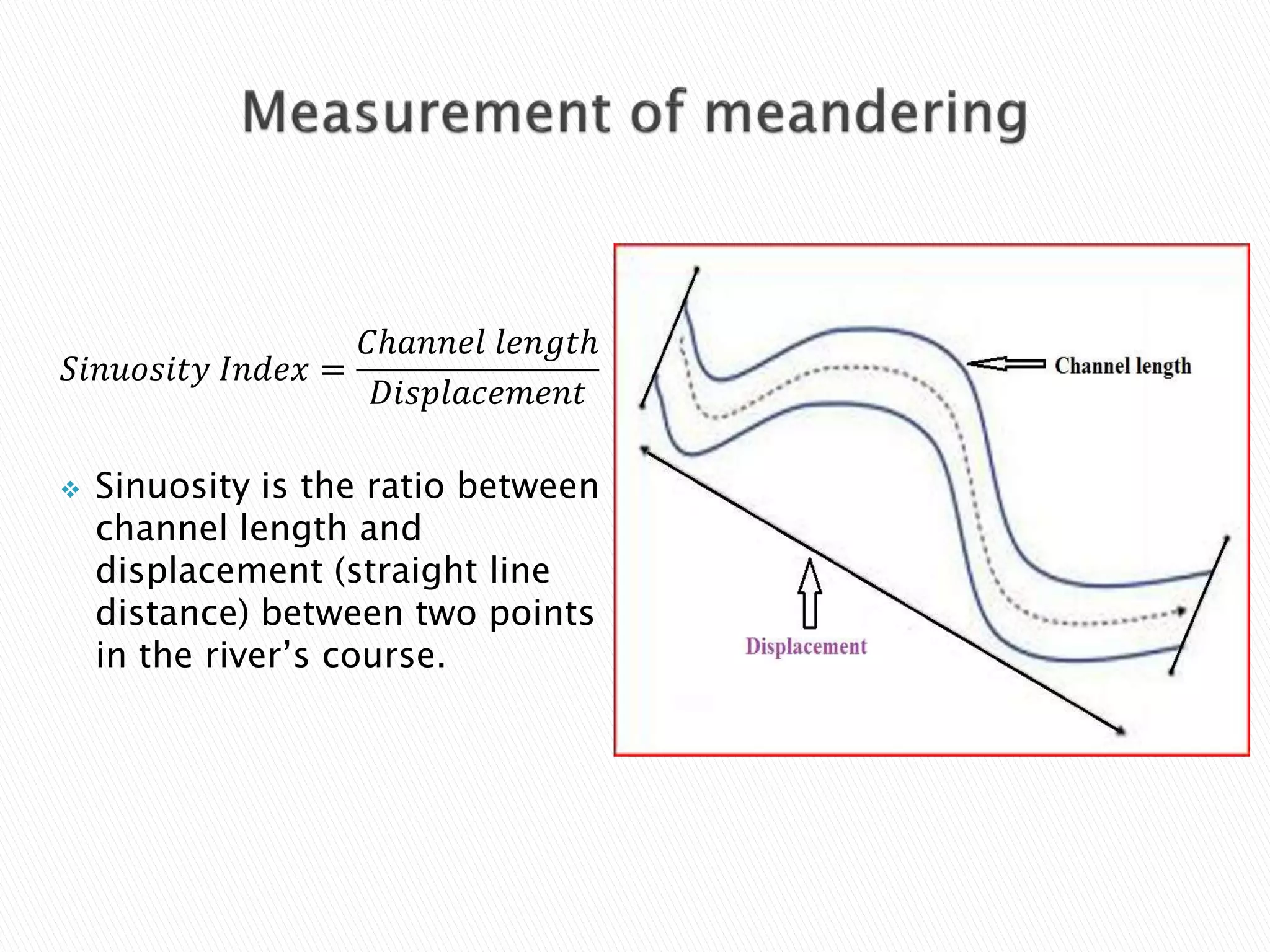
푆푖푛푢표푠푖푡푦 퐼푛푑푒푥 = 
퐶ℎ푎푛푛푒푙 푙푒푛푔푡ℎ 
퐷푖푠푝푙푎푐푒푚푒푛푡 
 Sinuosity is the ratio between 
channel length and 
displacement (straight line 
distance) between two points 
in the river’s course.
River deposits sediments in different parts of their 
courses and thus form various types of landforms 
which are called depositional or constructional 
landforms. 
Types of depositional landforms: 
 Alluvial Fan and Cone 
 Natural Levees 
 Flood Plain 
 Delta
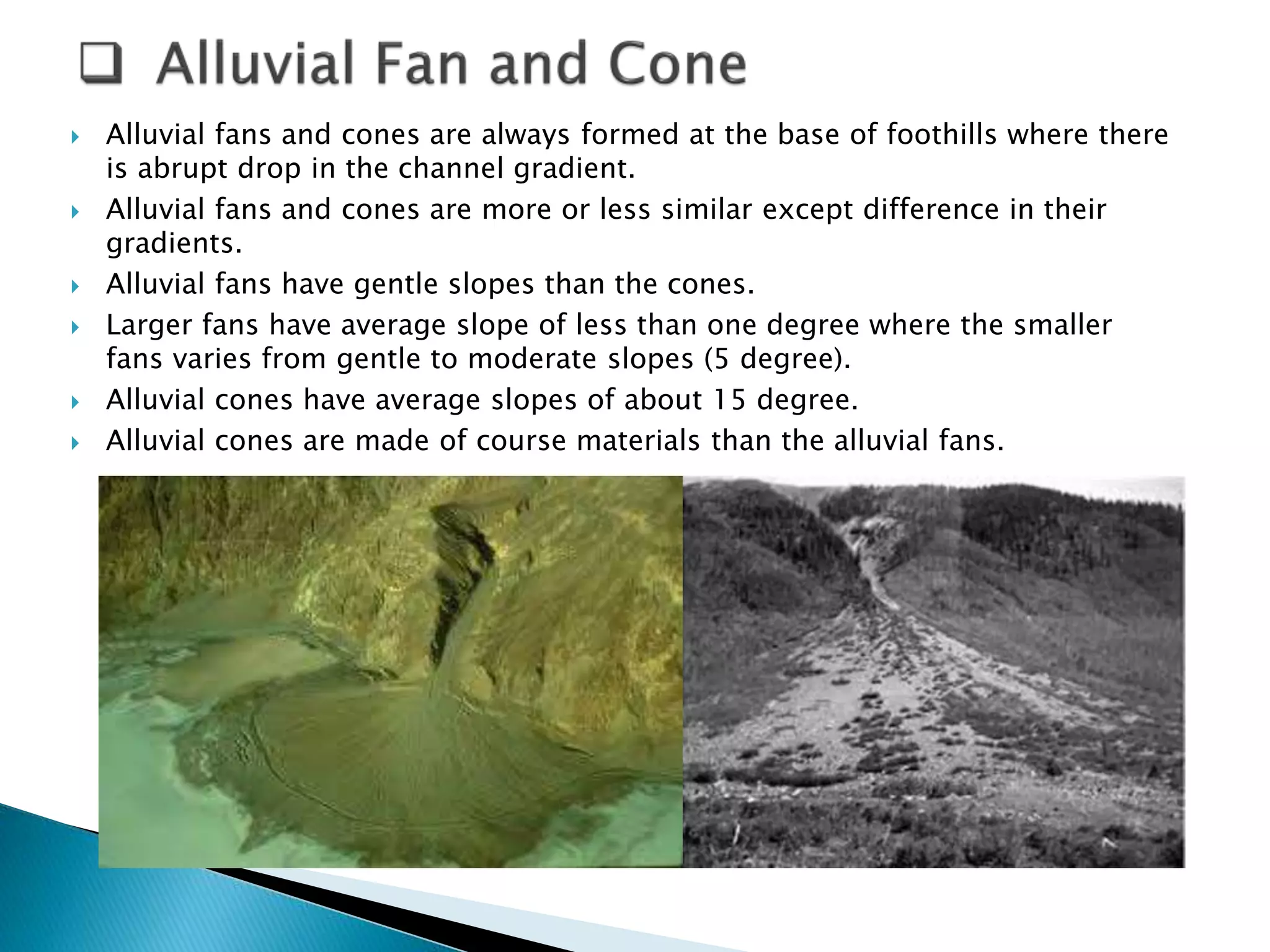
 Alluvial fans and cones are always formed at the base of foothills where there 
is abrupt drop in the channel gradient. 
 Alluvial fans and cones are more or less similar except difference in their 
gradients. 
 Alluvial fans have gentle slopes than the cones. 
 Larger fans have average slope of less than one degree where the smaller 
fans varies from gentle to moderate slopes (5 degree). 
 Alluvial cones have average slopes of about 15 degree. 
 Alluvial cones are made of course materials than the alluvial fans.
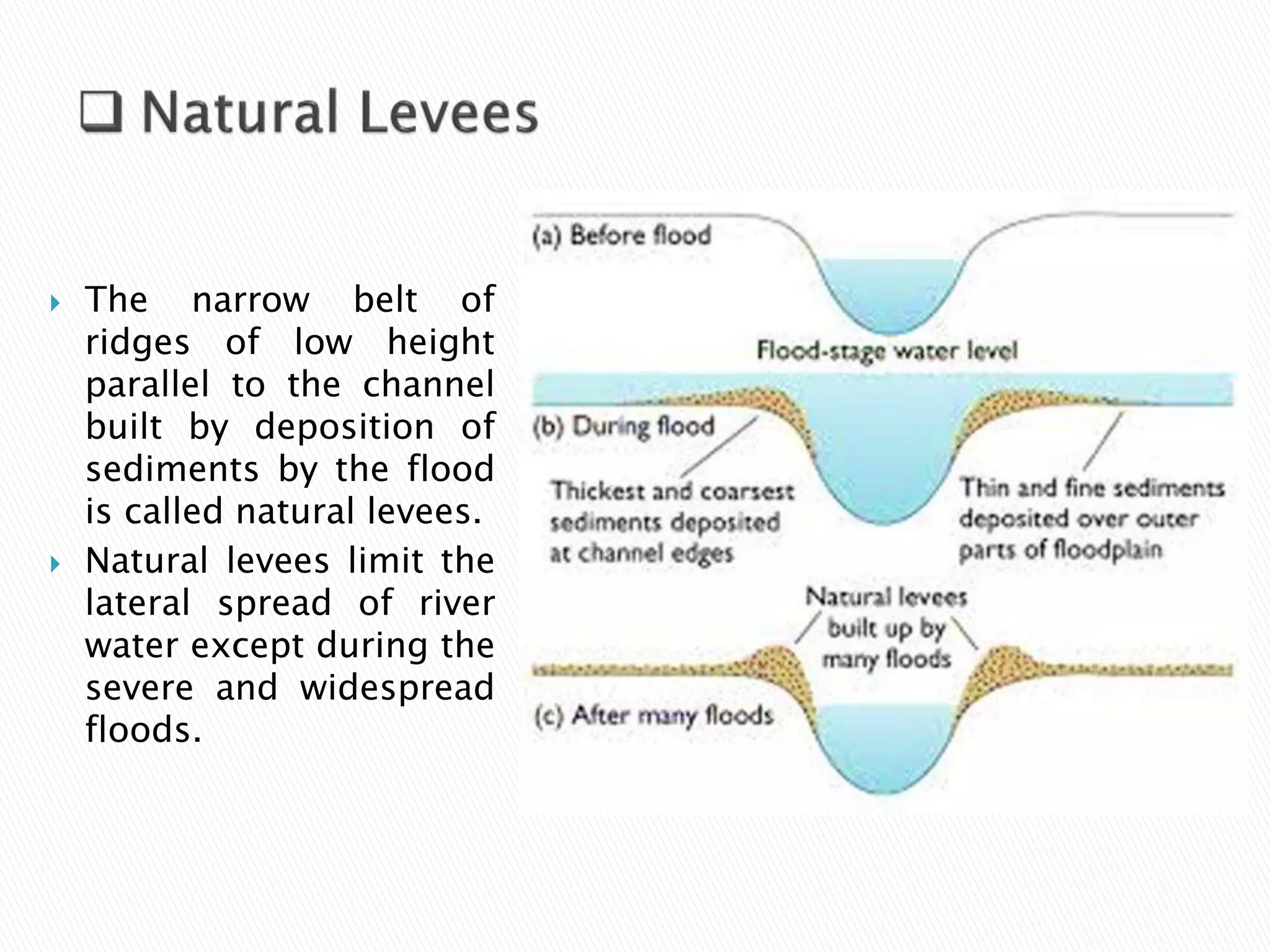
 The narrow belt of 
ridges of low height 
parallel to the channel 
built by deposition of 
sediments by the flood 
is called natural levees. 
 Natural levees limit the 
lateral spread of river 
water except during the 
severe and widespread 
floods.
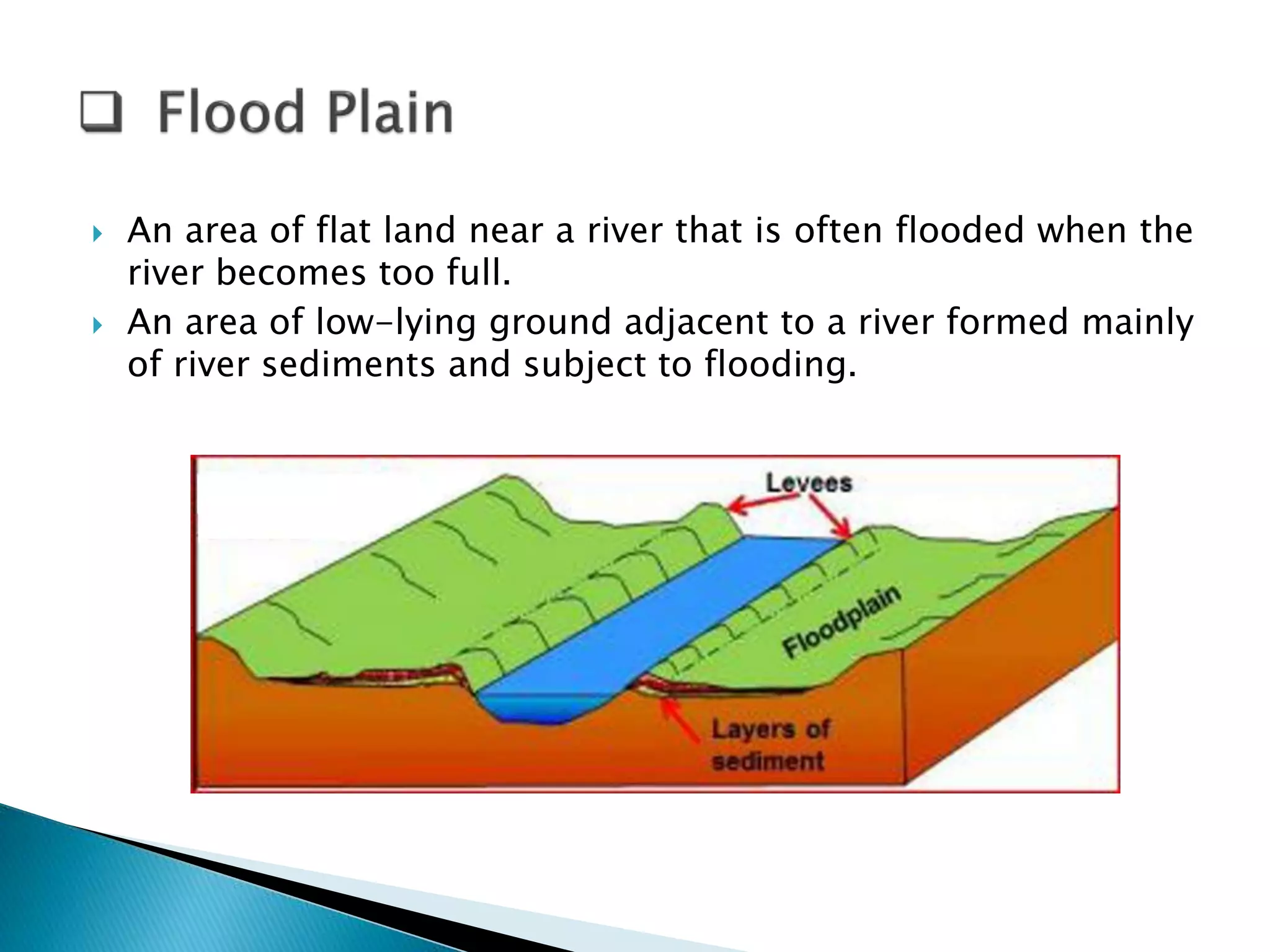
 An area of flat land near a river that is often flooded when the 
river becomes too full. 
 An area of low-lying ground adjacent to a river formed mainly 
of river sediments and subject to flooding.
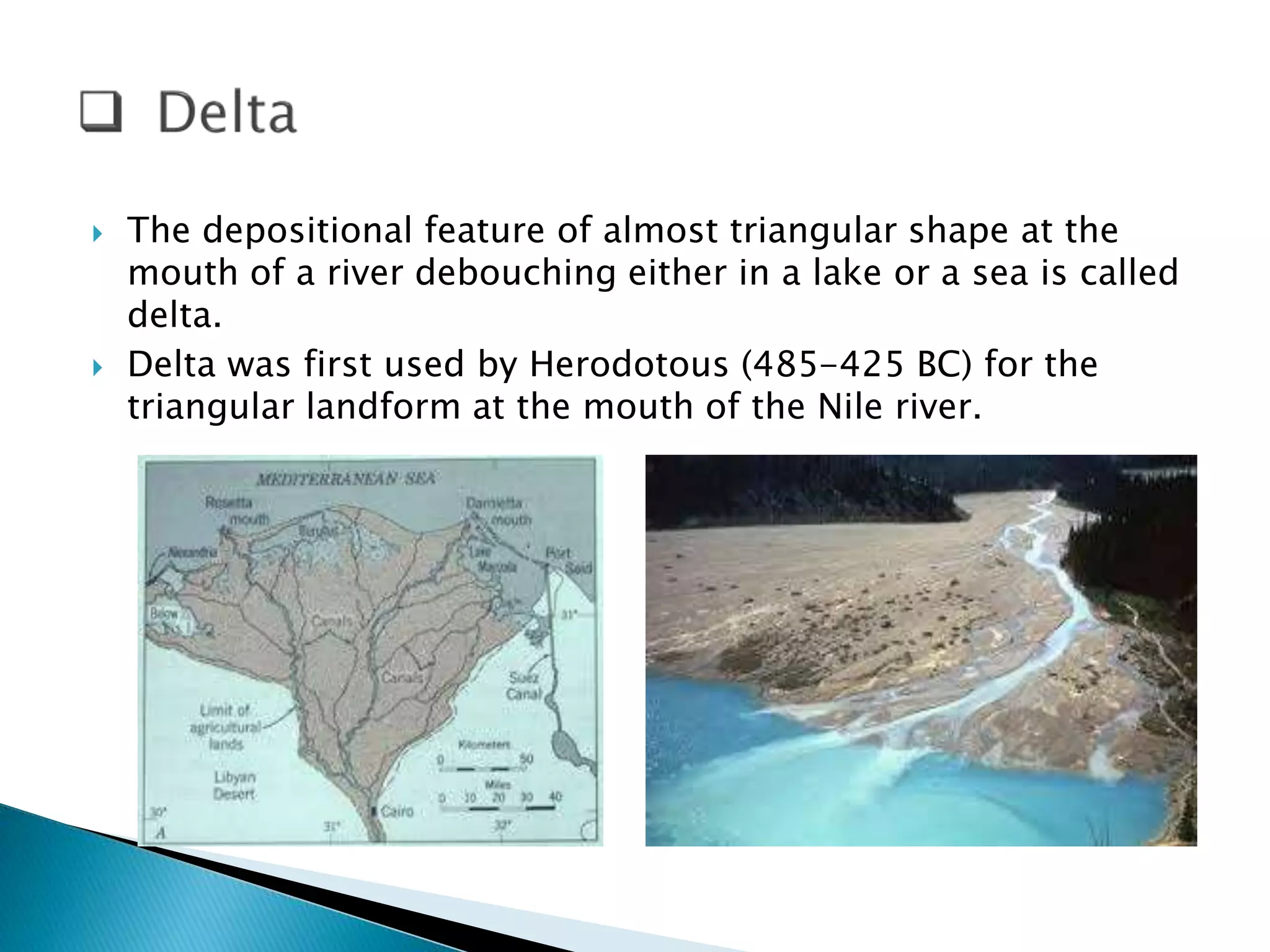
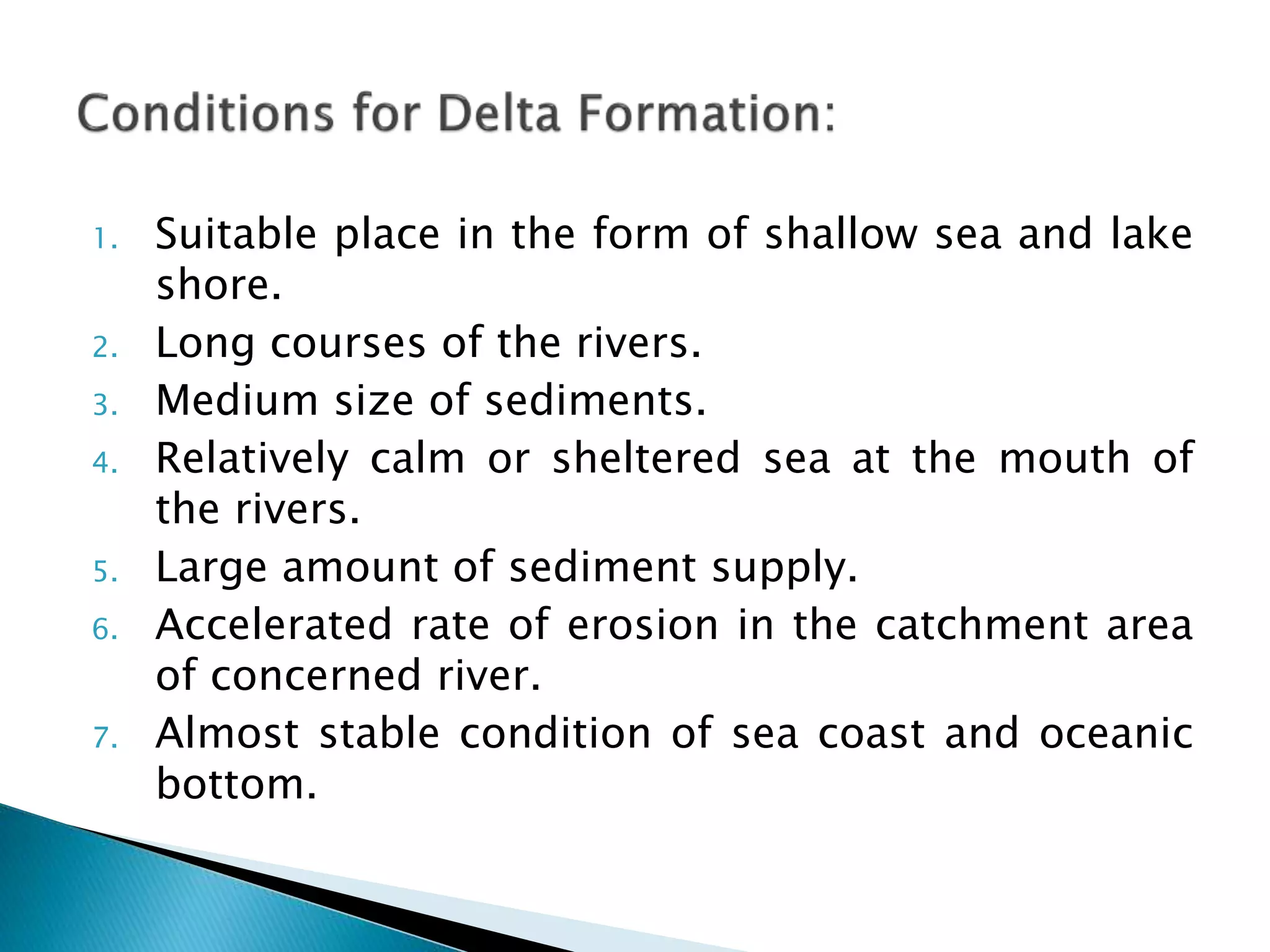
 The depositional feature of almost triangular shape at the 
mouth of a river debouching either in a lake or a sea is called 
delta. 
 Delta was first used by Herodotous (485-425 BC) for the 
triangular landform at the mouth of the Nile river.
1. Suitable place in the form of shallow sea and lake 
shore. 
2. Long courses of the rivers. 
3. Medium size of sediments. 
4. Relatively calm or sheltered sea at the mouth of 
the rivers. 
5. Large amount of sediment supply. 
6. Accelerated rate of erosion in the catchment area 
of concerned river. 
7. Almost stable condition of sea coast and oceanic 
bottom.
On the basis of shape: Four types 
1. Arcuate delta 
2. Bird-foot delta 
3. Estuarine delta 
4. Truncated delta 
On the basis of growth: Two types 
1. Growing delta 
2. Blocked delta
On the basis of shape: 
Four types 
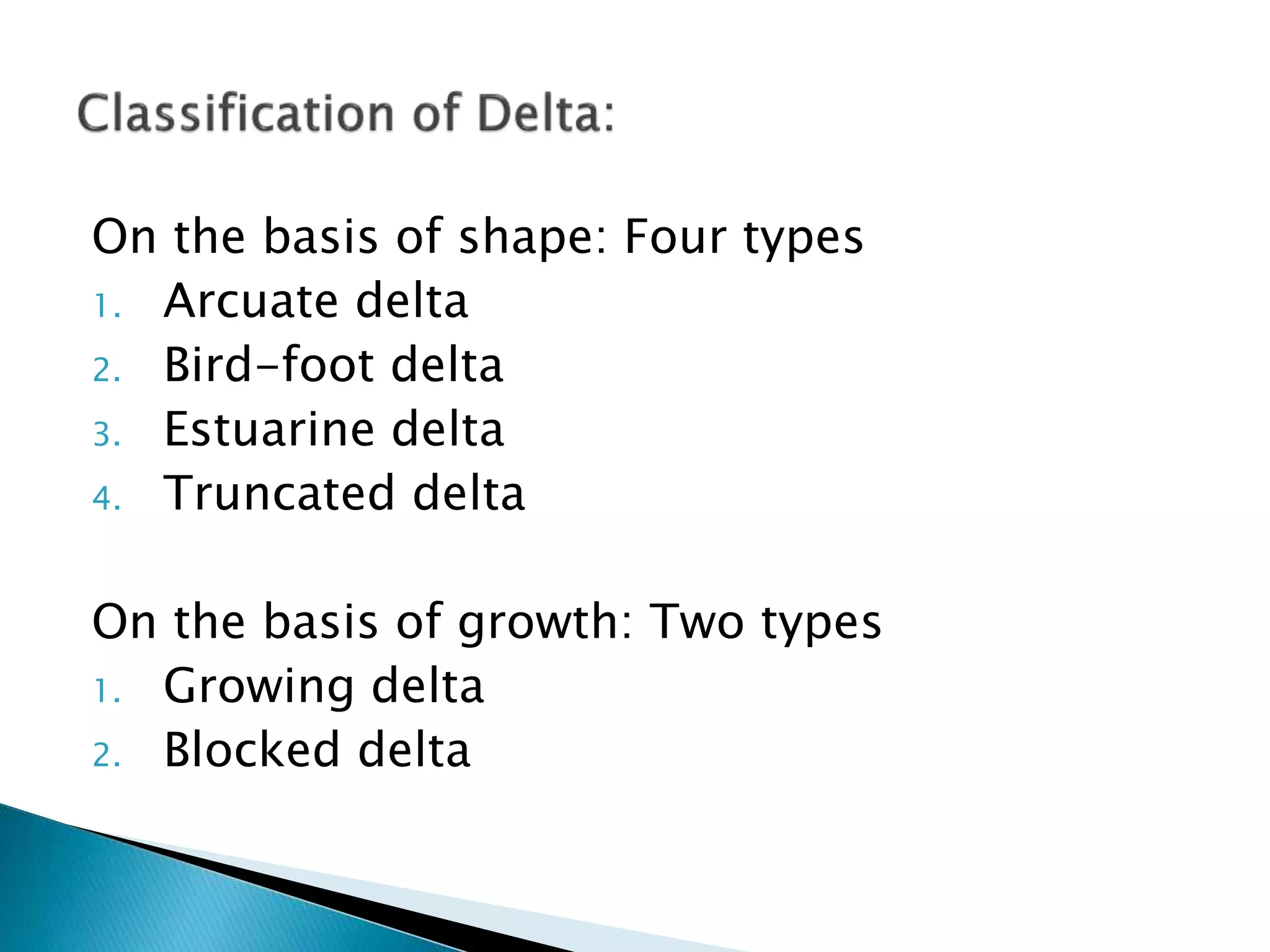
1. Arcuate delta 
 Arcuate delta is triangular 
in shape. 
 Outer edges are like an arc 
of a circle or a bow. 
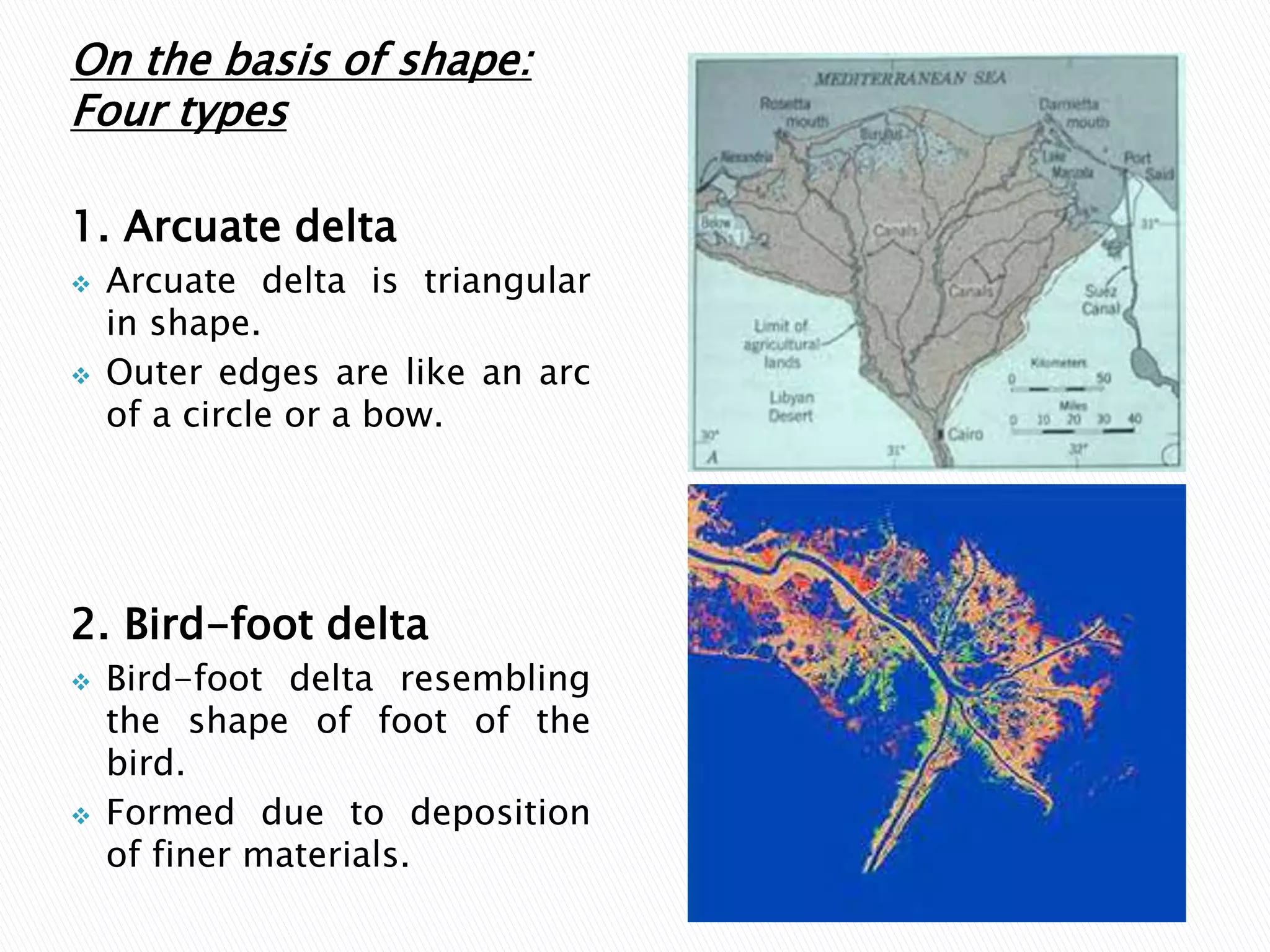
2. Bird-foot delta 
 Bird-foot delta resembling 
the shape of foot of the 
bird. 
 Formed due to deposition 
of finer materials.
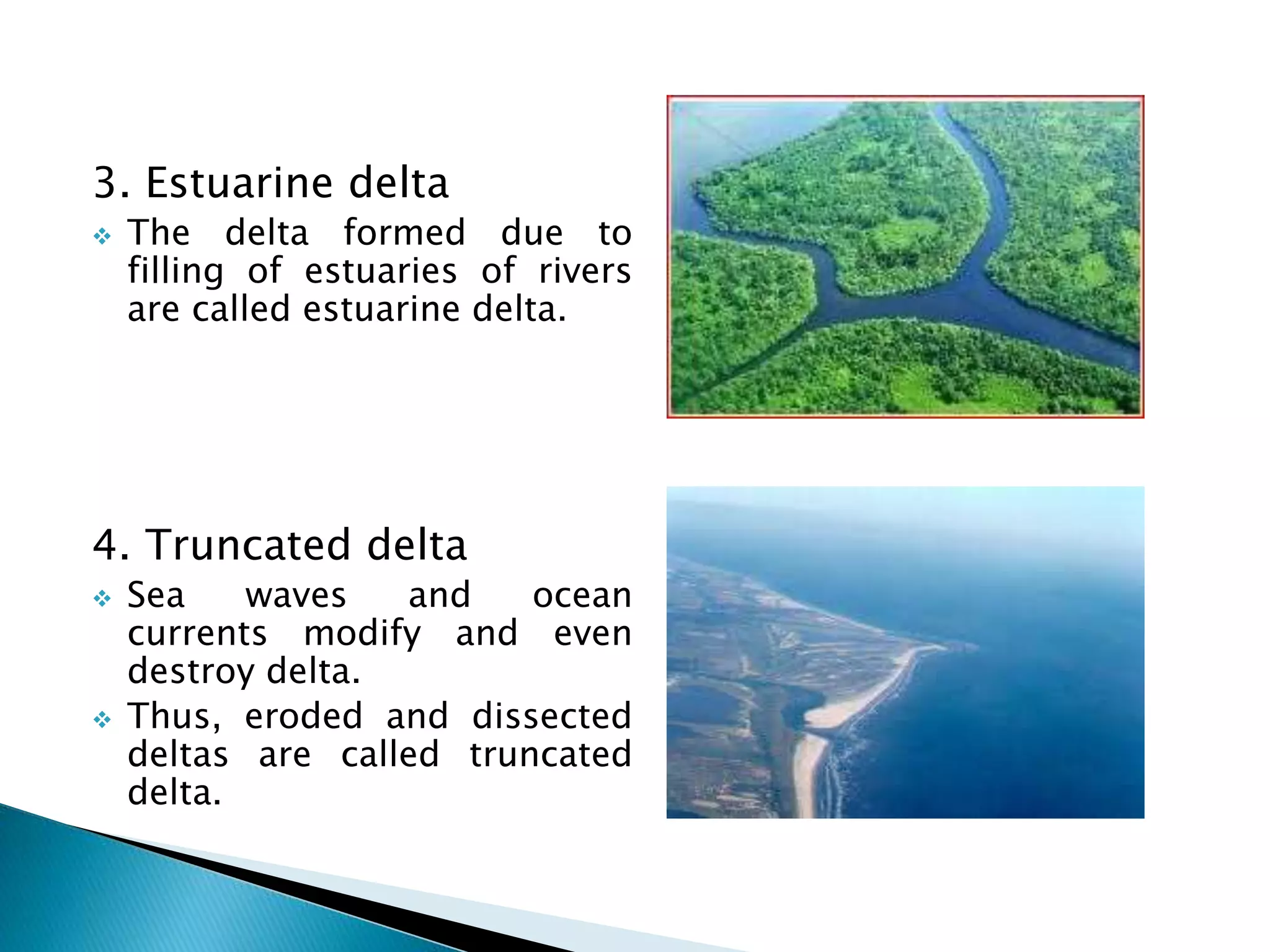
3. Estuarine delta 
 The delta formed due to 
filling of estuaries of rivers 
are called estuarine delta. 
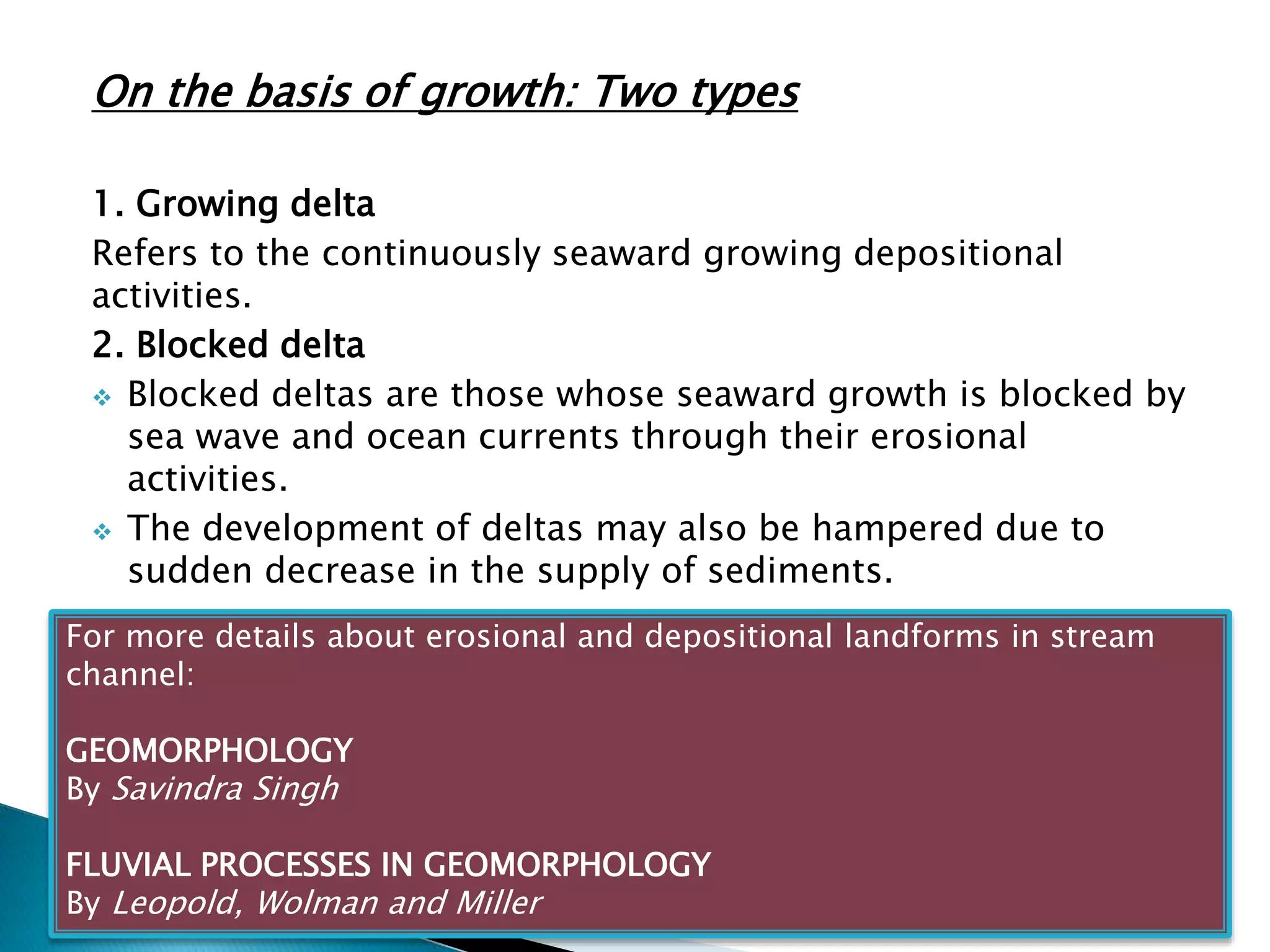
4. Truncated delta 
 Sea waves and ocean 
currents modify and even 
destroy delta. 
 Thus, eroded and dissected 
deltas are called truncated 
delta.
On the basis of growth: Two types 
1. Growing delta 
Refers to the continuously seaward growing depositional 
activities. 
2. Blocked delta 
 Blocked deltas are those whose seaward growth is blocked by 
sea wave and ocean currents through their erosional 
activities. 
 The development of deltas may also be hampered due to 
sudden decrease in the supply of sediments. 
For more details about erosional and depositional landforms in stream 
channel: 
GEOMORPHOLOGY 
By Savindra Singh 
FLUVIAL PROCESSES IN GEOMORPHOLOGY 
By Leopold, Wolman and Miller

Erosional and depositional landforms

  • 1.
    (Types and Characteristics) Md. Saiful Islam (2010135017) Nujath Tasnim (2010135027)
  • 2.
     Types ofErosional Landform: V-Shaped Valley Gorge and Canyon Waterfall  Pot hole  River Terraces  River Meanders
  • 3.
     The valleyscurved out by the rivers are significant erosional landforms.  The valley is very deep and narrow, both the valley sides meet together at the valley floor thus water always touches the valley sides.  The valley formed in the youthful stage of fluvial cycle of erosion and in the initial stage of valley development is V-shaped having steep valley side slope of convex element.  The valleys are gradually widened due to lateral erosion.
  • 4.
     Gorges andcanyons refer to the same basic landform.  The word ‘canyon’ is widely used in the United States and the term ‘gorge’ is widely used in Europe.  Gorge and canyon represents very deep and narrow valleys having very steep valley side slope.  Canyon have been formed through long period of time and frequent erosion from a plateau level. Gorges are mainly formed because of the flow of water or lava.  The walls of gorges and canyons are made of sandstone and granite.
  • 5.
     A waterfallmay be defined as a vertical drop of water of enormous volume from a great height in the long profile of the rivers.  Waterfalls are caused of factors e.g. (1) variation in the relative resistance of rocks, (2) relative difference in topographic reliefs, (3) fall in the sea level and (4) earth movement.
  • 6.
     A kettle-likesmall depressions in the rocky beds of the river valleys are called pot holes which are usually cylindrical in shape.  Pot holes are generally formed in coarse-grained rocks e.g. sandstone and granites.  The diameter of pot holes ranges from a few centimeters to several meters.  They are found in the upper course of a river where it has enough potential energy to erode vertically.  The pot holes go on increasing in both diameter and depth.
  • 7.
     The narrowflat surface on either side of the valley floor are called river terrace.  Some times, the river valleys are frequented by several terraces on either side wherein they are arranged in step-like forms.  River terraces are generally formed due to dissection of fluvial sediments of flood plains deposited along a valley floor.  Terrace represents the level of former valley floors and the remnants of former flood plain.
  • 8.
     River meandersrefer to the bends or longitudinal courses of the rivers.  The shape of meander is usually semi-circular but some times it is circular.  Each bend of a meander belt has two types of slopes: (1) Concave slope: This is the slope where the channel strikes the valley sides directly which is subjected to severe erosion resulting into the formation of vertical cliffs. (2) Convex slope: Characterized by gentle slope and which is formed by the deposition of mostly of sands and gravels but some times alluvium is also deposited.
  • 9.
    푆푖푛푢표푠푖푡푦 퐼푛푑푒푥 = 퐶ℎ푎푛푛푒푙 푙푒푛푔푡ℎ 퐷푖푠푝푙푎푐푒푚푒푛푡  Sinuosity is the ratio between channel length and displacement (straight line distance) between two points in the river’s course.
  • 10.
    River deposits sedimentsin different parts of their courses and thus form various types of landforms which are called depositional or constructional landforms. Types of depositional landforms:  Alluvial Fan and Cone  Natural Levees  Flood Plain  Delta
  • 11.
     Alluvial fansand cones are always formed at the base of foothills where there is abrupt drop in the channel gradient.  Alluvial fans and cones are more or less similar except difference in their gradients.  Alluvial fans have gentle slopes than the cones.  Larger fans have average slope of less than one degree where the smaller fans varies from gentle to moderate slopes (5 degree).  Alluvial cones have average slopes of about 15 degree.  Alluvial cones are made of course materials than the alluvial fans.
  • 12.
     The narrowbelt of ridges of low height parallel to the channel built by deposition of sediments by the flood is called natural levees.  Natural levees limit the lateral spread of river water except during the severe and widespread floods.
  • 13.
     An areaof flat land near a river that is often flooded when the river becomes too full.  An area of low-lying ground adjacent to a river formed mainly of river sediments and subject to flooding.
  • 14.
     The depositionalfeature of almost triangular shape at the mouth of a river debouching either in a lake or a sea is called delta.  Delta was first used by Herodotous (485-425 BC) for the triangular landform at the mouth of the Nile river.
  • 15.
    1. Suitable placein the form of shallow sea and lake shore. 2. Long courses of the rivers. 3. Medium size of sediments. 4. Relatively calm or sheltered sea at the mouth of the rivers. 5. Large amount of sediment supply. 6. Accelerated rate of erosion in the catchment area of concerned river. 7. Almost stable condition of sea coast and oceanic bottom.
  • 16.
    On the basisof shape: Four types 1. Arcuate delta 2. Bird-foot delta 3. Estuarine delta 4. Truncated delta On the basis of growth: Two types 1. Growing delta 2. Blocked delta
  • 17.
    On the basisof shape: Four types 1. Arcuate delta  Arcuate delta is triangular in shape.  Outer edges are like an arc of a circle or a bow. 2. Bird-foot delta  Bird-foot delta resembling the shape of foot of the bird.  Formed due to deposition of finer materials.
  • 18.
    3. Estuarine delta  The delta formed due to filling of estuaries of rivers are called estuarine delta. 4. Truncated delta  Sea waves and ocean currents modify and even destroy delta.  Thus, eroded and dissected deltas are called truncated delta.
  • 19.
    On the basisof growth: Two types 1. Growing delta Refers to the continuously seaward growing depositional activities. 2. Blocked delta  Blocked deltas are those whose seaward growth is blocked by sea wave and ocean currents through their erosional activities.  The development of deltas may also be hampered due to sudden decrease in the supply of sediments. For more details about erosional and depositional landforms in stream channel: GEOMORPHOLOGY By Savindra Singh FLUVIAL PROCESSES IN GEOMORPHOLOGY By Leopold, Wolman and Miller