Warm up
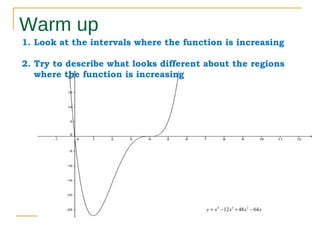
1. Look at the intervals where the function is increasing
2. Try to describe what looks different about the regions
where the function is increasing

y = x 4 − 12 x 3 + 48 x 2 − 64 x
Chapter Three: Section Four






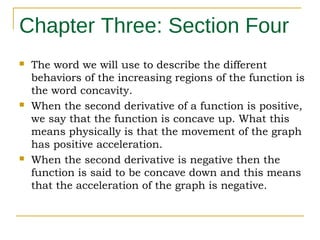
The word we will use to describe the different
behaviors of the increasing regions of the function is
the word concavity.
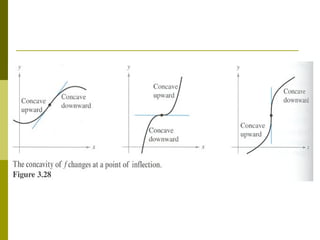
When the second derivative of a function is positive,
we say that the function is concave up. What this
means physically is that the movement of the graph
has positive acceleration.
When the second derivative is negative then the
function is said to be concave down and this means
that the acceleration of the graph is negative.
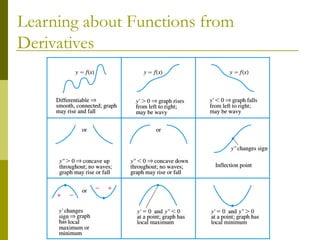
Concavity
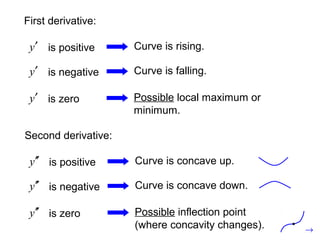
First derivative:

y′ is positive

Curve is rising.

y′ is negative

Curve is falling.

y′ is zero

Possible local maximum or
minimum.

Second derivative:

y′′ is positive

Curve is concave up.

y′′ is negative

Curve is concave down.

y′′ is zero

Possible inflection point
(where concavity changes).

→
Example Determining Concavity
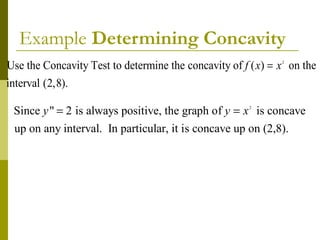
Use the Concavity Test to determine the concavity of f ( x) = x on the
interval (2,8).
2

Since y " = 2 is always positive, the graph of y = x is concave
up on any interval. In particular, it is concave up on (2,8).
2
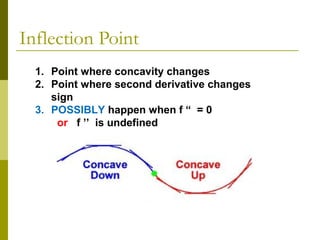
Inflection Point
1. Point where concavity changes
2. Point where second derivative changes
sign
3. POSSIBLY happen when f “ = 0
or f ’’ is undefined
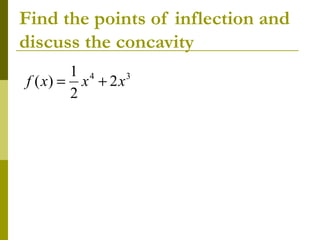
Find the points of inflection and
discuss the concavity
1 4
3
f ( x) = x + 2 x
2
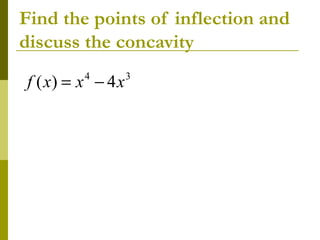
Find the points of inflection and
discuss the concavity
f ( x) = x − 4 x
4

3
Ex01: Determining Concavity

6
f ( x) = 2
x +3
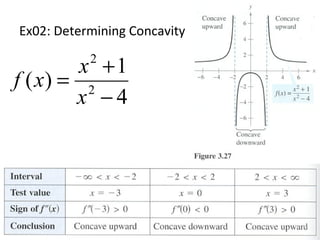
Ex02: Determining Concavity

x +1
f ( x) = 2
x −4
2
Learning about Functions from
Derivatives

Second derivative test ap calc

  • 1.
    Warm up 1. Lookat the intervals where the function is increasing 2. Try to describe what looks different about the regions where the function is increasing y = x 4 − 12 x 3 + 48 x 2 − 64 x
  • 2.
    Chapter Three: SectionFour    The word we will use to describe the different behaviors of the increasing regions of the function is the word concavity. When the second derivative of a function is positive, we say that the function is concave up. What this means physically is that the movement of the graph has positive acceleration. When the second derivative is negative then the function is said to be concave down and this means that the acceleration of the graph is negative.
  • 3.
  • 4.
    First derivative: y′ ispositive Curve is rising. y′ is negative Curve is falling. y′ is zero Possible local maximum or minimum. Second derivative: y′′ is positive Curve is concave up. y′′ is negative Curve is concave down. y′′ is zero Possible inflection point (where concavity changes). →
  • 5.
    Example Determining Concavity Usethe Concavity Test to determine the concavity of f ( x) = x on the interval (2,8). 2 Since y " = 2 is always positive, the graph of y = x is concave up on any interval. In particular, it is concave up on (2,8). 2
  • 6.
    Inflection Point 1. Pointwhere concavity changes 2. Point where second derivative changes sign 3. POSSIBLY happen when f “ = 0 or f ’’ is undefined
  • 8.
    Find the pointsof inflection and discuss the concavity 1 4 3 f ( x) = x + 2 x 2
  • 9.
    Find the pointsof inflection and discuss the concavity f ( x) = x − 4 x 4 3
  • 10.
  • 11.
    Ex02: Determining Concavity x+1 f ( x) = 2 x −4 2
  • 12.
    Learning about Functionsfrom Derivatives

Editor's Notes