Total Productive Maintenance
            TPM
          Overview

       Dave Hoyte, CEO
     JL French Corporation


                               Slide 1
TPM as a Lean Initiative

• Competitive costs require
  – Spending control
  – Defect control
  – Downtime reduction

• TPM = Total Productive Maintenance
  – Proactive (with all employees involved)
  – Preventive
  – Predictive
  – Planned

                                              Slide 2
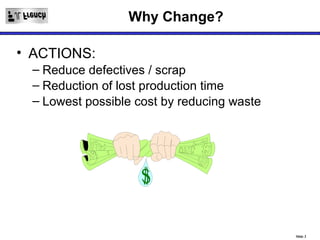
Why Change?

• ACTIONS:
  – Reduce defectives / scrap
  – Reduction of lost production time
  – Lowest possible cost by reducing waste


                                             Slide 3
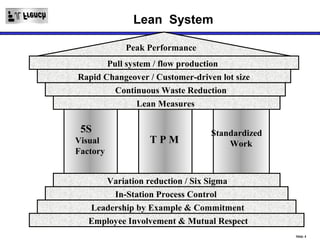
Lean System

            Peak Performance
       Pull system / flow production
Rapid Changeover / Customer-driven lot size
         Continuous Waste Reduction
               Lean Measures

 5S                              Standardized
Visual            TPM                Work
Factory


      Variation reduction / Six Sigma
        In-Station Process Control
   Leadership by Example & Commitment
   Employee Involvement & Mutual Respect
                                                Slide 4
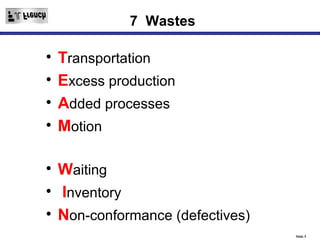
7 Wastes

•   Transportation
•   Excess production
•   Added processes
•   Motion

• Waiting
• Inventory
• Non-conformance (defectives)
                                 Slide 5
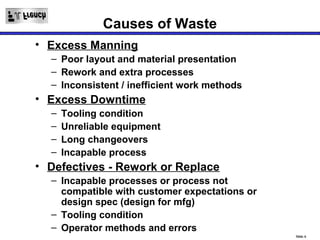
Causes of Waste
• Excess Manning
  – Poor layout and material presentation
  – Rework and extra processes
  – Inconsistent / inefficient work methods
• Excess Downtime
  –   Tooling condition
  –   Unreliable equipment
  –   Long changeovers
  –   Incapable process
• Defectives - Rework or Replace
  – Incapable processes or process not
    compatible with customer expectations or
    design spec (design for mfg)
  – Tooling condition
  – Operator methods and errors
                                               Slide 6
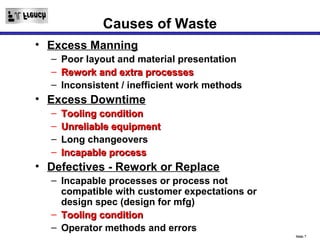
Causes of Waste
• Excess Manning
  – Poor layout and material presentation
  – Rework and extra processes
  – Inconsistent / inefficient work methods
• Excess Downtime
  –   Tooling condition
  –   Unreliable equipment
  –   Long changeovers
  –   Incapable process
• Defectives - Rework or Replace
  – Incapable processes or process not
    compatible with customer expectations or
    design spec (design for mfg)
  – Tooling condition
  – Operator methods and errors
                                               Slide 7
Effective TPM Eliminates 5 Losses


1.   Equipment breakdowns
2.   Defects, scrap, and rework
3.   Safety Issues
4.   Mini stoppages
5.   Reduced speed


                                           Slide 8
What is TPM??

TPM is a Lean tool to optimize the effectiveness of
manufacturing equipment and tooling.

  1. Starts with 5S / Visual Factory
  2. Builds a comprehensive Downtime Database by
     cause, frequency, and duration
  3. Predicts and prevents downtime by PM system
  4. Expands role of Operator as first point of early
     warning and prevention
  5. Develops Professional Maintenance skills


                                                        Slide 9
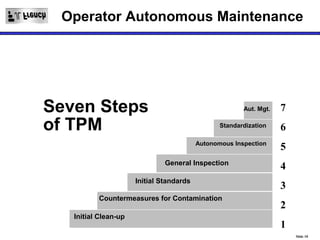
Operator Autonomous Maintenance


Seven Steps                                             Aut. Mgt.   7
                                                                    7
of TPM                                           Standardization    6
                                          Autonomous Inspection
                                                                    5
                               General Inspection                   4
                      Initial Standards                             3
                                                                    3
          Countermeasures for Contamination
                                                                    2
                                                                    2
   Initial Clean-up
                                                                    1
                                                                    1
                                                                        Slide 10
TPM is Planned, Predictive, & Preventive


1. Starts with 5S / Visual Factory
2. Builds a comprehensive downtime data
   base by cause, frequency, and duration
3. Predicts and prevents downtime by PM
   system
4. Expands role of Operator as first point of
   early warning and prevention
5. Professional Maintenance


                                                Slide 11
5S Workplace

A safe, clean, orderly workplace is
fundamental to quality, efficiency, and teams

   Sort (organize)
   Shine (clean)
   Set in order (make orderly and neat)
   Standardize (visual place for everything)
   Sustain (maintain the system)

                                                Slide 12
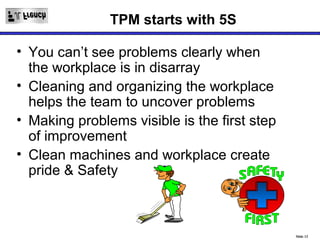
TPM starts with 5S

• You can’t see problems clearly when
  the workplace is in disarray
• Cleaning and organizing the workplace
  helps the team to uncover problems
• Making problems visible is the first step
  of improvement
• Clean machines and workplace create
  pride & Safety


                                              Slide 13
Downtime Visual Controls

• Visual or audio alerts
  – Abnormality obvious at a glance (e.g. stoppage,
    reject, control fault)
  – Alerting Maint and team leaders
  – Provide real time “scoreboard” for employees
     •   Machine down light visible from aisle
     •   Production status board (e.g. actual counts vs. goal)
     •   Scrap counts and downtime minutes
     •   Located in clear view in shop (not in control room)
     •   Simple, self regulating, & employee managed


                                                             Slide 14
TPM is Planned, Predictive, & Preventive


1. Starts with 5S / Visual Factory
2. Builds a comprehensive
   downtime data base by cause,
   frequency, and duration
3. Predicts and prevents downtime by PM
   system
4. Expands role of Operator as first point of
   early warning and prevention
5. Professional Maintenance


                                                Slide 15
Downtime Database
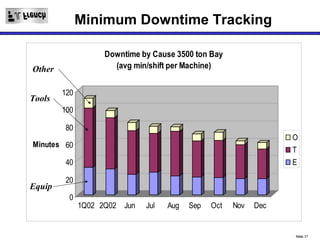
• Categorize at a minimum by Equip, Tooling, C/O, Other
• Segmented bar graph for E-T-O lost time
• Subcategories for Equip (e.g.)
   –   Hydraulic / pneumatic
   –   Mechanical / lubrication
   –   Electrical / controls
   –   Shot-end components
• Subcategories for Tooling (e.g.)
   –   Slides
   –   Cores
   –   Inserts
   –   Ejector pins
• Subcategories for Other (e.g.)
   – Operator error
   – Materials
                                                          Slide 16
Minimum Downtime Tracking

                    Downtime by Cause 3500 ton Bay
Other                 (avg min/shift per Machine)


        120
Tools
        100

        80
                                                                    O
Minutes 60
                                                                    T
        40                                                          E

        20
Equip
         0
              1Q02 2Q02   Jun   Jul   Aug   Sep   Oct   Nov   Dec


                                                                    Slide 17
TPM is Planned, Predictive, & Preventive


1. Starts with 5S / Visual Factory
2. Builds a comprehensive downtime data
   base by cause, frequency, and duration
3. Predicts and prevents downtime
   by PM system
4. Expands role of Operator as first point of
   early warning and prevention
5. Professional Maintenance


                                                Slide 18
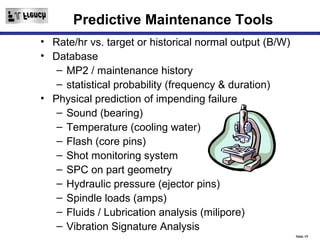
Predictive Maintenance Tools
• Rate/hr vs. target or historical normal output (B/W)
• Database
   – MP2 / maintenance history
   – statistical probability (frequency & duration)
• Physical prediction of impending failure
   – Sound (bearing)
   – Temperature (cooling water)
   – Flash (core pins)
   – Shot monitoring system
   – SPC on part geometry
   – Hydraulic pressure (ejector pins)
   – Spindle loads (amps)
   – Fluids / Lubrication analysis (milipore)
   – Vibration Signature Analysis
                                                         Slide 19
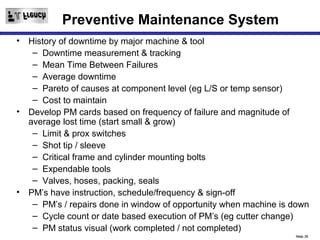
Preventive Maintenance System
• History of downtime by major machine & tool
   – Downtime measurement & tracking
   – Mean Time Between Failures
   – Average downtime
   – Pareto of causes at component level (eg L/S or temp sensor)
   – Cost to maintain
• Develop PM cards based on frequency of failure and magnitude of
  average lost time (start small & grow)
   – Limit & prox switches
   – Shot tip / sleeve
   – Critical frame and cylinder mounting bolts
   – Expendable tools
   – Valves, hoses, packing, seals
• PM’s have instruction, schedule/frequency & sign-off
   – PM’s / repairs done in window of opportunity when machine is down
   – Cycle count or date based execution of PM’s (eg cutter change)
   – PM status visual (work completed / not completed)
                                                                  Slide 20
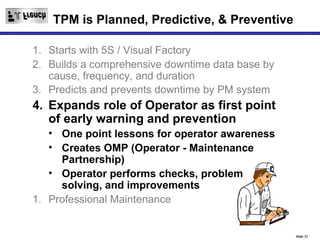
TPM is Planned, Predictive, & Preventive

1. Starts with 5S / Visual Factory
2. Builds a comprehensive downtime data base by
   cause, frequency, and duration
3. Predicts and prevents downtime by PM system
4. Expands role of Operator as first point
   of early warning and prevention
   • One point lessons for operator awareness
   • Creates OMP (Operator - Maintenance
     Partnership)
   • Operator performs checks, problem
     solving, and improvements
1. Professional Maintenance


                                                  Slide 21
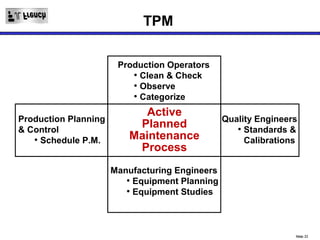
TPM

                       Production Operators
                          • Clean & Check
                          • Observe
                          • Categorize
                             Active
Production Planning                             Quality Engineers
& Control
                           Planned                 • Standards &
   • Schedule P.M.        Maintenance                Calibrations
                           Process
                      Manufacturing Engineers
                         • Equipment Planning
                         • Equipment Studies


                                                                Slide 22
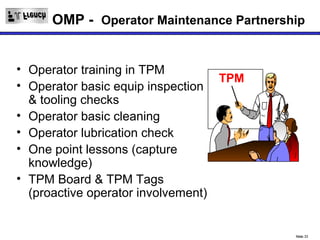
OMP - Operator Maintenance Partnership


• Operator training in TPM
                                   TPM
• Operator basic equip inspection
  & tooling checks
• Operator basic cleaning
• Operator lubrication check
• One point lessons (capture
  knowledge)
• TPM Board & TPM Tags
  (proactive operator involvement)


                                         Slide 23
TPM Tag System


• Problem communication tool to and from
  maintenance, tool room, and production
  – Identify abnormal machine conditions
     • Record problem discovered by operator
     • Record problem found during scheduled PM
  – Status tracking system of requested repairs
  – TPM visual management tool (hang tags)
  – Repair history for future problem solving
• TPM Tag used for recording problem & fix
  – Blue Tag-Operator or Maint responsible to repair
  – Red Tag- Safety-related request (priority)


                                                       Slide 24
Tag Process
Operator/Supervisor                    Production Management                      Maintenance
1. Abnormality Identified
2. Fill out Tag Red= Safety
                 Blue= Prod/Maint
3. Hang C-tag as close to the defect
as possible
4. Hang A &B Tags on the TPM Tag                                                  5.Maintenance evaluates problem. If
status board by Machine location and                                              fixed immediately go to 6. If parts or
area of responsibility to correct.                                                time needed, maint pulls A tag from
                                                                                  board. The A tag is MWO. The B
                                                                                  tag is posted on the Maint WO
                                                                                  status section of the TPM Board
                                                                                  with est. timing.

7. Operator/Supervisor check to see                                               6.After work is completed,
if work was done.                                                                 maintenance completes back side of
                                                                                   A tag and places both the A & B
                                                                                  tag in the work completed box

8. If OK, Operator/ supervisor         9. Production management reviews
removes C tag from machine and         the information. Also reviews the
places ABC tags in Completed box. If   comments and takes actions if
not OK, tags stay and maint is         required. Places tag in history file box
contacted. Contact noted on tag.       located in the office


                                       Tag information is recorded and reviewed for continuous improvement of PM
                                       database by Production and Maintenance; Repeat operator tags may indicate
                                       Maint needs to investigate.

                                                                                                                   Slide 25
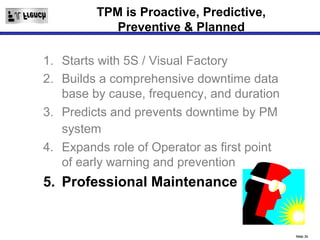
TPM is Proactive, Predictive,
            Preventive & Planned

1. Starts with 5S / Visual Factory
2. Builds a comprehensive downtime data
   base by cause, frequency, and duration
3. Predicts and prevents downtime by PM
   system
4. Expands role of Operator as first point
   of early warning and prevention
5. Professional Maintenance


                                             Slide 26
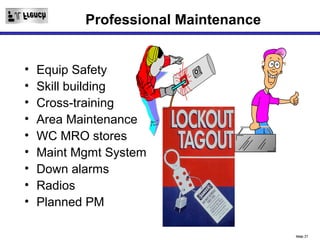
Professional Maintenance


•   Equip Safety
•   Skill building
•   Cross-training
•   Area Maintenance
•   WC MRO stores
•   Maint Mgmt System
•   Down alarms
•   Radios
•   Planned PM

                                      Slide 27
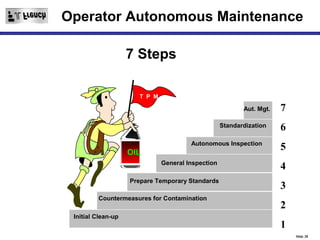
Operator Autonomous Maintenance

                    7 Steps

                      T P M

                                                          Aut. Mgt.   7
                                                                      7
                                                   Standardization    6
                                       Autonomous Inspection
                    OIL
                                                                      5
                              General Inspection                      4
                    Prepare Temporary Standards                       3
                                                                      3
         Countermeasures for Contamination
                                                                      2
                                                                      2
 Initial Clean-up
                                                                      1
                                                                      1
                                                                          Slide 28
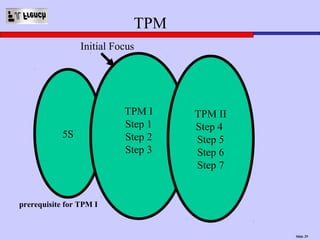
TPM
                 Initial Focus


                           TPM I    TPM II
                           Step 1   Step 4
            5S             Step 2   Step 5
                           Step 3   Step 6
                                    Step 7


prerequisite for TPM I


                                             Slide 29
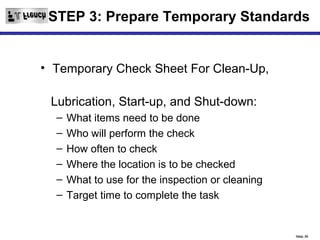
STEP 3: Prepare Temporary Standards
This step is to enhance the equipment reliability
& maintainability.
• Temporary Check Sheet For Clean-Up,

  Lubrication, Start-up, and Shut-down:
   –   What items need to be done
   –   Who will perform the check
   –   How often to check
   –   Where the location is to be checked
   –   What to use for the inspection or cleaning
   –   Target time to complete the task


                                                    Slide 30
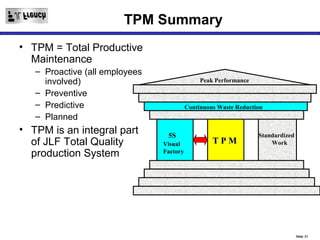
TPM Summary
• TPM = Total Productive
  Maintenance
   – Proactive (all employees
     involved)                                 Peak Performance

   – Preventive
   – Predictive                           Continuous Waste Reduction
   – Planned
• TPM is an integral part        5S                               Standardized
  of JLF Total Quality          Visual             TPM                Work
  production System             Factory


                                                                                 Slide 31
TPM is a Lean tool for
Quality and
Productivity


                         Slide 32

Tpm training

  • 1.
    Total Productive Maintenance TPM Overview Dave Hoyte, CEO JL French Corporation Slide 1
  • 2.
    TPM as aLean Initiative • Competitive costs require – Spending control – Defect control – Downtime reduction • TPM = Total Productive Maintenance – Proactive (with all employees involved) – Preventive – Predictive – Planned Slide 2
  • 3.
    Why Change? • ACTIONS: – Reduce defectives / scrap – Reduction of lost production time – Lowest possible cost by reducing waste Slide 3
  • 4.
    Lean System Peak Performance Pull system / flow production Rapid Changeover / Customer-driven lot size Continuous Waste Reduction Lean Measures 5S Standardized Visual TPM Work Factory Variation reduction / Six Sigma In-Station Process Control Leadership by Example & Commitment Employee Involvement & Mutual Respect Slide 4
  • 5.
    7 Wastes • Transportation • Excess production • Added processes • Motion • Waiting • Inventory • Non-conformance (defectives) Slide 5
  • 6.
    Causes of Waste •Excess Manning – Poor layout and material presentation – Rework and extra processes – Inconsistent / inefficient work methods • Excess Downtime – Tooling condition – Unreliable equipment – Long changeovers – Incapable process • Defectives - Rework or Replace – Incapable processes or process not compatible with customer expectations or design spec (design for mfg) – Tooling condition – Operator methods and errors Slide 6
  • 7.
    Causes of Waste •Excess Manning – Poor layout and material presentation – Rework and extra processes – Inconsistent / inefficient work methods • Excess Downtime – Tooling condition – Unreliable equipment – Long changeovers – Incapable process • Defectives - Rework or Replace – Incapable processes or process not compatible with customer expectations or design spec (design for mfg) – Tooling condition – Operator methods and errors Slide 7
  • 8.
    Effective TPM Eliminates5 Losses 1. Equipment breakdowns 2. Defects, scrap, and rework 3. Safety Issues 4. Mini stoppages 5. Reduced speed Slide 8
  • 9.
    What is TPM?? TPMis a Lean tool to optimize the effectiveness of manufacturing equipment and tooling. 1. Starts with 5S / Visual Factory 2. Builds a comprehensive Downtime Database by cause, frequency, and duration 3. Predicts and prevents downtime by PM system 4. Expands role of Operator as first point of early warning and prevention 5. Develops Professional Maintenance skills Slide 9
  • 10.
    Operator Autonomous Maintenance SevenSteps Aut. Mgt. 7 7 of TPM Standardization 6 Autonomous Inspection 5 General Inspection 4 Initial Standards 3 3 Countermeasures for Contamination 2 2 Initial Clean-up 1 1 Slide 10
  • 11.
    TPM is Planned,Predictive, & Preventive 1. Starts with 5S / Visual Factory 2. Builds a comprehensive downtime data base by cause, frequency, and duration 3. Predicts and prevents downtime by PM system 4. Expands role of Operator as first point of early warning and prevention 5. Professional Maintenance Slide 11
  • 12.
    5S Workplace A safe,clean, orderly workplace is fundamental to quality, efficiency, and teams Sort (organize) Shine (clean) Set in order (make orderly and neat) Standardize (visual place for everything) Sustain (maintain the system) Slide 12
  • 13.
    TPM starts with5S • You can’t see problems clearly when the workplace is in disarray • Cleaning and organizing the workplace helps the team to uncover problems • Making problems visible is the first step of improvement • Clean machines and workplace create pride & Safety Slide 13
  • 14.
    Downtime Visual Controls •Visual or audio alerts – Abnormality obvious at a glance (e.g. stoppage, reject, control fault) – Alerting Maint and team leaders – Provide real time “scoreboard” for employees • Machine down light visible from aisle • Production status board (e.g. actual counts vs. goal) • Scrap counts and downtime minutes • Located in clear view in shop (not in control room) • Simple, self regulating, & employee managed Slide 14
  • 15.
    TPM is Planned,Predictive, & Preventive 1. Starts with 5S / Visual Factory 2. Builds a comprehensive downtime data base by cause, frequency, and duration 3. Predicts and prevents downtime by PM system 4. Expands role of Operator as first point of early warning and prevention 5. Professional Maintenance Slide 15
  • 16.
    Downtime Database • Categorizeat a minimum by Equip, Tooling, C/O, Other • Segmented bar graph for E-T-O lost time • Subcategories for Equip (e.g.) – Hydraulic / pneumatic – Mechanical / lubrication – Electrical / controls – Shot-end components • Subcategories for Tooling (e.g.) – Slides – Cores – Inserts – Ejector pins • Subcategories for Other (e.g.) – Operator error – Materials Slide 16
  • 17.
    Minimum Downtime Tracking Downtime by Cause 3500 ton Bay Other (avg min/shift per Machine) 120 Tools 100 80 O Minutes 60 T 40 E 20 Equip 0 1Q02 2Q02 Jun Jul Aug Sep Oct Nov Dec Slide 17
  • 18.
    TPM is Planned,Predictive, & Preventive 1. Starts with 5S / Visual Factory 2. Builds a comprehensive downtime data base by cause, frequency, and duration 3. Predicts and prevents downtime by PM system 4. Expands role of Operator as first point of early warning and prevention 5. Professional Maintenance Slide 18
  • 19.
    Predictive Maintenance Tools •Rate/hr vs. target or historical normal output (B/W) • Database – MP2 / maintenance history – statistical probability (frequency & duration) • Physical prediction of impending failure – Sound (bearing) – Temperature (cooling water) – Flash (core pins) – Shot monitoring system – SPC on part geometry – Hydraulic pressure (ejector pins) – Spindle loads (amps) – Fluids / Lubrication analysis (milipore) – Vibration Signature Analysis Slide 19
  • 20.
    Preventive Maintenance System •History of downtime by major machine & tool – Downtime measurement & tracking – Mean Time Between Failures – Average downtime – Pareto of causes at component level (eg L/S or temp sensor) – Cost to maintain • Develop PM cards based on frequency of failure and magnitude of average lost time (start small & grow) – Limit & prox switches – Shot tip / sleeve – Critical frame and cylinder mounting bolts – Expendable tools – Valves, hoses, packing, seals • PM’s have instruction, schedule/frequency & sign-off – PM’s / repairs done in window of opportunity when machine is down – Cycle count or date based execution of PM’s (eg cutter change) – PM status visual (work completed / not completed) Slide 20
  • 21.
    TPM is Planned,Predictive, & Preventive 1. Starts with 5S / Visual Factory 2. Builds a comprehensive downtime data base by cause, frequency, and duration 3. Predicts and prevents downtime by PM system 4. Expands role of Operator as first point of early warning and prevention • One point lessons for operator awareness • Creates OMP (Operator - Maintenance Partnership) • Operator performs checks, problem solving, and improvements 1. Professional Maintenance Slide 21
  • 22.
    TPM Production Operators • Clean & Check • Observe • Categorize Active Production Planning Quality Engineers & Control Planned • Standards & • Schedule P.M. Maintenance Calibrations Process Manufacturing Engineers • Equipment Planning • Equipment Studies Slide 22
  • 23.
    OMP - OperatorMaintenance Partnership • Operator training in TPM TPM • Operator basic equip inspection & tooling checks • Operator basic cleaning • Operator lubrication check • One point lessons (capture knowledge) • TPM Board & TPM Tags (proactive operator involvement) Slide 23
  • 24.
    TPM Tag System •Problem communication tool to and from maintenance, tool room, and production – Identify abnormal machine conditions • Record problem discovered by operator • Record problem found during scheduled PM – Status tracking system of requested repairs – TPM visual management tool (hang tags) – Repair history for future problem solving • TPM Tag used for recording problem & fix – Blue Tag-Operator or Maint responsible to repair – Red Tag- Safety-related request (priority) Slide 24
  • 25.
    Tag Process Operator/Supervisor Production Management Maintenance 1. Abnormality Identified 2. Fill out Tag Red= Safety Blue= Prod/Maint 3. Hang C-tag as close to the defect as possible 4. Hang A &B Tags on the TPM Tag 5.Maintenance evaluates problem. If status board by Machine location and fixed immediately go to 6. If parts or area of responsibility to correct. time needed, maint pulls A tag from board. The A tag is MWO. The B tag is posted on the Maint WO status section of the TPM Board with est. timing. 7. Operator/Supervisor check to see 6.After work is completed, if work was done. maintenance completes back side of A tag and places both the A & B tag in the work completed box 8. If OK, Operator/ supervisor 9. Production management reviews removes C tag from machine and the information. Also reviews the places ABC tags in Completed box. If comments and takes actions if not OK, tags stay and maint is required. Places tag in history file box contacted. Contact noted on tag. located in the office Tag information is recorded and reviewed for continuous improvement of PM database by Production and Maintenance; Repeat operator tags may indicate Maint needs to investigate. Slide 25
  • 26.
    TPM is Proactive,Predictive, Preventive & Planned 1. Starts with 5S / Visual Factory 2. Builds a comprehensive downtime data base by cause, frequency, and duration 3. Predicts and prevents downtime by PM system 4. Expands role of Operator as first point of early warning and prevention 5. Professional Maintenance Slide 26
  • 27.
    Professional Maintenance • Equip Safety • Skill building • Cross-training • Area Maintenance • WC MRO stores • Maint Mgmt System • Down alarms • Radios • Planned PM Slide 27
  • 28.
    Operator Autonomous Maintenance 7 Steps T P M Aut. Mgt. 7 7 Standardization 6 Autonomous Inspection OIL 5 General Inspection 4 Prepare Temporary Standards 3 3 Countermeasures for Contamination 2 2 Initial Clean-up 1 1 Slide 28
  • 29.
    TPM Initial Focus TPM I TPM II Step 1 Step 4 5S Step 2 Step 5 Step 3 Step 6 Step 7 prerequisite for TPM I Slide 29
  • 30.
    STEP 3: PrepareTemporary Standards This step is to enhance the equipment reliability & maintainability. • Temporary Check Sheet For Clean-Up, Lubrication, Start-up, and Shut-down: – What items need to be done – Who will perform the check – How often to check – Where the location is to be checked – What to use for the inspection or cleaning – Target time to complete the task Slide 30
  • 31.
    TPM Summary • TPM= Total Productive Maintenance – Proactive (all employees involved) Peak Performance – Preventive – Predictive Continuous Waste Reduction – Planned • TPM is an integral part 5S Standardized of JLF Total Quality Visual TPM Work production System Factory Slide 31
  • 32.
    TPM is aLean tool for Quality and Productivity Slide 32

Editor's Notes

  • #7 A key to standardized work and to eliminating waste is the importance of workplace improvements.
  • #8 A key to standardized work and to eliminating waste is the importance of workplace improvements.
  • #11 These are the 7 steps for Operator Autonomous Maintenance: 1. Initial clean-up 2. Countermeasures for Hard-to-Access & Source of Contamination 3. Prepare Temporary Standards 4. General Inspection 5. Autonomous Inspection 6. Standardization 7. Autonomous Management
  • #23 All of these activities must work together to fully achieve a successful planned maintenance program. Everyone must understand their roles and responsibilities and execute as a team. Planned maintenance can no longer be the sole responsibility of the maintenance department.
  • #29 These are the 7 steps for Operator Autonomous Maintenance: 1. Initial clean-up 2. Countermeasures for Hard-to-Access & Source of Contamination 3. Prepare Temporary Standards 4. General Inspection 5. Autonomous Inspection 6. Standardization 7. Autonomous Management
  • #31 This step is to enhance equipment reliability and maintainability. In this step we will prepare standards for lubrication, cleaning and items to inspect. The experience gained in steps 1 and 2 combined with support from the maintenance group will enable us to prepare the initial check sheets.