The

SERVQUAL

Model

By Group-3
Section-C
PGDM- Ist Year
Introduction


Service quality is an approach to manage business processes in
order to ensure full satisfaction of the customers & quality in
service provided. It works as an antecedent of customer
satisfaction.



If expectations are greater than performance, then perceived
quality is less than satisfactory and hence customer
dissatisfaction occurs.



SERVQUAL is a service quality framework, developed in the
eighties by Zeithaml, Parasuraman & Berry, aiming at measuring
the scale of Quality in the service sectors.



SERVQUAL was originally measured on 10 aspects of service
quality: reliability, responsiveness, competence, access, courtesy,
communication, credibility, security, understanding the customer,
and tangibles, to measure the gap between customer
expectations and experience.
SERVQUAL as a Measuring Tool


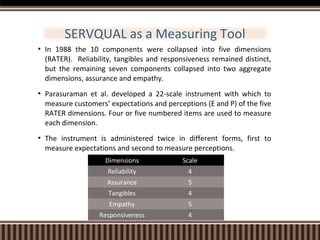
In 1988 the 10 components were collapsed into five dimensions
(RATER). Reliability, tangibles and responsiveness remained distinct,
but the remaining seven components collapsed into two aggregate
dimensions, assurance and empathy.



Parasuraman et al. developed a 22-scale instrument with which to
measure customers’ expectations and perceptions (E and P) of the five
RATER dimensions. Four or five numbered items are used to measure
each dimension.



The instrument is administered twice in different forms, first to
measure expectations and second to measure perceptions.
Dimensions

Scale

Reliability

4

Assurance

5

Tangibles

4

Empathy

5

Responsiveness

4
The Key Service Dimensions


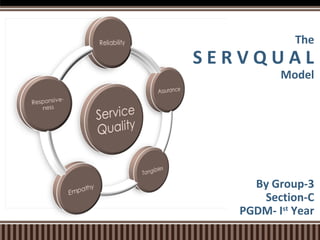
The five SERVQUAL dimensions are: R-A-T-E-R:

1.

RESPONSIVENESS - Willingness to help customers
and provide prompt service

2.

ASSURANCE - Knowledge and courtesy of employees
and their ability to convey trust and confidence

3.

TANGIBLES - Appearance of physical facilities,
equipment,
personnel,
and
communication
materials

4.

EMPATHY - Caring, individualized attention the firm
provides its customers

5.

RELIABILITY - Ability to perform the promised service
dependably and accurately
Conceptual Model of Service Quality


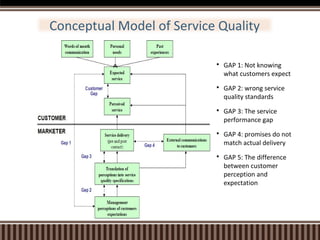
GAP 1: Not knowing
what customers expect



GAP 2: wrong service
quality standards



GAP 3: The service
performance gap



GAP 4: promises do not
match actual delivery



GAP 5: The difference
between customer
perception and
expectation
The SERVQUAL Gaps
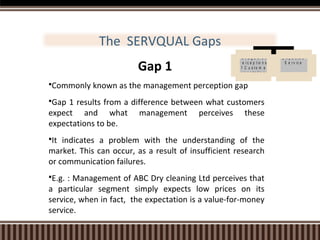
Gap 1

M a na ge m e nt
P e r c e p t io n s
o f C u s to m e r
E x p e c t a t io n s

Commonly known as the management perception gap
Gap

1 results from a difference between what customers
expect and what management perceives these
expectations to be.
It

indicates a problem with the understanding of the
market. This can occur, as a result of insufficient research
or communication failures.
E.g.

: Management of ABC Dry cleaning Ltd perceives that
a particular segment simply expects low prices on its
service, when in fact, the expectation is a value-for-money
service.

E x p e c te d
S e r v ic e
The SERVQUAL Gaps
Gap 2

S e r v ic e
Q u a lity
S p e c i f ic a t i o n s

Commonly known as quality specification gap.
Gap

2 results from a difference between management
perceptions of what customers expect and the
specifications that management draws up when detailing
the service quality delivery actions that are required.
Service

design and performance standards are prerequisites for bridging this gap.
E.g.

: Most hotels do not do housekeeping in a room on the
day the customer is checking out. But has management
realised that the customer who is doing a late checking out
wants a clean room during that day?

M a na ge m e nt
P e r c e p t io n s
o f C u s to m e r
E x p e c t a t io n s
The SERVQUAL Gaps
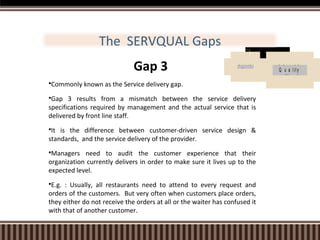
Gap 3

S e r v ic e
D e liv e r y

Commonly known as the Service delivery gap.
Gap

3 results from a mismatch between the service delivery
specifications required by management and the actual service that is
delivered by front line staff.
It

is the difference between customer-driven service design &
standards, and the service delivery of the provider.
Managers

need to audit the customer experience that their
organization currently delivers in order to make sure it lives up to the
expected level.
E.g.

: Usually, all restaurants need to attend to every request and
orders of the customers. But very often when customers place orders,
they either do not receive the orders at all or the waiter has confused it
with that of another customer.

S e r v ic e
Q u a lity
S p e c i f ic a t i o n s
The SERVQUAL Gaps

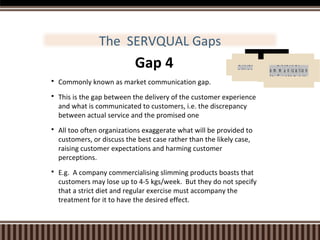
Gap 4

S e r v ic e
D e liv e r y



Commonly known as market communication gap.



This is the gap between the delivery of the customer experience
and what is communicated to customers, i.e. the discrepancy
between actual service and the promised one



All too often organizations exaggerate what will be provided to
customers, or discuss the best case rather than the likely case,
raising customer expectations and harming customer
perceptions.



E.g. A company commercialising slimming products boasts that
customers may lose up to 4-5 kgs/week. But they do not specify
that a strict diet and regular exercise must accompany the
treatment for it to have the desired effect.

E x te rn a l
C o m m u n ic a t io n s
to C u s to m e rs
The SERVQUAL Gaps
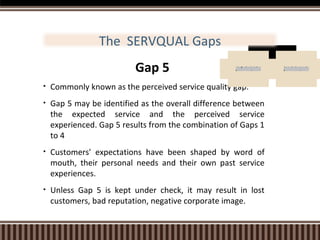
Gap 5

E x p e c te d
S e r v ic e

•

Commonly known as the perceived service quality gap.

•

Gap 5 may be identified as the overall difference between
the expected service and the perceived service
experienced. Gap 5 results from the combination of Gaps 1
to 4

•

Customers' expectations have been shaped by word of
mouth, their personal needs and their own past service
experiences.

•

Unless Gap 5 is kept under check, it may result in lost
customers, bad reputation, negative corporate image.

P e r c e iv e d
S e r v ic e
Causes for the Gaps
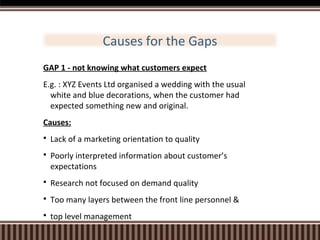
GAP 1 - not knowing what customers expect
E.g. : XYZ Events Ltd organised a wedding with the usual
white and blue decorations, when the customer had
expected something new and original.
Causes:


Lack of a marketing orientation to quality



Poorly interpreted information about customer’s
expectations



Research not focused on demand quality



Too many layers between the front line personnel &



top level management
Causes for the Gaps
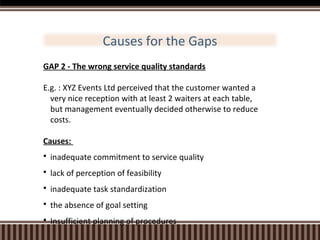
GAP 2 - The wrong service quality standards
E.g. : XYZ Events Ltd perceived that the customer wanted a
very nice reception with at least 2 waiters at each table,
but management eventually decided otherwise to reduce
costs.
Causes:


inadequate commitment to service quality



lack of perception of feasibility



inadequate task standardization



the absence of goal setting



Insufficient planning of procedures
Causes for the Gaps
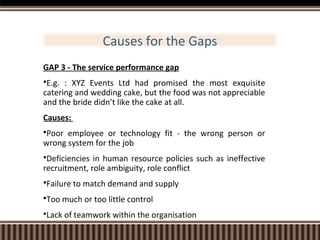
GAP 3 - The service performance gap
E.g.

: XYZ Events Ltd had promised the most exquisite
catering and wedding cake, but the food was not appreciable
and the bride didn’t like the cake at all.
Causes:
Poor

employee or technology fit - the wrong person or
wrong system for the job
Deficiencies

in human resource policies such as ineffective
recruitment, role ambiguity, role conflict
Failure to match demand and supply
Too much or too little control
Lack of teamwork within the organisation
Causes for the Gaps
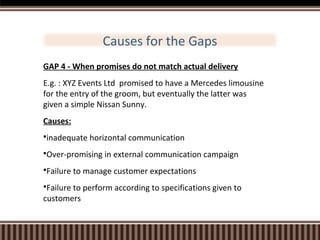
GAP 4 - When promises do not match actual delivery
E.g. : XYZ Events Ltd promised to have a Mercedes limousine
for the entry of the groom, but eventually the latter was
given a simple Nissan Sunny.
Causes:
inadequate horizontal communication
Over-promising in external communication campaign
Failure to manage customer expectations
Failure to perform according to specifications given to

customers
Causes for the Gaps
GAP 5 - The difference between customer perception of
service and the expectation they had
Usually the cause is the occurrence of the 4 other Gaps, which
results in a difference between customer perception and the
expectation they had. Ultimately the groom’s experience was
way too far from what he had expected, and thus results in
dissatisfaction.
Other causes can be:
cultural background, family lifestyle, personality,
demographics, advertising, experience with similar service
information available online
Solution for the Gaps
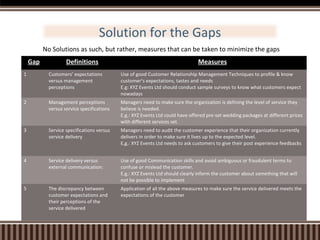
No Solutions as such, but rather, measures that can be taken to minimize the gaps
Gap

Definitions

Measures

1

Customers’ expectations
versus management
perceptions

Use of good Customer Relationship Management Techniques to profile & know
customer’s expectations, tastes and needs
E.g: XYZ Events Ltd should conduct sample surveys to know what customers expect
nowadays

2

Management perceptions
versus service specifications

Managers need to make sure the organization is defining the level of service they
believe is needed.
E.g.: XYZ Events Ltd could have offered pre-set wedding packages at different prices
with different services set.

3

Service specifications versus
service delivery

Managers need to audit the customer experience that their organization currently
delivers in order to make sure it lives up to the expected level.
E,g.: XYZ Events Ltd needs to ask customers to give their post experience feedbacks

4

Service delivery versus
external communication:

Use of good Communication skills and avoid ambiguous or fraudulent terms to
confuse or mislead the customer.
E.g.: XYZ Events Ltd should clearly inform the customer about something that will
not be possible to implement

5

The discrepancy between
customer expectations and
their perceptions of the
service delivered

Application of all the above measures to make sure the service delivered meets the
expectations of the customer
Criticisms to SERVQUAL


It has been criticized that SERVQUAL's 5 dimensions (RATER)
are not universals, and that the model fails to draw on
established economic, statistical and psychological theory.



There is little evidence that customers assess service quality
in terms of Perception / Expectation gaps.



SERVQUAL focuses on the process of service delivery, not
the outcomes of the service encounter.



There is a high degree of intercorrelation between the five
RATER dimensions, thus the scores obtained cannot be
exact.
SERVQUAL; Good or Bad???


SERVQUAL “remains the most complete attempt to
conceptualize and measure service quality” – Nyeck, et al.
(2002)



The main benefit to the SERVQUAL measuring tool is the
ability of researchers to examine numerous service industries
such as healthcare, banking, financial services, and education



Nyeck et al. (2002) reviewed 40 articles that made use of the
SERVQUAL measuring tool and discovered “that few
researchers concerned themselves with the validation of the
measuring tool”, which means it is well anchored as a trusted
model.



Service Quality is widely regarded as a driver of corporate
marketing and financial performance
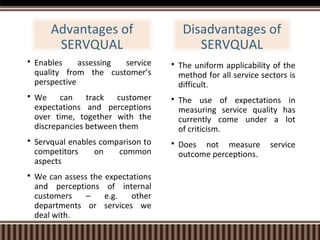
Advantages of
SERVQUAL


Enables
assessing
service
quality from the customer’s
perspective



We can track customer
expectations and perceptions
over time, together with the
discrepancies between them



Servqual enables comparison to
competitors
on
common
aspects



We can assess the expectations
and perceptions of internal
customers
–
e.g.
other
departments or services we
deal with.

Disadvantages of
SERVQUAL


The uniform applicability of the
method for all service sectors is
difficult.



The use of expectations in
measuring service quality has
currently come under a lot
of criticism.



Does not measure
outcome perceptions.

service
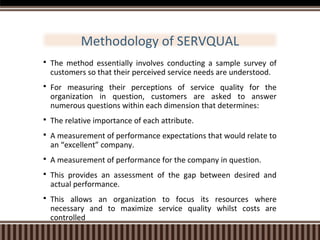
Methodology of SERVQUAL


The method essentially involves conducting a sample survey of
customers so that their perceived service needs are understood.



For measuring their perceptions of service quality for the
organization in question, customers are asked to answer
numerous questions within each dimension that determines:



The relative importance of each attribute.



A measurement of performance expectations that would relate to
an “excellent” company.



A measurement of performance for the company in question.



This provides an assessment of the gap between desired and
actual performance.



This allows an organization to focus its resources where
necessary and to maximize service quality whilst costs are
controlled
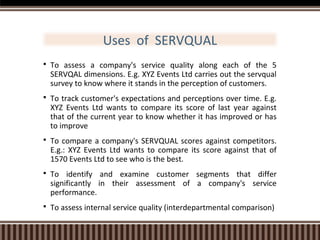
Uses of SERVQUAL


To assess a company's service quality along each of the 5
SERVQAL dimensions. E.g. XYZ Events Ltd carries out the servqual
survey to know where it stands in the perception of customers.



To track customer's expectations and perceptions over time. E.g.
XYZ Events Ltd wants to compare its score of last year against
that of the current year to know whether it has improved or has
to improve



To compare a company's SERVQUAL scores against competitors.
E.g.: XYZ Events Ltd wants to compare its score against that of
1570 Events Ltd to see who is the best.



To identify and examine customer segments that differ
significantly in their assessment of a company's service
performance.



To assess internal service quality (interdepartmental comparison)
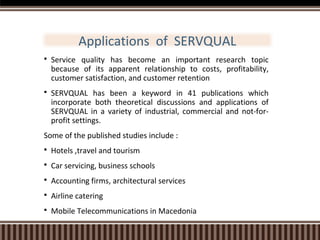
Applications of SERVQUAL


Service quality has become an important research topic
because of its apparent relationship to costs, profitability,
customer satisfaction, and customer retention



SERVQUAL has been a keyword in 41 publications which
incorporate both theoretical discussions and applications of
SERVQUAL in a variety of industrial, commercial and not-forprofit settings.

Some of the published studies include :


Hotels ,travel and tourism



Car servicing, business schools



Accounting firms, architectural services



Airline catering



Mobile Telecommunications in Macedonia
Conclusions


SERVQUAL is considered very complex, subjective and
statistically unreliable. The simplified RATER model however is
a simple and useful model for qualitatively exploring and
assessing customers' service experiences



It is an efficient model in helping an organization shape up
their efforts in bridging the gap between perceived and
expected service



SERVQUAL is used to track customer's expectations and
perceptions over time to compare the company's SERVQUAL
scores against competitors.



Although SERVQUAL's face and construct validity are in doubt,
it is widely used in modified forms (RATER) to measure
customer expectations and perceptions of service quality.
Servqual model

Servqual model

  • 1.
  • 2.
    Introduction  Service quality isan approach to manage business processes in order to ensure full satisfaction of the customers & quality in service provided. It works as an antecedent of customer satisfaction.  If expectations are greater than performance, then perceived quality is less than satisfactory and hence customer dissatisfaction occurs.  SERVQUAL is a service quality framework, developed in the eighties by Zeithaml, Parasuraman & Berry, aiming at measuring the scale of Quality in the service sectors.  SERVQUAL was originally measured on 10 aspects of service quality: reliability, responsiveness, competence, access, courtesy, communication, credibility, security, understanding the customer, and tangibles, to measure the gap between customer expectations and experience.
  • 3.
    SERVQUAL as aMeasuring Tool  In 1988 the 10 components were collapsed into five dimensions (RATER). Reliability, tangibles and responsiveness remained distinct, but the remaining seven components collapsed into two aggregate dimensions, assurance and empathy.  Parasuraman et al. developed a 22-scale instrument with which to measure customers’ expectations and perceptions (E and P) of the five RATER dimensions. Four or five numbered items are used to measure each dimension.  The instrument is administered twice in different forms, first to measure expectations and second to measure perceptions. Dimensions Scale Reliability 4 Assurance 5 Tangibles 4 Empathy 5 Responsiveness 4
  • 4.
    The Key ServiceDimensions  The five SERVQUAL dimensions are: R-A-T-E-R: 1. RESPONSIVENESS - Willingness to help customers and provide prompt service 2. ASSURANCE - Knowledge and courtesy of employees and their ability to convey trust and confidence 3. TANGIBLES - Appearance of physical facilities, equipment, personnel, and communication materials 4. EMPATHY - Caring, individualized attention the firm provides its customers 5. RELIABILITY - Ability to perform the promised service dependably and accurately
  • 5.
    Conceptual Model ofService Quality  GAP 1: Not knowing what customers expect  GAP 2: wrong service quality standards  GAP 3: The service performance gap  GAP 4: promises do not match actual delivery  GAP 5: The difference between customer perception and expectation
  • 6.
    The SERVQUAL Gaps Gap1 M a na ge m e nt P e r c e p t io n s o f C u s to m e r E x p e c t a t io n s Commonly known as the management perception gap Gap 1 results from a difference between what customers expect and what management perceives these expectations to be. It indicates a problem with the understanding of the market. This can occur, as a result of insufficient research or communication failures. E.g. : Management of ABC Dry cleaning Ltd perceives that a particular segment simply expects low prices on its service, when in fact, the expectation is a value-for-money service. E x p e c te d S e r v ic e
  • 7.
    The SERVQUAL Gaps Gap2 S e r v ic e Q u a lity S p e c i f ic a t i o n s Commonly known as quality specification gap. Gap 2 results from a difference between management perceptions of what customers expect and the specifications that management draws up when detailing the service quality delivery actions that are required. Service design and performance standards are prerequisites for bridging this gap. E.g. : Most hotels do not do housekeeping in a room on the day the customer is checking out. But has management realised that the customer who is doing a late checking out wants a clean room during that day? M a na ge m e nt P e r c e p t io n s o f C u s to m e r E x p e c t a t io n s
  • 8.
    The SERVQUAL Gaps Gap3 S e r v ic e D e liv e r y Commonly known as the Service delivery gap. Gap 3 results from a mismatch between the service delivery specifications required by management and the actual service that is delivered by front line staff. It is the difference between customer-driven service design & standards, and the service delivery of the provider. Managers need to audit the customer experience that their organization currently delivers in order to make sure it lives up to the expected level. E.g. : Usually, all restaurants need to attend to every request and orders of the customers. But very often when customers place orders, they either do not receive the orders at all or the waiter has confused it with that of another customer. S e r v ic e Q u a lity S p e c i f ic a t i o n s
  • 9.
    The SERVQUAL Gaps Gap4 S e r v ic e D e liv e r y  Commonly known as market communication gap.  This is the gap between the delivery of the customer experience and what is communicated to customers, i.e. the discrepancy between actual service and the promised one  All too often organizations exaggerate what will be provided to customers, or discuss the best case rather than the likely case, raising customer expectations and harming customer perceptions.  E.g. A company commercialising slimming products boasts that customers may lose up to 4-5 kgs/week. But they do not specify that a strict diet and regular exercise must accompany the treatment for it to have the desired effect. E x te rn a l C o m m u n ic a t io n s to C u s to m e rs
  • 10.
    The SERVQUAL Gaps Gap5 E x p e c te d S e r v ic e • Commonly known as the perceived service quality gap. • Gap 5 may be identified as the overall difference between the expected service and the perceived service experienced. Gap 5 results from the combination of Gaps 1 to 4 • Customers' expectations have been shaped by word of mouth, their personal needs and their own past service experiences. • Unless Gap 5 is kept under check, it may result in lost customers, bad reputation, negative corporate image. P e r c e iv e d S e r v ic e
  • 11.
    Causes for theGaps GAP 1 - not knowing what customers expect E.g. : XYZ Events Ltd organised a wedding with the usual white and blue decorations, when the customer had expected something new and original. Causes:  Lack of a marketing orientation to quality  Poorly interpreted information about customer’s expectations  Research not focused on demand quality  Too many layers between the front line personnel &  top level management
  • 12.
    Causes for theGaps GAP 2 - The wrong service quality standards E.g. : XYZ Events Ltd perceived that the customer wanted a very nice reception with at least 2 waiters at each table, but management eventually decided otherwise to reduce costs. Causes:  inadequate commitment to service quality  lack of perception of feasibility  inadequate task standardization  the absence of goal setting  Insufficient planning of procedures
  • 13.
    Causes for theGaps GAP 3 - The service performance gap E.g. : XYZ Events Ltd had promised the most exquisite catering and wedding cake, but the food was not appreciable and the bride didn’t like the cake at all. Causes: Poor employee or technology fit - the wrong person or wrong system for the job Deficiencies in human resource policies such as ineffective recruitment, role ambiguity, role conflict Failure to match demand and supply Too much or too little control Lack of teamwork within the organisation
  • 14.
    Causes for theGaps GAP 4 - When promises do not match actual delivery E.g. : XYZ Events Ltd promised to have a Mercedes limousine for the entry of the groom, but eventually the latter was given a simple Nissan Sunny. Causes: inadequate horizontal communication Over-promising in external communication campaign Failure to manage customer expectations Failure to perform according to specifications given to customers
  • 15.
    Causes for theGaps GAP 5 - The difference between customer perception of service and the expectation they had Usually the cause is the occurrence of the 4 other Gaps, which results in a difference between customer perception and the expectation they had. Ultimately the groom’s experience was way too far from what he had expected, and thus results in dissatisfaction. Other causes can be: cultural background, family lifestyle, personality, demographics, advertising, experience with similar service information available online
  • 16.
    Solution for theGaps No Solutions as such, but rather, measures that can be taken to minimize the gaps Gap Definitions Measures 1 Customers’ expectations versus management perceptions Use of good Customer Relationship Management Techniques to profile & know customer’s expectations, tastes and needs E.g: XYZ Events Ltd should conduct sample surveys to know what customers expect nowadays 2 Management perceptions versus service specifications Managers need to make sure the organization is defining the level of service they believe is needed. E.g.: XYZ Events Ltd could have offered pre-set wedding packages at different prices with different services set. 3 Service specifications versus service delivery Managers need to audit the customer experience that their organization currently delivers in order to make sure it lives up to the expected level. E,g.: XYZ Events Ltd needs to ask customers to give their post experience feedbacks 4 Service delivery versus external communication: Use of good Communication skills and avoid ambiguous or fraudulent terms to confuse or mislead the customer. E.g.: XYZ Events Ltd should clearly inform the customer about something that will not be possible to implement 5 The discrepancy between customer expectations and their perceptions of the service delivered Application of all the above measures to make sure the service delivered meets the expectations of the customer
  • 17.
    Criticisms to SERVQUAL  Ithas been criticized that SERVQUAL's 5 dimensions (RATER) are not universals, and that the model fails to draw on established economic, statistical and psychological theory.  There is little evidence that customers assess service quality in terms of Perception / Expectation gaps.  SERVQUAL focuses on the process of service delivery, not the outcomes of the service encounter.  There is a high degree of intercorrelation between the five RATER dimensions, thus the scores obtained cannot be exact.
  • 18.
    SERVQUAL; Good orBad???  SERVQUAL “remains the most complete attempt to conceptualize and measure service quality” – Nyeck, et al. (2002)  The main benefit to the SERVQUAL measuring tool is the ability of researchers to examine numerous service industries such as healthcare, banking, financial services, and education  Nyeck et al. (2002) reviewed 40 articles that made use of the SERVQUAL measuring tool and discovered “that few researchers concerned themselves with the validation of the measuring tool”, which means it is well anchored as a trusted model.  Service Quality is widely regarded as a driver of corporate marketing and financial performance
  • 19.
    Advantages of SERVQUAL  Enables assessing service quality fromthe customer’s perspective  We can track customer expectations and perceptions over time, together with the discrepancies between them  Servqual enables comparison to competitors on common aspects  We can assess the expectations and perceptions of internal customers – e.g. other departments or services we deal with. Disadvantages of SERVQUAL  The uniform applicability of the method for all service sectors is difficult.  The use of expectations in measuring service quality has currently come under a lot of criticism.  Does not measure outcome perceptions. service
  • 20.
    Methodology of SERVQUAL  Themethod essentially involves conducting a sample survey of customers so that their perceived service needs are understood.  For measuring their perceptions of service quality for the organization in question, customers are asked to answer numerous questions within each dimension that determines:  The relative importance of each attribute.  A measurement of performance expectations that would relate to an “excellent” company.  A measurement of performance for the company in question.  This provides an assessment of the gap between desired and actual performance.  This allows an organization to focus its resources where necessary and to maximize service quality whilst costs are controlled
  • 21.
    Uses of SERVQUAL  Toassess a company's service quality along each of the 5 SERVQAL dimensions. E.g. XYZ Events Ltd carries out the servqual survey to know where it stands in the perception of customers.  To track customer's expectations and perceptions over time. E.g. XYZ Events Ltd wants to compare its score of last year against that of the current year to know whether it has improved or has to improve  To compare a company's SERVQUAL scores against competitors. E.g.: XYZ Events Ltd wants to compare its score against that of 1570 Events Ltd to see who is the best.  To identify and examine customer segments that differ significantly in their assessment of a company's service performance.  To assess internal service quality (interdepartmental comparison)
  • 22.
    Applications of SERVQUAL  Servicequality has become an important research topic because of its apparent relationship to costs, profitability, customer satisfaction, and customer retention  SERVQUAL has been a keyword in 41 publications which incorporate both theoretical discussions and applications of SERVQUAL in a variety of industrial, commercial and not-forprofit settings. Some of the published studies include :  Hotels ,travel and tourism  Car servicing, business schools  Accounting firms, architectural services  Airline catering  Mobile Telecommunications in Macedonia
  • 23.
    Conclusions  SERVQUAL is consideredvery complex, subjective and statistically unreliable. The simplified RATER model however is a simple and useful model for qualitatively exploring and assessing customers' service experiences  It is an efficient model in helping an organization shape up their efforts in bridging the gap between perceived and expected service  SERVQUAL is used to track customer's expectations and perceptions over time to compare the company's SERVQUAL scores against competitors.  Although SERVQUAL's face and construct validity are in doubt, it is widely used in modified forms (RATER) to measure customer expectations and perceptions of service quality.