Service Quality (Servqual)
Servqual
ïŹ SERVQUAL is a multi-dimensional research
instrument designed to capture consumer
expectations and perceptions of a service
along five dimensions that are believed to
represent service quality.
ïŹ The questionnaire consists of matched pairs of
items - 22 expectation items and 22
perceptions items - organised into five
dimensions which are believed to align with the
consumer's mental map of service quality
dimensions.
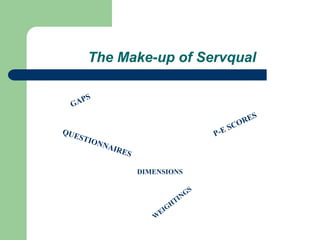
The Make-up of Servqual
GAPS
P-E SCORES
QUESTIONNAIRES
DIMENSIONS
W
EIGHTINGS
The Five Key Service Dimensions
ïŹ TANGIBLES - the appearance of physical
facilities, equipment, personnel and information
material
ïŹ RELIABILITY - the ability to perform the
service accurately and dependably
ïŹ RESPONSIVENESS - the willingness to help
customers and provide a prompt service
The Five Key Service Dimensions
ïŹ ASSURANCE - a combination of the following
– Competence - having the requisite skills and
knowledge
– Courtesy - politeness, respect, consideration and
friendliness of contact staff
– Credibility - trustworthiness, believability and
honesty of staff
– Security - freedom from danger, risk or doubt
The Five Key Service Dimensions
ïŹ EMPATHY - a combination of the following:
– Access (physical and social) - approachability and
ease of contact
– Communication - keeping customers informed in a
language they understand and really listening to
them
– Understanding the customer - making the effort to
get to know customers and their specific needs
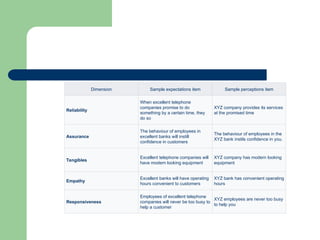
Dimension Sample expectations item Sample perceptions item
Reliability
When excellent telephone
companies promise to do
something by a certain time, they
do so
XYZ company provides its services
at the promised time
Assurance
The behaviour of employees in
excellent banks will instill
confidence in customers
The behaviour of employees in the
XYZ bank instils confidence in you.
Tangibles
Excellent telephone companies will
have modern looking equipment
XYZ company has modern looking
equipment
Empathy
Excellent banks will have operating
hours convenient to customers
XYZ bank has convenient operating
hours
Responsiveness
Employees of excellent telephone
companies will never be too busy to
help a customer
XYZ employees are never too busy
to help you
The model of service quality
The model of service quality, popularly known
as the gaps model was developed by a group
of American authors, A. Parasuraman,
Valarie A. Zeithaml and Len Berry, in a
systematic research program carried out
between 1983 and 1988.
Businesses use the SERVQUAL instrument (i.e. questionnaire) to
measure potential service quality problems and the model of
service quality to help diagnose possible causes of the problem.
The model of service quality is built on the expectancy-
confirmation paradigm which suggests that consumers perceive
quality in terms of their perceptions of how well a given service
delivery meets their expectations of that delivery.[12]
Thus, service
quality can be conceptualized as a simple equation:
SQ = P- E
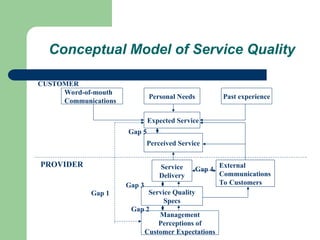
Conceptual Model of Service Quality
Word-of-mouth
Communications
Personal Needs Past experience
Expected Service
Perceived Service
Service
Delivery
External
Communications
To Customers
Service Quality
Specs
Management
Perceptions of
Customer Expectations
CUSTOMER
PROVIDER
Gap 1
Gap 2
Gap 3
Gap 4
Gap 5
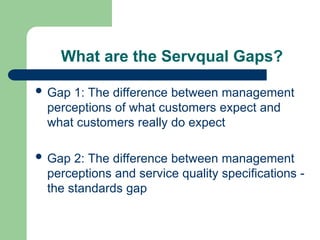
What are the Servqual Gaps?
ïŹ Gap 1: The difference between management
perceptions of what customers expect and
what customers really do expect
ïŹ Gap 2: The difference between management
perceptions and service quality specifications -
the standards gap
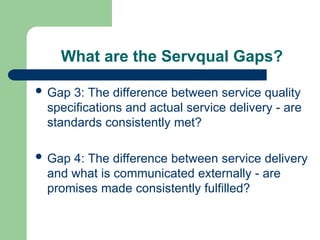
What are the Servqual Gaps?
ïŹ Gap 3: The difference between service quality
specifications and actual service delivery - are
standards consistently met?
ïŹ Gap 4: The difference between service delivery
and what is communicated externally - are
promises made consistently fulfilled?
What are the Servqual Gaps?
ïŹ Gap 5: The difference between what
customers expect of a service and what they
actually receive
– expectations are made up of past experience, word-
of-mouth and needs/wants of customers
– measurement is on the basis of two sets of
statements in groups according to the five key
service dimensions
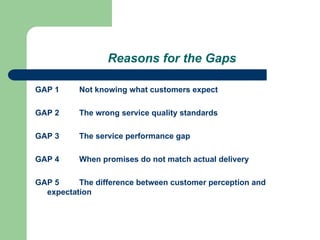
Reasons for the Gaps
GAP 1 Not knowing what customers expect
GAP 2 The wrong service quality standards
GAP 3 The service performance gap
GAP 4 When promises do not match actual delivery
GAP 5 The difference between customer perception and
expectation
Reasons for the Gaps
ïŹ GAP 1 - not knowing what customers expect
– lack of a marketing orientation
– inadequate upward communication (from contact
staff to management)
– too many levels of management
Reasons for the Gaps
ïŹ GAP 2 - the wrong service quality standards
– inadequate commitment to service quality
– lack of perception of feasibility - ‘it cannot be done’
– inadequate task standardisation
– the absence of goal setting
Reasons for the Gaps
ïŹ GAP 2 - the wrong service quality standards
– inadequate commitment to service quality
– lack of perception of feasibility - ‘it cannot be done’
– inadequate task standardisation
– the absence of goal setting
Reasons for the Gaps
ïŹ GAP 3 - the service performance gap
– role ambiguity and role conflict - unsure of what your
remit is and how it fits with others
– poor employee or technology fit - the wrong person
or system for the job
– inappropriate supervisory control or lack of
perceived control - too much or too little control
– lack of teamwork
Reasons for the Gaps
ïŹ GAP 4 - when promises made do not match
actual delivery
– inadequate horizontal communication - between
departments or services
– a propensity to overpromise
Servqual Data - How Useful is it?
ïŹ We can assess service quality from the
customer’s perspective
ïŹ We can track customer expectations and
perceptions over time and the discrepancies
between them
ïŹ We can compare a set of Servqual scores
against those of competitors or best practice
examples
Servqual Data - How Useful is it?
ïŹ We can compare the expectations and
perceptions of different customer groups - this
is particularly useful in the public sector
ïŹ We can assess the expectations and
perceptions of internal customers - eg other
departments or services we deal with
Servqual Data - What can we do
with it?
ïŹ We can use data on customer priorities to feed
into the House of Quality (QFD)
ïŹ Customer priorities and their ranked order of
importance can become the WHATS
ïŹ These WHATS can then be compared with the
HOWS (key business processes) and
relationships matched to check service design
and provision according to key requirements

4547_servqual.ppt service quality service

  • 1.
  • 2.
    Servqual ïŹ SERVQUAL isa multi-dimensional research instrument designed to capture consumer expectations and perceptions of a service along five dimensions that are believed to represent service quality.
  • 3.
    ïŹ The questionnaireconsists of matched pairs of items - 22 expectation items and 22 perceptions items - organised into five dimensions which are believed to align with the consumer's mental map of service quality dimensions.
  • 4.
    The Make-up ofServqual GAPS P-E SCORES QUESTIONNAIRES DIMENSIONS W EIGHTINGS
  • 5.
    The Five KeyService Dimensions ïŹ TANGIBLES - the appearance of physical facilities, equipment, personnel and information material ïŹ RELIABILITY - the ability to perform the service accurately and dependably ïŹ RESPONSIVENESS - the willingness to help customers and provide a prompt service
  • 6.
    The Five KeyService Dimensions ïŹ ASSURANCE - a combination of the following – Competence - having the requisite skills and knowledge – Courtesy - politeness, respect, consideration and friendliness of contact staff – Credibility - trustworthiness, believability and honesty of staff – Security - freedom from danger, risk or doubt
  • 7.
    The Five KeyService Dimensions ïŹ EMPATHY - a combination of the following: – Access (physical and social) - approachability and ease of contact – Communication - keeping customers informed in a language they understand and really listening to them – Understanding the customer - making the effort to get to know customers and their specific needs
  • 8.
    Dimension Sample expectationsitem Sample perceptions item Reliability When excellent telephone companies promise to do something by a certain time, they do so XYZ company provides its services at the promised time Assurance The behaviour of employees in excellent banks will instill confidence in customers The behaviour of employees in the XYZ bank instils confidence in you. Tangibles Excellent telephone companies will have modern looking equipment XYZ company has modern looking equipment Empathy Excellent banks will have operating hours convenient to customers XYZ bank has convenient operating hours Responsiveness Employees of excellent telephone companies will never be too busy to help a customer XYZ employees are never too busy to help you
  • 9.
    The model ofservice quality The model of service quality, popularly known as the gaps model was developed by a group of American authors, A. Parasuraman, Valarie A. Zeithaml and Len Berry, in a systematic research program carried out between 1983 and 1988.
  • 10.
    Businesses use theSERVQUAL instrument (i.e. questionnaire) to measure potential service quality problems and the model of service quality to help diagnose possible causes of the problem. The model of service quality is built on the expectancy- confirmation paradigm which suggests that consumers perceive quality in terms of their perceptions of how well a given service delivery meets their expectations of that delivery.[12] Thus, service quality can be conceptualized as a simple equation: SQ = P- E
  • 11.
    Conceptual Model ofService Quality Word-of-mouth Communications Personal Needs Past experience Expected Service Perceived Service Service Delivery External Communications To Customers Service Quality Specs Management Perceptions of Customer Expectations CUSTOMER PROVIDER Gap 1 Gap 2 Gap 3 Gap 4 Gap 5
  • 12.
    What are theServqual Gaps? ïŹ Gap 1: The difference between management perceptions of what customers expect and what customers really do expect ïŹ Gap 2: The difference between management perceptions and service quality specifications - the standards gap
  • 13.
    What are theServqual Gaps? ïŹ Gap 3: The difference between service quality specifications and actual service delivery - are standards consistently met? ïŹ Gap 4: The difference between service delivery and what is communicated externally - are promises made consistently fulfilled?
  • 14.
    What are theServqual Gaps? ïŹ Gap 5: The difference between what customers expect of a service and what they actually receive – expectations are made up of past experience, word- of-mouth and needs/wants of customers – measurement is on the basis of two sets of statements in groups according to the five key service dimensions
  • 15.
    Reasons for theGaps GAP 1 Not knowing what customers expect GAP 2 The wrong service quality standards GAP 3 The service performance gap GAP 4 When promises do not match actual delivery GAP 5 The difference between customer perception and expectation
  • 16.
    Reasons for theGaps ïŹ GAP 1 - not knowing what customers expect – lack of a marketing orientation – inadequate upward communication (from contact staff to management) – too many levels of management
  • 17.
    Reasons for theGaps ïŹ GAP 2 - the wrong service quality standards – inadequate commitment to service quality – lack of perception of feasibility - ‘it cannot be done’ – inadequate task standardisation – the absence of goal setting
  • 18.
    Reasons for theGaps ïŹ GAP 2 - the wrong service quality standards – inadequate commitment to service quality – lack of perception of feasibility - ‘it cannot be done’ – inadequate task standardisation – the absence of goal setting
  • 19.
    Reasons for theGaps ïŹ GAP 3 - the service performance gap – role ambiguity and role conflict - unsure of what your remit is and how it fits with others – poor employee or technology fit - the wrong person or system for the job – inappropriate supervisory control or lack of perceived control - too much or too little control – lack of teamwork
  • 20.
    Reasons for theGaps ïŹ GAP 4 - when promises made do not match actual delivery – inadequate horizontal communication - between departments or services – a propensity to overpromise
  • 21.
    Servqual Data -How Useful is it? ïŹ We can assess service quality from the customer’s perspective ïŹ We can track customer expectations and perceptions over time and the discrepancies between them ïŹ We can compare a set of Servqual scores against those of competitors or best practice examples
  • 22.
    Servqual Data -How Useful is it? ïŹ We can compare the expectations and perceptions of different customer groups - this is particularly useful in the public sector ïŹ We can assess the expectations and perceptions of internal customers - eg other departments or services we deal with
  • 23.
    Servqual Data -What can we do with it? ïŹ We can use data on customer priorities to feed into the House of Quality (QFD) ïŹ Customer priorities and their ranked order of importance can become the WHATS ïŹ These WHATS can then be compared with the HOWS (key business processes) and relationships matched to check service design and provision according to key requirements