Time-Dependent Perturbation Theory Prepared by: James Salveo L. Olarve   Graduate Student January 28, 2010
Introduction The presentation is about how to evaluate  the probability of finding the system in any particular state at any later time  when the simple Hamiltonian was added by time dependent perturbation. S o now the wave function will have perturbation-induced time dependence.  The intended reader of this presentation were physics students. The author already assumed that the reader knows dirac braket notation. This presentation was made to facilitate learning in quantum mechanics.
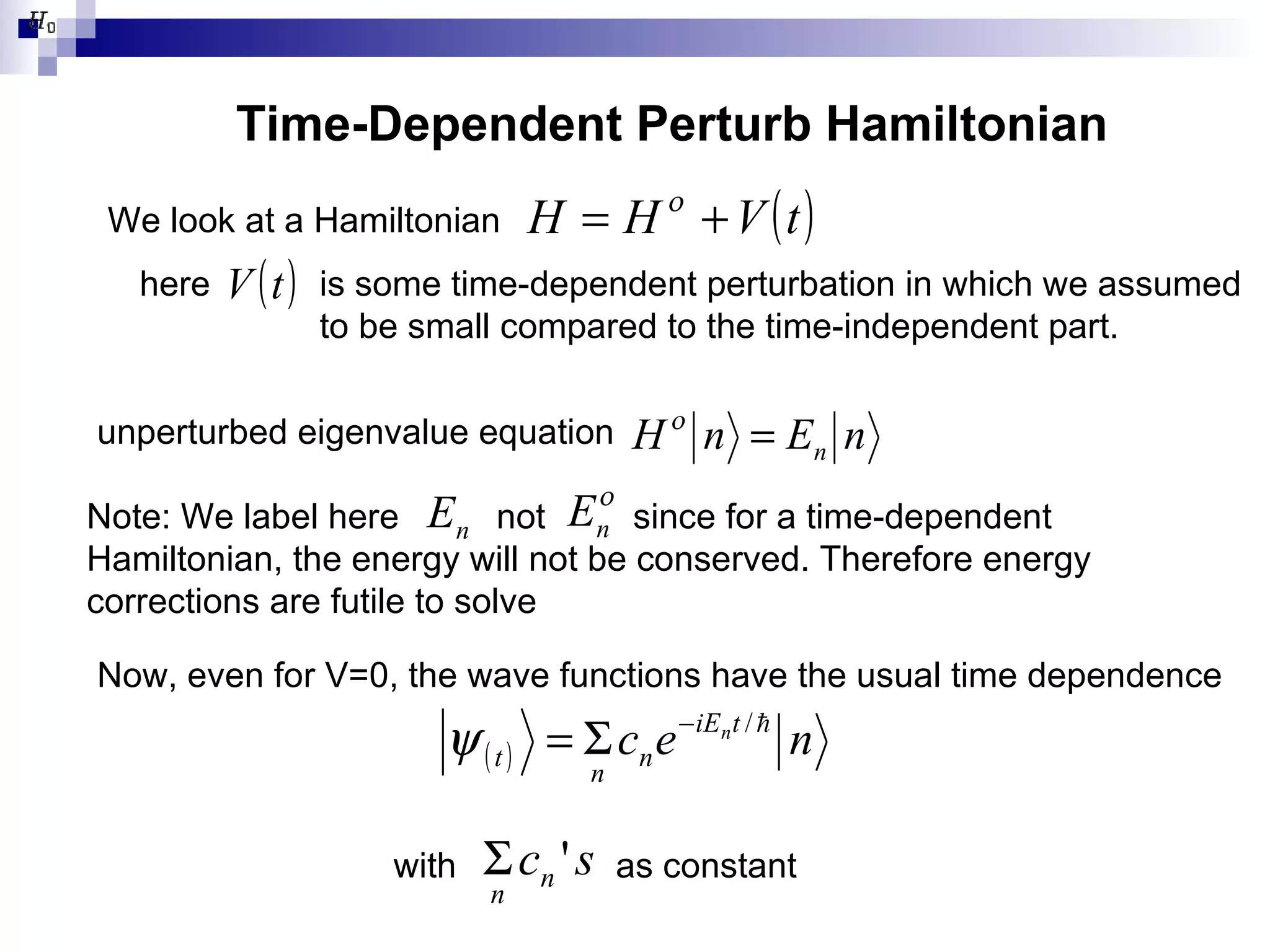
Time-Dependent Perturb Hamiltonian We look at a Hamiltonian is some time-dependent perturbation in which we assumed to be small compared to the time-independent part. here unperturbed eigenvalue equation Note: We label here  not  since for a time-dependent  Hamiltonian, the energy will not be conserved. Therefore energy  corrections are futile to solve Now, even for V=0, the wave functions have the usual time dependence with as constant
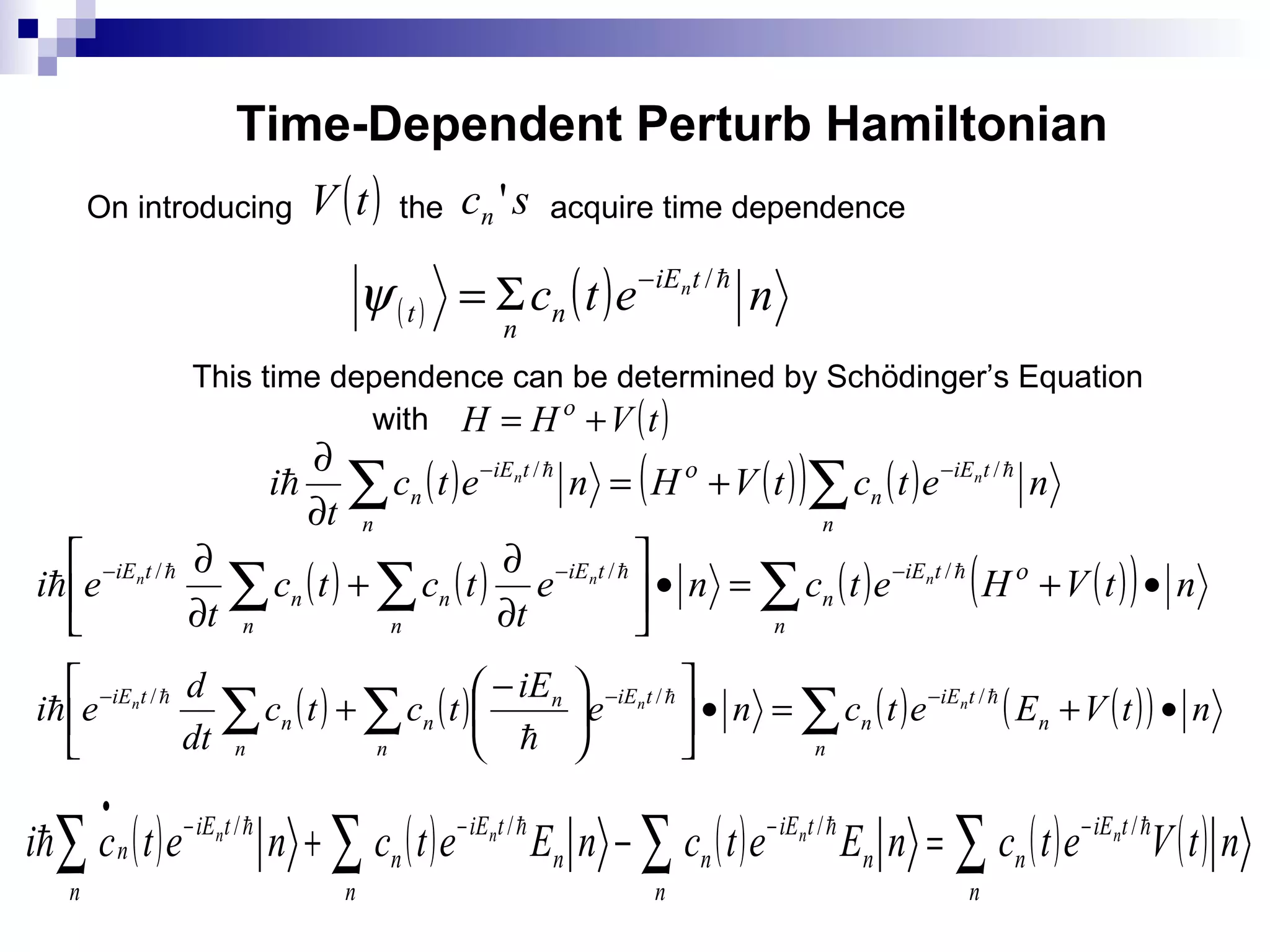
On introducing  the  acquire time dependence Time-Dependent Perturb Hamiltonian This time dependence can be determined by Schödinger’s Equation  with
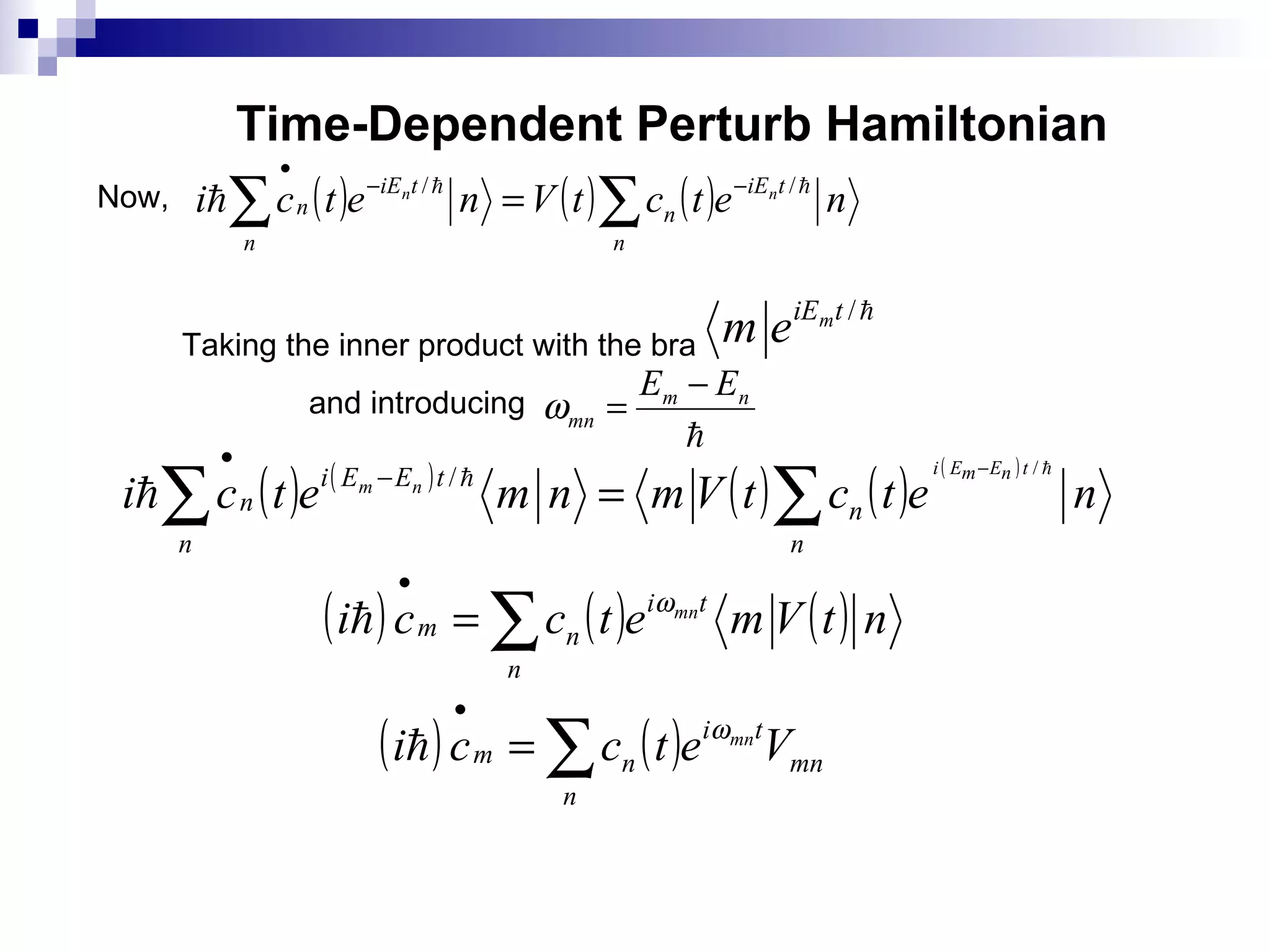
Time-Dependent Perturb Hamiltonian Now, Taking the inner product with the bra  and introducing
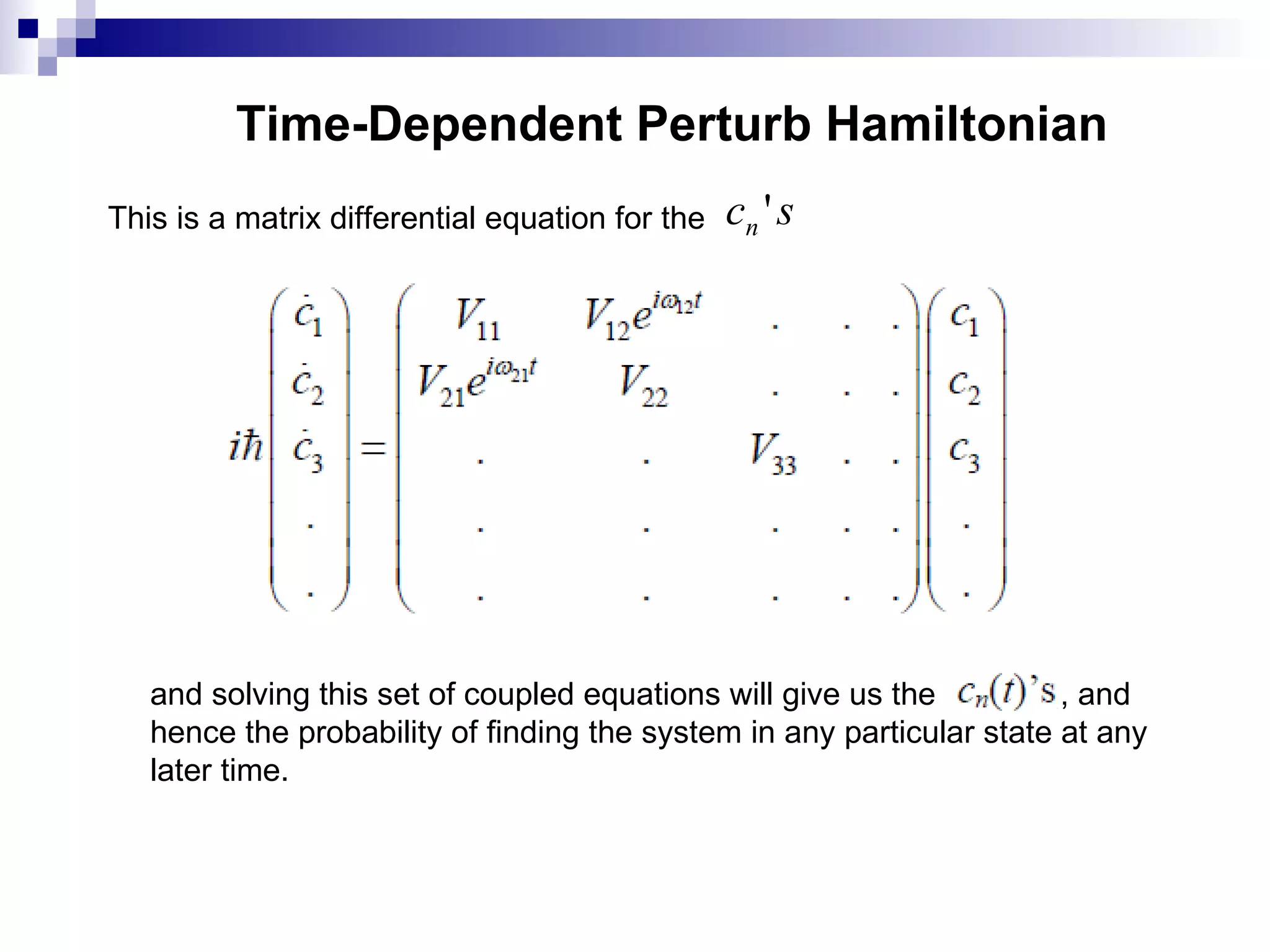
Time-Dependent Perturb Hamiltonian This is a matrix differential equation for the  and solving this set of coupled equations will give us the  , and hence the probability of finding the system in any particular state at any later time.
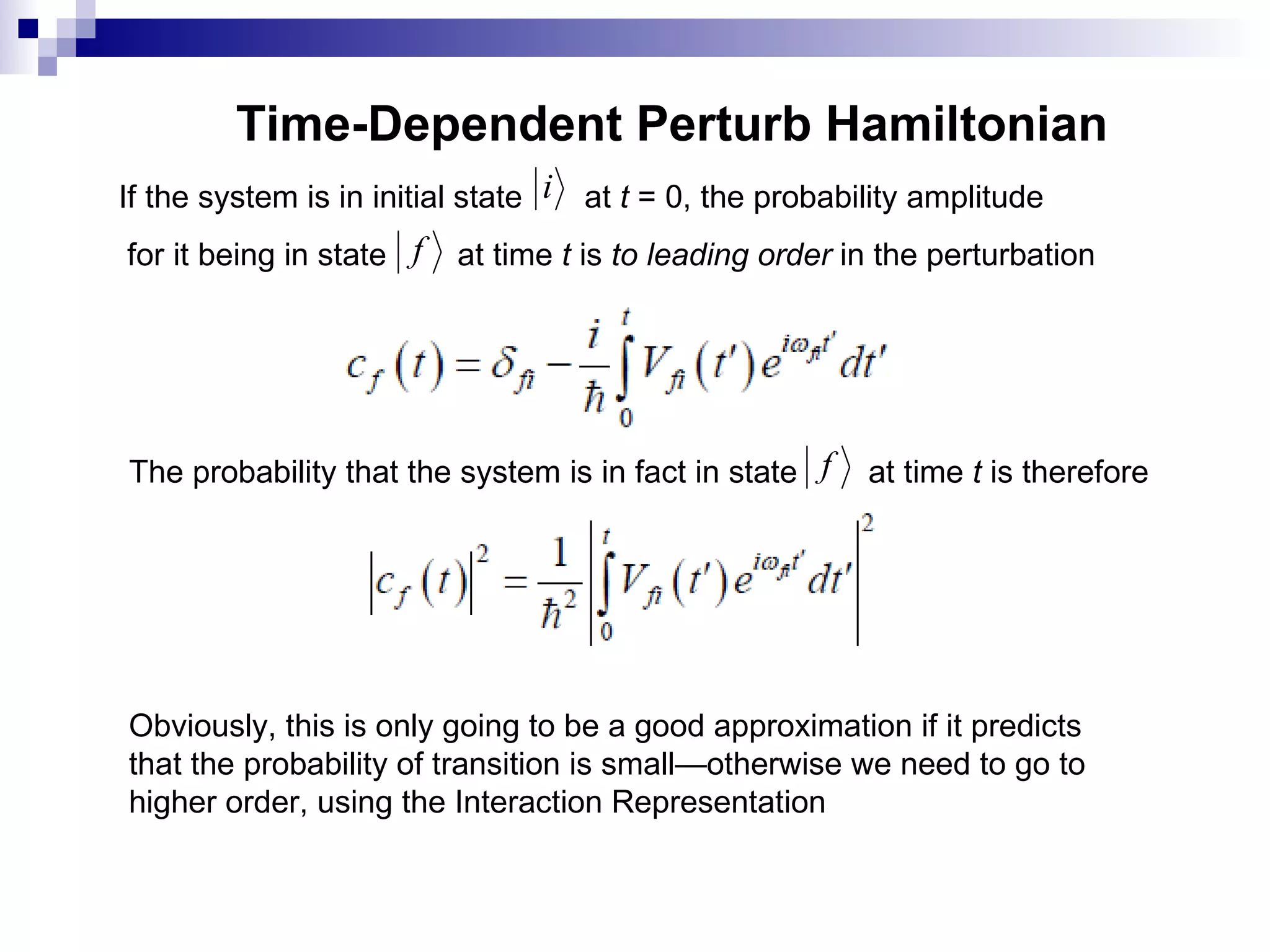
If the system is in initial state  at  t  = 0, the probability amplitude for it being in state  at time  t  is  to leading order  in the perturbation  Time-Dependent Perturb Hamiltonian The probability that the system is in fact in state  at time  t  is therefore  Obviously, this is only going to be a good approximation if it predicts that the probability of transition is small—otherwise we need to go to higher order, using the Interaction Representation
Reference: Retrieved from  http://galileo.phys.virginia.edu/classes/752.mf1i.spring03/Time_Ind_PT.htm , January 19 2010,  Michael Fowler.   Introduction to Quantum Mechanics. David J. Griffiths. 1994

Time Dependent Perturbation Theory

  • 1.
    Time-Dependent Perturbation TheoryPrepared by: James Salveo L. Olarve Graduate Student January 28, 2010
  • 2.
    Introduction The presentationis about how to evaluate the probability of finding the system in any particular state at any later time when the simple Hamiltonian was added by time dependent perturbation. S o now the wave function will have perturbation-induced time dependence. The intended reader of this presentation were physics students. The author already assumed that the reader knows dirac braket notation. This presentation was made to facilitate learning in quantum mechanics.
  • 3.
    Time-Dependent Perturb HamiltonianWe look at a Hamiltonian is some time-dependent perturbation in which we assumed to be small compared to the time-independent part. here unperturbed eigenvalue equation Note: We label here not since for a time-dependent Hamiltonian, the energy will not be conserved. Therefore energy corrections are futile to solve Now, even for V=0, the wave functions have the usual time dependence with as constant
  • 4.
    On introducing the acquire time dependence Time-Dependent Perturb Hamiltonian This time dependence can be determined by Schödinger’s Equation with
  • 5.
    Time-Dependent Perturb HamiltonianNow, Taking the inner product with the bra and introducing
  • 6.
    Time-Dependent Perturb HamiltonianThis is a matrix differential equation for the and solving this set of coupled equations will give us the , and hence the probability of finding the system in any particular state at any later time.
  • 7.
    If the systemis in initial state at t = 0, the probability amplitude for it being in state at time t is to leading order in the perturbation Time-Dependent Perturb Hamiltonian The probability that the system is in fact in state at time t is therefore Obviously, this is only going to be a good approximation if it predicts that the probability of transition is small—otherwise we need to go to higher order, using the Interaction Representation
  • 8.
    Reference: Retrieved from http://galileo.phys.virginia.edu/classes/752.mf1i.spring03/Time_Ind_PT.htm , January 19 2010, Michael Fowler. Introduction to Quantum Mechanics. David J. Griffiths. 1994