HUMAN DNA VIRUSES Ronald Luftig  Ph.D. Louisiana State University Professor and Head Department of Microbiology,Immunology & Parasitology www.freelivedoctor.com
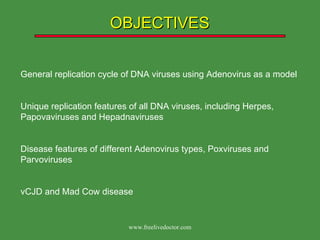
OBJECTIVES General replication cycle of DNA viruses using Adenovirus as a model Unique replication features of all DNA viruses, including Herpes, Papovaviruses and Hepadnaviruses Disease features of different Adenovirus types, Poxviruses and Parvoviruses vCJD and Mad Cow disease www.freelivedoctor.com
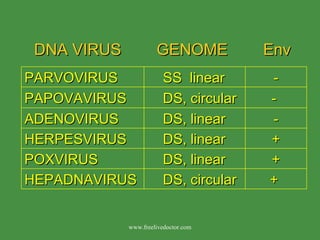
www.freelivedoctor.com PARVOVIRUS SS  linear - PAPOVAVIRUS DS, circular  -  ADENOVIRUS DS, linear - HERPESVIRUS DS, linear + POXVIRUS DS, linear + HEPADNAVIRUS DS, circular  +  DNA VIRUS  GENOME  Env
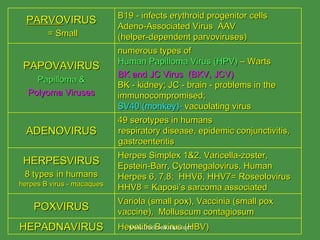
www.freelivedoctor.com PARVO VIRUS   = Small B19 - infects erythroid progenitor cells Adeno-Associated Virus  AAV  (helper-dependent parvoviruses) PAPOVAVIRUS Papilloma & Polyoma Viruses numerous types of  Human Papilloma Virus (HPV)  – Warts BK and JC Virus  (BKV, JCV) BK - kidney; JC - brain - problems in the immunocompromised; SV40 (monkey)-  vacuolating virus ADENOVIRUS 49 serotypes in humans respiratory disease, epidemic conjunctivitis, gastroenteritis HERPESVIRUS 8 types   in humans herpes B virus - macaques Herpes Simplex 1&2, Varicella-zoster, Epstein-Barr, Cytomegalovirus, Human Herpes 6, 7,8;  HHV6, HHV7= Roseolovirus HHV8 = Kaposi’s sarcoma associated POXVIRUS Variola (small pox), Vaccinia (small pox vaccine),  Molluscum contagiosum HEPADNAVIRUS Hepatitis B virus (HBV)
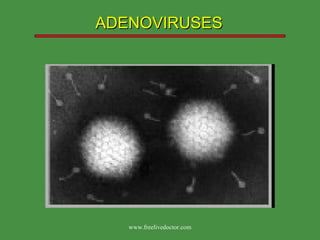
ADENOVIRUSES   www.freelivedoctor.com
Adenoviruses encompass 49 serotypes or six subgroups (A-F).  In humans, they infect cells in tissues at the portal of entry.  Many serotypes commonly infect local lymphoid tissue (adenoids, tonsils, Peyer’s patches) in persistent or latent fashion, perhaps for life.  Adenoviruses also replicate in the intestine, where they may persist for months and are usually not pathogenic.  NO viremia or disseminated diseases occurs except in immuncompromised patients. GENERAL ADENO PROPERTIES www.freelivedoctor.com
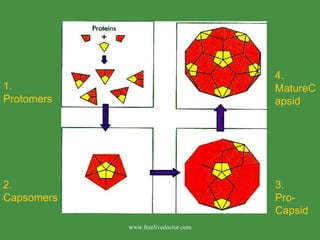
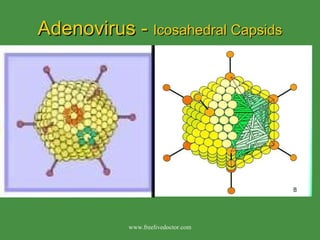
As a general rule all DNA viruses replicate in the nucleus, except the Pox viruses which replicate in the cytoplasm We will use Adenoviruses as a model system for understanding replication of DNA viruses in general Most DNA viruses are naked (see model of soccer ball), with 12 blue penton bases on the vertices and 20 yellow hexons on the rest of the face. Both pentons and hexons are known as capsomers and form the capsid which encloses the nucleic acid as discussed by Dr. Amedee For Adenovirus, there are 252 capsomers 12 on the vertices and 240 on the faces. In the soccer ball model there are 32 capsomers to give you an idea of size ADENOVIRUS REPLICATION www.freelivedoctor.com
1. Protomers 2. Capsomers 3. Pro-Capsid 4. MatureCapsid www.freelivedoctor.com
Adenovirus -  Icosahedral Capsids www.freelivedoctor.com
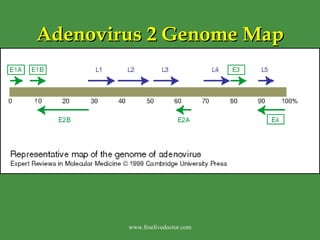
Adenovirus 2 Genome Map www.freelivedoctor.com
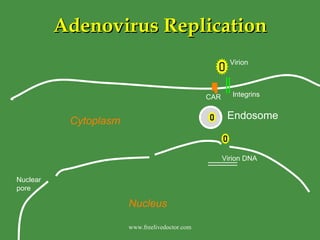
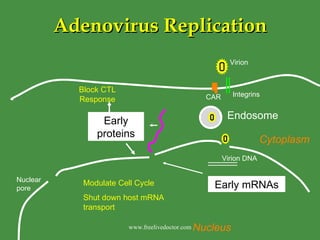
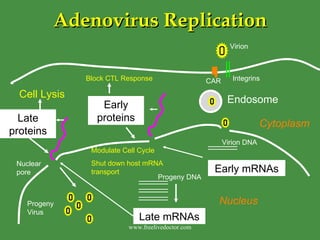
In adenovirus, the first step involves attachment of the fiber to a host cell receptor. This is called the CAR  (coxsackie-adenovirus receptor).  Then after entry the particle moves into an endosomal vesicle to the nucleus where the DNA is uncoated into the nucleus through the nuclear pore.  This sets up the general replication scheme:  first of enzymes to help the virus replicate (early stage), then double-stranded DNA replication (semi-conservative mode) begins (late stage), followed by translation of structural proteins, such as the penton and hexon precursors. STAGES OF ADENO REPLICATION I www.freelivedoctor.com
Adenovirus Replication Endosome Virion Integrins CAR Virion DNA Nuclear pore Nucleus Cytoplasm www.freelivedoctor.com
Adenovirus Replication Endosome Early mRNAs Early proteins Virion Integrins CAR Virion DNA Modulate Cell Cycle Shut down host mRNA transport Block CTL Response Nuclear pore Nucleus Cytoplasm www.freelivedoctor.com
STAGES OF ADENO REPLICATION II After translation the proteins accumulate in the nucleus and together with newly made (nascent) viral DNA assembly into virions. After 2-3 days of accumulation the cells lyse and release several hundred adenovirus particles in a burst. www.freelivedoctor.com
Adenovirus Replication Endosome Late mRNAs Early mRNAs Early proteins Late proteins Virion Integrins CAR Virion DNA Modulate Cell Cycle Shut down host mRNA transport Progeny DNA Cell Lysis Block CTL Response Progeny Virus Nuclear pore Nucleus Cytoplasm www.freelivedoctor.com
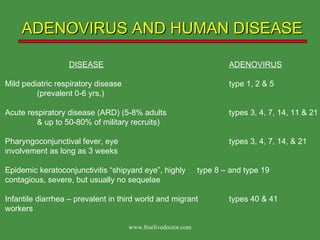
ADENOVIRUS AND HUMAN DISEASE DISEASE ADENOVIRUS Mild pediatric respiratory disease type 1, 2 & 5  (prevalent 0-6 yrs.) Acute respiratory disease (ARD) (5-8% adults types 3, 4, 7, 14, 11 & 21 & up to 50-80% of military recruits) Pharyngoconjunctival fever, eye types 3, 4, 7, 14, & 21 involvement as long as 3 weeks Epidemic keratoconjunctivitis “shipyard eye”, highly  type 8 – and type 19 contagious, severe, but usually no sequelae Infantile diarrhea – prevalent in third world and migrant types 40 & 41  workers www.freelivedoctor.com
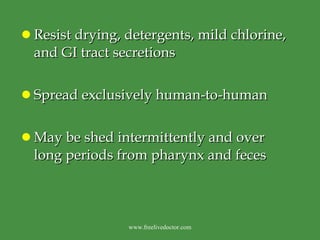
Resist drying, detergents, mild chlorine, and GI tract secretions Spread exclusively human-to-human May be shed intermittently and over long periods from pharynx and feces www.freelivedoctor.com
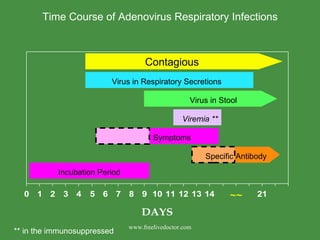
Contagious Virus in Respiratory Secretions Virus in Stool Incubation Period Time Course of Adenovirus Respiratory Infections ~~ Viremia ** ** in the immunosuppressed www.freelivedoctor.com Symptoms Specific Antibody
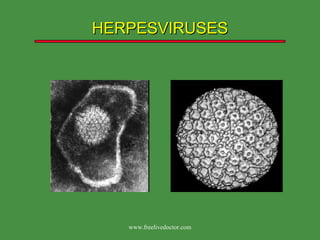
HERPESVIRUSES www.freelivedoctor.com
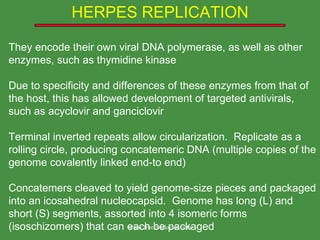
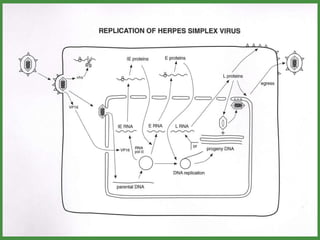
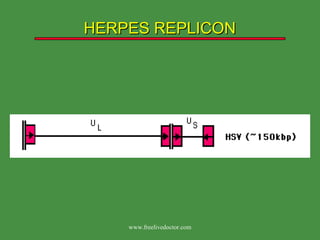
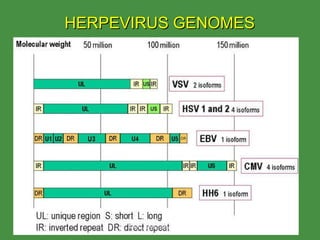
They encode their own viral DNA polymerase, as well as other enzymes, such as thymidine kinase Due to specificity and differences of these enzymes from that of the host, this has allowed development of targeted antivirals, such as acyclovir and ganciclovir Terminal inverted repeats allow circularization.  Replicate as a rolling circle, producing concatemeric DNA (multiple copies of the genome covalently linked end-to end) Concatemers cleaved to yield genome-size pieces and packaged into an icosahedral nucleocapsid.  Genome has long (L) and short (S) segments, assorted into 4 isomeric forms (isoschizomers) that can each be packaged HERPES REPLICATION www.freelivedoctor.com
www.freelivedoctor.com
HERPES REPLICON www.freelivedoctor.com
HERPEVIRUS GENOMES www.freelivedoctor.com
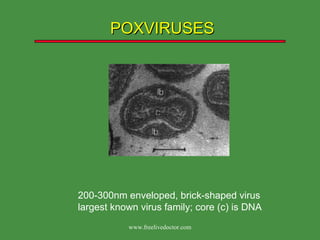
POXVIRUSES 200-300nm enveloped, brick-shaped virus largest known virus family; core (c) is DNA www.freelivedoctor.com
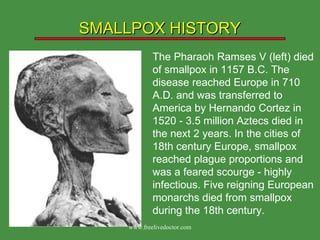
SMALLPOX HISTORY The Pharaoh Ramses V (left) died of smallpox in 1157 B.C. The disease reached Europe in 710 A.D. and was transferred to America by Hernando Cortez in 1520 - 3.5 million Aztecs died in the next 2 years. In the cities of 18th century Europe, smallpox reached plague proportions and was a feared scourge - highly infectious. Five reigning European monarchs died from smallpox during the 18th century. www.freelivedoctor.com
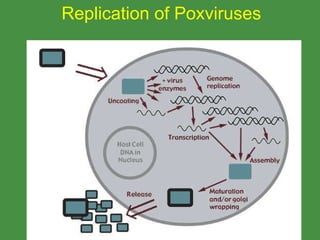
Replication of Poxviruses www.freelivedoctor.com
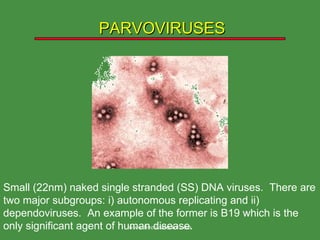
PARVOVIRUSES Small (22nm) naked single stranded (SS) DNA viruses.  There are two major subgroups: i) autonomous replicating and ii) dependoviruses.  An example of the former is B19 which is the only significant agent of human disease. www.freelivedoctor.com
PARVOVIRUS REPLICATION Both above subgroups replicate through a DNA strand intermediate, which is complimentary to the DNA strand in the parent virion. Unique Replication Features: Single strand has terminal hairpins formed by palindromic sequences. As with other viruses with terminal repeats, intermediate DNA forms replicate through concatemers. www.freelivedoctor.com
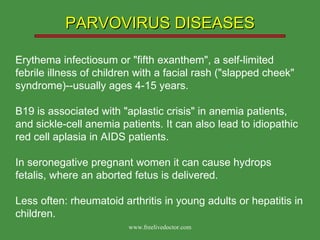
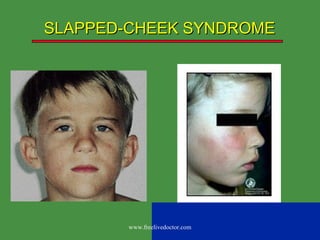
PARVOVIRUS DISEASES Erythema infectiosum or "fifth exanthem", a self-limited febrile illness of children with a facial rash ("slapped cheek" syndrome)--usually ages 4-15 years. B19 is associated with "aplastic crisis" in anemia patients, and sickle-cell anemia patients. It can also lead to idiopathic red cell aplasia in AIDS patients.  In seronegative pregnant women it can cause hydrops fetalis, where an aborted fetus is delivered. Less often: rheumatoid arthritis in young adults or hepatitis in children.  www.freelivedoctor.com
SLAPPED-CHEEK SYNDROME www.freelivedoctor.com
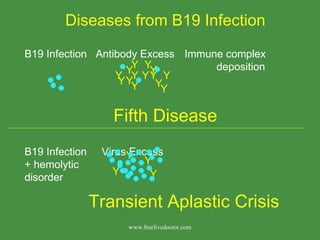
Diseases from B19 Infection B19 Infection  Antibody Excess Immune complex deposition Fifth Disease B19 Infection  Virus Excess + hemolytic disorder  Transient Aplastic Crisis Y Y Y Y Y Y Y Y Y Y Y Y Y Y Y Y Y Y www.freelivedoctor.com
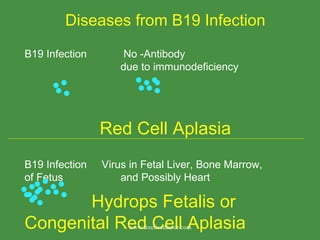
Diseases from B19 Infection B19 Infection   No -Antibody  due to immunodeficiency Red Cell Aplasia B19 Infection  Virus in Fetal Liver, Bone Marrow, of Fetus  and Possibly Heart   Hydrops Fetalis or  Congenital Red Cell Aplasia  www.freelivedoctor.com
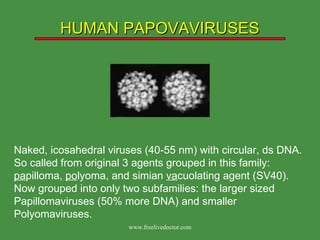
HUMAN PAPOVAVIRUSES Naked, icosahedral viruses (40-55 nm) with circular, ds DNA.  So called from original 3 agents grouped in this family:  pa pilloma,  po lyoma, and simian  va cuolating agent (SV40).  Now grouped into only two subfamilies: the larger sized Papillomaviruses (50% more DNA) and smaller Polyomaviruses. www.freelivedoctor.com
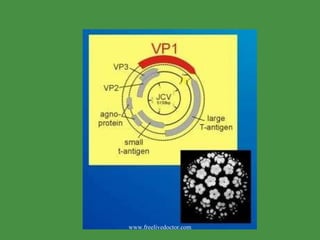
PAPOVAVIRUS REPLICATION Replicate in a circle from a single origin, by bi-directional fork (like a plasmid). Early genes transcribed in one direction off one strand: late genes transcribed in opposite direction off other strand. Early proteins (T Ag) are multifunctional, including late transcription in nucleus, and may also include either benign or malignant tumors. www.freelivedoctor.com
www.freelivedoctor.com
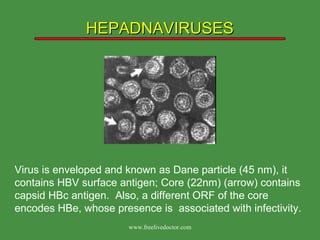
HEPADNAVIRUSES Virus is enveloped and known as Dane particle (45 nm), it contains HBV surface antigen; Core (22nm) (arrow) contains capsid HBc antigen.  Also, a different ORF of the core encodes HBe, whose presence is  associated with infectivity. www.freelivedoctor.com
LATEST ON PRIONS I Transmissible spongiform encephalopathies (TSEs) are not viruses or viroids; they are prions. Examples of prions include: 1. Scrapie in sheep 2. Creutzfeldt-Jacob Disease (CJD) in humans 3. Bovine Spongiform Encephalopathy (BSE) or Mad Cow Disease in cattle.  Following ingestion of beef by humans the disease is known as vCJD, which is a variant of CJD. 4. Gerstmann-Straussler-Scheinker syndrome (GSS) in humans www.freelivedoctor.com
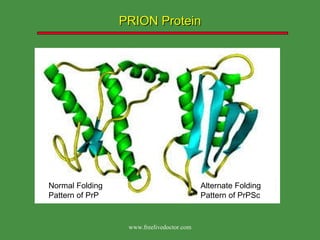
LATEST ON PRIONS II The prion consists partly or entirely of a conformational isoform of the normal host protein PrPc. When the abnormal conformer is introduced into the organism it causes the conversion of the host PrPc into a likeness of itself. The physiological role of PrPc and the pathological mechanisms of neurodegeneration in prion diseases are still elusive. www.freelivedoctor.com
PRION Protein Normal Folding Pattern of PrP  Alternate Folding Pattern of PrPSc  www.freelivedoctor.com

Dna Virus

  • 1.
    HUMAN DNA VIRUSESRonald Luftig Ph.D. Louisiana State University Professor and Head Department of Microbiology,Immunology & Parasitology www.freelivedoctor.com
  • 2.
    OBJECTIVES General replicationcycle of DNA viruses using Adenovirus as a model Unique replication features of all DNA viruses, including Herpes, Papovaviruses and Hepadnaviruses Disease features of different Adenovirus types, Poxviruses and Parvoviruses vCJD and Mad Cow disease www.freelivedoctor.com
  • 3.
    www.freelivedoctor.com PARVOVIRUS SS linear - PAPOVAVIRUS DS, circular - ADENOVIRUS DS, linear - HERPESVIRUS DS, linear + POXVIRUS DS, linear + HEPADNAVIRUS DS, circular + DNA VIRUS GENOME Env
  • 4.
    www.freelivedoctor.com PARVO VIRUS = Small B19 - infects erythroid progenitor cells Adeno-Associated Virus AAV (helper-dependent parvoviruses) PAPOVAVIRUS Papilloma & Polyoma Viruses numerous types of Human Papilloma Virus (HPV) – Warts BK and JC Virus (BKV, JCV) BK - kidney; JC - brain - problems in the immunocompromised; SV40 (monkey)- vacuolating virus ADENOVIRUS 49 serotypes in humans respiratory disease, epidemic conjunctivitis, gastroenteritis HERPESVIRUS 8 types in humans herpes B virus - macaques Herpes Simplex 1&2, Varicella-zoster, Epstein-Barr, Cytomegalovirus, Human Herpes 6, 7,8; HHV6, HHV7= Roseolovirus HHV8 = Kaposi’s sarcoma associated POXVIRUS Variola (small pox), Vaccinia (small pox vaccine), Molluscum contagiosum HEPADNAVIRUS Hepatitis B virus (HBV)
  • 5.
    ADENOVIRUSES www.freelivedoctor.com
  • 6.
    Adenoviruses encompass 49serotypes or six subgroups (A-F). In humans, they infect cells in tissues at the portal of entry. Many serotypes commonly infect local lymphoid tissue (adenoids, tonsils, Peyer’s patches) in persistent or latent fashion, perhaps for life. Adenoviruses also replicate in the intestine, where they may persist for months and are usually not pathogenic. NO viremia or disseminated diseases occurs except in immuncompromised patients. GENERAL ADENO PROPERTIES www.freelivedoctor.com
  • 7.
    As a generalrule all DNA viruses replicate in the nucleus, except the Pox viruses which replicate in the cytoplasm We will use Adenoviruses as a model system for understanding replication of DNA viruses in general Most DNA viruses are naked (see model of soccer ball), with 12 blue penton bases on the vertices and 20 yellow hexons on the rest of the face. Both pentons and hexons are known as capsomers and form the capsid which encloses the nucleic acid as discussed by Dr. Amedee For Adenovirus, there are 252 capsomers 12 on the vertices and 240 on the faces. In the soccer ball model there are 32 capsomers to give you an idea of size ADENOVIRUS REPLICATION www.freelivedoctor.com
  • 8.
    1. Protomers 2.Capsomers 3. Pro-Capsid 4. MatureCapsid www.freelivedoctor.com
  • 9.
    Adenovirus - Icosahedral Capsids www.freelivedoctor.com
  • 10.
    Adenovirus 2 GenomeMap www.freelivedoctor.com
  • 11.
    In adenovirus, thefirst step involves attachment of the fiber to a host cell receptor. This is called the CAR (coxsackie-adenovirus receptor). Then after entry the particle moves into an endosomal vesicle to the nucleus where the DNA is uncoated into the nucleus through the nuclear pore. This sets up the general replication scheme: first of enzymes to help the virus replicate (early stage), then double-stranded DNA replication (semi-conservative mode) begins (late stage), followed by translation of structural proteins, such as the penton and hexon precursors. STAGES OF ADENO REPLICATION I www.freelivedoctor.com
  • 12.
    Adenovirus Replication EndosomeVirion Integrins CAR Virion DNA Nuclear pore Nucleus Cytoplasm www.freelivedoctor.com
  • 13.
    Adenovirus Replication EndosomeEarly mRNAs Early proteins Virion Integrins CAR Virion DNA Modulate Cell Cycle Shut down host mRNA transport Block CTL Response Nuclear pore Nucleus Cytoplasm www.freelivedoctor.com
  • 14.
    STAGES OF ADENOREPLICATION II After translation the proteins accumulate in the nucleus and together with newly made (nascent) viral DNA assembly into virions. After 2-3 days of accumulation the cells lyse and release several hundred adenovirus particles in a burst. www.freelivedoctor.com
  • 15.
    Adenovirus Replication EndosomeLate mRNAs Early mRNAs Early proteins Late proteins Virion Integrins CAR Virion DNA Modulate Cell Cycle Shut down host mRNA transport Progeny DNA Cell Lysis Block CTL Response Progeny Virus Nuclear pore Nucleus Cytoplasm www.freelivedoctor.com
  • 16.
    ADENOVIRUS AND HUMANDISEASE DISEASE ADENOVIRUS Mild pediatric respiratory disease type 1, 2 & 5 (prevalent 0-6 yrs.) Acute respiratory disease (ARD) (5-8% adults types 3, 4, 7, 14, 11 & 21 & up to 50-80% of military recruits) Pharyngoconjunctival fever, eye types 3, 4, 7, 14, & 21 involvement as long as 3 weeks Epidemic keratoconjunctivitis “shipyard eye”, highly type 8 – and type 19 contagious, severe, but usually no sequelae Infantile diarrhea – prevalent in third world and migrant types 40 & 41 workers www.freelivedoctor.com
  • 17.
    Resist drying, detergents,mild chlorine, and GI tract secretions Spread exclusively human-to-human May be shed intermittently and over long periods from pharynx and feces www.freelivedoctor.com
  • 18.
    Contagious Virus inRespiratory Secretions Virus in Stool Incubation Period Time Course of Adenovirus Respiratory Infections ~~ Viremia ** ** in the immunosuppressed www.freelivedoctor.com Symptoms Specific Antibody
  • 19.
  • 20.
    They encode theirown viral DNA polymerase, as well as other enzymes, such as thymidine kinase Due to specificity and differences of these enzymes from that of the host, this has allowed development of targeted antivirals, such as acyclovir and ganciclovir Terminal inverted repeats allow circularization. Replicate as a rolling circle, producing concatemeric DNA (multiple copies of the genome covalently linked end-to end) Concatemers cleaved to yield genome-size pieces and packaged into an icosahedral nucleocapsid. Genome has long (L) and short (S) segments, assorted into 4 isomeric forms (isoschizomers) that can each be packaged HERPES REPLICATION www.freelivedoctor.com
  • 21.
  • 22.
  • 23.
  • 24.
    POXVIRUSES 200-300nm enveloped,brick-shaped virus largest known virus family; core (c) is DNA www.freelivedoctor.com
  • 25.
    SMALLPOX HISTORY ThePharaoh Ramses V (left) died of smallpox in 1157 B.C. The disease reached Europe in 710 A.D. and was transferred to America by Hernando Cortez in 1520 - 3.5 million Aztecs died in the next 2 years. In the cities of 18th century Europe, smallpox reached plague proportions and was a feared scourge - highly infectious. Five reigning European monarchs died from smallpox during the 18th century. www.freelivedoctor.com
  • 26.
    Replication of Poxviruseswww.freelivedoctor.com
  • 27.
    PARVOVIRUSES Small (22nm)naked single stranded (SS) DNA viruses. There are two major subgroups: i) autonomous replicating and ii) dependoviruses. An example of the former is B19 which is the only significant agent of human disease. www.freelivedoctor.com
  • 28.
    PARVOVIRUS REPLICATION Bothabove subgroups replicate through a DNA strand intermediate, which is complimentary to the DNA strand in the parent virion. Unique Replication Features: Single strand has terminal hairpins formed by palindromic sequences. As with other viruses with terminal repeats, intermediate DNA forms replicate through concatemers. www.freelivedoctor.com
  • 29.
    PARVOVIRUS DISEASES Erythemainfectiosum or "fifth exanthem", a self-limited febrile illness of children with a facial rash ("slapped cheek" syndrome)--usually ages 4-15 years. B19 is associated with "aplastic crisis" in anemia patients, and sickle-cell anemia patients. It can also lead to idiopathic red cell aplasia in AIDS patients. In seronegative pregnant women it can cause hydrops fetalis, where an aborted fetus is delivered. Less often: rheumatoid arthritis in young adults or hepatitis in children. www.freelivedoctor.com
  • 30.
  • 31.
    Diseases from B19Infection B19 Infection Antibody Excess Immune complex deposition Fifth Disease B19 Infection Virus Excess + hemolytic disorder Transient Aplastic Crisis Y Y Y Y Y Y Y Y Y Y Y Y Y Y Y Y Y Y www.freelivedoctor.com
  • 32.
    Diseases from B19Infection B19 Infection No -Antibody due to immunodeficiency Red Cell Aplasia B19 Infection Virus in Fetal Liver, Bone Marrow, of Fetus and Possibly Heart Hydrops Fetalis or Congenital Red Cell Aplasia www.freelivedoctor.com
  • 33.
    HUMAN PAPOVAVIRUSES Naked,icosahedral viruses (40-55 nm) with circular, ds DNA. So called from original 3 agents grouped in this family: pa pilloma, po lyoma, and simian va cuolating agent (SV40). Now grouped into only two subfamilies: the larger sized Papillomaviruses (50% more DNA) and smaller Polyomaviruses. www.freelivedoctor.com
  • 34.
    PAPOVAVIRUS REPLICATION Replicatein a circle from a single origin, by bi-directional fork (like a plasmid). Early genes transcribed in one direction off one strand: late genes transcribed in opposite direction off other strand. Early proteins (T Ag) are multifunctional, including late transcription in nucleus, and may also include either benign or malignant tumors. www.freelivedoctor.com
  • 35.
  • 36.
    HEPADNAVIRUSES Virus isenveloped and known as Dane particle (45 nm), it contains HBV surface antigen; Core (22nm) (arrow) contains capsid HBc antigen. Also, a different ORF of the core encodes HBe, whose presence is associated with infectivity. www.freelivedoctor.com
  • 37.
    LATEST ON PRIONSI Transmissible spongiform encephalopathies (TSEs) are not viruses or viroids; they are prions. Examples of prions include: 1. Scrapie in sheep 2. Creutzfeldt-Jacob Disease (CJD) in humans 3. Bovine Spongiform Encephalopathy (BSE) or Mad Cow Disease in cattle. Following ingestion of beef by humans the disease is known as vCJD, which is a variant of CJD. 4. Gerstmann-Straussler-Scheinker syndrome (GSS) in humans www.freelivedoctor.com
  • 38.
    LATEST ON PRIONSII The prion consists partly or entirely of a conformational isoform of the normal host protein PrPc. When the abnormal conformer is introduced into the organism it causes the conversion of the host PrPc into a likeness of itself. The physiological role of PrPc and the pathological mechanisms of neurodegeneration in prion diseases are still elusive. www.freelivedoctor.com
  • 39.
    PRION Protein NormalFolding Pattern of PrP Alternate Folding Pattern of PrPSc www.freelivedoctor.com