CS5371
Theory of Computation
Lecture 5: Automata Theory
III
(Non-regular Language, Pumping
Lemma, Regular Expression)
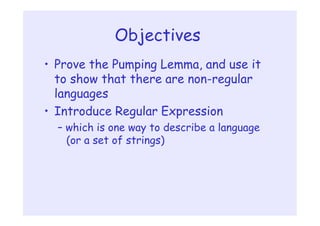
• Prove the Pumping Lemma, and use it
to show that there are non-regular
languages
• Introduce Regular Expression
– which is one way to describe a language
(or a set of strings)
Objectives
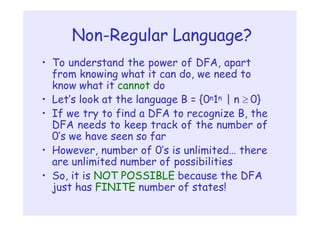
Non-Regular Language?
• To understand the power of DFA, apart
from knowing what it can do, we need to
know what it cannot do
• Let’s look at the language B = {0n1n | n  0}
• If we try to find a DFA to recognize B, the
DFA needs to keep track of the number of
0’s we have seen so far
• However, number of 0’s is unlimited… there
are unlimited number of possibilities
• So, it is NOT POSSIBLE because the DFA
just has FINITE number of states!
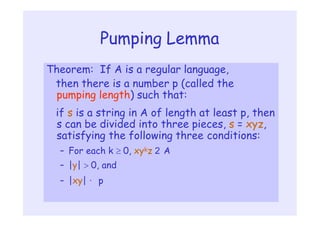
Pumping Lemma
Theorem: If A is a regular language,
then there is a number p (called the
pumping length) such that:
if s is a string in A of length at least p, then
s can be divided into three pieces, s = xyz,
satisfying the following three conditions:
– For each k  0, xykz 2 A
– |y|  0, and
– |xy| · p
Pumping Lemma (Proof)
• Let us assign the pumping length p to be
the number of states in the DFA that
recognize A
• Consider the sequence of states that the
DFA goes through when reading
s = s1s2…sn
• At the beginning, it is at state r0 = qstart
• Then, it goes to r1 after reading s1, then
goes to r2, then goes to r3 …
Pumping Lemma (Proof)
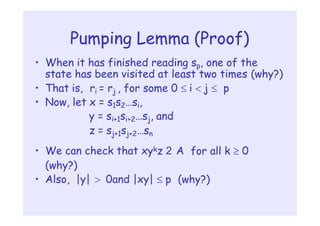
• When it has finished reading sp, one of the
state has been visited at least two times (why?)
• That is, ri = rj , for some 0  i  j  p
• Now, let x = s1s2…si,
y = si+1si+2…sj, and
z = sj+1sj+2…sn
• We can check that xykz 2 A for all k  0
(why?)
• Also, |y|  0and |xy|  p (why?)
Use of Pumping Lemma
(Example 1)
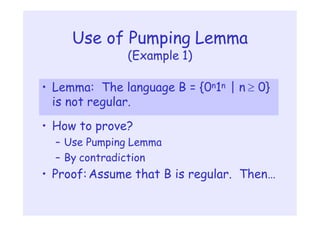
• Lemma: The language B = {0n1n | n  0}
is not regular.
• How to prove?
– Use Pumping Lemma
– By contradiction
• Proof:Assume that B is regular. Then…
Use of Pumping Lemma
(Example 1)
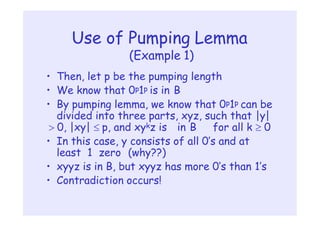
• Then, let p be the pumping length
• We know that 0p1p is in B
• By pumping lemma, we know that 0p1p can be
divided into three parts, xyz, such that |y|
 0, |xy|  p, and xykz is in B for all k  0
• In this case, y consists of all 0’s and at
least 1 zero (why??)
• xyyz is in B, but xyyz has more 0’s than 1’s
• Contradiction occurs!
Use of Pumping Lemma
(Example 2)
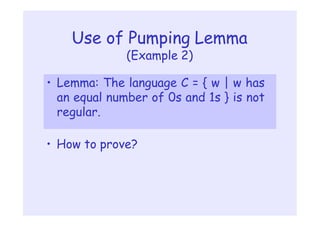
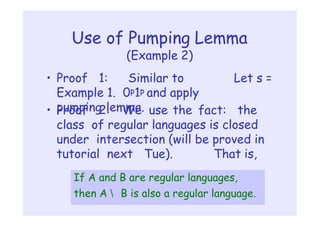
• Lemma: The language C = { w | w has
an equal number of 0s and 1s } is not
regular.
• How to prove?
Use of Pumping Lemma
(Example 2)
Let s =• Proof 1: Similar to
Example 1. 0p1p and apply
pumping lemma.• Proof 2: We use the fact: the
class of regular languages is closed
under intersection (will be proved in
tutorial next Tue). That is,
If A and B are regular languages,
then A  B is also a regular language.
Use of Pumping Lemma
(Example 2:Proof 2)
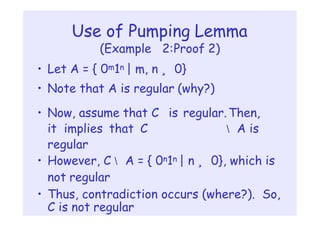
• Let A = { 0m1n | m, n ¸ 0}
• Note that A is regular (why?)
• Now, assume that C is regular.Then,
it implies that C  A is
regular
• However, C  A = { 0n1n | n ¸ 0}, which is
not regular
• Thus, contradiction occurs (where?). So,
C is not regular
Use of Pumping Lemma
(Example 2)
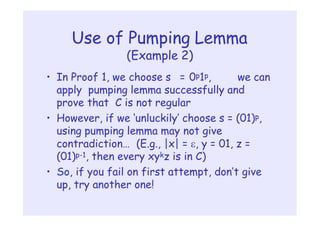
• In Proof 1, we choose s = 0p1p, we can
apply pumping lemma successfully and
prove that C is not regular
• However, if we ‘unluckily’ choose s = (01)p,
using pumping lemma may not give
contradiction… (E.g., |x| = , y = 01, z =
(01)p-1, then every xykz is in C)
• So, if you fail on first attempt, don’t give
up, try another one!
Use of Pumping Lemma
(Example 3)
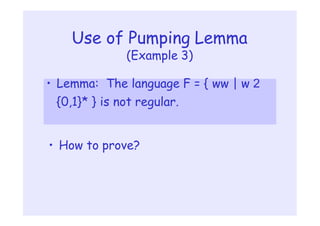
• Lemma: The language F = { ww | w 2
{0,1}* } is not regular.
• How to prove?
Use of Pumping Lemma
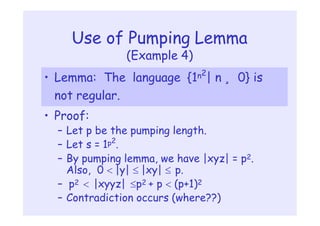
(Example 4)
• Lemma: The language {1n2
| n ¸ 0} is
not regular.
• Proof:
– Let p be the pumping length.
– Let s = 1p2
.
– By pumping lemma, we have |xyz| = p2.
Also, 0  |y|  |xy|  p.
– p2  |xyyz| p2 + p  (p+1)2
– Contradiction occurs (where??)
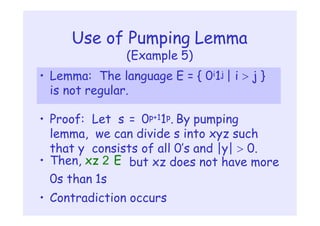
Use of Pumping Lemma
(Example 5)
• Lemma: The language E = { 0i1j | i  j }
is not regular.
• Proof: Let s = 0p+11p. By pumping
lemma, we can divide s into xyz such
that y consists of all 0’s and |y|  0.
but xz does not have more• Then, xz 2 E
0s than 1s
• Contradiction occurs
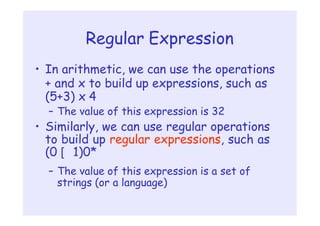
Regular Expression
• In arithmetic, we can use the operations
+ and x to build up expressions, such as
(5+3) x 4
– The value of this expression is 32
• Similarly, we can use regular operations
to build up regular expressions, such as
(0 [ 1)0*
– The value of this expression is a set of
strings (or a language)
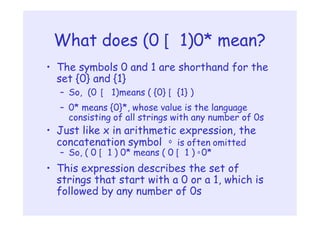
What does (0 [ 1)0* mean?
• The symbols 0 and 1 are shorthand for the
set {0} and {1}
– So, (0 [ 1)means ( {0} [ {1} )
– 0* means {0}*, whose value is the language
consisting of all strings with any number of 0s
• Just like x in arithmetic expression, the
concatenation symbol o is often omitted
– So, ( 0 [ 1 ) 0* means ( 0 [ 1 ) o 0*
• This expression describes the set of
strings that start with a 0 or a 1, which is
followed by any number of 0s
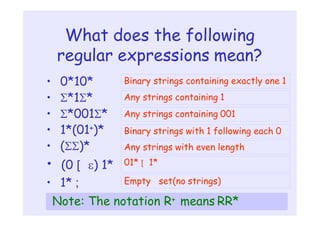
What does the following
regular expressions mean?
• 0*10*
• *1*
• *001*
• 1*(01+)*
• ()*
• (0 [ ) 1*
• 1* ;
Note: The notation R+ means RR*
Binary strings containing exactly one 1
Any strings containing 1
Any strings containing 001
Any strings with even length
Binary strings with 1 following each 0
01* [ 1*
Empty set(no strings)
Next time
• Formally define regular expression
• We will also show that
– (1) Language recognized by DFA can be
described by Regular Expression
– (2) Language described by Regular
Expression can be recognized by DFA

Pumping lemma for regular set h1

  • 1.
    CS5371 Theory of Computation Lecture5: Automata Theory III (Non-regular Language, Pumping Lemma, Regular Expression)
  • 2.
    • Prove thePumping Lemma, and use it to show that there are non-regular languages • Introduce Regular Expression – which is one way to describe a language (or a set of strings) Objectives
  • 3.
    Non-Regular Language? • Tounderstand the power of DFA, apart from knowing what it can do, we need to know what it cannot do • Let’s look at the language B = {0n1n | n  0} • If we try to find a DFA to recognize B, the DFA needs to keep track of the number of 0’s we have seen so far • However, number of 0’s is unlimited… there are unlimited number of possibilities • So, it is NOT POSSIBLE because the DFA just has FINITE number of states!
  • 4.
    Pumping Lemma Theorem: IfA is a regular language, then there is a number p (called the pumping length) such that: if s is a string in A of length at least p, then s can be divided into three pieces, s = xyz, satisfying the following three conditions: – For each k  0, xykz 2 A – |y|  0, and – |xy| · p
  • 5.
    Pumping Lemma (Proof) •Let us assign the pumping length p to be the number of states in the DFA that recognize A • Consider the sequence of states that the DFA goes through when reading s = s1s2…sn • At the beginning, it is at state r0 = qstart • Then, it goes to r1 after reading s1, then goes to r2, then goes to r3 …
  • 6.
    Pumping Lemma (Proof) •When it has finished reading sp, one of the state has been visited at least two times (why?) • That is, ri = rj , for some 0  i  j  p • Now, let x = s1s2…si, y = si+1si+2…sj, and z = sj+1sj+2…sn • We can check that xykz 2 A for all k  0 (why?) • Also, |y|  0and |xy|  p (why?)
  • 7.
    Use of PumpingLemma (Example 1) • Lemma: The language B = {0n1n | n  0} is not regular. • How to prove? – Use Pumping Lemma – By contradiction • Proof:Assume that B is regular. Then…
  • 8.
    Use of PumpingLemma (Example 1) • Then, let p be the pumping length • We know that 0p1p is in B • By pumping lemma, we know that 0p1p can be divided into three parts, xyz, such that |y|  0, |xy|  p, and xykz is in B for all k  0 • In this case, y consists of all 0’s and at least 1 zero (why??) • xyyz is in B, but xyyz has more 0’s than 1’s • Contradiction occurs!
  • 9.
    Use of PumpingLemma (Example 2) • Lemma: The language C = { w | w has an equal number of 0s and 1s } is not regular. • How to prove?
  • 10.
    Use of PumpingLemma (Example 2) Let s =• Proof 1: Similar to Example 1. 0p1p and apply pumping lemma.• Proof 2: We use the fact: the class of regular languages is closed under intersection (will be proved in tutorial next Tue). That is, If A and B are regular languages, then A B is also a regular language.
  • 11.
    Use of PumpingLemma (Example 2:Proof 2) • Let A = { 0m1n | m, n ¸ 0} • Note that A is regular (why?) • Now, assume that C is regular.Then, it implies that C A is regular • However, C A = { 0n1n | n ¸ 0}, which is not regular • Thus, contradiction occurs (where?). So, C is not regular
  • 12.
    Use of PumpingLemma (Example 2) • In Proof 1, we choose s = 0p1p, we can apply pumping lemma successfully and prove that C is not regular • However, if we ‘unluckily’ choose s = (01)p, using pumping lemma may not give contradiction… (E.g., |x| = , y = 01, z = (01)p-1, then every xykz is in C) • So, if you fail on first attempt, don’t give up, try another one!
  • 13.
    Use of PumpingLemma (Example 3) • Lemma: The language F = { ww | w 2 {0,1}* } is not regular. • How to prove?
  • 14.
    Use of PumpingLemma (Example 4) • Lemma: The language {1n2 | n ¸ 0} is not regular. • Proof: – Let p be the pumping length. – Let s = 1p2 . – By pumping lemma, we have |xyz| = p2. Also, 0  |y|  |xy|  p. – p2  |xyyz| p2 + p  (p+1)2 – Contradiction occurs (where??)
  • 15.
    Use of PumpingLemma (Example 5) • Lemma: The language E = { 0i1j | i  j } is not regular. • Proof: Let s = 0p+11p. By pumping lemma, we can divide s into xyz such that y consists of all 0’s and |y|  0. but xz does not have more• Then, xz 2 E 0s than 1s • Contradiction occurs
  • 16.
    Regular Expression • Inarithmetic, we can use the operations + and x to build up expressions, such as (5+3) x 4 – The value of this expression is 32 • Similarly, we can use regular operations to build up regular expressions, such as (0 [ 1)0* – The value of this expression is a set of strings (or a language)
  • 17.
    What does (0[ 1)0* mean? • The symbols 0 and 1 are shorthand for the set {0} and {1} – So, (0 [ 1)means ( {0} [ {1} ) – 0* means {0}*, whose value is the language consisting of all strings with any number of 0s • Just like x in arithmetic expression, the concatenation symbol o is often omitted – So, ( 0 [ 1 ) 0* means ( 0 [ 1 ) o 0* • This expression describes the set of strings that start with a 0 or a 1, which is followed by any number of 0s
  • 18.
    What does thefollowing regular expressions mean? • 0*10* • *1* • *001* • 1*(01+)* • ()* • (0 [ ) 1* • 1* ; Note: The notation R+ means RR* Binary strings containing exactly one 1 Any strings containing 1 Any strings containing 001 Any strings with even length Binary strings with 1 following each 0 01* [ 1* Empty set(no strings)
  • 19.
    Next time • Formallydefine regular expression • We will also show that – (1) Language recognized by DFA can be described by Regular Expression – (2) Language described by Regular Expression can be recognized by DFA