Download to read offline



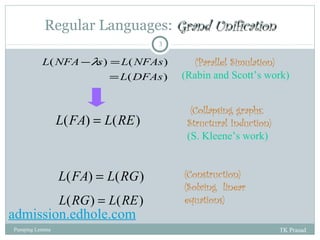
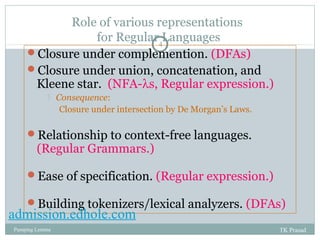
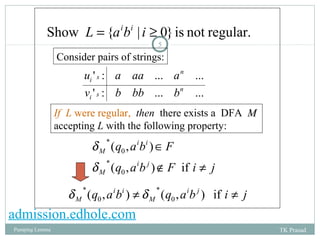
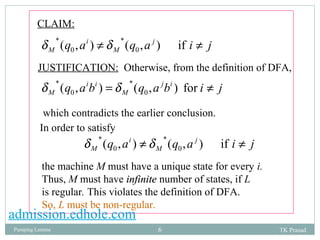
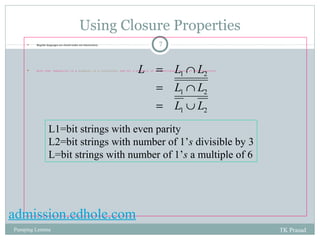
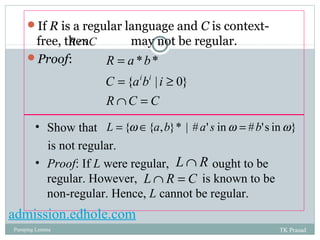
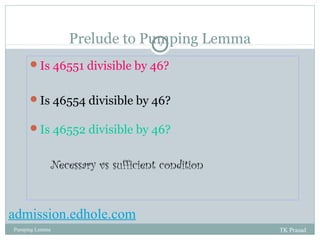
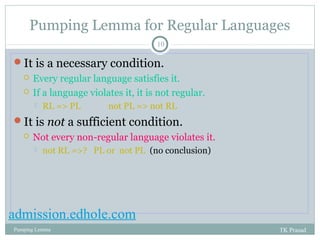
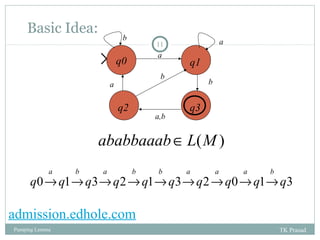
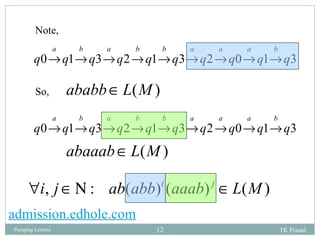
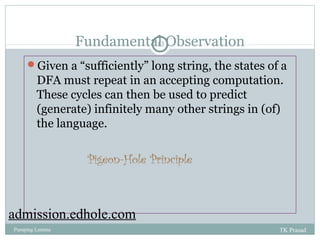
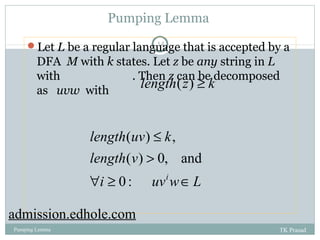
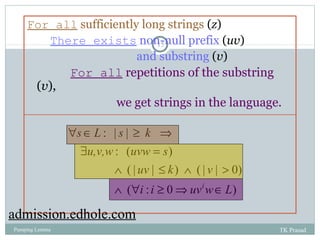
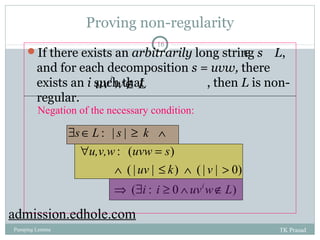
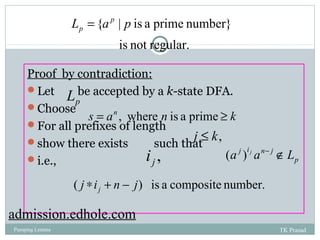
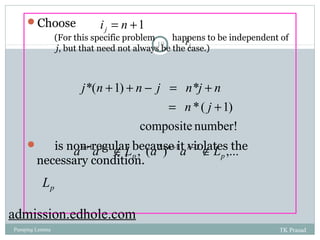
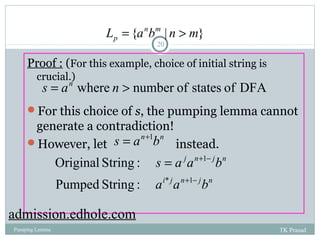
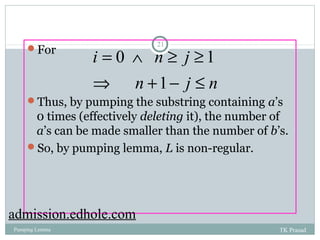
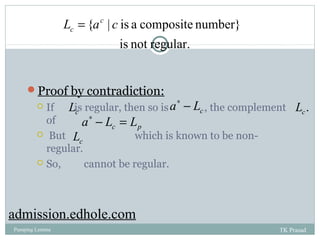
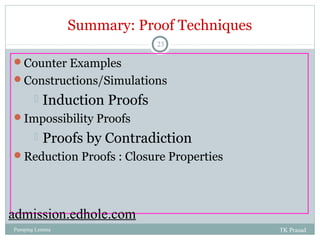

This document discusses regular languages and the pumping lemma for regular languages. It begins by defining regular languages and their representations using finite automata, regular expressions, and regular grammars. It then introduces the pumping lemma, which states that for any regular language, there exists a length such that any string in the language of that length or greater can be decomposed and pumped to generate new strings that are also in the language. The document provides examples of using the pumping lemma to prove languages are non-regular by finding a string that cannot be pumped in the required way. It concludes by summarizing different proof techniques used with the pumping lemma.


