Regional Anesthesia
PHYSIOLOGY OF NERVE CONDUCTION
 Nerve Fiber – impulse – transmitting unit
 Membrane
 90% of lipids
 10% protein
 Channels guarded by “gates”
 K+ pass freely in and out
 Na+ barred outside
 Negative resting potential -70 to -90 mV
PHYSIOLOGY OF NERVE CONDUCTION
 Nerve Stimulation
 Gates open
 Na+ rushing in
 Shifting of polarity
 Depolarization
I. TOPICAL – skin or mucous membrane
spray – refrigeration (e.g. boils / abcess)
ointment – insect bites
instillation – urethral meatus
contact – cotton pledgets in nasal mucosa
II. INFILTRATION – incision site / tissue to be cut
(e.g. sebaceous cyst)
III. FIELD BLOCK – around tissue to be cut (e.g.
breast mass)
Classification of
Regional Anesthesia
(according to SITE of application)
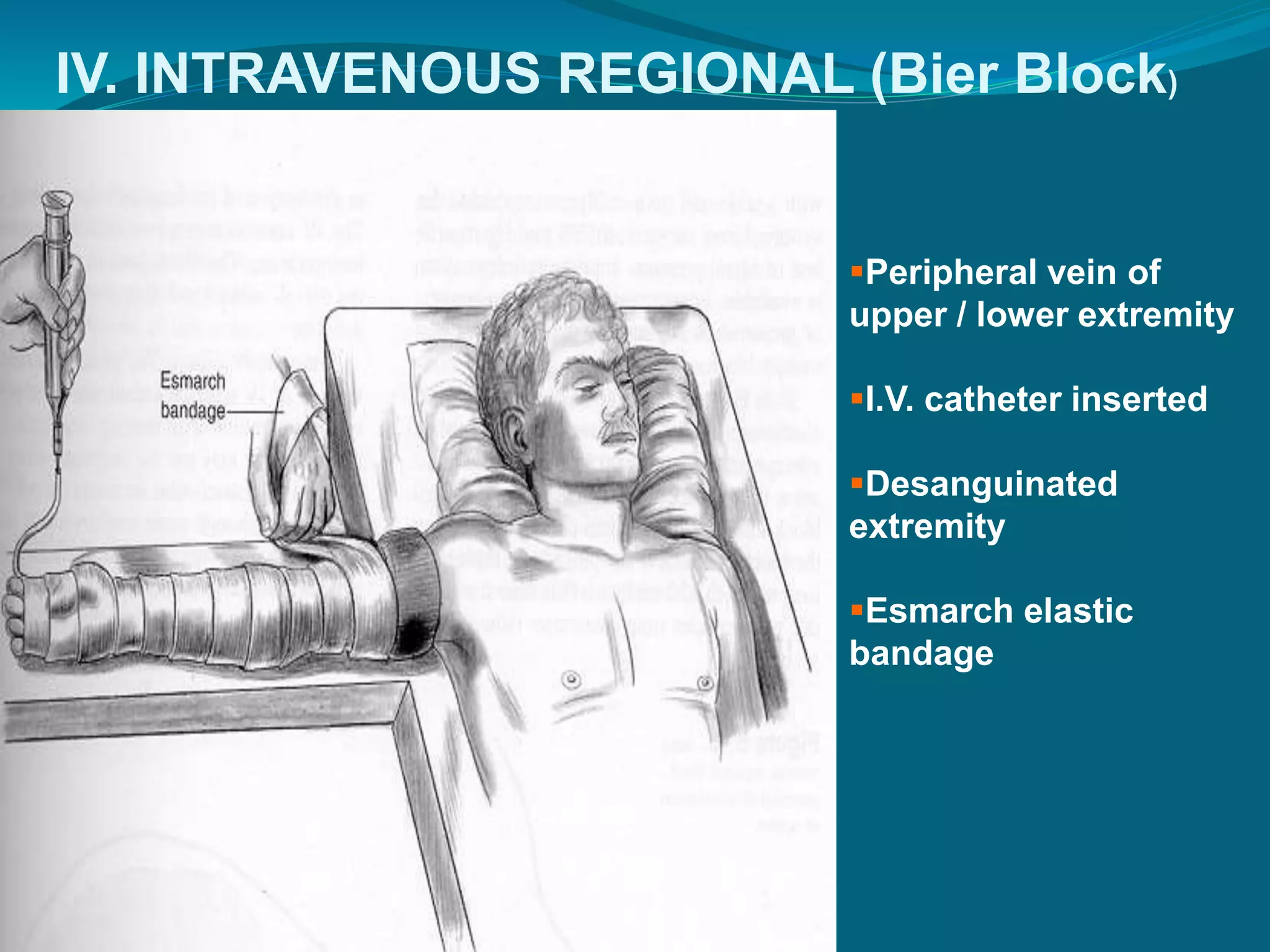
IV. INTRAVENOUS REGIONAL (Bier Block)
Peripheral vein of
upper / lower extremity
I.V. catheter inserted
Desanguinated
extremity
Esmarch elastic
bandage
2 tourniquets (BP cuffs)
bandage removed
LA injected over 2-3
minutes
Distal tourniquet inflated
after 20-30 minutes
Proximal tourniquet
deflated
Slow release of
tourniquet after at least 15-
20 minutes
Use: short surgical
procedure
< 45 minutes in upper /
lower extremity
V. CONDUCTION BLOCK – along nerve
or course of nerves
A. Peripheral Nerve Blocks
B. Central Blocks
Peripheral Nerve Blocks
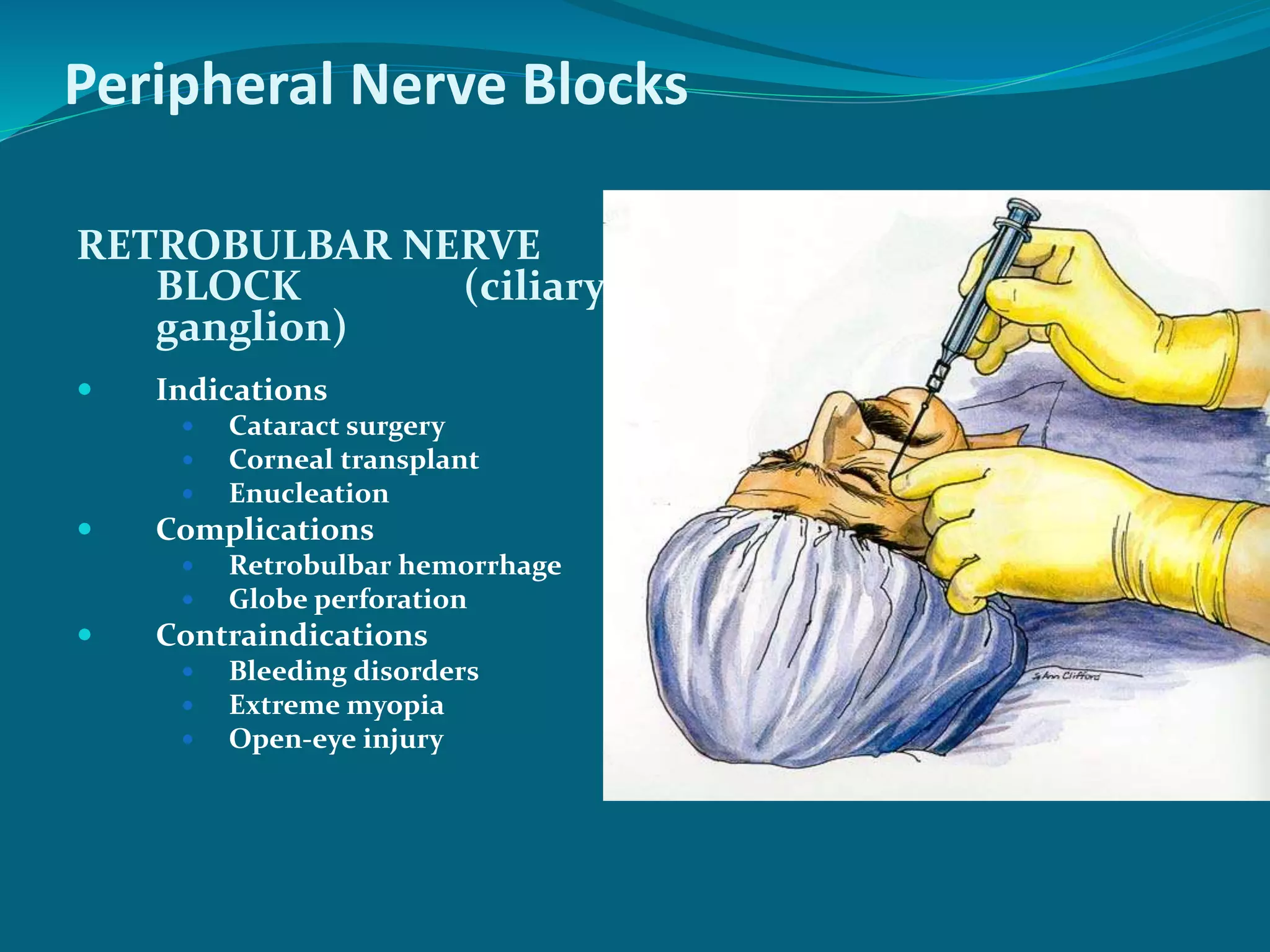
RETROBULBAR NERVE
BLOCK (ciliary
ganglion)
 Indications
 Cataract surgery
 Corneal transplant
 Enucleation
 Complications
 Retrobulbar hemorrhage
 Globe perforation
 Contraindications
 Bleeding disorders
 Extreme myopia
 Open-eye injury
GASSERIAN GANGLION BLOCK
Branches of trigeminal nerve
(ophthalmic, maxillary, mandibular)
Indications
 Trigeminal neuralgia
 Cancer pain in face
 Operations in face teeth, gum, mandible, etc.
 Technique: LA injected into respective
foramen of nerve branches
Peripheral Nerve Blocks
CERVICAL PLEXUS BLOCK
 Anterior rami of C1-C4 spinal nerve roots
 Sensory supply to jaw, a neck, occiput, chest-
shoulders, clavicle, upper border of scapula
 Indications
 Operations in the neck
 Cervical lymph node biopsy
 Carotid endarterectomy
 Thyroid operations
Peripheral Nerve Blocks
BRACHIAL PLEXUS BLOCK
 Anterior rami of C4-T2 spinal nerve roots
 Entire motor supply of upper extremity
 Almost entire sensory supply – except over
shoulder and medial arm
Peripheral Nerve Blocks
Major Peripheral Branches
a. Axillary N – shoulder
abduction
b. Musculocutaneous –
elbow flexion
c. Radial – elbow, wrist,
and finger extensions
d. Median – wrist and
finger flexion
e. Ulnar – wrist and
finger flexion
BRACHIAL PLEXUS BLOCK
 Indication: operations of upper
extremity
 Approaches to Brachial Plexus Block
1. interscalene approach
2. Supraclavicular
3. Infraclavicular
4. axillary
Peripheral Nerve Blocks
Interscalene approach
BRACHIAL PLEXUS BLOCK
Axillary approach
BRACHIAL PLEXUS BLOCK
INTERCOSTAL NERVE BLOCK
 Anterior rami of 1st eleven spinal nerves
 At inferior surface of ribs
 Indications
 Post-op analgesia of thoracic and upper abdomen
surgeries
 Relief of pain from rib fractures, herpes zoster,
pleurisy
 Complications: pneumothorax
Peripheral Nerve Blocks
INTERCOSTAL NERVE BLOCK
Peripheral Nerve Blocks
WRIST BLOCK
 Ulnar nerve
 Median
 Radial
 Indications:
 surgery or analgesia distal
to metacarpophalangeal
joints
 suture of lacerations
 paronychia, abcess
 Digital branches of
ulnar, median, radial
 Indications:
 minor procedure in fingers
 Reminder:
 avoid using large volume
of LA
 do not add
vasoconstrictors
Peripheral Nerve Blocks
DIGITAL NERVE BLOCK
Proximal nerve blocks on lower
extremity
 Femoral nerve block
 Sciatic nerve block
 Obturatory nerve block
 Lateral cutaneous femoral nerve block
 Lumbar plexus
 Lumbar paravertebral block
 Psoas compartment block
ANKLE BLOCK
 Blocks five nerves supplying foot
a. Deep peroneal
b. Superficial peroneal
c. Saphenous
d. Posterior tibial
e. Sural
 Indications
 Surgery of foot and toes in frail patients who cannot
tolerate hemodynamic effects of GA or neuraxial
block
Distal Nerve Blocks on the leg
ANKLE BLOCK
 Precaution
 Avoid epinephrine to
reduce risk of
ischemia
 Complication
 Intravascular
injection
Peripheral Nerve Blocks
PUDENDAL NERVE
BLOCK
 sacral plexus (S2 – S3 –
S4)
 Indications
 perineal surgery
o hemorrhoids
o lacerations
 obstetric vaginal delivery
 Complications
 puncture of fetal head
 inadvertent IV infection
DORSAL PENILE BLOCK
 Base of penis at symphysis pubis
 Blocks dorsal nerve
 Fan-shaped injection at the base blocks dorsal and
ventral branches
 Indications
 Penile surgery
 Post-op pain relief
Peripheral Nerve Blocks
DORSAL PENILE BLOCK
 Precautions
 Avoid big volume of solution
 Avoid epinephrine or any vasoconstrictor
 Complication
 Artery spasm – ischemic injury to penis
Peripheral Nerve Blocks
Central Blocks = Neuroaxial
anesthesia
A. SPINAL ANESTHESIA
Sub Arachnoid Block, Intrathecal Block
 Local anesthestic deposited at subarachnoid
space
 Acts on spinal nerve roots, dorsal ganglia, not
on substance of spinal cord
 Redistributed via vascular absorption
 Produces sympathetic block, sensory analgesia
and motor block
Indications
 Surgery involving lower half of body
 Upper abdomen
 Lower abdomen
 Perineum
 Lower Extremity
 Obstetrics – vaginal delivery
Caesarian section
 Painful diagnostic and therapeutic procedures
below diaphragm
Contraindications
 Absolute
 Bleeding disorders
 Septicemia
 Inc. intracranial pressure
 Chronic dermatitis or infection near puncture site
 Pre-existing spinal cord disease
 Hypotension
 Patient refusal
 Systemic disease with neurologic sequelae
 Relative
 Hemorrhage
 Back problem due to muscle strain, arthritis
 Extremely tense / psychotics
 Respiratory disease
Drugs Used
 Tetracaine
 Lidocaine
 Bupivacaine
Factors Determining Level of Anesthesia
 volume of solution
 concentration
 barbotage
 speed of injection
 patient position
 specific gravity of solution
 site of injection
 height of patient
 increased intra-abdominal pressure
Technique
A. Position
 Lateral decubitus – knees flexed to chest
hin put down on chest (nose-to-knee)
 Sitting – when lateral approach is difficult (e.g.
obese patients)
B. Puncture Sites
 Interspaces between L2-L3, L3-:4, L4-L5
 Line joining highest points of iliac crests
crosses either body of L4 or interspace
between L3-L4
Structures Traversed By Spinal Needle
a. Skin
b. Subcutaneous Tissue
c. Supraspinous ligament
d. Interspinuous ligament
e. ligamentum flavum
f. Dura
PHYSIOLOGIC EFFECTS (Immediate Complications)
A. Cardiovascular
Sympathectomy  vasodilation   BP,  CR
B. Respiratory
Difficulty of breathing
Apnea (high level)
C. Gastrointestinal
Nausea / vomiting in 20%
DELAYED COMPLICATIONS
 Headache – leak of CSF
 Backache
 Urinary retention
 Paraplegia – hematoma
Levels of Spinal Anesthesia – Dermatomes Involved
1. Saddle Block – sensory loss involves lowers lumbar
and sacral segments.
Area that “sits on the saddle”.
2. Low Spinal – level of umbilicus (T10) lower
thoracic lumbars and sacrals.
3. Mid-Spinal – costal margin (T6) lower thoracic
lumbars and sacrals
4. High Spinal – nipple line (T4) thoracic segments
(T4 – T12) lumbars and sacrals
B. EPIDURAL ANESTHESIA
 Anatomy
 Epidural space – base of skull (foramen magnum) to the coccyx
(sacrococcygeal membrane)
 Distance from skin to epidural space – 4-5 cm
 Epidural space contains loose areolar tissue, fat, arterial and
venous networks, lymphatics, spinal nerve roots
 LA deposited in epidural space
 Block spinal nerve roots that traverse peridural space
 Blocks sympathetic nerves traveling with the anterior roots
 Applications range from sensory analgesia, minimal motor block, or
dense anesthesia and full motor block – controlled by drug choice,
concentration, dosage
Central Blocks
Types – selective blockade possible
because it can be performed at any
level of spine
 Cervical epidural
 Thoracic epidural
 Lumbar epidural
 Caudal epidural
Factors Influencing Spread of Solution
 Height of patient
 Drugs used
 Volume
 Concentration
 Level of puncture and catheter insertion
Technique
 Method
 Single dose injection
 Fractional – continuous epidural – repeated injections
of LA through catheter inserted into epidural space
 Position
 Cervical epidural – sitting (C7)
 Thoracic epidural (T7)
 Lumbar epidural
(L1-L2, L2-L3, L3-L4, L4-L5)
Lateral
Decubitus, full
flexion
Method of Identifying Epidural Space
Principle: negative pressure in space
 Loss of resistance
 Plunger of syringe pushed without resistance once
epidural needle is in
 Hanging Drop
 Drop of saline at hub of epidural needle is sucked in
once it enters space
Indications
 All operations below diaphragm
 May be used in
 Poor risk patients
 Cardiac diseases
 Pulmonary diseases
 Metabolic disturbances
 When GA is contraindicated
 When spinal anesthesia is contraindicated
 Painful conditions including post-op pain relief
Contraindications – similar to spinal
 Severe hemorrhage
 Coagulation defects
 Previous laminectomy
 Uncooperative / apprehensive
 Local inflammation at site
 Patient refusal
Advantages
 Well-defined area of anesthesia
 Longer duration
 More severe disturbances of spinal anesthesia minimized
 GI complaints minimized
 Catheterization minimized
 Less respiratory effects
Disadvantages
 Technically more difficult
 Muscle relaxation not complete
 Large volume necessary
 Danger of dural puncture
 Incomplete / patchy block
Physiologic Effects
 Similar to those observed in spinal anesthesia
 Slower onset
 Less intensity of motor and sensory block
Drugs: low-dose LA, opiods
C. CAUDAL ANESTHESIA
 LA injected into the epidural space in the sacral
canal through sacral hiatus
 Blocks lumbosacral plexus (T12, L1-5, S1-3) and
coccygeal plexus (S4-5, coccygeal nerves)
 Indications
 OB – vaginal deliveries
 Surgery involving lower abdomen, perineum
 Post-op pain control following these surgeries
especially pediatric patients
Central Blocks
Technique
 Patient prone or lateral
 Needle inserted into sacral hiatus
 15-20 ml Lidocaine
Physiologic Effects
 Similar to lumbar epidural
 Related to level achieved – volume of drug
Complications
 Accidental Dural puncture
 General systemic reactions
 Infection at site of injection
Disadvantages
 Difficult to obtain high level
 Needs big amount – systemic reactions possible
 Infection possible
 5-10% failure – anatomic anomalies or incorrect
method
THANK YOU

Regional anesthesia

  • 1.
  • 2.
    PHYSIOLOGY OF NERVECONDUCTION  Nerve Fiber – impulse – transmitting unit  Membrane  90% of lipids  10% protein  Channels guarded by “gates”  K+ pass freely in and out  Na+ barred outside  Negative resting potential -70 to -90 mV
  • 3.
    PHYSIOLOGY OF NERVECONDUCTION  Nerve Stimulation  Gates open  Na+ rushing in  Shifting of polarity  Depolarization
  • 4.
    I. TOPICAL –skin or mucous membrane spray – refrigeration (e.g. boils / abcess) ointment – insect bites instillation – urethral meatus contact – cotton pledgets in nasal mucosa II. INFILTRATION – incision site / tissue to be cut (e.g. sebaceous cyst) III. FIELD BLOCK – around tissue to be cut (e.g. breast mass) Classification of Regional Anesthesia (according to SITE of application)
  • 5.
    IV. INTRAVENOUS REGIONAL(Bier Block) Peripheral vein of upper / lower extremity I.V. catheter inserted Desanguinated extremity Esmarch elastic bandage
  • 6.
    2 tourniquets (BPcuffs) bandage removed LA injected over 2-3 minutes Distal tourniquet inflated after 20-30 minutes Proximal tourniquet deflated Slow release of tourniquet after at least 15- 20 minutes Use: short surgical procedure < 45 minutes in upper / lower extremity
  • 7.
    V. CONDUCTION BLOCK– along nerve or course of nerves A. Peripheral Nerve Blocks B. Central Blocks
  • 8.
    Peripheral Nerve Blocks RETROBULBARNERVE BLOCK (ciliary ganglion)  Indications  Cataract surgery  Corneal transplant  Enucleation  Complications  Retrobulbar hemorrhage  Globe perforation  Contraindications  Bleeding disorders  Extreme myopia  Open-eye injury
  • 10.
    GASSERIAN GANGLION BLOCK Branchesof trigeminal nerve (ophthalmic, maxillary, mandibular) Indications  Trigeminal neuralgia  Cancer pain in face  Operations in face teeth, gum, mandible, etc.  Technique: LA injected into respective foramen of nerve branches Peripheral Nerve Blocks
  • 12.
    CERVICAL PLEXUS BLOCK Anterior rami of C1-C4 spinal nerve roots  Sensory supply to jaw, a neck, occiput, chest- shoulders, clavicle, upper border of scapula  Indications  Operations in the neck  Cervical lymph node biopsy  Carotid endarterectomy  Thyroid operations Peripheral Nerve Blocks
  • 15.
    BRACHIAL PLEXUS BLOCK Anterior rami of C4-T2 spinal nerve roots  Entire motor supply of upper extremity  Almost entire sensory supply – except over shoulder and medial arm Peripheral Nerve Blocks
  • 16.
    Major Peripheral Branches a.Axillary N – shoulder abduction b. Musculocutaneous – elbow flexion c. Radial – elbow, wrist, and finger extensions d. Median – wrist and finger flexion e. Ulnar – wrist and finger flexion
  • 17.
    BRACHIAL PLEXUS BLOCK Indication: operations of upper extremity  Approaches to Brachial Plexus Block 1. interscalene approach 2. Supraclavicular 3. Infraclavicular 4. axillary Peripheral Nerve Blocks
  • 18.
  • 19.
  • 20.
    INTERCOSTAL NERVE BLOCK Anterior rami of 1st eleven spinal nerves  At inferior surface of ribs  Indications  Post-op analgesia of thoracic and upper abdomen surgeries  Relief of pain from rib fractures, herpes zoster, pleurisy  Complications: pneumothorax Peripheral Nerve Blocks
  • 21.
  • 22.
  • 23.
  • 24.
    Peripheral Nerve Blocks WRISTBLOCK  Ulnar nerve  Median  Radial  Indications:  surgery or analgesia distal to metacarpophalangeal joints  suture of lacerations  paronychia, abcess
  • 25.
     Digital branchesof ulnar, median, radial  Indications:  minor procedure in fingers  Reminder:  avoid using large volume of LA  do not add vasoconstrictors Peripheral Nerve Blocks DIGITAL NERVE BLOCK
  • 26.
    Proximal nerve blockson lower extremity  Femoral nerve block  Sciatic nerve block  Obturatory nerve block  Lateral cutaneous femoral nerve block  Lumbar plexus  Lumbar paravertebral block  Psoas compartment block
  • 27.
    ANKLE BLOCK  Blocksfive nerves supplying foot a. Deep peroneal b. Superficial peroneal c. Saphenous d. Posterior tibial e. Sural  Indications  Surgery of foot and toes in frail patients who cannot tolerate hemodynamic effects of GA or neuraxial block Distal Nerve Blocks on the leg
  • 28.
    Distal Nerve Blockson the leg ANKLE BLOCK  Precaution  Avoid epinephrine to reduce risk of ischemia  Complication  Intravascular injection
  • 30.
    Peripheral Nerve Blocks PUDENDALNERVE BLOCK  sacral plexus (S2 – S3 – S4)  Indications  perineal surgery o hemorrhoids o lacerations  obstetric vaginal delivery  Complications  puncture of fetal head  inadvertent IV infection
  • 31.
    DORSAL PENILE BLOCK Base of penis at symphysis pubis  Blocks dorsal nerve  Fan-shaped injection at the base blocks dorsal and ventral branches  Indications  Penile surgery  Post-op pain relief Peripheral Nerve Blocks
  • 32.
    DORSAL PENILE BLOCK Precautions  Avoid big volume of solution  Avoid epinephrine or any vasoconstrictor  Complication  Artery spasm – ischemic injury to penis Peripheral Nerve Blocks
  • 33.
    Central Blocks =Neuroaxial anesthesia A. SPINAL ANESTHESIA Sub Arachnoid Block, Intrathecal Block  Local anesthestic deposited at subarachnoid space  Acts on spinal nerve roots, dorsal ganglia, not on substance of spinal cord  Redistributed via vascular absorption  Produces sympathetic block, sensory analgesia and motor block
  • 34.
    Indications  Surgery involvinglower half of body  Upper abdomen  Lower abdomen  Perineum  Lower Extremity  Obstetrics – vaginal delivery Caesarian section  Painful diagnostic and therapeutic procedures below diaphragm
  • 35.
    Contraindications  Absolute  Bleedingdisorders  Septicemia  Inc. intracranial pressure  Chronic dermatitis or infection near puncture site  Pre-existing spinal cord disease  Hypotension  Patient refusal  Systemic disease with neurologic sequelae  Relative  Hemorrhage  Back problem due to muscle strain, arthritis  Extremely tense / psychotics  Respiratory disease
  • 36.
    Drugs Used  Tetracaine Lidocaine  Bupivacaine Factors Determining Level of Anesthesia  volume of solution  concentration  barbotage  speed of injection  patient position  specific gravity of solution  site of injection  height of patient  increased intra-abdominal pressure
  • 37.
    Technique A. Position  Lateraldecubitus – knees flexed to chest hin put down on chest (nose-to-knee)  Sitting – when lateral approach is difficult (e.g. obese patients) B. Puncture Sites  Interspaces between L2-L3, L3-:4, L4-L5  Line joining highest points of iliac crests crosses either body of L4 or interspace between L3-L4
  • 39.
    Structures Traversed BySpinal Needle a. Skin b. Subcutaneous Tissue c. Supraspinous ligament d. Interspinuous ligament e. ligamentum flavum f. Dura
  • 40.
    PHYSIOLOGIC EFFECTS (ImmediateComplications) A. Cardiovascular Sympathectomy  vasodilation   BP,  CR B. Respiratory Difficulty of breathing Apnea (high level) C. Gastrointestinal Nausea / vomiting in 20% DELAYED COMPLICATIONS  Headache – leak of CSF  Backache  Urinary retention  Paraplegia – hematoma
  • 41.
    Levels of SpinalAnesthesia – Dermatomes Involved 1. Saddle Block – sensory loss involves lowers lumbar and sacral segments. Area that “sits on the saddle”. 2. Low Spinal – level of umbilicus (T10) lower thoracic lumbars and sacrals. 3. Mid-Spinal – costal margin (T6) lower thoracic lumbars and sacrals 4. High Spinal – nipple line (T4) thoracic segments (T4 – T12) lumbars and sacrals
  • 42.
    B. EPIDURAL ANESTHESIA Anatomy  Epidural space – base of skull (foramen magnum) to the coccyx (sacrococcygeal membrane)  Distance from skin to epidural space – 4-5 cm  Epidural space contains loose areolar tissue, fat, arterial and venous networks, lymphatics, spinal nerve roots  LA deposited in epidural space  Block spinal nerve roots that traverse peridural space  Blocks sympathetic nerves traveling with the anterior roots  Applications range from sensory analgesia, minimal motor block, or dense anesthesia and full motor block – controlled by drug choice, concentration, dosage Central Blocks
  • 43.
    Types – selectiveblockade possible because it can be performed at any level of spine  Cervical epidural  Thoracic epidural  Lumbar epidural  Caudal epidural Factors Influencing Spread of Solution  Height of patient  Drugs used  Volume  Concentration  Level of puncture and catheter insertion
  • 44.
    Technique  Method  Singledose injection  Fractional – continuous epidural – repeated injections of LA through catheter inserted into epidural space  Position  Cervical epidural – sitting (C7)  Thoracic epidural (T7)  Lumbar epidural (L1-L2, L2-L3, L3-L4, L4-L5) Lateral Decubitus, full flexion
  • 47.
    Method of IdentifyingEpidural Space Principle: negative pressure in space  Loss of resistance  Plunger of syringe pushed without resistance once epidural needle is in  Hanging Drop  Drop of saline at hub of epidural needle is sucked in once it enters space
  • 49.
    Indications  All operationsbelow diaphragm  May be used in  Poor risk patients  Cardiac diseases  Pulmonary diseases  Metabolic disturbances  When GA is contraindicated  When spinal anesthesia is contraindicated  Painful conditions including post-op pain relief
  • 50.
    Contraindications – similarto spinal  Severe hemorrhage  Coagulation defects  Previous laminectomy  Uncooperative / apprehensive  Local inflammation at site  Patient refusal Advantages  Well-defined area of anesthesia  Longer duration  More severe disturbances of spinal anesthesia minimized  GI complaints minimized  Catheterization minimized  Less respiratory effects
  • 51.
    Disadvantages  Technically moredifficult  Muscle relaxation not complete  Large volume necessary  Danger of dural puncture  Incomplete / patchy block Physiologic Effects  Similar to those observed in spinal anesthesia  Slower onset  Less intensity of motor and sensory block Drugs: low-dose LA, opiods
  • 52.
    C. CAUDAL ANESTHESIA LA injected into the epidural space in the sacral canal through sacral hiatus  Blocks lumbosacral plexus (T12, L1-5, S1-3) and coccygeal plexus (S4-5, coccygeal nerves)  Indications  OB – vaginal deliveries  Surgery involving lower abdomen, perineum  Post-op pain control following these surgeries especially pediatric patients Central Blocks
  • 53.
    Technique  Patient proneor lateral  Needle inserted into sacral hiatus  15-20 ml Lidocaine Physiologic Effects  Similar to lumbar epidural  Related to level achieved – volume of drug
  • 56.
    Complications  Accidental Duralpuncture  General systemic reactions  Infection at site of injection Disadvantages  Difficult to obtain high level  Needs big amount – systemic reactions possible  Infection possible  5-10% failure – anatomic anomalies or incorrect method
  • 57.