Dr. RAGHU PRASADA M S
MBBS,MD
ASSISTANT PROFESSOR
DEPT. OF PHARMACOLOGY
SSIMS & RC.
1
 Receptor is defined as a macro
molecule or an assembly of macro
molecules or binding site with functional
correlates located on surface or inside the
effector cell that serves to recognize the
signal molecule or drug and initiate the
response to it by altering the enzyme
activity, permeability to ions,
conformational features or genetic material
in the nucleus.
TRANSMEMBRANE RECEPTORS
METABOTROPIC RECEPTORS
 G protein-coupled receptors
 Muscarinic acetylcholine
receptor (Acetylcholine and M
uscarine)
 Adenosine receptors
 Adrenoceptors
 GABA receptors, Type-B (γ-
Aminobutyric acid or GABA)
 Angiotensin receptors
 Cannabinoid receptors
 Cholecystokinin receptors
 Dopamine receptors
 Glucagon receptors
 Metabotropic glutamate
receptors
 Histamine receptors
 Olfactory receptors
 Opioid receptors (
 Protease-activated receptors
 Rhodopsin (a photoreceptor
protein)
 Secretin receptors Serotonin
receptors, except Type-3
(Serotonin, 5-Hydroxy
tryptamine or 5-HT)
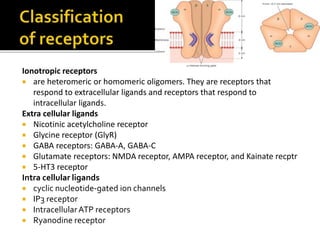
Ionotropic receptors
 are heteromeric or homomeric oligomers. They are receptors that
respond to extracellular ligands and receptors that respond to
intracellular ligands.
Extra cellular ligands
 Nicotinic acetylcholine receptor
 Glycine receptor (GlyR)
 GABA receptors: GABA-A, GABA-C
 Glutamate receptors: NMDA receptor, AMPA receptor, and Kainate recptr
 5-HT3 receptor
Intra cellular ligands
 cyclic nucleotide-gated ion channels
 IP3 receptor
 IntracellularATP receptors
 Ryanodine receptor
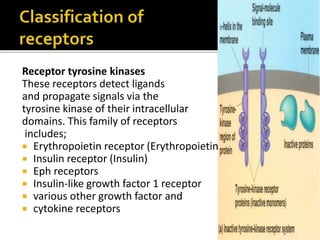
Receptor tyrosine kinases
These receptors detect ligands
and propagate signals via the
tyrosine kinase of their intracellular
domains. This family of receptors
includes;
 Erythropoietin receptor (Erythropoietin)
 Insulin receptor (Insulin)
 Eph receptors
 Insulin-like growth factor 1 receptor
 various other growth factor and
 cytokine receptors
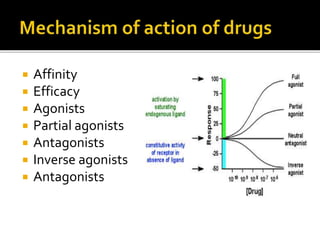
 Affinity
 Efficacy
 Agonists
 Partial agonists
 Antagonists
 Inverse agonists
 Antagonists
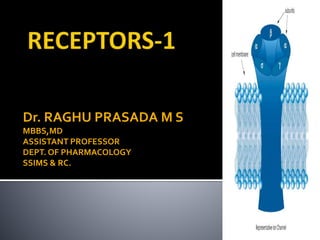
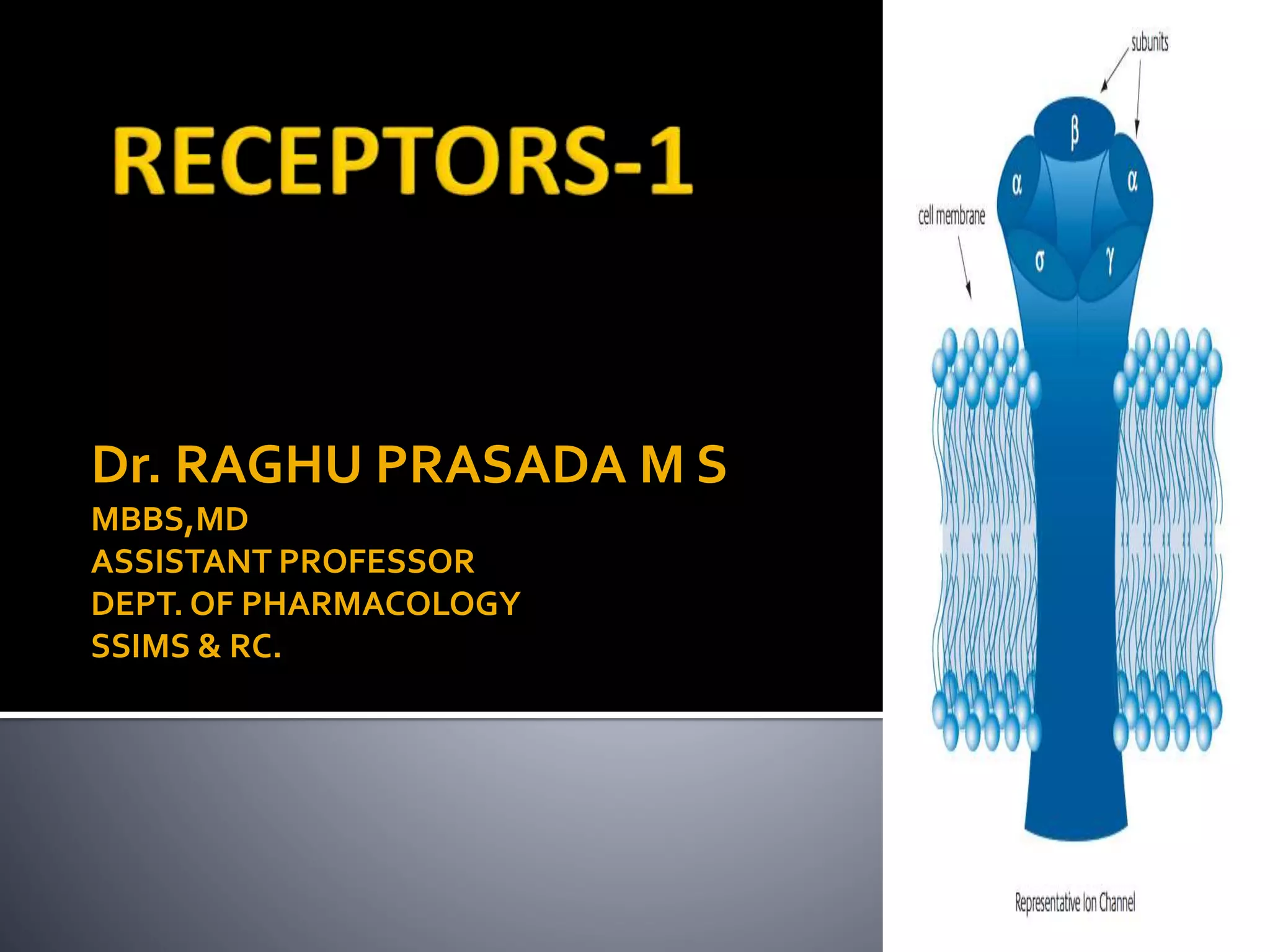
 Transmembrane proteins include G protein-linked
receptors and they are seven-pass trans membrane
proteins.
 When a chemical - a hormone or a pharmaceutical
agent - binds to the receptor on the outside of the
cell, this triggers a series of chemical reactions
 including the movement and binding of the G-
protein.
 transformation of GDP into GTP and
 activation of second messengers.
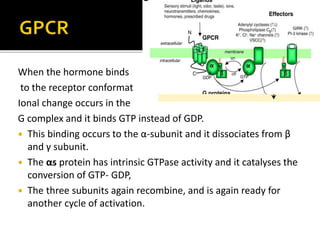
When the hormone binds
to the receptor conformat
Ional change occurs in the
G complex and it binds GTP instead of GDP.
 This binding occurs to the α-subunit and it dissociates from β
and γ subunit.
 The αs protein has intrinsic GTPase activity and it catalyses the
conversion of GTP- GDP,
 The three subunits again recombine, and is again ready for
another cycle of activation.
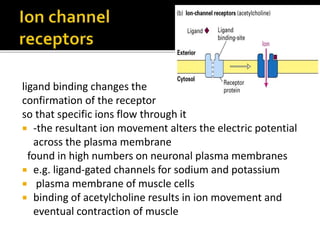
ligand binding changes the
confirmation of the receptor
so that specific ions flow through it
 -the resultant ion movement alters the electric potential
across the plasma membrane
found in high numbers on neuronal plasma membranes
 e.g. ligand-gated channels for sodium and potassium
 plasma membrane of muscle cells
 binding of acetylcholine results in ion movement and
eventual contraction of muscle
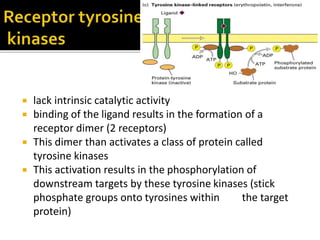
 lack intrinsic catalytic activity
 binding of the ligand results in the formation of a
receptor dimer (2 receptors)
 This dimer than activates a class of protein called
tyrosine kinases
 This activation results in the phosphorylation of
downstream targets by these tyrosine kinases (stick
phosphate groups onto tyrosines within the target
protein)
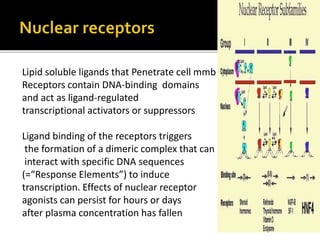
Lipid soluble ligands that Penetrate cell mmb
Receptors contain DNA-binding domains
and act as ligand-regulated
transcriptional activators or suppressors
Ligand binding of the receptors triggers
the formation of a dimeric complex that can
interact with specific DNA sequences
(=“Response Elements”) to induce
transcription. Effects of nuclear receptor
agonists can persist for hours or days
after plasma concentration has fallen
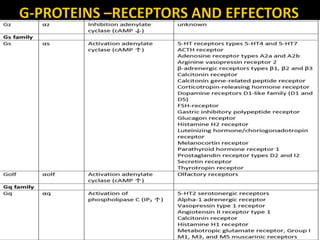
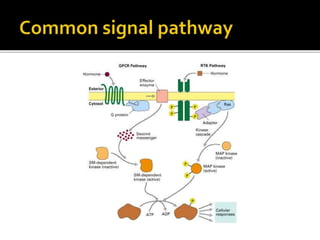
 Hormone stimulation of Gs protein-coupled receptors leads to
activation of adenylyl cyclase and synthesis of the second
messenger cAMP
 most commonly studied second messenger
 (cAMP-dependent protein kinases or PKAs)
 cAMP has a wide variety of effects depending on the cell type and
the downstream PKAs and other kinases
 In adipocytes, increased cAMP activates a PKA that stimulates
production of fatty acids
 In ovarian cells another PKA will respond to cAMP by increase
estrogen synthesis
 second messenger systems allow for amplification of an
extracellular signal
 one epinephine molecule can bind one GPCR – this can result in
the synthesis of multiple cAMP molecules which can go on to
activate and amplified number of PKAs
 IP3 and DAG – breakdown products of phosphotidylinositol
(PI)
 produced upon activation of multiple hormone receptor
types (GPCRs and RTKs)
 Calcium – IP3 production results in the opening of calcium-
channels on the plasma membrane of the ER – release of
calcium
 a rise in calcium in pancreatic beta cells triggers the
exocytosis of insulin
 a rise in intracellular calcium also triggers contraction of
muscle cells
 much study has been done on the binding of calcium to a
protein called calmodulin and the effect of this complex on
gene expression
 The effects of activation of GPCRs and RTKs is more
complicated than a simple step-by-step cascade
 Stimulation of either GPCRs or RTKs often leads to
production of multiple second messengers, and both
types of receptors promote or inhibit production of
many of the same second messengers
 in addition, RTKs can promote a signal transduction
cascade that eventually acts on the same target as the
GPCR
 therefore the same cellular response may be induced
by multiple signaling pathways by distinct mechanisms
 Interaction of different signaling pathways permits
fine-tuning of cellular activities
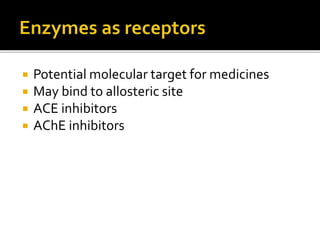
 Potential molecular target for medicines
 May bind to allosteric site
 ACE inhibitors
 AChE inhibitors
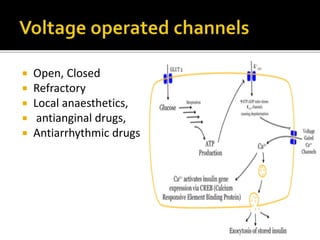
 Open, Closed
 Refractory
 Local anaesthetics,
 antianginal drugs,
 Antiarrhythmic drugs
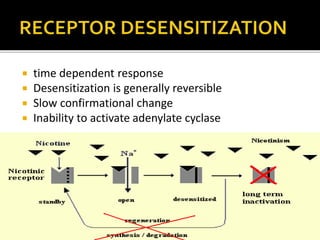
 time dependent response
 Desensitization is generally reversible
 Slow confirmational change
 Inability to activate adenylate cyclase
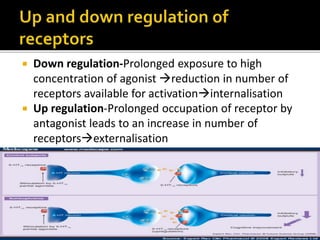
 Down regulation-Prolonged exposure to high
concentration of agonist reduction in number of
receptors available for activationinternalisation
 Up regulation-Prolonged occupation of receptor by
antagonist leads to an increase in number of
receptorsexternalisation
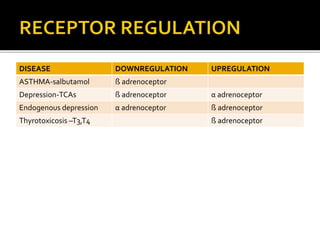
DISEASE DOWNREGULATION UPREGULATION
ASTHMA-salbutamol ß adrenoceptor
Depression-TCAs ß adrenoceptor α adrenoceptor
Endogenous depression α adrenoceptor ß adrenoceptor
Thyrotoxicosis –T3,T4 ß adrenoceptor
 The drug can produce maximal response even when
less than 100% of the receptors are occupied
 The remaining unoccupied receptors are just serving
as receptor reserve
 Insulin receptors-90%
 β receptors on heart 5-10%
 Fast up regulation
 Pharmacological basis of tardive dyskinesia
 Long term dopamine receptor blockade
 Supersensitive new dopamine receptors
 Myasthenia gravis
 Insulin resistant diabetes
 Testicular feminization
CHEMICAL ACTION
 Neutralisation
 Chelation
 Ion exchangers
PHYSICAL ACTION
 Osmosis
 Adsorption
 Protectives
 Demulcents
 Astringents
 Saturation in biophase
 By counterfeit or false incorporation mechanisms
 By virtue of being protoplasmic poisons
 Through formation of antibodies
 Through placebo action
 By targeting specific genetic changes
Class receptors  1&2

Class receptors 1&2

  • 1.
    Dr. RAGHU PRASADAM S MBBS,MD ASSISTANT PROFESSOR DEPT. OF PHARMACOLOGY SSIMS & RC. 1
  • 2.
     Receptor isdefined as a macro molecule or an assembly of macro molecules or binding site with functional correlates located on surface or inside the effector cell that serves to recognize the signal molecule or drug and initiate the response to it by altering the enzyme activity, permeability to ions, conformational features or genetic material in the nucleus.
  • 3.
    TRANSMEMBRANE RECEPTORS METABOTROPIC RECEPTORS G protein-coupled receptors  Muscarinic acetylcholine receptor (Acetylcholine and M uscarine)  Adenosine receptors  Adrenoceptors  GABA receptors, Type-B (γ- Aminobutyric acid or GABA)  Angiotensin receptors  Cannabinoid receptors  Cholecystokinin receptors  Dopamine receptors  Glucagon receptors  Metabotropic glutamate receptors  Histamine receptors  Olfactory receptors  Opioid receptors (  Protease-activated receptors  Rhodopsin (a photoreceptor protein)  Secretin receptors Serotonin receptors, except Type-3 (Serotonin, 5-Hydroxy tryptamine or 5-HT)
  • 4.
    Ionotropic receptors  areheteromeric or homomeric oligomers. They are receptors that respond to extracellular ligands and receptors that respond to intracellular ligands. Extra cellular ligands  Nicotinic acetylcholine receptor  Glycine receptor (GlyR)  GABA receptors: GABA-A, GABA-C  Glutamate receptors: NMDA receptor, AMPA receptor, and Kainate recptr  5-HT3 receptor Intra cellular ligands  cyclic nucleotide-gated ion channels  IP3 receptor  IntracellularATP receptors  Ryanodine receptor
  • 5.
    Receptor tyrosine kinases Thesereceptors detect ligands and propagate signals via the tyrosine kinase of their intracellular domains. This family of receptors includes;  Erythropoietin receptor (Erythropoietin)  Insulin receptor (Insulin)  Eph receptors  Insulin-like growth factor 1 receptor  various other growth factor and  cytokine receptors
  • 6.
     Affinity  Efficacy Agonists  Partial agonists  Antagonists  Inverse agonists  Antagonists
  • 7.
     Transmembrane proteinsinclude G protein-linked receptors and they are seven-pass trans membrane proteins.  When a chemical - a hormone or a pharmaceutical agent - binds to the receptor on the outside of the cell, this triggers a series of chemical reactions  including the movement and binding of the G- protein.  transformation of GDP into GTP and  activation of second messengers.
  • 9.
    When the hormonebinds to the receptor conformat Ional change occurs in the G complex and it binds GTP instead of GDP.  This binding occurs to the α-subunit and it dissociates from β and γ subunit.  The αs protein has intrinsic GTPase activity and it catalyses the conversion of GTP- GDP,  The three subunits again recombine, and is again ready for another cycle of activation.
  • 11.
    ligand binding changesthe confirmation of the receptor so that specific ions flow through it  -the resultant ion movement alters the electric potential across the plasma membrane found in high numbers on neuronal plasma membranes  e.g. ligand-gated channels for sodium and potassium  plasma membrane of muscle cells  binding of acetylcholine results in ion movement and eventual contraction of muscle
  • 12.
     lack intrinsiccatalytic activity  binding of the ligand results in the formation of a receptor dimer (2 receptors)  This dimer than activates a class of protein called tyrosine kinases  This activation results in the phosphorylation of downstream targets by these tyrosine kinases (stick phosphate groups onto tyrosines within the target protein)
  • 13.
    Lipid soluble ligandsthat Penetrate cell mmb Receptors contain DNA-binding domains and act as ligand-regulated transcriptional activators or suppressors Ligand binding of the receptors triggers the formation of a dimeric complex that can interact with specific DNA sequences (=“Response Elements”) to induce transcription. Effects of nuclear receptor agonists can persist for hours or days after plasma concentration has fallen
  • 14.
     Hormone stimulationof Gs protein-coupled receptors leads to activation of adenylyl cyclase and synthesis of the second messenger cAMP  most commonly studied second messenger  (cAMP-dependent protein kinases or PKAs)  cAMP has a wide variety of effects depending on the cell type and the downstream PKAs and other kinases  In adipocytes, increased cAMP activates a PKA that stimulates production of fatty acids  In ovarian cells another PKA will respond to cAMP by increase estrogen synthesis  second messenger systems allow for amplification of an extracellular signal  one epinephine molecule can bind one GPCR – this can result in the synthesis of multiple cAMP molecules which can go on to activate and amplified number of PKAs
  • 15.
     IP3 andDAG – breakdown products of phosphotidylinositol (PI)  produced upon activation of multiple hormone receptor types (GPCRs and RTKs)  Calcium – IP3 production results in the opening of calcium- channels on the plasma membrane of the ER – release of calcium  a rise in calcium in pancreatic beta cells triggers the exocytosis of insulin  a rise in intracellular calcium also triggers contraction of muscle cells  much study has been done on the binding of calcium to a protein called calmodulin and the effect of this complex on gene expression
  • 16.
     The effectsof activation of GPCRs and RTKs is more complicated than a simple step-by-step cascade  Stimulation of either GPCRs or RTKs often leads to production of multiple second messengers, and both types of receptors promote or inhibit production of many of the same second messengers  in addition, RTKs can promote a signal transduction cascade that eventually acts on the same target as the GPCR  therefore the same cellular response may be induced by multiple signaling pathways by distinct mechanisms  Interaction of different signaling pathways permits fine-tuning of cellular activities
  • 18.
     Potential moleculartarget for medicines  May bind to allosteric site  ACE inhibitors  AChE inhibitors
  • 19.
     Open, Closed Refractory  Local anaesthetics,  antianginal drugs,  Antiarrhythmic drugs
  • 20.
     time dependentresponse  Desensitization is generally reversible  Slow confirmational change  Inability to activate adenylate cyclase
  • 21.
     Down regulation-Prolongedexposure to high concentration of agonist reduction in number of receptors available for activationinternalisation  Up regulation-Prolonged occupation of receptor by antagonist leads to an increase in number of receptorsexternalisation
  • 22.
    DISEASE DOWNREGULATION UPREGULATION ASTHMA-salbutamolß adrenoceptor Depression-TCAs ß adrenoceptor α adrenoceptor Endogenous depression α adrenoceptor ß adrenoceptor Thyrotoxicosis –T3,T4 ß adrenoceptor
  • 23.
     The drugcan produce maximal response even when less than 100% of the receptors are occupied  The remaining unoccupied receptors are just serving as receptor reserve  Insulin receptors-90%  β receptors on heart 5-10%
  • 25.
     Fast upregulation  Pharmacological basis of tardive dyskinesia  Long term dopamine receptor blockade  Supersensitive new dopamine receptors
  • 26.
     Myasthenia gravis Insulin resistant diabetes  Testicular feminization
  • 27.
    CHEMICAL ACTION  Neutralisation Chelation  Ion exchangers PHYSICAL ACTION  Osmosis  Adsorption  Protectives  Demulcents  Astringents  Saturation in biophase
  • 28.
     By counterfeitor false incorporation mechanisms  By virtue of being protoplasmic poisons  Through formation of antibodies  Through placebo action  By targeting specific genetic changes