Fuzzy Logic and Fuzzy Set Theorywith examples from Image ProcessingBy: Rafi Steinberg4/2/20081
Some Fuzzy BackgroundLoftiZadeh has coined the term “Fuzzy Set” in 1965 and opened a new field of research and applicationsA Fuzzy Set is a class with different degrees of membership.  Almost all real world classes are fuzzy!Examples of fuzzy sets include: {‘Tall people’}, {‘Nice day’}, {‘Round object’} …If a person’s height is 1.88 meters is he considered ‘tall’?What if we also know that he is an NBA player? 2
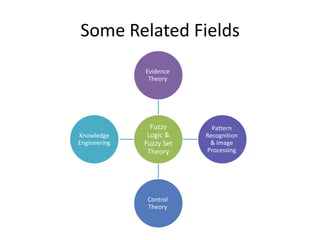
Some Related Fields3
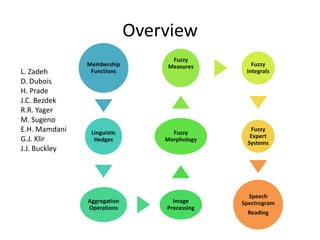
OverviewL. ZadehD. DuboisH. PradeJ.C. BezdekR.R. YagerM. SugenoE.H. MamdaniG.J. KlirJ.J. Buckley4
A Crisp Definition of Fuzzy LogicDoes not exist, however …	- Fuzzifies bivalent Aristotelian (Crisp) logic	Is “The sky are blue”True or False?Modus PonensIF <Antecedent == True> THEN <Do Consequent>IF (X is a prime number) THEN (Send TCP packet)Generalized Modus PonensIF “a region is green and highly textured” AND “the region is somewhat below a sky region”THEN “the region contains trees with high confidence”5
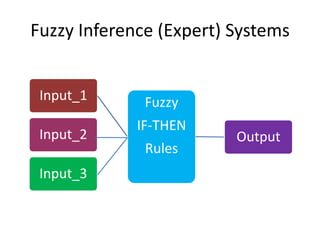
Fuzzy Inference (Expert) Systems6
Fuzzy Vs. ProbabilityWalking in the desert, close to being dehydrated, you find two bottles of water:The first contains deadly poison with a probability of 0.1The second has a 0.9 membership value in the Fuzzy Set “Safe drinks”Which one will you choose to drink from???7
Membership Functions (MFs)What is a MF? Linguistic VariableA Normal MF attains ‘1’ and ‘0’ for some inputHow do we construct MFs?HeuristicRank orderingMathematical ModelsAdaptive (Neural Networks, Genetic Algorithms …)8
Membership Function ExamplesSigmoidGaussianTrapezoidalTriangular9
Alpha CutsAlpha CutStrong Alpha Cut10
Linguistic HedgesOperate on the Membership Function (Linguistic Variable)Expansive (“Less”, ”Very Little”)Restrictive (“Very”, “Extremely”)Reinforcing/Weakening (“Really”, “Relatively”)11
Aggregation OperationsGeneralized Mean:12
Aggregation Operations (2)T-norms: Fixed Norms (Drastic, Product, Min)
 Parametric Norms (Yager)S-Norm Duals:Bounded Sum DrasticZadehianDrasticProduct Zadehian13
Aggregation Operations (3)Yager S-Normb (=0.8)a (=0.3)Yager S-Norm for varying wGeneralized MeanDrasticT-NormZadehian minGeometricZadehian maxBoundedSumDrastic S-NormProductHarmonicAlgebraic (Mean)14
Crisp Vs. FuzzyFuzzy Sets	Membership values on [0,1]Law of Excluded Middle and Non-Contradiction do not necessarily hold:Fuzzy Membership FunctionFlexibility in choosing the Intersection (T-Norm), Union (S-Norm) and Negation operationsCrisp SetsTrue/False {0,1}
Law of Excluded Middle and Non-Contradiction hold:Crisp Membership Function Intersection (AND) , Union (OR), and Negation (NOT) are fixed15
Image ProcessingBinaryGray LevelColor (RGB,HSV etc.)Can we give a crisp definition to light blue?16
Fuzziness Vs. VaguenessVagueness=Insufficient SpecificityFuzziness=Unsharp Boundaries17
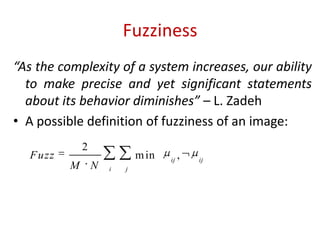
Fuzziness“As the complexity of a system increases, our ability to make precise and yet significant statements about its behavior diminishes” – L. ZadehA possible definition of fuzziness of an image:18
Example: Finding an Image ThresholdMembership ValueGray Level19
Mathematical MorphologyOperates on predefined geometrical objects in an imageStructured Element (SE) represents the shape of interestInitially developed for binary images; extended to grayscale using aggregation operations from Fuzzy LogicSome Examples: Dilation, Erosion, Open, Close, Hit&Miss, Skeleton20
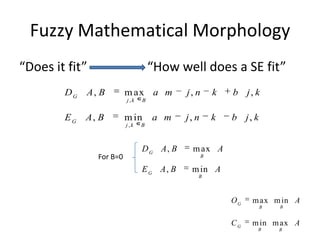
Fuzzy Mathematical Morphology“Does it fit”		“How well does a SE fit”For B=021
Some Basic ConceptsUniverse of Discourse:Power Set of X= P(X)= {Null , {a} , {b} , {c} ,{a , b},{b , c}, {a , c}, {a,b,c}}Singletons of the Power Set of X: { {a} , {b} , {c} }An Event=An Element of the Power SetBasic Probability Assignment (BPA)Consonant Body of EvidenceFocal Elementm(A)=0.222
Fuzzy MeasuresAdditive, Sub Additive, Super Additive MeasuresExamples: {Probability}, {Belief, Plausibility}, {Necessity, Possibility}(1) Boundary Condition:(2) Monotonicity:(3) Uniform Convergenceincreasing sequence of measurable sets we have uniform convergence:23
Example: Fuzzy Measure24
The Choquet IntegralIs defined over a Fuzzy MeasureConsider a gray level input25
Example: Choquet Integral Calculation26
Sugeno MeasuresSugeno Measure’s Additional Axiom:Compute λ from the normalization rule:Sugeno Inverse:Sugeno Inverse for λ={-0.99, -0.9, -0.5, 0, 1, 10}Optimistic/Pessimistic Aggregation of Evidence27
Finding the Sugeno Measure	We need to solve the third order equation:	Solutions: {0, -15, 5/3}	Since λ=0 is the trivial additive solution and since λ =-15 is out of range (λ>-1) we choose λ=5/3 and obtain:28
Example: Sugeno Integral Calculation-> We cannot aggregate with the Sugeno Union since the segmenting alpha cut values are not part of our initial frame of discernment-> Zadehian Max-Min are ‘good’ default operators29h(q) is the alpha cut that entirely includes the measure of q.
Example: Finding Edges30
O.K. So Now What?We have a fuzzy result, however in many cases we need to make a crisp decision (On/Off)Methods of defuzzifying are:Centroid (Center of Mass)MaximumOther methods31
Fuzzy Inference (Expert) SystemsFuzzify: Apply MF on inputGeneralized Modus Ponens with specified aggregation operationsDefuzzify: Method of Centroid, Maximum, ...32
Automatic Speech Recognition (ASR) via Automatic Reading of Speech SpectrogramsPhoneme Classes:VowelsSemi-vowels/DiphthongsNasalsPlosivesFricativesSilenceExamples of Fuzzy Variables:Distance between formants (Large/Small)Formant location (High/Mid/Low)Formant length (Long/Average/Short)Zero crossings (Many/Few)Formant movement (Descending/Ascending/Fixed)VOT= Voice Onset Time (Long/Short)Phoneme duration (Long/Average/Short)Pitch frequency (High/Low/Undetermined)Blob (F1/F2/F3/F4/None)“Don’t ask me to carry…"33
Applying the Segmentation Algorithm34
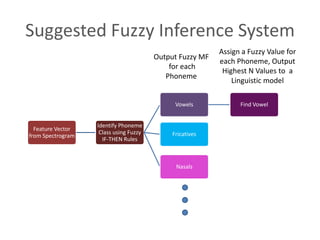
Suggested Fuzzy Inference SystemAssign a Fuzzy Value for each Phoneme, Output Highest N Values to  a Linguistic modelOutput Fuzzy MF for each Phoneme35
Summary36Fuzzy Logic can be useful in solving Human related tasks

Fuzzy Logic Ppt

  • 1.
    Fuzzy Logic andFuzzy Set Theorywith examples from Image ProcessingBy: Rafi Steinberg4/2/20081
  • 2.
    Some Fuzzy BackgroundLoftiZadehhas coined the term “Fuzzy Set” in 1965 and opened a new field of research and applicationsA Fuzzy Set is a class with different degrees of membership. Almost all real world classes are fuzzy!Examples of fuzzy sets include: {‘Tall people’}, {‘Nice day’}, {‘Round object’} …If a person’s height is 1.88 meters is he considered ‘tall’?What if we also know that he is an NBA player? 2
  • 3.
  • 4.
    OverviewL. ZadehD. DuboisH.PradeJ.C. BezdekR.R. YagerM. SugenoE.H. MamdaniG.J. KlirJ.J. Buckley4
  • 5.
    A Crisp Definitionof Fuzzy LogicDoes not exist, however … - Fuzzifies bivalent Aristotelian (Crisp) logic Is “The sky are blue”True or False?Modus PonensIF <Antecedent == True> THEN <Do Consequent>IF (X is a prime number) THEN (Send TCP packet)Generalized Modus PonensIF “a region is green and highly textured” AND “the region is somewhat below a sky region”THEN “the region contains trees with high confidence”5
  • 6.
  • 7.
    Fuzzy Vs. ProbabilityWalkingin the desert, close to being dehydrated, you find two bottles of water:The first contains deadly poison with a probability of 0.1The second has a 0.9 membership value in the Fuzzy Set “Safe drinks”Which one will you choose to drink from???7
  • 8.
    Membership Functions (MFs)Whatis a MF? Linguistic VariableA Normal MF attains ‘1’ and ‘0’ for some inputHow do we construct MFs?HeuristicRank orderingMathematical ModelsAdaptive (Neural Networks, Genetic Algorithms …)8
  • 9.
  • 10.
  • 11.
    Linguistic HedgesOperate onthe Membership Function (Linguistic Variable)Expansive (“Less”, ”Very Little”)Restrictive (“Very”, “Extremely”)Reinforcing/Weakening (“Really”, “Relatively”)11
  • 12.
  • 13.
    Aggregation Operations (2)T-norms:Fixed Norms (Drastic, Product, Min)
  • 14.
    Parametric Norms(Yager)S-Norm Duals:Bounded Sum DrasticZadehianDrasticProduct Zadehian13
  • 15.
    Aggregation Operations (3)YagerS-Normb (=0.8)a (=0.3)Yager S-Norm for varying wGeneralized MeanDrasticT-NormZadehian minGeometricZadehian maxBoundedSumDrastic S-NormProductHarmonicAlgebraic (Mean)14
  • 16.
    Crisp Vs. FuzzyFuzzySets Membership values on [0,1]Law of Excluded Middle and Non-Contradiction do not necessarily hold:Fuzzy Membership FunctionFlexibility in choosing the Intersection (T-Norm), Union (S-Norm) and Negation operationsCrisp SetsTrue/False {0,1}
  • 17.
    Law of ExcludedMiddle and Non-Contradiction hold:Crisp Membership Function Intersection (AND) , Union (OR), and Negation (NOT) are fixed15
  • 18.
    Image ProcessingBinaryGray LevelColor(RGB,HSV etc.)Can we give a crisp definition to light blue?16
  • 19.
    Fuzziness Vs. VaguenessVagueness=InsufficientSpecificityFuzziness=Unsharp Boundaries17
  • 20.
    Fuzziness“As the complexityof a system increases, our ability to make precise and yet significant statements about its behavior diminishes” – L. ZadehA possible definition of fuzziness of an image:18
  • 21.
    Example: Finding anImage ThresholdMembership ValueGray Level19
  • 22.
    Mathematical MorphologyOperates onpredefined geometrical objects in an imageStructured Element (SE) represents the shape of interestInitially developed for binary images; extended to grayscale using aggregation operations from Fuzzy LogicSome Examples: Dilation, Erosion, Open, Close, Hit&Miss, Skeleton20
  • 23.
    Fuzzy Mathematical Morphology“Doesit fit” “How well does a SE fit”For B=021
  • 24.
    Some Basic ConceptsUniverseof Discourse:Power Set of X= P(X)= {Null , {a} , {b} , {c} ,{a , b},{b , c}, {a , c}, {a,b,c}}Singletons of the Power Set of X: { {a} , {b} , {c} }An Event=An Element of the Power SetBasic Probability Assignment (BPA)Consonant Body of EvidenceFocal Elementm(A)=0.222
  • 25.
    Fuzzy MeasuresAdditive, SubAdditive, Super Additive MeasuresExamples: {Probability}, {Belief, Plausibility}, {Necessity, Possibility}(1) Boundary Condition:(2) Monotonicity:(3) Uniform Convergenceincreasing sequence of measurable sets we have uniform convergence:23
  • 26.
  • 27.
    The Choquet IntegralIsdefined over a Fuzzy MeasureConsider a gray level input25
  • 28.
  • 29.
    Sugeno MeasuresSugeno Measure’sAdditional Axiom:Compute λ from the normalization rule:Sugeno Inverse:Sugeno Inverse for λ={-0.99, -0.9, -0.5, 0, 1, 10}Optimistic/Pessimistic Aggregation of Evidence27
  • 30.
    Finding the SugenoMeasure We need to solve the third order equation: Solutions: {0, -15, 5/3} Since λ=0 is the trivial additive solution and since λ =-15 is out of range (λ>-1) we choose λ=5/3 and obtain:28
  • 31.
    Example: Sugeno IntegralCalculation-> We cannot aggregate with the Sugeno Union since the segmenting alpha cut values are not part of our initial frame of discernment-> Zadehian Max-Min are ‘good’ default operators29h(q) is the alpha cut that entirely includes the measure of q.
  • 32.
  • 33.
    O.K. So NowWhat?We have a fuzzy result, however in many cases we need to make a crisp decision (On/Off)Methods of defuzzifying are:Centroid (Center of Mass)MaximumOther methods31
  • 34.
    Fuzzy Inference (Expert)SystemsFuzzify: Apply MF on inputGeneralized Modus Ponens with specified aggregation operationsDefuzzify: Method of Centroid, Maximum, ...32
  • 35.
    Automatic Speech Recognition(ASR) via Automatic Reading of Speech SpectrogramsPhoneme Classes:VowelsSemi-vowels/DiphthongsNasalsPlosivesFricativesSilenceExamples of Fuzzy Variables:Distance between formants (Large/Small)Formant location (High/Mid/Low)Formant length (Long/Average/Short)Zero crossings (Many/Few)Formant movement (Descending/Ascending/Fixed)VOT= Voice Onset Time (Long/Short)Phoneme duration (Long/Average/Short)Pitch frequency (High/Low/Undetermined)Blob (F1/F2/F3/F4/None)“Don’t ask me to carry…"33
  • 36.
  • 37.
    Suggested Fuzzy InferenceSystemAssign a Fuzzy Value for each Phoneme, Output Highest N Values to a Linguistic modelOutput Fuzzy MF for each Phoneme35
  • 38.
    Summary36Fuzzy Logic canbe useful in solving Human related tasks

Editor's Notes

  • #3 Linguistic Variables
  • #4 Following Bezdek
  • #5 Buckley: Experiment – ask many people if statement A, B, A AND B is true. Then check the prior correlation coefficient. The result shows which method to use. The assumption is that with a large population model, the TRUE/FALSE values converge to the probability that a person would say that the statement is true.
  • #6 Following the work of Klir
  • #8 We obtain a negative value for lamda if the fuzzy measure of the singletons that span our set sum to more than unity. We have cancellation of evidence in this case. On the other hand, for (0.2+0.2+0.3) <1 we obtain a positive lamda