MANUFACTURING
TECHNOLOGY – I
CRAFTED BY:
RAMESH KUMAR A
Assistant Professor
Sona College of Technology
Salem
07-02-2019 05:43 1
EXTRUSION
07-02-2019 05:43 2
EXTRUSION
A compression forming process in which the work metal is forced
to flow through a die opening to produce a desired cross-
sectional shape
PROS:
variety of sections possible (hot extrusion)
grain structure and strength enhancement (cold)
close tolerance (cold)
no material wastage
07-02-2019 05:43 3
TYPES OF EXTRUSION
Direct Extrusion
The ram forces the work billet metal to move forward
to pass through the die opening
Indirect Extrusion
The die is mounted to the ram rather than at the
opposite end of the extruder container housing
07-02-2019 05:43 4
DIRECT EXTRUSION
Friction increases the extrusion force
Hollow section is formed using a mandrel
07-02-2019 05:43 5
INDIRECT EXTRUSION
Metal is forced to flow through
the die in an opposite direction
to the ram’s motion
Lower extrusion force as the
work billet metal is not moving
relative to the container wall
07-02-2019 05:43 6
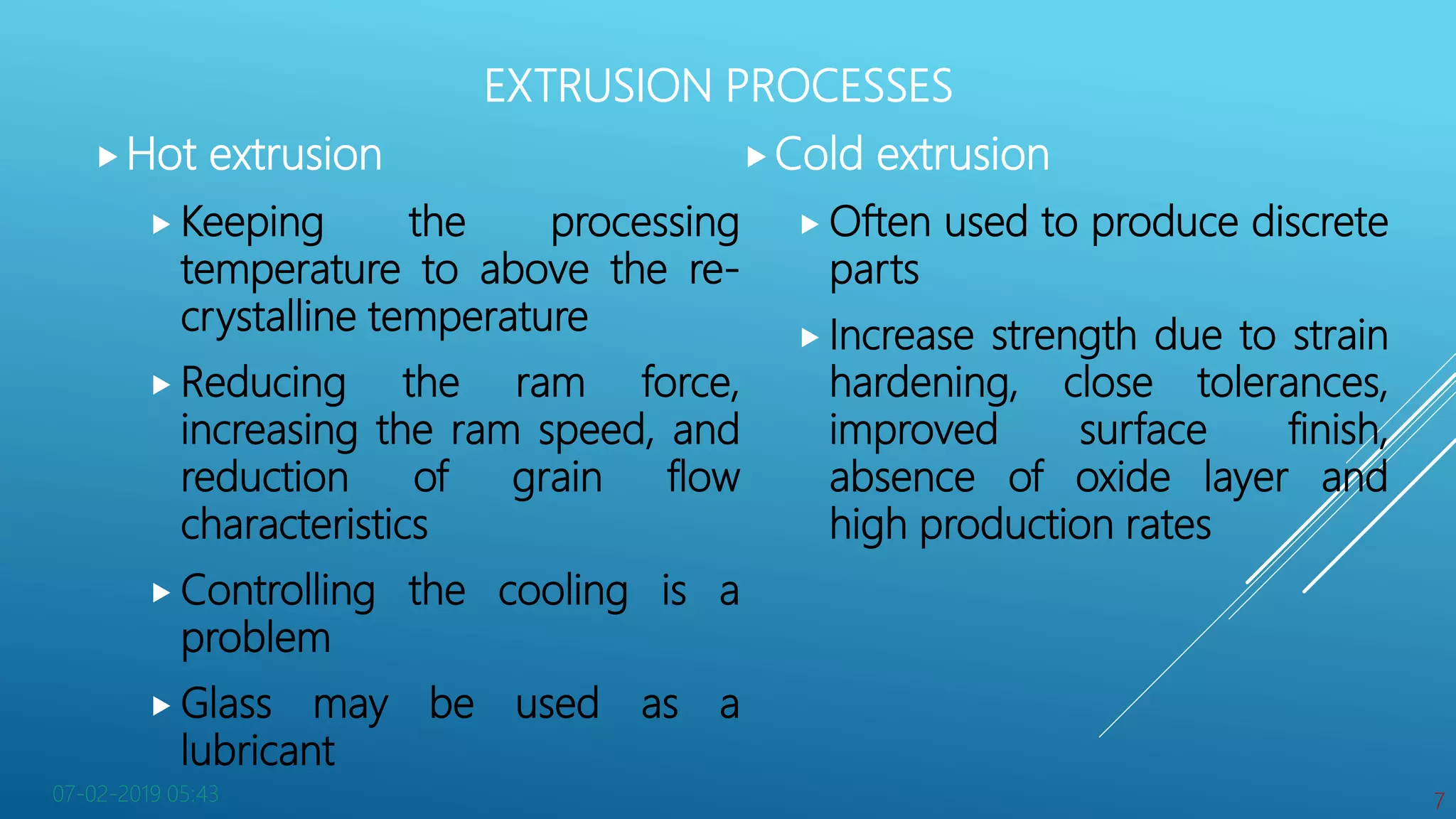
EXTRUSION PROCESSES
Hot extrusion
 Keeping the processing
temperature to above the re-
crystalline temperature
 Reducing the ram force,
increasing the ram speed, and
reduction of grain flow
characteristics
 Controlling the cooling is a
problem
 Glass may be used as a
lubricant
Cold extrusion
 Often used to produce discrete
parts
 Increase strength due to strain
hardening, close tolerances,
improved surface finish,
absence of oxide layer and
high production rates
07-02-2019 05:43 7
EXTRUSION
07-02-2019 05:43 8
IMPACT EXTRUSION
07-02-2019 05:43 9
combination
IMPACT EXTRUSION
Impact extrusion is performed at higher speeds and shorter
strokes than conventional extrusion
It is for making discrete parts
For making thin wall-thickness items by permitting large
deformation at high speed
07-02-2019 05:43 10
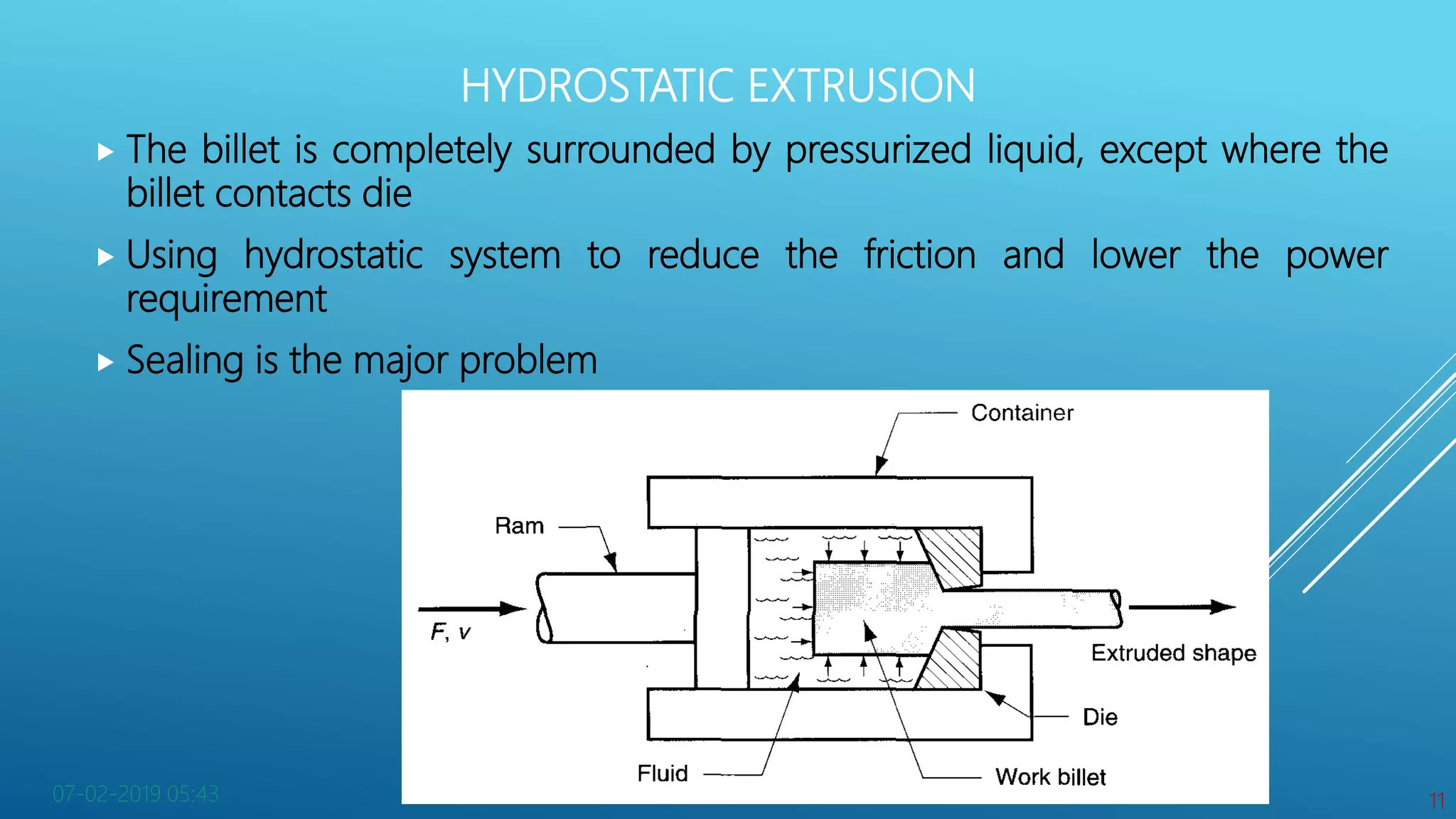
HYDROSTATIC EXTRUSION
 The billet is completely surrounded by pressurized liquid, except where the
billet contacts die
 Using hydrostatic system to reduce the friction and lower the power
requirement
 Sealing is the major problem
07-02-2019 05:43 11
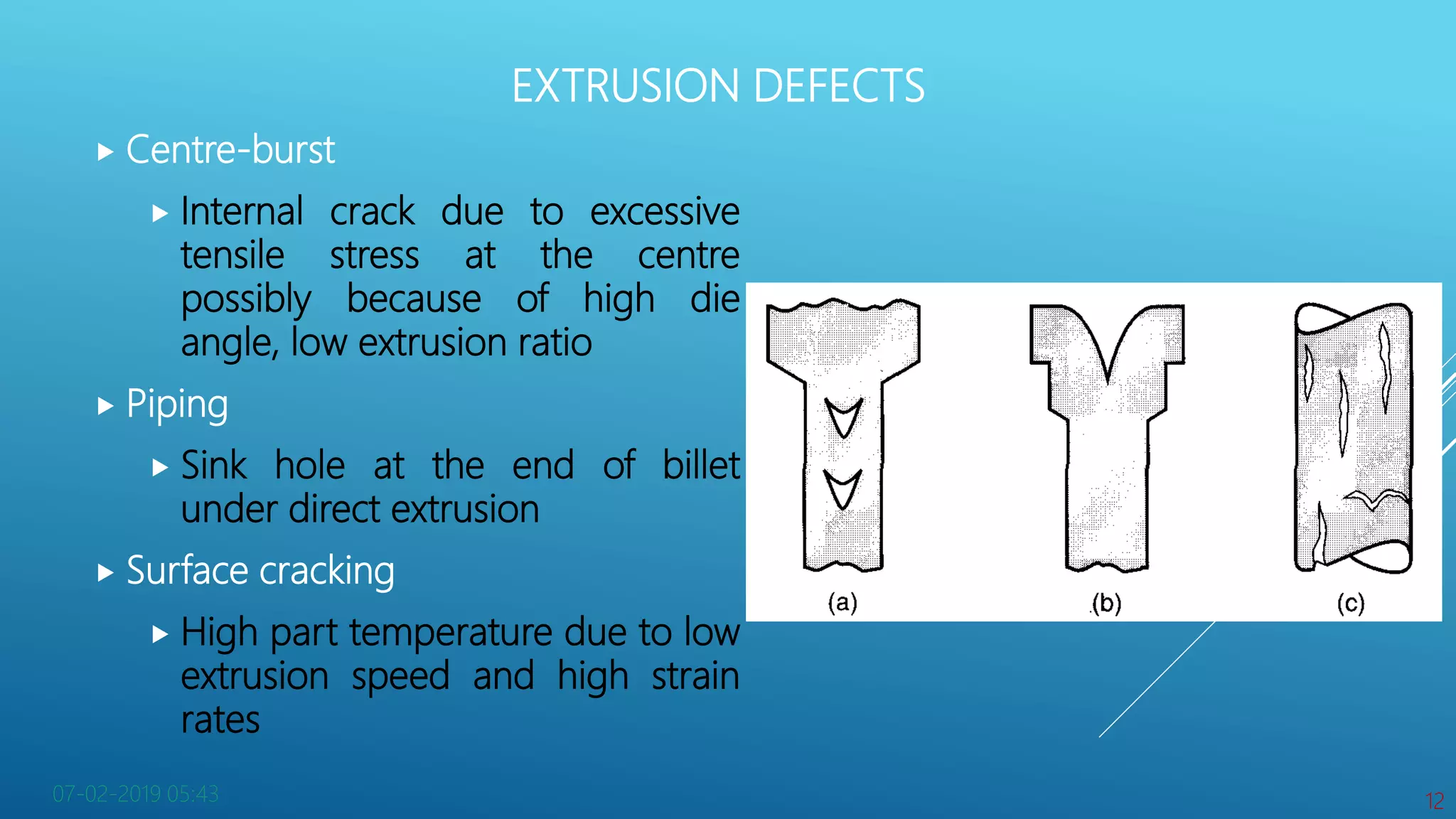
EXTRUSION DEFECTS
 Centre-burst
 Internal crack due to excessive
tensile stress at the centre
possibly because of high die
angle, low extrusion ratio
 Piping
 Sink hole at the end of billet
under direct extrusion
 Surface cracking
 High part temperature due to low
extrusion speed and high strain
rates
07-02-2019 05:43 12
EXTRUSION DEFECTS
07-02-2019 05:43 13

Extrusion

  • 1.
    MANUFACTURING TECHNOLOGY – I CRAFTEDBY: RAMESH KUMAR A Assistant Professor Sona College of Technology Salem 07-02-2019 05:43 1
  • 2.
  • 3.
    EXTRUSION A compression formingprocess in which the work metal is forced to flow through a die opening to produce a desired cross- sectional shape PROS: variety of sections possible (hot extrusion) grain structure and strength enhancement (cold) close tolerance (cold) no material wastage 07-02-2019 05:43 3
  • 4.
    TYPES OF EXTRUSION DirectExtrusion The ram forces the work billet metal to move forward to pass through the die opening Indirect Extrusion The die is mounted to the ram rather than at the opposite end of the extruder container housing 07-02-2019 05:43 4
  • 5.
    DIRECT EXTRUSION Friction increasesthe extrusion force Hollow section is formed using a mandrel 07-02-2019 05:43 5
  • 6.
    INDIRECT EXTRUSION Metal isforced to flow through the die in an opposite direction to the ram’s motion Lower extrusion force as the work billet metal is not moving relative to the container wall 07-02-2019 05:43 6
  • 7.
    EXTRUSION PROCESSES Hot extrusion Keeping the processing temperature to above the re- crystalline temperature  Reducing the ram force, increasing the ram speed, and reduction of grain flow characteristics  Controlling the cooling is a problem  Glass may be used as a lubricant Cold extrusion  Often used to produce discrete parts  Increase strength due to strain hardening, close tolerances, improved surface finish, absence of oxide layer and high production rates 07-02-2019 05:43 7
  • 8.
  • 9.
  • 10.
    IMPACT EXTRUSION Impact extrusionis performed at higher speeds and shorter strokes than conventional extrusion It is for making discrete parts For making thin wall-thickness items by permitting large deformation at high speed 07-02-2019 05:43 10
  • 11.
    HYDROSTATIC EXTRUSION  Thebillet is completely surrounded by pressurized liquid, except where the billet contacts die  Using hydrostatic system to reduce the friction and lower the power requirement  Sealing is the major problem 07-02-2019 05:43 11
  • 12.
    EXTRUSION DEFECTS  Centre-burst Internal crack due to excessive tensile stress at the centre possibly because of high die angle, low extrusion ratio  Piping  Sink hole at the end of billet under direct extrusion  Surface cracking  High part temperature due to low extrusion speed and high strain rates 07-02-2019 05:43 12
  • 13.