INDUCED PLURIPOTENT STEM CELLS  Presented by: VIDUR BHATIA M. Sc. (F), KUK.
Contents Introduction History Reprogramming of somatic cells What are iPSCs Genes responsible Production first generation Second generation Human iPSCs Complications Identity to natural  pluripotent stem cells Applications  Conclusions References
Introduction  Most of the cells of a multicellular organism become more and more restricted to specific cell lineages. For the treatment of many genetic diseases  Human  embryonic stem cells can be used   , But due to some ethics we can’t use embryo for this purpose. To avoid this problem artificially induced pluripotent stem cells came in picture, which can be created from normal somatic cells by the ectopic expression of some genes which are responsible for the pluripotency.
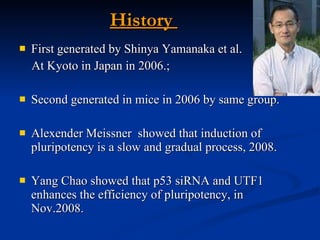
History  First generated by Shinya Yamanaka et al.  At Kyoto in Japan in 2006.;  Second generated in mice in 2006 by same group. Alexender Meissner  showed that induction of pluripotency is a slow and gradual process, 2008. Yang Chao showed that p53 siRNA and UTF1 enhances the efficiency of pluripotency, in  Nov.2008.
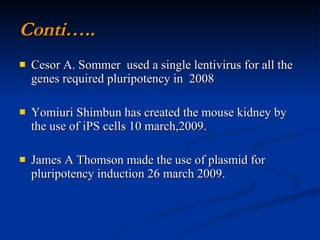
Conti….. Cesor A. Sommer  used a single lentivirus for all the genes required pluripotency in  2008 Yomiuri Shimbun has created the mouse kidney by the use of iPS cells 10 march,2009. James A Thomson made the use of plasmid for pluripotency induction 26 march 2009.
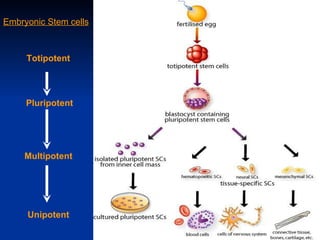
Embryonic Stem cells   Totipotent Pluripotent Multipotent Unipotent
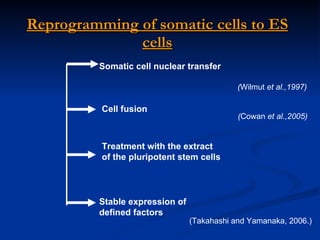
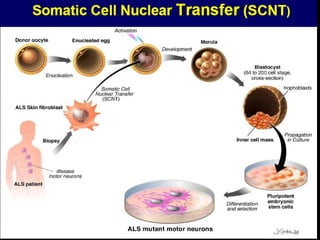
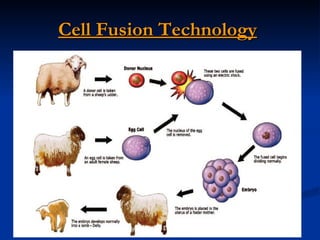
Reprogramming of somatic cells to ES cells Somatic cell nuclear transfer  Cell fusion Treatment with the extract of the pluripotent stem cells Stable expression of defined factors ( Cowan  et al.,2005) ( Wilmut  et al.,1997) (Takahashi and Yamanaka, 2006.)
 
Cell Fusion Technology
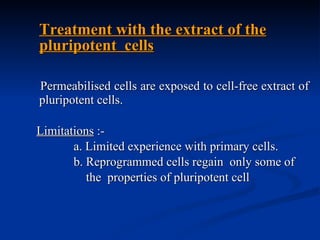
Treatment with the extract of the pluripotent  cells   Permeabilised cells are exposed to cell-free extract of pluripotent cells. Limitations  :- a. Limited experience with primary cells.  b. Reprogrammed cells regain  only some of the  properties of pluripotent cell
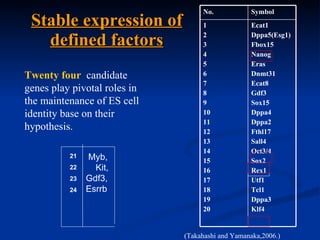
Stable expression of defined factors Twenty four   candidate genes play pivotal roles in the maintenance of ES cell identity base on their hypothesis. (Takahashi and Yamanaka,2006.)  Myb,  Kit, Gdf3, Esrrb 21 22 23 24 Ecat1 Dppa5(Esg1) Fbox15 Nanog Eras Dnmt31 Ecat8 Gdf3 Sox15 Dppa4 Dppa2 Fthl17 Sall4 Oct3/4 Sox2 Rex1 Utf1 Tcl1 Dppa3 Klf4 1 2 3 4 5 6 7 8 9 10 11 12 13 14 15 16 17 18 19 20 Symbol No.
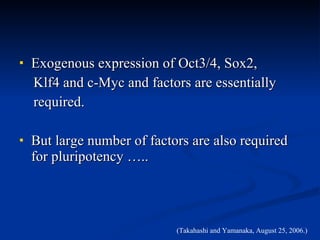
Exogenous expression of Oct3/4, Sox2,  Klf4 and c-Myc and factors are essentially required. But large number of factors are also required for pluripotency ….. (Takahashi and Yamanaka, August 25, 2006.)
iPSCs , are a type of  pluripotent   stem cell  artificially derived from a non- pluripotent  cell, typically an adult  somatic cell , by inducing a "forced" expression of certain  genes . first produced in 2006 from mouse cells and in 2007 from human cells   WHAT ARE iPSCs ?
Genes responsible for pluripotency Group 1 ES cell-Specific transcription factors Essential for pluripotency in ES cell & early embryos Oct¾, Sox2, Nanog… Group 2 (Proto-oncogene's) Important for proliferation of ES cells, but not in early embryos TCL1, Stat3, c-Myc, ERas, Klf4… Group 3 Less famous Specifically expressed in ES cell But less defined function ECAT1, Esg1,Fbx15, … (Takahashi and Yamanaka, 2006.)
Oct3/4:   Involve in the maintenance of self renewal of pluripotent cells. Repression in ES cells leads to the formation of trophoectoderm. Overexpression leads to the formation of various lineages including primitive endoderm . Sox2: Essential for embryonic development Downregulation by siRNA silencing leads to the differentiation of cell in murine ES cells .
Klf4 Klf4 repress p53 directly p53 protein suppress Nanog during ES cell differentiation  Klf4 contributes to activation of Nanog and other ES cell-specific genes (Rowland  et al ., 2005; Lin  et al ., 2004) Klf4 acts as an inhibitor of c-Myc-induced apoptosis through the  repression of p53 (Zindy  et al ., 1998) Klf4 activates p21CIP1, thereby suppressing cell proliferation .This antiproliferation function of Klf4 inhibited by c-Myc, which suppresses the expression of p21CIP1 ( Zhang  et al ., 2000; Seoane  et al ., 2002 )
Nanog :  In embryonic stem cells, Nanog, along with Oct-3/4 and Sox2, is necessary in promoting pluripotency.  LIN28 :  LIN28 is an  mRNA binding protein  expressed in  embryonic stem cells  and  embryonic carcinoma cells  associated with differentiation and proliferation. (Thomson et al.)
Production of iPSCs   Typically derived by  transfection  of certain stem cell-associated genes into non-pluripotent cells, such as adult  fibroblasts .  Transfection is typically achieved through viral vectors, such as  retroviruses . After 3–4 weeks, small numbers of transfected cells begin to become morphologically and biochemically similar to pluripotent stem cells, and are typically isolated through morphological selection, doubling time, or through a  reporter gene  and antibiotic selection.
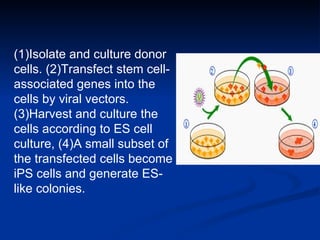
(1)Isolate and culture donor cells. (2)Transfect stem cell-associated genes into the cells by viral vectors. (3)Harvest and culture the cells according to ES cell culture, (4)A small subset of the transfected cells become iPS cells and generate ES-like colonies.
First generation   First generated by  Shinya Yamanaka 's team at  Kyoto University , Japan in 2006. four key pluripotency genes essential for the production of pluripotent stem cells were used; Oct-3/4, Sox2, c- Myc , and  Klf4 .  Retroviruses  was used to transfect mouse fibroblasts.  Cells were isolated by antibiotic selection of  Fbx15 + cells.
Limitations:- This iPS line showed DNA methylation errors compared to original patterns in ESC lines and failed to produce viable  chimeras  if injected into developing embryos
Second generation in mice   In June 2007, by the same group. These cell lines were also derived from mouse fibroblast by retroviral mediated reactivation of the same four endogenous pluripotent factors, but Instead of Fbx15, they used  Nanog  which is an important gene in ESCs.  DNA methylation patterns and producing viable chimeras (and thereby contributing to subsequent germ-line production) indicated that Nanog is a major determinant of cellular pluripotency.

Limitations:- One of the four genes used (namely, c-Myc) is  oncogenic , and 20% of the chimeric mice developed cancer.  (In a later study, Yamanaka reported that one can create iPSCs even without c-Myc, although process takes longer and is not as efficient, but the resulting chimeras didn't develop cancer).
Human induced pluripotent stem cells   Produced  in November 2007.  With the same principle used earlier in mouse models, Yamanaka had successfully transformed human fibroblasts into pluripotent stem cells using the same four pivotal genes: Oct3/4, Sox2, Klf4, and c-Myc with a  retroviral  system.
Pluripotency induction is a slow and gradual process After transfecting the cells with all of the four factors (Sox2,OCct3/4,Klf4 and c-Myc) initially only eight colonies were picked at 11th day and ten colonies  on 16th day. Only one out of eight colonies from 11 day and four colonies from ten colonies from 16 day old colonies gave rise the ES like cells. (Alexender Meissner et al.;2007)
Complications Because of viral transfection systems,   the created cells might be  prone to form tumors.   However  Konrad Hochedlinger  and his Harvard University research team successfully used an  adenovirus  to transport the requisite four genes into the DNA of skin and liver cells of mice. Since the adenovirus does not combine any of its own genes with the targeted host, the danger of creating tumors is eliminated.
Identity   The generated iPSCs were remarkably similar to naturally-isolated pluripotent stem cells Cellular biological properties:  Morphology ,  Growth properties ,  Stem Cell Markers ,  Stem Cell Genes ,  Telomerase Activity: Pluripotency of  iPSCs : Neural Differentiation, Cardiac Differentiation ,  Teratoma Formation ,  Embryoid Body,
Conti….. Epigenetic reprogramming : Promoter Demethylation , Histone  demethylation  etc.
APPLICATIONS
iPS Cells - the Wave of Future iPSC regarded as holy grail stem cell research Studying disease models  in vitro Drug screening Toxicological testing of new drugs Generating patient specific & disease specific pleuripotent stem cells Allow unprecedented access to all stages of human biology Studying development & function of human tissue Regenerative medicine
iPS CELLS TO CURE SC ANEAMIA
Cell replacement therapy seems particularly suitable for Parkinson’s disease, A common neurodegenerative disease caused by loss of midbrain dopamine neurons . Transplantation of fetal midbrain cells has been shown to restore dopamine function in animal models and in human patients .  ( Parish CL,  et al . (2008)) iPS can be used for treatment of  Parkinson’s  disease
Mouse kidneys created using iPS cells A team of scientists has successfully used induced pluripotent stem (iPS) cells to create kidneys inside a mouse whose parents were genetically engineered so their offspring would not be born with the organ. (Hiromitsu Nakuchi;  Mar. 10, 2009))
Stem cells scientists at UCLA showed for the first time that human induced pluripotent stem (iPS) cells can be differentiated into electrically active motor neurons, a discovery that may aid in studying and treating neurological disorders. The motor neurons derived from the iPS cells appeared to be similar in function and efficiency to those derived from human embryonic stem cells, although further testing needs to be done to confirm that.  iPSc can be used to create  Electrically Active Neuron (Michael Scott on February - 25 – 2009)
Somatic cells can be used to generate the  β -cells   Pancreatic Exocrine cells can be converted into  β -cells closely related to the islet  β -cells. Can be used to cure diabetes. (Qiao Zhou  et al .,2008)
Conclusion   SCNT and cell fusion may use to produce the pluripotent cells but can be used only for animals, these processes can’t be shifted to human beings. iPS may be the answer of the all question of ethics and may avoid the problem of transplant rejection. In future these technique may help us in the field genetic study, research and to fight against disease.
Takahashi & K. Yamanaka; Induction of pluripotent stem cells from mouse embryonic and  adult fibroblast cultures by defined factors, Cell  2006;126:663–676.  Yamanaka S. & et al. ; Generation of germline- competent induced pluripotent stem cells, Nature  2007;448:313-317. Maherali N & et. al.;  Directly reprogrammed  fibroblasts show global epigenetic remodeling and  widespread tissue contribution, Cell Stem Cell  2007;1:55–70 .  References
Stadtfeld M., Nagaya M., Utikal J., Weir G.,  Hochedlinger K.Induced Pluripotent Stem  Cells Generated without Viral Integration.  Science 2008 Sep. 25. pp.212-220. Okita K., Nakagawa M., Hyenjong H.,  Ichisaka T,Yamanaka S. Generation of  Mouse Induced Pluripotent Stem Cells  Without Viral Vectors, Science, 2008 Oct 9. pp.167-178.
Thank you

Induced pluripotent stem cells

  • 1.
    INDUCED PLURIPOTENT STEMCELLS Presented by: VIDUR BHATIA M. Sc. (F), KUK.
  • 2.
    Contents Introduction HistoryReprogramming of somatic cells What are iPSCs Genes responsible Production first generation Second generation Human iPSCs Complications Identity to natural pluripotent stem cells Applications Conclusions References
  • 3.
    Introduction Mostof the cells of a multicellular organism become more and more restricted to specific cell lineages. For the treatment of many genetic diseases Human embryonic stem cells can be used , But due to some ethics we can’t use embryo for this purpose. To avoid this problem artificially induced pluripotent stem cells came in picture, which can be created from normal somatic cells by the ectopic expression of some genes which are responsible for the pluripotency.
  • 4.
    History Firstgenerated by Shinya Yamanaka et al. At Kyoto in Japan in 2006.; Second generated in mice in 2006 by same group. Alexender Meissner showed that induction of pluripotency is a slow and gradual process, 2008. Yang Chao showed that p53 siRNA and UTF1 enhances the efficiency of pluripotency, in Nov.2008.
  • 5.
    Conti….. Cesor A.Sommer used a single lentivirus for all the genes required pluripotency in 2008 Yomiuri Shimbun has created the mouse kidney by the use of iPS cells 10 march,2009. James A Thomson made the use of plasmid for pluripotency induction 26 march 2009.
  • 6.
    Embryonic Stem cells Totipotent Pluripotent Multipotent Unipotent
  • 7.
    Reprogramming of somaticcells to ES cells Somatic cell nuclear transfer Cell fusion Treatment with the extract of the pluripotent stem cells Stable expression of defined factors ( Cowan et al.,2005) ( Wilmut et al.,1997) (Takahashi and Yamanaka, 2006.)
  • 8.
  • 9.
  • 10.
    Treatment with theextract of the pluripotent cells Permeabilised cells are exposed to cell-free extract of pluripotent cells. Limitations :- a. Limited experience with primary cells. b. Reprogrammed cells regain only some of the properties of pluripotent cell
  • 11.
    Stable expression ofdefined factors Twenty four candidate genes play pivotal roles in the maintenance of ES cell identity base on their hypothesis. (Takahashi and Yamanaka,2006.) Myb, Kit, Gdf3, Esrrb 21 22 23 24 Ecat1 Dppa5(Esg1) Fbox15 Nanog Eras Dnmt31 Ecat8 Gdf3 Sox15 Dppa4 Dppa2 Fthl17 Sall4 Oct3/4 Sox2 Rex1 Utf1 Tcl1 Dppa3 Klf4 1 2 3 4 5 6 7 8 9 10 11 12 13 14 15 16 17 18 19 20 Symbol No.
  • 12.
    Exogenous expression ofOct3/4, Sox2, Klf4 and c-Myc and factors are essentially required. But large number of factors are also required for pluripotency ….. (Takahashi and Yamanaka, August 25, 2006.)
  • 13.
    iPSCs , area type of pluripotent stem cell artificially derived from a non- pluripotent cell, typically an adult somatic cell , by inducing a "forced" expression of certain genes . first produced in 2006 from mouse cells and in 2007 from human cells WHAT ARE iPSCs ?
  • 14.
    Genes responsible forpluripotency Group 1 ES cell-Specific transcription factors Essential for pluripotency in ES cell & early embryos Oct¾, Sox2, Nanog… Group 2 (Proto-oncogene's) Important for proliferation of ES cells, but not in early embryos TCL1, Stat3, c-Myc, ERas, Klf4… Group 3 Less famous Specifically expressed in ES cell But less defined function ECAT1, Esg1,Fbx15, … (Takahashi and Yamanaka, 2006.)
  • 15.
    Oct3/4: Involve in the maintenance of self renewal of pluripotent cells. Repression in ES cells leads to the formation of trophoectoderm. Overexpression leads to the formation of various lineages including primitive endoderm . Sox2: Essential for embryonic development Downregulation by siRNA silencing leads to the differentiation of cell in murine ES cells .
  • 16.
    Klf4 Klf4 repressp53 directly p53 protein suppress Nanog during ES cell differentiation Klf4 contributes to activation of Nanog and other ES cell-specific genes (Rowland et al ., 2005; Lin et al ., 2004) Klf4 acts as an inhibitor of c-Myc-induced apoptosis through the repression of p53 (Zindy et al ., 1998) Klf4 activates p21CIP1, thereby suppressing cell proliferation .This antiproliferation function of Klf4 inhibited by c-Myc, which suppresses the expression of p21CIP1 ( Zhang et al ., 2000; Seoane et al ., 2002 )
  • 17.
    Nanog : In embryonic stem cells, Nanog, along with Oct-3/4 and Sox2, is necessary in promoting pluripotency. LIN28 : LIN28 is an mRNA binding protein expressed in embryonic stem cells and embryonic carcinoma cells associated with differentiation and proliferation. (Thomson et al.)
  • 18.
    Production of iPSCs Typically derived by transfection of certain stem cell-associated genes into non-pluripotent cells, such as adult fibroblasts . Transfection is typically achieved through viral vectors, such as retroviruses . After 3–4 weeks, small numbers of transfected cells begin to become morphologically and biochemically similar to pluripotent stem cells, and are typically isolated through morphological selection, doubling time, or through a reporter gene and antibiotic selection.
  • 19.
    (1)Isolate and culturedonor cells. (2)Transfect stem cell-associated genes into the cells by viral vectors. (3)Harvest and culture the cells according to ES cell culture, (4)A small subset of the transfected cells become iPS cells and generate ES-like colonies.
  • 20.
    First generation First generated by Shinya Yamanaka 's team at Kyoto University , Japan in 2006. four key pluripotency genes essential for the production of pluripotent stem cells were used; Oct-3/4, Sox2, c- Myc , and Klf4 . Retroviruses was used to transfect mouse fibroblasts. Cells were isolated by antibiotic selection of Fbx15 + cells.
  • 21.
    Limitations:- This iPSline showed DNA methylation errors compared to original patterns in ESC lines and failed to produce viable chimeras if injected into developing embryos
  • 22.
    Second generation inmice In June 2007, by the same group. These cell lines were also derived from mouse fibroblast by retroviral mediated reactivation of the same four endogenous pluripotent factors, but Instead of Fbx15, they used Nanog which is an important gene in ESCs. DNA methylation patterns and producing viable chimeras (and thereby contributing to subsequent germ-line production) indicated that Nanog is a major determinant of cellular pluripotency.
  • 23.
    Limitations:- One ofthe four genes used (namely, c-Myc) is oncogenic , and 20% of the chimeric mice developed cancer. (In a later study, Yamanaka reported that one can create iPSCs even without c-Myc, although process takes longer and is not as efficient, but the resulting chimeras didn't develop cancer).
  • 24.
    Human induced pluripotentstem cells Produced in November 2007. With the same principle used earlier in mouse models, Yamanaka had successfully transformed human fibroblasts into pluripotent stem cells using the same four pivotal genes: Oct3/4, Sox2, Klf4, and c-Myc with a retroviral system.
  • 25.
    Pluripotency induction isa slow and gradual process After transfecting the cells with all of the four factors (Sox2,OCct3/4,Klf4 and c-Myc) initially only eight colonies were picked at 11th day and ten colonies on 16th day. Only one out of eight colonies from 11 day and four colonies from ten colonies from 16 day old colonies gave rise the ES like cells. (Alexender Meissner et al.;2007)
  • 26.
    Complications Because ofviral transfection systems, the created cells might be prone to form tumors. However Konrad Hochedlinger and his Harvard University research team successfully used an adenovirus to transport the requisite four genes into the DNA of skin and liver cells of mice. Since the adenovirus does not combine any of its own genes with the targeted host, the danger of creating tumors is eliminated.
  • 27.
    Identity The generated iPSCs were remarkably similar to naturally-isolated pluripotent stem cells Cellular biological properties: Morphology , Growth properties , Stem Cell Markers , Stem Cell Genes , Telomerase Activity: Pluripotency of iPSCs : Neural Differentiation, Cardiac Differentiation , Teratoma Formation , Embryoid Body,
  • 28.
    Conti….. Epigenetic reprogramming: Promoter Demethylation , Histone demethylation etc.
  • 29.
  • 30.
    iPS Cells -the Wave of Future iPSC regarded as holy grail stem cell research Studying disease models in vitro Drug screening Toxicological testing of new drugs Generating patient specific & disease specific pleuripotent stem cells Allow unprecedented access to all stages of human biology Studying development & function of human tissue Regenerative medicine
  • 31.
    iPS CELLS TOCURE SC ANEAMIA
  • 32.
    Cell replacement therapyseems particularly suitable for Parkinson’s disease, A common neurodegenerative disease caused by loss of midbrain dopamine neurons . Transplantation of fetal midbrain cells has been shown to restore dopamine function in animal models and in human patients . ( Parish CL, et al . (2008)) iPS can be used for treatment of Parkinson’s disease
  • 33.
    Mouse kidneys createdusing iPS cells A team of scientists has successfully used induced pluripotent stem (iPS) cells to create kidneys inside a mouse whose parents were genetically engineered so their offspring would not be born with the organ. (Hiromitsu Nakuchi; Mar. 10, 2009))
  • 34.
    Stem cells scientistsat UCLA showed for the first time that human induced pluripotent stem (iPS) cells can be differentiated into electrically active motor neurons, a discovery that may aid in studying and treating neurological disorders. The motor neurons derived from the iPS cells appeared to be similar in function and efficiency to those derived from human embryonic stem cells, although further testing needs to be done to confirm that. iPSc can be used to create Electrically Active Neuron (Michael Scott on February - 25 – 2009)
  • 35.
    Somatic cells canbe used to generate the β -cells Pancreatic Exocrine cells can be converted into β -cells closely related to the islet β -cells. Can be used to cure diabetes. (Qiao Zhou et al .,2008)
  • 36.
    Conclusion SCNT and cell fusion may use to produce the pluripotent cells but can be used only for animals, these processes can’t be shifted to human beings. iPS may be the answer of the all question of ethics and may avoid the problem of transplant rejection. In future these technique may help us in the field genetic study, research and to fight against disease.
  • 37.
    Takahashi & K.Yamanaka; Induction of pluripotent stem cells from mouse embryonic and adult fibroblast cultures by defined factors, Cell 2006;126:663–676. Yamanaka S. & et al. ; Generation of germline- competent induced pluripotent stem cells, Nature 2007;448:313-317. Maherali N & et. al.; Directly reprogrammed fibroblasts show global epigenetic remodeling and widespread tissue contribution, Cell Stem Cell 2007;1:55–70 . References
  • 38.
    Stadtfeld M., NagayaM., Utikal J., Weir G., Hochedlinger K.Induced Pluripotent Stem Cells Generated without Viral Integration. Science 2008 Sep. 25. pp.212-220. Okita K., Nakagawa M., Hyenjong H., Ichisaka T,Yamanaka S. Generation of Mouse Induced Pluripotent Stem Cells Without Viral Vectors, Science, 2008 Oct 9. pp.167-178.
  • 39.