Stem Cell programming
and reprogramming
Kayeen Vadakkan
Assistant Professor
Department of Biotechnology
St. Mary's College, Thrissur.
Stem cell programming
 Stem cell programming can be defined as the mechanism through
which a potent cell is programmed to an other functional cell.
This mechanism was first demonstrated by Davis et al in 1987, where
they converted murine fibroblast cells to cells with myogenic
properties.
Based on it’s mechanism stem cell programming can be classified
into two
Forward programming
Direct programming
Stem Cell Biology, Kayeen Vadakkan, St. Mary's College, Thrissur
Stem cell programming (Continues)
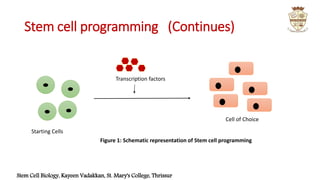
Stem cell programming is mediated by transcription factors which is
case specific (Transcription factors will change according to cell.
In programming of stem cell there will be minimum three
components.
Starting cell ( The cell that has to be converted)
Transcription Factors ( controls the programming)
Cell of choice (desired end product)
Stem Cell Biology, Kayeen Vadakkan, St. Mary's College, Thrissur
Stem cell programming (Continues)
Starting Cells
Cell of Choice
Transcription factors
Figure 1: Schematic representation of Stem cell programming
Stem Cell Biology, Kayeen Vadakkan, St. Mary's College, Thrissur
Types of Stem cell programming
 Based on mechanism and starting cell , Stem Cell programming can
be classified into two
Forward programming
Direct programming
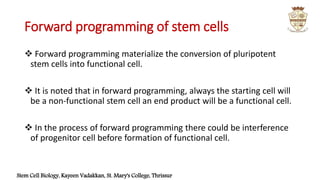
 Through forward programming a non functional stem cell will be
converted to a functional cell.
 Through direct programming a functional cell will be converted to
another functional cell.
Stem Cell Biology, Kayeen Vadakkan, St. Mary's College, Thrissur
Forward programming of stem cells
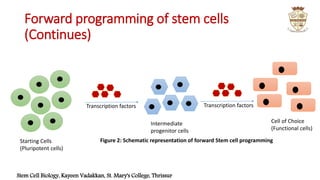
 Forward programming materialize the conversion of pluripotent
stem cells into functional cell.
 It is noted that in forward programming, always the starting cell will
be a non-functional stem cell an end product will be a functional cell.
 In the process of forward programming there could be interference
of progenitor cell before formation of functional cell.
Stem Cell Biology, Kayeen Vadakkan, St. Mary's College, Thrissur
Forward programming of stem cells
(Continues)
Stem Cell Biology, Kayeen Vadakkan, St. Mary's College, Thrissur
Starting Cells
(Pluripotent cells)
Transcription factors Transcription factors
Intermediate
progenitor cells
Cell of Choice
(Functional cells)
Figure 2: Schematic representation of forward Stem cell programming
Direct programming of stem cells
Conversion of mature differentiated cells to another type of
functional cell is called direct programming.
In direct programming the starting cell will be differentiated cell
unlike pluripotent stem cell in forward programming.
It is also observed that direct stem cell programming does not
include any intermediate progenitor cell during the conversion.
Stem Cell Biology, Kayeen Vadakkan, St. Mary's College, Thrissur
Direct programming of stem cells
(Continues)
Stem Cell Biology, Kayeen Vadakkan, St. Mary's College, Thrissur
Starting Cells
(functional cell)
Cell of Choice
(Functional cell)
Transcription factors
Figure 3 : Schematic representation of Direct Stem cell
programming
Programming of Human Pluripotent Stem cells
into Hematopoietic cells.
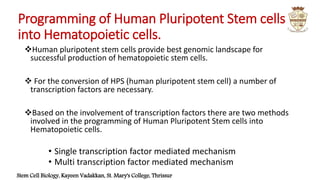
Human pluripotent stem cells provide best genomic landscape for
successful production of hematopoietic stem cells.
 For the conversion of HPS (human pluripotent stem cell) a number of
transcription factors are necessary.
Based on the involvement of transcription factors there are two methods
involved in the programming of Human Pluripotent Stem cells into
Hematopoietic cells.
• Single transcription factor mediated mechanism
• Multi transcription factor mediated mechanism
Stem Cell Biology, Kayeen Vadakkan, St. Mary's College, Thrissur
Single transcription factor mediated mechanism
In this type of programming there will be only a single transcription
factor involved.
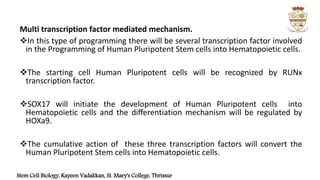
The sole transcription factor involved in the programming of Human
Pluripotent Stem cells into Hematopoietic cells is TAL1 (T cell acute
lymphocytic leukemia 1).
TAL1 mediate the recognition of specific pluripotent stem cell,
development and differentiation into Hematopoietic cells.
Stem Cell Biology, Kayeen Vadakkan, St. Mary's College, Thrissur
Human Pluripotent Stem cells
( Starting cell)
Hematopoietic cells
(Cell of Choice)
TAL1
(Transcription factors)
Figure 4 : Schematic representation of Single transcription
factor mediated cell programming
Multi transcription factor mediated mechanism.
In this type of programming there will be several transcription factor involved
in the Programming of Human Pluripotent Stem cells into Hematopoietic cells.
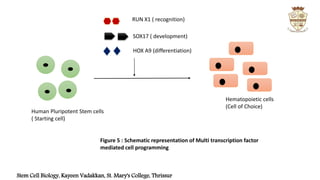
The starting cell Human Pluripotent cells will be recognized by RUNx
transcription factor.
SOX17 will initiate the development of Human Pluripotent cells into
Hematopoietic cells and the differentiation mechanism will be regulated by
HOXa9.
The cumulative action of these three transcription factors will convert the
Human Pluripotent Stem cells into Hematopoietic cells.
Stem Cell Biology, Kayeen Vadakkan, St. Mary's College, Thrissur
Human Pluripotent Stem cells
( Starting cell)
RUN X1 ( recognition)
Figure 5 : Schematic representation of Multi transcription factor
mediated cell programming
Hematopoietic cells
(Cell of Choice)
SOX17 ( development)
HOX A9 (differentiation)
Reprogramming of cells.
 Stem cell reprogramming is defined as the mechanism through
which a fully differentiated stem cell is converted to un organized
pluripotent stage.
 There are three major techniques used for the reprogramming of
functional cell into pluripotent stage.
Somatic Cell Nuclear Transfer (SCNT)
Fusion of Cells
Induced pluripotent stem cells
Stem Cell Biology, Kayeen Vadakkan, St. Mary's College, Thrissur
Somatic Cell Nuclear Transfer (SCNT)
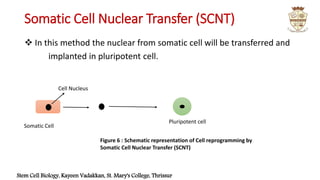
 In this method the nuclear from somatic cell will be transferred and
implanted in pluripotent cell.
Stem Cell Biology, Kayeen Vadakkan, St. Mary's College, Thrissur
Somatic Cell
Cell Nucleus
Pluripotent cell
Figure 6 : Schematic representation of Cell reprogramming by
Somatic Cell Nuclear Transfer (SCNT)
Reprogramming by Fusion of Cells
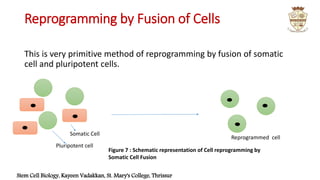
This is very primitive method of reprogramming by fusion of somatic
cell and pluripotent cells.
Stem Cell Biology, Kayeen Vadakkan, St. Mary's College, Thrissur
Somatic Cell
Pluripotent cell
Figure 7 : Schematic representation of Cell reprogramming by
Somatic Cell Fusion
Reprogrammed cell
Reprogramming by Induced pluripotency
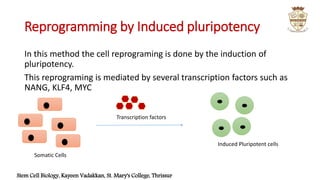
In this method the cell reprograming is done by the induction of
pluripotency.
This reprograming is mediated by several transcription factors such as
NANG, KLF4, MYC
Stem Cell Biology, Kayeen Vadakkan, St. Mary's College, Thrissur
Somatic Cells
Transcription factors
Induced Pluripotent cells

Stem cell programming

  • 1.
    Stem Cell programming andreprogramming Kayeen Vadakkan Assistant Professor Department of Biotechnology St. Mary's College, Thrissur.
  • 2.
    Stem cell programming Stem cell programming can be defined as the mechanism through which a potent cell is programmed to an other functional cell. This mechanism was first demonstrated by Davis et al in 1987, where they converted murine fibroblast cells to cells with myogenic properties. Based on it’s mechanism stem cell programming can be classified into two Forward programming Direct programming Stem Cell Biology, Kayeen Vadakkan, St. Mary's College, Thrissur
  • 3.
    Stem cell programming(Continues) Stem cell programming is mediated by transcription factors which is case specific (Transcription factors will change according to cell. In programming of stem cell there will be minimum three components. Starting cell ( The cell that has to be converted) Transcription Factors ( controls the programming) Cell of choice (desired end product) Stem Cell Biology, Kayeen Vadakkan, St. Mary's College, Thrissur
  • 4.
    Stem cell programming(Continues) Starting Cells Cell of Choice Transcription factors Figure 1: Schematic representation of Stem cell programming Stem Cell Biology, Kayeen Vadakkan, St. Mary's College, Thrissur
  • 5.
    Types of Stemcell programming  Based on mechanism and starting cell , Stem Cell programming can be classified into two Forward programming Direct programming  Through forward programming a non functional stem cell will be converted to a functional cell.  Through direct programming a functional cell will be converted to another functional cell. Stem Cell Biology, Kayeen Vadakkan, St. Mary's College, Thrissur
  • 6.
    Forward programming ofstem cells  Forward programming materialize the conversion of pluripotent stem cells into functional cell.  It is noted that in forward programming, always the starting cell will be a non-functional stem cell an end product will be a functional cell.  In the process of forward programming there could be interference of progenitor cell before formation of functional cell. Stem Cell Biology, Kayeen Vadakkan, St. Mary's College, Thrissur
  • 7.
    Forward programming ofstem cells (Continues) Stem Cell Biology, Kayeen Vadakkan, St. Mary's College, Thrissur Starting Cells (Pluripotent cells) Transcription factors Transcription factors Intermediate progenitor cells Cell of Choice (Functional cells) Figure 2: Schematic representation of forward Stem cell programming
  • 8.
    Direct programming ofstem cells Conversion of mature differentiated cells to another type of functional cell is called direct programming. In direct programming the starting cell will be differentiated cell unlike pluripotent stem cell in forward programming. It is also observed that direct stem cell programming does not include any intermediate progenitor cell during the conversion. Stem Cell Biology, Kayeen Vadakkan, St. Mary's College, Thrissur
  • 9.
    Direct programming ofstem cells (Continues) Stem Cell Biology, Kayeen Vadakkan, St. Mary's College, Thrissur Starting Cells (functional cell) Cell of Choice (Functional cell) Transcription factors Figure 3 : Schematic representation of Direct Stem cell programming
  • 10.
    Programming of HumanPluripotent Stem cells into Hematopoietic cells. Human pluripotent stem cells provide best genomic landscape for successful production of hematopoietic stem cells.  For the conversion of HPS (human pluripotent stem cell) a number of transcription factors are necessary. Based on the involvement of transcription factors there are two methods involved in the programming of Human Pluripotent Stem cells into Hematopoietic cells. • Single transcription factor mediated mechanism • Multi transcription factor mediated mechanism Stem Cell Biology, Kayeen Vadakkan, St. Mary's College, Thrissur
  • 11.
    Single transcription factormediated mechanism In this type of programming there will be only a single transcription factor involved. The sole transcription factor involved in the programming of Human Pluripotent Stem cells into Hematopoietic cells is TAL1 (T cell acute lymphocytic leukemia 1). TAL1 mediate the recognition of specific pluripotent stem cell, development and differentiation into Hematopoietic cells. Stem Cell Biology, Kayeen Vadakkan, St. Mary's College, Thrissur
  • 12.
    Stem Cell Biology,Kayeen Vadakkan, St. Mary's College, Thrissur Human Pluripotent Stem cells ( Starting cell) Hematopoietic cells (Cell of Choice) TAL1 (Transcription factors) Figure 4 : Schematic representation of Single transcription factor mediated cell programming
  • 13.
    Multi transcription factormediated mechanism. In this type of programming there will be several transcription factor involved in the Programming of Human Pluripotent Stem cells into Hematopoietic cells. The starting cell Human Pluripotent cells will be recognized by RUNx transcription factor. SOX17 will initiate the development of Human Pluripotent cells into Hematopoietic cells and the differentiation mechanism will be regulated by HOXa9. The cumulative action of these three transcription factors will convert the Human Pluripotent Stem cells into Hematopoietic cells. Stem Cell Biology, Kayeen Vadakkan, St. Mary's College, Thrissur
  • 14.
    Stem Cell Biology,Kayeen Vadakkan, St. Mary's College, Thrissur Human Pluripotent Stem cells ( Starting cell) RUN X1 ( recognition) Figure 5 : Schematic representation of Multi transcription factor mediated cell programming Hematopoietic cells (Cell of Choice) SOX17 ( development) HOX A9 (differentiation)
  • 15.
    Reprogramming of cells. Stem cell reprogramming is defined as the mechanism through which a fully differentiated stem cell is converted to un organized pluripotent stage.  There are three major techniques used for the reprogramming of functional cell into pluripotent stage. Somatic Cell Nuclear Transfer (SCNT) Fusion of Cells Induced pluripotent stem cells Stem Cell Biology, Kayeen Vadakkan, St. Mary's College, Thrissur
  • 16.
    Somatic Cell NuclearTransfer (SCNT)  In this method the nuclear from somatic cell will be transferred and implanted in pluripotent cell. Stem Cell Biology, Kayeen Vadakkan, St. Mary's College, Thrissur Somatic Cell Cell Nucleus Pluripotent cell Figure 6 : Schematic representation of Cell reprogramming by Somatic Cell Nuclear Transfer (SCNT)
  • 17.
    Reprogramming by Fusionof Cells This is very primitive method of reprogramming by fusion of somatic cell and pluripotent cells. Stem Cell Biology, Kayeen Vadakkan, St. Mary's College, Thrissur Somatic Cell Pluripotent cell Figure 7 : Schematic representation of Cell reprogramming by Somatic Cell Fusion Reprogrammed cell
  • 18.
    Reprogramming by Inducedpluripotency In this method the cell reprograming is done by the induction of pluripotency. This reprograming is mediated by several transcription factors such as NANG, KLF4, MYC Stem Cell Biology, Kayeen Vadakkan, St. Mary's College, Thrissur Somatic Cells Transcription factors Induced Pluripotent cells