OBJECT ORIENTED ARCHITECTURE IN
ERP
Submitted by:
• PREYANSHU KR. SAINI
“What object oriented means”??
• Means we organize s/w as a collection of
discrete objects that incorporate both “data
structure “ and “behaviour”.
• * it shows a contrast to conventional
programming and architectural approaches
such as “procedural approach”,i.e. they
emphasised on “doing” things rather than
“data”.
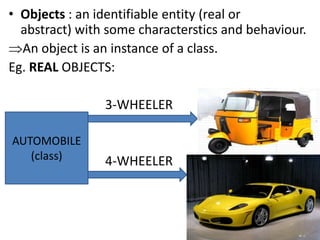
• Objects : an identifiable entity (real or
abstract) with some characterstics and behaviour.
An object is an instance of a class.
Eg. REAL OBJECTS:
3-WHEELER
4-WHEELER
AUTOMOBILE
(class)
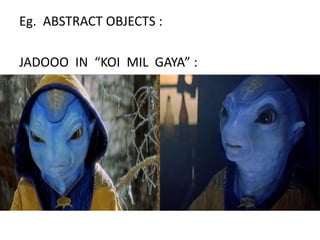
Eg. ABSTRACT OBJECTS :
JADOOO IN “KOI MIL GAYA” :
• Attributes* : features that define charaterstics
of objects.
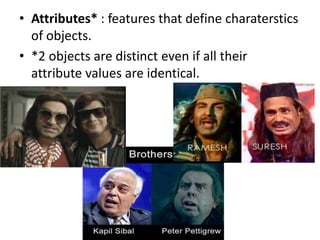
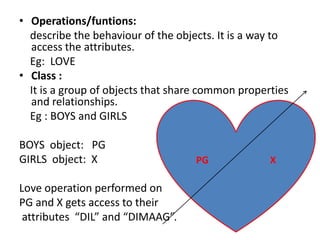
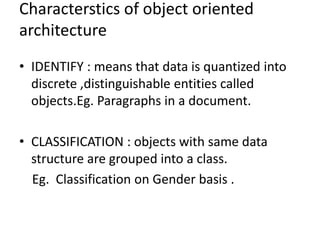
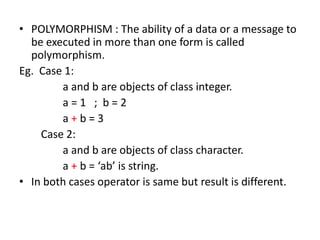
• *2 objects are distinct even if all their
attribute values are identical.
• Operations/funtions:
describe the behaviour of the objects. It is a way to
access the attributes.
Eg: LOVE
• Class :
It is a group of objects that share common properties
and relationships.
Eg : BOYS and GIRLS
BOYS object: PG
GIRLS object: X
Love operation performed on
PG and X gets access to their
attributes “DIL” and “DIMAAG”.
PG X
Characterstics of object oriented
architecture
• IDENTIFY : means that data is quantized into
discrete ,distinguishable entities called
objects.Eg. Paragraphs in a document.
• CLASSIFICATION : objects with same data
structure are grouped into a class.
Eg. Classification on Gender basis .
• POLYMORPHISM : The ability of a data or a message to
be executed in more than one form is called
polymorphism.
Eg. Case 1:
a and b are objects of class integer.
a = 1 ; b = 2
a + b = 3
Case 2:
a and b are objects of class character.
a + b = ‘ab’ is string.
• In both cases operator is same but result is different.
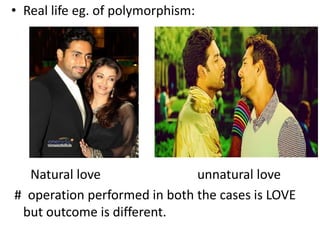
• Real life eg. of polymorphism:
Natural love unnatural love
# operation performed in both the cases is LOVE
but outcome is different.
• INHERITANCE:
Capability of one *class of things to inherit
properties from other **class of things.
**Super class
* Sub class
• ABSTRACTION :
The act of representing essential features
without including background details or
explanations .
• OBJECT ORIENTED METHODOLOGY-
To employ OOA in ERP we follow an approach called
the OBJECT MODELLING TECHNIQUE (OMT) . It has
following states :
1. Problem Analysis
2. System Design
3. Object Design
4. Implementation
• THREE MODELS:
OMT uses three kinds of models to describe a
system.
1. Object model :
Describes the objects in the system and their
relationships.
2. Dynamic model :
Describes the ospects of the system that change
over time, uses STATE diagrams.
3. Functional model :
Describes the data value trasformations within a
system, uses a DFD graph.

Object oriented architecture in erp

  • 1.
    OBJECT ORIENTED ARCHITECTUREIN ERP Submitted by: • PREYANSHU KR. SAINI
  • 2.
    “What object orientedmeans”?? • Means we organize s/w as a collection of discrete objects that incorporate both “data structure “ and “behaviour”. • * it shows a contrast to conventional programming and architectural approaches such as “procedural approach”,i.e. they emphasised on “doing” things rather than “data”.
  • 3.
    • Objects :an identifiable entity (real or abstract) with some characterstics and behaviour. An object is an instance of a class. Eg. REAL OBJECTS: 3-WHEELER 4-WHEELER AUTOMOBILE (class)
  • 4.
    Eg. ABSTRACT OBJECTS: JADOOO IN “KOI MIL GAYA” :
  • 5.
    • Attributes* :features that define charaterstics of objects. • *2 objects are distinct even if all their attribute values are identical.
  • 6.
    • Operations/funtions: describe thebehaviour of the objects. It is a way to access the attributes. Eg: LOVE • Class : It is a group of objects that share common properties and relationships. Eg : BOYS and GIRLS BOYS object: PG GIRLS object: X Love operation performed on PG and X gets access to their attributes “DIL” and “DIMAAG”. PG X
  • 7.
    Characterstics of objectoriented architecture • IDENTIFY : means that data is quantized into discrete ,distinguishable entities called objects.Eg. Paragraphs in a document. • CLASSIFICATION : objects with same data structure are grouped into a class. Eg. Classification on Gender basis .
  • 8.
    • POLYMORPHISM :The ability of a data or a message to be executed in more than one form is called polymorphism. Eg. Case 1: a and b are objects of class integer. a = 1 ; b = 2 a + b = 3 Case 2: a and b are objects of class character. a + b = ‘ab’ is string. • In both cases operator is same but result is different.
  • 9.
    • Real lifeeg. of polymorphism: Natural love unnatural love # operation performed in both the cases is LOVE but outcome is different.
  • 10.
    • INHERITANCE: Capability ofone *class of things to inherit properties from other **class of things. **Super class * Sub class • ABSTRACTION : The act of representing essential features without including background details or explanations .
  • 11.
    • OBJECT ORIENTEDMETHODOLOGY- To employ OOA in ERP we follow an approach called the OBJECT MODELLING TECHNIQUE (OMT) . It has following states : 1. Problem Analysis 2. System Design 3. Object Design 4. Implementation
  • 12.
    • THREE MODELS: OMTuses three kinds of models to describe a system. 1. Object model : Describes the objects in the system and their relationships. 2. Dynamic model : Describes the ospects of the system that change over time, uses STATE diagrams. 3. Functional model : Describes the data value trasformations within a system, uses a DFD graph.