




ENTERPRISE
SERVICES
PLANNING
A G I L E @ S C A L E M E E T U P O C T 2 0 1 6
• The Agile Revolution Podcast
https://theagilerevolution.com/
ABOUT ME
Agile Forest Blog
https://agileforest.com/
twitter
https://twitter.com/agilerenee?lang=en
renee@unbounddna.com
http://www.unbounddna.com/
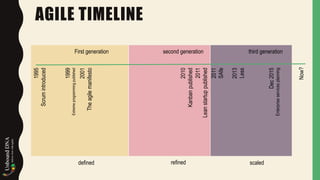
AGILE TIMELINE
2001
Theagilemanifesto
1995
Scrumintroduced
1999
Extremeprogrammingpublished
2011
SAfe
2010
Kanbanpublished
2011
Leanstartuppublished
First generation second generation
2013
Less
Dec2015
Enterpriseservicesplanning
third generation
Now?
defined refined scaled
REMEMBER
THAT KANBAN
THING?
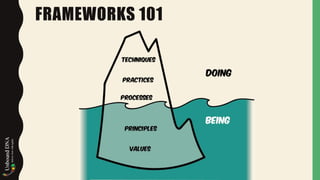
FRAMEWORKS 101
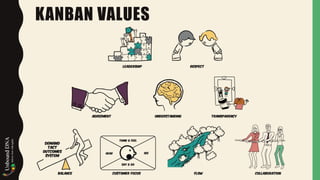
KANBAN VALUES
9 values
KANBAN VALUES
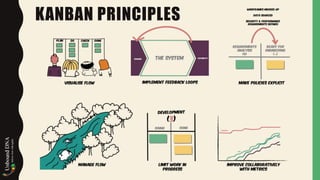
KANBAN PRINCIPLES
6 principles
KANBAN PRINCIPLES
KANBAN CORE TENANTS
• Evolutionary approach
• Start with what you do now
SO WHAT IS
ESP?
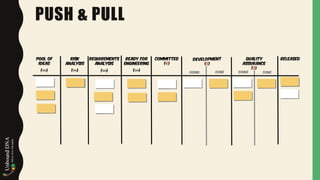
PUSH & PULL
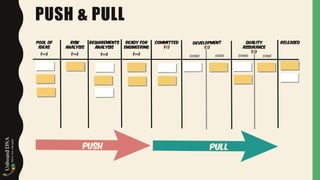
PUSH & PULL
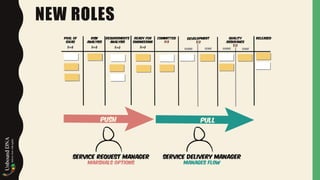
NEW ROLES
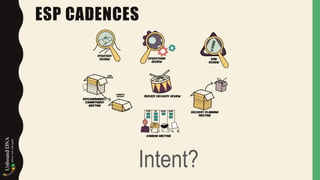
ESP CADENCES
ESP CADENCES
Intent?
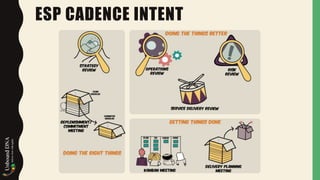
ESP CADENCE INTENT
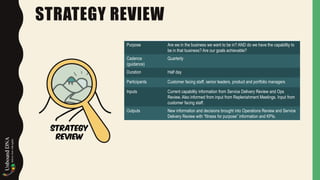
STRATEGY REVIEW
Purpose Are we in the business we want to be in? AND do we have the capability to
be in that business? Are our goals achievable?
Cadence
(guidance)
Quarterly
Duration Half day
Participants Customer facing staff, senior leaders, product and portfolio managers
Inputs Current capability information from Service Delivery Review and Ops
Review. Also informed from input from Replenishment Meetings. Input from
customer facing staff.
Outputs New information and decisions brought into Operations Review and Service
Delivery Review with “fitness for purpose” information and KPIs.
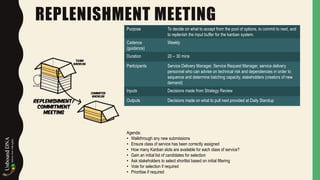
REPLENISHMENT MEETING
Purpose To decide on what to accept from the pool of options, to commit to next, and
to replenish the input buffer for the kanban system.
Cadence
(guidance)
Weekly
Duration 20 – 30 mins
Participants Service Delivery Manager, Service Request Manager, service delivery
personnel who can advise on technical risk and dependencies in order to
sequence and determine batching capacity, stakeholders (creators of new
demand)
Inputs Decisions made from Strategy Review
Outputs Decisions made on what to pull next provided at Daily Standup
Agenda:
• Walkthrough any new submissions
• Ensure class of service has been correctly assigned
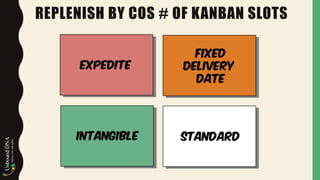
• How many Kanban slots are available for each class of service?
• Gain an initial list of candidates for selection
• Ask stakeholders to select shortlist based on initial filtering
• Vote for selection if required
• Prioritise if required
REPLENISH BY COS # OF KANBAN SLOTS
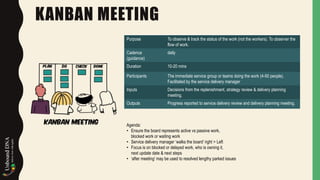
KANBAN MEETING
Purpose To observe & track the status of the work (not the workers). To observer the
flow of work.
Cadence
(guidance)
daily
Duration 10-20 mins
Participants The immediate service group or teams doing the work (4-50 people).
Facilitated by the service delivery manager
Inputs Decisions from the replenishment, strategy review & delivery planning
meeting.
Outputs Progress reported to service delivery review and delivery planning meeting.
Agenda:
• Ensure the board represents active vs passive work,
blocked work or waiting work
• Service delivery manager ‘walks the board’ right > Left
• Focus is on blocked or delayed work, who is owning it,
next update date & next steps
• ‘after meeting’ may be used to resolved lengthy parked issues
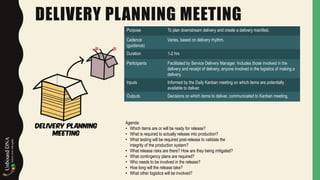
DELIVERY PLANNING MEETING
Purpose To plan downstream delivery and create a delivery manifest.
Cadence
(guidance)
Varies, based on delivery rhythm.
Duration 1-2 hrs
Participants Facilitated by Service Delivery Manager. Includes those involved in the
delivery and receipt of delivery, anyone involved in the logistics of making a
delivery.
Inputs Informed by the Daily Kanban meeting on which items are potentially
available to deliver.
Outputs Decisions on which items to deliver, communicated to Kanban meeting.
Agenda:
• Which items are or will be ready for release?
• What is required to actually release into production?
• What testing will be required post-release to validate the
integrity of the production system?
• What release risks are there? How are they being mitigated?
• What contingency plans are required?
• Who needs to be involved in the release?
• How long will the release take?
• What other logistics will be involved?
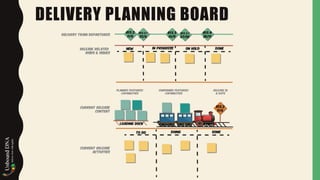
DELIVERY PLANNING BOARD
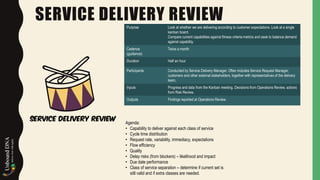
SERVICE DELIVERY REVIEWPurpose Look at whether we are delivering according to customer expectations. Look at a single
kanban board.
Compare current capabilities against fitness criteria metrics and seek to balance demand
against capability.
Cadence
(guidance)
Twice a month
Duration Half an hour
Participants Conducted by Service Delivery Manager. Often includes Service Request Manager,
customers and other external stakeholders, together with representatives of the delivery
team.
Inputs Progress and data from the Kanban meeting. Decisions from Operations Review, actions
from Risk Review.
Outputs Findings reported at Operations Review.
Agenda:
• Capability to deliver against each class of service
• Cycle time distribution
• Request rate, variability, immediacy, expectations
• Flow efficiency
• Quality
• Delay risks (from blockers) – likelihood and impact
• Due date performance
• Class of service separation – determine if current set is
still valid and if extra classes are needed.
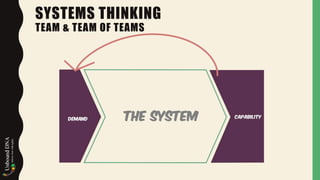
SYSTEMS THINKING
TEAM & TEAM OF TEAMS
DEMAND = TACT BY COS
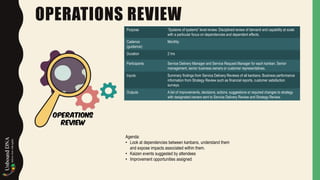
OPERATIONS REVIEW
Purpose “Systems of systems” level review. Disciplined review of demand and capability at scale
with a particular focus on dependencies and dependent effects.
Cadence
(guidance)
Monthly
Duration 2 hrs
Participants Service Delivery Manager and Service Request Manager for each kanban. Senior
management, senior business owners or customer representatives.
Inputs Summary findings from Service Delivery Reviews of all kanbans. Business performance
information from Strategy Review such as financial reports, customer satisfaction
surveys.
Outputs A list of improvements, decisions, actions, suggestions or required changes to strategy
with designated owners sent to Service Delivery Review and Strategy Review.
Agenda:
• Look at dependencies between kanbans, understand them
and expose impacts associated within them.
• Kaizen events suggested by attendees
• Improvement opportunities assigned
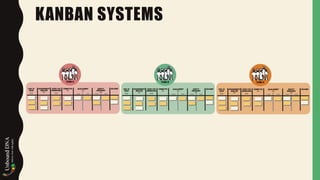
KANBAN SYSTEMS
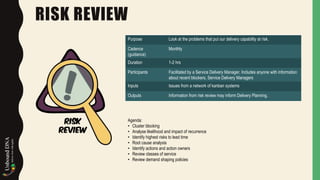
RISK REVIEW
Purpose Look at the problems that put our delivery capability at risk.
Cadence
(guidance)
Monthly
Duration 1-2 hrs
Participants Facilitated by a Service Delivery Manager. Includes anyone with information
about recent blockers, Service Delivery Managers
Inputs Issues from a network of kanban systems
Outputs Information from risk review may inform Delivery Planning.
Agenda:
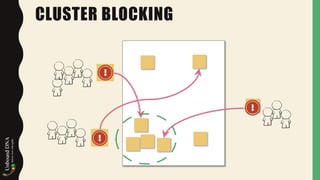
• Cluster blocking
• Analyse likelihood and impact of recurrence
• Identify highest risks to lead time
• Root cause analysis
• Identify actions and action owners
• Review classes of service
• Review demand shaping policies
CLUSTER BLOCKING
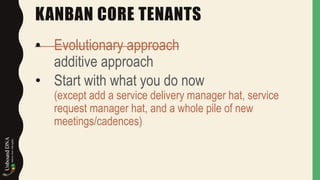
KANBAN CORE TENANTS
• Evolutionary approach
additive approach
• Start with what you do now
(except add a service delivery manager hat, service
request manager hat, and a whole pile of new
meetings/cadences)
The Agile Revolution Podcast
https://theagilerevolution.com/
MORE INFO
Agile Forest Blog
https://agileforest.com/
twitter
https://twitter.com/agilerenee?lang=en
renee@unbounddna.com
http://www.unbounddna.com/
Blogs and related slideshare by David J Anderson
http://www.slideshare.net/agilemanager/kanban-cadences-
information-flow
http://www.slideshare.net/agilemanager/kanban-organizational-
maturity
http://anderson.leankanban.com/emerging-roles-in-kanban/
http://anderson.leankanban.com/is-agile-costing-you-too-much/

Entrprise Services Planning

  • 1.
    ENTERPRISE SERVICES PLANNING A G IL E @ S C A L E M E E T U P O C T 2 0 1 6
  • 2.
    • The AgileRevolution Podcast https://theagilerevolution.com/ ABOUT ME Agile Forest Blog https://agileforest.com/ twitter https://twitter.com/agilerenee?lang=en renee@unbounddna.com http://www.unbounddna.com/
  • 3.
  • 4.
  • 5.
  • 6.
  • 7.
  • 8.
  • 9.
  • 10.
    KANBAN CORE TENANTS •Evolutionary approach • Start with what you do now
  • 11.
  • 12.
  • 13.
  • 14.
  • 15.
  • 16.
  • 17.
  • 18.
    STRATEGY REVIEW Purpose Arewe in the business we want to be in? AND do we have the capability to be in that business? Are our goals achievable? Cadence (guidance) Quarterly Duration Half day Participants Customer facing staff, senior leaders, product and portfolio managers Inputs Current capability information from Service Delivery Review and Ops Review. Also informed from input from Replenishment Meetings. Input from customer facing staff. Outputs New information and decisions brought into Operations Review and Service Delivery Review with “fitness for purpose” information and KPIs.
  • 19.
    REPLENISHMENT MEETING Purpose Todecide on what to accept from the pool of options, to commit to next, and to replenish the input buffer for the kanban system. Cadence (guidance) Weekly Duration 20 – 30 mins Participants Service Delivery Manager, Service Request Manager, service delivery personnel who can advise on technical risk and dependencies in order to sequence and determine batching capacity, stakeholders (creators of new demand) Inputs Decisions made from Strategy Review Outputs Decisions made on what to pull next provided at Daily Standup Agenda: • Walkthrough any new submissions • Ensure class of service has been correctly assigned • How many Kanban slots are available for each class of service? • Gain an initial list of candidates for selection • Ask stakeholders to select shortlist based on initial filtering • Vote for selection if required • Prioritise if required
  • 20.
    REPLENISH BY COS# OF KANBAN SLOTS
  • 21.
    KANBAN MEETING Purpose Toobserve & track the status of the work (not the workers). To observer the flow of work. Cadence (guidance) daily Duration 10-20 mins Participants The immediate service group or teams doing the work (4-50 people). Facilitated by the service delivery manager Inputs Decisions from the replenishment, strategy review & delivery planning meeting. Outputs Progress reported to service delivery review and delivery planning meeting. Agenda: • Ensure the board represents active vs passive work, blocked work or waiting work • Service delivery manager ‘walks the board’ right > Left • Focus is on blocked or delayed work, who is owning it, next update date & next steps • ‘after meeting’ may be used to resolved lengthy parked issues
  • 22.
    DELIVERY PLANNING MEETING PurposeTo plan downstream delivery and create a delivery manifest. Cadence (guidance) Varies, based on delivery rhythm. Duration 1-2 hrs Participants Facilitated by Service Delivery Manager. Includes those involved in the delivery and receipt of delivery, anyone involved in the logistics of making a delivery. Inputs Informed by the Daily Kanban meeting on which items are potentially available to deliver. Outputs Decisions on which items to deliver, communicated to Kanban meeting. Agenda: • Which items are or will be ready for release? • What is required to actually release into production? • What testing will be required post-release to validate the integrity of the production system? • What release risks are there? How are they being mitigated? • What contingency plans are required? • Who needs to be involved in the release? • How long will the release take? • What other logistics will be involved?
  • 23.
  • 24.
    SERVICE DELIVERY REVIEWPurposeLook at whether we are delivering according to customer expectations. Look at a single kanban board. Compare current capabilities against fitness criteria metrics and seek to balance demand against capability. Cadence (guidance) Twice a month Duration Half an hour Participants Conducted by Service Delivery Manager. Often includes Service Request Manager, customers and other external stakeholders, together with representatives of the delivery team. Inputs Progress and data from the Kanban meeting. Decisions from Operations Review, actions from Risk Review. Outputs Findings reported at Operations Review. Agenda: • Capability to deliver against each class of service • Cycle time distribution • Request rate, variability, immediacy, expectations • Flow efficiency • Quality • Delay risks (from blockers) – likelihood and impact • Due date performance • Class of service separation – determine if current set is still valid and if extra classes are needed.
  • 25.
  • 26.
  • 27.
    OPERATIONS REVIEW Purpose “Systemsof systems” level review. Disciplined review of demand and capability at scale with a particular focus on dependencies and dependent effects. Cadence (guidance) Monthly Duration 2 hrs Participants Service Delivery Manager and Service Request Manager for each kanban. Senior management, senior business owners or customer representatives. Inputs Summary findings from Service Delivery Reviews of all kanbans. Business performance information from Strategy Review such as financial reports, customer satisfaction surveys. Outputs A list of improvements, decisions, actions, suggestions or required changes to strategy with designated owners sent to Service Delivery Review and Strategy Review. Agenda: • Look at dependencies between kanbans, understand them and expose impacts associated within them. • Kaizen events suggested by attendees • Improvement opportunities assigned
  • 28.
  • 29.
    RISK REVIEW Purpose Lookat the problems that put our delivery capability at risk. Cadence (guidance) Monthly Duration 1-2 hrs Participants Facilitated by a Service Delivery Manager. Includes anyone with information about recent blockers, Service Delivery Managers Inputs Issues from a network of kanban systems Outputs Information from risk review may inform Delivery Planning. Agenda: • Cluster blocking • Analyse likelihood and impact of recurrence • Identify highest risks to lead time • Root cause analysis • Identify actions and action owners • Review classes of service • Review demand shaping policies
  • 30.
  • 31.
    KANBAN CORE TENANTS •Evolutionary approach additive approach • Start with what you do now (except add a service delivery manager hat, service request manager hat, and a whole pile of new meetings/cadences)
  • 32.
    The Agile RevolutionPodcast https://theagilerevolution.com/ MORE INFO Agile Forest Blog https://agileforest.com/ twitter https://twitter.com/agilerenee?lang=en renee@unbounddna.com http://www.unbounddna.com/ Blogs and related slideshare by David J Anderson http://www.slideshare.net/agilemanager/kanban-cadences- information-flow http://www.slideshare.net/agilemanager/kanban-organizational- maturity http://anderson.leankanban.com/emerging-roles-in-kanban/ http://anderson.leankanban.com/is-agile-costing-you-too-much/

Editor's Notes